Cloud ERP Market

ID: MRFR/ICT/2040-CR
100 Pages
Aarti Dhapte
Last Updated: June 17, 2026
Cloud ERP Market Size, Share and Research Report By Challenges (Data Security and Compliance Concerns, Migration Complexity and Downtime Risk) and By Regional (North America, Europe, South America, Asia Pacific, Middle East and Africa) - Industry Forecast to 2035.
Download PDF ×

We do not share your information with anyone. However, we may send you emails based on your report interest from time to time. You may contact us at any time to opt-out.

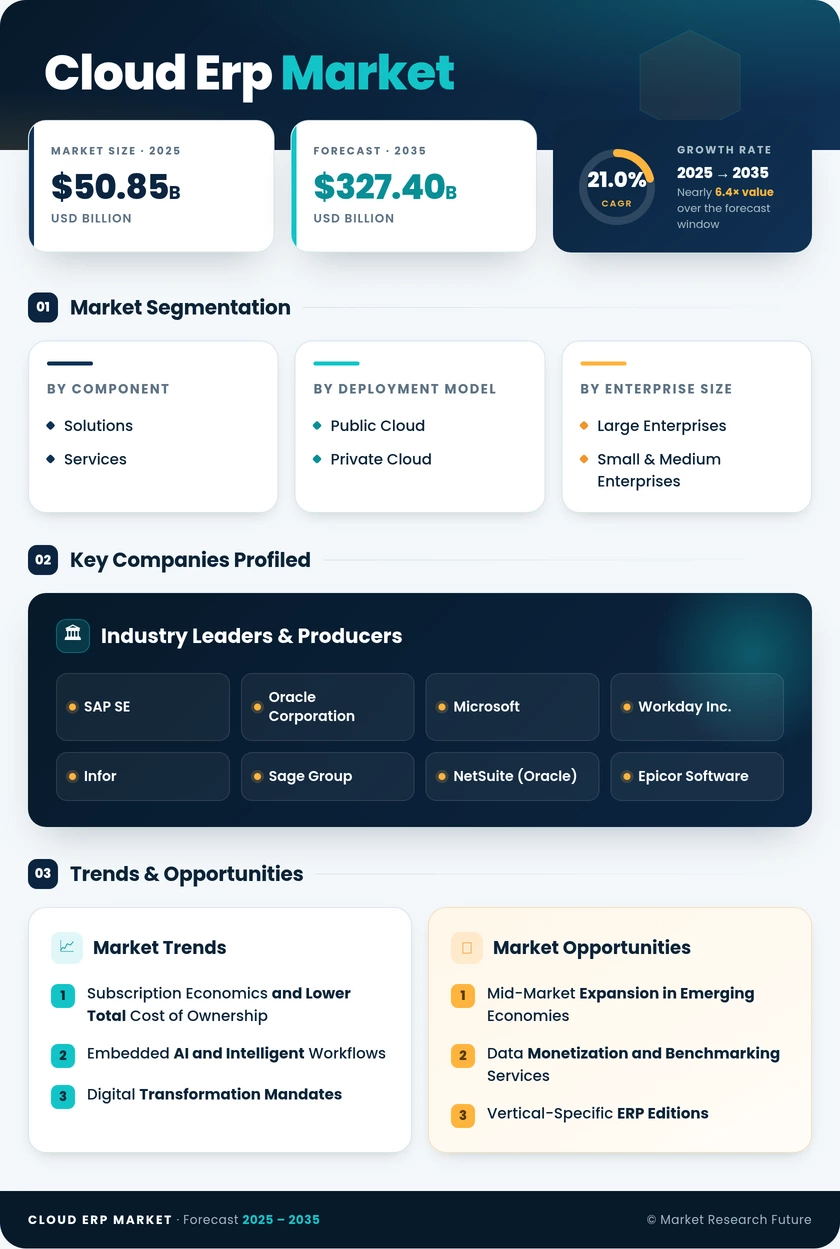
Cloud ERP Market

Market Size

Forecast Period2026-2035
CAGR (2026-2035)21.0%
2025 Market SizeUSD 50.85 Billion
2035 Market SizeUSD 327.40 Billion

Key Players

SAP SE
Oracle Corporation
Microsoft
Workday Inc.
Infor
Sage Group
Opportunities
  • Mid-Market Expansion in Emerging Economies
  • Data Monetization and Benchmarking Services
  • Vertical-Specific ERP Editions
  1. 1 Market Summary |
    1. 1.1 Study Assumptions & Market Definition |
    2. 1.2 Scope of the Study |
    3. 1.3 Research Methodology
  2. 2 Key Report Takeaways |
    1. 2.1 By Technology |
    2. 2.2 By Sector |
    3. 2.3 By Region
  3. 3 Market Size & Forecast (2021–2035) |
    1. 3.1 Historical Market Size (2021–2025) |
    2. 3.2 Current & Forecast Market Size (2026–2035) |
    3. 3.3 Year-over-Year Growth Analysis
  4. 4 Driver Impact Analysis |
    1. 4.1 Subscription Economics and Lower Total Cost of Ownership |
    2. 4.2 Embedded AI and Intelligent Workflows |
    3. 4.3 Digital Transformation Mandates
  5. 5 Restraints Impact Analysis |
    1. 5.1 Data Security and Compliance Concerns |
    2. 5.2 Migration Complexity and Downtime Risk
  6. 6 Opportunities |
    1. 6.1 Mid-Market Expansion in Emerging Economies |
    2. 6.2 Data Monetization and Benchmarking Services |
    3. 6.3 Vertical-Specific ERP Editions |
    4. 6.4 Composable and Low-Code Extensibility |
    5. 6.5 Sovereign-Cloud Deployments
  7. 7 Regional Market Share & Country-Level Analysis |
    1. 7.1 North America | |
      1. 7.1.1 United States | |
      2. 7.1.2 Canada | |
      3. 7.1.3 Mexico |
    2. 7.2 Europe | |
      1. 7.2.1 Germany | |
      2. 7.2.2 United Kingdom | |
      3. 7.2.3 France | |
      4. 7.2.4 Italy | |
      5. 7.2.5 Spain | |
      6. 7.2.6 Nordic Countries | |
      7. 7.2.7 Russia | |
      8. 7.2.8 Rest of Europe |
    3. 7.3 Asia-Pacific | |
      1. 7.3.1 China | |
      2. 7.3.2 India | |
      3. 7.3.3 Japan | |
      4. 7.3.4 South Korea | |
      5. 7.3.5 ASEAN | |
      6. 7.3.6 Rest of Asia-Pacific |
    4. 7.4 South America | |
      1. 7.4.1 Brazil | |
      2. 7.4.2 Argentina | |
      3. 7.4.3 Rest of South America |
    5. 7.5 Middle East & Africa | |
      1. 7.5.1 Saudi Arabia | |
      2. 7.5.2 UAE | |
      3. 7.5.3 South Africa | |
      4. 7.5.4 Egypt | |
      5. 7.5.5 Rest of MEA
  8. 8 Future Outlook (2026–2035) |
    1. 8.1 Autonomous Finance Operations |
    2. 8.2 Platform Economics and Ecosystem Lock-In |
    3. 8.3 Sustainability and ESG Reporting |
    4. 8.4 Industry Cloud Specialization
  9. 9 Market Segmentation Analysis |
    1. 9.1 By Component |
    2. 9.2 By Deployment Model |
    3. 9.3 By Enterprise Size |
    4. 9.4 By Business Function |
    5. 9.5 By End-User Industry
  10. 10 Competitive Landscape |
    1. 10.1 Market Concentration Analysis |
    2. 10.2 Competitive Benchmarking Matrix |
    3. 10.3 Company Profiles
  11. 11 Recent News & Developments
  12. 12 Report Scope & Methodology
  13. 13 Detailed Sources & Citations
  14. 14 Frequently Asked Questions
  15. 15 LIST OF TABLES |
  16. TABLE 1 Cloud ERP Market — Header Summary Metrics |
  17. TABLE 2 Global Cloud ERP Market Size & Forecast, by Revenue (USD Billion), 2021–2035 |
  18. TABLE 3 Cloud ERP Market — Driver Impact Analysis |
  19. TABLE 4 Cloud ERP Market — Restraints Impact Analysis |
  20. TABLE 5 Cloud ERP Market — Regional Revenue Share, 2025 |
  21. TABLE 6 North America Cloud ERP Market Size, by Country, 2025 (USD Billion) |
  22. TABLE 7 Europe Cloud ERP Market Size, by Country, 2025 (Region Share) |
  23. TABLE 8 Asia-Pacific Cloud ERP Market Size, by Country, 2025 (Region CAGR) |
  24. TABLE 9 South America Cloud ERP Market Size, by Country, 2025 (USD Billion) |
  25. TABLE 10 Middle East & Africa Cloud ERP Market Size, by Country, 2025 (Region Share) |
  26. TABLE 11 Cloud ERP Market Size, by Component, 2025 |
  27. TABLE 12 Cloud ERP Market Size, by Deployment Model, 2025 |
  28. TABLE 13 Cloud ERP Market Size, by Enterprise Size, 2025 |
  29. TABLE 14 Cloud ERP Market Size, by Business Function, 2025 |
  30. TABLE 15 Cloud ERP Market Size, by End-User Industry, 2025 |
  31. TABLE 16 Competitive Benchmarking Matrix — Cloud ERP Market, 2026 |
  32. TABLE 17 Report Scope & Methodology Summary |
  33. TABLE 18 Detailed Sources & Citations
  34. 16 LIST OF FIGURES |
  35. FIGURE 1 Cloud ERP Market — Market Dynamics Overview (Drivers, Restraints, Opportunities) |
  36. FIGURE 2 Cloud ERP Market — Industry Value Chain Analysis |
  37. FIGURE 3 Cloud ERP Market — Porter's Five Forces Analysis |
  38. FIGURE 4 Cloud ERP Market Size Trend, 2021–2035 (USD Billion) |
  39. FIGURE 5 Cloud ERP Market — Year-over-Year Growth Rate, 2021–2035 |
  40. FIGURE 6 Cloud ERP Market Share, by Component, 2025 |
  41. FIGURE 7 Cloud ERP Market Share, by Deployment Model, 2025 |
  42. FIGURE 8 Cloud ERP Market Share, by Enterprise Size, 2025 |
  43. FIGURE 9 Cloud ERP Market Share, by Business Function, 2025 |
  44. FIGURE 10 Cloud ERP Market Share, by End-User Industry, 2025 |
  45. FIGURE 11 Cloud ERP Market — Regional Revenue Share, 2025 |
  46. FIGURE 12 Cloud ERP Market — Asia-Pacific Country Growth Comparison |
  47. FIGURE 13 Cloud ERP Market — Competitive Landscape & Vendor Positioning, 2026

Segmentation Quick Reference

DimensionSub-SegmentsDominant SegmentFastest Growing Segment
By ComponentSolutions, ServicesSolutionsServices
By Deployment ModelPublic Cloud ERP Market, Private Cloud ERP MarketPublic Cloud ERP MarketPrivate Cloud ERP Market
By Enterprise SizeLarge Enterprises, Small & Medium EnterprisesLarge EnterprisesSmall & Medium Enterprises
By Business FunctionFinance & Accounting, Human Resources, Supply Chain, OthersFinance & AccountingHuman Resources
By End-User IndustryBFSI, IT & Telecom, Healthcare, Manufacturing, Retail & OthersBFSIHealthcare


Market Segmentation Overview

By Component

Sub-SegmentKey Trend
SolutionsContinuous update suites consolidating finance, supply chain, and HR modules
ServicesRising demand for implementation, migration, and managed support expertise.


Solutions form the deployed core of the market, while services scale faster because every new migration generates advisory and integration revenue around online ERP platforms.

By Deployment Model

Sub-SegmentKey Trend
Public Cloud ERP MarketMultitenant architecture delivers the lowest cost and fastest provisioning
Private Cloud ERP MarketGrowing uptake among regulated buyers needing data-residency control


Public cloud holds the larger value share, but private cloud accelerates as BFSI and healthcare buyers adopt cloud financial management within stricter compliance boundaries.

By Enterprise Size

Sub-SegmentKey Trend
Large EnterprisesMulti-entity, multi-currency deployments with complex configurations
Small & Medium EnterprisesAffordable per-seat pricing and pre-configured editions are driving fast adoption.


Large enterprises dominate deployed value, while SMEs represent the fastest-growing cohort as subscription costs fall and implementation simplifies.

By Business Function

Sub-SegmentKey Trend
Finance & AccountingFirst-migrated module for real-time reporting and compliance
Human ResourcesWorkforce analytics and hybrid-work tools are driving rapid growth.
Supply ChainInventory visibility and supplier coordination demand
OthersProject, asset, and procurement management expansion


Finance leads as the entry point for most deployments, while HR grows fastest as distributed workforces need cloud-native talent management embedded in SaaS ERP solutions.

By End-User Industry

Sub-SegmentKey Trend
BFSIRegulatory reporting and audit-grade ledgers are driving adoption
IT & TelecomScalable subscription-billing and high-growth operations
HealthcareCompliance and patient-data integration fuel the fastest growth.
ManufacturingSupply-chain coordination and smart-factory integration
Retail & OthersOmnichannel operations and inventory synchronization


BFSI leads adoption on the strength of regulatory needs, while healthcare grows fastest as providers unify clinical, supply, and financial data inside hosted business process software.