Request Free Sample ×

Kindly complete the form below to receive a free sample of this Report

* Please use a valid business email

Leading companies partner with us for data-driven Insights

clients tt-cursor
Hero Background
English
Chinese
French
Japanese
Korean
German
Spanish

Cloud based Medical Records Management Market Size

ID: MRFR/MED/9957-HCR
128 Pages
Rahul Gotadki
December 2024

Cloud-based Medical Records Management Market Research Report Information by Product & Service (Solutions [Standalone and Integrated] and Services [Medical Planning and Management Services and Product Support Services]), by Application (Medical Records, Billing Records, Admission & Registration, and Others), by End User (Hospitals & Clinics, Ambulatory Surgical Centers, Nursing Homes, and Others), and By Region (North America, Europe, Asia-Pacific, And Rest Of The World) - Forecast Till 2035

Share:
Download PDF ×

We do not share your information with anyone. However, we may send you emails based on your report interest from time to time. You may contact us at any time to opt-out.

Cloud based Medical Records Management Market Infographic
Purchase Options

Cloud Based Medical Records Management Size

Cloud based Medical Records Management Market Growth Projections and Opportunities

The Cloud-Based Medical Records Management market is significantly shaped by the ongoing digital transformation in healthcare. The transition from traditional paper-based records to digital formats stored in the cloud enhances accessibility, efficiency, and data security, driving the adoption of cloud-based solutions. Market dynamics are heavily influenced by concerns related to data security and compliance with healthcare regulations. Cloud-based solutions must adhere to strict standards such as HIPAA, influencing both provider and patient trust in the adoption of medical records management systems. Developments in cloud computing technologies change features of medical records management systems. The innovations like edge computing, artificial intelligence (AI), and blockchain make the functionalities such as real-time analytics and secure data sharing more improved in the market trends. Importance of telemedicine and remote healthcare services leads to the demand for cloud-based medical records management. Cloud solutions help in access of patient data at varied places, thus promoting the provision of virtual healthcare services. The competitive landscape and vendor dynamics significantly influence the market. Consolidation is done through mergers and acquisitions and through the entry of other competitors that improve the diversity of offerings and hence influence pricing and service quality. Government policies seeking to encourage adoption of digital healthcare solutions affect market factors. Supportive policies and funding programs perpetuate the growth of cloud-based medical records management market, mostly in regions with high focus on healthcare IT. The success of cloud-based healthcare record management systems depends on the efficiency of end users. Training and education programs aimed at healthcare professionals underpin successful implementation, thereby changing market dynamics through user acceptance and utilization rates. The patient oriented philosophy and demand for the personal health data determine the market dynamics. Cloud based solutions which promote secure patient access to medical records increases patient satisfaction and engagement which affects market adoption. Disparities in healthcare infrastructure globally contribute to variations in the adoption of cloud-based medical records management. Regions with advanced healthcare systems may embrace these solutions more readily than areas facing challenges in healthcare technology infrastructure development.
Cloud based Medical Records Management Market Size Graph
Author
Author Profile
Rahul Gotadki
Research Manager

He holds an experience of about 9+ years in Market Research and Business Consulting, working under the spectrum of Life Sciences and Healthcare domains. Rahul conceptualizes and implements a scalable business strategy and provides strategic leadership to the clients. His expertise lies in market estimation, competitive intelligence, pipeline analysis, customer assessment, etc.

Leave a Comment

FAQs

What is the projected market valuation for the Cloud based Medical Records Management Market in 2035?

<p>The projected market valuation for the Cloud based Medical Records Management Market in 2035 is 5212.51 USD Million.</p>

What was the overall market valuation in 2024?

<p>The overall market valuation for the Cloud based Medical Records Management Market was 1437.75 USD Million in 2024.</p>

What is the expected CAGR for the Cloud based Medical Records Management Market from 2025 to 2035?

<p>The expected CAGR for the Cloud based Medical Records Management Market during the forecast period 2025 - 2035 is 12.38%.</p>

Which companies are considered key players in the Cloud based Medical Records Management Market?

<p>Key players in the market include Epic Systems Corporation, Cerner Corporation, Allscripts Healthcare Solutions, and Athenahealth, among others.</p>

What segment had the highest valuation in 2024 for the Cloud based Medical Records Management Market?

<p>In 2024, the segment with the highest valuation was Clinical Data Management, valued at 350.0 USD Million.</p>

How does the market valuation for hospitals compare to ambulatory surgical centers in 2024?

<p>In 2024, hospitals had a market valuation of 575.1 USD Million, significantly higher than the 300.0 USD Million for ambulatory surgical centers.</p>

What is the projected valuation for the Public Cloud segment by 2035?

<p>The projected valuation for the Public Cloud segment by 2035 is 2100.0 USD Million.</p>

What is the market valuation for healthcare providers in 2024?

In 2024, the market valuation for healthcare providers was 600.0 USD Million.

What is the expected market size for the Data Analytics segment in 2035?

The expected market size for the Data Analytics segment in 2035 is projected to reach 900.0 USD Million.

What is the valuation range for the Low Security data segment in 2024?

The valuation range for the Low Security data segment in 2024 was between 287.75 USD Million and 1012.51 USD Million.

Market Summary

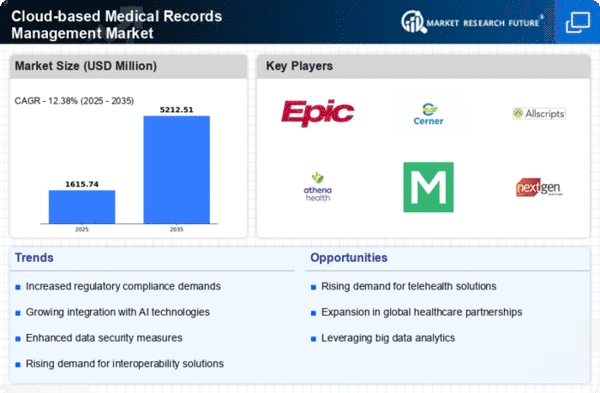
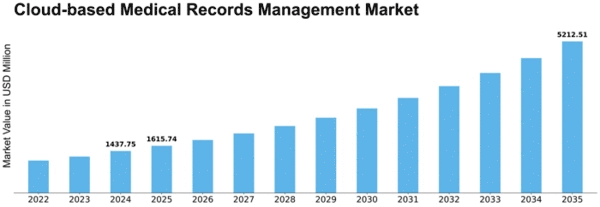
As per MRFR analysis, the Cloud based Medical Records Management Market Size was estimated at 1437.75 USD Million in 2024. The Cloud based Medical Records Management industry is projected to grow from 1632.22 USD Million in 2025 to 5212.51 USD Million by 2035, exhibiting a compound annual growth rate (CAGR) of 12.38% during the forecast period 2025 - 2035.

Key Market Trends & Highlights

The Cloud based Medical Records Management Market is experiencing robust growth driven by technological advancements and evolving healthcare needs.

  • North America remains the largest market for cloud-based medical records management, driven by advanced healthcare infrastructure. The Asia-Pacific region is emerging as the fastest-growing market, fueled by increasing investments in healthcare technology. Patient management systems dominate the market, while clinical data management is witnessing the fastest growth due to rising data complexity. Key market drivers include the rising demand for efficient healthcare solutions and the necessity for regulatory compliance and data security.

Market Size & Forecast

2024 Market Size 1437.75 (USD Million)
2035 Market Size 5212.51 (USD Million)
CAGR (2025 - 2035) 12.38%
Largest Regional Market Share in 2024 North America

Major Players

Epic Systems Corporation (US), Cerner Corporation (US), Allscripts Healthcare Solutions (US), Athenahealth, Inc. (US), Meditech (US), NextGen Healthcare, Inc. (US), eClinicalWorks (US), Kareo (US), Greenway Health (US), Practice Fusion (US)

Market Trends

The Cloud based Medical Records Management Market is currently experiencing a transformative phase, driven by the increasing demand for efficient healthcare solutions. This market appears to be evolving as healthcare providers seek to enhance patient care through streamlined access to medical records. The integration of cloud technology facilitates real-time data sharing, which may lead to improved decision-making and patient outcomes. Furthermore, the emphasis on data security and compliance with regulations suggests that organizations are prioritizing secure cloud solutions to protect sensitive information. In addition, the growing trend of telemedicine and remote patient monitoring is likely to further propel the Cloud based Medical Records Management Market. As healthcare systems adapt to new technologies, the need for accessible and organized medical records becomes paramount. This shift indicates a potential for increased investment in cloud-based solutions, as stakeholders recognize the benefits of centralized data management. Overall, the market appears poised for continued growth, with innovations in technology and changing healthcare dynamics shaping its future.

Increased Adoption of Telehealth Services

The rise of telehealth services is influencing the Cloud based Medical Records Management Market. As healthcare providers expand their remote service offerings, the need for accessible and organized medical records becomes critical. This trend suggests that cloud solutions will play a vital role in supporting telehealth initiatives.

Focus on Data Security and Compliance

With the growing concern over data breaches, the Cloud based Medical Records Management Market is witnessing a heightened focus on security measures. Organizations are increasingly prioritizing compliance with regulations, which indicates a shift towards adopting secure cloud solutions to safeguard patient information.

Integration of Artificial Intelligence

The integration of artificial intelligence into cloud-based systems is emerging as a notable trend. AI technologies may enhance data analysis and improve patient care by providing insights from medical records. This development suggests a potential for more efficient healthcare delivery through advanced cloud solutions.

Cloud based Medical Records Management Market Market Drivers

Increased Demand for Digital Health Solutions

The Global Cloud-based Medical Records Management Market Industry experiences heightened demand for digital health solutions, driven by the need for efficient patient data management. As healthcare providers seek to streamline operations, cloud-based systems offer enhanced accessibility and interoperability. In 2024, the market is projected to reach 2.34 USD Billion, reflecting the growing preference for digital solutions. This trend is likely to continue as healthcare organizations recognize the potential for improved patient outcomes and operational efficiency. The shift towards digital health is not merely a trend but a fundamental transformation in how healthcare is delivered and managed.

Market Segment Insights

By Application: Patient Management (Largest) vs. Clinical Data Management (Fastest-Growing)

In the Cloud-based Medical Records Management Market, Patient Management currently holds the largest market share, as it encompasses essential functions such as scheduling, tracking patient interactions, and maintaining comprehensive health records. This segment’s significance stems from the ongoing demand for enhanced patient experiences and operational efficiencies in healthcare organizations. Clinical Data Management, however, is rapidly gaining traction, driven by the increasing need for efficient handling of clinical trial data and regulatory compliance, marking it as a fast-expanding area in this market.

Patient Management (Dominant) vs. Data Analytics (Emerging)

Patient Management stands out as the dominant segment within the Cloud-based Medical Records Management Market, primarily due to its foundational role in compliance and patient engagement. This segment facilitates streamlined communication between healthcare providers and patients, ensuring a robust flow of information and enhanced care delivery. On the other hand, Data Analytics is emerging as a critical segment, harnessing the power of collected data to yield insights that drive strategic decision-making. As healthcare organizations increasingly adopt data-driven approaches, the demand for advanced analytics solutions is expected to surge, fostering innovation and operational improvements.

By End Use: Hospitals (Largest) vs. Ambulatory Surgical Centers (Fastest-Growing)

The Cloud based Medical Records Management Market exhibits a diverse distribution among its end use segments. Hospitals currently dominate the market, leveraging cloud technology for efficient management of patient records, data sharing, and better compliance with regulatory requirements. Among the segments, Hospitals account for a significant portion of the overall market share, benefiting from an increasing number of hospitalizations and the need for streamlined data access to improve patient care. On the other hand, Ambulatory Surgical Centers are rapidly emerging as a significant player in the market, with growth driven by the rising preference for outpatient services and minimally invasive procedures. This shift enables these centers to capitalize on the advantages of cloud solutions, such as reduced costs and enhanced patient data management. As healthcare shifts towards outpatient services, the demand for cloud-based solutions in this segment is projected to grow significantly, indicating a promising trend for the future.

Hospitals (Dominant) vs. Diagnostic Laboratories (Emerging)

Within the Cloud based Medical Records Management Market, Hospitals stand out as the dominant segment due to their substantial adoption of cloud technologies for record management and operational efficiency. Their ability to integrate cloud solutions allows hospitals to streamline operations, improve clinical decision-making, and enhance patient engagement. In contrast, Diagnostic Laboratories are considered an emerging segment, increasingly recognizing the benefits of cloud-based record management solutions to enhance test result tracking, improve data accessibility, and facilitate real-time collaboration with healthcare providers. The growth in diagnostics and the rising complexity of laboratory data drive this segment's adoption of cloud services, reflecting a crucial shift towards more integrated healthcare solutions.

By Deployment Model: Public Cloud (Largest) vs. Hybrid Cloud (Fastest-Growing)

<p>The Cloud based Medical Records Management Market is experiencing a dynamic shift with Public Cloud being the largest deployment model. Public Cloud solutions offer scalability and cost-efficiency, making them highly favored among healthcare providers looking to optimize their record management processes. Private Cloud follows suit, providing enhanced security and compliance, which is crucial for sensitive medical data. However, Hybrid Cloud is quickly gaining traction as it combines the benefits of both Public and Private, serving the diverse needs of healthcare organizations.</p>

<p>Public Cloud (Dominant) vs. Hybrid Cloud (Emerging)</p>

<p>Public Cloud solutions dominate the Cloud based Medical Records Management Market due to their extensive scalability, lower infrastructure costs, and accessibility. These solutions provide healthcare organizations the flexibility to manage vast amounts of data without the need for significant capital investment. On the other hand, Hybrid Cloud is emerging rapidly as a viable alternative, offering a blend of the scalability of Public Cloud and the security of Private Cloud. This model allows healthcare institutions to keep sensitive patient information in-house while leveraging external cloud services for non-sensitive data, thus maintaining both compliance and operational efficiency.</p>

By User Type: Healthcare Providers (Largest) vs. Patients (Fastest-Growing)

In the Cloud based Medical Records Management Market, Healthcare Providers hold the largest market share, as they are the primary users of cloud solutions for managing patient records efficiently. They benefit from enhanced data accessibility, security, and compliance with regulations, which drives their substantial investment in these technologies. In contrast, Patients represent the fastest-growing segment, as they increasingly demand access to their medical records and related services through digital platforms. This demand is being fueled by the rising adoption of telemedicine and personalized healthcare solutions that empower patients with better control over their health information. The growth trends within this segment are significantly influenced by the digital transformation in healthcare. Healthcare Providers are continuously upgrading their systems to adopt cloud-based solutions, which offer scalability and integration with other healthcare technologies. Additionally, as Patient engagement becomes a key focus, solutions that facilitate direct communication and access to records are experiencing rapid growth. The convergence of innovative technologies such as AI and machine learning into cloud solutions is set to further enhance the capabilities of both Healthcare Providers and Patients, driving overall market momentum.

Healthcare Providers (Dominant) vs. Patients (Emerging)

Healthcare Providers are the dominant force in the Cloud based Medical Records Management Market, leveraging cloud technologies to streamline operations, enhance data management, and improve patient care outcomes. They require robust cloud solutions to handle vast amounts of patient data while adhering to strict regulatory standards. In contrast, Patients are an emerging segment, becoming increasingly central to healthcare delivery. Their engagement in managing personal health records through cloud platforms signifies a shift towards patient-centered care. As healthcare systems evolve to accommodate this change, the demand for solutions that allow easy access and sharing of medical records is expected to grow exponentially. This dynamic is fostering innovation and competition among service providers aiming to meet the needs of both Healthcare Providers and Patients in the digital healthcare landscape.

By Data Security Level: High Security (Largest) vs. Medium Security (Fastest-Growing)

<p>In the Cloud based Medical Records Management Market, the data security level segment is critical in safeguarding sensitive patient information. The market share distribution shows that High Security holds the dominant position due to the increasing demand for stringent regulatory compliance and heightened cyber threats. Meanwhile, Medium Security is gaining traction, attracting healthcare providers who require a balance between robust security measures and cost-effectiveness, with a steadily growing share as organizations adapt to evolving digital health landscapes.</p>

<p>High Security (Dominant) vs. Medium Security (Emerging)</p>

<p>High Security solutions are characterized by rigorous encryption protocols, multi-factor authentication, and comprehensive monitoring capabilities, providing healthcare organizations with peace of mind amidst rising cyber threats. As the largest segment, High Security reflects the industry's commitment to safeguarding patient data while adhering to strict regulatory frameworks. In contrast, Medium Security options are emerging as a popular choice among smaller healthcare facilities seeking to protect patient records adequately without the financial burden of more advanced systems. This segment is growing rapidly as it offers a more flexible solution that can scale according to the organization's needs, making it an attractive choice as data security requirements continue to evolve.</p>

Get more detailed insights about Cloud-based Medical Records Management Market Research Report—Global Forecast till 2035

Regional Insights

North America : Leading Market Innovators

North America continues to lead the Cloud based Medical Records Management Market, holding a significant market share of 718.0 million in 2024. The growth is driven by increasing demand for efficient healthcare solutions, regulatory support for digital health, and the rising adoption of cloud technologies. The region's focus on interoperability and data security further propels market expansion, making it a hub for innovation in healthcare IT. The competitive landscape is characterized by major players such as Epic Systems Corporation, Cerner Corporation, and Allscripts Healthcare Solutions. These companies are at the forefront of technological advancements, offering comprehensive solutions that enhance patient care and streamline operations. The presence of these key players, along with a robust healthcare infrastructure, solidifies North America's position as a leader in the market.

Europe : Emerging Digital Health Hub

Europe is witnessing a significant transformation in the Cloud based Medical Records Management Market, with a market size of 400.0 million in 2024. The growth is fueled by increasing investments in digital health initiatives, regulatory frameworks promoting electronic health records, and a rising emphasis on patient-centric care. Countries are adopting cloud solutions to enhance data accessibility and improve healthcare outcomes, driving demand across the region. Leading countries such as Germany, the UK, and France are at the forefront of this digital shift, supported by key players like Cerner and Allscripts. The competitive landscape is evolving, with a mix of established firms and innovative startups entering the market. The European Union's commitment to digital health further strengthens the region's position, fostering an environment conducive to growth and innovation. "The European Commission aims to ensure that all citizens have access to their health data by 2025," European Commission.

Asia-Pacific : Rapidly Growing Market

The Asia-Pacific region is emerging as a rapidly growing market for Cloud based Medical Records Management, with a market size of 250.0 million in 2024. The growth is driven by increasing healthcare expenditure, government initiatives promoting digital health, and a rising demand for efficient healthcare management solutions. Countries are increasingly adopting cloud technologies to enhance data management and improve patient care, contributing to the region's market expansion. Key players such as eClinicalWorks and NextGen Healthcare are establishing a strong presence in countries like India and China, where the healthcare sector is undergoing significant transformation. The competitive landscape is becoming more dynamic, with local startups and international firms vying for market share. The region's diverse healthcare needs and regulatory support are expected to further accelerate growth in the coming years.

Middle East and Africa : Emerging Healthcare Solutions

The Middle East and Africa region is gradually emerging in the Cloud based Medical Records Management Market, with a market size of 69.75 million in 2024. The growth is driven by increasing investments in healthcare infrastructure, government initiatives to digitize health records, and a rising awareness of the benefits of cloud solutions. Countries are focusing on enhancing healthcare delivery through technology, which is fostering demand for cloud-based solutions in the region. Leading countries such as the UAE and South Africa are making strides in adopting digital health solutions, supported by key players like Cerner and Meditech. The competitive landscape is evolving, with both local and international companies entering the market. The region's commitment to improving healthcare access and quality is expected to drive further growth in the Cloud based Medical Records Management sector. "The Ministry of Health aims to digitize all health records by 2025," Ministry of Health.

Key Players and Competitive Insights

The Cloud based Medical Records Management Market is currently characterized by a dynamic competitive landscape, driven by the increasing demand for efficient healthcare data management solutions. Key players such as Epic Systems Corporation (US), Cerner Corporation (US), and Allscripts Healthcare Solutions (US) are at the forefront, each adopting distinct strategies to enhance their market positioning. Epic Systems Corporation (US) focuses on innovation through continuous software updates and user-friendly interfaces, while Cerner Corporation (US) emphasizes strategic partnerships to expand its service offerings. Allscripts Healthcare Solutions (US) is actively pursuing digital transformation initiatives, aiming to integrate advanced analytics into its platforms, thereby enhancing patient care and operational efficiency. Collectively, these strategies contribute to a competitive environment that is increasingly centered around technological advancement and customer-centric solutions.In terms of business tactics, companies are increasingly localizing their operations to better serve regional markets, which appears to be a response to the diverse regulatory environments across different countries. The market structure is moderately fragmented, with several players vying for market share, yet the influence of major companies remains substantial. This competitive structure allows for a variety of solutions tailored to specific healthcare needs, fostering innovation and responsiveness in service delivery.
In November Epic Systems Corporation (US) announced a significant partnership with a leading telehealth provider to enhance its cloud-based medical records system. This strategic move is likely to bolster Epic's capabilities in remote patient monitoring and telehealth integration, reflecting a growing trend towards hybrid healthcare solutions. Such partnerships may not only expand their service portfolio but also position them as a leader in the evolving landscape of digital health.
In October Cerner Corporation (US) launched a new AI-driven analytics tool designed to streamline patient data management. This tool aims to improve clinical decision-making by providing healthcare professionals with actionable insights derived from vast datasets. The introduction of AI into their offerings suggests a strategic pivot towards leveraging technology to enhance operational efficiency and patient outcomes, which could significantly impact their competitive standing.
In September Allscripts Healthcare Solutions (US) unveiled a new initiative focused on interoperability among different healthcare systems. By facilitating seamless data exchange, this initiative is expected to enhance care coordination and patient engagement. This strategic focus on interoperability indicates a recognition of the importance of integrated healthcare solutions, which may serve to differentiate Allscripts in a crowded marketplace.
As of December the competitive trends in the Cloud based Medical Records Management Market are increasingly defined by digitalization, AI integration, and a focus on sustainability. Strategic alliances are becoming more prevalent, as companies recognize the value of collaboration in enhancing their service offerings. Looking ahead, it appears that competitive differentiation will increasingly hinge on innovation and technological advancements rather than solely on pricing strategies. The shift towards reliable supply chains and cutting-edge technology is likely to shape the future landscape of this market.

Key Companies in the Cloud based Medical Records Management Market include

Industry Developments

  • September 2021: Epic Systems Corporation (US) and Walmart (US) partnered to provide Epic’s patient portal to Walmart’s customers to simplify their health care.
  • March 2019: Allscripts Healthcare, LLC (US) partnered with Ephraim McDowell Health (US) to enhance its patient portal tool, FollowMyHealth. The portal tool is useful for patient data access and enables secure direct messages with patients and providers.
  • July 2018: Cerner Corporation (US), a subsidiary of Oracle Corporation (US) collaborated with Mubadala Healthcare (UAE) to provide its EMR offerings in their hospitals. 

Future Outlook

Cloud based Medical Records Management Market Future Outlook

The Cloud based Medical Records Management Market is projected to grow at a 12.38% CAGR from 2025 to 2035, driven by technological advancements, regulatory support, and increasing demand for efficient healthcare solutions.

New opportunities lie in:

  • <p>Integration of AI-driven analytics for predictive patient care Development of mobile applications for real-time health data access Partnerships with telehealth providers to enhance service offerings</p>

By 2035, the market is expected to be robust, reflecting substantial growth and innovation.

Market Segmentation

Cloud based Medical Records Management Market End Use Outlook

  • Hospitals
  • Ambulatory Surgical Centers
  • Diagnostic Laboratories
  • Pharmacies

Cloud based Medical Records Management Market Data Type Outlook

  • Structured Data
  • Unstructured Data
  • Clinical Data
  • Administrative Data

Cloud based Medical Records Management Market User Type Outlook

  • Healthcare Providers
  • Healthcare Payers
  • Patients

Cloud based Medical Records Management Market Application Outlook

  • Patient Management
  • Clinical Data Management
  • Billing and Revenue Cycle Management
  • Data Analytics
  • Interoperability

Cloud based Medical Records Management Market Deployment Model Outlook

  • Public Cloud
  • Private Cloud
  • Hybrid Cloud

Report Scope

MARKET SIZE 2024 1437.75(USD Million)
MARKET SIZE 2025 1632.22(USD Million)
MARKET SIZE 2035 5212.51(USD Million)
COMPOUND ANNUAL GROWTH RATE (CAGR) 12.38% (2025 - 2035)
REPORT COVERAGE Revenue Forecast, Competitive Landscape, Growth Factors, and Trends
BASE YEAR 2024
Market Forecast Period 2025 - 2035
Historical Data 2019 - 2024
Market Forecast Units USD Million
Key Companies Profiled Epic Systems Corporation (US), Cerner Corporation (US), Allscripts Healthcare Solutions (US), Athenahealth, Inc. (US), Meditech (US), NextGen Healthcare, Inc. (US), eClinicalWorks (US), Kareo (US), Greenway Health (US), Practice Fusion (US)
Segments Covered Application, End Use, Deployment Model, User Type, Data Type
Key Market Opportunities Integration of artificial intelligence enhances data management efficiency in the Cloud based Medical Records Management Market.
Key Market Dynamics Rising demand for secure data access drives innovation in cloud-based medical records management solutions.
Countries Covered North America, Europe, APAC, South America, MEA

FAQs

What is the projected market valuation for the Cloud based Medical Records Management Market in 2035?

<p>The projected market valuation for the Cloud based Medical Records Management Market in 2035 is 5212.51 USD Million.</p>

What was the overall market valuation in 2024?

<p>The overall market valuation for the Cloud based Medical Records Management Market was 1437.75 USD Million in 2024.</p>

What is the expected CAGR for the Cloud based Medical Records Management Market from 2025 to 2035?

<p>The expected CAGR for the Cloud based Medical Records Management Market during the forecast period 2025 - 2035 is 12.38%.</p>

Which companies are considered key players in the Cloud based Medical Records Management Market?

<p>Key players in the market include Epic Systems Corporation, Cerner Corporation, Allscripts Healthcare Solutions, and Athenahealth, among others.</p>

What segment had the highest valuation in 2024 for the Cloud based Medical Records Management Market?

<p>In 2024, the segment with the highest valuation was Clinical Data Management, valued at 350.0 USD Million.</p>

How does the market valuation for hospitals compare to ambulatory surgical centers in 2024?

<p>In 2024, hospitals had a market valuation of 575.1 USD Million, significantly higher than the 300.0 USD Million for ambulatory surgical centers.</p>

What is the projected valuation for the Public Cloud segment by 2035?

<p>The projected valuation for the Public Cloud segment by 2035 is 2100.0 USD Million.</p>

What is the market valuation for healthcare providers in 2024?

In 2024, the market valuation for healthcare providers was 600.0 USD Million.

What is the expected market size for the Data Analytics segment in 2035?

The expected market size for the Data Analytics segment in 2035 is projected to reach 900.0 USD Million.

What is the valuation range for the Low Security data segment in 2024?

The valuation range for the Low Security data segment in 2024 was between 287.75 USD Million and 1012.51 USD Million.

  1. SECTION I: EXECUTIVE SUMMARY AND KEY HIGHLIGHTS
    1. | 1.1 EXECUTIVE SUMMARY
    2. | | 1.1.1 Market Overview
    3. | | 1.1.2 Key Findings
    4. | | 1.1.3 Market Segmentation
    5. | | 1.1.4 Competitive Landscape
    6. | | 1.1.5 Challenges and Opportunities
    7. | | 1.1.6 Future Outlook
  2. SECTION II: SCOPING, METHODOLOGY AND MARKET STRUCTURE
    1. | 2.1 MARKET INTRODUCTION
    2. | | 2.1.1 Definition
    3. | | 2.1.2 Scope of the study
    4. | | | 2.1.2.1 Research Objective
    5. | | | 2.1.2.2 Assumption
    6. | | | 2.1.2.3 Limitations
    7. | 2.2 RESEARCH METHODOLOGY
    8. | | 2.2.1 Overview
    9. | | 2.2.2 Data Mining
    10. | | 2.2.3 Secondary Research
    11. | | 2.2.4 Primary Research
    12. | | | 2.2.4.1 Primary Interviews and Information Gathering Process
    13. | | | 2.2.4.2 Breakdown of Primary Respondents
    14. | | 2.2.5 Forecasting Model
    15. | | 2.2.6 Market Size Estimation
    16. | | | 2.2.6.1 Bottom-Up Approach
    17. | | | 2.2.6.2 Top-Down Approach
    18. | | 2.2.7 Data Triangulation
    19. | | 2.2.8 Validation
  3. SECTION III: QUALITATIVE ANALYSIS
    1. | 3.1 MARKET DYNAMICS
    2. | | 3.1.1 Overview
    3. | | 3.1.2 Drivers
    4. | | 3.1.3 Restraints
    5. | | 3.1.4 Opportunities
    6. | 3.2 MARKET FACTOR ANALYSIS
    7. | | 3.2.1 Value chain Analysis
    8. | | 3.2.2 Porter's Five Forces Analysis
    9. | | | 3.2.2.1 Bargaining Power of Suppliers
    10. | | | 3.2.2.2 Bargaining Power of Buyers
    11. | | | 3.2.2.3 Threat of New Entrants
    12. | | | 3.2.2.4 Threat of Substitutes
    13. | | | 3.2.2.5 Intensity of Rivalry
    14. | | 3.2.3 COVID-19 Impact Analysis
    15. | | | 3.2.3.1 Market Impact Analysis
    16. | | | 3.2.3.2 Regional Impact
    17. | | | 3.2.3.3 Opportunity and Threat Analysis
  4. SECTION IV: QUANTITATIVE ANALYSIS
    1. | 4.1 Healthcare, BY Application (USD Million)
    2. | | 4.1.1 Patient Management
    3. | | 4.1.2 Clinical Data Management
    4. | | 4.1.3 Billing and Revenue Cycle Management
    5. | | 4.1.4 Data Analytics
    6. | | 4.1.5 Interoperability
    7. | 4.2 Healthcare, BY End Use (USD Million)
    8. | | 4.2.1 Hospitals
    9. | | 4.2.2 Ambulatory Surgical Centers
    10. | | 4.2.3 Diagnostic Laboratories
    11. | | 4.2.4 Pharmacies
    12. | 4.3 Healthcare, BY Deployment Model (USD Million)
    13. | | 4.3.1 Public Cloud
    14. | | 4.3.2 Private Cloud
    15. | | 4.3.3 Hybrid Cloud
    16. | 4.4 Healthcare, BY User Type (USD Million)
    17. | | 4.4.1 Healthcare Providers
    18. | | 4.4.2 Healthcare Payers
    19. | | 4.4.3 Patients
    20. | 4.5 Healthcare, BY Data Security Level (USD Million)
    21. | | 4.5.1 High Security
    22. | | 4.5.2 Medium Security
    23. | | 4.5.3 Low Security
    24. | 4.6 Healthcare, BY Region (USD Million)
    25. | | 4.6.1 North America
    26. | | | 4.6.1.1 US
    27. | | | 4.6.1.2 Canada
    28. | | 4.6.2 Europe
    29. | | | 4.6.2.1 Germany
    30. | | | 4.6.2.2 UK
    31. | | | 4.6.2.3 France
    32. | | | 4.6.2.4 Russia
    33. | | | 4.6.2.5 Italy
    34. | | | 4.6.2.6 Spain
    35. | | | 4.6.2.7 Rest of Europe
    36. | | 4.6.3 APAC
    37. | | | 4.6.3.1 China
    38. | | | 4.6.3.2 India
    39. | | | 4.6.3.3 Japan
    40. | | | 4.6.3.4 South Korea
    41. | | | 4.6.3.5 Malaysia
    42. | | | 4.6.3.6 Thailand
    43. | | | 4.6.3.7 Indonesia
    44. | | | 4.6.3.8 Rest of APAC
    45. | | 4.6.4 South America
    46. | | | 4.6.4.1 Brazil
    47. | | | 4.6.4.2 Mexico
    48. | | | 4.6.4.3 Argentina
    49. | | | 4.6.4.4 Rest of South America
    50. | | 4.6.5 MEA
    51. | | | 4.6.5.1 GCC Countries
    52. | | | 4.6.5.2 South Africa
    53. | | | 4.6.5.3 Rest of MEA
  5. SECTION V: COMPETITIVE ANALYSIS
    1. | 5.1 Competitive Landscape
    2. | | 5.1.1 Overview
    3. | | 5.1.2 Competitive Analysis
    4. | | 5.1.3 Market share Analysis
    5. | | 5.1.4 Major Growth Strategy in the Healthcare
    6. | | 5.1.5 Competitive Benchmarking
    7. | | 5.1.6 Leading Players in Terms of Number of Developments in the Healthcare
    8. | | 5.1.7 Key developments and growth strategies
    9. | | | 5.1.7.1 New Product Launch/Service Deployment
    10. | | | 5.1.7.2 Merger & Acquisitions
    11. | | | 5.1.7.3 Joint Ventures
    12. | | 5.1.8 Major Players Financial Matrix
    13. | | | 5.1.8.1 Sales and Operating Income
    14. | | | 5.1.8.2 Major Players R&D Expenditure. 2023
    15. | 5.2 Company Profiles
    16. | | 5.2.1 Epic Systems Corporation (US)
    17. | | | 5.2.1.1 Financial Overview
    18. | | | 5.2.1.2 Products Offered
    19. | | | 5.2.1.3 Key Developments
    20. | | | 5.2.1.4 SWOT Analysis
    21. | | | 5.2.1.5 Key Strategies
    22. | | 5.2.2 Cerner Corporation (US)
    23. | | | 5.2.2.1 Financial Overview
    24. | | | 5.2.2.2 Products Offered
    25. | | | 5.2.2.3 Key Developments
    26. | | | 5.2.2.4 SWOT Analysis
    27. | | | 5.2.2.5 Key Strategies
    28. | | 5.2.3 Allscripts Healthcare Solutions (US)
    29. | | | 5.2.3.1 Financial Overview
    30. | | | 5.2.3.2 Products Offered
    31. | | | 5.2.3.3 Key Developments
    32. | | | 5.2.3.4 SWOT Analysis
    33. | | | 5.2.3.5 Key Strategies
    34. | | 5.2.4 Athenahealth, Inc. (US)
    35. | | | 5.2.4.1 Financial Overview
    36. | | | 5.2.4.2 Products Offered
    37. | | | 5.2.4.3 Key Developments
    38. | | | 5.2.4.4 SWOT Analysis
    39. | | | 5.2.4.5 Key Strategies
    40. | | 5.2.5 Meditech (US)
    41. | | | 5.2.5.1 Financial Overview
    42. | | | 5.2.5.2 Products Offered
    43. | | | 5.2.5.3 Key Developments
    44. | | | 5.2.5.4 SWOT Analysis
    45. | | | 5.2.5.5 Key Strategies
    46. | | 5.2.6 NextGen Healthcare (US)
    47. | | | 5.2.6.1 Financial Overview
    48. | | | 5.2.6.2 Products Offered
    49. | | | 5.2.6.3 Key Developments
    50. | | | 5.2.6.4 SWOT Analysis
    51. | | | 5.2.6.5 Key Strategies
    52. | | 5.2.7 eClinicalWorks (US)
    53. | | | 5.2.7.1 Financial Overview
    54. | | | 5.2.7.2 Products Offered
    55. | | | 5.2.7.3 Key Developments
    56. | | | 5.2.7.4 SWOT Analysis
    57. | | | 5.2.7.5 Key Strategies
    58. | | 5.2.8 Kareo (US)
    59. | | | 5.2.8.1 Financial Overview
    60. | | | 5.2.8.2 Products Offered
    61. | | | 5.2.8.3 Key Developments
    62. | | | 5.2.8.4 SWOT Analysis
    63. | | | 5.2.8.5 Key Strategies
    64. | | 5.2.9 Greenway Health (US)
    65. | | | 5.2.9.1 Financial Overview
    66. | | | 5.2.9.2 Products Offered
    67. | | | 5.2.9.3 Key Developments
    68. | | | 5.2.9.4 SWOT Analysis
    69. | | | 5.2.9.5 Key Strategies
    70. | | 5.2.10 Practice Fusion (US)
    71. | | | 5.2.10.1 Financial Overview
    72. | | | 5.2.10.2 Products Offered
    73. | | | 5.2.10.3 Key Developments
    74. | | | 5.2.10.4 SWOT Analysis
    75. | | | 5.2.10.5 Key Strategies
    76. | 5.3 Appendix
    77. | | 5.3.1 References
    78. | | 5.3.2 Related Reports
  6. LIST OF FIGURES
    1. | 6.1 MARKET SYNOPSIS
    2. | 6.2 NORTH AMERICA MARKET ANALYSIS
    3. | 6.3 US MARKET ANALYSIS BY APPLICATION
    4. | 6.4 US MARKET ANALYSIS BY END USE
    5. | 6.5 US MARKET ANALYSIS BY DEPLOYMENT MODEL
    6. | 6.6 US MARKET ANALYSIS BY USER TYPE
    7. | 6.7 US MARKET ANALYSIS BY DATA SECURITY LEVEL
    8. | 6.8 CANADA MARKET ANALYSIS BY APPLICATION
    9. | 6.9 CANADA MARKET ANALYSIS BY END USE
    10. | 6.10 CANADA MARKET ANALYSIS BY DEPLOYMENT MODEL
    11. | 6.11 CANADA MARKET ANALYSIS BY USER TYPE
    12. | 6.12 CANADA MARKET ANALYSIS BY DATA SECURITY LEVEL
    13. | 6.13 EUROPE MARKET ANALYSIS
    14. | 6.14 GERMANY MARKET ANALYSIS BY APPLICATION
    15. | 6.15 GERMANY MARKET ANALYSIS BY END USE
    16. | 6.16 GERMANY MARKET ANALYSIS BY DEPLOYMENT MODEL
    17. | 6.17 GERMANY MARKET ANALYSIS BY USER TYPE
    18. | 6.18 GERMANY MARKET ANALYSIS BY DATA SECURITY LEVEL
    19. | 6.19 UK MARKET ANALYSIS BY APPLICATION
    20. | 6.20 UK MARKET ANALYSIS BY END USE
    21. | 6.21 UK MARKET ANALYSIS BY DEPLOYMENT MODEL
    22. | 6.22 UK MARKET ANALYSIS BY USER TYPE
    23. | 6.23 UK MARKET ANALYSIS BY DATA SECURITY LEVEL
    24. | 6.24 FRANCE MARKET ANALYSIS BY APPLICATION
    25. | 6.25 FRANCE MARKET ANALYSIS BY END USE
    26. | 6.26 FRANCE MARKET ANALYSIS BY DEPLOYMENT MODEL
    27. | 6.27 FRANCE MARKET ANALYSIS BY USER TYPE
    28. | 6.28 FRANCE MARKET ANALYSIS BY DATA SECURITY LEVEL
    29. | 6.29 RUSSIA MARKET ANALYSIS BY APPLICATION
    30. | 6.30 RUSSIA MARKET ANALYSIS BY END USE
    31. | 6.31 RUSSIA MARKET ANALYSIS BY DEPLOYMENT MODEL
    32. | 6.32 RUSSIA MARKET ANALYSIS BY USER TYPE
    33. | 6.33 RUSSIA MARKET ANALYSIS BY DATA SECURITY LEVEL
    34. | 6.34 ITALY MARKET ANALYSIS BY APPLICATION
    35. | 6.35 ITALY MARKET ANALYSIS BY END USE
    36. | 6.36 ITALY MARKET ANALYSIS BY DEPLOYMENT MODEL
    37. | 6.37 ITALY MARKET ANALYSIS BY USER TYPE
    38. | 6.38 ITALY MARKET ANALYSIS BY DATA SECURITY LEVEL
    39. | 6.39 SPAIN MARKET ANALYSIS BY APPLICATION
    40. | 6.40 SPAIN MARKET ANALYSIS BY END USE
    41. | 6.41 SPAIN MARKET ANALYSIS BY DEPLOYMENT MODEL
    42. | 6.42 SPAIN MARKET ANALYSIS BY USER TYPE
    43. | 6.43 SPAIN MARKET ANALYSIS BY DATA SECURITY LEVEL
    44. | 6.44 REST OF EUROPE MARKET ANALYSIS BY APPLICATION
    45. | 6.45 REST OF EUROPE MARKET ANALYSIS BY END USE
    46. | 6.46 REST OF EUROPE MARKET ANALYSIS BY DEPLOYMENT MODEL
    47. | 6.47 REST OF EUROPE MARKET ANALYSIS BY USER TYPE
    48. | 6.48 REST OF EUROPE MARKET ANALYSIS BY DATA SECURITY LEVEL
    49. | 6.49 APAC MARKET ANALYSIS
    50. | 6.50 CHINA MARKET ANALYSIS BY APPLICATION
    51. | 6.51 CHINA MARKET ANALYSIS BY END USE
    52. | 6.52 CHINA MARKET ANALYSIS BY DEPLOYMENT MODEL
    53. | 6.53 CHINA MARKET ANALYSIS BY USER TYPE
    54. | 6.54 CHINA MARKET ANALYSIS BY DATA SECURITY LEVEL
    55. | 6.55 INDIA MARKET ANALYSIS BY APPLICATION
    56. | 6.56 INDIA MARKET ANALYSIS BY END USE
    57. | 6.57 INDIA MARKET ANALYSIS BY DEPLOYMENT MODEL
    58. | 6.58 INDIA MARKET ANALYSIS BY USER TYPE
    59. | 6.59 INDIA MARKET ANALYSIS BY DATA SECURITY LEVEL
    60. | 6.60 JAPAN MARKET ANALYSIS BY APPLICATION
    61. | 6.61 JAPAN MARKET ANALYSIS BY END USE
    62. | 6.62 JAPAN MARKET ANALYSIS BY DEPLOYMENT MODEL
    63. | 6.63 JAPAN MARKET ANALYSIS BY USER TYPE
    64. | 6.64 JAPAN MARKET ANALYSIS BY DATA SECURITY LEVEL
    65. | 6.65 SOUTH KOREA MARKET ANALYSIS BY APPLICATION
    66. | 6.66 SOUTH KOREA MARKET ANALYSIS BY END USE
    67. | 6.67 SOUTH KOREA MARKET ANALYSIS BY DEPLOYMENT MODEL
    68. | 6.68 SOUTH KOREA MARKET ANALYSIS BY USER TYPE
    69. | 6.69 SOUTH KOREA MARKET ANALYSIS BY DATA SECURITY LEVEL
    70. | 6.70 MALAYSIA MARKET ANALYSIS BY APPLICATION
    71. | 6.71 MALAYSIA MARKET ANALYSIS BY END USE
    72. | 6.72 MALAYSIA MARKET ANALYSIS BY DEPLOYMENT MODEL
    73. | 6.73 MALAYSIA MARKET ANALYSIS BY USER TYPE
    74. | 6.74 MALAYSIA MARKET ANALYSIS BY DATA SECURITY LEVEL
    75. | 6.75 THAILAND MARKET ANALYSIS BY APPLICATION
    76. | 6.76 THAILAND MARKET ANALYSIS BY END USE
    77. | 6.77 THAILAND MARKET ANALYSIS BY DEPLOYMENT MODEL
    78. | 6.78 THAILAND MARKET ANALYSIS BY USER TYPE
    79. | 6.79 THAILAND MARKET ANALYSIS BY DATA SECURITY LEVEL
    80. | 6.80 INDONESIA MARKET ANALYSIS BY APPLICATION
    81. | 6.81 INDONESIA MARKET ANALYSIS BY END USE
    82. | 6.82 INDONESIA MARKET ANALYSIS BY DEPLOYMENT MODEL
    83. | 6.83 INDONESIA MARKET ANALYSIS BY USER TYPE
    84. | 6.84 INDONESIA MARKET ANALYSIS BY DATA SECURITY LEVEL
    85. | 6.85 REST OF APAC MARKET ANALYSIS BY APPLICATION
    86. | 6.86 REST OF APAC MARKET ANALYSIS BY END USE
    87. | 6.87 REST OF APAC MARKET ANALYSIS BY DEPLOYMENT MODEL
    88. | 6.88 REST OF APAC MARKET ANALYSIS BY USER TYPE
    89. | 6.89 REST OF APAC MARKET ANALYSIS BY DATA SECURITY LEVEL
    90. | 6.90 SOUTH AMERICA MARKET ANALYSIS
    91. | 6.91 BRAZIL MARKET ANALYSIS BY APPLICATION
    92. | 6.92 BRAZIL MARKET ANALYSIS BY END USE
    93. | 6.93 BRAZIL MARKET ANALYSIS BY DEPLOYMENT MODEL
    94. | 6.94 BRAZIL MARKET ANALYSIS BY USER TYPE
    95. | 6.95 BRAZIL MARKET ANALYSIS BY DATA SECURITY LEVEL
    96. | 6.96 MEXICO MARKET ANALYSIS BY APPLICATION
    97. | 6.97 MEXICO MARKET ANALYSIS BY END USE
    98. | 6.98 MEXICO MARKET ANALYSIS BY DEPLOYMENT MODEL
    99. | 6.99 MEXICO MARKET ANALYSIS BY USER TYPE
    100. | 6.100 MEXICO MARKET ANALYSIS BY DATA SECURITY LEVEL
    101. | 6.101 ARGENTINA MARKET ANALYSIS BY APPLICATION
    102. | 6.102 ARGENTINA MARKET ANALYSIS BY END USE
    103. | 6.103 ARGENTINA MARKET ANALYSIS BY DEPLOYMENT MODEL
    104. | 6.104 ARGENTINA MARKET ANALYSIS BY USER TYPE
    105. | 6.105 ARGENTINA MARKET ANALYSIS BY DATA SECURITY LEVEL
    106. | 6.106 REST OF SOUTH AMERICA MARKET ANALYSIS BY APPLICATION
    107. | 6.107 REST OF SOUTH AMERICA MARKET ANALYSIS BY END USE
    108. | 6.108 REST OF SOUTH AMERICA MARKET ANALYSIS BY DEPLOYMENT MODEL
    109. | 6.109 REST OF SOUTH AMERICA MARKET ANALYSIS BY USER TYPE
    110. | 6.110 REST OF SOUTH AMERICA MARKET ANALYSIS BY DATA SECURITY LEVEL
    111. | 6.111 MEA MARKET ANALYSIS
    112. | 6.112 GCC COUNTRIES MARKET ANALYSIS BY APPLICATION
    113. | 6.113 GCC COUNTRIES MARKET ANALYSIS BY END USE
    114. | 6.114 GCC COUNTRIES MARKET ANALYSIS BY DEPLOYMENT MODEL
    115. | 6.115 GCC COUNTRIES MARKET ANALYSIS BY USER TYPE
    116. | 6.116 GCC COUNTRIES MARKET ANALYSIS BY DATA SECURITY LEVEL
    117. | 6.117 SOUTH AFRICA MARKET ANALYSIS BY APPLICATION
    118. | 6.118 SOUTH AFRICA MARKET ANALYSIS BY END USE
    119. | 6.119 SOUTH AFRICA MARKET ANALYSIS BY DEPLOYMENT MODEL
    120. | 6.120 SOUTH AFRICA MARKET ANALYSIS BY USER TYPE
    121. | 6.121 SOUTH AFRICA MARKET ANALYSIS BY DATA SECURITY LEVEL
    122. | 6.122 REST OF MEA MARKET ANALYSIS BY APPLICATION
    123. | 6.123 REST OF MEA MARKET ANALYSIS BY END USE
    124. | 6.124 REST OF MEA MARKET ANALYSIS BY DEPLOYMENT MODEL
    125. | 6.125 REST OF MEA MARKET ANALYSIS BY USER TYPE
    126. | 6.126 REST OF MEA MARKET ANALYSIS BY DATA SECURITY LEVEL
    127. | 6.127 KEY BUYING CRITERIA OF HEALTHCARE
    128. | 6.128 RESEARCH PROCESS OF MRFR
    129. | 6.129 DRO ANALYSIS OF HEALTHCARE
    130. | 6.130 DRIVERS IMPACT ANALYSIS: HEALTHCARE
    131. | 6.131 RESTRAINTS IMPACT ANALYSIS: HEALTHCARE
    132. | 6.132 SUPPLY / VALUE CHAIN: HEALTHCARE
    133. | 6.133 HEALTHCARE, BY APPLICATION, 2024 (% SHARE)
    134. | 6.134 HEALTHCARE, BY APPLICATION, 2024 TO 2035 (USD Million)
    135. | 6.135 HEALTHCARE, BY END USE, 2024 (% SHARE)
    136. | 6.136 HEALTHCARE, BY END USE, 2024 TO 2035 (USD Million)
    137. | 6.137 HEALTHCARE, BY DEPLOYMENT MODEL, 2024 (% SHARE)
    138. | 6.138 HEALTHCARE, BY DEPLOYMENT MODEL, 2024 TO 2035 (USD Million)
    139. | 6.139 HEALTHCARE, BY USER TYPE, 2024 (% SHARE)
    140. | 6.140 HEALTHCARE, BY USER TYPE, 2024 TO 2035 (USD Million)
    141. | 6.141 HEALTHCARE, BY DATA SECURITY LEVEL, 2024 (% SHARE)
    142. | 6.142 HEALTHCARE, BY DATA SECURITY LEVEL, 2024 TO 2035 (USD Million)
    143. | 6.143 BENCHMARKING OF MAJOR COMPETITORS
  7. LIST OF TABLES
    1. | 7.1 LIST OF ASSUMPTIONS
    2. | | 7.1.1
    3. | 7.2 North America MARKET SIZE ESTIMATES; FORECAST
    4. | | 7.2.1 BY APPLICATION, 2025-2035 (USD Million)
    5. | | 7.2.2 BY END USE, 2025-2035 (USD Million)
    6. | | 7.2.3 BY DEPLOYMENT MODEL, 2025-2035 (USD Million)
    7. | | 7.2.4 BY USER TYPE, 2025-2035 (USD Million)
    8. | | 7.2.5 BY DATA SECURITY LEVEL, 2025-2035 (USD Million)
    9. | 7.3 US MARKET SIZE ESTIMATES; FORECAST
    10. | | 7.3.1 BY APPLICATION, 2025-2035 (USD Million)
    11. | | 7.3.2 BY END USE, 2025-2035 (USD Million)
    12. | | 7.3.3 BY DEPLOYMENT MODEL, 2025-2035 (USD Million)
    13. | | 7.3.4 BY USER TYPE, 2025-2035 (USD Million)
    14. | | 7.3.5 BY DATA SECURITY LEVEL, 2025-2035 (USD Million)
    15. | 7.4 Canada MARKET SIZE ESTIMATES; FORECAST
    16. | | 7.4.1 BY APPLICATION, 2025-2035 (USD Million)
    17. | | 7.4.2 BY END USE, 2025-2035 (USD Million)
    18. | | 7.4.3 BY DEPLOYMENT MODEL, 2025-2035 (USD Million)
    19. | | 7.4.4 BY USER TYPE, 2025-2035 (USD Million)
    20. | | 7.4.5 BY DATA SECURITY LEVEL, 2025-2035 (USD Million)
    21. | 7.5 Europe MARKET SIZE ESTIMATES; FORECAST
    22. | | 7.5.1 BY APPLICATION, 2025-2035 (USD Million)
    23. | | 7.5.2 BY END USE, 2025-2035 (USD Million)
    24. | | 7.5.3 BY DEPLOYMENT MODEL, 2025-2035 (USD Million)
    25. | | 7.5.4 BY USER TYPE, 2025-2035 (USD Million)
    26. | | 7.5.5 BY DATA SECURITY LEVEL, 2025-2035 (USD Million)
    27. | 7.6 Germany MARKET SIZE ESTIMATES; FORECAST
    28. | | 7.6.1 BY APPLICATION, 2025-2035 (USD Million)
    29. | | 7.6.2 BY END USE, 2025-2035 (USD Million)
    30. | | 7.6.3 BY DEPLOYMENT MODEL, 2025-2035 (USD Million)
    31. | | 7.6.4 BY USER TYPE, 2025-2035 (USD Million)
    32. | | 7.6.5 BY DATA SECURITY LEVEL, 2025-2035 (USD Million)
    33. | 7.7 UK MARKET SIZE ESTIMATES; FORECAST
    34. | | 7.7.1 BY APPLICATION, 2025-2035 (USD Million)
    35. | | 7.7.2 BY END USE, 2025-2035 (USD Million)
    36. | | 7.7.3 BY DEPLOYMENT MODEL, 2025-2035 (USD Million)
    37. | | 7.7.4 BY USER TYPE, 2025-2035 (USD Million)
    38. | | 7.7.5 BY DATA SECURITY LEVEL, 2025-2035 (USD Million)
    39. | 7.8 France MARKET SIZE ESTIMATES; FORECAST
    40. | | 7.8.1 BY APPLICATION, 2025-2035 (USD Million)
    41. | | 7.8.2 BY END USE, 2025-2035 (USD Million)
    42. | | 7.8.3 BY DEPLOYMENT MODEL, 2025-2035 (USD Million)
    43. | | 7.8.4 BY USER TYPE, 2025-2035 (USD Million)
    44. | | 7.8.5 BY DATA SECURITY LEVEL, 2025-2035 (USD Million)
    45. | 7.9 Russia MARKET SIZE ESTIMATES; FORECAST
    46. | | 7.9.1 BY APPLICATION, 2025-2035 (USD Million)
    47. | | 7.9.2 BY END USE, 2025-2035 (USD Million)
    48. | | 7.9.3 BY DEPLOYMENT MODEL, 2025-2035 (USD Million)
    49. | | 7.9.4 BY USER TYPE, 2025-2035 (USD Million)
    50. | | 7.9.5 BY DATA SECURITY LEVEL, 2025-2035 (USD Million)
    51. | 7.10 Italy MARKET SIZE ESTIMATES; FORECAST
    52. | | 7.10.1 BY APPLICATION, 2025-2035 (USD Million)
    53. | | 7.10.2 BY END USE, 2025-2035 (USD Million)
    54. | | 7.10.3 BY DEPLOYMENT MODEL, 2025-2035 (USD Million)
    55. | | 7.10.4 BY USER TYPE, 2025-2035 (USD Million)
    56. | | 7.10.5 BY DATA SECURITY LEVEL, 2025-2035 (USD Million)
    57. | 7.11 Spain MARKET SIZE ESTIMATES; FORECAST
    58. | | 7.11.1 BY APPLICATION, 2025-2035 (USD Million)
    59. | | 7.11.2 BY END USE, 2025-2035 (USD Million)
    60. | | 7.11.3 BY DEPLOYMENT MODEL, 2025-2035 (USD Million)
    61. | | 7.11.4 BY USER TYPE, 2025-2035 (USD Million)
    62. | | 7.11.5 BY DATA SECURITY LEVEL, 2025-2035 (USD Million)
    63. | 7.12 Rest of Europe MARKET SIZE ESTIMATES; FORECAST
    64. | | 7.12.1 BY APPLICATION, 2025-2035 (USD Million)
    65. | | 7.12.2 BY END USE, 2025-2035 (USD Million)
    66. | | 7.12.3 BY DEPLOYMENT MODEL, 2025-2035 (USD Million)
    67. | | 7.12.4 BY USER TYPE, 2025-2035 (USD Million)
    68. | | 7.12.5 BY DATA SECURITY LEVEL, 2025-2035 (USD Million)
    69. | 7.13 APAC MARKET SIZE ESTIMATES; FORECAST
    70. | | 7.13.1 BY APPLICATION, 2025-2035 (USD Million)
    71. | | 7.13.2 BY END USE, 2025-2035 (USD Million)
    72. | | 7.13.3 BY DEPLOYMENT MODEL, 2025-2035 (USD Million)
    73. | | 7.13.4 BY USER TYPE, 2025-2035 (USD Million)
    74. | | 7.13.5 BY DATA SECURITY LEVEL, 2025-2035 (USD Million)
    75. | 7.14 China MARKET SIZE ESTIMATES; FORECAST
    76. | | 7.14.1 BY APPLICATION, 2025-2035 (USD Million)
    77. | | 7.14.2 BY END USE, 2025-2035 (USD Million)
    78. | | 7.14.3 BY DEPLOYMENT MODEL, 2025-2035 (USD Million)
    79. | | 7.14.4 BY USER TYPE, 2025-2035 (USD Million)
    80. | | 7.14.5 BY DATA SECURITY LEVEL, 2025-2035 (USD Million)
    81. | 7.15 India MARKET SIZE ESTIMATES; FORECAST
    82. | | 7.15.1 BY APPLICATION, 2025-2035 (USD Million)
    83. | | 7.15.2 BY END USE, 2025-2035 (USD Million)
    84. | | 7.15.3 BY DEPLOYMENT MODEL, 2025-2035 (USD Million)
    85. | | 7.15.4 BY USER TYPE, 2025-2035 (USD Million)
    86. | | 7.15.5 BY DATA SECURITY LEVEL, 2025-2035 (USD Million)
    87. | 7.16 Japan MARKET SIZE ESTIMATES; FORECAST
    88. | | 7.16.1 BY APPLICATION, 2025-2035 (USD Million)
    89. | | 7.16.2 BY END USE, 2025-2035 (USD Million)
    90. | | 7.16.3 BY DEPLOYMENT MODEL, 2025-2035 (USD Million)
    91. | | 7.16.4 BY USER TYPE, 2025-2035 (USD Million)
    92. | | 7.16.5 BY DATA SECURITY LEVEL, 2025-2035 (USD Million)
    93. | 7.17 South Korea MARKET SIZE ESTIMATES; FORECAST
    94. | | 7.17.1 BY APPLICATION, 2025-2035 (USD Million)
    95. | | 7.17.2 BY END USE, 2025-2035 (USD Million)
    96. | | 7.17.3 BY DEPLOYMENT MODEL, 2025-2035 (USD Million)
    97. | | 7.17.4 BY USER TYPE, 2025-2035 (USD Million)
    98. | | 7.17.5 BY DATA SECURITY LEVEL, 2025-2035 (USD Million)
    99. | 7.18 Malaysia MARKET SIZE ESTIMATES; FORECAST
    100. | | 7.18.1 BY APPLICATION, 2025-2035 (USD Million)
    101. | | 7.18.2 BY END USE, 2025-2035 (USD Million)
    102. | | 7.18.3 BY DEPLOYMENT MODEL, 2025-2035 (USD Million)
    103. | | 7.18.4 BY USER TYPE, 2025-2035 (USD Million)
    104. | | 7.18.5 BY DATA SECURITY LEVEL, 2025-2035 (USD Million)
    105. | 7.19 Thailand MARKET SIZE ESTIMATES; FORECAST
    106. | | 7.19.1 BY APPLICATION, 2025-2035 (USD Million)
    107. | | 7.19.2 BY END USE, 2025-2035 (USD Million)
    108. | | 7.19.3 BY DEPLOYMENT MODEL, 2025-2035 (USD Million)
    109. | | 7.19.4 BY USER TYPE, 2025-2035 (USD Million)
    110. | | 7.19.5 BY DATA SECURITY LEVEL, 2025-2035 (USD Million)
    111. | 7.20 Indonesia MARKET SIZE ESTIMATES; FORECAST
    112. | | 7.20.1 BY APPLICATION, 2025-2035 (USD Million)
    113. | | 7.20.2 BY END USE, 2025-2035 (USD Million)
    114. | | 7.20.3 BY DEPLOYMENT MODEL, 2025-2035 (USD Million)
    115. | | 7.20.4 BY USER TYPE, 2025-2035 (USD Million)
    116. | | 7.20.5 BY DATA SECURITY LEVEL, 2025-2035 (USD Million)
    117. | 7.21 Rest of APAC MARKET SIZE ESTIMATES; FORECAST
    118. | | 7.21.1 BY APPLICATION, 2025-2035 (USD Million)
    119. | | 7.21.2 BY END USE, 2025-2035 (USD Million)
    120. | | 7.21.3 BY DEPLOYMENT MODEL, 2025-2035 (USD Million)
    121. | | 7.21.4 BY USER TYPE, 2025-2035 (USD Million)
    122. | | 7.21.5 BY DATA SECURITY LEVEL, 2025-2035 (USD Million)
    123. | 7.22 South America MARKET SIZE ESTIMATES; FORECAST
    124. | | 7.22.1 BY APPLICATION, 2025-2035 (USD Million)
    125. | | 7.22.2 BY END USE, 2025-2035 (USD Million)
    126. | | 7.22.3 BY DEPLOYMENT MODEL, 2025-2035 (USD Million)
    127. | | 7.22.4 BY USER TYPE, 2025-2035 (USD Million)
    128. | | 7.22.5 BY DATA SECURITY LEVEL, 2025-2035 (USD Million)
    129. | 7.23 Brazil MARKET SIZE ESTIMATES; FORECAST
    130. | | 7.23.1 BY APPLICATION, 2025-2035 (USD Million)
    131. | | 7.23.2 BY END USE, 2025-2035 (USD Million)
    132. | | 7.23.3 BY DEPLOYMENT MODEL, 2025-2035 (USD Million)
    133. | | 7.23.4 BY USER TYPE, 2025-2035 (USD Million)
    134. | | 7.23.5 BY DATA SECURITY LEVEL, 2025-2035 (USD Million)
    135. | 7.24 Mexico MARKET SIZE ESTIMATES; FORECAST
    136. | | 7.24.1 BY APPLICATION, 2025-2035 (USD Million)
    137. | | 7.24.2 BY END USE, 2025-2035 (USD Million)
    138. | | 7.24.3 BY DEPLOYMENT MODEL, 2025-2035 (USD Million)
    139. | | 7.24.4 BY USER TYPE, 2025-2035 (USD Million)
    140. | | 7.24.5 BY DATA SECURITY LEVEL, 2025-2035 (USD Million)
    141. | 7.25 Argentina MARKET SIZE ESTIMATES; FORECAST
    142. | | 7.25.1 BY APPLICATION, 2025-2035 (USD Million)
    143. | | 7.25.2 BY END USE, 2025-2035 (USD Million)
    144. | | 7.25.3 BY DEPLOYMENT MODEL, 2025-2035 (USD Million)
    145. | | 7.25.4 BY USER TYPE, 2025-2035 (USD Million)
    146. | | 7.25.5 BY DATA SECURITY LEVEL, 2025-2035 (USD Million)
    147. | 7.26 Rest of South America MARKET SIZE ESTIMATES; FORECAST
    148. | | 7.26.1 BY APPLICATION, 2025-2035 (USD Million)
    149. | | 7.26.2 BY END USE, 2025-2035 (USD Million)
    150. | | 7.26.3 BY DEPLOYMENT MODEL, 2025-2035 (USD Million)
    151. | | 7.26.4 BY USER TYPE, 2025-2035 (USD Million)
    152. | | 7.26.5 BY DATA SECURITY LEVEL, 2025-2035 (USD Million)
    153. | 7.27 MEA MARKET SIZE ESTIMATES; FORECAST
    154. | | 7.27.1 BY APPLICATION, 2025-2035 (USD Million)
    155. | | 7.27.2 BY END USE, 2025-2035 (USD Million)
    156. | | 7.27.3 BY DEPLOYMENT MODEL, 2025-2035 (USD Million)
    157. | | 7.27.4 BY USER TYPE, 2025-2035 (USD Million)
    158. | | 7.27.5 BY DATA SECURITY LEVEL, 2025-2035 (USD Million)
    159. | 7.28 GCC Countries MARKET SIZE ESTIMATES; FORECAST
    160. | | 7.28.1 BY APPLICATION, 2025-2035 (USD Million)
    161. | | 7.28.2 BY END USE, 2025-2035 (USD Million)
    162. | | 7.28.3 BY DEPLOYMENT MODEL, 2025-2035 (USD Million)
    163. | | 7.28.4 BY USER TYPE, 2025-2035 (USD Million)
    164. | | 7.28.5 BY DATA SECURITY LEVEL, 2025-2035 (USD Million)
    165. | 7.29 South Africa MARKET SIZE ESTIMATES; FORECAST
    166. | | 7.29.1 BY APPLICATION, 2025-2035 (USD Million)
    167. | | 7.29.2 BY END USE, 2025-2035 (USD Million)
    168. | | 7.29.3 BY DEPLOYMENT MODEL, 2025-2035 (USD Million)
    169. | | 7.29.4 BY USER TYPE, 2025-2035 (USD Million)
    170. | | 7.29.5 BY DATA SECURITY LEVEL, 2025-2035 (USD Million)
    171. | 7.30 Rest of MEA MARKET SIZE ESTIMATES; FORECAST
    172. | | 7.30.1 BY APPLICATION, 2025-2035 (USD Million)
    173. | | 7.30.2 BY END USE, 2025-2035 (USD Million)
    174. | | 7.30.3 BY DEPLOYMENT MODEL, 2025-2035 (USD Million)
    175. | | 7.30.4 BY USER TYPE, 2025-2035 (USD Million)
    176. | | 7.30.5 BY DATA SECURITY LEVEL, 2025-2035 (USD Million)
    177. | 7.31 PRODUCT LAUNCH/PRODUCT DEVELOPMENT/APPROVAL
    178. | | 7.31.1
    179. | 7.32 ACQUISITION/PARTNERSHIP
    180. | | 7.32.1

Healthcare Market Segmentation

Healthcare By Application (USD Million, 2025-2035)

  • Patient Management
  • Clinical Data Management
  • Billing and Revenue Cycle Management
  • Data Analytics
  • Interoperability

Healthcare By End Use (USD Million, 2025-2035)

  • Hospitals
  • Ambulatory Surgical Centers
  • Diagnostic Laboratories
  • Pharmacies

Healthcare By Deployment Model (USD Million, 2025-2035)

  • Public Cloud
  • Private Cloud
  • Hybrid Cloud

Healthcare By User Type (USD Million, 2025-2035)

  • Healthcare Providers
  • Healthcare Payers
  • Patients

Healthcare By Data Security Level (USD Million, 2025-2035)

  • High Security
  • Medium Security
  • Low Security
Infographic

Free Sample Request

Kindly complete the form below to receive a free sample of this Report

Get Free Sample

Customer Strories

Compare Licence

×
Features License Type
Single User Multiuser License Enterprise User
Price $4,950 $5,950 $7,250
Maximum User Access Limit 1 User Upto 10 Users Unrestricted Access Throughout the Organization
Free Customization
Direct Access to Analyst
Deliverable Format
Platform Access
Discount on Next Purchase 10% 15% 15%
Printable Versions