
Request Free Sample ×

Kindly complete the form below to receive a free sample of this Report

* Please use a valid business email

Leading companies partner with us for data-driven Insights

clients tt-cursor
Hero Background
English
Chinese
French
Japanese
Korean
German
Spanish

Cloud-Based Contact Center Market Size

ID: MRFR/ICT/4897-HCR
100 Pages
Ankit Gupta
April 2026

Cloud-Based Contact Center Market Size, Share and Research Report: By Solution (Automatic Call Distribution, and Agent Performance Optimization), by Application (Workforce Optimization, and Data Integration & Recording), by Vertical (BFSI, IT & Telecom, Media and Entertainment, Retail, Consumer, Logistics and Transport, Healthcare, and Others) and By Region (Asia-Pacific, North America, Europe, and Rest of the World) - Forecast till 2035

Share:
Download PDF ×

We do not share your information with anyone. However, we may send you emails based on your report interest from time to time. You may contact us at any time to opt-out.

Cloud-Based Contact Center Market Infographic
Purchase Options

Cloud Based Contact Center Size

Cloud-Based Contact Center Market Growth Projections and Opportunities

Various elements add to the prospering business sector for cloud-based contact center, including the rising acknowledgment of their benefit. Cloud arrangements are progressively being embraced by associations because of their flexibility and adaptability. Cloud arrangements give the capacity to effectively scale assets in light of changing responsibilities and business requests. As well as obliging the requests of customer administration, this adaptability forestalls the requirement for broad on-premises framework, accordingly, guaranteeing cost decreases. The change in accentuation is roused by the competitive edges presented by cloud arrangements. The essential driver behind the reception of cloud-based contact communities is the basic for cost adequacy. By taking out beginning interests in equipment and upkeep, associations plan to lessen functional costs. Pay-more only as costs arise estimating is steady with this cost-cognizant methodology, empowering associations to compensate exclusively for the administrations they consume, accordingly improving the distribution of assets and encouraging monetary adequacy. In this way, the monetary benefits of cloud-based contact communities fundamentally affect corporate choices. The market for cloud-based contact centre is dependent upon the effect of rising advances, for example, AI and man-made reasoning. These innovative progressions upgrade client commitment, improve functional cycles, and convey a more customized client experience. Market extension is being driven by the interest for modern innovative abilities, which is expanding as associations attempt to keep up with intensity and fulfil advancing shopper requests. This joining upgrade purchaser cooperations and makes an exhaustive commitment to the business climate. The market for cloud-based contact center is affected by the overall progress to remote and hybrid work game plans. Cloud arrangements give associations the capacity to help appropriated groups and distant specialists effortlessly, inferable from their versatile nature. This holds critical significance inside the unique domain of work. By controlling groups that are topographically scattered, cloud-based contact center guarantees the liberation of reliable and compelling client care. The rising reception of variable work models by associations is supposed to prompt a more noteworthy interest for cloud-based contact center arrangements. With the development of digitization and the administration of touchy information, security and consistence concerns impact the market. Cloud specialist co-ops make significant interests in consistence affirmations, encryption advancements, and strong conventions.
Cloud-Based Contact Center Market Size Graph
Author
Author Profile
Ankit Gupta
Team Lead - Research

Ankit Gupta is a seasoned market intelligence and strategic research professional with over six plus years of experience in the ICT and Semiconductor industries. With academic roots in Telecom, Marketing, and Electronics, he blends technical insight with business strategy. Ankit has led 200+ projects, including work for Fortune 500 clients like Microsoft and Rio Tinto, covering market sizing, tech forecasting, and go-to-market strategies. Known for bridging engineering and enterprise decision-making, his insights support growth, innovation, and investment planning across diverse technology markets.

Leave a Comment

FAQs

What is the projected market valuation of the Cloud-Based Contact Center Market by 2035?

<p>The projected market valuation for the Cloud-Based Contact Center Market by 2035 is 270.23 USD Billion.</p>

What was the market valuation of the Cloud-Based Contact Center Market in 2024?

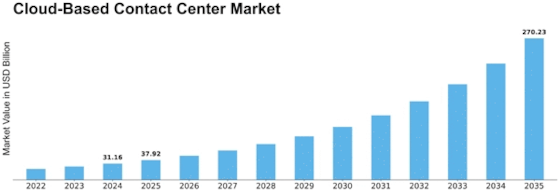
<p>The overall market valuation of the Cloud-Based Contact Center Market in 2024 was 31.16 USD Billion.</p>

What is the expected CAGR for the Cloud-Based Contact Center Market during the forecast period 2025 - 2035?

<p>The expected CAGR for the Cloud-Based Contact Center Market during the forecast period 2025 - 2035 is 21.7%.</p>

Which sectors are leading in the Cloud-Based Contact Center Market based on segment data?

<p>The leading sectors in the Cloud-Based Contact Center Market include IT & Telecom, BFSI, and Retail, with valuations of 60.0, 45.0, and 50.0 USD Billion respectively.</p>

Who are the key players in the Cloud-Based Contact Center Market?

<p>Key players in the Cloud-Based Contact Center Market include Amazon Web Services, Microsoft, Salesforce, Cisco, and RingCentral.</p>

What is the valuation of the Workforce Optimization segment in the Cloud-Based Contact Center Market?

<p>The valuation of the Workforce Optimization segment in the Cloud-Based Contact Center Market is 12.46 USD Billion.</p>

How does the Data Integration & Recording segment perform in terms of market valuation?

<p>The Data Integration & Recording segment performs with a valuation of 18.7 USD Billion.</p>

What is the projected growth trend for the Cloud-Based Contact Center Market from 2025 to 2035?

<p>The Cloud-Based Contact Center Market is projected to experience substantial growth from 2025 to 2035, driven by a CAGR of 21.7%.</p>

What is the valuation of the Healthcare segment in the Cloud-Based Contact Center Market?

<p>The valuation of the Healthcare segment in the Cloud-Based Contact Center Market is 2.0 USD Billion.</p>

Which application types are expected to drive growth in the Cloud-Based Contact Center Market?

<p>Application types such as Workforce Optimization and Data Integration & Recording are expected to drive growth, with valuations of 108.12 and 162.11 USD Billion respectively.</p>

Market Summary

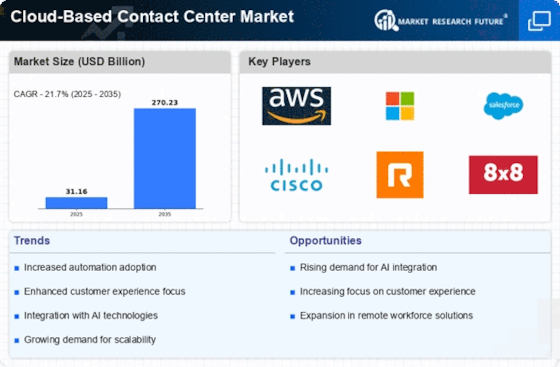
As per Market Research Future analysis, the Cloud-Based Contact Center Market Size was estimated at 31.16 USD Billion in 2024. The Cloud-Based Contact Center industry is projected to grow from 37.92 USD Billion in 2025 to 270.23 USD Billion by 2035, exhibiting a compound annual growth rate (CAGR) of 21.7% during the forecast period 2025 - 2035

Key Market Trends & Highlights

The Cloud-Based Contact Center Market is experiencing robust growth driven by technological advancements and evolving customer expectations.

  • The market is witnessing increased adoption of AI technologies to enhance customer interactions and operational efficiency. Omnichannel support is becoming a focal point, allowing businesses to engage customers seamlessly across various platforms. North America remains the largest market, while Asia-Pacific is emerging as the fastest-growing region in cloud-based contact center solutions. The growing demand for enhanced customer experience and cost efficiency are key drivers propelling market expansion.

Market Size & Forecast

2024 Market Size 31.16 (USD Billion)
2035 Market Size 270.23 (USD Billion)
CAGR (2025 - 2035) 21.7%
Largest Regional Market Share in 2024 North America

Major Players

Amazon Web Services (US), Microsoft (US), Salesforce (US), Cisco (US), RingCentral (US), 8x8 (US), NICE (IL), Zendesk (US), Freshworks (IN)

Market Trends

The Cloud-Based Contact Center Market is currently experiencing a transformative phase, driven by advancements in technology and evolving consumer expectations. Organizations are increasingly adopting cloud solutions to enhance operational efficiency and improve customer interactions. This shift appears to be motivated by the need for flexibility, scalability, and cost-effectiveness, which traditional systems often struggle to provide. As businesses seek to adapt to a rapidly changing environment, the integration of artificial intelligence and machine learning into contact center operations is becoming more prevalent. These technologies seem to offer the potential to streamline processes, personalize customer experiences, and provide valuable insights through data analytics. Moreover, the emphasis on remote work and digital communication channels is reshaping the landscape of customer service. Companies are recognizing the importance of omnichannel support, allowing customers to engage through various platforms seamlessly.

This trend indicates a growing demand for solutions that can unify interactions across voice, chat, email, and social media. As the Cloud-Based Contact Center Market continues to evolve, organizations are likely to prioritize investments in innovative technologies that enhance customer satisfaction and drive business growth. The future landscape may witness further integration of advanced analytics and automation, ultimately redefining how businesses approach customer engagement and service delivery. The cloud based contact center market is rapidly evolving as organizations transition from traditional infrastructure to cloud contact center solutions that improve scalability, operational efficiency, and customer engagement. 

Businesses are increasingly investing in cloud contact center software and cloud based call center platforms to enable omnichannel communication, real-time analytics, and automated customer service workflows. Modern cloud based contact center solutions integrate artificial intelligence, automation, and call center cloud technology to deliver seamless customer experiences across voice, chat, and digital channels. Workforce optimization tools within cloud call center software and contact centre software platforms allow organizations to enhance agent productivity and customer service performance. BFSI institutions rely heavily on cloud contact center platforms and contact center cloud solutions to ensure secure, compliant, and high-quality customer interactions. Adoption of cloud based call centre solutions is accelerating globally as enterprises modernize legacy systems with flexible cloud call centers.

Increased Adoption of AI Technologies

The integration of artificial intelligence within the Cloud-Based Contact Center Market is becoming more pronounced. Organizations are leveraging AI to automate routine tasks, enhance customer interactions, and provide personalized experiences. This trend suggests a shift towards more efficient operations, where AI-driven insights can inform decision-making and improve service quality.

Focus on Omnichannel Support

There is a growing emphasis on providing seamless customer experiences across multiple channels. The Cloud-Based Contact Center Market is witnessing a trend where businesses aim to unify interactions through voice, chat, email, and social media. This approach appears to enhance customer satisfaction by allowing for consistent communication regardless of the platform.

Remote Work Capabilities

The Cloud-Based Contact Center Market is adapting to the increasing demand for remote work solutions. Organizations are recognizing the need for flexible systems that enable agents to work from various locations. This trend indicates a potential shift in how contact centers operate, prioritizing adaptability and resilience in their workforce.

Cloud-Based Contact Center Market Market Drivers

Cost Efficiency and Scalability

Cost efficiency and scalability are pivotal drivers in the Cloud-Based Contact Center Market. Organizations are increasingly drawn to cloud solutions due to their ability to reduce operational costs associated with traditional contact centers. By eliminating the need for extensive hardware and infrastructure, businesses can allocate resources more effectively. Furthermore, cloud-based systems offer scalability, allowing companies to adjust their contact center capabilities in response to fluctuating demand. This flexibility is particularly appealing in a dynamic market environment, where the ability to scale operations quickly can provide a competitive edge. As a result, the Cloud-Based Contact Center Market is expected to grow as more organizations recognize these financial benefits.

Regulatory Compliance and Data Security

Regulatory compliance and data security are critical considerations in the Cloud-Based Contact Center Market. As organizations increasingly handle sensitive customer information, the need for robust security measures has become paramount. Cloud-based solutions often provide enhanced security features, including encryption and secure access controls, which help businesses comply with various regulations. The rising awareness of data privacy issues is prompting companies to adopt cloud solutions that prioritize security. This trend suggests that the Cloud-Based Contact Center Market will continue to expand as organizations seek to mitigate risks associated with data breaches and ensure compliance with evolving regulations.

Growing Demand for Enhanced Customer Experience

The Cloud-Based Contact Center Market is witnessing a growing demand for enhanced customer experience. Organizations are increasingly recognizing that superior customer service is a key differentiator in a competitive landscape. As a result, businesses are investing in cloud-based solutions that offer advanced features such as real-time analytics, personalized interactions, and seamless integration with various communication channels. According to recent data, companies that prioritize customer experience can achieve up to 60% higher profitability. This trend indicates that the Cloud-Based Contact Center Market is likely to expand as firms seek to leverage technology to meet evolving customer expectations.

Shift Towards Remote Customer Service Solutions

The shift towards remote customer service solutions is a notable trend in the Cloud-Based Contact Center Market. As businesses adapt to changing work environments, the demand for remote capabilities has surged. Cloud-based contact centers enable agents to work from various locations while maintaining high levels of service quality. This flexibility not only enhances employee satisfaction but also allows organizations to tap into a broader talent pool. The ability to provide uninterrupted service during unforeseen circumstances further underscores the appeal of cloud solutions. As a result, the Cloud-Based Contact Center Market is poised for growth as more companies embrace remote service models.

Integration of Advanced Analytics and Reporting Tools

The integration of advanced analytics and reporting tools is transforming the Cloud-Based Contact Center Market. Organizations are increasingly utilizing data-driven insights to enhance decision-making processes and improve operational efficiency. By leveraging analytics, businesses can monitor key performance indicators, identify trends, and optimize customer interactions. This capability not only enhances service quality but also drives strategic initiatives aimed at improving customer satisfaction. The demand for such analytics tools is projected to rise, as companies seek to harness the power of data to refine their contact center operations. Consequently, the Cloud-Based Contact Center Market is likely to experience significant growth as analytics become integral to customer service strategies.

Market Segment Insights

By Vertical Type: BFSI (Largest) vs. Healthcare (Fastest-Growing)

In the Cloud-Based Contact Center Market, the BFSI segment currently holds the largest share, predominantly driven by the need for enhanced <a href="https://www.marketresearchfuture.com/reports/customer-service-market-42123">customer service</a>, security, and compliance. As financial institutions increasingly adopt digital solutions, they leverage cloud-based contact centers to manage customer queries efficiently. Following BFSI, sectors like IT &amp; Telecom and Retail also exhibit significant shares, highlighting their crucial roles in utilizing advanced customer engagement solutions. On the other hand, the Healthcare segment is emerging as the fastest-growing vertical in this market. Factors such as the increasing demand for telehealth services and the critical need for 24/7 customer support are propelling this growth. The shift towards patient-centric care models further emphasizes the necessity for effective communication channels, driving healthcare providers to invest in cloud solutions.

BFSI (Dominant) vs. Healthcare (Emerging)

The BFSI segment remains dominant in the Cloud-Based Contact Center Market primarily due to its robust infrastructure and significant investments in new technologies aimed at improving customer service. This vertical thrives on providing secure, efficient, and personalized support, which is crucial for retaining customers in a highly competitive landscape. With <a href="https://www.marketresearchfuture.com/reports/advanced-analytics-market-5285">advanced analytics</a> and AI-driven solutions, BFSI is revolutionizing customer interactions while ensuring compliance with regulatory standards. Conversely, the Healthcare sector, marked as an emerging player, is rapidly adapting to technological advancements. Driven by an urgent need for accessible patient support and operational efficiency, healthcare providers are deploying sophisticated cloud solutions to enhance communication and streamline patient engagement. This transition is creating new opportunities for growth and innovation in patient services.

By Application Type: Workforce Optimization (Largest) vs. Data Integration & Recording (Fastest-Growing)

The 'Application Type' segment of the Cloud-Based Contact Center Market is primarily dominated by Workforce Optimization, which controls a substantial market share compared to its counterparts. This dominance is attributed to the increasing demand for efficient workforce management solutions among organizations aiming to enhance productivity and customer satisfaction. On the other hand, Data Integration &amp; Recording, while currently a smaller segment, is experiencing rapid growth as businesses recognize the importance of seamless data management and compliance in enhancing customer service capabilities.

Application Type: Workforce Optimization (Dominant) vs. Data Integration &amp; Recording (Emerging)

Workforce Optimization stands out as the dominant application in the Cloud-Based Contact Center Market. It provides tools for managing employee performance, scheduling, and training, ensuring that contact centers can operate efficiently and meet customer demands. In contrast, Data Integration &amp; Recording represents an emerging trend as organizations seek comprehensive solutions to integrate various data sources for better insights. This segment is rapidly gaining traction as companies strive to enhance their customer experiences through effective data utilization, making it a pivotal area for future investments and development in the cloud contact center space.

Get more detailed insights about Cloud-Based Contact Center Market Research Report – Forecast to 2035

Regional Insights

By region, this market has been segmented into North America, Europe, Asia-Pacific, and the rest of the world. The North American region dominates this market with a significant share of 40% in 2023 and is also estimated to witness commendable growth with a CAGR of 19.6% during the forecast period. U.S. holds the largest market share in cloud-based contact center market and is expected to dominate the market through the forecast period.

The U.S. market is highly competitive, and cloud-based contact centers can provide a competitive advantage by enabling companies to differentiate themselves based on the quality of their customer service. Cloud-based contact centers can help companies to provide personalized, efficient, and effective service that sets them apart from their competitors. The adoption of cloud-based contact centers in the U.S. is due to increasing importance of customer experience.

Companies in the U.S. are increasingly focusing on providing a seamless and personalized customer experience, and cloud-based contact centers can help them to achieve this by providing advanced features such as omnichannel support, real-time analytics, and personalized routing.

Figure 4: Cloud-Based Contact Center Market, by Region Type, 2022 & 2030 (USD Billion)

On the other side, the Asia-Pacific is expected to be the largest market for Cloud-Based Contact Center Market by the end of forecast period. In Asia Pacific, China is the largest market for implementing cloud-based contact center with a share of more than 32% in 2022. The growth of the Chinese economy is also driving the adoption of cloud-based contact centers in China. As more Chinese companies expand ly, they are facing increasing competition from international companies that have well-established customer service operations.

Cloud-based contact centers can help Chinese companies to compete by providing a range of features and capabilities that enable them to deliver high-quality customer service on a scale.

The adoption of digital technologies is driving the growth of the cloud-based contact center market in China. The rapid growth of e-commerce and social media platforms in China has created a need for companies to manage large volumes of customer interactions across multiple channels. Cloud-based contact centers can help companies to achieve this by providing advanced features such as omnichannel support, real-time analytics, and personalized routing.

Overall, the cloud-based contact center market in China is expected to continue to grow as companies seek to improve customer experience, adopt digital technologies, compete ly, and comply with government regulations.

Key Players and Competitive Insights

Major players in the Cloud-Based Contact Center Market, include RingCentral Inc., Genesys Telecommunications Laboratories Inc., 3CLogic Inc., Connect First Inc., Five9 Inc., Mitel Networks Corporation, Aspect Software Parent Inc., 8X8 Inc., Avaya Holdings Corp., NICE inContact, Teleforge Corporation, 1Stream Inc., AVOXI Inc. and, Odigo SAS.
The market's growth is predicted to be accelerated by the customer satisfaction demand, as well as various strategic alliances and investments among regional businesses. Due to most of the contact center head offices are in U.S., the U.S. controls most of the market in the region and generates a sizeable portion of overall income. Leading vendors such as Cisco are strengthening their offerings through solutions like Webex Contact Center, reflecting growing demand for scalable cloud based contact center platforms.

Key Companies in the Cloud-Based Contact Center Market include

Industry Developments

  • Q2 2024: Zoom, Cisco, UJET, RingCentral Lead Cloud Contact Center Growth Zoom, Cisco, UJET, and RingCentral were named top performers in the cloud contact center market for 2024, with Zoom leveraging AI and video meetings, Cisco focusing on security, UJET offering mobile-first CRM integration, and RingCentral excelling in UCaaS bundling and strategic partnerships.
  • Q4 2024: NICE, Genesys and Five9 Combine for More Than 50% Market Share NICE, Genesys, and Five9 collectively held over 50% of the cloud contact center market share in Q4 2024, reflecting their dominance in the sector.
  • Q2 2025: AI-Powered Contact Center as a Service Vendors Battle for Market Share in 2025 Vendors with strong AI portfolios, including NICE, Genesys, and Amazon Connect, saw higher price-per-seat and consumption-based revenue in 2024, driving expansion and strategic shifts in the cloud contact center market.

Future Outlook

Cloud-Based Contact Center Market Future Outlook

The Cloud-Based Contact Center Market is projected to grow at a 21.7% CAGR from 2025 to 2035, driven by technological advancements, increasing demand for remote solutions, and enhanced customer experience.

New opportunities lie in:

  • <p>Integration of AI-driven analytics for personalized customer interactions. Expansion into emerging markets with tailored cloud solutions. Development of omnichannel platforms to streamline customer engagement.</p>

By 2035, the market is expected to be robust, reflecting substantial growth and innovation.

Market Segmentation

Cloud-Based Contact Center Market Vertical Type Outlook

  • BFSI
  • IT & Telecom
  • Media and Entertainment
  • Retail
  • Consumer
  • Logistics and Transport
  • Healthcare
  • Others

Cloud-Based Contact Center Market Application Type Outlook

  • Workforce Optimization
  • Data Integration & Recording

Report Scope

MARKET SIZE 2024 31.16(USD Billion)
MARKET SIZE 2025 37.92(USD Billion)
MARKET SIZE 2035 270.23(USD Billion)
COMPOUND ANNUAL GROWTH RATE (CAGR) 21.7% (2025 - 2035)
REPORT COVERAGE Revenue Forecast, Competitive Landscape, Growth Factors, and Trends
BASE YEAR 2024
Market Forecast Period 2025 - 2035
Historical Data 2019 - 2024
Market Forecast Units USD Billion
Key Companies Profiled Amazon Web Services (US), Microsoft (US), Salesforce (US), Cisco (US), RingCentral (US), 8x8 (US), NICE (IL), Zendesk (US), Freshworks (IN)
Segments Covered Solution, Application, Vertical, Region
Key Market Opportunities Integration of artificial intelligence enhances customer experience in the Cloud-Based Contact Center Market.
Key Market Dynamics Rising demand for remote customer service solutions drives innovation and competition in the Cloud-Based Contact Center Market.
Countries Covered North America, Europe, APAC, South America, MEA

FAQs

What is the projected market valuation of the Cloud-Based Contact Center Market by 2035?

<p>The projected market valuation for the Cloud-Based Contact Center Market by 2035 is 270.23 USD Billion.</p>

What was the market valuation of the Cloud-Based Contact Center Market in 2024?

<p>The overall market valuation of the Cloud-Based Contact Center Market in 2024 was 31.16 USD Billion.</p>

What is the expected CAGR for the Cloud-Based Contact Center Market during the forecast period 2025 - 2035?

<p>The expected CAGR for the Cloud-Based Contact Center Market during the forecast period 2025 - 2035 is 21.7%.</p>

Which sectors are leading in the Cloud-Based Contact Center Market based on segment data?

<p>The leading sectors in the Cloud-Based Contact Center Market include IT & Telecom, BFSI, and Retail, with valuations of 60.0, 45.0, and 50.0 USD Billion respectively.</p>

Who are the key players in the Cloud-Based Contact Center Market?

<p>Key players in the Cloud-Based Contact Center Market include Amazon Web Services, Microsoft, Salesforce, Cisco, and RingCentral.</p>

What is the valuation of the Workforce Optimization segment in the Cloud-Based Contact Center Market?

<p>The valuation of the Workforce Optimization segment in the Cloud-Based Contact Center Market is 12.46 USD Billion.</p>

How does the Data Integration & Recording segment perform in terms of market valuation?

<p>The Data Integration & Recording segment performs with a valuation of 18.7 USD Billion.</p>

What is the projected growth trend for the Cloud-Based Contact Center Market from 2025 to 2035?

<p>The Cloud-Based Contact Center Market is projected to experience substantial growth from 2025 to 2035, driven by a CAGR of 21.7%.</p>

What is the valuation of the Healthcare segment in the Cloud-Based Contact Center Market?

<p>The valuation of the Healthcare segment in the Cloud-Based Contact Center Market is 2.0 USD Billion.</p>

Which application types are expected to drive growth in the Cloud-Based Contact Center Market?

<p>Application types such as Workforce Optimization and Data Integration & Recording are expected to drive growth, with valuations of 108.12 and 162.11 USD Billion respectively.</p>

  1. SECTION I: EXECUTIVE SUMMARY AND KEY HIGHLIGHTS
    1. | 1.1 EXECUTIVE SUMMARY
    2. | | 1.1.1 Market Overview
    3. | | 1.1.2 Key Findings
    4. | | 1.1.3 Market Segmentation
    5. | | 1.1.4 Competitive Landscape
    6. | | 1.1.5 Challenges and Opportunities
    7. | | 1.1.6 Future Outlook
  2. SECTION II: SCOPING, METHODOLOGY AND MARKET STRUCTURE
    1. | 2.1 MARKET INTRODUCTION
    2. | | 2.1.1 Definition
    3. | | 2.1.2 Scope of the study
    4. | | | 2.1.2.1 Research Objective
    5. | | | 2.1.2.2 Assumption
    6. | | | 2.1.2.3 Limitations
    7. | 2.2 RESEARCH METHODOLOGY
    8. | | 2.2.1 Overview
    9. | | 2.2.2 Data Mining
    10. | | 2.2.3 Secondary Research
    11. | | 2.2.4 Primary Research
    12. | | | 2.2.4.1 Primary Interviews and Information Gathering Process
    13. | | | 2.2.4.2 Breakdown of Primary Respondents
    14. | | 2.2.5 Forecasting Model
    15. | | 2.2.6 Market Size Estimation
    16. | | | 2.2.6.1 Bottom-Up Approach
    17. | | | 2.2.6.2 Top-Down Approach
    18. | | 2.2.7 Data Triangulation
    19. | | 2.2.8 Validation
  3. SECTION III: QUALITATIVE ANALYSIS
    1. | 3.1 MARKET DYNAMICS
    2. | | 3.1.1 Overview
    3. | | 3.1.2 Drivers
    4. | | 3.1.3 Restraints
    5. | | 3.1.4 Opportunities
    6. | 3.2 MARKET FACTOR ANALYSIS
    7. | | 3.2.1 Value chain Analysis
    8. | | 3.2.2 Porter's Five Forces Analysis
    9. | | | 3.2.2.1 Bargaining Power of Suppliers
    10. | | | 3.2.2.2 Bargaining Power of Buyers
    11. | | | 3.2.2.3 Threat of New Entrants
    12. | | | 3.2.2.4 Threat of Substitutes
    13. | | | 3.2.2.5 Intensity of Rivalry
    14. | | 3.2.3 COVID-19 Impact Analysis
    15. | | | 3.2.3.1 Market Impact Analysis
    16. | | | 3.2.3.2 Regional Impact
    17. | | | 3.2.3.3 Opportunity and Threat Analysis
  4. SECTION IV: QUANTITATIVE ANALYSIS
    1. | 4.1 Information and Communications Technology, BY Vertical Type (USD Billion)
    2. | | 4.1.1 BFSI
    3. | | 4.1.2 IT & Telecom
    4. | | 4.1.3 Media and Entertainment
    5. | | 4.1.4 Retail
    6. | | 4.1.5 Consumer
    7. | | 4.1.6 Logistics and Transport
    8. | | 4.1.7 Healthcare
    9. | | 4.1.8 Others
    10. | 4.2 Information and Communications Technology, BY Application Type (USD Billion)
    11. | | 4.2.1 Workforce Optimization
    12. | | 4.2.2 Data Integration & Recording
    13. | 4.3 Information and Communications Technology, BY Region (USD Billion)
    14. | | 4.3.1 North America
    15. | | | 4.3.1.1 US
    16. | | | 4.3.1.2 Canada
    17. | | 4.3.2 Europe
    18. | | | 4.3.2.1 Germany
    19. | | | 4.3.2.2 UK
    20. | | | 4.3.2.3 France
    21. | | | 4.3.2.4 Russia
    22. | | | 4.3.2.5 Italy
    23. | | | 4.3.2.6 Spain
    24. | | | 4.3.2.7 Rest of Europe
    25. | | 4.3.3 APAC
    26. | | | 4.3.3.1 China
    27. | | | 4.3.3.2 India
    28. | | | 4.3.3.3 Japan
    29. | | | 4.3.3.4 South Korea
    30. | | | 4.3.3.5 Malaysia
    31. | | | 4.3.3.6 Thailand
    32. | | | 4.3.3.7 Indonesia
    33. | | | 4.3.3.8 Rest of APAC
    34. | | 4.3.4 South America
    35. | | | 4.3.4.1 Brazil
    36. | | | 4.3.4.2 Mexico
    37. | | | 4.3.4.3 Argentina
    38. | | | 4.3.4.4 Rest of South America
    39. | | 4.3.5 MEA
    40. | | | 4.3.5.1 GCC Countries
    41. | | | 4.3.5.2 South Africa
    42. | | | 4.3.5.3 Rest of MEA
  5. SECTION V: COMPETITIVE ANALYSIS
    1. | 5.1 Competitive Landscape
    2. | | 5.1.1 Overview
    3. | | 5.1.2 Competitive Analysis
    4. | | 5.1.3 Market share Analysis
    5. | | 5.1.4 Major Growth Strategy in the Information and Communications Technology
    6. | | 5.1.5 Competitive Benchmarking
    7. | | 5.1.6 Leading Players in Terms of Number of Developments in the Information and Communications Technology
    8. | | 5.1.7 Key developments and growth strategies
    9. | | | 5.1.7.1 New Product Launch/Service Deployment
    10. | | | 5.1.7.2 Merger & Acquisitions
    11. | | | 5.1.7.3 Joint Ventures
    12. | | 5.1.8 Major Players Financial Matrix
    13. | | | 5.1.8.1 Sales and Operating Income
    14. | | | 5.1.8.2 Major Players R&D Expenditure. 2023
    15. | 5.2 Company Profiles
    16. | | 5.2.1 Amazon Web Services (US)
    17. | | | 5.2.1.1 Financial Overview
    18. | | | 5.2.1.2 Products Offered
    19. | | | 5.2.1.3 Key Developments
    20. | | | 5.2.1.4 SWOT Analysis
    21. | | | 5.2.1.5 Key Strategies
    22. | | 5.2.2 Microsoft (US)
    23. | | | 5.2.2.1 Financial Overview
    24. | | | 5.2.2.2 Products Offered
    25. | | | 5.2.2.3 Key Developments
    26. | | | 5.2.2.4 SWOT Analysis
    27. | | | 5.2.2.5 Key Strategies
    28. | | 5.2.3 Salesforce (US)
    29. | | | 5.2.3.1 Financial Overview
    30. | | | 5.2.3.2 Products Offered
    31. | | | 5.2.3.3 Key Developments
    32. | | | 5.2.3.4 SWOT Analysis
    33. | | | 5.2.3.5 Key Strategies
    34. | | 5.2.4 Cisco (US)
    35. | | | 5.2.4.1 Financial Overview
    36. | | | 5.2.4.2 Products Offered
    37. | | | 5.2.4.3 Key Developments
    38. | | | 5.2.4.4 SWOT Analysis
    39. | | | 5.2.4.5 Key Strategies
    40. | | 5.2.5 RingCentral (US)
    41. | | | 5.2.5.1 Financial Overview
    42. | | | 5.2.5.2 Products Offered
    43. | | | 5.2.5.3 Key Developments
    44. | | | 5.2.5.4 SWOT Analysis
    45. | | | 5.2.5.5 Key Strategies
    46. | | 5.2.6 8x8 (US)
    47. | | | 5.2.6.1 Financial Overview
    48. | | | 5.2.6.2 Products Offered
    49. | | | 5.2.6.3 Key Developments
    50. | | | 5.2.6.4 SWOT Analysis
    51. | | | 5.2.6.5 Key Strategies
    52. | | 5.2.7 NICE (IL)
    53. | | | 5.2.7.1 Financial Overview
    54. | | | 5.2.7.2 Products Offered
    55. | | | 5.2.7.3 Key Developments
    56. | | | 5.2.7.4 SWOT Analysis
    57. | | | 5.2.7.5 Key Strategies
    58. | | 5.2.8 Zendesk (US)
    59. | | | 5.2.8.1 Financial Overview
    60. | | | 5.2.8.2 Products Offered
    61. | | | 5.2.8.3 Key Developments
    62. | | | 5.2.8.4 SWOT Analysis
    63. | | | 5.2.8.5 Key Strategies
    64. | | 5.2.9 Freshworks (IN)
    65. | | | 5.2.9.1 Financial Overview
    66. | | | 5.2.9.2 Products Offered
    67. | | | 5.2.9.3 Key Developments
    68. | | | 5.2.9.4 SWOT Analysis
    69. | | | 5.2.9.5 Key Strategies
    70. | 5.3 Appendix
    71. | | 5.3.1 References
    72. | | 5.3.2 Related Reports
  6. LIST OF FIGURES
    1. | 6.1 MARKET SYNOPSIS
    2. | 6.2 NORTH AMERICA MARKET ANALYSIS
    3. | 6.3 US MARKET ANALYSIS BY VERTICAL TYPE
    4. | 6.4 US MARKET ANALYSIS BY APPLICATION TYPE
    5. | 6.5 CANADA MARKET ANALYSIS BY VERTICAL TYPE
    6. | 6.6 CANADA MARKET ANALYSIS BY APPLICATION TYPE
    7. | 6.7 EUROPE MARKET ANALYSIS
    8. | 6.8 GERMANY MARKET ANALYSIS BY VERTICAL TYPE
    9. | 6.9 GERMANY MARKET ANALYSIS BY APPLICATION TYPE
    10. | 6.10 UK MARKET ANALYSIS BY VERTICAL TYPE
    11. | 6.11 UK MARKET ANALYSIS BY APPLICATION TYPE
    12. | 6.12 FRANCE MARKET ANALYSIS BY VERTICAL TYPE
    13. | 6.13 FRANCE MARKET ANALYSIS BY APPLICATION TYPE
    14. | 6.14 RUSSIA MARKET ANALYSIS BY VERTICAL TYPE
    15. | 6.15 RUSSIA MARKET ANALYSIS BY APPLICATION TYPE
    16. | 6.16 ITALY MARKET ANALYSIS BY VERTICAL TYPE
    17. | 6.17 ITALY MARKET ANALYSIS BY APPLICATION TYPE
    18. | 6.18 SPAIN MARKET ANALYSIS BY VERTICAL TYPE
    19. | 6.19 SPAIN MARKET ANALYSIS BY APPLICATION TYPE
    20. | 6.20 REST OF EUROPE MARKET ANALYSIS BY VERTICAL TYPE
    21. | 6.21 REST OF EUROPE MARKET ANALYSIS BY APPLICATION TYPE
    22. | 6.22 APAC MARKET ANALYSIS
    23. | 6.23 CHINA MARKET ANALYSIS BY VERTICAL TYPE
    24. | 6.24 CHINA MARKET ANALYSIS BY APPLICATION TYPE
    25. | 6.25 INDIA MARKET ANALYSIS BY VERTICAL TYPE
    26. | 6.26 INDIA MARKET ANALYSIS BY APPLICATION TYPE
    27. | 6.27 JAPAN MARKET ANALYSIS BY VERTICAL TYPE
    28. | 6.28 JAPAN MARKET ANALYSIS BY APPLICATION TYPE
    29. | 6.29 SOUTH KOREA MARKET ANALYSIS BY VERTICAL TYPE
    30. | 6.30 SOUTH KOREA MARKET ANALYSIS BY APPLICATION TYPE
    31. | 6.31 MALAYSIA MARKET ANALYSIS BY VERTICAL TYPE
    32. | 6.32 MALAYSIA MARKET ANALYSIS BY APPLICATION TYPE
    33. | 6.33 THAILAND MARKET ANALYSIS BY VERTICAL TYPE
    34. | 6.34 THAILAND MARKET ANALYSIS BY APPLICATION TYPE
    35. | 6.35 INDONESIA MARKET ANALYSIS BY VERTICAL TYPE
    36. | 6.36 INDONESIA MARKET ANALYSIS BY APPLICATION TYPE
    37. | 6.37 REST OF APAC MARKET ANALYSIS BY VERTICAL TYPE
    38. | 6.38 REST OF APAC MARKET ANALYSIS BY APPLICATION TYPE
    39. | 6.39 SOUTH AMERICA MARKET ANALYSIS
    40. | 6.40 BRAZIL MARKET ANALYSIS BY VERTICAL TYPE
    41. | 6.41 BRAZIL MARKET ANALYSIS BY APPLICATION TYPE
    42. | 6.42 MEXICO MARKET ANALYSIS BY VERTICAL TYPE
    43. | 6.43 MEXICO MARKET ANALYSIS BY APPLICATION TYPE
    44. | 6.44 ARGENTINA MARKET ANALYSIS BY VERTICAL TYPE
    45. | 6.45 ARGENTINA MARKET ANALYSIS BY APPLICATION TYPE
    46. | 6.46 REST OF SOUTH AMERICA MARKET ANALYSIS BY VERTICAL TYPE
    47. | 6.47 REST OF SOUTH AMERICA MARKET ANALYSIS BY APPLICATION TYPE
    48. | 6.48 MEA MARKET ANALYSIS
    49. | 6.49 GCC COUNTRIES MARKET ANALYSIS BY VERTICAL TYPE
    50. | 6.50 GCC COUNTRIES MARKET ANALYSIS BY APPLICATION TYPE
    51. | 6.51 SOUTH AFRICA MARKET ANALYSIS BY VERTICAL TYPE
    52. | 6.52 SOUTH AFRICA MARKET ANALYSIS BY APPLICATION TYPE
    53. | 6.53 REST OF MEA MARKET ANALYSIS BY VERTICAL TYPE
    54. | 6.54 REST OF MEA MARKET ANALYSIS BY APPLICATION TYPE
    55. | 6.55 KEY BUYING CRITERIA OF INFORMATION AND COMMUNICATIONS TECHNOLOGY
    56. | 6.56 RESEARCH PROCESS OF MRFR
    57. | 6.57 DRO ANALYSIS OF INFORMATION AND COMMUNICATIONS TECHNOLOGY
    58. | 6.58 DRIVERS IMPACT ANALYSIS: INFORMATION AND COMMUNICATIONS TECHNOLOGY
    59. | 6.59 RESTRAINTS IMPACT ANALYSIS: INFORMATION AND COMMUNICATIONS TECHNOLOGY
    60. | 6.60 SUPPLY / VALUE CHAIN: INFORMATION AND COMMUNICATIONS TECHNOLOGY
    61. | 6.61 INFORMATION AND COMMUNICATIONS TECHNOLOGY, BY VERTICAL TYPE, 2024 (% SHARE)
    62. | 6.62 INFORMATION AND COMMUNICATIONS TECHNOLOGY, BY VERTICAL TYPE, 2024 TO 2035 (USD Billion)
    63. | 6.63 INFORMATION AND COMMUNICATIONS TECHNOLOGY, BY APPLICATION TYPE, 2024 (% SHARE)
    64. | 6.64 INFORMATION AND COMMUNICATIONS TECHNOLOGY, BY APPLICATION TYPE, 2024 TO 2035 (USD Billion)
    65. | 6.65 BENCHMARKING OF MAJOR COMPETITORS
  7. LIST OF TABLES
    1. | 7.1 LIST OF ASSUMPTIONS
    2. | | 7.1.1
    3. | 7.2 North America MARKET SIZE ESTIMATES; FORECAST
    4. | | 7.2.1 BY VERTICAL TYPE, 2025-2035 (USD Billion)
    5. | | 7.2.2 BY APPLICATION TYPE, 2025-2035 (USD Billion)
    6. | 7.3 US MARKET SIZE ESTIMATES; FORECAST
    7. | | 7.3.1 BY VERTICAL TYPE, 2025-2035 (USD Billion)
    8. | | 7.3.2 BY APPLICATION TYPE, 2025-2035 (USD Billion)
    9. | 7.4 Canada MARKET SIZE ESTIMATES; FORECAST
    10. | | 7.4.1 BY VERTICAL TYPE, 2025-2035 (USD Billion)
    11. | | 7.4.2 BY APPLICATION TYPE, 2025-2035 (USD Billion)
    12. | 7.5 Europe MARKET SIZE ESTIMATES; FORECAST
    13. | | 7.5.1 BY VERTICAL TYPE, 2025-2035 (USD Billion)
    14. | | 7.5.2 BY APPLICATION TYPE, 2025-2035 (USD Billion)
    15. | 7.6 Germany MARKET SIZE ESTIMATES; FORECAST
    16. | | 7.6.1 BY VERTICAL TYPE, 2025-2035 (USD Billion)
    17. | | 7.6.2 BY APPLICATION TYPE, 2025-2035 (USD Billion)
    18. | 7.7 UK MARKET SIZE ESTIMATES; FORECAST
    19. | | 7.7.1 BY VERTICAL TYPE, 2025-2035 (USD Billion)
    20. | | 7.7.2 BY APPLICATION TYPE, 2025-2035 (USD Billion)
    21. | 7.8 France MARKET SIZE ESTIMATES; FORECAST
    22. | | 7.8.1 BY VERTICAL TYPE, 2025-2035 (USD Billion)
    23. | | 7.8.2 BY APPLICATION TYPE, 2025-2035 (USD Billion)
    24. | 7.9 Russia MARKET SIZE ESTIMATES; FORECAST
    25. | | 7.9.1 BY VERTICAL TYPE, 2025-2035 (USD Billion)
    26. | | 7.9.2 BY APPLICATION TYPE, 2025-2035 (USD Billion)
    27. | 7.10 Italy MARKET SIZE ESTIMATES; FORECAST
    28. | | 7.10.1 BY VERTICAL TYPE, 2025-2035 (USD Billion)
    29. | | 7.10.2 BY APPLICATION TYPE, 2025-2035 (USD Billion)
    30. | 7.11 Spain MARKET SIZE ESTIMATES; FORECAST
    31. | | 7.11.1 BY VERTICAL TYPE, 2025-2035 (USD Billion)
    32. | | 7.11.2 BY APPLICATION TYPE, 2025-2035 (USD Billion)
    33. | 7.12 Rest of Europe MARKET SIZE ESTIMATES; FORECAST
    34. | | 7.12.1 BY VERTICAL TYPE, 2025-2035 (USD Billion)
    35. | | 7.12.2 BY APPLICATION TYPE, 2025-2035 (USD Billion)
    36. | 7.13 APAC MARKET SIZE ESTIMATES; FORECAST
    37. | | 7.13.1 BY VERTICAL TYPE, 2025-2035 (USD Billion)
    38. | | 7.13.2 BY APPLICATION TYPE, 2025-2035 (USD Billion)
    39. | 7.14 China MARKET SIZE ESTIMATES; FORECAST
    40. | | 7.14.1 BY VERTICAL TYPE, 2025-2035 (USD Billion)
    41. | | 7.14.2 BY APPLICATION TYPE, 2025-2035 (USD Billion)
    42. | 7.15 India MARKET SIZE ESTIMATES; FORECAST
    43. | | 7.15.1 BY VERTICAL TYPE, 2025-2035 (USD Billion)
    44. | | 7.15.2 BY APPLICATION TYPE, 2025-2035 (USD Billion)
    45. | 7.16 Japan MARKET SIZE ESTIMATES; FORECAST
    46. | | 7.16.1 BY VERTICAL TYPE, 2025-2035 (USD Billion)
    47. | | 7.16.2 BY APPLICATION TYPE, 2025-2035 (USD Billion)
    48. | 7.17 South Korea MARKET SIZE ESTIMATES; FORECAST
    49. | | 7.17.1 BY VERTICAL TYPE, 2025-2035 (USD Billion)
    50. | | 7.17.2 BY APPLICATION TYPE, 2025-2035 (USD Billion)
    51. | 7.18 Malaysia MARKET SIZE ESTIMATES; FORECAST
    52. | | 7.18.1 BY VERTICAL TYPE, 2025-2035 (USD Billion)
    53. | | 7.18.2 BY APPLICATION TYPE, 2025-2035 (USD Billion)
    54. | 7.19 Thailand MARKET SIZE ESTIMATES; FORECAST
    55. | | 7.19.1 BY VERTICAL TYPE, 2025-2035 (USD Billion)
    56. | | 7.19.2 BY APPLICATION TYPE, 2025-2035 (USD Billion)
    57. | 7.20 Indonesia MARKET SIZE ESTIMATES; FORECAST
    58. | | 7.20.1 BY VERTICAL TYPE, 2025-2035 (USD Billion)
    59. | | 7.20.2 BY APPLICATION TYPE, 2025-2035 (USD Billion)
    60. | 7.21 Rest of APAC MARKET SIZE ESTIMATES; FORECAST
    61. | | 7.21.1 BY VERTICAL TYPE, 2025-2035 (USD Billion)
    62. | | 7.21.2 BY APPLICATION TYPE, 2025-2035 (USD Billion)
    63. | 7.22 South America MARKET SIZE ESTIMATES; FORECAST
    64. | | 7.22.1 BY VERTICAL TYPE, 2025-2035 (USD Billion)
    65. | | 7.22.2 BY APPLICATION TYPE, 2025-2035 (USD Billion)
    66. | 7.23 Brazil MARKET SIZE ESTIMATES; FORECAST
    67. | | 7.23.1 BY VERTICAL TYPE, 2025-2035 (USD Billion)
    68. | | 7.23.2 BY APPLICATION TYPE, 2025-2035 (USD Billion)
    69. | 7.24 Mexico MARKET SIZE ESTIMATES; FORECAST
    70. | | 7.24.1 BY VERTICAL TYPE, 2025-2035 (USD Billion)
    71. | | 7.24.2 BY APPLICATION TYPE, 2025-2035 (USD Billion)
    72. | 7.25 Argentina MARKET SIZE ESTIMATES; FORECAST
    73. | | 7.25.1 BY VERTICAL TYPE, 2025-2035 (USD Billion)
    74. | | 7.25.2 BY APPLICATION TYPE, 2025-2035 (USD Billion)
    75. | 7.26 Rest of South America MARKET SIZE ESTIMATES; FORECAST
    76. | | 7.26.1 BY VERTICAL TYPE, 2025-2035 (USD Billion)
    77. | | 7.26.2 BY APPLICATION TYPE, 2025-2035 (USD Billion)
    78. | 7.27 MEA MARKET SIZE ESTIMATES; FORECAST
    79. | | 7.27.1 BY VERTICAL TYPE, 2025-2035 (USD Billion)
    80. | | 7.27.2 BY APPLICATION TYPE, 2025-2035 (USD Billion)
    81. | 7.28 GCC Countries MARKET SIZE ESTIMATES; FORECAST
    82. | | 7.28.1 BY VERTICAL TYPE, 2025-2035 (USD Billion)
    83. | | 7.28.2 BY APPLICATION TYPE, 2025-2035 (USD Billion)
    84. | 7.29 South Africa MARKET SIZE ESTIMATES; FORECAST
    85. | | 7.29.1 BY VERTICAL TYPE, 2025-2035 (USD Billion)
    86. | | 7.29.2 BY APPLICATION TYPE, 2025-2035 (USD Billion)
    87. | 7.30 Rest of MEA MARKET SIZE ESTIMATES; FORECAST
    88. | | 7.30.1 BY VERTICAL TYPE, 2025-2035 (USD Billion)
    89. | | 7.30.2 BY APPLICATION TYPE, 2025-2035 (USD Billion)
    90. | 7.31 PRODUCT LAUNCH/PRODUCT DEVELOPMENT/APPROVAL
    91. | | 7.31.1
    92. | 7.32 ACQUISITION/PARTNERSHIP
    93. | | 7.32.1

Information and Communications Technology Market Segmentation

Information and Communications Technology By Vertical Type (USD Billion, 2025-2035)

  • BFSI
  • IT & Telecom
  • Media and Entertainment
  • Retail
  • Consumer
  • Logistics and Transport
  • Healthcare
  • Others

Information and Communications Technology By Application Type (USD Billion, 2025-2035)

  • Workforce Optimization
  • Data Integration & Recording
Infographic

Free Sample Request

Kindly complete the form below to receive a free sample of this Report

Get Free Sample

Customer Strories

Compare Licence

×
Features License Type
Single User Multiuser License Enterprise User
Price $4,950 $5,950 $7,250
Maximum User Access Limit 1 User Upto 10 Users Unrestricted Access Throughout the Organization
Free Customization
Direct Access to Analyst
Deliverable Format
Platform Access
Discount on Next Purchase 10% 15% 15%
Printable Versions
%>