×
Hero Background
English
Chinese
French
Japanese
Korean
German
Spanish

Clinical Alarm Management Market Trends

ID: MRFR/HS/6041-HCR
110 Pages
Kinjoll Dey
October 2025

Clinical Alarm Management Market Research Report Information By Product (Nurse Call Systems, Physiological Monitors, EMR Integration Systems, and Bed Alarms), By Component (Solutions and Services), By End Users (Hospitals and Clinics, Long-Term Care (LTC) Centers, and Ambulatory Care Centers), And By Region (North America, Europe, Asia-Pacific, And Rest Of The World) – Market Forecast Till 2035

Share:
Download PDF ×

We do not share your information with anyone. However, we may send you emails based on your report interest from time to time. You may contact us at any time to opt-out.

Clinical Alarm Management Market Infographic
Purchase Options

Market Trends

Key Emerging Trends in the Clinical Alarm Management Market

The clinical alarm management market is experiencing significant growth and transformation driven by factors such as increasing patient acuity, alarm fatigue concerns, regulatory requirements, and technological advancements in healthcare IT systems. One significant trend in the clinical alarm management market is the adoption of advanced alarm management solutions and strategies to address the challenges associated with alarm fatigue and alarm overload in healthcare settings. With the proliferation of medical devices and monitoring systems generating a high volume of alarms, healthcare providers are implementing alarm management technologies such as alarm middleware platforms, intelligent alarm algorithms, and real-time analytics tools to prioritize and contextualize alarms, reduce unnecessary alerts, and improve alarm response and clinical decision-making.

Moreover, there is a growing emphasis on interoperability and integration of alarm management solutions with electronic health record (EHR) systems, clinical workflows, and communication platforms to enhance care coordination and patient safety. Healthcare organizations are leveraging health information exchange (HIE) standards, application programming interfaces (APIs), and middleware solutions to integrate alarm data from diverse sources into a centralized alarm management platform, enabling real-time monitoring, notification, and escalation of critical alarms to appropriate caregivers. This trend towards interoperable alarm management systems is driving innovation in healthcare IT interoperability standards and interoperability frameworks to facilitate seamless data exchange and communication across disparate systems and devices.

Additionally, the clinical alarm management market is witnessing increasing adoption of remote alarm monitoring and telehealth solutions to extend the reach of clinical alarm management beyond traditional healthcare settings. With the growing prevalence of remote patient monitoring (RPM) and telemedicine services, healthcare providers are leveraging remote alarm monitoring platforms, wearable devices, and mobile health applications to monitor patients' vital signs and physiological parameters remotely, detect early warning signs of deterioration, and intervene proactively to prevent adverse events. This trend towards remote alarm monitoring is driving innovation in telehealth technology platforms, remote patient monitoring devices, and telecommunication infrastructure to support real-time data transmission and communication between patients and healthcare providers.

Furthermore, there is a growing focus on patient-centric alarm management strategies and patient engagement initiatives to involve patients and their families in the alarm management process and empower them to participate in their care. Healthcare organizations are implementing patient education programs, shared decision-making tools, and interactive communication channels to educate patients about the significance of alarms, encourage them to report false alarms or alarms indicating clinical deterioration, and collaborate with healthcare providers to prioritize and respond to alarms based on patients' preferences and clinical needs. This trend towards patient-centered alarm management is driving innovation in patient engagement technologies, patient portals, and health literacy resources to promote active participation and shared decision-making in alarm management activities.

Moreover, the clinical alarm management market is witnessing increasing regulatory scrutiny and compliance requirements related to alarm management practices and patient safety standards. Regulatory agencies such as the Joint Commission and the Food and Drug Administration (FDA) have issued guidelines and recommendations for healthcare organizations to improve alarm management practices, reduce alarm fatigue, and enhance patient safety. This trend towards regulatory compliance is driving investments in alarm management solutions, staff training, and quality improvement initiatives to ensure compliance with regulatory requirements and accreditation standards, and mitigate the risk of adverse events associated with alarm-related errors.

Lastly, the clinical alarm management market is experiencing significant growth in emerging markets, driven by increasing investments in healthcare infrastructure, rising demand for patient safety solutions, and expanding adoption of healthcare IT systems in developing countries. Developing countries in Asia, Latin America, and Africa are witnessing rapid economic growth and urbanization, leading to a growing need for advanced healthcare technologies and solutions to address healthcare challenges and improve patient outcomes. This has created opportunities for alarm management solution providers to expand their presence in these markets by offering affordable, scalable, and customized alarm management solutions tailored to the needs and requirements of local healthcare systems and patient populations.


Author
Kinjoll Dey
Research Analyst Level I

He is an extremely curious individual currently working in Healthcare and Medical Devices Domain. Kinjoll is comfortably versed in data centric research backed by healthcare educational background. He leverages extensive data mining and analytics tools such as Primary and Secondary Research, Statistical Analysis, Machine Learning, Data Modelling. His key role also involves Technical Sales Support, Client Interaction and Project management within the Healthcare team. Lastly, he showcases extensive affinity towards learning new skills and remain fascinated in implementing them.

Leave a Comment

FAQs

What is the projected growth of the Clinical Alarm Management market?

The Clinical Alarm Management market is the expected increase in total market value of 27.62 USD billion over a defined forecast period 2025–2035. It is driven by factors such as demand trends, technological advances, regulatory changes, and geographic expansion.

What is the size of the Clinical Alarm Management market?

Clinical Alarm Management market size was valued at approximately 1.38 billion USD in 2024. This figure will reach 27.62 billion USD covering all regions (America, Europe, Asia, MEA and ROW), focusing its segments / services / distribution channels till 2035.

What is the CAGR of the Clinical Alarm Management market?

Clinical Alarm Management market is expected to grow at a CAGR of 31.32% between 2025 and 2035.

How much will the Clinical Alarm Management market be worth by 2035?

Clinical Alarm Management market is expected to be worth of 27.62 billion USD, reflecting growth driven by usage, technology and global demands by the end of 2035.

How will the Clinical Alarm Management market perform over the next 10 years?

Over the next 10 years the Clinical Alarm Management market is expected to shift from usd billion 1.38 to 27.62 billion USD, led by adoption of advanced tech, demographic trends, regulatory approvals, with potential headwinds from 2025 to 2035.

Which region held the largest market share in the clinical alarm management market?

North America had the largest share of the market

Market Summary

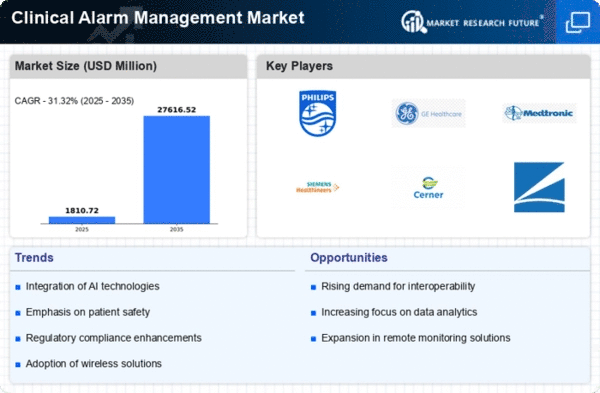
As per MRFR analysis, the Clinical Alarm Management Market Size was estimated at 1378.86 USD Million in 2024. The Clinical Alarm Management industry is projected to grow from 1810.73 USD Million in 2025 to 27616.52 USD Million by 2035, exhibiting a compound annual growth rate (CAGR) of 31.32 during the forecast period 2025 - 2035.

Key Market Trends & Highlights

The Clinical Alarm Management Market is poised for substantial growth driven by technological advancements and regulatory frameworks.

  • The integration of advanced technologies is transforming alarm management systems, enhancing their efficiency and effectiveness.
  • North America remains the largest market for clinical alarm management, while Asia-Pacific is emerging as the fastest-growing region.
  • The patient monitoring segment dominates the market, whereas the alarm notification segment is witnessing rapid growth.
  • Key market drivers include the rising incidence of chronic diseases and increased investment in healthcare infrastructure.

Market Size & Forecast

2024 Market Size 1378.86 (USD Million)
2035 Market Size 27616.52 (USD Million)
CAGR (2025 - 2035) 31.32%
Largest Regional Market Share in 2024 North America

Major Players

<p>Philips (NL), GE Healthcare (US), Siemens Healthineers (DE), Medtronic (IE), Johnson & Johnson (US), Baxter International (US), Hill-Rom Holdings (US), Ascom Holding (CH), Caresyntax (US)</p>

Market Trends

The Clinical Alarm Management Market is currently experiencing a transformative phase, driven by the increasing complexity of healthcare environments and the need for enhanced patient safety. As healthcare facilities strive to improve their operational efficiency, the focus on alarm management systems has intensified. These systems are designed to reduce alarm fatigue among healthcare professionals, ensuring that critical alerts are prioritized and effectively managed. The integration of advanced technologies, such as artificial intelligence and machine learning, appears to be a pivotal factor in optimizing alarm systems, potentially leading to better patient outcomes and streamlined workflows. Moreover, regulatory bodies are emphasizing the importance of alarm management protocols, which may further propel the adoption of sophisticated alarm systems across various healthcare settings. The growing awareness of the adverse effects of alarm overload on clinical staff and patient care suggests a shift towards more strategic alarm utilization. As hospitals and clinics continue to invest in innovative solutions, the Clinical Alarm Management Market is poised for substantial growth, reflecting a broader trend towards patient-centered care and operational excellence in healthcare delivery.

Integration of Advanced Technologies

The Clinical Alarm Management Market is witnessing a notable trend towards the incorporation of advanced technologies, such as artificial intelligence and machine learning. These innovations facilitate the analysis of alarm data, enabling healthcare providers to prioritize alerts based on urgency and relevance. This trend not only enhances the efficiency of alarm systems but also contributes to improved patient safety by minimizing alarm fatigue among clinical staff.

Regulatory Emphasis on Alarm Management

There is a growing emphasis from regulatory bodies on the establishment of robust alarm management protocols within healthcare facilities. This trend indicates a shift towards standardized practices aimed at reducing alarm-related incidents. Compliance with these regulations is likely to drive the adoption of comprehensive alarm management solutions, ensuring that healthcare providers can meet safety standards while enhancing patient care.

Focus on Patient-Centered Care

The Clinical Alarm Management Market reflects a broader trend towards patient-centered care, where the emphasis is placed on improving the overall patient experience. Healthcare facilities are increasingly recognizing the need to balance alarm notifications with patient comfort. This focus may lead to the development of more intuitive alarm systems that prioritize critical alerts while minimizing unnecessary disturbances, ultimately fostering a more conducive healing environment.

Clinical Alarm Management Market Market Drivers

Regulatory Compliance and Standards

Regulatory bodies are intensifying their focus on alarm management protocols, which is influencing the Global Clinical Alarm Management Market Industry. Compliance with standards set by organizations such as The Joint Commission is becoming essential for healthcare facilities. These regulations mandate the implementation of effective alarm management strategies to enhance patient safety and care quality. As a result, hospitals are investing in alarm management solutions to meet these compliance requirements, thereby driving market growth. The emphasis on regulatory adherence is expected to contribute to the market's expansion in the coming years.

Increasing Demand for Patient Safety

The Global Clinical Alarm Management Market Industry is experiencing a surge in demand driven by an increasing focus on patient safety. Healthcare facilities are prioritizing the reduction of alarm fatigue, which can lead to missed alerts and compromised patient care. As hospitals implement advanced alarm management systems, the market is projected to reach 1.38 USD Billion in 2024. This heightened awareness around patient safety is prompting investments in technologies that streamline alarm notifications, ensuring that critical alerts are prioritized and effectively communicated to healthcare providers.

Aging Population and Chronic Diseases

The aging population and the rising prevalence of chronic diseases are key drivers of the Global Clinical Alarm Management Market Industry. As the demographic landscape shifts, healthcare systems are increasingly challenged to monitor patients with complex health conditions. This necessitates the use of sophisticated alarm management systems to ensure timely interventions. The market is projected to experience substantial growth, reaching 22.4 USD Billion by 2035, as healthcare providers seek to enhance their monitoring capabilities and improve patient outcomes for this vulnerable population.

Technological Advancements in Alarm Systems

Technological innovations are significantly shaping the Global Clinical Alarm Management Market Industry. The integration of artificial intelligence and machine learning into alarm systems enhances their ability to filter out non-critical alerts, thereby reducing alarm fatigue among healthcare staff. As hospitals increasingly adopt these advanced systems, the market is expected to grow at a remarkable CAGR of 28.84% from 2025 to 2035. This growth is indicative of the healthcare sector's commitment to leveraging technology to improve clinical outcomes and operational efficiency.

Integration of Alarm Management with EHR Systems

The integration of clinical alarm management systems with electronic health record (EHR) systems is transforming the Global Clinical Alarm Management Market Industry. This integration allows for seamless data sharing and enhances the ability to respond to alarms in real-time. By consolidating patient information and alarm notifications, healthcare providers can make informed decisions quickly, improving patient care. As more healthcare organizations recognize the benefits of this integration, the market is expected to see accelerated growth, driven by the demand for comprehensive solutions that enhance clinical workflows.

Market Segment Insights

By Application: Patient Monitoring (Largest) vs. Alarm Notification (Fastest-Growing)

<p>In the Clinical Alarm Management Market, the 'Application' segment showcases a diverse range of solutions, with Patient Monitoring holding the largest market share. This segment is paramount due to the burgeoning need for robust monitoring systems to enhance patient safety and optimize clinical workflows. Alarm Notification follows closely, representing the fastest-growing application within this market, driven by advancements in alarm management technologies and the increasing demand for timely alerts in healthcare settings. The growth trends in this segment are primarily fueled by the evolving landscape of healthcare, with hospitals and clinics increasingly adopting integrated alarm management systems. These systems improve clinical decision-making and patient outcomes. As technology advances, the push for real-time data analysis, increased interoperability, and the integration of artificial intelligence is accelerating the growth of Alarm Notification solutions, solidifying their importance in clinical environments.</p>

<p>Patient Monitoring (Dominant) vs. Data Management (Emerging)</p>

<p>Patient Monitoring has established itself as the dominant application in the Clinical Alarm Management Market, owing to its critical role in ensuring patient safety and optimal clinical health outcomes. Healthcare providers rely heavily on these monitoring systems to track vital signs and detect irregularities, significantly reducing the incidence of adverse events. Meanwhile, Data Management emerges as an essential application that supports the effectiveness of Patient Monitoring through the aggregation and analysis of patient data. While still in the growth phase, Data Management aims to enhance clinical workflows by enabling healthcare systems to manage vast amounts of clinical data efficiently. The synergy between Patient Monitoring and Data Management is crucial for creating a more integrated and responsive clinical alarm environment, fostering improved patient care and operational efficiencies.</p>

By End Use: Hospitals (Largest) vs. Home Healthcare (Fastest-Growing)

<p>In the Clinical Alarm Management Market, hospitals represent the largest segment, accounting for a significant market share. This prominence is due to the high volume of alarms generated in hospital settings and their critical role in patient monitoring and safety. Following hospitals, home healthcare is emerging as a critical segment driven by the increasing need for remote patient monitoring and management, particularly among elderly patients and those with chronic illnesses.</p>

<p>Hospitals (Dominant) vs. Home Healthcare (Emerging)</p>

<p>Hospitals have consistently maintained their dominance in the Clinical Alarm Management Market due to their extensive infrastructure and the continual rise in patient admissions. The complexity of healthcare delivery, combined with the need for enhanced patient safety, drives demand for advanced alarm management solutions. On the other hand, home healthcare is rapidly emerging as a vital segment with the growing trend towards at-home patient care. This shift is primarily fueled by advancements in telehealth technologies and a focus on improving patient outcomes by integrating alarm management capabilities into home settings, ensuring timely responses to patient needs.</p>

By Type of Alarm: Physiological Alarms (Largest) vs. Medication Alarms (Fastest-Growing)

<p>In the Clinical Alarm Management Market, the segment of Physiological Alarms holds the largest market share, primarily because of their critical role in monitoring patient vitals such as heart rate, blood pressure, and oxygen saturation. Following closely, Technical Alarms, System Alarms, and Environmental Alarms contribute to the overall functionality and safety in clinical settings. Medication Alarms, while smaller in share, are increasingly recognized for their significance in preventing medication errors, thereby attracting more attention from healthcare providers. Growth trends in the Clinical Alarm Management Market are strongly driven by advancements in technology, emphasizing the need for real-time monitoring and patient safety. The rising adoption of integrated alarm systems is enhancing the functionality of Physiological and Medication Alarms, thus promoting their growth. Furthermore, regulatory pressures regarding patient safety are pushing healthcare institutions to improve alarm management processes, particularly around Medication Alarms. As hospitals seek to minimize alarm fatigue, innovative solutions are being deployed, bolstering both the efficiency and effectiveness of these alarms in clinical environments.</p>

<p>Physiological Alarms (Dominant) vs. Medication Alarms (Emerging)</p>

<p>Physiological Alarms dominate the Clinical Alarm Management Market due to their essential role in monitoring critical patient parameters. They are extensively utilized across various healthcare settings, including ICUs and surgical units, to ensure timely interventions in patient care. On the other hand, Medication Alarms are gaining traction as more healthcare facilities recognize their importance in reducing medication errors and enhancing patient safety. This segment's growth is fueled by the increasing complexity of medication regimens and the need for precision in pharmaceutical care. As technology evolves, integrating Medication Alarms with electronic health record systems is expected to further streamline workflows and improve overall alarm management. Consequently, while Physiological Alarms remain the dominant segment, Medication Alarms are positioned as an emerging necessity that aligns with modern healthcare's focus on safety and efficiency.</p>

By Technology: Software Solutions (Largest) vs. Mobile Applications (Fastest-Growing)

<p>In the Clinical Alarm Management Market, Software Solutions dominate with the largest share, providing comprehensive functionality for managing alarms across healthcare settings. This segment encompasses alarm filtering, prioritization, and analytics, making it a key element of effective clinical alarm management. Other segments, such as Hardware Solutions and Integration Platforms, also contribute significantly, but do not match the extensive market presence of Software Solutions. Mobile Applications represent the fastest-growing segment within this market, driven by the increasing adoption of handheld devices among healthcare professionals. As healthcare transitions towards more mobile and remote solutions, the demand for mobile applications that enhance alarm management grows. Cloud-based Solutions are also gaining traction due to their scalability and ease of integration, further shaping the landscape of alarm management technologies.</p>

<p>Technology: Software Solutions (Dominant) vs. Mobile Applications (Emerging)</p>

<p>Software Solutions in the Clinical Alarm Management Market are recognized for their robust capabilities in streamlining alarm notifications and enhancing patient safety. These solutions offer advanced features like customizable alarm thresholds, real-time monitoring, and integration with Electronic Health Records (EHR). The significance of Software Solutions in ensuring clinical efficiency and improving response times is vital as healthcare settings continue to evolve. In contrast, Mobile Applications are emerging as a crucial tool for healthcare professionals, allowing for flexible monitoring and alarm management through personal devices. This segment is rapidly evolving, appealing particularly to younger healthcare practitioners who favor mobile-first solutions. The shift towards mobile applications reflects an overall trend in healthcare towards greater accessibility and immediate responses to clinical alarms.</p>

Get more detailed insights about Clinical Alarm Management Market Research Report - Forecast till 2035

Regional Insights

North America : Market Leader in Innovation

North America continues to lead the Clinical Alarm Management market, holding a significant share of 689.43M in 2024. The region's growth is driven by increasing healthcare expenditures, technological advancements, and stringent regulatory frameworks aimed at improving patient safety. The demand for efficient alarm management systems is further fueled by the rising incidence of alarm fatigue among healthcare professionals, necessitating innovative solutions to enhance clinical workflows. The competitive landscape in North America is robust, featuring key players such as GE Healthcare, Philips, and Medtronic. The U.S. stands out as the largest market, supported by a well-established healthcare infrastructure and a high adoption rate of advanced medical technologies. Companies are increasingly focusing on developing integrated alarm management solutions that comply with regulatory standards, ensuring patient safety and operational efficiency.

Europe : Emerging Regulatory Frameworks

Europe's Clinical Alarm Management market is valued at 392.66M, reflecting a growing emphasis on regulatory compliance and patient safety. The region is witnessing a surge in demand for alarm management systems, driven by initiatives aimed at reducing alarm fatigue and enhancing clinical outcomes. Regulatory bodies are increasingly mandating the implementation of advanced alarm systems, which is propelling market growth and innovation in alarm technologies across healthcare facilities. Leading countries in this region include Germany, France, and the UK, where healthcare systems are investing heavily in alarm management solutions. The competitive landscape features major players like Siemens Healthineers and Ascom Holding, who are actively developing solutions tailored to meet stringent European regulations. The focus on interoperability and integration with existing healthcare IT systems is also shaping the market dynamics in Europe.

Asia-Pacific : Rapid Growth in Healthcare Sector

The Asia-Pacific Clinical Alarm Management market, valued at 239.77M, is experiencing rapid growth driven by increasing healthcare investments and a rising patient population. Countries in this region are focusing on modernizing their healthcare infrastructure, which includes the adoption of advanced alarm management systems. The growing awareness of patient safety and the need for efficient clinical workflows are key factors propelling market demand in this region. China, Japan, and India are leading the charge in adopting clinical alarm management solutions, supported by government initiatives aimed at improving healthcare quality. The competitive landscape is evolving, with both The Clinical Alarm Management share. Companies like Philips and Caresyntax are expanding their presence, offering tailored solutions that address the unique challenges faced by healthcare providers in the region.

Middle East and Africa : Developing Healthcare Infrastructure

The Middle East and Africa Clinical Alarm Management market, valued at 56.0M, is in a nascent stage but shows promising growth potential. The region is witnessing increased investments in healthcare infrastructure, driven by government initiatives aimed at improving healthcare delivery. The demand for clinical alarm management systems is rising as healthcare facilities seek to enhance patient safety and operational efficiency amidst growing patient populations. Countries like the UAE and South Africa are leading the way in adopting advanced healthcare technologies, including alarm management systems. The competitive landscape is characterized by a mix of local and international players, with companies like Baxter International and Hill-Rom Holdings making significant inroads. The focus on regulatory compliance and quality improvement is shaping the market dynamics in this region.

Key Players and Competitive Insights

The Clinical Alarm Management Market is currently characterized by a dynamic competitive landscape, driven by the increasing need for patient safety and the optimization of alarm systems in healthcare settings. Key players such as Philips (NL), GE Healthcare (US), and Siemens Healthineers (DE) are at the forefront, focusing on innovation and digital transformation to enhance alarm management solutions. Philips (NL) emphasizes the integration of advanced analytics and AI to reduce alarm fatigue, while GE Healthcare (US) is leveraging partnerships to expand its digital health offerings. Siemens Healthineers (DE) is also investing in cloud-based solutions to streamline alarm management processes, collectively shaping a competitive environment that prioritizes technological advancement and patient-centric care.

In terms of business tactics, companies are increasingly localizing manufacturing and optimizing supply chains to enhance responsiveness to market demands. The market structure appears moderately fragmented, with several players vying for market share, yet the influence of major companies remains substantial. This competitive structure fosters innovation, as companies strive to differentiate their offerings through advanced technologies and improved service delivery.

In November 2025, Philips (NL) announced a strategic partnership with a leading AI firm to develop predictive analytics tools aimed at reducing alarm fatigue in critical care environments. This move is significant as it aligns with the growing trend of utilizing AI to enhance clinical workflows, potentially leading to improved patient outcomes and operational efficiencies. The collaboration underscores Philips' commitment to leveraging cutting-edge technology to address pressing challenges in alarm management.

In October 2025, GE Healthcare (US) launched a new cloud-based alarm management platform designed to integrate seamlessly with existing hospital systems. This initiative is crucial as it reflects the industry's shift towards digital solutions that enhance interoperability and data sharing, thereby improving clinical decision-making. The platform's introduction is likely to strengthen GE Healthcare's position in the market by offering healthcare providers a comprehensive tool to manage alarms effectively.

In September 2025, Siemens Healthineers (DE) expanded its portfolio by acquiring a startup specializing in alarm management software. This acquisition is indicative of the company's strategy to bolster its technological capabilities and enhance its service offerings. By integrating innovative solutions from the startup, Siemens Healthineers aims to provide more robust alarm management systems that cater to the evolving needs of healthcare providers.

As of December 2025, current trends in the Clinical Alarm Management Market include a pronounced focus on digitalization, sustainability, and the integration of AI technologies. Strategic alliances are increasingly shaping the competitive landscape, enabling companies to pool resources and expertise to drive innovation. Looking ahead, it is anticipated that competitive differentiation will evolve, with a shift from price-based competition to a greater emphasis on innovation, technology, and supply chain reliability. This transition is likely to redefine how companies position themselves in the market, fostering a more collaborative and technologically advanced environment.

Key Companies in the Clinical Alarm Management Market market include

Industry Developments

August 2022:AirStrip released an FDA-cleared clinical alarm management communication solution. The alarm communication platform is built on the core AirStrip ONE solution bundle. It enables healthcare providers to focus on patient safety, reduce alarm fatigue, and notify mobile clinicians when critical, actionable alarm conditions occur for their patients and require attention.

June 2022:Ascom (Switzerland) collaborated with the German Healthcare Foundation (Germany). Through this collaboration, the German Healthcare Foundation commissioned Ascom to roll out the Ascom Digistat software to improve care efficiency at three of its hospital sites. The contract is worth approximately EUR 1.4 million.

February 2022:Vocera partnered with Jupiter Medical Center to further enhance team communication and collaboration across the 248-bed hospital. Vocera's solutions will help to achieve several clinical and operational objectives, including streamlining communication among clinicians, fostering patient and team safety, creating a quiet healing environment, and enhancing communication with patients' families.

Future Outlook

Clinical Alarm Management Market Future Outlook

<p>The Clinical Alarm Management Market is projected to grow at a 31.32% CAGR from 2024 to 2035, driven by technological advancements, regulatory changes, and increasing patient safety concerns.</p>

New opportunities lie in:

  • <p>Integration of AI-driven predictive analytics for alarm prioritization.</p>
  • <p>Development of customizable alarm systems tailored to specific clinical environments.</p>
  • <p>Expansion of alarm management training programs for healthcare professionals.</p>

<p>By 2035, the market is expected to be robust, driven by innovation and enhanced patient care strategies.</p>

Market Segmentation

Clinical Alarm Management Market End Use Outlook

  • Hospitals
  • Ambulatory Surgical Centers
  • Long-term Care Facilities
  • Home Healthcare
  • Emergency Medical Services

Clinical Alarm Management Market Technology Outlook

  • Software Solutions
  • Hardware Solutions
  • Cloud-based Solutions
  • Mobile Applications
  • Integration Platforms

Clinical Alarm Management Market Application Outlook

  • Patient Monitoring
  • Alarm Notification
  • Clinical Decision Support
  • Data Management
  • Integration with Electronic Health Records

Clinical Alarm Management Market Type of Alarm Outlook

  • Physiological Alarms
  • Technical Alarms
  • System Alarms
  • Medication Alarms
  • Environmental Alarms

Report Scope

MARKET SIZE 20241378.86(USD Million)
MARKET SIZE 20251810.73(USD Million)
MARKET SIZE 203527616.52(USD Million)
COMPOUND ANNUAL GROWTH RATE (CAGR)31.32% (2024 - 2035)
REPORT COVERAGERevenue Forecast, Competitive Landscape, Growth Factors, and Trends
BASE YEAR2024
Market Forecast Period2025 - 2035
Historical Data2019 - 2024
Market Forecast UnitsUSD Million
Key Companies ProfiledPhilips (NL), GE Healthcare (US), Siemens Healthineers (DE), Medtronic (IE), Johnson & Johnson (US), Baxter International (US), Hill-Rom Holdings (US), Ascom Holding (CH), Caresyntax (US)
Segments CoveredApplication, End Use, Type of Alarm, Technology
Key Market OpportunitiesIntegration of advanced analytics and artificial intelligence in Clinical Alarm Management Market enhances patient safety and operational efficiency.
Key Market DynamicsRising regulatory scrutiny and technological advancements drive innovation in Clinical Alarm Management solutions.
Countries CoveredNorth America, Europe, APAC, South America, MEA

FAQs

What is the projected growth of the Clinical Alarm Management market?

The Clinical Alarm Management market is the expected increase in total market value of 27.62 USD billion over a defined forecast period 2025–2035. It is driven by factors such as demand trends, technological advances, regulatory changes, and geographic expansion.

What is the size of the Clinical Alarm Management market?

Clinical Alarm Management market size was valued at approximately 1.38 billion USD in 2024. This figure will reach 27.62 billion USD covering all regions (America, Europe, Asia, MEA and ROW), focusing its segments / services / distribution channels till 2035.

What is the CAGR of the Clinical Alarm Management market?

Clinical Alarm Management market is expected to grow at a CAGR of 31.32% between 2025 and 2035.

How much will the Clinical Alarm Management market be worth by 2035?

Clinical Alarm Management market is expected to be worth of 27.62 billion USD, reflecting growth driven by usage, technology and global demands by the end of 2035.

How will the Clinical Alarm Management market perform over the next 10 years?

Over the next 10 years the Clinical Alarm Management market is expected to shift from usd billion 1.38 to 27.62 billion USD, led by adoption of advanced tech, demographic trends, regulatory approvals, with potential headwinds from 2025 to 2035.

Which region held the largest market share in the clinical alarm management market?

North America had the largest share of the market

  1. Definition
    1. Scope of the Study
    2. Assumptions and Limitations
    3. Market Structure
    4. Introduction
    5. Primary Research
    6. Secondary Research
    7. Market Size Estimation
    8. Drivers
    9. Restraints
    10. Opportunities
    11. Challenges
    12. Porter’s Five Forces Analysis
      1. Bargaining Power of Suppliers
      2. Bargaining Power of Buyers
      3. Threat of New Entrants
      4. Threat of Substitutes
      5. Intensity of Rivalry
    13. Value Chain Analysis
    14. Investment Feasibility Analysis
    15. Pricing Analysis
  2. Chapter 6 Global Clinical Alarm Management Market, by Product
    1. Overview
    2. Nurse Call Systems
  3. Market Estimates & Forecast, by Region, 2020-2027
  4. Market Estimates & Forecast, by Country, 2020-2027
    1. Physiological Monitors
  5. Market Estimates & Forecast, by Region, 2020-2027
  6. Market Estimates & Forecast, by Country, 2020-2027
    1. EMR Integration Systems
  7. Market Estimates & Forecast, by Region, 2020-2027
  8. Market Estimates & Forecast, by Country, 2020-2027
    1. Bed Alarms
  9. Market Estimates & Forecast, by Region, 2020-2027
  10. Market Estimates & Forecast, by Country, 2020-2027
    1. Ventilators
  11. Market Estimates & Forecast, by Region, 2020-2027
  12. Market Estimates & Forecast, by Country, 2020-2027
    1. Mobility Solutions
  13. Market Estimates & Forecast, by Region, 2020-2027
  14. Market Estimates & Forecast, by Country, 2020-2027
    1. Central Monitoring Systems
  15. Market Estimates & Forecast, by Region, 2020-2027
  16. Market Estimates & Forecast, by Country, 2020-2027
    1. Clinical Decision Support (CDC) Tools
  17. Market Estimates & Forecast, by Region, 2020-2027
  18. Market Estimates & Forecast, by Country, 2020-2027
    1. Others
  19. Market Estimates & Forecast, by Region, 2020-2027
  20. Market Estimates & Forecast, by Country, 2020-2027
  21. Chapter 7 Global Clinical Alarm Management Market, by Component
    1. Overview
    2. Solutions
  22. Market Estimates & Forecast, by Region, 2020-2027
  23. Market Estimates & Forecast, by Country, 2020-2027
    1. Services
  24. Market Estimates & Forecast, by Region, 2020-2027
  25. Market Estimates & Forecast, by Country, 2020-2027
  26. Chapter 8 Global Clinical Alarm Management Market, by End User
    1. Overview
    2. Hospitals and Clinics
  27. Market Estimates & Forecast, by Region, 2020-2027
  28. Market Estimates & Forecast, by Country, 2020-2027
    1. Long-Term Care (LTC) Centers
  29. Market Estimates & Forecast, by Region, 2020-2027
  30. Market Estimates & Forecast, by Country, 2020-2027
    1. Ambulatory Care Centers & Home Care Settings
  31. Market Estimates & Forecast, by Region, 2020-2027
  32. Market Estimates & Forecast, by Country, 2020-2027
  33. Chapter 9 Global Clinical Alarm Management Market, by Region
    1. Overview
    2. Americas
      1. North America
      2. Latin America
    3. Europe
      1. Western Europe
      2. Eastern Europe
    4. Asia-Pacific
      1. Japan
      2. China
      3. India
      4. Australia
      5. South Korea
      6. Rest of Asia-Pacific
    5. Middle East & Africa
      1. Middle East
      2. Africa
    6. Chapter 10 Company Landscape
    7. Overview
    8. Market Share Analysis
    9. Key Developments & Strategies
    10. Chapter 11 Company Profiles
    11. Philips Healthcare
      1. Company Overview
      2. Financial Overview
      3. Products/Services Offered
      4. Key Developments
      5. SWOT Analysis
      6. Key Strategies
    12. Medtronic plc
    13. GE Healthcare
    14. Capsule Technologies, Inc.
    15. Vocera Communications
    16. Shenzhen Mindray Bio-Medical Electronics Co., Ltd.
    17. Ascom Holding AG
    18. Spok Inc.
    19. Connexall (GlobeStar Systems Inc.)
    20. Drägerwerk AG & Co. KGaA
    21. Chapter 12 MRFR Conclusion
    22. Key Findings
      1. From CEO’s Viewpoint
      2. Unmet Needs of the Market
    23. Key Companies to Watch
    24. Predictions for the Clinical Alarm Management Industry
    25. Chapter 13 Appendix
  34. LIST OF TABLES
  35. Global Clinical Alarm Management Market, by Region, 2020-2027 (USD Million)
  36. Global Clinical Alarm Management Market, by Product, 2020-2027 (USD Million)
  37. Global Clinical Alarm Management Market, by Component, 2020-2027 (USD Million)
  38. Global Clinical Alarm Management Market, by End User, 2020-2027 (USD Million)
  39. Americas: Clinical Alarm Management Market, by Region, 2020-2027 (USD Million)
  40. Americas: Clinical Alarm Management Market, by Product, 2020-2027 (USD Million)
  41. Americas Clinical Alarm Management Market, by Component, 2020-2027 (USD Million)
  42. Americas Clinical Alarm Management Market, by End User, 2020-2027 (USD Million)
  43. North America: Clinical Alarm Management Market, by Country, 2020-2027 (USD Million)
  44. North America: Clinical Alarm Management Market, by Product, 2020-2027 (USD Million)
  45. North America Clinical Alarm Management Market, by Component, 2020-2027 (USD Million)
  46. North America Clinical Alarm Management Market, by End User, 2020-2027 (USD Million)
  47. Latin America: Clinical Alarm Management Market, by Product, 2020-2027 (USD Million)
  48. Latin America Clinical Alarm Management Market, by Component, 2020-2027 (USD Million)
  49. Latin America Clinical Alarm Management Market, by End User, 2020-2027 (USD Million)
  50. Europe: Clinical Alarm Management Market, by Region, 2020-2027 (USD Million)
  51. Europe: Clinical Alarm Management Market, by Product, 2020-2027 (USD Million)
  52. Europe Clinical Alarm Management Market, by Component, 2020-2027 (USD Million)
  53. Europe Clinical Alarm Management Market, by End User, 2020-2027 (USD Million)
  54. Western Europe: Clinical Alarm Management Market, by Country, 2020-2027 (USD Million)
  55. Western Europe: Clinical Alarm Management Market, by Product, 2020-2027 (USD Million)
  56. Western Europe Clinical Alarm Management Market, by Component, 2020-2027 (USD Million)
  57. Western Europe Clinical Alarm Management Market, by End User, 2020-2027 (USD Million)
  58. Eastern Europe: Clinical Alarm Management Market, by Product, 2020-2027 (USD Million)
  59. Eastern Europe Clinical Alarm Management Market, by Component, 2020-2027 (USD Million)
  60. Eastern Europe Clinical Alarm Management Market, by End User, 2020-2027 (USD Million)
  61. Asia-Pacific: Clinical Alarm Management Market, by Country, 2020-2027 (USD Million)
  62. Asia-Pacific: Clinical Alarm Management Market, by Product, 2020-2027 (USD Million)
  63. Asia-Pacific Clinical Alarm Management Market, by Component, 2020-2027 (USD Million)
  64. Asia-Pacific Clinical Alarm Management Market, by End User, 2020-2027 (USD Million)
  65. Middle East & Africa: Clinical Alarm Management Market, by Region, 2020-2027 (USD Million)
  66. Middle East & Africa: Clinical Alarm Management Market, by Product, 2020-2027 (USD Million)
  67. Middle East & Africa Clinical Alarm Management Market, by Component, 2020-2027 (USD Million)
  68. Middle East & Africa Clinical Alarm Management Market, by End User, 2020-2027 (USD Million)
  69. LIST OF FIGURES
  70. Market Synopsis
  71. Research Process
  72. Segmentation for Global Clinical Alarm Management Market
  73. Market Dynamics for Global Clinical Alarm Management Market
  74. Global Clinical Alarm Management Market Share, by Product, 2020
  75. Global Clinical Alarm Management Market Share, by Component, 2020
  76. Global Clinical Alarm Management Market Share, by End User, 2020
  77. Global Clinical Alarm Management Market Share, by Region, 2020
  78. Americas: Clinical Alarm Management Market Share, by Country, 2020
  79. Europe: Clinical Alarm Management Market Share, by Country, 2020
  80. Asia-Pacific: Clinical Alarm Management Market Share, by Country, 2020
  81. Middle East & Africa: Clinical Alarm Management Market Share, by Country, 2020
  82. Global Clinical Alarm Management Market: Company Share Analysis, 2020 (%)
  83. Philips Healthcare: Key Financials
  84. Philips Healthcare: Segmental Revenue
  85. Philips Healthcare: Regional Revenue
  86. Medtronic PLC: Key Financials
  87. Medtronic PLC: Segmental Revenue
  88. Medtronic PLC: Regional Revenue
  89. GE Healthcare: Key Financials
  90. GE Healthcare: Segmental Revenue
  91. GE Healthcare: Regional Revenue
  92. Capsule Technologies, Inc.: Key Financials
  93. Capsule Technologies, Inc.: Segmental Revenue
  94. Capsule Technologies, Inc.: Regional Revenue
  95. Vocera Communications: Key Financials
  96. Vocera Communications: Segmental Revenue
  97. Vocera Communications: Regional Revenue
  98. Shenzhen Mindray Bio-Medical Electronics Co., Ltd: Key Financials
  99. Shenzhen Mindray Bio-Medical Electronics Co., Ltd: Segmental Revenue
  100. Shenzhen Mindray Bio-Medical Electronics Co., Ltd: Regional Revenue
  101. Ascom Holding AG: Key Financials
  102. Ascom Holding AG: Segmental Revenue
  103. Ascom Holding AG: Regional Revenue
  104. Spok Inc.: Key Financials
  105. Spok Inc.: Segmental Revenue
  106. Spok Inc.: Regional Revenue
  107. Connexall (GlobeStar Systems Inc.): Key Financials
  108. Connexall (GlobeStar Systems Inc.): Segmental Revenue
  109. Connexall (GlobeStar Systems Inc.): Regional Revenue
  110. Drägerwerk AG & Co. KGaA: Key Financials
  111. Drägerwerk AG & Co. KGaA: Segmental Revenue
  112. Drägerwerk AG & Co. KGaA: Regional Revenue


Market Segmentation

Clinical Alarm Management Product Outlook (USD Billion, 2019-2030)

  • Nurse Call Systems
  • Physiological Monitors
  • EMR Integration Systems
  • Bed Alarms

Clinical Alarm Management End User Outlook (USD Billion, 2019-2030)

  • Hospitals and Clinics
  • Long-Term Care (LTC) Centers
  • Ambulatory Care Centers

Clinical Alarm Management Component Outlook (USD Billion, 2019-2030)

  • Solutions
  • Services

Clinical Alarm Management Regional Outlook (USD Billion, 2019-2030)

  • North America Outlook (USD Billion, 2019-2030)

    • North America Clinical Alarm Management by Product
      • Nurse Call Systems
      • Physiological Monitors
      • EMR Integration Systems
      • Bed Alarms
    • North America Clinical Alarm Management by End User
      • Hospitals and Clinics
      • Long-Term Care (LTC) Centers
      • Ambulatory Care Centers
    • North America Clinical Alarm Management by Component
      • Solutions
      • Services
    • US Outlook (USD Billion, 2019-2030)

    • US Clinical Alarm Management by Product
      • Nurse Call Systems
      • Physiological Monitors
      • EMR Integration Systems
      • Bed Alarms
    • US Clinical Alarm Management by End User
      • Hospitals and Clinics
      • Long-Term Care (LTC) Centers
      • Ambulatory Care Centers
    • US Clinical Alarm Management by Component
      • Solutions
      • Services
    • CANADA Outlook (USD Billion, 2019-2030)

    • CANADA Clinical Alarm Management by Product
      • Nurse Call Systems
      • Physiological Monitors
      • EMR Integration Systems
      • Bed Alarms
    • CANADA Clinical Alarm Management by End User
      • Hospitals and Clinics
      • Long-Term Care (LTC) Centers
      • Ambulatory Care Centers
    • CANADA Clinical Alarm Management by Component
      • Solutions
      • Services
  • Europe Outlook (USD Billion, 2019-2030)

    • Europe Clinical Alarm Management by Product
      • Nurse Call Systems
      • Physiological Monitors
      • EMR Integration Systems
      • Bed Alarms
    • Europe Clinical Alarm Management by End User
      • Hospitals and Clinics
      • Long-Term Care (LTC) Centers
      • Ambulatory Care Centers
    • Europe Clinical Alarm Management by Component
      • Solutions
      • Services
    • Germany Outlook (USD Billion, 2019-2030)

    • Germany Clinical Alarm Management by Product
      • Nurse Call Systems
      • Physiological Monitors
      • EMR Integration Systems
      • Bed Alarms
    • Germany Clinical Alarm Management by End User
      • Hospitals and Clinics
      • Long-Term Care (LTC) Centers
      • Ambulatory Care Centers
    • Germany Clinical Alarm Management by Component
      • Solutions
      • Services
    • France Outlook (USD Billion, 2019-2030)

    • France Clinical Alarm Management by Product
      • Nurse Call Systems
      • Physiological Monitors
      • EMR Integration Systems
      • Bed Alarms
    • France Clinical Alarm Management by End User
      • Hospitals and Clinics
      • Long-Term Care (LTC) Centers
      • Ambulatory Care Centers
    • France Clinical Alarm Management by Component
      • Solutions
      • Services
    • UK Outlook (USD Billion, 2019-2030)

    • UK Clinical Alarm Management by Product
      • Nurse Call Systems
      • Physiological Monitors
      • EMR Integration Systems
      • Bed Alarms
    • UK Clinical Alarm Management by End User
      • Hospitals and Clinics
      • Long-Term Care (LTC) Centers
      • Ambulatory Care Centers
    • UK Clinical Alarm Management by Component
      • Solutions
      • Services
    • ITALY Outlook (USD Billion, 2019-2030)

    • ITALY Clinical Alarm Management by Product
      • Nurse Call Systems
      • Physiological Monitors
      • EMR Integration Systems
      • Bed Alarms
    • ITALY Clinical Alarm Management by End User
      • Hospitals and Clinics
      • Long-Term Care (LTC) Centers
      • Ambulatory Care Centers
    • ITALY Clinical Alarm Management by Component
      • Solutions
      • Services
    • SPAIN Outlook (USD Billion, 2019-2030)

    • Spain Clinical Alarm Management by Product
      • Nurse Call Systems
      • Physiological Monitors
      • EMR Integration Systems
      • Bed Alarms
    • Spain Clinical Alarm Management by End User
      • Hospitals and Clinics
      • Long-Term Care (LTC) Centers
      • Ambulatory Care Centers
    • Spain Clinical Alarm Management by Component
      • Solutions
      • Services
    • Rest Of Europe Outlook (USD Billion, 2019-2030)

    • Rest Of Europe Clinical Alarm Management by Product
      • Nurse Call Systems
      • Physiological Monitors
      • EMR Integration Systems
      • Bed Alarms
    • REST OF EUROPE Clinical Alarm Management by End User
      • Hospitals and Clinics
      • Long-Term Care (LTC) Centers
      • Ambulatory Care Centers
    • REST OF EUROPE Clinical Alarm Management by Component
      • Solutions
      • Services
  • Asia-Pacific Outlook (USD Billion, 2019-2030)

    • Asia-Pacific Clinical Alarm Management by Product
      • Nurse Call Systems
      • Physiological Monitors
      • EMR Integration Systems
      • Bed Alarms
    • Asia-Pacific Clinical Alarm Management by End User
      • Hospitals and Clinics
      • Long-Term Care (LTC) Centers
      • Ambulatory Care Centers
    • Asia-Pacific Clinical Alarm Management by Component
      • Solutions
      • Services
    • China Outlook (USD Billion, 2019-2030)

    • China Clinical Alarm Management by Product
      • Nurse Call Systems
      • Physiological Monitors
      • EMR Integration Systems
      • Bed Alarms
    • China Clinical Alarm Management by End User
      • Hospitals and Clinics
      • Long-Term Care (LTC) Centers
      • Ambulatory Care Centers
    • China Clinical Alarm Management by Component
      • Solutions
      • Services
    • Japan Outlook (USD Billion, 2019-2030)

    • Japan Clinical Alarm Management by Product
      • Nurse Call Systems
      • Physiological Monitors
      • EMR Integration Systems
      • Bed Alarms
    • Japan Clinical Alarm Management by End User
      • Hospitals and Clinics
      • Long-Term Care (LTC) Centers
      • Ambulatory Care Centers
    • Japan Clinical Alarm Management by Component
      • Solutions
      • Services
    • India Outlook (USD Billion, 2019-2030)

    • India Clinical Alarm Management by Product
      • Nurse Call Systems
      • Physiological Monitors
      • EMR Integration Systems
      • Bed Alarms
    • India Clinical Alarm Management by End User
      • Hospitals and Clinics
      • Long-Term Care (LTC) Centers
      • Ambulatory Care Centers
    • India Clinical Alarm Management by Component
      • Solutions
      • Services
    • Australia Outlook (USD Billion, 2019-2030)

    • Australia Clinical Alarm Management by Product
      • Nurse Call Systems
      • Physiological Monitors
      • EMR Integration Systems
      • Bed Alarms
    • Australia Clinical Alarm Management by End User
      • Hospitals and Clinics
      • Long-Term Care (LTC) Centers
      • Ambulatory Care Centers
    • Australia Clinical Alarm Management by Component
      • Solutions
      • Services
    • Rest of Asia-Pacific Outlook (USD Billion, 2019-2030)

    • Rest of Asia-Pacific Clinical Alarm Management by Product
      • Nurse Call Systems
      • Physiological Monitors
      • EMR Integration Systems
      • Bed Alarms
    • Rest of Asia-Pacific Clinical Alarm Management by End User
      • Hospitals and Clinics
      • Long-Term Care (LTC) Centers
      • Ambulatory Care Centers
    • Rest of Asia-Pacific Clinical Alarm Management by Component
      • Solutions
      • Services
  • Rest of the World Outlook (USD Billion, 2019-2030)

    • Rest of the World Clinical Alarm Management by Product
      • Nurse Call Systems
      • Physiological Monitors
      • EMR Integration Systems
      • Bed Alarms
    • Rest of the World Clinical Alarm Management by End User
      • Hospitals and Clinics
      • Long-Term Care (LTC) Centers
      • Ambulatory Care Centers
    • Rest of the World Clinical Alarm Management by Component
      • Solutions
      • Services
    • Middle East Outlook (USD Billion, 2019-2030)

    • Middle East Clinical Alarm Management by Product
      • Nurse Call Systems
      • Physiological Monitors
      • EMR Integration Systems
      • Bed Alarms
    • Middle East Clinical Alarm Management by End User
      • Hospitals and Clinics
      • Long-Term Care (LTC) Centers
      • Ambulatory Care Centers
    • Middle East Clinical Alarm Management by Component
      • Solutions
      • Services
    • Africa Outlook (USD Billion, 2019-2030)

    • Africa Clinical Alarm Management by Product
      • Nurse Call Systems
      • Physiological Monitors
      • EMR Integration Systems
      • Bed Alarms
    • Africa Clinical Alarm Management by End User
      • Hospitals and Clinics
      • Long-Term Care (LTC) Centers
      • Ambulatory Care Centers
    • Africa Clinical Alarm Management by Component
      • Solutions
      • Services
    • Latin America Outlook (USD Billion, 2019-2030)

    • Latin America Clinical Alarm Management by Product
      • Nurse Call Systems
      • Physiological Monitors
      • EMR Integration Systems
      • Bed Alarms
    • Latin America Clinical Alarm Management by End User
      • Hospitals and Clinics
      • Long-Term Care (LTC) Centers
      • Ambulatory Care Centers
    • Latin America Clinical Alarm Management by Component
      • Solutions
      • Services
Infographic

Free Sample Request

Kindly complete the form below to receive a free sample of this Report

Get Free Sample

Customer Strories

Compare Licence

×
Features License Type
Single User Multiuser License Enterprise User
Price $4,950 $5,950 $7,250
Maximum User Access Limit 1 User Upto 10 Users Unrestricted Access Throughout the Organization
Free Customization
Direct Access to Analyst
Deliverable Format
Platform Access
Discount on Next Purchase 10% 15% 15%
Printable Versions