Cinnamon Market (2026 - 2035)

ID: MRFR/Agri/39851-HCR 128 Pages Snehal Singh Last Updated: September 17, 2026

Cinnamon Market Size, Share, Industry Trend & Analysis Research Report By Type (Cassia, Ceylon), By Form (Whole Quills and Sticks, Ground and Powder, Oil and Oleoresin, Standardized Extracts), By Application (Food & Beverage Processing, Retail / Household Culinary, Nutraceuticals & Pharmaceuticals, Cosmetics & Personal Care, Animal Feed & Other), By Nature (Organic, Conventional), By Distribution Channel (B2B / Industrial Direct, Modern Trade & Supermarkets, Traditional Trade, E-commerce / DTC), By Geography (North America, Europe, Asia-Pacific, South America, Middle East & Africa) - Forecast to 2035

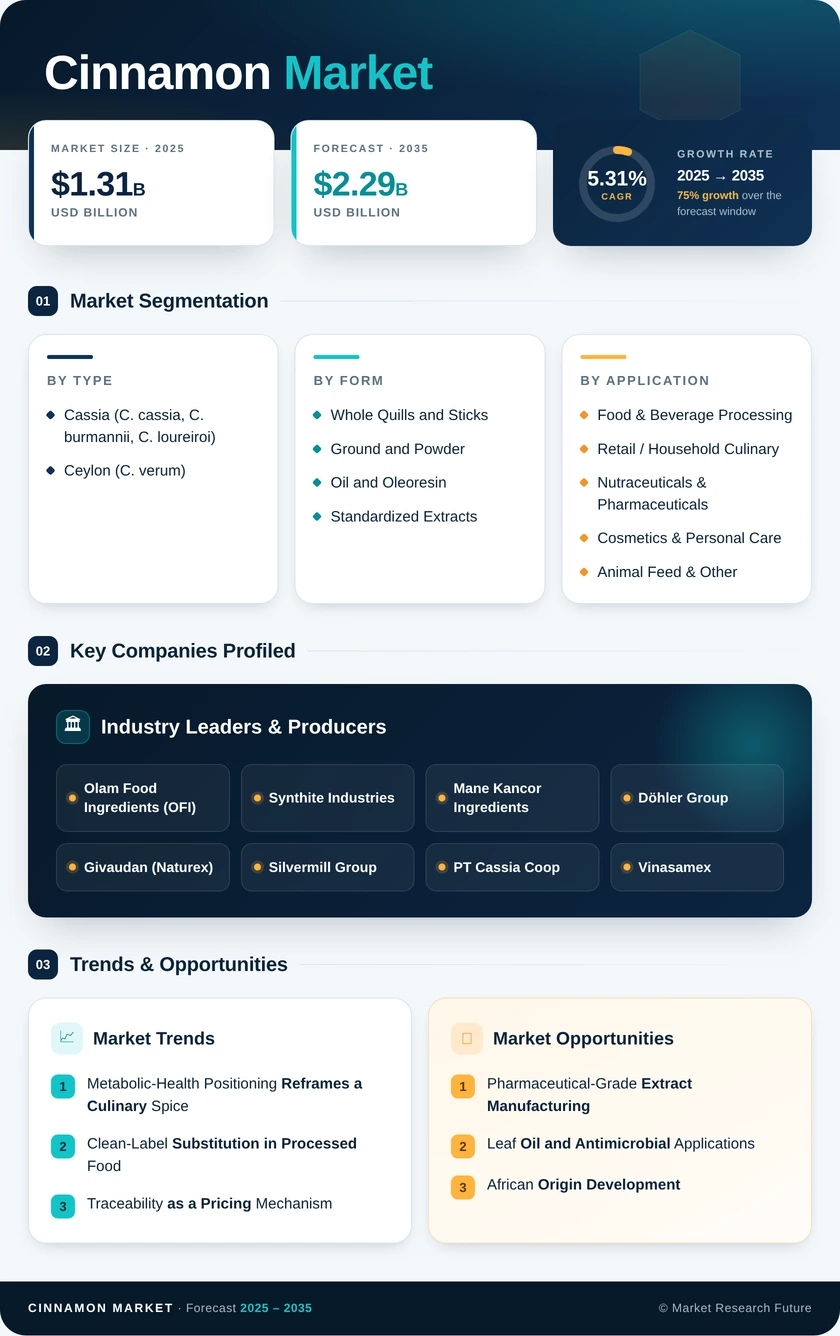
Cinnamon Market
Market Size
Forecast Period2026-2035
CAGR (2026-2035)5.31%
2025 Market SizeUSD 1.31 Billion
2035 Market SizeUSD 2.29 Billion
Key Players
Olam Food Ingredients
Synthite Industries
Mane Kancor Ingredients
Döhler Group
Givaudan
Silvermill Group
Opportunities
  • Pharmaceutical-Grade Extract Manufacturing
  • Leaf Oil and Antimicrobial Applications
  • African Origin Development
  1. 1 Market Overview |
    1. 1.1 Study Assumptions & Market Definition |
    2. 1.2 Scope of the Study |
    3. 1.3 Research Methodology |
    4. 1.4 Market Summary
  2. 2 Key Report Takeaways |
    1. 2.1 By Type & Form |
    2. 2.2 By Application |
    3. 2.3 By Geography
  3. 3 Global Market Size & Forecast (2021–2035) |
    1. 3.1 Historical Market Size (2021–2025) |
    2. 3.2 Current & Forecast Market Size (2026–2035) |
    3. 3.3 Market Size by Revenue (USD billion) |
    4. 3.4 Year-over-Year Growth Analysis
  4. 4 Driver Impact Analysis |
    1. 4.1 Metabolic-Health Positioning Reframes a Culinary Spice |
    2. 4.2 Clean-Label Substitution in Processed Food |
    3. 4.3 Traceability as a Pricing Mechanism |
    4. 4.4 Channel Shift Toward Direct Retail
  5. 5 Restraints Impact Analysis |
    1. 5.1 Coumarin Ceilings Divide the Grade Structure |
    2. 5.2 Supply Concentration Meets Climate Exposure |
    3. 5.3 Labour Scarcity in Bark Peeling
  6. 6 Opportunity Analysis |
    1. 6.1 Pharmaceutical-Grade Extract Manufacturing |
    2. 6.2 Leaf Oil and Antimicrobial Applications |
    3. 6.3 African Origin Development |
    4. 6.4 Traceability Data as a Product |
    5. 6.5 Private-Label Premiumization in Retail |
    6. 6.6 Industry Value Chain Analysis |
    7. 6.7 Porter's Five Forces Analysis
  7. 7 Regional Market Share & Country-Level Analysis |
    1. 7.1 North America | |
      1. 7.1.1 US | |
      2. 7.1.2 Canada | |
      3. 7.1.3 Mexico |
    2. 7.2 Europe | |
      1. 7.2.1 Germany | |
      2. 7.2.2 UK | |
      3. 7.2.3 France | |
      4. 7.2.4 Italy | |
      5. 7.2.5 Spain | |
      6. 7.2.6 Nordic Countries | |
      7. 7.2.7 Russia | |
      8. 7.2.8 Rest of Europe |
    3. 7.3 Asia-Pacific | |
      1. 7.3.1 China | |
      2. 7.3.2 India | |
      3. 7.3.3 Japan | |
      4. 7.3.4 South Korea | |
      5. 7.3.5 ASEAN | |
      6. 7.3.6 Rest of Asia-Pacific |
    4. 7.4 South America | |
      1. 7.4.1 Brazil | |
      2. 7.4.2 Argentina | |
      3. 7.4.3 Rest of South America |
    5. 7.5 Middle East & Africa | |
      1. 7.5.1 Saudi Arabia | |
      2. 7.5.2 UAE | |
      3. 7.5.3 South Africa | |
      4. 7.5.4 Egypt | |
      5. 7.5.5 Rest of Middle East & Africa
  8. 8 Future Outlook (2026–2035) |
    1. 8.1 Precision Agronomy and Machine Grading |
    2. 8.2 Fermentation-Derived Cinnamaldehyde |
    3. 8.3 Deforestation-Free and Carbon-Linked Sourcing |
    4. 8.4 Health-Claim Substantiation Tightens
  9. 9 Market Segmentation Analysis |
    1. 9.1 By Type | |
      1. 9.1.1 Cassia | |
      2. 9.1.2 Ceylon |
    2. 9.2 By Form | |
      1. 9.2.1 Whole Quills and Sticks | |
      2. 9.2.2 Ground and Powder | |
      3. 9.2.3 Oil and Oleoresin | |
      4. 9.2.4 Standardized Extracts |
    3. 9.3 By Application | |
      1. 9.3.1 Food & Beverage Processing | |
      2. 9.3.2 Retail / Household Culinary | |
      3. 9.3.3 Nutraceuticals & Pharmaceuticals | |
      4. 9.3.4 Cosmetics & Personal Care | |
      5. 9.3.5 Animal Feed & Other |
    4. 9.4 By Nature | |
      1. 9.4.1 Organic | |
      2. 9.4.2 Conventional |
    5. 9.5 By Distribution Channel | |
      1. 9.5.1 B2B / Industrial Direct | |
      2. 9.5.2 Modern Trade & Supermarkets | |
      3. 9.5.3 Traditional Trade | |
      4. 9.5.4 E-commerce / DTC
  10. 10 Competitive Landscape |
    1. 10.1 Market Share Analysis (2026) |
    2. 10.2 Competitive Benchmarking Matrix |
    3. 10.3 Company Profiles | |
      1. 10.3.1 McCormick & Company | |
      2. 10.3.2 Olam Food Ingredients (OFI) | |
      3. 10.3.3 Synthite Industries | |
      4. 10.3.4 Mane Kancor Ingredients | |
      5. 10.3.5 Döhler Group | |
      6. 10.3.6 Givaudan (Naturex) | |
      7. 10.3.7 Silvermill Group | |
      8. 10.3.8 PT Cassia Coop | |
      9. 10.3.9 Vinasamex | |
      10. 10.3.10 Frontier Co-op | |
      11. 10.3.11 EOAS Organic (Pvt) Ltd
  11. 11 Recent News & Developments
  12. 12 Report Scope & Methodology |
    1. 12.1 Study Period & Base Year |
    2. 12.2 Valuation Currency & Units |
    3. 12.3 Abbreviations
  13. 13 Detailed Sources & Citations
  14. 14 Frequently Asked Questions
  15. 15 LIST OF TABLES
  16. 16 LIST OF FIGURES

Segmentation Quick Reference

DimensionSub-SegmentsDominant SegmentFastest Growing Segment
By TypeCassia; CeylonCassiaCeylon
By FormWhole Quills and Sticks; Ground and Powder; Oil and Oleoresin; Standardized ExtractsWhole Quills and SticksStandardized Extracts
By ApplicationFood & Beverage Processing; Retail / Household Culinary; Nutraceuticals & Pharmaceuticals; Cosmetics & Personal Care; Animal Feed & OtherFood & Beverage ProcessingNutraceuticals & Pharmaceuticals
By NatureOrganic; ConventionalConventionalOrganic
By Distribution ChannelB2B / Industrial Direct; Modern Trade & Supermarkets; Traditional Trade; E-commerce / DTCB2B / Industrial DirectE-commerce / DTC
By GeographyNorth America; Europe; Asia-Pacific; South America; Middle East & AfricaAsia-PacificMiddle East & Africa


Market Segmentation Overview

By Type

Sub-SegmentKey Trend
CassiaIndustrial buyers hold volume leadership, but European inclusion rates face compliance ceilings.
CeylonLegal origin protection widens the premium over commodity grades rather than narrowing it.


Type selection has stopped being a taste debate and become a regulatory one. Buyers serving markets with coumarin limits engineer their formulations around grade availability, and that constraint sustains a durable two-tier price structure rather than convergence.

By Form

Sub-SegmentKey Trend
Whole Quills and SticksPresentation grade drives retail pricing and supports origin branding
Ground and PowderSteam-sterilized, origin-sealed powder emerges as a distinct anti-adulteration tier.
Oil and OleoresinDistillation of leaf and bark co-products lifts revenue per hectare.
Standardized ExtractsAssay-defined extracts unlock supplement and pharmaceutical accounts.


Value migrates steadily from raw bark toward processed forms. Origin economies that add extraction and sterilization capacity capture margin that historically settled with importers, and national policy in Vietnam and Sri Lanka now explicitly targets that shift.

By Application

Sub-SegmentKey Trend
Food & Beverage ProcessingClean-label reformulation replaces synthetic flavourings in bakery and dairy alternatives.
Retail / Household CulinaryOrigin-designated private label builds premium shelf tiers.
Nutraceuticals & PharmaceuticalsMetabolic-health positioning drives assay-specific procurement.
Cosmetics & Personal CareAntimicrobial and fragrance formulations absorb leaf-oil output.
Animal Feed & OtherGut-health additive trials open an early-stage volume channel.


Industrial processing carries the tonnage while nutraceuticals set the price ceiling. Extract capacity investment follows the smaller, faster segment because contribution margin there dwarfs bulk spice trading.

By Nature

Sub-SegmentKey Trend
OrganicCertified acreage expands fastest in Madagascar, Tanzania, and Vietnam
ConventionalCost optimization sustains volume in price-sensitive industrial accounts.


Certification has become an access requirement for European retail rather than a marketing add-on. Growers who complete audits early secure multi-year offtake, while late adopters remain exposed to spot volatility.

By Distribution Channel

Sub-SegmentKey Trend
B2B / Industrial DirectContract manufacturing and flavour houses anchor bulk volume
Modern Trade & SupermarketsPrivate-label premium tiers carry geographical-indication marks.
Traditional TradeEmerging-market retail density sustains loose-spice volume.
E-commerce / DTCOrigin cooperatives sell small high-grade lots at retail pricing.


Direct channels remain small but strategically important. They let producing-country sellers bypass intermediary layers entirely, and the margin retained funds the certification investment that premium contracts increasingly demand.




Download PDF ×

We do not share your information with anyone. However, we may send you emails based on your report interest from time to time. You may contact us at any time to opt-out.