×
Hero Background
English
Chinese
French
Japanese
Korean
German
Spanish

Chocolate Syrup Market Size

ID: MRFR/FnB/12491-HCR
128 Pages
Snehal Singh
October 2025

Chocolate Syrup Market Research Report Information By Nature (Organic and Conventional), Distribution Channel (B2B and B2C), And By Region (North America, Europe, Asia-Pacific, And Rest Of The World) –Market Forecast Till 2035

Share:
Download PDF ×

We do not share your information with anyone. However, we may send you emails based on your report interest from time to time. You may contact us at any time to opt-out.

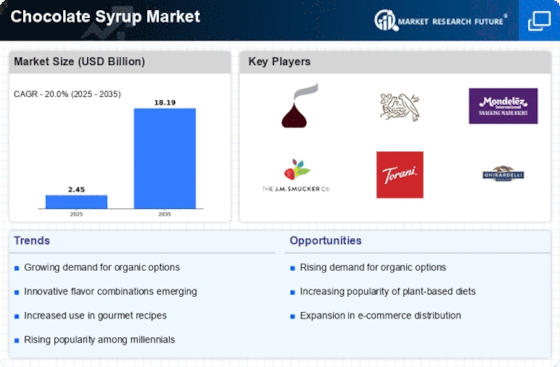
Chocolate Syrup Market Infographic
Purchase Options

Chocolate Syrup Size

The chocolate syrup market is influenced by several key factors that collectively contribute to its growth and dynamics. One significant driver is the enduring popularity of chocolate-flavored products among consumers of all ages. Chocolate syrup, with its rich and indulgent flavor, serves as a versatile topping for desserts, ice creams, and beverages. The universal appeal of chocolate contributes to a consistent demand for chocolate syrup across diverse demographics, making it a staple in many households.

Changing consumer preferences and lifestyle choices also play a pivotal role in shaping the chocolate syrup market. As consumers become more health-conscious, there is a growing demand for healthier and natural ingredients in food products. Market trends reflect a shift towards chocolate syrups with reduced sugar content, organic formulations, and clean-label attributes. Manufacturers are adapting to these preferences by introducing healthier alternatives, such as sugar-free or low-calorie chocolate syrups, to cater to the evolving tastes of health-conscious consumers.

The food and beverage industry's emphasis on innovation and product diversification contributes significantly to the chocolate syrup market. Manufacturers are continually introducing new flavors, formulations, and packaging innovations to capture consumer attention. Chocolate syrup is not only used as a topping but also as an ingredient in various recipes and beverages, expanding its application and market reach. The ability to offer innovative and versatile chocolate syrup options allows companies to stay competitive and meet the dynamic demands of consumers.

Economic factors, including disposable income and purchasing power, also influence the chocolate syrup market. In periods of economic stability and rising incomes, consumers are more willing to spend on indulgent and premium products, including high-quality chocolate syrups. Conversely, during economic downturns, there may be a shift towards more cost-conscious choices. Manufacturers need to consider these economic dynamics and tailor their marketing strategies to align with consumer spending patterns in different economic conditions.

Global cocoa production and supply chain logistics are critical factors affecting the chocolate syrup market. Fluctuations in cocoa prices, weather conditions impacting cocoa crops, and supply chain disruptions can influence the overall cost and availability of chocolate syrup. Market participants must closely monitor these factors to manage production costs, ensure a stable supply chain, and mitigate potential impacts on pricing and product availability.

The influence of cultural and seasonal factors also shapes the chocolate syrup market. In many cultures, chocolate is associated with celebrations, holidays, and special occasions, leading to increased demand during festive periods. Seasonal variations, such as higher consumption during winter months for hot chocolate or summer for ice cream toppings, affect market trends. Manufacturers often capitalize on these cultural and seasonal preferences by launching limited-edition or themed chocolate syrups to boost sales during specific periods.

Distribution channels and retail partnerships are crucial elements in the chocolate syrup market. The accessibility of chocolate syrup products through supermarkets, convenience stores, and online platforms impacts consumer reach and market penetration. Collaborations with retailers and effective distribution strategies contribute to the visibility and availability of chocolate syrup, influencing purchasing decisions and brand loyalty.
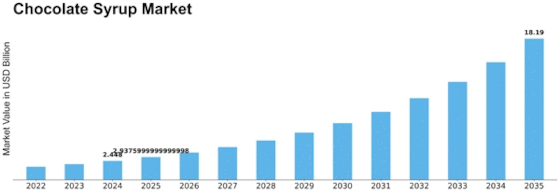

Chocolate Syrup Market Size Graph
Author
Snehal Singh
Assistant Manager - Research

High acumen in analyzing complex macro & micro markets with more than 6 years of work experience in the field of market research. By implementing her analytical skills in forecasting and estimation into market research reports, she has expertise in Packaging, Construction, and Equipment domains. She handles a team size of 20-25 resources and ensures smooth running of the projects, associated marketing activities, and client servicing.

Leave a Comment

FAQs

What is the current valuation of the Chocolate Syrup Market?

The Chocolate Syrup Market was valued at 2.448 USD Billion in 2024.

Market Summary

As per MRFR analysis, the Chocolate Syrup Market Size was estimated at 2.448 USD Billion in 2024. The Chocolate Syrup industry is projected to grow from 2.938 in 2025 to 18.19 by 2035, exhibiting a compound annual growth rate (CAGR) of 20.0 during the forecast period 2025 - 2035.

Key Market Trends & Highlights

The Chocolate Syrup Market is experiencing a dynamic shift towards health-conscious and versatile offerings, driven by evolving consumer preferences.

  • North America remains the largest market for chocolate syrup, characterized by a strong demand for premium products.
  • The Asia-Pacific region is emerging as the fastest-growing market, fueled by increasing urbanization and changing dietary habits.
  • Organic chocolate syrup is the fastest-growing segment, reflecting a rising consumer inclination towards health-conscious choices.
  • The market is driven by innovations in packaging and the increased use of chocolate syrup in food service applications.

Market Size & Forecast

2024 Market Size 2.448 (USD Billion)
2035 Market Size 18.19 (USD Billion)
CAGR (2025 - 2035) 20.0%
Largest Regional Market Share in 2024 North America

Major Players

<p>Hershey's (US), Nestle (CH), Mondelez International (US), Smucker's (US), Torani (US), Ghirardelli (US), Ovaltine (CH), Walden Farms (US)</p>

Market Trends

The Chocolate Syrup Market is currently experiencing a dynamic evolution, driven by shifting consumer preferences and an increasing inclination towards indulgent products. As health consciousness rises, manufacturers are adapting their offerings to include organic and natural ingredients, which appear to resonate well with a segment of the population seeking guilt-free indulgence. This trend suggests a potential for growth in premium chocolate syrups that emphasize quality and sustainability, appealing to environmentally aware consumers. Furthermore, the rise of e-commerce platforms has transformed the way chocolate syrup is marketed and sold, allowing brands to reach a broader audience and enhance customer engagement through targeted promotions and personalized experiences. In addition, the Chocolate Syrup Market is witnessing a diversification of applications beyond traditional uses. While chocolate syrup has long been a staple for desserts and beverages, innovative culinary uses are emerging, such as incorporation into savory dishes and gourmet recipes. This expansion indicates a growing acceptance of chocolate syrup as a versatile ingredient, potentially broadening its consumer base. As the market continues to evolve, it is likely that brands will focus on unique flavor profiles and creative packaging to capture the attention of adventurous consumers, thereby fostering a vibrant and competitive landscape.

Health-Conscious Offerings

The Chocolate Syrup Market is increasingly catering to health-conscious consumers by introducing products with organic and natural ingredients. This trend reflects a broader shift towards healthier eating habits, where consumers seek indulgent options that do not compromise their dietary preferences.

E-Commerce Growth

The rise of e-commerce platforms is reshaping the Chocolate Syrup Market, enabling brands to reach consumers directly. This shift allows for personalized marketing strategies and enhances customer engagement, making it easier for consumers to discover and purchase their favorite products.

Culinary Versatility

Chocolate syrup is finding new applications beyond traditional uses, as innovative culinary practices emerge. This trend suggests that chocolate syrup is being embraced as a versatile ingredient in both sweet and savory dishes, appealing to a wider range of consumers.

Chocolate Syrup Market Market Drivers

Innovations in Packaging

The Chocolate Syrup Market is experiencing a transformation driven by innovations in packaging. Manufacturers are increasingly adopting eco-friendly and convenient packaging solutions to appeal to environmentally conscious consumers. This includes the use of recyclable materials and single-serve packaging, which enhances convenience for on-the-go consumption. Recent data indicates that products with innovative packaging have seen a sales increase of approximately 20% compared to traditional packaging. This trend not only addresses sustainability concerns but also enhances the overall consumer experience. As brands strive to differentiate themselves in a competitive market, the emphasis on packaging innovation is likely to play a crucial role in shaping consumer preferences and driving growth within the Chocolate Syrup Market.

Health and Wellness Trends

The Chocolate Syrup Market is increasingly influenced by health and wellness trends. As consumers become more health-conscious, there is a rising demand for chocolate syrups that offer lower sugar content and natural ingredients. This shift is prompting manufacturers to reformulate their products, introducing options that cater to dietary preferences such as vegan, organic, and gluten-free. Recent market analysis suggests that health-oriented chocolate syrups are projected to grow at a rate of 10% annually, reflecting a significant shift in consumer preferences. This trend not only addresses health concerns but also aligns with the broader movement towards clean label products. Consequently, the Chocolate Syrup Market is adapting to these changes, ensuring that it meets the evolving needs of health-conscious consumers while maintaining flavor and quality.

Increased Use in Food Service

The Chocolate Syrup Market is witnessing a surge in demand from the food service sector. Restaurants, cafes, and dessert shops are increasingly incorporating chocolate syrup into their menus, enhancing the appeal of various dishes and beverages. This trend is particularly evident in the rise of specialty coffee drinks and gourmet desserts that utilize chocolate syrup as a key ingredient. Recent statistics indicate that the food service segment accounts for nearly 30% of total chocolate syrup consumption. This growing reliance on chocolate syrup in food service establishments not only boosts sales but also encourages innovation in product formulations. As establishments strive to differentiate themselves, the Chocolate Syrup Market is likely to benefit from creative applications and unique flavor combinations, further driving market expansion.

Expansion of Distribution Channels

The Chocolate Syrup Market is benefiting from the expansion of distribution channels, particularly through e-commerce platforms. The rise of online shopping has made chocolate syrup more accessible to consumers, allowing for a broader reach beyond traditional retail outlets. Recent statistics reveal that online sales of chocolate syrup have increased by over 25% in the past year, indicating a shift in consumer purchasing behavior. This expansion not only facilitates convenience for consumers but also enables brands to showcase a wider variety of products. As e-commerce continues to grow, the Chocolate Syrup Market is likely to see enhanced competition and innovation, as brands leverage digital marketing strategies to attract and retain customers. This trend underscores the importance of adapting to changing consumer habits in order to thrive in the evolving market landscape.

Rising Demand for Premium Products

The Chocolate Syrup Market experiences a notable shift towards premium and gourmet products. Consumers increasingly seek high-quality ingredients and unique flavors, which drives manufacturers to innovate. This trend is reflected in the growing sales of artisanal chocolate syrups, which often command higher price points. According to recent data, the premium segment of the chocolate syrup market has seen a growth rate of approximately 15% annually. This demand for premium offerings suggests that consumers are willing to invest in superior products, thereby enhancing the overall market value. As a result, brands are focusing on sourcing organic and ethically produced cocoa, which aligns with consumer preferences for sustainability and quality. This shift not only elevates the product offerings but also positions the Chocolate Syrup Market for sustained growth in the coming years.

Market Segment Insights

By Type: Organic (Fastest-Growing) vs. Conventional (Largest)

<p>The Chocolate Syrup Market exhibits a diverse division between Organic and Conventional types. Conventional chocolate syrups currently command the largest market share, appealing to traditional consumer preferences through established brands and widespread availability. Meanwhile, Organic syrups are rapidly gaining traction, particularly among health-conscious consumers seeking cleaner, sustainable options, allowing them to grow at a significant pace. As the demand for organic food products increases, the growth of Organic chocolate syrup is driven by a shift in consumer attitudes towards health and sustainability, influencing purchasing decisions. Many manufacturers are responding to this trend by introducing innovative organic offerings. Furthermore, increased retail presence and marketing efforts are anticipated to propel Organic chocolate syrup into becoming one of the fastest-growing segments of the market in upcoming years.</p>

<p>Chocolate Syrup Market: Conventional (Dominant) vs. Organic (Emerging)</p>

<p>Conventional chocolate syrup remains the dominant segment in the market, characterized by rich flavors, widespread recognition, and numerous variants offered by established brands. This segment benefits from robust distribution channels and consumer trust built over decades, making it a household staple. Meanwhile, Organic chocolate syrup is emerging as a significant player, appealing to environmentally conscious consumers and those seeking healthier lifestyle alternatives. These products typically emphasize natural ingredients, fewer additives, and ethical sourcing, which resonate well with modern buyer preferences. As the health-conscious trend grows, Organic syrups are likely to become even more competitive, narrowing the gap with Conventional options in terms of market presence and consumer adoption.</p>

By Distribution Channel: B2C (Largest) vs. B2B (Fastest-Growing)

<p>In the Chocolate Syrup Market, the distribution of market share is significantly skewed towards the B2C segment, which encompasses retail sales through supermarkets, convenience stores, and online platforms. This dominance reflects changing consumer behavior, where convenience and accessibility play crucial roles in purchasing decisions. On the other hand, the B2B segment, which includes sales to food service providers, restaurants, and manufacturers, holds a smaller share but is rapidly gaining traction as companies seek to integrate chocolate syrup into their product offerings and menu items.</p>

<p>Distribution Channel: B2C (Dominant) vs. B2B (Emerging)</p>

<p>The B2C segment in the Chocolate Syrup Market is characterized by its extensive reach and brand loyalty, driven by aggressive marketing and dynamic product placements. Consumers are increasingly favoring ready-to-use products that enhance their culinary experiences, showcasing the power of brand presence in retail outlets. Conversely, the B2B segment is emerging, propelled by the rising trend of gourmet and artisanal chocolate products. Businesses are increasingly adopting chocolate syrup as a versatile ingredient across various applications, from beverages to desserts, indicating a shift towards greater product innovation and customization in the food service industry.</p>

Get more detailed insights about Chocolate Syrup Market Research Report — Global Forecast till 2035

Regional Insights

North America : Market Leader in Chocolate Syrup Market

North America is the largest market for chocolate syrup, holding approximately 45% of the global share. The region's growth is driven by increasing consumer demand for indulgent products, particularly among millennials and families. Regulatory support for food safety and quality standards further enhances market stability, encouraging innovation and product diversification. The United States is the primary contributor, with key players like Hershey's, Smucker's, and Ghirardelli leading the competitive landscape. The presence of established brands and a strong distribution network facilitate market penetration. Additionally, the trend towards organic and healthier options is prompting companies to innovate, ensuring sustained growth in this lucrative market.

Europe : Emerging Chocolate Syrup Market

Europe is witnessing a growing demand for chocolate syrup, accounting for about 30% of the global market share. The rise in popularity of desserts and beverages featuring chocolate syrup, along with increasing disposable incomes, are key growth drivers. Regulatory frameworks in the EU promote food safety and quality, which further supports market expansion and consumer confidence. Leading countries include Germany, France, and the UK, where brands like Nestle and Mondelez International are prominent. The competitive landscape is characterized by a mix of local and international players, with a focus on premium and organic products. The trend towards healthier alternatives is also influencing product offerings, making the market dynamic and responsive to consumer preferences.

Asia-Pacific : Rapidly Growing Chocolate Market

Asia-Pacific is emerging as a significant player in the chocolate syrup market, holding around 20% of the global share. The region's growth is fueled by rising urbanization, increasing disposable incomes, and a growing preference for Western-style desserts. Regulatory initiatives aimed at improving food safety standards are also contributing to market growth, ensuring consumer trust and product quality. Countries like China, Japan, and India are leading the charge, with a mix of local and international brands competing for market share. Key players such as Torani and Ovaltine are expanding their presence, focusing on innovative flavors and packaging. The competitive landscape is evolving, with a strong emphasis on health-conscious products, catering to the changing tastes of consumers in this diverse region.

Middle East and Africa : Emerging Market Potential

The Middle East and Africa region is gradually developing its chocolate syrup market, currently holding about 5% of the global share. The growth is driven by increasing consumer interest in chocolate products, particularly among younger demographics. Regulatory bodies are beginning to implement food safety standards, which is essential for building consumer confidence and encouraging market growth. Countries like South Africa and the UAE are at the forefront, with local brands and international players like Walden Farms making inroads. The competitive landscape is characterized by a mix of traditional and modern retail channels, with a growing trend towards premium and organic offerings. As the market matures, innovation and quality will be key to capturing consumer interest and expanding market presence.

Key Players and Competitive Insights

The Chocolate Syrup Market is currently characterized by a dynamic competitive landscape, driven by evolving consumer preferences and a growing inclination towards premium and organic products. Major players such as Hershey's (US), Nestle (CH), and Mondelez International (US) are strategically positioning themselves to capitalize on these trends. Hershey's (US) focuses on innovation, particularly in developing new flavors and healthier options, while Nestle (CH) emphasizes sustainability in sourcing cocoa and reducing its carbon footprint. Mondelez International (US) is leveraging its extensive distribution network to enhance market penetration, particularly in emerging markets. Collectively, these strategies not only enhance their competitive edge but also shape the overall market dynamics, fostering a more diverse product offering for consumers.

In terms of business tactics, companies are increasingly localizing manufacturing to reduce costs and improve supply chain efficiency. This approach appears to be particularly effective in a moderately fragmented market, where the collective influence of key players can significantly impact pricing and availability. The competitive structure is evolving, with established brands facing pressure from smaller, niche players that cater to specific dietary preferences, such as vegan or gluten-free options. This shift necessitates a more agile response from larger companies to maintain their market share.

In August 2025, Hershey's (US) announced the launch of a new line of organic chocolate syrups, aiming to meet the rising demand for clean-label products. This strategic move not only aligns with consumer trends towards healthier eating but also positions Hershey's as a leader in the organic segment of the market. The introduction of these products is likely to attract health-conscious consumers and could potentially increase market share in a competitive landscape.

Similarly, in July 2025, Nestle (CH) unveiled its commitment to achieving carbon neutrality across its chocolate syrup production by 2030. This ambitious initiative underscores Nestle's focus on sustainability and may enhance its brand reputation among environmentally conscious consumers. By investing in renewable energy and sustainable sourcing practices, Nestle is likely to strengthen its competitive position in a market increasingly influenced by sustainability concerns.

In September 2025, Mondelez International (US) expanded its distribution partnership with a major online retailer, enhancing its e-commerce capabilities. This strategic action reflects the growing importance of digital channels in reaching consumers, particularly in the wake of changing shopping behaviors. By bolstering its online presence, Mondelez is poised to capture a larger share of the market, especially among younger consumers who prefer shopping online.

As of October 2025, the Chocolate Syrup Market is witnessing significant trends such as digitalization, sustainability, and the integration of artificial intelligence in supply chain management. Strategic alliances are becoming increasingly vital, as companies collaborate to enhance their technological capabilities and sustainability efforts. Looking ahead, competitive differentiation is likely to evolve from traditional price-based competition to a focus on innovation, technology, and supply chain reliability. This shift suggests that companies that prioritize these areas will be better positioned to thrive in an increasingly competitive environment.

Key Companies in the Chocolate Syrup Market market include

Industry Developments

September 2021:  RxSugar, a company that makes healthy organic chocolate syrup, won the award for Best New Product in 2021 from a top food and grocery industry publication. Their chocolate syrup is a better choice compared to regular ones that are filled with lots of sugar, calories, and many ingredients. The award was given because RxSugar's products are innovative, useful, and provide good value.

July 2021: Dabur India has added chocolate and strawberry flavors to its range of honey products, expanding into spreads and syrups. You can use these products by adding them to milk, spreading them on bread, or using them to make desserts like pancakes and waffles. It's a tasty and versatile way to enjoy honey in different flavors.

Future Outlook

Chocolate Syrup Market Future Outlook

<p>The Chocolate Syrup Market is projected to grow at a 20.0% CAGR from 2024 to 2035, driven by increasing consumer demand for indulgent products and innovative flavor offerings.</p>

New opportunities lie in:

  • <p>Expansion into plant-based chocolate syrup alternatives</p>
  • <p>Development of premium, artisanal chocolate syrup lines</p>
  • <p>Implementation of direct-to-consumer online sales platforms</p>

<p>By 2035, the market is expected to achieve robust growth, solidifying its position as a key player in the global food industry.</p>

Market Segmentation

Chocolate Syrup Market Type Outlook

  • Organic
  • Conventional

Chocolate Syrup Market Distribution Channel Outlook

  • B2B
  • B2C

Report Scope

MARKET SIZE 20242.448(USD Billion)
MARKET SIZE 20252.938(USD Billion)
MARKET SIZE 203518.19(USD Billion)
COMPOUND ANNUAL GROWTH RATE (CAGR)20.0% (2024 - 2035)
REPORT COVERAGERevenue Forecast, Competitive Landscape, Growth Factors, and Trends
BASE YEAR2024
Market Forecast Period2025 - 2035
Historical Data2019 - 2024
Market Forecast UnitsUSD Billion
Key Companies ProfiledMarket analysis in progress
Segments CoveredMarket segmentation analysis in progress
Key Market OpportunitiesGrowing demand for organic and healthier chocolate syrup options presents a lucrative market opportunity.
Key Market DynamicsRising consumer preference for organic ingredients drives innovation and competition in the chocolate syrup market.
Countries CoveredNorth America, Europe, APAC, South America, MEA

FAQs

What is the current valuation of the Chocolate Syrup Market?

The Chocolate Syrup Market was valued at 2.448 USD Billion in 2024.

  1. SECTION I: EXECUTIVE SUMMARY AND KEY HIGHLIGHTS
    1. EXECUTIVE SUMMARY
      1. Market Overview
      2. Key Findings
      3. Market Segmentation
      4. Competitive Landscape
      5. Challenges and Opportunities
      6. Future Outlook
  2. SECTION II: SCOPING, METHODOLOGY AND MARKET STRUCTURE
    1. MARKET INTRODUCTION
      1. Definition
      2. Scope of the study
    2. RESEARCH METHODOLOGY
      1. Overview
      2. Data Mining
      3. Secondary Research
      4. Primary Research
      5. Forecasting Model
      6. Market Size Estimation
      7. Data Triangulation
      8. Validation
  3. SECTION III: QUALITATIVE ANALYSIS
    1. MARKET DYNAMICS
      1. Overview
      2. Drivers
      3. Restraints
      4. Opportunities
    2. MARKET FACTOR ANALYSIS
      1. Value chain Analysis
      2. Porter's Five Forces Analysis
      3. COVID-19 Impact Analysis
  4. SECTION IV: QUANTITATIVE ANALYSIS
    1. Food, Beverages & Nutrition, BY Type (USD Billion)
      1. Organic
      2. Conventional
    2. Food, Beverages & Nutrition, BY Distribution Channel (USD Billion)
      1. B2B
      2. B2C
    3. Food, Beverages & Nutrition, BY Region (USD Billion)
      1. North America
      2. Europe
      3. APAC
      4. South America
      5. MEA
  5. SECTION V: COMPETITIVE ANALYSIS
    1. Competitive Landscape
      1. Overview
      2. Competitive Analysis
      3. Market share Analysis
      4. Major Growth Strategy in the Food, Beverages & Nutrition
      5. Competitive Benchmarking
      6. Leading Players in Terms of Number of Developments in the Food, Beverages & Nutrition
      7. Key developments and growth strategies
      8. Major Players Financial Matrix
    2. Company Profiles
      1. Hershey's (US)
      2. Nestle (CH)
      3. Mondelez International (US)
      4. Smucker's (US)
      5. Torani (US)
      6. Ghirardelli (US)
      7. Ovaltine (CH)
      8. Walden Farms (US)
    3. Appendix
      1. References
      2. Related Reports
  6. LIST OF FIGURES
    1. MARKET SYNOPSIS
    2. NORTH AMERICA MARKET ANALYSIS
    3. US MARKET ANALYSIS BY TYPE
    4. US MARKET ANALYSIS BY DISTRIBUTION CHANNEL
    5. CANADA MARKET ANALYSIS BY TYPE
    6. CANADA MARKET ANALYSIS BY DISTRIBUTION CHANNEL
    7. EUROPE MARKET ANALYSIS
    8. GERMANY MARKET ANALYSIS BY TYPE
    9. GERMANY MARKET ANALYSIS BY DISTRIBUTION CHANNEL
    10. UK MARKET ANALYSIS BY TYPE
    11. UK MARKET ANALYSIS BY DISTRIBUTION CHANNEL
    12. FRANCE MARKET ANALYSIS BY TYPE
    13. FRANCE MARKET ANALYSIS BY DISTRIBUTION CHANNEL
    14. RUSSIA MARKET ANALYSIS BY TYPE
    15. RUSSIA MARKET ANALYSIS BY DISTRIBUTION CHANNEL
    16. ITALY MARKET ANALYSIS BY TYPE
    17. ITALY MARKET ANALYSIS BY DISTRIBUTION CHANNEL
    18. SPAIN MARKET ANALYSIS BY TYPE
    19. SPAIN MARKET ANALYSIS BY DISTRIBUTION CHANNEL
    20. REST OF EUROPE MARKET ANALYSIS BY TYPE
    21. REST OF EUROPE MARKET ANALYSIS BY DISTRIBUTION CHANNEL
    22. APAC MARKET ANALYSIS
    23. CHINA MARKET ANALYSIS BY TYPE
    24. CHINA MARKET ANALYSIS BY DISTRIBUTION CHANNEL
    25. INDIA MARKET ANALYSIS BY TYPE
    26. INDIA MARKET ANALYSIS BY DISTRIBUTION CHANNEL
    27. JAPAN MARKET ANALYSIS BY TYPE
    28. JAPAN MARKET ANALYSIS BY DISTRIBUTION CHANNEL
    29. SOUTH KOREA MARKET ANALYSIS BY TYPE
    30. SOUTH KOREA MARKET ANALYSIS BY DISTRIBUTION CHANNEL
    31. MALAYSIA MARKET ANALYSIS BY TYPE
    32. MALAYSIA MARKET ANALYSIS BY DISTRIBUTION CHANNEL
    33. THAILAND MARKET ANALYSIS BY TYPE
    34. THAILAND MARKET ANALYSIS BY DISTRIBUTION CHANNEL
    35. INDONESIA MARKET ANALYSIS BY TYPE
    36. INDONESIA MARKET ANALYSIS BY DISTRIBUTION CHANNEL
    37. REST OF APAC MARKET ANALYSIS BY TYPE
    38. REST OF APAC MARKET ANALYSIS BY DISTRIBUTION CHANNEL
    39. SOUTH AMERICA MARKET ANALYSIS
    40. BRAZIL MARKET ANALYSIS BY TYPE
    41. BRAZIL MARKET ANALYSIS BY DISTRIBUTION CHANNEL
    42. MEXICO MARKET ANALYSIS BY TYPE
    43. MEXICO MARKET ANALYSIS BY DISTRIBUTION CHANNEL
    44. ARGENTINA MARKET ANALYSIS BY TYPE
    45. ARGENTINA MARKET ANALYSIS BY DISTRIBUTION CHANNEL
    46. REST OF SOUTH AMERICA MARKET ANALYSIS BY TYPE
    47. REST OF SOUTH AMERICA MARKET ANALYSIS BY DISTRIBUTION CHANNEL
    48. MEA MARKET ANALYSIS
    49. GCC COUNTRIES MARKET ANALYSIS BY TYPE
    50. GCC COUNTRIES MARKET ANALYSIS BY DISTRIBUTION CHANNEL
    51. SOUTH AFRICA MARKET ANALYSIS BY TYPE
    52. SOUTH AFRICA MARKET ANALYSIS BY DISTRIBUTION CHANNEL
    53. REST OF MEA MARKET ANALYSIS BY TYPE
    54. REST OF MEA MARKET ANALYSIS BY DISTRIBUTION CHANNEL
    55. KEY BUYING CRITERIA OF FOOD, BEVERAGES & NUTRITION
    56. RESEARCH PROCESS OF MRFR
    57. DRO ANALYSIS OF FOOD, BEVERAGES & NUTRITION
    58. DRIVERS IMPACT ANALYSIS: FOOD, BEVERAGES & NUTRITION
    59. RESTRAINTS IMPACT ANALYSIS: FOOD, BEVERAGES & NUTRITION
    60. SUPPLY / VALUE CHAIN: FOOD, BEVERAGES & NUTRITION
    61. FOOD, BEVERAGES & NUTRITION, BY TYPE, 2024 (% SHARE)
    62. FOOD, BEVERAGES & NUTRITION, BY TYPE, 2024 TO 2035 (USD Billion)
    63. FOOD, BEVERAGES & NUTRITION, BY DISTRIBUTION CHANNEL, 2024 (% SHARE)
    64. FOOD, BEVERAGES & NUTRITION, BY DISTRIBUTION CHANNEL, 2024 TO 2035 (USD Billion)
    65. BENCHMARKING OF MAJOR COMPETITORS
  7. LIST OF TABLES
    1. LIST OF ASSUMPTIONS
    2. North America MARKET SIZE ESTIMATES; FORECAST
      1. BY TYPE, 2025-2035 (USD Billion)
      2. BY DISTRIBUTION CHANNEL, 2025-2035 (USD Billion)
    3. US MARKET SIZE ESTIMATES; FORECAST
      1. BY TYPE, 2025-2035 (USD Billion)
      2. BY DISTRIBUTION CHANNEL, 2025-2035 (USD Billion)
    4. Canada MARKET SIZE ESTIMATES; FORECAST
      1. BY TYPE, 2025-2035 (USD Billion)
      2. BY DISTRIBUTION CHANNEL, 2025-2035 (USD Billion)
    5. Europe MARKET SIZE ESTIMATES; FORECAST
      1. BY TYPE, 2025-2035 (USD Billion)
      2. BY DISTRIBUTION CHANNEL, 2025-2035 (USD Billion)
    6. Germany MARKET SIZE ESTIMATES; FORECAST
      1. BY TYPE, 2025-2035 (USD Billion)
      2. BY DISTRIBUTION CHANNEL, 2025-2035 (USD Billion)
    7. UK MARKET SIZE ESTIMATES; FORECAST
      1. BY TYPE, 2025-2035 (USD Billion)
      2. BY DISTRIBUTION CHANNEL, 2025-2035 (USD Billion)
    8. France MARKET SIZE ESTIMATES; FORECAST
      1. BY TYPE, 2025-2035 (USD Billion)
      2. BY DISTRIBUTION CHANNEL, 2025-2035 (USD Billion)
    9. Russia MARKET SIZE ESTIMATES; FORECAST
      1. BY TYPE, 2025-2035 (USD Billion)
      2. BY DISTRIBUTION CHANNEL, 2025-2035 (USD Billion)
    10. Italy MARKET SIZE ESTIMATES; FORECAST
      1. BY TYPE, 2025-2035 (USD Billion)
      2. BY DISTRIBUTION CHANNEL, 2025-2035 (USD Billion)
    11. Spain MARKET SIZE ESTIMATES; FORECAST
      1. BY TYPE, 2025-2035 (USD Billion)
      2. BY DISTRIBUTION CHANNEL, 2025-2035 (USD Billion)
    12. Rest of Europe MARKET SIZE ESTIMATES; FORECAST
      1. BY TYPE, 2025-2035 (USD Billion)
      2. BY DISTRIBUTION CHANNEL, 2025-2035 (USD Billion)
    13. APAC MARKET SIZE ESTIMATES; FORECAST
      1. BY TYPE, 2025-2035 (USD Billion)
      2. BY DISTRIBUTION CHANNEL, 2025-2035 (USD Billion)
    14. China MARKET SIZE ESTIMATES; FORECAST
      1. BY TYPE, 2025-2035 (USD Billion)
      2. BY DISTRIBUTION CHANNEL, 2025-2035 (USD Billion)
    15. India MARKET SIZE ESTIMATES; FORECAST
      1. BY TYPE, 2025-2035 (USD Billion)
      2. BY DISTRIBUTION CHANNEL, 2025-2035 (USD Billion)
    16. Japan MARKET SIZE ESTIMATES; FORECAST
      1. BY TYPE, 2025-2035 (USD Billion)
      2. BY DISTRIBUTION CHANNEL, 2025-2035 (USD Billion)
    17. South Korea MARKET SIZE ESTIMATES; FORECAST
      1. BY TYPE, 2025-2035 (USD Billion)
      2. BY DISTRIBUTION CHANNEL, 2025-2035 (USD Billion)
    18. Malaysia MARKET SIZE ESTIMATES; FORECAST
      1. BY TYPE, 2025-2035 (USD Billion)
      2. BY DISTRIBUTION CHANNEL, 2025-2035 (USD Billion)
    19. Thailand MARKET SIZE ESTIMATES; FORECAST
      1. BY TYPE, 2025-2035 (USD Billion)
      2. BY DISTRIBUTION CHANNEL, 2025-2035 (USD Billion)
    20. Indonesia MARKET SIZE ESTIMATES; FORECAST
      1. BY TYPE, 2025-2035 (USD Billion)
      2. BY DISTRIBUTION CHANNEL, 2025-2035 (USD Billion)
    21. Rest of APAC MARKET SIZE ESTIMATES; FORECAST
      1. BY TYPE, 2025-2035 (USD Billion)
      2. BY DISTRIBUTION CHANNEL, 2025-2035 (USD Billion)
    22. South America MARKET SIZE ESTIMATES; FORECAST
      1. BY TYPE, 2025-2035 (USD Billion)
      2. BY DISTRIBUTION CHANNEL, 2025-2035 (USD Billion)
    23. Brazil MARKET SIZE ESTIMATES; FORECAST
      1. BY TYPE, 2025-2035 (USD Billion)
      2. BY DISTRIBUTION CHANNEL, 2025-2035 (USD Billion)
    24. Mexico MARKET SIZE ESTIMATES; FORECAST
      1. BY TYPE, 2025-2035 (USD Billion)
      2. BY DISTRIBUTION CHANNEL, 2025-2035 (USD Billion)
    25. Argentina MARKET SIZE ESTIMATES; FORECAST
      1. BY TYPE, 2025-2035 (USD Billion)
      2. BY DISTRIBUTION CHANNEL, 2025-2035 (USD Billion)
    26. Rest of South America MARKET SIZE ESTIMATES; FORECAST
      1. BY TYPE, 2025-2035 (USD Billion)
      2. BY DISTRIBUTION CHANNEL, 2025-2035 (USD Billion)
    27. MEA MARKET SIZE ESTIMATES; FORECAST
      1. BY TYPE, 2025-2035 (USD Billion)
      2. BY DISTRIBUTION CHANNEL, 2025-2035 (USD Billion)
    28. GCC Countries MARKET SIZE ESTIMATES; FORECAST
      1. BY TYPE, 2025-2035 (USD Billion)
      2. BY DISTRIBUTION CHANNEL, 2025-2035 (USD Billion)
    29. South Africa MARKET SIZE ESTIMATES; FORECAST
      1. BY TYPE, 2025-2035 (USD Billion)
      2. BY DISTRIBUTION CHANNEL, 2025-2035 (USD Billion)
    30. Rest of MEA MARKET SIZE ESTIMATES; FORECAST
      1. BY TYPE, 2025-2035 (USD Billion)
      2. BY DISTRIBUTION CHANNEL, 2025-2035 (USD Billion)
    31. PRODUCT LAUNCH/PRODUCT DEVELOPMENT/APPROVAL
    32. ACQUISITION/PARTNERSHIP

Chocolate Syrup Market Segmentation

Market Segmentation Overview

  • Detailed segmentation data will be available in the full report
  • Comprehensive analysis by multiple parameters
  • Regional and country-level breakdowns
  • Market size forecasts by segment
Infographic

Free Sample Request

Kindly complete the form below to receive a free sample of this Report

Get Free Sample

Customer Strories

Compare Licence

×
Features License Type
Single User Multiuser License Enterprise User
Price $4,950 $5,950 $7,250
Maximum User Access Limit 1 User Upto 10 Users Unrestricted Access Throughout the Organization
Free Customization
Direct Access to Analyst
Deliverable Format
Platform Access
Discount on Next Purchase 10% 15% 15%
Printable Versions