×
Request Free Sample ×

Kindly complete the form below to receive a free sample of this Report

* Please use a valid business email

Leading companies partner with us for data-driven Insights

clients tt-cursor
Hero Background
English
Chinese
French
Japanese
Korean
German
Spanish

China RO Antiscalant Market Size

ID: MRFR/CnM/16267-HCR
128 Pages
Chitranshi Jaiswal
October 2025

China RO Antiscalant Market Research Report Information By Type (Neutral pH Antiscalant, Broad Spectrum Antiscalant, Other), By Application (Brackish Water, Sea Water, Other) – Market Forecast Till 2035

Share:
Download PDF ×

We do not share your information with anyone. However, we may send you emails based on your report interest from time to time. You may contact us at any time to opt-out.

China RO Antiscalant Market Infographic
Purchase Options

China Ro Antiscalant Size

China RO Antiscalant Market Growth Projections and Opportunities

The growth and significance of water treatment industry in the China Reverse Osmosis (RO) Antiscalant Market is influenced by many market factors. The rapid industrialization and urbanization of China are one of the main drivers of this market. Increasing urban populations and growing industries have resulted in increased demand for water treatment solutions with reverse osmosis playing a critical role. RO antiscalants contribute significantly to maintaining the performance efficiency of water treatment processes through preventing scaling and fouling of membranes in RO systems. Industrial activities increase together with demand for clean water, thus driving up the need for RO antiscalants in China.

China’s government policies and regulations shape the China RO Antiscalant Market. The Chinese government has put into place strict regulations regarding water quality and treatment standards because they recognize the importance of conserving water as well as protecting environment. Efficiency compliance demands that effective antiscalants be used in RO systems according to these laws. Government measures oriented towards addressing issues related to scarcity of water and improving its quality also enhance adoption rates for advanced water treatment technologies thus contributing to growth within the market segment.

The technological development in terms of processes for treating waters greatly affect China RO Antiscalant Market. Ongoing researches focus on improving performance as well as efficiency levels of RO antiscalants. Formulation and application innovations support production of more effective antiscalants by manufacturers capable of preventing scaling, prolonging life expectancy for RO membranes plus increasing overall system’s efficiency. Manufacturers must keep pace with these technological changes so as to respond to changing demands from their customers who are mostly based in China.

Water conservation awareness affects the market demand too. Concerns over shortages plus contamination have compelled various industries as well as municipalities within China to invest heavily into modernized forms of water treatments. The use, however, can be traced back when it was realized that scaling prevention is important since it helps maintain efficiency in reverse osmosis systems; thus, more RO antiscalants are being adopted as a part of integrated water treatment approach. The market is responding to increasing consciousness among the end-users about why scaling has to be prevented and why RO membrane life should be maintained.

Investment decision making and market dynamics for the China RO Antiscalant Market are also influenced by economic factors. This demand covers the entire spectrum of water treatment solutions including RO antiscalants as driven by economic growth, industrial activities and infrastructure development. Industries seeking reliable and sustainable water treatment options have pivotal considerations such as cost-effectiveness and efficiency of antiscalant products. On the other hand, economic stability will determine whether or not industries will find it necessary to invest in advanced water treatment technologies.

The China RO Antiscalant Market is affected by supply chain performance indicators that include raw material availability as well as logistic efficiencies. Sourcing raw materials for production of antiscalants and establishing efficient supply chains are crucial for meeting the ever-increasing market demands. Manufacturers must establish reliable supply chains capable of delivering these products fast enough to all water treatment facilities in China whenever needed.
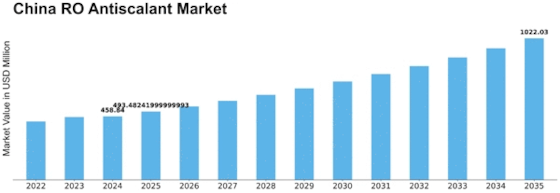
China RO Antiscalant Market Size Graph
Author
Chitranshi Jaiswal
Research Analyst Level I

In her 3 years of experience in the market research field, she has handled critical cross-domain projects. She has an in-depth knowledge of market estimation & analysis, problem-solving, primary as well as secondary research, and team management.She holds an engineering degree and is an MBA professional from a well-known university, capable of evaluating the market and competitive conditions. An exceptional strategist with excellent communication skills and a passion for delivering cutting-edge & practical insights for the market. Proficient in multi-tasking, and can successfully deal with competing demands, while maintaining complete confidentiality. Generated business through active client and project development, networking, and high-quality responses. Her knowledge and skills have helped in making solid business decisions, securing funding from investors, and avoiding business failures.

Leave a Comment

FAQs

What is the current valuation of the China RO antiscalant market?

The market valuation was 150.0 USD Million in 2024.

What is the projected market size for the China RO antiscalant market by 2035?

The projected valuation for 2035 is 256.2 USD Million.

What is the expected CAGR for the China RO antiscalant market during the forecast period?

The expected CAGR for the market from 2025 to 2035 is 4.99%.

Which companies are the key players in the China RO antiscalant market?

Key players include BASF, Dow, Solvay, Kemira, SUEZ, GE Water, Lanxess, Nitto Denko, and AkzoNobel.

What are the main application segments of the China RO antiscalant market?

Main application segments include desalination, wastewater treatment, industrial water treatment, power generation, and food and beverage processing.

Market Summary

As per analysis, the China ro antiscalant market is projected to grow from USD 150.0 Million in 2024 to USD 256.2 Million by 2035, exhibiting a compound annual growth rate (CAGR) of 4.99% during the forecast period (2025 - 2035).

Key Market Trends & Highlights

The China RO antiscalant market is poised for growth driven by sustainability and technological advancements.

  • The desalination segment remains the largest contributor to the market, reflecting a robust demand for freshwater resources.
  • Liquid antiscalants dominate the market, while powder antiscalants are emerging as the fastest-growing segment.
  • Technological innovations in water treatment are enhancing efficiency and effectiveness in both desalination and wastewater treatment processes.
  • Increasing water scarcity and rising awareness of water quality are key drivers propelling market expansion.

Market Size & Forecast

2024 Market Size 150.0 (USD Million)
2035 Market Size 256.2 (USD Million)
CAGR (2025 - 2035) 4.99%

Major Players

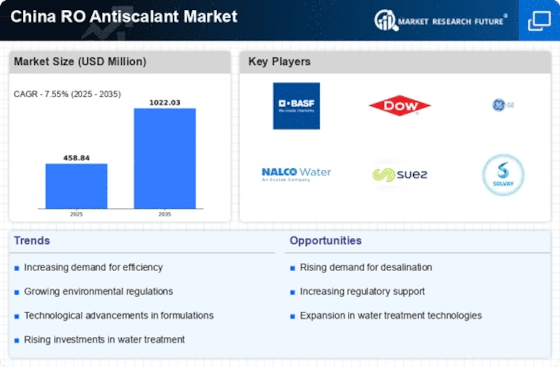
<p>BASF (DE), Dow (US), Solvay (BE), Kemira (FI), SUEZ (FR), GE Water (US), Lanxess (DE), Nitto Denko (JP), AkzoNobel (NL)</p>

Market Trends

The china ro antiscalant market is currently experiencing a dynamic evolution, driven by increasing industrialization and the growing demand for water treatment solutions. As industries expand, the need for efficient reverse osmosis systems becomes paramount, leading to a heightened focus on antiscalant products that prevent scaling and fouling in membranes. This trend is further supported by government initiatives aimed at promoting sustainable water management practices, which encourage the adoption of advanced technologies in water treatment processes. The regulatory framework in China appears to be increasingly favorable, fostering innovation and investment in the sector. Moreover, the market landscape is characterized by a diverse range of applications, spanning from municipal water treatment to industrial processes. The rising awareness of water scarcity issues has prompted various sectors to seek effective solutions, thereby enhancing the relevance of antiscalants in maintaining operational efficiency. As the market continues to mature, it is likely that manufacturers will focus on developing eco-friendly formulations that align with environmental regulations. This shift towards sustainability may redefine product offerings and influence consumer preferences in the china ro antiscalant market.

Sustainability Focus

There is a noticeable shift towards eco-friendly formulations in the china ro antiscalant market. Manufacturers are increasingly developing products that minimize environmental impact, aligning with government regulations and consumer preferences for sustainable solutions.

Technological Advancements

The market is witnessing rapid technological innovations aimed at enhancing the efficiency of antiscalants. New formulations and application techniques are being introduced, which could potentially improve performance and reduce costs for end-users.

Regulatory Support

Government policies are playing a crucial role in shaping the china ro antiscalant market. Initiatives promoting water conservation and treatment efficiency are likely to drive demand for antiscalants, as industries seek compliance with evolving standards.

China RO Antiscalant Market Market Drivers

Increasing Water Scarcity

The growing concern over water scarcity in China is a pivotal driver for the China RO antiscalant market. As urbanization and industrialization continue to escalate, the demand for clean water has surged. According to recent data, approximately 400 cities in China face water shortages, prompting industries to seek efficient water treatment solutions. Reverse osmosis (RO) systems, aided by antiscalants, are increasingly adopted to enhance water recovery rates and reduce operational costs. This trend indicates a robust market potential for antiscalants, as industries strive to optimize water usage and comply with stringent environmental regulations. The China RO antiscalant market is thus positioned to benefit from this pressing need for sustainable water management solutions.

Industrial Growth and Expansion

China's rapid industrial growth is a significant driver for the China RO antiscalant market. The country has witnessed a substantial increase in manufacturing and processing sectors, which require efficient water treatment solutions to meet production demands. Industries such as textiles, food and beverage, and pharmaceuticals are increasingly utilizing RO systems to ensure high-quality water for their operations. The market for antiscalants is projected to grow as these industries seek to mitigate scaling issues that can hinder production efficiency. In 2025, the industrial water treatment market in China was valued at over USD 10 billion, indicating a strong correlation between industrial expansion and the demand for effective antiscalants in the China RO antiscalant market.

Rising Awareness of Water Quality

There is a growing awareness among industries in China regarding the importance of water quality, which serves as a key driver for the China RO antiscalant market. As consumers become more conscious of the quality of products they consume, industries are compelled to ensure that their water sources meet high standards. This trend is particularly evident in sectors such as food and beverage, where water quality directly impacts product safety and quality. Consequently, the demand for RO systems, supported by effective antiscalants, is on the rise. The China RO antiscalant market is thus likely to experience growth as industries prioritize water quality in their operational strategies.

Government Regulations and Policies

The Chinese government has implemented stringent regulations aimed at improving water quality and promoting sustainable practices, which significantly influence the China RO antiscalant market. Policies encouraging the adoption of advanced water treatment technologies are driving industries to invest in RO systems and associated antiscalants. The Ministry of Ecology and Environment has set ambitious targets for water resource management, which necessitates the use of effective antiscalants to ensure compliance with water quality standards. This regulatory support is likely to create a favorable environment for the growth of the antiscalant market, as industries seek to align with government initiatives and enhance their operational efficiency.

Technological Innovations in Water Treatment

Technological advancements in water treatment processes are driving the China RO antiscalant market. Innovations such as advanced membrane technologies and improved formulations of antiscalants are enhancing the efficiency and effectiveness of RO systems. These developments not only improve the lifespan of membranes but also reduce the frequency of maintenance, thereby lowering operational costs for industries. The introduction of eco-friendly antiscalants is also gaining traction, aligning with China's sustainability goals. As industries increasingly adopt these advanced technologies, the demand for high-performance antiscalants is expected to rise, further propelling the growth of the China RO antiscalant market.

Market Segment Insights

By Application: Desalination (Largest) vs. Wastewater Treatment (Fastest-Growing)

<p>In the China RO antiscalant market, the application segment is primarily dominated by desalination, which has been recognized as the largest segment due to the increasing need for fresh water in arid regions. Wastewater treatment is gaining ground rapidly, driven by stringent regulations aimed at improving water quality and recycling efforts. As industries and municipalities invest in advanced wastewater management systems, the demand for effective antiscalants in this segment continues to rise. The growth trends in the application segment reveal that while desalination remains critical, the wastewater treatment sector is expected to experience the fastest growth in the coming years. This growth is driven by the rise in industrial activities and the subsequent increase in wastewater generation, along with the need for sustainable practices in water use. Furthermore, government initiatives promoting water reuse and environmental protection are accelerating investment in this sector, creating new opportunities for antiscalant products in the Chinese market.</p>

<p>Desalination (Dominant) vs. Industrial Water Treatment (Emerging)</p>

<p>Desalination serves as the dominant application in the China RO antiscalant market, primarily due to its necessity in providing sustainable water sources. This segment benefits from extensive projects and investments aimed at expanding fresh water access, particularly in coastal regions. On the other hand, industrial water treatment is categorized as an emerging application, gaining traction from the rapid growth of industrial sectors, including manufacturing, pharmaceuticals, and food processing. With increasing water quality requirements and changing regulations, industries are adopting advanced filtering technologies, creating a significant need for antiscalants to optimize system performance. The evolving landscape in industrial applications indicates a shift towards more efficient and eco-friendly water treatment solutions.</p>

By Formulation Type: Liquid Antiscalants (Largest) vs. Powder Antiscalants (Fastest-Growing)

<p>In the China RO antiscalant market, Liquid Antiscalants dominate the landscape, holding the largest share due to their ease of use and effectiveness in preventing scaling in reverse osmosis systems. They are widely adopted across various industries, including water treatment and desalination. Powder Antiscalants, while currently smaller in market share, are gaining traction as their effectiveness in different formulations is being recognized. Granular and Tablet Antiscalants constitute niche markets, primarily catering to specific application needs and preferences.</p>

<p>Liquid Antiscalants (Dominant) vs. Powder Antiscalants (Emerging)</p>

<p>Liquid Antiscalants are regarded as the dominant formulation type in the China RO antiscalant market due to their superior solubility and immediate availability for use in various applications. They are preferred for their convenience and consistent performance, particularly in large-scale industrial applications. On the other hand, Powder Antiscalants are emerging as a viable alternative, gaining popularity due to their customizable formulation and concentrated nature, which appeals to industries seeking cost-effective solutions without compromising performance. As awareness of the advantages of Powder Antiscalants grows, they are expected to capture a larger market share in the coming years.</p>

By End Use Industry: Municipal Water Supply (Largest) vs. Oil and Gas (Fastest-Growing)

<p>In the China RO antiscalant market, the Municipal Water Supply sector stands as the dominant player, capturing a significant share of the overall market. This sector's demand is driven by the increasing need for clean and safe drinking water in urban areas. In contrast, the Oil and Gas sector is rapidly emerging, fueled by accelerated industrial activities and advancements in drilling techniques that increase water usage, necessitating effective antiscalant solutions to prevent scaling in reverse osmosis systems.</p>

<p>Water Supply (Dominant) vs. Oil and Gas (Emerging)</p>

<p>The Municipal Water Supply segment is characterized by its stable demand for RO antiscalants, largely due to municipal investments in water treatment infrastructure. This sector is adept at managing large volumes of water, ensuring its quality for public consumption. Meanwhile, the Oil and Gas segment is witnessing a surge in demand for antiscalants as exploration and production activities escalate, driving the need for efficient water management solutions. As a result, the sector is gaining ground and is expected to witness significant growth, showcasing its emergent nature in the China RO antiscalant market.</p>

By Distribution Channel: Direct Sales (Largest) vs. Distributors (Fastest-Growing)

<p>In the China RO antiscalant market, Direct Sales holds a significant share, making it the largest distribution channel. Companies prefer this method to build closer relationships with clients and offer tailored solutions. Distributors, while currently smaller in market share compared to Direct Sales, are rapidly growing as businesses seek to expand their reach and leverage local expertise. As awareness of the importance of water treatment increases, these channels adapt by enhancing their service offerings.</p>

<p>Direct Sales (Dominant) vs. Online Sales (Emerging)</p>

<p>Direct Sales remain the dominant distribution channel in the China RO antiscalant market due to their ability to foster client relationships and customize solutions. This traditional method allows companies to directly engage with end-users, ensuring that the specific needs of various industries are met effectively. In contrast, Online Sales are emerging, driven by the rising trend of digitalization and the need for convenience. While Online Sales are gaining traction among tech-savvy customers and new entrants, they still lack the personalized service found in Direct Sales. However, as e-commerce continues to evolve, Online Sales have the potential to reshape purchasing behaviors in the segment.</p>

By Customer Type: Large Enterprises (Largest) vs. Small and Medium Enterprises (Fastest-Growing)

<p>In the China RO antiscalant market, Large Enterprises currently hold the largest market share, catering predominantly to industries with significant water treatment needs. These enterprises invest heavily in advanced technologies, ensuring efficient scaling control in their operations. Small and Medium Enterprises (SMEs) follow closely, leveraging innovation and flexibility to adapt to market demands while capturing a growing customer base. Their share has increased as more SMEs recognize the necessity of effective antiscalant solutions for improved operational efficiency. The growth trends in this segment are propelled by the ongoing industrialization and urbanization in China which significantly increases water demand and quality requirements. Large Enterprises are investing in sustainable practices, while SMEs are capitalizing on niche markets and cost-effective solutions. Regulatory support and rising awareness about water scarcity further drive the adoption of RO antiscalants across customer types, making it an exciting time for both segments as they navigate competitive landscapes and seek growth opportunities.</p>

<p>Large Enterprises: Dominant vs. Small and Medium Enterprises: Emerging</p>

<p>Large Enterprises in the China RO antiscalant market are characterized by their robust capabilities and substantial influence in decision-making processes, often dictating market trends and standards. They emphasize the use of advanced and effective solutions to minimize scaling in water treatment processes, aligning with environmental regulations. This dominance affords them economies of scale, enabling investments in research and development to innovate their product offerings. Conversely, Small and Medium Enterprises are emerging players that harness agility and innovation to fill market gaps. They focus on providing customer-centric solutions tailored to specific industry requirements, making them vital in expanding the overall market. With lower overheads, SMEs can compete on price and flexibility, appealing to a broader clientele.</p>

Get more detailed insights about China RO Antiscalant Market Research Report—Forecast till 2035

Regional Insights

North America : Innovation and Sustainability Focus

The North American RO antiscalant market is driven by stringent environmental regulations and a growing emphasis on sustainable water management practices. The region is characterized by advanced technological innovations and a strong demand for high-performance antiscalants. Currently, North America holds approximately 35% of the global market share, making it the largest market for RO antiscalants, followed closely by Europe at 30%. Leading countries in this region include the United States and Canada, where major players like Dow and GE Water & Process Technologies dominate the landscape. The competitive environment is marked by continuous product development and strategic partnerships among key players. The presence of established companies ensures a robust supply chain and innovation in antiscalant formulations, catering to diverse industrial applications.

Europe : Regulatory-Driven Market Dynamics

Europe's RO antiscalant market is significantly influenced by the European Union's stringent regulations on water quality and environmental sustainability. The region is witnessing a growing demand for eco-friendly antiscalants, driven by initiatives aimed at reducing chemical usage in water treatment processes. Europe currently holds about 30% of the global market share, making it the second-largest market after North America. Key players in this region include BASF and Solvay, which are actively involved in developing innovative solutions that comply with regulatory standards. Countries like Germany and France are at the forefront, with a competitive landscape that encourages collaboration between industry leaders and research institutions. This synergy fosters advancements in antiscalant technology, ensuring compliance with evolving regulations and market needs.

Asia-Pacific : Emerging Market Potential

The Asia-Pacific RO antiscalant market is experiencing rapid growth, driven by increasing industrialization and urbanization. Countries like China and India are leading this growth, with China holding approximately 25% of the global market share, making it a significant player in the antiscalant market. The demand for efficient water treatment solutions is further fueled by government initiatives aimed at improving water quality and availability. China is home to key players such as Tianjin Hengtong and Shandong Jiahua, which are expanding their product offerings to meet the rising demand. The competitive landscape is characterized by a mix of local and international companies, fostering innovation and price competition. As the region continues to develop, the focus on sustainable water management practices is expected to drive further growth in the RO antiscalant market.

Middle East and Africa : Resource Management Challenges

The Middle East and Africa region faces unique challenges in water resource management, leading to an increasing demand for RO antiscalants. The arid climate and limited freshwater resources necessitate efficient water treatment solutions, with the market expected to grow significantly in the coming years. Currently, this region holds about 10% of the global market share, with countries like Saudi Arabia and South Africa leading the demand. The competitive landscape is evolving, with both local and international players vying for market share. Companies are focusing on developing tailored solutions that address the specific needs of the region, such as high salinity levels in water sources. The presence of key players and ongoing investments in water infrastructure are expected to drive market growth in the Middle East and Africa.

Key Players and Competitive Insights

The competitive dynamics within the China RO antiscalant market are characterized by a blend of innovation, strategic partnerships, and a focus on sustainability. Key players such as BASF (DE), Dow (US), and Solvay (BE) are actively shaping the landscape through their operational strategies. BASF (DE) emphasizes innovation in product development, particularly in eco-friendly formulations, which aligns with the growing demand for sustainable solutions. Dow (US) focuses on regional expansion and digital transformation, leveraging advanced technologies to enhance operational efficiency. Solvay (BE) is strategically positioned through partnerships aimed at enhancing its product portfolio and market reach, collectively influencing the competitive environment by fostering a culture of collaboration and innovation.

The market structure appears moderately fragmented, with several players vying for market share. Key business tactics such as localizing manufacturing and optimizing supply chains are prevalent among these companies. This localized approach not only reduces operational costs but also enhances responsiveness to market demands. The collective influence of these major players contributes to a competitive landscape where agility and adaptability are paramount, allowing them to navigate the complexities of the market effectively.

In December 2025, Dow (US) announced a strategic partnership with a leading Chinese water treatment company to co-develop advanced antiscalant solutions tailored for local applications. This collaboration is significant as it not only strengthens Dow's foothold in the region but also enhances its ability to deliver customized solutions that meet specific customer needs. Such partnerships are likely to drive innovation and improve market penetration, positioning Dow favorably against its competitors.

In November 2025, BASF (DE) launched a new line of biodegradable antiscalants aimed at reducing environmental impact. This initiative reflects BASF's commitment to sustainability and aligns with global trends towards eco-friendly products. The introduction of these innovative solutions is expected to attract environmentally conscious customers, thereby enhancing BASF's competitive edge in the market.

In October 2025, Solvay (BE) expanded its production capacity in China by investing in a state-of-the-art facility dedicated to the manufacturing of antiscalants. This expansion is crucial as it not only increases Solvay's output but also positions the company to better serve the growing demand in the region. The investment underscores Solvay's long-term commitment to the market and its strategy to enhance operational efficiency through localized production.

As of January 2026, current trends in the China RO antiscalant market indicate a strong shift towards digitalization, sustainability, and the integration of AI technologies. Strategic alliances are increasingly shaping the competitive landscape, enabling companies to pool resources and expertise. The evolution of competitive differentiation appears to be moving away from price-based competition towards a focus on innovation, technological advancements, and supply chain reliability. This shift suggests that companies that prioritize these aspects are likely to gain a competitive advantage in the future.

Key Companies in the China RO Antiscalant Market include

Industry Developments

Future Outlook

China RO Antiscalant Market Future Outlook

The China RO antiscalant market is projected to grow at a 4.99% CAGR from 2025 to 2035, driven by increasing industrial water treatment needs and technological advancements.

New opportunities lie in:

  • Development of eco-friendly antiscalants for sustainable practices.
  • Expansion into emerging markets with tailored product offerings.
  • Integration of smart monitoring systems for real-time performance optimization.

By 2035, the market is expected to achieve robust growth, positioning itself as a leader in water treatment solutions.

Market Segmentation

China RO Antiscalant Market Application Outlook

  • Desalination
  • Wastewater Treatment
  • Industrial Water Treatment
  • Power Generation
  • Food and Beverage Processing

China RO Antiscalant Market Customer Type Outlook

  • Large Enterprises
  • Small and Medium Enterprises
  • Government Agencies
  • Non-Governmental Organizations

China RO Antiscalant Market End Use Industry Outlook

  • Municipal Water Supply
  • Oil and Gas
  • Chemical Processing
  • Pharmaceuticals
  • Mining

China RO Antiscalant Market Formulation Type Outlook

  • Liquid Antiscalants
  • Powder Antiscalants
  • Granular Antiscalants
  • Tablet Antiscalants

China RO Antiscalant Market Distribution Channel Outlook

  • Direct Sales
  • Distributors
  • Online Sales
  • Retail

Report Scope

MARKET SIZE 2024150.0(USD Million)
MARKET SIZE 2025158.4(USD Million)
MARKET SIZE 2035256.2(USD Million)
COMPOUND ANNUAL GROWTH RATE (CAGR)4.99% (2024 - 2035)
REPORT COVERAGERevenue Forecast, Competitive Landscape, Growth Factors, and Trends
BASE YEAR2024
Market Forecast Period2025 - 2035
Historical Data2019 - 2024
Market Forecast UnitsUSD Million
Key Companies ProfiledBASF (DE), Dow (US), Solvay (BE), Kemira (FI), SUEZ (FR), GE Water (US), Lanxess (DE), Nitto Denko (JP), AkzoNobel (NL)
Segments CoveredApplication, Formulation Type, End Use Industry, Distribution Channel, Customer Type
Key Market OpportunitiesGrowing demand for sustainable water treatment solutions drives innovation in the china ro antiscalant market.
Key Market DynamicsRising demand for efficient water treatment solutions drives innovation in China's reverse osmosis antiscalant market.
Countries CoveredChina

FAQs

What is the current valuation of the China RO antiscalant market?

The market valuation was 150.0 USD Million in 2024.

What is the projected market size for the China RO antiscalant market by 2035?

The projected valuation for 2035 is 256.2 USD Million.

What is the expected CAGR for the China RO antiscalant market during the forecast period?

The expected CAGR for the market from 2025 to 2035 is 4.99%.

Which companies are the key players in the China RO antiscalant market?

Key players include BASF, Dow, Solvay, Kemira, SUEZ, GE Water, Lanxess, Nitto Denko, and AkzoNobel.

What are the main application segments of the China RO antiscalant market?

Main application segments include desalination, wastewater treatment, industrial water treatment, power generation, and food and beverage processing.

  1. SECTION I: EXECUTIVE SUMMARY AND KEY HIGHLIGHTS
    1. EXECUTIVE SUMMARY
      1. Market Overview
      2. Key Findings
      3. Market Segmentation
      4. Competitive Landscape
      5. Challenges and Opportunities
      6. Future Outlook
  2. SECTION II: SCOPING, METHODOLOGY AND MARKET STRUCTURE
    1. MARKET INTRODUCTION
      1. Definition
      2. Scope of the study
    2. RESEARCH METHODOLOGY
      1. Overview
      2. Data Mining
      3. Secondary Research
      4. Primary Research
      5. Forecasting Model
      6. Market Size Estimation
      7. Data Triangulation
      8. Validation
  3. SECTION III: QUALITATIVE ANALYSIS
    1. MARKET DYNAMICS
      1. Overview
      2. Drivers
      3. Restraints
      4. Opportunities
    2. MARKET FACTOR ANALYSIS
      1. Value chain Analysis
      2. Porter's Five Forces Analysis
      3. COVID-19 Impact Analysis
  4. SECTION IV: QUANTITATIVE ANALYSIS
    1. Chemicals and Materials, BY Type (USD Million)
      1. Neutral pH Antiscalant
      2. Broad Spectrum Antiscalant
      3. Other
    2. Chemicals and Materials, BY Application (USD Million)
      1. Brackish Water
      2. Sea Water
      3. Other
    3. Chemicals and Materials, BY Region (USD Million)
      1. North America
      2. Europe
      3. APAC
      4. South America
      5. MEA
  5. SECTION V: COMPETITIVE ANALYSIS
    1. Competitive Landscape
      1. Overview
      2. Competitive Analysis
      3. Market share Analysis
      4. Major Growth Strategy in the Chemicals and Materials
      5. Competitive Benchmarking
      6. Leading Players in Terms of Number of Developments in the Chemicals and Materials
      7. Key developments and growth strategies
      8. Major Players Financial Matrix
    2. Company Profiles
      1. BASF (DE)
      2. Dow (US)
      3. GE Water & Process Technologies (US)
      4. Nalco Water (US)
      5. SUEZ Water Technologies & Solutions (US)
      6. Solvay (BE)
      7. Koch Membrane Systems (US)
      8. Tianjin Hengtong (CN)
      9. Shandong Jiahua (CN)
    3. Appendix
      1. References
      2. Related Reports
  6. LIST OF FIGURES
    1. MARKET SYNOPSIS
    2. NORTH AMERICA MARKET ANALYSIS
    3. US MARKET ANALYSIS BY TYPE
    4. US MARKET ANALYSIS BY APPLICATION
    5. CANADA MARKET ANALYSIS BY TYPE
    6. CANADA MARKET ANALYSIS BY APPLICATION
    7. EUROPE MARKET ANALYSIS
    8. GERMANY MARKET ANALYSIS BY TYPE
    9. GERMANY MARKET ANALYSIS BY APPLICATION
    10. UK MARKET ANALYSIS BY TYPE
    11. UK MARKET ANALYSIS BY APPLICATION
    12. FRANCE MARKET ANALYSIS BY TYPE
    13. FRANCE MARKET ANALYSIS BY APPLICATION
    14. RUSSIA MARKET ANALYSIS BY TYPE
    15. RUSSIA MARKET ANALYSIS BY APPLICATION
    16. ITALY MARKET ANALYSIS BY TYPE
    17. ITALY MARKET ANALYSIS BY APPLICATION
    18. SPAIN MARKET ANALYSIS BY TYPE
    19. SPAIN MARKET ANALYSIS BY APPLICATION
    20. REST OF EUROPE MARKET ANALYSIS BY TYPE
    21. REST OF EUROPE MARKET ANALYSIS BY APPLICATION
    22. APAC MARKET ANALYSIS
    23. CHINA MARKET ANALYSIS BY TYPE
    24. CHINA MARKET ANALYSIS BY APPLICATION
    25. INDIA MARKET ANALYSIS BY TYPE
    26. INDIA MARKET ANALYSIS BY APPLICATION
    27. JAPAN MARKET ANALYSIS BY TYPE
    28. JAPAN MARKET ANALYSIS BY APPLICATION
    29. SOUTH KOREA MARKET ANALYSIS BY TYPE
    30. SOUTH KOREA MARKET ANALYSIS BY APPLICATION
    31. MALAYSIA MARKET ANALYSIS BY TYPE
    32. MALAYSIA MARKET ANALYSIS BY APPLICATION
    33. THAILAND MARKET ANALYSIS BY TYPE
    34. THAILAND MARKET ANALYSIS BY APPLICATION
    35. INDONESIA MARKET ANALYSIS BY TYPE
    36. INDONESIA MARKET ANALYSIS BY APPLICATION
    37. REST OF APAC MARKET ANALYSIS BY TYPE
    38. REST OF APAC MARKET ANALYSIS BY APPLICATION
    39. SOUTH AMERICA MARKET ANALYSIS
    40. BRAZIL MARKET ANALYSIS BY TYPE
    41. BRAZIL MARKET ANALYSIS BY APPLICATION
    42. MEXICO MARKET ANALYSIS BY TYPE
    43. MEXICO MARKET ANALYSIS BY APPLICATION
    44. ARGENTINA MARKET ANALYSIS BY TYPE
    45. ARGENTINA MARKET ANALYSIS BY APPLICATION
    46. REST OF SOUTH AMERICA MARKET ANALYSIS BY TYPE
    47. REST OF SOUTH AMERICA MARKET ANALYSIS BY APPLICATION
    48. MEA MARKET ANALYSIS
    49. GCC COUNTRIES MARKET ANALYSIS BY TYPE
    50. GCC COUNTRIES MARKET ANALYSIS BY APPLICATION
    51. SOUTH AFRICA MARKET ANALYSIS BY TYPE
    52. SOUTH AFRICA MARKET ANALYSIS BY APPLICATION
    53. REST OF MEA MARKET ANALYSIS BY TYPE
    54. REST OF MEA MARKET ANALYSIS BY APPLICATION
    55. KEY BUYING CRITERIA OF CHEMICALS AND MATERIALS
    56. RESEARCH PROCESS OF MRFR
    57. DRO ANALYSIS OF CHEMICALS AND MATERIALS
    58. DRIVERS IMPACT ANALYSIS: CHEMICALS AND MATERIALS
    59. RESTRAINTS IMPACT ANALYSIS: CHEMICALS AND MATERIALS
    60. SUPPLY / VALUE CHAIN: CHEMICALS AND MATERIALS
    61. CHEMICALS AND MATERIALS, BY TYPE, 2024 (% SHARE)
    62. CHEMICALS AND MATERIALS, BY TYPE, 2024 TO 2035 (USD Million)
    63. CHEMICALS AND MATERIALS, BY APPLICATION, 2024 (% SHARE)
    64. CHEMICALS AND MATERIALS, BY APPLICATION, 2024 TO 2035 (USD Million)
    65. BENCHMARKING OF MAJOR COMPETITORS
  7. LIST OF TABLES
    1. LIST OF ASSUMPTIONS
    2. North America MARKET SIZE ESTIMATES; FORECAST
      1. BY TYPE, 2025-2035 (USD Million)
      2. BY APPLICATION, 2025-2035 (USD Million)
    3. US MARKET SIZE ESTIMATES; FORECAST
      1. BY TYPE, 2025-2035 (USD Million)
      2. BY APPLICATION, 2025-2035 (USD Million)
    4. Canada MARKET SIZE ESTIMATES; FORECAST
      1. BY TYPE, 2025-2035 (USD Million)
      2. BY APPLICATION, 2025-2035 (USD Million)
    5. Europe MARKET SIZE ESTIMATES; FORECAST
      1. BY TYPE, 2025-2035 (USD Million)
      2. BY APPLICATION, 2025-2035 (USD Million)
    6. Germany MARKET SIZE ESTIMATES; FORECAST
      1. BY TYPE, 2025-2035 (USD Million)
      2. BY APPLICATION, 2025-2035 (USD Million)
    7. UK MARKET SIZE ESTIMATES; FORECAST
      1. BY TYPE, 2025-2035 (USD Million)
      2. BY APPLICATION, 2025-2035 (USD Million)
    8. France MARKET SIZE ESTIMATES; FORECAST
      1. BY TYPE, 2025-2035 (USD Million)
      2. BY APPLICATION, 2025-2035 (USD Million)
    9. Russia MARKET SIZE ESTIMATES; FORECAST
      1. BY TYPE, 2025-2035 (USD Million)
      2. BY APPLICATION, 2025-2035 (USD Million)
    10. Italy MARKET SIZE ESTIMATES; FORECAST
      1. BY TYPE, 2025-2035 (USD Million)
      2. BY APPLICATION, 2025-2035 (USD Million)
    11. Spain MARKET SIZE ESTIMATES; FORECAST
      1. BY TYPE, 2025-2035 (USD Million)
      2. BY APPLICATION, 2025-2035 (USD Million)
    12. Rest of Europe MARKET SIZE ESTIMATES; FORECAST
      1. BY TYPE, 2025-2035 (USD Million)
      2. BY APPLICATION, 2025-2035 (USD Million)
    13. APAC MARKET SIZE ESTIMATES; FORECAST
      1. BY TYPE, 2025-2035 (USD Million)
      2. BY APPLICATION, 2025-2035 (USD Million)
    14. China MARKET SIZE ESTIMATES; FORECAST
      1. BY TYPE, 2025-2035 (USD Million)
      2. BY APPLICATION, 2025-2035 (USD Million)
    15. India MARKET SIZE ESTIMATES; FORECAST
      1. BY TYPE, 2025-2035 (USD Million)
      2. BY APPLICATION, 2025-2035 (USD Million)
    16. Japan MARKET SIZE ESTIMATES; FORECAST
      1. BY TYPE, 2025-2035 (USD Million)
      2. BY APPLICATION, 2025-2035 (USD Million)
    17. South Korea MARKET SIZE ESTIMATES; FORECAST
      1. BY TYPE, 2025-2035 (USD Million)
      2. BY APPLICATION, 2025-2035 (USD Million)
    18. Malaysia MARKET SIZE ESTIMATES; FORECAST
      1. BY TYPE, 2025-2035 (USD Million)
      2. BY APPLICATION, 2025-2035 (USD Million)
    19. Thailand MARKET SIZE ESTIMATES; FORECAST
      1. BY TYPE, 2025-2035 (USD Million)
      2. BY APPLICATION, 2025-2035 (USD Million)
    20. Indonesia MARKET SIZE ESTIMATES; FORECAST
      1. BY TYPE, 2025-2035 (USD Million)
      2. BY APPLICATION, 2025-2035 (USD Million)
    21. Rest of APAC MARKET SIZE ESTIMATES; FORECAST
      1. BY TYPE, 2025-2035 (USD Million)
      2. BY APPLICATION, 2025-2035 (USD Million)
    22. South America MARKET SIZE ESTIMATES; FORECAST
      1. BY TYPE, 2025-2035 (USD Million)
      2. BY APPLICATION, 2025-2035 (USD Million)
    23. Brazil MARKET SIZE ESTIMATES; FORECAST
      1. BY TYPE, 2025-2035 (USD Million)
      2. BY APPLICATION, 2025-2035 (USD Million)
    24. Mexico MARKET SIZE ESTIMATES; FORECAST
      1. BY TYPE, 2025-2035 (USD Million)
      2. BY APPLICATION, 2025-2035 (USD Million)
    25. Argentina MARKET SIZE ESTIMATES; FORECAST
      1. BY TYPE, 2025-2035 (USD Million)
      2. BY APPLICATION, 2025-2035 (USD Million)
    26. Rest of South America MARKET SIZE ESTIMATES; FORECAST
      1. BY TYPE, 2025-2035 (USD Million)
      2. BY APPLICATION, 2025-2035 (USD Million)
    27. MEA MARKET SIZE ESTIMATES; FORECAST
      1. BY TYPE, 2025-2035 (USD Million)
      2. BY APPLICATION, 2025-2035 (USD Million)
    28. GCC Countries MARKET SIZE ESTIMATES; FORECAST
      1. BY TYPE, 2025-2035 (USD Million)
      2. BY APPLICATION, 2025-2035 (USD Million)
    29. South Africa MARKET SIZE ESTIMATES; FORECAST
      1. BY TYPE, 2025-2035 (USD Million)
      2. BY APPLICATION, 2025-2035 (USD Million)
    30. Rest of MEA MARKET SIZE ESTIMATES; FORECAST
      1. BY TYPE, 2025-2035 (USD Million)
      2. BY APPLICATION, 2025-2035 (USD Million)
    31. PRODUCT LAUNCH/PRODUCT DEVELOPMENT/APPROVAL
    32. ACQUISITION/PARTNERSHIP

China RO Antiscalant Market Segmentation

Market Segmentation Overview

  • Detailed segmentation data will be available in the full report
  • Comprehensive analysis by multiple parameters
  • Regional and country-level breakdowns
  • Market size forecasts by segment
Infographic

Free Sample Request

Kindly complete the form below to receive a free sample of this Report

Get Free Sample

Customer Strories

Compare Licence

×
Features License Type
Single User Multiuser License Enterprise User
Price $4,950 $5,950 $7,250
Maximum User Access Limit 1 User Upto 10 Users Unrestricted Access Throughout the Organization
Free Customization
Direct Access to Analyst
Deliverable Format
Platform Access
Discount on Next Purchase 10% 15% 15%
Printable Versions