Childrenswear Market

ID: MRFR/CG/14573-HCR
128 Pages
Varsha More
Last Updated: June 03, 2026
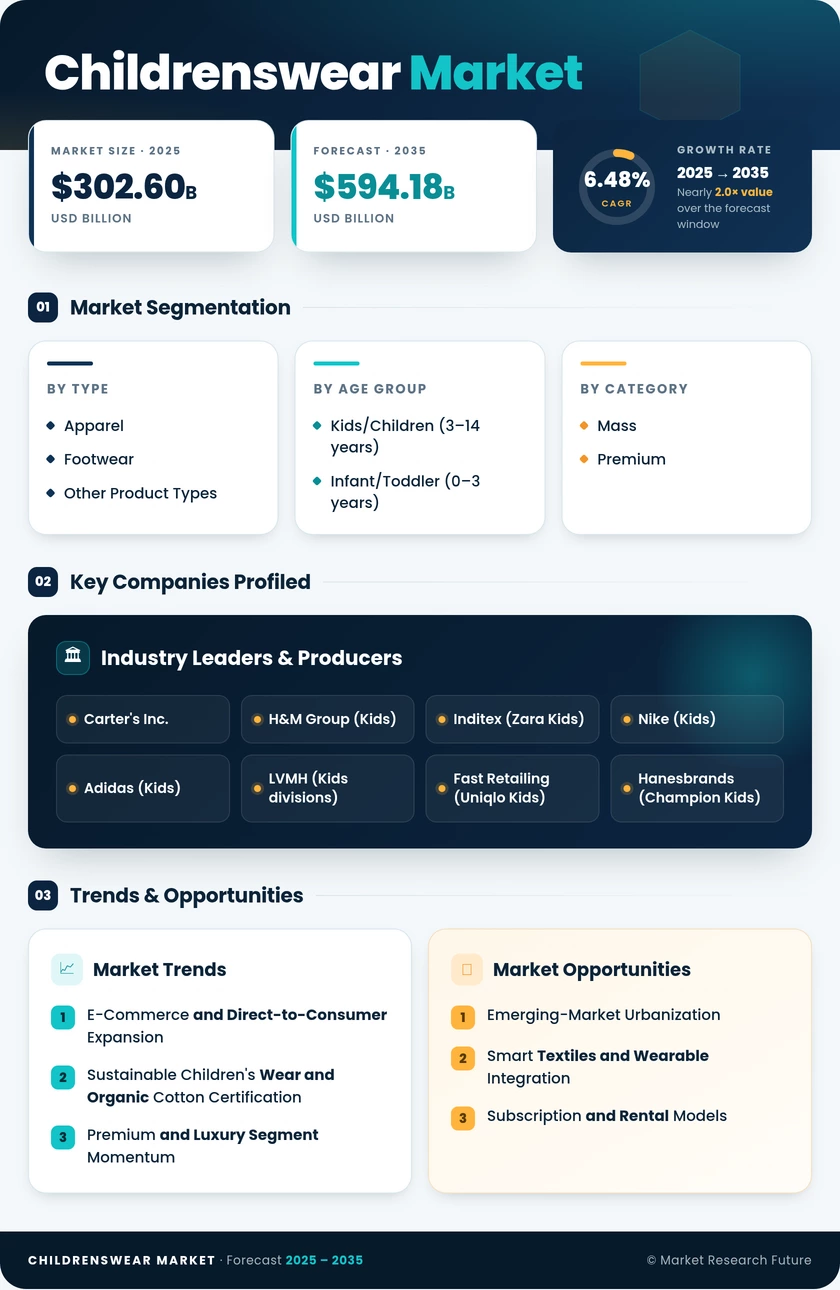
Global Childrenswear Market Size, Share, Industry Trend & Analysis Research Report: By Product Type (Apparel, Footwear, Other Product Types), By Age Group (Infant/Toddler, Kids/Children), By Category (Mass, Premium), By Distribution Channel (Offline Stores, Online Stores), By Geography (North America, Europe, Asia-Pacific, South America, Middle East & Africa) - Forecast to 2035.
Download PDF ×

We do not share your information with anyone. However, we may send you emails based on your report interest from time to time. You may contact us at any time to opt-out.

  1. 1 Market Overview |
    1. 1.1 Study Assumptions & Market Definition |
    2. 1.2 Scope of the Study |
    3. 1.3 Research Methodology
  2. 2 Market Summary & Key Takeaways
  3. 3 Market Dynamics |
    1. 3.1 Market Drivers Analysis | |
      1. 3.1.1 E-Commerce and Direct-to-Consumer Expansion | |
      2. 3.1.2 Sustainable Children's Wear and Organic Cotton Certification | |
      3. 3.1.3 School Uniform Policies as Volume Anchors | |
      4. 3.1.4 Premium and Luxury Segment Momentum | |
      5. 3.1.5 Rising Birth Rates and Demographic Tailwinds | |
      6. 3.1.6 AI-Driven Production and Inventory Optimization | |
      7. 3.1.7 Adaptive-Fit and Gender-Neutral Collections |
    2. 3.2 Market Restraints Analysis | |
      1. 3.2.1 Declining Birth Rates in Developed Economies | |
      2. 3.2.2 Fast Fashion Regulatory Pressure | |
      3. 3.2.3 Cotton and Input Cost Volatility | |
      4. 3.2.4 Counterfeit and Unregulated Imports | |
      5. 3.2.5 Consumer Trade-Down During Economic Slowdowns |
    3. 3.3 Market Opportunity Analysis | |
      1. 3.3.1 Resale and Circular Economy Platforms | |
      2. 3.3.2 Emerging-Market Urbanization | |
      3. 3.3.3 Smart Textiles and Wearable Integration | |
      4. 3.3.4 Subscription and Rental Models | |
      5. 3.3.5 Data-Driven Personalization |
    4. 3.4 Industry Value Chain Analysis |
    5. 3.5 Porter's Five Forces Analysis
  4. 4 Global Childrenswear Market Size & Forecast (2021–2035) |
    1. 4.1 Historical Market Size (2021–2025) |
    2. 4.2 Current & Forecast Market Size (2026–2035) |
    3. 4.3 Market Size by Revenue (USD Billion) |
    4. 4.4 Year-over-Year Growth Analysis
  5. 5 Segmentation Analysis |
    1. 5.1 By Product Type | |
      1. 5.1.1 Apparel | |
      2. 5.1.2 Footwear | |
      3. 5.1.3 Other Product Types |
    2. 5.2 By Age Group | |
      1. 5.2.1 Infant/Toddler (0–3 Years) | |
      2. 5.2.2 Kids/Children (3–14 Years) |
    3. 5.3 By Category | |
      1. 5.3.1 Mass | |
      2. 5.3.2 Premium |
    4. 5.4 By Distribution Channel | |
      1. 5.4.1 Offline Stores | |
      2. 5.4.2 Online Stores
  6. 6 Regional Analysis |
    1. 6.1 North America | |
      1. 6.1.1 United States | |
      2. 6.1.2 Canada | |
      3. 6.1.3 Mexico |
    2. 6.2 Europe | |
      1. 6.2.1 Germany | |
      2. 6.2.2 United Kingdom | |
      3. 6.2.3 France | |
      4. 6.2.4 Italy | |
      5. 6.2.5 Spain | |
      6. 6.2.6 Nordic Countries | |
      7. 6.2.7 Russia | |
      8. 6.2.8 Rest of Europe |
    3. 6.3 Asia-Pacific | |
      1. 6.3.1 China | |
      2. 6.3.2 India | |
      3. 6.3.3 Japan | |
      4. 6.3.4 South Korea | |
      5. 6.3.5 ASEAN | |
      6. 6.3.6 Rest of Asia-Pacific |
    4. 6.4 South America | |
      1. 6.4.1 Brazil | |
      2. 6.4.2 Argentina | |
      3. 6.4.3 Rest of South America |
    5. 6.5 Middle East & Africa | |
      1. 6.5.1 Saudi Arabia | |
      2. 6.5.2 UAE | |
      3. 6.5.3 South Africa | |
      4. 6.5.4 Egypt | |
      5. 6.5.5 Rest of MEA
  7. 7 Competitive Landscape |
    1. 7.1 Market Share Analysis (2025) |
    2. 7.2 Competitive Benchmarking Matrix |
    3. 7.3 Company Profiles | |
      1. 7.3.1 Carter's Inc. | |
      2. 7.3.2 H&M Group (Kids) | |
      3. 7.3.3 Inditex (Zara Kids) | |
      4. 7.3.4 Nike (Kids) | |
      5. 7.3.5 Adidas (Kids) | |
      6. 7.3.6 LVMH (Kids Divisions) | |
      7. 7.3.7 Fast Retailing (Uniqlo Kids) | |
      8. 7.3.8 Hanesbrands (Champion Kids) | |
      9. 7.3.9 Mothercare PLC | |
      10. 7.3.10 Burberry Children
  8. 8 Future Outlook & Strategic Recommendations (2026–2035) |
    1. 8.1 AI-Powered Design and On-Demand Manufacturing |
    2. 8.2 Platform Economics and Marketplace Consolidation |
    3. 8.3 Sustainability Reporting and ESG Integration |
    4. 8.4 Inclusive Design as a Growth Catalyst
  9. 9 Recent Developments & News
  10. 10 Frequently Asked Questions (FAQs)
  11. 11 Report Scope & Methodology |
    1. 11.1 Study Period & Base Year |
    2. 11.2 Data Sources & Citations |
    3. 11.3 Abbreviations
  12. 12 LIST OF TABLES |
  13. TABLE 1 Global Childrenswear Market Size & Forecast, by Revenue (USD Billion), 2021–2035 |
  14. TABLE 2 Global Childrenswear Market – Year-over-Year Growth Analysis, 2021–2035 |
  15. TABLE 3 Global Children's Wear Market – Driver Impact Analysis |
  16. TABLE 4 Global Children's Wear Market – Restraints Impact Analysis |
  17. TABLE 5 Global Children's Wear Market – Regional Summary Table |
  18. TABLE 6 North America Childrenswear Market Size, by Country, 2021–2035 (USD Billion) |
  19. TABLE 7 Europe Childrenswear Market Size, by Country, 2021–2035 (USD Billion) |
  20. TABLE 8 Asia-Pacific Childrenswear Market Size, by Country, 2021–2035 (USD Billion) |
  21. TABLE 9 South America Childrenswear Market Size, by Country, 2021–2035 (USD Billion) |
  22. TABLE 10 Middle East & Africa Childrenswear Market Size, by Country, 2021–2035 (USD Billion) |
  23. TABLE 11 Global Childrenswear Market Size, by Product Type, 2021–2035 (USD Billion) |
  24. TABLE 12 Global Children's Wear Market Size, by Age Group, 2021–2035 (USD Billion) |
  25. TABLE 13 Global Children's Wear Market Size, by Category, 2021–2035 (USD Billion) |
  26. TABLE 14 Global Children's Wear Market Size, by Distribution Channel, 2021–2035 (USD Billion) |
  27. TABLE 15 Competitive Benchmarking Matrix – Global Childrenswear Market, 2025 |
  28. TABLE 16 Company Profiles – Key Players, Global Childrenswear Market |
  29. TABLE 17 Recent Developments & Strategic Announcements, 2024–2025 |
  30. TABLE 18 Report Scope & Methodology |
  31. TABLE 19 Detailed Sources & Citations
  32. 13 LIST OF FIGURES |
  33. FIGURE 1 Global Children's Wear Market Dynamics – Drivers, Restraints, and Opportunities |
  34. FIGURE 2 Industry Value Chain Analysis – Children's Wear Market |
  35. FIGURE 3 Porter's Five Forces Analysis – Childrenswear Market |
  36. FIGURE 4 Global Childrenswear Market Size Trend (USD Billion), 2021–2035 |
  37. FIGURE 5 Global Childrenswear Market Share, by Product Type, 2025 |
  38. FIGURE 6 Global Children's Wear Market Share, by Age Group, 2025 |
  39. FIGURE 7 Global Childrenswear Market Share, by Category, 2025 |
  40. FIGURE 8 Global Childrenswear Market Share, by Distribution Channel, 2025 |
  41. FIGURE 9 Global Childrenswear Market Share, by Region, 2025 |
  42. FIGURE 10 North America Childrenswear Market Share, by Country, 2025 |
  43. FIGURE 11 Europe Childrenswear Market Share, by Country, 2025 |
  44. FIGURE 12 Asia-Pacific Childrenswear Market Share, by Country, 2025 |
  45. FIGURE 13 South America Childrenswear Market Share, by Country, 2025 |
  46. FIGURE 14 Middle East & Africa Childrenswear Market Share, by Country, 2025 |
  47. FIGURE 15 Competitive Landscape – Market Share Analysis, 2025

Segmentation Quick Reference

DimensionSub-SegmentsDominant SegmentFastest Growing Segment
Product TypeApparel, Footwear, Other Product TypesApparelFootwear
Age GroupInfant/Toddler, Kids/ChildrenKids/ChildrenInfant/Toddler
CategoryMass, PremiumMassPremium
Distribution ChannelOffline Stores, Online StoresOffline StoresOnline Stores
GeographyNorth America, Europe, Asia-Pacific, South America, Middle East & AfricaAsia-PacificAsia-Pacific


Market Segmentation Overview

By Product Type

Sub-SegmentKey Trend
ApparelEveryday basics, school uniforms, and sustainable organic cotton lines drive the highest volume.
FootwearAthletic crossover designs and adaptive-fit shoes accelerate growth.
Other Product TypesAccessories, hats, and bags complement the core wardrobe, spending


Apparel remains the revenue foundation of the children's wear sector, spanning everyday essentials, formal occasions, and school uniform needs. Footwear is outpacing the broader category as athletic and adaptive designs attract both performance-minded and inclusion-focused parents.

By Age Group

Sub-SegmentKey Trend
Infant/Toddler (0–3 Years)Gifting culture and organic-certified fabric preferences drive premium pricing.
Kids/Children (3–14 Years)Rapid growth spurts and school-age wardrobe expansion dominate volume


The kids/children segment captures the majority of spend due to the extended age range and frequent replacement cycles. Infant/toddler lines command higher per-item margins owing to safety-certification requirements and gifting-occasion purchases.

By Category

Sub-SegmentKey Trend
MassValue-focused parents sustain volume through fast-fashion and private-label offerings.
PremiumDual-income households and aspiration-driven spending fuel above-average growth


Mass-market lines serve the largest consumer base globally, while premium children's wear is expanding as quality-conscious parents seek durable, sustainably sourced garments.

By Distribution Channel

Sub-SegmentKey Trend
Offline StoresTouch-and-feel preference and impulse purchases sustain the majority share
Online StoresSubscription models, social commerce, and D2C platforms drive the fastest growth.


Offline retail benefits from parents' preference for in-store fitting, but online channels are rapidly closing the gap through personalized shopping experiences and mobile-first checkout innovations.

By Geography

Sub-SegmentKey Trend
North AmericaD2C innovation and high per-child spending anchor the market
EuropeSustainability regulation and premium heritage brands define the region.
Asia-PacificDemographic scale and e-commerce penetration drive volume leadership
South AmericaInstitutional school-uniform procurement sustains structured demand.
Middle East & AfricaYouth demographics and retail modernization create long-term growth runways.


Asia-Pacific leads globally on both size and growth, driven by China's and India's demographic scale. Europe's regulatory environment positions it as the standard-setter for sustainable and certified children's wear production.