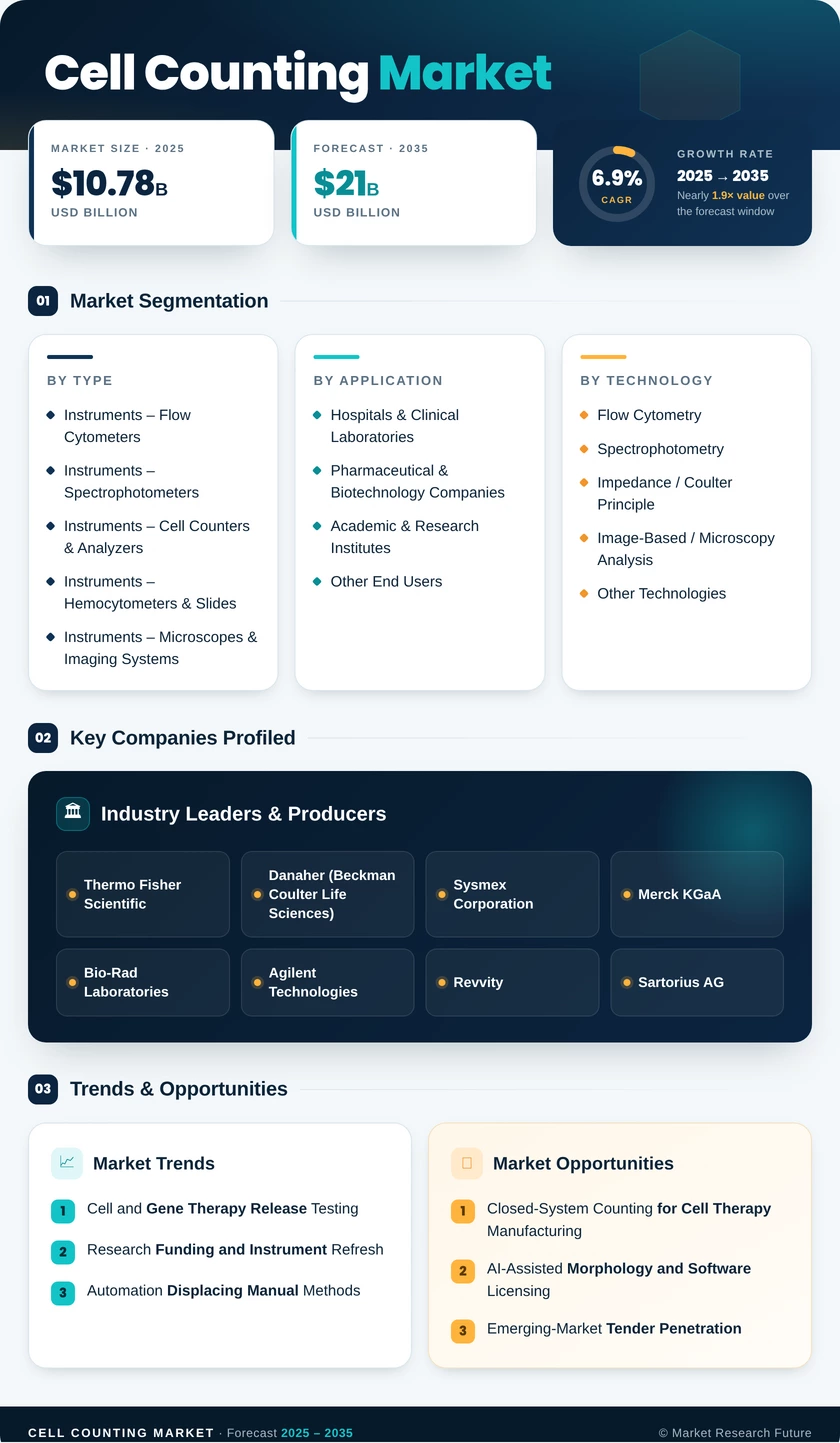
Cell Counting Market (2026 - 2035)

Cell Counting Market Research Report: Size, Share, Trend Analysis By Product (Consumables, Instruments) By Applications (Research Application, Clinical & Diagnostic Applications, Others) By End-User (Pharmaceutical & Biotechnology Companies, Hospitals, Research Institutes, Others) Forecast till 2035

Forecast Period
2026-2035
CAGR
6.9%
2025 Market Size
USD 10.78 Billion
2035 Market Size
USD 21.00 Billion
Healthcare ● Updated August 2026 Report ID: MRFR/HC/7128-HCR | Pages: 125 | Author: Vikita Thakur, Kinjoll Dey
  1. 1 Market Summary |
    1. 1.1 Study Assumptions & Market Definition |
    2. 1.2 Scope of the Study |
    3. 1.3 Research Methodology
  2. 2 Key Report Takeaways |
    1. 2.1 Takeaways by Technology |
    2. 2.2 Takeaways by Sector |
    3. 2.3 Takeaways by Geography
  3. 3 Market Size & Forecast (2021–2035) |
    1. 3.1 Historical Market Size (2021–2024) |
    2. 3.2 Base Year Assessment (2025) |
    3. 3.3 Forecast Market Size (2026–2035) |
    4. 3.4 Year-over-Year Growth Analysis
  4. 4 Driver Impact Analysis |
    1. 4.1 Cell and Gene Therapy Release Testing |
    2. 4.2 Research Funding and Instrument Refresh |
    3. 4.3 Automation Displacing Manual Methods |
    4. 4.4 Asia-Pacific Manufacturing Build-Out
  5. 5 Restraints Impact Analysis |
    1. 5.1 Capital Intensity Blocks Mid-Tier Adoption |
    2. 5.2 Validation Overhead Slows Switching |
    3. 5.3 Manual Methods Remain Economically Rational
  6. 6 Opportunities |
    1. 6.1 Closed-System Counting for Cell Therapy Manufacturing |
    2. 6.2 AI-Assisted Morphology and Software Licensing |
    3. 6.3 Emerging-Market Tender Penetration |
    4. 6.4 Data Monetization Through Connected Fleets |
    5. 6.5 Point-of-Care Hematology Screening
  7. 7 Regional Market Share & Country-Level Analysis |
    1. 7.1 North America | |
      1. 7.1.1 US | |
      2. 7.1.2 Canada | |
      3. 7.1.3 Mexico |
    2. 7.2 Europe | |
      1. 7.2.1 Germany | |
      2. 7.2.2 UK | |
      3. 7.2.3 France | |
      4. 7.2.4 Italy | |
      5. 7.2.5 Spain | |
      6. 7.2.6 Nordic Countries | |
      7. 7.2.7 Russia | |
      8. 7.2.8 Rest of Europe |
    3. 7.3 Asia-Pacific | |
      1. 7.3.1 China | |
      2. 7.3.2 India | |
      3. 7.3.3 Japan | |
      4. 7.3.4 South Korea | |
      5. 7.3.5 ASEAN | |
      6. 7.3.6 Rest of Asia-Pacific |
    4. 7.4 South America | |
      1. 7.4.1 Brazil | |
      2. 7.4.2 Argentina | |
      3. 7.4.3 Rest of South America |
    5. 7.5 Middle East & Africa | |
      1. 7.5.1 Saudi Arabia | |
      2. 7.5.2 UAE | |
      3. 7.5.3 South Africa | |
      4. 7.5.4 Egypt | |
      5. 7.5.5 Rest of Middle East & Africa
  8. 8 Future Outlook (2026–2035) |
    1. 8.1 Autonomous Laboratory Workflows |
    2. 8.2 Consumables-Led Platform Economics |
    3. 8.3 Single-Cell Analysis Convergence |
    4. 8.4 Sustainability and Reagent Circularity
  9. 9 Market Segmentation Analysis |
    1. 9.1 By Product Type | |
      1. 9.1.1 Instruments – Spectrophotometers | |
      2. 9.1.2 Instruments – Flow Cytometers | |
      3. 9.1.3 Instruments – Cell Counters & Analyzers | |
      4. 9.1.4 Instruments – Hemocytometers & Slides | |
      5. 9.1.5 Instruments – Microscopes & Imaging Systems | |
      6. 9.1.6 Consumables (Reagents, Kits, Accessories) |
    2. 9.2 By Application | |
      1. 9.2.1 Research (Cancer Research, Stem Cell Research, Drug Discovery) | |
      2. 9.2.2 Clinical & Diagnostic | |
      3. 9.2.3 Bioprocessing & Quality Control | |
      4. 9.2.4 Other Applications |
    3. 9.3 By End User | |
      1. 9.3.1 Hospitals & Clinical Laboratories | |
      2. 9.3.2 Pharmaceutical & Biotechnology Companies | |
      3. 9.3.3 Academic & Research Institutes | |
      4. 9.3.4 Other End Users |
    4. 9.4 By Technology | |
      1. 9.4.1 Flow Cytometry | |
      2. 9.4.2 Spectrophotometry | |
      3. 9.4.3 Impedance / Coulter Principle | |
      4. 9.4.4 Image-Based / Microscopy Analysis | |
      5. 9.4.5 Other Technologies
  10. 10 Competitive Landscape |
    1. 10.1 Market Concentration Analysis (2026) |
    2. 10.2 Competitive Benchmarking Matrix |
    3. 10.3 Company Profiles | |
      1. 10.3.1 Thermo Fisher Scientific | |
      2. 10.3.2 Danaher (Beckman Coulter Life Sciences) | |
      3. 10.3.3 Becton, Dickinson and Company | |
      4. 10.3.4 Sysmex Corporation | |
      5. 10.3.5 Merck KGaA | |
      6. 10.3.6 Bio-Rad Laboratories | |
      7. 10.3.7 Agilent Technologies | |
      8. 10.3.8 Revvity | |
      9. 10.3.9 Sartorius AG | |
      10. 10.3.10 Corning Incorporated | |
      11. 10.3.11 Olympus / Evident Corporation | |
      12. 10.3.12 Logos Biosystems
  11. 11 Recent News & Developments
  12. 12 Report Scope & Methodology |
    1. 12.1 Study Period & Base Year |
    2. 12.2 Data Sources & Validation Approach |
    3. 12.3 Abbreviations
  13. 13 Detailed Sources & Citations
  14. 14 Frequently Asked Questions
  15. 15 LIST OF TABLES |
  16. TABLE 1 Global Cell Counting Market Size & Forecast, by Revenue (USD billion), 2021–2035 |
  17. TABLE 2 Global Cell Counting Market – Year-over-Year Growth Analysis, 2021–2035 |
  18. TABLE 3 Driver Impact Analysis Matrix, 2026–2035 |
  19. TABLE 4 Restraint Impact Analysis Matrix, 2026–2035 |
  20. TABLE 5 Global Market Size, by Region, 2021–2035 (USD billion) |
  21. TABLE 6 North America Market Size, by Country, 2021–2035 (USD billion) |
  22. TABLE 7 Europe Market Size, by Country, 2021–2035 (USD billion) |
  23. TABLE 8 Asia-Pacific Market Size, by Country, 2021–2035 (USD billion) |
  24. TABLE 9 South America Market Size, by Country, 2021–2035 (USD billion) |
  25. TABLE 10 Middle East & Africa Market Size, by Country, 2021–2035 (USD billion) |
  26. TABLE 11 Global Market Size, by Product Type, 2021–2035 (USD billion) |
  27. TABLE 12 Global Market Size, by Application, 2021–2035 (USD billion) |
  28. TABLE 13 Global Market Size, by End User, 2021–2035 (USD billion) |
  29. TABLE 14 Global Market Size, by Technology, 2021–2035 (USD billion) |
  30. TABLE 15 North America Market Size, by Product Type, 2021–2035 (USD billion) |
  31. TABLE 16 North America Market Size, by Technology, 2021–2035 (USD billion) |
  32. TABLE 17 Europe Market Size, by Application, 2021–2035 (USD billion) |
  33. TABLE 18 Asia-Pacific Market Size, by End User, 2021–2035 (USD billion) |
  34. TABLE 19 Competitive Benchmarking Matrix, 2026 |
  35. TABLE 20 Company Profiles – Key Players |
  36. TABLE 21 Recent Developments & Strategic Announcements, 2023–2025 |
  37. TABLE 22 Report Scope & Methodology Summary |
  38. TABLE 23 Detailed Sources & Citations Index
  39. 16 LIST OF FIGURES |
  40. FIGURE 1 Market Dynamics Overview – Drivers, Restraints, Opportunities |
  41. FIGURE 2 Industry Value Chain Analysis |
  42. FIGURE 3 Porter's Five Forces Analysis |
  43. FIGURE 4 Global Market Size Trend, 2021–2035 (USD billion) |
  44. FIGURE 5 Year-over-Year Growth Trajectory, 2022–2035 |
  45. FIGURE 6 Market Share by Product Type, 2025 vs 2035 |
  46. FIGURE 7 Market Share by Application, 2025 vs 2035 |
  47. FIGURE 8 Market Share by End User, 2025 |
  48. FIGURE 9 Market Share by Technology, 2025 vs 2035 |
  49. FIGURE 10 Regional Revenue Share Distribution, 2025 |
  50. FIGURE 11 Regional CAGR Comparison, 2026–2035 |
  51. FIGURE 12 Country-Level Revenue Heat Map, 2025 |
  52. FIGURE 13 Competitive Landscape Positioning Matrix, 2026 |
  53. FIGURE 14 Top-Five Supplier Concentration Trend, 2021–2026 |
  54. FIGURE 15 Consumables versus Instruments Revenue Mix, 2021–2035
Share::
Request Free Sample

Segmentation Quick Reference

DimensionSub-SegmentsDominant SegmentFastest Growing Segment
By Product TypeInstruments (Spectrophotometers, Flow Cytometers, Cell Counters & Analyzers, Hemocytometers & Slides, Microscopes & Imaging Systems); ConsumablesConsumablesInstruments – Cell Counters & Analyzers
By ApplicationResearch (Cancer Research, Stem Cell Research, Drug Discovery); Clinical & Diagnostic; Bioprocessing & Quality Control; Other ApplicationsResearchBioprocessing & Quality Control
By End UserHospitals & Clinical Laboratories; Pharmaceutical & Biotechnology Companies; Academic & Research Institutes; Other End UsersHospitals & Clinical LaboratoriesAcademic & Research Institutes
By TechnologyFlow Cytometry; Spectrophotometry; Impedance / Coulter Principle; Image-Based / Microscopy Analysis; Other TechnologiesFlow CytometryImage-Based / Microscopy Analysis
By GeographyNorth America; Europe; Asia-Pacific; South America; Middle East & AfricaNorth AmericaAsia-Pacific


Market Segmentation Overview

By Product Type

Sub-SegmentKey Trend
Instruments – SpectrophotometersMiniaturized benchtop units bundled with plate-reading functions
Instruments – Flow CytometersSpectral detection expanding practical panel sizes beyond 40 colours
Instruments – Cell Counters & AnalyzersDual fluorescence and brightfield modes standardizing at mid-price tiers
Instruments – Hemocytometers & SlidesRetained in teaching labs and low-volume clinics as a cost anchor
Instruments – Microscopes & Imaging SystemsAI-assisted segmentation converting imaging into quantitative output
Consumables (Reagents, Kits, Accessories)Proprietary cartridge formats deepening recurring revenue capture


Product mix is the clearest signal of platform maturity. As installed bases age past the initial deployment wave, consumables revenue grows faster than instrument revenue, shifting supplier economics toward annuity-like income and raising the strategic value of format control.

By Application

Sub-SegmentKey Trend
Research (Cancer, Stem Cell, Drug Discovery)Grant-cycle-driven purchasing with strong core-facility concentration
Clinical & DiagnosticConsolidation into high-throughput reference laboratories
Bioprocessing & Quality ControlGMP-qualified, closed-system instruments commanding price premiums
Other ApplicationsFood safety, veterinary and environmental testing broadening demand.


Application demand diverges on discretion. Research spending flexes with funding cycles, while bioprocessing and clinical testing volumes are contractually or clinically mandated, giving those segments steadier revenue visibility across the forecast horizon.

By End User

Sub-SegmentKey Trend
Hospitals & Clinical LaboratoriesMiddleware-integrated automation replacing standalone analyzers
Pharmaceutical & Biotechnology CompaniesInstrument selection embedded in process-design decisions
Academic & Research InstitutesShared core facilities concentrating high-end platform purchases
Other End UsersCROs and blood banks scaling outsourced testing capacity.


Buyer sophistication varies sharply by channel. Pharmaceutical purchasers evaluate validation packages and change-control support, whereas academic cores weigh multi-user flexibility and per-sample cost above regulatory documentation.

By Technology

Sub-SegmentKey Trend
Flow CytometrySpectral unmixing and compact analyzers widening the addressable base
SpectrophotometryPersisting as the low-cost default for concentration measurement
Impedance / Coulter PrincipleEntrenched in hematology through installed base and reagent lock-in
Image-Based / Microscopy AnalysisDeep-learning classification adding morphology to the count
Other TechnologiesAcoustic and dielectrophoretic methods advancing in niche workflows


Technology choice increasingly follows the endpoint rather than the budget. Where viability and morphology matter, imaging wins; where raw throughput governs, impedance holds its ground — and multi-modal instruments that combine both are emerging as the premium tier.




Share::
Request Free Sample
Download PDF ×

We do not share your information with anyone. However, we may send you emails based on your report interest from time to time. You may contact us at any time to opt-out.