×
Hero Background
English
Chinese
French
Japanese
Korean
German
Spanish

Catechol Market Share

ID: MRFR/CnM/1788-HCR
125 Pages
Priya Nagrale
October 2025

Catechol Market Research Report Information By Form (Flakes and Molten), End Use (Pharmaceutical, Agrochemicals, Food and beverage, Personal care & Cosmetics and Others) and Region (Asia-Pacific, North America, Europe, Latin America, and Middle East & Africa)—Forecast till 2035

Share:
Download PDF ×

We do not share your information with anyone. However, we may send you emails based on your report interest from time to time. You may contact us at any time to opt-out.

Catechol Market Infographic
Purchase Options

Market Share

Catechol Market Share Analysis

In the competitive landscape of the Catechol Market, companies employ various strategies to position themselves favorably and gain market share. One common approach is differentiation, where companies focus on unique features or attributes of their products to stand out from competitors. For instance, some companies may emphasize the purity or quality of their catechol products, while others might highlight environmentally friendly production processes or superior customer service. By differentiating themselves, companies aim to attract customers who value these specific qualities, thereby carving out a distinct market share.

Another key strategy is cost leadership, wherein companies strive to offer catechol products at lower prices than their competitors. This approach requires efficient production processes, economies of scale, and tight cost control measures to maintain profitability despite lower prices. By undercutting competitors on price, companies can appeal to price-sensitive customers and capture market share from rivals who cannot match their pricing. However, maintaining cost leadership requires continuous efforts to optimize operations and reduce expenses to remain competitive in the long term.

Furthermore, companies may pursue niche market positioning by targeting specific customer segments with unique needs or preferences. Instead of trying to compete directly with larger rivals across the entire market, companies focus on serving a smaller, but more specialized segment where they can excel. For example, a company might specialize in supplying high-purity catechol for research laboratories or offer customized formulations for niche industrial applications. By focusing on niche markets, companies can often command higher prices and build stronger customer loyalty, enabling them to secure a profitable market share despite operating in a smaller segment.

Additionally, companies in the Catechol Market may adopt a geographic positioning strategy, focusing their efforts on specific regions or countries where they see the greatest opportunities for growth. This approach allows companies to tailor their products and marketing efforts to local preferences and regulatory requirements, gaining a competitive edge over more generalized competitors. By concentrating resources in select geographic markets, companies can establish a strong presence and become the preferred choice for customers in those regions, thereby securing a significant market share.

Moreover, innovation plays a crucial role in market share positioning strategies within the Catechol Market. Companies that invest in research and development to develop new formulations, production techniques, or applications for catechol can differentiate themselves from competitors and capture market share by offering unique solutions. Whether it's developing more efficient synthesis methods, creating novel catechol derivatives with enhanced properties, or discovering new applications in industries such as pharmaceuticals or agriculture, innovation drives growth and competitiveness in the market.

Furthermore, strategic partnerships and alliances can also be instrumental in market share positioning within the Catechol Market. By collaborating with suppliers, distributors, or complementary businesses, companies can expand their reach, access new markets, and leverage each other's strengths to gain a competitive advantage. Whether through joint ventures, licensing agreements, or strategic alliances, partnerships enable companies to pool resources, share risks, and capitalize on synergies to strengthen their market position and increase their share of the catechol market.

Author
Priya Nagrale
Senior Research Analyst

With an experience of over five years in market research industry (Chemicals & Materials domain), I gather and analyze market data from diverse sources to produce results, which are then presented back to a client. Also, provide recommendations based on the findings. As a Senior Research Analyst, I perform quality checks (QC) for market estimations, QC for reports, and handle queries and work extensively on client customizations. Also, handle the responsibilities of client proposals, report planning, report finalization, and execution

Leave a Comment

FAQs

At what CAGR is the catechol market expected to grow over the forecast period?

The catechol market is predicted to grow at a 3.40% CAGR between 2023-2035.

Which region is expected to dominate the catechol market?

Asia Pacific is expected to dominate the catechol coatings market.

What are the different applications of catechol?

It has extensive applications in personal care and cosmetics, food and beverage, agrochemicals, and pharmaceutical industries.

Who are the eminent players profiled in the catechol market?

Eminent players profiled in the catechol market include Alfa Aesar (US), Sisco Research Laboratories Pvt. Ltd. (India), K. Poonja & Sons (India), Lianyungang Sanjili Chemical Industry Co. (China), UBE INDUSTRIES, LTD. (Japan), Camlin Fine Sciences Ltd (India), and Solvay (Belgium).

What are the key factors driving the growth of the catechol market?

Growing demand in pharmaceuticals and agrochemicals and increasing demand in the production of ethyl-vanillin and vanillin are boosting market demand.

Market Summary

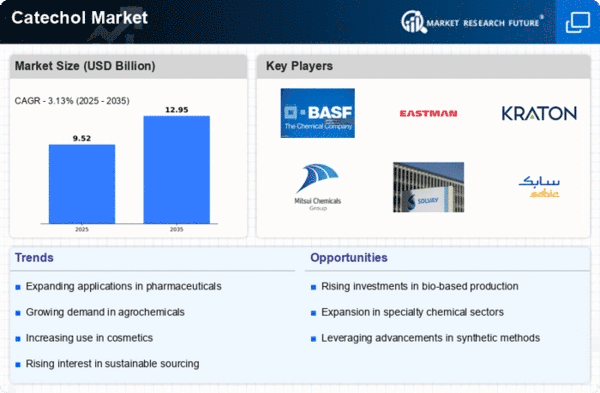
As per MRFR analysis, the Catechol Market Size was estimated at 9.23 USD Billion in 2024. The Catechol industry is projected to grow from 9.52 in 2025 to 12.95 by 2035, exhibiting a compound annual growth rate (CAGR) of 3.13 during the forecast period 2025 - 2035.

Key Market Trends & Highlights

The Catechol Market is currently experiencing a dynamic shift towards sustainable practices and diversified applications.

  • North America remains the largest market for catechol, driven by robust demand in pharmaceuticals and personal care products.
  • Asia-Pacific is identified as the fastest-growing region, with increasing investments in agrochemicals and innovative applications.
  • The pharmaceuticals segment continues to dominate the market, while the flavors and fragrances segment is witnessing rapid growth.
  • Rising demand in pharmaceuticals and expanding use in agrochemicals are key drivers propelling market expansion.

Market Size & Forecast

2024 Market Size 9.23 (USD Billion)
2035 Market Size 12.95 (USD Billion)
CAGR (2025 - 2035) 3.13%
Largest Regional Market Share in 2024 Asia-Pacific

Major Players

<p>BASF SE (DE), Eastman Chemical Company (US), Kraton Corporation (US), Mitsui Chemicals, Inc. (JP), Solvay S.A. (BE), Huntsman Corporation (US), SABIC (SA), Alfa Aesar (US)</p>

Market Trends

The Catechol Market is currently experiencing a dynamic phase characterized by evolving applications and increasing demand across various industries. This compound, known for its role in the production of pharmaceuticals, agrochemicals, and fragrances, is witnessing a surge in interest due to its versatile properties. As industries seek sustainable and efficient solutions, catechol's role in the synthesis of advanced materials and specialty chemicals appears to be expanding. Furthermore, the growing emphasis on eco-friendly products is likely to drive innovation in catechol production methods, potentially leading to more sustainable practices in the market. In addition to its established applications, the Catechol Market is also influenced by advancements in technology and research. The exploration of new uses, particularly in the fields of biotechnology and material science, suggests a promising future for catechol derivatives. As companies invest in research and development, the potential for novel applications may reshape market dynamics. Overall, the Catechol Market seems poised for growth, driven by both traditional uses and emerging opportunities that align with global sustainability goals.

Sustainable Production Methods

The trend towards sustainable production methods in the Catechol Market is gaining traction. Manufacturers are increasingly focusing on eco-friendly processes that minimize environmental impact. This shift not only aligns with global sustainability initiatives but also caters to consumer preferences for greener products.

Diversification of Applications

The diversification of applications for catechol is notable, as industries explore its potential beyond traditional uses. Emerging sectors such as biotechnology and advanced materials are beginning to adopt catechol, indicating a broader acceptance and integration of this compound in various innovative applications.

Technological Advancements

Technological advancements are playing a crucial role in shaping the future of the Catechol Market. Innovations in production techniques and research into new derivatives are likely to enhance efficiency and open new avenues for catechol use, potentially transforming market dynamics.

Catechol Market Market Drivers

Growth in Agrochemicals

The Global Catechol Market Industry benefits from the rising utilization of catechol in agrochemical formulations. As agricultural practices evolve, there is an increasing need for effective herbicides and pesticides, where catechol plays a pivotal role as a precursor. The agrochemical sector's expansion is anticipated to contribute significantly to the market, with projections indicating a market size of 2.32 USD Billion by 2035. This growth is underpinned by the global push for sustainable agriculture and the development of eco-friendly products, positioning catechol as a vital component in meeting these demands within the Global Catechol Market Industry.

Market Trends and Projections

The Global Catechol Market Industry is characterized by dynamic trends and projections that indicate a positive outlook for the coming years. With a market value of 1.62 USD Billion in 2024, the industry is expected to grow to 2.32 USD Billion by 2035. This growth trajectory reflects a compound annual growth rate of 3.33% from 2025 to 2035, driven by diverse applications across pharmaceuticals, agrochemicals, and personal care products. The increasing focus on sustainability and innovation in production processes further supports this upward trend, positioning the Global Catechol Market Industry as a vital component of the broader chemical market.

Rising Demand in Pharmaceuticals

The Global Catechol Market Industry experiences a notable surge in demand from the pharmaceutical sector. Catechol Market serves as a crucial intermediate in the synthesis of various pharmaceutical compounds, including analgesics and antiseptics. As the global population ages and healthcare needs expand, the pharmaceutical industry's reliance on catechol is likely to increase. This trend is reflected in the projected market value of 1.62 USD Billion in 2024, with expectations of growth driven by innovations in drug development and increased production capacities. Consequently, the Global Catechol Market Industry is poised for sustained growth as it aligns with the evolving healthcare landscape.

Emerging Markets and Economic Growth

The Global Catechol Market Industry is poised for expansion in emerging markets, where economic growth is driving increased industrial activity. Countries in Asia-Pacific and Latin America are witnessing rapid urbanization and industrialization, leading to heightened demand for catechol in various applications, including plastics and resins. As these economies develop, the market is likely to benefit from increased investments in manufacturing and infrastructure. This trend suggests that the Global Catechol Market Industry will experience robust growth, as emerging markets become key players in the global supply chain.

Innovations in Chemical Manufacturing

Advancements in chemical manufacturing processes are driving the Global Catechol Market Industry forward. The introduction of more efficient production methods, such as biotechnological approaches, enhances the yield and reduces the environmental impact of catechol production. These innovations not only lower production costs but also align with global sustainability goals. As a result, the market is expected to witness a compound annual growth rate of 3.33% from 2025 to 2035. This growth trajectory suggests that the Global Catechol Market Industry is adapting to meet both economic and environmental challenges, thereby reinforcing its position in the global chemical landscape.

Increasing Use in Personal Care Products

The Global Catechol Market Industry sees a growing trend in the use of catechol in personal care products. Its antioxidant properties make it a valuable ingredient in cosmetics and skincare formulations. As consumer awareness regarding product ingredients rises, manufacturers are increasingly incorporating catechol to enhance product efficacy and safety. This trend is likely to bolster market growth, as the personal care sector continues to expand globally. The demand for high-quality, effective personal care products is expected to drive the Global Catechol Market Industry, reflecting changing consumer preferences and a shift towards more natural ingredients.

Market Segment Insights

By Application: Pharmaceuticals (Largest) vs. Agriculture (Fastest-Growing)

<p>In the Catechol Market, the application segment showcases a diverse distribution with Pharmaceuticals holding the largest share. This sector significantly benefits from catechol's antioxidant properties and is instrumental in the synthesis of various pharmaceutical compounds. The Agriculture segment follows closely, propelled by its emerging applications in agrochemicals, where catechol enhances crop protection and yields, demonstrating substantial adoption in recent years. The growth trends indicate that Pharmaceuticals will continue to dominate the market due to continuous innovations and research in drug formulations. Conversely, the Agriculture segment is rapidly gaining traction, driven by increasing agricultural practices and the demand for sustainable farming solutions, which leverage catechol's effectiveness in pest management and as a plant growth regulator.</p>

<p>Pharmaceuticals (Dominant) vs. Agriculture (Emerging)</p>

<p>Pharmaceuticals, as the dominant application in the Catechol Market, utilizes catechol in producing vital drugs, particularly in the development of anti-inflammatory and anti-cancer medications. The consistent innovation in the pharmaceutical industry and the growing demand for advanced therapeutic options solidify its strong market position. On the other hand, Agriculture is emerging as a vital application, benefiting from the rising need for sustainable farming practices. The increasing emphasis on reducing chemical pesticide reliance has led to catechol's rising popularity in eco-friendly agricultural inputs. This shift presents significant growth opportunities for the Agriculture segment, positioning it as a strong contender within the market, particularly as global farmers seek natural alternatives.</p>

By End Use: Antioxidants (Largest) vs. Flavors and Fragrances (Fastest-Growing)

<p>In the Catechol Market, the end use distribution reveals that Antioxidants hold the largest segment share, driven by increasing demand in various industries. This segment caters primarily to the plastics, rubber, and food sectors as a stabilizing agent and preservative, reinforcing its dominant position. Flavors and Fragrances, while currently smaller in share, show promising growth trends, underpinned by rising consumer awareness about natural and organic products. Brands are increasingly opting for catechol-derived flavors and fragrances to meet the evolving tastes of consumers, leading to an expansion in this segment.</p>

<p>Antioxidants (Dominant) vs. Flavors and Fragrances (Emerging)</p>

<p>The Antioxidants segment in the Catechol Market is characterized by its significant application across various sectors, emphasizing its role in extending the shelf life of products by preventing oxidative degradation. This segment enjoys strong backing from stringent regulations on food preservation and rising demands for longevity in various products. On the other hand, the Flavors and Fragrances segment is rapidly evolving, fueled by consumer preferences for sustainable and naturally sourced ingredients. This segment’s growth is also boosted by innovations in product formulations and the emergence of new market players focused on creating unique sensory experiences driven by catechol derivatives.</p>

By Form: Liquid (Largest) vs. Powder (Fastest-Growing)

<p>The catechol market exhibits a diverse distribution across the form segment, with liquid catechol holding the largest share. This form is widely preferred in various industries due to its high solubility and compatibility with different formulations. Following liquids, the powder form, while smaller in share, is gaining traction thanks to its versatility and ease of transportation. Solid catechol remains a niche segment, appealing primarily to specialized applications. As industries seek high-performance chemicals, the demand for liquid catechol continues to dominate market dynamics.</p>

<p>Liquid (Dominant) vs. Powder (Emerging)</p>

<p>Liquid catechol is recognized as the dominant form in the catechol market, prized for its efficacy in applications such as pharmaceuticals, agrochemicals, and polymers. Its liquid state allows for enhanced absorption rates and ease of blending in formulations, making it indispensable for various chemical processes. In contrast, powder catechol is emerging as a notable player, particularly in industries where space and logistics are critical. Its lightweight nature and extended shelf life position it favorably for transport and storage, while ongoing research into its applications is likely to accelerate its growth in the coming years.</p>

By Source: Natural (Largest) vs. Synthetic (Fastest-Growing)

<p>In the Catechol Market, the source segment is primarily divided into Natural and Synthetic catechol. Natural catechol is currently the largest segment, primarily due to its environmentally friendly attributes which resonate well with consumer preferences for sustainable products. This segment benefits from a growing demand in various applications, including pharmaceuticals and agrochemicals, reflecting its dominant position in the market. On the other hand, the Synthetic segment is emerging as the fastest-growing category within the market. The rapid advancements in synthetic production methods have made it a viable alternative, enabling manufacturers to meet rising demand and address supply chain challenges. This trend is driven by the increasing need for consistent quality and performance in industrial applications, bolstering the adoption of synthetic catechol across key sectors.</p>

<p>Source: Natural (Dominant) vs. Synthetic (Emerging)</p>

<p>Natural catechol, derived from renewable sources, is characterized by its lower environmental impact and increasing preference in various industries, positioning itself as a dominant player in the catechol market. Its applications span across pharmaceuticals, fragrances, and agrochemicals, highlighting its versatility. Meanwhile, Synthetic catechol is gaining traction as an emerging source due to its cost-effectiveness and scalability. The growing capability to produce synthetic catechol efficiently caters to high-demand sectors, like the plastics and petrochemicals industries. As both segments evolve, they showcase a healthy rivalry where natural products appeal to eco-conscious consumers, while synthetic options satisfy the industry's quest for reliable, high-volume supply.</p>

By Purity Level: High Purity (Largest) vs. Standard Purity (Fastest-Growing)

<p>The catechol market's purity level segment showcases two primary categories: High Purity and Standard Purity. High Purity catechol holds the largest share, widely preferred in applications requiring stringent quality standards such as pharmaceuticals and specialty chemicals. In contrast, Standard Purity catechol caters to less demanding applications, capturing a rapidly growing fraction of the market as manufacturers seek cost-effective solutions in various industries.</p>

<p>Purity Level: High Purity (Dominant) vs. Standard Purity (Emerging)</p>

<p>High Purity catechol remains the dominant choice for industries where performance and efficacy are crucial, such as in the production of high-grade antioxidants and specialty resins. Its stringent manufacturing processes ensure superior quality and minimal impurities, making it the preferred option for critical applications. On the other hand, Standard Purity catechol is emerging as an attractive alternative for cost-sensitive sectors. Its reasonable purity levels meet the requirements of many conventional applications, resulting in increased adoption. The growth of high-volume industries such as agrochemicals and plastics is driving demand for Standard Purity, showcasing its potential as a viable competitor in the catechol market.</p>

Get more detailed insights about Catechol Market Research Report - Global Forecast till 2035

Regional Insights

North America : Established Market with Growth Potential

The North American catechol market, valued at $2.77 billion, is driven by increasing demand in the pharmaceutical and agrochemical sectors. Regulatory support for sustainable chemicals and innovations in production processes are key growth catalysts. The region's focus on environmental regulations is pushing manufacturers to adopt greener technologies, enhancing market dynamics. Leading countries like the US and Canada are home to major players such as Eastman Chemical Company and Huntsman Corporation. The competitive landscape is characterized by strategic partnerships and investments in R&D. As companies strive to meet regulatory standards, the market is expected to witness steady growth, with a focus on sustainable practices and product innovation.

Europe : Innovation and Sustainability Focus

Europe's catechol market, valued at $2.31 billion, is characterized by stringent regulations promoting sustainability and innovation. The region's commitment to reducing carbon footprints and enhancing chemical safety is driving demand for catechol in various applications, including cosmetics and pharmaceuticals. Regulatory frameworks are encouraging investments in eco-friendly production methods, further boosting market growth. Germany, France, and the UK are leading countries in this market, with key players like BASF SE and Solvay S.A. actively participating in the innovation landscape. The competitive environment is marked by collaborations and technological advancements aimed at meeting regulatory requirements. As the market evolves, companies are focusing on developing sustainable products to align with consumer preferences and regulatory demands.

Asia-Pacific : Emerging Powerhouse in Chemicals

Asia-Pacific holds the largest catechol market share at $4.0 billion, driven by rapid industrialization and increasing demand in sectors like agriculture and pharmaceuticals. The region's growth is supported by favorable government policies and investments in chemical manufacturing. Countries like China and India are leading the charge, with a focus on expanding production capacities and enhancing supply chains. China, as a manufacturing hub, hosts several key players, including Mitsui Chemicals, Inc. and Kraton Corporation. The competitive landscape is evolving, with local manufacturers gaining traction alongside established global firms. As the region continues to grow, innovations in production processes and sustainability practices are expected to shape the future of the catechol market.

Middle East and Africa : Emerging Market with Challenges

The Middle East and Africa's catechol market, valued at $0.15 billion, is still in its nascent stages but shows potential for growth. The region's market dynamics are influenced by increasing industrial activities and a growing focus on chemical manufacturing. However, challenges such as regulatory hurdles and limited infrastructure can impede growth. Countries like South Africa and Saudi Arabia are key players in this market, with a focus on developing local production capabilities. The competitive landscape is characterized by a mix of local and international companies, striving to establish a foothold in the region. As investments in infrastructure and regulatory frameworks improve, the catechol market is expected to gradually expand, driven by rising demand in various sectors.

Key Players and Competitive Insights

The Catechol exhibits a dynamic competitive landscape characterized by innovation and strategic positioning among key players. Major companies such as BASF SE (Germany), Eastman Chemical Company (US), and Solvay S.A. (Belgium) are actively shaping the market through various strategies. BASF SE (Germany) focuses on sustainable production methods, aiming to reduce its carbon footprint while enhancing product efficiency. Eastman Chemical Company (US) emphasizes digital transformation and advanced manufacturing techniques to streamline operations and improve product quality. Solvay S.A. (Belgium) is investing in research and development to innovate new applications for catechol derivatives, thereby expanding its market reach. Collectively, these strategies foster a competitive environment that prioritizes sustainability and technological advancement.

Key business tactics in the Catechol Market include localizing manufacturing and optimizing supply chains to enhance responsiveness to regional demands. The market structure appears moderately fragmented, with several players vying for market share. However, the influence of major companies is substantial, as they leverage their resources and expertise to establish a competitive edge. This collective presence of key players not only drives innovation but also sets industry standards that smaller companies may strive to meet.

In November 2025, BASF SE (Germany) announced the launch of a new eco-friendly catechol production process that utilizes renewable raw materials. This strategic move is significant as it aligns with global sustainability trends and positions BASF as a leader in environmentally conscious manufacturing. The initiative is expected to enhance the company's market share while appealing to increasingly eco-aware consumers and businesses.

In October 2025, Eastman Chemical Company (US) unveiled a partnership with a leading technology firm to develop AI-driven solutions for optimizing catechol production. This collaboration is crucial as it signifies a shift towards integrating advanced technologies in chemical manufacturing, potentially leading to increased efficiency and reduced operational costs. The partnership may also enhance Eastman's competitive positioning by enabling faster response times to market changes.

In September 2025, Solvay S.A. (Belgium) expanded its research facilities dedicated to catechol applications, focusing on pharmaceuticals and agrochemicals. This expansion is indicative of Solvay's commitment to innovation and its strategic intent to diversify its product offerings. By investing in R&D, Solvay aims to capture emerging market opportunities and strengthen its foothold in high-growth sectors.

As of December 2025, current competitive trends in the Catechol Market are heavily influenced by digitalization, sustainability, and the integration of AI technologies. Strategic alliances are increasingly shaping the landscape, allowing companies to pool resources and expertise for enhanced innovation. Looking ahead, competitive differentiation is likely to evolve from traditional price-based competition to a focus on technological advancements, sustainability initiatives, and supply chain reliability. This shift underscores the importance of innovation as a key driver of market success.

Key Companies in the Catechol Market market include

Industry Developments

In 2019, Solvay created a cooperative venture with Anthea, an Indian specialty chemicals producer, to produce catechol derivatives. CatàSynth, as the venture is known, is now developing a facility at Anthea's Mangalore location, which will be completely operational in Q1 2020. The products will include methylenedioxybenzene, heliotropin (piperonal), and helional, all of which are used as components in the flavoring, fragrance, agrochemical, and pharmaceutical industries. Anthea has been creating synthetic heliotropin since 2010, using a patented production process, and this will increase both its range and capacity.

March 2021

- the Institute of Process Engineering (IPE) research group led by Prof. Wan Yinhua has developed a dually charged, robust loose nanofiltration (NF) membrane for greatly efficient dye/salt separation. The research was published in the Journal of Membrane Science.NF is an efficient technique to treat textile wastewater. However, the NF membranes most commercially show low selectivity in dye/salt separation owing to their negatively charged, dense separation layer.

Based on a basic catechol-amine chemistry surface engineering strategy, the team created an NF membrane with a dually charged and loose separation layer.In the approach, polyethyleneimine (PEI) was applied on a hydrolyzed polyacrylonitrile substrate to build a positively charged intermediate layer, trailed by poly-γ-glutamic acid (γ-PGA) and co-deposition of tannic acid (TA) to build a negatively charged top layer.The loose separation layer structure was credited to the viable reaction tempted by polyphenols.

The electrostatic adsorption, hydrogen bonding, and covalent interactions among TA, γ-PGA and PEI impeded the quick non-uniform self-polymerization of TA.The pre-reaction between γ-PGA and TA could further deteriorate those competitive reactions, regulating the pore size and charging property and resulting in improving the separation performance.

Intended Audience
    • Traders and Distributors of Catechol Market
    • Potential Investors
    • Raw Material Suppliers
    • Catechol Market manufacturers
    • Distributors
    • Industry Associations

Future Outlook

Catechol Market Future Outlook

<p>The Catechol is projected to grow at a 3.13% CAGR from 2024 to 2035, driven by increasing demand in pharmaceuticals, agrochemicals, and specialty chemicals.</p>

New opportunities lie in:

  • <p>Expansion into emerging markets with tailored product offerings.</p>
  • <p>Development of eco-friendly catechol production methods.</p>
  • <p>Strategic partnerships with pharmaceutical companies for innovative applications.</p>

<p>By 2035, the catechol market is expected to achieve robust growth, solidifying its position in various industries.</p>

Market Segmentation

Catechol Market Form Outlook

  • Liquid
  • Solid
  • Powder

Catechol Market Source Outlook

  • Natural
  • Synthetic

Catechol Market End Use Outlook

  • Antioxidants
  • Flavors and Fragrances
  • Dyes and Pigments
  • Resins and Adhesives

Catechol Market Application Outlook

  • Pharmaceuticals
  • Agriculture
  • Chemical Synthesis
  • Cosmetics
  • Food Industry

Catechol Market Purity Level Outlook

  • High Purity
  • Standard Purity

Report Scope

MARKET SIZE 20249.23(USD Billion)
MARKET SIZE 20259.52(USD Billion)
MARKET SIZE 203512.95(USD Billion)
COMPOUND ANNUAL GROWTH RATE (CAGR)3.13% (2024 - 2035)
REPORT COVERAGERevenue Forecast, Competitive Landscape, Growth Factors, and Trends
BASE YEAR2024
Market Forecast Period2025 - 2035
Historical Data2019 - 2024
Market Forecast UnitsUSD Billion
Key Companies ProfiledBASF SE (DE), Eastman Chemical Company (US), Kraton Corporation (US), Mitsui Chemicals, Inc. (JP), Solvay S.A. (BE), Huntsman Corporation (US), SABIC (SA), Alfa Aesar (US)
Segments CoveredApplication, End Use, Form, Source, Purity Level
Key Market OpportunitiesGrowing demand for catechol in pharmaceuticals and agrochemicals presents significant opportunities in the Catechol Market.
Key Market DynamicsRising demand for catechol in pharmaceuticals drives innovation and competitive dynamics in the chemical sector.
Countries CoveredNorth America, Europe, APAC, South America, MEA

FAQs

At what CAGR is the catechol market expected to grow over the forecast period?

The catechol market is predicted to grow at a 3.40% CAGR between 2023-2035.

Which region is expected to dominate the catechol market?

Asia Pacific is expected to dominate the catechol coatings market.

What are the different applications of catechol?

It has extensive applications in personal care and cosmetics, food and beverage, agrochemicals, and pharmaceutical industries.

Who are the eminent players profiled in the catechol market?

Eminent players profiled in the catechol market include Alfa Aesar (US), Sisco Research Laboratories Pvt. Ltd. (India), K. Poonja &amp; Sons (India), Lianyungang Sanjili Chemical Industry Co. (China), UBE INDUSTRIES, LTD. (Japan), Camlin Fine Sciences Ltd (India), and Solvay (Belgium).

What are the key factors driving the growth of the catechol market?

Growing demand in pharmaceuticals and agrochemicals and increasing demand in the production of ethyl-vanillin and vanillin are boosting market demand.

  1. Executive Summary
  2. Market Introduction
    1. Market Definition
    2. Scope of the
      1. Research
      2. Assumptions & Limitations
    3. Study
    4. Objectives
    5. Markets Structure
    6. Key Takeaways
  3. Market Research Methodology
    1. Research Process
    2. Primary Research
    3. Secondary Research
    4. Market Size Estimation
    5. Forecast Model
  4. Market Dynamics of the Global Catechol
    1. Market
    2. Introduction
    3. Drivers
    4. Restraints
    5. Opportunities
    6. Challenges
    7. Trends/Technology
  5. Market Factor Analysis of the
    1. Global Catechol Market
    2. Supply Chain
      1. Raw Material Suppliers
      2. Manufacturers/Producers
      3. Distributors/Retailers/Wholesalers/E-Commerce
    3. Analysis
    4. End User
    5. Porter’s
      1. Threat of New
      2. Bargaining Power of Buyers
      3. Bargaining Power of Suppliers
      4. Threat of Substitutes
    6. Five Forces Analysis
    7. Entrants
    8. Intensity of Competitive Rivalry
    9. Pricing Analysis
  6. Global Catechol Market, by Form
    1. Introduction
    2. Flakes
      1. Market
    3. Market Estimates & Forecast, 2020−2027
    4. Estimates & Forecast, by Region, 2020−2027
    5. Molten
      1. Market Estimates
      2. Market Estimates & Forecast,
    6. & Forecast, 2020−2027
    7. by Region, 2020−2027
  7. Global Catechol Market, by
    1. End Use
    2. Introduction
    3. Pharmaceutical
      1. Market Estimates & Forecast, 2020−2027
  8. Market Estimates & Forecast, by Region, 2020−2027
    1. Agrochemical
    2. Food & Beverage
    3. Personal Care & Cosmetics
  9. Market Estimates & Forecast, 2020−2027
  10. Market Estimates & Forecast, by Region, 2020−2027
  11. Market Estimates & Forecast, 2020−2027
  12. Market Estimates & Forecast, by Region, 2020−2027
  13. Market Estimates & Forecast,
  14. Market Estimates & Forecast, by Region, 2020−2027
    1. Others
      1. Market Estimates & Forecast,
      2. Market Estimates & Forecast, by Region, 2020−2027
  15. Global Catechol Market, by Region
    1. Introduction
    2. North America
      1. Market Estimates &
      2. Market Estimates & Forecast,
      3. Market Estimates & Forecast,
      4. US
      5. Canada
    3. Forecast, 2020−2027
    4. by Form, 2020−2027
    5. by End Use, 2020−2027
    6. & Forecast, by Form, 2020−2027
    7. Market Estimates & Forecast, 2020−2027
  16. Market Estimates & Forecast, by End Use, 2020−2027
    1. Europe
    2. Forecast, by Form, 2020−2027
    3. Forecast, by Form, 2020−2027
    4. by Form, 2020−2027
  17. Market Estimates & Forecast, 2020−2027
  18. Market Estimates & Forecast, by Form, 2020−2027
  19. Market Estimates & Forecast, by End Use, 2020−2027
  20. Germany
  21. Market Estimates & Forecast, 2020−2027
  22. Market Estimates &
  23. Market Estimates & Forecast, by End Use, 2020−2027
  24. France
  25. Market Estimates & Forecast, 2020−2027
  26. Market Estimates &
  27. Market Estimates & Forecast, by End Use, 2020−2027
  28. Italy
  29. Market Estimates & Forecast, 2020−2027
  30. Market Estimates & Forecast,
  31. Market Estimates & Forecast, by End Use, 2020−2027
    1. Spain
    2. Market Estimates & Forecast, 2020−2027
    3. & Forecast, by End Use, 2020−2027
    4. & Forecast, 2020−2027
    5. Forecast, by End Use, 2020−2027
    6. Forecast, 2020−2027
    7. Forecast, by End Use, 2020−2027
    8. Forecast, 2020−2027
    9. Forecast, by End Use, 2020−2027
    10. & Forecast, 2020−2027
    11. & Forecast, by End Use, 2020−2027
    12. Market Estimates & Forecast, 2020−2027
    13. Forecast, by Form, 2020−2027
    14. & Forecast, by Form, 2020−2027
  32. Market Estimates & Forecast, by Form,2020−2027
  33. Market Estimates
  34. UK
  35. Market Estimates
  36. Market Estimates & Forecast, by Form,2020−2027
  37. Market Estimates &
  38. Russia
  39. Market Estimates &
  40. Market Estimates & Forecast, by Form,2020−2027
  41. Market Estimates &
  42. Poland
  43. Market Estimates &
  44. Market Estimates & Forecast, by Form, 2020−2027
  45. Market Estimates &
  46. Rest of Europe
  47. Market Estimates
  48. Market Estimates & Forecast, by Form, 2020−2027
  49. Market Estimates
    1. Asia-Pacific
      1. Market Estimates & Forecast, 2020−2027
      2. Market Estimates & Forecast, by Form, 2020−2027
      3. Market Estimates & Forecast, by End Use, 2020−2027
      4. China
      5. India
      6. Japan
  50. Market Estimates & Forecast, by Form, 2020−2027
    1. by End Use, 2020−2027
    2. New Zealand
    3. Market Estimates & Forecast, 2020−2027
    4. by Form, 2020−2027
  51. Market Estimates & Forecast,
  52. Australia &
  53. Market Estimates & Forecast,
  54. Market Estimates & Forecast, by End Use, 2020−2027
    1. & Forecast, by Form, 2020−2027
    2. Middle East & Africa
    3. Forecast, 2020−2027
    4. by Form, 2020−2027
    5. by End Use, 2020−2027
    6. & Forecast, by Form, 2020−2027
    7. by Form, 2020−2027
  55. Rest of Asia-Pacific
  56. Market Estimates & Forecast, 2020−2027
  57. Market Estimates
  58. Market Estimates & Forecast, by End Use,
  59. Market Estimates &
  60. Market Estimates & Forecast,
  61. Market Estimates & Forecast,
  62. GCC
  63. Market Estimates & Forecast, 2020−2027
  64. Market Estimates
  65. Market Estimates & Forecast, by End Use, 2020−2027
  66. Israel
  67. Market Estimates & Forecast, 2020−2027
  68. Market Estimates & Forecast,
  69. Market Estimates & Forecast, by End Use, 2020−2027
    1. Forecast, by Form, 2020−2027
    2. Forecast, by Form, 2020−2027
    3. & Forecast, by Form, 2020−2027
    4. Forecast, 2020−2027
    5. by Form, 2020−2027
    6. by End Use, 2020−2027
    7. Forecast, 2020−2027
    8. Forecast, by End Use, 2020−2027
    9. & Forecast, 2020−2027
    10. Forecast, by End Use, 2020−2027
    11. & Forecast, 2020−2027
    12. Forecast, by End Use, 2020−2027
    13. America
    14. Market Estimates & Forecast, 2020−2027
    15. & Forecast, by End Use, 2020−2027
  70. North Africa
  71. Market Estimates & Forecast, 2020−2027
  72. Market Estimates &
  73. Market Estimates & Forecast, by End Use, 2020−2027
  74. Turkey
  75. Market Estimates & Forecast, 2020−2027
  76. Market Estimates &
  77. Market Estimates & Forecast, by End Use, 2020−2027
  78. Rest of Middle East & Africa
  79. Market Estimates & Forecast, 2020−2027
  80. Market Estimates
  81. Market Estimates & Forecast, by End Use, 2020−2027
    1. Latin America
      1. Market Estimates &
      2. Market Estimates & Forecast,
      3. Market Estimates & Forecast,
      4. Brazil
      5. Argentina
      6. Mexico
      7. Rest of Latin
  82. Company Landscape
    1. Introduction
    2. Market Strategies
    3. Key Development Analysis
    4. (Expansion/Merger & Acquisitions/Joint Venture/New Product Development/Agreement/Investment)
  83. Company Profiles
    1. Solvay
    2. Company Overview
    3. Key Developments
    4. Company Overview
    5. Key Developments
    6. Financial Updates
    7. Product/Business Segment Overview
    8. Strategies
    9. SWOT Analysis
    10. Industry Co.
    11. Company Overview
    12. Key Developments
    13. Financial Updates
    14. Product/Business Segment Overview
    15. Strategies
    16. SWOT Analysis
    17. Pvt. Ltd.
    18. Financial Updates
    19. Product/Business Segment Overview
    20. Strategies
    21. SWOT Analysis
    22. Company Overview
    23. Key Developments
  84. Financial Updates
  85. Product/Business Segment Overview
  86. Key Strategies
  87. SWOT Analysis
    1. Camlin Fine Sciences Ltd
      1. Financial Updates
      2. Product/Business Segment Overview
      3. Key Strategies
      4. SWOT Analysis
    2. UBE INDUSTRIES, LTD
      1. Company Overview
      2. Key
      3. Key Developments
    3. Lianyungang Sanjili Chemical
      1. Financial Updates
      2. Product/Business Segment Overview
      3. Key Strategies
      4. SWOT Analysis
    4. K. K. Poonja & Sons
      1. Company Overview
      2. Key
      3. Key Developments
    5. Sisco Research Laboratories
      1. Company Overview
      2. Key
      3. Key Developments
    6. Alfa Aesar
      1. Financial Updates
      2. Product/Business Segment Overview
      3. Key Strategies
      4. SWOT Analysis
  88. Conclusion
  89. LIST OF TABLES
  90. Global Catechol Market: by Region, 2020−2027
  91. North America: Catechol Market, by Country, 2020−2027
  92. Europe: Catechol Market, by Country, 2020−2027
  93. Asia-Pacific: Catechol Market. by Country, 2020−2027
  94. Middle East & Africa: Catechol Market, by Country,
  95. Latin America: Catechol Market, by
    1. Country, 2020−2027
  96. Global Catechol Form Market,
    1. by Regions, 2020−2027
  97. North America: Catechol
  98. Form Market, by Country, 2020−2027
  99. Europe:
  100. Catechol Form Market, by Country, 2020−2027
    1. Table10 Asia-Pacific:
  101. Catechol Form Market, by Country, 2020−2027
    1. Table11 Middle
  102. East & Africa: Catechol Form Market, by Country, 2020−2027
    1. Table12
  103. Latin America: Catechol Form Market, by Country, 2020−2027
    1. Table13
  104. Global Catechol End Use Market, by Regions, 2020−2027
    1. Table14
  105. North America: Catechol End Use Market, by Country, 2020−2027
    1. Table15
  106. Europe: Catechol End Use Market, by Country, 2020−2027
    1. Table16
  107. Asia-Pacific: Catechol End Use Market, by Country, 2020−2027
    1. Table17
  108. Middle East & Africa: Catechol End Use Market, by Country, 2020−2027
  109. Table18 Latin America: Catechol by End Use Market, by Country,
  110. Table19 Global Form Market, by Region, 2020−2027
  111. Table20 Global End Use Market, by Region, 2020−2027
  112. Table21 North America: Catechol Market, by Country, 2020−2027
  113. Table22 North America: Catechol Market, by Form, 2020−2027
  114. Table23 North America: Catechol Market, by End Use, 2020−2027
  115. Table24 Europe: Catechol Market, by Country, 2020−2027
  116. Table25 Europe: Catechol Market, by Form, 2020−2027
  117. Table26 Europe: Catechol Market, by End Use, 2020−2027
  118. Table27 Asia-Pacific: Catechol Market, by Country,
    1. Table28 Asia-Pacific: Catechol Market,
    2. by Form, 2020−2027
    3. Table29 Asia-Pacific: Catechol Market,
    4. by End Use, 2020−2027
    5. Table30 Middle East &
  119. Africa: Catechol Market, by Country, 2020−2027
    1. Table31 Middle
  120. East & Africa: Catechol Market, by Form, 2020−2027
    1. Table32
  121. Middle East & Africa: Catechol Market, by End Use, 2020−2027
  122. Table33 Latin America: Catechol Market, by Country, 2020−2027
  123. Table34 Latin America: Catechol Market, by Form, 2020−2027
  124. Table35 Latin America: Catechol Market, by End Use, 2020−2027
  125. LIST OF FIGURES
  126. Global Catechol
    1. Market Segmentation
  127. Forecast Research Methodology
  128. Five Forces Analysis of the Global Catechol Market
    1. FIGURE
  129. Value Chain of the Global Catechol Market
    1. FIGURE 5
  130. Global Catechol Market, 2020−2027, by Country, 2020
  131. Share
  132. of the Global Catechol Market, by Form, 2020−2027
  133. Global
  134. Catechol Market Size, by Form, 2020
  135. Share of the Global
  136. Catechol Market, by Form, 2020−2027
  137. Global Catechol
  138. Market Size, by End Use, 2020
    1. FIGURE10 Share of the Global Catechol
  139. Market, by End Use, 2020−2027

Catechol Market Segmentation

Market Segmentation Overview

  • Detailed segmentation data will be available in the full report
  • Comprehensive analysis by multiple parameters
  • Regional and country-level breakdowns
  • Market size forecasts by segment
Infographic

Free Sample Request

Kindly complete the form below to receive a free sample of this Report

Get Free Sample

Customer Strories

Compare Licence

×
Features License Type
Single User Multiuser License Enterprise User
Price $4,950 $5,950 $7,250
Maximum User Access Limit 1 User Upto 10 Users Unrestricted Access Throughout the Organization
Free Customization
Direct Access to Analyst
Deliverable Format
Platform Access
Discount on Next Purchase 10% 15% 15%
Printable Versions