×
Request Free Sample ×

Kindly complete the form below to receive a free sample of this Report

* Please use a valid business email

Leading companies partner with us for data-driven Insights

clients tt-cursor
Hero Background
English
Chinese
French
Japanese
Korean
German
Spanish

Carotid Artery Disease Market Analysis

ID: MRFR/MED/4840-CR
157 Pages
Kinjoll Dey
July 2019

Carotid Artery Disease Market Research Report Information by Diagnosis & Treatment (Carotid Artery Disease and Antihypertensive Drugs), End User (Hospital & Clinics, Ambulatory Surgical Centers and Pharmacies) and Region (Americas, Europe, Asia-Pacific and the Middle East & Africa) - Forecast till 2035

Share:
Download PDF ×

We do not share your information with anyone. However, we may send you emails based on your report interest from time to time. You may contact us at any time to opt-out.

Carotid Artery Disease Market Infographic
Purchase Options

Market Analysis

In-depth Analysis of Carotid Artery Disease Market Industry Landscape

The market dynamics of carotid artery disease treatment are influenced by various factors that impact supply, demand, pricing, innovation, and regulation within the sector. Carotid artery disease refers to the narrowing or blockage of the carotid arteries, which supply oxygen-rich blood to the brain, often leading to serious health risks such as stroke. Treatment options range from lifestyle changes and medication to surgical interventions, each playing a role in shaping the market dynamics.

Supply in this market is primarily driven by advancements in medical technology and manufacturing capabilities. Medical device companies invest heavily in research and development to create innovative products for the diagnosis and treatment of carotid artery disease. These include devices such as carotid artery stents, angioplasty balloons, embolic protection devices, and surgical instruments used in procedures like carotid endarterectomy. Additionally, stringent regulatory requirements ensure that these products meet safety and efficacy standards before entering the market, contributing to a steady supply of approved treatments.

On the demand side, several factors contribute to the need for carotid artery disease treatment. Aging populations, unhealthy lifestyles, and increasing prevalence of risk factors such as hypertension, diabetes, and smoking drive the demand for interventions to prevent or manage carotid artery disease. Moreover, advancements in medical imaging technologies enable early detection and diagnosis of carotid artery disease, leading to increased demand for treatment options to mitigate the risk of stroke and other complications.

Pricing dynamics in the carotid artery disease treatment market are influenced by factors such as product efficacy, market competition, reimbursement policies, and healthcare economics. Innovative treatments and devices may command premium prices, especially if they offer superior outcomes or reduced procedural risks compared to conventional therapies. However, pricing pressures from healthcare payers and regulatory bodies may constrain reimbursement rates, impacting the affordability and accessibility of treatments for patients.

Innovation plays a crucial role in shaping the market dynamics of carotid artery disease treatment. Medical device companies continually invest in research and development to improve existing treatments and develop novel therapies for better patient outcomes. Technological advancements such as minimally invasive procedures, novel stent designs, and integrated imaging systems enhance the safety, efficacy, and convenience of carotid artery disease treatments, driving innovation within the industry.

Regulatory compliance is a significant consideration for companies operating in the carotid artery disease treatment market. Medical devices used in the diagnosis and treatment of carotid artery disease are subject to regulatory oversight by agencies such as the FDA in the United States and similar authorities worldwide. Compliance with regulatory requirements ensures the safety, efficacy, and quality of treatments, instilling confidence in healthcare providers and patients.

Market competition in the carotid artery disease treatment industry is intense, with several established players and emerging companies competing for market share. Established medical device manufacturers leverage their experience, brand reputation, and distribution networks to maintain a competitive edge. Meanwhile, smaller companies focus on innovation, niche markets, and strategic partnerships to differentiate themselves and gain market traction.

Geopolitical factors also influence the market dynamics of carotid artery disease treatment. Healthcare policies, government funding, reimbursement systems, and public health initiatives impact the adoption and utilization of treatments for carotid artery disease. Moreover, regional variations in disease prevalence, healthcare infrastructure, and patient demographics create diverse market conditions and opportunities for manufacturers.


Author
Kinjoll Dey
Research Analyst Level I

He is an extremely curious individual currently working in Healthcare and Medical Devices Domain. Kinjoll is comfortably versed in data centric research backed by healthcare educational background. He leverages extensive data mining and analytics tools such as Primary and Secondary Research, Statistical Analysis, Machine Learning, Data Modelling. His key role also involves Technical Sales Support, Client Interaction and Project management within the Healthcare team. Lastly, he showcases extensive affinity towards learning new skills and remain fascinated in implementing them.

Leave a Comment

FAQs

What is the projected market valuation for the Carotid Artery Disease Market in 2035?

The projected market valuation for the Carotid Artery Disease Market in 2035 is 20.77 USD Billion.

What was the overall market valuation for the Carotid Artery Disease Market in 2024?

The overall market valuation for the Carotid Artery Disease Market in 2024 was 12.47 USD Billion.

What is the expected CAGR for the Carotid Artery Disease Market from 2025 to 2035?

The expected CAGR for the Carotid Artery Disease Market during the forecast period 2025 - 2035 is 4.75%.

Which companies are considered key players in the Carotid Artery Disease Market?

Key players in the Carotid Artery Disease Market include Medtronic, Abbott Laboratories, Boston Scientific, and Johnson & Johnson.

What are the projected revenues for surgical procedures in the Carotid Artery Disease Market by 2035?

By 2035, the projected revenues for surgical procedures in the Carotid Artery Disease Market are expected to reach 10.37 USD Billion.

Market Summary

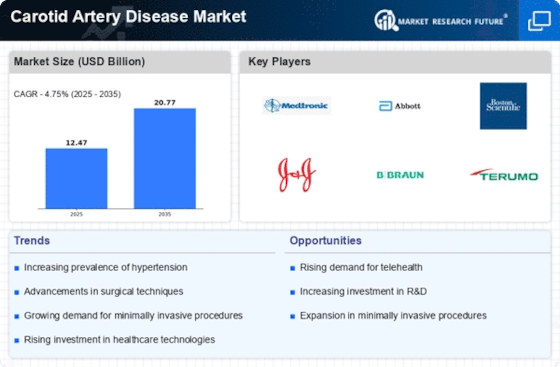
As per Market Research Future analysis, the Carotid Artery Disease Market Size was estimated at 12.47 USD Billion in 2024. The Carotid Artery Disease industry is projected to grow from 13.06 USD Billion in 2025 to 20.77 USD Billion by 2035, exhibiting a compound annual growth rate (CAGR) of 4.75% during the forecast period 2025 - 2035

Key Market Trends & Highlights

The Carotid Artery Disease Market is experiencing notable growth driven by technological advancements and increasing awareness.

  • Technological advancements in treatment are reshaping the Carotid Artery Disease Market, particularly in North America. The Asia-Pacific region is emerging as the fastest-growing market, driven by rising healthcare expenditure and awareness. Surgery remains the largest segment, while medication is witnessing rapid growth due to evolving treatment paradigms. Key market drivers include the aging population and advancements in medical technology, which are significantly influencing market dynamics.

Market Size & Forecast

2024 Market Size 12.47 (USD Billion)
2035 Market Size 20.77 (USD Billion)
CAGR (2025 - 2035) 4.75%
Largest Regional Market Share in 2024 North America

Major Players

Medtronic (US), Abbott Laboratories (US), Boston Scientific (US), Johnson & Johnson (US), B. Braun Melsungen AG (DE), Terumo Corporation (JP), Stryker Corporation (US), Cook Medical (US), Cardinal Health (US)

Market Trends

The Carotid Artery Disease Market is currently experiencing notable transformations driven by advancements in medical technology and an increasing awareness of cardiovascular health. As healthcare systems globally prioritize preventive measures, there is a growing emphasis on early detection and management of carotid artery disease. This shift is likely to enhance patient outcomes and reduce the burden of stroke, which remains a leading cause of morbidity and mortality. Furthermore, the integration of telemedicine and digital health solutions appears to facilitate remote monitoring and consultations, thereby improving access to care for patients in underserved regions. In addition, the demographic trends indicate an aging population, which may contribute to a higher prevalence of carotid artery disease. As individuals age, the risk factors associated with this condition, such as hypertension and diabetes, become more pronounced. Consequently, healthcare providers are adapting their strategies to address these challenges, potentially leading to an increase in the demand for innovative treatment options. Overall, the Carotid Artery Disease Market seems poised for growth, driven by technological advancements and a proactive approach to cardiovascular health management.

Technological Advancements in Treatment

The Carotid Artery Disease Market is witnessing a surge in innovative treatment modalities, including minimally invasive surgical techniques and advanced stenting options. These developments may enhance patient recovery times and reduce complications, thereby making interventions more appealing to both patients and healthcare providers.

Increased Focus on Preventive Care

There is a growing trend towards preventive care in the Carotid Artery Disease Market, with healthcare systems emphasizing early detection and lifestyle modifications. This proactive approach could lead to a decline in severe cases, as patients are encouraged to adopt healthier habits and undergo regular screenings.

Rising Awareness and Education

Public awareness campaigns regarding cardiovascular health are becoming more prevalent, which may contribute to increased screening and diagnosis of carotid artery disease. Educational initiatives appear to empower patients, enabling them to recognize symptoms and seek timely medical intervention.

Carotid Artery Disease Market Market Drivers

Rising Healthcare Expenditure

Rising healthcare expenditure is a significant factor influencing the Carotid Artery Disease Market. As countries allocate more resources to healthcare, there is a corresponding increase in funding for cardiovascular disease management, including carotid artery disease. This trend is evident in various regions, where healthcare budgets are expanding to accommodate advanced diagnostic tools and treatment options. For example, investments in public health initiatives aimed at reducing the incidence of cardiovascular diseases are becoming more prevalent. Consequently, this increased financial commitment is likely to enhance access to care and improve treatment outcomes for patients suffering from carotid artery disease, thereby driving growth in the Carotid Artery Disease Market.

Regulatory Support and Guidelines

Regulatory support and updated clinical guidelines are playing a pivotal role in shaping the Carotid Artery Disease Market. Health authorities are increasingly recognizing the importance of standardized treatment protocols for carotid artery disease, which may enhance patient outcomes and streamline care delivery. Recent guidelines emphasize the need for timely intervention and the use of evidence-based practices in managing carotid artery disease. This regulatory framework is likely to encourage healthcare providers to adopt best practices, thereby improving the quality of care. As a result, the Carotid Artery Disease Market may experience growth driven by the implementation of these guidelines, which could lead to increased utilization of diagnostic and therapeutic services.

Advancements in Medical Technology

Technological advancements in medical devices and treatment methodologies are transforming the Carotid Artery Disease Market. Innovations such as minimally invasive surgical techniques, advanced imaging technologies, and improved stenting procedures are enhancing patient outcomes and expanding treatment options. For instance, the introduction of carotid artery stenting has emerged as a less invasive alternative to traditional carotid endarterectomy, appealing to a broader patient population. Market data suggests that the adoption of these technologies is expected to grow, driven by their effectiveness and reduced recovery times. As healthcare providers increasingly embrace these advancements, the Carotid Artery Disease Market is likely to witness a surge in demand for cutting-edge solutions that improve patient care and streamline treatment processes.

Aging Population and Increased Incidence

The aging population appears to be a primary driver of the Carotid Artery Disease Market. As individuals age, the risk of developing cardiovascular diseases, including carotid artery disease, increases significantly. Data indicates that the prevalence of carotid artery disease is notably higher in older adults, with estimates suggesting that nearly 20% of individuals over the age of 65 may be affected. This demographic shift is likely to lead to a higher demand for diagnostic and therapeutic interventions within the Carotid Artery Disease Market, as healthcare systems adapt to manage the growing burden of this condition. Furthermore, the increasing life expectancy in many regions may exacerbate this trend, necessitating enhanced healthcare resources and innovative treatment options.

Growing Awareness of Cardiovascular Health

Growing awareness of cardiovascular health is emerging as a crucial driver for the Carotid Artery Disease Market. Public health campaigns and educational initiatives are increasingly focusing on the importance of early detection and management of cardiovascular diseases, including carotid artery disease. This heightened awareness is likely to lead to more individuals seeking medical advice and undergoing screening procedures. Data indicates that early intervention can significantly reduce the risk of severe complications associated with carotid artery disease, such as stroke. As awareness continues to rise, the demand for diagnostic services and treatment options within the Carotid Artery Disease Market is expected to increase, fostering a proactive approach to cardiovascular health.

Market Segment Insights

By Type: Surgery (Largest) vs. Medication (Fastest-Growing)

In the Carotid Artery Disease Market, the segment values reveal significant differences in market presence and anticipated growth trajectories. Surgery commands the largest share, indicating its critical role in addressing severe cases of carotid artery disease. This includes procedures like carotid endarterectomy and stenting, which are essential for preventing strokes by restoring proper blood flow. In contrast, medication, particularly anti-platelet agents and statins, is gaining traction, showcasing a growing recognition of its importance in managing milder cases and preventing disease progression. Growth trends in this market are influenced by several factors, including advancements in surgical techniques and increased awareness of carotid artery disease. The opioid crisis is prompting a shift toward non-invasive medication-based treatment protocols. Additionally, an aging population is driving demand for both surgical interventions and long-term medication regimens, leading to robust growth in the medication segment as patients and healthcare providers seek effective, less invasive options for managing carotid artery disease.

Surgery: Carotid Endarterectomy (Dominant) vs. Medication: Anti-Platelet Agents (Emerging)

In the Carotid Artery Disease Market, Surgery, particularly the carotid endarterectomy, remains the dominant approach due to its effectiveness in managing significant vascular blockage. This surgical procedure not only significantly reduces the risk of stroke but also reassures patients of immediate, tangible health benefits. On the other hand, anti-platelet agents represent an emerging segment, offering a non-invasive option with growing adoption among healthcare providers. The rise of this medication segment is driven by extensive research validating the role of anti-platelet therapy in stabilizing carotid plaque and preventing stroke in patients who may not be suitable candidates for surgery. As both segments evolve, they complement each other in providing comprehensive care for carotid artery disease.

By Diagnosis: Duplex Ultrasound (Largest) vs. Magnetic Resonance Imaging (Fastest-Growing)

In the Carotid Artery Disease market, Duplex Ultrasound has emerged as the largest diagnostic segment, holding a significant share due to its non-invasive nature and real-time imaging capabilities. It is widely adopted for routine assessments, providing essential information about blood flow and vessel structure. Compound Tomography is also notable, although it accounts for a smaller share relative to Duplex Ultrasound, while Magnetic Resonance Imaging is swiftly gaining traction, especially in advanced diagnostic settings.

Duplex Ultrasound (Dominant) vs. Magnetic Resonance Imaging (Emerging)

Duplex Ultrasound is currently the dominant method in the Carotid Artery Disease diagnosis segment, revered for its ease of use, rapid results, and comprehensive imaging of blood flow and artery structure. It is particularly favored in clinical practice for its non-invasive approach that minimizes patient risk. Conversely, Magnetic Resonance Imaging is considered an emerging technology, gaining popularity due to its ability to provide high-resolution images and detailed anatomical information. This method is increasingly utilized in complex cases and research settings, suggesting a promising growth trajectory as more healthcare facilities continue to adopt advanced imaging technologies.

By Medications: Antiplatelet Drugs (Largest) vs. Cholesterol-Lowering Statins (Fastest-Growing)

In the Carotid Artery Disease market, the Antiplatelet Drugs segment holds the largest market share, primarily due to its widespread prescription and established efficacy in preventing thrombotic events. Following closely is the Cholesterol-Lowering Statins segment, which is rapidly gaining traction owing to the increasing focus on managing cholesterol levels as a preventive measure against carotid artery disease. Antihypertensive Drugs continue to play a supportive role in this segment, contributing to the overall treatment landscape but lagging in market share compared to the leading segments.

Antiplatelet Drugs (Dominant) vs. Cholesterol-Lowering Statins (Emerging)

Antiplatelet Drugs, such as aspirin and clopidogrel, are pivotal in the management of carotid artery disease due to their ability to inhibit platelet aggregation, thereby reducing the risk of stroke. They are well-established in clinical practice and have a robust patient base. On the other hand, Cholesterol-Lowering Statins, which include atorvastatin and simvastatin, are emerging as key players in the treatment regimen as awareness of lipid management increases. Their effectiveness in lowering LDL cholesterol is driving their adoption, positioning them as the fastest-growing segment in this market. Antihypertensive Drugs, while critical for managing blood pressure, are considered more adjunctive in the context of carotid artery disease treatment.

By Surgical Procedures: Carotid Endarterectomy (Largest) vs. Carotid Artery Angioplasty (Fastest-Growing)

In the Carotid Artery Disease Market, the segmentation by surgical procedures showcases distinct market shares for various interventions. Carotid Endarterectomy holds the largest share among the procedures, reflecting its established role in the treatment landscape. Meanwhile, Carotid Artery Angioplasty has gained traction, with increasing adoption rates contributing to its notable growth in market share compared to other surgical options. The other procedure, Carotid Artery Bypass, maintains a smaller but steady share as it serves a niche market segment. Recent trends illustrate a dynamic shift towards minimally invasive techniques, with Carotid Artery Angioplasty experiencing the fastest growth in the surgical segment. This surge can be attributed to advancements in catheter technology, which enhance procedural safety and efficacy. Moreover, rising awareness among patients and healthcare providers regarding less invasive options is driving preference for angioplasty over traditional methods. The ongoing developments in vascular surgical technologies indicate a promising trajectory for these procedures, particularly for angioplasty, as it continues to align with the evolving needs of patients and practitioners alike.

Carotid Endarterectomy (Dominant) vs. Carotid Artery Bypass (Emerging)

Carotid Endarterectomy stands out as the dominant procedure in the Carotid Artery Disease Market, known for its proven effectiveness in stroke prevention through the surgical removal of plaque from the carotid arteries. This procedure has a well-established track record and is widely accepted in clinical practice, making it the preferred choice for many surgeons. In contrast, Carotid Artery Bypass is considered an emerging technique that serves specific cases, particularly in patients with severe arterial blockages where other methods may not be suitable. While it is less commonly performed compared to endarterectomy, it shows promise in certain clinical scenarios and is gaining recognition due to improved outcomes in surgical care. This juxtaposition illustrates a blend of traditional and evolving practices within the field, highlighting the ongoing advancements in treating carotid artery disease.

By End-User: Clinics and Hospitals (Largest) vs. Ambulatory Surgical Centres (Fastest-Growing)

In the Carotid Artery Disease Market, clinics and hospitals hold a substantial market share due to their comprehensive treatment options and advanced medical technologies. These facilities are pivotal in providing traditional surgical interventions and follow-up care, making them an integral part of the patient journey. In contrast, pharmacies and ambulatory surgical centres, while smaller in market presence, have begun to carve out significant niches. These segments focus on convenience and streamlined services, appealing to patients seeking less invasive treatment options and quicker recovery times.

Clinics and Hospitals (Dominant) vs. Ambulatory Surgical Centres (Emerging)

Clinics and hospitals dominate the Carotid Artery Disease Market by offering a wide range of diagnostic and treatment options, including endarterectomies and stenting procedures. These institutions benefit from established patient trust and extensive resources, allowing them to provide comprehensive care. On the other hand, ambulatory surgical centres are emerging as influential players, characterized by their outpatient services that promote faster patient turnaround and lower costs. This shift towards minimally invasive procedures in these centres is appealing to a growing segment of patients, contributing to their rapid growth and increasing market relevance.

Get more detailed insights about Carotid Artery Disease Market Research Report - Forecast till 2035

Regional Insights

North America : Leading Innovation and Treatment

North America is the largest market for Carotid Artery Disease Market treatments, holding approximately 45% of the global market share. The region's growth is driven by advanced healthcare infrastructure, increasing prevalence of cardiovascular diseases, and supportive regulatory frameworks. The demand for minimally invasive procedures is also rising, further propelling market expansion. Regulatory bodies like the FDA are actively promoting innovations in medical devices, enhancing patient access to cutting-edge treatments. The United States is the primary contributor to this market, with key players such as Medtronic, Abbott Laboratories, and Boston Scientific leading the competitive landscape. The presence of these major companies fosters innovation and competition, ensuring a steady supply of advanced treatment options. Canada also plays a significant role, contributing to the overall market growth with its robust healthcare system and increasing awareness of carotid artery disease.

Europe : Emerging Regulatory Frameworks

Europe is the second-largest market for Carotid Artery Disease Market, accounting for approximately 30% of the global market share. The region's growth is fueled by an aging population, rising healthcare expenditure, and advancements in medical technology. Regulatory bodies are increasingly focusing on improving patient outcomes through stringent guidelines and approvals for innovative treatments. The European Medicines Agency (EMA) is actively involved in ensuring the safety and efficacy of new medical devices, which is crucial for market growth. Leading countries in this region include Germany, France, and the UK, where significant investments in healthcare infrastructure are being made. Major players like B. Braun Melsungen AG and Terumo Corporation are enhancing their market presence through strategic partnerships and product innovations. The competitive landscape is characterized by a mix of established companies and emerging startups, all striving to meet the growing demand for effective carotid artery disease treatments.

Asia-Pacific : Rapidly Growing Healthcare Sector

Asia-Pacific is witnessing rapid growth in the Carotid Artery Disease Market, driven by increasing healthcare investments and a rising prevalence of cardiovascular diseases. The region holds approximately 20% of the global market share, with countries like Japan and China leading the way. The demand for advanced medical technologies and improved healthcare access is propelling market expansion. Government initiatives aimed at enhancing healthcare infrastructure are also significant growth drivers in this region. Japan is a key player in the market, with established companies like Stryker Corporation and Cook Medical actively participating in the development of innovative treatment options. The competitive landscape is evolving, with local manufacturers emerging to meet the growing demand. Additionally, increasing awareness about carotid artery disease and its treatment options is further contributing to market growth in the Asia-Pacific region, making it a promising area for investment and development.

Middle East and Africa : Untapped Market Opportunities

The Middle East and Africa region is gradually emerging in the Carotid Artery Disease Market, holding about 5% of the global market share. The growth is primarily driven by increasing healthcare investments, rising awareness of cardiovascular diseases, and improving healthcare infrastructure. Governments in this region are focusing on enhancing healthcare access and quality, which is expected to boost the demand for advanced medical treatments in the coming years. Countries like South Africa and the UAE are leading the way in adopting innovative healthcare solutions. The competitive landscape is characterized by a mix of local and international players, with companies like Cardinal Health expanding their presence. The region presents significant opportunities for growth, especially as healthcare systems continue to evolve and adapt to meet the needs of the population, making it an attractive market for investment.

Key Companies in the Carotid Artery Disease Market include

Industry Developments

    • Boston Scientific Corporation in July 2018, announced the acquisition of Claret Medical Inc.
    • Stryker Corporation in July 2018, renewed the “Pre-Market Approval” (PMA) from the FDA (Food and Drug Administration) of the United States.


Future Outlook

Carotid Artery Disease Market Future Outlook

The Carotid Artery Disease Market is projected to grow at a 4.75% CAGR from 2025 to 2035, driven by technological advancements, increasing prevalence, and enhanced healthcare access.

New opportunities lie in:

  • <p>Development of AI-driven diagnostic tools for early detection. Expansion of telehealth services for remote patient monitoring. Investment in minimally invasive surgical technologies to improve patient outcomes.</p>

By 2035, the market is expected to achieve substantial growth, reflecting evolving healthcare dynamics.

Market Segmentation

Carotid Artery Disease Market Type Outlook

  • Surgery
  • Medication
  • Diagnosis

Carotid Artery Disease Market End-User Outlook

  • Clinics and Hospitals
  • Pharmacies
  • Ambulatory Surgical Centres

Carotid Artery Disease Market Diagnosis Outlook

  • Duplex Ultrasound
  • Compound Tomography
  • Magnetic Resonance Imaging
  • Others

Carotid Artery Disease Market Medications Outlook

  • Antiplatelet Drugs
  • Cholesterol-Lowering Statins
  • Antihypertensive Drugs

Carotid Artery Disease Market Surgical Procedures Outlook

  • Carotid Artery Angioplasty
  • Carotid Artery Bypass
  • Carotid Endarterectomy

Report Scope

MARKET SIZE 2024 12.47(USD Billion)
MARKET SIZE 2025 13.06(USD Billion)
MARKET SIZE 2035 20.77(USD Billion)
COMPOUND ANNUAL GROWTH RATE (CAGR) 4.75% (2025 - 2035)
REPORT COVERAGE Revenue Forecast, Competitive Landscape, Growth Factors, and Trends
BASE YEAR 2024
Market Forecast Period 2025 - 2035
Historical Data 2019 - 2024
Market Forecast Units USD Billion
Key Companies Profiled Medtronic (US), Abbott Laboratories (US), Boston Scientific (US), Johnson & Johnson (US), B. Braun Melsungen AG (DE), Terumo Corporation (JP), Stryker Corporation (US), Cook Medical (US), Cardinal Health (US)
Segments Covered Diagnosis & Treatment
Key Market Opportunities Advancements in minimally invasive procedures enhance treatment options in the Carotid Artery Disease Market.
Key Market Dynamics Rising demand for minimally invasive procedures drives innovation and competition in the Carotid Artery Disease market.
Countries Covered North America, Europe, APAC, South America, MEA

FAQs

What is the projected market valuation for the Carotid Artery Disease Market in 2035?

The projected market valuation for the Carotid Artery Disease Market in 2035 is 20.77 USD Billion.

What was the overall market valuation for the Carotid Artery Disease Market in 2024?

The overall market valuation for the Carotid Artery Disease Market in 2024 was 12.47 USD Billion.

What is the expected CAGR for the Carotid Artery Disease Market from 2025 to 2035?

The expected CAGR for the Carotid Artery Disease Market during the forecast period 2025 - 2035 is 4.75%.

Which companies are considered key players in the Carotid Artery Disease Market?

Key players in the Carotid Artery Disease Market include Medtronic, Abbott Laboratories, Boston Scientific, and Johnson &amp; Johnson.

What are the projected revenues for surgical procedures in the Carotid Artery Disease Market by 2035?

By 2035, the projected revenues for surgical procedures in the Carotid Artery Disease Market are expected to reach 10.37 USD Billion.

  1. SECTION I: EXECUTIVE SUMMARY AND KEY HIGHLIGHTS
    1. EXECUTIVE SUMMARY
      1. Market Overview
      2. Key Findings
      3. Market Segmentation
      4. Competitive Landscape
      5. Challenges and Opportunities
      6. Future Outlook 2
  2. SECTION II: SCOPING, METHODOLOGY AND MARKET STRUCTURE
    1. MARKET INTRODUCTION
      1. Definition
      2. Scope of the study
    2. RESEARCH METHODOLOGY
      1. Overview
      2. Data Mining
      3. Secondary Research
      4. Primary Research
      5. Forecasting Model
      6. Market Size Estimation
      7. Data Triangulation
      8. Validation 3
  3. SECTION III: QUALITATIVE ANALYSIS
    1. MARKET DYNAMICS
      1. Overview
      2. Drivers
      3. Restraints
      4. Opportunities
    2. MARKET FACTOR ANALYSIS
      1. Value chain Analysis
      2. Porter's Five Forces Analysis
      3. COVID-19 Impact Analysis
  4. SECTION IV: QUANTITATIVE ANALYSIS
    1. Carotid Artery Disease Market, BY Type (USD Billion)
      1. Surgery
      2. Medication
      3. Diagnosis
    2. Carotid Artery Disease Market, BY Diagnosis (USD Billion)
      1. Duplex Ultrasound
      2. Compound Tomography
      3. Magnetic Resonance Imaging
      4. Others
    3. Carotid Artery Disease Market, BY Medications (USD Billion)
      1. Antiplatelet Drugs
      2. Cholesterol-Lowering Statins
      3. Antihypertensive Drugs
    4. Carotid Artery Disease Market, BY Surgical Procedures (USD Billion)
      1. Carotid Artery Angioplasty
      2. Carotid Artery Bypass
      3. Carotid Endarterectomy
    5. Carotid Artery Disease Market, BY End-User (USD Billion)
      1. Clinics and Hospitals
      2. Pharmacies
      3. Ambulatory Surgical Centres
    6. Carotid Artery Disease Market, BY Region (USD Billion)
      1. North America
      2. Europe
      3. APAC
      4. South America
      5. MEA
  5. SECTION V: COMPETITIVE ANALYSIS
    1. Competitive Landscape
      1. Overview
      2. Competitive Analysis
      3. Market share Analysis
      4. Major Growth Strategy in the Healthcare
      5. Competitive Benchmarking
      6. Leading Players in Terms of Number of Developments in the Healthcare
      7. Key developments and growth strategies
      8. Major Players Financial Matrix
    2. Company Profiles
      1. Medtronic (US)
      2. Abbott Laboratories (US)
      3. Boston Scientific (US)
      4. Johnson & Johnson (US)
      5. B. Braun Melsungen AG (DE)
      6. Terumo Corporation (JP)
      7. Stryker Corporation (US)
      8. Cook Medical (US)
      9. Cardinal Health (US)
    3. Appendix
      1. References
      2. Related Reports 6 LIST OF FIGURES
    4. MARKET SYNOPSIS
    5. NORTH AMERICA MARKET ANALYSIS
    6. US MARKET ANALYSIS BY TYPE
    7. US MARKET ANALYSIS BY DIAGNOSIS
    8. US MARKET ANALYSIS BY MEDICATIONS
    9. US MARKET ANALYSIS BY SURGICAL PROCEDURES
    10. US MARKET ANALYSIS BY END-USER
    11. CANADA MARKET ANALYSIS BY TYPE
    12. CANADA MARKET ANALYSIS BY DIAGNOSIS
    13. CANADA MARKET ANALYSIS BY MEDICATIONS
    14. CANADA MARKET ANALYSIS BY SURGICAL PROCEDURES
    15. CANADA MARKET ANALYSIS BY END-USER
    16. EUROPE MARKET ANALYSIS
    17. GERMANY MARKET ANALYSIS BY TYPE
    18. GERMANY MARKET ANALYSIS BY DIAGNOSIS
    19. GERMANY MARKET ANALYSIS BY MEDICATIONS
    20. GERMANY MARKET ANALYSIS BY SURGICAL PROCEDURES
    21. GERMANY MARKET ANALYSIS BY END-USER
    22. UK MARKET ANALYSIS BY TYPE
    23. UK MARKET ANALYSIS BY DIAGNOSIS
    24. UK MARKET ANALYSIS BY MEDICATIONS
    25. UK MARKET ANALYSIS BY SURGICAL PROCEDURES
    26. UK MARKET ANALYSIS BY END-USER
    27. FRANCE MARKET ANALYSIS BY TYPE
    28. FRANCE MARKET ANALYSIS BY DIAGNOSIS
    29. FRANCE MARKET ANALYSIS BY MEDICATIONS
    30. FRANCE MARKET ANALYSIS BY SURGICAL PROCEDURES
    31. FRANCE MARKET ANALYSIS BY END-USER
    32. RUSSIA MARKET ANALYSIS BY TYPE
    33. RUSSIA MARKET ANALYSIS BY DIAGNOSIS
    34. RUSSIA MARKET ANALYSIS BY MEDICATIONS
    35. RUSSIA MARKET ANALYSIS BY SURGICAL PROCEDURES
    36. RUSSIA MARKET ANALYSIS BY END-USER
    37. ITALY MARKET ANALYSIS BY TYPE
    38. ITALY MARKET ANALYSIS BY DIAGNOSIS
    39. ITALY MARKET ANALYSIS BY MEDICATIONS
    40. ITALY MARKET ANALYSIS BY SURGICAL PROCEDURES
    41. ITALY MARKET ANALYSIS BY END-USER
    42. SPAIN MARKET ANALYSIS BY TYPE
    43. SPAIN MARKET ANALYSIS BY DIAGNOSIS
    44. SPAIN MARKET ANALYSIS BY MEDICATIONS
    45. SPAIN MARKET ANALYSIS BY SURGICAL PROCEDURES
    46. SPAIN MARKET ANALYSIS BY END-USER
    47. REST OF EUROPE MARKET ANALYSIS BY TYPE
    48. REST OF EUROPE MARKET ANALYSIS BY DIAGNOSIS
    49. REST OF EUROPE MARKET ANALYSIS BY MEDICATIONS
    50. REST OF EUROPE MARKET ANALYSIS BY SURGICAL PROCEDURES
    51. REST OF EUROPE MARKET ANALYSIS BY END-USER
    52. APAC MARKET ANALYSIS
    53. CHINA MARKET ANALYSIS BY TYPE
    54. CHINA MARKET ANALYSIS BY DIAGNOSIS
    55. CHINA MARKET ANALYSIS BY MEDICATIONS
    56. CHINA MARKET ANALYSIS BY SURGICAL PROCEDURES
    57. CHINA MARKET ANALYSIS BY END-USER
    58. INDIA MARKET ANALYSIS BY TYPE
    59. INDIA MARKET ANALYSIS BY DIAGNOSIS
    60. INDIA MARKET ANALYSIS BY MEDICATIONS
    61. INDIA MARKET ANALYSIS BY SURGICAL PROCEDURES
    62. INDIA MARKET ANALYSIS BY END-USER
    63. JAPAN MARKET ANALYSIS BY TYPE
    64. JAPAN MARKET ANALYSIS BY DIAGNOSIS
    65. JAPAN MARKET ANALYSIS BY MEDICATIONS
    66. JAPAN MARKET ANALYSIS BY SURGICAL PROCEDURES
    67. JAPAN MARKET ANALYSIS BY END-USER
    68. SOUTH KOREA MARKET ANALYSIS BY TYPE
    69. SOUTH KOREA MARKET ANALYSIS BY DIAGNOSIS
    70. SOUTH KOREA MARKET ANALYSIS BY MEDICATIONS
    71. SOUTH KOREA MARKET ANALYSIS BY SURGICAL PROCEDURES
    72. SOUTH KOREA MARKET ANALYSIS BY END-USER
    73. MALAYSIA MARKET ANALYSIS BY TYPE
    74. MALAYSIA MARKET ANALYSIS BY DIAGNOSIS
    75. MALAYSIA MARKET ANALYSIS BY MEDICATIONS
    76. MALAYSIA MARKET ANALYSIS BY SURGICAL PROCEDURES
    77. MALAYSIA MARKET ANALYSIS BY END-USER
    78. THAILAND MARKET ANALYSIS BY TYPE
    79. THAILAND MARKET ANALYSIS BY DIAGNOSIS
    80. THAILAND MARKET ANALYSIS BY MEDICATIONS
    81. THAILAND MARKET ANALYSIS BY SURGICAL PROCEDURES
    82. THAILAND MARKET ANALYSIS BY END-USER
    83. INDONESIA MARKET ANALYSIS BY TYPE
    84. INDONESIA MARKET ANALYSIS BY DIAGNOSIS
    85. INDONESIA MARKET ANALYSIS BY MEDICATIONS
    86. INDONESIA MARKET ANALYSIS BY SURGICAL PROCEDURES
    87. INDONESIA MARKET ANALYSIS BY END-USER
    88. REST OF APAC MARKET ANALYSIS BY TYPE
    89. REST OF APAC MARKET ANALYSIS BY DIAGNOSIS
    90. REST OF APAC MARKET ANALYSIS BY MEDICATIONS
    91. REST OF APAC MARKET ANALYSIS BY SURGICAL PROCEDURES
    92. REST OF APAC MARKET ANALYSIS BY END-USER
    93. SOUTH AMERICA MARKET ANALYSIS
    94. BRAZIL MARKET ANALYSIS BY TYPE
    95. BRAZIL MARKET ANALYSIS BY DIAGNOSIS
    96. BRAZIL MARKET ANALYSIS BY MEDICATIONS
    97. BRAZIL MARKET ANALYSIS BY SURGICAL PROCEDURES
    98. BRAZIL MARKET ANALYSIS BY END-USER
    99. MEXICO MARKET ANALYSIS BY TYPE
    100. MEXICO MARKET ANALYSIS BY DIAGNOSIS
    101. MEXICO MARKET ANALYSIS BY MEDICATIONS
    102. MEXICO MARKET ANALYSIS BY SURGICAL PROCEDURES
    103. MEXICO MARKET ANALYSIS BY END-USER
    104. ARGENTINA MARKET ANALYSIS BY TYPE
    105. ARGENTINA MARKET ANALYSIS BY DIAGNOSIS
    106. ARGENTINA MARKET ANALYSIS BY MEDICATIONS
    107. ARGENTINA MARKET ANALYSIS BY SURGICAL PROCEDURES
    108. ARGENTINA MARKET ANALYSIS BY END-USER
    109. REST OF SOUTH AMERICA MARKET ANALYSIS BY TYPE
    110. REST OF SOUTH AMERICA MARKET ANALYSIS BY DIAGNOSIS
    111. REST OF SOUTH AMERICA MARKET ANALYSIS BY MEDICATIONS
    112. REST OF SOUTH AMERICA MARKET ANALYSIS BY SURGICAL PROCEDURES
    113. REST OF SOUTH AMERICA MARKET ANALYSIS BY END-USER
    114. MEA MARKET ANALYSIS
    115. GCC COUNTRIES MARKET ANALYSIS BY TYPE
    116. GCC COUNTRIES MARKET ANALYSIS BY DIAGNOSIS
    117. GCC COUNTRIES MARKET ANALYSIS BY MEDICATIONS
    118. GCC COUNTRIES MARKET ANALYSIS BY SURGICAL PROCEDURES
    119. GCC COUNTRIES MARKET ANALYSIS BY END-USER
    120. SOUTH AFRICA MARKET ANALYSIS BY TYPE
    121. SOUTH AFRICA MARKET ANALYSIS BY DIAGNOSIS
    122. SOUTH AFRICA MARKET ANALYSIS BY MEDICATIONS
    123. SOUTH AFRICA MARKET ANALYSIS BY SURGICAL PROCEDURES
    124. SOUTH AFRICA MARKET ANALYSIS BY END-USER
    125. REST OF MEA MARKET ANALYSIS BY TYPE
    126. REST OF MEA MARKET ANALYSIS BY DIAGNOSIS
    127. REST OF MEA MARKET ANALYSIS BY MEDICATIONS
    128. REST OF MEA MARKET ANALYSIS BY SURGICAL PROCEDURES
    129. REST OF MEA MARKET ANALYSIS BY END-USER
    130. KEY BUYING CRITERIA OF HEALTHCARE
    131. RESEARCH PROCESS OF MRFR
    132. DRO ANALYSIS OF HEALTHCARE
    133. DRIVERS IMPACT ANALYSIS: HEALTHCARE
    134. RESTRAINTS IMPACT ANALYSIS: HEALTHCARE
    135. SUPPLY / VALUE CHAIN: HEALTHCARE
    136. Carotid Artery Disease Market, BY TYPE, 2024 (% SHARE)
    137. Carotid Artery Disease Market, BY TYPE, 2024 TO 2035 (USD Billion)
    138. Carotid Artery Disease Market, BY DIAGNOSIS, 2024 (% SHARE)
    139. Carotid Artery Disease Market, BY DIAGNOSIS, 2024 TO 2035 (USD Billion)
    140. Carotid Artery Disease Market, BY MEDICATIONS, 2024 (% SHARE)
    141. Carotid Artery Disease Market, BY MEDICATIONS, 2024 TO 2035 (USD Billion)
    142. Carotid Artery Disease Market, BY SURGICAL PROCEDURES, 2024 (% SHARE)
    143. Carotid Artery Disease Market, BY SURGICAL PROCEDURES, 2024 TO 2035 (USD Billion)
    144. Carotid Artery Disease Market, BY END-USER, 2024 (% SHARE)
    145. Carotid Artery Disease Market, BY END-USER, 2024 TO 2035 (USD Billion)
    146. BENCHMARKING OF MAJOR COMPETITORS 7 LIST OF TABLES
    147. LIST OF ASSUMPTIONS
    148. North America MARKET SIZE ESTIMATES; FORECAST
      1. BY TYPE, 2025-2035 (USD Billion)
      2. BY DIAGNOSIS, 2025-2035 (USD Billion)
      3. BY MEDICATIONS, 2025-2035 (USD Billion)
      4. BY SURGICAL PROCEDURES, 2025-2035 (USD Billion)
      5. BY END-USER, 2025-2035 (USD Billion)
    149. US MARKET SIZE ESTIMATES; FORECAST
      1. BY TYPE, 2025-2035 (USD Billion)
      2. BY DIAGNOSIS, 2025-2035 (USD Billion)
      3. BY MEDICATIONS, 2025-2035 (USD Billion)
      4. BY SURGICAL PROCEDURES, 2025-2035 (USD Billion)
      5. BY END-USER, 2025-2035 (USD Billion)
    150. Canada MARKET SIZE ESTIMATES; FORECAST
      1. BY TYPE, 2025-2035 (USD Billion)
      2. BY DIAGNOSIS, 2025-2035 (USD Billion)
      3. BY MEDICATIONS, 2025-2035 (USD Billion)
      4. BY SURGICAL PROCEDURES, 2025-2035 (USD Billion)
      5. BY END-USER, 2025-2035 (USD Billion)
    151. Europe MARKET SIZE ESTIMATES; FORECAST
      1. BY TYPE, 2025-2035 (USD Billion)
      2. BY DIAGNOSIS, 2025-2035 (USD Billion)
      3. BY MEDICATIONS, 2025-2035 (USD Billion)
      4. BY SURGICAL PROCEDURES, 2025-2035 (USD Billion)
      5. BY END-USER, 2025-2035 (USD Billion)
    152. Germany MARKET SIZE ESTIMATES; FORECAST
      1. BY TYPE, 2025-2035 (USD Billion)
      2. BY DIAGNOSIS, 2025-2035 (USD Billion)
      3. BY MEDICATIONS, 2025-2035 (USD Billion)
      4. BY SURGICAL PROCEDURES, 2025-2035 (USD Billion)
      5. BY END-USER, 2025-2035 (USD Billion)
    153. UK MARKET SIZE ESTIMATES; FORECAST
      1. BY TYPE, 2025-2035 (USD Billion)
      2. BY DIAGNOSIS, 2025-2035 (USD Billion)
      3. BY MEDICATIONS, 2025-2035 (USD Billion)
      4. BY SURGICAL PROCEDURES, 2025-2035 (USD Billion)
      5. BY END-USER, 2025-2035 (USD Billion)
    154. France MARKET SIZE ESTIMATES; FORECAST
      1. BY TYPE, 2025-2035 (USD Billion)
      2. BY DIAGNOSIS, 2025-2035 (USD Billion)
      3. BY MEDICATIONS, 2025-2035 (USD Billion)
      4. BY SURGICAL PROCEDURES, 2025-2035 (USD Billion)
      5. BY END-USER, 2025-2035 (USD Billion)
    155. Russia MARKET SIZE ESTIMATES; FORECAST
      1. BY TYPE, 2025-2035 (USD Billion)
      2. BY DIAGNOSIS, 2025-2035 (USD Billion)
      3. BY MEDICATIONS, 2025-2035 (USD Billion)
      4. BY SURGICAL PROCEDURES, 2025-2035 (USD Billion)
      5. BY END-USER, 2025-2035 (USD Billion)
    156. Italy MARKET SIZE ESTIMATES; FORECAST
      1. BY TYPE, 2025-2035 (USD Billion)
      2. BY DIAGNOSIS, 2025-2035 (USD Billion)
      3. BY MEDICATIONS, 2025-2035 (USD Billion)
      4. BY SURGICAL PROCEDURES, 2025-2035 (USD Billion)
      5. BY END-USER, 2025-2035 (USD Billion)
    157. Spain MARKET SIZE ESTIMATES; FORECAST
      1. BY TYPE, 2025-2035 (USD Billion)
      2. BY DIAGNOSIS, 2025-2035 (USD Billion)
      3. BY MEDICATIONS, 2025-2035 (USD Billion)
      4. BY SURGICAL PROCEDURES, 2025-2035 (USD Billion)
      5. BY END-USER, 2025-2035 (USD Billion)
    158. Rest of Europe MARKET SIZE ESTIMATES; FORECAST
      1. BY TYPE, 2025-2035 (USD Billion)
      2. BY DIAGNOSIS, 2025-2035 (USD Billion)
      3. BY MEDICATIONS, 2025-2035 (USD Billion)
      4. BY SURGICAL PROCEDURES, 2025-2035 (USD Billion)
      5. BY END-USER, 2025-2035 (USD Billion)
    159. APAC MARKET SIZE ESTIMATES; FORECAST
      1. BY TYPE, 2025-2035 (USD Billion)
      2. BY DIAGNOSIS, 2025-2035 (USD Billion)
      3. BY MEDICATIONS, 2025-2035 (USD Billion)
      4. BY SURGICAL PROCEDURES, 2025-2035 (USD Billion)
      5. BY END-USER, 2025-2035 (USD Billion)
    160. China MARKET SIZE ESTIMATES; FORECAST
      1. BY TYPE, 2025-2035 (USD Billion)
      2. BY DIAGNOSIS, 2025-2035 (USD Billion)
      3. BY MEDICATIONS, 2025-2035 (USD Billion)
      4. BY SURGICAL PROCEDURES, 2025-2035 (USD Billion)
      5. BY END-USER, 2025-2035 (USD Billion)
    161. India MARKET SIZE ESTIMATES; FORECAST
      1. BY TYPE, 2025-2035 (USD Billion)
      2. BY DIAGNOSIS, 2025-2035 (USD Billion)
      3. BY MEDICATIONS, 2025-2035 (USD Billion)
      4. BY SURGICAL PROCEDURES, 2025-2035 (USD Billion)
      5. BY END-USER, 2025-2035 (USD Billion)
    162. Japan MARKET SIZE ESTIMATES; FORECAST
      1. BY TYPE, 2025-2035 (USD Billion)
      2. BY DIAGNOSIS, 2025-2035 (USD Billion)
      3. BY MEDICATIONS, 2025-2035 (USD Billion)
      4. BY SURGICAL PROCEDURES, 2025-2035 (USD Billion)
      5. BY END-USER, 2025-2035 (USD Billion)
    163. South Korea MARKET SIZE ESTIMATES; FORECAST
      1. BY TYPE, 2025-2035 (USD Billion)
      2. BY DIAGNOSIS, 2025-2035 (USD Billion)
      3. BY MEDICATIONS, 2025-2035 (USD Billion)
      4. BY SURGICAL PROCEDURES, 2025-2035 (USD Billion)
      5. BY END-USER, 2025-2035 (USD Billion)
    164. Malaysia MARKET SIZE ESTIMATES; FORECAST
      1. BY TYPE, 2025-2035 (USD Billion)
      2. BY DIAGNOSIS, 2025-2035 (USD Billion)
      3. BY MEDICATIONS, 2025-2035 (USD Billion)
      4. BY SURGICAL PROCEDURES, 2025-2035 (USD Billion)
      5. BY END-USER, 2025-2035 (USD Billion)
    165. Thailand MARKET SIZE ESTIMATES; FORECAST
      1. BY TYPE, 2025-2035 (USD Billion)
      2. BY DIAGNOSIS, 2025-2035 (USD Billion)
      3. BY MEDICATIONS, 2025-2035 (USD Billion)
      4. BY SURGICAL PROCEDURES, 2025-2035 (USD Billion)
      5. BY END-USER, 2025-2035 (USD Billion)
    166. Indonesia MARKET SIZE ESTIMATES; FORECAST
      1. BY TYPE, 2025-2035 (USD Billion)
      2. BY DIAGNOSIS, 2025-2035 (USD Billion)
      3. BY MEDICATIONS, 2025-2035 (USD Billion)
      4. BY SURGICAL PROCEDURES, 2025-2035 (USD Billion)
      5. BY END-USER, 2025-2035 (USD Billion)
    167. Rest of APAC MARKET SIZE ESTIMATES; FORECAST
      1. BY TYPE, 2025-2035 (USD Billion)
      2. BY DIAGNOSIS, 2025-2035 (USD Billion)
      3. BY MEDICATIONS, 2025-2035 (USD Billion)
      4. BY SURGICAL PROCEDURES, 2025-2035 (USD Billion)
      5. BY END-USER, 2025-2035 (USD Billion)
    168. South America MARKET SIZE ESTIMATES; FORECAST
      1. BY TYPE, 2025-2035 (USD Billion)
      2. BY DIAGNOSIS, 2025-2035 (USD Billion)
      3. BY MEDICATIONS, 2025-2035 (USD Billion)
      4. BY SURGICAL PROCEDURES, 2025-2035 (USD Billion)
      5. BY END-USER, 2025-2035 (USD Billion)
    169. Brazil MARKET SIZE ESTIMATES; FORECAST
      1. BY TYPE, 2025-2035 (USD Billion)
      2. BY DIAGNOSIS, 2025-2035 (USD Billion)
      3. BY MEDICATIONS, 2025-2035 (USD Billion)
      4. BY SURGICAL PROCEDURES, 2025-2035 (USD Billion)
      5. BY END-USER, 2025-2035 (USD Billion)
    170. Mexico MARKET SIZE ESTIMATES; FORECAST
      1. BY TYPE, 2025-2035 (USD Billion)
      2. BY DIAGNOSIS, 2025-2035 (USD Billion)
      3. BY MEDICATIONS, 2025-2035 (USD Billion)
      4. BY SURGICAL PROCEDURES, 2025-2035 (USD Billion)
      5. BY END-USER, 2025-2035 (USD Billion)
    171. Argentina MARKET SIZE ESTIMATES; FORECAST
      1. BY TYPE, 2025-2035 (USD Billion)
      2. BY DIAGNOSIS, 2025-2035 (USD Billion)
      3. BY MEDICATIONS, 2025-2035 (USD Billion)
      4. BY SURGICAL PROCEDURES, 2025-2035 (USD Billion)
      5. BY END-USER, 2025-2035 (USD Billion)
    172. Rest of South America MARKET SIZE ESTIMATES; FORECAST
      1. BY TYPE, 2025-2035 (USD Billion)
      2. BY DIAGNOSIS, 2025-2035 (USD Billion)
      3. BY MEDICATIONS, 2025-2035 (USD Billion)
      4. BY SURGICAL PROCEDURES, 2025-2035 (USD Billion)
      5. BY END-USER, 2025-2035 (USD Billion)
    173. MEA MARKET SIZE ESTIMATES; FORECAST
      1. BY TYPE, 2025-2035 (USD Billion)
      2. BY DIAGNOSIS, 2025-2035 (USD Billion)
      3. BY MEDICATIONS, 2025-2035 (USD Billion)
      4. BY SURGICAL PROCEDURES, 2025-2035 (USD Billion)
      5. BY END-USER, 2025-2035 (USD Billion)
    174. GCC Countries MARKET SIZE ESTIMATES; FORECAST
      1. BY TYPE, 2025-2035 (USD Billion)
      2. BY DIAGNOSIS, 2025-2035 (USD Billion)
      3. BY MEDICATIONS, 2025-2035 (USD Billion)
      4. BY SURGICAL PROCEDURES, 2025-2035 (USD Billion)
      5. BY END-USER, 2025-2035 (USD Billion)
    175. South Africa MARKET SIZE ESTIMATES; FORECAST
      1. BY TYPE, 2025-2035 (USD Billion)
      2. BY DIAGNOSIS, 2025-2035 (USD Billion)
      3. BY MEDICATIONS, 2025-2035 (USD Billion)
      4. BY SURGICAL PROCEDURES, 2025-2035 (USD Billion)
      5. BY END-USER, 2025-2035 (USD Billion)
    176. Rest of MEA MARKET SIZE ESTIMATES; FORECAST
      1. BY TYPE, 2025-2035 (USD Billion)
      2. BY DIAGNOSIS, 2025-2035 (USD Billion)
      3. BY MEDICATIONS, 2025-2035 (USD Billion)
      4. BY SURGICAL PROCEDURES, 2025-2035 (USD Billion)
      5. BY END-USER, 2025-2035 (USD Billion)
    177. PRODUCT LAUNCH/PRODUCT DEVELOPMENT/APPROVAL
    178. ACQUISITION/PARTNERSHIP

Carotid Artery Disease Market Segmentation

Market Segmentation Overview

  • Detailed segmentation data will be available in the full report
  • Comprehensive analysis by multiple parameters
  • Regional and country-level breakdowns
  • Market size forecasts by segment
Infographic

Free Sample Request

Kindly complete the form below to receive a free sample of this Report

Get Free Sample

Customer Strories

Compare Licence

×
Features License Type
Single User Multiuser License Enterprise User
Price $4,950 $5,950 $7,250
Maximum User Access Limit 1 User Upto 10 Users Unrestricted Access Throughout the Organization
Free Customization
Direct Access to Analyst
Deliverable Format
Platform Access
Discount on Next Purchase 10% 15% 15%
Printable Versions