×
Request Free Sample ×

Kindly complete the form below to receive a free sample of this Report

* Please use a valid business email

Leading companies partner with us for data-driven Insights

clients tt-cursor
Hero Background
English
Chinese
French
Japanese
Korean
German
Spanish

Cardiovascular Information System Market Trends

ID: MRFR/HC/6252-CR
137 Pages
Kinjoll Dey
July 2025

Cardiovascular Information System (CVIS) Market Research Report: Size, Share, Trend Analysis By Applications (Cardiac Imaging, Electronic Health Records, Data Management, Patient Management, Telehealth Services), By End Users (Hospitals, Clinics, Ambulatory Surgical Centers, Research and Academic Institutes), By Deployment Type (On-Premises, Cloud-Based, Hybrid), By Component (Software, Hardware, Services) and By Regional (North America, Europe, South America, Asia Pacific, Middle East and Africa) - Growth Outlook & Industry Forecast 2025 To 2035

Share:
Download PDF ×

We do not share your information with anyone. However, we may send you emails based on your report interest from time to time. You may contact us at any time to opt-out.

Cardiovascular Information System Market Infographic
Purchase Options

Market Trends

Key Emerging Trends in the Cardiovascular Information System Market

The number of cardiovascular diseases (CVD), like heart diseases and stroke, is on the rise. The Center for Disease Control and Prevention reported that more than 630,000 Americans die from heart diseases every year, making up one in four deaths. The World Health Organization stated that in 2015, over 17.7 million people worldwide died from cardiovascular diseases, accounting for 31% of all global deaths. This increasing health issue has led to a race among major companies to develop high-quality devices and accessories for better data management of CVD patients. This, in turn, has boosted the demand for cardiovascular information systems, driving market growth.

Governments around the world have been taking steps to implement electronic health record (EHR) systems, contributing to the growth of the healthcare technology market. For instance, the National Health Service in England aims to make patients' records 'largely paperless' by 2020. The NHS initiated the Integrated Digital Care Fund to support the rapid shift from paper-based clinical records to integrated digital care records (IDCR). A significant amount of funding, exceeding USD 63 million, was provided by NHS trusts and local authorities to implement electronic information systems, facilitating the smooth transfer of patient information. Similarly, Canada invested over USD 10 billion in 2014 for the implementation of EHR. These government initiatives and funding are creating favorable conditions for the growth of the cardiovascular information system market.

The past decade has witnessed significant technological advancements in cardiovascular information systems (CVIS) to meet the evolving demands of healthcare IT. Modern CVIS platforms are mostly web-based, allowing the transfer of data across the web from any location and eliminating the need for tethered workstations. These web-based platforms are considered zero-footprint systems, providing easy report generation and distribution. Notably, mobile systems have been incorporated into CVIS platforms, extending their utilization across the entire healthcare continuum and improving patient care globally. This feature enables timely access to dynamic ECG reports, facilitating efficient diagnoses.

CVIS vendors are also integrating enterprise imaging into their platforms, streamlining data workflows from all departments into a central electronic health record (EHR). This integration creates a single, comprehensive record for each patient, contributing to more effective healthcare management. These technological enhancements in CVIS are key drivers behind the global growth of the cardiovascular information system market.

The increasing prevalence of cardiovascular diseases, coupled with government initiatives to implement electronic health record systems and technological advancements in cardiovascular information systems, has fueled the growth of the healthcare technology market. These trends are expected to continue, providing better tools and systems for the management and treatment of cardiovascular diseases globally.


Author
Kinjoll Dey
Senior Research Analyst

He is an extremely curious individual currently working in Healthcare and Medical Devices Domain. Kinjoll is comfortably versed in data centric research backed by healthcare educational background. He leverages extensive data mining and analytics tools such as Primary and Secondary Research, Statistical Analysis, Machine Learning, Data Modelling. His key role also involves Technical Sales Support, Client Interaction and Project management within the Healthcare team. Lastly, he showcases extensive affinity towards learning new skills and remain fascinated in implementing them.

Leave a Comment

FAQs

What is the projected market valuation of the Cardiovascular Information System (CVIS) Market by 2035?

<p>The projected market valuation for the Cardiovascular Information System (CVIS) Market is 1.331 USD Billion by 2035.</p>

What was the market valuation of the CVIS Market in 2024?

<p>The overall market valuation of the CVIS Market was 0.64 USD Billion in 2024.</p>

What is the expected CAGR for the CVIS Market during the forecast period 2025 - 2035?

<p>The expected CAGR for the CVIS Market during the forecast period 2025 - 2035 is 6.88%.</p>

Which segments are included in the CVIS Market and what are their valuations?

<p>The CVIS Market includes segments such as Cardiac Imaging, Electronic Health Records, Data Management, Patient Management, and Telehealth Services, with valuations ranging from 0.09 to 0.45 USD Billion.</p>

Who are the key players in the Cardiovascular Information System (CVIS) Market?

<p>Key players in the CVIS Market include Philips, GE Healthcare, Siemens Healthineers, Cerner Corporation, McKesson Corporation, Allscripts Healthcare Solutions, Epic Systems Corporation, and Cardiovascular Systems, Inc.</p>

What is the valuation range for the Cardiac Imaging segment in the CVIS Market?

<p>The valuation range for the Cardiac Imaging segment in the CVIS Market is from 0.15 to 0.35 USD Billion.</p>

How does the deployment type affect the CVIS Market?

<p>The CVIS Market is segmented by deployment type, with On-Premises valued between 0.25 and 0.5 USD Billion, Cloud-Based between 0.2 and 0.4 USD Billion, and Hybrid between 0.19 and 0.43 USD Billion.</p>

What are the expected valuations for the end-user segments in the CVIS Market?

<p>End-user segments in the CVIS Market, such as Hospitals, Clinics, Ambulatory Surgical Centers, and Research and Academic Institutes, have valuations ranging from 0.1 to 0.55 USD Billion.</p>

What components are included in the CVIS Market and their respective valuations?

<p>The CVIS Market comprises components like Software, Hardware, and Services, with valuations ranging from 0.128 to 0.55 USD Billion.</p>

How does the CVIS Market's growth potential compare to other healthcare technology markets?

<p>The CVIS Market's growth potential, indicated by a projected CAGR of 6.88% from 2025 - 2035, suggests a robust expansion compared to other healthcare technology markets.</p>

Market Summary

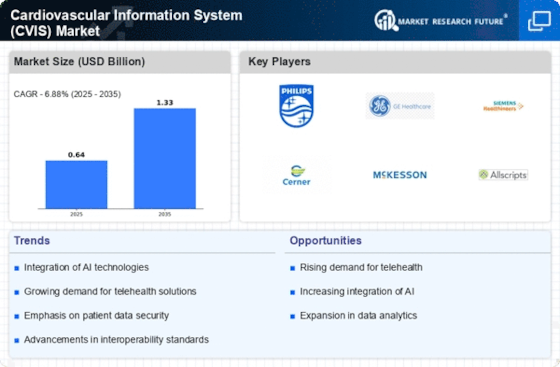
As per MRFR analysis, the Cardiovascular Information System Market Size was estimated at 640.0 USD Million in 2024. The Cardiovascular Information System industry is projected to grow from 684.04 in 2025 to 1330.86 by 2035, exhibiting a compound annual growth rate (CAGR) of 6.88% during the forecast period 2025 - 2035.

Key Market Trends & Highlights

The Cardiovascular Information System Market is poised for substantial growth driven by technological advancements and increasing demand for patient-centric solutions.

  • Technological integration is transforming cardiovascular information systems, enhancing efficiency and accuracy in patient care.
  • Patient-centric solutions are gaining traction, reflecting a shift towards personalized healthcare experiences in North America.
  • Interoperability and data sharing are becoming essential, particularly in the Asia-Pacific region, to facilitate seamless communication among healthcare providers.
  • The rising prevalence of cardiovascular diseases and government initiatives are key drivers propelling market expansion.

Market Size & Forecast

2024 Market Size 640.0 (USD Million)
2035 Market Size 1330.86 (USD Million)
CAGR (2025 - 2035) 6.88%
Largest Regional Market Share in 2024 North America

Major Players

<p>Philips (NL), GE Healthcare (US), Siemens Healthineers (DE), Medtronic (US), Cerner Corporation (US), Epic Systems Corporation (US), Allscripts Healthcare Solutions (US), IBM Watson Health (US)</p>

Market Trends

The Cardiovascular Information System Market is currently experiencing a transformative phase, driven by advancements in technology and an increasing emphasis on patient-centered care. The integration of electronic health records, telemedicine, and data analytics is reshaping how cardiovascular health is monitored and managed. Healthcare providers are increasingly adopting these systems to enhance clinical workflows, improve patient outcomes, and facilitate better communication among care teams. This shift appears to be fueled by a growing recognition of the importance of real-time data in making informed clinical decisions, which ultimately leads to more effective treatment strategies. Moreover, the rising prevalence of cardiovascular diseases globally necessitates innovative solutions that can streamline patient management and enhance the quality of care. As healthcare systems strive to meet the demands of an aging population, the Cardiovascular Information System Market is likely to expand further. The focus on interoperability among various health information systems suggests a trend towards more cohesive and integrated healthcare solutions. This evolution may not only improve operational efficiency but also empower patients by providing them with greater access to their health information, thereby fostering a more engaged approach to their cardiovascular health.

Technological Integration

The Cardiovascular Information System Market is witnessing a notable trend towards the integration of advanced technologies such as artificial intelligence and machine learning. These innovations are enhancing diagnostic accuracy and enabling predictive analytics, which can lead to earlier interventions and improved patient outcomes.

Patient-Centric Solutions

There is a growing emphasis on developing patient-centric solutions within the Cardiovascular Information System Market. This trend focuses on empowering patients through access to their health data, personalized treatment plans, and enhanced communication with healthcare providers, ultimately fostering a more collaborative healthcare environment.

Interoperability and Data Sharing

Interoperability among various healthcare systems is becoming increasingly critical in the Cardiovascular Information System Market. This trend emphasizes the need for seamless data sharing across platforms, which can enhance care coordination, reduce redundancies, and improve overall healthcare delivery.

Cardiovascular Information System Market Market Drivers

Government Initiatives and Funding

Government initiatives aimed at improving healthcare infrastructure are significantly influencing the Cardiovascular Information System Market. Various countries are investing in healthcare technology to enhance patient care and reduce healthcare costs. For example, funding programs for health IT systems are being implemented to encourage the adoption of electronic health records and cardiovascular information systems. This financial support is likely to accelerate the development and deployment of innovative solutions within the market. As a result, the Cardiovascular Information System Market is expected to benefit from these initiatives, leading to increased accessibility and improved health outcomes for patients with cardiovascular diseases.

Focus on Data Security and Compliance

Data security and compliance are becoming paramount in the Cardiovascular Information System Market. With the increasing digitization of health records, ensuring the protection of sensitive patient information is critical. Regulatory frameworks, such as HIPAA, mandate strict compliance measures for healthcare providers, driving the need for secure information systems. As organizations prioritize data security, the demand for advanced cybersecurity solutions within cardiovascular information systems is expected to rise. This focus on compliance and security may lead to innovations in the market, as companies strive to develop systems that not only meet regulatory requirements but also enhance patient trust and safety.

Technological Advancements in Healthcare

Technological innovations are transforming the landscape of the Cardiovascular Information System Market. The integration of artificial intelligence, machine learning, and telemedicine into cardiovascular care is enhancing diagnostic accuracy and treatment efficacy. For instance, AI algorithms can analyze vast amounts of patient data to identify risk factors and predict outcomes, which is becoming increasingly essential in clinical settings. The market is projected to witness substantial growth as healthcare facilities adopt these advanced technologies to streamline operations and improve patient care. This trend suggests that the Cardiovascular Information System Market will continue to evolve, driven by the need for more sophisticated and efficient healthcare solutions.

Growing Demand for Remote Patient Monitoring

The demand for remote patient monitoring solutions is driving growth in the Cardiovascular Information System Market. As healthcare shifts towards more patient-centered approaches, the ability to monitor patients outside traditional clinical settings is becoming crucial. Remote monitoring technologies allow healthcare providers to track patients' cardiovascular health in real-time, facilitating timely interventions and reducing hospital readmissions. This trend is particularly relevant as patients increasingly prefer to manage their health from home. The Cardiovascular Information System Market is likely to expand as more healthcare organizations adopt these solutions to enhance patient engagement and improve overall care delivery.

Rising Prevalence of Cardiovascular Diseases

The increasing incidence of cardiovascular diseases is a primary driver for the Cardiovascular Information System Market. As populations age and lifestyle-related health issues become more prevalent, the demand for effective management solutions rises. According to recent statistics, cardiovascular diseases account for a significant portion of global mortality rates, necessitating advanced information systems for monitoring and treatment. This trend indicates a growing need for integrated systems that can provide real-time data and analytics, thereby enhancing patient outcomes. The Cardiovascular Information System Market is likely to expand as healthcare providers seek to implement these technologies to address the rising burden of cardiovascular conditions.

Market Segment Insights

By Application: Cardiac Imaging (Largest) vs. Telehealth Services (Fastest-Growing)

<p>In the Cardiovascular Information System (CVIS) Market, the application segment showcases a diverse distribution of roles and functionalities. Cardiac Imaging holds the largest share, being integral to diagnostics and treatment planning. It is closely followed by Electronic Health Records, which facilitate comprehensive patient data management. Data Management, Patient Management, and Telehealth Services collectively contribute to enhancing care delivery, yet they share a smaller portion of the market share footprint.</p>

<p>Cardiac Imaging (Dominant) vs. Telehealth Services (Emerging)</p>

<p>Cardiac Imaging remains the dominant application in the CVIS market, providing essential tools for precise diagnosis and visualization of cardiovascular conditions. Its advanced technologies enable healthcare providers to enhance patient outcomes through accurate imaging modalities and integration with EHR systems. In contrast, Telehealth Services, while emerging, are gaining traction rapidly due to their ability to facilitate remote patient monitoring and consultations, driven by increased demand for accessible healthcare solutions. The convergence of these applications is reshaping care models, with Telehealth Services poised to play a pivotal role in expanding patient reach and engagement.</p>

By End User: Hospitals (Largest) vs. Clinics (Fastest-Growing)

<p>In the Cardiovascular Information System (CVIS) market, hospitals represent the largest share of end-users, largely due to the extensive adoption of advanced cardiovascular technologies and the increasing number of patients requiring specialized cardiac care. Clinics, while smaller in market share, are witnessing rapid growth as more outpatient services are being offered, driven by the rising trend of preventive care and the demand for accessible cardiac health assessments.</p>

<p>Hospitals (Dominant) vs. Clinics (Emerging)</p>

<p>Hospitals dominate the CVIS market due to their comprehensive offerings and the ability to invest in sophisticated technology, creating a robust infrastructure for cardiovascular care. They cater to a wide range of complex cases, adapting quickly to advancements in cardiovascular treatment and management. Conversely, clinics represent an emerging segment, growing swiftly in response to increasing consumer demand for accessible and cost-effective cardiovascular services. With an emphasis on preventive cardiology and outpatient care, clinics are expanding their capabilities and utilizing CVIS solutions to enhance patient outcomes and streamline operations.</p>

By Deployment Type: Cloud-Based (Largest) vs. Hybrid (Fastest-Growing)

<p>The deployment types in the Cardiovascular Information System (CVIS) market showcase a significant preference towards cloud-based solutions, which have established themselves as the largest segment due to their scalability, accessibility, and reduced infrastructure costs. On-premises systems, while still in use, are gradually declining in market share as healthcare institutions increasingly adopt more flexible solutions that enhance interoperability. Hybrid deployment models are emerging swiftly, driven by the need for healthcare organizations to maintain sensitive data on-premises while also leveraging cloud capabilities for data analytics and storage. This trend is fueled by advancements in internet security, regulatory pressures for data protection, and the demand for greater operational efficiency. As a result, the hybrid segment is expected to experience rapid growth in the coming years, catering to institutions looking for a balanced approach to technology integration.</p>

<p>Cloud-Based (Dominant) vs. On-Premises (Emerging)</p>

<p>Cloud-based deployment in the Cardiovascular Information System (CVIS) market stands as the dominant player, characterized by its ability to offer real-time data access, remote monitoring, and seamless integration with other digital health solutions. Its advantages include lower upfront costs, regular updates, and easier scalability, making it the first choice for many healthcare providers seeking modernization. Conversely, on-premises deployment is considered an emerging model, typically preferred by institutions with stringent data control requirements. While it offers enhanced security and control over patient information, the need for continuous maintenance and higher initial investments can hinder its adoption. As data security technology advances, on-premises models may see a revival, especially among larger organizations prioritizing data sovereignty.</p>

By Component: Software (Largest) vs. Hardware (Fastest-Growing)

<p>The Cardiovascular Information System (CVIS) Market is primarily divided into software, hardware, and services, with software holding the largest share. Software solutions provide essential functionalities for data management, patient tracking, and advanced analytics, making it indispensable for healthcare providers. Meanwhile, hardware, which includes diagnostic devices and imaging equipment, is experiencing rapid growth due to technological advancements and increasing demand for integrated systems in cardiovascular care.</p>

<p>Software (Dominant) vs. Hardware (Emerging)</p>

<p>Software in the CVIS market plays a pivotal role in streamlining cardiovascular data management, enhancing interoperability and facilitating improved patient outcomes. It is characterized by its capability to integrate with electronic health records and provide real-time analytics, which is crucial for decision-making in clinical settings. On the other hand, hardware, although currently in the emerging stage, is gaining momentum as healthcare facilities invest in advanced imaging and diagnostic technologies, driven by the need for precision medicine practices. The integration of hardware with software solutions is expected to further enhance their value proposition, catering to an increasingly technology-driven healthcare ecosystem.</p>

By Type: Integrated Systems (Largest) vs. Standalone Systems (Fastest-Growing)

<p>In the Cardiovascular Information System Market, Integrated Systems currently hold the largest share, providing comprehensive solutions that encompass various functionalities within cardiovascular care. Standalone Systems, while smaller in market share, are witnessing rapid adoption due to their focused solutions and ease of installation, proving beneficial in specific healthcare environments. Modular Systems, although significant, cater to niche needs, reinforcing the market's diversity in addressing cardiology demands. The growth trends in this segment show a clear shift towards Integrated Systems driven by healthcare providers' preference for holistic approaches to patient management. However, the rising demand for Standalone Systems indicates a growing recognition of their efficiency and flexibility, particularly among smaller clinics and practices. As technology evolves, Modular Systems are also evolving, encouraging tailored solutions that meet specific cardiovascular needs, thereby stimulating further growth and innovation in the sector.</p>

<p>Integrated Systems (Dominant) vs. Standalone Systems (Emerging)</p>

<p>Integrated Systems dominate the Cardiovascular Information System Market by offering a broad range of features that streamline workflows and improve patient outcomes through data integration and analytics. These systems are typically favored in larger hospital settings where comprehensive management and efficiency are paramount. On the other hand, Standalone Systems are emerging as crucial alternatives that serve specific functions within cardiovascular care, aligning with workflows in smaller practices or specialized clinics. Their simplicity and ease of use make them attractive, particularly as medical facilities seek to enhance service without significant financial commitment. The distinct characteristics of these system types illustrate their roles in supporting clinical decisions and operational efficiency, meeting varied healthcare needs based on size and service scope.</p>

Get more detailed insights about Cardiovascular Information System Market Research Report - Forecast till 2035

Regional Insights

North America : Market Leader in Innovation

North America holds a commanding position in the Cardiovascular Information System market, accounting for a significant share of 320.0 million in 2024. The region's growth is driven by advanced healthcare infrastructure, increasing prevalence of cardiovascular diseases, and a strong focus on technological innovations. Regulatory support from agencies like the FDA further catalyzes market expansion, ensuring that cutting-edge solutions are rapidly adopted to improve patient outcomes. The competitive landscape in North America is robust, featuring key players such as GE Healthcare, Medtronic, and Cerner Corporation. The U.S. leads the market, supported by high healthcare spending and a growing emphasis on digital health solutions. Companies are investing heavily in R&D to enhance their offerings, ensuring they remain at the forefront of the industry. This dynamic environment fosters collaboration and innovation, positioning North America as a global leader in cardiovascular information systems.

Europe : Emerging Market with Growth Potential

Europe's Cardiovascular Information System market is valued at 180.0 million, reflecting a growing demand for advanced healthcare solutions. The region benefits from a well-established healthcare system, increasing investments in health technology, and a rising incidence of cardiovascular diseases. Regulatory frameworks, such as the EU Medical Device Regulation, are pivotal in ensuring safety and efficacy, thus driving market growth and innovation in cardiovascular care. Leading countries in Europe include Germany, France, and the UK, where major players like Siemens Healthineers and Philips are actively enhancing their market presence. The competitive landscape is characterized by strategic partnerships and collaborations aimed at developing integrated solutions. As healthcare providers increasingly adopt digital health technologies, Europe is poised for significant growth in the cardiovascular information systems sector.

Asia-Pacific : Rapidly Growing Healthcare Sector

The Asia-Pacific region, with a market size of 100.0 million, is witnessing rapid growth in the Cardiovascular Information System sector. Factors such as increasing urbanization, rising disposable incomes, and a growing aging population contribute to the heightened demand for advanced healthcare solutions. Governments are also investing in healthcare infrastructure, which is crucial for improving cardiovascular care and addressing the rising burden of heart diseases across the region. Countries like China, India, and Japan are leading the charge, with significant investments from key players such as IBM Watson Health and Allscripts Healthcare Solutions. The competitive landscape is evolving, with local companies emerging alongside established global players. This dynamic environment fosters innovation and collaboration, positioning the Asia-Pacific region as a promising market for cardiovascular information systems.

Middle East and Africa : Developing Market with Opportunities

The Middle East and Africa region, valued at 40.0 million, presents unique opportunities in the Cardiovascular Information System market. The growth is driven by increasing healthcare investments, a rising prevalence of cardiovascular diseases, and a focus on improving healthcare infrastructure. Governments are prioritizing health initiatives, which is essential for enhancing cardiovascular care and addressing the needs of a growing population. Leading countries in this region include South Africa and the UAE, where there is a growing presence of international players. The competitive landscape is characterized by partnerships and collaborations aimed at improving healthcare delivery. As the region continues to develop, the demand for advanced cardiovascular information systems is expected to rise, creating a favorable environment for market expansion.

Key Players and Competitive Insights

The Cardiovascular Information System Market is currently characterized by a dynamic competitive landscape, driven by technological advancements and an increasing emphasis on patient-centric care. Key players such as Philips (NL), GE Healthcare (US), and Siemens Healthineers (DE) are at the forefront, each adopting distinct strategies to enhance their market positioning. Philips (NL) focuses on innovation through the integration of AI and machine learning into its cardiovascular solutions, aiming to improve diagnostic accuracy and patient outcomes. Meanwhile, GE Healthcare (US) emphasizes partnerships with healthcare providers to expand its reach and enhance service delivery, while Siemens Healthineers (DE) is investing heavily in digital transformation initiatives to streamline operations and improve data management capabilities. Collectively, these strategies contribute to a competitive environment that is increasingly centered around technological innovation and collaborative approaches.

In terms of business tactics, companies are localizing manufacturing and optimizing supply chains to enhance operational efficiency and reduce costs. The market appears moderately fragmented, with several key players exerting influence over various segments. This fragmentation allows for a diverse range of offerings, catering to different healthcare needs and preferences. The collective influence of these major players shapes the market structure, fostering an environment where innovation and strategic partnerships are paramount.

In January 2026, Philips (NL) announced a strategic partnership with a leading telehealth provider to enhance remote monitoring capabilities for cardiovascular patients. This collaboration is expected to leverage advanced analytics and real-time data sharing, thereby improving patient engagement and outcomes. The strategic importance of this move lies in its potential to position Philips as a leader in the growing telehealth segment, which is increasingly vital in modern healthcare delivery.

In December 2025, GE Healthcare (US) launched a new cloud-based cardiovascular information system designed to facilitate seamless data integration across healthcare facilities. This initiative underscores GE's commitment to digital transformation and reflects a broader trend towards cloud solutions in healthcare. The strategic significance of this launch is evident in its potential to enhance interoperability and streamline workflows, ultimately leading to improved patient care.

In November 2025, Siemens Healthineers (DE) expanded its portfolio by acquiring a software company specializing in AI-driven cardiovascular analytics. This acquisition is likely to bolster Siemens' capabilities in predictive analytics, enabling healthcare providers to make more informed decisions. The strategic importance of this acquisition lies in its alignment with the growing demand for data-driven solutions in cardiovascular care, positioning Siemens as a formidable competitor in the market.

As of February 2026, current trends in the Cardiovascular Information System Market are heavily influenced by digitalization, sustainability, and AI integration. Strategic alliances are increasingly shaping the competitive landscape, as companies recognize the value of collaboration in driving innovation. Looking ahead, competitive differentiation is expected to evolve, with a shift from price-based competition to a focus on technological innovation, enhanced patient outcomes, and supply chain reliability. This transition suggests that companies that prioritize these aspects will likely gain a competitive edge in the evolving market.

Key Companies in the Cardiovascular Information System Market include

Industry Developments

The Cardiovascular Information System Market (CVIS) Market has seen a lot of changes in the last few months, mostly because of how quickly technology and digital health projects are moving forward. Companies like GE Healthcare and Philips are still at the forefront of innovation. Both have added artificial intelligence (AI) to their CVIS platforms—GE's Centricity Cardio Enterprise and Philips' IntelliSpace Cardiovascular—to make diagnoses more accurate and make it easier to manage cardiovascular data (as of Q1 2024).

Industry sources said in September 2023 that eClinicalWorks might be looking into strategic partnerships to make data easier to share, but there was no official announcement of a merger. Merative, which used to be called IBM Watson Health and changed its name in January 2022, has shifted its focus to cardiovascular analytics. This is in line with the growing need for AI-driven clinical insights. 

As of late 2023, Cerner (now part of Oracle Health after its acquisition was completed in June 2022) said that more health systems were using its cardiovascular EHR module, which shows that CVIS is becoming more popular. But McKesson, which left the health IT business in 2017, is no longer an active player in the CVIS market. Since 2021, there has been a strong push in the healthcare sector toward digital transformation. This has sped up the use of integrated solutions that bring together imaging, diagnostics, and reporting in cardiovascular care. 

The American College of Cardiology (ACC) and the European Society of Cardiology (ESC) are two of the busiest trade groups that keep talking about how important strong CVIS platforms are for making clinical workflows more efficient and getting better results in managing cardiovascular disease around the world.

Future Outlook

Cardiovascular Information System Market Future Outlook

The Cardiovascular Information System Market is projected to grow at a 6.88% CAGR from 2024 to 2035, driven by technological advancements, increasing cardiovascular diseases, and demand for integrated healthcare solutions.

New opportunities lie in:

  • Development of AI-driven predictive analytics tools for patient management.
  • Expansion of telehealth platforms integrating cardiovascular monitoring systems.
  • Partnerships with wearable technology firms to enhance data collection and patient engagement.

By 2035, the market is expected to be robust, driven by innovation and strategic partnerships.

Market Segmentation

Cardiovascular Information System Market Type Outlook

  • Standalone Systems
  • Integrated Systems
  • Modular Systems

Cardiovascular Information System Market End Use Outlook

  • Hospitals
  • Ambulatory Surgical Centers
  • Diagnostic Centers
  • Home Care Settings

Cardiovascular Information System Market Component Outlook

  • Software
  • Hardware
  • Services

Cardiovascular Information System Market Application Outlook

  • Cardiovascular Imaging
  • Cardiac Monitoring
  • Data Management
  • Clinical Decision Support
  • Telemedicine

Cardiovascular Information System Market Deployment Mode Outlook

  • On-Premise
  • Cloud-Based
  • Hybrid

Report Scope

MARKET SIZE 2024 640.0(USD Million)
MARKET SIZE 2025 684.04(USD Million)
MARKET SIZE 2035 1330.86(USD Million)
COMPOUND ANNUAL GROWTH RATE (CAGR) 6.88% (2024 - 2035)
REPORT COVERAGE Revenue Forecast, Competitive Landscape, Growth Factors, and Trends
BASE YEAR 2024
Market Forecast Period 2025 - 2035
Historical Data 2019 - 2024
Market Forecast Units USD Million
Key Companies Profiled Philips (NL), GE Healthcare (US), Siemens Healthineers (DE), Medtronic (US), Cerner Corporation (US), Epic Systems Corporation (US), Allscripts Healthcare Solutions (US), IBM Watson Health (US)
Segments Covered Application, End Use, Component, Deployment Mode, Type
Key Market Opportunities Integration of artificial intelligence enhances diagnostic accuracy in the Cardiovascular Information System Market.
Key Market Dynamics Technological advancements and regulatory changes drive innovation and competition in the Cardiovascular Information System Market.
Countries Covered North America, Europe, APAC, South America, MEA

FAQs

What is the projected market valuation of the Cardiovascular Information System (CVIS) Market by 2035?

<p>The projected market valuation for the Cardiovascular Information System (CVIS) Market is 1.331 USD Billion by 2035.</p>

What was the market valuation of the CVIS Market in 2024?

<p>The overall market valuation of the CVIS Market was 0.64 USD Billion in 2024.</p>

What is the expected CAGR for the CVIS Market during the forecast period 2025 - 2035?

<p>The expected CAGR for the CVIS Market during the forecast period 2025 - 2035 is 6.88%.</p>

Which segments are included in the CVIS Market and what are their valuations?

<p>The CVIS Market includes segments such as Cardiac Imaging, Electronic Health Records, Data Management, Patient Management, and Telehealth Services, with valuations ranging from 0.09 to 0.45 USD Billion.</p>

Who are the key players in the Cardiovascular Information System (CVIS) Market?

<p>Key players in the CVIS Market include Philips, GE Healthcare, Siemens Healthineers, Cerner Corporation, McKesson Corporation, Allscripts Healthcare Solutions, Epic Systems Corporation, and Cardiovascular Systems, Inc.</p>

What is the valuation range for the Cardiac Imaging segment in the CVIS Market?

<p>The valuation range for the Cardiac Imaging segment in the CVIS Market is from 0.15 to 0.35 USD Billion.</p>

How does the deployment type affect the CVIS Market?

<p>The CVIS Market is segmented by deployment type, with On-Premises valued between 0.25 and 0.5 USD Billion, Cloud-Based between 0.2 and 0.4 USD Billion, and Hybrid between 0.19 and 0.43 USD Billion.</p>

What are the expected valuations for the end-user segments in the CVIS Market?

<p>End-user segments in the CVIS Market, such as Hospitals, Clinics, Ambulatory Surgical Centers, and Research and Academic Institutes, have valuations ranging from 0.1 to 0.55 USD Billion.</p>

What components are included in the CVIS Market and their respective valuations?

<p>The CVIS Market comprises components like Software, Hardware, and Services, with valuations ranging from 0.128 to 0.55 USD Billion.</p>

How does the CVIS Market's growth potential compare to other healthcare technology markets?

<p>The CVIS Market's growth potential, indicated by a projected CAGR of 6.88% from 2025 - 2035, suggests a robust expansion compared to other healthcare technology markets.</p>

  1. SECTION I: EXECUTIVE SUMMARY AND KEY HIGHLIGHTS
    1. | 1.1 EXECUTIVE SUMMARY
    2. | | 1.1.1 Market Overview
    3. | | 1.1.2 Key Findings
    4. | | 1.1.3 Market Segmentation
    5. | | 1.1.4 Competitive Landscape
    6. | | 1.1.5 Challenges and Opportunities
    7. | | 1.1.6 Future Outlook
  2. SECTION II: SCOPING, METHODOLOGY AND MARKET STRUCTURE
    1. | 2.1 MARKET INTRODUCTION
    2. | | 2.1.1 Definition
    3. | | 2.1.2 Scope of the study
    4. | | | 2.1.2.1 Research Objective
    5. | | | 2.1.2.2 Assumption
    6. | | | 2.1.2.3 Limitations
    7. | 2.2 RESEARCH METHODOLOGY
    8. | | 2.2.1 Overview
    9. | | 2.2.2 Data Mining
    10. | | 2.2.3 Secondary Research
    11. | | 2.2.4 Primary Research
    12. | | | 2.2.4.1 Primary Interviews and Information Gathering Process
    13. | | | 2.2.4.2 Breakdown of Primary Respondents
    14. | | 2.2.5 Forecasting Model
    15. | | 2.2.6 Market Size Estimation
    16. | | | 2.2.6.1 Bottom-Up Approach
    17. | | | 2.2.6.2 Top-Down Approach
    18. | | 2.2.7 Data Triangulation
    19. | | 2.2.8 Validation
  3. SECTION III: QUALITATIVE ANALYSIS
    1. | 3.1 MARKET DYNAMICS
    2. | | 3.1.1 Overview
    3. | | 3.1.2 Drivers
    4. | | 3.1.3 Restraints
    5. | | 3.1.4 Opportunities
    6. | 3.2 MARKET FACTOR ANALYSIS
    7. | | 3.2.1 Value chain Analysis
    8. | | 3.2.2 Porter's Five Forces Analysis
    9. | | | 3.2.2.1 Bargaining Power of Suppliers
    10. | | | 3.2.2.2 Bargaining Power of Buyers
    11. | | | 3.2.2.3 Threat of New Entrants
    12. | | | 3.2.2.4 Threat of Substitutes
    13. | | | 3.2.2.5 Intensity of Rivalry
    14. | | 3.2.3 COVID-19 Impact Analysis
    15. | | | 3.2.3.1 Market Impact Analysis
    16. | | | 3.2.3.2 Regional Impact
    17. | | | 3.2.3.3 Opportunity and Threat Analysis
  4. SECTION IV: QUANTITATIVE ANALYSIS
    1. | 4.1 Healthcare, BY Application (USD Billion)
    2. | | 4.1.1 Cardiac Imaging
    3. | | 4.1.2 Electronic Health Records
    4. | | 4.1.3 Data Management
    5. | | 4.1.4 Patient Management
    6. | | 4.1.5 Telehealth Services
    7. | 4.2 Healthcare, BY End User (USD Billion)
    8. | | 4.2.1 Hospitals
    9. | | 4.2.2 Clinics
    10. | | 4.2.3 Ambulatory Surgical Centers
    11. | | 4.2.4 Research and Academic Institutes
    12. | 4.3 Healthcare, BY Deployment Type (USD Billion)
    13. | | 4.3.1 On-Premises
    14. | | 4.3.2 Cloud-Based
    15. | | 4.3.3 Hybrid
    16. | 4.4 Healthcare, BY Component (USD Billion)
    17. | | 4.4.1 Software
    18. | | 4.4.2 Hardware
    19. | | 4.4.3 Services
    20. | 4.5 Healthcare, BY Region (USD Billion)
    21. | | 4.5.1 North America
    22. | | | 4.5.1.1 US
    23. | | | 4.5.1.2 Canada
    24. | | 4.5.2 Europe
    25. | | | 4.5.2.1 Germany
    26. | | | 4.5.2.2 UK
    27. | | | 4.5.2.3 France
    28. | | | 4.5.2.4 Russia
    29. | | | 4.5.2.5 Italy
    30. | | | 4.5.2.6 Spain
    31. | | | 4.5.2.7 Rest of Europe
    32. | | 4.5.3 APAC
    33. | | | 4.5.3.1 China
    34. | | | 4.5.3.2 India
    35. | | | 4.5.3.3 Japan
    36. | | | 4.5.3.4 South Korea
    37. | | | 4.5.3.5 Malaysia
    38. | | | 4.5.3.6 Thailand
    39. | | | 4.5.3.7 Indonesia
    40. | | | 4.5.3.8 Rest of APAC
    41. | | 4.5.4 South America
    42. | | | 4.5.4.1 Brazil
    43. | | | 4.5.4.2 Mexico
    44. | | | 4.5.4.3 Argentina
    45. | | | 4.5.4.4 Rest of South America
    46. | | 4.5.5 MEA
    47. | | | 4.5.5.1 GCC Countries
    48. | | | 4.5.5.2 South Africa
    49. | | | 4.5.5.3 Rest of MEA
  5. SECTION V: COMPETITIVE ANALYSIS
    1. | 5.1 Competitive Landscape
    2. | | 5.1.1 Overview
    3. | | 5.1.2 Competitive Analysis
    4. | | 5.1.3 Market share Analysis
    5. | | 5.1.4 Major Growth Strategy in the Healthcare
    6. | | 5.1.5 Competitive Benchmarking
    7. | | 5.1.6 Leading Players in Terms of Number of Developments in the Healthcare
    8. | | 5.1.7 Key developments and growth strategies
    9. | | | 5.1.7.1 New Product Launch/Service Deployment
    10. | | | 5.1.7.2 Merger & Acquisitions
    11. | | | 5.1.7.3 Joint Ventures
    12. | | 5.1.8 Major Players Financial Matrix
    13. | | | 5.1.8.1 Sales and Operating Income
    14. | | | 5.1.8.2 Major Players R&D Expenditure. 2023
    15. | 5.2 Company Profiles
    16. | | 5.2.1 Philips (NL)
    17. | | | 5.2.1.1 Financial Overview
    18. | | | 5.2.1.2 Products Offered
    19. | | | 5.2.1.3 Key Developments
    20. | | | 5.2.1.4 SWOT Analysis
    21. | | | 5.2.1.5 Key Strategies
    22. | | 5.2.2 GE Healthcare (US)
    23. | | | 5.2.2.1 Financial Overview
    24. | | | 5.2.2.2 Products Offered
    25. | | | 5.2.2.3 Key Developments
    26. | | | 5.2.2.4 SWOT Analysis
    27. | | | 5.2.2.5 Key Strategies
    28. | | 5.2.3 Siemens Healthineers (DE)
    29. | | | 5.2.3.1 Financial Overview
    30. | | | 5.2.3.2 Products Offered
    31. | | | 5.2.3.3 Key Developments
    32. | | | 5.2.3.4 SWOT Analysis
    33. | | | 5.2.3.5 Key Strategies
    34. | | 5.2.4 Cerner Corporation (US)
    35. | | | 5.2.4.1 Financial Overview
    36. | | | 5.2.4.2 Products Offered
    37. | | | 5.2.4.3 Key Developments
    38. | | | 5.2.4.4 SWOT Analysis
    39. | | | 5.2.4.5 Key Strategies
    40. | | 5.2.5 McKesson Corporation (US)
    41. | | | 5.2.5.1 Financial Overview
    42. | | | 5.2.5.2 Products Offered
    43. | | | 5.2.5.3 Key Developments
    44. | | | 5.2.5.4 SWOT Analysis
    45. | | | 5.2.5.5 Key Strategies
    46. | | 5.2.6 Allscripts Healthcare Solutions (US)
    47. | | | 5.2.6.1 Financial Overview
    48. | | | 5.2.6.2 Products Offered
    49. | | | 5.2.6.3 Key Developments
    50. | | | 5.2.6.4 SWOT Analysis
    51. | | | 5.2.6.5 Key Strategies
    52. | | 5.2.7 Epic Systems Corporation (US)
    53. | | | 5.2.7.1 Financial Overview
    54. | | | 5.2.7.2 Products Offered
    55. | | | 5.2.7.3 Key Developments
    56. | | | 5.2.7.4 SWOT Analysis
    57. | | | 5.2.7.5 Key Strategies
    58. | | 5.2.8 Cardiovascular Systems, Inc. (US)
    59. | | | 5.2.8.1 Financial Overview
    60. | | | 5.2.8.2 Products Offered
    61. | | | 5.2.8.3 Key Developments
    62. | | | 5.2.8.4 SWOT Analysis
    63. | | | 5.2.8.5 Key Strategies
    64. | 5.3 Appendix
    65. | | 5.3.1 References
    66. | | 5.3.2 Related Reports
  6. LIST OF FIGURES
    1. | 6.1 MARKET SYNOPSIS
    2. | 6.2 NORTH AMERICA MARKET ANALYSIS
    3. | 6.3 US MARKET ANALYSIS BY APPLICATION
    4. | 6.4 US MARKET ANALYSIS BY END USER
    5. | 6.5 US MARKET ANALYSIS BY DEPLOYMENT TYPE
    6. | 6.6 US MARKET ANALYSIS BY COMPONENT
    7. | 6.7 CANADA MARKET ANALYSIS BY APPLICATION
    8. | 6.8 CANADA MARKET ANALYSIS BY END USER
    9. | 6.9 CANADA MARKET ANALYSIS BY DEPLOYMENT TYPE
    10. | 6.10 CANADA MARKET ANALYSIS BY COMPONENT
    11. | 6.11 EUROPE MARKET ANALYSIS
    12. | 6.12 GERMANY MARKET ANALYSIS BY APPLICATION
    13. | 6.13 GERMANY MARKET ANALYSIS BY END USER
    14. | 6.14 GERMANY MARKET ANALYSIS BY DEPLOYMENT TYPE
    15. | 6.15 GERMANY MARKET ANALYSIS BY COMPONENT
    16. | 6.16 UK MARKET ANALYSIS BY APPLICATION
    17. | 6.17 UK MARKET ANALYSIS BY END USER
    18. | 6.18 UK MARKET ANALYSIS BY DEPLOYMENT TYPE
    19. | 6.19 UK MARKET ANALYSIS BY COMPONENT
    20. | 6.20 FRANCE MARKET ANALYSIS BY APPLICATION
    21. | 6.21 FRANCE MARKET ANALYSIS BY END USER
    22. | 6.22 FRANCE MARKET ANALYSIS BY DEPLOYMENT TYPE
    23. | 6.23 FRANCE MARKET ANALYSIS BY COMPONENT
    24. | 6.24 RUSSIA MARKET ANALYSIS BY APPLICATION
    25. | 6.25 RUSSIA MARKET ANALYSIS BY END USER
    26. | 6.26 RUSSIA MARKET ANALYSIS BY DEPLOYMENT TYPE
    27. | 6.27 RUSSIA MARKET ANALYSIS BY COMPONENT
    28. | 6.28 ITALY MARKET ANALYSIS BY APPLICATION
    29. | 6.29 ITALY MARKET ANALYSIS BY END USER
    30. | 6.30 ITALY MARKET ANALYSIS BY DEPLOYMENT TYPE
    31. | 6.31 ITALY MARKET ANALYSIS BY COMPONENT
    32. | 6.32 SPAIN MARKET ANALYSIS BY APPLICATION
    33. | 6.33 SPAIN MARKET ANALYSIS BY END USER
    34. | 6.34 SPAIN MARKET ANALYSIS BY DEPLOYMENT TYPE
    35. | 6.35 SPAIN MARKET ANALYSIS BY COMPONENT
    36. | 6.36 REST OF EUROPE MARKET ANALYSIS BY APPLICATION
    37. | 6.37 REST OF EUROPE MARKET ANALYSIS BY END USER
    38. | 6.38 REST OF EUROPE MARKET ANALYSIS BY DEPLOYMENT TYPE
    39. | 6.39 REST OF EUROPE MARKET ANALYSIS BY COMPONENT
    40. | 6.40 APAC MARKET ANALYSIS
    41. | 6.41 CHINA MARKET ANALYSIS BY APPLICATION
    42. | 6.42 CHINA MARKET ANALYSIS BY END USER
    43. | 6.43 CHINA MARKET ANALYSIS BY DEPLOYMENT TYPE
    44. | 6.44 CHINA MARKET ANALYSIS BY COMPONENT
    45. | 6.45 INDIA MARKET ANALYSIS BY APPLICATION
    46. | 6.46 INDIA MARKET ANALYSIS BY END USER
    47. | 6.47 INDIA MARKET ANALYSIS BY DEPLOYMENT TYPE
    48. | 6.48 INDIA MARKET ANALYSIS BY COMPONENT
    49. | 6.49 JAPAN MARKET ANALYSIS BY APPLICATION
    50. | 6.50 JAPAN MARKET ANALYSIS BY END USER
    51. | 6.51 JAPAN MARKET ANALYSIS BY DEPLOYMENT TYPE
    52. | 6.52 JAPAN MARKET ANALYSIS BY COMPONENT
    53. | 6.53 SOUTH KOREA MARKET ANALYSIS BY APPLICATION
    54. | 6.54 SOUTH KOREA MARKET ANALYSIS BY END USER
    55. | 6.55 SOUTH KOREA MARKET ANALYSIS BY DEPLOYMENT TYPE
    56. | 6.56 SOUTH KOREA MARKET ANALYSIS BY COMPONENT
    57. | 6.57 MALAYSIA MARKET ANALYSIS BY APPLICATION
    58. | 6.58 MALAYSIA MARKET ANALYSIS BY END USER
    59. | 6.59 MALAYSIA MARKET ANALYSIS BY DEPLOYMENT TYPE
    60. | 6.60 MALAYSIA MARKET ANALYSIS BY COMPONENT
    61. | 6.61 THAILAND MARKET ANALYSIS BY APPLICATION
    62. | 6.62 THAILAND MARKET ANALYSIS BY END USER
    63. | 6.63 THAILAND MARKET ANALYSIS BY DEPLOYMENT TYPE
    64. | 6.64 THAILAND MARKET ANALYSIS BY COMPONENT
    65. | 6.65 INDONESIA MARKET ANALYSIS BY APPLICATION
    66. | 6.66 INDONESIA MARKET ANALYSIS BY END USER
    67. | 6.67 INDONESIA MARKET ANALYSIS BY DEPLOYMENT TYPE
    68. | 6.68 INDONESIA MARKET ANALYSIS BY COMPONENT
    69. | 6.69 REST OF APAC MARKET ANALYSIS BY APPLICATION
    70. | 6.70 REST OF APAC MARKET ANALYSIS BY END USER
    71. | 6.71 REST OF APAC MARKET ANALYSIS BY DEPLOYMENT TYPE
    72. | 6.72 REST OF APAC MARKET ANALYSIS BY COMPONENT
    73. | 6.73 SOUTH AMERICA MARKET ANALYSIS
    74. | 6.74 BRAZIL MARKET ANALYSIS BY APPLICATION
    75. | 6.75 BRAZIL MARKET ANALYSIS BY END USER
    76. | 6.76 BRAZIL MARKET ANALYSIS BY DEPLOYMENT TYPE
    77. | 6.77 BRAZIL MARKET ANALYSIS BY COMPONENT
    78. | 6.78 MEXICO MARKET ANALYSIS BY APPLICATION
    79. | 6.79 MEXICO MARKET ANALYSIS BY END USER
    80. | 6.80 MEXICO MARKET ANALYSIS BY DEPLOYMENT TYPE
    81. | 6.81 MEXICO MARKET ANALYSIS BY COMPONENT
    82. | 6.82 ARGENTINA MARKET ANALYSIS BY APPLICATION
    83. | 6.83 ARGENTINA MARKET ANALYSIS BY END USER
    84. | 6.84 ARGENTINA MARKET ANALYSIS BY DEPLOYMENT TYPE
    85. | 6.85 ARGENTINA MARKET ANALYSIS BY COMPONENT
    86. | 6.86 REST OF SOUTH AMERICA MARKET ANALYSIS BY APPLICATION
    87. | 6.87 REST OF SOUTH AMERICA MARKET ANALYSIS BY END USER
    88. | 6.88 REST OF SOUTH AMERICA MARKET ANALYSIS BY DEPLOYMENT TYPE
    89. | 6.89 REST OF SOUTH AMERICA MARKET ANALYSIS BY COMPONENT
    90. | 6.90 MEA MARKET ANALYSIS
    91. | 6.91 GCC COUNTRIES MARKET ANALYSIS BY APPLICATION
    92. | 6.92 GCC COUNTRIES MARKET ANALYSIS BY END USER
    93. | 6.93 GCC COUNTRIES MARKET ANALYSIS BY DEPLOYMENT TYPE
    94. | 6.94 GCC COUNTRIES MARKET ANALYSIS BY COMPONENT
    95. | 6.95 SOUTH AFRICA MARKET ANALYSIS BY APPLICATION
    96. | 6.96 SOUTH AFRICA MARKET ANALYSIS BY END USER
    97. | 6.97 SOUTH AFRICA MARKET ANALYSIS BY DEPLOYMENT TYPE
    98. | 6.98 SOUTH AFRICA MARKET ANALYSIS BY COMPONENT
    99. | 6.99 REST OF MEA MARKET ANALYSIS BY APPLICATION
    100. | 6.100 REST OF MEA MARKET ANALYSIS BY END USER
    101. | 6.101 REST OF MEA MARKET ANALYSIS BY DEPLOYMENT TYPE
    102. | 6.102 REST OF MEA MARKET ANALYSIS BY COMPONENT
    103. | 6.103 KEY BUYING CRITERIA OF HEALTHCARE
    104. | 6.104 RESEARCH PROCESS OF MRFR
    105. | 6.105 DRO ANALYSIS OF HEALTHCARE
    106. | 6.106 DRIVERS IMPACT ANALYSIS: HEALTHCARE
    107. | 6.107 RESTRAINTS IMPACT ANALYSIS: HEALTHCARE
    108. | 6.108 SUPPLY / VALUE CHAIN: HEALTHCARE
    109. | 6.109 HEALTHCARE, BY APPLICATION, 2024 (% SHARE)
    110. | 6.110 HEALTHCARE, BY APPLICATION, 2024 TO 2035 (USD Billion)
    111. | 6.111 HEALTHCARE, BY END USER, 2024 (% SHARE)
    112. | 6.112 HEALTHCARE, BY END USER, 2024 TO 2035 (USD Billion)
    113. | 6.113 HEALTHCARE, BY DEPLOYMENT TYPE, 2024 (% SHARE)
    114. | 6.114 HEALTHCARE, BY DEPLOYMENT TYPE, 2024 TO 2035 (USD Billion)
    115. | 6.115 HEALTHCARE, BY COMPONENT, 2024 (% SHARE)
    116. | 6.116 HEALTHCARE, BY COMPONENT, 2024 TO 2035 (USD Billion)
    117. | 6.117 BENCHMARKING OF MAJOR COMPETITORS
  7. LIST OF TABLES
    1. | 7.1 LIST OF ASSUMPTIONS
    2. | | 7.1.1
    3. | 7.2 North America MARKET SIZE ESTIMATES; FORECAST
    4. | | 7.2.1 BY APPLICATION, 2025-2035 (USD Billion)
    5. | | 7.2.2 BY END USER, 2025-2035 (USD Billion)
    6. | | 7.2.3 BY DEPLOYMENT TYPE, 2025-2035 (USD Billion)
    7. | | 7.2.4 BY COMPONENT, 2025-2035 (USD Billion)
    8. | 7.3 US MARKET SIZE ESTIMATES; FORECAST
    9. | | 7.3.1 BY APPLICATION, 2025-2035 (USD Billion)
    10. | | 7.3.2 BY END USER, 2025-2035 (USD Billion)
    11. | | 7.3.3 BY DEPLOYMENT TYPE, 2025-2035 (USD Billion)
    12. | | 7.3.4 BY COMPONENT, 2025-2035 (USD Billion)
    13. | 7.4 Canada MARKET SIZE ESTIMATES; FORECAST
    14. | | 7.4.1 BY APPLICATION, 2025-2035 (USD Billion)
    15. | | 7.4.2 BY END USER, 2025-2035 (USD Billion)
    16. | | 7.4.3 BY DEPLOYMENT TYPE, 2025-2035 (USD Billion)
    17. | | 7.4.4 BY COMPONENT, 2025-2035 (USD Billion)
    18. | 7.5 Europe MARKET SIZE ESTIMATES; FORECAST
    19. | | 7.5.1 BY APPLICATION, 2025-2035 (USD Billion)
    20. | | 7.5.2 BY END USER, 2025-2035 (USD Billion)
    21. | | 7.5.3 BY DEPLOYMENT TYPE, 2025-2035 (USD Billion)
    22. | | 7.5.4 BY COMPONENT, 2025-2035 (USD Billion)
    23. | 7.6 Germany MARKET SIZE ESTIMATES; FORECAST
    24. | | 7.6.1 BY APPLICATION, 2025-2035 (USD Billion)
    25. | | 7.6.2 BY END USER, 2025-2035 (USD Billion)
    26. | | 7.6.3 BY DEPLOYMENT TYPE, 2025-2035 (USD Billion)
    27. | | 7.6.4 BY COMPONENT, 2025-2035 (USD Billion)
    28. | 7.7 UK MARKET SIZE ESTIMATES; FORECAST
    29. | | 7.7.1 BY APPLICATION, 2025-2035 (USD Billion)
    30. | | 7.7.2 BY END USER, 2025-2035 (USD Billion)
    31. | | 7.7.3 BY DEPLOYMENT TYPE, 2025-2035 (USD Billion)
    32. | | 7.7.4 BY COMPONENT, 2025-2035 (USD Billion)
    33. | 7.8 France MARKET SIZE ESTIMATES; FORECAST
    34. | | 7.8.1 BY APPLICATION, 2025-2035 (USD Billion)
    35. | | 7.8.2 BY END USER, 2025-2035 (USD Billion)
    36. | | 7.8.3 BY DEPLOYMENT TYPE, 2025-2035 (USD Billion)
    37. | | 7.8.4 BY COMPONENT, 2025-2035 (USD Billion)
    38. | 7.9 Russia MARKET SIZE ESTIMATES; FORECAST
    39. | | 7.9.1 BY APPLICATION, 2025-2035 (USD Billion)
    40. | | 7.9.2 BY END USER, 2025-2035 (USD Billion)
    41. | | 7.9.3 BY DEPLOYMENT TYPE, 2025-2035 (USD Billion)
    42. | | 7.9.4 BY COMPONENT, 2025-2035 (USD Billion)
    43. | 7.10 Italy MARKET SIZE ESTIMATES; FORECAST
    44. | | 7.10.1 BY APPLICATION, 2025-2035 (USD Billion)
    45. | | 7.10.2 BY END USER, 2025-2035 (USD Billion)
    46. | | 7.10.3 BY DEPLOYMENT TYPE, 2025-2035 (USD Billion)
    47. | | 7.10.4 BY COMPONENT, 2025-2035 (USD Billion)
    48. | 7.11 Spain MARKET SIZE ESTIMATES; FORECAST
    49. | | 7.11.1 BY APPLICATION, 2025-2035 (USD Billion)
    50. | | 7.11.2 BY END USER, 2025-2035 (USD Billion)
    51. | | 7.11.3 BY DEPLOYMENT TYPE, 2025-2035 (USD Billion)
    52. | | 7.11.4 BY COMPONENT, 2025-2035 (USD Billion)
    53. | 7.12 Rest of Europe MARKET SIZE ESTIMATES; FORECAST
    54. | | 7.12.1 BY APPLICATION, 2025-2035 (USD Billion)
    55. | | 7.12.2 BY END USER, 2025-2035 (USD Billion)
    56. | | 7.12.3 BY DEPLOYMENT TYPE, 2025-2035 (USD Billion)
    57. | | 7.12.4 BY COMPONENT, 2025-2035 (USD Billion)
    58. | 7.13 APAC MARKET SIZE ESTIMATES; FORECAST
    59. | | 7.13.1 BY APPLICATION, 2025-2035 (USD Billion)
    60. | | 7.13.2 BY END USER, 2025-2035 (USD Billion)
    61. | | 7.13.3 BY DEPLOYMENT TYPE, 2025-2035 (USD Billion)
    62. | | 7.13.4 BY COMPONENT, 2025-2035 (USD Billion)
    63. | 7.14 China MARKET SIZE ESTIMATES; FORECAST
    64. | | 7.14.1 BY APPLICATION, 2025-2035 (USD Billion)
    65. | | 7.14.2 BY END USER, 2025-2035 (USD Billion)
    66. | | 7.14.3 BY DEPLOYMENT TYPE, 2025-2035 (USD Billion)
    67. | | 7.14.4 BY COMPONENT, 2025-2035 (USD Billion)
    68. | 7.15 India MARKET SIZE ESTIMATES; FORECAST
    69. | | 7.15.1 BY APPLICATION, 2025-2035 (USD Billion)
    70. | | 7.15.2 BY END USER, 2025-2035 (USD Billion)
    71. | | 7.15.3 BY DEPLOYMENT TYPE, 2025-2035 (USD Billion)
    72. | | 7.15.4 BY COMPONENT, 2025-2035 (USD Billion)
    73. | 7.16 Japan MARKET SIZE ESTIMATES; FORECAST
    74. | | 7.16.1 BY APPLICATION, 2025-2035 (USD Billion)
    75. | | 7.16.2 BY END USER, 2025-2035 (USD Billion)
    76. | | 7.16.3 BY DEPLOYMENT TYPE, 2025-2035 (USD Billion)
    77. | | 7.16.4 BY COMPONENT, 2025-2035 (USD Billion)
    78. | 7.17 South Korea MARKET SIZE ESTIMATES; FORECAST
    79. | | 7.17.1 BY APPLICATION, 2025-2035 (USD Billion)
    80. | | 7.17.2 BY END USER, 2025-2035 (USD Billion)
    81. | | 7.17.3 BY DEPLOYMENT TYPE, 2025-2035 (USD Billion)
    82. | | 7.17.4 BY COMPONENT, 2025-2035 (USD Billion)
    83. | 7.18 Malaysia MARKET SIZE ESTIMATES; FORECAST
    84. | | 7.18.1 BY APPLICATION, 2025-2035 (USD Billion)
    85. | | 7.18.2 BY END USER, 2025-2035 (USD Billion)
    86. | | 7.18.3 BY DEPLOYMENT TYPE, 2025-2035 (USD Billion)
    87. | | 7.18.4 BY COMPONENT, 2025-2035 (USD Billion)
    88. | 7.19 Thailand MARKET SIZE ESTIMATES; FORECAST
    89. | | 7.19.1 BY APPLICATION, 2025-2035 (USD Billion)
    90. | | 7.19.2 BY END USER, 2025-2035 (USD Billion)
    91. | | 7.19.3 BY DEPLOYMENT TYPE, 2025-2035 (USD Billion)
    92. | | 7.19.4 BY COMPONENT, 2025-2035 (USD Billion)
    93. | 7.20 Indonesia MARKET SIZE ESTIMATES; FORECAST
    94. | | 7.20.1 BY APPLICATION, 2025-2035 (USD Billion)
    95. | | 7.20.2 BY END USER, 2025-2035 (USD Billion)
    96. | | 7.20.3 BY DEPLOYMENT TYPE, 2025-2035 (USD Billion)
    97. | | 7.20.4 BY COMPONENT, 2025-2035 (USD Billion)
    98. | 7.21 Rest of APAC MARKET SIZE ESTIMATES; FORECAST
    99. | | 7.21.1 BY APPLICATION, 2025-2035 (USD Billion)
    100. | | 7.21.2 BY END USER, 2025-2035 (USD Billion)
    101. | | 7.21.3 BY DEPLOYMENT TYPE, 2025-2035 (USD Billion)
    102. | | 7.21.4 BY COMPONENT, 2025-2035 (USD Billion)
    103. | 7.22 South America MARKET SIZE ESTIMATES; FORECAST
    104. | | 7.22.1 BY APPLICATION, 2025-2035 (USD Billion)
    105. | | 7.22.2 BY END USER, 2025-2035 (USD Billion)
    106. | | 7.22.3 BY DEPLOYMENT TYPE, 2025-2035 (USD Billion)
    107. | | 7.22.4 BY COMPONENT, 2025-2035 (USD Billion)
    108. | 7.23 Brazil MARKET SIZE ESTIMATES; FORECAST
    109. | | 7.23.1 BY APPLICATION, 2025-2035 (USD Billion)
    110. | | 7.23.2 BY END USER, 2025-2035 (USD Billion)
    111. | | 7.23.3 BY DEPLOYMENT TYPE, 2025-2035 (USD Billion)
    112. | | 7.23.4 BY COMPONENT, 2025-2035 (USD Billion)
    113. | 7.24 Mexico MARKET SIZE ESTIMATES; FORECAST
    114. | | 7.24.1 BY APPLICATION, 2025-2035 (USD Billion)
    115. | | 7.24.2 BY END USER, 2025-2035 (USD Billion)
    116. | | 7.24.3 BY DEPLOYMENT TYPE, 2025-2035 (USD Billion)
    117. | | 7.24.4 BY COMPONENT, 2025-2035 (USD Billion)
    118. | 7.25 Argentina MARKET SIZE ESTIMATES; FORECAST
    119. | | 7.25.1 BY APPLICATION, 2025-2035 (USD Billion)
    120. | | 7.25.2 BY END USER, 2025-2035 (USD Billion)
    121. | | 7.25.3 BY DEPLOYMENT TYPE, 2025-2035 (USD Billion)
    122. | | 7.25.4 BY COMPONENT, 2025-2035 (USD Billion)
    123. | 7.26 Rest of South America MARKET SIZE ESTIMATES; FORECAST
    124. | | 7.26.1 BY APPLICATION, 2025-2035 (USD Billion)
    125. | | 7.26.2 BY END USER, 2025-2035 (USD Billion)
    126. | | 7.26.3 BY DEPLOYMENT TYPE, 2025-2035 (USD Billion)
    127. | | 7.26.4 BY COMPONENT, 2025-2035 (USD Billion)
    128. | 7.27 MEA MARKET SIZE ESTIMATES; FORECAST
    129. | | 7.27.1 BY APPLICATION, 2025-2035 (USD Billion)
    130. | | 7.27.2 BY END USER, 2025-2035 (USD Billion)
    131. | | 7.27.3 BY DEPLOYMENT TYPE, 2025-2035 (USD Billion)
    132. | | 7.27.4 BY COMPONENT, 2025-2035 (USD Billion)
    133. | 7.28 GCC Countries MARKET SIZE ESTIMATES; FORECAST
    134. | | 7.28.1 BY APPLICATION, 2025-2035 (USD Billion)
    135. | | 7.28.2 BY END USER, 2025-2035 (USD Billion)
    136. | | 7.28.3 BY DEPLOYMENT TYPE, 2025-2035 (USD Billion)
    137. | | 7.28.4 BY COMPONENT, 2025-2035 (USD Billion)
    138. | 7.29 South Africa MARKET SIZE ESTIMATES; FORECAST
    139. | | 7.29.1 BY APPLICATION, 2025-2035 (USD Billion)
    140. | | 7.29.2 BY END USER, 2025-2035 (USD Billion)
    141. | | 7.29.3 BY DEPLOYMENT TYPE, 2025-2035 (USD Billion)
    142. | | 7.29.4 BY COMPONENT, 2025-2035 (USD Billion)
    143. | 7.30 Rest of MEA MARKET SIZE ESTIMATES; FORECAST
    144. | | 7.30.1 BY APPLICATION, 2025-2035 (USD Billion)
    145. | | 7.30.2 BY END USER, 2025-2035 (USD Billion)
    146. | | 7.30.3 BY DEPLOYMENT TYPE, 2025-2035 (USD Billion)
    147. | | 7.30.4 BY COMPONENT, 2025-2035 (USD Billion)
    148. | 7.31 PRODUCT LAUNCH/PRODUCT DEVELOPMENT/APPROVAL
    149. | | 7.31.1
    150. | 7.32 ACQUISITION/PARTNERSHIP
    151. | | 7.32.1

Healthcare Market Segmentation

Healthcare By Application (USD Billion, 2025-2035)

  • Cardiac Imaging
  • Electronic Health Records
  • Data Management
  • Patient Management
  • Telehealth Services

Healthcare By End User (USD Billion, 2025-2035)

  • Hospitals
  • Clinics
  • Ambulatory Surgical Centers
  • Research and Academic Institutes

Healthcare By Deployment Type (USD Billion, 2025-2035)

  • On-Premises
  • Cloud-Based
  • Hybrid

Healthcare By Component (USD Billion, 2025-2035)

  • Software
  • Hardware
  • Services
Infographic

Free Sample Request

Kindly complete the form below to receive a free sample of this Report

Get Free Sample

Customer Strories

Compare Licence

×
Features License Type
Single User Multiuser License Enterprise User
Price $4,950 $5,950 $7,250
Maximum User Access Limit 1 User Upto 10 Users Unrestricted Access Throughout the Organization
Free Customization
Direct Access to Analyst
Deliverable Format
Platform Access
Discount on Next Purchase 10% 15% 15%
Printable Versions