×
Request Free Sample ×

Kindly complete the form below to receive a free sample of this Report

* Please use a valid business email

Leading companies partner with us for data-driven Insights

clients tt-cursor
Hero Background
English
Chinese
French
Japanese
Korean
German
Spanish

Cardamom Oil Market Share

ID: MRFR/FnB/0065-CR
109 Pages
Pradeep Nandi
February 2017

Cardamom Oil Market Size, Share, Industry Trend & Analysis Research Report Information- by Type (Elettaria Cardamom Oil and Amomum (Subulatum/ Costatum) Cardamom Oil), by Application (Food and Beverages, Pharmaceuticals, Personal Care Products, Home Care Products and others) and Region Forecast to 2035

Share:
Download PDF ×

We do not share your information with anyone. However, we may send you emails based on your report interest from time to time. You may contact us at any time to opt-out.

Cardamom Oil Market Infographic
×
Cardamom Oil Market Infographic Full View
Purchase Options

Market Share

Cardamom Oil Market Share Analysis

In the competitive landscape of the Cardamom Oil market, market share positioning strategies are instrumental for businesses aiming to distinguish themselves and capture a significant portion of the market. One primary strategy employed by industry players is product differentiation. By offering unique formulations, such as organic or sustainably sourced cardamom oil, companies can create a distinct identity and appeal to consumers who prioritize ethical and eco-friendly products. This strategy allows businesses to carve out a niche and position themselves as leaders in specific market segments.

Branding and marketing strategies play a crucial role in market share positioning within the Cardamom Oil market. Establishing a strong brand presence, communicating the quality and purity of the cardamom oil, and highlighting any certifications or unique selling propositions contribute to building consumer trust and loyalty. Effective marketing campaigns, both online and offline, help raise awareness and influence purchasing decisions, ultimately impacting market share. The global cardamom oil market is experiencing a remarkable surge, propelled by the myriad benefits it offers in the health and personal care sector. The industry's growth is further accelerated by cardamom oil's role as a natural coloring agent and flavor enhancer. The increasing adoption of cardamom oil in cosmetics, medicine, and various oil formulations is a key driver for market expansion. Notably, the pharmaceutical sector leverages cardamom oil in drug production for treating muscle pulls and spasms, contributing significantly to the market's upward trajectory on a global scale.

The product segment of the cardamom oil industry is witnessing substantial growth worldwide, owing to the numerous health and cosmetic benefits associated with cardamom. Both sectors play a pivotal role in driving the expansion of cardamom-related units. The utilization of cardamom oil as a coloring agent and the incorporation of its flavorful compounds have been instrumental in elevating market demand. The integration of cardamom into personal care products and medicinal applications has further contributed to the escalating size of the cardamom oil market.

In addition to its widespread use in personal care and health applications, the pharmaceutical industry has found cardamom oil to be a valuable ingredient. Its incorporation in drug manufacturing has proven effective in addressing issues such as muscle pulls and spasms, thus amplifying its market size. The therapeutic properties of cardamom oil are increasingly recognized, fostering its utilization in various sectors and solidifying its position as a versatile and sought-after product in the global market. Price positioning is another key aspect of market share strategies in the Cardamom Oil market. Companies may opt for premium or competitive pricing based on factors such as the quality of the cardamom oil, extraction methods used, and the brand's perceived value. Balancing affordability with perceived quality is essential for attracting a broad consumer base while maintaining a competitive edge in the market.

Distribution strategies are pivotal for market share positioning in the Cardamom Oil industry. Ensuring widespread availability through strategic partnerships with retailers, health stores, and online platforms enhances accessibility for consumers. Securing prominent shelf space and visibility in retail outlets contributes to brand recognition and influences consumer choices, directly impacting market share.

Geographic expansion is a common strategy employed by companies to increase their market share in the Cardamom Oil market. Exploring new markets and regions where demand for natural and holistic products is growing allows businesses to tap into untapped consumer segments. By adapting to regional preferences and tailoring marketing strategies, companies can expand their reach and solidify their market position.

Strategic collaborations and partnerships contribute to market share growth in the Cardamom Oil industry. Partnering with other businesses in the wellness or beauty sector, such as skincare or aromatherapy brands, enables cross-promotion and the creation of synergies. Such collaborations can lead to the development of co-branded products or exclusive formulations, enhancing market share and reaching a broader audience.

Quality control and assurance strategies are fundamental in market share positioning for Cardamom Oil. Ensuring that the cardamom oil meets or exceeds industry standards for purity, authenticity, and potency is crucial for building consumer trust. Obtaining certifications from reputable organizations reinforces the quality narrative and differentiates a brand in a market where authenticity is highly valued.

Sustainability considerations play an increasingly significant role in market share positioning. Consumers are leaning towards brands that adopt environmentally friendly practices. Companies incorporating sustainable sourcing, eco-friendly packaging, and ethical production methods can appeal to a growing segment of environmentally conscious consumers, thereby influencing market share positively.

Author
Pradeep Nandi
Senior Research Analyst

I have a bachelor's degree in mechanical engineering and an MBA. I have more than two years of expertise in the retail, food, and beverage, chemical, and material industries, and hence have developed a sound cross-domain expertise. A firm believer in lifelong learning and sharing of knowledge. Having a proclivity for hatching ideas and trying to absorb as much information as possible in a short amount of time. Introducing corporates to the data and insight, which enables them to move from probability to possibility, has been my key areas of interest. 

Leave a Comment

FAQs

What is the expected growth rate in the cardamom oil market in the global market?

It is expected that the cardamom oil market will grow at a high CAGR of 7.35% in the global market.

What is the expected market share in the global market for cardamom oil?

The global cardamom oil market is expected to account for a higher market share of approximately 1645.8 USD Billion by 2035.

What are the leading players in the cardamom oil market?

Leading players in the cardamom oil market include Melicia, Greenleaf Extractions Pvt Ltd, Green Fields Oil factory, Piping Rock Health Products LLC, Shiv Sales Corporation, Nature's Natural India, Aromaaz International, etc.

Which region holds the largest market share in the cardamom oil market?

The largest market share in the cardamom oil market is held by the Asia-Pacific region.

Market Summary

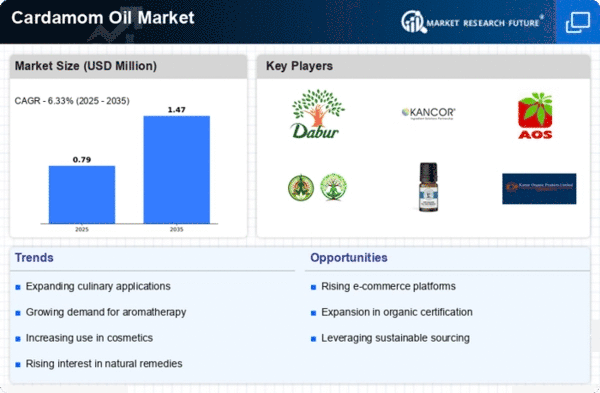
As per MRFR analysis, the Cardamom Oil Market Size was estimated at 0.743 USD Million in 2024. The Cardamom Oil industry is projected to grow from 0.799 in 2025 to 1.47 by 2035, exhibiting a compound annual growth rate (CAGR) of 6.33 during the forecast period 2025 - 2035.

Key Market Trends & Highlights

The Cardamom Oil Market is experiencing robust growth driven by diverse applications and increasing consumer preferences for natural products.

  • The demand for natural ingredients in personal care and food sectors is rising, particularly in North America, the largest market.
  • E-commerce channels are expanding, facilitating greater access to cardamom oil products across various consumer segments.
  • Aromatherapy remains the largest segment, while the food and beverage sector is witnessing the fastest growth in cardamom oil applications.
  • Increasing health consciousness and the rising popularity of aromatherapy are key drivers propelling market expansion.

Market Size & Forecast

2024 Market Size 0.743 (USD Million)
2035 Market Size 1.47 (USD Million)
CAGR (2025 - 2035) 6.33%
Largest Regional Market Share in 2024 Asia-Pacific

Major Players

Dabur India Ltd (IN), Kancor Ingredients Ltd (IN), AOS Products Pvt Ltd (IN), Sambavanam Ayurvedic Research Institute (IN), Essential Oils of New Zealand (NZ), Kumar Organic Products Ltd (IN), VedaOils (IN), Aromaaz International (IN)

Market Trends

cardamom oil

Cardamom Oil Market Market Drivers

Growth in Food and Beverage Sector

The Global cardamom oil Industry is significantly influenced by the expansion of the food and beverage sector, where cardamom oil is utilized for its flavoring and preservative qualities. The increasing consumer inclination towards exotic flavors and natural preservatives is driving the demand for cardamom oil in culinary applications. As the global food industry continues to evolve, the market for cardamom oil is poised for growth, with projections indicating a market size of 1645.8 USD Billion by 2035. This growth trajectory suggests a robust opportunity for cardamom oil producers to enhance their market share in the food sector.

Expansion of Aromatherapy Practices

Rising Demand for Natural Ingredients

The Global Cardamom Oil Industry experiences a notable surge in demand for natural and organic ingredients across various sectors, including food and beverages, cosmetics, and pharmaceuticals. Consumers increasingly prefer products derived from natural sources, driven by health consciousness and a desire for sustainability. This trend is reflected in the growing market size, projected to reach 754.6 USD Billion in 2024. The shift towards natural alternatives is likely to bolster the demand for cardamom oil, which is renowned for its therapeutic properties and culinary applications, thereby enhancing its market presence globally.

Increased Awareness of Health Benefits

The Global Cardamom Oil Industry is experiencing heightened awareness regarding the health benefits associated with cardamom oil, which is known for its anti-inflammatory, digestive, and antimicrobial properties. As consumers become more health-conscious, the demand for natural remedies and supplements is on the rise. This trend is particularly evident in the wellness and personal care sectors, where cardamom oil is incorporated into various products. The increasing recognition of its therapeutic attributes is likely to drive market growth, as consumers seek natural alternatives to synthetic ingredients, thereby enhancing the overall market dynamics.

Technological Advancements in Extraction Methods

The Global Cardamom Oil Industry is witnessing advancements in extraction technologies, which enhance the efficiency and quality of cardamom oil production. Innovations such as steam distillation and cold pressing are improving yield rates and preserving the oil's natural properties. These technological improvements not only reduce production costs but also ensure a higher quality product for consumers. As the market evolves, these advancements are expected to play a crucial role in meeting the growing demand for high-quality cardamom oil, thereby positioning producers favorably in the competitive landscape.

Market Segment Insights

By Application: Aromatherapy (Largest) vs. Food and Beverage (Fastest-Growing)

The Cardamom Oil market showcases a distinct distribution of applications, with Aromatherapy leading the segment. This application attracts a substantial market share due to the rising demand for natural remedies and holistic wellness solutions. Following sharply behind, the Food and Beverage sector is gaining momentum, fueled by the trend of incorporating exotic flavors and natural ingredients into culinary practices. The Cosmetics and Pharmaceuticals applications, while important, hold relatively smaller shares, contributing to the diversified usage of cardamom oil in enhancing product offerings.

Aromatherapy: Dominant vs. Food and Beverage: Emerging

Aromatherapy remains the dominant application of cardamom oil, leveraging its therapeutic properties to cater to an increasingly health-conscious consumer base. This segment thrives due to the growing popularity of aromatherapy practices in stress relief and relaxation. On the other hand, the Food and Beverage segment is an emerging player, rapidly gaining traction as consumers seek natural flavor enhancements. This burgeoning application is characterized by the integration of cardamom oil in gourmet cooking and beverages. The synergy between culinary innovation and health trends suggests a promising future for both segments, each catering to specific consumer preferences and market demand.

By End Use: Household (Largest) vs. Commercial (Fastest-Growing)

In the Cardamom Oil Market, the distribution among end-use segments indicates that the household sector holds the largest share, driven by an increasing preference for natural and aromatic oils in daily household activities such as cooking and home fragrances. On the other hand, the commercial segment, encompassing applications in food and beverage, personal care, and wellness industries, is experiencing rapid growth. This is largely attributed to rising consumer demand for premium products infused with natural flavors and essential oils.

Household (Dominant) vs. Commercial (Emerging)

The household segment of the Cardamom Oil Market is characterized by the widespread utilization of cardamom oil for culinary purposes and aromatherapy, making it a staple in many homes. Its appealing aroma and health benefits contribute significantly to its enduring popularity. Conversely, the commercial segment showcases emerging trends where businesses leverage cardamom oil for creating unique flavor profiles in food products and for therapeutic uses in spas and wellness centers. This segment is being propelled by the increasing emphasis on organic and natural products in commercial food processing and wellness offerings, highlighting its potential for substantial growth as consumer preferences shift towards more health-conscious options.

By Distribution Channel: Online (Largest) vs. Offline Retail (Fastest-Growing)

In the Cardamom Oil Market, the distribution landscape is predominantly shaped by three channels: Online, Offline Retail, and Direct Sales. The Online distribution channel emerges as the largest segment, capitalizing on the growing preference for e-commerce and digital platforms. Meanwhile, Offline Retail continues to hold significant ground due to traditional shopping habits, while Direct Sales are carving out niche markets, primarily targeting specific consumer demographics. Accordingly, the Online segment is witnessing substantial traction owing to its convenience and broader reach, positioning it at the forefront of the market.

Online (Dominant) vs. Direct Sales (Emerging)

The Online distribution channel stands out as the dominant player in the Cardamom Oil Market, leveraging advancements in e-commerce and digital marketing strategies to appeal to a tech-savvy consumer base. This segment thrives on convenience and accessibility, offering consumers an extensive range of products at competitive prices. In contrast, Direct Sales, while still emerging, focus on personalized customer interactions and tailored marketing approaches, fostering strong brand loyalty and direct consumer engagement. Together, these channels illustrate the evolving dynamics of the market, where Online retailing is key to capturing market share, while Direct Sales are on the rise, attracting consumers who prefer a more personalized shopping experience.

By Formulation: Organic (Largest) vs. Conventional (Fastest-Growing)

In the Cardamom Oil Market, the formulation segment is notably dominated by Organic cardamom oil, which has gained considerable consumer preference over the years. The increasing demand for natural and organic ingredients in various applications such as aromatherapy, food flavoring, and cosmetic products has fortified its market share, making it the leading segment by a significant margin. Meanwhile, the Conventional formulation is also experiencing robust interest, driven by its affordability and wide availability, appealing particularly to budget-conscious consumers and mass-market products. Growth trends in the formulation segment reflect a broader consumer shift towards sustainability and health consciousness. The Organic segment continues to thrive due to rising awareness of the benefits of organic products and the stringent regulations ensuring quality. On the other hand, the Conventional segment is witnessing accelerated growth rates as manufacturers seek to cater to diverse market segments, emphasizing improved accessibility and cost-effectiveness to tap into the larger consumer market.

Organic (Dominant) vs. Conventional (Emerging)

Organic cardamom oil is currently the dominant player in the formulation segment of the Cardamom Oil Market, owing to its perceived health benefits and alignment with eco-conscious consumer trends. It is often sourced from sustainably managed farms, enhancing its attractiveness in the health and wellness sectors. Furthermore, Organic cardamom offers superior quality and potency, making it a preferred choice for high-end applications in aromatherapy and culinary uses. In contrast, Conventional cardamom oil, while emerging, has made significant strides in gaining popularity due to its cost-effectiveness and widespread availability. This formulation is favored in mass production settings where price sensitivity is paramount, allowing it to cater to a broader audience, thus establishing a competitive position in the market.

By Source: Natural (Largest) vs. Synthetic (Fastest-Growing)

The Cardamom Oil Market showcases a pronounced preference for natural sources, with natural cardamom oil leading the market due to its traditional use, scent profile, and perceived health benefits. On the other hand, synthetic cardamom oil, while currently smaller in market share, is on the rise as manufacturers seek cost-effective alternatives. This dual-source dynamic reflects consumer demand and industry innovation.

Source: Natural (Dominant) vs. Synthetic (Emerging)

Natural cardamom oil remains the dominant force in the Cardamom Oil Market, revered for its authenticity and quality. Extracted from the seeds of Elettaria cardamomum, it is cherished in culinary and therapeutic applications, where its unique flavor and health benefits are paramount. Conversely, synthetic cardamom oil is emerging rapidly, appealing to budget-conscious manufacturers and growing in popularity in various applications. Its rise is fueled by technological advances that enable the production of synthetic variants that can mimic the flavor and aroma of natural cardamom, providing a viable option for wider market accessibility.

Get more detailed insights about Cardamom Oil Market Research Report- Forecast to 2035

Regional Insights

North America : Emerging Market for Essential Oils

The North American cardamom oil market is witnessing gradual growth, driven by increasing consumer interest in natural and organic products. The market size is estimated at $0.1 million, reflecting a growing trend towards health and wellness. Regulatory support for natural ingredients in food and cosmetics is also a catalyst for market expansion. As consumers become more health-conscious, the demand for cardamom oil in aromatherapy and culinary applications is expected to rise. Leading countries in this region include the USA and Canada, where the presence of key players like Dabur India Ltd and AOS Products Pvt Ltd is notable. The competitive landscape is characterized by a mix of established companies and emerging brands focusing on quality and sustainability. The market is also influenced by consumer preferences for ethically sourced and environmentally friendly products, which are becoming increasingly important in purchasing decisions.

Europe : Established Market with High Demand

Europe represents a significant market for cardamom oil, with a market size of $0.15 million. The region benefits from strong regulatory frameworks that promote the use of natural ingredients in cosmetics and food products. The demand for cardamom oil is driven by its applications in aromatherapy, culinary uses, and personal care products. The growing trend towards organic and natural products is expected to further enhance market growth in the coming years. Key players in Europe include Kancor Ingredients Ltd and Essential Oils of New Zealand, which are well-positioned to meet the rising demand. Countries like Germany, France, and the UK are leading in consumption, supported by a robust distribution network. The competitive landscape is marked by innovation and a focus on quality, with companies investing in sustainable sourcing practices to appeal to environmentally conscious consumers.

Asia-Pacific : Dominant Market Leader

Asia-Pacific is the largest market for cardamom oil, holding a substantial market share of 45%. The region's growth is driven by increasing demand for natural and organic products, particularly in countries like India and China. The rising popularity of aromatherapy and traditional medicine is also contributing to market expansion. Regulatory support for natural ingredients in food and cosmetics further enhances the market's growth potential. India stands out as a leading country in the production and consumption of cardamom oil, with key players like Dabur India Ltd and Kancor Ingredients Ltd dominating the landscape. The competitive environment is characterized by a mix of local and international companies, all vying for market share. The focus on quality and sustainability is paramount, as consumers increasingly prefer ethically sourced products that align with their health and wellness goals.

Middle East and Africa : Emerging Market with Potential

The Middle East and Africa region represents an emerging market for cardamom oil, with a market size of $0.03 million. The growth is primarily driven by increasing consumer awareness of the benefits of natural oils in health and wellness. The region's diverse cultural practices also contribute to the demand for cardamom oil in culinary and traditional medicine applications. Regulatory frameworks are gradually evolving to support the use of natural ingredients, which is expected to boost market growth. Countries like South Africa and the UAE are leading the way in market development, with a growing number of local and international players entering the space. The competitive landscape is still developing, with opportunities for new entrants to establish themselves. Key players are focusing on quality and sustainability, aligning their products with the increasing consumer preference for natural and organic options.

Key Players and Competitive Insights

The Cardamom Oil Market is currently characterized by a dynamic competitive landscape, driven by increasing consumer demand for natural and organic products. Key players are actively engaging in strategies that emphasize innovation, sustainability, and regional expansion. For instance, Dabur India Ltd (IN) has positioned itself as a leader in the herbal and Ayurvedic segment, focusing on product diversification and enhancing its distribution network. Similarly, Kancor Ingredients Ltd (IN) is leveraging its expertise in essential oils to expand its product offerings, thereby strengthening its market presence. These strategies collectively contribute to a moderately fragmented market structure, where competition is intensifying as companies seek to differentiate themselves through quality and sustainability initiatives.In terms of business tactics, companies are increasingly localizing manufacturing to reduce costs and enhance supply chain efficiency. This approach not only mitigates risks associated with The Cardamom Oil demands. The competitive structure of the market remains moderately fragmented, with several players vying for market share. The collective influence of these key players is shaping the market dynamics, as they adopt innovative practices to meet evolving consumer preferences.In November 2025, AOS Products Pvt Ltd (IN) announced a strategic partnership with a leading organic farming cooperative to enhance the sourcing of high-quality cardamom. This collaboration is expected to bolster the company’s supply chain resilience and ensure a consistent supply of premium raw materials. Such strategic moves are crucial in maintaining product quality and meeting the growing demand for organic cardamom oil.In October 2025, Kumar Organic Products Ltd (IN) launched a new line of sustainably sourced cardamom oil, emphasizing eco-friendly extraction methods. This initiative not only aligns with global sustainability trends but also positions the company favorably among environmentally conscious consumers. The launch reflects a broader industry trend towards sustainable practices, which are becoming increasingly important in consumer purchasing decisions.In September 2025, Essential Oils of New Zealand (NZ) expanded its distribution network in Asia, targeting emerging markets with high growth potential. This strategic move is indicative of the company’s commitment to capturing new market segments and enhancing its global footprint. By tapping into these markets, the company aims to leverage the rising demand for natural products in the region.As of December 2025, the Cardamom Oil Market is witnessing significant trends such as digitalization and the integration of AI technologies in production processes. Companies are increasingly forming strategic alliances to enhance their competitive edge, focusing on innovation and sustainability. The shift from price-based competition to differentiation through technology and supply chain reliability is becoming evident. Moving forward, it appears that companies that prioritize innovation and sustainable practices will likely lead the market, as consumer preferences continue to evolve towards more responsible and high-quality products.

Key Companies in the Cardamom Oil Market include

Industry Developments

  • It has been noted that the population of the Asia Pacific region is growing rapidly due to the presence of great populated regions of China and India. The people here use food and beverages along with cosmetic products during this forecast period.
  • Elettaria cardamom oil in 2019, was in great demand as it covered a huge market share which helped in driving up the market especially in this region.
  • Cardamom oil is used in the food and beverages market which covers a cardamom oil market share of about 40% throughout the forecast period of 2020-2027.
  • Moreover, the green field oil factory is spending a huge sum on the research and the developmental manufacturing units which raises the share of the cardamom units which will give the company huge results.
  • It has been noted that the market is expected to cover a huge market value of about USD 869 billion having a CAGR value of about 8.31% during the market forecast period.

Report Outlook

Future Outlook

Cardamom Oil Market Future Outlook

The Cardamom Oil Market is projected to grow at a 6.33% CAGR from 2024 to 2035, driven by rising demand in aromatherapy, food flavoring, and natural cosmetics.

New opportunities lie in:

  • Expansion into organic certification for premium pricing
  • Development of innovative packaging solutions for enhanced shelf life
  • Strategic partnerships with wellness brands for co-marketing initiatives

By 2035, the Cardamom Oil Market is expected to achieve robust growth and increased market share.

Market Segmentation

Cardamom Oil Market Source Outlook

  • Natural
  • Synthetic

Cardamom Oil Market End Use Outlook

  • Household
  • Commercial
  • Industrial

Cardamom Oil Market Application Outlook

  • Aromatherapy
  • Cosmetics
  • Food and Beverage
  • Pharmaceuticals

Cardamom Oil Market Formulation Outlook

  • Organic
  • Conventional
  • Blended

Cardamom Oil Market Distribution Channel Outlook

  • Online
  • Offline Retail
  • Direct Sales

Report Scope

MARKET SIZE 20240.743(USD Million)
MARKET SIZE 20250.799(USD Million)
MARKET SIZE 20351.47(USD Million)
COMPOUND ANNUAL GROWTH RATE (CAGR)6.33% (2025 - 2035)
REPORT COVERAGERevenue Forecast, Competitive Landscape, Growth Factors, and Trends
BASE YEAR2024
Market Forecast Period2025 - 2035
Historical Data2019 - 2024
Market Forecast UnitsUSD Million
Key Companies ProfiledDabur India Ltd (IN), Kancor Ingredients Ltd (IN), AOS Products Pvt Ltd (IN), Sambavanam Ayurvedic Research Institute (IN), Essential Oils of New Zealand (NZ), Kumar Organic Products Ltd (IN), VedaOils (IN), Aromaaz International (IN)
Segments CoveredApplication, End Use, Distribution Channel, Formulation, Source
Key Market OpportunitiesGrowing demand for natural ingredients in cosmetics and wellness sectors enhances opportunities in the Cardamom Oil Market.
Key Market DynamicsRising demand for natural ingredients drives competition and innovation in the cardamom oil market.
Countries CoveredNorth America, Europe, APAC, South America, MEA

FAQs

What is the expected growth rate in the cardamom oil market in the global market?

It is expected that the cardamom oil market will grow at a high CAGR of 7.35% in the global market.

What is the expected market share in the global market for cardamom oil?

The global cardamom oil market is expected to account for a higher market share of approximately 1645.8 USD Billion by 2035.

What are the leading players in the cardamom oil market?

Leading players in the cardamom oil market include Melicia, Greenleaf Extractions Pvt Ltd, Green Fields Oil factory, Piping Rock Health Products LLC, Shiv Sales Corporation, Nature's Natural India, Aromaaz International, etc.

Which region holds the largest market share in the cardamom oil market?

The largest market share in the cardamom oil market is held by the Asia-Pacific region.

  1. SECTION I: EXECUTIVE SUMMARY AND KEY HIGHLIGHTS
    1. | 1.1 EXECUTIVE SUMMARY
  2. SECTION II: SCOPING, METHODOLOGY AND MARKET STRUCTURE
    1. | 2.1 MARKET INTRODUCTION
    2. | 2.2 RESEARCH METHODOLOGY
  3. SECTION III: QUALITATIVE ANALYSIS
    1. | 3.1 MARKET DYNAMICS
    2. | 3.2 MARKET FACTOR ANALYSIS
  4. SECTION IV: QUANTITATIVE ANALYSIS
    1. | 4.1 Food, Beverages & Nutrition, BY Application (USD Million)
    2. | 4.2 Food, Beverages & Nutrition, BY End Use (USD Million)
    3. | 4.3 Food, Beverages & Nutrition, BY Distribution Channel (USD Million)
    4. | 4.4 Food, Beverages & Nutrition, BY Formulation (USD Million)
    5. | 4.5 Food, Beverages & Nutrition, BY Source (USD Million)
    6. | 4.6 Food, Beverages & Nutrition, BY Region (USD Million)
  5. SECTION V: COMPETITIVE ANALYSIS
    1. | 5.1 Competitive Landscape
    2. | 5.2 Company Profiles
    3. | 5.3 Appendix

Cardamom Oil Market Segmentation

Market Segmentation Overview

  • Detailed segmentation data will be available in the full report
  • Comprehensive analysis by multiple parameters
  • Regional and country-level breakdowns
  • Market size forecasts by segment
Infographic

Free Sample Request

Kindly complete the form below to receive a free sample of this Report

Get Free Sample

Customer Strories

Compare Licence

×
Features License Type
Single User Multiuser License Enterprise User
Price $4,950 $5,950 $7,250
Maximum User Access Limit 1 User Upto 10 Users Unrestricted Access Throughout the Organization
Free Customization
Direct Access to Analyst
Deliverable Format
Platform Access
Discount on Next Purchase 10% 15% 15%
Printable Versions