Request Free Sample ×

Kindly complete the form below to receive a free sample of this Report

* Please use a valid business email

Leading companies partner with us for data-driven Insights

clients tt-cursor
Hero Background
English
Chinese
French
Japanese
Korean
German
Spanish

Carcinoembryonic Antigen Market Share

ID: MRFR/Pharma/0288-HCR
81 Pages
Rahul Gotadki
March 2026

Carcinoembryonic Antigen Market Research Report Information by Application (Colorectal Cancer, Pancreatic Cancer, Breast Cancer, Lung Cancer, and Others), End User (Hospitals and Clinics, Diagnostic Centers, and Others), And By Region (North America, Europe, Asia-Pacific, And Rest Of The World) –Market Forecast Till 2035

Share:
Download PDF ×

We do not share your information with anyone. However, we may send you emails based on your report interest from time to time. You may contact us at any time to opt-out.

Carcinoembryonic Antigen Market Infographic
Purchase Options

Market Share

Carcinoembryonic Antigen Market Share Analysis

Carcinoembryonic Antigen (CEA) is a profoundly serious market; hence, organizations working in this industry should execute successful pieces of the pie situating systems. In this examination, we investigate central strategies used by members in the business to lay out and expand their market standing. Designated promoting methodologies are critical for laying out serious areas of strength for a situation for CEA items. Using designated crusades, organizations can arrive at specific socioeconomics, incorporating those with a higher gamble of fostering specific malignancies. This approach ensures that special undertakings really associate with the objective segment, consequently developing brand mindfulness and idealness. Item separation is a basic perspective to consider in the CEA market because of its exceptionally serious climate. Associations apportion assets towards innovative work to present notable CEA items that have particular ascribes or further developed viability. Associations can lay out a specific market by giving exceptional advantages that enticement for both medical services specialists and patients. Coordinated efforts and associations: Piece of the pie can be considerably affected through the foundation of key coalitions with medical services establishments, research associations, and drug organizations. These coordinated efforts empower the exchange of experiences as well as award passage to a greater customer. By pooling assets, joint endeavors and collusions empower organizations to all the more really enter new business sectors. Geographic Extension: A common way to deal with an expanded piece of the pie is through the development of one's geographic presence. Associations designate assets towards fathoming the purposes for provincial aberrations in malignant growth pervasiveness and medical services framework to modify their CEA promoting approaches correspondingly. Firms can build their piece of the pie of the overall CEA industry by laying out vigorous traction in various business sectors. Evaluating methodologies are critical in deciding an organization's piece of the pie position. To get an upper hand over rivals, organizations might embrace cutthroat valuing systems or select premium evaluating in the event that their item has particular characteristics. Keeping an ideal harmony is of most extreme significance, considering that cost-cognizant shoppers are attracted to cutthroat evaluating, while the apparent predominance of an item might give support to premium valuing. Guaranteeing the nature of items and consenting to thorough administrative principles are vital inside the medical services area. Associations that consolidate thorough quality confirmation systems and spot administrative consistency as a main concern procure the certainty of medical care experts and end-clients. This trust assumes a pivotal part in both saving and expanding piece of the pie.


Author
Author Profile
Rahul Gotadki
Research Manager

He holds an experience of about 9+ years in Market Research and Business Consulting, working under the spectrum of Life Sciences and Healthcare domains. Rahul conceptualizes and implements a scalable business strategy and provides strategic leadership to the clients. His expertise lies in market estimation, competitive intelligence, pipeline analysis, customer assessment, etc.

Leave a Comment

FAQs

What is the current valuation of the Carcinoembryonic Antigen Market as of 2025?

<p>The Carcinoembryonic Antigen Market is valued at approximately 1451.77 USD Million in 2024.</p>

What is the projected market size for the Carcinoembryonic Antigen Market by 2035?

<p>The market is expected to reach a valuation of around 6897.88 USD Million by 2035.</p>

What is the expected CAGR for the Carcinoembryonic Antigen Market during the forecast period?

<p>The anticipated CAGR for the Carcinoembryonic Antigen Market from 2025 to 2035 is 15.22%.</p>

Which companies are the key players in the Carcinoembryonic Antigen Market?

<p>Key players include Roche, Abbott Laboratories, Siemens Healthineers, and Thermo Fisher Scientific.</p>

What are the primary applications of Carcinoembryonic Antigen testing?

<p>The main applications include Cancer Diagnosis, Cancer Monitoring, Prognostic Assessment, and Therapeutic Monitoring.</p>

How does the market segment by end use for Carcinoembryonic Antigen testing?

<p>The market segments by end use include Hospitals, Diagnostic Laboratories, and Research Institutions.</p>

What test types are utilized in the Carcinoembryonic Antigen Market?

Test types include Immunoassays, Enzyme-Linked Immunosorbent Assay, and Radioimmunoassay.

What sample types are used for Carcinoembryonic Antigen testing?

Sample types include Blood, Tissue, and Serum.

What technologies are employed in the Carcinoembryonic Antigen testing process?

Technologies used include Chemiluminescence, Fluorescence, and Electrochemiluminescence.

How did the market perform in terms of Cancer Diagnosis segment in 2024?

In 2024, the Cancer Diagnosis segment was valued at 580.0 USD Million.

Market Summary

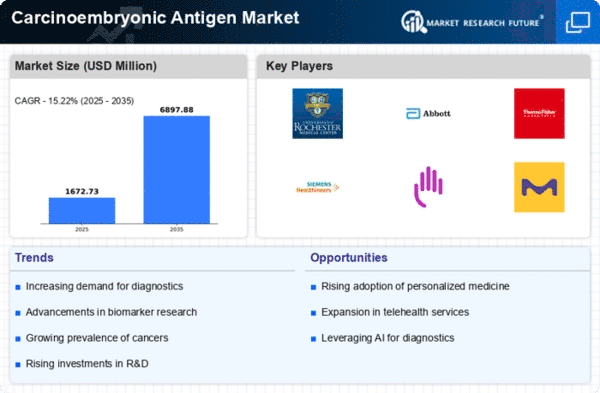
As per MRFR analysis, the Carcinoembryonic Antigen Market Size was estimated at 1451.77 USD Million in 2024. The Carcinoembryonic Antigen industry is projected to grow from 1672.74 USD Million in 2025 to 6897.88 USD Million by 2035, exhibiting a compound annual growth rate (CAGR) of 15.22% during the forecast period 2025 - 2035.

Key Market Trends & Highlights

The Carcinoembryonic Antigen Market is poised for substantial growth driven by technological advancements and increasing demand for personalized medicine.

  • Technological advancements in diagnostics are enhancing the accuracy and efficiency of Carcinoembryonic Antigen testing. The shift towards personalized medicine is fostering tailored treatment approaches, thereby increasing the relevance of biomarkers like Carcinoembryonic Antigen. North America remains the largest market, while the Asia-Pacific region is emerging as the fastest-growing area for Carcinoembryonic Antigen applications. Rising incidence of cancer and advancements in diagnostic technologies are key drivers propelling market growth.

Market Size & Forecast

2024 Market Size 1451.77 (USD Million)
2035 Market Size 6897.88 (USD Million)
CAGR (2025 - 2035) 15.22%
Largest Regional Market Share in 2024 North America

Major Players

Roche (CH), Abbott Laboratories (US), Thermo Fisher Scientific (US), Siemens Healthineers (DE), Bristol-Myers Squibb (US), Merck KGaA (DE), Johnson &amp; Johnson (US), F. Hoffmann-La Roche AG (CH)

Market Trends

The Carcinoembryonic Antigen Market is currently experiencing notable developments, driven by advancements in diagnostic technologies and an increasing emphasis on early cancer detection. These developments represent important carcinoembryonic antigen market trends shaping the global oncology diagnostics landscape. This biomarker, primarily associated with colorectal cancer, is gaining traction in various oncological applications. The growing awareness among healthcare professionals and patients regarding the importance of monitoring tumor markers is likely to enhance the demand for carcinoembryonic antigen testing, thereby strengthening the carcinoembryonic antigen CEA testing market. Furthermore, the integration of innovative methodologies in laboratories is expected to improve the accuracy and efficiency of these tests, thereby fostering carcinoembryonic antigen market growth.

In addition, the rising prevalence of cancer globally appears to be a significant factor influencing the carcinoembryonic antigen CEA market. As healthcare systems strive to provide better diagnostic tools, the focus on personalized medicine is becoming more pronounced. This shift may lead to an increased utilization of carcinoembryonic antigen as a reliable biomarker for assessing treatment responses and disease progression within the carcinoembryonic antigen CEA marker market. Overall, the market seems poised for expansion, with ongoing research and development efforts likely to introduce novel applications and enhance existing testing protocols.

Technological Advancements in Diagnostics

The Carcinoembryonic Antigen Market is witnessing a surge in technological innovations that enhance diagnostic accuracy. These developments are key drivers of carcinoembryonic antigen market trends globally. New methodologies, such as liquid biopsies and advanced imaging techniques, are being integrated into clinical practice. These advancements not only improve the sensitivity of carcinoembryonic antigen tests but also strengthen the carcinoembryonic antigen CEA testing market, facilitating earlier detection of malignancies and potentially leading to better patient outcomes.

Growing Focus on Personalized Medicine

There is an increasing trend towards personalized medicine within the Carcinoembryonic Antigen Market. As healthcare providers aim to tailor treatments based on individual patient profiles, carcinoembryonic antigen testing is becoming a crucial component in monitoring therapeutic efficacy, further supporting the growth of the carcinoembryonic antigen CEA market.

Rising Awareness and Education

The Carcinoembryonic Antigen Market is benefiting from heightened awareness and education initiatives aimed at both healthcare professionals and patients. As knowledge regarding the significance of tumor markers expands, there is a growing demand for carcinoembryonic antigen testing, boosting the carcinoembryonic antigen CEA marker market and strengthening overall carcinoembryonic antigen market growth.

Carcinoembryonic Antigen Market Market Drivers

Rising Incidence of Cancer

The Global Carcinoembryonic Antigen Market Industry is experiencing growth due to the increasing incidence of various cancers, particularly colorectal cancer. As per health statistics, colorectal cancer remains one of the leading causes of cancer-related deaths worldwide. The demand for carcinoembryonic antigen testing is likely to rise as healthcare providers seek to improve early detection and monitoring of cancer progression. This trend is expected to contribute to the market's expansion, with projections indicating a market value of 1.45 USD Billion in 2024 and a potential increase to 6.3 USD Billion by 2035, reflecting a compound annual growth rate of 14.28% from 2025 to 2035.

Market Segment Insights

By Application: Cancer Diagnosis (Largest) vs. Cancer Monitoring (Fastest-Growing)

<p>In the Carcinoembryonic Antigen (CEA) Market, the application segment showcases significant variability in market share among its values. Cancer Diagnosis holds the largest share due to its critical role in initial cancer detection and patient management, while Cancer Monitoring follows closely, enabling ongoing assessment of cancer progression and treatment efficacy. The importance of timely diagnosis and monitoring drives their high adoption, ultimately influencing patient outcomes positively. Recent trends indicate a shift towards increased utilization of Carcinoembryonic Antigen in Cancer Monitoring, which is the fastest-growing segment. Technological advancements in assays and point-of-care testing are facilitating this growth. The rising prevalence of cancer cases and the demand for personalized treatment plans are major factors influencing this trend, underscoring the significance of ongoing monitoring in treatment strategies.</p>

<p>Cancer Diagnosis (Dominant) vs. Prognostic Assessment (Emerging)</p>

<p>In the context of the Carcinoembryonic Antigen Market, Cancer Diagnosis is the dominant application due to its primary function in identifying cancerous conditions at an early stage, which is crucial for effective intervention. It is widely adopted in clinical practice, supported by robust clinical guidelines emphasizing its importance. On the other hand, Prognostic Assessment is emerging as a key value in this market, recognizing the potential of CEA levels to predict disease outcomes and treatment responses. As healthcare moves towards more personalized medicine, the demand for prognostic insights is rising, aligning with the overall trend of enhancing treatment decisions. This segment is gaining traction among healthcare providers as they seek to improve patient prognostication and tailor cancer therapies accordingly.</p>

By End Use: Hospitals (Largest) vs. Diagnostic Laboratories (Fastest-Growing)

The Carcinoembryonic Antigen (CEA) market exhibits a distinct distribution across various end-use segments. Hospitals hold the largest share, primarily due to their extensive patient base and the increasing prevalence of cancers that necessitate CEA testing for diagnosis and monitoring. This segment's reliance on CEA as a tumor marker gives hospitals a significant position in the market, allowing them to command a substantial share compared to other end users. Meanwhile, diagnostic laboratories are rapidly emerging as a key player, capitalizing on advancements in testing technologies and the rising demand for accurate diagnostics that propel their market share upward.

Hospitals (Dominant) vs. Research Institutions (Emerging)

Hospitals dominate the Carcinoembryonic Antigen market, characterized by their robust infrastructure and comprehensive cancer care services. They leverage their access to advanced diagnostic tools and skilled healthcare professionals to deliver timely CEA tests, crucial for ongoing patient management. In contrast, research institutions are emerging in significance, driven by a focus on innovative cancer therapies and biomarker research. This segment’s growth is propelled by increasing funding for cancer research, collaboration with pharmaceutical companies, and the demand for novel diagnostic solutions. As research institutions continue to evolve, they are expected to play a pivotal role in refining CEA applications and enhancing its clinical utility.

By Test Type: Immunoassays (Largest) vs. Enzyme-Linked Immunosorbent Assay (Fastest-Growing)

In the Carcinoembryonic Antigen Market, the Immunoassays segment holds the largest share due to its established applications and reliability in cancer diagnostics. Following closely is the Enzyme-Linked Immunosorbent Assay (ELISA), which is gaining traction, particularly for its versatility and user-friendly nature. Other methods like Radioimmunoassay and Western Blot hold smaller portions of the market but still contribute significantly to overall testing practices.

Testing Method: Immunoassays (Dominant) vs. ELISA (Emerging)

Immunoassays are recognized as the dominant testing method in the Carcinoembryonic Antigen Market, primarily valued for their accuracy and high throughput capabilities. These tests are commonly implemented in clinical laboratories for reliable and rapid results, making them a go-to choice for healthcare providers. On the other hand, ELISA is emerging as a fast-growing option, appealing to laboratories seeking affordable and easily automated solutions. This method offers flexibility in terms of panel setups and has seen increased adoption for specific cancer types, enhancing its market position. Both methodologies reflect advancements in diagnostic technologies, catering to a diverse range of patient needs.

By Sample Type: Blood (Largest) vs. Serum (Fastest-Growing)

In the Carcinoembryonic Antigen Market, the sample type segment showcases significant distribution among blood, tissue, serum, and plasma samples. Blood samples hold the largest share due to their ease of collection and widespread acceptance in clinical settings, making them a preferred choice for diagnostics. Tissue samples, while crucial for certain applications, represent a smaller segment of the market. Serum and plasma sample types are gaining momentum, particularly serum, which is emerging as a vital component in biomarker detection and patient monitoring. The growth trends within the sample type segment are driven by advances in diagnostic technologies and increasing demands for non-invasive testing methods. Serum is recognized as the fastest-growing segment, fueled by improved testing accuracy and rising incidences of cancers detected via blood tests. Additionally, innovations in laboratory techniques and rising awareness about cancer screening are enhancing the adoption of various sample types in the market.

Blood (Dominant) vs. Serum (Emerging)

Blood samples are the dominant segment in the Carcinoembryonic Antigen Market due to their convenience and commonality in <a href="https://www.marketresearchfuture.com/reports/clinical-diagnostic-market-41770" target="_blank" title="clinical diagnostic">clinical diagnostics</a>. They facilitate easy handling and quicker results, making them a staple in cancer detection and monitoring. On the other hand, serum samples are emerging as a vital alternative, gaining popularity due to their enhanced sensitivity for biomarker discovery and analysis. This trend is encouraged by technological advancements in diagnostic assays and higher accuracy in cancer screening measures. As both blood and serum samples play crucial roles in patient diagnostics, their distinct characteristics cater to varying clinical needs while complementing each other in the spectrum of <a href="https://www.marketresearchfuture.com/reports/cancer-biomarker-market-5378" target="_blank" title="cancer biomarker">cancer biomarker</a> testing.

By Technology: Electrochemiluminescence (Largest) vs. Chemiluminescence (Fastest-Growing)

<p>In the Carcinoembryonic Antigen Market, the distribution of technology segments reveals that Electrochemiluminescence holds the majority market share, reflecting its established presence and reliability in diagnostic applications. Chemiluminescence, while currently holding a smaller share, has shown significant traction due to advancements in assay sensitivity and specificity, making it an appealing option for laboratories aiming to enhance diagnostic accuracy.</p>

<p>Technology: Electrochemiluminescence (Dominant) vs. Chemiluminescence (Emerging)</p>

<p>Electrochemiluminescence technology is regarded as the dominant force in the Carcinoembryonic Antigen Market due to its superior sensitivity and faster response times, which are crucial in clinical testing environments. This technology allows for the precise detection of carcinoembryonic antigen levels, playing a pivotal role in cancer diagnostics. Conversely, Chemiluminescence is emerging as a strong contender, driven by ongoing innovations aimed at improving reagent stability and assay performance. While it currently trails in market share, its rapid development indicates a bright future, particularly in routine cancer screenings and point-of-care testing.</p>

Get more detailed insights about Carcinoembryonic Antigen Market Research Report - Global Forecast till 2035

Regional Insights

North America : Market Leader in Innovation

North America continues to lead the Carcinoembryonic Antigen (CEA) market, holding a significant share of approximately $725.89 million in 2025. The growth is driven by increasing cancer prevalence, advancements in diagnostic technologies, and supportive regulatory frameworks. The region's robust healthcare infrastructure and high R&D investments further catalyze market expansion, making it a hub for innovative solutions in cancer diagnostics. The United States is the primary contributor to this market, with key players like Roche, Abbott Laboratories, and Thermo Fisher Scientific leading the charge. The competitive landscape is characterized by continuous innovation and strategic partnerships aimed at enhancing diagnostic accuracy. The presence of established companies ensures a steady supply of advanced CEA tests, catering to the growing demand for early cancer detection and monitoring.

Europe : Emerging Market with Growth Potential

Europe's Carcinoembryonic Antigen market is projected to reach $450 million by 2025, driven by increasing awareness of cancer screening and advancements in medical technology. Regulatory support for innovative diagnostic solutions and a growing aging population are key factors propelling market growth. The region is witnessing a shift towards personalized medicine, which is expected to further boost demand for CEA testing in oncology. Leading countries such as Germany, France, and the UK are at the forefront of this market, with significant contributions from companies like Siemens Healthineers and Merck KGaA. The competitive landscape is marked by collaborations between healthcare providers and diagnostic companies, enhancing the availability of CEA tests. As regulatory bodies emphasize the importance of early detection, the market is poised for substantial growth in the coming years.

Asia-Pacific : Rapidly Growing Market Segment

The Asia-Pacific Carcinoembryonic Antigen market is expected to reach $225 million by 2025, fueled by rising cancer incidences and increasing healthcare expenditure. Countries like China and India are witnessing a surge in demand for advanced diagnostic tools, including CEA tests, as awareness of cancer screening grows. Government initiatives aimed at improving healthcare access and affordability are also contributing to market expansion. China is leading the market in this region, with significant investments in healthcare infrastructure and technology. The competitive landscape features both local and international players, including Johnson & Johnson and Thermo Fisher Scientific. As the region continues to develop its healthcare capabilities, the demand for CEA testing is anticipated to rise, driven by both public and private sector initiatives.

Middle East and Africa : Emerging Market with Challenges

The Middle East and Africa Carcinoembryonic Antigen market is valued at approximately $50.88 million in 2025. The growth in this region is hindered by limited healthcare infrastructure and access to advanced diagnostic technologies. However, increasing awareness of cancer and the need for early detection are driving demand for CEA tests. Government initiatives aimed at improving healthcare services are expected to support market growth in the coming years. Countries like South Africa and the UAE are leading the market, with efforts to enhance cancer screening programs. The competitive landscape is characterized by a mix of local and international players, although the market remains underdeveloped compared to other regions. As healthcare systems improve, the demand for CEA testing is likely to increase, presenting opportunities for growth.

Key Players and Competitive Insights

The Carcinoembryonic Antigen Market is characterized by a competitive landscape that is increasingly shaped by innovation, strategic partnerships, and a focus on personalized medicine. Key players such as Roche (CH), Abbott Laboratories (US), and Thermo Fisher Scientific (US) are at the forefront, leveraging their extensive research capabilities and technological advancements to enhance diagnostic accuracy and treatment efficacy. These companies are not only investing in R&D but are also exploring mergers and acquisitions to consolidate their market positions and expand their product portfolios, thereby intensifying competition within the sector.In terms of business tactics, companies are localizing manufacturing to reduce costs and improve supply chain efficiency. The market structure appears moderately fragmented, with several players vying for market share. However, the collective influence of major companies like Siemens Healthineers (DE) and Bristol-Myers Squibb (US) is significant, as they drive innovation and set industry standards that smaller firms must follow.
In November Roche (CH) announced the launch of a new diagnostic platform that integrates AI technology to enhance the detection of carcinoembryonic antigen levels in patients. This strategic move is likely to position Roche as a leader in precision diagnostics, as it aligns with the growing trend towards personalized medicine and the increasing demand for rapid, accurate testing solutions.
In October Abbott Laboratories (US) expanded its collaboration with a leading biotechnology firm to develop novel biomarkers for cancer detection, including carcinoembryonic antigen. This partnership is indicative of Abbott's commitment to innovation and its strategy to enhance its diagnostic offerings, potentially leading to improved patient outcomes and a stronger market presence.
In September Thermo Fisher Scientific (US) acquired a smaller diagnostics company specializing in immunoassays, which includes carcinoembryonic antigen testing. This acquisition is expected to bolster Thermo Fisher's product portfolio and enhance its capabilities in the oncology diagnostics space, reflecting a broader trend of consolidation in the market as companies seek to enhance their competitive edge.
As of December the competitive trends in the Carcinoembryonic Antigen Market are increasingly defined by digitalization, sustainability, and the integration of AI technologies. Strategic alliances are becoming more prevalent, as companies recognize the need to collaborate to drive innovation and improve supply chain reliability. Looking ahead, competitive differentiation is likely to evolve from traditional price-based competition to a focus on technological advancements and innovative solutions that meet the specific needs of healthcare providers and patients.

Key Companies in the Carcinoembryonic Antigen Market include

Industry Developments

  • Q2 2024: Carcinoembryonic Antigen Market Poised for Substantial Growth, Forecasted to Surpass USD 3,809.7 Mn by 2033 | Marketresearch.biz Report On April 18, 2024, a press release highlighted ongoing product development and innovation in the carcinoembryonic antigen sector, with companies focusing on new diagnostic technologies and strategic alliances to expand their offerings. The release specifically mentions product development, innovations, joint ventures, partnerships, mergers & acquisitions, and strategic alliances as current news and developments in the sector.

.webp

Future Outlook

Carcinoembryonic Antigen Market Future Outlook

The Carcinoembryonic Antigen Market is projected to grow at a 15.22% CAGR from 2025 to 2035, driven by advancements in diagnostic technologies and increasing cancer prevalence.

New opportunities lie in:

  • <p>Development of personalized CEA testing kits for home use. Expansion of CEA-based immunotherapy solutions in oncology. Partnerships with diagnostic labs for enhanced CEA testing services.</p>

By 2035, the Carcinoembryonic Antigen Market is expected to be robust, reflecting substantial growth and innovation.

Market Segmentation

Carcinoembryonic Antigen Market End Use Outlook

  • Hospitals
  • Diagnostic Laboratories
  • Research Institutions
  • Pharmaceutical Companies

Carcinoembryonic Antigen Market Test Type Outlook

  • Immunoassays
  • Enzyme-Linked Immunosorbent Assay
  • Radioimmunoassay
  • Western Blot

Carcinoembryonic Antigen Market Application Outlook

  • Oncology
  • Diagnostic Testing
  • Monitoring Treatment
  • Prognostic Assessment

Carcinoembryonic Antigen Market Sample Type Outlook

  • Blood
  • Tissue
  • Serum
  • Plasma

Carcinoembryonic Antigen Market Distribution Channel Outlook

  • Direct Sales
  • Online Sales
  • Third-Party Distributors
  • Retail Pharmacies

Report Scope

MARKET SIZE 2024 1451.77(USD Million)
MARKET SIZE 2025 1672.74(USD Million)
MARKET SIZE 2035 6897.88(USD Million)
COMPOUND ANNUAL GROWTH RATE (CAGR) 15.22% (2025 - 2035)
REPORT COVERAGE Revenue Forecast, Competitive Landscape, Growth Factors, and Trends
BASE YEAR 2024
Market Forecast Period 2025 - 2035
Historical Data 2019 - 2024
Market Forecast Units USD Million
Key Companies Profiled Roche (CH), Abbott Laboratories (US), Thermo Fisher Scientific (US), Siemens Healthineers (DE), Bristol-Myers Squibb (US), Merck KGaA (DE), Johnson & Johnson (US), F. Hoffmann-La Roche AG (CH)
Segments Covered Application, End Use, Test Type, Sample Type, Distribution Channel
Key Market Opportunities Advancements in diagnostic technologies enhance the Carcinoembryonic Antigen Market's potential for early cancer detection.
Key Market Dynamics Rising demand for early cancer detection drives innovation and competition in the Carcinoembryonic Antigen market.
Countries Covered North America, Europe, APAC, South America, MEA

FAQs

What is the current valuation of the Carcinoembryonic Antigen Market as of 2025?

<p>The Carcinoembryonic Antigen Market is valued at approximately 1451.77 USD Million in 2024.</p>

What is the projected market size for the Carcinoembryonic Antigen Market by 2035?

<p>The market is expected to reach a valuation of around 6897.88 USD Million by 2035.</p>

What is the expected CAGR for the Carcinoembryonic Antigen Market during the forecast period?

<p>The anticipated CAGR for the Carcinoembryonic Antigen Market from 2025 to 2035 is 15.22%.</p>

Which companies are the key players in the Carcinoembryonic Antigen Market?

<p>Key players include Roche, Abbott Laboratories, Siemens Healthineers, and Thermo Fisher Scientific.</p>

What are the primary applications of Carcinoembryonic Antigen testing?

<p>The main applications include Cancer Diagnosis, Cancer Monitoring, Prognostic Assessment, and Therapeutic Monitoring.</p>

How does the market segment by end use for Carcinoembryonic Antigen testing?

<p>The market segments by end use include Hospitals, Diagnostic Laboratories, and Research Institutions.</p>

What test types are utilized in the Carcinoembryonic Antigen Market?

Test types include Immunoassays, Enzyme-Linked Immunosorbent Assay, and Radioimmunoassay.

What sample types are used for Carcinoembryonic Antigen testing?

Sample types include Blood, Tissue, and Serum.

What technologies are employed in the Carcinoembryonic Antigen testing process?

Technologies used include Chemiluminescence, Fluorescence, and Electrochemiluminescence.

How did the market perform in terms of Cancer Diagnosis segment in 2024?

In 2024, the Cancer Diagnosis segment was valued at 580.0 USD Million.

  1. SECTION I: EXECUTIVE SUMMARY AND KEY HIGHLIGHTS
    1. | 1.1 EXECUTIVE SUMMARY
    2. | | 1.1.1 Market Overview
    3. | | 1.1.2 Key Findings
    4. | | 1.1.3 Market Segmentation
    5. | | 1.1.4 Competitive Landscape
    6. | | 1.1.5 Challenges and Opportunities
    7. | | 1.1.6 Future Outlook
  2. SECTION II: SCOPING, METHODOLOGY AND MARKET STRUCTURE
    1. | 2.1 MARKET INTRODUCTION
    2. | | 2.1.1 Definition
    3. | | 2.1.2 Scope of the study
    4. | | | 2.1.2.1 Research Objective
    5. | | | 2.1.2.2 Assumption
    6. | | | 2.1.2.3 Limitations
    7. | 2.2 RESEARCH METHODOLOGY
    8. | | 2.2.1 Overview
    9. | | 2.2.2 Data Mining
    10. | | 2.2.3 Secondary Research
    11. | | 2.2.4 Primary Research
    12. | | | 2.2.4.1 Primary Interviews and Information Gathering Process
    13. | | | 2.2.4.2 Breakdown of Primary Respondents
    14. | | 2.2.5 Forecasting Model
    15. | | 2.2.6 Market Size Estimation
    16. | | | 2.2.6.1 Bottom-Up Approach
    17. | | | 2.2.6.2 Top-Down Approach
    18. | | 2.2.7 Data Triangulation
    19. | | 2.2.8 Validation
  3. SECTION III: QUALITATIVE ANALYSIS
    1. | 3.1 MARKET DYNAMICS
    2. | | 3.1.1 Overview
    3. | | 3.1.2 Drivers
    4. | | 3.1.3 Restraints
    5. | | 3.1.4 Opportunities
    6. | 3.2 MARKET FACTOR ANALYSIS
    7. | | 3.2.1 Value chain Analysis
    8. | | 3.2.2 Porter's Five Forces Analysis
    9. | | | 3.2.2.1 Bargaining Power of Suppliers
    10. | | | 3.2.2.2 Bargaining Power of Buyers
    11. | | | 3.2.2.3 Threat of New Entrants
    12. | | | 3.2.2.4 Threat of Substitutes
    13. | | | 3.2.2.5 Intensity of Rivalry
    14. | | 3.2.3 COVID-19 Impact Analysis
    15. | | | 3.2.3.1 Market Impact Analysis
    16. | | | 3.2.3.2 Regional Impact
    17. | | | 3.2.3.3 Opportunity and Threat Analysis
  4. SECTION IV: QUANTITATIVE ANALYSIS
    1. | 4.1 Healthcare, BY Application (USD Million)
    2. | | 4.1.1 Cancer Diagnosis
    3. | | 4.1.2 Cancer Monitoring
    4. | | 4.1.3 Prognostic Assessment
    5. | | 4.1.4 Therapeutic Monitoring
    6. | 4.2 Healthcare, BY End Use (USD Million)
    7. | | 4.2.1 Hospitals
    8. | | 4.2.2 Diagnostic Laboratories
    9. | | 4.2.3 Research Institutions
    10. | 4.3 Healthcare, BY Test Type (USD Million)
    11. | | 4.3.1 Immunoassays
    12. | | 4.3.2 Enzyme-Linked Immunosorbent Assay
    13. | | 4.3.3 Radioimmunoassay
    14. | 4.4 Healthcare, BY Sample Type (USD Million)
    15. | | 4.4.1 Blood
    16. | | 4.4.2 Tissue
    17. | | 4.4.3 Serum
    18. | 4.5 Healthcare, BY Technology (USD Million)
    19. | | 4.5.1 Chemiluminescence
    20. | | 4.5.2 Fluorescence
    21. | | 4.5.3 Electrochemiluminescence
    22. | 4.6 Healthcare, BY Region (USD Million)
    23. | | 4.6.1 North America
    24. | | | 4.6.1.1 US
    25. | | | 4.6.1.2 Canada
    26. | | 4.6.2 Europe
    27. | | | 4.6.2.1 Germany
    28. | | | 4.6.2.2 UK
    29. | | | 4.6.2.3 France
    30. | | | 4.6.2.4 Russia
    31. | | | 4.6.2.5 Italy
    32. | | | 4.6.2.6 Spain
    33. | | | 4.6.2.7 Rest of Europe
    34. | | 4.6.3 APAC
    35. | | | 4.6.3.1 China
    36. | | | 4.6.3.2 India
    37. | | | 4.6.3.3 Japan
    38. | | | 4.6.3.4 South Korea
    39. | | | 4.6.3.5 Malaysia
    40. | | | 4.6.3.6 Thailand
    41. | | | 4.6.3.7 Indonesia
    42. | | | 4.6.3.8 Rest of APAC
    43. | | 4.6.4 South America
    44. | | | 4.6.4.1 Brazil
    45. | | | 4.6.4.2 Mexico
    46. | | | 4.6.4.3 Argentina
    47. | | | 4.6.4.4 Rest of South America
    48. | | 4.6.5 MEA
    49. | | | 4.6.5.1 GCC Countries
    50. | | | 4.6.5.2 South Africa
    51. | | | 4.6.5.3 Rest of MEA
  5. SECTION V: COMPETITIVE ANALYSIS
    1. | 5.1 Competitive Landscape
    2. | | 5.1.1 Overview
    3. | | 5.1.2 Competitive Analysis
    4. | | 5.1.3 Market share Analysis
    5. | | 5.1.4 Major Growth Strategy in the Healthcare
    6. | | 5.1.5 Competitive Benchmarking
    7. | | 5.1.6 Leading Players in Terms of Number of Developments in the Healthcare
    8. | | 5.1.7 Key developments and growth strategies
    9. | | | 5.1.7.1 New Product Launch/Service Deployment
    10. | | | 5.1.7.2 Merger & Acquisitions
    11. | | | 5.1.7.3 Joint Ventures
    12. | | 5.1.8 Major Players Financial Matrix
    13. | | | 5.1.8.1 Sales and Operating Income
    14. | | | 5.1.8.2 Major Players R&D Expenditure. 2023
    15. | 5.2 Company Profiles
    16. | | 5.2.1 Roche (CH)
    17. | | | 5.2.1.1 Financial Overview
    18. | | | 5.2.1.2 Products Offered
    19. | | | 5.2.1.3 Key Developments
    20. | | | 5.2.1.4 SWOT Analysis
    21. | | | 5.2.1.5 Key Strategies
    22. | | 5.2.2 Abbott Laboratories (US)
    23. | | | 5.2.2.1 Financial Overview
    24. | | | 5.2.2.2 Products Offered
    25. | | | 5.2.2.3 Key Developments
    26. | | | 5.2.2.4 SWOT Analysis
    27. | | | 5.2.2.5 Key Strategies
    28. | | 5.2.3 Siemens Healthineers (DE)
    29. | | | 5.2.3.1 Financial Overview
    30. | | | 5.2.3.2 Products Offered
    31. | | | 5.2.3.3 Key Developments
    32. | | | 5.2.3.4 SWOT Analysis
    33. | | | 5.2.3.5 Key Strategies
    34. | | 5.2.4 Thermo Fisher Scientific (US)
    35. | | | 5.2.4.1 Financial Overview
    36. | | | 5.2.4.2 Products Offered
    37. | | | 5.2.4.3 Key Developments
    38. | | | 5.2.4.4 SWOT Analysis
    39. | | | 5.2.4.5 Key Strategies
    40. | | 5.2.5 Bristol-Myers Squibb (US)
    41. | | | 5.2.5.1 Financial Overview
    42. | | | 5.2.5.2 Products Offered
    43. | | | 5.2.5.3 Key Developments
    44. | | | 5.2.5.4 SWOT Analysis
    45. | | | 5.2.5.5 Key Strategies
    46. | | 5.2.6 Johnson & Johnson (US)
    47. | | | 5.2.6.1 Financial Overview
    48. | | | 5.2.6.2 Products Offered
    49. | | | 5.2.6.3 Key Developments
    50. | | | 5.2.6.4 SWOT Analysis
    51. | | | 5.2.6.5 Key Strategies
    52. | | 5.2.7 Merck KGaA (DE)
    53. | | | 5.2.7.1 Financial Overview
    54. | | | 5.2.7.2 Products Offered
    55. | | | 5.2.7.3 Key Developments
    56. | | | 5.2.7.4 SWOT Analysis
    57. | | | 5.2.7.5 Key Strategies
    58. | | 5.2.8 Bio-Rad Laboratories (US)
    59. | | | 5.2.8.1 Financial Overview
    60. | | | 5.2.8.2 Products Offered
    61. | | | 5.2.8.3 Key Developments
    62. | | | 5.2.8.4 SWOT Analysis
    63. | | | 5.2.8.5 Key Strategies
    64. | | 5.2.9 Ortho Clinical Diagnostics (US)
    65. | | | 5.2.9.1 Financial Overview
    66. | | | 5.2.9.2 Products Offered
    67. | | | 5.2.9.3 Key Developments
    68. | | | 5.2.9.4 SWOT Analysis
    69. | | | 5.2.9.5 Key Strategies
    70. | 5.3 Appendix
    71. | | 5.3.1 References
    72. | | 5.3.2 Related Reports
  6. LIST OF FIGURES
    1. | 6.1 MARKET SYNOPSIS
    2. | 6.2 NORTH AMERICA MARKET ANALYSIS
    3. | 6.3 US MARKET ANALYSIS BY APPLICATION
    4. | 6.4 US MARKET ANALYSIS BY END USE
    5. | 6.5 US MARKET ANALYSIS BY TEST TYPE
    6. | 6.6 US MARKET ANALYSIS BY SAMPLE TYPE
    7. | 6.7 US MARKET ANALYSIS BY TECHNOLOGY
    8. | 6.8 CANADA MARKET ANALYSIS BY APPLICATION
    9. | 6.9 CANADA MARKET ANALYSIS BY END USE
    10. | 6.10 CANADA MARKET ANALYSIS BY TEST TYPE
    11. | 6.11 CANADA MARKET ANALYSIS BY SAMPLE TYPE
    12. | 6.12 CANADA MARKET ANALYSIS BY TECHNOLOGY
    13. | 6.13 EUROPE MARKET ANALYSIS
    14. | 6.14 GERMANY MARKET ANALYSIS BY APPLICATION
    15. | 6.15 GERMANY MARKET ANALYSIS BY END USE
    16. | 6.16 GERMANY MARKET ANALYSIS BY TEST TYPE
    17. | 6.17 GERMANY MARKET ANALYSIS BY SAMPLE TYPE
    18. | 6.18 GERMANY MARKET ANALYSIS BY TECHNOLOGY
    19. | 6.19 UK MARKET ANALYSIS BY APPLICATION
    20. | 6.20 UK MARKET ANALYSIS BY END USE
    21. | 6.21 UK MARKET ANALYSIS BY TEST TYPE
    22. | 6.22 UK MARKET ANALYSIS BY SAMPLE TYPE
    23. | 6.23 UK MARKET ANALYSIS BY TECHNOLOGY
    24. | 6.24 FRANCE MARKET ANALYSIS BY APPLICATION
    25. | 6.25 FRANCE MARKET ANALYSIS BY END USE
    26. | 6.26 FRANCE MARKET ANALYSIS BY TEST TYPE
    27. | 6.27 FRANCE MARKET ANALYSIS BY SAMPLE TYPE
    28. | 6.28 FRANCE MARKET ANALYSIS BY TECHNOLOGY
    29. | 6.29 RUSSIA MARKET ANALYSIS BY APPLICATION
    30. | 6.30 RUSSIA MARKET ANALYSIS BY END USE
    31. | 6.31 RUSSIA MARKET ANALYSIS BY TEST TYPE
    32. | 6.32 RUSSIA MARKET ANALYSIS BY SAMPLE TYPE
    33. | 6.33 RUSSIA MARKET ANALYSIS BY TECHNOLOGY
    34. | 6.34 ITALY MARKET ANALYSIS BY APPLICATION
    35. | 6.35 ITALY MARKET ANALYSIS BY END USE
    36. | 6.36 ITALY MARKET ANALYSIS BY TEST TYPE
    37. | 6.37 ITALY MARKET ANALYSIS BY SAMPLE TYPE
    38. | 6.38 ITALY MARKET ANALYSIS BY TECHNOLOGY
    39. | 6.39 SPAIN MARKET ANALYSIS BY APPLICATION
    40. | 6.40 SPAIN MARKET ANALYSIS BY END USE
    41. | 6.41 SPAIN MARKET ANALYSIS BY TEST TYPE
    42. | 6.42 SPAIN MARKET ANALYSIS BY SAMPLE TYPE
    43. | 6.43 SPAIN MARKET ANALYSIS BY TECHNOLOGY
    44. | 6.44 REST OF EUROPE MARKET ANALYSIS BY APPLICATION
    45. | 6.45 REST OF EUROPE MARKET ANALYSIS BY END USE
    46. | 6.46 REST OF EUROPE MARKET ANALYSIS BY TEST TYPE
    47. | 6.47 REST OF EUROPE MARKET ANALYSIS BY SAMPLE TYPE
    48. | 6.48 REST OF EUROPE MARKET ANALYSIS BY TECHNOLOGY
    49. | 6.49 APAC MARKET ANALYSIS
    50. | 6.50 CHINA MARKET ANALYSIS BY APPLICATION
    51. | 6.51 CHINA MARKET ANALYSIS BY END USE
    52. | 6.52 CHINA MARKET ANALYSIS BY TEST TYPE
    53. | 6.53 CHINA MARKET ANALYSIS BY SAMPLE TYPE
    54. | 6.54 CHINA MARKET ANALYSIS BY TECHNOLOGY
    55. | 6.55 INDIA MARKET ANALYSIS BY APPLICATION
    56. | 6.56 INDIA MARKET ANALYSIS BY END USE
    57. | 6.57 INDIA MARKET ANALYSIS BY TEST TYPE
    58. | 6.58 INDIA MARKET ANALYSIS BY SAMPLE TYPE
    59. | 6.59 INDIA MARKET ANALYSIS BY TECHNOLOGY
    60. | 6.60 JAPAN MARKET ANALYSIS BY APPLICATION
    61. | 6.61 JAPAN MARKET ANALYSIS BY END USE
    62. | 6.62 JAPAN MARKET ANALYSIS BY TEST TYPE
    63. | 6.63 JAPAN MARKET ANALYSIS BY SAMPLE TYPE
    64. | 6.64 JAPAN MARKET ANALYSIS BY TECHNOLOGY
    65. | 6.65 SOUTH KOREA MARKET ANALYSIS BY APPLICATION
    66. | 6.66 SOUTH KOREA MARKET ANALYSIS BY END USE
    67. | 6.67 SOUTH KOREA MARKET ANALYSIS BY TEST TYPE
    68. | 6.68 SOUTH KOREA MARKET ANALYSIS BY SAMPLE TYPE
    69. | 6.69 SOUTH KOREA MARKET ANALYSIS BY TECHNOLOGY
    70. | 6.70 MALAYSIA MARKET ANALYSIS BY APPLICATION
    71. | 6.71 MALAYSIA MARKET ANALYSIS BY END USE
    72. | 6.72 MALAYSIA MARKET ANALYSIS BY TEST TYPE
    73. | 6.73 MALAYSIA MARKET ANALYSIS BY SAMPLE TYPE
    74. | 6.74 MALAYSIA MARKET ANALYSIS BY TECHNOLOGY
    75. | 6.75 THAILAND MARKET ANALYSIS BY APPLICATION
    76. | 6.76 THAILAND MARKET ANALYSIS BY END USE
    77. | 6.77 THAILAND MARKET ANALYSIS BY TEST TYPE
    78. | 6.78 THAILAND MARKET ANALYSIS BY SAMPLE TYPE
    79. | 6.79 THAILAND MARKET ANALYSIS BY TECHNOLOGY
    80. | 6.80 INDONESIA MARKET ANALYSIS BY APPLICATION
    81. | 6.81 INDONESIA MARKET ANALYSIS BY END USE
    82. | 6.82 INDONESIA MARKET ANALYSIS BY TEST TYPE
    83. | 6.83 INDONESIA MARKET ANALYSIS BY SAMPLE TYPE
    84. | 6.84 INDONESIA MARKET ANALYSIS BY TECHNOLOGY
    85. | 6.85 REST OF APAC MARKET ANALYSIS BY APPLICATION
    86. | 6.86 REST OF APAC MARKET ANALYSIS BY END USE
    87. | 6.87 REST OF APAC MARKET ANALYSIS BY TEST TYPE
    88. | 6.88 REST OF APAC MARKET ANALYSIS BY SAMPLE TYPE
    89. | 6.89 REST OF APAC MARKET ANALYSIS BY TECHNOLOGY
    90. | 6.90 SOUTH AMERICA MARKET ANALYSIS
    91. | 6.91 BRAZIL MARKET ANALYSIS BY APPLICATION
    92. | 6.92 BRAZIL MARKET ANALYSIS BY END USE
    93. | 6.93 BRAZIL MARKET ANALYSIS BY TEST TYPE
    94. | 6.94 BRAZIL MARKET ANALYSIS BY SAMPLE TYPE
    95. | 6.95 BRAZIL MARKET ANALYSIS BY TECHNOLOGY
    96. | 6.96 MEXICO MARKET ANALYSIS BY APPLICATION
    97. | 6.97 MEXICO MARKET ANALYSIS BY END USE
    98. | 6.98 MEXICO MARKET ANALYSIS BY TEST TYPE
    99. | 6.99 MEXICO MARKET ANALYSIS BY SAMPLE TYPE
    100. | 6.100 MEXICO MARKET ANALYSIS BY TECHNOLOGY
    101. | 6.101 ARGENTINA MARKET ANALYSIS BY APPLICATION
    102. | 6.102 ARGENTINA MARKET ANALYSIS BY END USE
    103. | 6.103 ARGENTINA MARKET ANALYSIS BY TEST TYPE
    104. | 6.104 ARGENTINA MARKET ANALYSIS BY SAMPLE TYPE
    105. | 6.105 ARGENTINA MARKET ANALYSIS BY TECHNOLOGY
    106. | 6.106 REST OF SOUTH AMERICA MARKET ANALYSIS BY APPLICATION
    107. | 6.107 REST OF SOUTH AMERICA MARKET ANALYSIS BY END USE
    108. | 6.108 REST OF SOUTH AMERICA MARKET ANALYSIS BY TEST TYPE
    109. | 6.109 REST OF SOUTH AMERICA MARKET ANALYSIS BY SAMPLE TYPE
    110. | 6.110 REST OF SOUTH AMERICA MARKET ANALYSIS BY TECHNOLOGY
    111. | 6.111 MEA MARKET ANALYSIS
    112. | 6.112 GCC COUNTRIES MARKET ANALYSIS BY APPLICATION
    113. | 6.113 GCC COUNTRIES MARKET ANALYSIS BY END USE
    114. | 6.114 GCC COUNTRIES MARKET ANALYSIS BY TEST TYPE
    115. | 6.115 GCC COUNTRIES MARKET ANALYSIS BY SAMPLE TYPE
    116. | 6.116 GCC COUNTRIES MARKET ANALYSIS BY TECHNOLOGY
    117. | 6.117 SOUTH AFRICA MARKET ANALYSIS BY APPLICATION
    118. | 6.118 SOUTH AFRICA MARKET ANALYSIS BY END USE
    119. | 6.119 SOUTH AFRICA MARKET ANALYSIS BY TEST TYPE
    120. | 6.120 SOUTH AFRICA MARKET ANALYSIS BY SAMPLE TYPE
    121. | 6.121 SOUTH AFRICA MARKET ANALYSIS BY TECHNOLOGY
    122. | 6.122 REST OF MEA MARKET ANALYSIS BY APPLICATION
    123. | 6.123 REST OF MEA MARKET ANALYSIS BY END USE
    124. | 6.124 REST OF MEA MARKET ANALYSIS BY TEST TYPE
    125. | 6.125 REST OF MEA MARKET ANALYSIS BY SAMPLE TYPE
    126. | 6.126 REST OF MEA MARKET ANALYSIS BY TECHNOLOGY
    127. | 6.127 KEY BUYING CRITERIA OF HEALTHCARE
    128. | 6.128 RESEARCH PROCESS OF MRFR
    129. | 6.129 DRO ANALYSIS OF HEALTHCARE
    130. | 6.130 DRIVERS IMPACT ANALYSIS: HEALTHCARE
    131. | 6.131 RESTRAINTS IMPACT ANALYSIS: HEALTHCARE
    132. | 6.132 SUPPLY / VALUE CHAIN: HEALTHCARE
    133. | 6.133 HEALTHCARE, BY APPLICATION, 2024 (% SHARE)
    134. | 6.134 HEALTHCARE, BY APPLICATION, 2024 TO 2035 (USD Million)
    135. | 6.135 HEALTHCARE, BY END USE, 2024 (% SHARE)
    136. | 6.136 HEALTHCARE, BY END USE, 2024 TO 2035 (USD Million)
    137. | 6.137 HEALTHCARE, BY TEST TYPE, 2024 (% SHARE)
    138. | 6.138 HEALTHCARE, BY TEST TYPE, 2024 TO 2035 (USD Million)
    139. | 6.139 HEALTHCARE, BY SAMPLE TYPE, 2024 (% SHARE)
    140. | 6.140 HEALTHCARE, BY SAMPLE TYPE, 2024 TO 2035 (USD Million)
    141. | 6.141 HEALTHCARE, BY TECHNOLOGY, 2024 (% SHARE)
    142. | 6.142 HEALTHCARE, BY TECHNOLOGY, 2024 TO 2035 (USD Million)
    143. | 6.143 BENCHMARKING OF MAJOR COMPETITORS
  7. LIST OF TABLES
    1. | 7.1 LIST OF ASSUMPTIONS
    2. | | 7.1.1
    3. | 7.2 North America MARKET SIZE ESTIMATES; FORECAST
    4. | | 7.2.1 BY APPLICATION, 2025-2035 (USD Million)
    5. | | 7.2.2 BY END USE, 2025-2035 (USD Million)
    6. | | 7.2.3 BY TEST TYPE, 2025-2035 (USD Million)
    7. | | 7.2.4 BY SAMPLE TYPE, 2025-2035 (USD Million)
    8. | | 7.2.5 BY TECHNOLOGY, 2025-2035 (USD Million)
    9. | 7.3 US MARKET SIZE ESTIMATES; FORECAST
    10. | | 7.3.1 BY APPLICATION, 2025-2035 (USD Million)
    11. | | 7.3.2 BY END USE, 2025-2035 (USD Million)
    12. | | 7.3.3 BY TEST TYPE, 2025-2035 (USD Million)
    13. | | 7.3.4 BY SAMPLE TYPE, 2025-2035 (USD Million)
    14. | | 7.3.5 BY TECHNOLOGY, 2025-2035 (USD Million)
    15. | 7.4 Canada MARKET SIZE ESTIMATES; FORECAST
    16. | | 7.4.1 BY APPLICATION, 2025-2035 (USD Million)
    17. | | 7.4.2 BY END USE, 2025-2035 (USD Million)
    18. | | 7.4.3 BY TEST TYPE, 2025-2035 (USD Million)
    19. | | 7.4.4 BY SAMPLE TYPE, 2025-2035 (USD Million)
    20. | | 7.4.5 BY TECHNOLOGY, 2025-2035 (USD Million)
    21. | 7.5 Europe MARKET SIZE ESTIMATES; FORECAST
    22. | | 7.5.1 BY APPLICATION, 2025-2035 (USD Million)
    23. | | 7.5.2 BY END USE, 2025-2035 (USD Million)
    24. | | 7.5.3 BY TEST TYPE, 2025-2035 (USD Million)
    25. | | 7.5.4 BY SAMPLE TYPE, 2025-2035 (USD Million)
    26. | | 7.5.5 BY TECHNOLOGY, 2025-2035 (USD Million)
    27. | 7.6 Germany MARKET SIZE ESTIMATES; FORECAST
    28. | | 7.6.1 BY APPLICATION, 2025-2035 (USD Million)
    29. | | 7.6.2 BY END USE, 2025-2035 (USD Million)
    30. | | 7.6.3 BY TEST TYPE, 2025-2035 (USD Million)
    31. | | 7.6.4 BY SAMPLE TYPE, 2025-2035 (USD Million)
    32. | | 7.6.5 BY TECHNOLOGY, 2025-2035 (USD Million)
    33. | 7.7 UK MARKET SIZE ESTIMATES; FORECAST
    34. | | 7.7.1 BY APPLICATION, 2025-2035 (USD Million)
    35. | | 7.7.2 BY END USE, 2025-2035 (USD Million)
    36. | | 7.7.3 BY TEST TYPE, 2025-2035 (USD Million)
    37. | | 7.7.4 BY SAMPLE TYPE, 2025-2035 (USD Million)
    38. | | 7.7.5 BY TECHNOLOGY, 2025-2035 (USD Million)
    39. | 7.8 France MARKET SIZE ESTIMATES; FORECAST
    40. | | 7.8.1 BY APPLICATION, 2025-2035 (USD Million)
    41. | | 7.8.2 BY END USE, 2025-2035 (USD Million)
    42. | | 7.8.3 BY TEST TYPE, 2025-2035 (USD Million)
    43. | | 7.8.4 BY SAMPLE TYPE, 2025-2035 (USD Million)
    44. | | 7.8.5 BY TECHNOLOGY, 2025-2035 (USD Million)
    45. | 7.9 Russia MARKET SIZE ESTIMATES; FORECAST
    46. | | 7.9.1 BY APPLICATION, 2025-2035 (USD Million)
    47. | | 7.9.2 BY END USE, 2025-2035 (USD Million)
    48. | | 7.9.3 BY TEST TYPE, 2025-2035 (USD Million)
    49. | | 7.9.4 BY SAMPLE TYPE, 2025-2035 (USD Million)
    50. | | 7.9.5 BY TECHNOLOGY, 2025-2035 (USD Million)
    51. | 7.10 Italy MARKET SIZE ESTIMATES; FORECAST
    52. | | 7.10.1 BY APPLICATION, 2025-2035 (USD Million)
    53. | | 7.10.2 BY END USE, 2025-2035 (USD Million)
    54. | | 7.10.3 BY TEST TYPE, 2025-2035 (USD Million)
    55. | | 7.10.4 BY SAMPLE TYPE, 2025-2035 (USD Million)
    56. | | 7.10.5 BY TECHNOLOGY, 2025-2035 (USD Million)
    57. | 7.11 Spain MARKET SIZE ESTIMATES; FORECAST
    58. | | 7.11.1 BY APPLICATION, 2025-2035 (USD Million)
    59. | | 7.11.2 BY END USE, 2025-2035 (USD Million)
    60. | | 7.11.3 BY TEST TYPE, 2025-2035 (USD Million)
    61. | | 7.11.4 BY SAMPLE TYPE, 2025-2035 (USD Million)
    62. | | 7.11.5 BY TECHNOLOGY, 2025-2035 (USD Million)
    63. | 7.12 Rest of Europe MARKET SIZE ESTIMATES; FORECAST
    64. | | 7.12.1 BY APPLICATION, 2025-2035 (USD Million)
    65. | | 7.12.2 BY END USE, 2025-2035 (USD Million)
    66. | | 7.12.3 BY TEST TYPE, 2025-2035 (USD Million)
    67. | | 7.12.4 BY SAMPLE TYPE, 2025-2035 (USD Million)
    68. | | 7.12.5 BY TECHNOLOGY, 2025-2035 (USD Million)
    69. | 7.13 APAC MARKET SIZE ESTIMATES; FORECAST
    70. | | 7.13.1 BY APPLICATION, 2025-2035 (USD Million)
    71. | | 7.13.2 BY END USE, 2025-2035 (USD Million)
    72. | | 7.13.3 BY TEST TYPE, 2025-2035 (USD Million)
    73. | | 7.13.4 BY SAMPLE TYPE, 2025-2035 (USD Million)
    74. | | 7.13.5 BY TECHNOLOGY, 2025-2035 (USD Million)
    75. | 7.14 China MARKET SIZE ESTIMATES; FORECAST
    76. | | 7.14.1 BY APPLICATION, 2025-2035 (USD Million)
    77. | | 7.14.2 BY END USE, 2025-2035 (USD Million)
    78. | | 7.14.3 BY TEST TYPE, 2025-2035 (USD Million)
    79. | | 7.14.4 BY SAMPLE TYPE, 2025-2035 (USD Million)
    80. | | 7.14.5 BY TECHNOLOGY, 2025-2035 (USD Million)
    81. | 7.15 India MARKET SIZE ESTIMATES; FORECAST
    82. | | 7.15.1 BY APPLICATION, 2025-2035 (USD Million)
    83. | | 7.15.2 BY END USE, 2025-2035 (USD Million)
    84. | | 7.15.3 BY TEST TYPE, 2025-2035 (USD Million)
    85. | | 7.15.4 BY SAMPLE TYPE, 2025-2035 (USD Million)
    86. | | 7.15.5 BY TECHNOLOGY, 2025-2035 (USD Million)
    87. | 7.16 Japan MARKET SIZE ESTIMATES; FORECAST
    88. | | 7.16.1 BY APPLICATION, 2025-2035 (USD Million)
    89. | | 7.16.2 BY END USE, 2025-2035 (USD Million)
    90. | | 7.16.3 BY TEST TYPE, 2025-2035 (USD Million)
    91. | | 7.16.4 BY SAMPLE TYPE, 2025-2035 (USD Million)
    92. | | 7.16.5 BY TECHNOLOGY, 2025-2035 (USD Million)
    93. | 7.17 South Korea MARKET SIZE ESTIMATES; FORECAST
    94. | | 7.17.1 BY APPLICATION, 2025-2035 (USD Million)
    95. | | 7.17.2 BY END USE, 2025-2035 (USD Million)
    96. | | 7.17.3 BY TEST TYPE, 2025-2035 (USD Million)
    97. | | 7.17.4 BY SAMPLE TYPE, 2025-2035 (USD Million)
    98. | | 7.17.5 BY TECHNOLOGY, 2025-2035 (USD Million)
    99. | 7.18 Malaysia MARKET SIZE ESTIMATES; FORECAST
    100. | | 7.18.1 BY APPLICATION, 2025-2035 (USD Million)
    101. | | 7.18.2 BY END USE, 2025-2035 (USD Million)
    102. | | 7.18.3 BY TEST TYPE, 2025-2035 (USD Million)
    103. | | 7.18.4 BY SAMPLE TYPE, 2025-2035 (USD Million)
    104. | | 7.18.5 BY TECHNOLOGY, 2025-2035 (USD Million)
    105. | 7.19 Thailand MARKET SIZE ESTIMATES; FORECAST
    106. | | 7.19.1 BY APPLICATION, 2025-2035 (USD Million)
    107. | | 7.19.2 BY END USE, 2025-2035 (USD Million)
    108. | | 7.19.3 BY TEST TYPE, 2025-2035 (USD Million)
    109. | | 7.19.4 BY SAMPLE TYPE, 2025-2035 (USD Million)
    110. | | 7.19.5 BY TECHNOLOGY, 2025-2035 (USD Million)
    111. | 7.20 Indonesia MARKET SIZE ESTIMATES; FORECAST
    112. | | 7.20.1 BY APPLICATION, 2025-2035 (USD Million)
    113. | | 7.20.2 BY END USE, 2025-2035 (USD Million)
    114. | | 7.20.3 BY TEST TYPE, 2025-2035 (USD Million)
    115. | | 7.20.4 BY SAMPLE TYPE, 2025-2035 (USD Million)
    116. | | 7.20.5 BY TECHNOLOGY, 2025-2035 (USD Million)
    117. | 7.21 Rest of APAC MARKET SIZE ESTIMATES; FORECAST
    118. | | 7.21.1 BY APPLICATION, 2025-2035 (USD Million)
    119. | | 7.21.2 BY END USE, 2025-2035 (USD Million)
    120. | | 7.21.3 BY TEST TYPE, 2025-2035 (USD Million)
    121. | | 7.21.4 BY SAMPLE TYPE, 2025-2035 (USD Million)
    122. | | 7.21.5 BY TECHNOLOGY, 2025-2035 (USD Million)
    123. | 7.22 South America MARKET SIZE ESTIMATES; FORECAST
    124. | | 7.22.1 BY APPLICATION, 2025-2035 (USD Million)
    125. | | 7.22.2 BY END USE, 2025-2035 (USD Million)
    126. | | 7.22.3 BY TEST TYPE, 2025-2035 (USD Million)
    127. | | 7.22.4 BY SAMPLE TYPE, 2025-2035 (USD Million)
    128. | | 7.22.5 BY TECHNOLOGY, 2025-2035 (USD Million)
    129. | 7.23 Brazil MARKET SIZE ESTIMATES; FORECAST
    130. | | 7.23.1 BY APPLICATION, 2025-2035 (USD Million)
    131. | | 7.23.2 BY END USE, 2025-2035 (USD Million)
    132. | | 7.23.3 BY TEST TYPE, 2025-2035 (USD Million)
    133. | | 7.23.4 BY SAMPLE TYPE, 2025-2035 (USD Million)
    134. | | 7.23.5 BY TECHNOLOGY, 2025-2035 (USD Million)
    135. | 7.24 Mexico MARKET SIZE ESTIMATES; FORECAST
    136. | | 7.24.1 BY APPLICATION, 2025-2035 (USD Million)
    137. | | 7.24.2 BY END USE, 2025-2035 (USD Million)
    138. | | 7.24.3 BY TEST TYPE, 2025-2035 (USD Million)
    139. | | 7.24.4 BY SAMPLE TYPE, 2025-2035 (USD Million)
    140. | | 7.24.5 BY TECHNOLOGY, 2025-2035 (USD Million)
    141. | 7.25 Argentina MARKET SIZE ESTIMATES; FORECAST
    142. | | 7.25.1 BY APPLICATION, 2025-2035 (USD Million)
    143. | | 7.25.2 BY END USE, 2025-2035 (USD Million)
    144. | | 7.25.3 BY TEST TYPE, 2025-2035 (USD Million)
    145. | | 7.25.4 BY SAMPLE TYPE, 2025-2035 (USD Million)
    146. | | 7.25.5 BY TECHNOLOGY, 2025-2035 (USD Million)
    147. | 7.26 Rest of South America MARKET SIZE ESTIMATES; FORECAST
    148. | | 7.26.1 BY APPLICATION, 2025-2035 (USD Million)
    149. | | 7.26.2 BY END USE, 2025-2035 (USD Million)
    150. | | 7.26.3 BY TEST TYPE, 2025-2035 (USD Million)
    151. | | 7.26.4 BY SAMPLE TYPE, 2025-2035 (USD Million)
    152. | | 7.26.5 BY TECHNOLOGY, 2025-2035 (USD Million)
    153. | 7.27 MEA MARKET SIZE ESTIMATES; FORECAST
    154. | | 7.27.1 BY APPLICATION, 2025-2035 (USD Million)
    155. | | 7.27.2 BY END USE, 2025-2035 (USD Million)
    156. | | 7.27.3 BY TEST TYPE, 2025-2035 (USD Million)
    157. | | 7.27.4 BY SAMPLE TYPE, 2025-2035 (USD Million)
    158. | | 7.27.5 BY TECHNOLOGY, 2025-2035 (USD Million)
    159. | 7.28 GCC Countries MARKET SIZE ESTIMATES; FORECAST
    160. | | 7.28.1 BY APPLICATION, 2025-2035 (USD Million)
    161. | | 7.28.2 BY END USE, 2025-2035 (USD Million)
    162. | | 7.28.3 BY TEST TYPE, 2025-2035 (USD Million)
    163. | | 7.28.4 BY SAMPLE TYPE, 2025-2035 (USD Million)
    164. | | 7.28.5 BY TECHNOLOGY, 2025-2035 (USD Million)
    165. | 7.29 South Africa MARKET SIZE ESTIMATES; FORECAST
    166. | | 7.29.1 BY APPLICATION, 2025-2035 (USD Million)
    167. | | 7.29.2 BY END USE, 2025-2035 (USD Million)
    168. | | 7.29.3 BY TEST TYPE, 2025-2035 (USD Million)
    169. | | 7.29.4 BY SAMPLE TYPE, 2025-2035 (USD Million)
    170. | | 7.29.5 BY TECHNOLOGY, 2025-2035 (USD Million)
    171. | 7.30 Rest of MEA MARKET SIZE ESTIMATES; FORECAST
    172. | | 7.30.1 BY APPLICATION, 2025-2035 (USD Million)
    173. | | 7.30.2 BY END USE, 2025-2035 (USD Million)
    174. | | 7.30.3 BY TEST TYPE, 2025-2035 (USD Million)
    175. | | 7.30.4 BY SAMPLE TYPE, 2025-2035 (USD Million)
    176. | | 7.30.5 BY TECHNOLOGY, 2025-2035 (USD Million)
    177. | 7.31 PRODUCT LAUNCH/PRODUCT DEVELOPMENT/APPROVAL
    178. | | 7.31.1
    179. | 7.32 ACQUISITION/PARTNERSHIP
    180. | | 7.32.1

Healthcare Market Segmentation

Healthcare By Application (USD Million, 2025-2035)

  • Cancer Diagnosis
  • Cancer Monitoring
  • Prognostic Assessment
  • Therapeutic Monitoring

Healthcare By End Use (USD Million, 2025-2035)

  • Hospitals
  • Diagnostic Laboratories
  • Research Institutions

Healthcare By Test Type (USD Million, 2025-2035)

  • Immunoassays
  • Enzyme-Linked Immunosorbent Assay
  • Radioimmunoassay

Healthcare By Sample Type (USD Million, 2025-2035)

  • Blood
  • Tissue
  • Serum

Healthcare By Technology (USD Million, 2025-2035)

  • Chemiluminescence
  • Fluorescence
  • Electrochemiluminescence
Infographic

Free Sample Request

Kindly complete the form below to receive a free sample of this Report

Get Free Sample

Customer Strories

Compare Licence

×
Features License Type
Single User Multiuser License Enterprise User
Price $4,950 $5,950 $7,250
Maximum User Access Limit 1 User Upto 10 Users Unrestricted Access Throughout the Organization
Free Customization
Direct Access to Analyst
Deliverable Format
Platform Access
Discount on Next Purchase 10% 15% 15%
Printable Versions