×
Request Free Sample ×

Kindly complete the form below to receive a free sample of this Report

* Please use a valid business email

Leading companies partner with us for data-driven Insights

clients tt-cursor
Hero Background
English
Chinese
French
Japanese
Korean
German
Spanish

Carbon Fiber Prepreg Market Analysis

ID: MRFR/CnM/4172-HCR
139 Pages
Chitranshi Jaiswal
October 2025

Carbon Fiber Prepreg Market Research Report Resin (Epoxy Resin, Phenolic Resin, Bmi Resin) Manufacturing Process (Hot Melt Process) End-Use (Automotive, Wind Energy, Sports & Leisure) Forecast Till 2035

Share:
Download PDF ×

We do not share your information with anyone. However, we may send you emails based on your report interest from time to time. You may contact us at any time to opt-out.

Carbon Fiber Prepreg Market Infographic
Purchase Options

Market Analysis

In-depth Analysis of Carbon Fiber Prepreg Market Industry Landscape

The carbon fiber prepreg sector has a complex mix of elements that affect supply, demand, and market trends. Aerospace demand drives the carbon fiber prepreg industry. As the aviation industry seeks lightweight materials to improve fuel economy and minimize emissions, carbon fiber prepreg is a popular aircraft component material. Another major market driver is the automobile industry, which is using carbon fiber prepreg for lightweighting, fuel economy, and pollution compliance.

Carbon fibre producers' manufacturing capability and raw material availability affect market supply. Carbon fiber prepreg availability can be affected by supply chain disruptions since carbon fiber synthesis is highly specialized and energy-intensive. Manufacturing technology and cost-effective production processes also shape the market.

Environmental and regulatory variables impact market dynamics. Carbon fiber prepreg, which may reduce weight and energy use, is becoming more popular because to its eco-friendliness. However, strict environmental and waste management laws in carbon fiber prepreg production might hinder market participants.

Economic factors and trade policy affect the carbon fiber prepreg industry globally. Currency exchange rates, trade barriers, and geopolitical conflicts can affect raw material prices and carbon fiber prepreg costs. Market participants must actively watch these external forces to handle difficulties and opportunities.

Industry competition is balanced between old and new businesses. Established organizations use their expertise, technology, and client relationships to stay competitive. However, fresh entrants may use innovation, cost-effectiveness, and specialized applications to gain market share. Collaborations, partnerships, and mergers and acquisitions shape the carbon fiber prepreg market's competitive landscape.

Market dynamics change according to end-user consumer choices and trends. The desire for high-performance and attractive products in sports and recreation drives carbon fiber prepreg innovation. Consumer knowledge of the environmental effect of manufacturing materials drives firms to adopt sustainable procedures and provide eco-friendly goods.

Technological advances, regulatory landscape, economic conditions, and customer choices influence carbon fiber prepreg market dynamics. These characteristics create a dynamic and competitive market where industry participants must adapt to changing conditions and embrace growth and innovation possibilities."

Author
Chitranshi Jaiswal
Research Analyst Level I

In her 3 years of experience in the market research field, she has handled critical cross-domain projects. She has an in-depth knowledge of market estimation & analysis, problem-solving, primary as well as secondary research, and team management.She holds an engineering degree and is an MBA professional from a well-known university, capable of evaluating the market and competitive conditions. An exceptional strategist with excellent communication skills and a passion for delivering cutting-edge & practical insights for the market. Proficient in multi-tasking, and can successfully deal with competing demands, while maintaining complete confidentiality. Generated business through active client and project development, networking, and high-quality responses. Her knowledge and skills have helped in making solid business decisions, securing funding from investors, and avoiding business failures.

Leave a Comment

FAQs

How much will the global carbon fiber prepreg market be worth in the future?

The global carbon fiber prepreg market value is expected to be worth USD 17.1 billion by 2035. at a CAGR of 10.4 %

Which region leads the carbon fiber Prepreg market in terms of value?

North America holds the largest carbon fiber prepreg market share among other regions. The greater presence of aircraft and automobile manufacturing units makes it the leading regional segment.

Which end-user industry is expected to have the highest market value during the current forecast period?

The aerospace and defense segment of the global carbon fiber prepreg market is expected to have the highest market value over the current forecast period.

Who are the key players of the global carbon fiber Prepreg industry?

Cytec Solvay Group (Brussels, Belgium), Royal TenCate N.V. (Almeo, Netherlands), Teijin Limited (Osaka, Japan), Toray Industries, Inc. (Tokyo, Japan), Hexcel Corporation (Connecticut, U.S.), SGL Group (Wiesbaden, Germany), Gurit Holding AG (Wattwil, Switzerland), Park Electrochemical Corporation (Melville, U.S.), Mitsubishi Rayon Co., Ltd. (Japan), and Axiom Materials (California, U.S.)

What is the major driving factor behind the growth of the carbon fiber Prepreg market?

The growing demand for carbon fiber prepreg in different end-user industries owing to its several advantages is the major growth driving factor.

Market Summary

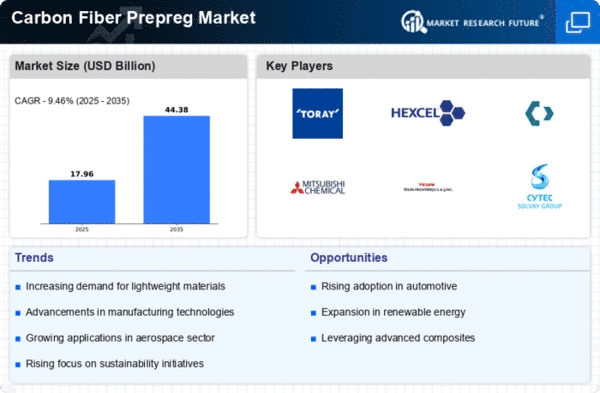
As per MRFR analysis, the Carbon Fiber Prepreg Market Size was estimated at 16.41 USD Billion in 2024. The Carbon Fiber Prepreg industry is projected to grow from 17.97 USD Billion in 2025 to 44.38 USD Billion by 2035, exhibiting a compound annual growth rate (CAGR) of 9.46% during the forecast period 2025 - 2035.

Key Market Trends & Highlights

The Carbon Fiber Prepreg Market is poised for robust growth driven by sustainability and technological advancements.

  • North America remains the largest market for carbon fiber prepreg, primarily due to its strong aerospace sector. Asia-Pacific is emerging as the fastest-growing region, fueled by increasing automotive applications and manufacturing capabilities. The aerospace segment continues to dominate the market, while the automotive segment is experiencing rapid growth due to innovations in vehicle design. Key market drivers include rising demand in the aerospace sector and advancements in manufacturing technologies, which are propelling the overall market forward.

Market Size & Forecast

2024 Market Size 16.41 (USD Billion)
2035 Market Size 44.38 (USD Billion)
CAGR (2025 - 2035) 9.46%
Largest Regional Market Share in 2024 North America

Major Players

Toray Industries (JP), Hexcel Corporation (US), SGL Carbon (DE), Mitsubishi Chemical Corporation (JP), Teijin Limited (JP), Cytec Solvay Group (BE), Zoltek Companies (US), Axiom Materials (US), Formosa Plastics Corporation (TW)

Market Trends

The Carbon Fiber Prepreg Market is currently experiencing a notable transformation, driven by advancements in material science and increasing demand across various industries. This market encompasses a range of applications, including aerospace, automotive, and sporting goods, where the lightweight and high-strength properties of carbon fiber prepreg materials are highly valued. As manufacturers seek to enhance performance and reduce weight in their products, the adoption of carbon fiber prepreg is likely to expand. Furthermore, the growing emphasis on sustainability and eco-friendly materials may influence the development of innovative prepreg solutions that align with environmental standards. In addition to technological advancements, the Carbon Fiber Prepreg Market is witnessing a shift towards automation and efficiency in production processes. Companies are investing in advanced manufacturing techniques to streamline operations and reduce costs. This trend may lead to increased competition among suppliers, as they strive to offer high-quality products at competitive prices. Moreover, collaborations between material producers and end-users are becoming more prevalent, fostering innovation and ensuring that the evolving needs of various sectors are met. Overall, the carbon fiber prepreg market appears poised for growth, with numerous opportunities for stakeholders to explore in the coming years.

Sustainability Initiatives

The Carbon Fiber Prepreg Market is increasingly influenced by sustainability initiatives, as manufacturers seek to develop eco-friendly materials. This trend reflects a broader commitment to reducing environmental impact, prompting innovations in production processes and material sourcing.

Technological Advancements

Technological advancements play a crucial role in shaping the Carbon Fiber Prepreg Market. Innovations in manufacturing techniques and material formulations are enhancing product performance, leading to greater adoption across diverse applications.

Increased Automation

The trend towards increased automation in production processes is transforming the Carbon Fiber Prepreg Market. Companies are investing in automated systems to improve efficiency, reduce costs, and maintain high-quality standards in their offerings.

Carbon Fiber Prepreg Market Market Drivers

Rising Demand in Aerospace Sector

The Global Carbon Fiber Prepreg Market Industry experiences a notable surge in demand driven by the aerospace sector. The lightweight and high-strength properties of carbon fiber prepreg materials are increasingly favored for aircraft manufacturing. As of 2024, the market is valued at approximately 7.5 USD Billion, reflecting the aerospace industry's shift towards advanced composite materials to enhance fuel efficiency and reduce emissions. Major aircraft manufacturers are integrating carbon fiber prepreg into their designs, which is expected to contribute significantly to the industry's growth. By 2035, the market could reach 17.1 USD Billion, indicating a robust trajectory fueled by technological advancements and regulatory pressures for sustainable aviation solutions.

Market Segment Insights

By Application: Aerospace (Largest) vs. Automotive (Fastest-Growing)

In the Carbon Fiber Prepreg Market, the application segment shows a diverse distribution of market shares among aerospace, automotive, sports equipment, wind energy, and marine applications. The aerospace segment remains the largest, driven by the continuous demand for lightweight, high-strength materials in aircraft manufacturing. Following aerospace, automotive is emerging as a significant player, particularly due to the increasing focus on fuel efficiency and performance in vehicles. Growth trends in the Carbon Fiber Prepreg Market are primarily influenced by advancements in manufacturing technology and the rising adoption of carbon fiber composites in various applications. The automotive sector is experiencing robust growth as manufacturers seek lightweight solutions to enhance energy efficiency and reduce emissions. Meanwhile, aerospace continues to innovate with new designs and applications, solidifying its position as a leading segment in the market.

Aerospace (Dominant) vs. Automotive (Emerging)

The aerospace application segment of carbon fiber prepreg is characterized by its requirement for materials that provide exceptional strength-to-weight ratios and thermal stability, making it ideal for aircraft structures and components. Aerospace manufacturers leverage carbon fiber prepregs to enhance the performance of their aircraft, leading to increased fuel efficiency and reduced operational costs. In contrast, the automotive application represents an emerging segment that is rapidly evolving, driven by trends such as the electrification of vehicles and stricter regulations on emissions. Automotive manufacturers are increasingly integrating carbon fiber prepregs into vehicle designs to reduce weight and improve overall performance, signaling a shift towards advanced materials in the automotive industry.

By End Use: Structural Components (Largest) vs. Reinforcements (Fastest-Growing)

In the Carbon Fiber Prepreg Market, the end-use segment is characterized by notable variations in market share. Structural Components hold the largest share, primarily driven by their application in aircraft and automotive manufacturing where high strength-to-weight ratios are crucial. Conversely, Reinforcements have emerged as a significant segment as industries increasingly seek lightweight and durable materials for modern applications, showcasing a growing shift towards innovative solutions in engineering design.

Structural Components: Dominant vs. Reinforcements: Emerging

Structural Components represent a dominant force in the Carbon Fiber Prepreg Market, largely due to their critical role in aerospace and automotive industries where the demand for lightweight yet robust materials is paramount. This segment is characterized by advanced applications, providing essential strength and rigidity to various structural elements. On the other hand, Reinforcements are rapidly becoming an emerging segment, driven by the increasing adoption of composites in sectors such as construction and sporting goods. These materials enhance the performance and durability of products, attracting significant interest from manufacturers keen on innovation and efficiency, thus indicating a bright future for the Reinforcements segment.

By Manufacturing Process: Autoclave (Largest) vs. Out-of-Autoclave (Fastest-Growing)

In the Carbon Fiber Prepreg Market, the manufacturing processes exhibit distinct share distributions, with autoclave techniques dominating due to their established reliability and superior product quality. This method allows for precise control over temperature and pressure, resulting in high-performance composites ideal for aerospace and automotive applications. Out-of-autoclave processes, while currently holding a smaller share, are gaining traction as they offer advantages in cost and manufacturing flexibility, appealing to a broader range of industries including consumer goods and sports equipment. Growth trends in this market segment are driven by advancements in technology, increasing demand for lightweight materials, and the push for more efficient manufacturing techniques. The out-of-autoclave processes, in particular, are witnessing rapid development as manufacturers seek to reduce production costs and time without compromising on quality. This trend is fostering innovation and competition among manufacturers, leading to a dynamic market environment in the carbon fiber prepreg space.

Autoclave (Dominant) vs. Resin Transfer Molding (Emerging)

The autoclave manufacturing process is recognized as the dominant technique in the carbon fiber prepreg market, primarily due to its ability to produce high-quality composites with superior mechanical properties. It ensures uniform temperature distribution and pressure application, making it essential for high-performance applications. On the other hand, resin transfer molding (RTM) is emerging as a viable alternative, known for its efficiency and suitability for complex parts. RTM allows for quicker processing times and reduced waste, making it attractive for manufacturers looking to optimize production. Together, these processes highlight the balance between traditional strengths and innovative solutions in the manufacturing landscape of carbon fiber prepregs.

By Fiber Type: T700 (Largest) vs. T1000 (Fastest-Growing)

In the Carbon Fiber Prepreg Market, the T700 fiber type emerges as the largest segment, holding a sizable share driven by its well-established applications in aerospace and automotive industries. Following closely in its wake are T800 and T300, which also command significant attention due to their balanced performance characteristics and versatility. Meanwhile, T1000 is experiencing rapid growth as manufacturers increasingly turn toward its enhanced strength-to-weight ratio, appealing in niche applications that demand superior performance.

T700 (Dominant) vs. T1000 (Emerging)

T700 fiber is recognized for its exceptional properties, making it a dominant choice in various high-performance applications, particularly in aerospace structures and automotive components where durability and weight savings are paramount. Conversely, T1000 is emerging quickly due to its superior tensile strength and modulus. This makes it an attractive option for innovative applications, including certain sporting goods and high-stress structural components. The demand for specialized products that leverage the T1000’s capabilities is driving its rapid acceptance and market penetration, emphasizing the evolving landscape of the carbon fiber prepreg market.

By Resin Type: Epoxy (Largest) vs. Polyester (Fastest-Growing)

In the Carbon Fiber Prepreg Market, the resin type segment experiences significant differentiation in terms of market share. Epoxy resin holds the largest share, owing to its superior mechanical properties and broad applicability in aviation, automotive, and sporting goods industries. In contrast, polyester resin, while historically trailing in market share, is witnessing rapid adoption due to its cost-effectiveness and versatility, particularly in non-structural applications. The competition among these resin types highlights the evolving dynamics of the market as end-user demands shift towards more specialized applications with varying performance requirements.

Epoxy (Dominant) vs. Polyester (Emerging)

Epoxy resins dominate the Carbon Fiber Prepreg Market, characterized by their exceptional strength, rigidity, and chemical resistance. This dominance is primarily due to their high-performance capabilities, making them ideal for critical applications in aerospace and high-end automotive sectors. On the other hand, polyester resins, emerging as a significant player, offer cost advantages and ease of production that appeal to manufacturers pursuing budget-friendly solutions. As industries seek to balance performance and pricing, polyester is gaining traction for applications that do not necessitate the advanced properties of epoxy, signaling a shift towards a more diverse resin landscape.

Get more detailed insights about Carbon Fiber Prepreg Market Research Report- Forecast to 2035

Regional Insights

North America : Market Leader in Innovation

North America is poised to maintain its leadership in the Carbon Fiber Prepreg market, holding a significant market share of 7.0 in 2024. The region's growth is driven by increasing demand in aerospace, automotive, and renewable energy sectors, alongside supportive government regulations promoting advanced materials. The focus on lightweight and high-strength materials is further propelling market expansion, with innovations in manufacturing processes enhancing efficiency and reducing costs. The competitive landscape in North America is robust, featuring key players such as Toray Industries, Hexcel Corporation, and Zoltek Companies. The U.S. is the leading country, supported by a strong industrial base and significant investments in R&D. The presence of major manufacturers and a growing number of startups focused on carbon fiber technologies are expected to drive further growth, making North America a hub for innovation in this sector.

Europe : Emerging Market with Potential

Europe is witnessing a growing interest in the Carbon Fiber Prepreg market, with a market size of 4.5. The region's growth is fueled by increasing applications in the automotive and aerospace industries, driven by stringent regulations aimed at reducing emissions and enhancing fuel efficiency. The European Union's commitment to sustainability and innovation is acting as a catalyst for the adoption of advanced materials, including carbon fiber prepregs, which are essential for lightweight construction. Leading countries in Europe include Germany, France, and the UK, where major players like SGL Carbon and Cytec Solvay Group are actively investing in new technologies. The competitive landscape is characterized by collaborations between manufacturers and research institutions, fostering innovation. The presence of a skilled workforce and advanced manufacturing capabilities further strengthens Europe's position in the global market.

Asia-Pacific : Rapid Growth and Adoption

Asia-Pacific is rapidly emerging as a significant player in the Carbon Fiber Prepreg market, with a market size of 4.0. The region's growth is driven by increasing demand from the automotive and aerospace sectors, particularly in countries like China and Japan. Government initiatives promoting the use of lightweight materials to enhance energy efficiency are further propelling market growth. The region is also witnessing a rise in manufacturing capabilities, making it a competitive landscape for carbon fiber production. China is the leading country in the region, supported by major manufacturers such as Mitsubishi Chemical Corporation and Teijin Limited. The competitive environment is characterized by a mix of established players and new entrants, focusing on innovation and cost-effective production methods. As the demand for carbon fiber prepregs continues to rise, Asia-Pacific is expected to play a crucial role in the global market dynamics.

Middle East and Africa : Untapped Market Opportunities

The Middle East and Africa region is currently at a nascent stage in the Carbon Fiber Prepreg market, with a market size of 1.91. However, there are significant opportunities for growth driven by increasing investments in infrastructure and aerospace sectors. The region's focus on diversifying its economy away from oil dependency is leading to a growing interest in advanced materials, including carbon fiber prepregs, which are essential for modern manufacturing processes. Countries like South Africa and the UAE are beginning to explore the potential of carbon fiber applications, supported by government initiatives aimed at fostering innovation. The competitive landscape is still developing, with a few key players starting to establish a presence. As the market matures, the region is expected to attract more investments and partnerships, paving the way for future growth in the carbon fiber sector.

Key Players and Competitive Insights

The Carbon Fiber Prepreg Market is currently characterized by a dynamic competitive landscape, driven by increasing demand across various sectors such as aerospace, automotive, and sports equipment. Key players are actively engaging in strategies that emphasize innovation, regional expansion, and sustainability. For instance, Toray Industries (Japan) has positioned itself as a leader through continuous investment in R&D, focusing on high-performance materials that cater to the evolving needs of its clients. Similarly, Hexcel Corporation (US) has been enhancing its operational capabilities by forming strategic partnerships aimed at expanding its product offerings and market reach, thereby reinforcing its competitive stance.
In terms of business tactics, companies are increasingly localizing manufacturing to reduce lead times and optimize supply chains. The market appears moderately fragmented, with several key players exerting considerable influence. This structure allows for a diverse range of products and innovations, as companies strive to differentiate themselves in a competitive environment. The collective actions of these major players suggest a trend towards consolidation, as firms seek to leverage synergies and enhance their market positions.
In November 2025, SGL Carbon (Germany) announced the opening of a new production facility in North America, aimed at increasing its output of carbon fiber prepreg materials. This strategic move is likely to enhance SGL's ability to meet the growing demand in the region, particularly from the aerospace sector, which is increasingly adopting lightweight materials to improve fuel efficiency. The establishment of this facility not only signifies SGL's commitment to regional growth but also reflects a broader trend of companies investing in local production capabilities to better serve their customers.
In October 2025, Mitsubishi Chemical Corporation (Japan) unveiled a new line of eco-friendly carbon fiber prepregs, which utilize bio-based resins. This initiative aligns with the growing emphasis on sustainability within the industry and positions Mitsubishi as a forward-thinking player committed to reducing its environmental footprint. The introduction of these products could potentially attract a new customer base that prioritizes sustainable materials, thereby enhancing Mitsubishi's competitive edge in the market.
In September 2025, Cytec Solvay Group (Belgium) entered into a strategic alliance with a leading aerospace manufacturer to co-develop advanced carbon fiber prepreg solutions. This collaboration is indicative of the increasing trend towards partnerships that leverage complementary strengths, allowing both companies to innovate more rapidly and effectively. Such alliances are becoming crucial as the market evolves, with firms recognizing that shared expertise can lead to superior product offerings and enhanced market positioning.
As of December 2025, the competitive trends within the Carbon Fiber Prepreg Market are increasingly defined by digitalization, sustainability, and the integration of advanced technologies such as AI. Strategic alliances are playing a pivotal role in shaping the landscape, enabling companies to pool resources and knowledge. Looking ahead, it appears that competitive differentiation will increasingly hinge on innovation and technological advancements rather than solely on price. Companies that can reliably deliver high-quality, sustainable products while optimizing their supply chains are likely to emerge as leaders in this evolving market.

Key Companies in the Carbon Fiber Prepreg Market include

Industry Developments

    • In January 2020, Mitsubishi chemical corporation (MCC) A Japanese chemical solutions provider announced the acquisition of a German carbon fiber prepreg manufacturing company, c-m-p GmbH, to strengthen its carbon fiber composite material business.
    • In February 2019, Teijin Ltd, a Japanese IT, and pharmaceutical company, announced the acquisition of Renegade Materials Corporation (Renegade), a leading North American supplier of highly heat-resistant thermoset prepreg for the aerospace industry.

Intended Audience

This report will be beneficial for every stakeholder of the carbon fiber prepreg market such as :

    • Carbon Fiber Prepreg Market Manufacturers
    • Research and Development Institutes
    • Raw Material suppliers
    • Traders and Distributors
    • End-user industries


Future Outlook

Carbon Fiber Prepreg Market Future Outlook

The Carbon Fiber Prepreg Market is projected to grow at a 9.46% CAGR from 2025 to 2035, driven by advancements in aerospace, automotive, and renewable energy sectors.

New opportunities lie in:

  • Development of automated prepreg manufacturing technologies
  • Expansion into emerging markets with tailored solutions
  • Strategic partnerships with aerospace manufacturers for specialized applications

By 2035, the market is expected to achieve robust growth, solidifying its position as a leader in advanced materials.

Market Segmentation

Carbon Fiber Prepreg Market End Use Outlook

  • Structural Components
  • Interior Components
  • Exterior Components
  • Reinforcements
  • Composites

Carbon Fiber Prepreg Market Fiber Type Outlook

  • T700
  • T800
  • T1000
  • T300
  • T350

Carbon Fiber Prepreg Market Resin Type Outlook

  • Epoxy
  • Polyester
  • Vinyl Ester
  • Phenolic
  • Polyurethane

Carbon Fiber Prepreg Market Application Outlook

  • Aerospace
  • Automotive
  • Sports Equipment
  • Wind Energy
  • Marine

Carbon Fiber Prepreg Market Manufacturing Process Outlook

  • Autoclave
  • Out-of-Autoclave
  • Resin Transfer Molding
  • Vacuum Infusion
  • Filament Winding

Report Scope

MARKET SIZE 2024 16.41(USD Billion)
MARKET SIZE 2025 17.97(USD Billion)
MARKET SIZE 2035 44.38(USD Billion)
COMPOUND ANNUAL GROWTH RATE (CAGR) 9.46% (2025 - 2035)
REPORT COVERAGE Revenue Forecast, Competitive Landscape, Growth Factors, and Trends
BASE YEAR 2024
Market Forecast Period 2025 - 2035
Historical Data 2019 - 2024
Market Forecast Units USD Billion
Key Companies Profiled Toray Industries (JP), Hexcel Corporation (US), SGL Carbon (DE), Mitsubishi Chemical Corporation (JP), Teijin Limited (JP), Cytec Solvay Group (BE), Zoltek Companies (US), Axiom Materials (US), Formosa Plastics Corporation (TW)
Segments Covered Application, End Use, Manufacturing Process, Fiber Type, Resin Type
Key Market Opportunities Growing demand for lightweight materials in aerospace and automotive sectors drives Carbon Fiber Prepreg Market expansion.
Key Market Dynamics Rising demand for lightweight materials drives innovation and competition in the carbon fiber prepreg market.
Countries Covered North America, Europe, APAC, South America, MEA

FAQs

How much will the global carbon fiber prepreg market be worth in the future?

The global carbon fiber prepreg market value is expected to be worth USD 17.1 billion by 2035. at a CAGR of 10.4 %

Which region leads the carbon fiber Prepreg market in terms of value?

North America holds the largest carbon fiber prepreg market share among other regions. The greater presence of aircraft and automobile manufacturing units makes it the leading regional segment.

Which end-user industry is expected to have the highest market value during the current forecast period?

The aerospace and defense segment of the global carbon fiber prepreg market is expected to have the highest market value over the current forecast period.

Who are the key players of the global carbon fiber Prepreg industry?

Cytec Solvay Group (Brussels, Belgium), Royal TenCate N.V. (Almeo, Netherlands), Teijin Limited (Osaka, Japan), Toray Industries, Inc. (Tokyo, Japan), Hexcel Corporation (Connecticut, U.S.), SGL Group (Wiesbaden, Germany), Gurit Holding AG (Wattwil, Switzerland), Park Electrochemical Corporation (Melville, U.S.), Mitsubishi Rayon Co., Ltd. (Japan), and Axiom Materials (California, U.S.)

What is the major driving factor behind the growth of the carbon fiber Prepreg market?

The growing demand for carbon fiber prepreg in different end-user industries owing to its several advantages is the major growth driving factor.

  1. SECTION I: EXECUTIVE SUMMARY AND KEY HIGHLIGHTS
    1. | 1.1 EXECUTIVE SUMMARY
    2. | 1.1.1 Market Overview
    3. | 1.1.2 Key Findings
    4. | 1.1.3 Market Segmentation
    5. | 1.1.4 Competitive Landscape
    6. | 1.1.5 Challenges and Opportunities
    7. | 1.1.6 Future Outlook
  2. SECTION II: SCOPING, METHODOLOGY AND MARKET STRUCTURE
    1. | 2.1 MARKET INTRODUCTION
    2. | 2.1.1 Definition
    3. | 2.1.2 Scope of the study
    4. |-- 2.1.2.1 Research Objective
    5. |-- 2.1.2.2 Assumption
    6. |-- 2.1.2.3 Limitations
    7. | 2.2 RESEARCH METHODOLOGY
    8. | 2.2.1 Overview
    9. | 2.2.2 Data Mining
    10. | 2.2.3 Secondary Research
    11. | 2.2.4 Primary Research
    12. |-- 2.2.4.1 Primary Interviews and Information Gathering Process
    13. |-- 2.2.4.2 Breakdown of Primary Respondents
    14. | 2.2.5 Forecasting Model
    15. | 2.2.6 Market Size Estimation
    16. |-- 2.2.6.1 Bottom-Up Approach
    17. |-- 2.2.6.2 Top-Down Approach
    18. | 2.2.7 Data Triangulation
    19. | 2.2.8 Validation
  3. SECTION III: QUALITATIVE ANALYSIS
    1. | 3.1 MARKET DYNAMICS
    2. | 3.1.1 Overview
    3. | 3.1.2 Drivers
    4. | 3.1.3 Restraints
    5. | 3.1.4 Opportunities
    6. | 3.2 MARKET FACTOR ANALYSIS
    7. | 3.2.1 Value chain Analysis
    8. | 3.2.2 Porter's Five Forces Analysis
    9. |-- 3.2.2.1 Bargaining Power of Suppliers
    10. |-- 3.2.2.2 Bargaining Power of Buyers
    11. |-- 3.2.2.3 Threat of New Entrants
    12. |-- 3.2.2.4 Threat of Substitutes
    13. |-- 3.2.2.5 Intensity of Rivalry
    14. | 3.2.3 COVID-19 Impact Analysis
    15. |-- 3.2.3.1 Market Impact Analysis
    16. |-- 3.2.3.2 Regional Impact
    17. |-- 3.2.3.3 Opportunity and Threat Analysis
  4. SECTION IV: QUANTITATIVE ANALYSIS
    1. | 4.1 Chemicals and Materials, BY Application (USD Billion)
    2. | 4.1.1 Aerospace
    3. | 4.1.2 Automotive
    4. | 4.1.3 Sports Equipment
    5. | 4.1.4 Wind Energy
    6. | 4.1.5 Marine
    7. | 4.2 Chemicals and Materials, BY End Use (USD Billion)
    8. | 4.2.1 Structural Components
    9. | 4.2.2 Interior Components
    10. | 4.2.3 Exterior Components
    11. | 4.2.4 Reinforcements
    12. | 4.2.5 Composites
    13. | 4.3 Chemicals and Materials, BY Manufacturing Process (USD Billion)
    14. | 4.3.1 Autoclave
    15. | 4.3.2 Out-of-Autoclave
    16. | 4.3.3 Resin Transfer Molding
    17. | 4.3.4 Vacuum Infusion
    18. | 4.3.5 Filament Winding
    19. | 4.4 Chemicals and Materials, BY Fiber Type (USD Billion)
    20. | 4.4.1 T700
    21. | 4.4.2 T800
    22. | 4.4.3 T1000
    23. | 4.4.4 T300
    24. | 4.4.5 T350
    25. | 4.5 Chemicals and Materials, BY Resin Type (USD Billion)
    26. | 4.5.1 Epoxy
    27. | 4.5.2 Polyester
    28. | 4.5.3 Vinyl Ester
    29. | 4.5.4 Phenolic
    30. | 4.5.5 Polyurethane
    31. | 4.6 Chemicals and Materials, BY Region (USD Billion)
    32. | 4.6.1 North America
    33. |-- 4.6.1.1 US
    34. |-- 4.6.1.2 Canada
    35. | 4.6.2 Europe
    36. |-- 4.6.2.1 Germany
    37. |-- 4.6.2.2 UK
    38. |-- 4.6.2.3 France
    39. |-- 4.6.2.4 Russia
    40. |-- 4.6.2.5 Italy
    41. |-- 4.6.2.6 Spain
    42. |-- 4.6.2.7 Rest of Europe
    43. | 4.6.3 APAC
    44. |-- 4.6.3.1 China
    45. |-- 4.6.3.2 India
    46. |-- 4.6.3.3 Japan
    47. |-- 4.6.3.4 South Korea
    48. |-- 4.6.3.5 Malaysia
    49. |-- 4.6.3.6 Thailand
    50. |-- 4.6.3.7 Indonesia
    51. |-- 4.6.3.8 Rest of APAC
    52. | 4.6.4 South America
    53. |-- 4.6.4.1 Brazil
    54. |-- 4.6.4.2 Mexico
    55. |-- 4.6.4.3 Argentina
    56. |-- 4.6.4.4 Rest of South America
    57. | 4.6.5 MEA
    58. |-- 4.6.5.1 GCC Countries
    59. |-- 4.6.5.2 South Africa
    60. |-- 4.6.5.3 Rest of MEA
  5. SECTION V: COMPETITIVE ANALYSIS
    1. | 5.1 Competitive Landscape
    2. | 5.1.1 Overview
    3. | 5.1.2 Competitive Analysis
    4. | 5.1.3 Market share Analysis
    5. | 5.1.4 Major Growth Strategy in the Chemicals and Materials
    6. | 5.1.5 Competitive Benchmarking
    7. | 5.1.6 Leading Players in Terms of Number of Developments in the Chemicals and Materials
    8. | 5.1.7 Key developments and growth strategies
    9. |-- 5.1.7.1 New Product Launch/Service Deployment
    10. |-- 5.1.7.2 Merger & Acquisitions
    11. |-- 5.1.7.3 Joint Ventures
    12. | 5.1.8 Major Players Financial Matrix
    13. |-- 5.1.8.1 Sales and Operating Income
    14. |-- 5.1.8.2 Major Players R&D Expenditure. 2023
    15. | 5.2 Company Profiles
    16. | 5.2.1 Toray Industries (JP)
    17. |-- 5.2.1.1 Financial Overview
    18. |-- 5.2.1.2 Products Offered
    19. |-- 5.2.1.3 Key Developments
    20. |-- 5.2.1.4 SWOT Analysis
    21. |-- 5.2.1.5 Key Strategies
    22. | 5.2.2 Hexcel Corporation (US)
    23. |-- 5.2.2.1 Financial Overview
    24. |-- 5.2.2.2 Products Offered
    25. |-- 5.2.2.3 Key Developments
    26. |-- 5.2.2.4 SWOT Analysis
    27. |-- 5.2.2.5 Key Strategies
    28. | 5.2.3 SGL Carbon (DE)
    29. |-- 5.2.3.1 Financial Overview
    30. |-- 5.2.3.2 Products Offered
    31. |-- 5.2.3.3 Key Developments
    32. |-- 5.2.3.4 SWOT Analysis
    33. |-- 5.2.3.5 Key Strategies
    34. | 5.2.4 Mitsubishi Chemical Corporation (JP)
    35. |-- 5.2.4.1 Financial Overview
    36. |-- 5.2.4.2 Products Offered
    37. |-- 5.2.4.3 Key Developments
    38. |-- 5.2.4.4 SWOT Analysis
    39. |-- 5.2.4.5 Key Strategies
    40. | 5.2.5 Teijin Limited (JP)
    41. |-- 5.2.5.1 Financial Overview
    42. |-- 5.2.5.2 Products Offered
    43. |-- 5.2.5.3 Key Developments
    44. |-- 5.2.5.4 SWOT Analysis
    45. |-- 5.2.5.5 Key Strategies
    46. | 5.2.6 Cytec Solvay Group (BE)
    47. |-- 5.2.6.1 Financial Overview
    48. |-- 5.2.6.2 Products Offered
    49. |-- 5.2.6.3 Key Developments
    50. |-- 5.2.6.4 SWOT Analysis
    51. |-- 5.2.6.5 Key Strategies
    52. | 5.2.7 Zoltek Companies (US)
    53. |-- 5.2.7.1 Financial Overview
    54. |-- 5.2.7.2 Products Offered
    55. |-- 5.2.7.3 Key Developments
    56. |-- 5.2.7.4 SWOT Analysis
    57. |-- 5.2.7.5 Key Strategies
    58. | 5.2.8 Axiom Materials (US)
    59. |-- 5.2.8.1 Financial Overview
    60. |-- 5.2.8.2 Products Offered
    61. |-- 5.2.8.3 Key Developments
    62. |-- 5.2.8.4 SWOT Analysis
    63. |-- 5.2.8.5 Key Strategies
    64. | 5.2.9 Formosa Plastics Corporation (TW)
    65. |-- 5.2.9.1 Financial Overview
    66. |-- 5.2.9.2 Products Offered
    67. |-- 5.2.9.3 Key Developments
    68. |-- 5.2.9.4 SWOT Analysis
    69. |-- 5.2.9.5 Key Strategies
    70. | 5.3 Appendix
    71. | 5.3.1 References
    72. | 5.3.2 Related Reports

Chemicals and Materials Market Segmentation

Chemicals and Materials By Application (USD Billion, 2025-2035)

  • Aerospace
  • Automotive
  • Sports Equipment
  • Wind Energy
  • Marine

Chemicals and Materials By End Use (USD Billion, 2025-2035)

  • Structural Components
  • Interior Components
  • Exterior Components
  • Reinforcements
  • Composites

Chemicals and Materials By Manufacturing Process (USD Billion, 2025-2035)

  • Autoclave
  • Out-of-Autoclave
  • Resin Transfer Molding
  • Vacuum Infusion
  • Filament Winding

Chemicals and Materials By Fiber Type (USD Billion, 2025-2035)

  • T700
  • T800
  • T1000
  • T300
  • T350

Chemicals and Materials By Resin Type (USD Billion, 2025-2035)

  • Epoxy
  • Polyester
  • Vinyl Ester
  • Phenolic
  • Polyurethane
Infographic

Free Sample Request

Kindly complete the form below to receive a free sample of this Report

Get Free Sample

Customer Strories

Compare Licence

×
Features License Type
Single User Multiuser License Enterprise User
Price $4,950 $5,950 $7,250
Maximum User Access Limit 1 User Upto 10 Users Unrestricted Access Throughout the Organization
Free Customization
Direct Access to Analyst
Deliverable Format
Platform Access
Discount on Next Purchase 10% 15% 15%
Printable Versions