Request Free Sample ×

Kindly complete the form below to receive a free sample of this Report

* Please use a valid business email

Leading companies partner with us for data-driven Insights

clients tt-cursor
Hero Background
English
Chinese
French
Japanese
Korean
German
Spanish

Car Bumpers Market Size

ID: MRFR/AT/14539-HCR
128 Pages
Shubham Munde
Last Updated: April 06, 2026

Car Bumpers Market Research Report Information By Type (Standard Bumper, Deep Drop/Cowboy Bumper, Roll Pan Bumper, Step Bumper, Tube Bumper), By Material, By Positioning, By Vehicle Type [Passenger Cars (Hatchbacks, Sedans, and Utility Vehicles (SUVs & MPVS), Light Commercial Vehicles, Heavy Duty Trucks, Buses and Coaches, Off- Highway vehicles (Agriculture Tractors & Equipment, Construction & Mining Equipment, and Industrial Vehicles (Forklift, AGV, Etc.)], By Sales Channel and By Region– Market Forecast Till 2035

Share:
Download PDF ×

We do not share your information with anyone. However, we may send you emails based on your report interest from time to time. You may contact us at any time to opt-out.

Car Bumpers Market Infographic
Purchase Options

Car Bumpers Size

Car Bumpers Market Growth Projections and Opportunities

The scope of the industry factors include a wide range touch-points that shape the dynamics dictating how it is evolving to meet this demand. The focus on the safety standards and regulations as one of the primary factors driving growth in car bumpers market. With governments around the world imposing strict safety standards, automakers are forced to incorporate high-end protection features such as impact resistant and energy absorbing bumpers into vehicles in order improve occupant’s survival rate during a crash. This practice reflects the importance of bumpers for contributing to overall vehicle safety. Consumer tastes and style also play a major role in influencing the car bumper market. With an increasingly competitive market, automakers are looking to distinguish their brand through innovative materials, designs and finishes that enhance the visual appeal of vehicles. Color-matching and integrated styling elements often serve as customization options that are essential for attracting of the potential purchasers. The consumer preference for aesthetically improved and stylish bumpers further fuels the continuous change in design trends of automotive. Sustainability and lightweight materials are now a significant driving force behind the car bumpers market, as environmental concerns have been on the rise. Manufacturers are considering various environmentally friendly materials including thermoplastics that contributes not only to lighter vehicle technologies, but also fuel efficiency and emissions. The use of recyclable materials reflects efforts on a global scale to curtail the ecological impact that automotive manufacturing has had and addresses issues regarding end-of-life vehicle disposal, expressing ongoing commitment towards sustainable practices. The factor driving the market of car bumpers is technological advancements in materials and manufacturing processes. The use of modern composites, reinforced plastics and hybrid materials improves structural strength with high impact resistance for the bumper. The methodology of manufacturing plays a significant role in making the material more durable and cost-effective with such innovations as injection molding, thermosetting processes. Furthermore, modern bumpers now take advantage of the use of sensors and smart materials in order to facilitate the integration ADAS systems alongside collision avoidance technologies for higher vehicle safety. Besides, global economic factors and market dynamics also play a major role in the car bumpers industry. Changes in the economic indicators, the consumer purchasing power and automotive sales volumes have an influence on bumper demand. Moreover, the changes in markets based on EVs and autonomous cars are affecting bumper design fundamentals.

Car Bumpers Market Size Graph
Author
Author Profile
Shubham Munde
Team Lead - Research

Shubham brings over 7 years of expertise in Market Intelligence and Strategic Consulting, with a strong focus on the Automotive, Aerospace, and Defense sectors. Backed by a solid foundation in semiconductors, electronics, and software, he has successfully delivered high-impact syndicated and custom research on a global scale. His core strengths include market sizing, forecasting, competitive intelligence, consumer insights, and supply chain mapping. Widely recognized for developing scalable growth strategies, Shubham empowers clients to navigate complex markets and achieve a lasting competitive edge. Trusted by start-ups and Fortune 500 companies alike, he consistently converts challenges into strategic opportunities that drive sustainable growth.

Leave a Comment

FAQs

What is the projected market valuation for the Car Bumpers Market in 2035?

<p>The Car Bumpers Market is projected to reach a valuation of 21.31 USD Billion by 2035.</p>

What was the market valuation of the Car Bumpers Market in 2024?

<p>In 2024, the Car Bumpers Market was valued at 13.84 USD Billion.</p>

What is the expected CAGR for the Car Bumpers Market during the forecast period 2025 - 2035?

<p>The expected CAGR for the Car Bumpers Market during the forecast period 2025 - 2035 is 4.0%.</p>

Which companies are considered key players in the Car Bumpers Market?

<p>Key players in the Car Bumpers Market include Plastic Omnium, Magna International, Valeo, and Daimler AG.</p>

What are the main types of car bumpers and their market values?

<p>The main types of car bumpers include Standard Bumpers valued at 8.66 USD Billion and Deep Drop/Cowboy Bumpers valued at 3.2 USD Billion.</p>

How does the market for OEM and aftermarket car bumpers compare?

<p>The OEM segment is projected to reach 12.5 USD Billion, while the aftermarket segment is expected to reach 8.81 USD Billion.</p>

What materials are predominantly used in car bumpers and their market values?

<p>Plastic is the leading material for car bumpers, projected to reach 6.0 USD Billion, followed by Steel at 3.5 USD Billion.</p>

What is the market value for front-end and rear-end bumpers?

<p>Front-end bumpers are projected to reach 8.66 USD Billion, while rear-end bumpers are expected to reach 12.65 USD Billion.</p>

Which vehicle types contribute most to the Car Bumpers Market?

<p>Passenger cars lead the market with a projected value of 8.66 USD Billion, followed by SUVs and MPVs at 4.12 USD Billion.</p>

What is the significance of the Car Bumpers Market in the automotive industry?

<p>The Car Bumpers Market plays a crucial role in vehicle safety and aesthetics, with a projected growth reflecting increasing automotive production and innovation.</p>

Market Summary

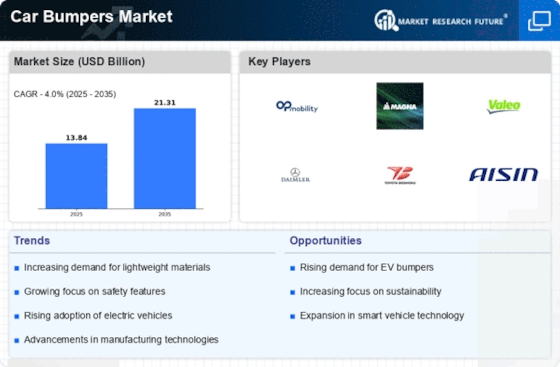
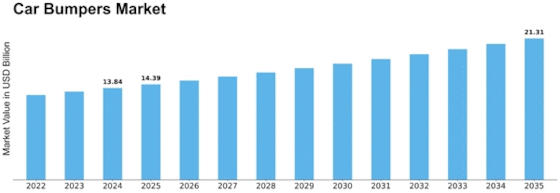
As per Market Research Future analysis, the Car Bumpers Market Size was estimated at 13.84 USD Billion in 2024. The Car Bumpers industry is projected to grow from 14.4 USD Billion in 2025 to 21.31 USD Billion by 2035, exhibiting a compound annual growth rate (CAGR) of 4.0% during the forecast period 2025 - 2035

Key Market Trends & Highlights

The Car Bumpers Market is experiencing a transformative shift towards advanced materials and safety features.

  • The market is witnessing a notable shift to lightweight materials, enhancing fuel efficiency and performance. Integration of advanced safety features in car bumpers is becoming increasingly prevalent, driven by consumer demand for enhanced protection. North America remains the largest market, while the Asia-Pacific region is emerging as the fastest-growing area for car bumpers. The rising demand for vehicle customization and technological advancements in manufacturing are key drivers propelling market growth.

Market Size & Forecast

2024 Market Size 13.84 (USD Billion)
2035 Market Size 21.31 (USD Billion)
CAGR (2025 - 2035) 4.0%
Largest Regional Market Share in 2024 North America

Major Players

<a href="https://www.opmobility.com/en/exterior-and-lighting/">Plastic Omnium</a> (FR), Magna International (CA), Valeo (FR), Daimler AG (DE), Toyota Boshoku Corporation (JP), Aisin Seiki Co., Ltd. (JP), Hyundai Mobis (KR), <a href="https://www.gentex.com/products-technology/automotive/">Gentex Corporation</a> (US), SMP Automotive (DE)

Market Trends

The Car Bumpers Market is currently experiencing a dynamic evolution, driven by various factors including technological advancements and changing consumer preferences. Manufacturers are increasingly focusing on lightweight materials, which not only enhance fuel efficiency but also improve vehicle performance. Additionally, the integration of advanced safety features into bumpers is becoming more prevalent, as consumers prioritize safety in their purchasing decisions. This shift towards innovation suggests a competitive landscape where companies must adapt to meet the demands of modern consumers while adhering to regulatory standards. Moreover, the growing trend towards electric vehicles is likely to influence the Car Bumpers Market significantly. As automakers transition to electric models, the design and functionality of bumpers may evolve to accommodate new technologies and aesthetics. This transition could lead to a redefinition of bumper designs, emphasizing sustainability and efficiency. Overall, the Car Bumpers Market appears poised for growth, with opportunities arising from both technological advancements and shifts in consumer behavior, indicating a vibrant future for industry stakeholders.

Shift to Lightweight Materials

The Car Bumpers Market is witnessing a notable shift towards the use of lightweight materials. This trend is primarily driven by the need for improved fuel efficiency and enhanced vehicle performance. Manufacturers are exploring alternatives such as plastics and composites, which not only reduce weight but also offer better impact resistance. As a result, this shift may lead to more efficient vehicles and a reduction in overall emissions.

Integration of Advanced Safety Features

There is a growing emphasis on integrating advanced safety features within car bumpers. This trend reflects the increasing consumer demand for enhanced safety measures in vehicles. Features such as pedestrian detection systems and energy-absorbing structures are becoming more common, suggesting that manufacturers are prioritizing safety in their designs. This focus on safety could potentially reshape consumer preferences and influence purchasing decisions.

Impact of Electric Vehicle Adoption

The rise of electric vehicles is likely to have a profound impact on the Car Bumpers Market. As automakers shift towards electric models, the design and functionality of bumpers may evolve to accommodate new technologies. This transition could lead to innovative designs that emphasize sustainability and efficiency, indicating a potential redefinition of bumper aesthetics and materials in the coming years.

Car Bumpers Market Market Drivers

Growth of the Automotive Aftermarket

The automotive aftermarket is a vital driver for the Car Bumpers Market. As vehicle ownership continues to rise, the demand for replacement and aftermarket bumpers is also increasing. Consumers are more inclined to invest in high-quality aftermarket parts to enhance the performance and aesthetics of their vehicles. This trend is further fueled by the growing awareness of the benefits of using aftermarket components, such as improved durability and customization options. Market analysis indicates that the aftermarket segment is projected to expand at a rate of 7% over the next few years, highlighting its significance in the overall Car Bumpers Market.

Rising Demand for Vehicle Customization

The Car Bumpers Market is experiencing a notable increase in demand for vehicle customization. Consumers are increasingly seeking personalized options that reflect their individual styles and preferences. This trend is particularly pronounced among younger demographics, who prioritize aesthetics and unique features in their vehicles. As a result, manufacturers are expanding their offerings to include a variety of bumper designs, materials, and finishes. The customization trend not only enhances the visual appeal of vehicles but also allows for improved functionality, such as enhanced aerodynamics and protection. Market data indicates that the customization segment is projected to grow at a compound annual growth rate of approximately 6% over the next five years, underscoring the importance of this driver in the Car Bumpers Market.

Sustainability and Eco-Friendly Materials

Sustainability is becoming an increasingly important consideration in the Car Bumpers Market. As environmental concerns rise, manufacturers are exploring eco-friendly materials and production methods to reduce their carbon footprint. The use of recycled plastics and bio-based materials in bumper production is gaining traction, appealing to environmentally conscious consumers. This shift not only aligns with global sustainability goals but also meets the growing demand for greener automotive solutions. Market trends suggest that the segment focused on sustainable materials is likely to witness a growth rate of around 4% annually, indicating a shift towards more responsible manufacturing practices within the Car Bumpers Market.

Technological Advancements in Manufacturing

Technological advancements are playing a crucial role in shaping the Car Bumpers Market. Innovations in manufacturing processes, such as 3D printing and automated production lines, are enabling manufacturers to produce bumpers with greater precision and efficiency. These technologies not only reduce production costs but also allow for the creation of complex designs that were previously unattainable. Furthermore, the integration of smart technologies into bumpers, such as sensors and cameras, is enhancing safety features and overall vehicle performance. As manufacturers continue to invest in these advancements, the market is likely to witness a surge in demand for high-tech bumpers, which could account for a significant portion of the market share in the coming years.

Increasing Focus on Vehicle Safety Regulations

The Car Bumpers Market is significantly influenced by the increasing focus on vehicle safety regulations. Governments and regulatory bodies are implementing stricter safety standards to enhance occupant protection and reduce the severity of injuries in accidents. This has led to a growing demand for bumpers that meet these enhanced safety requirements. Manufacturers are responding by developing bumpers that incorporate advanced materials and designs aimed at energy absorption and impact resistance. Market data suggests that the segment of bumpers designed for safety compliance is expected to grow by approximately 5% annually, reflecting the industry's commitment to meeting regulatory demands and improving vehicle safety.

Market Segment Insights

By Type: Standard Bumper (Largest) vs. Tube Bumper (Fastest-Growing)

The car bumpers market segment is primarily dominated by Standard Bumpers, which have a significant market share due to their widespread adoption in various vehicle models for both aesthetic and functional purposes. Deep Drop/Cowboy Bumpers and Step Bumpers also hold notable portions of the market, appealing primarily to off-road enthusiasts and trucks, while Roll Pan Bumpers cater to custom car modifications, representing a niche but dedicated segment. Tube Bumpers have gained traction recently as they are increasingly popular for their rugged design and off-road capabilities, indicating a shift in consumer preferences. Growth trends in the car bumpers market highlight the increasing demand for customized and durable bumpers that meet specific consumer needs. The rise of off-roading and adventure-based activities has significantly influenced the popularity of Tube Bumpers, marking it as the fastest-growing segment. Innovation in materials, such as lightweight composites, and the push for improved vehicle safety standards are also driving growth in various bumper types, making the market dynamic and responsive to consumer trends.

Standard Bumper (Dominant) vs. Tube Bumper (Emerging)

Standard Bumpers serve as the backbone of the car bumpers market, offering versatility and compatibility across a wide range of vehicles. Their designs prioritize safety, ensuring that they absorb impact effectively while maintaining aesthetics, which appeals to mass-market consumers. In contrast, Tube Bumpers have emerged as a favored choice among off-road and adventure vehicle owners due to their unique design that allows for superior protection and a rugged look. They are particularly popular in the aftermarket sector where customization is key, attracting a dedicated consumer base that values durability and functionality in challenging terrains. This emerging trend showcases a transformation in consumer preferences towards more robust and personalized vehicle accessories.

By Material: Plastic (Largest) vs. Carbon Fiber (Fastest-Growing)

In the Car Bumpers Market, the material segment is dominated primarily by plastic, accounting for the largest share due to its lightweight, cost-effective, and versatile properties. Plastic bumpers are widely used across various vehicle types, contributing significantly to the overall market. Other materials such as steel and aluminum, while traditional choices, fall behind in market share as manufacturers opt for lighter alternatives to improve fuel efficiency and performance. Carbon fiber is emerging as the fastest-growing segment in material usage for car bumpers, driven by the increasing demand for lightweight and high-performance vehicles. As automotive manufacturers seek to enhance fuel efficiency and reduce emissions, they are progressively adopting advanced composite materials like carbon fiber. This shift is spurred by innovations in production techniques that lower costs, making carbon fiber more accessible in the mass market.

Plastic (Dominant) vs. Carbon Fiber (Emerging)

Plastic bumpers, notably made from materials like polypropylene (PP) and HDPE, offer excellent durability and ease of manufacturing, making them a dominant choice in the market. Their lightweight nature contributes to better fuel efficiency, a crucial factor for modern vehicles. On the other hand, <a href="https://www.marketresearchfuture.com/reports/carbon-fiber-market-7607">carbon fiber</a>, while currently a more niche choice, is quickly gaining traction due to its superior strength-to-weight ratio and aesthetic appeal. The increasing interest in electric vehicles and high-performance models is driving the adoption of carbon fiber, as manufacturers look for innovative ways to enhance vehicle performance without adding significant weight. As such, while plastic remains the go-to for affordability and versatility, carbon fiber is positioning itself as the preferred choice for luxury and performance-oriented vehicles.

By Positioning: Front Ends (Largest) vs. Rear Ends (Fastest-Growing)

In the Car Bumpers Market, the positioning segment is dominated by front ends, which command a significant share due to their crucial role in vehicle aesthetics and safety. As the first point of impact, front bumpers are designed with advanced materials and technologies to ensure both functionality and design appeal, making them a preferred choice for many manufacturers. Meanwhile, rear ends are gaining traction as more manufacturers focus on innovative designs and safety enhancements, creating a growing segment that appeals to both automakers and consumers alike.

Positioning: Front Ends (Dominant) vs. Rear Ends (Emerging)

Front ends are characterized by their solid market presence, as they serve not only an aesthetic function but also offer vital safety performance in collisions. They are designed for superior durability and energy absorption to withstand impacts, making them a primary choice for leading automotive brands. On the other hand, rear ends, while previously less emphasized, are becoming increasingly important as drivers seek comprehensive protection and style. The emergence of new design technologies and consumer preferences for unique rear aesthetics have positioned rear bumpers as a rapidly evolving segment within the market, indicating a shift towards more versatile and functional vehicle designs.

By Vehicle Type: Passenger Cars (Largest) vs. Utility Vehicles (Fastest-Growing)

The Car Bumpers Market is heavily influenced by the vehicle type segment, with passenger cars accounting for the largest share. This includes various categories under passenger vehicles, such as sedans and hatchbacks. As the automotive industry continues to grow, these segments significantly impact market dynamics. Meanwhile, utility vehicles, encompassing SUVs and MPVs, are quickly gaining traction, indicating a shift in consumer preferences towards larger vehicles. This increase impacts manufacturing specifications and market strategies as automakers adapt to consumer demand. The growth in the vehicle type segment is primarily driven by changing consumer preferences and advancements in vehicle technology. The demand for passenger cars remains strong, with a focus on design and safety features that enhance user experience. <a href="https://www.marketresearchfuture.com/reports/utility-vehicles-market-11867">Utility vehicles</a> are quickly rising due to their versatility and ability to serve multiple purposes, thus meeting the needs of families and work-related use alike, indicating a robust trend that looks promising for the near future.

Passenger Cars: Sedans (Dominant) vs. SUVs (Emerging)

In the context of the Car Bumpers Market, sedans represent a dominant segment, renowned for their design, fuel efficiency, and comfort. Sedans are a preferred choice for everyday commuting and family use, reinforcing their strong market presence. On the other hand, SUVs are emerging as a key player in the market due to their spacious interiors and off-road capabilities. They cater to consumers seeking a blend of luxury and functionality, leading to increased demand. Both segments require specific bumper designs and materials to meet safety regulations and aesthetic preferences. As the market evolves, manufacturers are likely to innovate in these categories, ensuring that both sedans and SUVs continue to thrive.

By Sales Channel: OEM (Largest) vs. Aftermarket (Fastest-Growing)

In the Car Bumpers Market, sales channels are significantly polarized between OEM and Aftermarket segments. The OEM segment dominates the market, driven by the consistent demand from automobile manufacturers who prioritize original parts for their vehicles. On the other hand, the Aftermarket segment, while smaller in size, has been rapidly gaining traction among consumers looking for cost-effective and custom solutions that add value to their vehicles. The shift in consumer preferences towards personalization and enhanced vehicle performance is notable in this space. The growth trends within the Car Bumpers Market indicate that the Aftermarket is poised for substantial expansion, fueled mainly by a rise in vehicle ownership and increased spending on vehicle maintenance and upgrades. Furthermore, the advent of e-commerce platforms has streamlined the procurement process for aftermarket parts, enhancing accessibility for consumers. As more car owners seek efficient and unique bumper solutions, the Aftermarket segment is positioned to thrive, marking it as a significant player in the overall market landscape.

Sales Channel: OEM (Dominant) vs. Aftermarket (Emerging)

The OEM segment is characterized by its strong relationships with auto manufacturers, supplying them with high-quality and standardized bumpers designed to meet strict compliance and safety regulations. These bumpers are engineered specifically for particular vehicle models, ensuring a perfect fit and seamless integration into the manufacturing process. OEM products typically secure customer confidence due to their reliability and brand association. In contrast, the Aftermarket segment appeals to a diverse consumer base seeking versatility and customization. It allows for greater personal expression through styling options and performance enhancements. This segment includes a range of products that cater to different price points and quality levels, making it an attractive alternative for consumers interested in modifying their vehicles or replacing damaged components.

Get more detailed insights about Car Bumpers Market Research Report — Global Forecast till 2035

Regional Insights

By region, the study provides the market insights into North America, Europe, Asia-Pacific and Rest of the World. North America's largest automobile market is in the United States. The desire of American consumers for trucks, SUVs, and crossover cars affects bumper market figures. Beauty and safety elements are frequently given priority in bumper designs. The market is also impacted by strict safety laws from organizations like the NHTSA.

Further, the major countries studied in the market report are The US, German, France, the UK, Canada, Italy, Spain, India, Australia, South Korea, China, Japan, and Brazil.

Figure2: CAR BUMPERS MARKET SHARE BY REGION 2022 (USD Billion)

Europe Car Bumpers Market has the second-largest portion of the market. In enforcing strict safety regulations and advancing the sustainability of car bumpers, the area frequently takes the lead. Further, the German Car Bumpers Market had the biggest market share, and the UK Car Bumpers Market was the European market with the quickest rate of growth.

The Asia-Pacific Car Bumpers Market is anticipated to expand between 2023 and 2032 at the quickest CAGR. This is because of the existence of significant automobile manufacturing in South Korea, China, Japan, and India. Moreover, China’s Car Bumpers Market had the biggest market share, and the Indian Car Bumpers Market was the Asia-Pacific region's fastest-growing market.

Key Players and Competitive Insights

Leading market players are putting a lot of money on R&D to expand their product lines, which will help the automobile bumper market grow. Additionally, market players are engaging in a range of calculated initiatives to increase their worldwide presence, with important market developments involving the introduction of new products, contracts, M&A transactions, increased investment, and cooperation with other enterprises. To grow and endure in an increasingly cutthroat and dynamic market, Car Bumpers industry must provide reasonably priced goods. One of the main business strategies employed by manufacturers is to manufacture locally in order to reduce operating expenses in the global Car Bumpers industry to help customers and expand the market segment. In recent years, the Car Bumpers industry has provided some of the biggest benefits to medicine. Major players in the Car Bumpers Market, including Plastic Omnium, Hyundai Mobis Co. Ltd., Magna International, Inc., SMP Deutschland GmbH, Toyoda Gosei Co. Ltd., Benteler Automotive, Samvardhana Motherson Group (SMG), Faurecia SA., and others, are engaging in research and development activities in an effort to boost market demand. Faurecia SE (now FORVIA) is a French global automobile supplier. In terms of car interiors and emission control technology, it ranked first in 2022 and was the seventh-largest global maker of automotive parts. Faurecia equips one out of every two cars. It creates and produces vehicle seats, exhaust systems, interior systems (dashboards, center consoles, door panels, acoustic modules), and exterior features (wood, aluminum). In 2023, the company and Hella, a German car parts producer, combined to form Forvia. Tong Yang Group) is a conglomerate based in South Korea. It grew over the next few decades to incorporate a variety of holdings, including a basketball franchise and financial services organizations. When cash flow problems caused it to default on its debt in September 2013, the company, which was ranked 38th in the nation, tried to raise money by selling off important subsidiaries. Group chairman Hyun Jae-hyun was detained in January 2014 together with three other senior executives on allegations of financial product fraud and misconduct. In 2022, Tong Yang was certified as an AEO by the Ministry of Finance's Customs Administration and Kaohsiung Customs.

Key Companies in the Car Bumpers Market include

Industry Developments

September 2021: Toyoda Gosei Co., Ltd. increased production capacity at TG Missouri Corporation, one of its production subsidiaries in the United States. This move helped the company further develop its production network in the important North American market.

July 2021: Samvardhana Motherson Automotive Systems Group BV (SMRPBV) and Marelli Automotive Lighting to investigate potential new collaborations in intelligently lighted external body pieces, such as front grills and bumpers, as well as other illuminated automotive components.

Future Outlook

Car Bumpers Market Future Outlook

The Car Bumpers Market is projected to grow at a 4.0% CAGR from 2025 to 2035, driven by increasing vehicle production, safety regulations, and demand for lightweight materials.

New opportunities lie in:

  • <p>Expansion into electric vehicle bumper manufacturing Development of smart bumpers with integrated sensors Partnerships with automotive OEMs for customized solutions</p>

By 2035, the market is expected to achieve robust growth, reflecting evolving automotive trends.

Market Segmentation

Car Bumpers Market Type Outlook

  • Standard Bumper
  • Deep Drop/Cowboy Bumper
  • Roll Pan Bumper
  • Step Bumper
  • Tube Bumper

Car Bumpers Market Material Outlook

  • Steel
  • Aluminum
  • Rubber
  • Plastic
  • Polypropylene (PP)
  • HDPE
  • Polycarbonate
  • Thermoplastic Polyolefins (TPOs)
  • Carbon Fiber
  • Fiberglass

Car Bumpers Market Positioning Outlook

  • Front Ends
  • Rear Ends

Car Bumpers Market Vehicle Type Outlook

  • Passenger Cars
  • Hatchbacks
  • Sedans
  • Utility Vehicles (SUVs & MPVS)
  • Light Commercial Vehicles
  • Heavy Duty Trucks
  • Buses and Coaches
  • Off-Highway vehicles (Agriculture Tractors & Equipment
  • Construction & Mining Equipment
  • and Industrial Vehicles (Forklift
  • AGV
  • Etc.))

Car Bumpers Market Sales Channel Outlook

  • OEM
  • Aftermarket

Report Scope

MARKET SIZE 2024 13.84(USD Billion)
MARKET SIZE 2025 14.4(USD Billion)
MARKET SIZE 2035 21.31(USD Billion)
COMPOUND ANNUAL GROWTH RATE (CAGR) 4.0% (2025 - 2035)
REPORT COVERAGE Revenue Forecast, Competitive Landscape, Growth Factors, and Trends
BASE YEAR 2024
Market Forecast Period 2025 - 2035
Historical Data 2019 - 2024
Market Forecast Units USD Billion
Key Companies Profiled Plastic Omnium (FR), Magna International (CA), Valeo (FR), Daimler AG (DE), Toyota Boshoku Corporation (JP), Aisin Seiki Co., Ltd. (JP), Hyundai Mobis (KR), Gentex Corporation (US), SMP Automotive (DE)
Segments Covered Type, Material, By Positioning, By Vehicle Type [Passenger Cars, Sales Channel and By Region– Market Forecast Till 2035
Key Market Opportunities Integration of advanced materials and smart technologies in the Car Bumpers Market enhances safety and performance.
Key Market Dynamics Rising demand for lightweight materials in car bumpers drives innovation and competitive dynamics in the automotive sector.
Countries Covered North America, Europe, APAC, South America, MEA

FAQs

What is the projected market valuation for the Car Bumpers Market in 2035?

<p>The Car Bumpers Market is projected to reach a valuation of 21.31 USD Billion by 2035.</p>

What was the market valuation of the Car Bumpers Market in 2024?

<p>In 2024, the Car Bumpers Market was valued at 13.84 USD Billion.</p>

What is the expected CAGR for the Car Bumpers Market during the forecast period 2025 - 2035?

<p>The expected CAGR for the Car Bumpers Market during the forecast period 2025 - 2035 is 4.0%.</p>

Which companies are considered key players in the Car Bumpers Market?

<p>Key players in the Car Bumpers Market include Plastic Omnium, Magna International, Valeo, and Daimler AG.</p>

What are the main types of car bumpers and their market values?

<p>The main types of car bumpers include Standard Bumpers valued at 8.66 USD Billion and Deep Drop/Cowboy Bumpers valued at 3.2 USD Billion.</p>

How does the market for OEM and aftermarket car bumpers compare?

<p>The OEM segment is projected to reach 12.5 USD Billion, while the aftermarket segment is expected to reach 8.81 USD Billion.</p>

What materials are predominantly used in car bumpers and their market values?

<p>Plastic is the leading material for car bumpers, projected to reach 6.0 USD Billion, followed by Steel at 3.5 USD Billion.</p>

What is the market value for front-end and rear-end bumpers?

<p>Front-end bumpers are projected to reach 8.66 USD Billion, while rear-end bumpers are expected to reach 12.65 USD Billion.</p>

Which vehicle types contribute most to the Car Bumpers Market?

<p>Passenger cars lead the market with a projected value of 8.66 USD Billion, followed by SUVs and MPVs at 4.12 USD Billion.</p>

What is the significance of the Car Bumpers Market in the automotive industry?

<p>The Car Bumpers Market plays a crucial role in vehicle safety and aesthetics, with a projected growth reflecting increasing automotive production and innovation.</p>

  1. SECTION I: EXECUTIVE SUMMARY AND KEY HIGHLIGHTS
    1. | 1.1 EXECUTIVE SUMMARY
    2. | | 1.1.1 Market Overview
    3. | | 1.1.2 Key Findings
    4. | | 1.1.3 Market Segmentation
    5. | | 1.1.4 Competitive Landscape
    6. | | 1.1.5 Challenges and Opportunities
    7. | | 1.1.6 Future Outlook
  2. SECTION II: SCOPING, METHODOLOGY AND MARKET STRUCTURE
    1. | 2.1 MARKET INTRODUCTION
    2. | | 2.1.1 Definition
    3. | | 2.1.2 Scope of the study
    4. | | | 2.1.2.1 Research Objective
    5. | | | 2.1.2.2 Assumption
    6. | | | 2.1.2.3 Limitations
    7. | 2.2 RESEARCH METHODOLOGY
    8. | | 2.2.1 Overview
    9. | | 2.2.2 Data Mining
    10. | | 2.2.3 Secondary Research
    11. | | 2.2.4 Primary Research
    12. | | | 2.2.4.1 Primary Interviews and Information Gathering Process
    13. | | | 2.2.4.2 Breakdown of Primary Respondents
    14. | | 2.2.5 Forecasting Model
    15. | | 2.2.6 Market Size Estimation
    16. | | | 2.2.6.1 Bottom-Up Approach
    17. | | | 2.2.6.2 Top-Down Approach
    18. | | 2.2.7 Data Triangulation
    19. | | 2.2.8 Validation
  3. SECTION III: QUALITATIVE ANALYSIS
    1. | 3.1 MARKET DYNAMICS
    2. | | 3.1.1 Overview
    3. | | 3.1.2 Drivers
    4. | | 3.1.3 Restraints
    5. | | 3.1.4 Opportunities
    6. | 3.2 MARKET FACTOR ANALYSIS
    7. | | 3.2.1 Value chain Analysis
    8. | | 3.2.2 Porter's Five Forces Analysis
    9. | | | 3.2.2.1 Bargaining Power of Suppliers
    10. | | | 3.2.2.2 Bargaining Power of Buyers
    11. | | | 3.2.2.3 Threat of New Entrants
    12. | | | 3.2.2.4 Threat of Substitutes
    13. | | | 3.2.2.5 Intensity of Rivalry
    14. | | 3.2.3 COVID-19 Impact Analysis
    15. | | | 3.2.3.1 Market Impact Analysis
    16. | | | 3.2.3.2 Regional Impact
    17. | | | 3.2.3.3 Opportunity and Threat Analysis
  4. SECTION IV: QUANTITATIVE ANALYSIS
    1. | 4.1 Automobile, BY Type (USD Billion)
    2. | | 4.1.1 Standard Bumper
    3. | | 4.1.2 Deep Drop/Cowboy Bumper
    4. | | 4.1.3 Roll Pan Bumper
    5. | | 4.1.4 Step Bumper
    6. | | 4.1.5 Tube Bumper
    7. | 4.2 Automobile, BY Material (USD Billion)
    8. | | 4.2.1 Steel
    9. | | 4.2.2 Aluminum
    10. | | 4.2.3 Rubber
    11. | | 4.2.4 Plastic
    12. | | 4.2.5 Polypropylene (PP)
    13. | | 4.2.6 HDPE
    14. | | 4.2.7 Polycarbonate
    15. | | 4.2.8 Thermoplastic Polyolefins (TPOs)
    16. | | 4.2.9 Carbon Fiber
    17. | | 4.2.10 Fiberglass
    18. | 4.3 Automobile, BY Positioning (USD Billion)
    19. | | 4.3.1 Front Ends
    20. | | 4.3.2 Rear Ends
    21. | 4.4 Automobile, BY Vehicle Type (USD Billion)
    22. | | 4.4.1 Passenger Cars
    23. | | 4.4.2 Hatchbacks
    24. | | 4.4.3 Sedans
    25. | | 4.4.4 Utility Vehicles (SUVs & MPVS)
    26. | | 4.4.5 Light Commercial Vehicles
    27. | | 4.4.6 Heavy Duty Trucks
    28. | | 4.4.7 Buses and Coaches
    29. | | 4.4.8 Off-Highway vehicles (Agriculture Tractors & Equipment, Construction & Mining Equipment, and Industrial Vehicles (Forklift, AGV, Etc.))
    30. | 4.5 Automobile, BY Sales Channel (USD Billion)
    31. | | 4.5.1 OEM
    32. | | 4.5.2 Aftermarket
    33. | 4.6 Automobile, BY Region (USD Billion)
    34. | | 4.6.1 North America
    35. | | | 4.6.1.1 US
    36. | | | 4.6.1.2 Canada
    37. | | 4.6.2 Europe
    38. | | | 4.6.2.1 Germany
    39. | | | 4.6.2.2 UK
    40. | | | 4.6.2.3 France
    41. | | | 4.6.2.4 Russia
    42. | | | 4.6.2.5 Italy
    43. | | | 4.6.2.6 Spain
    44. | | | 4.6.2.7 Rest of Europe
    45. | | 4.6.3 APAC
    46. | | | 4.6.3.1 China
    47. | | | 4.6.3.2 India
    48. | | | 4.6.3.3 Japan
    49. | | | 4.6.3.4 South Korea
    50. | | | 4.6.3.5 Malaysia
    51. | | | 4.6.3.6 Thailand
    52. | | | 4.6.3.7 Indonesia
    53. | | | 4.6.3.8 Rest of APAC
    54. | | 4.6.4 South America
    55. | | | 4.6.4.1 Brazil
    56. | | | 4.6.4.2 Mexico
    57. | | | 4.6.4.3 Argentina
    58. | | | 4.6.4.4 Rest of South America
    59. | | 4.6.5 MEA
    60. | | | 4.6.5.1 GCC Countries
    61. | | | 4.6.5.2 South Africa
    62. | | | 4.6.5.3 Rest of MEA
  5. SECTION V: COMPETITIVE ANALYSIS
    1. | 5.1 Competitive Landscape
    2. | | 5.1.1 Overview
    3. | | 5.1.2 Competitive Analysis
    4. | | 5.1.3 Market share Analysis
    5. | | 5.1.4 Major Growth Strategy in the Automobile
    6. | | 5.1.5 Competitive Benchmarking
    7. | | 5.1.6 Leading Players in Terms of Number of Developments in the Automobile
    8. | | 5.1.7 Key developments and growth strategies
    9. | | | 5.1.7.1 New Product Launch/Service Deployment
    10. | | | 5.1.7.2 Merger & Acquisitions
    11. | | | 5.1.7.3 Joint Ventures
    12. | | 5.1.8 Major Players Financial Matrix
    13. | | | 5.1.8.1 Sales and Operating Income
    14. | | | 5.1.8.2 Major Players R&D Expenditure. 2023
    15. | 5.2 Company Profiles
    16. | | 5.2.1 Plastic Omnium (FR)
    17. | | | 5.2.1.1 Financial Overview
    18. | | | 5.2.1.2 Products Offered
    19. | | | 5.2.1.3 Key Developments
    20. | | | 5.2.1.4 SWOT Analysis
    21. | | | 5.2.1.5 Key Strategies
    22. | | 5.2.2 Magna International (CA)
    23. | | | 5.2.2.1 Financial Overview
    24. | | | 5.2.2.2 Products Offered
    25. | | | 5.2.2.3 Key Developments
    26. | | | 5.2.2.4 SWOT Analysis
    27. | | | 5.2.2.5 Key Strategies
    28. | | 5.2.3 Valeo (FR)
    29. | | | 5.2.3.1 Financial Overview
    30. | | | 5.2.3.2 Products Offered
    31. | | | 5.2.3.3 Key Developments
    32. | | | 5.2.3.4 SWOT Analysis
    33. | | | 5.2.3.5 Key Strategies
    34. | | 5.2.4 Daimler AG (DE)
    35. | | | 5.2.4.1 Financial Overview
    36. | | | 5.2.4.2 Products Offered
    37. | | | 5.2.4.3 Key Developments
    38. | | | 5.2.4.4 SWOT Analysis
    39. | | | 5.2.4.5 Key Strategies
    40. | | 5.2.5 Toyota Boshoku Corporation (JP)
    41. | | | 5.2.5.1 Financial Overview
    42. | | | 5.2.5.2 Products Offered
    43. | | | 5.2.5.3 Key Developments
    44. | | | 5.2.5.4 SWOT Analysis
    45. | | | 5.2.5.5 Key Strategies
    46. | | 5.2.6 Aisin Seiki Co., Ltd. (JP)
    47. | | | 5.2.6.1 Financial Overview
    48. | | | 5.2.6.2 Products Offered
    49. | | | 5.2.6.3 Key Developments
    50. | | | 5.2.6.4 SWOT Analysis
    51. | | | 5.2.6.5 Key Strategies
    52. | | 5.2.7 Hyundai Mobis (KR)
    53. | | | 5.2.7.1 Financial Overview
    54. | | | 5.2.7.2 Products Offered
    55. | | | 5.2.7.3 Key Developments
    56. | | | 5.2.7.4 SWOT Analysis
    57. | | | 5.2.7.5 Key Strategies
    58. | | 5.2.8 Gentex Corporation (US)
    59. | | | 5.2.8.1 Financial Overview
    60. | | | 5.2.8.2 Products Offered
    61. | | | 5.2.8.3 Key Developments
    62. | | | 5.2.8.4 SWOT Analysis
    63. | | | 5.2.8.5 Key Strategies
    64. | | 5.2.9 SMP Automotive (DE)
    65. | | | 5.2.9.1 Financial Overview
    66. | | | 5.2.9.2 Products Offered
    67. | | | 5.2.9.3 Key Developments
    68. | | | 5.2.9.4 SWOT Analysis
    69. | | | 5.2.9.5 Key Strategies
    70. | 5.3 Appendix
    71. | | 5.3.1 References
    72. | | 5.3.2 Related Reports
  6. LIST OF FIGURES
    1. | 6.1 MARKET SYNOPSIS
    2. | 6.2 NORTH AMERICA MARKET ANALYSIS
    3. | 6.3 US MARKET ANALYSIS BY TYPE
    4. | 6.4 US MARKET ANALYSIS BY MATERIAL
    5. | 6.5 US MARKET ANALYSIS BY POSITIONING
    6. | 6.6 US MARKET ANALYSIS BY VEHICLE TYPE
    7. | 6.7 US MARKET ANALYSIS BY SALES CHANNEL
    8. | 6.8 CANADA MARKET ANALYSIS BY TYPE
    9. | 6.9 CANADA MARKET ANALYSIS BY MATERIAL
    10. | 6.10 CANADA MARKET ANALYSIS BY POSITIONING
    11. | 6.11 CANADA MARKET ANALYSIS BY VEHICLE TYPE
    12. | 6.12 CANADA MARKET ANALYSIS BY SALES CHANNEL
    13. | 6.13 EUROPE MARKET ANALYSIS
    14. | 6.14 GERMANY MARKET ANALYSIS BY TYPE
    15. | 6.15 GERMANY MARKET ANALYSIS BY MATERIAL
    16. | 6.16 GERMANY MARKET ANALYSIS BY POSITIONING
    17. | 6.17 GERMANY MARKET ANALYSIS BY VEHICLE TYPE
    18. | 6.18 GERMANY MARKET ANALYSIS BY SALES CHANNEL
    19. | 6.19 UK MARKET ANALYSIS BY TYPE
    20. | 6.20 UK MARKET ANALYSIS BY MATERIAL
    21. | 6.21 UK MARKET ANALYSIS BY POSITIONING
    22. | 6.22 UK MARKET ANALYSIS BY VEHICLE TYPE
    23. | 6.23 UK MARKET ANALYSIS BY SALES CHANNEL
    24. | 6.24 FRANCE MARKET ANALYSIS BY TYPE
    25. | 6.25 FRANCE MARKET ANALYSIS BY MATERIAL
    26. | 6.26 FRANCE MARKET ANALYSIS BY POSITIONING
    27. | 6.27 FRANCE MARKET ANALYSIS BY VEHICLE TYPE
    28. | 6.28 FRANCE MARKET ANALYSIS BY SALES CHANNEL
    29. | 6.29 RUSSIA MARKET ANALYSIS BY TYPE
    30. | 6.30 RUSSIA MARKET ANALYSIS BY MATERIAL
    31. | 6.31 RUSSIA MARKET ANALYSIS BY POSITIONING
    32. | 6.32 RUSSIA MARKET ANALYSIS BY VEHICLE TYPE
    33. | 6.33 RUSSIA MARKET ANALYSIS BY SALES CHANNEL
    34. | 6.34 ITALY MARKET ANALYSIS BY TYPE
    35. | 6.35 ITALY MARKET ANALYSIS BY MATERIAL
    36. | 6.36 ITALY MARKET ANALYSIS BY POSITIONING
    37. | 6.37 ITALY MARKET ANALYSIS BY VEHICLE TYPE
    38. | 6.38 ITALY MARKET ANALYSIS BY SALES CHANNEL
    39. | 6.39 SPAIN MARKET ANALYSIS BY TYPE
    40. | 6.40 SPAIN MARKET ANALYSIS BY MATERIAL
    41. | 6.41 SPAIN MARKET ANALYSIS BY POSITIONING
    42. | 6.42 SPAIN MARKET ANALYSIS BY VEHICLE TYPE
    43. | 6.43 SPAIN MARKET ANALYSIS BY SALES CHANNEL
    44. | 6.44 REST OF EUROPE MARKET ANALYSIS BY TYPE
    45. | 6.45 REST OF EUROPE MARKET ANALYSIS BY MATERIAL
    46. | 6.46 REST OF EUROPE MARKET ANALYSIS BY POSITIONING
    47. | 6.47 REST OF EUROPE MARKET ANALYSIS BY VEHICLE TYPE
    48. | 6.48 REST OF EUROPE MARKET ANALYSIS BY SALES CHANNEL
    49. | 6.49 APAC MARKET ANALYSIS
    50. | 6.50 CHINA MARKET ANALYSIS BY TYPE
    51. | 6.51 CHINA MARKET ANALYSIS BY MATERIAL
    52. | 6.52 CHINA MARKET ANALYSIS BY POSITIONING
    53. | 6.53 CHINA MARKET ANALYSIS BY VEHICLE TYPE
    54. | 6.54 CHINA MARKET ANALYSIS BY SALES CHANNEL
    55. | 6.55 INDIA MARKET ANALYSIS BY TYPE
    56. | 6.56 INDIA MARKET ANALYSIS BY MATERIAL
    57. | 6.57 INDIA MARKET ANALYSIS BY POSITIONING
    58. | 6.58 INDIA MARKET ANALYSIS BY VEHICLE TYPE
    59. | 6.59 INDIA MARKET ANALYSIS BY SALES CHANNEL
    60. | 6.60 JAPAN MARKET ANALYSIS BY TYPE
    61. | 6.61 JAPAN MARKET ANALYSIS BY MATERIAL
    62. | 6.62 JAPAN MARKET ANALYSIS BY POSITIONING
    63. | 6.63 JAPAN MARKET ANALYSIS BY VEHICLE TYPE
    64. | 6.64 JAPAN MARKET ANALYSIS BY SALES CHANNEL
    65. | 6.65 SOUTH KOREA MARKET ANALYSIS BY TYPE
    66. | 6.66 SOUTH KOREA MARKET ANALYSIS BY MATERIAL
    67. | 6.67 SOUTH KOREA MARKET ANALYSIS BY POSITIONING
    68. | 6.68 SOUTH KOREA MARKET ANALYSIS BY VEHICLE TYPE
    69. | 6.69 SOUTH KOREA MARKET ANALYSIS BY SALES CHANNEL
    70. | 6.70 MALAYSIA MARKET ANALYSIS BY TYPE
    71. | 6.71 MALAYSIA MARKET ANALYSIS BY MATERIAL
    72. | 6.72 MALAYSIA MARKET ANALYSIS BY POSITIONING
    73. | 6.73 MALAYSIA MARKET ANALYSIS BY VEHICLE TYPE
    74. | 6.74 MALAYSIA MARKET ANALYSIS BY SALES CHANNEL
    75. | 6.75 THAILAND MARKET ANALYSIS BY TYPE
    76. | 6.76 THAILAND MARKET ANALYSIS BY MATERIAL
    77. | 6.77 THAILAND MARKET ANALYSIS BY POSITIONING
    78. | 6.78 THAILAND MARKET ANALYSIS BY VEHICLE TYPE
    79. | 6.79 THAILAND MARKET ANALYSIS BY SALES CHANNEL
    80. | 6.80 INDONESIA MARKET ANALYSIS BY TYPE
    81. | 6.81 INDONESIA MARKET ANALYSIS BY MATERIAL
    82. | 6.82 INDONESIA MARKET ANALYSIS BY POSITIONING
    83. | 6.83 INDONESIA MARKET ANALYSIS BY VEHICLE TYPE
    84. | 6.84 INDONESIA MARKET ANALYSIS BY SALES CHANNEL
    85. | 6.85 REST OF APAC MARKET ANALYSIS BY TYPE
    86. | 6.86 REST OF APAC MARKET ANALYSIS BY MATERIAL
    87. | 6.87 REST OF APAC MARKET ANALYSIS BY POSITIONING
    88. | 6.88 REST OF APAC MARKET ANALYSIS BY VEHICLE TYPE
    89. | 6.89 REST OF APAC MARKET ANALYSIS BY SALES CHANNEL
    90. | 6.90 SOUTH AMERICA MARKET ANALYSIS
    91. | 6.91 BRAZIL MARKET ANALYSIS BY TYPE
    92. | 6.92 BRAZIL MARKET ANALYSIS BY MATERIAL
    93. | 6.93 BRAZIL MARKET ANALYSIS BY POSITIONING
    94. | 6.94 BRAZIL MARKET ANALYSIS BY VEHICLE TYPE
    95. | 6.95 BRAZIL MARKET ANALYSIS BY SALES CHANNEL
    96. | 6.96 MEXICO MARKET ANALYSIS BY TYPE
    97. | 6.97 MEXICO MARKET ANALYSIS BY MATERIAL
    98. | 6.98 MEXICO MARKET ANALYSIS BY POSITIONING
    99. | 6.99 MEXICO MARKET ANALYSIS BY VEHICLE TYPE
    100. | 6.100 MEXICO MARKET ANALYSIS BY SALES CHANNEL
    101. | 6.101 ARGENTINA MARKET ANALYSIS BY TYPE
    102. | 6.102 ARGENTINA MARKET ANALYSIS BY MATERIAL
    103. | 6.103 ARGENTINA MARKET ANALYSIS BY POSITIONING
    104. | 6.104 ARGENTINA MARKET ANALYSIS BY VEHICLE TYPE
    105. | 6.105 ARGENTINA MARKET ANALYSIS BY SALES CHANNEL
    106. | 6.106 REST OF SOUTH AMERICA MARKET ANALYSIS BY TYPE
    107. | 6.107 REST OF SOUTH AMERICA MARKET ANALYSIS BY MATERIAL
    108. | 6.108 REST OF SOUTH AMERICA MARKET ANALYSIS BY POSITIONING
    109. | 6.109 REST OF SOUTH AMERICA MARKET ANALYSIS BY VEHICLE TYPE
    110. | 6.110 REST OF SOUTH AMERICA MARKET ANALYSIS BY SALES CHANNEL
    111. | 6.111 MEA MARKET ANALYSIS
    112. | 6.112 GCC COUNTRIES MARKET ANALYSIS BY TYPE
    113. | 6.113 GCC COUNTRIES MARKET ANALYSIS BY MATERIAL
    114. | 6.114 GCC COUNTRIES MARKET ANALYSIS BY POSITIONING
    115. | 6.115 GCC COUNTRIES MARKET ANALYSIS BY VEHICLE TYPE
    116. | 6.116 GCC COUNTRIES MARKET ANALYSIS BY SALES CHANNEL
    117. | 6.117 SOUTH AFRICA MARKET ANALYSIS BY TYPE
    118. | 6.118 SOUTH AFRICA MARKET ANALYSIS BY MATERIAL
    119. | 6.119 SOUTH AFRICA MARKET ANALYSIS BY POSITIONING
    120. | 6.120 SOUTH AFRICA MARKET ANALYSIS BY VEHICLE TYPE
    121. | 6.121 SOUTH AFRICA MARKET ANALYSIS BY SALES CHANNEL
    122. | 6.122 REST OF MEA MARKET ANALYSIS BY TYPE
    123. | 6.123 REST OF MEA MARKET ANALYSIS BY MATERIAL
    124. | 6.124 REST OF MEA MARKET ANALYSIS BY POSITIONING
    125. | 6.125 REST OF MEA MARKET ANALYSIS BY VEHICLE TYPE
    126. | 6.126 REST OF MEA MARKET ANALYSIS BY SALES CHANNEL
    127. | 6.127 KEY BUYING CRITERIA OF AUTOMOBILE
    128. | 6.128 RESEARCH PROCESS OF MRFR
    129. | 6.129 DRO ANALYSIS OF AUTOMOBILE
    130. | 6.130 DRIVERS IMPACT ANALYSIS: AUTOMOBILE
    131. | 6.131 RESTRAINTS IMPACT ANALYSIS: AUTOMOBILE
    132. | 6.132 SUPPLY / VALUE CHAIN: AUTOMOBILE
    133. | 6.133 AUTOMOBILE, BY TYPE, 2024 (% SHARE)
    134. | 6.134 AUTOMOBILE, BY TYPE, 2024 TO 2035 (USD Billion)
    135. | 6.135 AUTOMOBILE, BY MATERIAL, 2024 (% SHARE)
    136. | 6.136 AUTOMOBILE, BY MATERIAL, 2024 TO 2035 (USD Billion)
    137. | 6.137 AUTOMOBILE, BY POSITIONING, 2024 (% SHARE)
    138. | 6.138 AUTOMOBILE, BY POSITIONING, 2024 TO 2035 (USD Billion)
    139. | 6.139 AUTOMOBILE, BY VEHICLE TYPE, 2024 (% SHARE)
    140. | 6.140 AUTOMOBILE, BY VEHICLE TYPE, 2024 TO 2035 (USD Billion)
    141. | 6.141 AUTOMOBILE, BY SALES CHANNEL, 2024 (% SHARE)
    142. | 6.142 AUTOMOBILE, BY SALES CHANNEL, 2024 TO 2035 (USD Billion)
    143. | 6.143 BENCHMARKING OF MAJOR COMPETITORS
  7. LIST OF TABLES
    1. | 7.1 LIST OF ASSUMPTIONS
    2. | | 7.1.1
    3. | 7.2 North America MARKET SIZE ESTIMATES; FORECAST
    4. | | 7.2.1 BY TYPE, 2025-2035 (USD Billion)
    5. | | 7.2.2 BY MATERIAL, 2025-2035 (USD Billion)
    6. | | 7.2.3 BY POSITIONING, 2025-2035 (USD Billion)
    7. | | 7.2.4 BY VEHICLE TYPE, 2025-2035 (USD Billion)
    8. | | 7.2.5 BY SALES CHANNEL, 2025-2035 (USD Billion)
    9. | 7.3 US MARKET SIZE ESTIMATES; FORECAST
    10. | | 7.3.1 BY TYPE, 2025-2035 (USD Billion)
    11. | | 7.3.2 BY MATERIAL, 2025-2035 (USD Billion)
    12. | | 7.3.3 BY POSITIONING, 2025-2035 (USD Billion)
    13. | | 7.3.4 BY VEHICLE TYPE, 2025-2035 (USD Billion)
    14. | | 7.3.5 BY SALES CHANNEL, 2025-2035 (USD Billion)
    15. | 7.4 Canada MARKET SIZE ESTIMATES; FORECAST
    16. | | 7.4.1 BY TYPE, 2025-2035 (USD Billion)
    17. | | 7.4.2 BY MATERIAL, 2025-2035 (USD Billion)
    18. | | 7.4.3 BY POSITIONING, 2025-2035 (USD Billion)
    19. | | 7.4.4 BY VEHICLE TYPE, 2025-2035 (USD Billion)
    20. | | 7.4.5 BY SALES CHANNEL, 2025-2035 (USD Billion)
    21. | 7.5 Europe MARKET SIZE ESTIMATES; FORECAST
    22. | | 7.5.1 BY TYPE, 2025-2035 (USD Billion)
    23. | | 7.5.2 BY MATERIAL, 2025-2035 (USD Billion)
    24. | | 7.5.3 BY POSITIONING, 2025-2035 (USD Billion)
    25. | | 7.5.4 BY VEHICLE TYPE, 2025-2035 (USD Billion)
    26. | | 7.5.5 BY SALES CHANNEL, 2025-2035 (USD Billion)
    27. | 7.6 Germany MARKET SIZE ESTIMATES; FORECAST
    28. | | 7.6.1 BY TYPE, 2025-2035 (USD Billion)
    29. | | 7.6.2 BY MATERIAL, 2025-2035 (USD Billion)
    30. | | 7.6.3 BY POSITIONING, 2025-2035 (USD Billion)
    31. | | 7.6.4 BY VEHICLE TYPE, 2025-2035 (USD Billion)
    32. | | 7.6.5 BY SALES CHANNEL, 2025-2035 (USD Billion)
    33. | 7.7 UK MARKET SIZE ESTIMATES; FORECAST
    34. | | 7.7.1 BY TYPE, 2025-2035 (USD Billion)
    35. | | 7.7.2 BY MATERIAL, 2025-2035 (USD Billion)
    36. | | 7.7.3 BY POSITIONING, 2025-2035 (USD Billion)
    37. | | 7.7.4 BY VEHICLE TYPE, 2025-2035 (USD Billion)
    38. | | 7.7.5 BY SALES CHANNEL, 2025-2035 (USD Billion)
    39. | 7.8 France MARKET SIZE ESTIMATES; FORECAST
    40. | | 7.8.1 BY TYPE, 2025-2035 (USD Billion)
    41. | | 7.8.2 BY MATERIAL, 2025-2035 (USD Billion)
    42. | | 7.8.3 BY POSITIONING, 2025-2035 (USD Billion)
    43. | | 7.8.4 BY VEHICLE TYPE, 2025-2035 (USD Billion)
    44. | | 7.8.5 BY SALES CHANNEL, 2025-2035 (USD Billion)
    45. | 7.9 Russia MARKET SIZE ESTIMATES; FORECAST
    46. | | 7.9.1 BY TYPE, 2025-2035 (USD Billion)
    47. | | 7.9.2 BY MATERIAL, 2025-2035 (USD Billion)
    48. | | 7.9.3 BY POSITIONING, 2025-2035 (USD Billion)
    49. | | 7.9.4 BY VEHICLE TYPE, 2025-2035 (USD Billion)
    50. | | 7.9.5 BY SALES CHANNEL, 2025-2035 (USD Billion)
    51. | 7.10 Italy MARKET SIZE ESTIMATES; FORECAST
    52. | | 7.10.1 BY TYPE, 2025-2035 (USD Billion)
    53. | | 7.10.2 BY MATERIAL, 2025-2035 (USD Billion)
    54. | | 7.10.3 BY POSITIONING, 2025-2035 (USD Billion)
    55. | | 7.10.4 BY VEHICLE TYPE, 2025-2035 (USD Billion)
    56. | | 7.10.5 BY SALES CHANNEL, 2025-2035 (USD Billion)
    57. | 7.11 Spain MARKET SIZE ESTIMATES; FORECAST
    58. | | 7.11.1 BY TYPE, 2025-2035 (USD Billion)
    59. | | 7.11.2 BY MATERIAL, 2025-2035 (USD Billion)
    60. | | 7.11.3 BY POSITIONING, 2025-2035 (USD Billion)
    61. | | 7.11.4 BY VEHICLE TYPE, 2025-2035 (USD Billion)
    62. | | 7.11.5 BY SALES CHANNEL, 2025-2035 (USD Billion)
    63. | 7.12 Rest of Europe MARKET SIZE ESTIMATES; FORECAST
    64. | | 7.12.1 BY TYPE, 2025-2035 (USD Billion)
    65. | | 7.12.2 BY MATERIAL, 2025-2035 (USD Billion)
    66. | | 7.12.3 BY POSITIONING, 2025-2035 (USD Billion)
    67. | | 7.12.4 BY VEHICLE TYPE, 2025-2035 (USD Billion)
    68. | | 7.12.5 BY SALES CHANNEL, 2025-2035 (USD Billion)
    69. | 7.13 APAC MARKET SIZE ESTIMATES; FORECAST
    70. | | 7.13.1 BY TYPE, 2025-2035 (USD Billion)
    71. | | 7.13.2 BY MATERIAL, 2025-2035 (USD Billion)
    72. | | 7.13.3 BY POSITIONING, 2025-2035 (USD Billion)
    73. | | 7.13.4 BY VEHICLE TYPE, 2025-2035 (USD Billion)
    74. | | 7.13.5 BY SALES CHANNEL, 2025-2035 (USD Billion)
    75. | 7.14 China MARKET SIZE ESTIMATES; FORECAST
    76. | | 7.14.1 BY TYPE, 2025-2035 (USD Billion)
    77. | | 7.14.2 BY MATERIAL, 2025-2035 (USD Billion)
    78. | | 7.14.3 BY POSITIONING, 2025-2035 (USD Billion)
    79. | | 7.14.4 BY VEHICLE TYPE, 2025-2035 (USD Billion)
    80. | | 7.14.5 BY SALES CHANNEL, 2025-2035 (USD Billion)
    81. | 7.15 India MARKET SIZE ESTIMATES; FORECAST
    82. | | 7.15.1 BY TYPE, 2025-2035 (USD Billion)
    83. | | 7.15.2 BY MATERIAL, 2025-2035 (USD Billion)
    84. | | 7.15.3 BY POSITIONING, 2025-2035 (USD Billion)
    85. | | 7.15.4 BY VEHICLE TYPE, 2025-2035 (USD Billion)
    86. | | 7.15.5 BY SALES CHANNEL, 2025-2035 (USD Billion)
    87. | 7.16 Japan MARKET SIZE ESTIMATES; FORECAST
    88. | | 7.16.1 BY TYPE, 2025-2035 (USD Billion)
    89. | | 7.16.2 BY MATERIAL, 2025-2035 (USD Billion)
    90. | | 7.16.3 BY POSITIONING, 2025-2035 (USD Billion)
    91. | | 7.16.4 BY VEHICLE TYPE, 2025-2035 (USD Billion)
    92. | | 7.16.5 BY SALES CHANNEL, 2025-2035 (USD Billion)
    93. | 7.17 South Korea MARKET SIZE ESTIMATES; FORECAST
    94. | | 7.17.1 BY TYPE, 2025-2035 (USD Billion)
    95. | | 7.17.2 BY MATERIAL, 2025-2035 (USD Billion)
    96. | | 7.17.3 BY POSITIONING, 2025-2035 (USD Billion)
    97. | | 7.17.4 BY VEHICLE TYPE, 2025-2035 (USD Billion)
    98. | | 7.17.5 BY SALES CHANNEL, 2025-2035 (USD Billion)
    99. | 7.18 Malaysia MARKET SIZE ESTIMATES; FORECAST
    100. | | 7.18.1 BY TYPE, 2025-2035 (USD Billion)
    101. | | 7.18.2 BY MATERIAL, 2025-2035 (USD Billion)
    102. | | 7.18.3 BY POSITIONING, 2025-2035 (USD Billion)
    103. | | 7.18.4 BY VEHICLE TYPE, 2025-2035 (USD Billion)
    104. | | 7.18.5 BY SALES CHANNEL, 2025-2035 (USD Billion)
    105. | 7.19 Thailand MARKET SIZE ESTIMATES; FORECAST
    106. | | 7.19.1 BY TYPE, 2025-2035 (USD Billion)
    107. | | 7.19.2 BY MATERIAL, 2025-2035 (USD Billion)
    108. | | 7.19.3 BY POSITIONING, 2025-2035 (USD Billion)
    109. | | 7.19.4 BY VEHICLE TYPE, 2025-2035 (USD Billion)
    110. | | 7.19.5 BY SALES CHANNEL, 2025-2035 (USD Billion)
    111. | 7.20 Indonesia MARKET SIZE ESTIMATES; FORECAST
    112. | | 7.20.1 BY TYPE, 2025-2035 (USD Billion)
    113. | | 7.20.2 BY MATERIAL, 2025-2035 (USD Billion)
    114. | | 7.20.3 BY POSITIONING, 2025-2035 (USD Billion)
    115. | | 7.20.4 BY VEHICLE TYPE, 2025-2035 (USD Billion)
    116. | | 7.20.5 BY SALES CHANNEL, 2025-2035 (USD Billion)
    117. | 7.21 Rest of APAC MARKET SIZE ESTIMATES; FORECAST
    118. | | 7.21.1 BY TYPE, 2025-2035 (USD Billion)
    119. | | 7.21.2 BY MATERIAL, 2025-2035 (USD Billion)
    120. | | 7.21.3 BY POSITIONING, 2025-2035 (USD Billion)
    121. | | 7.21.4 BY VEHICLE TYPE, 2025-2035 (USD Billion)
    122. | | 7.21.5 BY SALES CHANNEL, 2025-2035 (USD Billion)
    123. | 7.22 South America MARKET SIZE ESTIMATES; FORECAST
    124. | | 7.22.1 BY TYPE, 2025-2035 (USD Billion)
    125. | | 7.22.2 BY MATERIAL, 2025-2035 (USD Billion)
    126. | | 7.22.3 BY POSITIONING, 2025-2035 (USD Billion)
    127. | | 7.22.4 BY VEHICLE TYPE, 2025-2035 (USD Billion)
    128. | | 7.22.5 BY SALES CHANNEL, 2025-2035 (USD Billion)
    129. | 7.23 Brazil MARKET SIZE ESTIMATES; FORECAST
    130. | | 7.23.1 BY TYPE, 2025-2035 (USD Billion)
    131. | | 7.23.2 BY MATERIAL, 2025-2035 (USD Billion)
    132. | | 7.23.3 BY POSITIONING, 2025-2035 (USD Billion)
    133. | | 7.23.4 BY VEHICLE TYPE, 2025-2035 (USD Billion)
    134. | | 7.23.5 BY SALES CHANNEL, 2025-2035 (USD Billion)
    135. | 7.24 Mexico MARKET SIZE ESTIMATES; FORECAST
    136. | | 7.24.1 BY TYPE, 2025-2035 (USD Billion)
    137. | | 7.24.2 BY MATERIAL, 2025-2035 (USD Billion)
    138. | | 7.24.3 BY POSITIONING, 2025-2035 (USD Billion)
    139. | | 7.24.4 BY VEHICLE TYPE, 2025-2035 (USD Billion)
    140. | | 7.24.5 BY SALES CHANNEL, 2025-2035 (USD Billion)
    141. | 7.25 Argentina MARKET SIZE ESTIMATES; FORECAST
    142. | | 7.25.1 BY TYPE, 2025-2035 (USD Billion)
    143. | | 7.25.2 BY MATERIAL, 2025-2035 (USD Billion)
    144. | | 7.25.3 BY POSITIONING, 2025-2035 (USD Billion)
    145. | | 7.25.4 BY VEHICLE TYPE, 2025-2035 (USD Billion)
    146. | | 7.25.5 BY SALES CHANNEL, 2025-2035 (USD Billion)
    147. | 7.26 Rest of South America MARKET SIZE ESTIMATES; FORECAST
    148. | | 7.26.1 BY TYPE, 2025-2035 (USD Billion)
    149. | | 7.26.2 BY MATERIAL, 2025-2035 (USD Billion)
    150. | | 7.26.3 BY POSITIONING, 2025-2035 (USD Billion)
    151. | | 7.26.4 BY VEHICLE TYPE, 2025-2035 (USD Billion)
    152. | | 7.26.5 BY SALES CHANNEL, 2025-2035 (USD Billion)
    153. | 7.27 MEA MARKET SIZE ESTIMATES; FORECAST
    154. | | 7.27.1 BY TYPE, 2025-2035 (USD Billion)
    155. | | 7.27.2 BY MATERIAL, 2025-2035 (USD Billion)
    156. | | 7.27.3 BY POSITIONING, 2025-2035 (USD Billion)
    157. | | 7.27.4 BY VEHICLE TYPE, 2025-2035 (USD Billion)
    158. | | 7.27.5 BY SALES CHANNEL, 2025-2035 (USD Billion)
    159. | 7.28 GCC Countries MARKET SIZE ESTIMATES; FORECAST
    160. | | 7.28.1 BY TYPE, 2025-2035 (USD Billion)
    161. | | 7.28.2 BY MATERIAL, 2025-2035 (USD Billion)
    162. | | 7.28.3 BY POSITIONING, 2025-2035 (USD Billion)
    163. | | 7.28.4 BY VEHICLE TYPE, 2025-2035 (USD Billion)
    164. | | 7.28.5 BY SALES CHANNEL, 2025-2035 (USD Billion)
    165. | 7.29 South Africa MARKET SIZE ESTIMATES; FORECAST
    166. | | 7.29.1 BY TYPE, 2025-2035 (USD Billion)
    167. | | 7.29.2 BY MATERIAL, 2025-2035 (USD Billion)
    168. | | 7.29.3 BY POSITIONING, 2025-2035 (USD Billion)
    169. | | 7.29.4 BY VEHICLE TYPE, 2025-2035 (USD Billion)
    170. | | 7.29.5 BY SALES CHANNEL, 2025-2035 (USD Billion)
    171. | 7.30 Rest of MEA MARKET SIZE ESTIMATES; FORECAST
    172. | | 7.30.1 BY TYPE, 2025-2035 (USD Billion)
    173. | | 7.30.2 BY MATERIAL, 2025-2035 (USD Billion)
    174. | | 7.30.3 BY POSITIONING, 2025-2035 (USD Billion)
    175. | | 7.30.4 BY VEHICLE TYPE, 2025-2035 (USD Billion)
    176. | | 7.30.5 BY SALES CHANNEL, 2025-2035 (USD Billion)
    177. | 7.31 PRODUCT LAUNCH/PRODUCT DEVELOPMENT/APPROVAL
    178. | | 7.31.1
    179. | 7.32 ACQUISITION/PARTNERSHIP
    180. | | 7.32.1

Automobile Market Segmentation

Automobile By Type (USD Billion, 2025-2035)

  • Standard Bumper
  • Deep Drop/Cowboy Bumper
  • Roll Pan Bumper
  • Step Bumper
  • Tube Bumper

Automobile By Material (USD Billion, 2025-2035)

  • Steel
  • Aluminum
  • Rubber
  • Plastic
  • Polypropylene (PP)
  • HDPE
  • Polycarbonate
  • Thermoplastic Polyolefins (TPOs)
  • Carbon Fiber
  • Fiberglass

Automobile By Positioning (USD Billion, 2025-2035)

  • Front Ends
  • Rear Ends

Automobile By Vehicle Type (USD Billion, 2025-2035)

  • Passenger Cars
  • Hatchbacks
  • Sedans
  • Utility Vehicles (SUVs & MPVS)
  • Light Commercial Vehicles
  • Heavy Duty Trucks
  • Buses and Coaches
  • Off-Highway vehicles (Agriculture Tractors & Equipment, Construction & Mining Equipment, and Industrial Vehicles (Forklift, AGV, Etc.))

Automobile By Sales Channel (USD Billion, 2025-2035)

  • OEM
  • Aftermarket
Infographic

Free Sample Request

Kindly complete the form below to receive a free sample of this Report

Get Free Sample

Customer Strories

Compare Licence

×
Features License Type
Single User Multiuser License Enterprise User
Price $4,950 $5,950 $7,250
Maximum User Access Limit 1 User Upto 10 Users Unrestricted Access Throughout the Organization
Free Customization
Direct Access to Analyst
Deliverable Format
Platform Access
Discount on Next Purchase 10% 15% 15%
Printable Versions