Request Free Sample ×

Kindly complete the form below to receive a free sample of this Report

* Please use a valid business email

Leading companies partner with us for data-driven Insights

clients tt-cursor
Hero Background
English
Chinese
French
Japanese
Korean
German
Spanish

Car Accessories Market Share

ID: MRFR/AT/11178-CR
128 Pages
Shubham Munde
December 2024

Car Accessories Market Size, Share & Growth Analysis Report By Type (Interior accessories {Infotainment System, Seat Covers, Mats, Central Locking System, Odor Remover, Device Charger, Communication System, Switches, and Others.} and Exterior Accessories {LED Lights, Alloy Wheels, Chrome Accessories, Body Kit, Racks, Window Films, Covers, Crash Guards, and Others}), by End User (Individual, and Commercial and Fleet Owner), by Distribution Channel (Online Retail, Automotive OEMS, and Mass Merchandisers), and By Region (North America, Europe, Asia-Pacific, Middle East and Africa, South and Central America) - Industry Growth & Forecast to 2035

Share:
Download PDF ×

We do not share your information with anyone. However, we may send you emails based on your report interest from time to time. You may contact us at any time to opt-out.

Car Accessories Market Infographic
Purchase Options

Market Share

Car Accessories Market Share Analysis

In the competitive landscape of the car accessories market, companies employ various positioning strategies to capture market share and differentiate themselves from competitors. One prevalent strategy is focusing on product quality and innovation. Brands often invest in research and development to introduce new and improved accessories that meet evolving consumer needs and preferences. Whether it's state-of-the-art electronics or durable car seat covers, companies strive to offer products that stand out in terms of functionality and performance.

Another key aspect of market share positioning in the car accessories market is pricing strategy. Some companies opt for a premium pricing approach, positioning their products as high-end and exclusive. These brands emphasize quality, luxury, and sometimes even exclusivity, appealing to consumers willing to pay more for superior products and brand image. On the other hand, there are players in the market that adopt a value pricing strategy, focusing on affordability and accessibility. By offering competitive prices without compromising too much on quality, these brands target a broader customer base, including budget-conscious consumers.

Furthermore, effective distribution channels play a crucial role in market share positioning. Companies strategize their distribution networks to ensure maximum availability and reach. This may involve partnerships with retail chains, online marketplaces, or even direct-to-consumer sales through company-owned stores or websites. By optimizing distribution channels, brands can enhance their visibility and accessibility, ultimately strengthening their market position.

Brand image and reputation also contribute significantly to market share positioning in the car accessories market. Companies work tirelessly to build strong brand identities that resonate with their target audience. This involves consistent branding across various touchpoints, from product packaging to marketing campaigns. A positive brand image not only attracts customers but also fosters loyalty and trust, giving companies a competitive edge in the market.

In addition to product quality, pricing, distribution, and brand image, customer service plays a pivotal role in market share positioning. Brands that prioritize customer satisfaction and provide excellent after-sales support tend to outperform competitors. Whether it's offering warranty services, responding promptly to inquiries, or facilitating hassle-free returns, exceptional customer service helps build long-term relationships with consumers, fostering loyalty and positive word-of-mouth.

Moreover, customization and personalization have emerged as effective market share positioning strategies in the car accessories market. Many consumers seek accessories that allow them to personalize their vehicles according to their tastes and preferences. Companies that offer customization options, whether through modular designs, color choices, or personalized engraving, can tap into this demand and carve out a niche for themselves in the market.

Lastly, strategic partnerships and collaborations can also aid in market share positioning. By teaming up with other brands or influencers, companies can expand their reach and tap into new customer segments. Whether it's a co-branded product line with a popular automotive brand or a collaboration with a social media influencer to promote their accessories, strategic partnerships can generate buzz and drive sales.

In conclusion, market share positioning in the car accessories market involves a multifaceted approach encompassing product quality, pricing, distribution, brand image, customer service, customization, and strategic partnerships. By carefully crafting their positioning strategies across these dimensions, companies can effectively differentiate themselves from competitors and capture a larger share of the market.


Author
Author Profile
Shubham Munde
Team Lead - Research

Shubham brings over 7 years of expertise in Market Intelligence and Strategic Consulting, with a strong focus on the Automotive, Aerospace, and Defense sectors. Backed by a solid foundation in semiconductors, electronics, and software, he has successfully delivered high-impact syndicated and custom research on a global scale. His core strengths include market sizing, forecasting, competitive intelligence, consumer insights, and supply chain mapping. Widely recognized for developing scalable growth strategies, Shubham empowers clients to navigate complex markets and achieve a lasting competitive edge. Trusted by start-ups and Fortune 500 companies alike, he consistently converts challenges into strategic opportunities that drive sustainable growth.

Leave a Comment

FAQs

What is the projected market valuation of the Car Accessories Market by 2035?

<p>The Car Accessories Market is projected to reach a valuation of 116606.53 USD Million by 2035.</p>

What was the overall market valuation of the Car Accessories Market in 2024?

<p>In 2024, the overall market valuation of the Car Accessories Market was 70949.6 USD Million.</p>

What is the expected CAGR for the Car Accessories Market during the forecast period 2025 - 2035?

<p>The expected CAGR for the Car Accessories Market during the forecast period 2025 - 2035 is 4.62%.</p>

Which segment had the highest valuation in the Car Accessories Market in 2024?

<p>In 2024, the segments of Interior Accessories, Exterior Accessories, Safety Accessories, Performance Accessories, and Technology Accessories each had a valuation of 14100.0 USD Million.</p>

What are the key players in the Car Accessories Market?

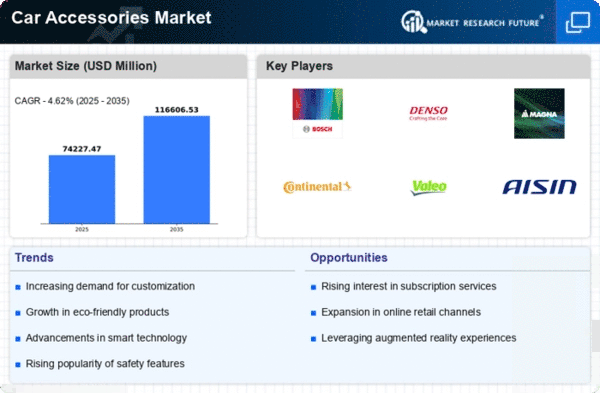
<p>Key players in the Car Accessories Market include Bosch, Denso, Magna International, Continental AG, Valeo, Aisin Seiki, Hella, Pioneer Corporation, and JVC Kenwood Corporation.</p>

How do passenger vehicles compare to commercial vehicles in terms of market valuation?

In 2024, passenger vehicles had a market valuation of 35500.0 USD Million, whereas commercial vehicles were valued at 15000.0 USD Million.

What is the projected valuation for electric vehicles in the Car Accessories Market by 2035?

The projected valuation for electric vehicles in the Car Accessories Market is expected to reach 15000.0 USD Million by 2035.

Which material type is anticipated to have the highest market valuation in the Car Accessories Market?

Plastic is anticipated to have the highest market valuation, projected to reach 32000.0 USD Million by 2035.

What distribution channel is expected to grow significantly in the Car Accessories Market?

The online retail distribution channel is expected to grow significantly, with a projected valuation of 23000.0 USD Million by 2035.

How does the market valuation of luxury vehicles compare to sports vehicles in 2024?

In 2024, luxury vehicles had a market valuation of 10000.0 USD Million, while sports vehicles were valued at 4000.0 USD Million.

Market Summary

As per MRFR analysis, the Car Accessories Market Size was estimated at 70949.6 USD Million in 2024. The Car Accessories industry is projected to grow from 74227.64 in 2025 to 116606.53 by 2035, exhibiting a compound annual growth rate (CAGR) of 4.62% during the forecast period 2025 - 2035.

Key Market Trends & Highlights

The Car Accessories Market is experiencing a dynamic shift towards smart technology and sustainability.

  • The integration of smart technology is reshaping consumer expectations in the North American market. Safety features are becoming increasingly prioritized among consumers in both North America and Asia-Pacific. Sustainability in product development is gaining traction, particularly in the performance accessories segment. Rising vehicle ownership and evolving consumer preferences are driving growth in the passenger vehicle segment.

Market Size & Forecast

2024 Market Size 70949.6 (USD Million)
2035 Market Size 116606.53 (USD Million)
CAGR (2025 - 2035) 4.62%
Largest Regional Market Share in 2024 North America

Major Players

Bosch (DE), Denso (JP), Magna International (CA), Continental (DE), Valeo (FR), Aisin Seiki (JP), Hella (DE), Lear Corporation (US), Pioneer Corporation (JP)

Market Trends

The Car Accessories Market is currently experiencing a dynamic evolution, driven by various factors including technological advancements and changing consumer preferences. As vehicles become increasingly integrated with smart technology, there is a growing demand for accessories that enhance connectivity and convenience.

This trend is evident in the rising popularity of smartphone mounts, advanced audio systems, and in-car navigation tools. Furthermore, the emphasis on safety has led to a surge in demand for accessories such as dash cams and parking sensors, which provide drivers with additional security and peace of mind. In addition to technological innovations, the Car Accessories Market is also influenced by a shift towards sustainability.

Consumers are becoming more environmentally conscious, prompting manufacturers to develop eco-friendly products. This includes accessories made from recycled materials and those that promote fuel efficiency. As the market continues to evolve, it appears that the integration of technology and sustainability will play a crucial role in shaping future trends, potentially leading to a more diverse and innovative range of products available to consumers.

Integration of Smart Technology

The Car Accessories Market is witnessing a notable trend towards the incorporation of smart technology. Consumers increasingly seek accessories that enhance their driving experience through connectivity features. This includes devices that integrate with smartphones, enabling hands-free communication and navigation, as well as advanced audio systems that offer superior sound quality and streaming capabilities.

Focus on Safety Features

There is a growing emphasis on safety within the Car Accessories Market, as consumers prioritize products that enhance vehicle security. Accessories such as dash cams, parking sensors, and blind-spot monitors are gaining traction. These products not only provide added protection but also contribute to a more confident driving experience.

Sustainability in Product Development

The Car Accessories Market is gradually shifting towards sustainability, with manufacturers responding to consumer demand for eco-friendly products. This trend encompasses the use of recycled materials in accessory production and the development of items that promote energy efficiency. As environmental awareness increases, this focus on sustainability is likely to shape future offerings in the market.

Car Accessories Market Market Drivers

Rising Vehicle Ownership

The Car Accessories Industry experiences a notable surge in demand due to the increasing vehicle ownership worldwide. As more individuals acquire personal vehicles, the necessity for various accessories, such as floor mats, seat covers, and infotainment systems, escalates. In 2024, the market is projected to reach 71.0 USD Billion, reflecting the growing consumer inclination towards enhancing vehicle aesthetics and functionality. This trend is particularly pronounced in emerging economies, where rising disposable incomes and urbanization contribute to higher vehicle sales. Consequently, the auto accessories landscape is poised for substantial growth as consumers seek to personalize and protect their investments.

Market Growth Projections

The Car Accessories Sector is projected to experience substantial growth in the coming years. With an estimated market value of 71.0 USD Billion in 2024, it is anticipated to reach 126.1 USD Billion by 2035. This growth trajectory suggests a compound annual growth rate (CAGR) of 5.36% from 2025 to 2035. Such projections indicate a robust demand for car accessories driven by various factors, including rising vehicle ownership, technological advancements, and increasing consumer awareness regarding vehicle customization and maintenance. The market's expansion reflects the evolving needs and preferences of consumers, positioning the automotive accessories space for continued success.

Technological Advancements

Technological innovations play a pivotal role in shaping the Car Accessories Sector . The integration of smart technologies, such as advanced driver-assistance systems, GPS navigation, and smartphone connectivity, enhances the functionality and appeal of car accessories. For instance, the introduction of wireless charging pads and adaptive lighting systems caters to the tech-savvy consumer base. As these technologies evolve, they not only improve user experience but also drive sales in the accessories segment. The anticipated growth of the market, projected to reach 126.1 USD Billion by 2035, underscores the importance of innovation in meeting consumer demands and preferences within the Vehicle Accessories Segment.

Growing Focus on Vehicle Customization

The trend towards vehicle customization significantly influences the Car Accessories Industry. Consumers increasingly seek to personalize their vehicles to reflect individual styles and preferences. This demand encompasses a wide range of accessories, including custom decals, upgraded audio systems, and performance-enhancing components. The market's growth trajectory, with a projected CAGR of 5.36% from 2025 to 2035, indicates a robust interest in tailored automotive solutions. As manufacturers respond to this trend by offering diverse customization options, the Customization-focused accessories sector is likely to witness sustained expansion, driven by consumer desire for unique and personalized driving experiences.

Environmental Concerns and Sustainability

The growing emphasis on environmental sustainability is reshaping the Car Accessories Industry. Consumers are increasingly inclined towards eco-friendly accessories, such as biodegradable seat covers and energy-efficient lighting solutions. This shift reflects a broader societal trend towards sustainability, prompting manufacturers to innovate and offer greener alternatives. As regulations regarding emissions and waste management become more stringent, the demand for sustainable car accessories is likely to rise. The Automotive Accessories Market stands to benefit from this trend, as consumers seek products that align with their environmental values while enhancing their driving experience.

Increased Awareness of Vehicle Maintenance

Heightened awareness regarding vehicle maintenance and safety is a significant driver for the Car Accessories Sector. Consumers are increasingly investing in accessories that promote vehicle longevity and enhance safety features. Products such as dash cams, tire pressure monitoring systems, and high-quality cleaning supplies are gaining traction as drivers prioritize the upkeep of their vehicles. This trend is further supported by government initiatives promoting road safety and vehicle maintenance education. As a result, the market is expected to flourish, with the Vehicle-care accessories domain benefiting from consumers' proactive approach to maintaining their vehicles and ensuring safety on the roads.

Market Segment Insights

By Application: Interior Accessories (Largest) vs. Technology Accessories (Fastest-Growing)

<p>The Car Accessories Market is broad, with Interior Accessories holding the largest market share. This category encompasses items such as seat covers, floor mats, and steering wheel covers, appealing to consumers seeking enhanced comfort and style in their vehicles. In contrast, the Technology Accessories segment has emerged as a rapidly growing sector, driven by the increasing demand for advanced infotainment systems and driving aids, capturing the attention of tech-savvy consumers.</p>

<p>Interior Accessories: Comfort (Dominant) vs. Technology Accessories: Innovation (Emerging)</p>

<p>Interior Accessories stand out as the dominant category in the Car Accessories Market, focusing on consumer comfort and personalization. Items like seat covers and custom floor mats resonate with buyers wanting to enhance their vehicle's appeal. Meanwhile, Technology Accessories are emerging as a significant force, characterized by cutting-edge innovations like smart dash cams and vehicle diagnostic tools. As technology advances, the integration of features such as connectivity and multifunctionality in these accessories is driving consumer preferences, positioning them as essential components in modern vehicles.</p>

By End Use: Passenger Vehicles (Largest) vs. Electric Vehicles (Fastest-Growing)

In the Car Accessories Market, the segment distribution indicates that Passenger Vehicles hold the largest share, driven by the sheer volume of sales in this category. This segment's dominance is attributed to the high demand for various accessories aimed at enhancing comfort, safety, and functionality. On the other hand, Electric Vehicles are rapidly gaining traction due to the increasing consumer shift toward sustainable mobility solutions, which is reshaping the market landscape.

Passenger Vehicles (Dominant) vs. Electric Vehicles (Emerging)

Passenger Vehicles represent the dominant segment in the Car Accessories Market, characterized by a wide array of accessories tailored to enhance driving comfort and safety features. This category includes infotainment systems, floor mats, seat covers, and more, which are in constant demand due to the growth in personal vehicle ownership. Conversely, Electric Vehicles are an emerging segment showing significant growth potential, driven by advancements in technology and eco-friendly initiatives. As more consumers lean toward electric options, the accessories specifically suited for these vehicles, such as <a href="https://www.marketresearchfuture.com/reports/electric-vehicle-ev-charging-cables-market-24542">charging cables</a> and eco-friendly materials, are gaining popularity, signifying a shift in consumer preferences and market trends.

By Material Type: Plastic (Largest) vs. Metal (Fastest-Growing)

In the Car Accessories Market, the material type distribution showcases a significant prevalence of plastic, accounting for a substantial portion of the market share. The lightweight nature, durability, and cost-effectiveness of plastic make it a preferred choice among manufacturers, leading to its dominance. On the other hand, metal has emerged as a notable contender, especially in high-end accessories, where strength and aesthetic appeal are critical. Its share is steadily growing as consumers seek premium materials for durability and design.

Plastic (Dominant) vs. Metal (Emerging)

Plastic materials play a vital role in the Car Accessories Market due to their versatility and affordability, making them a dominant choice for a broad range of products, from dashboard components to storage solutions. Their resistance to weathering and ease of molding into various shapes add to their appeal, catering to both practical and aesthetic needs. On the other hand, metal has started gaining traction as an emerging material, particularly in premium offerings like custom parts and decorative trims. With growing consumer interest in sustainability, manufacturers are increasingly exploring the use of recycled metals, integrating strong design elements that highlight craftsmanship and durability.

By Distribution Channel: E-commerce (Largest) vs. Online Retail (Fastest-Growing)

<p>In the Car Accessories Market, the distribution of sales among various channels shows a clear preference for E-commerce, representing the largest proportion of market share. This segment leverages the growing trend of online shopping, providing consumers with a wide range of products at their fingertips. Meanwhile, Online Retail also holds a significant share, appealing particularly to tech-savvy consumers who prefer the convenience of shopping from home. The growth trends in the Car Accessories Market are driven by the increasing penetration of the internet and the rise in smartphone usage among consumers. As brands enhance their online presence and optimize their e-commerce platforms for user experience, Online Retail is expected to experience rapid growth, becoming the fastest-growing segment. Factors such as aggressive digital marketing strategies, advanced logistics, and greater product availability are propelling this segment forward, reflecting changing consumer preferences and shopping behaviors.</p>

<p>E-commerce: Dominant vs. Online Retail: Emerging</p>

<p>E-commerce is the dominant force in the distribution of car accessories, characterized by its extensive reach and availability of a wide variety of products. This channel offers the convenience of 24/7 shopping, tailored experiences, and often competitive pricing due to lower overhead costs. In contrast, Online Retail is emerging rapidly, capitalizing on the shifting consumer behavior towards online shopping. This segment presents a unique opportunity for growth, particularly among niche markets and specialized products. Online Retailers often focus on personalized customer experiences, innovative marketing strategies, and quick delivery options, making them more appealing to the modern consumer.</p>

Get more detailed insights about Car Accessories Market Research Report—Global Forecast till 2035

Regional Insights

North America : Market Leader in Car Accessories

North America is poised to maintain its leadership in the car accessories market, holding a significant share of 35500.0. The region's growth is driven by increasing vehicle ownership, rising disposable incomes, and a growing trend towards vehicle customization. Regulatory support for automotive innovation further fuels demand, making it a vibrant market for car accessories. The competitive landscape is characterized by key players such as Bosch, Denso, and Magna International, which are investing heavily in R&D to enhance product offerings. The U.S. stands out as the largest market, with Canada also contributing significantly. The presence of established brands ensures a robust supply chain and innovation pipeline, solidifying North America's position as a market leader.

Europe : Innovation and Sustainability Focus

Europe's car accessories market, valued at 22000.0, is experiencing growth driven by a strong emphasis on sustainability and innovation. Regulatory frameworks promoting eco-friendly products are catalyzing demand for accessories that enhance vehicle efficiency and reduce emissions. The shift towards electric vehicles (EVs) is also influencing consumer preferences, leading to a rise in demand for specialized accessories. Leading countries like Germany, France, and the UK are at the forefront of this transformation, with major players such as Valeo and Continental leading the charge. The competitive landscape is marked by a focus on high-quality, sustainable products, ensuring that Europe remains a key player in The Car Accessories. The region's commitment to innovation is evident in its investment in R&D and partnerships with tech firms.

Asia-Pacific : Emerging Market with High Potential

The Asia-Pacific region, with a market size of 11000.0, is emerging as a significant player in the car accessories market. The growth is fueled by increasing urbanization, rising disposable incomes, and a burgeoning middle class that is investing in vehicle enhancements. Additionally, government initiatives promoting automotive safety and technology adoption are acting as catalysts for market expansion. Countries like China, Japan, and India are leading the charge, with a competitive landscape featuring key players such as Denso and Aisin Seiki. The region is witnessing a surge in demand for both traditional and innovative accessories, reflecting changing consumer preferences. As the automotive sector continues to evolve, Asia-Pacific is set to become a crucial market for car accessories.

Middle East and Africa : Untapped Market Opportunities

The Middle East and Africa region, valued at 4499.6, presents untapped opportunities in the car accessories market. The growth is driven by increasing vehicle ownership and a rising interest in automotive customization among consumers. Additionally, government investments in infrastructure and transportation are expected to boost market demand, creating a favorable environment for accessory sales. Leading countries in this region include South Africa and the UAE, where a growing automotive sector is attracting international players. The competitive landscape is evolving, with both local and The Car Accessories share. As the region continues to develop, the car accessories market is expected to expand significantly, driven by changing consumer behaviors and preferences.

Key Players and Competitive Insights

The Car Accessories Market is currently characterized by a dynamic competitive landscape, driven by technological advancements, consumer preferences for enhanced vehicle functionality, and a growing emphasis on sustainability. Major players such as Bosch (DE), Denso (JP), and Valeo (FR) are strategically positioned to leverage innovation and partnerships to maintain their competitive edge. Bosch (DE) focuses on integrating smart technologies into its product offerings, while Denso (JP) emphasizes its commitment to electrification and hybrid technologies. Valeo (FR) is actively pursuing sustainability initiatives, which collectively shape a competitive environment that prioritizes technological innovation and environmental responsibility. Key business tactics within the market include localizing manufacturing to reduce costs and optimize supply chains, which is particularly relevant in a moderately fragmented market structure. The collective influence of key players fosters a competitive atmosphere where collaboration and strategic partnerships are essential for growth. This fragmentation allows for niche players to emerge, yet the dominance of established companies ensures that innovation remains at the forefront of market activities. In November 2025, Bosch (DE) announced a partnership with a leading software company to develop advanced driver-assistance systems (ADAS) that utilize AI for enhanced safety features. This strategic move underscores Bosch's commitment to innovation and positions it to capitalize on the growing demand for smart vehicle technologies. The integration of AI into ADAS not only enhances vehicle safety but also aligns with consumer expectations for smarter, more connected vehicles. In October 2025, Denso (JP) unveiled a new line of eco-friendly car accessories designed to reduce carbon emissions. This initiative reflects Denso's strategic focus on sustainability and its response to increasing regulatory pressures and consumer demand for environmentally friendly products. By prioritizing eco-friendly solutions, Denso is likely to strengthen its market position and appeal to a broader customer base. In September 2025, Valeo (FR) launched a new range of energy-efficient lighting systems that utilize LED technology. This product line not only enhances vehicle aesthetics but also contributes to energy savings, aligning with global trends towards sustainability. Valeo's focus on energy efficiency may provide a competitive advantage as consumers increasingly seek products that reduce their environmental footprint. As of December 2025, the Car Accessories Market is witnessing trends such as digitalization, sustainability, and AI integration, which are reshaping competitive dynamics. Strategic alliances are becoming increasingly important, as companies recognize the need to collaborate to enhance technological capabilities and market reach. The shift from price-based competition to a focus on innovation, technology, and supply chain reliability is evident, suggesting that future competitive differentiation will hinge on the ability to deliver cutting-edge solutions that meet evolving consumer demands.

Key Companies in the Car Accessories Market include

Industry Developments

Q4 2025: Global automakers are rushing to secure semiconductor supplies as new export restrictions tighten chip availability, prompting OEMs to adopt long-term supply contracts, diversify vendors, and stabilize production schedules. Industry analysts note that several manufacturers have already begun reallocating capacity and reworking supply-chain commitments to avoid disruptions entering 2026.

Q4 2025: Uno Minda has launched its new direct-to-consumer platform “UnoMindaKart,” offering customers easier access to automotive components, accessories, and digital support services. The platform aims to streamline product availability, improve transparency, and strengthen the company’s retail connect.

In April 2024, Antolin and VIA optronics AG which is one of the leading suppliers of interactive display solutions, launched their Sunrise vehicle cockpit concept at an event in Nuremberg around the European exhibition “Embedded World”.

In July 2024, Panasonic Connect Co., Ltd. announced that it has reached an agreement on a strategic capital partnership with ORIX Corporation in regards to the company’s projector business and related operations. The two companies plan to establish a new company to operate the business aiming for continued growth.

Future Outlook

Car Accessories Market Future Outlook

The Car Accessories Market is projected to grow at a 4.62% CAGR from 2025 to 2035, driven by technological advancements, increasing vehicle ownership, and consumer demand for customization.

New opportunities lie in:

  • <p>Expansion of smart accessory integration for enhanced vehicle connectivity. Development of eco-friendly car accessories to meet sustainability trends. Launch of subscription-based accessory services for recurring revenue streams.</p>

By 2035, the Car Accessories Market is expected to be robust, reflecting strong growth and innovation.

Market Segmentation

Car Accessories Market End Use Outlook

  • Passenger Vehicles
  • Commercial Vehicles
  • Electric Vehicles
  • Luxury Vehicles
  • Sports Vehicles

Car Accessories Market Application Outlook

  • Interior Accessories
  • Exterior Accessories
  • Safety Accessories
  • Performance Accessories
  • Technology Accessories

Car Accessories Market Material Type Outlook

  • Plastic
  • Metal
  • Fabric
  • Rubber
  • Glass

Car Accessories Market Distribution Channel Outlook

  • Online Retail
  • Offline Retail
  • Direct Sales
  • Wholesale
  • E-commerce

Report Scope

MARKET SIZE 2024 70949.6(USD Million)
MARKET SIZE 2025 74227.64(USD Million)
MARKET SIZE 2035 116606.53(USD Million)
COMPOUND ANNUAL GROWTH RATE (CAGR) 4.62% (2025 - 2035)
REPORT COVERAGE Revenue Forecast, Competitive Landscape, Growth Factors, and Trends
BASE YEAR 2024
Market Forecast Period 2025 - 2035
Historical Data 2019 - 2024
Market Forecast Units USD Million
Key Companies Profiled Bosch (DE), Denso (JP), Magna International (CA), Continental (DE), Valeo (FR), Aisin Seiki (JP), Hella (DE), Lear Corporation (US), Pioneer Corporation (JP)
Segments Covered Application, End Use, Material Type, Distribution Channel
Key Market Opportunities Integration of smart technology in Car Accessories Market enhances user experience and safety features.
Key Market Dynamics Rising consumer demand for smart car accessories drives innovation and competition among manufacturers.
Countries Covered North America, Europe, APAC, South America, MEA

FAQs

What is the projected market valuation of the Car Accessories Market by 2035?

<p>The Car Accessories Market is projected to reach a valuation of 116606.53 USD Million by 2035.</p>

What was the overall market valuation of the Car Accessories Market in 2024?

<p>In 2024, the overall market valuation of the Car Accessories Market was 70949.6 USD Million.</p>

What is the expected CAGR for the Car Accessories Market during the forecast period 2025 - 2035?

<p>The expected CAGR for the Car Accessories Market during the forecast period 2025 - 2035 is 4.62%.</p>

Which segment had the highest valuation in the Car Accessories Market in 2024?

<p>In 2024, the segments of Interior Accessories, Exterior Accessories, Safety Accessories, Performance Accessories, and Technology Accessories each had a valuation of 14100.0 USD Million.</p>

What are the key players in the Car Accessories Market?

<p>Key players in the Car Accessories Market include Bosch, Denso, Magna International, Continental AG, Valeo, Aisin Seiki, Hella, Pioneer Corporation, and JVC Kenwood Corporation.</p>

How do passenger vehicles compare to commercial vehicles in terms of market valuation?

In 2024, passenger vehicles had a market valuation of 35500.0 USD Million, whereas commercial vehicles were valued at 15000.0 USD Million.

What is the projected valuation for electric vehicles in the Car Accessories Market by 2035?

The projected valuation for electric vehicles in the Car Accessories Market is expected to reach 15000.0 USD Million by 2035.

Which material type is anticipated to have the highest market valuation in the Car Accessories Market?

Plastic is anticipated to have the highest market valuation, projected to reach 32000.0 USD Million by 2035.

What distribution channel is expected to grow significantly in the Car Accessories Market?

The online retail distribution channel is expected to grow significantly, with a projected valuation of 23000.0 USD Million by 2035.

How does the market valuation of luxury vehicles compare to sports vehicles in 2024?

In 2024, luxury vehicles had a market valuation of 10000.0 USD Million, while sports vehicles were valued at 4000.0 USD Million.

  1. SECTION I: EXECUTIVE SUMMARY AND KEY HIGHLIGHTS
    1. | 1.1 EXECUTIVE SUMMARY
    2. | | 1.1.1 Market Overview
    3. | | 1.1.2 Key Findings
    4. | | 1.1.3 Market Segmentation
    5. | | 1.1.4 Competitive Landscape
    6. | | 1.1.5 Challenges and Opportunities
    7. | | 1.1.6 Future Outlook
  2. SECTION II: SCOPING, METHODOLOGY AND MARKET STRUCTURE
    1. | 2.1 MARKET INTRODUCTION
    2. | | 2.1.1 Definition
    3. | | 2.1.2 Scope of the study
    4. | | | 2.1.2.1 Research Objective
    5. | | | 2.1.2.2 Assumption
    6. | | | 2.1.2.3 Limitations
    7. | 2.2 RESEARCH METHODOLOGY
    8. | | 2.2.1 Overview
    9. | | 2.2.2 Data Mining
    10. | | 2.2.3 Secondary Research
    11. | | 2.2.4 Primary Research
    12. | | | 2.2.4.1 Primary Interviews and Information Gathering Process
    13. | | | 2.2.4.2 Breakdown of Primary Respondents
    14. | | 2.2.5 Forecasting Model
    15. | | 2.2.6 Market Size Estimation
    16. | | | 2.2.6.1 Bottom-Up Approach
    17. | | | 2.2.6.2 Top-Down Approach
    18. | | 2.2.7 Data Triangulation
    19. | | 2.2.8 Validation
  3. SECTION III: QUALITATIVE ANALYSIS
    1. | 3.1 MARKET DYNAMICS
    2. | | 3.1.1 Overview
    3. | | 3.1.2 Drivers
    4. | | 3.1.3 Restraints
    5. | | 3.1.4 Opportunities
    6. | 3.2 MARKET FACTOR ANALYSIS
    7. | | 3.2.1 Value chain Analysis
    8. | | 3.2.2 Porter's Five Forces Analysis
    9. | | | 3.2.2.1 Bargaining Power of Suppliers
    10. | | | 3.2.2.2 Bargaining Power of Buyers
    11. | | | 3.2.2.3 Threat of New Entrants
    12. | | | 3.2.2.4 Threat of Substitutes
    13. | | | 3.2.2.5 Intensity of Rivalry
    14. | | 3.2.3 COVID-19 Impact Analysis
    15. | | | 3.2.3.1 Market Impact Analysis
    16. | | | 3.2.3.2 Regional Impact
    17. | | | 3.2.3.3 Opportunity and Threat Analysis
  4. SECTION IV: QUANTITATIVE ANALYSIS
    1. | 4.1 Automobile, BY Application (USD Million)
    2. | | 4.1.1 Interior Accessories
    3. | | 4.1.2 Exterior Accessories
    4. | | 4.1.3 Safety Accessories
    5. | | 4.1.4 Performance Accessories
    6. | | 4.1.5 Technology Accessories
    7. | 4.2 Automobile, BY End Use (USD Million)
    8. | | 4.2.1 Passenger Vehicles
    9. | | 4.2.2 Commercial Vehicles
    10. | | 4.2.3 Electric Vehicles
    11. | | 4.2.4 Luxury Vehicles
    12. | | 4.2.5 Sports Vehicles
    13. | 4.3 Automobile, BY Material Type (USD Million)
    14. | | 4.3.1 Plastic
    15. | | 4.3.2 Metal
    16. | | 4.3.3 Fabric
    17. | | 4.3.4 Rubber
    18. | | 4.3.5 Glass
    19. | 4.4 Automobile, BY Distribution Channel (USD Million)
    20. | | 4.4.1 Online Retail
    21. | | 4.4.2 Offline Retail
    22. | | 4.4.3 Direct Sales
    23. | | 4.4.4 Wholesale
    24. | | 4.4.5 E-commerce
    25. | 4.5 Automobile, BY Region (USD Million)
    26. | | 4.5.1 North America
    27. | | | 4.5.1.1 US
    28. | | | 4.5.1.2 Canada
    29. | | 4.5.2 Europe
    30. | | | 4.5.2.1 Germany
    31. | | | 4.5.2.2 UK
    32. | | | 4.5.2.3 France
    33. | | | 4.5.2.4 Russia
    34. | | | 4.5.2.5 Italy
    35. | | | 4.5.2.6 Spain
    36. | | | 4.5.2.7 Rest of Europe
    37. | | 4.5.3 APAC
    38. | | | 4.5.3.1 China
    39. | | | 4.5.3.2 India
    40. | | | 4.5.3.3 Japan
    41. | | | 4.5.3.4 South Korea
    42. | | | 4.5.3.5 Malaysia
    43. | | | 4.5.3.6 Thailand
    44. | | | 4.5.3.7 Indonesia
    45. | | | 4.5.3.8 Rest of APAC
    46. | | 4.5.4 South America
    47. | | | 4.5.4.1 Brazil
    48. | | | 4.5.4.2 Mexico
    49. | | | 4.5.4.3 Argentina
    50. | | | 4.5.4.4 Rest of South America
    51. | | 4.5.5 MEA
    52. | | | 4.5.5.1 GCC Countries
    53. | | | 4.5.5.2 South Africa
    54. | | | 4.5.5.3 Rest of MEA
  5. SECTION V: COMPETITIVE ANALYSIS
    1. | 5.1 Competitive Landscape
    2. | | 5.1.1 Overview
    3. | | 5.1.2 Competitive Analysis
    4. | | 5.1.3 Market share Analysis
    5. | | 5.1.4 Major Growth Strategy in the Automobile
    6. | | 5.1.5 Competitive Benchmarking
    7. | | 5.1.6 Leading Players in Terms of Number of Developments in the Automobile
    8. | | 5.1.7 Key developments and growth strategies
    9. | | | 5.1.7.1 New Product Launch/Service Deployment
    10. | | | 5.1.7.2 Merger & Acquisitions
    11. | | | 5.1.7.3 Joint Ventures
    12. | | 5.1.8 Major Players Financial Matrix
    13. | | | 5.1.8.1 Sales and Operating Income
    14. | | | 5.1.8.2 Major Players R&D Expenditure. 2023
    15. | 5.2 Company Profiles
    16. | | 5.2.1 Bosch (DE)
    17. | | | 5.2.1.1 Financial Overview
    18. | | | 5.2.1.2 Products Offered
    19. | | | 5.2.1.3 Key Developments
    20. | | | 5.2.1.4 SWOT Analysis
    21. | | | 5.2.1.5 Key Strategies
    22. | | 5.2.2 Denso (JP)
    23. | | | 5.2.2.1 Financial Overview
    24. | | | 5.2.2.2 Products Offered
    25. | | | 5.2.2.3 Key Developments
    26. | | | 5.2.2.4 SWOT Analysis
    27. | | | 5.2.2.5 Key Strategies
    28. | | 5.2.3 Magna International (CA)
    29. | | | 5.2.3.1 Financial Overview
    30. | | | 5.2.3.2 Products Offered
    31. | | | 5.2.3.3 Key Developments
    32. | | | 5.2.3.4 SWOT Analysis
    33. | | | 5.2.3.5 Key Strategies
    34. | | 5.2.4 Continental AG (DE)
    35. | | | 5.2.4.1 Financial Overview
    36. | | | 5.2.4.2 Products Offered
    37. | | | 5.2.4.3 Key Developments
    38. | | | 5.2.4.4 SWOT Analysis
    39. | | | 5.2.4.5 Key Strategies
    40. | | 5.2.5 Valeo (FR)
    41. | | | 5.2.5.1 Financial Overview
    42. | | | 5.2.5.2 Products Offered
    43. | | | 5.2.5.3 Key Developments
    44. | | | 5.2.5.4 SWOT Analysis
    45. | | | 5.2.5.5 Key Strategies
    46. | | 5.2.6 Aisin Seiki (JP)
    47. | | | 5.2.6.1 Financial Overview
    48. | | | 5.2.6.2 Products Offered
    49. | | | 5.2.6.3 Key Developments
    50. | | | 5.2.6.4 SWOT Analysis
    51. | | | 5.2.6.5 Key Strategies
    52. | | 5.2.7 Hella (DE)
    53. | | | 5.2.7.1 Financial Overview
    54. | | | 5.2.7.2 Products Offered
    55. | | | 5.2.7.3 Key Developments
    56. | | | 5.2.7.4 SWOT Analysis
    57. | | | 5.2.7.5 Key Strategies
    58. | | 5.2.8 Pioneer Corporation (JP)
    59. | | | 5.2.8.1 Financial Overview
    60. | | | 5.2.8.2 Products Offered
    61. | | | 5.2.8.3 Key Developments
    62. | | | 5.2.8.4 SWOT Analysis
    63. | | | 5.2.8.5 Key Strategies
    64. | | 5.2.9 JVC Kenwood Corporation (JP)
    65. | | | 5.2.9.1 Financial Overview
    66. | | | 5.2.9.2 Products Offered
    67. | | | 5.2.9.3 Key Developments
    68. | | | 5.2.9.4 SWOT Analysis
    69. | | | 5.2.9.5 Key Strategies
    70. | 5.3 Appendix
    71. | | 5.3.1 References
    72. | | 5.3.2 Related Reports
  6. LIST OF FIGURES
    1. | 6.1 MARKET SYNOPSIS
    2. | 6.2 NORTH AMERICA MARKET ANALYSIS
    3. | 6.3 US MARKET ANALYSIS BY APPLICATION
    4. | 6.4 US MARKET ANALYSIS BY END USE
    5. | 6.5 US MARKET ANALYSIS BY MATERIAL TYPE
    6. | 6.6 US MARKET ANALYSIS BY DISTRIBUTION CHANNEL
    7. | 6.7 CANADA MARKET ANALYSIS BY APPLICATION
    8. | 6.8 CANADA MARKET ANALYSIS BY END USE
    9. | 6.9 CANADA MARKET ANALYSIS BY MATERIAL TYPE
    10. | 6.10 CANADA MARKET ANALYSIS BY DISTRIBUTION CHANNEL
    11. | 6.11 EUROPE MARKET ANALYSIS
    12. | 6.12 GERMANY MARKET ANALYSIS BY APPLICATION
    13. | 6.13 GERMANY MARKET ANALYSIS BY END USE
    14. | 6.14 GERMANY MARKET ANALYSIS BY MATERIAL TYPE
    15. | 6.15 GERMANY MARKET ANALYSIS BY DISTRIBUTION CHANNEL
    16. | 6.16 UK MARKET ANALYSIS BY APPLICATION
    17. | 6.17 UK MARKET ANALYSIS BY END USE
    18. | 6.18 UK MARKET ANALYSIS BY MATERIAL TYPE
    19. | 6.19 UK MARKET ANALYSIS BY DISTRIBUTION CHANNEL
    20. | 6.20 FRANCE MARKET ANALYSIS BY APPLICATION
    21. | 6.21 FRANCE MARKET ANALYSIS BY END USE
    22. | 6.22 FRANCE MARKET ANALYSIS BY MATERIAL TYPE
    23. | 6.23 FRANCE MARKET ANALYSIS BY DISTRIBUTION CHANNEL
    24. | 6.24 RUSSIA MARKET ANALYSIS BY APPLICATION
    25. | 6.25 RUSSIA MARKET ANALYSIS BY END USE
    26. | 6.26 RUSSIA MARKET ANALYSIS BY MATERIAL TYPE
    27. | 6.27 RUSSIA MARKET ANALYSIS BY DISTRIBUTION CHANNEL
    28. | 6.28 ITALY MARKET ANALYSIS BY APPLICATION
    29. | 6.29 ITALY MARKET ANALYSIS BY END USE
    30. | 6.30 ITALY MARKET ANALYSIS BY MATERIAL TYPE
    31. | 6.31 ITALY MARKET ANALYSIS BY DISTRIBUTION CHANNEL
    32. | 6.32 SPAIN MARKET ANALYSIS BY APPLICATION
    33. | 6.33 SPAIN MARKET ANALYSIS BY END USE
    34. | 6.34 SPAIN MARKET ANALYSIS BY MATERIAL TYPE
    35. | 6.35 SPAIN MARKET ANALYSIS BY DISTRIBUTION CHANNEL
    36. | 6.36 REST OF EUROPE MARKET ANALYSIS BY APPLICATION
    37. | 6.37 REST OF EUROPE MARKET ANALYSIS BY END USE
    38. | 6.38 REST OF EUROPE MARKET ANALYSIS BY MATERIAL TYPE
    39. | 6.39 REST OF EUROPE MARKET ANALYSIS BY DISTRIBUTION CHANNEL
    40. | 6.40 APAC MARKET ANALYSIS
    41. | 6.41 CHINA MARKET ANALYSIS BY APPLICATION
    42. | 6.42 CHINA MARKET ANALYSIS BY END USE
    43. | 6.43 CHINA MARKET ANALYSIS BY MATERIAL TYPE
    44. | 6.44 CHINA MARKET ANALYSIS BY DISTRIBUTION CHANNEL
    45. | 6.45 INDIA MARKET ANALYSIS BY APPLICATION
    46. | 6.46 INDIA MARKET ANALYSIS BY END USE
    47. | 6.47 INDIA MARKET ANALYSIS BY MATERIAL TYPE
    48. | 6.48 INDIA MARKET ANALYSIS BY DISTRIBUTION CHANNEL
    49. | 6.49 JAPAN MARKET ANALYSIS BY APPLICATION
    50. | 6.50 JAPAN MARKET ANALYSIS BY END USE
    51. | 6.51 JAPAN MARKET ANALYSIS BY MATERIAL TYPE
    52. | 6.52 JAPAN MARKET ANALYSIS BY DISTRIBUTION CHANNEL
    53. | 6.53 SOUTH KOREA MARKET ANALYSIS BY APPLICATION
    54. | 6.54 SOUTH KOREA MARKET ANALYSIS BY END USE
    55. | 6.55 SOUTH KOREA MARKET ANALYSIS BY MATERIAL TYPE
    56. | 6.56 SOUTH KOREA MARKET ANALYSIS BY DISTRIBUTION CHANNEL
    57. | 6.57 MALAYSIA MARKET ANALYSIS BY APPLICATION
    58. | 6.58 MALAYSIA MARKET ANALYSIS BY END USE
    59. | 6.59 MALAYSIA MARKET ANALYSIS BY MATERIAL TYPE
    60. | 6.60 MALAYSIA MARKET ANALYSIS BY DISTRIBUTION CHANNEL
    61. | 6.61 THAILAND MARKET ANALYSIS BY APPLICATION
    62. | 6.62 THAILAND MARKET ANALYSIS BY END USE
    63. | 6.63 THAILAND MARKET ANALYSIS BY MATERIAL TYPE
    64. | 6.64 THAILAND MARKET ANALYSIS BY DISTRIBUTION CHANNEL
    65. | 6.65 INDONESIA MARKET ANALYSIS BY APPLICATION
    66. | 6.66 INDONESIA MARKET ANALYSIS BY END USE
    67. | 6.67 INDONESIA MARKET ANALYSIS BY MATERIAL TYPE
    68. | 6.68 INDONESIA MARKET ANALYSIS BY DISTRIBUTION CHANNEL
    69. | 6.69 REST OF APAC MARKET ANALYSIS BY APPLICATION
    70. | 6.70 REST OF APAC MARKET ANALYSIS BY END USE
    71. | 6.71 REST OF APAC MARKET ANALYSIS BY MATERIAL TYPE
    72. | 6.72 REST OF APAC MARKET ANALYSIS BY DISTRIBUTION CHANNEL
    73. | 6.73 SOUTH AMERICA MARKET ANALYSIS
    74. | 6.74 BRAZIL MARKET ANALYSIS BY APPLICATION
    75. | 6.75 BRAZIL MARKET ANALYSIS BY END USE
    76. | 6.76 BRAZIL MARKET ANALYSIS BY MATERIAL TYPE
    77. | 6.77 BRAZIL MARKET ANALYSIS BY DISTRIBUTION CHANNEL
    78. | 6.78 MEXICO MARKET ANALYSIS BY APPLICATION
    79. | 6.79 MEXICO MARKET ANALYSIS BY END USE
    80. | 6.80 MEXICO MARKET ANALYSIS BY MATERIAL TYPE
    81. | 6.81 MEXICO MARKET ANALYSIS BY DISTRIBUTION CHANNEL
    82. | 6.82 ARGENTINA MARKET ANALYSIS BY APPLICATION
    83. | 6.83 ARGENTINA MARKET ANALYSIS BY END USE
    84. | 6.84 ARGENTINA MARKET ANALYSIS BY MATERIAL TYPE
    85. | 6.85 ARGENTINA MARKET ANALYSIS BY DISTRIBUTION CHANNEL
    86. | 6.86 REST OF SOUTH AMERICA MARKET ANALYSIS BY APPLICATION
    87. | 6.87 REST OF SOUTH AMERICA MARKET ANALYSIS BY END USE
    88. | 6.88 REST OF SOUTH AMERICA MARKET ANALYSIS BY MATERIAL TYPE
    89. | 6.89 REST OF SOUTH AMERICA MARKET ANALYSIS BY DISTRIBUTION CHANNEL
    90. | 6.90 MEA MARKET ANALYSIS
    91. | 6.91 GCC COUNTRIES MARKET ANALYSIS BY APPLICATION
    92. | 6.92 GCC COUNTRIES MARKET ANALYSIS BY END USE
    93. | 6.93 GCC COUNTRIES MARKET ANALYSIS BY MATERIAL TYPE
    94. | 6.94 GCC COUNTRIES MARKET ANALYSIS BY DISTRIBUTION CHANNEL
    95. | 6.95 SOUTH AFRICA MARKET ANALYSIS BY APPLICATION
    96. | 6.96 SOUTH AFRICA MARKET ANALYSIS BY END USE
    97. | 6.97 SOUTH AFRICA MARKET ANALYSIS BY MATERIAL TYPE
    98. | 6.98 SOUTH AFRICA MARKET ANALYSIS BY DISTRIBUTION CHANNEL
    99. | 6.99 REST OF MEA MARKET ANALYSIS BY APPLICATION
    100. | 6.100 REST OF MEA MARKET ANALYSIS BY END USE
    101. | 6.101 REST OF MEA MARKET ANALYSIS BY MATERIAL TYPE
    102. | 6.102 REST OF MEA MARKET ANALYSIS BY DISTRIBUTION CHANNEL
    103. | 6.103 KEY BUYING CRITERIA OF AUTOMOBILE
    104. | 6.104 RESEARCH PROCESS OF MRFR
    105. | 6.105 DRO ANALYSIS OF AUTOMOBILE
    106. | 6.106 DRIVERS IMPACT ANALYSIS: AUTOMOBILE
    107. | 6.107 RESTRAINTS IMPACT ANALYSIS: AUTOMOBILE
    108. | 6.108 SUPPLY / VALUE CHAIN: AUTOMOBILE
    109. | 6.109 AUTOMOBILE, BY APPLICATION, 2024 (% SHARE)
    110. | 6.110 AUTOMOBILE, BY APPLICATION, 2024 TO 2035 (USD Million)
    111. | 6.111 AUTOMOBILE, BY END USE, 2024 (% SHARE)
    112. | 6.112 AUTOMOBILE, BY END USE, 2024 TO 2035 (USD Million)
    113. | 6.113 AUTOMOBILE, BY MATERIAL TYPE, 2024 (% SHARE)
    114. | 6.114 AUTOMOBILE, BY MATERIAL TYPE, 2024 TO 2035 (USD Million)
    115. | 6.115 AUTOMOBILE, BY DISTRIBUTION CHANNEL, 2024 (% SHARE)
    116. | 6.116 AUTOMOBILE, BY DISTRIBUTION CHANNEL, 2024 TO 2035 (USD Million)
    117. | 6.117 BENCHMARKING OF MAJOR COMPETITORS
  7. LIST OF TABLES
    1. | 7.1 LIST OF ASSUMPTIONS
    2. | | 7.1.1
    3. | 7.2 North America MARKET SIZE ESTIMATES; FORECAST
    4. | | 7.2.1 BY APPLICATION, 2025-2035 (USD Million)
    5. | | 7.2.2 BY END USE, 2025-2035 (USD Million)
    6. | | 7.2.3 BY MATERIAL TYPE, 2025-2035 (USD Million)
    7. | | 7.2.4 BY DISTRIBUTION CHANNEL, 2025-2035 (USD Million)
    8. | 7.3 US MARKET SIZE ESTIMATES; FORECAST
    9. | | 7.3.1 BY APPLICATION, 2025-2035 (USD Million)
    10. | | 7.3.2 BY END USE, 2025-2035 (USD Million)
    11. | | 7.3.3 BY MATERIAL TYPE, 2025-2035 (USD Million)
    12. | | 7.3.4 BY DISTRIBUTION CHANNEL, 2025-2035 (USD Million)
    13. | 7.4 Canada MARKET SIZE ESTIMATES; FORECAST
    14. | | 7.4.1 BY APPLICATION, 2025-2035 (USD Million)
    15. | | 7.4.2 BY END USE, 2025-2035 (USD Million)
    16. | | 7.4.3 BY MATERIAL TYPE, 2025-2035 (USD Million)
    17. | | 7.4.4 BY DISTRIBUTION CHANNEL, 2025-2035 (USD Million)
    18. | 7.5 Europe MARKET SIZE ESTIMATES; FORECAST
    19. | | 7.5.1 BY APPLICATION, 2025-2035 (USD Million)
    20. | | 7.5.2 BY END USE, 2025-2035 (USD Million)
    21. | | 7.5.3 BY MATERIAL TYPE, 2025-2035 (USD Million)
    22. | | 7.5.4 BY DISTRIBUTION CHANNEL, 2025-2035 (USD Million)
    23. | 7.6 Germany MARKET SIZE ESTIMATES; FORECAST
    24. | | 7.6.1 BY APPLICATION, 2025-2035 (USD Million)
    25. | | 7.6.2 BY END USE, 2025-2035 (USD Million)
    26. | | 7.6.3 BY MATERIAL TYPE, 2025-2035 (USD Million)
    27. | | 7.6.4 BY DISTRIBUTION CHANNEL, 2025-2035 (USD Million)
    28. | 7.7 UK MARKET SIZE ESTIMATES; FORECAST
    29. | | 7.7.1 BY APPLICATION, 2025-2035 (USD Million)
    30. | | 7.7.2 BY END USE, 2025-2035 (USD Million)
    31. | | 7.7.3 BY MATERIAL TYPE, 2025-2035 (USD Million)
    32. | | 7.7.4 BY DISTRIBUTION CHANNEL, 2025-2035 (USD Million)
    33. | 7.8 France MARKET SIZE ESTIMATES; FORECAST
    34. | | 7.8.1 BY APPLICATION, 2025-2035 (USD Million)
    35. | | 7.8.2 BY END USE, 2025-2035 (USD Million)
    36. | | 7.8.3 BY MATERIAL TYPE, 2025-2035 (USD Million)
    37. | | 7.8.4 BY DISTRIBUTION CHANNEL, 2025-2035 (USD Million)
    38. | 7.9 Russia MARKET SIZE ESTIMATES; FORECAST
    39. | | 7.9.1 BY APPLICATION, 2025-2035 (USD Million)
    40. | | 7.9.2 BY END USE, 2025-2035 (USD Million)
    41. | | 7.9.3 BY MATERIAL TYPE, 2025-2035 (USD Million)
    42. | | 7.9.4 BY DISTRIBUTION CHANNEL, 2025-2035 (USD Million)
    43. | 7.10 Italy MARKET SIZE ESTIMATES; FORECAST
    44. | | 7.10.1 BY APPLICATION, 2025-2035 (USD Million)
    45. | | 7.10.2 BY END USE, 2025-2035 (USD Million)
    46. | | 7.10.3 BY MATERIAL TYPE, 2025-2035 (USD Million)
    47. | | 7.10.4 BY DISTRIBUTION CHANNEL, 2025-2035 (USD Million)
    48. | 7.11 Spain MARKET SIZE ESTIMATES; FORECAST
    49. | | 7.11.1 BY APPLICATION, 2025-2035 (USD Million)
    50. | | 7.11.2 BY END USE, 2025-2035 (USD Million)
    51. | | 7.11.3 BY MATERIAL TYPE, 2025-2035 (USD Million)
    52. | | 7.11.4 BY DISTRIBUTION CHANNEL, 2025-2035 (USD Million)
    53. | 7.12 Rest of Europe MARKET SIZE ESTIMATES; FORECAST
    54. | | 7.12.1 BY APPLICATION, 2025-2035 (USD Million)
    55. | | 7.12.2 BY END USE, 2025-2035 (USD Million)
    56. | | 7.12.3 BY MATERIAL TYPE, 2025-2035 (USD Million)
    57. | | 7.12.4 BY DISTRIBUTION CHANNEL, 2025-2035 (USD Million)
    58. | 7.13 APAC MARKET SIZE ESTIMATES; FORECAST
    59. | | 7.13.1 BY APPLICATION, 2025-2035 (USD Million)
    60. | | 7.13.2 BY END USE, 2025-2035 (USD Million)
    61. | | 7.13.3 BY MATERIAL TYPE, 2025-2035 (USD Million)
    62. | | 7.13.4 BY DISTRIBUTION CHANNEL, 2025-2035 (USD Million)
    63. | 7.14 China MARKET SIZE ESTIMATES; FORECAST
    64. | | 7.14.1 BY APPLICATION, 2025-2035 (USD Million)
    65. | | 7.14.2 BY END USE, 2025-2035 (USD Million)
    66. | | 7.14.3 BY MATERIAL TYPE, 2025-2035 (USD Million)
    67. | | 7.14.4 BY DISTRIBUTION CHANNEL, 2025-2035 (USD Million)
    68. | 7.15 India MARKET SIZE ESTIMATES; FORECAST
    69. | | 7.15.1 BY APPLICATION, 2025-2035 (USD Million)
    70. | | 7.15.2 BY END USE, 2025-2035 (USD Million)
    71. | | 7.15.3 BY MATERIAL TYPE, 2025-2035 (USD Million)
    72. | | 7.15.4 BY DISTRIBUTION CHANNEL, 2025-2035 (USD Million)
    73. | 7.16 Japan MARKET SIZE ESTIMATES; FORECAST
    74. | | 7.16.1 BY APPLICATION, 2025-2035 (USD Million)
    75. | | 7.16.2 BY END USE, 2025-2035 (USD Million)
    76. | | 7.16.3 BY MATERIAL TYPE, 2025-2035 (USD Million)
    77. | | 7.16.4 BY DISTRIBUTION CHANNEL, 2025-2035 (USD Million)
    78. | 7.17 South Korea MARKET SIZE ESTIMATES; FORECAST
    79. | | 7.17.1 BY APPLICATION, 2025-2035 (USD Million)
    80. | | 7.17.2 BY END USE, 2025-2035 (USD Million)
    81. | | 7.17.3 BY MATERIAL TYPE, 2025-2035 (USD Million)
    82. | | 7.17.4 BY DISTRIBUTION CHANNEL, 2025-2035 (USD Million)
    83. | 7.18 Malaysia MARKET SIZE ESTIMATES; FORECAST
    84. | | 7.18.1 BY APPLICATION, 2025-2035 (USD Million)
    85. | | 7.18.2 BY END USE, 2025-2035 (USD Million)
    86. | | 7.18.3 BY MATERIAL TYPE, 2025-2035 (USD Million)
    87. | | 7.18.4 BY DISTRIBUTION CHANNEL, 2025-2035 (USD Million)
    88. | 7.19 Thailand MARKET SIZE ESTIMATES; FORECAST
    89. | | 7.19.1 BY APPLICATION, 2025-2035 (USD Million)
    90. | | 7.19.2 BY END USE, 2025-2035 (USD Million)
    91. | | 7.19.3 BY MATERIAL TYPE, 2025-2035 (USD Million)
    92. | | 7.19.4 BY DISTRIBUTION CHANNEL, 2025-2035 (USD Million)
    93. | 7.20 Indonesia MARKET SIZE ESTIMATES; FORECAST
    94. | | 7.20.1 BY APPLICATION, 2025-2035 (USD Million)
    95. | | 7.20.2 BY END USE, 2025-2035 (USD Million)
    96. | | 7.20.3 BY MATERIAL TYPE, 2025-2035 (USD Million)
    97. | | 7.20.4 BY DISTRIBUTION CHANNEL, 2025-2035 (USD Million)
    98. | 7.21 Rest of APAC MARKET SIZE ESTIMATES; FORECAST
    99. | | 7.21.1 BY APPLICATION, 2025-2035 (USD Million)
    100. | | 7.21.2 BY END USE, 2025-2035 (USD Million)
    101. | | 7.21.3 BY MATERIAL TYPE, 2025-2035 (USD Million)
    102. | | 7.21.4 BY DISTRIBUTION CHANNEL, 2025-2035 (USD Million)
    103. | 7.22 South America MARKET SIZE ESTIMATES; FORECAST
    104. | | 7.22.1 BY APPLICATION, 2025-2035 (USD Million)
    105. | | 7.22.2 BY END USE, 2025-2035 (USD Million)
    106. | | 7.22.3 BY MATERIAL TYPE, 2025-2035 (USD Million)
    107. | | 7.22.4 BY DISTRIBUTION CHANNEL, 2025-2035 (USD Million)
    108. | 7.23 Brazil MARKET SIZE ESTIMATES; FORECAST
    109. | | 7.23.1 BY APPLICATION, 2025-2035 (USD Million)
    110. | | 7.23.2 BY END USE, 2025-2035 (USD Million)
    111. | | 7.23.3 BY MATERIAL TYPE, 2025-2035 (USD Million)
    112. | | 7.23.4 BY DISTRIBUTION CHANNEL, 2025-2035 (USD Million)
    113. | 7.24 Mexico MARKET SIZE ESTIMATES; FORECAST
    114. | | 7.24.1 BY APPLICATION, 2025-2035 (USD Million)
    115. | | 7.24.2 BY END USE, 2025-2035 (USD Million)
    116. | | 7.24.3 BY MATERIAL TYPE, 2025-2035 (USD Million)
    117. | | 7.24.4 BY DISTRIBUTION CHANNEL, 2025-2035 (USD Million)
    118. | 7.25 Argentina MARKET SIZE ESTIMATES; FORECAST
    119. | | 7.25.1 BY APPLICATION, 2025-2035 (USD Million)
    120. | | 7.25.2 BY END USE, 2025-2035 (USD Million)
    121. | | 7.25.3 BY MATERIAL TYPE, 2025-2035 (USD Million)
    122. | | 7.25.4 BY DISTRIBUTION CHANNEL, 2025-2035 (USD Million)
    123. | 7.26 Rest of South America MARKET SIZE ESTIMATES; FORECAST
    124. | | 7.26.1 BY APPLICATION, 2025-2035 (USD Million)
    125. | | 7.26.2 BY END USE, 2025-2035 (USD Million)
    126. | | 7.26.3 BY MATERIAL TYPE, 2025-2035 (USD Million)
    127. | | 7.26.4 BY DISTRIBUTION CHANNEL, 2025-2035 (USD Million)
    128. | 7.27 MEA MARKET SIZE ESTIMATES; FORECAST
    129. | | 7.27.1 BY APPLICATION, 2025-2035 (USD Million)
    130. | | 7.27.2 BY END USE, 2025-2035 (USD Million)
    131. | | 7.27.3 BY MATERIAL TYPE, 2025-2035 (USD Million)
    132. | | 7.27.4 BY DISTRIBUTION CHANNEL, 2025-2035 (USD Million)
    133. | 7.28 GCC Countries MARKET SIZE ESTIMATES; FORECAST
    134. | | 7.28.1 BY APPLICATION, 2025-2035 (USD Million)
    135. | | 7.28.2 BY END USE, 2025-2035 (USD Million)
    136. | | 7.28.3 BY MATERIAL TYPE, 2025-2035 (USD Million)
    137. | | 7.28.4 BY DISTRIBUTION CHANNEL, 2025-2035 (USD Million)
    138. | 7.29 South Africa MARKET SIZE ESTIMATES; FORECAST
    139. | | 7.29.1 BY APPLICATION, 2025-2035 (USD Million)
    140. | | 7.29.2 BY END USE, 2025-2035 (USD Million)
    141. | | 7.29.3 BY MATERIAL TYPE, 2025-2035 (USD Million)
    142. | | 7.29.4 BY DISTRIBUTION CHANNEL, 2025-2035 (USD Million)
    143. | 7.30 Rest of MEA MARKET SIZE ESTIMATES; FORECAST
    144. | | 7.30.1 BY APPLICATION, 2025-2035 (USD Million)
    145. | | 7.30.2 BY END USE, 2025-2035 (USD Million)
    146. | | 7.30.3 BY MATERIAL TYPE, 2025-2035 (USD Million)
    147. | | 7.30.4 BY DISTRIBUTION CHANNEL, 2025-2035 (USD Million)
    148. | 7.31 PRODUCT LAUNCH/PRODUCT DEVELOPMENT/APPROVAL
    149. | | 7.31.1
    150. | 7.32 ACQUISITION/PARTNERSHIP
    151. | | 7.32.1

Automobile Market Segmentation

Automobile By Application (USD Million, 2025-2035)

  • Interior Accessories
  • Exterior Accessories
  • Safety Accessories
  • Performance Accessories
  • Technology Accessories

Automobile By End Use (USD Million, 2025-2035)

  • Passenger Vehicles
  • Commercial Vehicles
  • Electric Vehicles
  • Luxury Vehicles
  • Sports Vehicles

Automobile By Material Type (USD Million, 2025-2035)

  • Plastic
  • Metal
  • Fabric
  • Rubber
  • Glass

Automobile By Distribution Channel (USD Million, 2025-2035)

  • Online Retail
  • Offline Retail
  • Direct Sales
  • Wholesale
  • E-commerce
Infographic

Free Sample Request

Kindly complete the form below to receive a free sample of this Report

Get Free Sample

Customer Strories

Compare Licence

×
Features License Type
Single User Multiuser License Enterprise User
Price $4,950 $5,950 $7,250
Maximum User Access Limit 1 User Upto 10 Users Unrestricted Access Throughout the Organization
Free Customization
Direct Access to Analyst
Deliverable Format
Platform Access
Discount on Next Purchase 10% 15% 15%
Printable Versions
%>