
Request Free Sample ×

Kindly complete the form below to receive a free sample of this Report

* Please use a valid business email

Leading companies partner with us for data-driven Insights

clients tt-cursor
Hero Background
English
Chinese
French
Japanese
Korean
German
Spanish

Cannabis Plant Nutrients Market Trends

ID: MRFR/FnB/9479-CR
167 Pages
Snehal Singh
Last Updated: April 06, 2026

Cannabis Plant Nutrients Market Size, Share, Industry Trend & Analysis Research Report Information by Nutrients Type (Macronutrients and Micronutrients), Category (Conventional and Organic), Mode of Application (Drenching, Fertigation, and Foliar), And by Region (North America, Europe, Asia-Pacific, and Rest of the World) - Forecast Till 2030

Share:
Download PDF ×

We do not share your information with anyone. However, we may send you emails based on your report interest from time to time. You may contact us at any time to opt-out.

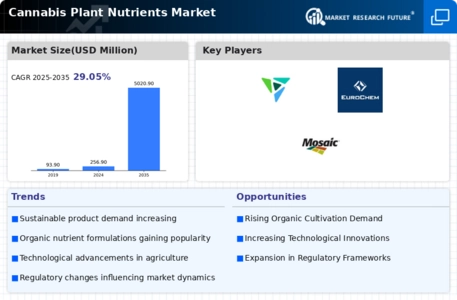
Cannabis Plant Nutrients Market Infographic
Purchase Options

Market Trends

Key Emerging Trends in the Cannabis Plant Nutrients Market

The increasing recognition of the manifold benefits associated with cannabis has led to its legalization in several countries. There is substantial evidence supporting the legitimate medical applications of cannabinoids, spanning indications such as alleviating nausea and vomiting linked to chemotherapy, managing spasticity in multiple sclerosis, addressing HIV/AIDS cachexia, and mitigating neuropathic pain. A pivotal moment in the United States unfolded on June 28, 2018, when the Agriculture Improvement Act of 2018, commonly referred to as the Farm Bill, was officially passed by the US Senate. This legislative milestone brought about a reclassification of hemp for commercial utilization and removed hemp-derived CBD from the controlled substance list. Significantly, it conferred regulatory authority for hemp production to both states and the federal government, marking a paradigm shift in the treatment of hemp-related activities.

In the wake of the 2018 Farm Bill, the Agricultural Marketing Service (AMS) was designated as the primary agency within the United States Department of Agriculture (USDA) to oversee the newly established USDA Hemp Production Program. This transformative legislation dictated that hemp, once considered an illicit substance under the purview of the Justice Department, would now be managed as a legitimate crop by the Department of Agriculture. This change reflected a broader acknowledgment of the economic and industrial potential of hemp, particularly in the form of CBD-derived products.

Further underscoring the momentum towards cannabis normalization, the Ohio Senate took a decisive step on March 28, 2019, by unanimously passing Senate Bill-57. This legislation empowered farmers in Ohio to cultivate industrial hemp under a three-year license granted by the Ohio Department of Agriculture. The bill also introduced licensing requirements for cannabis processors, mandated testing of hemp products, and addressed the incorporation of cannabis products into consumables like food, beverages, and cosmetics. This multifaceted approach not only facilitates hemp cultivation but also ensures a regulated and safe entry of cannabis derivatives into various consumer products.

In Europe, the production of cannabis is legal in several countries, albeit with certain constraints on usage. Notably, the Czech Republic legalized medical cannabis in 2013, albeit with a limitation of 180 grams of dry matter per month. The regulatory landscape for cannabis across Europe is diverse, with individual countries establishing specific rules and restrictions. According to EU law, CBD products are constrained to containing no more than 0.2% tetrahydrocannabinol (THC), highlighting the stringent regulatory framework within the European Union.

Considering the current global scenario, it is evident that the legalization of cannabis production and associated products in various countries is poised to catalyze the growth of the global cannabis plant nutrients market. The legislative strides made in different regions not only reflect evolving societal attitudes toward cannabis but also present significant opportunities for the industry stakeholders during the review period. The changing legal landscape, especially with the recognition of hemp as a legitimate crop, underscores the potential for substantial growth in the cannabis market, aligning with the increasing acceptance and understanding of its diverse applications.


Author
Author Profile
Snehal Singh
Manager - Research

High acumen in analyzing complex macro & micro markets with more than 6 years of work experience in the field of market research. By implementing her analytical skills in forecasting and estimation into market research reports, she has expertise in Packaging, Construction, and Equipment domains. She handles a team size of 20-25 resources and ensures smooth running of the projects, associated marketing activities, and client servicing.

Leave a Comment

FAQs

What is the current valuation of the Cannabis Plant Nutrients Market?

<p>The market valuation was 256.85 USD Million in 2024.</p>

What is the projected market size for the Cannabis Plant Nutrients Market by 2035?

<p>The market is projected to reach 4246.37 USD Million by 2035.</p>

What is the expected CAGR for the Cannabis Plant Nutrients Market during the forecast period?

<p>The expected CAGR for the market from 2025 to 2035 is 29.05%.</p>

Which companies are considered key players in the Cannabis Plant Nutrients Market?

<p>Key players include Scotts Miracle-Gro, Advanced Nutrients, and General Hydroponics, among others.</p>

What are the main types of nutrients in the Cannabis Plant Nutrients Market?

<p>The market segments include macronutrients and micronutrients, with valuations of 2130.0 and 2116.37 USD Million, respectively.</p>

How is the Cannabis Plant Nutrients Market categorized?

<p>The market is categorized into conventional and organic nutrients, with both segments valued at approximately 2130.0 and 2116.37 USD Million.</p>

What are the primary modes of application for cannabis nutrients?

<p>The main modes of application are drenching, fertigation, and foliar, with fertigation valued at 1740.0 USD Million.</p>

How does the market performance of organic nutrients compare to conventional nutrients?

<p>Organic nutrients appear to have a comparable market performance to conventional nutrients, with both segments showing similar valuations.</p>

What trends are influencing the growth of the Cannabis Plant Nutrients Market?

<p>The increasing legalization of cannabis and growing consumer awareness are likely driving market growth.</p>

What is the significance of the projected growth in the Cannabis Plant Nutrients Market?

<p>The substantial projected growth indicates a robust demand for cannabis cultivation and nutrient products in the coming years.</p>

Market Summary

As per Market Research Future analysis, the Cannabis Plant Nutrients Market Size was estimated at 256.85 USD Million in 2024. The Cannabis Plant Nutrients industry is projected to grow from 331.46 USD Million in 2025 to 4246.37 USD Million by 2035, exhibiting a compound annual growth rate (CAGR) of 29.05% during the forecast period 2025 - 2035

Key Market Trends & Highlights

The Cannabis Plant Nutrients Market is experiencing a dynamic evolution driven by sustainability and technological advancements.

  • There is a notable shift towards organic nutrients, particularly in North America, as consumers prioritize sustainability. Technological advancements in nutrient delivery systems are enhancing efficiency and effectiveness, especially in the Asia-Pacific region. Customization of nutrient solutions is becoming increasingly popular, catering to the specific needs of growers in diverse environments. The increasing legalization of cannabis and rising consumer awareness of quality are major drivers propelling market growth, particularly in the macronutrients and organic segments.

Market Size & Forecast

2024 Market Size 256.85 (USD Million)
2035 Market Size 4246.37 (USD Million)
CAGR (2025 - 2035) 29.05%
Largest Regional Market Share in 2024 Asia Pacific

Major Players

Scotts Miracle-Gro (US), Advanced Nutrients (CA), General Hydroponics (US), FoxFarm Soil &amp; Fertilizer Company (US), Canna (NL), Humboldt Nutrients (US), BioBizz (NL), Green Planet Nutrients (CA), Nutrifield (AU)

Market Trends

The Cannabis Plant Nutrients Market is currently experiencing a dynamic evolution, driven by increasing consumer awareness regarding the importance of optimal plant nutrition for enhancing yield and quality. As cultivation practices become more sophisticated, growers are increasingly seeking specialized nutrient solutions tailored to the unique needs of cannabis plants. This shift is indicative of a broader trend towards precision agriculture, where the focus is on maximizing efficiency and sustainability in cultivation. Furthermore, the rise of organic and eco-friendly products is influencing purchasing decisions, as consumers show a preference for environmentally responsible options. In addition, regulatory changes across various regions are shaping the landscape of the Cannabis Plant Nutrients Market. As legalization efforts gain momentum, more growers are entering the market, leading to heightened competition and innovation. This influx of new entrants is likely to drive the development of advanced nutrient formulations that cater to diverse growing environments and methodologies. Overall, the Cannabis Plant Nutrients Market appears poised for continued growth, with evolving consumer preferences and regulatory frameworks playing pivotal roles in its trajectory.

Shift Towards Organic Nutrients

There is a noticeable trend towards the adoption of organic nutrients within the Cannabis Plant Nutrients Market. Growers are increasingly prioritizing sustainable practices, leading to a demand for products that are free from synthetic chemicals. This shift not only aligns with consumer preferences for organic produce but also reflects a broader commitment to environmental stewardship.

Technological Advancements in Nutrient Delivery

Innovations in nutrient delivery systems are emerging as a key trend in the Cannabis Plant Nutrients Market. Advanced formulations and application methods, such as slow-release and water-soluble nutrients, are gaining traction. These technologies enhance nutrient absorption and reduce waste, thereby improving overall plant health and yield.

Customization of Nutrient Solutions

The trend towards customization is becoming prominent in the Cannabis Plant Nutrients Market. Growers are increasingly seeking tailored nutrient solutions that address specific growth stages and environmental conditions. This demand for personalized products is driving manufacturers to develop specialized formulations that cater to the diverse needs of cannabis cultivation.

Cannabis Plant Nutrients Market Market Drivers

Increasing Legalization of Cannabis

The ongoing trend of legalization across various regions appears to be a primary driver for the cannabis plant nutrients Market. As more countries and states embrace cannabis for both medicinal and recreational use, the demand for high-quality plant nutrients is likely to surge. This shift not only encourages new growers to enter the market but also compels existing cultivators to enhance their production quality. According to recent data, the number of legal cannabis markets has expanded significantly, with projections indicating a potential market size of over 70 billion dollars by 2028. This burgeoning market creates a fertile ground for nutrient suppliers, who must adapt their offerings to meet the diverse needs of a growing customer base.

Rising Consumer Awareness of Quality

Consumer awareness regarding the quality of cannabis products is on the rise, which significantly impacts the Cannabis Plant Nutrients Market. As consumers become more educated about the benefits of organic and high-quality nutrients, they are increasingly demanding products that enhance the growth and potency of cannabis plants. This trend is reflected in the growing preference for nutrient solutions that are free from harmful chemicals and additives. Market data suggests that organic nutrient sales have seen a substantial increase, with a notable percentage of growers opting for organic solutions to meet consumer expectations. This shift not only influences purchasing decisions but also drives manufacturers to innovate and improve their product lines to cater to this discerning market.

Sustainability Trends in Agriculture

The increasing emphasis on sustainability within the agricultural sector is significantly influencing the Cannabis Plant Nutrients Market. Growers are increasingly seeking eco-friendly nutrient solutions that align with sustainable farming practices. This trend is driven by both consumer demand for environmentally responsible products and regulatory pressures aimed at reducing the ecological footprint of agriculture. Market data indicates a growing segment of the industry focused on biodegradable and organic nutrients, which are perceived as more sustainable alternatives. As sustainability becomes a core value for many consumers, nutrient manufacturers are likely to innovate and develop products that not only meet performance standards but also adhere to environmental considerations.

Technological Innovations in Agriculture

Technological advancements in agricultural practices are playing a crucial role in shaping the Cannabis Plant Nutrients Market. Innovations such as precision agriculture, automated nutrient delivery systems, and data analytics are enabling growers to optimize their nutrient application processes. These technologies not only enhance efficiency but also improve crop yields and quality. For instance, the integration of IoT devices allows for real-time monitoring of nutrient levels, ensuring that plants receive the right amount at the right time. As these technologies become more accessible, they are likely to attract a broader range of cultivators, from small-scale growers to large commercial operations, thereby expanding the market for specialized cannabis nutrients.

Expansion of Indoor and Hydroponic Cultivation

The rise of indoor and hydroponic cultivation methods is emerging as a significant driver for the Cannabis Plant Nutrients Market. These cultivation techniques allow for year-round production and greater control over growing conditions, which in turn increases the demand for specialized nutrients tailored to these environments. As urban farming and home cultivation gain popularity, the market for nutrient solutions designed for hydroponics and indoor setups is likely to expand. Data suggests that the hydroponics market alone is projected to reach several billion dollars in the coming years, indicating a robust opportunity for nutrient suppliers to cater to this niche yet growing segment of cannabis cultivation.

Market Segment Insights

By Type: Macronutrients (Largest) vs. Micronutrients (Fastest-Growing)

<p>The Cannabis Plant Nutrients Market is significantly influenced by its type segmentation, with macronutrients dominating the landscape. This category, which includes essential nutrients such as nitrogen, phosphorus, and potassium, captures the lion's share of market preference among cultivators due to its fundamental role in plant health and growth. Micronutrients, while smaller in market share, are steadily gaining traction as awareness of their benefits—such as improved yield and resilience—grows among cannabis growers. In recent years, the growth trajectory of the micronutrients segment has emerged as one of the most promising in the cannabis plant nutrients market. Factors driving this surge include increased research into the specific needs of cannabis strains and a growing trend towards organic and sustainable farming practices. As growers seek to enhance their yields and optimize plant health, micronutrients are becoming increasingly vital to nutrient formulations, positioning them as a key growth driver for the market in the coming years.</p>

<p>Macronutrients: Nitrogen, Phosphorus, and Potassium (Dominant) vs. Micronutrients: Iron, Manganese, and Zinc (Emerging)</p>

<p>Macronutrients such as nitrogen, phosphorus, and potassium have long been the backbone of growth for the Cannabis Plant Nutrients Market. These essential nutrients are crucial for supporting robust plant growth and development, driving the market's stability and dominance. Their extensive use among cultivators ensures minimal risk in terms of effectiveness and results, which is why they hold a prominent position. In contrast, micronutrients, including iron, manganese, and zinc, represent an emerging segment within the market; they offer targeted benefits that enhance specific physiological functions in plants. As growers become increasingly educated about nutrient management and the specific requirements of cannabis plants, they are incorporating micronutrients into their growing practices, thus bolstering their growth prospects significantly.</p>

By Category: Organic (Largest) vs. Conventional (Fastest-Growing)

<p>In the Cannabis Plant Nutrients Market, the category segment shows a clear preference towards organic solutions, which currently dominate with the largest share. This preference is attributed to growing consumer awareness and demand for sustainable practices in cannabis cultivation. Moreover, organic nutrients are increasingly recognized for their benefits in enhancing plant health, ultimately leading to better yield and quality. On the other hand, conventional nutrients are retaining relevance, particularly among producers seeking immediate results, proving their significance in this competitive landscape.</p>

<p>Organic: Sustainable (Dominant) vs. Conventional: Quick Results (Emerging)</p>

<p>The organic segment within the Cannabis Plant Nutrients Market is characterized by its emphasis on sustainability and ecological impact, appealing to environmentally conscious growers. These nutrients often comprise natural ingredients, aligning with the ethical standards sought by consumers today. Meanwhile, the conventional segment offers a robust performance-driven approach, catering to producers who prioritize rapid growth and efficiency. While the organic segment enjoys a loyal customer base driven by long-term benefits, conventional products are becoming increasingly relevant due to their capacity for immediate results, positioning both segments in a dynamic rivalry as market demands evolve.</p>

By Mode of Application: Drenching (Largest) vs. Foliar (Fastest-Growing)

<p>In the Cannabis Plant Nutrients Market, the mode of application is essential in determining nutrient efficiency and plant health. Drenching currently dominates this segment, accounting for the largest share of application methods. This technique involves saturating the soil, allowing for better nutrient absorption through the root system. Fertigation follows as a significant contender, integrating fertilization with irrigation, while Foliar application is gaining traction for its rapid results in nutrient uptake and targeted feeding. Growth trends indicate a robust increase in the adoption of Foliar application, marking it as the fastest-growing method in recent years. This surge is primarily driven by the rising demand for quicker nutrient absorption solutions in cannabis cultivation, coupled with advancements in nutrient formulations that enhance foliar spray effectiveness. Drenching, though still popular, is facing competition as growers look for more efficient applications to maximize yield and quality.</p>

<p>Fertigation (Dominant) vs. Foliar (Emerging)</p>

<p>Fertigation plays a dominant role in the Cannabis Plant Nutrients Market, combining irrigation with the delivery of fertilizers directly to the plant root zone. This method ensures a consistent supply of nutrients, optimal plant growth, and reduced nutrient waste. It is particularly favored for large-scale operations due to its labor efficiency and effectiveness in maintaining precise nutrient levels. In contrast, the emerging Foliar application is quickly gaining popularity for its ability to deliver nutrients through the leaves, allowing for immediate uptake, especially in times of plant stress or nutrient deficiencies. The flexibility and speed of Foliar treatment position it as an attractive alternative, making it essential for growers aiming for rapid plant response and improved overall crop health.</p>

Cannabis Plant Nutrients Market Regional Market Insights

By Region, the study segments the market into North America, Europe, Asia-Pacific and the Rest of the World. The Asia-Pacific region has become a significant player in the Cannabis Plant Nutrients Market. China, Australia, and New Zealand are the major cultivators of hemp, which is contributing to the growth of the cannabis plant nutrients market in Asia-Pacific. The cannabis plant nutrients market in India is expected to register the highest CAGR, followed by China, during the forecast period. The increasing adoption of organic farming is the primary factor driving the growth of the markets in these countries.

The high demand for cannabis in the pharmaceutical industry, especially in China and India, is expected to contribute to the growth of the regional market. Moreover, the key players operating in the regional market are making high investments to increase production capacities. Further, the major countries studied are U.S, Canada, Germany, France, the UK, Italy, Spain, China, Japan, India, and Australia.

Get more detailed insights about Cannabis Plant Nutrients Market Research Report—Global Forecast till 2035

Regional Insights

North America : Market Leader in Cannabis Nutrients

North America is the largest market for cannabis plant nutrients, driven by increasing legalization and consumer demand for high-quality cannabis products. The U.S. holds approximately 70% of the market share, while Canada follows with around 20%. Regulatory support and a growing number of licensed producers are key growth drivers, alongside rising awareness of sustainable farming practices. The competitive landscape is robust, featuring major players like Scotts Miracle-Gro, Advanced Nutrients, and General Hydroponics. These companies are investing heavily in R&D to innovate nutrient formulations tailored for cannabis cultivation. The presence of established brands and a growing number of startups contribute to a dynamic market environment, ensuring a wide range of products for consumers.

Europe : Emerging Market with Potential

Europe is rapidly emerging as a significant player in the cannabis plant nutrients market, driven by increasing legalization across various countries. The market is expected to grow as countries like Germany and the Netherlands lead the way, holding approximately 30% and 25% of the market share, respectively. Regulatory changes and a shift towards organic farming practices are key catalysts for growth in this region. Leading countries in Europe are Germany, the Netherlands, and the UK, with a competitive landscape featuring companies like Canna and BioBizz. The presence of established brands and a growing interest in sustainable cultivation methods are shaping the market. As regulations evolve, the demand for specialized nutrients tailored for cannabis cultivation is expected to rise significantly.

Asia-Pacific : Rapidly Growing Market Segment

Asia-Pacific is witnessing a surge in the cannabis plant nutrients market, driven by increasing acceptance of cannabis cultivation for medicinal and recreational purposes. Countries like Australia and New Zealand are at the forefront, with Australia holding about 15% of the market share. The region's growth is supported by favorable regulations and a growing awareness of the benefits of cannabis cultivation. The competitive landscape is evolving, with key players like Nutrifield and local startups entering the market. The presence of established agricultural practices and a focus on organic farming are contributing to the demand for specialized nutrients. As the market matures, the region is expected to see increased investment in R&D for innovative nutrient solutions tailored for cannabis cultivation.

Middle East and Africa : Emerging Market with Challenges

The Middle East and Africa region is in the early stages of developing its cannabis plant nutrients market, with varying degrees of legalization across countries. South Africa is leading the way, holding approximately 10% of the market share, while other countries are still navigating regulatory challenges. The region's growth is hindered by strict regulations, but increasing interest in medicinal cannabis is driving demand for specialized nutrients. Countries like South Africa and Israel are at the forefront, with a competitive landscape that includes local and international players. The presence of key companies is limited, but as regulations evolve, the market is expected to attract more investment. The focus on sustainable agriculture and organic practices may further enhance the demand for cannabis-specific nutrients in the coming years.

Key Players and Competitive Insights

The Cannabis Plant Nutrients Market is currently characterized by a dynamic competitive landscape, driven by increasing consumer demand for high-quality cultivation inputs and a growing acceptance of cannabis products globally. Key players such as Scotts Miracle-Gro (US), Advanced Nutrients (CA), and General Hydroponics (US) are strategically positioned to leverage their extensive product portfolios and established market presence. These companies focus on innovation and sustainability, with an emphasis on developing nutrient solutions that cater to both commercial growers and home cultivators. Their collective strategies not only enhance their competitive edge but also contribute to shaping market trends towards more environmentally friendly practices.

In terms of business tactics, companies are increasingly localizing manufacturing to reduce costs and improve supply chain efficiency. The market appears moderately fragmented, with several players vying for market share, yet the influence of major companies remains substantial. This competitive structure allows for a diverse range of products and innovations, fostering a healthy environment for growth and development within the sector.

In August 2025, Advanced Nutrients (CA) announced the launch of a new line of organic plant nutrients aimed at the growing segment of eco-conscious consumers. This strategic move is significant as it aligns with the increasing demand for sustainable cultivation practices, potentially positioning the company as a leader in the organic segment of the market. By focusing on environmentally friendly products, Advanced Nutrients may enhance its brand reputation and attract a broader customer base.

In September 2025, Scotts Miracle-Gro (US) revealed a partnership with a leading agricultural technology firm to integrate AI-driven analytics into their nutrient management systems. This collaboration is likely to enhance product efficacy and optimize nutrient delivery, thereby improving overall crop yields. The integration of advanced technology into their offerings could provide Scotts Miracle-Gro with a competitive advantage, as growers increasingly seek data-driven solutions to maximize their operations.

In October 2025, General Hydroponics (US) expanded its distribution network by entering into a strategic alliance with several regional distributors across Europe. This expansion is crucial as it allows General Hydroponics to tap into new markets and increase its footprint in the rapidly growing European cannabis sector. By enhancing its distribution capabilities, the company may improve its market penetration and accessibility to a wider range of customers.

As of October 2025, current competitive trends in the Cannabis Plant Nutrients Market are heavily influenced by digitalization, sustainability, and the integration of advanced technologies such as AI. Strategic alliances are increasingly shaping the landscape, enabling companies to pool resources and expertise to innovate more effectively. Looking ahead, competitive differentiation is likely to evolve from traditional price-based competition towards a focus on innovation, technological advancements, and supply chain reliability, as companies strive to meet the sophisticated demands of modern cultivators.

Key Companies in the Cannabis Plant Nutrients Market include

Industry Developments

January 2022: Yara signed an agreement with Lantmännen for the development of fertilizers with 80 to 90 percent lower carbon footprint. The agreement is expected to increase the company's portfolio.

December 2020: Haifa Chemicals Ltd signed an agreement with Saipem for building a new ammonia plant in Mishor Rotem. The facility will have a capacity of 100,000 tons of ammonia a year. The facility and production will strengthen the company's position in the nutrients market

December 2021: EuroChem Group acquired Fertilizantes Heringer S.A. The acquisition strengthens the company's presence in South America and significantly increases the company's foothold in the region.

Future Outlook

Cannabis Plant Nutrients Market Future Outlook

The Cannabis Plant Nutrients Market is projected to grow at a 29.05% CAGR from 2025 to 2035, driven by increasing legalization, consumer demand, and technological advancements in cultivation.

New opportunities lie in:

  • Development of precision nutrient delivery systems for optimized growth
  • Expansion into organic nutrient lines to meet consumer preferences
  • Partnerships with agricultural technology firms for integrated solutions

By 2035, the market is expected to be robust, reflecting substantial growth and innovation.

Market Segmentation

Cannabis Plant Nutrients Market Type Outlook

  • Macronutrients
  • Micronutrients

Cannabis Plant Nutrients Market Category Outlook

  • Conventional
  • Organic

Cannabis Plant Nutrients Market Mode of Application Outlook

  • Drenching
  • Fertigation
  • Foliar

Report Scope

MARKET SIZE 2024 256.85(USD Million)
MARKET SIZE 2025 331.46(USD Million)
MARKET SIZE 2035 4246.37(USD Million)
COMPOUND ANNUAL GROWTH RATE (CAGR) 29.05% (2025 - 2035)
REPORT COVERAGE Revenue Forecast, Competitive Landscape, Growth Factors, and Trends
BASE YEAR 2024
Market Forecast Period 2025 - 2035
Historical Data 2019 - 2024
Market Forecast Units USD Million
Key Companies Profiled Scotts Miracle-Gro (US), Advanced Nutrients (CA), General Hydroponics (US), FoxFarm Soil & Fertilizer Company (US), Canna (NL), Humboldt Nutrients (US), BioBizz (NL), Green Planet Nutrients (CA), Nutrifield (AU)
Segments Covered Nutrients Type, Region
Key Market Opportunities Growing demand for organic nutrients driven by consumer preference for sustainable cannabis cultivation practices.
Key Market Dynamics Rising demand for organic cannabis nutrients drives innovation and competition among manufacturers in the market.
Countries Covered North America, Europe, APAC, South America, MEA

FAQs

What is the current valuation of the Cannabis Plant Nutrients Market?

<p>The market valuation was 256.85 USD Million in 2024.</p>

What is the projected market size for the Cannabis Plant Nutrients Market by 2035?

<p>The market is projected to reach 4246.37 USD Million by 2035.</p>

What is the expected CAGR for the Cannabis Plant Nutrients Market during the forecast period?

<p>The expected CAGR for the market from 2025 to 2035 is 29.05%.</p>

Which companies are considered key players in the Cannabis Plant Nutrients Market?

<p>Key players include Scotts Miracle-Gro, Advanced Nutrients, and General Hydroponics, among others.</p>

What are the main types of nutrients in the Cannabis Plant Nutrients Market?

<p>The market segments include macronutrients and micronutrients, with valuations of 2130.0 and 2116.37 USD Million, respectively.</p>

How is the Cannabis Plant Nutrients Market categorized?

<p>The market is categorized into conventional and organic nutrients, with both segments valued at approximately 2130.0 and 2116.37 USD Million.</p>

What are the primary modes of application for cannabis nutrients?

<p>The main modes of application are drenching, fertigation, and foliar, with fertigation valued at 1740.0 USD Million.</p>

How does the market performance of organic nutrients compare to conventional nutrients?

<p>Organic nutrients appear to have a comparable market performance to conventional nutrients, with both segments showing similar valuations.</p>

What trends are influencing the growth of the Cannabis Plant Nutrients Market?

<p>The increasing legalization of cannabis and growing consumer awareness are likely driving market growth.</p>

What is the significance of the projected growth in the Cannabis Plant Nutrients Market?

<p>The substantial projected growth indicates a robust demand for cannabis cultivation and nutrient products in the coming years.</p>

  1. SECTION I: EXECUTIVE SUMMARY AND KEY HIGHLIGHTS
    1. | 1.1 EXECUTIVE SUMMARY
    2. | | 1.1.1 Market Overview
    3. | | 1.1.2 Key Findings
    4. | | 1.1.3 Market Segmentation
    5. | | 1.1.4 Competitive Landscape
    6. | | 1.1.5 Challenges and Opportunities
    7. | | 1.1.6 Future Outlook
  2. SECTION II: SCOPING, METHODOLOGY AND MARKET STRUCTURE
    1. | 2.1 MARKET INTRODUCTION
    2. | | 2.1.1 Definition
    3. | | 2.1.2 Scope of the study
    4. | | | 2.1.2.1 Research Objective
    5. | | | 2.1.2.2 Assumption
    6. | | | 2.1.2.3 Limitations
    7. | 2.2 RESEARCH METHODOLOGY
    8. | | 2.2.1 Overview
    9. | | 2.2.2 Data Mining
    10. | | 2.2.3 Secondary Research
    11. | | 2.2.4 Primary Research
    12. | | | 2.2.4.1 Primary Interviews and Information Gathering Process
    13. | | | 2.2.4.2 Breakdown of Primary Respondents
    14. | | 2.2.5 Forecasting Model
    15. | | 2.2.6 Market Size Estimation
    16. | | | 2.2.6.1 Bottom-Up Approach
    17. | | | 2.2.6.2 Top-Down Approach
    18. | | 2.2.7 Data Triangulation
    19. | | 2.2.8 Validation
  3. SECTION III: QUALITATIVE ANALYSIS
    1. | 3.1 MARKET DYNAMICS
    2. | | 3.1.1 Overview
    3. | | 3.1.2 Drivers
    4. | | 3.1.3 Restraints
    5. | | 3.1.4 Opportunities
    6. | 3.2 MARKET FACTOR ANALYSIS
    7. | | 3.2.1 Value chain Analysis
    8. | | 3.2.2 Porter's Five Forces Analysis
    9. | | | 3.2.2.1 Bargaining Power of Suppliers
    10. | | | 3.2.2.2 Bargaining Power of Buyers
    11. | | | 3.2.2.3 Threat of New Entrants
    12. | | | 3.2.2.4 Threat of Substitutes
    13. | | | 3.2.2.5 Intensity of Rivalry
    14. | | 3.2.3 COVID-19 Impact Analysis
    15. | | | 3.2.3.1 Market Impact Analysis
    16. | | | 3.2.3.2 Regional Impact
    17. | | | 3.2.3.3 Opportunity and Threat Analysis
  4. SECTION IV: QUANTITATIVE ANALYSIS
    1. | 4.1 Food, Beverages & Nutrition, BY Type (USD Million)
    2. | | 4.1.1 Macronutrients
    3. | | 4.1.2 Micronutrients
    4. | 4.2 Food, Beverages & Nutrition, BY Category (USD Million)
    5. | | 4.2.1 Conventional
    6. | | 4.2.2 Organic
    7. | 4.3 Food, Beverages & Nutrition, BY Mode of Application (USD Million)
    8. | | 4.3.1 Drenching
    9. | | 4.3.2 Fertigation
    10. | | 4.3.3 Foliar
    11. | 4.4 Food, Beverages & Nutrition, BY Region (USD Million)
    12. | | 4.4.1 North America
    13. | | | 4.4.1.1 US
    14. | | | 4.4.1.2 Canada
    15. | | 4.4.2 Europe
    16. | | | 4.4.2.1 Germany
    17. | | | 4.4.2.2 UK
    18. | | | 4.4.2.3 France
    19. | | | 4.4.2.4 Russia
    20. | | | 4.4.2.5 Italy
    21. | | | 4.4.2.6 Spain
    22. | | | 4.4.2.7 Rest of Europe
    23. | | 4.4.3 APAC
    24. | | | 4.4.3.1 China
    25. | | | 4.4.3.2 India
    26. | | | 4.4.3.3 Japan
    27. | | | 4.4.3.4 South Korea
    28. | | | 4.4.3.5 Malaysia
    29. | | | 4.4.3.6 Thailand
    30. | | | 4.4.3.7 Indonesia
    31. | | | 4.4.3.8 Rest of APAC
    32. | | 4.4.4 South America
    33. | | | 4.4.4.1 Brazil
    34. | | | 4.4.4.2 Mexico
    35. | | | 4.4.4.3 Argentina
    36. | | | 4.4.4.4 Rest of South America
    37. | | 4.4.5 MEA
    38. | | | 4.4.5.1 GCC Countries
    39. | | | 4.4.5.2 South Africa
    40. | | | 4.4.5.3 Rest of MEA
  5. SECTION V: COMPETITIVE ANALYSIS
    1. | 5.1 Competitive Landscape
    2. | | 5.1.1 Overview
    3. | | 5.1.2 Competitive Analysis
    4. | | 5.1.3 Market share Analysis
    5. | | 5.1.4 Major Growth Strategy in the Food, Beverages & Nutrition
    6. | | 5.1.5 Competitive Benchmarking
    7. | | 5.1.6 Leading Players in Terms of Number of Developments in the Food, Beverages & Nutrition
    8. | | 5.1.7 Key developments and growth strategies
    9. | | | 5.1.7.1 New Product Launch/Service Deployment
    10. | | | 5.1.7.2 Merger & Acquisitions
    11. | | | 5.1.7.3 Joint Ventures
    12. | | 5.1.8 Major Players Financial Matrix
    13. | | | 5.1.8.1 Sales and Operating Income
    14. | | | 5.1.8.2 Major Players R&D Expenditure. 2023
    15. | 5.2 Company Profiles
    16. | | 5.2.1 Scotts Miracle-Gro (US)
    17. | | | 5.2.1.1 Financial Overview
    18. | | | 5.2.1.2 Products Offered
    19. | | | 5.2.1.3 Key Developments
    20. | | | 5.2.1.4 SWOT Analysis
    21. | | | 5.2.1.5 Key Strategies
    22. | | 5.2.2 Advanced Nutrients (CA)
    23. | | | 5.2.2.1 Financial Overview
    24. | | | 5.2.2.2 Products Offered
    25. | | | 5.2.2.3 Key Developments
    26. | | | 5.2.2.4 SWOT Analysis
    27. | | | 5.2.2.5 Key Strategies
    28. | | 5.2.3 General Hydroponics (US)
    29. | | | 5.2.3.1 Financial Overview
    30. | | | 5.2.3.2 Products Offered
    31. | | | 5.2.3.3 Key Developments
    32. | | | 5.2.3.4 SWOT Analysis
    33. | | | 5.2.3.5 Key Strategies
    34. | | 5.2.4 FoxFarm Soil & Fertilizer Company (US)
    35. | | | 5.2.4.1 Financial Overview
    36. | | | 5.2.4.2 Products Offered
    37. | | | 5.2.4.3 Key Developments
    38. | | | 5.2.4.4 SWOT Analysis
    39. | | | 5.2.4.5 Key Strategies
    40. | | 5.2.5 Canna (NL)
    41. | | | 5.2.5.1 Financial Overview
    42. | | | 5.2.5.2 Products Offered
    43. | | | 5.2.5.3 Key Developments
    44. | | | 5.2.5.4 SWOT Analysis
    45. | | | 5.2.5.5 Key Strategies
    46. | | 5.2.6 Humboldt Nutrients (US)
    47. | | | 5.2.6.1 Financial Overview
    48. | | | 5.2.6.2 Products Offered
    49. | | | 5.2.6.3 Key Developments
    50. | | | 5.2.6.4 SWOT Analysis
    51. | | | 5.2.6.5 Key Strategies
    52. | | 5.2.7 BioBizz (NL)
    53. | | | 5.2.7.1 Financial Overview
    54. | | | 5.2.7.2 Products Offered
    55. | | | 5.2.7.3 Key Developments
    56. | | | 5.2.7.4 SWOT Analysis
    57. | | | 5.2.7.5 Key Strategies
    58. | | 5.2.8 Green Planet Nutrients (CA)
    59. | | | 5.2.8.1 Financial Overview
    60. | | | 5.2.8.2 Products Offered
    61. | | | 5.2.8.3 Key Developments
    62. | | | 5.2.8.4 SWOT Analysis
    63. | | | 5.2.8.5 Key Strategies
    64. | | 5.2.9 Nutrifield (AU)
    65. | | | 5.2.9.1 Financial Overview
    66. | | | 5.2.9.2 Products Offered
    67. | | | 5.2.9.3 Key Developments
    68. | | | 5.2.9.4 SWOT Analysis
    69. | | | 5.2.9.5 Key Strategies
    70. | 5.3 Appendix
    71. | | 5.3.1 References
    72. | | 5.3.2 Related Reports
  6. LIST OF FIGURES
    1. | 6.1 MARKET SYNOPSIS
    2. | 6.2 NORTH AMERICA MARKET ANALYSIS
    3. | 6.3 US MARKET ANALYSIS BY TYPE
    4. | 6.4 US MARKET ANALYSIS BY CATEGORY
    5. | 6.5 US MARKET ANALYSIS BY MODE OF APPLICATION
    6. | 6.6 CANADA MARKET ANALYSIS BY TYPE
    7. | 6.7 CANADA MARKET ANALYSIS BY CATEGORY
    8. | 6.8 CANADA MARKET ANALYSIS BY MODE OF APPLICATION
    9. | 6.9 EUROPE MARKET ANALYSIS
    10. | 6.10 GERMANY MARKET ANALYSIS BY TYPE
    11. | 6.11 GERMANY MARKET ANALYSIS BY CATEGORY
    12. | 6.12 GERMANY MARKET ANALYSIS BY MODE OF APPLICATION
    13. | 6.13 UK MARKET ANALYSIS BY TYPE
    14. | 6.14 UK MARKET ANALYSIS BY CATEGORY
    15. | 6.15 UK MARKET ANALYSIS BY MODE OF APPLICATION
    16. | 6.16 FRANCE MARKET ANALYSIS BY TYPE
    17. | 6.17 FRANCE MARKET ANALYSIS BY CATEGORY
    18. | 6.18 FRANCE MARKET ANALYSIS BY MODE OF APPLICATION
    19. | 6.19 RUSSIA MARKET ANALYSIS BY TYPE
    20. | 6.20 RUSSIA MARKET ANALYSIS BY CATEGORY
    21. | 6.21 RUSSIA MARKET ANALYSIS BY MODE OF APPLICATION
    22. | 6.22 ITALY MARKET ANALYSIS BY TYPE
    23. | 6.23 ITALY MARKET ANALYSIS BY CATEGORY
    24. | 6.24 ITALY MARKET ANALYSIS BY MODE OF APPLICATION
    25. | 6.25 SPAIN MARKET ANALYSIS BY TYPE
    26. | 6.26 SPAIN MARKET ANALYSIS BY CATEGORY
    27. | 6.27 SPAIN MARKET ANALYSIS BY MODE OF APPLICATION
    28. | 6.28 REST OF EUROPE MARKET ANALYSIS BY TYPE
    29. | 6.29 REST OF EUROPE MARKET ANALYSIS BY CATEGORY
    30. | 6.30 REST OF EUROPE MARKET ANALYSIS BY MODE OF APPLICATION
    31. | 6.31 APAC MARKET ANALYSIS
    32. | 6.32 CHINA MARKET ANALYSIS BY TYPE
    33. | 6.33 CHINA MARKET ANALYSIS BY CATEGORY
    34. | 6.34 CHINA MARKET ANALYSIS BY MODE OF APPLICATION
    35. | 6.35 INDIA MARKET ANALYSIS BY TYPE
    36. | 6.36 INDIA MARKET ANALYSIS BY CATEGORY
    37. | 6.37 INDIA MARKET ANALYSIS BY MODE OF APPLICATION
    38. | 6.38 JAPAN MARKET ANALYSIS BY TYPE
    39. | 6.39 JAPAN MARKET ANALYSIS BY CATEGORY
    40. | 6.40 JAPAN MARKET ANALYSIS BY MODE OF APPLICATION
    41. | 6.41 SOUTH KOREA MARKET ANALYSIS BY TYPE
    42. | 6.42 SOUTH KOREA MARKET ANALYSIS BY CATEGORY
    43. | 6.43 SOUTH KOREA MARKET ANALYSIS BY MODE OF APPLICATION
    44. | 6.44 MALAYSIA MARKET ANALYSIS BY TYPE
    45. | 6.45 MALAYSIA MARKET ANALYSIS BY CATEGORY
    46. | 6.46 MALAYSIA MARKET ANALYSIS BY MODE OF APPLICATION
    47. | 6.47 THAILAND MARKET ANALYSIS BY TYPE
    48. | 6.48 THAILAND MARKET ANALYSIS BY CATEGORY
    49. | 6.49 THAILAND MARKET ANALYSIS BY MODE OF APPLICATION
    50. | 6.50 INDONESIA MARKET ANALYSIS BY TYPE
    51. | 6.51 INDONESIA MARKET ANALYSIS BY CATEGORY
    52. | 6.52 INDONESIA MARKET ANALYSIS BY MODE OF APPLICATION
    53. | 6.53 REST OF APAC MARKET ANALYSIS BY TYPE
    54. | 6.54 REST OF APAC MARKET ANALYSIS BY CATEGORY
    55. | 6.55 REST OF APAC MARKET ANALYSIS BY MODE OF APPLICATION
    56. | 6.56 SOUTH AMERICA MARKET ANALYSIS
    57. | 6.57 BRAZIL MARKET ANALYSIS BY TYPE
    58. | 6.58 BRAZIL MARKET ANALYSIS BY CATEGORY
    59. | 6.59 BRAZIL MARKET ANALYSIS BY MODE OF APPLICATION
    60. | 6.60 MEXICO MARKET ANALYSIS BY TYPE
    61. | 6.61 MEXICO MARKET ANALYSIS BY CATEGORY
    62. | 6.62 MEXICO MARKET ANALYSIS BY MODE OF APPLICATION
    63. | 6.63 ARGENTINA MARKET ANALYSIS BY TYPE
    64. | 6.64 ARGENTINA MARKET ANALYSIS BY CATEGORY
    65. | 6.65 ARGENTINA MARKET ANALYSIS BY MODE OF APPLICATION
    66. | 6.66 REST OF SOUTH AMERICA MARKET ANALYSIS BY TYPE
    67. | 6.67 REST OF SOUTH AMERICA MARKET ANALYSIS BY CATEGORY
    68. | 6.68 REST OF SOUTH AMERICA MARKET ANALYSIS BY MODE OF APPLICATION
    69. | 6.69 MEA MARKET ANALYSIS
    70. | 6.70 GCC COUNTRIES MARKET ANALYSIS BY TYPE
    71. | 6.71 GCC COUNTRIES MARKET ANALYSIS BY CATEGORY
    72. | 6.72 GCC COUNTRIES MARKET ANALYSIS BY MODE OF APPLICATION
    73. | 6.73 SOUTH AFRICA MARKET ANALYSIS BY TYPE
    74. | 6.74 SOUTH AFRICA MARKET ANALYSIS BY CATEGORY
    75. | 6.75 SOUTH AFRICA MARKET ANALYSIS BY MODE OF APPLICATION
    76. | 6.76 REST OF MEA MARKET ANALYSIS BY TYPE
    77. | 6.77 REST OF MEA MARKET ANALYSIS BY CATEGORY
    78. | 6.78 REST OF MEA MARKET ANALYSIS BY MODE OF APPLICATION
    79. | 6.79 KEY BUYING CRITERIA OF FOOD, BEVERAGES & NUTRITION
    80. | 6.80 RESEARCH PROCESS OF MRFR
    81. | 6.81 DRO ANALYSIS OF FOOD, BEVERAGES & NUTRITION
    82. | 6.82 DRIVERS IMPACT ANALYSIS: FOOD, BEVERAGES & NUTRITION
    83. | 6.83 RESTRAINTS IMPACT ANALYSIS: FOOD, BEVERAGES & NUTRITION
    84. | 6.84 SUPPLY / VALUE CHAIN: FOOD, BEVERAGES & NUTRITION
    85. | 6.85 FOOD, BEVERAGES & NUTRITION, BY TYPE, 2024 (% SHARE)
    86. | 6.86 FOOD, BEVERAGES & NUTRITION, BY TYPE, 2024 TO 2035 (USD Million)
    87. | 6.87 FOOD, BEVERAGES & NUTRITION, BY CATEGORY, 2024 (% SHARE)
    88. | 6.88 FOOD, BEVERAGES & NUTRITION, BY CATEGORY, 2024 TO 2035 (USD Million)
    89. | 6.89 FOOD, BEVERAGES & NUTRITION, BY MODE OF APPLICATION, 2024 (% SHARE)
    90. | 6.90 FOOD, BEVERAGES & NUTRITION, BY MODE OF APPLICATION, 2024 TO 2035 (USD Million)
    91. | 6.91 BENCHMARKING OF MAJOR COMPETITORS
  7. LIST OF TABLES
    1. | 7.1 LIST OF ASSUMPTIONS
    2. | | 7.1.1
    3. | 7.2 North America MARKET SIZE ESTIMATES; FORECAST
    4. | | 7.2.1 BY TYPE, 2025-2035 (USD Million)
    5. | | 7.2.2 BY CATEGORY, 2025-2035 (USD Million)
    6. | | 7.2.3 BY MODE OF APPLICATION, 2025-2035 (USD Million)
    7. | 7.3 US MARKET SIZE ESTIMATES; FORECAST
    8. | | 7.3.1 BY TYPE, 2025-2035 (USD Million)
    9. | | 7.3.2 BY CATEGORY, 2025-2035 (USD Million)
    10. | | 7.3.3 BY MODE OF APPLICATION, 2025-2035 (USD Million)
    11. | 7.4 Canada MARKET SIZE ESTIMATES; FORECAST
    12. | | 7.4.1 BY TYPE, 2025-2035 (USD Million)
    13. | | 7.4.2 BY CATEGORY, 2025-2035 (USD Million)
    14. | | 7.4.3 BY MODE OF APPLICATION, 2025-2035 (USD Million)
    15. | 7.5 Europe MARKET SIZE ESTIMATES; FORECAST
    16. | | 7.5.1 BY TYPE, 2025-2035 (USD Million)
    17. | | 7.5.2 BY CATEGORY, 2025-2035 (USD Million)
    18. | | 7.5.3 BY MODE OF APPLICATION, 2025-2035 (USD Million)
    19. | 7.6 Germany MARKET SIZE ESTIMATES; FORECAST
    20. | | 7.6.1 BY TYPE, 2025-2035 (USD Million)
    21. | | 7.6.2 BY CATEGORY, 2025-2035 (USD Million)
    22. | | 7.6.3 BY MODE OF APPLICATION, 2025-2035 (USD Million)
    23. | 7.7 UK MARKET SIZE ESTIMATES; FORECAST
    24. | | 7.7.1 BY TYPE, 2025-2035 (USD Million)
    25. | | 7.7.2 BY CATEGORY, 2025-2035 (USD Million)
    26. | | 7.7.3 BY MODE OF APPLICATION, 2025-2035 (USD Million)
    27. | 7.8 France MARKET SIZE ESTIMATES; FORECAST
    28. | | 7.8.1 BY TYPE, 2025-2035 (USD Million)
    29. | | 7.8.2 BY CATEGORY, 2025-2035 (USD Million)
    30. | | 7.8.3 BY MODE OF APPLICATION, 2025-2035 (USD Million)
    31. | 7.9 Russia MARKET SIZE ESTIMATES; FORECAST
    32. | | 7.9.1 BY TYPE, 2025-2035 (USD Million)
    33. | | 7.9.2 BY CATEGORY, 2025-2035 (USD Million)
    34. | | 7.9.3 BY MODE OF APPLICATION, 2025-2035 (USD Million)
    35. | 7.10 Italy MARKET SIZE ESTIMATES; FORECAST
    36. | | 7.10.1 BY TYPE, 2025-2035 (USD Million)
    37. | | 7.10.2 BY CATEGORY, 2025-2035 (USD Million)
    38. | | 7.10.3 BY MODE OF APPLICATION, 2025-2035 (USD Million)
    39. | 7.11 Spain MARKET SIZE ESTIMATES; FORECAST
    40. | | 7.11.1 BY TYPE, 2025-2035 (USD Million)
    41. | | 7.11.2 BY CATEGORY, 2025-2035 (USD Million)
    42. | | 7.11.3 BY MODE OF APPLICATION, 2025-2035 (USD Million)
    43. | 7.12 Rest of Europe MARKET SIZE ESTIMATES; FORECAST
    44. | | 7.12.1 BY TYPE, 2025-2035 (USD Million)
    45. | | 7.12.2 BY CATEGORY, 2025-2035 (USD Million)
    46. | | 7.12.3 BY MODE OF APPLICATION, 2025-2035 (USD Million)
    47. | 7.13 APAC MARKET SIZE ESTIMATES; FORECAST
    48. | | 7.13.1 BY TYPE, 2025-2035 (USD Million)
    49. | | 7.13.2 BY CATEGORY, 2025-2035 (USD Million)
    50. | | 7.13.3 BY MODE OF APPLICATION, 2025-2035 (USD Million)
    51. | 7.14 China MARKET SIZE ESTIMATES; FORECAST
    52. | | 7.14.1 BY TYPE, 2025-2035 (USD Million)
    53. | | 7.14.2 BY CATEGORY, 2025-2035 (USD Million)
    54. | | 7.14.3 BY MODE OF APPLICATION, 2025-2035 (USD Million)
    55. | 7.15 India MARKET SIZE ESTIMATES; FORECAST
    56. | | 7.15.1 BY TYPE, 2025-2035 (USD Million)
    57. | | 7.15.2 BY CATEGORY, 2025-2035 (USD Million)
    58. | | 7.15.3 BY MODE OF APPLICATION, 2025-2035 (USD Million)
    59. | 7.16 Japan MARKET SIZE ESTIMATES; FORECAST
    60. | | 7.16.1 BY TYPE, 2025-2035 (USD Million)
    61. | | 7.16.2 BY CATEGORY, 2025-2035 (USD Million)
    62. | | 7.16.3 BY MODE OF APPLICATION, 2025-2035 (USD Million)
    63. | 7.17 South Korea MARKET SIZE ESTIMATES; FORECAST
    64. | | 7.17.1 BY TYPE, 2025-2035 (USD Million)
    65. | | 7.17.2 BY CATEGORY, 2025-2035 (USD Million)
    66. | | 7.17.3 BY MODE OF APPLICATION, 2025-2035 (USD Million)
    67. | 7.18 Malaysia MARKET SIZE ESTIMATES; FORECAST
    68. | | 7.18.1 BY TYPE, 2025-2035 (USD Million)
    69. | | 7.18.2 BY CATEGORY, 2025-2035 (USD Million)
    70. | | 7.18.3 BY MODE OF APPLICATION, 2025-2035 (USD Million)
    71. | 7.19 Thailand MARKET SIZE ESTIMATES; FORECAST
    72. | | 7.19.1 BY TYPE, 2025-2035 (USD Million)
    73. | | 7.19.2 BY CATEGORY, 2025-2035 (USD Million)
    74. | | 7.19.3 BY MODE OF APPLICATION, 2025-2035 (USD Million)
    75. | 7.20 Indonesia MARKET SIZE ESTIMATES; FORECAST
    76. | | 7.20.1 BY TYPE, 2025-2035 (USD Million)
    77. | | 7.20.2 BY CATEGORY, 2025-2035 (USD Million)
    78. | | 7.20.3 BY MODE OF APPLICATION, 2025-2035 (USD Million)
    79. | 7.21 Rest of APAC MARKET SIZE ESTIMATES; FORECAST
    80. | | 7.21.1 BY TYPE, 2025-2035 (USD Million)
    81. | | 7.21.2 BY CATEGORY, 2025-2035 (USD Million)
    82. | | 7.21.3 BY MODE OF APPLICATION, 2025-2035 (USD Million)
    83. | 7.22 South America MARKET SIZE ESTIMATES; FORECAST
    84. | | 7.22.1 BY TYPE, 2025-2035 (USD Million)
    85. | | 7.22.2 BY CATEGORY, 2025-2035 (USD Million)
    86. | | 7.22.3 BY MODE OF APPLICATION, 2025-2035 (USD Million)
    87. | 7.23 Brazil MARKET SIZE ESTIMATES; FORECAST
    88. | | 7.23.1 BY TYPE, 2025-2035 (USD Million)
    89. | | 7.23.2 BY CATEGORY, 2025-2035 (USD Million)
    90. | | 7.23.3 BY MODE OF APPLICATION, 2025-2035 (USD Million)
    91. | 7.24 Mexico MARKET SIZE ESTIMATES; FORECAST
    92. | | 7.24.1 BY TYPE, 2025-2035 (USD Million)
    93. | | 7.24.2 BY CATEGORY, 2025-2035 (USD Million)
    94. | | 7.24.3 BY MODE OF APPLICATION, 2025-2035 (USD Million)
    95. | 7.25 Argentina MARKET SIZE ESTIMATES; FORECAST
    96. | | 7.25.1 BY TYPE, 2025-2035 (USD Million)
    97. | | 7.25.2 BY CATEGORY, 2025-2035 (USD Million)
    98. | | 7.25.3 BY MODE OF APPLICATION, 2025-2035 (USD Million)
    99. | 7.26 Rest of South America MARKET SIZE ESTIMATES; FORECAST
    100. | | 7.26.1 BY TYPE, 2025-2035 (USD Million)
    101. | | 7.26.2 BY CATEGORY, 2025-2035 (USD Million)
    102. | | 7.26.3 BY MODE OF APPLICATION, 2025-2035 (USD Million)
    103. | 7.27 MEA MARKET SIZE ESTIMATES; FORECAST
    104. | | 7.27.1 BY TYPE, 2025-2035 (USD Million)
    105. | | 7.27.2 BY CATEGORY, 2025-2035 (USD Million)
    106. | | 7.27.3 BY MODE OF APPLICATION, 2025-2035 (USD Million)
    107. | 7.28 GCC Countries MARKET SIZE ESTIMATES; FORECAST
    108. | | 7.28.1 BY TYPE, 2025-2035 (USD Million)
    109. | | 7.28.2 BY CATEGORY, 2025-2035 (USD Million)
    110. | | 7.28.3 BY MODE OF APPLICATION, 2025-2035 (USD Million)
    111. | 7.29 South Africa MARKET SIZE ESTIMATES; FORECAST
    112. | | 7.29.1 BY TYPE, 2025-2035 (USD Million)
    113. | | 7.29.2 BY CATEGORY, 2025-2035 (USD Million)
    114. | | 7.29.3 BY MODE OF APPLICATION, 2025-2035 (USD Million)
    115. | 7.30 Rest of MEA MARKET SIZE ESTIMATES; FORECAST
    116. | | 7.30.1 BY TYPE, 2025-2035 (USD Million)
    117. | | 7.30.2 BY CATEGORY, 2025-2035 (USD Million)
    118. | | 7.30.3 BY MODE OF APPLICATION, 2025-2035 (USD Million)
    119. | 7.31 PRODUCT LAUNCH/PRODUCT DEVELOPMENT/APPROVAL
    120. | | 7.31.1
    121. | 7.32 ACQUISITION/PARTNERSHIP
    122. | | 7.32.1

Food, Beverages & Nutrition Market Segmentation

Food, Beverages & Nutrition By Type (USD Million, 2025-2035)

  • Macronutrients
  • Micronutrients

Food, Beverages & Nutrition By Category (USD Million, 2025-2035)

  • Conventional
  • Organic

Food, Beverages & Nutrition By Mode of Application (USD Million, 2025-2035)

  • Drenching
  • Fertigation
  • Foliar
Infographic

Free Sample Request

Kindly complete the form below to receive a free sample of this Report

Get Free Sample

Customer Strories

Compare Licence

×
Features License Type
Single User Multiuser License Enterprise User
Price $4,950 $5,950 $7,250
Maximum User Access Limit 1 User Upto 10 Users Unrestricted Access Throughout the Organization
Free Customization
Direct Access to Analyst
Deliverable Format
Platform Access
Discount on Next Purchase 10% 15% 15%
Printable Versions