
×
Hero Background
English
Chinese
French
Japanese
Korean
German
Spanish

Cancer Supportive Care Market Analysis

ID: MRFR/HC/10207-HCR
128 Pages
Rahul Gotadki
October 2025

Cancer Supportive Care Market Research Report Information By Type (ESA (Erythropoiesis-Stimulating Agents), G-CSFs (Granulocyte Colony-Stimulating Factors), Antiemetics, Bisphosphonates, Opioids, NSAIDs (Non-Steroidal Auto Inflammatory Drugs), and Others), By Application (Breast Cancer, Lung Cancer, Colorectal Cancer, Prostate Cancer, Liver Cancer, Stomach Cancer, and Others), By Distribution Channel (Hospital Pharmacies, Drug Stores and Retail Pharmacies, and Online Providers), and By Region (North America, Europe, Asia-Pacific, and Rest Of... read more

Share:
Download PDF ×

We do not share your information with anyone. However, we may send you emails based on your report interest from time to time. You may contact us at any time to opt-out.

Cancer Supportive Care Market Infographic
Purchase Options

Market Analysis

In-depth Analysis of Cancer Supportive Care Market Industry Landscape

With the goal of enhancing the quality of life for cancer patients receiving treatment, a variety of variables have moulded the dynamic landscape of the cancer supportive care industry. The rising incidence of cancer, developments in supportive care treatments, and an increased focus on individualised and comprehensive cancer treatment strategies all have an impact on market dynamics. The increasing global prevalence of cancer is a major driver of market dynamics. The need for supportive care interventions to control the adverse effects of cancer therapy is rising in tandem with the number of cancer diagnoses. A range of interventions are included in supportive care, which aims to address the psychological, social, and physical difficulties that cancer patients confront. This helps to create a market that is always changing to accommodate the many requirements of people going through treatment. Developments in treatments for supportive care have a major impact on market dynamics. The creation of new drugs, such as growth factors, antiemetics, and painkillers, provides better alternatives for controlling the adverse effects of radiation and chemotherapy used in cancer therapies. Furthermore, non-pharmacological interventions—such as integrative treatments, dietary counselling, and psychosocial support—are becoming more and more popular, indicating a comprehensive approach to cancer supportive care. Personalised healthcare is a major factor in determining market dynamics. Customising supportive care interventions is crucial since different people may react differently to cancer therapies and have various side effects. In response, the industry provides tailored and focused solutions that cater to the distinct requirements of every patient, including everything from psychological support to symptom management, hence fostering a more patient-centric approach. The growing understanding of the significance of symptom management and supportive care integration in cancer treatment programmes also affects the market dynamics of cancer supportive care. Healthcare professionals are realising that treating cancer patients holistically, with supportive care included, improves patient outcomes and overall treatment satisfaction. Because of this understanding, supportive care services are being incorporated into regular oncology procedures, creating a more inclusive and all-encompassing market. Two important factors influencing market dynamics are patient empowerment and advocacy. Information seeking and active participation in treatment decisions are on the rise among cancer patients and their carers. The need for supportive treatment choices that enable patients to actively control their symptoms and enhance their general well-being is a result of this change in dynamics.


Author
Rahul Gotadki
Assistant Manager

He holds an experience of about 7+ years in Market Research and Business Consulting, working under the spectrum of Life Sciences and Healthcare domains. Rahul conceptualizes and implements a scalable business strategy and provides strategic leadership to the clients. His expertise lies in market estimation, competitive intelligence, pipeline analysis, customer assessment, etc. In addition to the above, his other responsibility includes strategic tracking of high growth markets & advising clients on the potential areas of focus they could direct their business initiatives

Leave a Comment

FAQs

What is the projected market valuation of the Cancer Supportive Care Market by 2035?

The Cancer Supportive Care Market is projected to reach a valuation of 27.44 USD Billion by 2035.

What was the market valuation of the Cancer Supportive Care Market in 2024?

In 2024, the market valuation of the Cancer Supportive Care Market was 20.91 USD Billion.

What is the expected CAGR for the Cancer Supportive Care Market during the forecast period 2025 - 2035?

The expected CAGR for the Cancer Supportive Care Market during the forecast period 2025 - 2035 is 2.5%.

Which segment had the highest valuation in 2024 within the Cancer Supportive Care Market?

In 2024, the segment of Opioids had the highest valuation at 5.0 USD Billion.

What are the key players in the Cancer Supportive Care Market?

Key players in the Cancer Supportive Care Market include Roche, Bristol-Myers Squibb, Amgen, Merck & Co., Novartis, Pfizer, Eli Lilly and Company, AstraZeneca, and Gilead Sciences.

How does the valuation of Antiemetics change from 2024 to 2035?

The valuation of Antiemetics is expected to increase from 4.0 USD Billion in 2024 to 5.0 USD Billion by 2035.

Market Summary

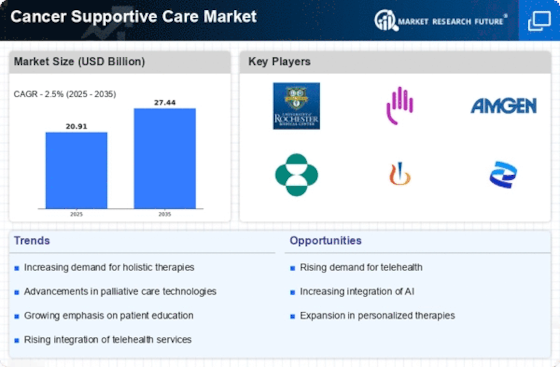
As per MRFR analysis, the Cancer Supportive Care Market Size was estimated at 20.91 USD Billion in 2024. The Cancer Supportive Care industry is projected to grow from 21.43 USD Billion in 2025 to 27.44 USD Billion by 2035, exhibiting a compound annual growth rate (CAGR) of 2.5 during the forecast period 2025 - 2035.

Key Market Trends & Highlights

The Cancer Supportive Care Market is experiencing a transformative shift towards more integrated and personalized care solutions.

  • The integration of holistic approaches is becoming increasingly prevalent in cancer supportive care, particularly in North America.
  • Telehealth expansion is facilitating greater access to supportive services, especially in the rapidly growing Asia-Pacific region.
  • Personalized support services are gaining traction, with breast cancer being the largest segment and lung cancer emerging as the fastest-growing segment.
  • The rising incidence of cancer and advancements in treatment modalities are key drivers propelling market growth.

Market Size & Forecast

2024 Market Size 20.91 (USD Billion)
2035 Market Size 27.44 (USD Billion)
CAGR (2025 - 2035) 2.5%
Largest Regional Market Share in 2024 North America

Major Players

<p>Roche (CH), Bristol-Myers Squibb (US), Amgen (US), Merck & Co. (US), Novartis (CH), Pfizer (US), Eli Lilly and Company (US), AstraZeneca (GB), Gilead Sciences (US)</p>

Market Trends

The Cancer Supportive Care Market is currently experiencing a notable evolution, driven by an increasing recognition of the importance of holistic treatment approaches. This market encompasses a wide array of services and products aimed at alleviating the physical and emotional burdens faced by cancer patients. As healthcare systems worldwide shift towards patient-centered care, there is a growing emphasis on integrating supportive care into standard oncology practices. This trend reflects a broader understanding that effective cancer treatment extends beyond mere disease management, encompassing the overall well-being of patients. Moreover, advancements in technology and the proliferation of telehealth services are reshaping the landscape of the Cancer Supportive Care Market. Patients now have greater access to resources, including counseling, nutritional support, and pain management solutions, which can be delivered remotely. This shift not only enhances patient convenience but also allows for more personalized care plans tailored to individual needs. As the market continues to evolve, stakeholders must remain vigilant in adapting to these changes, ensuring that they meet the diverse requirements of patients navigating their cancer journeys.

Integration of Holistic Approaches

There is a growing trend towards incorporating holistic methods into cancer treatment protocols. This integration aims to address not only the physical symptoms of cancer but also the psychological and emotional challenges faced by patients. By focusing on the whole person, healthcare providers are enhancing the quality of life for individuals undergoing treatment.

Telehealth Expansion

The rise of telehealth services is transforming the Cancer Supportive Care Market. Patients can now access vital support services from the comfort of their homes, including virtual consultations with healthcare professionals. This trend is particularly beneficial for those in remote areas or with mobility challenges, ensuring that supportive care is more accessible.

Personalized Support Services

There is an increasing emphasis on personalized care plans tailored to the unique needs of each patient. This trend reflects a shift towards recognizing that cancer treatment is not one-size-fits-all. By customizing supportive care services, providers can better address the specific challenges and preferences of individual patients.

Cancer Supportive Care Market Market Drivers

Aging Population

The aging population is a critical factor driving the Cancer Supportive Care Market. As individuals age, the risk of developing cancer increases, leading to a higher prevalence of cancer among older adults. By 2030, it is estimated that the number of people aged 65 and older will reach 1.5 billion, many of whom will require cancer care and supportive services. This demographic shift necessitates a robust supportive care framework to address the unique needs of elderly cancer patients, including managing comorbidities and enhancing their quality of life. Consequently, healthcare providers are adapting their services to cater to this growing population, thereby propelling the Cancer Supportive Care Market forward.

Rising Incidence of Cancer

The increasing incidence of cancer worldwide is a primary driver for the Cancer Supportive Care Market. According to recent statistics, cancer cases are projected to rise significantly, with estimates suggesting that by 2040, the number of new cancer cases could reach 30 million annually. This alarming trend necessitates enhanced supportive care services to manage symptoms and improve the quality of life for patients. As the patient population grows, the demand for comprehensive supportive care solutions, including pain management, nutritional support, and psychological counseling, is likely to escalate. Consequently, healthcare providers are increasingly focusing on integrating supportive care into standard oncology practices, thereby expanding the Cancer Supportive Care Market.

Policy and Reimbursement Changes

Recent policy and reimbursement changes are significantly impacting the Cancer Supportive Care Market. Governments and insurance providers are increasingly recognizing the importance of supportive care in cancer treatment, leading to improved reimbursement policies for these services. This shift is encouraging healthcare providers to integrate supportive care into their treatment protocols, as financial barriers are reduced. Enhanced reimbursement for palliative care and supportive services is likely to increase access for patients, thereby driving demand within the Cancer Supportive Care Market. As policies continue to evolve, the landscape for supportive care is expected to become more favorable, promoting the growth of this essential sector.

Increased Awareness and Education

There is a notable increase in awareness and education regarding the importance of supportive care in cancer treatment, which is significantly influencing the Cancer Supportive Care Market. Patients, caregivers, and healthcare professionals are becoming more informed about the benefits of supportive care services, leading to higher demand. Educational initiatives and advocacy campaigns are playing a crucial role in disseminating information about the various supportive care options available, including palliative care and psychosocial support. This heightened awareness is likely to result in more patients seeking these services, thereby expanding the Cancer Supportive Care Market. Furthermore, as healthcare systems recognize the value of supportive care in improving patient outcomes, investments in these services are expected to increase.

Advancements in Treatment Modalities

Innovations in cancer treatment modalities, such as immunotherapy and targeted therapies, are reshaping the Cancer Supportive Care Market. These advanced treatments often come with complex side effects that require specialized supportive care. For instance, patients undergoing immunotherapy may experience unique challenges, including immune-related adverse events, which necessitate tailored supportive interventions. The growing complexity of cancer treatments is driving the need for multidisciplinary care teams that can address both the medical and psychosocial needs of patients. As a result, the Cancer Supportive Care Market is witnessing an increase in demand for services that complement these advanced therapies, ensuring that patients receive holistic care throughout their treatment journey.

Market Segment Insights

By Type: G-CSFs (Largest) vs. Antiemetics (Fastest-Growing)

<p>In the Cancer Supportive Care Market, granulocyte colony-stimulating factors (G-CSFs) hold the largest market share, predominantly used to boost white blood cell counts in cancer patients undergoing chemotherapy. Following them, antiemetics are witnessing significant growth due to an increasing prevalence of chemotherapy-induced nausea and vomiting, driving demand for effective symptom management. Erythropoiesis-stimulating agents (ESAs), bisphosphonates, opioids, and NSAIDs also contribute notably to market dynamics, albeit with varying impacts on overall market share.</p>

<p>G-CSFs (Dominant) vs. Antiemetics (Emerging)</p>

<p>Granulocyte colony-stimulating factors (G-CSFs) are vital in preventing infections in cancer patients, making them a cornerstone of supportive therapies. Their established presence and acceptance among healthcare professionals solidify their dominant position. On the other hand, antiemetics are emerging as essential in alleviating treatment-related nausea and vomiting. The increasing recognition of their importance, especially with the rise of targeted therapies that often induce these side effects, positions antiemetics as a rapid growth area. The combination of innovative formulations and an expanding patient population needing symptom management will likely propel their market presence.</p>

By Application: Breast Cancer (Largest) vs. Lung Cancer (Fastest-Growing)

<p>The Cancer Supportive Care Market demonstrates diverse applications across several cancer types, with breast cancer holding the largest share. This segment is primarily driven by the increasing number of breast cancer cases and heightened awareness surrounding treatment options. Other applications, such as lung and colorectal cancer, follow closely behind but do not match breast cancer's substantial market representation. In contrast, lung cancer is emerging as the fastest-growing segment, largely due to advancements in treatment technologies and an increasing patient population. This rapid growth is attributed to rising smoking rates and environmental factors contributing to lung cancer diagnoses. The demand for supportive care solutions in this area is expected to surge as awareness and treatment options expand.</p>

<p>Breast Cancer (Dominant) vs. Lung Cancer (Emerging)</p>

<p>Breast cancer remains the dominant application in the Cancer Supportive Care Market, characterized by extensive research, funding, and treatment options. This segment benefits from early detection programs and a variety of therapies available, creating a robust support environment for patients. On the other hand, lung cancer, classified as an emerging segment, is witnessing rapid innovation and increasing attention from healthcare providers and researchers. Factors contributing to its growth include a surge in smoking-related cases and the development of new treatment modalities, which provide comprehensive supportive care. As healthcare continues to evolve, both breast and lung cancer segments are critical in shaping the future landscape of cancer supportive care.</p>

By Distribution Channel: Hospital Pharmacies (Largest) vs. Online Providers (Fastest-Growing)

<p>The distribution of cancer supportive care products reveals that hospital pharmacies hold the largest market share, catering primarily to patients with acute care needs. These facilities benefit from their close proximity to oncology specialists and the integrated care available within hospitals, establishing a strong foothold in the market. Conversely, online providers, although smaller in share, are rapidly expanding as digital health solutions gain acceptance, presenting a modern avenue for purchasing supportive care products that complements traditional channels.</p>

<p>Hospital Pharmacies (Dominant) vs. Online Providers (Emerging)</p>

<p>Hospital pharmacies remain a dominant force in the cancer supportive care market due to their established networks within healthcare systems and ability to provide ongoing patient support. They are often preferred for in-hospital therapies and immediate patient needs. On the other hand, online providers are emerging as a significant player, powered by convenience and the increasing trend of telemedicine. Patients are increasingly seeking easier access to medications and supportive care products through online platforms, leading to surging demand. This shift indicates a pivotal change in consumer behavior, reflecting a growing trust in online services for health-related purchases.</p>

Get more detailed insights about Cancer Supportive Care Market Research Report—Global Forecast till 2035

Regional Insights

North America : Leading Market for Innovation

North America is the largest market for cancer supportive care, accounting for approximately 45% of the global market share. The region benefits from advanced healthcare infrastructure, high R&D investments, and a growing prevalence of cancer. Regulatory support from agencies like the FDA accelerates the approval of innovative therapies, driving demand for supportive care solutions. The increasing focus on personalized medicine and patient-centric care further fuels market growth. The United States is the primary contributor, with significant market shares held by key players such as Roche, Bristol-Myers Squibb, and Merck & Co. Canada also plays a vital role, emphasizing access to advanced therapies. The competitive landscape is characterized by collaborations and partnerships among leading pharmaceutical companies, enhancing the availability of supportive care products and services. The presence of robust healthcare systems ensures that patients receive comprehensive care throughout their treatment journey.

Europe : Emerging Market with Growth Potential

Europe is witnessing significant growth in the cancer supportive care market, holding approximately 30% of the global share. The region's growth is driven by increasing cancer incidence, supportive government policies, and a focus on improving patient outcomes. The European Medicines Agency (EMA) plays a crucial role in regulating and approving new therapies, which enhances market dynamics and fosters innovation in supportive care solutions. Leading countries such as Germany, France, and the UK are at the forefront of this market, with a strong presence of key players like Novartis and AstraZeneca. The competitive landscape is marked by strategic collaborations and investments in research and development. Additionally, initiatives aimed at enhancing patient access to supportive care services are gaining traction, further propelling market growth. The emphasis on integrated care models is expected to shape the future of cancer supportive care in Europe.

Asia-Pacific : Rapidly Growing Healthcare Sector

Asia-Pacific is rapidly emerging as a significant player in the cancer supportive care market, accounting for about 20% of the global share. The region's growth is fueled by increasing cancer prevalence, rising healthcare expenditure, and improving access to advanced medical technologies. Government initiatives aimed at enhancing cancer care services and regulatory support for innovative therapies are key drivers of market expansion. Countries like China, Japan, and India are leading the charge, with a growing number of pharmaceutical companies entering the market. The competitive landscape is characterized by both local and international players, including Amgen and Pfizer, who are focusing on expanding their product offerings. The increasing collaboration between public and private sectors is expected to enhance the availability of supportive care solutions, ultimately benefiting patients across the region.

Middle East and Africa : Untapped Market with Opportunities

The Middle East and Africa region is gradually emerging in the cancer supportive care market, holding approximately 5% of the global share. The growth is driven by increasing cancer cases, rising awareness about supportive care, and improving healthcare infrastructure. Regulatory bodies are beginning to recognize the importance of supportive therapies, which is expected to catalyze market growth in the coming years. Countries like South Africa and the UAE are leading the market, with a growing focus on enhancing cancer care services. The competitive landscape is still developing, with opportunities for both local and international players to establish a presence. Key players are increasingly investing in partnerships and collaborations to improve access to supportive care solutions, addressing the needs of patients in this region. The emphasis on education and awareness campaigns is also crucial for market development.

Key Players and Competitive Insights

The Cancer Supportive Care Market is characterized by a dynamic competitive landscape, driven by an increasing emphasis on patient-centric care and the integration of innovative therapies. Key players such as Roche (CH), Bristol-Myers Squibb (US), and Amgen (US) are strategically positioned to leverage their extensive research capabilities and established market presence. Roche (CH) focuses on personalized medicine, enhancing its portfolio through targeted therapies that address specific patient needs. Meanwhile, Bristol-Myers Squibb (US) emphasizes partnerships and collaborations to expand its reach in supportive care, particularly in immunotherapy. Amgen (US) is investing in digital health solutions, aiming to improve patient engagement and adherence to treatment protocols. Collectively, these strategies not only enhance their competitive positioning but also contribute to a more integrated and responsive market environment.

In terms of business tactics, companies are increasingly localizing manufacturing and optimizing supply chains to enhance efficiency and responsiveness to market demands. The Cancer Supportive Care Market appears moderately fragmented, with a mix of established players and emerging companies vying for market share. The collective influence of these key players shapes the market structure, as they engage in strategic collaborations and innovations that drive growth and improve patient outcomes.

In August 2025, Roche (CH) announced a partnership with a leading digital health company to develop a mobile application aimed at improving symptom management for cancer patients. This strategic move underscores Roche's commitment to integrating technology into supportive care, potentially enhancing patient adherence and satisfaction. By leveraging digital tools, Roche aims to provide real-time support, which could lead to better health outcomes and a stronger market position.

In September 2025, Bristol-Myers Squibb (US) launched a new initiative focused on expanding access to its supportive care therapies in underserved regions. This initiative reflects the company's strategic focus on equity in healthcare, aiming to bridge gaps in treatment availability. By addressing disparities in access, Bristol-Myers Squibb not only enhances its corporate social responsibility profile but also positions itself favorably in a market increasingly driven by patient access and equity considerations.

In July 2025, Amgen (US) unveiled a new digital platform designed to facilitate remote monitoring of patients undergoing supportive care. This platform aims to enhance patient engagement and provide healthcare providers with valuable data to tailor treatment plans. The introduction of such technology indicates Amgen's proactive approach to integrating digital solutions into its offerings, potentially setting a new standard for patient management in the supportive care landscape.

As of October 2025, current competitive trends in the Cancer Supportive Care Market are increasingly defined by digitalization, sustainability, and the integration of artificial intelligence. Strategic alliances are becoming pivotal, as companies recognize the value of collaborative innovation in enhancing patient care. Looking ahead, competitive differentiation is likely to evolve from traditional price-based competition to a focus on innovation, technological advancements, and the reliability of supply chains. This shift suggests that companies that prioritize these elements will be better positioned to thrive in an increasingly complex and patient-centric market.

Key Companies in the Cancer Supportive Care Market market include

Industry Developments

December 2022 For the treatment of adults and children 2 years of age and older with Alveolar Soft Part Sarcoma (ASPS) that has migrated to other parts of the body or cannot be removed by surgery, the U.S. Food and medication Administration (FDA) approved immunotherapy medication atezolizumab (Tecentriq).

March 2020 For pediatric malignancies, the National Cancer Institute has started the Molecular Characterization Initiative. Children, adolescents, and young adults being treated at hospitals affiliated with the Children's Oncology Group (COG) who have recently been diagnosed with central nervous system cancers can take advantage of this program's tumor molecular characterisation, also known as biomarker testing.


Future Outlook

Cancer Supportive Care Market Future Outlook

<p>The Cancer Supportive Care Market is projected to grow at a 2.5% CAGR from 2024 to 2035, driven by increasing patient needs, technological advancements, and enhanced healthcare policies.</p>

New opportunities lie in:

  • <p>Development of telehealth platforms for remote patient monitoring</p>
  • <p>Integration of AI-driven analytics for personalized care plans</p>
  • <p>Expansion of home-based palliative care services to improve accessibility</p>

<p>By 2035, the market is expected to be robust, reflecting evolving patient care dynamics.</p>

Market Segmentation

Cancer Supportive Care Market Type Outlook

  • ESA (Erythropoiesis-Stimulating Agents)
  • G-CSFs (Granulocyte Colony-Stimulating Factors)
  • Antiemetics
  • Bisphosphonates
  • Opioids
  • NSAIDs (Non-Steroidal Auto Inflammatory Drugs)
  • Others

Cancer Supportive Care Market Application Outlook

  • Breast Cancer
  • Lung Cancer
  • Colorectal Cancer
  • Prostate Cancer
  • Liver Cancer
  • Stomach Cancer
  • Others

Cancer Supportive Care Market Distribution Channel Outlook

  • Hospital Pharmacies
  • Drug Stores and Retail Pharmacies
  • Online Providers

Report Scope

MARKET SIZE 202420.91(USD Billion)
MARKET SIZE 202521.43(USD Billion)
MARKET SIZE 203527.44(USD Billion)
COMPOUND ANNUAL GROWTH RATE (CAGR)2.5% (2024 - 2035)
REPORT COVERAGERevenue Forecast, Competitive Landscape, Growth Factors, and Trends
BASE YEAR2024
Market Forecast Period2025 - 2035
Historical Data2019 - 2024
Market Forecast UnitsUSD Billion
Key Companies ProfiledMarket analysis in progress
Segments CoveredMarket segmentation analysis in progress
Key Market OpportunitiesIntegration of telehealth solutions enhances access to Cancer Supportive Care services for diverse patient populations.
Key Market DynamicsRising demand for personalized therapies drives innovation and competition in the Cancer Supportive Care Market.
Countries CoveredNorth America, Europe, APAC, South America, MEA

FAQs

What is the projected market valuation of the Cancer Supportive Care Market by 2035?

The Cancer Supportive Care Market is projected to reach a valuation of 27.44 USD Billion by 2035.

What was the market valuation of the Cancer Supportive Care Market in 2024?

In 2024, the market valuation of the Cancer Supportive Care Market was 20.91 USD Billion.

What is the expected CAGR for the Cancer Supportive Care Market during the forecast period 2025 - 2035?

The expected CAGR for the Cancer Supportive Care Market during the forecast period 2025 - 2035 is 2.5%.

Which segment had the highest valuation in 2024 within the Cancer Supportive Care Market?

In 2024, the segment of Opioids had the highest valuation at 5.0 USD Billion.

What are the key players in the Cancer Supportive Care Market?

Key players in the Cancer Supportive Care Market include Roche, Bristol-Myers Squibb, Amgen, Merck & Co., Novartis, Pfizer, Eli Lilly and Company, AstraZeneca, and Gilead Sciences.

How does the valuation of Antiemetics change from 2024 to 2035?

The valuation of Antiemetics is expected to increase from 4.0 USD Billion in 2024 to 5.0 USD Billion by 2035.

  1. SECTION I: EXECUTIVE SUMMARY AND KEY HIGHLIGHTS
    1. EXECUTIVE SUMMARY
      1. Market Overview
      2. Key Findings
      3. Market Segmentation
      4. Competitive Landscape
      5. Challenges and Opportunities
      6. Future Outlook
  2. SECTION II: SCOPING, METHODOLOGY AND MARKET STRUCTURE
    1. MARKET INTRODUCTION
      1. Definition
      2. Scope of the study
    2. RESEARCH METHODOLOGY
      1. Overview
      2. Data Mining
      3. Secondary Research
      4. Primary Research
      5. Forecasting Model
      6. Market Size Estimation
      7. Data Triangulation
      8. Validation
  3. SECTION III: QUALITATIVE ANALYSIS
    1. MARKET DYNAMICS
      1. Overview
      2. Drivers
      3. Restraints
      4. Opportunities
    2. MARKET FACTOR ANALYSIS
      1. Value chain Analysis
      2. Porter's Five Forces Analysis
      3. COVID-19 Impact Analysis
  4. SECTION IV: QUANTITATIVE ANALYSIS
    1. Healthcare, BY Type (USD Billion)
      1. ESA (Erythropoiesis-Stimulating Agents)
      2. G-CSFs (Granulocyte Colony-Stimulating Factors)
      3. Antiemetics
      4. Bisphosphonates
      5. Opioids
      6. NSAIDs (Non-Steroidal Auto Inflammatory Drugs)
      7. Others
    2. Healthcare, BY Application (USD Billion)
      1. Breast Cancer
      2. Lung Cancer
      3. Colorectal Cancer
      4. Prostate Cancer
      5. Liver Cancer
      6. Stomach Cancer
      7. Others
    3. Healthcare, BY Distribution Channel (USD Billion)
      1. Hospital Pharmacies
      2. Drug Stores and Retail Pharmacies
      3. Online Providers
    4. Healthcare, BY Region (USD Billion)
      1. North America
      2. Europe
      3. APAC
      4. South America
      5. MEA
  5. SECTION V: COMPETITIVE ANALYSIS
    1. Competitive Landscape
      1. Overview
      2. Competitive Analysis
      3. Market share Analysis
      4. Major Growth Strategy in the Healthcare
      5. Competitive Benchmarking
      6. Leading Players in Terms of Number of Developments in the Healthcare
      7. Key developments and growth strategies
      8. Major Players Financial Matrix
    2. Company Profiles
      1. Roche (CH)
      2. Bristol-Myers Squibb (US)
      3. Amgen (US)
      4. Merck & Co. (US)
      5. Novartis (CH)
      6. Pfizer (US)
      7. Eli Lilly and Company (US)
      8. AstraZeneca (GB)
      9. Gilead Sciences (US)
    3. Appendix
      1. References
      2. Related Reports
  6. LIST OF FIGURES
    1. MARKET SYNOPSIS
    2. NORTH AMERICA MARKET ANALYSIS
    3. US MARKET ANALYSIS BY TYPE
    4. US MARKET ANALYSIS BY APPLICATION
    5. US MARKET ANALYSIS BY DISTRIBUTION CHANNEL
    6. CANADA MARKET ANALYSIS BY TYPE
    7. CANADA MARKET ANALYSIS BY APPLICATION
    8. CANADA MARKET ANALYSIS BY DISTRIBUTION CHANNEL
    9. EUROPE MARKET ANALYSIS
    10. GERMANY MARKET ANALYSIS BY TYPE
    11. GERMANY MARKET ANALYSIS BY APPLICATION
    12. GERMANY MARKET ANALYSIS BY DISTRIBUTION CHANNEL
    13. UK MARKET ANALYSIS BY TYPE
    14. UK MARKET ANALYSIS BY APPLICATION
    15. UK MARKET ANALYSIS BY DISTRIBUTION CHANNEL
    16. FRANCE MARKET ANALYSIS BY TYPE
    17. FRANCE MARKET ANALYSIS BY APPLICATION
    18. FRANCE MARKET ANALYSIS BY DISTRIBUTION CHANNEL
    19. RUSSIA MARKET ANALYSIS BY TYPE
    20. RUSSIA MARKET ANALYSIS BY APPLICATION
    21. RUSSIA MARKET ANALYSIS BY DISTRIBUTION CHANNEL
    22. ITALY MARKET ANALYSIS BY TYPE
    23. ITALY MARKET ANALYSIS BY APPLICATION
    24. ITALY MARKET ANALYSIS BY DISTRIBUTION CHANNEL
    25. SPAIN MARKET ANALYSIS BY TYPE
    26. SPAIN MARKET ANALYSIS BY APPLICATION
    27. SPAIN MARKET ANALYSIS BY DISTRIBUTION CHANNEL
    28. REST OF EUROPE MARKET ANALYSIS BY TYPE
    29. REST OF EUROPE MARKET ANALYSIS BY APPLICATION
    30. REST OF EUROPE MARKET ANALYSIS BY DISTRIBUTION CHANNEL
    31. APAC MARKET ANALYSIS
    32. CHINA MARKET ANALYSIS BY TYPE
    33. CHINA MARKET ANALYSIS BY APPLICATION
    34. CHINA MARKET ANALYSIS BY DISTRIBUTION CHANNEL
    35. INDIA MARKET ANALYSIS BY TYPE
    36. INDIA MARKET ANALYSIS BY APPLICATION
    37. INDIA MARKET ANALYSIS BY DISTRIBUTION CHANNEL
    38. JAPAN MARKET ANALYSIS BY TYPE
    39. JAPAN MARKET ANALYSIS BY APPLICATION
    40. JAPAN MARKET ANALYSIS BY DISTRIBUTION CHANNEL
    41. SOUTH KOREA MARKET ANALYSIS BY TYPE
    42. SOUTH KOREA MARKET ANALYSIS BY APPLICATION
    43. SOUTH KOREA MARKET ANALYSIS BY DISTRIBUTION CHANNEL
    44. MALAYSIA MARKET ANALYSIS BY TYPE
    45. MALAYSIA MARKET ANALYSIS BY APPLICATION
    46. MALAYSIA MARKET ANALYSIS BY DISTRIBUTION CHANNEL
    47. THAILAND MARKET ANALYSIS BY TYPE
    48. THAILAND MARKET ANALYSIS BY APPLICATION
    49. THAILAND MARKET ANALYSIS BY DISTRIBUTION CHANNEL
    50. INDONESIA MARKET ANALYSIS BY TYPE
    51. INDONESIA MARKET ANALYSIS BY APPLICATION
    52. INDONESIA MARKET ANALYSIS BY DISTRIBUTION CHANNEL
    53. REST OF APAC MARKET ANALYSIS BY TYPE
    54. REST OF APAC MARKET ANALYSIS BY APPLICATION
    55. REST OF APAC MARKET ANALYSIS BY DISTRIBUTION CHANNEL
    56. SOUTH AMERICA MARKET ANALYSIS
    57. BRAZIL MARKET ANALYSIS BY TYPE
    58. BRAZIL MARKET ANALYSIS BY APPLICATION
    59. BRAZIL MARKET ANALYSIS BY DISTRIBUTION CHANNEL
    60. MEXICO MARKET ANALYSIS BY TYPE
    61. MEXICO MARKET ANALYSIS BY APPLICATION
    62. MEXICO MARKET ANALYSIS BY DISTRIBUTION CHANNEL
    63. ARGENTINA MARKET ANALYSIS BY TYPE
    64. ARGENTINA MARKET ANALYSIS BY APPLICATION
    65. ARGENTINA MARKET ANALYSIS BY DISTRIBUTION CHANNEL
    66. REST OF SOUTH AMERICA MARKET ANALYSIS BY TYPE
    67. REST OF SOUTH AMERICA MARKET ANALYSIS BY APPLICATION
    68. REST OF SOUTH AMERICA MARKET ANALYSIS BY DISTRIBUTION CHANNEL
    69. MEA MARKET ANALYSIS
    70. GCC COUNTRIES MARKET ANALYSIS BY TYPE
    71. GCC COUNTRIES MARKET ANALYSIS BY APPLICATION
    72. GCC COUNTRIES MARKET ANALYSIS BY DISTRIBUTION CHANNEL
    73. SOUTH AFRICA MARKET ANALYSIS BY TYPE
    74. SOUTH AFRICA MARKET ANALYSIS BY APPLICATION
    75. SOUTH AFRICA MARKET ANALYSIS BY DISTRIBUTION CHANNEL
    76. REST OF MEA MARKET ANALYSIS BY TYPE
    77. REST OF MEA MARKET ANALYSIS BY APPLICATION
    78. REST OF MEA MARKET ANALYSIS BY DISTRIBUTION CHANNEL
    79. KEY BUYING CRITERIA OF HEALTHCARE
    80. RESEARCH PROCESS OF MRFR
    81. DRO ANALYSIS OF HEALTHCARE
    82. DRIVERS IMPACT ANALYSIS: HEALTHCARE
    83. RESTRAINTS IMPACT ANALYSIS: HEALTHCARE
    84. SUPPLY / VALUE CHAIN: HEALTHCARE
    85. HEALTHCARE, BY TYPE, 2024 (% SHARE)
    86. HEALTHCARE, BY TYPE, 2024 TO 2035 (USD Billion)
    87. HEALTHCARE, BY APPLICATION, 2024 (% SHARE)
    88. HEALTHCARE, BY APPLICATION, 2024 TO 2035 (USD Billion)
    89. HEALTHCARE, BY DISTRIBUTION CHANNEL, 2024 (% SHARE)
    90. HEALTHCARE, BY DISTRIBUTION CHANNEL, 2024 TO 2035 (USD Billion)
    91. BENCHMARKING OF MAJOR COMPETITORS
  7. LIST OF TABLES
    1. LIST OF ASSUMPTIONS
    2. North America MARKET SIZE ESTIMATES; FORECAST
      1. BY TYPE, 2025-2035 (USD Billion)
      2. BY APPLICATION, 2025-2035 (USD Billion)
      3. BY DISTRIBUTION CHANNEL, 2025-2035 (USD Billion)
    3. US MARKET SIZE ESTIMATES; FORECAST
      1. BY TYPE, 2025-2035 (USD Billion)
      2. BY APPLICATION, 2025-2035 (USD Billion)
      3. BY DISTRIBUTION CHANNEL, 2025-2035 (USD Billion)
    4. Canada MARKET SIZE ESTIMATES; FORECAST
      1. BY TYPE, 2025-2035 (USD Billion)
      2. BY APPLICATION, 2025-2035 (USD Billion)
      3. BY DISTRIBUTION CHANNEL, 2025-2035 (USD Billion)
    5. Europe MARKET SIZE ESTIMATES; FORECAST
      1. BY TYPE, 2025-2035 (USD Billion)
      2. BY APPLICATION, 2025-2035 (USD Billion)
      3. BY DISTRIBUTION CHANNEL, 2025-2035 (USD Billion)
    6. Germany MARKET SIZE ESTIMATES; FORECAST
      1. BY TYPE, 2025-2035 (USD Billion)
      2. BY APPLICATION, 2025-2035 (USD Billion)
      3. BY DISTRIBUTION CHANNEL, 2025-2035 (USD Billion)
    7. UK MARKET SIZE ESTIMATES; FORECAST
      1. BY TYPE, 2025-2035 (USD Billion)
      2. BY APPLICATION, 2025-2035 (USD Billion)
      3. BY DISTRIBUTION CHANNEL, 2025-2035 (USD Billion)
    8. France MARKET SIZE ESTIMATES; FORECAST
      1. BY TYPE, 2025-2035 (USD Billion)
      2. BY APPLICATION, 2025-2035 (USD Billion)
      3. BY DISTRIBUTION CHANNEL, 2025-2035 (USD Billion)
    9. Russia MARKET SIZE ESTIMATES; FORECAST
      1. BY TYPE, 2025-2035 (USD Billion)
      2. BY APPLICATION, 2025-2035 (USD Billion)
      3. BY DISTRIBUTION CHANNEL, 2025-2035 (USD Billion)
    10. Italy MARKET SIZE ESTIMATES; FORECAST
      1. BY TYPE, 2025-2035 (USD Billion)
      2. BY APPLICATION, 2025-2035 (USD Billion)
      3. BY DISTRIBUTION CHANNEL, 2025-2035 (USD Billion)
    11. Spain MARKET SIZE ESTIMATES; FORECAST
      1. BY TYPE, 2025-2035 (USD Billion)
      2. BY APPLICATION, 2025-2035 (USD Billion)
      3. BY DISTRIBUTION CHANNEL, 2025-2035 (USD Billion)
    12. Rest of Europe MARKET SIZE ESTIMATES; FORECAST
      1. BY TYPE, 2025-2035 (USD Billion)
      2. BY APPLICATION, 2025-2035 (USD Billion)
      3. BY DISTRIBUTION CHANNEL, 2025-2035 (USD Billion)
    13. APAC MARKET SIZE ESTIMATES; FORECAST
      1. BY TYPE, 2025-2035 (USD Billion)
      2. BY APPLICATION, 2025-2035 (USD Billion)
      3. BY DISTRIBUTION CHANNEL, 2025-2035 (USD Billion)
    14. China MARKET SIZE ESTIMATES; FORECAST
      1. BY TYPE, 2025-2035 (USD Billion)
      2. BY APPLICATION, 2025-2035 (USD Billion)
      3. BY DISTRIBUTION CHANNEL, 2025-2035 (USD Billion)
    15. India MARKET SIZE ESTIMATES; FORECAST
      1. BY TYPE, 2025-2035 (USD Billion)
      2. BY APPLICATION, 2025-2035 (USD Billion)
      3. BY DISTRIBUTION CHANNEL, 2025-2035 (USD Billion)
    16. Japan MARKET SIZE ESTIMATES; FORECAST
      1. BY TYPE, 2025-2035 (USD Billion)
      2. BY APPLICATION, 2025-2035 (USD Billion)
      3. BY DISTRIBUTION CHANNEL, 2025-2035 (USD Billion)
    17. South Korea MARKET SIZE ESTIMATES; FORECAST
      1. BY TYPE, 2025-2035 (USD Billion)
      2. BY APPLICATION, 2025-2035 (USD Billion)
      3. BY DISTRIBUTION CHANNEL, 2025-2035 (USD Billion)
    18. Malaysia MARKET SIZE ESTIMATES; FORECAST
      1. BY TYPE, 2025-2035 (USD Billion)
      2. BY APPLICATION, 2025-2035 (USD Billion)
      3. BY DISTRIBUTION CHANNEL, 2025-2035 (USD Billion)
    19. Thailand MARKET SIZE ESTIMATES; FORECAST
      1. BY TYPE, 2025-2035 (USD Billion)
      2. BY APPLICATION, 2025-2035 (USD Billion)
      3. BY DISTRIBUTION CHANNEL, 2025-2035 (USD Billion)
    20. Indonesia MARKET SIZE ESTIMATES; FORECAST
      1. BY TYPE, 2025-2035 (USD Billion)
      2. BY APPLICATION, 2025-2035 (USD Billion)
      3. BY DISTRIBUTION CHANNEL, 2025-2035 (USD Billion)
    21. Rest of APAC MARKET SIZE ESTIMATES; FORECAST
      1. BY TYPE, 2025-2035 (USD Billion)
      2. BY APPLICATION, 2025-2035 (USD Billion)
      3. BY DISTRIBUTION CHANNEL, 2025-2035 (USD Billion)
    22. South America MARKET SIZE ESTIMATES; FORECAST
      1. BY TYPE, 2025-2035 (USD Billion)
      2. BY APPLICATION, 2025-2035 (USD Billion)
      3. BY DISTRIBUTION CHANNEL, 2025-2035 (USD Billion)
    23. Brazil MARKET SIZE ESTIMATES; FORECAST
      1. BY TYPE, 2025-2035 (USD Billion)
      2. BY APPLICATION, 2025-2035 (USD Billion)
      3. BY DISTRIBUTION CHANNEL, 2025-2035 (USD Billion)
    24. Mexico MARKET SIZE ESTIMATES; FORECAST
      1. BY TYPE, 2025-2035 (USD Billion)
      2. BY APPLICATION, 2025-2035 (USD Billion)
      3. BY DISTRIBUTION CHANNEL, 2025-2035 (USD Billion)
    25. Argentina MARKET SIZE ESTIMATES; FORECAST
      1. BY TYPE, 2025-2035 (USD Billion)
      2. BY APPLICATION, 2025-2035 (USD Billion)
      3. BY DISTRIBUTION CHANNEL, 2025-2035 (USD Billion)
    26. Rest of South America MARKET SIZE ESTIMATES; FORECAST
      1. BY TYPE, 2025-2035 (USD Billion)
      2. BY APPLICATION, 2025-2035 (USD Billion)
      3. BY DISTRIBUTION CHANNEL, 2025-2035 (USD Billion)
    27. MEA MARKET SIZE ESTIMATES; FORECAST
      1. BY TYPE, 2025-2035 (USD Billion)
      2. BY APPLICATION, 2025-2035 (USD Billion)
      3. BY DISTRIBUTION CHANNEL, 2025-2035 (USD Billion)
    28. GCC Countries MARKET SIZE ESTIMATES; FORECAST
      1. BY TYPE, 2025-2035 (USD Billion)
      2. BY APPLICATION, 2025-2035 (USD Billion)
      3. BY DISTRIBUTION CHANNEL, 2025-2035 (USD Billion)
    29. South Africa MARKET SIZE ESTIMATES; FORECAST
      1. BY TYPE, 2025-2035 (USD Billion)
      2. BY APPLICATION, 2025-2035 (USD Billion)
      3. BY DISTRIBUTION CHANNEL, 2025-2035 (USD Billion)
    30. Rest of MEA MARKET SIZE ESTIMATES; FORECAST
      1. BY TYPE, 2025-2035 (USD Billion)
      2. BY APPLICATION, 2025-2035 (USD Billion)
      3. BY DISTRIBUTION CHANNEL, 2025-2035 (USD Billion)
    31. PRODUCT LAUNCH/PRODUCT DEVELOPMENT/APPROVAL
    32. ACQUISITION/PARTNERSHIP

Cancer Supportive Care Market Segmentation

Cancer Supportive Care Type Outlook (USD Billion, 2018-2032)

ESA (Erythropoiesis-Stimulating Agents)

G-CSFs (Granulocyte Colony-Stimulating Factors)

Antiemetics

Bisphosphonates

Opioids

NSAIDs (Non-Steroidal Auto Inflammatory Drugs)

Others

Cancer Supportive Care Application Outlook (USD Billion, 2018-2032)

Breast Cancer

Lung Cancer

Colorectal Cancer

Prostate Cancer

Liver Cancer

Stomach Cancer

Others

Cancer Supportive Care Distribution Channel Outlook (USD Billion, 2018-2032)

Hospital Pharmacies

Drug Stores and Retail Pharmacies

Online Providers

Cancer Supportive Care Regional Outlook (USD Billion, 2018-2032)

North America Outlook (USD Billion, 2018-2032)

Cancer Supportive Care by Type

ESA (Erythropoiesis-Stimulating Agents)

G-CSFs (Granulocyte Colony-Stimulating Factors)

Antiemetics

Bisphosphonates

Opioids

NSAIDs (Non-Steroidal Auto Inflammatory Drugs)

Others

Cancer Supportive Care by Application

Breast Cancer

Lung Cancer

Colorectal Cancer

Prostate Cancer

Liver Cancer

Stomach Cancer

Others

Cancer Supportive Care by Distribution Channel

Hospital Pharmacies

Drug Stores and Retail Pharmacies

Online Providers

US Outlook (USD Billion, 2018-2032)

Cancer Supportive Care by Type

ESA (Erythropoiesis-Stimulating Agents)

G-CSFs (Granulocyte Colony-Stimulating Factors)

Antiemetics

Bisphosphonates

Opioids

NSAIDs (Non-Steroidal Auto Inflammatory Drugs)

Others

Cancer Supportive Care by Application

Breast Cancer

Lung Cancer

Colorectal Cancer

Prostate Cancer

Liver Cancer

Stomach Cancer

Others

Cancer Supportive Care by Distribution Channel

Hospital Pharmacies

Drug Stores and Retail Pharmacies

Online Providers

Canada Outlook (USD Billion, 2018-2032)

Cancer Supportive Care by Type

ESA (Erythropoiesis-Stimulating Agents)

G-CSFs (Granulocyte Colony-Stimulating Factors)

Antiemetics

Bisphosphonates

Opioids

NSAIDs (Non-Steroidal Auto Inflammatory Drugs)

Others

Cancer Supportive Care by Application

Breast Cancer

Lung Cancer

Colorectal Cancer

Prostate Cancer

Liver Cancer

Stomach Cancer

Others

Cancer Supportive Care by Distribution Channel

Hospital Pharmacies

Drug Stores and Retail Pharmacies

Online Providers

Europe Outlook (USD Billion, 2018-2032)

Cancer Supportive Care by Type

ESA (Erythropoiesis-Stimulating Agents)

G-CSFs (Granulocyte Colony-Stimulating Factors)

Antiemetics

Bisphosphonates

Opioids

NSAIDs (Non-Steroidal Auto Inflammatory Drugs)

Others

Cancer Supportive Care by Application

Breast Cancer

Lung Cancer

Colorectal Cancer

Prostate Cancer

Liver Cancer

Stomach Cancer

Others

Cancer Supportive Care by Distribution Channel

Hospital Pharmacies

Drug Stores and Retail Pharmacies

Online Providers

Germany Outlook (USD Billion, 2018-2032)

Cancer Supportive Care by Type

ESA (Erythropoiesis-Stimulating Agents)

G-CSFs (Granulocyte Colony-Stimulating Factors)

Antiemetics

Bisphosphonates

Opioids

NSAIDs (Non-Steroidal Auto Inflammatory Drugs)

Others

Cancer Supportive Care by Application

Breast Cancer

Lung Cancer

Colorectal Cancer

Prostate Cancer

Liver Cancer

Stomach Cancer

Others

Cancer Supportive Care by Distribution Channel

Hospital Pharmacies

Drug Stores and Retail Pharmacies

Online Providers

France Outlook (USD Billion, 2018-2032)

Cancer Supportive Care by Type

ESA (Erythropoiesis-Stimulating Agents)

G-CSFs (Granulocyte Colony-Stimulating Factors)

Antiemetics

Bisphosphonates

Opioids

NSAIDs (Non-Steroidal Auto Inflammatory Drugs)

Others

Cancer Supportive Care by Application

Breast Cancer

Lung Cancer

Colorectal Cancer

Prostate Cancer

Liver Cancer

Stomach Cancer

Others

Cancer Supportive Care by Distribution Channel

Hospital Pharmacies

Drug Stores and Retail Pharmacies

Online Providers

UK Outlook (USD Billion, 2018-2032)

Cancer Supportive Care by Type

ESA (Erythropoiesis-Stimulating Agents)

G-CSFs (Granulocyte Colony-Stimulating Factors)

Antiemetics

Bisphosphonates

Opioids

NSAIDs (Non-Steroidal Auto Inflammatory Drugs)

Others

Cancer Supportive Care by Application

Breast Cancer

Lung Cancer

Colorectal Cancer

Prostate Cancer

Liver Cancer

Stomach Cancer

Others

Cancer Supportive Care by Distribution Channel

Hospital Pharmacies

Drug Stores and Retail Pharmacies

Online Providers

Italy Outlook (USD Billion, 2018-2032)

Cancer Supportive Care by Type

ESA (Erythropoiesis-Stimulating Agents)

G-CSFs (Granulocyte Colony-Stimulating Factors)

Antiemetics

Bisphosphonates

Opioids

NSAIDs (Non-Steroidal Auto Inflammatory Drugs)

Others

Cancer Supportive Care by Application

Breast Cancer

Lung Cancer

Colorectal Cancer

Prostate Cancer

Liver Cancer

Stomach Cancer

Others

Cancer Supportive Care by Distribution Channel

Hospital Pharmacies

Drug Stores and Retail Pharmacies

Online Providers

Spain Outlook (USD Billion, 2018-2032)

Cancer Supportive Care by Type

ESA (Erythropoiesis-Stimulating Agents)

G-CSFs (Granulocyte Colony-Stimulating Factors)

Antiemetics

Bisphosphonates

Opioids

NSAIDs (Non-Steroidal Auto Inflammatory Drugs)

Others

Cancer Supportive Care by Application

Breast Cancer

Lung Cancer

Colorectal Cancer

Prostate Cancer

Liver Cancer

Stomach Cancer

Others

Cancer Supportive Care by Distribution Channel

Hospital Pharmacies

Drug Stores and Retail Pharmacies

Online Providers

Rest Of Europe Outlook (USD Billion, 2018-2032)

Cancer Supportive Care by Type

ESA (Erythropoiesis-Stimulating Agents)

G-CSFs (Granulocyte Colony-Stimulating Factors)

Antiemetics

Bisphosphonates

Opioids

NSAIDs (Non-Steroidal Auto Inflammatory Drugs)

Others

Cancer Supportive Care by Application

Breast Cancer

Lung Cancer

Colorectal Cancer

Prostate Cancer

Liver Cancer

Stomach Cancer

Others

Cancer Supportive Care by Distribution Channel

Hospital Pharmacies

Drug Stores and Retail Pharmacies

Online Providers

Asia-Pacific Outlook (USD Billion, 2018-2032)

Cancer Supportive Care by Type

ESA (Erythropoiesis-Stimulating Agents)

G-CSFs (Granulocyte Colony-Stimulating Factors)

Antiemetics

Bisphosphonates

Opioids

NSAIDs (Non-Steroidal Auto Inflammatory Drugs)

Others

Cancer Supportive Care by Application

Breast Cancer

Lung Cancer

Colorectal Cancer

Prostate Cancer

Liver Cancer

Stomach Cancer

Others

Cancer Supportive Care by Distribution Channel

Hospital Pharmacies

Drug Stores and Retail Pharmacies

Online Providers

China Outlook (USD Billion, 2018-2032)

Cancer Supportive Care by Type

ESA (Erythropoiesis-Stimulating Agents)

G-CSFs (Granulocyte Colony-Stimulating Factors)

Antiemetics

Bisphosphonates

Opioids

NSAIDs (Non-Steroidal Auto Inflammatory Drugs)

Others

Cancer Supportive Care by Application

Breast Cancer

Lung Cancer

Colorectal Cancer

Prostate Cancer

Liver Cancer

Stomach Cancer

Others

Cancer Supportive Care by Distribution Channel

Hospital Pharmacies

Drug Stores and Retail Pharmacies

Online Providers

Japan Outlook (USD Billion, 2018-2032)

Cancer Supportive Care by Type

ESA (Erythropoiesis-Stimulating Agents)

G-CSFs (Granulocyte Colony-Stimulating Factors)

Antiemetics

Bisphosphonates

Opioids

NSAIDs (Non-Steroidal Auto Inflammatory Drugs)

Others

Cancer Supportive Care by Application

Breast Cancer

Lung Cancer

Colorectal Cancer

Prostate Cancer

Liver Cancer

Stomach Cancer

Others

Cancer Supportive Care by Distribution Channel

Hospital Pharmacies

Drug Stores and Retail Pharmacies

Online Providers

India Outlook (USD Billion, 2018-2032)

Cancer Supportive Care by Type

ESA (Erythropoiesis-Stimulating Agents)

G-CSFs (Granulocyte Colony-Stimulating Factors)

Antiemetics

Bisphosphonates

Opioids

NSAIDs (Non-Steroidal Auto Inflammatory Drugs)

Others

Cancer Supportive Care by Application

Breast Cancer

Lung Cancer

Colorectal Cancer

Prostate Cancer

Liver Cancer

Stomach Cancer

Others

Cancer Supportive Care by Distribution Channel

Hospital Pharmacies

Drug Stores and Retail Pharmacies

Online Providers

Australia Outlook (USD Billion, 2018-2032)

Cancer Supportive Care by Type

ESA (Erythropoiesis-Stimulating Agents)

G-CSFs (Granulocyte Colony-Stimulating Factors)

Antiemetics

Bisphosphonates

Opioids

NSAIDs (Non-Steroidal Auto Inflammatory Drugs)

Others

Cancer Supportive Care by Application

Breast Cancer

Lung Cancer

Colorectal Cancer

Prostate Cancer

Liver Cancer

Stomach Cancer

Others

Cancer Supportive Care by Distribution Channel

Hospital Pharmacies

Drug Stores and Retail Pharmacies

Online Providers

Rest of Asia-Pacific Outlook (USD Billion, 2018-2032)

Cancer Supportive Care by Type

ESA (Erythropoiesis-Stimulating Agents)

G-CSFs (Granulocyte Colony-Stimulating Factors)

Antiemetics

Bisphosphonates

Opioids

NSAIDs (Non-Steroidal Auto Inflammatory Drugs)

Others

Cancer Supportive Care by Application

Breast Cancer

Lung Cancer

Colorectal Cancer

Prostate Cancer

Liver Cancer

Stomach Cancer

Others

Cancer Supportive Care by Distribution Channel

Hospital Pharmacies

Drug Stores and Retail Pharmacies

Online Providers

Rest of the World Outlook (USD Billion, 2018-2032)

Cancer Supportive Care by Type

ESA (Erythropoiesis-Stimulating Agents)

G-CSFs (Granulocyte Colony-Stimulating Factors)

Antiemetics

Bisphosphonates

Opioids

NSAIDs (Non-Steroidal Auto Inflammatory Drugs)

Others

Cancer Supportive Care by Application

Breast Cancer

Lung Cancer

Colorectal Cancer

Prostate Cancer

Liver Cancer

Stomach Cancer

Others

Cancer Supportive Care by Distribution Channel

Hospital Pharmacies

Drug Stores and Retail Pharmacies

Online Providers

Middle East Outlook (USD Billion, 2018-2032)

Cancer Supportive Care by Type

ESA (Erythropoiesis-Stimulating Agents)

G-CSFs (Granulocyte Colony-Stimulating Factors)

Antiemetics

Bisphosphonates

Opioids

NSAIDs (Non-Steroidal Auto Inflammatory Drugs)

Others

Cancer Supportive Care by Application

Breast Cancer

Lung Cancer

Colorectal Cancer

Prostate Cancer

Liver Cancer

Stomach Cancer

Others

Cancer Supportive Care by Distribution Channel

Hospital Pharmacies

Drug Stores and Retail Pharmacies

Online Providers

Africa Outlook (USD Billion, 2018-2032)

Cancer Supportive Care by Type

ESA (Erythropoiesis-Stimulating Agents)

G-CSFs (Granulocyte Colony-Stimulating Factors)

Antiemetics

Bisphosphonates

Opioids

NSAIDs (Non-Steroidal Auto Inflammatory Drugs)

Others

Cancer Supportive Care by Application

Breast Cancer

Lung Cancer

Colorectal Cancer

Prostate Cancer

Liver Cancer

Stomach Cancer

Others

Cancer Supportive Care by Distribution Channel

Hospital Pharmacies

Drug Stores and Retail Pharmacies

Online Providers

Latin America Outlook (USD Billion, 2018-2032)

Cancer Supportive Care by Type

ESA (Erythropoiesis-Stimulating Agents)

G-CSFs (Granulocyte Colony-Stimulating Factors)

Antiemetics

Bisphosphonates

Opioids

NSAIDs (Non-Steroidal Auto Inflammatory Drugs)

Others

Cancer Supportive Care by Application

Breast Cancer

Lung Cancer

Colorectal Cancer

Prostate Cancer

Liver Cancer

Stomach Cancer

Others

Cancer Supportive Care by Distribution Channel

Hospital Pharmacies

Drug Stores and Retail Pharmacies

Online Providers

Infographic

Free Sample Request

Kindly complete the form below to receive a free sample of this Report

Get Free Sample

Customer Strories

Compare Licence

×
Features License Type
Single User Multiuser License Enterprise User
Price $4,950 $5,950 $7,250
Maximum User Access Limit 1 User Upto 10 Users Unrestricted Access Throughout the Organization
Free Customization
Direct Access to Analyst
Deliverable Format
Platform Access
Discount on Next Purchase 10% 15% 15%
Printable Versions