×
Hero Background
English
Chinese
French
Japanese
Korean
German
Spanish

Cancer API Market Trends

ID: MRFR/Pharma/4782-CR
128 Pages
Rahul Gotadki
January 2024

Cancer API Market Research Report Information by Drug Type (Innovative Oncology API, And Generic Oncology API), By Manufacturer Type (Captive Manufacturer, Merchant Manufacturer), By Type Of Synthesis (Synthetic Oncology Apis, And Biotech Oncology API), By Indication (Lung Cancer, Breast Cancer, Colorectal Cancer, Prostate Cancer, Stomach Cancer, Liver Cancer, Cervical Cancer, And Others), and by Region (North America, Europe, Asia-Pacific, and Rest of the World) - Forecast till 2035

Share:
Download PDF ×

We do not share your information with anyone. However, we may send you emails based on your report interest from time to time. You may contact us at any time to opt-out.

Cancer API Market Infographic
Purchase Options

Market Trends

Key Emerging Trends in the Cancer API Market

The Cancer API market is witnessing significant growth due to the increasing prevalence of cancer and the demand for advanced solutions in the healthcare sector. With the increasing role of technology in healthcare APIs or Application Programming Interfaces have become crucial tools to access and exchange cancer related data. The global increase in cancer cases is among the leading factors driving Cancer API market. With the rapid increase in cancer cases worldwide, there is an urgent need for effective data management and analysis tools. Cancer APIs facilitate easy integration of varied datasets, allowing healthcare professionals to make informed conclusions for diagnosing diseases or treatment and research initiatives. Market Trends The trends in the markets show that cancer APIs are becoming more integrated with artificial intelligence AI and machine learning ML. These technologies improve the forecasting abilities of APIs, allowing more accurate diagnoses and tailored treatment plans. Cancer APIs which are powered by AI play their part in optimizing the healthcare processes, increasing patient outcomes and resource utilization. Key issues in this Cancer API market are still interoperability, which allows easy transfer of data between different healthcare systems. Simultaneously, APIs are so important because of the fact that as healthcare providers and researchers collaborate internationally; what is needed in their efforts to connect such divergent databases. Increasing demand for telemedicine and remote patient monitoring is shaping the Cancer API market. APIs have become critical for fetching remote monitoring devices and healthcare platforms to share live information. Trends indicate a bias towards patient-centric solutions when it comes to the Cancer API landscape. APIs are developing to empower patients with increased accessibility of their health data, and thus facilitate a more cooperative relationship between healthcare providers and patients. The focus on patient engagement also enhances treatment adherence and general health outcomes. With the growing trust in digital health solutions, Cancer API market is poised to overcome security and compliance challenges. It is necessary to ensure the confidentiality and integrity of sensitive health data. API developers are developing strong security measures and adhering to healthcare regulations as they seek to earn confidence among users and stakeholders. Customizable and modular solutions are also demanded by the Cancer API market. The modular APIs provide scalability so that healthcare providers can easily adjust to emerging technology requirements and changing health care environments. The Cancer API market is being pushed by collaborations and partnerships between technology companies, pharmaceutical firms, and healthcare institutions. These strategic alliances aim to leverage collective expertise and resources to develop comprehensive API solutions. Such collaborations accelerate the pace of API development and enhance the overall effectiveness of cancer-related data management. Looking ahead, the Cancer API market is poised for continued growth with advancements in technology and increasing awareness of the benefits of data-driven healthcare. However, challenges related to data privacy, standardization, and the need for widespread adoption pose hurdles. Overcoming these challenges will be crucial for unlocking the full potential of Cancer APIs in revolutionizing cancer care.

Author
Rahul Gotadki
Assistant Manager

He holds an experience of about 7+ years in Market Research and Business Consulting, working under the spectrum of Life Sciences and Healthcare domains. Rahul conceptualizes and implements a scalable business strategy and provides strategic leadership to the clients. His expertise lies in market estimation, competitive intelligence, pipeline analysis, customer assessment, etc. In addition to the above, his other responsibility includes strategic tracking of high growth markets & advising clients on the potential areas of focus they could direct their business initiatives

Leave a Comment

FAQs

What is the current valuation of the Cancer API Market as of 2024?

The Cancer API Market was valued at 48.81 USD Billion in 2024.

What is the projected market size for the Cancer API Market by 2035?

The market is projected to reach 90.21 USD Billion by 2035.

What is the expected CAGR for the Cancer API Market during the forecast period 2025 - 2035?

The expected CAGR for the Cancer API Market during 2025 - 2035 is 5.74%.

Which companies are considered key players in the Cancer API Market?

Key players include Roche, Novartis, Bristol-Myers Squibb, Merck & Co., Amgen, AstraZeneca, Pfizer, Gilead Sciences, and Eli Lilly and Company.

What are the two main segments of drug types in the Cancer API Market?

The two main segments are Innovative Oncology APIs, valued at 55.0 USD Billion, and Generic Oncology APIs, valued at 35.21 USD Billion.

How do the manufacturer types segment the Cancer API Market?

The market segments into Captive Manufacturers, valued at 45.11 USD Billion, and Merchant Manufacturers, valued at 45.1 USD Billion.

Market Summary

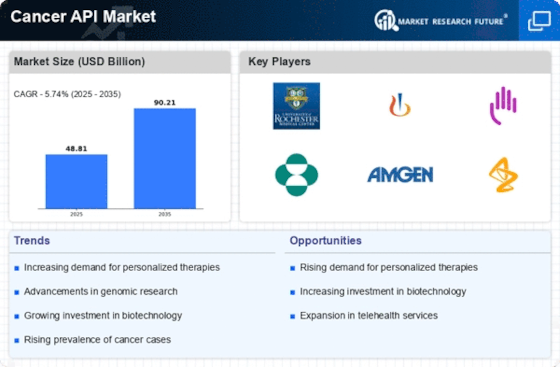
As per MRFR analysis, the Cancer API Market Size was estimated at 48.81 USD Billion in 2024. The Cancer API industry is projected to grow from 51.61 USD Billion in 2025 to 90.21 USD Billion by 2035, exhibiting a compound annual growth rate (CAGR) of 5.74 during the forecast period 2025 - 2035.

Key Market Trends & Highlights

The Cancer API Market is experiencing robust growth driven by technological advancements and increasing demand for personalized therapies.

  • The rise of personalized medicine is reshaping treatment paradigms in oncology, particularly in North America.
  • Integration of advanced technologies is enhancing the efficacy and precision of cancer therapies across the Asia-Pacific region.
  • The growth of companion diagnostics is facilitating tailored treatment approaches, especially within the innovative oncology API segment.
  • Increasing cancer incidence and advancements in biotechnology are key drivers propelling the market forward, particularly for captive manufacturers.

Market Size & Forecast

2024 Market Size 48.81 (USD Billion)
2035 Market Size 90.21 (USD Billion)
CAGR (2025 - 2035) 5.74%
Largest Regional Market Share in 2024 North America

Major Players

<p>Roche (CH), Novartis (CH), Bristol-Myers Squibb (US), Merck & Co. (US), Amgen (US), AstraZeneca (GB), Pfizer (US), Gilead Sciences (US), Eli Lilly and Company (US)</p>

Market Trends

The Cancer API Market is currently experiencing a transformative phase, driven by advancements in biotechnology and a growing emphasis on personalized medicine. This sector encompasses a range of applications, including drug development, diagnostics, and treatment planning, which are increasingly tailored to individual patient profiles. The integration of artificial intelligence and machine learning into cancer research is enhancing the efficiency of drug discovery processes, thereby expediting the development of targeted therapies. Furthermore, collaborations between pharmaceutical companies and research institutions are fostering innovation, leading to the emergence of novel therapeutic agents that address various cancer types more effectively. In addition, the Cancer API Market is witnessing a surge in demand for companion diagnostics, which are essential for determining the suitability of specific treatments for patients. This trend is indicative of a broader shift towards precision oncology, where treatment regimens are customized based on genetic and molecular profiling. As regulatory frameworks evolve to accommodate these advancements, the market is poised for substantial growth. Stakeholders are increasingly focusing on developing APIs that facilitate seamless integration of data across platforms, enhancing the overall patient care experience. The future landscape of the Cancer API Market appears promising, with ongoing research and development efforts likely to yield innovative solutions that improve patient outcomes and streamline treatment processes.

Rise of Personalized Medicine

The Cancer API Market is increasingly leaning towards personalized medicine, where treatments are tailored to individual genetic profiles. This shift enhances the efficacy of therapies and minimizes adverse effects, as therapies are designed to target specific cancer mutations.

Integration of Advanced Technologies

The incorporation of artificial intelligence and machine learning into cancer research is revolutionizing the Cancer API Market. These technologies facilitate faster drug discovery and development processes, enabling researchers to identify potential therapeutic candidates more efficiently.

Growth of Companion Diagnostics

Companion diagnostics are becoming more prevalent within the Cancer API Market, as they play a crucial role in determining the appropriateness of specific treatments for patients. This trend underscores the importance of precision oncology in modern cancer care.

Cancer API Market Market Drivers

Increasing Cancer Incidence

The rising incidence of cancer worldwide is a primary driver for the Cancer API Market. According to recent statistics, cancer cases are projected to increase significantly, with estimates suggesting that by 2040, the number of new cancer cases could reach 27.5 million annually. This alarming trend necessitates the development of innovative therapies and diagnostic tools, thereby propelling the demand for cancer APIs. As healthcare systems strive to address this growing burden, investments in research and development are likely to surge, fostering advancements in cancer treatment options. Consequently, the Cancer API Market is expected to expand as pharmaceutical companies and research institutions seek to create more effective and targeted therapies.

Advancements in Biotechnology

Technological advancements in biotechnology are reshaping the Cancer API Market. Innovations such as CRISPR gene editing and next-generation sequencing are enabling researchers to develop more precise and effective cancer treatments. The biotechnology sector has witnessed substantial growth, with investments reaching over 300 billion in recent years. These advancements facilitate the discovery of novel APIs that can target specific cancer pathways, enhancing treatment efficacy. Furthermore, the integration of artificial intelligence in drug discovery processes is streamlining the identification of potential cancer APIs, thereby accelerating the development timeline. As a result, the Cancer API Market is poised for significant growth, driven by these transformative biotechnological innovations.

Rising Demand for Targeted Therapies

The shift towards targeted therapies in cancer treatment is driving the Cancer API Market. Patients and healthcare providers are increasingly favoring treatments that are tailored to individual genetic profiles, which enhances treatment effectiveness and minimizes side effects. The market for targeted therapies is projected to grow at a compound annual growth rate of over 10% in the coming years. This trend is prompting pharmaceutical companies to invest heavily in the development of cancer APIs that can cater to specific patient populations. As a result, the Cancer API Market is likely to expand, reflecting the growing preference for personalized treatment approaches that align with the evolving landscape of oncology.

Regulatory Support for Drug Development

Regulatory bodies are increasingly providing support for the development of cancer therapies, which is a crucial driver for the Cancer API Market. Initiatives such as expedited review processes and orphan drug designations are encouraging pharmaceutical companies to invest in cancer research. For instance, the FDA has implemented programs that facilitate faster approval for breakthrough therapies, which can significantly shorten the time to market for new cancer APIs. This supportive regulatory environment not only incentivizes innovation but also enhances the overall landscape for cancer treatment development. As a result, the Cancer API Market is likely to experience accelerated growth as more companies enter the field, motivated by favorable regulatory conditions.

Collaboration Between Academia and Industry

Collaboration between academic institutions and the pharmaceutical industry is emerging as a vital driver for the Cancer API Market. These partnerships facilitate the exchange of knowledge and resources, leading to accelerated research and development of new cancer therapies. Many universities are establishing research centers focused on oncology, which often collaborate with biotech firms to translate scientific discoveries into viable cancer APIs. This synergy not only enhances innovation but also increases the likelihood of successful drug development. As these collaborations continue to flourish, the Cancer API Market is expected to benefit from a steady influx of novel therapies and treatment options, ultimately improving patient outcomes.

Market Segment Insights

By Drug Type: Innovative Oncology APIs (Largest) vs. Generic Oncology APIs (Fastest-Growing)

<p>The Cancer API Market exhibits a diverse landscape, with Innovative Oncology APIs commanding the largest share among drug types. These APIs represent significant investment in research and development, leading to the production of advanced therapies that are often pivotal in niche oncology treatments. In contrast, Generic Oncology APIs are quickly gaining traction due to their cost-effectiveness and increasing adoption by healthcare providers, contributing to a substantial shift in market dynamics.</p>

<p>Innovative Oncology APIs (Dominant) vs. Generic Oncology APIs (Emerging)</p>

<p>Innovative Oncology APIs are considered the dominant force in the Cancer API Market due to their pioneering nature in the treatment of various cancers. They are characterized by innovative mechanisms of action, targeting specific cancer pathways, which enhance efficacy and reduce side effects. Conversely, Generic Oncology APIs, while emerging, are experiencing rapid growth as they offer affordable alternatives to branded drugs. This growth is driven by the expiration of patents on major oncology drugs and a rising demand for accessible cancer care, allowing generic APIs to carve out a significant niche in the market.</p>

By Manufacturer Type: Captive Manufacturer (Largest) vs. Merchant Manufacturer (Fastest-Growing)

<p>The Cancer API Market demonstrates a notable distribution of market share between Captive Manufacturers and Merchant Manufacturers. Captive Manufacturers hold a dominant position, leveraging their integrated supply chains and proprietary technologies to control production processes and ensure quality. On the other hand, Merchant Manufacturers are rapidly gaining ground, appealing to diverse clients with their flexibility and ability to fulfill specific and customized demands.</p>

<p>Manufacturers: Captive (Dominant) vs. Merchant (Emerging)</p>

<p>Captive Manufacturers dominate the Cancer API Market by providing high-quality, reliable products tailored to the needs of pharmaceutical companies. With strong research and development capabilities and a focus on innovation, these manufacturers can maintain a competitive edge. Conversely, Merchant Manufacturers represent an emerging segment that caters to the demand for cost-effective solutions without compromising quality. This segment thrives on flexibility and rapid delivery, making them an attractive option for companies looking to manage their supply chains more efficiently. While Captive Manufacturers emphasize long-term collaborations, Merchant Manufacturers are characterized by their adaptability and ability to pivot according to market demands.</p>

By Type of Synthesis: Synthetic Oncology APIs (Largest) vs. Biotech Oncology APIs (Fastest-Growing)

<p>In the Cancer API Market, the landscape is primarily dominated by Synthetic Oncology APIs, which hold a significant portion of the market share due to their stability and effectiveness. These synthetic products have gained traction among pharmaceutical companies for their reliability in production and consistency in therapeutic outcomes. On the other hand, Biotech Oncology APIs are steadily gaining ground, appealing to a more niche market as they offer innovative solutions driven by biological processes. This shift represents a diversification within the overall industry, catering to varying therapeutic needs and patient responses.</p>

<p>Synthesis Type: Synthetic Oncology APIs (Dominant) vs. Biotech Oncology APIs (Emerging)</p>

<p>Synthetic Oncology APIs are characterized by their robust manufacturing processes and proven track record in the development of cancer therapies. These APIs are preferred for their efficacy and scalability, allowing for higher volumes to meet market demands without compromising quality. Conversely, Biotech Oncology APIs represent an emerging class that utilizes cutting-edge biotechnological advancements, presenting unique therapeutic profiles tailored for specific cancer types. The growth of this segment is driven by increasing investments in biopharmaceuticals and a rising demand for personalized medicine, suggesting that while Synthetic APIs remain dominant, Biotech APIs are positioned for rapid expansion as they resonate with contemporary medical trends.</p>

By Indication: Lung Cancer (Largest) vs. Breast Cancer (Fastest-Growing)

<p>The Cancer API Market demonstrates a distinct distribution of market share across various cancer indications. Lung cancer stands as the dominant segment, reflecting a significant portion of demand due to its high prevalence and associated healthcare costs. Breast cancer follows closely, leveraging advancements in treatment modalities and heightened awareness. Other indications, like colorectal and prostate cancer, also contribute to the market, yet they hold smaller shares in comparison to the leading segments. The competition among these indications fosters a dynamic environment where targeted therapies and personalized medicine are crucial. Growth trends within the Cancer API Market reveal a robust increase in focus on breast cancer therapies, marking it as the fastest-growing segment. Drivers behind this growth include increasing incidence rates, the introduction of novel treatments, and amplified patient support initiatives. Furthermore, lung cancer remains prominent due to ongoing research and funding, ensuring consistent advancements in API technologies for this indication. The overall emphasis on precision medicine and the evolving landscape of cancer therapeutics set the stage for ongoing growth within the market.</p>

<p>Indication: Lung Cancer (Dominant) vs. Breast Cancer (Emerging)</p>

<p>Lung cancer remains the dominant indication in the Cancer API Market, owing to high global prevalence rates and significant investments in research and treatment options. This segment benefits from continuous developments in targeted therapies, immunotherapy, and early detection technologies, which enhance patient outcomes. In contrast, breast cancer has emerged rapidly, driven by the expansion of personalized treatment regimens and improved healthcare access. As awareness and screening practices increase, breast cancer APIs have gained momentum, reflecting evolving patient needs and a shift towards more tailored therapeutic interventions. This dynamic interplay creates opportunities for innovation and competition within the market, as both segments strive to enhance patient care and treatment efficacy.</p>

Get more detailed insights about Cancer API Market Research Report — Global Forecast till 2035

Regional Insights

North America : Leading Innovation and Research

North America is the largest market for Cancer APIs, holding approximately 45% of the global share. The region benefits from advanced healthcare infrastructure, significant R&D investments, and a strong presence of leading pharmaceutical companies. Regulatory support from agencies like the FDA accelerates the approval of innovative therapies, driving demand for APIs. The increasing prevalence of cancer and the push for personalized medicine further fuel market growth. The United States is the primary contributor, with major players such as Merck & Co., Bristol-Myers Squibb, and Pfizer leading the competitive landscape. Canada also plays a significant role, focusing on research and development. The presence of key players and a robust supply chain enhances the region's market position, making it a hub for cancer treatment innovations.

Europe : Regulatory Framework and Growth

Europe is the second-largest market for Cancer APIs, accounting for approximately 30% of the global share. The region's growth is driven by stringent regulatory frameworks that ensure the safety and efficacy of cancer treatments. The European Medicines Agency (EMA) plays a crucial role in facilitating the approval process for new APIs, which is vital for market expansion. Increasing investments in biotechnology and a rising incidence of cancer are also key growth drivers. Leading countries in this region include Germany, France, and the UK, which host several major pharmaceutical companies like Roche and Novartis. The competitive landscape is characterized by a mix of established firms and emerging biotech companies. Collaborative efforts between public and private sectors further enhance innovation, positioning Europe as a significant player in The Cancer API Market.

Asia-Pacific : Rapid Growth and Development

Asia-Pacific is witnessing rapid growth in the Cancer API Market, holding approximately 20% of the global share. The region's expansion is fueled by increasing healthcare expenditures, a growing patient population, and rising awareness about cancer treatments. Countries like China and India are investing heavily in healthcare infrastructure and biotechnology, which are critical for market development. Regulatory reforms are also being implemented to streamline the approval process for new APIs. China is the largest market in the region, followed by India and Japan. The competitive landscape is evolving, with both local and international players vying for market share. Key companies such as Amgen and AstraZeneca are expanding their presence, while numerous startups are emerging, focusing on innovative cancer therapies. This dynamic environment is expected to drive further growth in the Cancer API Market.

Middle East and Africa : Untapped Potential and Challenges

The Middle East and Africa (MEA) region represents an emerging market for Cancer APIs, holding about 5% of the global share. The growth in this region is driven by increasing cancer prevalence, rising healthcare investments, and a growing focus on improving healthcare access. However, challenges such as regulatory hurdles and limited infrastructure can impede market growth. Governments are beginning to recognize the importance of cancer treatment, leading to supportive policies and initiatives. Countries like South Africa and the UAE are at the forefront of this market, with increasing investments in healthcare and pharmaceutical sectors. The competitive landscape is still developing, with a mix of local and international players. As awareness of cancer treatment options grows, the demand for APIs is expected to rise, presenting significant opportunities for market players in the region.

Key Players and Competitive Insights

The Cancer API Market is currently characterized by a dynamic competitive landscape, driven by a confluence of innovation, strategic partnerships, and a growing emphasis on personalized medicine. Major players such as Roche (CH), Novartis (CH), and Bristol-Myers Squibb (US) are at the forefront, each adopting distinct strategies to enhance their market positioning. Roche (CH) focuses on integrating advanced diagnostics with therapeutic solutions, thereby fostering a holistic approach to cancer treatment. In contrast, Novartis (CH) emphasizes its commitment to research and development, particularly in targeted therapies, while Bristol-Myers Squibb (US) is leveraging its strong portfolio in immuno-oncology to expand its market share. Collectively, these strategies not only enhance their competitive edge but also contribute to a rapidly evolving market landscape.

In terms of business tactics, companies are increasingly localizing manufacturing and optimizing supply chains to enhance efficiency and responsiveness to market demands. The Cancer API Market appears moderately fragmented, with a blend of established players and emerging biotech firms. This structure allows for a diverse range of products and services, fostering innovation while also intensifying competition among key players. The collective influence of these companies shapes market dynamics, as they vie for leadership through strategic initiatives and operational excellence.

In August 2025, Roche (CH) announced a strategic partnership with a leading AI firm to enhance its drug discovery processes. This collaboration aims to leverage artificial intelligence to identify novel therapeutic targets more efficiently, potentially accelerating the development of new cancer treatments. The significance of this move lies in Roche's commitment to staying at the cutting edge of technology, which may provide a substantial competitive advantage in the rapidly evolving oncology landscape.

Similarly, in July 2025, Novartis (CH) launched a new initiative focused on expanding access to its innovative therapies in underserved regions. This initiative not only aligns with global health equity goals but also positions Novartis as a leader in corporate social responsibility within the pharmaceutical sector. By addressing access disparities, Novartis could enhance its brand reputation and foster loyalty among healthcare providers and patients alike.

In September 2025, Bristol-Myers Squibb (US) unveiled a new clinical trial strategy aimed at diversifying its patient population. This approach is designed to ensure that its therapies are effective across various demographics, thereby enhancing the robustness of its clinical data. The strategic importance of this initiative is multifaceted; it not only addresses regulatory expectations but also aligns with the growing demand for inclusivity in clinical research, potentially leading to broader market acceptance of its products.

As of October 2025, the Cancer API Market is witnessing trends that emphasize digitalization, sustainability, and the integration of artificial intelligence into drug development processes. Strategic alliances are increasingly shaping the competitive landscape, as companies recognize the value of collaboration in driving innovation. Looking ahead, it appears that competitive differentiation will evolve from traditional price-based competition to a focus on technological advancements, innovative therapies, and reliable supply chains. This shift underscores the importance of agility and adaptability in navigating the complexities of the modern healthcare environment.

Key Companies in the Cancer API Market market include

Industry Developments

May 2023 Sun Pharma entered into a license agreement with Philogen SpA (Italy) for commercializing Philogen’s specialty cancer product, Nidlegy (Daromun) in Australia, Europe, and New Zealand. As per the agreement Sun Pharma holds exclusive rights to marketing Nidlegy for skin cancer in Europe, New Zealand, and Australia.

January 2023, Dr. Reddy's Laboratories announced the acquisition trademark rights of the breast cancer drug Primcyv (Palbociclib) from Pfizer. As per the agreement company Dr.Reddy manufactured cancer API in its production facility which is approved by US FDA.

December 2021, Biocon partnered with Tabuk Pharmaceuticals (Saudi Arabia) to provide its specialty generic drugs in the Middle East. The partnership will allow Biocon access to the MENA region, which now encompasses Jordan, Lebanon, Saudi Arabia, the United Arab Emirates, Kuwait, Qatar, Oman, and Iraq

Future Outlook

Cancer API Market Future Outlook

<p>The Cancer API Market is projected to grow at a 5.74% CAGR from 2024 to 2035, driven by advancements in personalized medicine, increasing cancer prevalence, and technological innovations.</p>

New opportunities lie in:

  • <p>Development of targeted therapy APIs for specific cancer types.</p>
  • <p>Expansion of partnerships with biotech firms for innovative drug delivery systems.</p>
  • <p>Investment in AI-driven analytics for personalized treatment plans.</p>

<p>By 2035, the Cancer API Market is expected to be robust, reflecting substantial growth and innovation.</p>

Market Segmentation

Cancer API Market Drug Type Outlook

  • Innovative Oncology APIs
  • Generic Oncology APIs

Cancer API Market Indication Outlook

  • Lung Cancer
  • Breast Cancer
  • Colorectal Cancer
  • Prostate Cancer
  • Stomach Cancer
  • Liver Cancer
  • Cervical Cancer
  • Others

Cancer API Market Manufacturer Type Outlook

  • Captive Manufacturer
  • Merchant Manufacturer

Cancer API Market Type of Synthesis Outlook

  • Synthetic Oncology APIs
  • Biotech Oncology APIs

Report Scope

MARKET SIZE 202448.81(USD Billion)
MARKET SIZE 202551.61(USD Billion)
MARKET SIZE 203590.21(USD Billion)
COMPOUND ANNUAL GROWTH RATE (CAGR)5.74% (2024 - 2035)
REPORT COVERAGERevenue Forecast, Competitive Landscape, Growth Factors, and Trends
BASE YEAR2024
Market Forecast Period2025 - 2035
Historical Data2019 - 2024
Market Forecast UnitsUSD Billion
Key Companies ProfiledMarket analysis in progress
Segments CoveredMarket segmentation analysis in progress
Key Market OpportunitiesIntegration of artificial intelligence in Cancer API Market enhances personalized treatment options and accelerates drug discovery.
Key Market DynamicsRising demand for personalized medicine drives innovation and competition in the Cancer Active Pharmaceutical Ingredient market.
Countries CoveredNorth America, Europe, APAC, South America, MEA

FAQs

What is the current valuation of the Cancer API Market as of 2024?

The Cancer API Market was valued at 48.81 USD Billion in 2024.

What is the projected market size for the Cancer API Market by 2035?

The market is projected to reach 90.21 USD Billion by 2035.

What is the expected CAGR for the Cancer API Market during the forecast period 2025 - 2035?

The expected CAGR for the Cancer API Market during 2025 - 2035 is 5.74%.

Which companies are considered key players in the Cancer API Market?

Key players include Roche, Novartis, Bristol-Myers Squibb, Merck & Co., Amgen, AstraZeneca, Pfizer, Gilead Sciences, and Eli Lilly and Company.

What are the two main segments of drug types in the Cancer API Market?

The two main segments are Innovative Oncology APIs, valued at 55.0 USD Billion, and Generic Oncology APIs, valued at 35.21 USD Billion.

How do the manufacturer types segment the Cancer API Market?

The market segments into Captive Manufacturers, valued at 45.11 USD Billion, and Merchant Manufacturers, valued at 45.1 USD Billion.

  1. SECTION I: EXECUTIVE SUMMARY AND KEY HIGHLIGHTS
    1. EXECUTIVE SUMMARY
      1. Market Overview
      2. Key Findings
      3. Market Segmentation
      4. Competitive Landscape
      5. Challenges and Opportunities
      6. Future Outlook
  2. SECTION II: SCOPING, METHODOLOGY AND MARKET STRUCTURE
    1. MARKET INTRODUCTION
      1. Definition
      2. Scope of the study
    2. RESEARCH METHODOLOGY
      1. Overview
      2. Data Mining
      3. Secondary Research
      4. Primary Research
      5. Forecasting Model
      6. Market Size Estimation
      7. Data Triangulation
      8. Validation
  3. SECTION III: QUALITATIVE ANALYSIS
    1. MARKET DYNAMICS
      1. Overview
      2. Drivers
      3. Restraints
      4. Opportunities
    2. MARKET FACTOR ANALYSIS
      1. Value chain Analysis
      2. Porter's Five Forces Analysis
      3. COVID-19 Impact Analysis
  4. SECTION IV: QUANTITATIVE ANALYSIS
    1. Healthcare, BY Drug Type (USD Billion)
      1. Innovative Oncology APIs
      2. Generic Oncology APIs
    2. Healthcare, BY Manufacturer Type (USD Billion)
      1. Captive Manufacturer
      2. Merchant Manufacturer
    3. Healthcare, BY Type of Synthesis (USD Billion)
      1. Synthetic Oncology APIs
      2. Biotech Oncology APIs
    4. Healthcare, BY Indication (USD Billion)
      1. Lung Cancer
      2. Breast Cancer
      3. Colorectal Cancer
      4. Prostate Cancer
      5. Stomach Cancer
      6. Liver Cancer
      7. Cervical Cancer
      8. Others
    5. Healthcare, BY Region (USD Billion)
      1. North America
      2. Europe
      3. APAC
      4. South America
      5. MEA
  5. SECTION V: COMPETITIVE ANALYSIS
    1. Competitive Landscape
      1. Overview
      2. Competitive Analysis
      3. Market share Analysis
      4. Major Growth Strategy in the Healthcare
      5. Competitive Benchmarking
      6. Leading Players in Terms of Number of Developments in the Healthcare
      7. Key developments and growth strategies
      8. Major Players Financial Matrix
    2. Company Profiles
      1. Roche (CH)
      2. Novartis (CH)
      3. Bristol-Myers Squibb (US)
      4. Merck & Co. (US)
      5. Amgen (US)
      6. AstraZeneca (GB)
      7. Pfizer (US)
      8. Gilead Sciences (US)
      9. Eli Lilly and Company (US)
    3. Appendix
      1. References
      2. Related Reports
  6. LIST OF FIGURES
    1. MARKET SYNOPSIS
    2. NORTH AMERICA MARKET ANALYSIS
    3. US MARKET ANALYSIS BY DRUG TYPE
    4. US MARKET ANALYSIS BY MANUFACTURER TYPE
    5. US MARKET ANALYSIS BY TYPE OF SYNTHESIS
    6. US MARKET ANALYSIS BY INDICATION
    7. CANADA MARKET ANALYSIS BY DRUG TYPE
    8. CANADA MARKET ANALYSIS BY MANUFACTURER TYPE
    9. CANADA MARKET ANALYSIS BY TYPE OF SYNTHESIS
    10. CANADA MARKET ANALYSIS BY INDICATION
    11. EUROPE MARKET ANALYSIS
    12. GERMANY MARKET ANALYSIS BY DRUG TYPE
    13. GERMANY MARKET ANALYSIS BY MANUFACTURER TYPE
    14. GERMANY MARKET ANALYSIS BY TYPE OF SYNTHESIS
    15. GERMANY MARKET ANALYSIS BY INDICATION
    16. UK MARKET ANALYSIS BY DRUG TYPE
    17. UK MARKET ANALYSIS BY MANUFACTURER TYPE
    18. UK MARKET ANALYSIS BY TYPE OF SYNTHESIS
    19. UK MARKET ANALYSIS BY INDICATION
    20. FRANCE MARKET ANALYSIS BY DRUG TYPE
    21. FRANCE MARKET ANALYSIS BY MANUFACTURER TYPE
    22. FRANCE MARKET ANALYSIS BY TYPE OF SYNTHESIS
    23. FRANCE MARKET ANALYSIS BY INDICATION
    24. RUSSIA MARKET ANALYSIS BY DRUG TYPE
    25. RUSSIA MARKET ANALYSIS BY MANUFACTURER TYPE
    26. RUSSIA MARKET ANALYSIS BY TYPE OF SYNTHESIS
    27. RUSSIA MARKET ANALYSIS BY INDICATION
    28. ITALY MARKET ANALYSIS BY DRUG TYPE
    29. ITALY MARKET ANALYSIS BY MANUFACTURER TYPE
    30. ITALY MARKET ANALYSIS BY TYPE OF SYNTHESIS
    31. ITALY MARKET ANALYSIS BY INDICATION
    32. SPAIN MARKET ANALYSIS BY DRUG TYPE
    33. SPAIN MARKET ANALYSIS BY MANUFACTURER TYPE
    34. SPAIN MARKET ANALYSIS BY TYPE OF SYNTHESIS
    35. SPAIN MARKET ANALYSIS BY INDICATION
    36. REST OF EUROPE MARKET ANALYSIS BY DRUG TYPE
    37. REST OF EUROPE MARKET ANALYSIS BY MANUFACTURER TYPE
    38. REST OF EUROPE MARKET ANALYSIS BY TYPE OF SYNTHESIS
    39. REST OF EUROPE MARKET ANALYSIS BY INDICATION
    40. APAC MARKET ANALYSIS
    41. CHINA MARKET ANALYSIS BY DRUG TYPE
    42. CHINA MARKET ANALYSIS BY MANUFACTURER TYPE
    43. CHINA MARKET ANALYSIS BY TYPE OF SYNTHESIS
    44. CHINA MARKET ANALYSIS BY INDICATION
    45. INDIA MARKET ANALYSIS BY DRUG TYPE
    46. INDIA MARKET ANALYSIS BY MANUFACTURER TYPE
    47. INDIA MARKET ANALYSIS BY TYPE OF SYNTHESIS
    48. INDIA MARKET ANALYSIS BY INDICATION
    49. JAPAN MARKET ANALYSIS BY DRUG TYPE
    50. JAPAN MARKET ANALYSIS BY MANUFACTURER TYPE
    51. JAPAN MARKET ANALYSIS BY TYPE OF SYNTHESIS
    52. JAPAN MARKET ANALYSIS BY INDICATION
    53. SOUTH KOREA MARKET ANALYSIS BY DRUG TYPE
    54. SOUTH KOREA MARKET ANALYSIS BY MANUFACTURER TYPE
    55. SOUTH KOREA MARKET ANALYSIS BY TYPE OF SYNTHESIS
    56. SOUTH KOREA MARKET ANALYSIS BY INDICATION
    57. MALAYSIA MARKET ANALYSIS BY DRUG TYPE
    58. MALAYSIA MARKET ANALYSIS BY MANUFACTURER TYPE
    59. MALAYSIA MARKET ANALYSIS BY TYPE OF SYNTHESIS
    60. MALAYSIA MARKET ANALYSIS BY INDICATION
    61. THAILAND MARKET ANALYSIS BY DRUG TYPE
    62. THAILAND MARKET ANALYSIS BY MANUFACTURER TYPE
    63. THAILAND MARKET ANALYSIS BY TYPE OF SYNTHESIS
    64. THAILAND MARKET ANALYSIS BY INDICATION
    65. INDONESIA MARKET ANALYSIS BY DRUG TYPE
    66. INDONESIA MARKET ANALYSIS BY MANUFACTURER TYPE
    67. INDONESIA MARKET ANALYSIS BY TYPE OF SYNTHESIS
    68. INDONESIA MARKET ANALYSIS BY INDICATION
    69. REST OF APAC MARKET ANALYSIS BY DRUG TYPE
    70. REST OF APAC MARKET ANALYSIS BY MANUFACTURER TYPE
    71. REST OF APAC MARKET ANALYSIS BY TYPE OF SYNTHESIS
    72. REST OF APAC MARKET ANALYSIS BY INDICATION
    73. SOUTH AMERICA MARKET ANALYSIS
    74. BRAZIL MARKET ANALYSIS BY DRUG TYPE
    75. BRAZIL MARKET ANALYSIS BY MANUFACTURER TYPE
    76. BRAZIL MARKET ANALYSIS BY TYPE OF SYNTHESIS
    77. BRAZIL MARKET ANALYSIS BY INDICATION
    78. MEXICO MARKET ANALYSIS BY DRUG TYPE
    79. MEXICO MARKET ANALYSIS BY MANUFACTURER TYPE
    80. MEXICO MARKET ANALYSIS BY TYPE OF SYNTHESIS
    81. MEXICO MARKET ANALYSIS BY INDICATION
    82. ARGENTINA MARKET ANALYSIS BY DRUG TYPE
    83. ARGENTINA MARKET ANALYSIS BY MANUFACTURER TYPE
    84. ARGENTINA MARKET ANALYSIS BY TYPE OF SYNTHESIS
    85. ARGENTINA MARKET ANALYSIS BY INDICATION
    86. REST OF SOUTH AMERICA MARKET ANALYSIS BY DRUG TYPE
    87. REST OF SOUTH AMERICA MARKET ANALYSIS BY MANUFACTURER TYPE
    88. REST OF SOUTH AMERICA MARKET ANALYSIS BY TYPE OF SYNTHESIS
    89. REST OF SOUTH AMERICA MARKET ANALYSIS BY INDICATION
    90. MEA MARKET ANALYSIS
    91. GCC COUNTRIES MARKET ANALYSIS BY DRUG TYPE
    92. GCC COUNTRIES MARKET ANALYSIS BY MANUFACTURER TYPE
    93. GCC COUNTRIES MARKET ANALYSIS BY TYPE OF SYNTHESIS
    94. GCC COUNTRIES MARKET ANALYSIS BY INDICATION
    95. SOUTH AFRICA MARKET ANALYSIS BY DRUG TYPE
    96. SOUTH AFRICA MARKET ANALYSIS BY MANUFACTURER TYPE
    97. SOUTH AFRICA MARKET ANALYSIS BY TYPE OF SYNTHESIS
    98. SOUTH AFRICA MARKET ANALYSIS BY INDICATION
    99. REST OF MEA MARKET ANALYSIS BY DRUG TYPE
    100. REST OF MEA MARKET ANALYSIS BY MANUFACTURER TYPE
    101. REST OF MEA MARKET ANALYSIS BY TYPE OF SYNTHESIS
    102. REST OF MEA MARKET ANALYSIS BY INDICATION
    103. KEY BUYING CRITERIA OF HEALTHCARE
    104. RESEARCH PROCESS OF MRFR
    105. DRO ANALYSIS OF HEALTHCARE
    106. DRIVERS IMPACT ANALYSIS: HEALTHCARE
    107. RESTRAINTS IMPACT ANALYSIS: HEALTHCARE
    108. SUPPLY / VALUE CHAIN: HEALTHCARE
    109. HEALTHCARE, BY DRUG TYPE, 2024 (% SHARE)
    110. HEALTHCARE, BY DRUG TYPE, 2024 TO 2035 (USD Billion)
    111. HEALTHCARE, BY MANUFACTURER TYPE, 2024 (% SHARE)
    112. HEALTHCARE, BY MANUFACTURER TYPE, 2024 TO 2035 (USD Billion)
    113. HEALTHCARE, BY TYPE OF SYNTHESIS, 2024 (% SHARE)
    114. HEALTHCARE, BY TYPE OF SYNTHESIS, 2024 TO 2035 (USD Billion)
    115. HEALTHCARE, BY INDICATION, 2024 (% SHARE)
    116. HEALTHCARE, BY INDICATION, 2024 TO 2035 (USD Billion)
    117. BENCHMARKING OF MAJOR COMPETITORS
  7. LIST OF TABLES
    1. LIST OF ASSUMPTIONS
    2. North America MARKET SIZE ESTIMATES; FORECAST
      1. BY DRUG TYPE, 2025-2035 (USD Billion)
      2. BY MANUFACTURER TYPE, 2025-2035 (USD Billion)
      3. BY TYPE OF SYNTHESIS, 2025-2035 (USD Billion)
      4. BY INDICATION, 2025-2035 (USD Billion)
    3. US MARKET SIZE ESTIMATES; FORECAST
      1. BY DRUG TYPE, 2025-2035 (USD Billion)
      2. BY MANUFACTURER TYPE, 2025-2035 (USD Billion)
      3. BY TYPE OF SYNTHESIS, 2025-2035 (USD Billion)
      4. BY INDICATION, 2025-2035 (USD Billion)
    4. Canada MARKET SIZE ESTIMATES; FORECAST
      1. BY DRUG TYPE, 2025-2035 (USD Billion)
      2. BY MANUFACTURER TYPE, 2025-2035 (USD Billion)
      3. BY TYPE OF SYNTHESIS, 2025-2035 (USD Billion)
      4. BY INDICATION, 2025-2035 (USD Billion)
    5. Europe MARKET SIZE ESTIMATES; FORECAST
      1. BY DRUG TYPE, 2025-2035 (USD Billion)
      2. BY MANUFACTURER TYPE, 2025-2035 (USD Billion)
      3. BY TYPE OF SYNTHESIS, 2025-2035 (USD Billion)
      4. BY INDICATION, 2025-2035 (USD Billion)
    6. Germany MARKET SIZE ESTIMATES; FORECAST
      1. BY DRUG TYPE, 2025-2035 (USD Billion)
      2. BY MANUFACTURER TYPE, 2025-2035 (USD Billion)
      3. BY TYPE OF SYNTHESIS, 2025-2035 (USD Billion)
      4. BY INDICATION, 2025-2035 (USD Billion)
    7. UK MARKET SIZE ESTIMATES; FORECAST
      1. BY DRUG TYPE, 2025-2035 (USD Billion)
      2. BY MANUFACTURER TYPE, 2025-2035 (USD Billion)
      3. BY TYPE OF SYNTHESIS, 2025-2035 (USD Billion)
      4. BY INDICATION, 2025-2035 (USD Billion)
    8. France MARKET SIZE ESTIMATES; FORECAST
      1. BY DRUG TYPE, 2025-2035 (USD Billion)
      2. BY MANUFACTURER TYPE, 2025-2035 (USD Billion)
      3. BY TYPE OF SYNTHESIS, 2025-2035 (USD Billion)
      4. BY INDICATION, 2025-2035 (USD Billion)
    9. Russia MARKET SIZE ESTIMATES; FORECAST
      1. BY DRUG TYPE, 2025-2035 (USD Billion)
      2. BY MANUFACTURER TYPE, 2025-2035 (USD Billion)
      3. BY TYPE OF SYNTHESIS, 2025-2035 (USD Billion)
      4. BY INDICATION, 2025-2035 (USD Billion)
    10. Italy MARKET SIZE ESTIMATES; FORECAST
      1. BY DRUG TYPE, 2025-2035 (USD Billion)
      2. BY MANUFACTURER TYPE, 2025-2035 (USD Billion)
      3. BY TYPE OF SYNTHESIS, 2025-2035 (USD Billion)
      4. BY INDICATION, 2025-2035 (USD Billion)
    11. Spain MARKET SIZE ESTIMATES; FORECAST
      1. BY DRUG TYPE, 2025-2035 (USD Billion)
      2. BY MANUFACTURER TYPE, 2025-2035 (USD Billion)
      3. BY TYPE OF SYNTHESIS, 2025-2035 (USD Billion)
      4. BY INDICATION, 2025-2035 (USD Billion)
    12. Rest of Europe MARKET SIZE ESTIMATES; FORECAST
      1. BY DRUG TYPE, 2025-2035 (USD Billion)
      2. BY MANUFACTURER TYPE, 2025-2035 (USD Billion)
      3. BY TYPE OF SYNTHESIS, 2025-2035 (USD Billion)
      4. BY INDICATION, 2025-2035 (USD Billion)
    13. APAC MARKET SIZE ESTIMATES; FORECAST
      1. BY DRUG TYPE, 2025-2035 (USD Billion)
      2. BY MANUFACTURER TYPE, 2025-2035 (USD Billion)
      3. BY TYPE OF SYNTHESIS, 2025-2035 (USD Billion)
      4. BY INDICATION, 2025-2035 (USD Billion)
    14. China MARKET SIZE ESTIMATES; FORECAST
      1. BY DRUG TYPE, 2025-2035 (USD Billion)
      2. BY MANUFACTURER TYPE, 2025-2035 (USD Billion)
      3. BY TYPE OF SYNTHESIS, 2025-2035 (USD Billion)
      4. BY INDICATION, 2025-2035 (USD Billion)
    15. India MARKET SIZE ESTIMATES; FORECAST
      1. BY DRUG TYPE, 2025-2035 (USD Billion)
      2. BY MANUFACTURER TYPE, 2025-2035 (USD Billion)
      3. BY TYPE OF SYNTHESIS, 2025-2035 (USD Billion)
      4. BY INDICATION, 2025-2035 (USD Billion)
    16. Japan MARKET SIZE ESTIMATES; FORECAST
      1. BY DRUG TYPE, 2025-2035 (USD Billion)
      2. BY MANUFACTURER TYPE, 2025-2035 (USD Billion)
      3. BY TYPE OF SYNTHESIS, 2025-2035 (USD Billion)
      4. BY INDICATION, 2025-2035 (USD Billion)
    17. South Korea MARKET SIZE ESTIMATES; FORECAST
      1. BY DRUG TYPE, 2025-2035 (USD Billion)
      2. BY MANUFACTURER TYPE, 2025-2035 (USD Billion)
      3. BY TYPE OF SYNTHESIS, 2025-2035 (USD Billion)
      4. BY INDICATION, 2025-2035 (USD Billion)
    18. Malaysia MARKET SIZE ESTIMATES; FORECAST
      1. BY DRUG TYPE, 2025-2035 (USD Billion)
      2. BY MANUFACTURER TYPE, 2025-2035 (USD Billion)
      3. BY TYPE OF SYNTHESIS, 2025-2035 (USD Billion)
      4. BY INDICATION, 2025-2035 (USD Billion)
    19. Thailand MARKET SIZE ESTIMATES; FORECAST
      1. BY DRUG TYPE, 2025-2035 (USD Billion)
      2. BY MANUFACTURER TYPE, 2025-2035 (USD Billion)
      3. BY TYPE OF SYNTHESIS, 2025-2035 (USD Billion)
      4. BY INDICATION, 2025-2035 (USD Billion)
    20. Indonesia MARKET SIZE ESTIMATES; FORECAST
      1. BY DRUG TYPE, 2025-2035 (USD Billion)
      2. BY MANUFACTURER TYPE, 2025-2035 (USD Billion)
      3. BY TYPE OF SYNTHESIS, 2025-2035 (USD Billion)
      4. BY INDICATION, 2025-2035 (USD Billion)
    21. Rest of APAC MARKET SIZE ESTIMATES; FORECAST
      1. BY DRUG TYPE, 2025-2035 (USD Billion)
      2. BY MANUFACTURER TYPE, 2025-2035 (USD Billion)
      3. BY TYPE OF SYNTHESIS, 2025-2035 (USD Billion)
      4. BY INDICATION, 2025-2035 (USD Billion)
    22. South America MARKET SIZE ESTIMATES; FORECAST
      1. BY DRUG TYPE, 2025-2035 (USD Billion)
      2. BY MANUFACTURER TYPE, 2025-2035 (USD Billion)
      3. BY TYPE OF SYNTHESIS, 2025-2035 (USD Billion)
      4. BY INDICATION, 2025-2035 (USD Billion)
    23. Brazil MARKET SIZE ESTIMATES; FORECAST
      1. BY DRUG TYPE, 2025-2035 (USD Billion)
      2. BY MANUFACTURER TYPE, 2025-2035 (USD Billion)
      3. BY TYPE OF SYNTHESIS, 2025-2035 (USD Billion)
      4. BY INDICATION, 2025-2035 (USD Billion)
    24. Mexico MARKET SIZE ESTIMATES; FORECAST
      1. BY DRUG TYPE, 2025-2035 (USD Billion)
      2. BY MANUFACTURER TYPE, 2025-2035 (USD Billion)
      3. BY TYPE OF SYNTHESIS, 2025-2035 (USD Billion)
      4. BY INDICATION, 2025-2035 (USD Billion)
    25. Argentina MARKET SIZE ESTIMATES; FORECAST
      1. BY DRUG TYPE, 2025-2035 (USD Billion)
      2. BY MANUFACTURER TYPE, 2025-2035 (USD Billion)
      3. BY TYPE OF SYNTHESIS, 2025-2035 (USD Billion)
      4. BY INDICATION, 2025-2035 (USD Billion)
    26. Rest of South America MARKET SIZE ESTIMATES; FORECAST
      1. BY DRUG TYPE, 2025-2035 (USD Billion)
      2. BY MANUFACTURER TYPE, 2025-2035 (USD Billion)
      3. BY TYPE OF SYNTHESIS, 2025-2035 (USD Billion)
      4. BY INDICATION, 2025-2035 (USD Billion)
    27. MEA MARKET SIZE ESTIMATES; FORECAST
      1. BY DRUG TYPE, 2025-2035 (USD Billion)
      2. BY MANUFACTURER TYPE, 2025-2035 (USD Billion)
      3. BY TYPE OF SYNTHESIS, 2025-2035 (USD Billion)
      4. BY INDICATION, 2025-2035 (USD Billion)
    28. GCC Countries MARKET SIZE ESTIMATES; FORECAST
      1. BY DRUG TYPE, 2025-2035 (USD Billion)
      2. BY MANUFACTURER TYPE, 2025-2035 (USD Billion)
      3. BY TYPE OF SYNTHESIS, 2025-2035 (USD Billion)
      4. BY INDICATION, 2025-2035 (USD Billion)
    29. South Africa MARKET SIZE ESTIMATES; FORECAST
      1. BY DRUG TYPE, 2025-2035 (USD Billion)
      2. BY MANUFACTURER TYPE, 2025-2035 (USD Billion)
      3. BY TYPE OF SYNTHESIS, 2025-2035 (USD Billion)
      4. BY INDICATION, 2025-2035 (USD Billion)
    30. Rest of MEA MARKET SIZE ESTIMATES; FORECAST
      1. BY DRUG TYPE, 2025-2035 (USD Billion)
      2. BY MANUFACTURER TYPE, 2025-2035 (USD Billion)
      3. BY TYPE OF SYNTHESIS, 2025-2035 (USD Billion)
      4. BY INDICATION, 2025-2035 (USD Billion)
    31. PRODUCT LAUNCH/PRODUCT DEVELOPMENT/APPROVAL
    32. ACQUISITION/PARTNERSHIP

Cancer API Market Segmentation

Cancer API Drug Type Outlook (USD Billion, 2019-2032)

  • Innovative Oncology APIs
  • Generic Oncology APIs

Cancer API Manufacturer Type Outlook (USD Billion, 2019-2032)

  • Captive Manufacturers
  • Merchant Manufacturers

Cancer API Type of Synthesis Outlook (USD Billion, 2019-2032)

  • Synthetic Oncology APIs
  • Biotech Oncology APIs

Cancer API Indication Outlook (USD Billion, 2019-2032)

  • Lung Cancer
  • Breast Cancer
  • Colorectal Cancer
  • Prostate Cancer
  • Stomach Cancer
  • Liver Cancer
  • Cervical Cancer
  • Others

Cancer API Regional Outlook (USD Billion, 2019-2032)

  • North America Outlook (USD Billion, 2019-2032)
    • North America Cancer API by Drug Type
      • Innovative Oncology APIs
      • Generic Oncology APIs
    • North America Cancer API by Manufacturer Type
      • Captive Manufacturers
      • Merchant Manufacturers
    • North America Cancer API by Type of Synthesis
      • Synthetic Oncology APIs
      • Biotech Oncology APIs
    • North America Cancer API by Indication
      • Lung Cancer
      • Breast Cancer
      • Colorectal Cancer
      • Prostate Cancer
      • Stomach Cancer
      • Liver Cancer
      • Cervical Cancer
      • Others
    • US Outlook (USD Billion, 2019-2032)
    • US Cancer API by Drug Type
      • Innovative Oncology APIs
      • Generic Oncology APIs
    • US Cancer API by Manufacturer Type
      • Captive Manufacturers
      • Merchant Manufacturers
    • US Cancer API by Type of Synthesis
      • Synthetic Oncology APIs
      • Biotech Oncology APIs
    • US Cancer API by Indication
      • Lung Cancer
      • Breast Cancer
      • Colorectal Cancer
      • Prostate Cancer
      • Stomach Cancer
      • Liver Cancer
      • Cervical Cancer
      • Others
    • Canada Outlook (USD Billion, 2019-2032)
    • Canada Cancer API by Drug Type
      • Innovative Oncology APIs
      • Generic Oncology APIs
    • Canada Cancer API by Manufacturer Type
      • Captive Manufacturers
      • Merchant Manufacturers
    • Canada Cancer API by Type of Synthesis
      • Synthetic Oncology APIs
      • Biotech Oncology APIs
    • Canada Cancer API by Indication
      • Lung Cancer
      • Breast Cancer
      • Colorectal Cancer
      • Prostate Cancer
      • Stomach Cancer
      • Liver Cancer
      • Cervical Cancer
      • Others
    • Europe Outlook (USD Billion, 2019-2032)
      • Europe Cancer API by Drug Type
        • Innovative Oncology APIs
        • Generic Oncology APIs
      • Europe Cancer API by Manufacturer Type
        • Captive Manufacturers
        • Merchant Manufacturers
      • Europe Cancer API by Type of Synthesis
        • Synthetic Oncology APIs
        • Biotech Oncology APIs
      • Europe Cancer API by Indication
        • Lung Cancer
        • Breast Cancer
        • Colorectal Cancer
        • Prostate Cancer
        • Stomach Cancer
        • Liver Cancer
        • Cervical Cancer
        • Others
      • Germany Outlook (USD Billion, 2019-2032)
      • Germany Cancer API by Drug Type
        • Innovative Oncology APIs
        • Generic Oncology APIs
      • Germany Cancer API by Manufacturer Type
        • Captive Manufacturers
        • Merchant Manufacturers
      • Germany Cancer API by Type of Synthesis
        • Synthetic Oncology APIs
        • Biotech Oncology APIs
      • Germany Cancer API by Indication
        • Lung Cancer
        • Breast Cancer
        • Colorectal Cancer
        • Prostate Cancer
        • Stomach Cancer
        • Liver Cancer
        • Cervical Cancer
        • Others
      • France Outlook (USD Billion, 2019-2032)
      • France Cancer API by Drug Type
        • Innovative Oncology APIs
        • Generic Oncology APIs
      • France Cancer API by Manufacturer Type
        • Captive Manufacturers
        • Merchant Manufacturers
      • France Cancer API by Type of Synthesis
        • Synthetic Oncology APIs
        • Biotech Oncology APIs
      • France Cancer API by Indication
        • Lung Cancer
        • Breast Cancer
        • Colorectal Cancer
        • Prostate Cancer
        • Stomach Cancer
        • Liver Cancer
        • Cervical Cancer
        • Others
      • UK Outlook (USD Billion, 2019-2032)
      • UK Cancer API by Drug Type
        • Innovative Oncology APIs
        • Generic Oncology APIs
      • UK Cancer API by Manufacturer Type
        • Captive Manufacturers
        • Merchant Manufacturers
      • UK Cancer API by Type of Synthesis
        • Synthetic Oncology APIs
        • Biotech Oncology APIs
      • UK Cancer API by Indication
        • Lung Cancer
        • Breast Cancer
        • Colorectal Cancer
        • Prostate Cancer
        • Stomach Cancer
        • Liver Cancer
        • Cervical Cancer
        • Others
      • Italy Outlook (USD Billion, 2019-2032)
      • Italy Cancer API by Drug Type
        • Innovative Oncology APIs
        • Generic Oncology APIs
      • Italy Cancer API by Manufacturer Type
        • Captive Manufacturers
        • Merchant Manufacturers
      • Italy Cancer API by Type of Synthesis
        • Synthetic Oncology APIs
        • Biotech Oncology APIs
      • Italy Cancer API by Indication
        • Lung Cancer
        • Breast Cancer
        • Colorectal Cancer
        • Prostate Cancer
        • Stomach Cancer
        • Liver Cancer
        • Cervical Cancer
        • Others
      • Spain Outlook (USD Billion, 2019-2032)
      • Spain Cancer API by Drug Type
        • Innovative Oncology APIs
        • Generic Oncology APIs
      • Spain Cancer API by Manufacturer Type
        • Captive Manufacturers
        • Merchant Manufacturers
      • Spain Cancer API by Type of Synthesis
        • Synthetic Oncology APIs
        • Biotech Oncology APIs
      • Spain Cancer API by Indication
        • Lung Cancer
        • Breast Cancer
        • Colorectal Cancer
        • Prostate Cancer
        • Stomach Cancer
        • Liver Cancer
        • Cervical Cancer
        • Others
      • Rest of Europe Outlook (USD Billion, 2019-2032)
      • Rest of Europe Cancer API by Drug Type
        • Innovative Oncology APIs
        • Generic Oncology APIs
      • Rest of Europe Cancer API by Manufacturer Type
        • Captive Manufacturers
        • Merchant Manufacturers
      • Rest of Europe Cancer API by Type of Synthesis
        • Synthetic Oncology APIs
        • Biotech Oncology APIs
      • Rest of Europe Cancer API by Indication
        • Lung Cancer
        • Breast Cancer
        • Colorectal Cancer
        • Prostate Cancer
        • Stomach Cancer
        • Liver Cancer
        • Cervical Cancer
        • Others
      • Asia-Pacific Outlook (USD Billion, 2019-2032)
        • Asia-Pacific Cancer API by Type
          • CPET Metabolic Carts
          • Software
        • Asia-Pacific Cancer API by End User
          • Hospitals & Clinics
          • Diagnostic Centers
          • Ambulatory Centers
        • Others Asia-Pacific Cancer API by Drug Type
          • Innovative Oncology APIs
          • Generic Oncology APIs
        • Asia-Pacific Cancer API by Manufacturer Type
          • Captive Manufacturers
          • Merchant Manufacturers
        • Asia-Pacific Cancer API by Type of Synthesis
          • Synthetic Oncology APIs
          • Biotech Oncology APIs
        • Asia-Pacific Cancer API by Indication
          • Lung Cancer
          • Breast Cancer
          • Colorectal Cancer
          • Prostate Cancer
          • Stomach Cancer
          • Liver Cancer
          • Cervical Cancer
          • Others
        • China Outlook (USD Billion, 2019-2032)
        • China Cancer API by Drug Type
          • Innovative Oncology APIs
          • Generic Oncology APIs
        • China Cancer API by Manufacturer Type
          • Captive Manufacturers
          • Merchant Manufacturers
        • China Cancer API by Type of Synthesis
          • Synthetic Oncology APIs
          • Biotech Oncology APIs
        • China Cancer API by Indication
          • Lung Cancer
          • Breast Cancer
          • Colorectal Cancer
          • Prostate Cancer
          • Stomach Cancer
          • Liver Cancer
          • Cervical Cancer
          • Others
        • Japan Outlook (USD Billion, 2019-2032)
        • Japan Cancer API by Drug Type
          • Innovative Oncology APIs
          • Generic Oncology APIs
        • Japan Cancer API by Manufacturer Type
          • Captive Manufacturers
          • Merchant Manufacturers
        • Japan Cancer API by Type of Synthesis
          • Synthetic Oncology APIs
          • Biotech Oncology APIs
        • Japan Cancer API by Indication
          • Lung Cancer
          • Breast Cancer
          • Colorectal Cancer
          • Prostate Cancer
          • Stomach Cancer
          • Liver Cancer
          • Cervical Cancer
          • Others
        • India Outlook (USD Billion, 2019-2032)
        • India Cancer API by Drug Type
          • Innovative Oncology APIs
          • Generic Oncology APIs
        • India Cancer API by Manufacturer Type
          • Captive Manufacturers
          • Merchant Manufacturers
        • India Cancer API by Type of Synthesis
          • Synthetic Oncology APIs
          • Biotech Oncology APIs
        • India Cancer API by Indication
          • Lung Cancer
          • Breast Cancer
          • Colorectal Cancer
          • Prostate Cancer
          • Stomach Cancer
          • Liver Cancer
          • Cervical Cancer
          • Others
        • South Korea Outlook (USD Billion, 2019-2032)
        • South Korea Cancer API by Drug Type
          • Innovative Oncology APIs
          • Generic Oncology APIs
        • South Korea Cancer API by Manufacturer Type
          • Captive Manufacturers
          • Merchant Manufacturers
        • South Korea Cancer API by Type of Synthesis
          • Synthetic Oncology APIs
          • Biotech Oncology APIs
        • South Korea Cancer API by Indication
          • Lung Cancer
          • Breast Cancer
          • Colorectal Cancer
          • Prostate Cancer
          • Stomach Cancer
          • Liver Cancer
          • Cervical Cancer
          • Others
        • Australia Outlook (USD Billion, 2019-2032)
        • Australia Cancer API by Drug Type
          • Innovative Oncology APIs
          • Generic Oncology APIs
        • Australia Cancer API by Manufacturer Type
          • Captive Manufacturers
          • Merchant Manufacturers
        • Australia Cancer API by Type of Synthesis
          • Synthetic Oncology APIs
          • Biotech Oncology APIs
        • Australia Cancer API by Indication
          • Lung Cancer
          • Breast Cancer
          • Colorectal Cancer
          • Prostate Cancer
          • Stomach Cancer
          • Liver Cancer
          • Cervical Cancer
          • Others
        • Rest of Asia-Pacific Outlook (USD Billion, 2019-2032)
        • Rest of Asia-Pacific Cancer API by Drug Type
          • Innovative Oncology APIs
          • Generic Oncology APIs
        • Rest of Asia-Pacific Cancer API by Manufacturer Type
          • Captive Manufacturers
          • Merchant Manufacturers
        • Rest of Asia-Pacific Cancer API by Type of Synthesis
          • Synthetic Oncology APIs
          • Biotech Oncology APIs
        • Rest of Asia-Pacific Cancer API by Indication
          • Lung Cancer
          • Breast Cancer
          • Colorectal Cancer
          • Prostate Cancer
          • Stomach Cancer
          • Liver Cancer
          • Cervical Cancer
          • Others
        • Rest of the World Outlook (USD Billion, 2019-2032)
          • Rest of the World Cancer API by Drug Type
            • Innovative Oncology APIs
            • Generic Oncology APIs
          • Rest of the World Cancer API by Manufacturer Type
            • Captive Manufacturers
            • Merchant Manufacturers
          • Rest of the World Cancer API by Type of Synthesis
            • Synthetic Oncology APIs
            • Biotech Oncology APIs
          • Rest of the World Cancer API by Indication
            • Lung Cancer
            • Breast Cancer
            • Colorectal Cancer
            • Prostate Cancer
            • Stomach Cancer
            • Liver Cancer
            • Cervical Cancer
            • Others
          • Middle East Outlook (USD Billion, 2019-2032)
          • Middle East Cancer API by Drug Type
            • Innovative Oncology APIs
            • Generic Oncology APIs
          • Middle East Cancer API by Manufacturer Type
            • Captive Manufacturers
            • Merchant Manufacturers
          • Middle East Cancer API by Type of Synthesis
            • Synthetic Oncology APIs
            • Biotech Oncology APIs
          • Middle East Cancer API by Indication
            • Lung Cancer
            • Breast Cancer
            • Colorectal Cancer
            • Prostate Cancer
            • Stomach Cancer
            • Liver Cancer
            • Cervical Cancer
            • Others
          • Latin America Outlook (USD Billion, 2019-2032)
          • Latin America Cancer API by Drug Type
            • Innovative Oncology APIs
            • Generic Oncology APIs
          • Latin America Cancer API by Manufacturer Type
            • Captive Manufacturers
            • Merchant Manufacturers
          • Latin America Cancer API by Type of Synthesis
            • Synthetic Oncology APIs
            • Biotech Oncology APIs
          • Latin America Cancer API by Indication
            • Lung Cancer
            • Breast Cancer
            • Colorectal Cancer
            • Prostate Cancer
            • Stomach Cancer
            • Liver Cancer
            • Cervical Cancer
            • Others
Infographic

Free Sample Request

Kindly complete the form below to receive a free sample of this Report

Get Free Sample

Customer Strories

Compare Licence

×
Features License Type
Single User Multiuser License Enterprise User
Price $4,950 $5,950 $7,250
Maximum User Access Limit 1 User Upto 10 Users Unrestricted Access Throughout the Organization
Free Customization
Direct Access to Analyst
Deliverable Format
Platform Access
Discount on Next Purchase 10% 15% 15%
Printable Versions