×
Hero Background
English
Chinese
French
Japanese
Korean
German
Spanish

Butadiene Derivatives Market Trends

ID: MRFR/CnM/5138-HCR
140 Pages
Anshula Mandaokar
October 2025

Butadiene Derivatives Market Research Report Information by Product Derivatives [Styrene Butadiene Rubber (SBR), Polybutadiene Rubber (PBR), Acrylonitrile Butadiene Styrene (ABS), Styrene Butadiene Latex, Adiponitrile, Nitrile Rubber (NR) and others], Application (Tires and Rubber, Injection-Molded Products, Electronics, Adhesives, Paints, Footwear and Others) and Region (Asia-Pacific, North America, Europe, Latin America and Middle East & Africa) - Forecast till 2035.

Share:
Download PDF ×

We do not share your information with anyone. However, we may send you emails based on your report interest from time to time. You may contact us at any time to opt-out.

Butadiene Derivatives Market Infographic
Purchase Options

Market Trends

Key Emerging Trends in the Butadiene Derivatives Market

Butadiene Derivatives Market and its trends have been a recent key focus of industry attention, and it is a result of a variety of factors that have been driving market trends. A critical phenomenon in the Butadiene Derivatives Market now is the growing procurement of synthetic rubber as the key product. The global auto sector is growing, which has contributed to the need for synthetic rubber for tires production, all of which has led to a continuous growth. The trend is likely to remain a fact for years to come, which will especially be relevant for the emerging economies where fast industrialization and urbanization are the catalysts of the auto industry.

Interestingly, the Butadiene Derivatives market is experiencing a trend of being more consciously sustainable and related to the issue of the environment. With the atmosphere of climate change and environmental impact in our heads, there is more interest in creating the latest eco-friendly solutions in Manufacture of the butadiene derivatives. Apart from savings in time, some of the employments and opportunities will be created locally for the unemployed who are looking for a source of income. Those two motives coincide with the global tendency which directive sustainable policies in any area become one of the world's main purposes.

The differentiation is another trend in the process as a result of that butadiene derivates can be used in different fields. Butadiene, although still being a major application, provides various industrial sectors with different kinds of butadiene derivatives. Due to the variety in aspects, butadiene derivatives can be incorporated into several industries, hence boosting the market size, which is another factor that is contributing to the growth of this market.

The market is strongly colored by geopolitical dynamics as well as supply chain conditions. Supply of raw materials the geopolitical factors that cause a country to limit the volumes of the goods that it imports can easily affect the Butadiene Derivatives Market. Industriaries, and specifically manufacturers and other stakeholders, need to stay resilient to confront the uncertainties in external factors and do so with flexibility.

Moreover, technology is a key influencer and steers marketing remits. The research and development activities go on as a part of a quest for increasing the efforts that are butadiene production-driving. Also, it involves development of other application areas. Catalytic technologies, the discovery of enzymes and the invention of new bio-based methods are the topic for many researchers which aim to provide the best solutions for environmental problems and an overall sustainable development for the industry.

In addition, manufacturers are seeking different forms of alliances and partnerships as a way of strengthening their participation in the world of Butadiene Derivatives. Joining forces with companies via joint ventures can play an important role in knowledge transfer, continuous improvement of product processes and global competitive circles. Moreover, M&A deals also occur on a usual basis when some companies want to add some products to their existing lineups and also increase their market catchment areas.

Author
Anshula Mandaokar
Team Lead - Research

Anshula Mandaokar holds an academic degree in Chemical Engineering and has been contributing to the field for more than 5 years. She has expertise in Market Research and Business Consulting and serves as a Team Lead for a reputed Market Research firm under the Chemicals and Materials domain spectrum. She has worked on multiple projects, generating explicit results in a quick turnaround time. Her understanding of data interpretation justifies her role as a leader.

Leave a Comment

FAQs

What is the growth rate of the Butadiene Derivatives Market?

Butadiene Derivatives Market is projected to grow at 4.65% CAGR during the Forecast 2025-2035.

Which region held the largest market share in the Butadiene Derivatives Market?

North America had the largest share of the global market.

Who are the key players in the Butadiene Derivatives Market?

Royal Dutch Shell Plc (Netherlands), LyondellBasell Industries Holdings B.V. (Netherlands), TPC Group (US), China Petrochemical Corporation (China), Exxon Mobil Corporation (US), BASF SE (Germany), Dow (US), Braskem (Brazil), China National Petroleum Corporation (China), and Eni S.p.A (Italy)

Market Summary

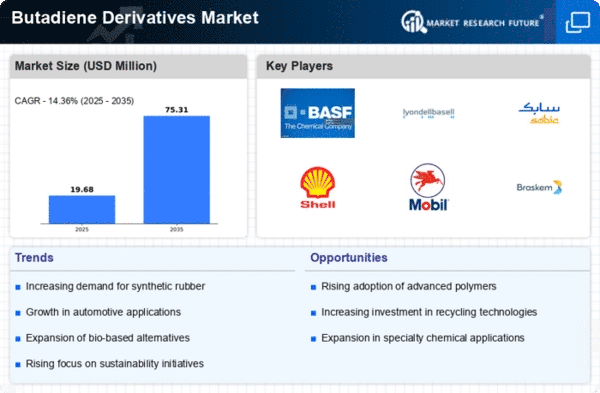
As per MRFR analysis, the Butadiene Derivatives Market Size was estimated at 17.21 USD Million in 2024. The Butadiene Derivatives industry is projected to grow from 19.68 USD Million in 2025 to 75.31 USD Million by 2035, exhibiting a compound annual growth rate (CAGR) of 14.36 during the forecast period 2025 - 2035.

Key Market Trends & Highlights

The Butadiene Derivatives Market is poised for growth driven by sustainability and technological advancements.

  • North America remains the largest market for butadiene derivatives, primarily due to its robust automotive sector.
  • Asia-Pacific is emerging as the fastest-growing region, fueled by increasing industrialization and demand for synthetic rubber.
  • The synthetic rubber segment dominates the market, while the coatings segment is experiencing rapid growth due to rising applications.
  • Key market drivers include the rising demand for synthetic rubber and regulatory support for sustainable practices.

Market Size & Forecast

2024 Market Size 17.21 (USD Million)
2035 Market Size 75.31 (USD Million)
CAGR (2025 - 2035) 14.36%
Largest Regional Market Share in 2024 Asia-Pacific

Major Players

<p>BASF SE (DE), LyondellBasell Industries N.V. (NL), SABIC (SA), Shell Chemicals (GB), ExxonMobil Chemical Company (US), Tosoh Corporation (JP), INEOS Group Limited (GB), LG Chem Ltd. (KR), Mitsubishi Chemical Corporation (JP)</p>

Market Trends

The Butadiene Derivatives Market is currently experiencing a dynamic phase characterized by evolving consumer preferences and technological advancements. The demand for butadiene derivatives is driven by their extensive applications in various industries, including automotive, textiles, and consumer goods. As sustainability becomes a focal point, manufacturers are increasingly exploring eco-friendly alternatives and innovative production methods. This shift not only aligns with The Butadiene Derivatives's resilience against fluctuating raw material prices. Furthermore, the integration of advanced technologies in production processes is likely to improve efficiency and reduce waste, thereby attracting investments in this sector. In addition, the Butadiene Derivatives Market is witnessing a surge in research and development activities aimed at enhancing product performance and expanding application areas. Companies are focusing on developing high-performance materials that meet stringent regulatory standards while catering to the growing demand for lightweight and durable products. This trend indicates a potential for growth in niche markets, as businesses seek to differentiate themselves through innovation. Overall, the Butadiene Derivatives Market appears poised for continued expansion, driven by a combination of technological progress and shifting market dynamics.

Sustainability Initiatives

The Butadiene Derivatives Market is increasingly influenced by sustainability initiatives. Companies are prioritizing eco-friendly production methods and materials to meet consumer demand for greener products. This trend reflects a broader commitment to reducing environmental impact and aligns with global sustainability goals.

Technological Advancements

Technological advancements are reshaping the Butadiene Derivatives Market. Innovations in production processes are enhancing efficiency and reducing costs. These developments enable manufacturers to produce higher-quality derivatives, thereby expanding their application potential across various industries.

Growing Demand in Automotive Sector

The automotive sector is driving significant demand for butadiene derivatives. As the industry shifts towards lightweight materials and improved performance, the need for high-quality derivatives is likely to increase. This trend suggests a robust growth opportunity for manufacturers in this segment.

Butadiene Derivatives Market Market Drivers

Growth in Plastics Production

The Global Butadiene Derivatives Market Industry is significantly influenced by the increasing production of plastics, particularly in packaging and consumer goods. Butadiene derivatives serve as essential feedstocks for producing various plastic materials, including polystyrene and acrylonitrile-butadiene-styrene (ABS). As global plastic production continues to rise, driven by urbanization and changing consumer preferences, the demand for butadiene derivatives is likely to follow suit. This growth is evident in the projected market value of 138.2 USD Billion in 2024, indicating a stable market environment. The ongoing shift towards sustainable packaging solutions may also impact the types of plastics produced, further influencing the derivatives market.

Rising Demand for Synthetic Rubber

The Global Butadiene Derivatives Market Industry experiences a notable increase in demand for synthetic rubber, primarily driven by the automotive and construction sectors. As the automotive industry continues to expand, the need for high-performance tires and other rubber products rises. In 2024, the market is valued at 138.2 USD Billion, reflecting the growing reliance on butadiene derivatives for producing synthetic rubber. This trend is expected to persist, as manufacturers seek to enhance product performance and durability. The construction sector also contributes to this demand, utilizing synthetic rubber in various applications, thereby bolstering the overall market growth.

Market Stability and Long-Term Projections

The Global Butadiene Derivatives Market Industry demonstrates a degree of stability, with projections indicating a market value of 138.2 USD Billion in 2035 and a CAGR of 0.0% for the period from 2025 to 2035. This stability may be attributed to the balanced supply and demand dynamics within the industry, as well as the ongoing development of applications for butadiene derivatives across various sectors. While growth may appear stagnant, the consistent market value suggests that the industry is likely to maintain its relevance in the global economy. Stakeholders may need to focus on innovation and efficiency to navigate this stable yet challenging market environment.

Regulatory Support for Sustainable Practices

The Global Butadiene Derivatives Market Industry benefits from increasing regulatory support for sustainable practices and environmentally friendly products. Governments worldwide are implementing stricter regulations aimed at reducing carbon emissions and promoting the use of renewable resources. This regulatory landscape encourages manufacturers to innovate and develop sustainable butadiene derivatives, which can lead to new market opportunities. As companies adapt to these regulations, they may find themselves better positioned to meet consumer demands for eco-friendly products. The anticipated market stability, with a projected value of 138.2 USD Billion in 2024, suggests that regulatory support could foster a more sustainable future for the industry.

Technological Advancements in Production Processes

Technological advancements in the production processes of butadiene derivatives play a crucial role in shaping the Global Butadiene Derivatives Market Industry. Innovations in catalytic processes and extraction techniques enhance efficiency and reduce production costs, making it more feasible for manufacturers to meet growing demand. These advancements not only improve yield but also minimize environmental impact, aligning with global sustainability goals. As companies adopt these technologies, they are likely to experience increased competitiveness in the market. This trend is particularly relevant as the industry anticipates a stable market value of 138.2 USD Billion in 2024, suggesting that technological improvements may sustain growth in the coming years.

Market Segment Insights

By Application: Synthetic Rubber (Largest) vs. Coatings (Fastest-Growing)

<p>The Butadiene Derivatives Market showcases a diverse range of applications, with synthetic rubber commanding the largest market share. This segment prevails due to its extensive use in tire manufacturing and automotive products. Conversely, the coatings segment is seeing rapid growth, driven by increasing demand for protective and decorative finishes in various industries including automotive and construction. Growth trends in the Butadiene Derivatives Market are influenced by several factors, including advancements in manufacturing processes and a rising focus on sustainability. The transition towards eco-friendly products is prompting innovations in coatings and adhesives, catering to consumer preferences. As industries continue to invest in R&D, both synthetic rubber and coatings are poised for sustained growth in upcoming years.</p>

<p>Synthetic Rubber (Dominant) vs. Coatings (Emerging)</p>

<p>Synthetic rubber holds a dominant position in the Butadiene Derivatives Market due to its critical role in the production of tires, footwear, and other rubber-based products. Its unparalleled elasticity and resistance to wear make it a preferred choice for manufacturers, solidifying its market leadership. On the other hand, coatings are an emerging segment, experiencing rapid advancements driven by innovative formulations that focus on performance and environmental sustainability. The coatings market is evolving as manufacturers adopt advanced techniques to enhance durability and aesthetics, aligning with industry trends towards higher quality standards. Thus, while synthetic rubber remains the bedrock of this market, coatings are swiftly gaining traction.</p>

By End Use Industry: Automotive (Largest) vs. Healthcare (Fastest-Growing)

<p>The butadiene derivatives market showcases a diverse distribution across various end-use industries. The automotive sector holds the largest share, leveraging butadiene derivatives for manufacturing tires, interior components, and various rubber products. In contrast, the healthcare industry, while having a smaller current share, is gaining traction due to increased demand for medical devices and safe packaging materials, thus marking its presence in the overall market landscape. As technology and environmental regulations evolve, the demand for butadiene derivatives in these industries is experiencing notable growth. The automotive sector is propelled by ongoing advancements in vehicle manufacturing and a shift towards electric vehicles, which necessitate lightweight and durable materials. Meanwhile, the healthcare sector is expanding rapidly due to heightened awareness around hygiene and safety, driving innovations in packaging and medical supplies that utilize butadiene derivatives effectively.</p>

<p>Automotive: Dominant vs. Healthcare: Emerging</p>

<p>In the Butadiene Derivatives Market, the automotive sector stands as the dominant player, utilizing butadiene derivatives extensively for its diverse applications, including tires and various synthetic rubber products. This sector benefits from established demand and continuous innovation in materials that enhance vehicle performance and efficiency. On the other hand, the healthcare sector represents an emerging opportunity, tapping into the potential of butadiene derivatives for safer and more efficient medical supplies and devices. The growth in this segment is powered by increasing investments in healthcare infrastructure, alongside a rising need for advanced materials that offer both durability and safety in medical applications. With this contrast, while automotive remains strong and stable, healthcare is set to rise rapidly in prominence.</p>

By Type of Butadiene Derivative: Acrylonitrile Butadiene Styrene (Largest) vs. Styrene Butadiene Rubber (Fastest-Growing)

<p>The Butadiene Derivatives Market is dominated by Acrylonitrile Butadiene Styrene (ABS), capturing a substantial share due to its versatile applications in automotive, consumer goods, and electronics. Styrene Butadiene Rubber (SBR) follows as a competitive segment, gaining traction thanks to its usage in tire manufacturing and industrial applications. Other derivatives such as Butadiene Rubber and Butadiene Acrylonitrile Rubber hold modest shares but play crucial roles in niche areas, contributing to the overall diversification of the market share landscape. Emerging segments like Polybutadiene also contribute significantly to applications in various industries, enhancing the segment's appeal.</p>

<p>Acrylonitrile Butadiene Styrene (Dominant) vs. Butadiene Rubber (Emerging)</p>

<p>Acrylonitrile Butadiene Styrene (ABS) remains the dominant player in the Butadiene Derivatives Market, known for its strength, toughness, and ease of processing. It is widely utilized in automotive interiors and electronic housings, making it essential for modern manufacturing. Conversely, Butadiene Rubber is an emerging product characterized by excellent elasticity and low hysteresis, appealing to industries focused on manufacturing high-performance tires and other rubber products. The growth of these segments is spurred by increased demand for durable and high-quality materials across various end-use industries, highlighting the shift toward innovative polymer solutions. As sustainability and performance become pivotal, both segments are positioned to play critical roles in shaping the market dynamics.</p>

By Production Method: Steam Cracking (Largest) vs. Catalytic Dehydrogenation (Fastest-Growing)

<p>In the Butadiene Derivatives Market, the production methods show a diverse landscape with Steam Cracking leading the market share, owing to its established presence in the industry. This method benefits from a robust operational framework and is widely adopted for its efficiency. Meanwhile, Catalytic Dehydrogenation is emerging rapidly, primarily driven by increasing demands for lighter and more efficient chemicals derived from butadiene. This shift is reflecting a more innovative approach within the sector, catering to evolving consumer preferences. The growth trends in production methods highlight a clear trajectory toward more sustainable and efficient processes. Steam Cracking remains a staple due to its versatility and proven technology, but Catalytic Dehydrogenation is gaining momentum due to technological advancements and regulatory push for lower emissions. Industry players are investing in R&D aimed at optimizing these production methods, indicating a significant shift towards improved efficiency and sustainability across the Butadiene Derivatives Market.</p>

<p>Steam Cracking (Dominant) vs. Hydrogenation (Emerging)</p>

<p>Steam Cracking is the dominant production method in the Butadiene Derivatives Market because of its extensive usage and established technology. This method enables the efficient conversion of hydrocarbons into olefins, including butadiene, making it a critical pathway for downstream applications. Moreover, it benefits from economies of scale and widespread infrastructure. On the other hand, Hydrogenation is regarded as an emerging technique that is breaching traditional market standards. It focuses on reducing by-products and enhancing the quality of butadiene derivatives. This method is gaining traction due to its ability to align with modern environmental standards and its potential to produce high-purity end-products that meet evolving market demands.</p>

By Form: Liquid (Largest) vs. Solid (Fastest-Growing)

<p>In the Butadiene Derivatives Market, the distribution among the forms shows that liquid derivatives hold a dominant position, appealing significantly to various industries for their versatility and ease of use. Solid derivatives are quickly gaining traction, attributed to their applications in specialty chemicals and robust performance in specific applications, thereby increasing their market presence and share.</p>

<p>Liquid (Dominant) vs. Solid (Emerging)</p>

<p>Liquid butadiene derivatives are widely recognized for their fluidity, making them suitable for use in numerous applications such as polymers and automotive products. Their physical properties allow for efficient transport and application across various industries. On the other hand, solid derivatives are emerging in the market, being increasingly preferred for their stability and performance advantages in chemical formulations. The transition towards solid forms is driven by demand for more durable and efficient alternatives, particularly in sectors focusing on advanced materials and sustainable solutions.</p>

Get more detailed insights about Butadiene Derivatives Market Research Report - Forecast till 2035

Regional Insights

North America : Established Market with Growth Potential

The North American butadiene derivatives market is poised for growth, driven by increasing demand in automotive and consumer goods sectors. With a market size of $4.5 billion, the region benefits from robust manufacturing capabilities and a strong regulatory framework that supports innovation. The push for sustainable practices and the adoption of advanced technologies are also key growth drivers, enhancing the market's potential in the coming years. Leading countries like the US and Canada dominate the landscape, with major players such as ExxonMobil and LyondellBasell leading the charge. The competitive environment is characterized by strategic partnerships and investments in R&D, aimed at developing eco-friendly derivatives. The presence of established companies ensures a steady supply chain, further solidifying North America's position in the global market.

Europe : Innovation and Sustainability Focus

Europe's butadiene derivatives market, valued at $3.5 billion, is characterized by a strong emphasis on sustainability and innovation. Regulatory frameworks, such as the European Green Deal, are driving the transition towards greener alternatives, fostering demand for bio-based derivatives. The region's commitment to reducing carbon emissions is a significant catalyst for market growth, aligning with global sustainability goals. Germany, France, and the Netherlands are leading countries in this sector, hosting key players like BASF and LyondellBasell. The competitive landscape is marked by collaborations between industry and academia, focusing on research and development of sustainable products. This synergy is expected to enhance the region's market share and position in The Butadiene Derivatives.

Asia-Pacific : Emerging Powerhouse in Butadiene

The Asia-Pacific region is the largest market for butadiene derivatives, with a market size of $8.5 billion. This growth is fueled by rapid industrialization, urbanization, and increasing demand from the automotive and construction sectors. Countries like China and India are leading the charge, supported by favorable government policies and investments in infrastructure, which are expected to drive further growth in the coming years. China stands out as a key player, with major companies like SABIC and LG Chem heavily investing in production capabilities. The competitive landscape is vibrant, with numerous local and international players vying for market share. The region's focus on expanding production capacity and enhancing supply chain efficiencies positions it as a formidable force in The Butadiene Derivatives.

Middle East and Africa : Resource-Rich Frontier for Growth

The Middle East and Africa (MEA) region, with a market size of $0.71 billion, is gradually emerging as a significant player in the butadiene derivatives market. The region's growth is driven by abundant natural resources and increasing investments in petrochemical industries. Governments are implementing policies to diversify economies, which is expected to boost demand for butadiene derivatives in various applications, including automotive and textiles. Countries like Saudi Arabia and South Africa are at the forefront, with key players such as SABIC and INEOS establishing a strong presence. The competitive landscape is evolving, with new entrants and local companies enhancing production capabilities. As infrastructure develops and regulatory frameworks improve, the MEA region is set to capture a larger share of the global market.

Key Players and Competitive Insights

The Butadiene Derivatives Market is characterized by a competitive landscape that is increasingly shaped by innovation, sustainability, and strategic partnerships. Key players such as BASF SE (DE), LyondellBasell Industries N.V. (NL), and SABIC (SA) are actively pursuing strategies that emphasize technological advancements and regional expansion. BASF SE (DE) has focused on enhancing its product portfolio through sustainable practices, while LyondellBasell Industries N.V. (NL) is leveraging digital transformation to optimize its operations. SABIC (SA) appears to be concentrating on strategic alliances to bolster its market presence, collectively influencing the competitive dynamics of the market.

The market structure is moderately fragmented, with several players vying for market share. Key business tactics include localizing manufacturing to reduce costs and enhance supply chain efficiency. This approach not only allows companies to respond swiftly to regional demands but also mitigates risks associated with global supply chain disruptions. The collective influence of these major players fosters a competitive environment where innovation and operational efficiency are paramount.

In November 2025, BASF SE (DE) announced the launch of a new line of bio-based butadiene derivatives aimed at reducing carbon emissions. This strategic move underscores the company's commitment to sustainability and positions it favorably in a market increasingly driven by environmental considerations. The introduction of these products is likely to enhance BASF's competitive edge, appealing to environmentally conscious consumers and industries.

In October 2025, LyondellBasell Industries N.V. (NL) unveiled a digital platform designed to streamline its supply chain operations. This initiative reflects the company's focus on digitalization, which is expected to improve operational efficiency and reduce costs. By integrating advanced analytics and AI into its supply chain, LyondellBasell is poised to enhance its responsiveness to market fluctuations, thereby strengthening its competitive position.

In September 2025, SABIC (SA) entered into a strategic partnership with a leading technology firm to develop innovative butadiene derivatives. This collaboration aims to leverage cutting-edge technologies to create high-performance materials. Such partnerships are indicative of a broader trend in the market, where companies are increasingly seeking synergies to drive innovation and expand their product offerings.

As of December 2025, the Butadiene Derivatives Market is witnessing trends that emphasize digitalization, sustainability, and strategic alliances. The shift from price-based competition to a focus on innovation and technology is becoming evident, as companies recognize the importance of supply chain reliability and product differentiation. Moving forward, competitive differentiation is likely to evolve, with firms that prioritize technological advancements and sustainable practices gaining a significant advantage in the marketplace.

Key Companies in the Butadiene Derivatives Market market include

Industry Developments

Future Outlook

Butadiene Derivatives Market Future Outlook

<p>The Butadiene Derivatives Market is projected to grow at a 14.36% CAGR from 2024 to 2035, driven by increasing demand in automotive and consumer goods sectors.</p>

New opportunities lie in:

  • <p>Expansion into bio-based butadiene derivatives</p>
  • <p>Development of advanced polymer formulations</p>
  • <p>Strategic partnerships with automotive manufacturers</p>

<p>By 2035, the market is expected to achieve robust growth, solidifying its position as a key player in the chemical industry.</p>

Market Segmentation

Butadiene Derivatives Market Form Outlook

  • Liquid
  • Solid
  • Gas

Butadiene Derivatives Market Application Outlook

  • Synthetic Rubber
  • Plastics
  • Adhesives
  • Coatings
  • Textiles

Butadiene Derivatives Market End Use Industry Outlook

  • Automotive
  • Construction
  • Electronics
  • Consumer Goods
  • Healthcare

Butadiene Derivatives Market Production Method Outlook

  • Steam Cracking
  • Catalytic Dehydrogenation
  • Extraction from C4 Fraction
  • Hydrogenation
  • Dehydrogenation

Butadiene Derivatives Market Type of Butadiene Derivative Outlook

  • Acrylonitrile Butadiene Styrene
  • Styrene Butadiene Rubber
  • Butadiene Rubber
  • Butadiene Acrylonitrile Rubber
  • Polybutadiene

Report Scope

MARKET SIZE 202417.21(USD Million)
MARKET SIZE 202519.68(USD Million)
MARKET SIZE 203575.31(USD Million)
COMPOUND ANNUAL GROWTH RATE (CAGR)14.36% (2024 - 2035)
REPORT COVERAGERevenue Forecast, Competitive Landscape, Growth Factors, and Trends
BASE YEAR2024
Market Forecast Period2025 - 2035
Historical Data2019 - 2024
Market Forecast UnitsUSD Million
Key Companies ProfiledBASF SE (DE), LyondellBasell Industries N.V. (NL), SABIC (SA), Shell Chemicals (GB), ExxonMobil Chemical Company (US), Tosoh Corporation (JP), INEOS Group Limited (GB), LG Chem Ltd. (KR), Mitsubishi Chemical Corporation (JP)
Segments CoveredApplication, End Use Industry, Type of Butadiene Derivative, Production Method, Form
Key Market OpportunitiesGrowing demand for sustainable materials drives innovation in the Butadiene Derivatives Market.
Key Market DynamicsRising demand for sustainable materials drives innovation in Butadiene Derivatives, influencing competitive dynamics and market strategies.
Countries CoveredNorth America, Europe, APAC, South America, MEA

FAQs

What is the growth rate of the Butadiene Derivatives Market?

Butadiene Derivatives Market is projected to grow at 4.65% CAGR during the Forecast 2025-2035.

Which region held the largest market share in the Butadiene Derivatives Market?

North America had the largest share of the global market.

Who are the key players in the Butadiene Derivatives Market?

Royal Dutch Shell Plc (Netherlands), LyondellBasell Industries Holdings B.V. (Netherlands), TPC Group (US), China Petrochemical Corporation (China), Exxon Mobil Corporation (US), BASF SE (Germany), Dow (US), Braskem (Brazil), China National Petroleum Corporation (China), and Eni S.p.A (Italy)

  1. Executive Summary
  2. Market Introduction
    1. Market Definition
    2. Scope of the Study
      1. Research Objectives
      2. Assumptions & Limitations
    3. Markets Structure
    4. Key
    5. Takeaways
  3. Market Research Methodology
    1. Research Process
    2. Primary Research
    3. Secondary Research
    4. Market Size Estimation
    5. Forecast Model
  4. Market Dynamics of the Global Butadiene Derivatives
    1. Market
    2. Introduction
    3. Drivers
    4. Restraints
    5. Opportunities
    6. Challenges
    7. Trends/Technology
  5. Market Factor Analysis of the
    1. Global Butadiene Derivatives Market
    2. Supply Chain Analysis
      1. Manufacturers/Producers
      2. Distributors/Retailers/Wholesalers/E-Commerce
      3. End User
    3. Raw Material Suppliers
    4. Porter’s Five Forces Analysis
      1. Threat
      2. Bargaining Power of Buyers
      3. Bargaining Power
      4. Threat of Substitutes
      5. Intensity of Competitive
    5. of New Entrants
    6. of Suppliers
    7. Rivalry
    8. Pricing Analysis
  6. Global Butadiene Derivatives Market, by
    1. Product Derivatives
    2. Introduction
    3. Styrene Butadiene Rubber (SBR)
      1. Market Estimates & Forecast, 2020−2027
      2. Market Estimates
    4. & Forecast, by Region, 2020−2027
    5. Polybutadiene Rubber (PBR)
      1. Market Estimates & Forecast, 2020−2027
      2. Market Estimates
    6. & Forecast, by Region, 2020−2027
    7. Acrylonitrile Butadiene Styrene
      1. Market Estimates & Forecast, 2020−2027
      2. Market
    8. (ABS)
    9. Estimates & Forecast, by Region, 2020−2027
    10. Styrene Butadiene
      1. Market Estimates & Forecast, 2020−2027
      2. Market
    11. Latex
    12. Estimates & Forecast, by Region, 2020−2027
    13. Adiponitrile
      1. Market Estimates &
    14. Market Estimates & Forecast, 2020−2027
    15. Forecast, by Region, 2020−2027
    16. Nitrile Rubber (NR)
      1. Market
      2. Market Estimates & Forecast,
    17. Estimates & Forecast, 2020−2027
    18. by Region, 2020−2027
    19. Others
      1. Market Estimates & Forecast,
      2. Market Estimates & Forecast, by Region, 2020−2027
  7. Global Butadiene Derivatives Market, by Application
    1. Introduction
    2. Tires and Rubber
      1. Market Estimates & Forecast, 2020−2027
      2. Market Estimates & Forecast, by Region, 2020−2027
    3. Injection-Molded
      1. Market Estimates & Forecast, 2020−2027
    4. Products
  8. Market Estimates & Forecast, by Region, 2020−2027
    1. Electronics
      1. Market Estimates & Forecast, 2020−2027
      2. Market Estimates
    2. & Forecast, by Region, 2020−2027
    3. Adhesives
      1. Market
      2. Market Estimates & Forecast,
    4. Estimates & Forecast, 2020−2027
    5. by Region, 2020−2027
    6. Paints
      1. Market Estimates & Forecast,
      2. Market Estimates & Forecast, by Region, 2020−2027
    7. Footwear
      1. Market Estimates & Forecast, 2020−2027
  9. Market Estimates & Forecast, by Region, 2020−2027
    1. Others
      1. Market Estimates &
    2. Market Estimates & Forecast, 2020−2027
    3. Forecast, by Region, 2020−2027
  10. Global Butadiene Derivatives Market,
    1. by Region
    2. Introduction
    3. North America
      1. Market Estimates
      2. Market Estimates & Forecast, by Product
      3. Market Estimates & Forecast, by Application,
      4. US
    4. & Forecast, 2020−2027
    5. Derivatives, 2020−2027
    6. Canada
  11. Market Estimates & Forecast, by Product Derivatives, 2020−2027
  12. Market Estimates & Forecast, by Application, 2020−2027
    1. Europe
      1. Market Estimates & Forecast, 2020−2027
      2. Market Estimates
      3. Market Estimates
      4. Germany
      5. France
      6. Italy
      7. Spain
      8. Russia
      9. Poland
      10. Rest of Europe
    2. & Forecast, by Product Derivatives, 2020−2027
    3. & Forecast, by Application, 2020−2027
    4. Market Estimates & Forecast, 2020−2027
    5. Forecast, by Product Derivatives, 2020−2027
    6. & Forecast, by Application, 2020−2027
    7. Estimates & Forecast, 2020−2027
    8. by Product Derivatives, 2020−2027
    9. by Application, 2020−2027
    10. Forecast, 2020−2027
    11. Derivatives, 2020−2027
    12. UK
    13. Estimates & Forecast, by Product Derivatives,2020−2027
    14. Estimates & Forecast, by Application, 2020−2027
    15. Market Estimates & Forecast, 2020−2027
    16. Forecast, by Product Derivatives,2020−2027
    17. Forecast, by Application, 2020−2027
    18. Estimates & Forecast, 2020−2027
    19. by Product Derivatives, 2020−2027
    20. by Application, 2020−2027
    21. Estimates & Forecast, 2020−2027
    22. by Product Derivatives, 2020−2027
    23. by Application, 2020−2027
    24. Asia-Pacific
      1. Market Estimates
      2. Market Estimates & Forecast, by Product
      3. Market Estimates & Forecast, by Application,
      4. China
    25. & Forecast, 2020−2027
    26. Derivatives, 2020−2027
    27. India
  13. Market Estimates & Forecast, by Product Derivatives, 2020−2027
  14. Market Estimates & Forecast, by Application, 2020−2027
    1. & Forecast, by Product Derivatives, 2020−2027
    2. & Forecast, by Application, 2020−2027
    3. & Forecast, by Product Derivatives, 2020−2027
    4. & Forecast, by Application, 2020−2027
    5. & Forecast, by Product Derivatives, 2020−2027
    6. & Forecast, by Application, 2020−2027
    7. & Forecast, by Product Derivatives, 2020−2027
    8. & Forecast, by Application, 2020−2027
    9. Estimates & Forecast, 2020−2027
    10. by Product Derivatives, 2020−2027
    11. by Application, 2020−2027
    12. & Forecast, 2020−2027
    13. Product Derivatives, 2020−2027
    14. by Application, 2020−2027
    15. & Forecast, 2020−2027
    16. Product Derivatives, 2020−2027
    17. by Application, 2020−2027
    18. & Forecast, 2020−2027
    19. Product Derivatives, 2020−2027
    20. by Application, 2020−2027
    21. & Forecast, by Product Derivatives, 2020−2027
    22. & Forecast, by Application, 2020−2027
    23. Market Estimates & Forecast, 2020−2027
    24. Forecast, by Product Derivatives, 2020−2027
    25. Forecast, by Application, 2020−2027
    26. Estimates & Forecast, 2020−2027
    27. by Product Derivatives, 2020−2027
    28. by Application, 2020−2027
    29. & Forecast, 2020−2027
    30. Product Derivatives, 2020−2027
    31. by Application, 2020−2027
    32. & Forecast, 2020−2027
    33. Product Derivatives, 2020−2027
    34. by Application, 2020−2027
    35. Estimates & Forecast, 2020−2027
    36. by Product Derivatives, 2020−2027
    37. by Application, 2020−2027
  15. Japan
  16. Market Estimates & Forecast, 2020−2027
  17. Market Estimates
  18. Market Estimates
  19. Australia & New Zealand
  20. Market Estimates & Forecast, 2020−2027
  21. Market Estimates
  22. Market Estimates
  23. Rest of Asia-Pacific
  24. Market Estimates & Forecast, 2020−2027
  25. Market Estimates
  26. Market Estimates
    1. Middle East & Africa
      1. Market Estimates & Forecast, 2020−2027
      2. Market Estimates
      3. Market Estimates
      4. GCC
      5. Israel
      6. North Africa
      7. Turkey
      8. Rest of Middle East & Africa
    2. Latin America
      1. Market Estimates &
      2. Market Estimates &
      3. Brazil
      4. Argentina
      5. Mexico
      6. Rest of Latin America
  27. Company Landscape
    1. Introduction
    2. Market Strategies
    3. Key Development Analysis (Expansion/Merger &
    4. Acquisitions/Joint Venture/New Product Development/Agreement/Investment)
    5. Company Profiles
    6. BASF SE
      1. Company Overview
      2. Financial
      3. Product/Business Segment Overview
      4. Key Strategies
      5. Key Developments
      6. SWOT Analysis
    7. Updates
    8. Royal Dutch Shell
      1. Company Overview
      2. Financial Updates
      3. Product/Business
      4. Key Strategies
      5. Key Developments
    9. Plc
    10. Segment Overview
    11. SWOT Analysis
    12. LyondellBasell Industries Holdings B.V.
      1. Company
      2. Financial Updates
      3. Product/Business Segment Overview
      4. Key Strategies
      5. Key Developments
      6. SWOT Analysis
    13. Overview
    14. TPC Group
      1. Company Overview
      2. Financial Updates
      3. Product/Business Segment Overview
      4. Key Strategies
      5. SWOT Analysis
    15. Key Developments
    16. China Petrochemical Corporation
      1. Company Overview
      2. Financial Updates
      3. Product/Business
      4. Key Strategies
      5. Key Developments
    17. Segment Overview
    18. SWOT Analysis
    19. Exxon Mobil Corporation
      1. Company Overview
      2. Financial Updates
      3. Product/Business Segment Overview
      4. Key Developments
      5. SWOT Analysis
      6. Company Overview
      7. Financial Updates
      8. Product/Business
      9. Key Strategies
      10. Key Developments
    20. Key Strategies
    21. Dow
    22. Segment Overview
    23. SWOT Analysis
    24. Braskem
      1. Company Overview
      2. Financial
      3. Product/Business Segment Overview
      4. Key Strategies
      5. Key Developments
      6. SWOT Analysis
    25. Updates
    26. China National
      1. Company Overview
      2. Financial Updates
      3. Product/Business Segment Overview
      4. Key Strategies
      5. SWOT Analysis
    27. Petroleum Corporation
    28. Key Developments
    29. Eni S.p.A
      1. Company
      2. Financial Updates
      3. Product/Business Segment Overview
      4. Key Strategies
      5. Key Developments
      6. SWOT Analysis
    30. Overview
  28. Conclusion
  29. LIST OF TABLES
  30. Global Butadiene Derivatives
  31. Market, by Region, 2020−2027
  32. North America: Butadiene Derivatives
  33. Market, by Country, 2020−2027
  34. Europe: Butadiene Derivatives Market,
    1. by Country, 2020−2027
  35. Asia-Pacific: Butadiene Derivatives Market,
    1. by Country, 2020−2027
  36. Middle East & Africa: Butadiene Derivatives
  37. Market, by Country, 2020−2027
  38. Latin America: Butadiene Derivatives
  39. Market, by Country, 2020−2027
  40. Global Butadiene Derivatives Product
  41. Derivatives Market, by Regions, 2020−2027
  42. North America: Butadiene
  43. Derivatives Product Derivatives Market, by Country, 2020−2027
    1. Table 9
  44. Europe: Butadiene Derivatives Product Derivatives Market, by Country, 2020−2027
  45. Table10 Asia-Pacific: Butadiene Derivatives Product Derivatives Market, by Country,
    1. Table11 Middle East & Africa: Butadiene Derivatives Product
  46. Derivatives Market, by Country, 2020−2027
    1. Table12 Latin America: Butadiene
  47. Derivatives Product Derivatives Market, by Country, 2020−2027
    1. Table13
  48. Global Butadiene Derivatives Application Market, by Regions, 2020−2027
  49. Table14 North America: Butadiene Derivatives Application Market, by Country, 2020−2027
  50. Table15 Europe: Butadiene Derivatives Application Market, by Country, 2020−2027
  51. Table16 Asia-Pacific: Butadiene Derivatives Application Market, by Country, 2020−2027
    1. Table17 Middle East & Africa: Butadiene Derivatives Application Market, by
    2. Country, 2020−2027
    3. Table18 Latin America: Butadiene Derivatives by Application
  52. Market, by Country, 2016-2023
    1. Table19 Global Product Derivatives Market, by
    2. Region, 2020−2027
  53. Table20 Global Application Market, by Region, 2020−2027
  54. Table21 North America: Butadiene Derivatives Market, by Country, 2020−2027
  55. Table22 North America: Butadiene Derivatives Market, by Product Derivatives,
  56. Table23 North America: Butadiene Derivatives Market, by Application,
  57. Table24 Europe: Butadiene Derivatives Market, by Country,
  58. Table25 Europe: Butadiene Derivatives Market, by Product Derivatives,
  59. Table26 Europe: Butadiene Derivatives Market, by Application,
  60. Table27 Asia-Pacific: Butadiene Derivatives Market, by Country,
  61. Table28 Asia-Pacific: Butadiene Derivatives Market, by Product
    1. Derivatives, 2020−2027
    2. Table29 Asia-Pacific: Butadiene Derivatives Market,
    3. by Application, 2020−2027
    4. Table30 Middle East & Africa: Butadiene
  62. Derivatives Market, by Country, 2020−2027
    1. Table31 Middle East & Africa:
  63. Butadiene Derivatives Market, by Product Derivatives, 2020−2027
    1. Table32
  64. Middle East & Africa: Butadiene Derivatives Market, by Application, 2020−2027
  65. Table33 Latin America: Butadiene Derivatives Market, by Country, 2020−2027
  66. Table34 Latin America: Butadiene Derivatives Market, by Product Derivatives,
  67. Table35 Latin America: Butadiene Derivatives Market, by Application,
  68. LIST OF FIGURES
  69. Global Butadiene Derivatives
    1. Market Segmentation
  70. Forecast Research Methodology
  71. Five
    1. Forces Analysis of the Global Butadiene Derivatives Market
  72. Value Chain
    1. of the Global Butadiene Derivatives Market
  73. Global Butadiene Derivatives
  74. Market, 2020−2027, by Country, 2020
  75. Share of the Global Butadiene
  76. Derivatives Market, by Product Derivatives, 2020−2027
  77. Global
  78. Butadiene Derivatives Market Size, by Product Derivatives, 2020
  79. Share
  80. of the Global Butadiene Derivatives Market, by Product Derivatives, 2020−2027
  81. Global Butadiene Derivatives Market Size, by Application, 2020
    1. FIGURE10
  82. Share of the Global Butadiene Derivatives Market, by Application, 2020−2027

Butadiene Derivatives Market Segmentation

Market Segmentation Overview

  • Detailed segmentation data will be available in the full report
  • Comprehensive analysis by multiple parameters
  • Regional and country-level breakdowns
  • Market size forecasts by segment
Infographic

Free Sample Request

Kindly complete the form below to receive a free sample of this Report

Get Free Sample

Customer Strories

Compare Licence

×
Features License Type
Single User Multiuser License Enterprise User
Price $4,950 $5,950 $7,250
Maximum User Access Limit 1 User Upto 10 Users Unrestricted Access Throughout the Organization
Free Customization
Direct Access to Analyst
Deliverable Format
Platform Access
Discount on Next Purchase 10% 15% 15%
Printable Versions