×
Request Free Sample ×

Kindly complete the form below to receive a free sample of this Report

* Please use a valid business email

Leading companies partner with us for data-driven Insights

clients tt-cursor
Hero Background
English
Chinese
French
Japanese
Korean
German
Spanish

Buses and coaches Market Analysis

ID: MRFR/AT/9948-CR
188 Pages
Swapnil Palwe
March 2024

Buses and Coaches Market Research Report Information by Type (Single Deck, Double Deck, Low floor buses, Minibus, Coaches and Others), by Propulsion (ICE and Electric), by Seat Capacity (15-30 Seats, 31-50 Seats and more than 50 Seats), By Application (City Buses, Intercity Coaches, Airport Shuttle, Delivery Van, School Buses and Others), By Sales Channel (OEM and Aftermarket) and By Region (North America, Europe, Asia-Pacific, Middle East & Africa, and South America) –Market Forecast Till 2035

Share:
Download PDF ×

We do not share your information with anyone. However, we may send you emails based on your report interest from time to time. You may contact us at any time to opt-out.

Buses and coaches Market Infographic
Purchase Options

Market Analysis

In-depth Analysis of Buses and coaches Market Industry Landscape

The buses and coaches market is influenced by a myriad of factors that collectively contribute to its size, growth, and dynamics. One of the primary drivers of this market is the increasing demand for sustainable and efficient public transportation solutions. As urbanization continues to accelerate globally, cities face challenges related to traffic congestion, pollution, and the need for reliable mass transit. Buses and coaches emerge as viable solutions, offering a more environmentally friendly alternative to individual car ownership and helping alleviate congestion in urban areas.

Government initiatives and policies play a pivotal role in shaping the buses and coaches market. Many governments around the world are implementing measures to promote public transportation, reduce emissions, and enhance the overall efficiency of transit systems. Incentives, subsidies, and regulatory frameworks aimed at supporting the adoption of clean and sustainable transportation solutions significantly impact the market. As a result, both public and private entities are incentivized to invest in modernizing their fleets with environmentally friendly buses and coaches, further boosting market growth.

Advancements in technology are transforming the buses and coaches market, driving innovation and improving the overall efficiency and sustainability of these vehicles. The development of electric and hybrid buses is gaining traction, addressing concerns related to air quality and reducing the carbon footprint of public transportation. Additionally, the integration of smart and connected technologies, such as real-time tracking systems, Wi-Fi connectivity, and advanced safety features, enhances the appeal and functionality of buses and coaches, contributing to market expansion.

Global trends in urban mobility, including a shift toward multimodal transportation systems, are influencing the buses and coaches market. Integrated transportation networks that seamlessly connect buses, coaches, trains, and other modes of transit are becoming increasingly important for providing commuters with convenient and efficient travel options. This trend encourages investments in modernizing bus and coach fleets to integrate seamlessly into broader transportation ecosystems, fostering market growth.

The growing emphasis on sustainability and corporate social responsibility (CSR) is encouraging businesses and fleet operators to adopt greener transportation solutions. As companies strive to reduce their environmental impact and meet sustainability goals, the demand for eco-friendly buses and coaches is on the rise. This shift in corporate mindset not only positively influences the market but also aligns with broader global efforts to combat climate change and reduce dependency on fossil fuels.

Market factors related to demographic trends also contribute to the growth of the buses and coaches market. In regions experiencing population growth and urbanization, the demand for efficient and affordable public transportation options is higher. Additionally, an aging population in some areas creates opportunities for the development of accessible and comfortable buses and coaches designed to cater to the specific needs of elderly passengers, further influencing market dynamics.

Infrastructure development, including the expansion and improvement of urban transportation networks, is a critical factor in the buses and coaches market. Investments in new roads, bus lanes, and transit hubs enhance the accessibility and efficiency of public transportation systems. Governments and city planners recognizing the importance of a well-connected and efficient transit infrastructure contribute to a favorable market environment for buses and coaches.

In conclusion, the buses and coaches market is shaped by a complex interplay of factors ranging from government policies and technological advancements to global trends in sustainability and urbanization. As the demand for efficient and environmentally friendly transportation solutions continues to grow, the buses and coaches market is poised for further expansion, presenting opportunities for industry players to innovate and contribute to the evolution of public transit systems worldwide.

Author
Swapnil Palwe
Team Lead - Research

With a technical background as Bachelor's in Mechanical Engineering, with MBA in Operations Management , Swapnil has 6+ years of experience in market research, consulting and analytics with the tasks of data mining, analysis, and project execution. He is the POC for our clients, for their consulting projects running under the Automotive/A&D domain. Swapnil has worked on major projects in verticals such as Aerospace & Defense, Automotive and many other domain projects. He has worked on projects for fortune 500 companies' syndicate and consulting projects along with several government projects.

Leave a Comment

FAQs

How much is the Buses and Coaches Market?

The Buses and Coaches Market size is expected to be valued at USD 37,510.0 Million in 2022.

What is the growth rate of the Buses and Coaches Market?

The global market is projected to grow at a CAGR of 6.3 % during the forecast period, 2023-2032.

Which region held the largest market share in the Buses and Coaches Market?

Asia-Pacific had the largest share of the global market.

Who are the key players in the Buses and Coaches Market?

The key players in the market are Anhui Ankai Automobile Co., Ltd, BYD Company Limited, Daimler Truck AG, Proterra, AB Volvo, MAN, Xiamen King Long United Automotive Industry Co., Ltd, Yutong Bus Co., Ltd., NFI Group, and Tata Motors.

Which Type led the Buses and Coaches Market?

The single deck category dominated the market in 2022.

Market Summary

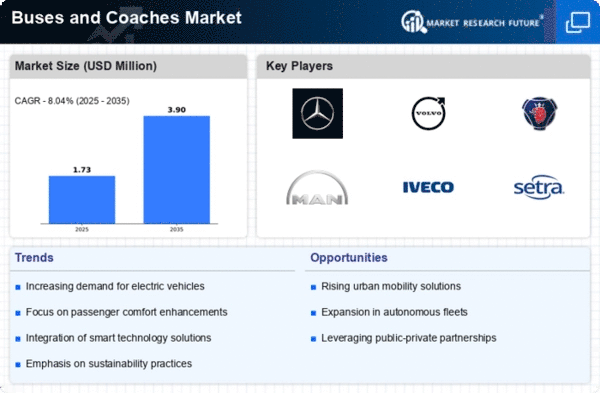
As per MRFR analysis, the Buses and Coaches Market Size was estimated at 1.6 USD Million in 2024. The Buses and coaches industry is projected to grow from 1.8 in 2025 to 3.9 by 2035, exhibiting a compound annual growth rate (CAGR) of 8.04 during the forecast period 2025 - 2035.

Key Market Trends & Highlights

The Buses and Coaches Market is experiencing a transformative shift towards electrification and smart technologies, driven by urbanization and sustainability initiatives.

  • The market is witnessing a significant shift towards electrification, particularly in North America, which remains the largest market. Integration of smart technologies is becoming increasingly prevalent, enhancing operational efficiency and passenger experience in the Asia-Pacific region. Public transport continues to dominate the market, while the tourism segment is emerging as the fastest-growing area, reflecting changing commuter preferences. Sustainability initiatives and government funding are major drivers propelling the demand for single decker buses, which remain the largest segment, alongside the rapid growth of double decker buses.

Market Size & Forecast

2024 Market Size 1.6 (USD Million)
2035 Market Size 3.9 (USD Million)
CAGR (2025 - 2035) 8.04%
Largest Regional Market Share in 2024 North America

Major Players

Mercedes-Benz (DE), Volvo (SE), <a href="https://www.scania.com/buses-and-coaches.html">Scania</a> (SE), MAN (DE), Iveco (IT), Setra (DE), Bluebird (US), <a href="https://www.alexander-dennis.com/buses/">Gillig</a> (US), Alexander Dennis (GB)

Market Trends

The Buses and coaches Market is currently experiencing a transformative phase, characterized by a shift towards sustainability and technological advancements. As environmental concerns gain prominence, manufacturers are increasingly focusing on electric and hybrid models, which are perceived as more eco-friendly alternatives to traditional diesel-powered vehicles. This transition not only aligns with global emissions targets but also caters to the growing consumer demand for greener transportation options. Furthermore, advancements in smart technologies are enhancing the operational efficiency of buses and coaches, leading to improved passenger experiences and optimized fleet management. In addition to sustainability, the Buses and coaches Market is witnessing a rise in urbanization, which is reshaping public transportation needs. Cities are expanding, and with this growth comes the necessity for efficient mass transit solutions. Consequently, there is a heightened emphasis on developing integrated transport systems that facilitate seamless connectivity between various modes of transport. This trend indicates a potential for increased investment in infrastructure and innovative transport solutions, which could further stimulate market growth. Overall, the Buses and coaches Market appears poised for significant evolution, driven by a combination of environmental imperatives and urban development.

Shift Towards Electrification

The Buses and coaches Market is increasingly leaning towards electrification, with manufacturers prioritizing electric and hybrid models. This trend reflects a broader commitment to reducing carbon emissions and enhancing energy efficiency, as stakeholders recognize the importance of sustainable transport solutions.

Integration of Smart Technologies

The incorporation of smart technologies is becoming prevalent within the Buses and coaches Market. Innovations such as real-time tracking, automated ticketing systems, and enhanced passenger information systems are improving operational efficiency and elevating the overall travel experience.

Urbanization and Public Transport Demand

As urban areas continue to expand, the demand for efficient public transport solutions is intensifying. The Buses and coaches Market is responding to this need by developing integrated transport systems that promote seamless connectivity, thereby enhancing accessibility and convenience for commuters.

Buses and coaches Market Market Drivers

Rising Fuel Prices

Rising fuel prices are influencing the Global Buses and Coaches Market Industry by prompting a shift towards more sustainable transport options. As fuel costs escalate, both operators and passengers are seeking alternatives that offer better economic viability. This has led to increased interest in electric and hybrid buses, which, despite higher initial costs, promise lower operational expenses over time. For example, cities are investing in electric bus infrastructure to mitigate the impact of fuel price volatility. This trend indicates a potential for market expansion, as more stakeholders recognize the long-term benefits of transitioning to alternative fuel sources.

Growing Urbanization

The Global Buses and Coaches Market Industry is experiencing a surge driven by rapid urbanization. As cities expand, the demand for public transportation solutions increases, leading to a projected market value of 40.3 USD Billion in 2024. Urban areas are increasingly adopting buses and coaches as efficient means of transport to alleviate traffic congestion and reduce pollution. For instance, cities like London and New York have invested heavily in modern bus fleets, enhancing service frequency and reliability. This trend indicates a shift towards sustainable urban mobility, suggesting that the market will continue to grow as urban populations rise.

Environmental Regulations

Stringent environmental regulations are shaping the Global Buses and Coaches Market Industry. Governments worldwide are implementing policies aimed at reducing greenhouse gas emissions, which encourages the adoption of cleaner technologies in public transport. Electric and hybrid buses are gaining traction as cities strive to meet these regulations. For example, the European Union has set ambitious targets for reducing emissions, prompting cities to transition to electric buses. This regulatory environment not only fosters innovation but also positions the market for substantial growth, potentially reaching 82.8 USD Billion by 2035 as more regions adopt eco-friendly transport solutions.

Market Growth Projections

The Global Buses and Coaches Market Industry is projected to experience robust growth, with a market value expected to reach 82.8 USD Billion by 2035. This growth trajectory reflects a compound annual growth rate of 6.76% from 2025 to 2035. The increasing demand for efficient public transport solutions, coupled with technological advancements and supportive government policies, is likely to drive this expansion. Furthermore, the shift towards sustainable transport options and the need for improved urban mobility solutions are anticipated to contribute to this upward trend. The market's resilience in adapting to changing consumer preferences and regulatory landscapes suggests a promising future.

Technological Advancements

Technological advancements are a key driver in the Global Buses and Coaches Market Industry. Innovations such as smart ticketing systems, real-time tracking, and autonomous driving technology are enhancing the efficiency and appeal of bus services. For instance, cities are increasingly implementing contactless payment systems, making public transport more user-friendly. Moreover, the integration of artificial intelligence in fleet management optimizes routes and reduces operational costs. These advancements are likely to attract more users to public transport, contributing to a compound annual growth rate of 6.76% from 2025 to 2035, as the industry evolves to meet modern transportation needs.

Increasing Public Transport Investments

Increasing investments in public transport infrastructure are significantly impacting the Global Buses and Coaches Market Industry. Governments are allocating substantial budgets to enhance public transport systems, recognizing their role in economic development and sustainability. For instance, many countries are prioritizing the expansion of bus rapid transit systems, which offer efficient and cost-effective solutions for urban mobility. This influx of funding is likely to bolster the market, as improved infrastructure attracts more users and encourages the adoption of modern bus fleets. Consequently, the market is poised for growth, with projections indicating a value of 82.8 USD Billion by 2035.

Market Segment Insights

By Application: Public Transport (Largest) vs. Tourism (Fastest-Growing)

In the Buses and Coaches Market, <a href="https://www.marketresearchfuture.com/reports/public-transport-market-8677">Public Transport</a> holds the largest share, serving as the backbone of urban mobility and catering to millions of commuters daily. Its significant market presence is attributed to government investments and the increasing focus on sustainable transportation solutions. Conversely, the Tourism application is experiencing rapid growth, driven by the resurgence of travel and tourism following global disruptions. This segment's expansion is marked by rising disposable incomes and consumer preferences for group travel, making it a strong competitor in the market.

Public Transport (Dominant) vs. Tourism (Emerging)

Public Transport is the dominant application in the Buses and Coaches Market, characterized by extensive route networks that provide essential connectivity in urban areas. It benefits from robust government support aimed at enhancing public infrastructure and reducing traffic congestion. Its loyal ridership stems from the affordability and convenience offered to daily commuters. In contrast, the Tourism sector is an emerging force, fueled by the growing trend of experiential travel. Tour operators are increasingly turning to bus and coach services to accommodate larger groups, capitalizing on the flexibility and cost-effectiveness of these vehicles. The segment's growth is also supported by innovative service offerings that enhance the travel experience, including luxury coaches and guided tours.

By Vehicle Type: Single Decker (Largest) vs. Double Decker (Fastest-Growing)

In the Buses and Coaches market, the Single Decker segment holds the largest market share, catering primarily to urban transport systems and school transportation. This vehicle type's popularity stems from its versatility and efficiency in navigating city streets, making it an essential mode of transport. In contrast, the Double Decker segment, while smaller in share, is gaining traction due to its unique ability to maximize passenger capacity without increasing the vehicle's footprint, making it ideal for crowded urban areas. The growth trends in the Vehicle Type segment are driven by the rising demand for mass transportation solutions that are both economical and environmentally friendly. Increasing urbanization and population density in major cities are propelling the need for efficient bus systems. Additionally, innovations in design and technology, such as electric and hybrid buses, are making the Double Decker segment more appealing to city planners and transport authorities who seek to reduce traffic congestion and enhance public transport's attractiveness.

Single Decker (Dominant) vs. Articulated Bus (Emerging)

The Single Decker buses dominate the market due to their efficiency in urban environments, where space is often at a premium. These buses are typically favored for their smaller size and ability to operate on various routes, making them a common choice for everyday public transportation. Conversely, the Articulated Bus segment is emerging as a significant player, particularly in high-density urban areas. Known for their longer length and flexible design, articulated buses can carry more passengers while maintaining maneuverability in tight spaces. The unique design allows them to navigate complex routes while offering a comfortable ride, making them a suitable choice for express services and transit corridors.

By Fuel Type: Internal Combustion Engine (Largest) vs. Electric (Fastest-Growing)

In the Buses and Coaches market, the Internal Combustion Engine remains the largest fuel type, commanding a significant portion of the total market share. Despite the rise of alternative fuel types, traditional diesel buses are still widely used for public transportation due to their established infrastructure and operational efficiency. Conversely, the Electric segment is witnessing rapid growth, reflecting a shift towards sustainable transportation solutions and government mandates for cleaner energy usage.

Internal Combustion Engine (Dominant) vs. Electric (Emerging)

The Internal Combustion Engine segment dominates the Buses and Coaches market, primarily owing to its widespread adoption and operational familiarity among transport operators. Diesel-powered buses are praised for their longevity, extensive range, and ability to serve high-demand routes effectively. However, the Electric segment is rapidly emerging, driven by advancements in battery technology and incentives for zero-emission vehicles. Electric buses are viewed as future-oriented, providing an eco-friendly alternative with lower operating costs, making them increasingly attractive for modern transit fleets.

By Passenger Capacity: 51 to 100 (Largest) vs. 20 to 50 (Fastest-Growing)

In the Buses and Coaches Market, the 'Passenger Capacity' segment exhibits significant variation in market share distribution. The segment of '51 to 100' seats captures the largest share, making it the preferred choice for many commercial operators due to its balanced capacity for both short and long trips. In contrast, the '20 to 50' segment is gaining traction, especially among small businesses and community transportation services, as it caters to niche markets and offers flexible sizing options that meet specific需求.

51 to 100 (Dominant) vs. 20 to 50 (Emerging)

The '51 to 100' passenger capacity segment is the dominant player in the Buses and Coaches Market as it meets the diverse needs of urban and intercity transport, combining capacity and comfort. Traditionally favored for its ability to accommodate group travels while still being easy to maneuver in urban environments, this segment is also witnessing continued demand due to an increase in tourism and corporate travel. On the other hand, the '20 to 50' capacity segment is emerging rapidly due to a focus on community-based transport solutions and the rise of micro-mobility services. This segment is gaining popularity as operators seek vehicles that are efficient for smaller groups, further fueled by concerns over environmental impact and the desire for cost-effective transportation solutions.

By Chassis Type: Low Floor Chassis (Largest) vs. Electric Chassis (Fastest-Growing)

In the Buses and coaches Market, the chassis type segment is primarily dominated by the Low Floor Chassis, which offers enhanced accessibility and comfort for passengers, leading to its largest market share. The Conventional Chassis follows, suited for traditional bus applications, while the High Floor Chassis serves niche markets requiring higher passenger capacities. The Articulated Chassis caters to metropolitan areas with larger passenger volumes but holds a smaller percentage of the overall market. Electric Chassis are gaining traction due to environmental considerations and government incentives, marking a shift in consumer preferences towards sustainable transport solutions.

Conventional Chassis (Dominant) vs. Electric Chassis (Emerging)

The Conventional Chassis remains a dominant force in the Buses and coaches Market, characterized by its traditional design and robust performance in urban and suburban routes. This chassis type is known for its reliability and cost-effectiveness, making it a preferred choice among fleet operators. On the other hand, the Electric Chassis represents the emerging trend towards sustainable transportation. With advancements in battery technology and increasing environmental regulations, this chassis type is rapidly being integrated into fleets seeking to reduce their carbon footprint. As cities invest in cleaner public transport solutions, the Electric Chassis is poised to capture a significant market share, offering benefits like lower operating costs and fewer emissions.

Get more detailed insights about Buses and Coaches Market Research Report - Forecast to 2035

Regional Insights

Middle East and Africa : Developing Transport Infrastructure

The Middle East and Africa region, with a market share of 8%, is gradually developing its buses and coaches market, driven by urbanization and infrastructure projects. Governments are increasingly recognizing the importance of public transport systems to alleviate traffic congestion and improve air quality. Investments in transport infrastructure are expected to boost market growth significantly in the coming years. Countries like South Africa and the UAE are leading the way in adopting modern bus systems. The competitive landscape is evolving, with both local and international players entering the market. Key manufacturers are focusing on providing cost-effective and reliable solutions to meet the growing demand for public transport, making this region a potential growth hub for the buses and coaches market.

Key Players and Competitive Insights

The Buses and coaches Market is currently characterized by a dynamic competitive landscape, driven by factors such as urbanization, increasing public transportation demand, and a growing emphasis on sustainability. Major players like Mercedes-Benz (DE), Volvo (SE), and Scania (SE) are strategically positioned to leverage these trends. Mercedes-Benz (DE) focuses on innovation in electric bus technology, while Volvo (SE) emphasizes safety and environmental performance. Scania (SE) is enhancing its operational efficiency through digital transformation initiatives. Collectively, these strategies not only enhance their market presence but also shape a competitive environment that increasingly prioritizes technological advancement and sustainability.
Key business tactics employed by these companies include localizing manufacturing and optimizing supply chains to enhance responsiveness to market demands. The market structure appears moderately fragmented, with several key players exerting considerable influence. This fragmentation allows for a diverse range of offerings, catering to various customer needs while fostering competition that drives innovation and efficiency.
In November 2025, Volvo (SE) announced a partnership with a leading technology firm to develop advanced AI systems for fleet management. This strategic move is likely to enhance operational efficiency and reduce costs for fleet operators, positioning Volvo as a leader in smart transportation solutions. The integration of AI into fleet management could significantly improve route optimization and maintenance scheduling, thereby increasing overall service reliability.
In October 2025, Scania (SE) unveiled its latest line of electric buses, which are designed to meet the stringent emissions regulations set to take effect in 2026. This launch not only underscores Scania's commitment to sustainability but also positions the company favorably in a market increasingly driven by environmental considerations. The introduction of these electric buses may attract environmentally conscious consumers and public transport authorities, enhancing Scania's competitive edge.
In September 2025, Mercedes-Benz (DE) expanded its electric bus production facility in Germany, aiming to double its output by 2026. This expansion reflects the company's strategic focus on meeting the growing demand for electric public transport solutions. By increasing production capacity, Mercedes-Benz is likely to strengthen its market position and respond effectively to the rising trend of electrification in public transport.
As of December 2025, current competitive trends in the Buses and coaches Market are heavily influenced by digitalization, sustainability, and the integration of AI technologies. Strategic alliances are becoming increasingly vital, as companies seek to enhance their technological capabilities and market reach. The competitive differentiation is expected to evolve from traditional price-based competition towards a focus on innovation, technology, and supply chain reliability, indicating a shift in how companies will compete in the future.

Key Companies in the Buses and coaches Market include

Industry Developments

    • In May 2023, King Long has signed strategic cooperation agreement with Vivipra, a long-distance bus sales agent in Chile. This agreement will enhance the brand recognition & influence of King Long and promote the development of local public transportation in Chile.

    • In April 2023, Volvo Penta has invested in Utility Innovation Group (UIG) to acquire a minority stake in the group. This investment will accelerate Volvo Penta’s entry into the utility sector and further develop battery energy storage subsystem & power generation portfolio as part of its road to net zero.

    • In Septem,ber 2022, Ankai has signed a framework cooperation agreement with JAC Group, Fudi Battery Co., Ltd. and Zhechu Energy Group Co., Ltd. for Vehicle Power Battery Development & Production. The company will Invest 450 million RMB in this new joint venture.

Future Outlook

Buses and coaches Market Future Outlook

The Buses and Coaches Market is projected to grow at an 8.04% CAGR from 2025 to 2035, driven by urbanization, technological advancements, and sustainability initiatives.

New opportunities lie in:

  • Integration of electric and hybrid bus technologies
  • Development of smart ticketing systems for enhanced user experience
  • Expansion of autonomous bus services in urban areas

By 2035, the market is expected to be robust, driven by innovation and increased demand for sustainable transport solutions.

Market Segmentation

Buses and coaches Market Fuel Type Outlook

  • Internal Combustion Engine
  • Electric
  • Hybrid
  • Compressed Natural Gas
  • Hydrogen

Buses and coaches Market Application Outlook

  • Public Transport
  • Tourism
  • School Transport
  • Corporate Transport
  • Freight Transport

Buses and coaches Market Chassis Type Outlook

  • Conventional Chassis
  • Low Floor Chassis
  • High Floor Chassis
  • Articulated Chassis
  • Electric Chassis

Buses and coaches Market Vehicle Type Outlook

  • Single Decker
  • Double Decker
  • Minibus
  • Coach
  • Articulated Bus

Buses and coaches Market Passenger Capacity Outlook

  • Less than 20
  • 20 to 50
  • 51 to 100
  • 101 to 150
  • More than 150

Report Scope

MARKET SIZE 2024 1.6(USD Million)
MARKET SIZE 2025 1.8(USD Million)
MARKET SIZE 2035 3.9(USD Million)
COMPOUND ANNUAL GROWTH RATE (CAGR) 8.04% (2025 - 2035)
REPORT COVERAGE Revenue Forecast, Competitive Landscape, Growth Factors, and Trends
BASE YEAR 2024
Market Forecast Period 2025 - 2035
Historical Data 2019 - 2024
Market Forecast Units USD Million
Key Companies Profiled Mercedes-Benz (DE), Volvo (SE), Scania (SE), MAN (DE), Iveco (IT), Setra (DE), Bluebird (US), Gillig (US), Alexander Dennis (GB)
Segments Covered Application, Vehicle Type, Fuel Type, Passenger Capacity, Chassis Type
Key Market Opportunities Integration of electric and autonomous technologies in the Buses and coaches Market presents substantial growth opportunities.
Key Market Dynamics Rising demand for electric buses driven by environmental regulations and shifting consumer preferences towards sustainable transportation solutions.
Countries Covered North America, Europe, APAC, South America, MEA

FAQs

How much is the Buses and Coaches Market?

The Buses and Coaches Market size is expected to be valued at USD 37,510.0 Million in 2022.

What is the growth rate of the Buses and Coaches Market?

The global market is projected to grow at a CAGR of 6.3 % during the forecast period, 2023-2032.

Which region held the largest market share in the Buses and Coaches Market?

Asia-Pacific had the largest share of the global market.

Who are the key players in the Buses and Coaches Market?

The key players in the market are Anhui Ankai Automobile Co., Ltd, BYD Company Limited, Daimler Truck AG, Proterra, AB Volvo, MAN, Xiamen King Long United Automotive Industry Co., Ltd, Yutong Bus Co., Ltd., NFI Group, and Tata Motors.

Which Type led the Buses and Coaches Market?

The single deck category dominated the market in 2022.

  1. SECTION I: EXECUTIVE SUMMARY AND KEY HIGHLIGHTS
    1. EXECUTIVE SUMMARY
      1. Market Overview
      2. Key Findings
      3. Market Segmentation
      4. Competitive Landscape
      5. Challenges and Opportunities
      6. Future Outlook
  2. SECTION II: SCOPING, METHODOLOGY AND MARKET STRUCTURE
    1. MARKET INTRODUCTION
      1. Definition
      2. Scope of the study
    2. RESEARCH METHODOLOGY
      1. Overview
      2. Data Mining
      3. Secondary Research
      4. Primary Research
      5. Forecasting Model
      6. Market Size Estimation
      7. Data Triangulation
      8. Validation
  3. SECTION III: QUALITATIVE ANALYSIS
    1. MARKET DYNAMICS
      1. Overview
      2. Drivers
      3. Restraints
      4. Opportunities
    2. MARKET FACTOR ANALYSIS
      1. Value chain Analysis
      2. Porter's Five Forces Analysis
      3. COVID-19 Impact Analysis
  4. SECTION IV: QUANTITATIVE ANALYSIS
    1. Automobile, BY Application (USD Million)
      1. Public Transport
      2. Tourism
      3. School Transport
      4. Corporate Transport
      5. Freight Transport
    2. Automobile, BY Vehicle Type (USD Million)
      1. Single Decker
      2. Double Decker
      3. Minibus
      4. Coach
      5. Articulated Bus
    3. Automobile, BY Fuel Type (USD Million)
      1. Internal Combustion Engine
      2. Electric
      3. Hybrid
      4. Compressed Natural Gas
      5. Hydrogen
    4. Automobile, BY Passenger Capacity (USD Million)
      1. Less than 20
      2. 20 to 50
      3. 51 to 100
      4. 101 to 150
      5. More than 150
    5. Automobile, BY Chassis Type (USD Million)
      1. Conventional Chassis
      2. Low Floor Chassis
      3. High Floor Chassis
      4. Articulated Chassis
      5. Electric Chassis
    6. Automobile, BY Region (USD Million)
      1. North America
      2. Europe
      3. APAC
      4. South America
      5. MEA
  5. SECTION V: COMPETITIVE ANALYSIS
    1. Competitive Landscape
      1. Overview
      2. Competitive Analysis
      3. Market share Analysis
      4. Major Growth Strategy in the Automobile
      5. Competitive Benchmarking
      6. Leading Players in Terms of Number of Developments in the Automobile
      7. Key developments and growth strategies
      8. Major Players Financial Matrix
    2. Company Profiles
      1. Mercedes-Benz (DE)
      2. Volvo (SE)
      3. Scania (SE)
      4. MAN (DE)
      5. Iveco (IT)
      6. Setra (DE)
      7. Bluebird (US)
      8. Gillig (US)
      9. Alexander Dennis (GB)
    3. Appendix
      1. References
      2. Related Reports

Automobile Market Segmentation

Automobile By Application (USD Million, 2025-2035)

  • Public Transport
  • Tourism
  • School Transport
  • Corporate Transport
  • Freight Transport

Automobile By Vehicle Type (USD Million, 2025-2035)

  • Single Decker
  • Double Decker
  • Minibus
  • Coach
  • Articulated Bus

Automobile By Fuel Type (USD Million, 2025-2035)

  • Internal Combustion Engine
  • Electric
  • Hybrid
  • Compressed Natural Gas
  • Hydrogen

Automobile By Passenger Capacity (USD Million, 2025-2035)

  • Less than 20
  • 20 to 50
  • 51 to 100
  • 101 to 150
  • More than 150

Automobile By Chassis Type (USD Million, 2025-2035)

  • Conventional Chassis
  • Low Floor Chassis
  • High Floor Chassis
  • Articulated Chassis
  • Electric Chassis
Infographic

Free Sample Request

Kindly complete the form below to receive a free sample of this Report

Get Free Sample

Customer Strories

Compare Licence

×
Features License Type
Single User Multiuser License Enterprise User
Price $4,950 $5,950 $7,250
Maximum User Access Limit 1 User Upto 10 Users Unrestricted Access Throughout the Organization
Free Customization
Direct Access to Analyst
Deliverable Format
Platform Access
Discount on Next Purchase 10% 15% 15%
Printable Versions