Request Free Sample ×

Kindly complete the form below to receive a free sample of this Report

* Please use a valid business email

Leading companies partner with us for data-driven Insights

clients tt-cursor
Hero Background
English
Chinese
French
Japanese
Korean
German
Spanish

Burglar Alarm Market Share

ID: MRFR/SEM/4903-CR
99 Pages
Nirmit Biswas
April 2023

Burglar Alarm Market Size, Share and Research Report By Product Systems and Hardware (Remote Terminal Unit, Alarm Sensors, and Central Monitoring Receiver), By End User (Residential and Small and Medium Enterprises (SME)), and By Region (North America, Europe, Asia-Pacific, Middle East & Africa, and South America) - Industry Forecast Till 2035

Share:
Download PDF ×

We do not share your information with anyone. However, we may send you emails based on your report interest from time to time. You may contact us at any time to opt-out.

Burglar Alarm Market Infographic
Purchase Options

Market Share

Burglar Alarm Market Share Analysis

To interest many clients, a few organizations adopt an expense initiative strategy by giving caution frameworks that are both reasonable and reliable. In the savagely cutthroat burglar alarm market, market share techniques are urgent for organizations trying to lay out major areas of strength for an and gain an upper hand. Differentiation through technological innovation is a common strategy. In order to incorporate cutting-edge features like artificial intelligence, machine learning, and smart home integration into their alarm systems, businesses make significant investments in research and development. By offering progressed and special functionalities, organizations mean to draw in educated shoppers who focus on the most recent advancements in their security arrangements. As well as aiding the procurement of piece of the pie, this system positions the brand as a trailblazer at the cutting edge of the business.

This technique is viable in capturing shoppers who actually focus on security. Then again, premium estimating systems center around situating items as top-of-the-line arrangements with extra elements and improved execution. This contributes to the company's market share in the premium segment by appealing to customers who are willing to spend more on comprehensive and high-end security systems.

Vital organizations and joint efforts are progressively used as market share tools in the burglar alarm industry. Organization’s structure unions with different organizations, including savvy home gadget producers, security specialist co-ops, and even insurance agency. Customers can acquire integrated security solutions or receive discounts on insurance premiums through these collaborations, which frequently result in bundled offerings. By making collaborations with reciprocal administrations, organizations can improve their portion of the overall industry by furnishing clients with exhaustive security bundles and added esteem.

Brand notoriety and trust-building systems are basic parts of capturing market share. Laying out a positive and dependable brand picture is critical for drawing in and holding clients. Organizations put resources into promoting efforts, client surveys, and tributes to fabricate believability and grandstand the dependability of their caution frameworks. A solid brand notoriety assists in acquiring with showcasing share as well as makes client steadfastness, as shoppers are bound to pick a brand with a demonstrated history of conveying powerful security arrangements.

Geological extension is one more system utilized by organizations to improve their portion of the overall industry situating. By entering new business sectors and growing their presence internationally or locally, organizations can take advantage of neglected client bases. Understanding local regulations and preferences and adapting products to meet the specific security requirements of various regions are necessary components of this strategy. Companies can increase their overall market share by diversifying their customer base and mitigating the risks of being reliant on a single market through geographic expansion.

Client driven approaches, for example, extraordinary client care and customized arrangements, are fundamental procedures for market development. Organizations that focus on consumer loyalty and offer responsive help gain an upper hand. Positive customer experiences increase brand advocacy and word-of-mouth recommendations, thereby attracting new customers and keeping current ones. A client centered technique assists in getting with showcasing share as well as makes a feasible plan of action in view of long-haul client connections. Natural manageability drives are arising as a particular system for acquiring piece of the pie in the market. As customers become more mindful of ecological issues, they are bound to buy items that are better for the climate. Associations that combine eco-obliging materials, energy-capable advances, and achievable practices in the gathering and movement of their ready systems can attract earth mindful clients. This procedure positions the brand as socially skilled and lines up with the potential gains of a segment of the market that spotlights practicality.


Author
Author Profile
Nirmit Biswas
Senior Research Analyst

With 5+ years of expertise in Market Intelligence and Strategic Research, Nirmit Biswas specializes in ICT, Semiconductors, and BFSI. Backed by an MBA in Financial Services and a Computer Science foundation, Nirmit blends technical depth with business acumen. He has successfully led 100+ projects for global enterprises and startups, including Amazon, Cisco, L&T and Huawei, delivering market estimations, competitive benchmarking, and GTM strategies. His focus lies in transforming complex data into clear, actionable insights that drive growth, innovation, and investment decisions. Recognized for bridging engineering innovation with executive strategy, Nirmit helps businesses navigate dynamic markets with confidence.

Leave a Comment

FAQs

What is the current valuation of the Burglar Alarm Market as of 2025?

<p>The Burglar Alarm Market is valued at approximately 4879.2 USD Million in 2024.</p>

What is the projected market valuation for the Burglar Alarm Market in 2035?

<p>The market is projected to reach a valuation of 13134.79 USD Million by 2035.</p>

What is the expected CAGR for the Burglar Alarm Market during the forecast period 2025 - 2035?

<p>The expected CAGR for the Burglar Alarm Market during the forecast period 2025 - 2035 is 9.42%.</p>

Which companies are considered key players in the Burglar Alarm Market?

<p>Key players in the market include ADT Inc., Honeywell International Inc., Johnson Controls International plc, and Vivint Smart Home, Inc.</p>

How does the residential segment perform in the Burglar Alarm Market?

<p>The residential segment was valued at 1463.68 USD Million in 2024 and is projected to reach 3920.0 USD Million.</p>

What is the valuation of the commercial segment in the Burglar Alarm Market?

The commercial segment was valued at 1214.76 USD Million in 2024 and is expected to grow to 3200.0 USD Million.

What are the projected values for the wireless technology segment in the Burglar Alarm Market?

The wireless technology segment was valued at 1500.0 USD Million in 2024 and is anticipated to reach 4000.0 USD Million.

What is the expected growth for the monitored technology segment in the Burglar Alarm Market?

The monitored technology segment was valued at 1779.2 USD Million in 2024 and is projected to grow to 4934.79 USD Million.

How does the institutional segment compare to others in the Burglar Alarm Market?

The institutional segment was valued at 737.92 USD Million in 2024 and is expected to reach 2014.79 USD Million.

What end-use applications are driving growth in the Burglar Alarm Market?

End-use applications such as home security and business security are driving growth, with valuations of 1463.68 USD Million and 1214.56 USD Million, respectively, in 2024.

Market Summary

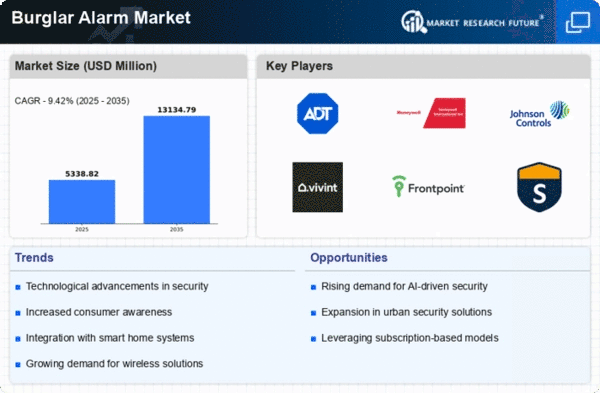
As per MRFR analysis, the Burglar Alarm Market Size was estimated at 4879.2 USD Million in 2024. The Burglar Alarm industry is projected to grow from 5338.83 USD Million in 2025 to 13134.79 USD Million by 2035, exhibiting a compound annual growth rate (CAGR) of 9.42% during the forecast period 2025 - 2035.

Key Market Trends & Highlights

The Burglar Alarm Market is experiencing a transformative shift towards advanced technology and integrated solutions.

  • The rise of smart alarm systems is reshaping consumer preferences, particularly in North America. DIY security solutions are gaining traction, appealing to cost-conscious consumers in both residential and commercial segments. Regulatory compliance and innovation are driving the market, especially in the rapidly growing Asia-Pacific region. Increasing crime rates and growing awareness of home security are major drivers propelling demand for integrated security solutions.

Market Size & Forecast

2024 Market Size 4879.2 (USD Million)
2035 Market Size 13134.79 (USD Million)
CAGR (2025 - 2035) 9.42%
Largest Regional Market Share in 2024 North America

Major Players

ADT Inc. (US), Honeywell International Inc. (US), Johnson Controls International plc (IE), Vivint Smart Home, Inc. (US), Frontpoint Security Solutions, LLC (US), SimpliSafe, Inc. (US), Brinks Home Security (US), Xfinity Home (US)

Market Trends

The Burglar Alarm Market is currently experiencing a dynamic evolution, driven by advancements in technology and increasing consumer awareness regarding security. As urbanization continues to rise, the demand for effective security solutions has intensified. This market appears to be characterized by a shift towards smart alarm systems, which integrate seamlessly with home automation technologies. These systems not only provide enhanced security features but also offer convenience and remote monitoring capabilities, appealing to a tech-savvy consumer base. Furthermore, the growing prevalence of smart homes is likely to bolster the adoption of these innovative solutions, as homeowners seek to enhance their living environments with integrated security measures. In addition to technological advancements, the Burglar Alarm Market is influenced by changing consumer preferences and regulatory frameworks. There seems to be a notable trend towards DIY security systems, which allow consumers to install and manage their own alarm systems without professional assistance. This shift may be attributed to the desire for cost-effective solutions and greater control over personal security. Moreover, as governments worldwide implement stricter regulations regarding safety and security, manufacturers are compelled to innovate and comply with these standards. Overall, the Burglar Alarm Market appears poised for continued growth, driven by a combination of technological innovation, consumer demand, and regulatory influences.

Rise of Smart Alarm Systems

The Burglar Alarm Market is witnessing a notable shift towards smart alarm systems. These advanced solutions integrate with home automation technologies, offering enhanced security features and remote monitoring capabilities. This trend reflects a growing consumer preference for convenience and connectivity in security solutions.

DIY Security Solutions

There is an increasing inclination towards DIY security systems within the Burglar Alarm Market. Consumers are opting for self-installation options that provide greater control and cost savings. This trend indicates a shift in consumer behavior, favoring personalized security management.

Regulatory Compliance and Innovation

The Burglar Alarm Market is also shaped by evolving regulatory frameworks. Stricter safety and security regulations compel manufacturers to innovate and enhance their product offerings. This trend suggests that compliance with regulations is becoming a critical factor in market competitiveness.

Burglar Alarm Market Market Drivers

Rising Crime Rates

The increasing incidence of property crimes globally appears to be a primary driver for the Global Burglar Alarm Market Industry. As urbanization accelerates, crime rates in metropolitan areas have surged, prompting homeowners and businesses to seek enhanced security measures. For instance, the FBI reported a notable rise in burglary rates in several regions, which has led to a heightened demand for burglar alarm systems. This trend is expected to contribute significantly to the market's growth, with projections indicating that the market will reach 4.88 USD Billion in 2024, reflecting a growing awareness of security needs among consumers.

Technological Advancements

Technological innovations in burglar alarm systems are transforming the Global Burglar Alarm Market Industry. The integration of smart technology, such as IoT devices and mobile applications, allows users to monitor their properties remotely. For example, systems equipped with real-time alerts and video surveillance capabilities are becoming increasingly popular. This shift towards smart security solutions is likely to attract a broader consumer base, as individuals seek convenience and enhanced safety. As a result, the market is anticipated to experience a compound annual growth rate of 9.37% from 2025 to 2035, driven by these advancements.

Expansion of E-commerce Platforms

The expansion of e-commerce platforms is reshaping the Global Burglar Alarm Market Industry by providing consumers with easier access to security products. Online retailers are increasingly offering a wide range of burglar alarm systems, allowing customers to compare features and prices conveniently. This trend is particularly relevant in regions where traditional retail options may be limited. The accessibility of information and products through e-commerce is likely to drive sales, as consumers can make informed decisions. As the market continues to evolve, the anticipated growth trajectory suggests a potential market size of 13.1 USD Billion by 2035.

Government Initiatives and Regulations

Government initiatives aimed at enhancing public safety are influencing the Global Burglar Alarm Market Industry. Various countries are implementing regulations that encourage the installation of security systems in residential and commercial properties. For instance, some local governments offer incentives for homeowners to install burglar alarms, thereby promoting a safer environment. These initiatives not only raise awareness about security but also stimulate market growth. As the demand for compliance with safety regulations increases, the market is expected to expand, potentially reaching 13.1 USD Billion by 2035.

Increased Awareness of Security Solutions

The growing awareness of security solutions among consumers is a significant factor driving the Global Burglar Alarm Market Industry. Educational campaigns and media coverage regarding the importance of home security have led to a shift in consumer behavior. Individuals are now more inclined to invest in burglar alarms as a preventive measure against theft and property damage. This heightened awareness is reflected in the increasing sales of alarm systems, suggesting a robust market potential. As consumers prioritize safety, the market is poised for substantial growth, with projections indicating a market size of 4.88 USD Billion in 2024.

Market Segment Insights

By Application: Residential (Largest) vs. Commercial (Fastest-Growing)

The burglar alarm market showcases a varied distribution among its application segments, prominently featuring residential as the largest segment. The residential sector benefits from heightened security needs among homeowners, driven by increased awareness of burglary incidents and advancing technology in alarm systems. Meanwhile, commercial applications are experiencing rapid growth, as businesses prioritize security solutions to protect assets and ensure safety in an evolving threat landscape. This trend is particularly pronounced in retail and corporate spaces, where integrated systems are becoming essential. In terms of growth trends, the increasing crime rates and the proliferation of smart technologies are boosting the demand for burglar alarms across all segments. Residential areas are generally adopting more sophisticated systems that integrate with home automation, while commercial and government sectors are investing in scalable solutions. The rise of connected devices and IoT is further enhancing functionality and user experience, paving the way for robust growth in these applications.

Residential (Dominant) vs. Government (Emerging)

The residential sector stands as a dominant force in the burglar alarm market, primarily characterized by consumer demand for enhanced security and peace of mind. Homeowners increasingly favor systems that offer not just intrusion detection, but smart features like app connectivity and integration with other home automation systems. In contrast, the government segment is emergent, with an increasing focus on public safety and infrastructure protection driving demand. Government entities are investing in advanced alarm systems that comply with regulatory standards and integrate with broader security frameworks. As cybersecurity concerns become paramount, both sectors are evolving, but residential remains the preferred choice of consumers, while the government sector is expanding its capabilities in response to growing threats.

By Technology: Wireless (Largest) vs. Smart (Fastest-Growing)

The burglar alarm market showcases a diverse landscape when segmented by technology. The wireless segment currently holds the largest share, favored for its ease of installation and flexibility. Meanwhile, the wired and hybrid systems maintain significant positions, appealing to traditional security preferences, while monitored burglar alarms offer additional peace of mind through professional oversight. In contrast, smart alarms, despite being a relatively newer entrant, are capturing market attention due to their advanced features and integrations with smart home devices.

Wireless (Dominant) vs. Smart (Emerging)

Wireless burglar alarms represent the dominant force in the market, celebrated for their quick installation and adaptability to various environments without the need for extensive wiring. Their appeal is amplified by features like remote monitoring and user-friendly interfaces. On the other hand, smart burglar alarms are emerging rapidly as a popular choice, integrating seamlessly with IoT devices and home automation systems. This segment is characterized by innovations such as AI-driven threat detection and customizable alerts, catering especially to tech-savvy consumers seeking enhanced security and convenience.

By End Use: Home Security (Largest) vs. Business Security (Fastest-Growing)

The Burglar Alarm Market is predominantly driven by the home security segment, which captures the largest share. Homeowners increasingly prioritize safety, leading to a surge in demand for advanced burglar alarm systems. Following closely is the business security segment, which is witnessing rapid growth as companies enhance their security measures to protect assets and employees. Public safety, insurance compliance, and emergency response segments contribute significantly, though to a lesser extent in comparison to home and business security. As urbanization continues, the need for robust security solutions is becoming essential. Growing concerns around crime rates and property protection are propelling the demand for burglar alarms. Technological advancements and increasing consumer awareness are key growth drivers. As businesses focus on risk management and insurance compliance becomes necessary, these segments are expected to gain traction. Emergency response systems integrated with burglar alarms are also seeing a spike in adoption, further supporting market expansion. The market is evolving rapidly, and the interplay of these end-use segments shapes future trends in the Burglar Alarm Market.

Home Security: Dominant vs. Business Security: Emerging

Home security remains the dominant segment in the Burglar Alarm Market due to the heightened focus on residential safety and the growing trend towards smart home solutions. Consumers are increasingly inclined to invest in burglar alarms that come with integrated technology features such as mobile alerts and remote monitoring, improving their appeal. On the other hand, business security is emerging as a key player in the market, driven by a wave of necessity from commercial establishments seeking to minimize risks from burglaries and internal theft. Advancements in technology mean that these systems can offer tailored solutions to businesses, thus increasing their effectiveness. Both segments are unique in terms of target audiences and needs, but they share a common goal of enhancing security and peace of mind.

Get more detailed insights about Burglar Alarm Market Research Report—Global Forecast till 2035

Regional Insights

North America : Market Leader in Security Solutions

North America continues to lead the burglar alarm market, holding a significant share of 2450.0 million in 2024. The growth is driven by increasing crime rates, heightened consumer awareness, and advancements in technology. Regulatory support for home security systems further fuels demand, as governments promote safety initiatives. The region's robust infrastructure and high disposable income also contribute to the market's expansion. The competitive landscape is characterized by major players such as ADT Inc., Honeywell International Inc., and Vivint Smart Home, Inc. The U.S. remains the largest market, with a strong presence of innovative companies offering smart home integration. The focus on user-friendly technology and subscription-based services enhances customer engagement, ensuring sustained growth in this sector.

Europe : Emerging Market with Growth Potential

Europe's burglar alarm market is valued at 1450.0 million, reflecting a growing demand for security solutions. Factors such as increasing urbanization, rising crime rates, and regulatory frameworks promoting safety are driving this growth. The European Union's initiatives to enhance public safety and security have also catalyzed market expansion, encouraging investments in advanced alarm technologies. Leading countries in this region include Germany, the UK, and France, where key players like Johnson Controls International plc and Honeywell are prominent. The competitive landscape is evolving, with a shift towards smart and integrated security systems. The presence of innovative startups alongside established firms is fostering a dynamic market environment, enhancing consumer choice and driving technological advancements.

Asia-Pacific : Rapidly Growing Security Sector

The Asia-Pacific burglar alarm market, valued at 1300.0 million, is experiencing rapid growth due to urbanization and rising disposable incomes. Increased awareness of home security and government initiatives to promote safety are key drivers. The region's diverse market dynamics, coupled with technological advancements, are creating significant opportunities for growth in the burglar alarm sector. Countries like China, Japan, and India are leading the charge, with a mix of local and international players competing for market share. Companies such as SimpliSafe and Brinks Home Security are expanding their footprint in this region. The competitive landscape is characterized by innovation, with a focus on smart home integration and user-friendly solutions, catering to the evolving needs of consumers.

Middle East and Africa : Emerging Market with Unique Challenges

The Middle East and Africa burglar alarm market, valued at 679.2 million, is gradually expanding, driven by increasing security concerns and urban development. The region faces unique challenges, including varying regulatory environments and economic disparities. However, rising crime rates and a growing middle class are propelling demand for advanced security solutions, making it a promising market for investment. Countries like South Africa and the UAE are at the forefront of this growth, with key players such as Xfinity Home and Frontpoint Security Solutions establishing a presence. The competitive landscape is evolving, with a focus on affordable and effective security solutions tailored to local needs. As the market matures, innovation and partnerships will be crucial for success in this diverse region.

Key Players and Competitive Insights

The Burglar Alarm Market is currently characterized by a dynamic competitive landscape, driven by technological advancements and an increasing emphasis on home security. Key players such as ADT Inc. (US), Honeywell International Inc. (US), and Vivint Smart Home, Inc. (US) are actively shaping the market through innovative solutions and strategic partnerships. ADT Inc. (US) has positioned itself as a leader in the sector by focusing on integrating smart home technology with traditional security systems, thereby enhancing user experience and operational efficiency. Meanwhile, Honeywell International Inc. (US) emphasizes its commitment to digital transformation, leveraging IoT capabilities to offer advanced security solutions that cater to evolving consumer needs. These strategies collectively foster a competitive environment that prioritizes innovation and customer-centric solutions.
In terms of business tactics, companies are increasingly localizing manufacturing and optimizing supply chains to enhance responsiveness to market demands. The Burglar Alarm Market appears moderately fragmented, with several key players exerting influence over various segments. This structure allows for a diverse range of offerings, enabling consumers to select from a variety of solutions tailored to their specific security needs. The collective actions of these companies indicate a trend towards consolidation, as they seek to enhance their market presence through strategic collaborations and acquisitions.
In November 2025, Vivint Smart Home, Inc. (US) announced a partnership with a leading AI technology firm to develop next-generation security systems that utilize machine learning for threat detection. This strategic move is likely to position Vivint at the forefront of innovation in the Burglar Alarm Market, as it aims to enhance the accuracy and efficiency of its security solutions. The integration of AI technology not only improves the functionality of their products but also aligns with the growing consumer demand for smart home integration.
In October 2025, Brinks Home Security (US) launched a new line of eco-friendly security devices, reflecting a growing trend towards sustainability in the industry. This initiative is significant as it not only addresses environmental concerns but also appeals to a consumer base increasingly focused on sustainable living. By prioritizing eco-friendly solutions, Brinks Home Security is likely to differentiate itself in a crowded market, potentially attracting environmentally conscious consumers.
In September 2025, SimpliSafe, Inc. (US) expanded its service offerings by introducing a subscription model that includes 24/7 professional monitoring and smart home integration. This strategic action appears to enhance customer loyalty and retention, as it provides users with a comprehensive security solution that is both accessible and user-friendly. The subscription model may also serve to stabilize revenue streams, allowing SimpliSafe to invest further in product development and innovation.
As of December 2025, the competitive trends in the Burglar Alarm Market are increasingly defined by digitalization, sustainability, and the integration of AI technologies. Strategic alliances are becoming more prevalent, as companies recognize the value of collaboration in enhancing their technological capabilities and market reach. Looking ahead, competitive differentiation is likely to evolve from traditional price-based competition towards a focus on innovation, technological advancement, and supply chain reliability. This shift underscores the importance of adaptability and forward-thinking strategies in maintaining a competitive edge in the rapidly changing landscape.

Key Companies in the Burglar Alarm Market include

Industry Developments

October 2022 Inovonics has announced the release of two next-generation senior living solutions: fall detection and alarm location. Even if a resident is unable to click the button on their fall detection pendant, the Inovonics fall detection system will automatically notify carers if they believe a resident has fallen. When location-enabled pendants with or without fall detection are activated, the alarm location solution offers exact room and floor locations.

May 2021 Johnson Controls collaborated with DigiCert to deliver the next level of digital trust to smart building solutions. By streamlining the deployment and maintenance of public key infrastructure (PKI) and digital identities, our alliance accelerated smart building cybersecurity.

December 2020 Securitas AB acquired FE Moran Security Solutions, based in the US. This company is one of the top 30 alarm monitoring and electronic security systems companies in the US. This acquisition helped enhance the company’s offerings in the US Midwest region and enabled it to double the size of its security solutions and electronic security businesses.

Intended Audience

    • Sensor Industry
    • Semiconductor Industry
    • Factories And Manufacturing Facilities
    • Technology Investors
    • Regulatory Industries
    • Government Bodies
    • Alarm Manufacturer
    • Smart Home Providers

Future Outlook

Burglar Alarm Market Future Outlook

The Burglar Alarm Market is projected to grow at a 9.42% CAGR from 2025 to 2035, driven by technological advancements, increasing security concerns, and urbanization.

New opportunities lie in:

  • Integration of AI-driven analytics for enhanced threat detection
  • Expansion into smart home ecosystems for seamless connectivity
  • Development of subscription-based monitoring services for recurring revenue

By 2035, the Burglar Alarm Market is expected to be robust, reflecting substantial growth and innovation.

Market Segmentation

Burglar Alarm Market End Use Outlook

  • Home Security
  • Business Security
  • Public Safety
  • Insurance Compliance
  • Emergency Response

Burglar Alarm Market Technology Outlook

  • Wired
  • Wireless
  • Hybrid
  • Smart
  • Monitored

Burglar Alarm Market Application Outlook

  • Residential
  • Commercial
  • Industrial
  • Government
  • Institutional

Report Scope

MARKET SIZE 2024 4879.2(USD Million)
MARKET SIZE 2025 5338.83(USD Million)
MARKET SIZE 2035 13134.79(USD Million)
COMPOUND ANNUAL GROWTH RATE (CAGR) 9.42% (2025 - 2035)
REPORT COVERAGE Revenue Forecast, Competitive Landscape, Growth Factors, and Trends
BASE YEAR 2024
Market Forecast Period 2025 - 2035
Historical Data 2019 - 2024
Market Forecast Units USD Million
Key Companies Profiled ADT Inc. (US), Honeywell International Inc. (US), Johnson Controls International plc (IE), Vivint Smart Home, Inc. (US), Frontpoint Security Solutions, LLC (US), SimpliSafe, Inc. (US), Brinks Home Security (US), Xfinity Home (US)
Segments Covered Application, Technology, End Use
Key Market Opportunities Integration of smart home technology enhances consumer demand in the Burglar Alarm Market.
Key Market Dynamics Rising consumer demand for smart home integration drives innovation and competition in the burglar alarm market.
Countries Covered North America, Europe, APAC, South America, MEA

FAQs

What is the current valuation of the Burglar Alarm Market as of 2025?

<p>The Burglar Alarm Market is valued at approximately 4879.2 USD Million in 2024.</p>

What is the projected market valuation for the Burglar Alarm Market in 2035?

<p>The market is projected to reach a valuation of 13134.79 USD Million by 2035.</p>

What is the expected CAGR for the Burglar Alarm Market during the forecast period 2025 - 2035?

<p>The expected CAGR for the Burglar Alarm Market during the forecast period 2025 - 2035 is 9.42%.</p>

Which companies are considered key players in the Burglar Alarm Market?

<p>Key players in the market include ADT Inc., Honeywell International Inc., Johnson Controls International plc, and Vivint Smart Home, Inc.</p>

How does the residential segment perform in the Burglar Alarm Market?

<p>The residential segment was valued at 1463.68 USD Million in 2024 and is projected to reach 3920.0 USD Million.</p>

What is the valuation of the commercial segment in the Burglar Alarm Market?

The commercial segment was valued at 1214.76 USD Million in 2024 and is expected to grow to 3200.0 USD Million.

What are the projected values for the wireless technology segment in the Burglar Alarm Market?

The wireless technology segment was valued at 1500.0 USD Million in 2024 and is anticipated to reach 4000.0 USD Million.

What is the expected growth for the monitored technology segment in the Burglar Alarm Market?

The monitored technology segment was valued at 1779.2 USD Million in 2024 and is projected to grow to 4934.79 USD Million.

How does the institutional segment compare to others in the Burglar Alarm Market?

The institutional segment was valued at 737.92 USD Million in 2024 and is expected to reach 2014.79 USD Million.

What end-use applications are driving growth in the Burglar Alarm Market?

End-use applications such as home security and business security are driving growth, with valuations of 1463.68 USD Million and 1214.56 USD Million, respectively, in 2024.

  1. SECTION I: EXECUTIVE SUMMARY AND KEY HIGHLIGHTS
    1. | 1.1 EXECUTIVE SUMMARY
    2. | | 1.1.1 Market Overview
    3. | | 1.1.2 Key Findings
    4. | | 1.1.3 Market Segmentation
    5. | | 1.1.4 Competitive Landscape
    6. | | 1.1.5 Challenges and Opportunities
    7. | | 1.1.6 Future Outlook
  2. SECTION II: SCOPING, METHODOLOGY AND MARKET STRUCTURE
    1. | 2.1 MARKET INTRODUCTION
    2. | | 2.1.1 Definition
    3. | | 2.1.2 Scope of the study
    4. | | | 2.1.2.1 Research Objective
    5. | | | 2.1.2.2 Assumption
    6. | | | 2.1.2.3 Limitations
    7. | 2.2 RESEARCH METHODOLOGY
    8. | | 2.2.1 Overview
    9. | | 2.2.2 Data Mining
    10. | | 2.2.3 Secondary Research
    11. | | 2.2.4 Primary Research
    12. | | | 2.2.4.1 Primary Interviews and Information Gathering Process
    13. | | | 2.2.4.2 Breakdown of Primary Respondents
    14. | | 2.2.5 Forecasting Model
    15. | | 2.2.6 Market Size Estimation
    16. | | | 2.2.6.1 Bottom-Up Approach
    17. | | | 2.2.6.2 Top-Down Approach
    18. | | 2.2.7 Data Triangulation
    19. | | 2.2.8 Validation
  3. SECTION III: QUALITATIVE ANALYSIS
    1. | 3.1 MARKET DYNAMICS
    2. | | 3.1.1 Overview
    3. | | 3.1.2 Drivers
    4. | | 3.1.3 Restraints
    5. | | 3.1.4 Opportunities
    6. | 3.2 MARKET FACTOR ANALYSIS
    7. | | 3.2.1 Value chain Analysis
    8. | | 3.2.2 Porter's Five Forces Analysis
    9. | | | 3.2.2.1 Bargaining Power of Suppliers
    10. | | | 3.2.2.2 Bargaining Power of Buyers
    11. | | | 3.2.2.3 Threat of New Entrants
    12. | | | 3.2.2.4 Threat of Substitutes
    13. | | | 3.2.2.5 Intensity of Rivalry
    14. | | 3.2.3 COVID-19 Impact Analysis
    15. | | | 3.2.3.1 Market Impact Analysis
    16. | | | 3.2.3.2 Regional Impact
    17. | | | 3.2.3.3 Opportunity and Threat Analysis
  4. SECTION IV: QUANTITATIVE ANALYSIS
    1. | 4.1 Semiconductor & Electronics, BY Application (USD Million)
    2. | | 4.1.1 Residential
    3. | | 4.1.2 Commercial
    4. | | 4.1.3 Industrial
    5. | | 4.1.4 Government
    6. | | 4.1.5 Institutional
    7. | 4.2 Semiconductor & Electronics, BY Technology (USD Million)
    8. | | 4.2.1 Wired
    9. | | 4.2.2 Wireless
    10. | | 4.2.3 Hybrid
    11. | | 4.2.4 Smart
    12. | | 4.2.5 Monitored
    13. | 4.3 Semiconductor & Electronics, BY End Use (USD Million)
    14. | | 4.3.1 Home Security
    15. | | 4.3.2 Business Security
    16. | | 4.3.3 Public Safety
    17. | | 4.3.4 Insurance Compliance
    18. | | 4.3.5 Emergency Response
    19. | 4.4 Semiconductor & Electronics, BY Region (USD Million)
    20. | | 4.4.1 North America
    21. | | | 4.4.1.1 US
    22. | | | 4.4.1.2 Canada
    23. | | 4.4.2 Europe
    24. | | | 4.4.2.1 Germany
    25. | | | 4.4.2.2 UK
    26. | | | 4.4.2.3 France
    27. | | | 4.4.2.4 Russia
    28. | | | 4.4.2.5 Italy
    29. | | | 4.4.2.6 Spain
    30. | | | 4.4.2.7 Rest of Europe
    31. | | 4.4.3 APAC
    32. | | | 4.4.3.1 China
    33. | | | 4.4.3.2 India
    34. | | | 4.4.3.3 Japan
    35. | | | 4.4.3.4 South Korea
    36. | | | 4.4.3.5 Malaysia
    37. | | | 4.4.3.6 Thailand
    38. | | | 4.4.3.7 Indonesia
    39. | | | 4.4.3.8 Rest of APAC
    40. | | 4.4.4 South America
    41. | | | 4.4.4.1 Brazil
    42. | | | 4.4.4.2 Mexico
    43. | | | 4.4.4.3 Argentina
    44. | | | 4.4.4.4 Rest of South America
    45. | | 4.4.5 MEA
    46. | | | 4.4.5.1 GCC Countries
    47. | | | 4.4.5.2 South Africa
    48. | | | 4.4.5.3 Rest of MEA
  5. SECTION V: COMPETITIVE ANALYSIS
    1. | 5.1 Competitive Landscape
    2. | | 5.1.1 Overview
    3. | | 5.1.2 Competitive Analysis
    4. | | 5.1.3 Market share Analysis
    5. | | 5.1.4 Major Growth Strategy in the Semiconductor & Electronics
    6. | | 5.1.5 Competitive Benchmarking
    7. | | 5.1.6 Leading Players in Terms of Number of Developments in the Semiconductor & Electronics
    8. | | 5.1.7 Key developments and growth strategies
    9. | | | 5.1.7.1 New Product Launch/Service Deployment
    10. | | | 5.1.7.2 Merger & Acquisitions
    11. | | | 5.1.7.3 Joint Ventures
    12. | | 5.1.8 Major Players Financial Matrix
    13. | | | 5.1.8.1 Sales and Operating Income
    14. | | | 5.1.8.2 Major Players R&D Expenditure. 2023
    15. | 5.2 Company Profiles
    16. | | 5.2.1 ADT Inc. (US)
    17. | | | 5.2.1.1 Financial Overview
    18. | | | 5.2.1.2 Products Offered
    19. | | | 5.2.1.3 Key Developments
    20. | | | 5.2.1.4 SWOT Analysis
    21. | | | 5.2.1.5 Key Strategies
    22. | | 5.2.2 Honeywell International Inc. (US)
    23. | | | 5.2.2.1 Financial Overview
    24. | | | 5.2.2.2 Products Offered
    25. | | | 5.2.2.3 Key Developments
    26. | | | 5.2.2.4 SWOT Analysis
    27. | | | 5.2.2.5 Key Strategies
    28. | | 5.2.3 Johnson Controls International plc (IE)
    29. | | | 5.2.3.1 Financial Overview
    30. | | | 5.2.3.2 Products Offered
    31. | | | 5.2.3.3 Key Developments
    32. | | | 5.2.3.4 SWOT Analysis
    33. | | | 5.2.3.5 Key Strategies
    34. | | 5.2.4 Vivint Smart Home, Inc. (US)
    35. | | | 5.2.4.1 Financial Overview
    36. | | | 5.2.4.2 Products Offered
    37. | | | 5.2.4.3 Key Developments
    38. | | | 5.2.4.4 SWOT Analysis
    39. | | | 5.2.4.5 Key Strategies
    40. | | 5.2.5 Frontpoint Security Solutions, LLC (US)
    41. | | | 5.2.5.1 Financial Overview
    42. | | | 5.2.5.2 Products Offered
    43. | | | 5.2.5.3 Key Developments
    44. | | | 5.2.5.4 SWOT Analysis
    45. | | | 5.2.5.5 Key Strategies
    46. | | 5.2.6 SimpliSafe, Inc. (US)
    47. | | | 5.2.6.1 Financial Overview
    48. | | | 5.2.6.2 Products Offered
    49. | | | 5.2.6.3 Key Developments
    50. | | | 5.2.6.4 SWOT Analysis
    51. | | | 5.2.6.5 Key Strategies
    52. | | 5.2.7 Brinks Home Security (US)
    53. | | | 5.2.7.1 Financial Overview
    54. | | | 5.2.7.2 Products Offered
    55. | | | 5.2.7.3 Key Developments
    56. | | | 5.2.7.4 SWOT Analysis
    57. | | | 5.2.7.5 Key Strategies
    58. | | 5.2.8 Xfinity Home (US)
    59. | | | 5.2.8.1 Financial Overview
    60. | | | 5.2.8.2 Products Offered
    61. | | | 5.2.8.3 Key Developments
    62. | | | 5.2.8.4 SWOT Analysis
    63. | | | 5.2.8.5 Key Strategies
    64. | 5.3 Appendix
    65. | | 5.3.1 References
    66. | | 5.3.2 Related Reports
  6. LIST OF FIGURES
    1. | 6.1 MARKET SYNOPSIS
    2. | 6.2 NORTH AMERICA MARKET ANALYSIS
    3. | 6.3 US MARKET ANALYSIS BY APPLICATION
    4. | 6.4 US MARKET ANALYSIS BY TECHNOLOGY
    5. | 6.5 US MARKET ANALYSIS BY END USE
    6. | 6.6 CANADA MARKET ANALYSIS BY APPLICATION
    7. | 6.7 CANADA MARKET ANALYSIS BY TECHNOLOGY
    8. | 6.8 CANADA MARKET ANALYSIS BY END USE
    9. | 6.9 EUROPE MARKET ANALYSIS
    10. | 6.10 GERMANY MARKET ANALYSIS BY APPLICATION
    11. | 6.11 GERMANY MARKET ANALYSIS BY TECHNOLOGY
    12. | 6.12 GERMANY MARKET ANALYSIS BY END USE
    13. | 6.13 UK MARKET ANALYSIS BY APPLICATION
    14. | 6.14 UK MARKET ANALYSIS BY TECHNOLOGY
    15. | 6.15 UK MARKET ANALYSIS BY END USE
    16. | 6.16 FRANCE MARKET ANALYSIS BY APPLICATION
    17. | 6.17 FRANCE MARKET ANALYSIS BY TECHNOLOGY
    18. | 6.18 FRANCE MARKET ANALYSIS BY END USE
    19. | 6.19 RUSSIA MARKET ANALYSIS BY APPLICATION
    20. | 6.20 RUSSIA MARKET ANALYSIS BY TECHNOLOGY
    21. | 6.21 RUSSIA MARKET ANALYSIS BY END USE
    22. | 6.22 ITALY MARKET ANALYSIS BY APPLICATION
    23. | 6.23 ITALY MARKET ANALYSIS BY TECHNOLOGY
    24. | 6.24 ITALY MARKET ANALYSIS BY END USE
    25. | 6.25 SPAIN MARKET ANALYSIS BY APPLICATION
    26. | 6.26 SPAIN MARKET ANALYSIS BY TECHNOLOGY
    27. | 6.27 SPAIN MARKET ANALYSIS BY END USE
    28. | 6.28 REST OF EUROPE MARKET ANALYSIS BY APPLICATION
    29. | 6.29 REST OF EUROPE MARKET ANALYSIS BY TECHNOLOGY
    30. | 6.30 REST OF EUROPE MARKET ANALYSIS BY END USE
    31. | 6.31 APAC MARKET ANALYSIS
    32. | 6.32 CHINA MARKET ANALYSIS BY APPLICATION
    33. | 6.33 CHINA MARKET ANALYSIS BY TECHNOLOGY
    34. | 6.34 CHINA MARKET ANALYSIS BY END USE
    35. | 6.35 INDIA MARKET ANALYSIS BY APPLICATION
    36. | 6.36 INDIA MARKET ANALYSIS BY TECHNOLOGY
    37. | 6.37 INDIA MARKET ANALYSIS BY END USE
    38. | 6.38 JAPAN MARKET ANALYSIS BY APPLICATION
    39. | 6.39 JAPAN MARKET ANALYSIS BY TECHNOLOGY
    40. | 6.40 JAPAN MARKET ANALYSIS BY END USE
    41. | 6.41 SOUTH KOREA MARKET ANALYSIS BY APPLICATION
    42. | 6.42 SOUTH KOREA MARKET ANALYSIS BY TECHNOLOGY
    43. | 6.43 SOUTH KOREA MARKET ANALYSIS BY END USE
    44. | 6.44 MALAYSIA MARKET ANALYSIS BY APPLICATION
    45. | 6.45 MALAYSIA MARKET ANALYSIS BY TECHNOLOGY
    46. | 6.46 MALAYSIA MARKET ANALYSIS BY END USE
    47. | 6.47 THAILAND MARKET ANALYSIS BY APPLICATION
    48. | 6.48 THAILAND MARKET ANALYSIS BY TECHNOLOGY
    49. | 6.49 THAILAND MARKET ANALYSIS BY END USE
    50. | 6.50 INDONESIA MARKET ANALYSIS BY APPLICATION
    51. | 6.51 INDONESIA MARKET ANALYSIS BY TECHNOLOGY
    52. | 6.52 INDONESIA MARKET ANALYSIS BY END USE
    53. | 6.53 REST OF APAC MARKET ANALYSIS BY APPLICATION
    54. | 6.54 REST OF APAC MARKET ANALYSIS BY TECHNOLOGY
    55. | 6.55 REST OF APAC MARKET ANALYSIS BY END USE
    56. | 6.56 SOUTH AMERICA MARKET ANALYSIS
    57. | 6.57 BRAZIL MARKET ANALYSIS BY APPLICATION
    58. | 6.58 BRAZIL MARKET ANALYSIS BY TECHNOLOGY
    59. | 6.59 BRAZIL MARKET ANALYSIS BY END USE
    60. | 6.60 MEXICO MARKET ANALYSIS BY APPLICATION
    61. | 6.61 MEXICO MARKET ANALYSIS BY TECHNOLOGY
    62. | 6.62 MEXICO MARKET ANALYSIS BY END USE
    63. | 6.63 ARGENTINA MARKET ANALYSIS BY APPLICATION
    64. | 6.64 ARGENTINA MARKET ANALYSIS BY TECHNOLOGY
    65. | 6.65 ARGENTINA MARKET ANALYSIS BY END USE
    66. | 6.66 REST OF SOUTH AMERICA MARKET ANALYSIS BY APPLICATION
    67. | 6.67 REST OF SOUTH AMERICA MARKET ANALYSIS BY TECHNOLOGY
    68. | 6.68 REST OF SOUTH AMERICA MARKET ANALYSIS BY END USE
    69. | 6.69 MEA MARKET ANALYSIS
    70. | 6.70 GCC COUNTRIES MARKET ANALYSIS BY APPLICATION
    71. | 6.71 GCC COUNTRIES MARKET ANALYSIS BY TECHNOLOGY
    72. | 6.72 GCC COUNTRIES MARKET ANALYSIS BY END USE
    73. | 6.73 SOUTH AFRICA MARKET ANALYSIS BY APPLICATION
    74. | 6.74 SOUTH AFRICA MARKET ANALYSIS BY TECHNOLOGY
    75. | 6.75 SOUTH AFRICA MARKET ANALYSIS BY END USE
    76. | 6.76 REST OF MEA MARKET ANALYSIS BY APPLICATION
    77. | 6.77 REST OF MEA MARKET ANALYSIS BY TECHNOLOGY
    78. | 6.78 REST OF MEA MARKET ANALYSIS BY END USE
    79. | 6.79 KEY BUYING CRITERIA OF SEMICONDUCTOR & ELECTRONICS
    80. | 6.80 RESEARCH PROCESS OF MRFR
    81. | 6.81 DRO ANALYSIS OF SEMICONDUCTOR & ELECTRONICS
    82. | 6.82 DRIVERS IMPACT ANALYSIS: SEMICONDUCTOR & ELECTRONICS
    83. | 6.83 RESTRAINTS IMPACT ANALYSIS: SEMICONDUCTOR & ELECTRONICS
    84. | 6.84 SUPPLY / VALUE CHAIN: SEMICONDUCTOR & ELECTRONICS
    85. | 6.85 SEMICONDUCTOR & ELECTRONICS, BY APPLICATION, 2024 (% SHARE)
    86. | 6.86 SEMICONDUCTOR & ELECTRONICS, BY APPLICATION, 2024 TO 2035 (USD Million)
    87. | 6.87 SEMICONDUCTOR & ELECTRONICS, BY TECHNOLOGY, 2024 (% SHARE)
    88. | 6.88 SEMICONDUCTOR & ELECTRONICS, BY TECHNOLOGY, 2024 TO 2035 (USD Million)
    89. | 6.89 SEMICONDUCTOR & ELECTRONICS, BY END USE, 2024 (% SHARE)
    90. | 6.90 SEMICONDUCTOR & ELECTRONICS, BY END USE, 2024 TO 2035 (USD Million)
    91. | 6.91 BENCHMARKING OF MAJOR COMPETITORS
  7. LIST OF TABLES
    1. | 7.1 LIST OF ASSUMPTIONS
    2. | | 7.1.1
    3. | 7.2 North America MARKET SIZE ESTIMATES; FORECAST
    4. | | 7.2.1 BY APPLICATION, 2025-2035 (USD Million)
    5. | | 7.2.2 BY TECHNOLOGY, 2025-2035 (USD Million)
    6. | | 7.2.3 BY END USE, 2025-2035 (USD Million)
    7. | 7.3 US MARKET SIZE ESTIMATES; FORECAST
    8. | | 7.3.1 BY APPLICATION, 2025-2035 (USD Million)
    9. | | 7.3.2 BY TECHNOLOGY, 2025-2035 (USD Million)
    10. | | 7.3.3 BY END USE, 2025-2035 (USD Million)
    11. | 7.4 Canada MARKET SIZE ESTIMATES; FORECAST
    12. | | 7.4.1 BY APPLICATION, 2025-2035 (USD Million)
    13. | | 7.4.2 BY TECHNOLOGY, 2025-2035 (USD Million)
    14. | | 7.4.3 BY END USE, 2025-2035 (USD Million)
    15. | 7.5 Europe MARKET SIZE ESTIMATES; FORECAST
    16. | | 7.5.1 BY APPLICATION, 2025-2035 (USD Million)
    17. | | 7.5.2 BY TECHNOLOGY, 2025-2035 (USD Million)
    18. | | 7.5.3 BY END USE, 2025-2035 (USD Million)
    19. | 7.6 Germany MARKET SIZE ESTIMATES; FORECAST
    20. | | 7.6.1 BY APPLICATION, 2025-2035 (USD Million)
    21. | | 7.6.2 BY TECHNOLOGY, 2025-2035 (USD Million)
    22. | | 7.6.3 BY END USE, 2025-2035 (USD Million)
    23. | 7.7 UK MARKET SIZE ESTIMATES; FORECAST
    24. | | 7.7.1 BY APPLICATION, 2025-2035 (USD Million)
    25. | | 7.7.2 BY TECHNOLOGY, 2025-2035 (USD Million)
    26. | | 7.7.3 BY END USE, 2025-2035 (USD Million)
    27. | 7.8 France MARKET SIZE ESTIMATES; FORECAST
    28. | | 7.8.1 BY APPLICATION, 2025-2035 (USD Million)
    29. | | 7.8.2 BY TECHNOLOGY, 2025-2035 (USD Million)
    30. | | 7.8.3 BY END USE, 2025-2035 (USD Million)
    31. | 7.9 Russia MARKET SIZE ESTIMATES; FORECAST
    32. | | 7.9.1 BY APPLICATION, 2025-2035 (USD Million)
    33. | | 7.9.2 BY TECHNOLOGY, 2025-2035 (USD Million)
    34. | | 7.9.3 BY END USE, 2025-2035 (USD Million)
    35. | 7.10 Italy MARKET SIZE ESTIMATES; FORECAST
    36. | | 7.10.1 BY APPLICATION, 2025-2035 (USD Million)
    37. | | 7.10.2 BY TECHNOLOGY, 2025-2035 (USD Million)
    38. | | 7.10.3 BY END USE, 2025-2035 (USD Million)
    39. | 7.11 Spain MARKET SIZE ESTIMATES; FORECAST
    40. | | 7.11.1 BY APPLICATION, 2025-2035 (USD Million)
    41. | | 7.11.2 BY TECHNOLOGY, 2025-2035 (USD Million)
    42. | | 7.11.3 BY END USE, 2025-2035 (USD Million)
    43. | 7.12 Rest of Europe MARKET SIZE ESTIMATES; FORECAST
    44. | | 7.12.1 BY APPLICATION, 2025-2035 (USD Million)
    45. | | 7.12.2 BY TECHNOLOGY, 2025-2035 (USD Million)
    46. | | 7.12.3 BY END USE, 2025-2035 (USD Million)
    47. | 7.13 APAC MARKET SIZE ESTIMATES; FORECAST
    48. | | 7.13.1 BY APPLICATION, 2025-2035 (USD Million)
    49. | | 7.13.2 BY TECHNOLOGY, 2025-2035 (USD Million)
    50. | | 7.13.3 BY END USE, 2025-2035 (USD Million)
    51. | 7.14 China MARKET SIZE ESTIMATES; FORECAST
    52. | | 7.14.1 BY APPLICATION, 2025-2035 (USD Million)
    53. | | 7.14.2 BY TECHNOLOGY, 2025-2035 (USD Million)
    54. | | 7.14.3 BY END USE, 2025-2035 (USD Million)
    55. | 7.15 India MARKET SIZE ESTIMATES; FORECAST
    56. | | 7.15.1 BY APPLICATION, 2025-2035 (USD Million)
    57. | | 7.15.2 BY TECHNOLOGY, 2025-2035 (USD Million)
    58. | | 7.15.3 BY END USE, 2025-2035 (USD Million)
    59. | 7.16 Japan MARKET SIZE ESTIMATES; FORECAST
    60. | | 7.16.1 BY APPLICATION, 2025-2035 (USD Million)
    61. | | 7.16.2 BY TECHNOLOGY, 2025-2035 (USD Million)
    62. | | 7.16.3 BY END USE, 2025-2035 (USD Million)
    63. | 7.17 South Korea MARKET SIZE ESTIMATES; FORECAST
    64. | | 7.17.1 BY APPLICATION, 2025-2035 (USD Million)
    65. | | 7.17.2 BY TECHNOLOGY, 2025-2035 (USD Million)
    66. | | 7.17.3 BY END USE, 2025-2035 (USD Million)
    67. | 7.18 Malaysia MARKET SIZE ESTIMATES; FORECAST
    68. | | 7.18.1 BY APPLICATION, 2025-2035 (USD Million)
    69. | | 7.18.2 BY TECHNOLOGY, 2025-2035 (USD Million)
    70. | | 7.18.3 BY END USE, 2025-2035 (USD Million)
    71. | 7.19 Thailand MARKET SIZE ESTIMATES; FORECAST
    72. | | 7.19.1 BY APPLICATION, 2025-2035 (USD Million)
    73. | | 7.19.2 BY TECHNOLOGY, 2025-2035 (USD Million)
    74. | | 7.19.3 BY END USE, 2025-2035 (USD Million)
    75. | 7.20 Indonesia MARKET SIZE ESTIMATES; FORECAST
    76. | | 7.20.1 BY APPLICATION, 2025-2035 (USD Million)
    77. | | 7.20.2 BY TECHNOLOGY, 2025-2035 (USD Million)
    78. | | 7.20.3 BY END USE, 2025-2035 (USD Million)
    79. | 7.21 Rest of APAC MARKET SIZE ESTIMATES; FORECAST
    80. | | 7.21.1 BY APPLICATION, 2025-2035 (USD Million)
    81. | | 7.21.2 BY TECHNOLOGY, 2025-2035 (USD Million)
    82. | | 7.21.3 BY END USE, 2025-2035 (USD Million)
    83. | 7.22 South America MARKET SIZE ESTIMATES; FORECAST
    84. | | 7.22.1 BY APPLICATION, 2025-2035 (USD Million)
    85. | | 7.22.2 BY TECHNOLOGY, 2025-2035 (USD Million)
    86. | | 7.22.3 BY END USE, 2025-2035 (USD Million)
    87. | 7.23 Brazil MARKET SIZE ESTIMATES; FORECAST
    88. | | 7.23.1 BY APPLICATION, 2025-2035 (USD Million)
    89. | | 7.23.2 BY TECHNOLOGY, 2025-2035 (USD Million)
    90. | | 7.23.3 BY END USE, 2025-2035 (USD Million)
    91. | 7.24 Mexico MARKET SIZE ESTIMATES; FORECAST
    92. | | 7.24.1 BY APPLICATION, 2025-2035 (USD Million)
    93. | | 7.24.2 BY TECHNOLOGY, 2025-2035 (USD Million)
    94. | | 7.24.3 BY END USE, 2025-2035 (USD Million)
    95. | 7.25 Argentina MARKET SIZE ESTIMATES; FORECAST
    96. | | 7.25.1 BY APPLICATION, 2025-2035 (USD Million)
    97. | | 7.25.2 BY TECHNOLOGY, 2025-2035 (USD Million)
    98. | | 7.25.3 BY END USE, 2025-2035 (USD Million)
    99. | 7.26 Rest of South America MARKET SIZE ESTIMATES; FORECAST
    100. | | 7.26.1 BY APPLICATION, 2025-2035 (USD Million)
    101. | | 7.26.2 BY TECHNOLOGY, 2025-2035 (USD Million)
    102. | | 7.26.3 BY END USE, 2025-2035 (USD Million)
    103. | 7.27 MEA MARKET SIZE ESTIMATES; FORECAST
    104. | | 7.27.1 BY APPLICATION, 2025-2035 (USD Million)
    105. | | 7.27.2 BY TECHNOLOGY, 2025-2035 (USD Million)
    106. | | 7.27.3 BY END USE, 2025-2035 (USD Million)
    107. | 7.28 GCC Countries MARKET SIZE ESTIMATES; FORECAST
    108. | | 7.28.1 BY APPLICATION, 2025-2035 (USD Million)
    109. | | 7.28.2 BY TECHNOLOGY, 2025-2035 (USD Million)
    110. | | 7.28.3 BY END USE, 2025-2035 (USD Million)
    111. | 7.29 South Africa MARKET SIZE ESTIMATES; FORECAST
    112. | | 7.29.1 BY APPLICATION, 2025-2035 (USD Million)
    113. | | 7.29.2 BY TECHNOLOGY, 2025-2035 (USD Million)
    114. | | 7.29.3 BY END USE, 2025-2035 (USD Million)
    115. | 7.30 Rest of MEA MARKET SIZE ESTIMATES; FORECAST
    116. | | 7.30.1 BY APPLICATION, 2025-2035 (USD Million)
    117. | | 7.30.2 BY TECHNOLOGY, 2025-2035 (USD Million)
    118. | | 7.30.3 BY END USE, 2025-2035 (USD Million)
    119. | 7.31 PRODUCT LAUNCH/PRODUCT DEVELOPMENT/APPROVAL
    120. | | 7.31.1
    121. | 7.32 ACQUISITION/PARTNERSHIP
    122. | | 7.32.1

Semiconductor & Electronics Market Segmentation

Semiconductor & Electronics By Application (USD Million, 2025-2035)

  • Residential
  • Commercial
  • Industrial
  • Government
  • Institutional

Semiconductor & Electronics By Technology (USD Million, 2025-2035)

  • Wired
  • Wireless
  • Hybrid
  • Smart
  • Monitored

Semiconductor & Electronics By End Use (USD Million, 2025-2035)

  • Home Security
  • Business Security
  • Public Safety
  • Insurance Compliance
  • Emergency Response
Infographic

Free Sample Request

Kindly complete the form below to receive a free sample of this Report

Get Free Sample

Customer Strories

Compare Licence

×
Features License Type
Single User Multiuser License Enterprise User
Price $4,950 $5,950 $7,250
Maximum User Access Limit 1 User Upto 10 Users Unrestricted Access Throughout the Organization
Free Customization
Direct Access to Analyst
Deliverable Format
Platform Access
Discount on Next Purchase 10% 15% 15%
Printable Versions