Request Free Sample ×

Kindly complete the form below to receive a free sample of this Report

* Please use a valid business email

Leading companies partner with us for data-driven Insights

clients tt-cursor
Hero Background
English
Chinese
French
Japanese
Korean
German
Spanish

Bulletproof Glass Market Size

ID: MRFR/CnM/10145-HCR
111 Pages
Chitranshi Jaiswal
Last Updated: April 06, 2026

Bulletproof Glass Market Size, Share & Industry Analysis Research Report Information By Application (Defense & VIP Vehicles, ATM Booths & Teller Stations, Cash-in-Transit Vehicles, Commercial Buildings, Government & Law Enforcement, and Others), By End-Use (Automotive, Military, Banking & Finance, Construction, and Others), And By Region (North America, Europe, Asia-Pacific, And Rest Of The World) –Market Forecast Till 2035

Share:
Download PDF ×

We do not share your information with anyone. However, we may send you emails based on your report interest from time to time. You may contact us at any time to opt-out.

Bulletproof Glass Market Infographic
Purchase Options

Bulletproof Glass Size

Bulletproof Glass Market Growth Projections and Opportunities

The Bulletproof Glass Market has several market influences that contribute to its growth and dynamics. One of the main drivers is increased security concerns in different sectors. An upswing in vandalism, thefts, and terrorist acts has seen an increase in demand for bulletproof glasses in areas such as banking, retail and government facilities. The market demands advanced security solutions.

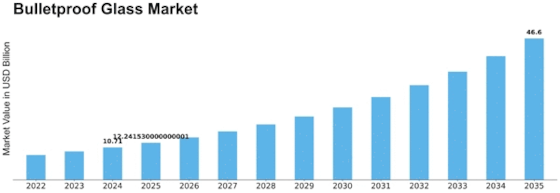
Bulletproof Glass Market Size valued at USD 8.2 billion in 2022 is expected to grow from USD 9.37 Billion in 2023 to USD 27.30 billion by 2032 at a Compound Annual Growth Rate (CAGR) of around 14.30%.

There are also technological advancements shaping the Bulletproof Glass Market. As materials science research advances, bulletproof glass can be manufactured which stops bullets better but is lighter and more transparent too. Thereby, bullet proof glass finds wider acceptance into architectural applications like residential or commercial buildings where aesthetics and visibility are equally important.

Bullet proof Glass market is dependent on economic factors as well; this includes economic stability and growth rates which determine the will of business organizations and governments to invest in matters bordering on safety measures. Bullet proof Glasses demand tend to rise when an economy is doing well leading to increased security measures during construction projects infrastructure development. Because of this there may be reduced spending on security measures due to economic recessions thereby affecting the market negatively.

Global geopolitical factors also drive sales for bulletproof glass. Unstable political conditions coupled with high crime rates often necessitate higher security levels including usage of shatter proof glasses. Apart from conflicts within certain regions of the world that have necessitated use of this type kind of window panes especially by army personnel’s
Bulletproof Glass Market Size Graph
Author
Author Profile
Chitranshi Jaiswal
Team Lead - Research

Chitranshi is a Team Leader in the Chemicals & Materials (CnM) and Energy & Power (EnP) domains, with 6+ years of experience in market research. She leads and mentors teams to deliver cross-domain projects that equip clients with actionable insights and growth strategies. She is skilled in market estimation, forecasting, competitive benchmarking, and both primary & secondary research, enabling her to turn complex data into decision-ready insights. An engineer and MBA professional, she combines technical expertise with strategic acumen to solve dynamic market challenges. Chitranshi has successfully managed projects that support market entry, investment planning, and competitive positioning, while building strong client relationships. Certified in Advanced Excel & Power BI she leverages data-driven approaches to ensure accuracy, clarity, and impactful outcomes.

Leave a Comment

FAQs

What is the current valuation of the Bulletproof Glass Market as of 2024?

<p>The Bulletproof Glass Market was valued at 10.71 USD Billion in 2024.</p>

What is the projected market valuation for the Bulletproof Glass Market in 2035?

<p>The market is projected to reach 46.6 USD Billion by 2035.</p>

What is the expected CAGR for the Bulletproof Glass Market during the forecast period 2025 - 2035?

<p>The expected CAGR for the Bulletproof Glass Market during 2025 - 2035 is 14.3%.</p>

Which application segment is anticipated to have the highest growth in the Bulletproof Glass Market?

<p>The Commercial Buildings segment is projected to grow from 2.5 USD Billion in 2024 to 10.0 USD Billion by 2035.</p>

How does the Defense & VIP Vehicles segment perform in terms of market valuation?

<p>The Defense & VIP Vehicles segment was valued at 1.5 USD Billion in 2024 and is expected to grow to 6.5 USD Billion by 2035.</p>

What are the key players in the Bulletproof Glass Market?

<p>Key players include Saint-Gobain, PPG Industries, Guardian Glass, and Armored Glass, among others.</p>

What is the market valuation for the Banking & Finance segment in 2024?

The Banking &amp; Finance segment was valued at 2.0 USD Billion in 2024.

What is the projected valuation for the Cash-in-Transit Vehicles segment by 2035?

The Cash-in-Transit Vehicles segment is expected to reach 4.0 USD Billion by 2035.

How does the Military segment compare to other end-use segments in terms of growth?

The Military segment was valued at 3.0 USD Billion in 2024 and is projected to grow to 12.0 USD Billion by 2035.

What is the expected growth for the Others segment in the Application category?

The Others segment in the Application category is anticipated to grow from 2.51 USD Billion in 2024 to 13.1 USD Billion by 2035.

Market Summary

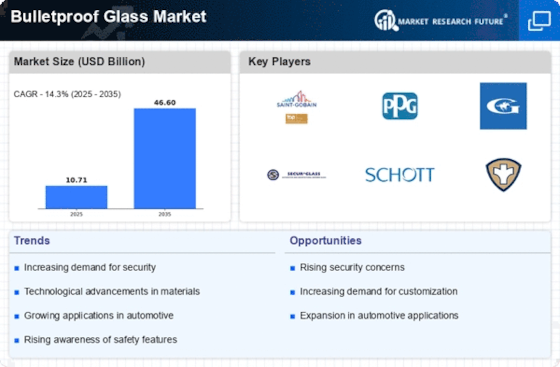
As per Market Research Future analysis, the Bulletproof Glass Market Size was estimated at 10.71 USD Billion in 2024. The Bulletproof Glass industry is projected to grow from 12.24 USD Billion in 2025 to 46.6 USD Billion by 2035, exhibiting a compound annual growth rate (CAGR) of 14.3% during the forecast period 2025 - 2035

Key Market Trends & Highlights

The Bulletproof Glass Market is experiencing robust growth driven by technological advancements and rising security concerns.

  • Technological advancements are enhancing the performance and applications of bulletproof glass across various sectors. North America remains the largest market, while Asia-Pacific is emerging as the fastest-growing region for bulletproof glass. The Defense and VIP Vehicles segment holds the largest market share, whereas ATM Booths and Teller Stations are witnessing the fastest growth. Rising security concerns and increased military applications are key drivers propelling the demand for bulletproof glass.

Market Size & Forecast

2024 Market Size 10.71 (USD Billion)
2035 Market Size 46.6 (USD Billion)
CAGR (2025 - 2035) 14.3%
Largest Regional Market Share in 2024 North America

Major Players

Saint-Gobain (FR), PPG Industries (US), Guardian Glass (US), Armored Glass (US), Schott AG (DE), Bollinger (US), Verco (US), Kastle Systems (US), Meyer Tool (US)

Market Trends

The Bulletproof Glass Market is currently experiencing a notable transformation, driven by increasing security concerns across various sectors. This heightened demand is particularly evident in the automotive, military, and architectural industries, where the need for enhanced protection against ballistic threats is paramount. As urban environments evolve and crime rates fluctuate, the emphasis on safety measures has intensified, prompting manufacturers to innovate and improve their offerings. Furthermore, advancements in materials technology are enabling the production of lighter, more effective bulletproof glass solutions, which could potentially expand their applications beyond traditional uses. In addition to technological advancements, regulatory frameworks are also shaping the Bulletproof Glass Market. Governments worldwide are implementing stricter safety standards, which may compel businesses to invest in higher-quality protective materials. This trend suggests a growing awareness of the importance of security in both public and private spaces. As the market continues to evolve, it appears that collaboration between manufacturers, regulatory bodies, and end-users will be crucial in addressing emerging challenges and opportunities. Overall, the Bulletproof Glass Market is poised for growth, driven by innovation and a collective commitment to safety and security.

Technological Advancements

Recent innovations in materials science are leading to the development of lighter and more effective bulletproof glass solutions. These advancements may enhance performance while reducing weight, making products more versatile for various applications.

Regulatory Influence

Stricter safety regulations are emerging globally, compelling manufacturers to adhere to higher standards. This trend indicates a shift towards prioritizing quality and safety in the production of bulletproof glass.

Increased Demand in Urban Areas

As urbanization continues, the demand for security solutions in metropolitan regions is rising. This trend suggests that bulletproof glass may become a standard feature in buildings and vehicles to address safety concerns.

Bulletproof Glass Market Market Drivers

Rising Security Concerns

The Bulletproof Glass Market is experiencing a notable surge in demand due to escalating security concerns across various sectors. As incidents of violence and crime increase, businesses and individuals are prioritizing safety measures. This heightened awareness has led to a significant uptick in the adoption of bulletproof glass in commercial buildings, banks, and government facilities. According to recent data, the market is projected to grow at a compound annual growth rate of approximately 7% over the next five years. This trend indicates that stakeholders are increasingly investing in protective solutions, thereby driving the Bulletproof Glass Market forward.

Technological Innovations

Technological advancements play a pivotal role in shaping the Bulletproof Glass Market. Innovations in materials science have led to the development of lighter and more effective bullet-resistant glass solutions. For instance, the introduction of polycarbonate and laminated glass has enhanced the performance of bulletproof products, making them more accessible for various applications. The market is witnessing a shift towards smart glass technologies, which not only provide protection but also offer features such as energy efficiency and UV protection. This evolution in technology is likely to attract new customers and expand the market reach, further propelling the Bulletproof Glass Market.

Regulatory Standards and Compliance

Regulatory frameworks and compliance requirements are shaping the Bulletproof Glass Market. Governments and regulatory bodies are establishing stringent safety standards for buildings and vehicles, particularly in high-risk areas. These regulations often mandate the use of bullet-resistant materials in certain applications, thereby driving demand for bulletproof glass. As companies strive to meet these compliance standards, the market is expected to see increased investments in protective glass solutions. This regulatory influence not only enhances safety but also propels the Bulletproof Glass Market as businesses adapt to evolving legal requirements.

Urbanization and Infrastructure Development

Urbanization is a driving force behind the Bulletproof Glass Market, as cities expand and infrastructure projects proliferate. The construction of high-rise buildings, commercial complexes, and public transport systems necessitates the integration of safety features, including bulletproof glass. As urban areas become more densely populated, the need for enhanced security measures becomes increasingly apparent. Recent estimates suggest that the construction sector is set to grow by 5% annually, which will likely boost the demand for bulletproof glass in new developments. This trend underscores the importance of safety in urban planning and development, thereby propelling the Bulletproof Glass Market.

Increased Military and Law Enforcement Applications

The Bulletproof Glass Market is significantly influenced by the growing demand from military and law enforcement agencies. As security threats evolve, these sectors are increasingly adopting advanced protective measures, including bulletproof glass for vehicles and facilities. The market for armored vehicles, which often incorporate bullet-resistant glass, is projected to grow substantially, reflecting a broader trend towards enhanced security in defense and public safety. This demand is expected to contribute to a robust growth trajectory for the Bulletproof Glass Market, as governments and organizations prioritize the safety of personnel and assets.

Market Segment Insights

By Application: Defense & VIP Vehicles (Largest) vs. ATM Booths & Teller Stations (Fastest-Growing)

The Bulletproof Glass Market demonstrates a varied distribution in the application segments, notably dominated by Defense &amp; VIP Vehicles. This segment commands a substantial share due to the heightened demand for security in military and governmental operations. Following closely are ATM Booths &amp; Teller Stations, which are witnessing rapid adoption as banks increasingly prioritize customer safety. The remaining segments, including Cash-in-Transit Vehicles, Commercial Buildings, and Government &amp; Law Enforcement, collectively contribute to a noteworthy market presence, showcasing diverse applications across varied industries.

ATM Booths &amp; Teller Stations (Dominant) vs. Government &amp; Law Enforcement (Emerging)

In the Bulletproof Glass Market, ATM Booths &amp; Teller Stations are regarded as a dominant segment, reflecting essential security needs as banks and financial institutions prioritize customer protection. With increasing risks of theft and vandalism, this segment is experiencing robust demand, driving innovation in the materials and design of bulletproof <a href="https://www.marketresearchfuture.com/reports/glass-market-11515">glass</a>. On the other hand, Government &amp; Law Enforcement represents an emerging segment, leveraging advancements in technology to enhance safety protocols. As government facilities seek enhanced protection measures for personnel and sensitive operations, this segment is expected to gain significance, requiring innovations in bulletproof glass applications that maintain aesthetic and functional integrity while providing optimal security.

By End-Use: Automotive (Largest) vs. Military (Fastest-Growing)

In the Bulletproof Glass Market, the 'By End-Use' segment is characterized by diverse applications, with the automotive sector holding the largest market share. This segment is driven by increasing safety regulations and the demand for advanced protective features in vehicles. The military sector, on the other hand, is witnessing significant growth, fueled by the rising need for security in defense operations and the enhancement of vehicle armor technologies. The banking and finance, <a href="https://www.marketresearchfuture.com/reports/construction-market-16065">construction</a>, and other segments also contribute to the market but are relatively smaller in comparison to automotive and military applications. Growth trends indicate a robust trajectory for the bulletproof glass market, particularly in the military sector, which is positioned as the fastest-growing end-use segment. This growth is driven by geopolitical tensions and increased defense spending across nations, leading to higher investments in security technologies. Additionally, advancements in manufacturing processes and materials are enhancing the performance and affordability of bulletproof glass, which is encouraging wider adoption across various sectors, including construction and banking, further establishing the bulletproof glass as a crucial safety solution.

Automotive: Dominant vs. Military: Emerging

The automotive segment of the Bulletproof Glass Market stands as the dominant force, propelled by the rising concerns over safety and security in personal and commercial vehicles. As manufacturers adopt bulletproof glass technology to enhance vehicle protection against potential threats, this segment thrives with sustained innovations and customer demands. In contrast, the military segment represents an emerging sector, rapidly gaining ground due to escalating defense requirements and advancements in military vehicle technologies. This segment focuses on providing enhanced protection for soldiers and equipment in conflict zones, leading to the development of specialized bulletproof glass solutions that meet stringent military standards. The demand in both segments showcases a dual focus on safety and technology, with automotive leading and military quickly following in importance.

Get more detailed insights about Bulletproof Glass Market Research Report—Global Forecast till 2035

Regional Insights

North America : Market Leader in Innovation

North America is the largest market for bulletproof glass, holding approximately 45% of the global market share. The region's growth is driven by increasing security concerns, particularly in urban areas, and stringent regulations regarding safety standards. The demand for bulletproof glass is further fueled by rising investments in infrastructure and defense sectors, which are critical for enhancing public safety and security. The United States is the leading country in this market, with significant contributions from key players such as PPG Industries and Guardian Glass. The competitive landscape is characterized by innovation and technological advancements, with companies focusing on developing lightweight and more effective bulletproof solutions. Canada also plays a vital role, contributing to the overall market dynamics with its growing demand for security solutions.

Europe : Emerging Market with Regulations

Europe is witnessing a growing demand for bulletproof glass, accounting for approximately 30% of the global market share. The region's growth is primarily driven by increasing safety regulations and a heightened focus on security in public spaces. Countries like Germany and France are leading this trend, with government initiatives aimed at enhancing safety standards in both commercial and residential sectors. Germany stands out as a key player in the bulletproof glass market, with companies like Schott AG leading the charge. The competitive landscape is marked by a mix of established players and emerging startups focusing on innovative solutions. The presence of stringent regulations and a proactive approach towards safety is shaping the market dynamics, making Europe a significant player in the bulletproof glass industry.

Asia-Pacific : Rapid Growth in Security Needs

Asia-Pacific is rapidly emerging as a significant market for bulletproof glass, holding around 20% of the global market share. The region's growth is driven by urbanization, rising crime rates, and increasing investments in security infrastructure. Countries like China and India are witnessing a surge in demand for bulletproof solutions, particularly in commercial buildings and government facilities, as safety concerns escalate. China is the largest market in the region, with a growing number of local manufacturers entering the space. The competitive landscape is evolving, with both domestic and international players vying for market share. The presence of key players such as Guardian Glass and local manufacturers is fostering innovation and driving down costs, making bulletproof glass more accessible to a broader audience.

Middle East and Africa : Growing Security Concerns

The Middle East and Africa region is witnessing a gradual increase in the demand for bulletproof glass, accounting for approximately 5% of the global market share. The growth is primarily driven by rising security concerns due to geopolitical tensions and increasing investments in infrastructure projects. Countries like the UAE and South Africa are at the forefront, focusing on enhancing security measures in both public and private sectors. The UAE is leading the market in this region, with significant contributions from local manufacturers and international players. The competitive landscape is characterized by a mix of established companies and new entrants, all aiming to meet the growing demand for security solutions. As the region continues to develop, the need for advanced protective materials like bulletproof glass is expected to rise significantly.

Key Players and Competitive Insights

The Bulletproof Glass Market is currently characterized by a dynamic competitive landscape, driven by increasing security concerns across various sectors, including automotive, military, and commercial applications. Key players such as Saint-Gobain (FR), PPG Industries (US), and Guardian Glass (US) are strategically positioning themselves through innovation and regional expansion. Saint-Gobain (FR) focuses on enhancing product durability and performance, while PPG Industries (US) emphasizes technological advancements in glass manufacturing. Guardian Glass (US) is actively pursuing partnerships to broaden its market reach, collectively shaping a competitive environment that prioritizes quality and technological superiority.
In terms of business tactics, companies are increasingly localizing manufacturing to reduce lead times and optimize supply chains. The Bulletproof Glass Market appears moderately fragmented, with several players vying for market share. However, the collective influence of major companies is significant, as they leverage their resources to enhance production capabilities and meet the growing demand for advanced security solutions.
In August 2025, PPG Industries (US) announced the launch of a new line of bullet-resistant glass designed specifically for high-risk environments. This strategic move not only reinforces PPG's commitment to innovation but also positions the company to capture a larger share of the security-focused market segment. The introduction of this product is likely to enhance PPG's competitive edge by addressing the evolving needs of customers seeking enhanced protection.
In September 2025, Guardian Glass (US) entered into a strategic partnership with a leading technology firm to integrate smart glass solutions into its bulletproof offerings. This collaboration aims to develop glass that not only provides ballistic protection but also incorporates advanced features such as energy efficiency and smart technology. Such a move indicates Guardian's intent to diversify its product portfolio and cater to a broader range of consumer needs, potentially setting a new standard in the industry.
In July 2025, Saint-Gobain (FR) expanded its manufacturing capabilities by investing in a new facility dedicated to producing high-performance bulletproof glass. This investment underscores the company's strategy to enhance production efficiency and meet the increasing demand for security solutions. By bolstering its manufacturing footprint, Saint-Gobain is likely to improve its supply chain reliability and responsiveness to market changes.
As of October 2025, current trends in the Bulletproof Glass Market include a strong emphasis on digitalization, sustainability, and the integration of artificial intelligence in manufacturing processes. Strategic alliances are increasingly shaping the competitive landscape, enabling companies to pool resources and expertise. Looking ahead, it appears that competitive differentiation will evolve from traditional price-based competition to a focus on innovation, technological advancements, and supply chain reliability, as companies strive to meet the sophisticated demands of a security-conscious market.

Key Companies in the Bulletproof Glass Market include

Industry Developments

  • Q2 2024: AGP Group inaugurates new bulletproof glass manufacturing facility in Texas AGP Group, a leading manufacturer of specialty glass, opened a new state-of-the-art facility in Texas dedicated to the production of advanced bulletproof glass for automotive and architectural applications. The facility aims to meet growing demand in North America and create over 200 jobs.
  • Q2 2024: Saint-Gobain launches next-generation bulletproof glass for armored vehicles Saint-Gobain announced the commercial launch of its new lightweight, multi-layered bulletproof glass designed for military and VIP vehicles, offering enhanced protection and reduced weight compared to previous models.
  • Q3 2024: AGC Inc. secures major contract to supply bulletproof glass for new European government buildings AGC Inc. was awarded a multi-year contract to provide bulletproof glass for a series of high-security government facilities under construction in Western Europe, marking a significant expansion of its security glass business.
  • Q3 2024: Guardian Glass partners with Tesla to develop advanced bulletproof glass for Cybertruck Guardian Glass entered a strategic partnership with Tesla to co-develop and supply advanced bulletproof glass for the upcoming Cybertruck, focusing on improved impact resistance and optical clarity.
  • Q4 2024: PPG Industries acquires minority stake in Israeli bulletproof glass startup ArmorVision PPG Industries invested in ArmorVision, an Israeli startup specializing in transparent armor solutions, to accelerate the commercialization of next-generation bulletproof glass technologies for defense and civilian markets.
  • Q4 2024: Asahi Glass Co. opens R&D center for bulletproof glass innovation in Japan Asahi Glass Co. inaugurated a new research and development center focused on advanced bulletproof glass technologies, aiming to develop lighter and more durable solutions for global security applications.
  • Q1 2025: Schott AG wins contract to supply bulletproof glass for German police vehicles Schott AG secured a government contract to provide bulletproof glass for a new fleet of armored police vehicles in Germany, supporting enhanced law enforcement protection.
  • Q1 2025: Saint-Gobain acquires US-based security glass manufacturer SecureLite Saint-Gobain completed the acquisition of SecureLite, a US manufacturer specializing in bulletproof and security glass, expanding its footprint in the North American security glazing market.
  • Q2 2025: AGP Group announces $100 million investment to expand bulletproof glass production in Brazil AGP Group revealed plans to invest $100 million to expand its bulletproof glass manufacturing capacity in Brazil, targeting increased demand from the automotive and banking sectors.
  • Q2 2025: PPG Industries launches eco-friendly bulletproof glass line for commercial buildings PPG Industries introduced a new line of environmentally friendly bulletproof glass products designed for commercial and public infrastructure, featuring recycled materials and reduced carbon footprint.
  • Q3 2025: Guardian Glass secures contract to supply bulletproof glass for London’s new embassy district Guardian Glass was awarded a contract to provide bulletproof glass for several embassies in London’s newly developed diplomatic quarter, enhancing security for international missions.
  • Q3 2025: AGC Inc. appoints new CEO to lead global security glass division AGC Inc. announced the appointment of a new CEO for its global security glass division, aiming to accelerate innovation and growth in the bulletproof glass market.

Future Outlook

Bulletproof Glass Market Future Outlook

The Bulletproof Glass Market is projected to grow at a 14.3% CAGR from 2025 to 2035, driven by increasing security concerns, technological advancements, and rising demand in various sectors.

New opportunities lie in:

  • Expansion into emerging markets with tailored solutions
  • Development of lightweight, high-performance glass for automotive applications
  • Integration of smart technology for enhanced security features

By 2035, the Bulletproof Glass Market is expected to achieve substantial growth and innovation.

Market Segmentation

Bulletproof Glass Market End-Use Outlook

  • Automotive
  • Military
  • Banking & Finance
  • Construction
  • Others

Bulletproof Glass Market Application Outlook

  • Defense & VIP Vehicles
  • ATM Booths & Teller Stations
  • Cash-in-Transit Vehicles
  • Commercial Buildings
  • Government & Law Enforcement
  • Others

Report Scope

MARKET SIZE 2024 10.71(USD Billion)
MARKET SIZE 2025 12.24(USD Billion)
MARKET SIZE 2035 46.6(USD Billion)
COMPOUND ANNUAL GROWTH RATE (CAGR) 14.3% (2025 - 2035)
REPORT COVERAGE Revenue Forecast, Competitive Landscape, Growth Factors, and Trends
BASE YEAR 2024
Market Forecast Period 2025 - 2035
Historical Data 2019 - 2024
Market Forecast Units USD Billion
Key Companies Profiled Saint-Gobain (FR), PPG Industries (US), Guardian Glass (US), Armored Glass (US), Schott AG (DE), Bollinger (US), Verco (US), Kastle Systems (US), Meyer Tool (US)
Segments Covered Application, End-Use, Region
Key Market Opportunities Growing demand for enhanced security solutions drives innovation in the Bulletproof Glass Market.
Key Market Dynamics Rising demand for enhanced security solutions drives innovation and competition in the bulletproof glass market.
Countries Covered North America, Europe, APAC, South America, MEA

FAQs

What is the current valuation of the Bulletproof Glass Market as of 2024?

<p>The Bulletproof Glass Market was valued at 10.71 USD Billion in 2024.</p>

What is the projected market valuation for the Bulletproof Glass Market in 2035?

<p>The market is projected to reach 46.6 USD Billion by 2035.</p>

What is the expected CAGR for the Bulletproof Glass Market during the forecast period 2025 - 2035?

<p>The expected CAGR for the Bulletproof Glass Market during 2025 - 2035 is 14.3%.</p>

Which application segment is anticipated to have the highest growth in the Bulletproof Glass Market?

<p>The Commercial Buildings segment is projected to grow from 2.5 USD Billion in 2024 to 10.0 USD Billion by 2035.</p>

How does the Defense & VIP Vehicles segment perform in terms of market valuation?

<p>The Defense & VIP Vehicles segment was valued at 1.5 USD Billion in 2024 and is expected to grow to 6.5 USD Billion by 2035.</p>

What are the key players in the Bulletproof Glass Market?

<p>Key players include Saint-Gobain, PPG Industries, Guardian Glass, and Armored Glass, among others.</p>

What is the market valuation for the Banking & Finance segment in 2024?

The Banking &amp; Finance segment was valued at 2.0 USD Billion in 2024.

What is the projected valuation for the Cash-in-Transit Vehicles segment by 2035?

The Cash-in-Transit Vehicles segment is expected to reach 4.0 USD Billion by 2035.

How does the Military segment compare to other end-use segments in terms of growth?

The Military segment was valued at 3.0 USD Billion in 2024 and is projected to grow to 12.0 USD Billion by 2035.

What is the expected growth for the Others segment in the Application category?

The Others segment in the Application category is anticipated to grow from 2.51 USD Billion in 2024 to 13.1 USD Billion by 2035.

  1. SECTION I: EXECUTIVE SUMMARY AND KEY HIGHLIGHTS
    1. | 1.1 EXECUTIVE SUMMARY
    2. | | 1.1.1 Market Overview
    3. | | 1.1.2 Key Findings
    4. | | 1.1.3 Market Segmentation
    5. | | 1.1.4 Competitive Landscape
    6. | | 1.1.5 Challenges and Opportunities
    7. | | 1.1.6 Future Outlook
  2. SECTION II: SCOPING, METHODOLOGY AND MARKET STRUCTURE
    1. | 2.1 MARKET INTRODUCTION
    2. | | 2.1.1 Definition
    3. | | 2.1.2 Scope of the study
    4. | | | 2.1.2.1 Research Objective
    5. | | | 2.1.2.2 Assumption
    6. | | | 2.1.2.3 Limitations
    7. | 2.2 RESEARCH METHODOLOGY
    8. | | 2.2.1 Overview
    9. | | 2.2.2 Data Mining
    10. | | 2.2.3 Secondary Research
    11. | | 2.2.4 Primary Research
    12. | | | 2.2.4.1 Primary Interviews and Information Gathering Process
    13. | | | 2.2.4.2 Breakdown of Primary Respondents
    14. | | 2.2.5 Forecasting Model
    15. | | 2.2.6 Market Size Estimation
    16. | | | 2.2.6.1 Bottom-Up Approach
    17. | | | 2.2.6.2 Top-Down Approach
    18. | | 2.2.7 Data Triangulation
    19. | | 2.2.8 Validation
  3. SECTION III: QUALITATIVE ANALYSIS
    1. | 3.1 MARKET DYNAMICS
    2. | | 3.1.1 Overview
    3. | | 3.1.2 Drivers
    4. | | 3.1.3 Restraints
    5. | | 3.1.4 Opportunities
    6. | 3.2 MARKET FACTOR ANALYSIS
    7. | | 3.2.1 Value chain Analysis
    8. | | 3.2.2 Porter's Five Forces Analysis
    9. | | | 3.2.2.1 Bargaining Power of Suppliers
    10. | | | 3.2.2.2 Bargaining Power of Buyers
    11. | | | 3.2.2.3 Threat of New Entrants
    12. | | | 3.2.2.4 Threat of Substitutes
    13. | | | 3.2.2.5 Intensity of Rivalry
    14. | | 3.2.3 COVID-19 Impact Analysis
    15. | | | 3.2.3.1 Market Impact Analysis
    16. | | | 3.2.3.2 Regional Impact
    17. | | | 3.2.3.3 Opportunity and Threat Analysis
  4. SECTION IV: QUANTITATIVE ANALYSIS
    1. | 4.1 Chemicals and Materials, BY Application (USD Billion)
    2. | | 4.1.1 Defense & VIP Vehicles
    3. | | 4.1.2 ATM Booths & Teller Stations
    4. | | 4.1.3 Cash-in-Transit Vehicles
    5. | | 4.1.4 Commercial Buildings
    6. | | 4.1.5 Government & Law Enforcement
    7. | | 4.1.6 Others
    8. | 4.2 Chemicals and Materials, BY End-Use (USD Billion)
    9. | | 4.2.1 Automotive
    10. | | 4.2.2 Military
    11. | | 4.2.3 Banking & Finance
    12. | | 4.2.4 Construction
    13. | | 4.2.5 Others
    14. | 4.3 Chemicals and Materials, BY Region (USD Billion)
    15. | | 4.3.1 North America
    16. | | | 4.3.1.1 US
    17. | | | 4.3.1.2 Canada
    18. | | 4.3.2 Europe
    19. | | | 4.3.2.1 Germany
    20. | | | 4.3.2.2 UK
    21. | | | 4.3.2.3 France
    22. | | | 4.3.2.4 Russia
    23. | | | 4.3.2.5 Italy
    24. | | | 4.3.2.6 Spain
    25. | | | 4.3.2.7 Rest of Europe
    26. | | 4.3.3 APAC
    27. | | | 4.3.3.1 China
    28. | | | 4.3.3.2 India
    29. | | | 4.3.3.3 Japan
    30. | | | 4.3.3.4 South Korea
    31. | | | 4.3.3.5 Malaysia
    32. | | | 4.3.3.6 Thailand
    33. | | | 4.3.3.7 Indonesia
    34. | | | 4.3.3.8 Rest of APAC
    35. | | 4.3.4 South America
    36. | | | 4.3.4.1 Brazil
    37. | | | 4.3.4.2 Mexico
    38. | | | 4.3.4.3 Argentina
    39. | | | 4.3.4.4 Rest of South America
    40. | | 4.3.5 MEA
    41. | | | 4.3.5.1 GCC Countries
    42. | | | 4.3.5.2 South Africa
    43. | | | 4.3.5.3 Rest of MEA
  5. SECTION V: COMPETITIVE ANALYSIS
    1. | 5.1 Competitive Landscape
    2. | | 5.1.1 Overview
    3. | | 5.1.2 Competitive Analysis
    4. | | 5.1.3 Market share Analysis
    5. | | 5.1.4 Major Growth Strategy in the Chemicals and Materials
    6. | | 5.1.5 Competitive Benchmarking
    7. | | 5.1.6 Leading Players in Terms of Number of Developments in the Chemicals and Materials
    8. | | 5.1.7 Key developments and growth strategies
    9. | | | 5.1.7.1 New Product Launch/Service Deployment
    10. | | | 5.1.7.2 Merger & Acquisitions
    11. | | | 5.1.7.3 Joint Ventures
    12. | | 5.1.8 Major Players Financial Matrix
    13. | | | 5.1.8.1 Sales and Operating Income
    14. | | | 5.1.8.2 Major Players R&D Expenditure. 2023
    15. | 5.2 Company Profiles
    16. | | 5.2.1 Saint-Gobain (FR)
    17. | | | 5.2.1.1 Financial Overview
    18. | | | 5.2.1.2 Products Offered
    19. | | | 5.2.1.3 Key Developments
    20. | | | 5.2.1.4 SWOT Analysis
    21. | | | 5.2.1.5 Key Strategies
    22. | | 5.2.2 PPG Industries (US)
    23. | | | 5.2.2.1 Financial Overview
    24. | | | 5.2.2.2 Products Offered
    25. | | | 5.2.2.3 Key Developments
    26. | | | 5.2.2.4 SWOT Analysis
    27. | | | 5.2.2.5 Key Strategies
    28. | | 5.2.3 Guardian Glass (US)
    29. | | | 5.2.3.1 Financial Overview
    30. | | | 5.2.3.2 Products Offered
    31. | | | 5.2.3.3 Key Developments
    32. | | | 5.2.3.4 SWOT Analysis
    33. | | | 5.2.3.5 Key Strategies
    34. | | 5.2.4 Armored Glass (US)
    35. | | | 5.2.4.1 Financial Overview
    36. | | | 5.2.4.2 Products Offered
    37. | | | 5.2.4.3 Key Developments
    38. | | | 5.2.4.4 SWOT Analysis
    39. | | | 5.2.4.5 Key Strategies
    40. | | 5.2.5 Schott AG (DE)
    41. | | | 5.2.5.1 Financial Overview
    42. | | | 5.2.5.2 Products Offered
    43. | | | 5.2.5.3 Key Developments
    44. | | | 5.2.5.4 SWOT Analysis
    45. | | | 5.2.5.5 Key Strategies
    46. | | 5.2.6 Bollinger (US)
    47. | | | 5.2.6.1 Financial Overview
    48. | | | 5.2.6.2 Products Offered
    49. | | | 5.2.6.3 Key Developments
    50. | | | 5.2.6.4 SWOT Analysis
    51. | | | 5.2.6.5 Key Strategies
    52. | | 5.2.7 Verco (US)
    53. | | | 5.2.7.1 Financial Overview
    54. | | | 5.2.7.2 Products Offered
    55. | | | 5.2.7.3 Key Developments
    56. | | | 5.2.7.4 SWOT Analysis
    57. | | | 5.2.7.5 Key Strategies
    58. | | 5.2.8 Kastle Systems (US)
    59. | | | 5.2.8.1 Financial Overview
    60. | | | 5.2.8.2 Products Offered
    61. | | | 5.2.8.3 Key Developments
    62. | | | 5.2.8.4 SWOT Analysis
    63. | | | 5.2.8.5 Key Strategies
    64. | | 5.2.9 Meyer Tool (US)
    65. | | | 5.2.9.1 Financial Overview
    66. | | | 5.2.9.2 Products Offered
    67. | | | 5.2.9.3 Key Developments
    68. | | | 5.2.9.4 SWOT Analysis
    69. | | | 5.2.9.5 Key Strategies
    70. | 5.3 Appendix
    71. | | 5.3.1 References
    72. | | 5.3.2 Related Reports
  6. LIST OF FIGURES
    1. | 6.1 MARKET SYNOPSIS
    2. | 6.2 NORTH AMERICA MARKET ANALYSIS
    3. | 6.3 US MARKET ANALYSIS BY APPLICATION
    4. | 6.4 US MARKET ANALYSIS BY END-USE
    5. | 6.5 CANADA MARKET ANALYSIS BY APPLICATION
    6. | 6.6 CANADA MARKET ANALYSIS BY END-USE
    7. | 6.7 EUROPE MARKET ANALYSIS
    8. | 6.8 GERMANY MARKET ANALYSIS BY APPLICATION
    9. | 6.9 GERMANY MARKET ANALYSIS BY END-USE
    10. | 6.10 UK MARKET ANALYSIS BY APPLICATION
    11. | 6.11 UK MARKET ANALYSIS BY END-USE
    12. | 6.12 FRANCE MARKET ANALYSIS BY APPLICATION
    13. | 6.13 FRANCE MARKET ANALYSIS BY END-USE
    14. | 6.14 RUSSIA MARKET ANALYSIS BY APPLICATION
    15. | 6.15 RUSSIA MARKET ANALYSIS BY END-USE
    16. | 6.16 ITALY MARKET ANALYSIS BY APPLICATION
    17. | 6.17 ITALY MARKET ANALYSIS BY END-USE
    18. | 6.18 SPAIN MARKET ANALYSIS BY APPLICATION
    19. | 6.19 SPAIN MARKET ANALYSIS BY END-USE
    20. | 6.20 REST OF EUROPE MARKET ANALYSIS BY APPLICATION
    21. | 6.21 REST OF EUROPE MARKET ANALYSIS BY END-USE
    22. | 6.22 APAC MARKET ANALYSIS
    23. | 6.23 CHINA MARKET ANALYSIS BY APPLICATION
    24. | 6.24 CHINA MARKET ANALYSIS BY END-USE
    25. | 6.25 INDIA MARKET ANALYSIS BY APPLICATION
    26. | 6.26 INDIA MARKET ANALYSIS BY END-USE
    27. | 6.27 JAPAN MARKET ANALYSIS BY APPLICATION
    28. | 6.28 JAPAN MARKET ANALYSIS BY END-USE
    29. | 6.29 SOUTH KOREA MARKET ANALYSIS BY APPLICATION
    30. | 6.30 SOUTH KOREA MARKET ANALYSIS BY END-USE
    31. | 6.31 MALAYSIA MARKET ANALYSIS BY APPLICATION
    32. | 6.32 MALAYSIA MARKET ANALYSIS BY END-USE
    33. | 6.33 THAILAND MARKET ANALYSIS BY APPLICATION
    34. | 6.34 THAILAND MARKET ANALYSIS BY END-USE
    35. | 6.35 INDONESIA MARKET ANALYSIS BY APPLICATION
    36. | 6.36 INDONESIA MARKET ANALYSIS BY END-USE
    37. | 6.37 REST OF APAC MARKET ANALYSIS BY APPLICATION
    38. | 6.38 REST OF APAC MARKET ANALYSIS BY END-USE
    39. | 6.39 SOUTH AMERICA MARKET ANALYSIS
    40. | 6.40 BRAZIL MARKET ANALYSIS BY APPLICATION
    41. | 6.41 BRAZIL MARKET ANALYSIS BY END-USE
    42. | 6.42 MEXICO MARKET ANALYSIS BY APPLICATION
    43. | 6.43 MEXICO MARKET ANALYSIS BY END-USE
    44. | 6.44 ARGENTINA MARKET ANALYSIS BY APPLICATION
    45. | 6.45 ARGENTINA MARKET ANALYSIS BY END-USE
    46. | 6.46 REST OF SOUTH AMERICA MARKET ANALYSIS BY APPLICATION
    47. | 6.47 REST OF SOUTH AMERICA MARKET ANALYSIS BY END-USE
    48. | 6.48 MEA MARKET ANALYSIS
    49. | 6.49 GCC COUNTRIES MARKET ANALYSIS BY APPLICATION
    50. | 6.50 GCC COUNTRIES MARKET ANALYSIS BY END-USE
    51. | 6.51 SOUTH AFRICA MARKET ANALYSIS BY APPLICATION
    52. | 6.52 SOUTH AFRICA MARKET ANALYSIS BY END-USE
    53. | 6.53 REST OF MEA MARKET ANALYSIS BY APPLICATION
    54. | 6.54 REST OF MEA MARKET ANALYSIS BY END-USE
    55. | 6.55 KEY BUYING CRITERIA OF CHEMICALS AND MATERIALS
    56. | 6.56 RESEARCH PROCESS OF MRFR
    57. | 6.57 DRO ANALYSIS OF CHEMICALS AND MATERIALS
    58. | 6.58 DRIVERS IMPACT ANALYSIS: CHEMICALS AND MATERIALS
    59. | 6.59 RESTRAINTS IMPACT ANALYSIS: CHEMICALS AND MATERIALS
    60. | 6.60 SUPPLY / VALUE CHAIN: CHEMICALS AND MATERIALS
    61. | 6.61 CHEMICALS AND MATERIALS, BY APPLICATION, 2024 (% SHARE)
    62. | 6.62 CHEMICALS AND MATERIALS, BY APPLICATION, 2024 TO 2035 (USD Billion)
    63. | 6.63 CHEMICALS AND MATERIALS, BY END-USE, 2024 (% SHARE)
    64. | 6.64 CHEMICALS AND MATERIALS, BY END-USE, 2024 TO 2035 (USD Billion)
    65. | 6.65 BENCHMARKING OF MAJOR COMPETITORS
  7. LIST OF TABLES
    1. | 7.1 LIST OF ASSUMPTIONS
    2. | | 7.1.1
    3. | 7.2 North America MARKET SIZE ESTIMATES; FORECAST
    4. | | 7.2.1 BY APPLICATION, 2025-2035 (USD Billion)
    5. | | 7.2.2 BY END-USE, 2025-2035 (USD Billion)
    6. | 7.3 US MARKET SIZE ESTIMATES; FORECAST
    7. | | 7.3.1 BY APPLICATION, 2025-2035 (USD Billion)
    8. | | 7.3.2 BY END-USE, 2025-2035 (USD Billion)
    9. | 7.4 Canada MARKET SIZE ESTIMATES; FORECAST
    10. | | 7.4.1 BY APPLICATION, 2025-2035 (USD Billion)
    11. | | 7.4.2 BY END-USE, 2025-2035 (USD Billion)
    12. | 7.5 Europe MARKET SIZE ESTIMATES; FORECAST
    13. | | 7.5.1 BY APPLICATION, 2025-2035 (USD Billion)
    14. | | 7.5.2 BY END-USE, 2025-2035 (USD Billion)
    15. | 7.6 Germany MARKET SIZE ESTIMATES; FORECAST
    16. | | 7.6.1 BY APPLICATION, 2025-2035 (USD Billion)
    17. | | 7.6.2 BY END-USE, 2025-2035 (USD Billion)
    18. | 7.7 UK MARKET SIZE ESTIMATES; FORECAST
    19. | | 7.7.1 BY APPLICATION, 2025-2035 (USD Billion)
    20. | | 7.7.2 BY END-USE, 2025-2035 (USD Billion)
    21. | 7.8 France MARKET SIZE ESTIMATES; FORECAST
    22. | | 7.8.1 BY APPLICATION, 2025-2035 (USD Billion)
    23. | | 7.8.2 BY END-USE, 2025-2035 (USD Billion)
    24. | 7.9 Russia MARKET SIZE ESTIMATES; FORECAST
    25. | | 7.9.1 BY APPLICATION, 2025-2035 (USD Billion)
    26. | | 7.9.2 BY END-USE, 2025-2035 (USD Billion)
    27. | 7.10 Italy MARKET SIZE ESTIMATES; FORECAST
    28. | | 7.10.1 BY APPLICATION, 2025-2035 (USD Billion)
    29. | | 7.10.2 BY END-USE, 2025-2035 (USD Billion)
    30. | 7.11 Spain MARKET SIZE ESTIMATES; FORECAST
    31. | | 7.11.1 BY APPLICATION, 2025-2035 (USD Billion)
    32. | | 7.11.2 BY END-USE, 2025-2035 (USD Billion)
    33. | 7.12 Rest of Europe MARKET SIZE ESTIMATES; FORECAST
    34. | | 7.12.1 BY APPLICATION, 2025-2035 (USD Billion)
    35. | | 7.12.2 BY END-USE, 2025-2035 (USD Billion)
    36. | 7.13 APAC MARKET SIZE ESTIMATES; FORECAST
    37. | | 7.13.1 BY APPLICATION, 2025-2035 (USD Billion)
    38. | | 7.13.2 BY END-USE, 2025-2035 (USD Billion)
    39. | 7.14 China MARKET SIZE ESTIMATES; FORECAST
    40. | | 7.14.1 BY APPLICATION, 2025-2035 (USD Billion)
    41. | | 7.14.2 BY END-USE, 2025-2035 (USD Billion)
    42. | 7.15 India MARKET SIZE ESTIMATES; FORECAST
    43. | | 7.15.1 BY APPLICATION, 2025-2035 (USD Billion)
    44. | | 7.15.2 BY END-USE, 2025-2035 (USD Billion)
    45. | 7.16 Japan MARKET SIZE ESTIMATES; FORECAST
    46. | | 7.16.1 BY APPLICATION, 2025-2035 (USD Billion)
    47. | | 7.16.2 BY END-USE, 2025-2035 (USD Billion)
    48. | 7.17 South Korea MARKET SIZE ESTIMATES; FORECAST
    49. | | 7.17.1 BY APPLICATION, 2025-2035 (USD Billion)
    50. | | 7.17.2 BY END-USE, 2025-2035 (USD Billion)
    51. | 7.18 Malaysia MARKET SIZE ESTIMATES; FORECAST
    52. | | 7.18.1 BY APPLICATION, 2025-2035 (USD Billion)
    53. | | 7.18.2 BY END-USE, 2025-2035 (USD Billion)
    54. | 7.19 Thailand MARKET SIZE ESTIMATES; FORECAST
    55. | | 7.19.1 BY APPLICATION, 2025-2035 (USD Billion)
    56. | | 7.19.2 BY END-USE, 2025-2035 (USD Billion)
    57. | 7.20 Indonesia MARKET SIZE ESTIMATES; FORECAST
    58. | | 7.20.1 BY APPLICATION, 2025-2035 (USD Billion)
    59. | | 7.20.2 BY END-USE, 2025-2035 (USD Billion)
    60. | 7.21 Rest of APAC MARKET SIZE ESTIMATES; FORECAST
    61. | | 7.21.1 BY APPLICATION, 2025-2035 (USD Billion)
    62. | | 7.21.2 BY END-USE, 2025-2035 (USD Billion)
    63. | 7.22 South America MARKET SIZE ESTIMATES; FORECAST
    64. | | 7.22.1 BY APPLICATION, 2025-2035 (USD Billion)
    65. | | 7.22.2 BY END-USE, 2025-2035 (USD Billion)
    66. | 7.23 Brazil MARKET SIZE ESTIMATES; FORECAST
    67. | | 7.23.1 BY APPLICATION, 2025-2035 (USD Billion)
    68. | | 7.23.2 BY END-USE, 2025-2035 (USD Billion)
    69. | 7.24 Mexico MARKET SIZE ESTIMATES; FORECAST
    70. | | 7.24.1 BY APPLICATION, 2025-2035 (USD Billion)
    71. | | 7.24.2 BY END-USE, 2025-2035 (USD Billion)
    72. | 7.25 Argentina MARKET SIZE ESTIMATES; FORECAST
    73. | | 7.25.1 BY APPLICATION, 2025-2035 (USD Billion)
    74. | | 7.25.2 BY END-USE, 2025-2035 (USD Billion)
    75. | 7.26 Rest of South America MARKET SIZE ESTIMATES; FORECAST
    76. | | 7.26.1 BY APPLICATION, 2025-2035 (USD Billion)
    77. | | 7.26.2 BY END-USE, 2025-2035 (USD Billion)
    78. | 7.27 MEA MARKET SIZE ESTIMATES; FORECAST
    79. | | 7.27.1 BY APPLICATION, 2025-2035 (USD Billion)
    80. | | 7.27.2 BY END-USE, 2025-2035 (USD Billion)
    81. | 7.28 GCC Countries MARKET SIZE ESTIMATES; FORECAST
    82. | | 7.28.1 BY APPLICATION, 2025-2035 (USD Billion)
    83. | | 7.28.2 BY END-USE, 2025-2035 (USD Billion)
    84. | 7.29 South Africa MARKET SIZE ESTIMATES; FORECAST
    85. | | 7.29.1 BY APPLICATION, 2025-2035 (USD Billion)
    86. | | 7.29.2 BY END-USE, 2025-2035 (USD Billion)
    87. | 7.30 Rest of MEA MARKET SIZE ESTIMATES; FORECAST
    88. | | 7.30.1 BY APPLICATION, 2025-2035 (USD Billion)
    89. | | 7.30.2 BY END-USE, 2025-2035 (USD Billion)
    90. | 7.31 PRODUCT LAUNCH/PRODUCT DEVELOPMENT/APPROVAL
    91. | | 7.31.1
    92. | 7.32 ACQUISITION/PARTNERSHIP
    93. | | 7.32.1

Chemicals and Materials Market Segmentation

Chemicals and Materials By Application (USD Billion, 2025-2035)

  • Defense & VIP Vehicles
  • ATM Booths & Teller Stations
  • Cash-in-Transit Vehicles
  • Commercial Buildings
  • Government & Law Enforcement
  • Others

Chemicals and Materials By End-Use (USD Billion, 2025-2035)

  • Automotive
  • Military
  • Banking & Finance
  • Construction
  • Others
Infographic

Free Sample Request

Kindly complete the form below to receive a free sample of this Report

Get Free Sample

Customer Strories

Compare Licence

×
Features License Type
Single User Multiuser License Enterprise User
Price $4,950 $5,950 $7,250
Maximum User Access Limit 1 User Upto 10 Users Unrestricted Access Throughout the Organization
Free Customization
Direct Access to Analyst
Deliverable Format
Platform Access
Discount on Next Purchase 10% 15% 15%
Printable Versions