Request Free Sample ×

Kindly complete the form below to receive a free sample of this Report

* Please use a valid business email

Leading companies partner with us for data-driven Insights

clients tt-cursor
Hero Background
English
Chinese
French
Japanese
Korean
German
Spanish

Brain Imaging Neuroimaging Market Size

ID: MRFR/MED/10744-CR
135 Pages
Nidhi Mandole
September 2023

Global Brain Imaging and Neuroimaging Market Research Report Information By Imaging Type [Functional Magnetic Resonance Imaging (FMRI), Compound Tomography (CT), Positron Emission Tomography (PET), Electroencephalography (EEG), Magnetoencephalography (MEG) and Near Infrared Spectroscopy (NIRS)], By End User (Hospitals, Ambulatory Surgical Centers and Clinics and Diagnostic Centers) And By Region (North America, Europe, Asia-Pacific, And Rest Of The World) –Market Forecast Till 2035

Share:
Download PDF ×

We do not share your information with anyone. However, we may send you emails based on your report interest from time to time. You may contact us at any time to opt-out.

Brain Imaging Neuroimaging Market Infographic
Purchase Options

Brain Imaging Neuroimaging Size

Brain Imaging Neuroimaging Market Growth Projections and Opportunities

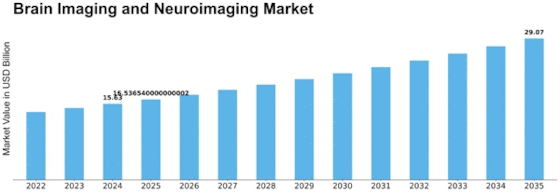
The forecast period is to see an expected 5.8% CAGR, with the market size of Brain imaging neuroimaging reaching USD 21.9 billion by 2032. Growth and development within the Brain Imaging Neuroimaging Market are driven by a number of factors that work together in its dynamic framework. Technological advancements made in brain imaging and neuroimaging techniques also have a significant influence on the market dynamics of this region, as these innovations have helped enhance neuro-imaging resolution, speed, and capability, which has propelled the upward path of this industry. Neuroimaging enhances resolution, capabilities, and speed through continuous improvements in imaging modalities such as magnetic resonance imaging (MRI), computed tomography (CT), positron emission tomography (PET), and functional MRI (fMRI). The versatile usage and clinical utility of these technologies depend on advanced image protocols and image analysis software, including integration with other diagnostic modalities, thereby contributing to overall changes in market trends. An increasing prevalence of neurological disorders drives the Brain Imaging Neuroimaging Market. Some examples include Alzheimer's disease, Parkinson's disease, stroke, and traumatic brain injuries, among others for which neuro-imaging plays very crucial roles during diagnosis monitoring or understanding phase. Several factors contribute to the dynamics of the brain imaging neuroimaging market, among them research initiatives and collaborations within scientific and medical communities. These organizations actively engage themselves in collaborative projects meant to advance neuro-imaging technology while exploring new areas for their use and also improving accuracy in diagnostics. The overall growth of neuro-imagining also comes from different initiatives that focus on elucidating how brains function, mapping neural circuits, and therefore understanding underlying mechanisms of those diseases, hence affecting market shifts. Regulatory considerations are critical factors influencing market dynamics for brain imaging &neuro-imagining technologies: regulatory approval pathways exist for novel imaging devices or contrast agents, thus affecting accessibility or uptake into clinical practice. Regulatory agencies ensure that neuroimaging is safe and effective by considering aspects such as device performance, radiation exposure, and contrast agent safety. The healthcare environment is changing rapidly; hence, brain imaging and neuroimaging market dynamics are also affected. Market competition among imaging device manufacturers, software developers, and healthcare providers offering neuroimaging services is an important consideration for market dynamics. Companies in this industry want to be seen as different from others through innovative imaging solutions with advanced analysis tools and comprehensive services for various user needs within health institutions or research facilities. Therefore, business competitiveness fosters the unwavering creativity needed to address changing customer demands, improve imaging workflows, and solve specific challenges relating to neurological imaging.

Brain Imaging Neuroimaging Market Size Graph
Author
Author Profile
Nidhi Mandole
Senior Research Analyst

She is an extremely curious individual currently working in Healthcare and Medical Devices Domain. Nidhi is comfortably versed in data centric research backed by healthcare educational background. She leverages extensive data mining and analytics tools such as Primary and Secondary Research, Statistical Analysis, Machine Learning, Data Modelling. Her key role also involves Technical Sales Support, Client Interaction and Project management within the Healthcare team. Lastly, she showcases extensive affinity towards learning new skills and remain fascinated in implementing them.

Leave a Comment

FAQs

What is the projected market valuation of the Brain Imaging and Neuroimaging Market by 2035?

<p>The projected market valuation for the Brain Imaging and Neuroimaging Market is 29.07 USD Billion by 2035.</p>

What was the market valuation of the Brain Imaging and Neuroimaging Market in 2024?

<p>The overall market valuation was 15.63 USD Billion in 2024.</p>

What is the expected CAGR for the Brain Imaging and Neuroimaging Market during the forecast period 2025 - 2035?

<p>The expected CAGR for the Brain Imaging and Neuroimaging Market during the forecast period 2025 - 2035 is 5.8%.</p>

Which companies are considered key players in the Brain Imaging and Neuroimaging Market?

<p>Key players in the market include Siemens Healthineers, GE Healthcare, Philips Healthcare, and Canon Medical Systems.</p>

What segment of the Brain Imaging and Neuroimaging Market had the highest valuation in 2024?

<p>In 2024, the segment of compound tomography (CT) had the highest valuation at 4.56 USD Billion.</p>

How much is the functional magnetic resonance imaging (FMRI) segment projected to grow by 2035?

<p>The functional magnetic resonance imaging (FMRI) segment is projected to grow to 5.67 USD Billion by 2035.</p>

What is the projected valuation for hospitals as an end user in the Brain Imaging and Neuroimaging Market by 2035?

The projected valuation for hospitals as an end user is 11.25 USD Billion by 2035.

What is the expected growth for the electroencephalography (EEG) segment from 2024 to 2035?

The electroencephalography (EEG) segment is expected to grow from 2.45 USD Billion in 2024 to 4.56 USD Billion by 2035.

Which end user segment is anticipated to show significant growth in the Brain Imaging and Neuroimaging Market?

The ambulatory surgical centers and clinics segment is anticipated to grow from 4.5 USD Billion in 2024 to 8.0 USD Billion by 2035.

What does the growth of the Brain Imaging and Neuroimaging Market indicate about advancements in medical technology?

The growth of the Brain Imaging and Neuroimaging Market suggests ongoing advancements in medical technology and increasing demand for diagnostic imaging.

Market Summary

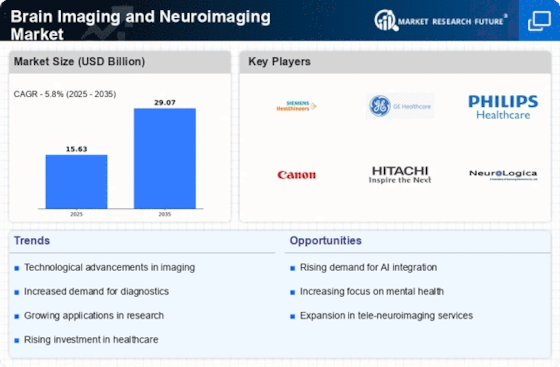
As per Market Research Future analysis, the Brain Imaging and Neuroimaging Market Size was estimated at 15.63 USD Billion in 2024. The Brain Imaging and Neuroimaging industry is projected to grow from 16.54 USD Billion in 2025 to 29.07 USD Billion by 2035, exhibiting a compound annual growth rate (CAGR) of 5.8% during the forecast period 2025 - 2035

Key Market Trends & Highlights

The Brain Imaging and Neuroimaging Market is poised for substantial growth driven by technological advancements and increasing demand for personalized medicine.

  • Technological advancements in imaging techniques are revolutionizing diagnostic capabilities in the market. The integration of artificial intelligence is enhancing the accuracy and efficiency of neuroimaging processes. North America remains the largest market, while Asia-Pacific is emerging as the fastest-growing region in this sector. The rising prevalence of neurological disorders and government initiatives are key drivers propelling market expansion.

Market Size & Forecast

2024 Market Size 15.63 (USD Billion)
2035 Market Size 29.07 (USD Billion)
CAGR (2025 - 2035) 5.8%
Largest Regional Market Share in 2024 North America

Major Players

Siemens Healthineers (DE), <a href="https://www.gehealthcare.in/products/magnetic-resonance-imaging/mr-applications/neuro-imaging">GE Healthcare</a> (US), Philips Healthcare (NL), Canon Medical Systems (JP), Hitachi Medical Corporation (JP), NeuroLogica Corporation (US), Medtronic (US), Elekta (SE), Brainlab (DE)

Market Trends

The Brain Imaging and Neuroimaging Market is currently experiencing a transformative phase, driven by advancements in technology and an increasing understanding of neurological disorders. Innovations in imaging modalities, such as functional magnetic resonance imaging and positron emission tomography, are enhancing diagnostic capabilities. This evolution is not merely a technical upgrade; it reflects a broader shift towards personalized medicine, where tailored treatment plans are developed based on individual brain profiles. Furthermore, the integration of artificial intelligence in image analysis is streamlining workflows and improving accuracy, suggesting a future where diagnostic processes are more efficient and reliable. In addition to technological advancements, the growing prevalence of neurological conditions is propelling demand within the Brain Imaging and Neuroimaging Market. As awareness of mental health issues rises, there is a corresponding need for effective diagnostic tools. This trend indicates a potential expansion of research initiatives aimed at understanding complex brain functions and disorders. Moreover, collaborations between academic institutions and industry players are likely to foster innovation, leading to the development of novel imaging techniques and applications. Overall, the market appears poised for substantial growth, driven by both technological progress and an increasing focus on brain health.

Technological Advancements in Imaging Techniques

Recent innovations in imaging technologies are reshaping the Brain Imaging and Neuroimaging Market. Techniques such as functional magnetic resonance imaging and advanced computed tomography are becoming more sophisticated, allowing for better visualization of brain activity and structure. This evolution not only enhances diagnostic accuracy but also facilitates research into complex neurological conditions.

Integration of Artificial Intelligence

The incorporation of artificial intelligence into neuroimaging is emerging as a pivotal trend. AI algorithms are being utilized to analyze imaging data more efficiently, potentially leading to quicker diagnoses and improved patient outcomes. This integration suggests a future where machine learning plays a crucial role in interpreting complex brain images.

Rising Demand for Personalized Medicine

There is a noticeable shift towards personalized medicine within the Brain Imaging and Neuroimaging Market. As healthcare becomes more individualized, the need for tailored diagnostic and treatment approaches is increasing. This trend indicates a growing emphasis on understanding the unique neurological profiles of patients, which could enhance treatment efficacy.

Brain Imaging Neuroimaging Market Market Drivers

Government Initiatives and Funding

Government initiatives and funding are playing a pivotal role in the advancement of the Brain Imaging and Neuroimaging Market. Various governments are investing in research and development to enhance imaging technologies and improve healthcare outcomes. These initiatives often focus on increasing access to advanced neuroimaging services, particularly in underserved regions. Funding for research projects aimed at developing new imaging modalities is also on the rise, with several countries allocating significant budgets to support neuroscience research. This financial backing is expected to stimulate innovation within the Brain Imaging and Neuroimaging Market, leading to the introduction of novel imaging techniques and applications. As governments continue to prioritize brain health, the market is likely to benefit from increased investment and support, fostering growth and development.

Integration of Artificial Intelligence

The integration of artificial intelligence (AI) into the Brain Imaging and Neuroimaging Market is reshaping diagnostic methodologies. AI algorithms are increasingly utilized to analyze complex imaging data, leading to more accurate interpretations and faster diagnoses. This integration is particularly beneficial in identifying subtle changes in brain structure and function that may indicate early stages of diseases such as Alzheimer's. Market analysts project that the AI segment within the neuroimaging market could account for a substantial share, potentially exceeding 20% by 2027. The ability of AI to process vast amounts of data efficiently enhances the capabilities of traditional imaging techniques, thereby improving patient care and outcomes. As AI technology continues to advance, its role in the Brain Imaging and Neuroimaging Market is expected to expand, offering new avenues for research and clinical applications.

Rising Demand for Personalized Medicine

The increasing emphasis on personalized medicine is significantly influencing the Brain Imaging and Neuroimaging Market. As healthcare shifts towards tailored treatment plans, neuroimaging plays a crucial role in understanding individual patient profiles. This trend is particularly evident in the treatment of neurological disorders, where imaging helps in customizing therapies based on specific brain characteristics. The market is witnessing a surge in demand for imaging techniques that can provide detailed insights into brain function and structure, which is essential for developing personalized treatment strategies. Analysts predict that the personalized medicine segment within the neuroimaging market could grow at a CAGR of around 8% over the next few years. This shift towards individualized care is likely to propel the Brain Imaging and Neuroimaging Market forward, fostering innovation and enhancing patient outcomes.

Increasing Prevalence of Neurological Disorders

The rising prevalence of neurological disorders is a critical driver for the Brain Imaging and Neuroimaging Market. Conditions such as dementia, multiple sclerosis, and epilepsy are becoming more common, necessitating advanced imaging solutions for accurate diagnosis and management. According to recent estimates, the number of individuals affected by neurological disorders is expected to reach over 100 million by 2030. This growing patient population is driving demand for effective imaging technologies that can aid in early detection and ongoing monitoring of these conditions. As healthcare providers seek to improve diagnostic accuracy and treatment efficacy, the Brain Imaging and Neuroimaging Market is poised for substantial growth. The increasing burden of neurological diseases underscores the need for innovative imaging solutions, further propelling market expansion.

Technological Advancements in Imaging Techniques

The Brain Imaging and Neuroimaging Market is experiencing a transformative phase due to rapid technological advancements. Innovations such as functional magnetic resonance imaging (fMRI) and positron emission tomography (PET) are enhancing the precision and efficacy of brain imaging. These advancements facilitate earlier diagnosis and better treatment planning for neurological disorders. The market is projected to grow significantly, with estimates suggesting a compound annual growth rate (CAGR) of over 7% in the coming years. Enhanced imaging techniques not only improve patient outcomes but also reduce the overall healthcare costs associated with prolonged diagnostic processes. As technology continues to evolve, the Brain Imaging and Neuroimaging Market is likely to witness an influx of new products and services, further driving its expansion.

Market Segment Insights

By Imaging Type: Functional Magnetic Resonance Imaging (FMRI) (Largest) vs. Positron Emission Tomography (PET) (Fastest-Growing)

In the brain imaging and neuroimaging market, functional magnetic resonance imaging (FMRI) stands out as the largest share holder, leveraging its superior capabilities in capturing brain activity in real-time. Other technologies, such as compound tomography (CT) and <a href="https://www.marketresearchfuture.com/reports/electroencephalography-systems-devices-market-43185">electroencephalography (EEG) system</a>, also contribute significantly, with CT being known for its rapid imaging capabilities and EEG for its ability to measure electrical activity non-invasively. Positron emission tomography (PET), while smaller in market share, is rapidly gaining traction due to its unique ability to provide insights into metabolic processes.

FMRI (Dominant) vs. MEG (Emerging)

Functional magnetic resonance imaging (FMRI) is recognized as the dominant technology in the brain imaging sector, renowned for its non-invasive nature and ability to visualize brain activity by detecting changes in blood flow. It is extensively used in both clinical and research settings, making it a preferred choice among neuroscientists. On the other hand, <a href="https://www.marketresearchfuture.com/reports/magnetoencephalography-market-32806">magnetoencephalography</a> (MEG) is an emerging technology characterized by its capacity to capture the magnetic fields produced by neural activity with high temporal resolution. Despite being in the developmental stage, MEG's ability to provide real-time brain activity mapping is attracting increasing interest, positioning it as a promising tool for future neuroimaging applications.

By End User: Hospitals (Largest) vs. Diagnostic Centers (Fastest-Growing)

In the Brain Imaging and Neuroimaging Market, hospitals hold a significant portion of the market share, driven by their advanced infrastructure and comprehensive healthcare services. These institutions utilize various imaging technologies to provide accurate diagnoses and treatment planning, capturing a substantial demand from patients with neurological disorders. On the other hand, diagnostic centers have been gaining traction due to the rising number of patients seeking specialized imaging services, leading to a competitive landscape in this segment.

Hospitals (Dominant) vs. Ambulatory Surgical Centers (Emerging)

Hospitals are currently the dominant end user in the Brain Imaging and Neuroimaging Market, primarily due to their extensive facilities equipped with advanced imaging technologies such as MRI, CT, and PET scanners. These institutions have the capability to offer comprehensive diagnostic services, catering to a wide range of neurological conditions. Conversely, ambulatory surgical centers are considered an emerging segment, experiencing growth as they offer a convenient and efficient alternative for outpatient procedures, including minor neurological surgeries. Their ability to provide specialized services with shorter wait times positions them as a key player in this evolving market.

Get more detailed insights about Brain Imaging and Neuroimaging Market Research Report

Regional Insights

By region, the study provides the market insights into North America, Europe, Asia-Pacific and Rest of the World. The North America Brain Imaging and Neuroimaging Market dominated this market in 2022 (45.80%). North America is home to globally recognized centers for neuroscience research and innovation. Prominent academic institutions including MIT and Harvard University work together on state-of-the-art brain imaging research in Boston, Massachusetts. This partnership drives technological progress and results in the creation of novel neuroimaging methods. Further, the U.S.

Brain imaging and neuroimaging market held the largest market share, and the Canada Brain imaging and neuroimaging market was the fastest growing market in the North America region.

Further, the major countries studied in the market report are The U.S., Canada, German, France, the UK, Italy, Spain, China, Japan, India, Australia, South Korea, and Brazil.

Europe Brain imaging and neuroimaging market accounts for the second-largest market share. Institutions in Europe place a strong emphasis on multidisciplinary neuroscience research, encouraging partnerships between computer scientists, radiologists, neurologists, and psychologists. The multidisciplinary approach to neuroimaging at the Oxford Centre for Functional MRI of the Brain (FMRIB) in the United Kingdom is well-known. Further, the German Brain imaging and neuroimaging market held the largest market share, and the UK Brain imaging and neuroimaging market was the fastest growing market in the European region.

The Asia-Pacific Brain Imaging and Neuroimaging Market is expected to grow at the fastest CAGR from 2023 to 2032. There is an increasing need for neurological healthcare services as the region experiences demographic changes due to a fast aging population and a rise in non-communicable diseases. Japan is a prime example of this trend, as evidenced by the aging population there and the reliance on neuroimaging for geriatric care at institutions such as the National Center for Geriatrics and Gerontology.

Moreover, China’s Brain imaging and neuroimaging market held the largest market share, and the Indian Brain imaging and neuroimaging market was the fastest growing market in the Asia-Pacific region.

Key Players and Competitive Insights

Leading market players are investing heavily in research and development in order to expand their product lines, which will help the Brain imaging and neuroimaging market, grow even more. Market participants are also undertaking a variety of strategic activities to expand their global footprint, with important market developments including new product launches, contractual agreements, mergers and acquisitions, higher investments, and collaboration with other organizations. To expand and survive in a more competitive and rising market climate, Brain imaging and neuroimaging industry must offer cost-effective items.Manufacturing locally to minimize operational costs is one of the key business tactics used by manufacturers in the global Brain imaging and neuroimaging industry to benefit clients and increase the market sector. In recent years, the Brain imaging and neuroimaging industry has offered some of the most significant advantages to medicine. Major players in the Brain imaging and neuroimaging market, including GE, Siemens, Canon, Hitachi Medical Systems, Medtronic PLC., EB Neuro S.p.A., Neurosoft, MinFound Medical Systems Co. Ltd., Elekta, Varian medical Systems, General Electric Company, Philips Healthcare, Toshiba Medical Systems, Sanrad medical Systems Pvt.Ltd, Esaote SpA and others, are attempting to increase market demand by investing in research and development operations.Elekta AB (Elekta) is a medical technology firm that provides information systems, image guided clinical solutions, and services for the treatment of cancer and brain illnesses. Gamma knife and extend systems, volumetric arc modulated therapy, fully integrated stereotactic radiation therapy systems, advanced digital treatment systems, treatment planning systems, electronic brachy therapy for skin cancer, and automated remote after loading platform are some of its main products. The company provides, among other things, treatment planning software, cancer registry software, soft tissue imaging software, and oncology information systems for radiation and medical oncology. Moreover, it provides radiation therapy for animals.The business has operations throughout Asia-Pacific, Europe, the Middle East, Africa, and North America. Base of operations for Elekta is in Stockholm, Sweden.Technology is the business of Siemens AG (Siemens). Its activities cover the domains of digitalization, automation, and electrification. The business creates, develops, and produces goods in addition to installing intricate projects and systems. Additionally, it offers a large selection of specially designed solutions to meet specific needs. Siemens specializes in distributed energy systems, intelligent building infrastructure, and power generation and distribution. Medical technology, digital healthcare services, and smart mobility solutions for road and rail transportation are all offered. Siemens maintains production sites, warehouses, sales offices, and research and development centers all around the world.It provides services to clients in a number of sectors, including manufacturing, infrastructure, energy, healthcare, and process. Bavaria, Germany's Munich serves as the home base for Siemens.

Key Companies in the Brain Imaging Neuroimaging Market include

Industry Developments

March 2024: Philips and Synthetic MR have joined forces to improve the identification of neurological illnesses in the realm of medical diagnostics. They aim to achieve this by utilizing modern quantitative brain imaging methods. This collaboration seeks to transform the identification and examination of illnesses such as multiple sclerosis, traumatic brain injuries, and dementia.

June 2023: The software's maker, Ezra, claims that the Food and Drug Administration (FDA) authorized Ezra Flash (Ezra). Artificial intelligence software enhances the images obtained from a fast MRI procedure.

October 2022: GE Healthcare unveiled the Omni Legend positron emission tomography/computed tomography (PET/CT) platform at the European Association of Nuclear Medicine (EANM) in Barcelona. The platform's features, which are made possible by artificial intelligence (AI), include enhanced diagnostic capabilities and increased effectiveness.

September 2022: In collaboration with the University Of Miami Miller School Of Medicine, Qynapse Inc. is thrilled to announce the commencement of a research supported by the National Institutes of Health (NIH). The project will examine the impact of COVID-19 on the vascular factors that lead to dementia and cognitive impairment (VCID).

March 2022: The Indian Institute of Technology (IIT Madras) is home to the Sudha Gopala Krishnan Brain Centre, which was founded with a focus on high-resolution brain imaging and the cellular and connectivity maps of human brains. The state-of-the-art brain center aims to become a premier research facility by producing unprecedented volumes of data on the human brain, new scientific findings, and technology innovations.

In February 2024, Neuro42, Inc, which specializes in MRI and robotic solutions for diagnosing and treating brain conditions, received FDA clearance for its compact diagnostic MRI scanner. This breakthrough by Neuro42 eliminates the need to move all patients to a specialized imaging suite, which allows for immediate diagnosis and enhances treatment results for patients with serious neurological issues

Future Outlook

Brain Imaging Neuroimaging Market Future Outlook

The Brain Imaging and Neuroimaging Market is projected to grow at a 5.8% CAGR from 2025 to 2035, driven by technological advancements, increasing prevalence of neurological disorders, and rising healthcare expenditure.

New opportunities lie in:

  • Development of portable neuroimaging devices for remote diagnostics.</p><p>Integration of AI algorithms for enhanced image analysis and interpretation.</p><p>Expansion of tele-neuroimaging services to improve patient access and convenience.

By 2035, the market is expected to be robust, driven by innovation and increased demand.

Market Segmentation

Brain Imaging Neuroimaging Market End User Outlook

  • hospitals
  • ambulatory surgical centers and clinics
  • diagnostic centers

Brain Imaging Neuroimaging Market Imaging Type Outlook

  • functional magnetic resonance imaging (FMRI)
  • compound tomography (CT)
  • positron emission tomography (PET)
  • electroencephalography (EEG)
  • magnetoencephalography (MEG)
  • near infrared spectroscopy (NIRS)

Report Scope

MARKET SIZE 2024 15.63(USD Billion)
MARKET SIZE 2025 16.54(USD Billion)
MARKET SIZE 2035 29.07(USD Billion)
COMPOUND ANNUAL GROWTH RATE (CAGR) 5.8% (2025 - 2035)
REPORT COVERAGE Revenue Forecast, Competitive Landscape, Growth Factors, and Trends
BASE YEAR 2024
Market Forecast Period 2025 - 2035
Historical Data 2019 - 2024
Market Forecast Units USD Billion
Key Companies Profiled Siemens Healthineers (DE), GE Healthcare (US), Philips Healthcare (NL), Canon Medical Systems (JP), Hitachi Medical Corporation (JP), NeuroLogica Corporation (US), Medtronic (US), Elekta (SE), Brainlab (DE)
Segments Covered Imaging Type [Functional Magnetic Resonance Imaging, End User, Region
Key Market Opportunities Advancements in artificial intelligence enhance diagnostic accuracy in the Brain Imaging and Neuroimaging Market.
Key Market Dynamics Technological advancements drive innovation in brain imaging techniques, enhancing diagnostic accuracy and patient outcomes.
Countries Covered North America, Europe, APAC, South America, MEA

FAQs

What is the projected market valuation of the Brain Imaging and Neuroimaging Market by 2035?

<p>The projected market valuation for the Brain Imaging and Neuroimaging Market is 29.07 USD Billion by 2035.</p>

What was the market valuation of the Brain Imaging and Neuroimaging Market in 2024?

<p>The overall market valuation was 15.63 USD Billion in 2024.</p>

What is the expected CAGR for the Brain Imaging and Neuroimaging Market during the forecast period 2025 - 2035?

<p>The expected CAGR for the Brain Imaging and Neuroimaging Market during the forecast period 2025 - 2035 is 5.8%.</p>

Which companies are considered key players in the Brain Imaging and Neuroimaging Market?

<p>Key players in the market include Siemens Healthineers, GE Healthcare, Philips Healthcare, and Canon Medical Systems.</p>

What segment of the Brain Imaging and Neuroimaging Market had the highest valuation in 2024?

<p>In 2024, the segment of compound tomography (CT) had the highest valuation at 4.56 USD Billion.</p>

How much is the functional magnetic resonance imaging (FMRI) segment projected to grow by 2035?

<p>The functional magnetic resonance imaging (FMRI) segment is projected to grow to 5.67 USD Billion by 2035.</p>

What is the projected valuation for hospitals as an end user in the Brain Imaging and Neuroimaging Market by 2035?

The projected valuation for hospitals as an end user is 11.25 USD Billion by 2035.

What is the expected growth for the electroencephalography (EEG) segment from 2024 to 2035?

The electroencephalography (EEG) segment is expected to grow from 2.45 USD Billion in 2024 to 4.56 USD Billion by 2035.

Which end user segment is anticipated to show significant growth in the Brain Imaging and Neuroimaging Market?

The ambulatory surgical centers and clinics segment is anticipated to grow from 4.5 USD Billion in 2024 to 8.0 USD Billion by 2035.

What does the growth of the Brain Imaging and Neuroimaging Market indicate about advancements in medical technology?

The growth of the Brain Imaging and Neuroimaging Market suggests ongoing advancements in medical technology and increasing demand for diagnostic imaging.

  1. SECTION I: EXECUTIVE SUMMARY AND KEY HIGHLIGHTS
    1. | 1.1 EXECUTIVE SUMMARY
    2. | | 1.1.1 Market Overview
    3. | | 1.1.2 Key Findings
    4. | | 1.1.3 Market Segmentation
    5. | | 1.1.4 Competitive Landscape
    6. | | 1.1.5 Challenges and Opportunities
    7. | | 1.1.6 Future Outlook
  2. SECTION II: SCOPING, METHODOLOGY AND MARKET STRUCTURE
    1. | 2.1 MARKET INTRODUCTION
    2. | | 2.1.1 Definition
    3. | | 2.1.2 Scope of the study
    4. | | | 2.1.2.1 Research Objective
    5. | | | 2.1.2.2 Assumption
    6. | | | 2.1.2.3 Limitations
    7. | 2.2 RESEARCH METHODOLOGY
    8. | | 2.2.1 Overview
    9. | | 2.2.2 Data Mining
    10. | | 2.2.3 Secondary Research
    11. | | 2.2.4 Primary Research
    12. | | | 2.2.4.1 Primary Interviews and Information Gathering Process
    13. | | | 2.2.4.2 Breakdown of Primary Respondents
    14. | | 2.2.5 Forecasting Model
    15. | | 2.2.6 Market Size Estimation
    16. | | | 2.2.6.1 Bottom-Up Approach
    17. | | | 2.2.6.2 Top-Down Approach
    18. | | 2.2.7 Data Triangulation
    19. | | 2.2.8 Validation
  3. SECTION III: QUALITATIVE ANALYSIS
    1. | 3.1 MARKET DYNAMICS
    2. | | 3.1.1 Overview
    3. | | 3.1.2 Drivers
    4. | | 3.1.3 Restraints
    5. | | 3.1.4 Opportunities
    6. | 3.2 MARKET FACTOR ANALYSIS
    7. | | 3.2.1 Value chain Analysis
    8. | | 3.2.2 Porter's Five Forces Analysis
    9. | | | 3.2.2.1 Bargaining Power of Suppliers
    10. | | | 3.2.2.2 Bargaining Power of Buyers
    11. | | | 3.2.2.3 Threat of New Entrants
    12. | | | 3.2.2.4 Threat of Substitutes
    13. | | | 3.2.2.5 Intensity of Rivalry
    14. | | 3.2.3 COVID-19 Impact Analysis
    15. | | | 3.2.3.1 Market Impact Analysis
    16. | | | 3.2.3.2 Regional Impact
    17. | | | 3.2.3.3 Opportunity and Threat Analysis
  4. SECTION IV: QUANTITATIVE ANALYSIS
    1. | 4.1 Healthcare, BY Imaging Type (USD Billion)
    2. | | 4.1.1 functional magnetic resonance imaging (FMRI)
    3. | | 4.1.2 compound tomography (CT)
    4. | | 4.1.3 positron emission tomography (PET)
    5. | | 4.1.4 electroencephalography (EEG)
    6. | | 4.1.5 magnetoencephalography (MEG)
    7. | | 4.1.6 near infrared spectroscopy (NIRS)
    8. | 4.2 Healthcare, BY End User (USD Billion)
    9. | | 4.2.1 hospitals
    10. | | 4.2.2 ambulatory surgical centers and clinics
    11. | | 4.2.3 diagnostic centers
    12. | 4.3 Healthcare, BY Region (USD Billion)
    13. | | 4.3.1 North America
    14. | | | 4.3.1.1 US
    15. | | | 4.3.1.2 Canada
    16. | | 4.3.2 Europe
    17. | | | 4.3.2.1 Germany
    18. | | | 4.3.2.2 UK
    19. | | | 4.3.2.3 France
    20. | | | 4.3.2.4 Russia
    21. | | | 4.3.2.5 Italy
    22. | | | 4.3.2.6 Spain
    23. | | | 4.3.2.7 Rest of Europe
    24. | | 4.3.3 APAC
    25. | | | 4.3.3.1 China
    26. | | | 4.3.3.2 India
    27. | | | 4.3.3.3 Japan
    28. | | | 4.3.3.4 South Korea
    29. | | | 4.3.3.5 Malaysia
    30. | | | 4.3.3.6 Thailand
    31. | | | 4.3.3.7 Indonesia
    32. | | | 4.3.3.8 Rest of APAC
    33. | | 4.3.4 South America
    34. | | | 4.3.4.1 Brazil
    35. | | | 4.3.4.2 Mexico
    36. | | | 4.3.4.3 Argentina
    37. | | | 4.3.4.4 Rest of South America
    38. | | 4.3.5 MEA
    39. | | | 4.3.5.1 GCC Countries
    40. | | | 4.3.5.2 South Africa
    41. | | | 4.3.5.3 Rest of MEA
  5. SECTION V: COMPETITIVE ANALYSIS
    1. | 5.1 Competitive Landscape
    2. | | 5.1.1 Overview
    3. | | 5.1.2 Competitive Analysis
    4. | | 5.1.3 Market share Analysis
    5. | | 5.1.4 Major Growth Strategy in the Healthcare
    6. | | 5.1.5 Competitive Benchmarking
    7. | | 5.1.6 Leading Players in Terms of Number of Developments in the Healthcare
    8. | | 5.1.7 Key developments and growth strategies
    9. | | | 5.1.7.1 New Product Launch/Service Deployment
    10. | | | 5.1.7.2 Merger & Acquisitions
    11. | | | 5.1.7.3 Joint Ventures
    12. | | 5.1.8 Major Players Financial Matrix
    13. | | | 5.1.8.1 Sales and Operating Income
    14. | | | 5.1.8.2 Major Players R&D Expenditure. 2023
    15. | 5.2 Company Profiles
    16. | | 5.2.1 Siemens Healthineers (DE)
    17. | | | 5.2.1.1 Financial Overview
    18. | | | 5.2.1.2 Products Offered
    19. | | | 5.2.1.3 Key Developments
    20. | | | 5.2.1.4 SWOT Analysis
    21. | | | 5.2.1.5 Key Strategies
    22. | | 5.2.2 GE Healthcare (US)
    23. | | | 5.2.2.1 Financial Overview
    24. | | | 5.2.2.2 Products Offered
    25. | | | 5.2.2.3 Key Developments
    26. | | | 5.2.2.4 SWOT Analysis
    27. | | | 5.2.2.5 Key Strategies
    28. | | 5.2.3 Philips Healthcare (NL)
    29. | | | 5.2.3.1 Financial Overview
    30. | | | 5.2.3.2 Products Offered
    31. | | | 5.2.3.3 Key Developments
    32. | | | 5.2.3.4 SWOT Analysis
    33. | | | 5.2.3.5 Key Strategies
    34. | | 5.2.4 Canon Medical Systems (JP)
    35. | | | 5.2.4.1 Financial Overview
    36. | | | 5.2.4.2 Products Offered
    37. | | | 5.2.4.3 Key Developments
    38. | | | 5.2.4.4 SWOT Analysis
    39. | | | 5.2.4.5 Key Strategies
    40. | | 5.2.5 Hitachi Medical Corporation (JP)
    41. | | | 5.2.5.1 Financial Overview
    42. | | | 5.2.5.2 Products Offered
    43. | | | 5.2.5.3 Key Developments
    44. | | | 5.2.5.4 SWOT Analysis
    45. | | | 5.2.5.5 Key Strategies
    46. | | 5.2.6 NeuroLogica Corporation (US)
    47. | | | 5.2.6.1 Financial Overview
    48. | | | 5.2.6.2 Products Offered
    49. | | | 5.2.6.3 Key Developments
    50. | | | 5.2.6.4 SWOT Analysis
    51. | | | 5.2.6.5 Key Strategies
    52. | | 5.2.7 Medtronic (US)
    53. | | | 5.2.7.1 Financial Overview
    54. | | | 5.2.7.2 Products Offered
    55. | | | 5.2.7.3 Key Developments
    56. | | | 5.2.7.4 SWOT Analysis
    57. | | | 5.2.7.5 Key Strategies
    58. | | 5.2.8 Elekta (SE)
    59. | | | 5.2.8.1 Financial Overview
    60. | | | 5.2.8.2 Products Offered
    61. | | | 5.2.8.3 Key Developments
    62. | | | 5.2.8.4 SWOT Analysis
    63. | | | 5.2.8.5 Key Strategies
    64. | | 5.2.9 Brainlab (DE)
    65. | | | 5.2.9.1 Financial Overview
    66. | | | 5.2.9.2 Products Offered
    67. | | | 5.2.9.3 Key Developments
    68. | | | 5.2.9.4 SWOT Analysis
    69. | | | 5.2.9.5 Key Strategies
    70. | 5.3 Appendix
    71. | | 5.3.1 References
    72. | | 5.3.2 Related Reports
  6. LIST OF FIGURES
    1. | 6.1 MARKET SYNOPSIS
    2. | 6.2 NORTH AMERICA MARKET ANALYSIS
    3. | 6.3 US MARKET ANALYSIS BY IMAGING TYPE
    4. | 6.4 US MARKET ANALYSIS BY END USER
    5. | 6.5 CANADA MARKET ANALYSIS BY IMAGING TYPE
    6. | 6.6 CANADA MARKET ANALYSIS BY END USER
    7. | 6.7 EUROPE MARKET ANALYSIS
    8. | 6.8 GERMANY MARKET ANALYSIS BY IMAGING TYPE
    9. | 6.9 GERMANY MARKET ANALYSIS BY END USER
    10. | 6.10 UK MARKET ANALYSIS BY IMAGING TYPE
    11. | 6.11 UK MARKET ANALYSIS BY END USER
    12. | 6.12 FRANCE MARKET ANALYSIS BY IMAGING TYPE
    13. | 6.13 FRANCE MARKET ANALYSIS BY END USER
    14. | 6.14 RUSSIA MARKET ANALYSIS BY IMAGING TYPE
    15. | 6.15 RUSSIA MARKET ANALYSIS BY END USER
    16. | 6.16 ITALY MARKET ANALYSIS BY IMAGING TYPE
    17. | 6.17 ITALY MARKET ANALYSIS BY END USER
    18. | 6.18 SPAIN MARKET ANALYSIS BY IMAGING TYPE
    19. | 6.19 SPAIN MARKET ANALYSIS BY END USER
    20. | 6.20 REST OF EUROPE MARKET ANALYSIS BY IMAGING TYPE
    21. | 6.21 REST OF EUROPE MARKET ANALYSIS BY END USER
    22. | 6.22 APAC MARKET ANALYSIS
    23. | 6.23 CHINA MARKET ANALYSIS BY IMAGING TYPE
    24. | 6.24 CHINA MARKET ANALYSIS BY END USER
    25. | 6.25 INDIA MARKET ANALYSIS BY IMAGING TYPE
    26. | 6.26 INDIA MARKET ANALYSIS BY END USER
    27. | 6.27 JAPAN MARKET ANALYSIS BY IMAGING TYPE
    28. | 6.28 JAPAN MARKET ANALYSIS BY END USER
    29. | 6.29 SOUTH KOREA MARKET ANALYSIS BY IMAGING TYPE
    30. | 6.30 SOUTH KOREA MARKET ANALYSIS BY END USER
    31. | 6.31 MALAYSIA MARKET ANALYSIS BY IMAGING TYPE
    32. | 6.32 MALAYSIA MARKET ANALYSIS BY END USER
    33. | 6.33 THAILAND MARKET ANALYSIS BY IMAGING TYPE
    34. | 6.34 THAILAND MARKET ANALYSIS BY END USER
    35. | 6.35 INDONESIA MARKET ANALYSIS BY IMAGING TYPE
    36. | 6.36 INDONESIA MARKET ANALYSIS BY END USER
    37. | 6.37 REST OF APAC MARKET ANALYSIS BY IMAGING TYPE
    38. | 6.38 REST OF APAC MARKET ANALYSIS BY END USER
    39. | 6.39 SOUTH AMERICA MARKET ANALYSIS
    40. | 6.40 BRAZIL MARKET ANALYSIS BY IMAGING TYPE
    41. | 6.41 BRAZIL MARKET ANALYSIS BY END USER
    42. | 6.42 MEXICO MARKET ANALYSIS BY IMAGING TYPE
    43. | 6.43 MEXICO MARKET ANALYSIS BY END USER
    44. | 6.44 ARGENTINA MARKET ANALYSIS BY IMAGING TYPE
    45. | 6.45 ARGENTINA MARKET ANALYSIS BY END USER
    46. | 6.46 REST OF SOUTH AMERICA MARKET ANALYSIS BY IMAGING TYPE
    47. | 6.47 REST OF SOUTH AMERICA MARKET ANALYSIS BY END USER
    48. | 6.48 MEA MARKET ANALYSIS
    49. | 6.49 GCC COUNTRIES MARKET ANALYSIS BY IMAGING TYPE
    50. | 6.50 GCC COUNTRIES MARKET ANALYSIS BY END USER
    51. | 6.51 SOUTH AFRICA MARKET ANALYSIS BY IMAGING TYPE
    52. | 6.52 SOUTH AFRICA MARKET ANALYSIS BY END USER
    53. | 6.53 REST OF MEA MARKET ANALYSIS BY IMAGING TYPE
    54. | 6.54 REST OF MEA MARKET ANALYSIS BY END USER
    55. | 6.55 KEY BUYING CRITERIA OF HEALTHCARE
    56. | 6.56 RESEARCH PROCESS OF MRFR
    57. | 6.57 DRO ANALYSIS OF HEALTHCARE
    58. | 6.58 DRIVERS IMPACT ANALYSIS: HEALTHCARE
    59. | 6.59 RESTRAINTS IMPACT ANALYSIS: HEALTHCARE
    60. | 6.60 SUPPLY / VALUE CHAIN: HEALTHCARE
    61. | 6.61 HEALTHCARE, BY IMAGING TYPE, 2024 (% SHARE)
    62. | 6.62 HEALTHCARE, BY IMAGING TYPE, 2024 TO 2035 (USD Billion)
    63. | 6.63 HEALTHCARE, BY END USER, 2024 (% SHARE)
    64. | 6.64 HEALTHCARE, BY END USER, 2024 TO 2035 (USD Billion)
    65. | 6.65 BENCHMARKING OF MAJOR COMPETITORS
  7. LIST OF TABLES
    1. | 7.1 LIST OF ASSUMPTIONS
    2. | | 7.1.1
    3. | 7.2 North America MARKET SIZE ESTIMATES; FORECAST
    4. | | 7.2.1 BY IMAGING TYPE, 2025-2035 (USD Billion)
    5. | | 7.2.2 BY END USER, 2025-2035 (USD Billion)
    6. | 7.3 US MARKET SIZE ESTIMATES; FORECAST
    7. | | 7.3.1 BY IMAGING TYPE, 2025-2035 (USD Billion)
    8. | | 7.3.2 BY END USER, 2025-2035 (USD Billion)
    9. | 7.4 Canada MARKET SIZE ESTIMATES; FORECAST
    10. | | 7.4.1 BY IMAGING TYPE, 2025-2035 (USD Billion)
    11. | | 7.4.2 BY END USER, 2025-2035 (USD Billion)
    12. | 7.5 Europe MARKET SIZE ESTIMATES; FORECAST
    13. | | 7.5.1 BY IMAGING TYPE, 2025-2035 (USD Billion)
    14. | | 7.5.2 BY END USER, 2025-2035 (USD Billion)
    15. | 7.6 Germany MARKET SIZE ESTIMATES; FORECAST
    16. | | 7.6.1 BY IMAGING TYPE, 2025-2035 (USD Billion)
    17. | | 7.6.2 BY END USER, 2025-2035 (USD Billion)
    18. | 7.7 UK MARKET SIZE ESTIMATES; FORECAST
    19. | | 7.7.1 BY IMAGING TYPE, 2025-2035 (USD Billion)
    20. | | 7.7.2 BY END USER, 2025-2035 (USD Billion)
    21. | 7.8 France MARKET SIZE ESTIMATES; FORECAST
    22. | | 7.8.1 BY IMAGING TYPE, 2025-2035 (USD Billion)
    23. | | 7.8.2 BY END USER, 2025-2035 (USD Billion)
    24. | 7.9 Russia MARKET SIZE ESTIMATES; FORECAST
    25. | | 7.9.1 BY IMAGING TYPE, 2025-2035 (USD Billion)
    26. | | 7.9.2 BY END USER, 2025-2035 (USD Billion)
    27. | 7.10 Italy MARKET SIZE ESTIMATES; FORECAST
    28. | | 7.10.1 BY IMAGING TYPE, 2025-2035 (USD Billion)
    29. | | 7.10.2 BY END USER, 2025-2035 (USD Billion)
    30. | 7.11 Spain MARKET SIZE ESTIMATES; FORECAST
    31. | | 7.11.1 BY IMAGING TYPE, 2025-2035 (USD Billion)
    32. | | 7.11.2 BY END USER, 2025-2035 (USD Billion)
    33. | 7.12 Rest of Europe MARKET SIZE ESTIMATES; FORECAST
    34. | | 7.12.1 BY IMAGING TYPE, 2025-2035 (USD Billion)
    35. | | 7.12.2 BY END USER, 2025-2035 (USD Billion)
    36. | 7.13 APAC MARKET SIZE ESTIMATES; FORECAST
    37. | | 7.13.1 BY IMAGING TYPE, 2025-2035 (USD Billion)
    38. | | 7.13.2 BY END USER, 2025-2035 (USD Billion)
    39. | 7.14 China MARKET SIZE ESTIMATES; FORECAST
    40. | | 7.14.1 BY IMAGING TYPE, 2025-2035 (USD Billion)
    41. | | 7.14.2 BY END USER, 2025-2035 (USD Billion)
    42. | 7.15 India MARKET SIZE ESTIMATES; FORECAST
    43. | | 7.15.1 BY IMAGING TYPE, 2025-2035 (USD Billion)
    44. | | 7.15.2 BY END USER, 2025-2035 (USD Billion)
    45. | 7.16 Japan MARKET SIZE ESTIMATES; FORECAST
    46. | | 7.16.1 BY IMAGING TYPE, 2025-2035 (USD Billion)
    47. | | 7.16.2 BY END USER, 2025-2035 (USD Billion)
    48. | 7.17 South Korea MARKET SIZE ESTIMATES; FORECAST
    49. | | 7.17.1 BY IMAGING TYPE, 2025-2035 (USD Billion)
    50. | | 7.17.2 BY END USER, 2025-2035 (USD Billion)
    51. | 7.18 Malaysia MARKET SIZE ESTIMATES; FORECAST
    52. | | 7.18.1 BY IMAGING TYPE, 2025-2035 (USD Billion)
    53. | | 7.18.2 BY END USER, 2025-2035 (USD Billion)
    54. | 7.19 Thailand MARKET SIZE ESTIMATES; FORECAST
    55. | | 7.19.1 BY IMAGING TYPE, 2025-2035 (USD Billion)
    56. | | 7.19.2 BY END USER, 2025-2035 (USD Billion)
    57. | 7.20 Indonesia MARKET SIZE ESTIMATES; FORECAST
    58. | | 7.20.1 BY IMAGING TYPE, 2025-2035 (USD Billion)
    59. | | 7.20.2 BY END USER, 2025-2035 (USD Billion)
    60. | 7.21 Rest of APAC MARKET SIZE ESTIMATES; FORECAST
    61. | | 7.21.1 BY IMAGING TYPE, 2025-2035 (USD Billion)
    62. | | 7.21.2 BY END USER, 2025-2035 (USD Billion)
    63. | 7.22 South America MARKET SIZE ESTIMATES; FORECAST
    64. | | 7.22.1 BY IMAGING TYPE, 2025-2035 (USD Billion)
    65. | | 7.22.2 BY END USER, 2025-2035 (USD Billion)
    66. | 7.23 Brazil MARKET SIZE ESTIMATES; FORECAST
    67. | | 7.23.1 BY IMAGING TYPE, 2025-2035 (USD Billion)
    68. | | 7.23.2 BY END USER, 2025-2035 (USD Billion)
    69. | 7.24 Mexico MARKET SIZE ESTIMATES; FORECAST
    70. | | 7.24.1 BY IMAGING TYPE, 2025-2035 (USD Billion)
    71. | | 7.24.2 BY END USER, 2025-2035 (USD Billion)
    72. | 7.25 Argentina MARKET SIZE ESTIMATES; FORECAST
    73. | | 7.25.1 BY IMAGING TYPE, 2025-2035 (USD Billion)
    74. | | 7.25.2 BY END USER, 2025-2035 (USD Billion)
    75. | 7.26 Rest of South America MARKET SIZE ESTIMATES; FORECAST
    76. | | 7.26.1 BY IMAGING TYPE, 2025-2035 (USD Billion)
    77. | | 7.26.2 BY END USER, 2025-2035 (USD Billion)
    78. | 7.27 MEA MARKET SIZE ESTIMATES; FORECAST
    79. | | 7.27.1 BY IMAGING TYPE, 2025-2035 (USD Billion)
    80. | | 7.27.2 BY END USER, 2025-2035 (USD Billion)
    81. | 7.28 GCC Countries MARKET SIZE ESTIMATES; FORECAST
    82. | | 7.28.1 BY IMAGING TYPE, 2025-2035 (USD Billion)
    83. | | 7.28.2 BY END USER, 2025-2035 (USD Billion)
    84. | 7.29 South Africa MARKET SIZE ESTIMATES; FORECAST
    85. | | 7.29.1 BY IMAGING TYPE, 2025-2035 (USD Billion)
    86. | | 7.29.2 BY END USER, 2025-2035 (USD Billion)
    87. | 7.30 Rest of MEA MARKET SIZE ESTIMATES; FORECAST
    88. | | 7.30.1 BY IMAGING TYPE, 2025-2035 (USD Billion)
    89. | | 7.30.2 BY END USER, 2025-2035 (USD Billion)
    90. | 7.31 PRODUCT LAUNCH/PRODUCT DEVELOPMENT/APPROVAL
    91. | | 7.31.1
    92. | 7.32 ACQUISITION/PARTNERSHIP
    93. | | 7.32.1

Healthcare Market Segmentation

Healthcare By Imaging Type (USD Billion, 2025-2035)

  • functional magnetic resonance imaging (FMRI)
  • compound tomography (CT)
  • positron emission tomography (PET)
  • electroencephalography (EEG)
  • magnetoencephalography (MEG)
  • near infrared spectroscopy (NIRS)

Healthcare By End User (USD Billion, 2025-2035)

  • hospitals
  • ambulatory surgical centers and clinics
  • diagnostic centers
Infographic

Free Sample Request

Kindly complete the form below to receive a free sample of this Report

Get Free Sample

Customer Strories

Compare Licence

×
Features License Type
Single User Multiuser License Enterprise User
Price $4,950 $5,950 $7,250
Maximum User Access Limit 1 User Upto 10 Users Unrestricted Access Throughout the Organization
Free Customization
Direct Access to Analyst
Deliverable Format
Platform Access
Discount on Next Purchase 10% 15% 15%
Printable Versions
%>