Request Free Sample ×

Kindly complete the form below to receive a free sample of this Report

* Please use a valid business email

Leading companies partner with us for data-driven Insights

clients tt-cursor
Hero Background
English
Chinese
French
Japanese
Korean
German
Spanish

Boom Truck Market Share

ID: MRFR/PCM/6639-HCR
100 Pages
Sakshi Gupta
Last Updated: April 06, 2026

Boom Truck Market Research Report Information, by Capacity (Up to 15 Tons, 15 Tons–25 Tons, 25 Tons–35 Tons and Above 35 Tons), Application (Construction, Utilities, Industries and others) and Region (North America, Europe, Asia-Pacific and Rest of the World) - Forecast till 2035

Share:
Download PDF ×

We do not share your information with anyone. However, we may send you emails based on your report interest from time to time. You may contact us at any time to opt-out.

Boom Truck Market Infographic
Purchase Options

Market Share

Boom Truck Market Share Analysis

The Boom Truck market, part of the automotive and construction equipment industry, uses market share positioning techniques to compete. Manufacturers often differentiate boom trucks by offering unique features or technologies. This could incorporate crane, safety, or fuel efficiency enhancements. Companies attempt to attract clients seeking unique perks that set their products apart.

Companies use cost leadership to make boom trucks cheaper than their competitors. This lets them offer competitive pricing and gain market share. Cost leadership tactics frequently involve streamlining production, optimizing supply chain management, and using economies of scale. Companies taking this technique hope to become the go-to for economical, reliable boom trucks.

Market segmentation, which divides the market by geography, consumer demographics, or application needs, is crucial. Companies can better tailor boom truck offers to different consumer segments by knowing their particular needs. Customers are happier and organizations are stronger in niche markets with this targeted strategy.

Boom Trucks' market share is also influenced by strategic agreements and collaborations. To improve their capabilities and market reach, manufacturers often partner with suppliers, distributors, or other industry participants. Collaborations can boost market presence through shared resources, technology, and visibility.

Innovation drives the Boom Truck industry, and companies who spend in R&D to introduce new and improved products can gain a competitive edge. In the fast-changing market, ongoing innovation helps enterprises stay ahead by offering new crane technologies, safety features, and fuel efficiency. An innovative image can attract boom truck buyers who value cutting-edge technology.

Brand positioning also matters in market share tactics. A positive brand image can greatly impact customers' opinions. Brands aim to be trustworthy, durable, and user-friendly. Effective branding communicates a clear value offer, creating consumer loyalty and trust and increasing market share.

Finally, market share positioning requires a complete marketing and communication plan. It involves targeted advertising, digital marketing, and a strong web presence. Companies can promote their boom truck goods and become market leaders by targeting the correct audience through multiple means.


Author
Author Profile
Sakshi Gupta
Team Lead - Research

Currently a Team Lead in consumer goods, FMCG, and F&B, she translates rigorous research into decisive strategy. She develops GTM roadmaps, pricing architectures, and competitive benchmarks for companies across Europe, the US, and APAC. She synthesize insights, align cross-functional teams, and drive execution from brief to measurable outcomes. She leads end-to-end engagements with crisp analysis, compelling storytelling, and a strong command of Power BI, Tableau, SQL, and advanced research platforms.

Leave a Comment

FAQs

What is the current valuation of the Boom Truck Market as of 2024?

<p>The Boom Truck Market was valued at 3231.7 USD Million in 2024.</p>

What is the projected market valuation for the Boom Truck Market in 2035?

<p>The market is projected to reach 5812.92 USD Million by 2035.</p>

What is the expected CAGR for the Boom Truck Market during the forecast period 2025 - 2035?

<p>The expected CAGR for the Boom Truck Market during 2025 - 2035 is 5.48%.</p>

Which companies are considered key players in the Boom Truck Market?

<p>Key players in the Boom Truck Market include Terex Corporation, Altec Industries Inc, Manitex International Inc, Bronto Skylift, Skyjack Inc, XCMG Group, SANY Group, and JLG Industries Inc.</p>

What segment of the Boom Truck Market had a valuation of 800.0 to 1500.0 USD Million?

<p>The capacity segment of the Boom Truck Market, specifically for 25 tons–35 tons, had a valuation ranging from 800.0 to 1500.0 USD Million.</p>

What application segment of the Boom Truck Market was valued at 3231.7 USD Million in 2024?

The construction application segment of the Boom Truck Market was valued at 3231.7 USD Million in 2024.

How does the Boom Truck Market's growth from 2024 to 2035 appear?

The Boom Truck Market appears to be on a growth trajectory, with a projected increase from 3231.7 USD Million in 2024 to 5812.92 USD Million by 2035.

What factors might influence the growth of the Boom Truck Market during 2025 - 2035?

Factors influencing growth may include advancements in technology, increased demand in construction, and the strategic initiatives of key players.

What is the significance of the 5.48% CAGR for the Boom Truck Market?

The 5.48% CAGR indicates a steady growth rate, suggesting a robust expansion of the Boom Truck Market over the forecast period.

How do the key players in the Boom Truck Market position themselves for future growth?

Key players like Terex Corporation and Altec Industries Inc likely position themselves through innovation and strategic partnerships to capture market share.

Market Summary

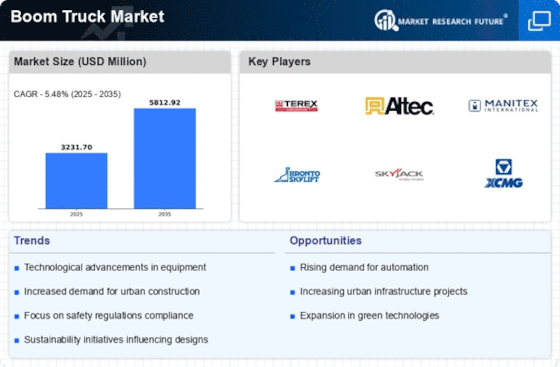
As per Market Research Future analysis, the Boom Truck Market Size was estimated at 3231.7 USD Million in 2024. The Boom Truck industry is projected to grow from 3408.86 USD Million in 2025 to 5812.92 USD Million by 2035, exhibiting a compound annual growth rate (CAGR) of 5.48% during the forecast period 2025 - 2035

Key Market Trends & Highlights

The Boom Truck Market is experiencing robust growth driven by technological advancements and increasing urbanization.

  • Technological advancements are enhancing the operational efficiency of boom trucks, particularly in North America. Sustainability initiatives are becoming increasingly relevant, influencing design and manufacturing processes in the Asia-Pacific region. The construction segment remains the largest market, while the infrastructure segment is witnessing the fastest growth due to rising urbanization. Key market drivers include the increased demand for construction equipment and the growth of rental services in the construction sector.

Market Size & Forecast

2024 Market Size 3231.7 (USD Million)
2035 Market Size 5812.92 (USD Million)
CAGR (2025 - 2035) 5.48%
Largest Regional Market Share in 2024 Asia Pacific

Major Players

Terex Corporation (US), Altec Industries Inc (US), Manitex International Inc (US), Bronto Skylift (FI), Skyjack Inc (CA), XCMG Group (CN), SANY Group (CN), JLG Industries Inc (US)

Market Trends

The Boom Truck Market is currently experiencing a dynamic evolution, driven by various factors that influence its growth trajectory. The increasing demand for efficient lifting solutions across multiple industries, such as construction, telecommunications, and utilities, appears to be a primary catalyst. As urbanization accelerates, the need for advanced equipment that can navigate tight spaces and perform complex tasks becomes more pronounced. Furthermore, advancements in technology, including the integration of telematics and automation, seem to enhance operational efficiency and safety, thereby attracting more stakeholders to this market. In addition, environmental considerations are gaining traction, with a noticeable shift towards eco-friendly boom trucks. Manufacturers are likely to invest in sustainable practices and alternative energy sources, aligning with global efforts to reduce carbon footprints. This trend not only reflects a growing awareness of environmental issues but also indicates a potential competitive advantage for companies that prioritize sustainability. Overall, the Boom Truck Market is poised for continued growth, influenced by technological innovations and changing consumer preferences.

Technological Advancements

The integration of advanced technologies in boom trucks is reshaping the market landscape. Innovations such as telematics, automation, and enhanced safety features are becoming increasingly prevalent. These advancements not only improve operational efficiency but also enhance safety protocols, making boom trucks more appealing to various industries.

Sustainability Initiatives

There is a noticeable trend towards sustainability within the Boom Truck Market. Manufacturers are exploring eco-friendly alternatives and energy-efficient solutions to meet growing environmental regulations. This shift reflects a broader commitment to reducing carbon emissions and promoting sustainable practices in the industry.

Urbanization and Infrastructure Development

The ongoing urbanization and infrastructure development across the globe are driving demand for boom trucks. As cities expand and new projects emerge, the need for versatile lifting equipment that can operate in confined spaces is becoming increasingly critical. This trend suggests a robust future for the Boom Truck Market as it adapts to the evolving needs of urban environments.

Boom Truck Market Market Drivers

Technological Innovations in Boom Trucks

Technological advancements play a crucial role in shaping the Boom Truck Market. Innovations such as telematics, advanced hydraulic systems, and improved safety features are becoming increasingly prevalent. These technologies not only enhance operational efficiency but also improve safety standards, which is a growing concern in the construction sector. For instance, the integration of telematics allows for real-time monitoring of equipment performance, leading to better maintenance practices and reduced downtime. As of 2025, it is estimated that the adoption of these technologies could increase market competitiveness, with companies that invest in modern boom trucks likely to gain a significant advantage. This trend suggests that the Boom Truck Market is on the cusp of a technological revolution, potentially transforming operational practices.

Growth of Rental Services in Construction

The Boom Truck Market is also experiencing growth due to the increasing popularity of rental services in the construction sector. Many companies are opting to rent boom trucks rather than purchase them outright, as this approach allows for greater flexibility and cost savings. The rental market for construction equipment is projected to grow at a compound annual growth rate of around 4.5% through 2025. This trend is particularly appealing to small and medium-sized enterprises that may not have the capital to invest in new equipment. As rental services expand, they provide access to a wider range of boom trucks, enabling construction firms to select the most suitable equipment for specific projects. Consequently, this shift towards rental services is likely to bolster the Boom Truck Market, as it adapts to changing customer preferences.

Regulatory Compliance and Safety Standards

The Boom Truck Market is significantly influenced by stringent regulatory compliance and safety standards. Governments worldwide are implementing more rigorous regulations to ensure the safety of construction operations. These regulations often mandate the use of advanced boom trucks equipped with safety features such as load monitoring systems and emergency stop mechanisms. As a result, manufacturers are compelled to innovate and enhance their product offerings to meet these requirements. In 2025, it is anticipated that compliance with safety regulations will drive a substantial portion of the market growth, as companies prioritize investments in safer equipment. This focus on safety not only protects workers but also enhances the reputation of companies within the Boom Truck Market.

Increased Demand for Construction Equipment

The Boom Truck Market experiences heightened demand due to the ongoing expansion of construction activities. As urban areas continue to develop, the need for efficient lifting and transportation solutions becomes paramount. In 2025, the construction sector is projected to grow at a rate of approximately 5.5% annually, driving the need for boom trucks. These vehicles are essential for tasks such as lifting heavy materials and accessing hard-to-reach areas, which are common in modern construction projects. Consequently, manufacturers are focusing on producing advanced boom trucks that cater to the evolving needs of the construction industry. This trend indicates a robust growth trajectory for the Boom Truck Market, as companies seek to enhance productivity and safety on job sites.

Rising Urbanization and Infrastructure Projects

Urbanization trends are a significant driver for the Boom Truck Market. As populations migrate towards urban centers, the demand for infrastructure development escalates. This trend is evident in various regions, where governments are investing heavily in public infrastructure projects, including roads, bridges, and buildings. The boom truck's versatility in handling diverse lifting tasks makes it an indispensable asset in these projects. In 2025, the infrastructure sector is expected to witness a surge in investments, potentially exceeding several billion dollars. This influx of capital will likely stimulate demand for boom trucks, as construction companies seek reliable equipment to meet project deadlines and specifications. Thus, the Boom Truck Market stands to benefit from the ongoing urbanization and infrastructure initiatives.

Market Segment Insights

By Capacity: 25 tons (Largest) vs. 35 tons (Fastest-Growing)

In the Boom Truck Market, the 25 tons category holds the largest market share within the capacity segment, appealing to a wide range of industries that require heavy lifting capabilities. This capacity is favored for its balance of load handling and operational flexibility, making it a preferred choice for construction and industrial applications. On the other hand, the 35 tons category is recognized as the fastest-growing segment, driven by an increased demand for larger and more robust lifting solutions, especially in the energy and infrastructure sectors. As industries evolve and project demands escalate, the growth trends highlight a significant shift towards higher capacity boom trucks. The compelling drivers for the 35 tons segment include advancements in technology, enhancing lifting efficiency, and significant safety features tailored for heavy-duty operations. Additionally, environmental regulations in various regions are pushing manufacturers to innovate, making these larger capacity models more attractive due to their improved power and fuel efficiency, fostering a surge in adoption rates among potential buyers.

25 tons (Dominant) vs. 35 tons (Emerging)

The 25 tons boom trucks are regarded as the dominant players in the segment due to their widespread application and versatility across multiple sectors, including construction, manufacturing, and <a href="https://www.marketresearchfuture.com/reports/logistics-market-5076">logistics</a>. These trucks are known for their reliable performance and operational efficiency, making them an essential tool for projects requiring substantial load lifting without compromising maneuverability. Conversely, the 35 tons boom trucks are emerging as a significant force in the market, characterized by their enhanced lifting capabilities and advanced technology features. These trucks cater to the growing needs of large-scale projects, particularly in the energy and infrastructure segments, where powerful and efficient lifting solutions are increasingly crucial. As the demand for higher capacity options continues to rise, these emerging trucks are positioned to capture a larger market share.

By Application: Construction (Largest) vs. Infrastructure (Fastest-Growing)

In the Boom Truck Market, the Construction segment continues to hold a substantial share, driven primarily by the increasing demand for high-rise building projects and large-scale construction activities. As urbanization accelerates and infrastructure development initiatives gain momentum across various regions, boom trucks play a vital role in elevating capabilities during construction operations. The ability of boom trucks to provide critical lifting solutions in confined spaces enhances their utility, leading to a strong market presence in this segment. Conversely, the Infrastructure segment is recognized as the fastest-growing area within the Boom Truck Market. The rise in public and private sector investment into infrastructure projects, such as bridges, roads, and utilities, is contributing to this trend. The growing emphasis on modernization and sustainability in construction methods further accelerates the adoption of boom trucks, making it essential to meet the specific requirements of this evolving landscape.

Construction: Boom Trucks (Dominant) vs. Infrastructure Boom Trucks (Emerging)

The dominant segment of <a href="https://www.marketresearchfuture.com/reports/construction-market-16065">Construction</a> Boom Trucks is characterized by their extensive use in building sites where they provide essential lifting and maneuvering solutions for heavy materials and equipment. These boom trucks are known for their robust design and versatility, allowing them to operate efficiently in a range of environments. Features such as multiple boom extensions and high load capacities cater specifically to the exacting demands of construction projects. On the other hand, Infrastructure Boom Trucks represent the emerging segment, designed to cater specifically to infrastructure-related projects, such as the construction of bridges and other civil engineering works. Their specialized features, including enhanced stability and precision, address the unique challenges posed by infrastructure projects, illustrating the evolving functionalities and innovations within the Boom Truck Market.

Get more detailed insights about Boom Truck Market Research Report - Global Forecast 2035

Regional Insights

North America : Market Leader in Boom Trucks

North America is the largest market for boom trucks, accounting for approximately 45% of the global market share. The region's growth is driven by increasing construction activities, infrastructure development, and stringent safety regulations that necessitate the use of advanced lifting equipment. The demand for boom trucks is further fueled by the rise in renewable energy projects and urbanization trends, particularly in the United States and Canada, which are the largest contributors to this market. The competitive landscape in North America is characterized by the presence of key players such as Terex Corporation, Altec Industries, and JLG Industries. These companies are continuously innovating and expanding their product offerings to meet the growing demand. The market is also witnessing collaborations and partnerships aimed at enhancing operational efficiency and safety standards. The focus on sustainability and eco-friendly solutions is expected to shape future developments in this sector.

Europe : Emerging Market with Growth Potential

Europe is witnessing significant growth in the boom truck market, holding approximately 30% of the global share. The region's expansion is driven by increasing investments in infrastructure, particularly in Eastern European countries, and a growing emphasis on safety regulations. The European Union's initiatives to enhance construction standards and promote sustainable practices are also contributing to market growth. Countries like Germany and France are leading this trend, supported by favorable government policies and funding for construction projects. The competitive landscape in Europe features key players such as Bronto Skylift and Manitex International, which are focusing on innovation and technology to enhance their product offerings. The market is characterized by a mix of established companies and emerging players, fostering a competitive environment. Additionally, the presence of regulatory bodies ensures compliance with safety standards, further driving the demand for advanced boom trucks in the region.

Asia-Pacific : Rapid Growth in Emerging Economies

The Asia-Pacific region is rapidly emerging as a significant player in the boom truck market, accounting for approximately 20% of the global share. The growth is primarily driven by urbanization, increasing construction activities, and government initiatives to improve infrastructure in countries like China and India. The rising demand for efficient lifting solutions in various sectors, including construction and logistics, is further propelling market growth. Additionally, favorable economic conditions and investments in smart city projects are expected to enhance market dynamics in the coming years. Leading countries in this region include China, which is home to major manufacturers like XCMG Group and SANY Group, and India, where the market is expanding due to rising construction projects. The competitive landscape is marked by a mix of local and international players, with companies focusing on technological advancements and product diversification to capture market share. The increasing emphasis on safety and compliance with regulations is also shaping the market landscape.

Middle East and Africa : Resource-Rich Market Opportunities

The Middle East and Africa region is gradually developing its boom truck market, holding about 5% of the global share. The growth is driven by increasing investments in infrastructure and construction projects, particularly in the Gulf Cooperation Council (GCC) countries. The region's focus on diversifying its economy away from oil dependency is leading to significant investments in construction and real estate, which in turn boosts the demand for boom trucks. Additionally, government initiatives aimed at enhancing safety standards are catalyzing market growth. Key players in this region include both local and international companies, with a growing presence of manufacturers looking to tap into the emerging market. Countries like the UAE and South Africa are leading the charge, with numerous construction projects underway. The competitive landscape is evolving, with companies focusing on innovation and compliance with international safety standards to gain a competitive edge in this resource-rich market.

Key Players and Competitive Insights

The Boom Truck Market is currently characterized by a dynamic competitive landscape, driven by technological advancements and increasing demand for efficient lifting solutions across various sectors. Key players such as Terex Corporation (US), Altec Industries Inc (US), and SANY Group (CN) are strategically positioning themselves through innovation and regional expansion. Terex Corporation (US) focuses on enhancing its product offerings with advanced telematics and safety features, while Altec Industries Inc (US) emphasizes sustainable practices in its manufacturing processes. Meanwhile, SANY Group (CN) is expanding its global footprint, particularly in emerging markets, which collectively shapes a competitive environment that is increasingly focused on technological differentiation and sustainability.

In terms of business tactics, companies are localizing manufacturing to reduce costs and optimize supply chains, which is particularly relevant in the context of fluctuating global trade dynamics. The Boom Truck Market appears moderately fragmented, with several key players exerting influence over their respective regions. This fragmentation allows for niche players to thrive, while larger corporations leverage their scale to optimize operations and enhance customer service.

In August 2025, Terex Corporation (US) announced a partnership with a leading technology firm to integrate AI-driven analytics into its boom truck operations. This strategic move is likely to enhance operational efficiency and provide customers with real-time data insights, thereby improving decision-making processes. Such innovations may position Terex as a leader in the market, particularly as customers increasingly seek data-driven solutions.

In September 2025, Altec Industries Inc (US) launched a new line of eco-friendly boom trucks designed to meet stringent emissions regulations. This initiative not only aligns with global sustainability trends but also caters to a growing customer base that prioritizes environmentally responsible equipment. The introduction of these products could potentially enhance Altec's market share and brand reputation in an increasingly eco-conscious industry.

In July 2025, SANY Group (CN) expanded its manufacturing capabilities by opening a new facility in Southeast Asia, aimed at increasing production capacity and reducing lead times for customers in the region. This strategic expansion is indicative of SANY's commitment to meeting rising demand and enhancing its competitive edge in the global market. By localizing production, SANY may also mitigate risks associated with supply chain disruptions, thereby improving reliability for its clients.

As of October 2025, the Boom Truck Market is witnessing trends that emphasize digitalization, sustainability, and the integration of advanced technologies such as AI. Strategic alliances among key players are increasingly shaping the competitive landscape, fostering innovation and collaboration. Looking ahead, it appears that competitive differentiation will evolve from traditional price-based competition to a focus on technological innovation, supply chain reliability, and sustainable practices, which are likely to become the new benchmarks for success in this sector.

Key Companies in the Boom Truck Market include

Industry Developments

    • The global boom truck market has been witnessing significant growth in the past few years, because of factors like the growing oil and gas industry and a high degree of versatility of boom trucks available in various market locations. The overall boom truck industry is inclusive of boom trucks that can lift heavy equipment, carry loads on the flatbed, and further, hoist personnel using crane buckets. This makes these market cranes more versatile and convenient in the form of market end-users that can use them for various tasks in sectors like the construction sector and project sites.
    • The governments belonging to the prominent market regions like the North American market followed by the Asian Pacific region are likely to loosen their strictness in the resolutions and measures that are likely to help the boom truck market size that is amounting for growth during the forecast period that will be ending in 2028.
    • Boom trucks can be hired on rent that is dependent on the need for projects as per the application. This can be attributed to the reduction in costs associated with renting in comparison to purchasing new cranes. Therefore, the growing degree of demand for rental units is creating a huge growth opportunity for the global boom trucks market during the forecast period that will be ending in 2028.

Future Outlook

Boom Truck Market Future Outlook

The Boom Truck Market is projected to grow at a 5.48% CAGR from 2025 to 2035, driven by urbanization, infrastructure development, and technological advancements.

New opportunities lie in:

  • <p>Expansion into electric boom truck models for sustainability Development of telematics solutions for fleet management Partnerships with construction firms for integrated service offerings</p>

By 2035, the Boom Truck Market is expected to achieve robust growth and enhanced market positioning.

Market Segmentation

Boom Truck Market Capacity Outlook

Boom Truck Market Application Outlook

Report Scope

MARKET SIZE 2024 3231.7(USD Million)
MARKET SIZE 2025 3408.86(USD Million)
MARKET SIZE 2035 5812.92(USD Million)
COMPOUND ANNUAL GROWTH RATE (CAGR) 5.48% (2025 - 2035)
REPORT COVERAGE Revenue Forecast, Competitive Landscape, Growth Factors, and Trends
BASE YEAR 2024
Market Forecast Period 2025 - 2035
Historical Data 2019 - 2024
Market Forecast Units USD Million
Key Companies Profiled Terex Corporation (US), Altec Industries Inc (US), Manitex International Inc (US), Bronto Skylift (FI), Skyjack Inc (CA), XCMG Group (CN), SANY Group (CN), JLG Industries Inc (US)
Segments Covered Capacity
Key Market Opportunities Integration of advanced telematics and automation technologies in the Boom Truck Market.
Key Market Dynamics Rising demand for advanced safety features in boom trucks drives innovation and competitive differentiation among manufacturers.
Countries Covered North America, Europe, APAC, South America, MEA

FAQs

What is the current valuation of the Boom Truck Market as of 2024?

<p>The Boom Truck Market was valued at 3231.7 USD Million in 2024.</p>

What is the projected market valuation for the Boom Truck Market in 2035?

<p>The market is projected to reach 5812.92 USD Million by 2035.</p>

What is the expected CAGR for the Boom Truck Market during the forecast period 2025 - 2035?

<p>The expected CAGR for the Boom Truck Market during 2025 - 2035 is 5.48%.</p>

Which companies are considered key players in the Boom Truck Market?

<p>Key players in the Boom Truck Market include Terex Corporation, Altec Industries Inc, Manitex International Inc, Bronto Skylift, Skyjack Inc, XCMG Group, SANY Group, and JLG Industries Inc.</p>

What segment of the Boom Truck Market had a valuation of 800.0 to 1500.0 USD Million?

<p>The capacity segment of the Boom Truck Market, specifically for 25 tons–35 tons, had a valuation ranging from 800.0 to 1500.0 USD Million.</p>

What application segment of the Boom Truck Market was valued at 3231.7 USD Million in 2024?

The construction application segment of the Boom Truck Market was valued at 3231.7 USD Million in 2024.

How does the Boom Truck Market's growth from 2024 to 2035 appear?

The Boom Truck Market appears to be on a growth trajectory, with a projected increase from 3231.7 USD Million in 2024 to 5812.92 USD Million by 2035.

What factors might influence the growth of the Boom Truck Market during 2025 - 2035?

Factors influencing growth may include advancements in technology, increased demand in construction, and the strategic initiatives of key players.

What is the significance of the 5.48% CAGR for the Boom Truck Market?

The 5.48% CAGR indicates a steady growth rate, suggesting a robust expansion of the Boom Truck Market over the forecast period.

How do the key players in the Boom Truck Market position themselves for future growth?

Key players like Terex Corporation and Altec Industries Inc likely position themselves through innovation and strategic partnerships to capture market share.

  1. SECTION I: EXECUTIVE SUMMARY AND KEY HIGHLIGHTS
    1. | 1.1 EXECUTIVE SUMMARY
    2. | | 1.1.1 Market Overview
    3. | | 1.1.2 Key Findings
    4. | | 1.1.3 Market Segmentation
    5. | | 1.1.4 Competitive Landscape
    6. | | 1.1.5 Challenges and Opportunities
    7. | | 1.1.6 Future Outlook
  2. SECTION II: SCOPING, METHODOLOGY AND MARKET STRUCTURE
    1. | 2.1 MARKET INTRODUCTION
    2. | | 2.1.1 Definition
    3. | | 2.1.2 Scope of the study
    4. | | | 2.1.2.1 Research Objective
    5. | | | 2.1.2.2 Assumption
    6. | | | 2.1.2.3 Limitations
    7. | 2.2 RESEARCH METHODOLOGY
    8. | | 2.2.1 Overview
    9. | | 2.2.2 Data Mining
    10. | | 2.2.3 Secondary Research
    11. | | 2.2.4 Primary Research
    12. | | | 2.2.4.1 Primary Interviews and Information Gathering Process
    13. | | | 2.2.4.2 Breakdown of Primary Respondents
    14. | | 2.2.5 Forecasting Model
    15. | | 2.2.6 Market Size Estimation
    16. | | | 2.2.6.1 Bottom-Up Approach
    17. | | | 2.2.6.2 Top-Down Approach
    18. | | 2.2.7 Data Triangulation
    19. | | 2.2.8 Validation
  3. SECTION III: QUALITATIVE ANALYSIS
    1. | 3.1 MARKET DYNAMICS
    2. | | 3.1.1 Overview
    3. | | 3.1.2 Drivers
    4. | | 3.1.3 Restraints
    5. | | 3.1.4 Opportunities
    6. | 3.2 MARKET FACTOR ANALYSIS
    7. | | 3.2.1 Value chain Analysis
    8. | | 3.2.2 Porter's Five Forces Analysis
    9. | | | 3.2.2.1 Bargaining Power of Suppliers
    10. | | | 3.2.2.2 Bargaining Power of Buyers
    11. | | | 3.2.2.3 Threat of New Entrants
    12. | | | 3.2.2.4 Threat of Substitutes
    13. | | | 3.2.2.5 Intensity of Rivalry
    14. | | 3.2.3 COVID-19 Impact Analysis
    15. | | | 3.2.3.1 Market Impact Analysis
    16. | | | 3.2.3.2 Regional Impact
    17. | | | 3.2.3.3 Opportunity and Threat Analysis
  4. SECTION IV: QUANTITATIVE ANALYSIS
    1. | 4.1 Packaging & Transport, BY Capacity (USD Million)
    2. | | 4.1.1 25 tons–35 tons
    3. | 4.2 Packaging & Transport, BY Application (USD Million)
    4. | | 4.2.1 Construction
    5. | 4.3 Packaging & Transport, BY Region (USD Million)
    6. | | 4.3.1 North America
    7. | | | 4.3.1.1 US
    8. | | | 4.3.1.2 Canada
    9. | | 4.3.2 Europe
    10. | | | 4.3.2.1 Germany
    11. | | | 4.3.2.2 UK
    12. | | | 4.3.2.3 France
    13. | | | 4.3.2.4 Russia
    14. | | | 4.3.2.5 Italy
    15. | | | 4.3.2.6 Spain
    16. | | | 4.3.2.7 Rest of Europe
    17. | | 4.3.3 APAC
    18. | | | 4.3.3.1 China
    19. | | | 4.3.3.2 India
    20. | | | 4.3.3.3 Japan
    21. | | | 4.3.3.4 South Korea
    22. | | | 4.3.3.5 Malaysia
    23. | | | 4.3.3.6 Thailand
    24. | | | 4.3.3.7 Indonesia
    25. | | | 4.3.3.8 Rest of APAC
    26. | | 4.3.4 South America
    27. | | | 4.3.4.1 Brazil
    28. | | | 4.3.4.2 Mexico
    29. | | | 4.3.4.3 Argentina
    30. | | | 4.3.4.4 Rest of South America
    31. | | 4.3.5 MEA
    32. | | | 4.3.5.1 GCC Countries
    33. | | | 4.3.5.2 South Africa
    34. | | | 4.3.5.3 Rest of MEA
  5. SECTION V: COMPETITIVE ANALYSIS
    1. | 5.1 Competitive Landscape
    2. | | 5.1.1 Overview
    3. | | 5.1.2 Competitive Analysis
    4. | | 5.1.3 Market share Analysis
    5. | | 5.1.4 Major Growth Strategy in the Packaging & Transport
    6. | | 5.1.5 Competitive Benchmarking
    7. | | 5.1.6 Leading Players in Terms of Number of Developments in the Packaging & Transport
    8. | | 5.1.7 Key developments and growth strategies
    9. | | | 5.1.7.1 New Product Launch/Service Deployment
    10. | | | 5.1.7.2 Merger & Acquisitions
    11. | | | 5.1.7.3 Joint Ventures
    12. | | 5.1.8 Major Players Financial Matrix
    13. | | | 5.1.8.1 Sales and Operating Income
    14. | | | 5.1.8.2 Major Players R&D Expenditure. 2023
    15. | 5.2 Company Profiles
    16. | | 5.2.1 Terex Corporation (US)
    17. | | | 5.2.1.1 Financial Overview
    18. | | | 5.2.1.2 Products Offered
    19. | | | 5.2.1.3 Key Developments
    20. | | | 5.2.1.4 SWOT Analysis
    21. | | | 5.2.1.5 Key Strategies
    22. | | 5.2.2 Altec Industries Inc (US)
    23. | | | 5.2.2.1 Financial Overview
    24. | | | 5.2.2.2 Products Offered
    25. | | | 5.2.2.3 Key Developments
    26. | | | 5.2.2.4 SWOT Analysis
    27. | | | 5.2.2.5 Key Strategies
    28. | | 5.2.3 Manitex International Inc (US)
    29. | | | 5.2.3.1 Financial Overview
    30. | | | 5.2.3.2 Products Offered
    31. | | | 5.2.3.3 Key Developments
    32. | | | 5.2.3.4 SWOT Analysis
    33. | | | 5.2.3.5 Key Strategies
    34. | | 5.2.4 Bronto Skylift (FI)
    35. | | | 5.2.4.1 Financial Overview
    36. | | | 5.2.4.2 Products Offered
    37. | | | 5.2.4.3 Key Developments
    38. | | | 5.2.4.4 SWOT Analysis
    39. | | | 5.2.4.5 Key Strategies
    40. | | 5.2.5 Skyjack Inc (CA)
    41. | | | 5.2.5.1 Financial Overview
    42. | | | 5.2.5.2 Products Offered
    43. | | | 5.2.5.3 Key Developments
    44. | | | 5.2.5.4 SWOT Analysis
    45. | | | 5.2.5.5 Key Strategies
    46. | | 5.2.6 XCMG Group (CN)
    47. | | | 5.2.6.1 Financial Overview
    48. | | | 5.2.6.2 Products Offered
    49. | | | 5.2.6.3 Key Developments
    50. | | | 5.2.6.4 SWOT Analysis
    51. | | | 5.2.6.5 Key Strategies
    52. | | 5.2.7 SANY Group (CN)
    53. | | | 5.2.7.1 Financial Overview
    54. | | | 5.2.7.2 Products Offered
    55. | | | 5.2.7.3 Key Developments
    56. | | | 5.2.7.4 SWOT Analysis
    57. | | | 5.2.7.5 Key Strategies
    58. | | 5.2.8 JLG Industries Inc (US)
    59. | | | 5.2.8.1 Financial Overview
    60. | | | 5.2.8.2 Products Offered
    61. | | | 5.2.8.3 Key Developments
    62. | | | 5.2.8.4 SWOT Analysis
    63. | | | 5.2.8.5 Key Strategies
    64. | 5.3 Appendix
    65. | | 5.3.1 References
    66. | | 5.3.2 Related Reports
  6. LIST OF FIGURES
    1. | 6.1 MARKET SYNOPSIS
    2. | 6.2 NORTH AMERICA MARKET ANALYSIS
    3. | 6.3 US MARKET ANALYSIS BY CAPACITY
    4. | 6.4 US MARKET ANALYSIS BY APPLICATION
    5. | 6.5 CANADA MARKET ANALYSIS BY CAPACITY
    6. | 6.6 CANADA MARKET ANALYSIS BY APPLICATION
    7. | 6.7 EUROPE MARKET ANALYSIS
    8. | 6.8 GERMANY MARKET ANALYSIS BY CAPACITY
    9. | 6.9 GERMANY MARKET ANALYSIS BY APPLICATION
    10. | 6.10 UK MARKET ANALYSIS BY CAPACITY
    11. | 6.11 UK MARKET ANALYSIS BY APPLICATION
    12. | 6.12 FRANCE MARKET ANALYSIS BY CAPACITY
    13. | 6.13 FRANCE MARKET ANALYSIS BY APPLICATION
    14. | 6.14 RUSSIA MARKET ANALYSIS BY CAPACITY
    15. | 6.15 RUSSIA MARKET ANALYSIS BY APPLICATION
    16. | 6.16 ITALY MARKET ANALYSIS BY CAPACITY
    17. | 6.17 ITALY MARKET ANALYSIS BY APPLICATION
    18. | 6.18 SPAIN MARKET ANALYSIS BY CAPACITY
    19. | 6.19 SPAIN MARKET ANALYSIS BY APPLICATION
    20. | 6.20 REST OF EUROPE MARKET ANALYSIS BY CAPACITY
    21. | 6.21 REST OF EUROPE MARKET ANALYSIS BY APPLICATION
    22. | 6.22 APAC MARKET ANALYSIS
    23. | 6.23 CHINA MARKET ANALYSIS BY CAPACITY
    24. | 6.24 CHINA MARKET ANALYSIS BY APPLICATION
    25. | 6.25 INDIA MARKET ANALYSIS BY CAPACITY
    26. | 6.26 INDIA MARKET ANALYSIS BY APPLICATION
    27. | 6.27 JAPAN MARKET ANALYSIS BY CAPACITY
    28. | 6.28 JAPAN MARKET ANALYSIS BY APPLICATION
    29. | 6.29 SOUTH KOREA MARKET ANALYSIS BY CAPACITY
    30. | 6.30 SOUTH KOREA MARKET ANALYSIS BY APPLICATION
    31. | 6.31 MALAYSIA MARKET ANALYSIS BY CAPACITY
    32. | 6.32 MALAYSIA MARKET ANALYSIS BY APPLICATION
    33. | 6.33 THAILAND MARKET ANALYSIS BY CAPACITY
    34. | 6.34 THAILAND MARKET ANALYSIS BY APPLICATION
    35. | 6.35 INDONESIA MARKET ANALYSIS BY CAPACITY
    36. | 6.36 INDONESIA MARKET ANALYSIS BY APPLICATION
    37. | 6.37 REST OF APAC MARKET ANALYSIS BY CAPACITY
    38. | 6.38 REST OF APAC MARKET ANALYSIS BY APPLICATION
    39. | 6.39 SOUTH AMERICA MARKET ANALYSIS
    40. | 6.40 BRAZIL MARKET ANALYSIS BY CAPACITY
    41. | 6.41 BRAZIL MARKET ANALYSIS BY APPLICATION
    42. | 6.42 MEXICO MARKET ANALYSIS BY CAPACITY
    43. | 6.43 MEXICO MARKET ANALYSIS BY APPLICATION
    44. | 6.44 ARGENTINA MARKET ANALYSIS BY CAPACITY
    45. | 6.45 ARGENTINA MARKET ANALYSIS BY APPLICATION
    46. | 6.46 REST OF SOUTH AMERICA MARKET ANALYSIS BY CAPACITY
    47. | 6.47 REST OF SOUTH AMERICA MARKET ANALYSIS BY APPLICATION
    48. | 6.48 MEA MARKET ANALYSIS
    49. | 6.49 GCC COUNTRIES MARKET ANALYSIS BY CAPACITY
    50. | 6.50 GCC COUNTRIES MARKET ANALYSIS BY APPLICATION
    51. | 6.51 SOUTH AFRICA MARKET ANALYSIS BY CAPACITY
    52. | 6.52 SOUTH AFRICA MARKET ANALYSIS BY APPLICATION
    53. | 6.53 REST OF MEA MARKET ANALYSIS BY CAPACITY
    54. | 6.54 REST OF MEA MARKET ANALYSIS BY APPLICATION
    55. | 6.55 KEY BUYING CRITERIA OF PACKAGING & TRANSPORT
    56. | 6.56 RESEARCH PROCESS OF MRFR
    57. | 6.57 DRO ANALYSIS OF PACKAGING & TRANSPORT
    58. | 6.58 DRIVERS IMPACT ANALYSIS: PACKAGING & TRANSPORT
    59. | 6.59 RESTRAINTS IMPACT ANALYSIS: PACKAGING & TRANSPORT
    60. | 6.60 SUPPLY / VALUE CHAIN: PACKAGING & TRANSPORT
    61. | 6.61 PACKAGING & TRANSPORT, BY CAPACITY, 2024 (% SHARE)
    62. | 6.62 PACKAGING & TRANSPORT, BY CAPACITY, 2024 TO 2035 (USD Million)
    63. | 6.63 PACKAGING & TRANSPORT, BY APPLICATION, 2024 (% SHARE)
    64. | 6.64 PACKAGING & TRANSPORT, BY APPLICATION, 2024 TO 2035 (USD Million)
    65. | 6.65 BENCHMARKING OF MAJOR COMPETITORS
  7. LIST OF TABLES
    1. | 7.1 LIST OF ASSUMPTIONS
    2. | | 7.1.1
    3. | 7.2 North America MARKET SIZE ESTIMATES; FORECAST
    4. | | 7.2.1 BY CAPACITY, 2025-2035 (USD Million)
    5. | | 7.2.2 BY APPLICATION, 2025-2035 (USD Million)
    6. | 7.3 US MARKET SIZE ESTIMATES; FORECAST
    7. | | 7.3.1 BY CAPACITY, 2025-2035 (USD Million)
    8. | | 7.3.2 BY APPLICATION, 2025-2035 (USD Million)
    9. | 7.4 Canada MARKET SIZE ESTIMATES; FORECAST
    10. | | 7.4.1 BY CAPACITY, 2025-2035 (USD Million)
    11. | | 7.4.2 BY APPLICATION, 2025-2035 (USD Million)
    12. | 7.5 Europe MARKET SIZE ESTIMATES; FORECAST
    13. | | 7.5.1 BY CAPACITY, 2025-2035 (USD Million)
    14. | | 7.5.2 BY APPLICATION, 2025-2035 (USD Million)
    15. | 7.6 Germany MARKET SIZE ESTIMATES; FORECAST
    16. | | 7.6.1 BY CAPACITY, 2025-2035 (USD Million)
    17. | | 7.6.2 BY APPLICATION, 2025-2035 (USD Million)
    18. | 7.7 UK MARKET SIZE ESTIMATES; FORECAST
    19. | | 7.7.1 BY CAPACITY, 2025-2035 (USD Million)
    20. | | 7.7.2 BY APPLICATION, 2025-2035 (USD Million)
    21. | 7.8 France MARKET SIZE ESTIMATES; FORECAST
    22. | | 7.8.1 BY CAPACITY, 2025-2035 (USD Million)
    23. | | 7.8.2 BY APPLICATION, 2025-2035 (USD Million)
    24. | 7.9 Russia MARKET SIZE ESTIMATES; FORECAST
    25. | | 7.9.1 BY CAPACITY, 2025-2035 (USD Million)
    26. | | 7.9.2 BY APPLICATION, 2025-2035 (USD Million)
    27. | 7.10 Italy MARKET SIZE ESTIMATES; FORECAST
    28. | | 7.10.1 BY CAPACITY, 2025-2035 (USD Million)
    29. | | 7.10.2 BY APPLICATION, 2025-2035 (USD Million)
    30. | 7.11 Spain MARKET SIZE ESTIMATES; FORECAST
    31. | | 7.11.1 BY CAPACITY, 2025-2035 (USD Million)
    32. | | 7.11.2 BY APPLICATION, 2025-2035 (USD Million)
    33. | 7.12 Rest of Europe MARKET SIZE ESTIMATES; FORECAST
    34. | | 7.12.1 BY CAPACITY, 2025-2035 (USD Million)
    35. | | 7.12.2 BY APPLICATION, 2025-2035 (USD Million)
    36. | 7.13 APAC MARKET SIZE ESTIMATES; FORECAST
    37. | | 7.13.1 BY CAPACITY, 2025-2035 (USD Million)
    38. | | 7.13.2 BY APPLICATION, 2025-2035 (USD Million)
    39. | 7.14 China MARKET SIZE ESTIMATES; FORECAST
    40. | | 7.14.1 BY CAPACITY, 2025-2035 (USD Million)
    41. | | 7.14.2 BY APPLICATION, 2025-2035 (USD Million)
    42. | 7.15 India MARKET SIZE ESTIMATES; FORECAST
    43. | | 7.15.1 BY CAPACITY, 2025-2035 (USD Million)
    44. | | 7.15.2 BY APPLICATION, 2025-2035 (USD Million)
    45. | 7.16 Japan MARKET SIZE ESTIMATES; FORECAST
    46. | | 7.16.1 BY CAPACITY, 2025-2035 (USD Million)
    47. | | 7.16.2 BY APPLICATION, 2025-2035 (USD Million)
    48. | 7.17 South Korea MARKET SIZE ESTIMATES; FORECAST
    49. | | 7.17.1 BY CAPACITY, 2025-2035 (USD Million)
    50. | | 7.17.2 BY APPLICATION, 2025-2035 (USD Million)
    51. | 7.18 Malaysia MARKET SIZE ESTIMATES; FORECAST
    52. | | 7.18.1 BY CAPACITY, 2025-2035 (USD Million)
    53. | | 7.18.2 BY APPLICATION, 2025-2035 (USD Million)
    54. | 7.19 Thailand MARKET SIZE ESTIMATES; FORECAST
    55. | | 7.19.1 BY CAPACITY, 2025-2035 (USD Million)
    56. | | 7.19.2 BY APPLICATION, 2025-2035 (USD Million)
    57. | 7.20 Indonesia MARKET SIZE ESTIMATES; FORECAST
    58. | | 7.20.1 BY CAPACITY, 2025-2035 (USD Million)
    59. | | 7.20.2 BY APPLICATION, 2025-2035 (USD Million)
    60. | 7.21 Rest of APAC MARKET SIZE ESTIMATES; FORECAST
    61. | | 7.21.1 BY CAPACITY, 2025-2035 (USD Million)
    62. | | 7.21.2 BY APPLICATION, 2025-2035 (USD Million)
    63. | 7.22 South America MARKET SIZE ESTIMATES; FORECAST
    64. | | 7.22.1 BY CAPACITY, 2025-2035 (USD Million)
    65. | | 7.22.2 BY APPLICATION, 2025-2035 (USD Million)
    66. | 7.23 Brazil MARKET SIZE ESTIMATES; FORECAST
    67. | | 7.23.1 BY CAPACITY, 2025-2035 (USD Million)
    68. | | 7.23.2 BY APPLICATION, 2025-2035 (USD Million)
    69. | 7.24 Mexico MARKET SIZE ESTIMATES; FORECAST
    70. | | 7.24.1 BY CAPACITY, 2025-2035 (USD Million)
    71. | | 7.24.2 BY APPLICATION, 2025-2035 (USD Million)
    72. | 7.25 Argentina MARKET SIZE ESTIMATES; FORECAST
    73. | | 7.25.1 BY CAPACITY, 2025-2035 (USD Million)
    74. | | 7.25.2 BY APPLICATION, 2025-2035 (USD Million)
    75. | 7.26 Rest of South America MARKET SIZE ESTIMATES; FORECAST
    76. | | 7.26.1 BY CAPACITY, 2025-2035 (USD Million)
    77. | | 7.26.2 BY APPLICATION, 2025-2035 (USD Million)
    78. | 7.27 MEA MARKET SIZE ESTIMATES; FORECAST
    79. | | 7.27.1 BY CAPACITY, 2025-2035 (USD Million)
    80. | | 7.27.2 BY APPLICATION, 2025-2035 (USD Million)
    81. | 7.28 GCC Countries MARKET SIZE ESTIMATES; FORECAST
    82. | | 7.28.1 BY CAPACITY, 2025-2035 (USD Million)
    83. | | 7.28.2 BY APPLICATION, 2025-2035 (USD Million)
    84. | 7.29 South Africa MARKET SIZE ESTIMATES; FORECAST
    85. | | 7.29.1 BY CAPACITY, 2025-2035 (USD Million)
    86. | | 7.29.2 BY APPLICATION, 2025-2035 (USD Million)
    87. | 7.30 Rest of MEA MARKET SIZE ESTIMATES; FORECAST
    88. | | 7.30.1 BY CAPACITY, 2025-2035 (USD Million)
    89. | | 7.30.2 BY APPLICATION, 2025-2035 (USD Million)
    90. | 7.31 PRODUCT LAUNCH/PRODUCT DEVELOPMENT/APPROVAL
    91. | | 7.31.1
    92. | 7.32 ACQUISITION/PARTNERSHIP
    93. | | 7.32.1

Packaging & Transport Market Segmentation

Packaging & Transport By Capacity (USD Million, 2025-2035)

  • 25 tons–35 tons

Packaging & Transport By Application (USD Million, 2025-2035)

  • Construction
Infographic

Free Sample Request

Kindly complete the form below to receive a free sample of this Report

Get Free Sample

Customer Strories

Compare Licence

×
Features License Type
Single User Multiuser License Enterprise User
Price $4,950 $5,950 $7,250
Maximum User Access Limit 1 User Upto 10 Users Unrestricted Access Throughout the Organization
Free Customization
Direct Access to Analyst
Deliverable Format
Platform Access
Discount on Next Purchase 10% 15% 15%
Printable Versions