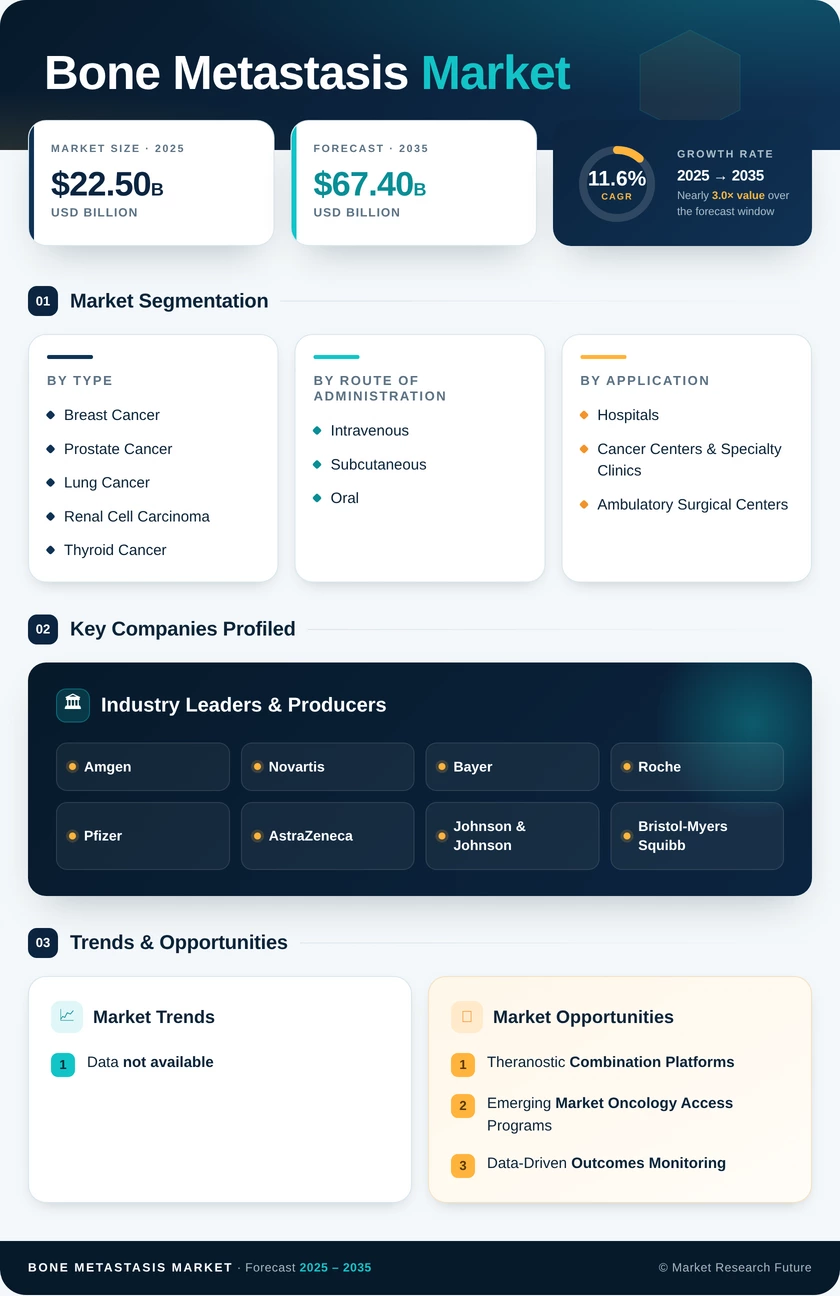
Segmentation Quick Reference
| Dimension | Sub-Segments | Dominant Segment | Fastest Growing Segment |
| Therapy Type | Bisphosphonates, RANK-L Inhibitors, Radiopharmaceuticals, Chemotherapy, Others | Bisphosphonates | Radiopharmaceuticals |
| Cancer Type | Breast, Prostate, Lung, Renal Cell Carcinoma, Thyroid | Breast Cancer | Lung Cancer |
| Route of Administration | Intravenous, Subcutaneous, Oral | Intravenous | Subcutaneous |
| End User | Hospitals, Cancer Centers & Specialty Clinics, Ambulatory Surgical Centers | Hospitals | Ambulatory Surgical Centers |
| Geography | North America, Europe, Asia-Pacific, South America, Middle East & Africa | North America | Asia-Pacific |
Market Segmentation Overview
By Therapy Type
| Sub-Segment | Key Trend |
| Bisphosphonates | Generic zoledronic acid sustains volume leadership across public health systems globally |
| RANK-L Inhibitors | Denosumab retains premium positioning; biosimilar entry anticipated 2026–2027 |
| Radiopharmaceuticals | Alpha-emitter pipeline expansion and theranostic pairing drive double-digit growth |
| Chemotherapy | Palliative cytotoxic regimens maintain steady demand in multi-line treatment |
| Others | Immunotherapy–bone-modifying agent combinations under clinical investigation |
Therapy type segmentation reflects the shift from legacy cytotoxic approaches toward targeted bone-modifying agents and precision radiopharmaceuticals. Bisphosphonates anchor volume share through generic affordability, while radiopharmaceuticals capture the innovation premium as theranostic platforms mature.
By Cancer Type
| Sub-Segment | Key Trend |
| Breast Cancer | High bone tropism in HR+/HER2– subtypes sustains largest patient pool requiring bone-modifying agents |
| Prostate Cancer | CRPC radiopharmaceutical approvals expand treatment-eligible population |
| Lung Cancer | Immunotherapy-extended survival increases duration of bone-modifying agent use |
| Renal Cell Carcinoma | Targeted therapy survival gains create emerging demand for skeletal event prevention |
| Thyroid Cancer | Radioiodine-refractory patients represent a growing niche for novel agents |
Cancer type segmentation tracks the evolving epidemiology and treatment landscape of metastatic disease. Breast and prostate cancers dominate addressable patient volume, while lung cancer emerges as the fastest-growth segment driven by improving survival outcomes.
By Route of Administration
| Sub-Segment | Key Trend |
| Intravenous | Hospital infusion infrastructure supports continued dominance for zoledronic acid and radiopharmaceuticals |
| Subcutaneous | Convenience and reduced chair time drive adoption in ambulatory and community settings |
| Oral | Patient preference for home administration sustains demand for oral bisphosphonate formulations |
Route of administration segmentation captures the ongoing shift from hospital-centric intravenous delivery toward more convenient subcutaneous and oral formats that enable community-based and home-based care models.
By End User
| Sub-Segment | Key Trend |
| Hospitals | Comprehensive oncology departments and nuclear medicine facilities anchor radiopharmaceutical delivery |
| Cancer Centers & Specialty Clinics | Multidisciplinary tumor boards drive evidence-based bone-modifying agent selection |
| Ambulatory Surgical Centers | Outpatient shift and subcutaneous formulation adoption fuel fastest growth |
End-user segmentation highlights the decentralization trend in oncology care delivery. Hospitals retain dominance for complex interventions and radiopharmaceutical administration, while ambulatory centers capture growing share as subcutaneous formulations reduce the clinical complexity of bone-modifying therapy.

 Noah Malgeri
Co-Founder
Noah Malgeri
Co-Founder

 Peter Groot koerkamp
Account and Business Manager
Peter Groot koerkamp
Account and Business Manager

 Younghwan Choi
Senior Retail Manager
Younghwan Choi
Senior Retail Manager

 Mark Irwin
Management Consultant
Mark Irwin
Management Consultant

 Akif Moroglu
Strategy & Business Development Director
Akif Moroglu
Strategy & Business Development Director

 Guilherme Gomes Martins
Product Management Director
Guilherme Gomes Martins
Product Management Director

 Joseph Aguayo
Sales Operations & Pricing Manager
Joseph Aguayo
Sales Operations & Pricing Manager

 La Terria Dodd
Program Support Specialist
La Terria Dodd
Program Support Specialist

 Rob Kooiker
Group Product Manager HVAC & Fire Protection GMA
Rob Kooiker
Group Product Manager HVAC & Fire Protection GMA