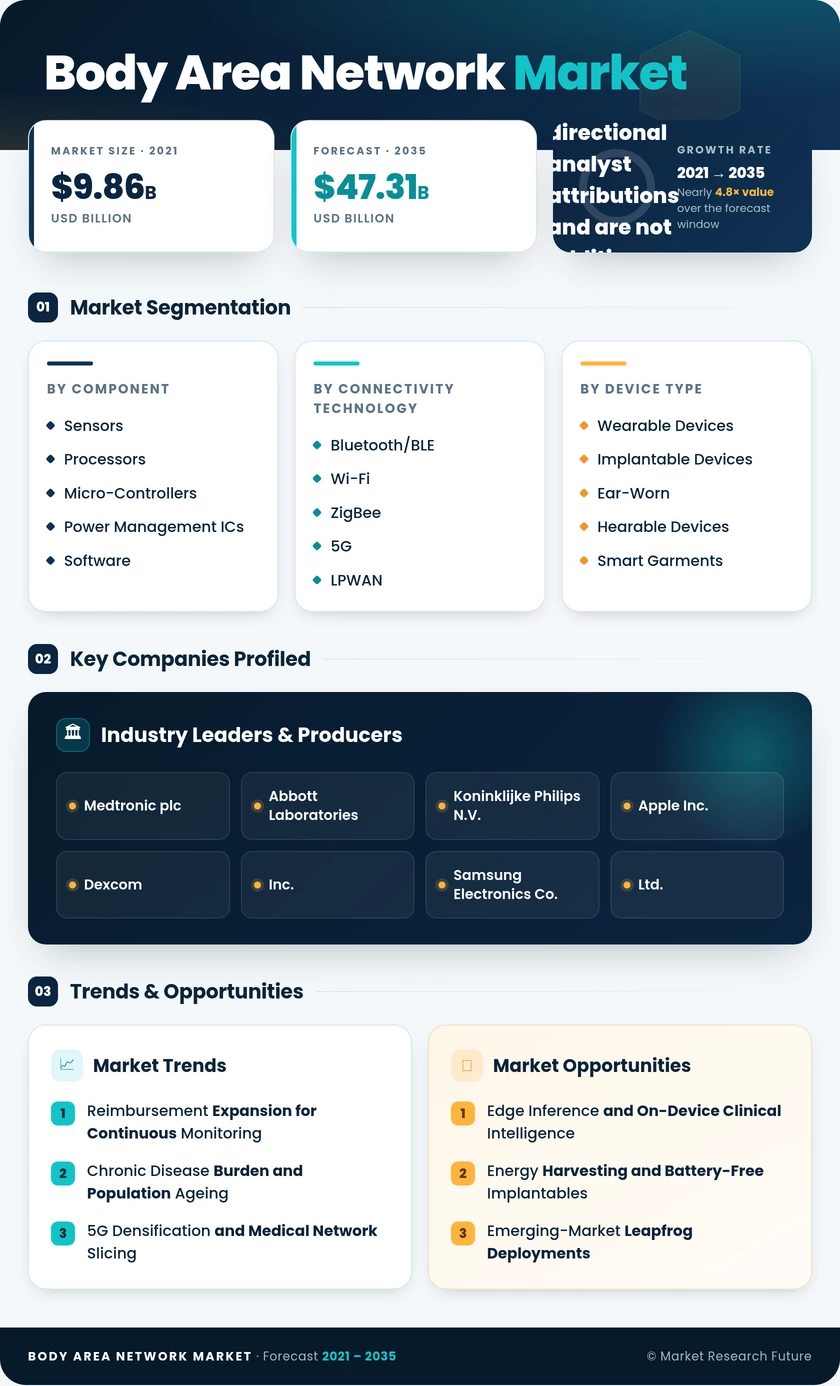
Segmentation Quick Reference
| Dimension | Sub-Segments | Dominant Segment | Fastest Growing Segment |
| By Component | Sensors; Processors and Micro-Controllers; Power Management ICs; Software and Services; Other Components | Sensors (35.3% share, 2025) | Software and Services (15.6% CAGR) |
| By Connectivity Technology | Bluetooth/BLE; Wi-Fi; ZigBee; 5G and LPWAN; UWB; ANT+; NFC | Bluetooth/BLE (41.6% share, 2025) | 5G and LPWAN (16.1% CAGR) |
| By Device Type | Wearable Devices; Implantable Devices; Ear-Worn and Hearable Devices; Smart Garments | Wearable Devices (65.3% share, 2025) | Ear-Worn and Hearable Devices (14.4% CAGR) |
| By Application | Medical and Healthcare; Sports and Fitness; Entertainment and Gaming; Military and Defence; Elderly Care and Assisted Living | Medical and Healthcare (42.4% share, 2025) | Entertainment and Gaming (15.9% CAGR) |
| By Communication Type | On-Body Communication; Intra-Body Communication; Off-Body Communication | On-Body Communication (51.0% share, 2025) | Off-Body Communication (14.6% CAGR) |
Market Segmentation Overview
By Component
| Sub-Segment | Key Trend |
| Sensors | Magnetoreceptive and multi-modal arrays widen non-invasive diagnostic reach |
| Processors and Micro-Controllers | Integrated neural accelerators keep classification on the device |
| Power Management ICs | Organic photovoltaic integration lifts duty cycles without larger cells |
| Software and Services | Analytic dashboards and compliance logging become the renewal-driving layer |
| Other Components | Biocompatible packaging and miniaturised antennas enable implantable form factors |
Sensors lead this dimension because signal acquisition is the non-negotiable first layer of every deployment, and falling analogue front-end costs have expanded how many physiological parameters a single device can capture. Software and Services grow fastest as hospital buyers shift their evaluation criteria from measurement fidelity to workflow integration and predictive alerting. Processors and Micro-Controllers sit at the strategic junction of those two forces, since privacy mandates increasingly reward architectures that classify locally rather than exporting raw waveforms. Power Management ICs quietly determine whether any of it is deployable outside well-resourced hospital settings.
By Connectivity Technology
| Sub-Segment | Key Trend |
| Bluetooth/BLE | Universal gateway compatibility removes integration cost from procurement |
| Wi-Fi | Carries bandwidth-heavy streams within existing hospital local networks |
| ZigBee | Mesh topologies preserve redundancy in operating theatre environments |
| 5G and LPWAN | Dedicated medical slices deliver deterministic latency for implantables |
| UWB | Centimetre-accurate positioning for asset and patient tracking |
| ANT+ | Entrenched within sports and fitness sensor ecosystems |
| NFC | Secure pairing and device identity verification at point of use |
Bluetooth/BLE holds the largest share because every smartphone, tablet, and clinical gateway already supports it, which means adopting it adds no integration line item to a procurement budget. 5G and LPWAN expand fastest since isolated network cores solve the quality-of-service and security objections that kept hospital IT departments from trusting shared carrier infrastructure for clinical telemetry. ZigBee retains a defensible position wherever mesh redundancy is a patient-safety requirement rather than a convenience, while Wi-Fi absorbs the high-bandwidth transfers that short-range radios cannot carry.
By Device Type
| Sub-Segment | Key Trend |
| Wearable Devices | Biosensor arrays extend to blood-pressure estimation and stress biomarkers |
| Implantable Devices | Dual-chamber leadless pacing establishes a new procedural category |
| Ear-Worn and Hearable Devices | MEMS microphones and photoplethysmography converge inside earbuds |
| Smart Garments | Conductive yarns and haptic actuators deliver biofeedback without visible hardware |
Wearable Devices dominate on adoption friction alone: a patch, ring, or watch requires no procedure, no clinician time, and no behaviour change from the patient. Ear-Worn and Hearable Devices post the fastest growth because they piggyback on a product category users already wear for extended daily periods, making continuous measurement genuinely passive. Implantable Devices generate far higher revenue per unit and are where clinical incumbency is most durable, given the evidence and reimbursement thresholds involved. Smart Garments remain earlier in commercialisation but benefit directly from self-healing conductor and flexible substrate research.
By Application
| Sub-Segment | Key Trend |
| Medical and Healthcare | Reimbursement codes convert monitoring into recurring provider revenue |
| Sports and Fitness | Inertial and metabolic sensing tunes training load at franchise level |
| Entertainment and Gaming | Real-time biometric triggers adapt difficulty and narrative branching |
| Military and Defence | Ruggedised vitals and location relay compresses casualty response times |
| Elderly Care and Assisted Living | Fall detection layered with medication adherence extends independence |
Medical and Healthcare anchors this dimension because payment infrastructure and published outcome evidence together justify institutional procurement in a way no other application can match. Entertainment and Gaming grows fastest precisely because it operates outside that framework — no clearance is required, consumer-grade accuracy suffices, and monetisation runs through content rather than payers, which collapses the sales cycle. Sports and Fitness functions as the validation ground where sensing techniques prove out before commercial adaptation, while Military and Defence sustains the premium pricing that funds ruggedisation engineering.
By Communication Type
| Sub-Segment | Key Trend |
| On-Body Communication | Short-range links deliver reliability at minimal power cost |
| Intra-Body Communication | Capacitive coupling enables implant-to-implant signalling through tissue |
| Off-Body Communication | Gateway and cloud hand-offs carry data into the analytics layer |
On-Body Communication carries the majority of traffic because short-range Bluetooth and capacitive couplings meet clinical reliability expectations without meaningfully draining the power budget. Off-Body Communication grows fastest as the commercial value of these systems migrates from measurement toward interpretation — every predictive alert requires a hand-off to an edge gateway or cloud engine. Intra-Body Communication addresses the narrowest but most technically demanding case, propagating signals through tissue where conventional radio performs poorly and regulatory scrutiny over implanted transmitters is highest.


 Noah Malgeri
Co-Founder

 Peter Groot koerkamp
Account and Business Manager

 Younghwan Choi
Senior Retail Manager

 Mark Irwin
Management Consultant

 Akif Moroglu
Strategy & Business Development Director

 Guilherme Gomes Martins
Product Management Director

 Joseph Aguayo
Sales Operations & Pricing Manager

 La Terria Dodd
Program Support Specialist

 Rob Kooiker
Group Product Manager HVAC & Fire Protection GMA