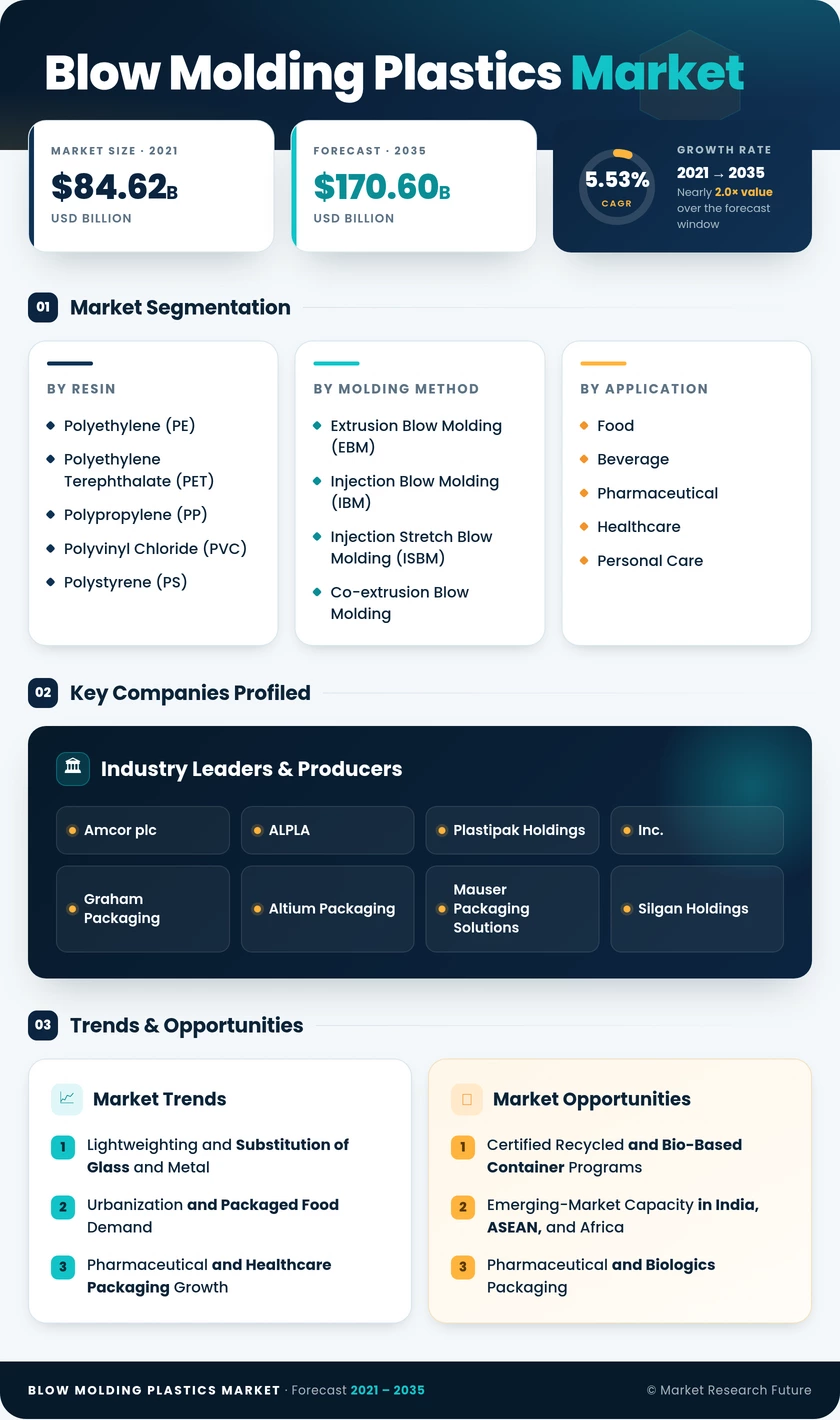
Blow Molding Plastics Market (2026 - 2035)

ID: MRFR/CnM/3296-CR 161 Pages Priya Nagrale Last Updated: November 06, 2026
Blow Molding Plastics Market Research Report Information By Resin (Polyethylene (PE), Polyethylene Terephthalate (PET), Polypropylene (PP), Polyvinyl Chloride (PVC), Polystyrene (PS), Acrylonitrile Butadiene Styrene (ABS), Polycarbonate (PC), Polyamide (PA), Bio-Based and Recycled Plastics, and Other Resins), By Molding Method (Extrusion Blow Molding (EBM), Injection Blow Molding (IBM), Injection Stretch Blow Molding (ISBM), and Co-Extrusion Blow Molding), By Application (Food and Beverage, Pharmaceutical and Healthcare, Personal Care and Cosmetics, Household Chemicals, Automotive and Transportation, Building and Construction, Electrical and Electronics, Industrial Manufacturing, Agriculture, and Consumer Goods), And By Region (North America, Europe, Asia-Pacific, and Rest of the World) – Market Forecast Till 2035.
Blow Molding Plastics Market
Market Size
Forecast Period2026-2035
CAGR (2026-2035)5.53%
2025 Market SizeUSD 100.12 Billion
2035 Market SizeUSD 170.60 Billion
Key Players
Amcor plc
ALPLA
Plastipak Holdings, Inc.
Graham Packaging
Altium Packaging
Mauser Packaging Solutions
Opportunities
  • Certified Recycled and Bio-Based Container Programs
  • Emerging-Market Capacity in India, ASEAN, and Africa
  • Pharmaceutical and Biologics Packaging
  1. 1 Market Summary | |
  2. 2 Key Report Takeaways | |
    1. 2.1 By Resin | |
    2. 2.2 By Molding Method | |
    3. 2.3 By Application | |
    4. 2.4 By Region | |
  3. 3 Market Size and Forecast (2021–2035) | |
    1. 3.1 Historical Market Size (2021–2025) | |
    2. 3.2 Forecast Market Size (2026–2035) | |
    3. 3.3 Year-over-Year Growth Analysis | |
  4. 4 Driver Impact Analysis | |
    1. 4.1 Lightweighting and Substitution of Glass and Metal | |
    2. 4.2 Urbanization and Packaged Food Demand | |
    3. 4.3 Pharmaceutical and Healthcare Packaging Growth | |
    4. 4.4 Recycled-Content Mandates Driving Container Redesign | |
    5. 4.5 EV Thermal and Fluid-Management Components | |
    6. 4.6 All-Electric and ISBM Machinery Efficiency Gains | |
  5. 5 Restraints Impact Analysis | |
    1. 5.1 Resin Price Volatility | |
    2. 5.2 Plastic Packaging Taxes and Producer-Responsibility Fees | |
    3. 5.3 Shortage of Food-Grade Recycled Resin | |
    4. 5.4 Single-Use Bans and Reuse Targets | |
    5. 5.5 High Energy Costs and Capital Intensity | |
  6. 6 Opportunities | |
    1. 6.1 Certified Recycled and Bio-Based Container Programs | |
    2. 6.2 Emerging-Market Capacity in India, ASEAN, and Africa | |
    3. 6.3 Pharmaceutical and Biologics Packaging | |
    4. 6.4 Data-Enabled Sorting and Container-as-a-Service Models | |
    5. 6.5 EV and Lightweight Automotive Components | |
  7. 7 Regional Market Share and Country-Level Analysis | |
    1. 7.1 North America | | |
      1. 7.1.1 US | | |
      2. 7.1.2 Canada | | |
      3. 7.1.3 Mexico | |
    2. 7.2 Europe | | |
      1. 7.2.1 Germany | | |
      2. 7.2.2 UK | | |
      3. 7.2.3 France | | |
      4. 7.2.4 Italy | | |
      5. 7.2.5 Spain | | |
      6. 7.2.6 Nordic Countries | | |
      7. 7.2.7 Russia | | |
      8. 7.2.8 Rest of Europe | |
    3. 7.3 Asia-Pacific | | |
      1. 7.3.1 China | | |
      2. 7.3.2 India | | |
      3. 7.3.3 Japan | | |
      4. 7.3.4 South Korea | | |
      5. 7.3.5 ASEAN | | |
      6. 7.3.6 Rest of Asia-Pacific | |
    4. 7.4 South America | | |
      1. 7.4.1 Brazil | | |
      2. 7.4.2 Argentina | | |
      3. 7.4.3 Rest of South America | |
    5. 7.5 Middle East & Africa | | |
      1. 7.5.1 Saudi Arabia | | |
      2. 7.5.2 UAE | | |
      3. 7.5.3 South Africa | | |
      4. 7.5.4 Egypt | | |
      5. 7.5.5 Rest of MEA | |
  8. 8 Future Outlook (2026–2035) | |
    1. 8.1 AI-Driven Process Control and Digital Twins | |
    2. 8.2 Circular Economy and ESG Reporting | |
    3. 8.3 Electrification of Vehicles and Plants | |
    4. 8.4 Consolidation and Platform Economics | |
  9. 9 Segmentation Analysis | |
    1. 9.1 By Resin | | |
      1. 9.1.1 Polyethylene (PE) | | |
      2. 9.1.2 Polyethylene Terephthalate (PET) | | |
      3. 9.1.3 Polypropylene (PP) | | |
      4. 9.1.4 Polyvinyl Chloride (PVC) | | |
      5. 9.1.5 Polystyrene (PS) | | |
      6. 9.1.6 Acrylonitrile Butadiene Styrene (ABS) | | |
      7. 9.1.7 Polycarbonate (PC) | | |
      8. 9.1.8 Polyamide (PA) | | |
      9. 9.1.9 Bio-based and Recycled Plastics | | |
      10. 9.1.10 Other Resins | |
    2. 9.2 By Molding Method | | |
      1. 9.2.1 Extrusion Blow Molding (EBM) | | |
      2. 9.2.2 Injection Blow Molding (IBM) | | |
      3. 9.2.3 Injection Stretch Blow Molding (ISBM) | | |
      4. 9.2.4 Co-extrusion Blow Molding | |
    3. 9.3 By Application | | |
      1. 9.3.1 Food and Beverage | | |
      2. 9.3.2 Pharmaceutical and Healthcare | | |
      3. 9.3.3 Personal Care and Cosmetics | | |
      4. 9.3.4 Household Chemicals | | |
      5. 9.3.5 Automotive and Transportation | | |
      6. 9.3.6 Building and Construction | | |
      7. 9.3.7 Electrical and Electronics | | |
      8. 9.3.8 Industrial Manufacturing | | |
      9. 9.3.9 Agriculture | | |
      10. 9.3.10 Consumer Goods | |
  10. 10 Competitive Landscape | |
    1. 10.1 Market Concentration Analysis | |
    2. 10.2 Competitive Benchmarking Table | |
    3. 10.3 Company Profiles | | |
      1. 10.3.1 Amcor plc | | |
      2. 10.3.2 ALPLA | | |
      3. 10.3.3 Plastipak Holdings, Inc. | | |
      4. 10.3.4 Graham Packaging | | |
      5. 10.3.5 Altium Packaging | | |
      6. 10.3.6 Mauser Packaging Solutions | | |
      7. 10.3.7 Silgan Holdings | | |
      8. 10.3.8 Gerresheimer AG | | |
      9. 10.3.9 Greiner Packaging | | |
      10. 10.3.10 Retal Industries | | |
      11. 10.3.11 Pretium Packaging | |
  11. 11 Recent News & Developments | |
  12. 12 Report Scope and Methodology | |
  13. 13 Detailed Sources and Citations | |
  14. 14 Frequently Asked Questions (FAQs) | | LIST OF TABLES | |
  15. TABLE 1 Global Market Snapshot, 2025–2035 | |
  16. TABLE 2 Global Market Size and Forecast, by Revenue (USD Billion), 2021–2035 | |
  17. TABLE 3 Driver Impact Analysis, 2026–2035 | |
  18. TABLE 4 Restraints Impact Analysis, 2026–2035 | |
  19. TABLE 5 Regional Summary, 2025 | |
  20. TABLE 6 North America Market, by Country, 2025 | |
  21. TABLE 7 Europe Market, by Country, 2025 | |
  22. TABLE 8 Asia-Pacific Market, by Country, 2025 | |
  23. TABLE 9 South America Market, by Country, 2025 | |
  24. TABLE 10 Middle East & Africa Market, by Country, 2025 | |
  25. TABLE 11 Global Market, by Resin, 2025 | |
  26. TABLE 12 Global Market, by Molding Method, 2025 | |
  27. TABLE 13 Global Market, by Application, 2025 | |
  28. TABLE 14 Competitive Benchmarking, 2025 | |
  29. TABLE 15 Report Scope and Methodology | |
  30. TABLE 16 Detailed Sources and Citations | | LIST OF FIGURES | |
  31. FIGURE 1 Market Dynamics Overview — Drivers, Restraints and Opportunities | |
  32. FIGURE 2 Industry Value Chain Analysis | |
  33. FIGURE 3 Porter's Five Forces Analysis | |
  34. FIGURE 4 Global Market Size Trend, 2021–2035 (USD Billion) | |
  35. FIGURE 5 Market Share, by Resin, 2025 | |
  36. FIGURE 6 Market Share, by Molding Method, 2025 | |
  37. FIGURE 7 Market Share, by Application, 2025 | |
  38. FIGURE 8 Regional Market Share, 2025 | |
  39. FIGURE 9 Country-Level Market Share, by Region, 2025 | |
  40. FIGURE 10 Competitive Landscape — Estimated Revenue Share Ranges, 2025

Segmentation Quick Reference

DimensionSub-SegmentsDominant SegmentFastest Growing Segment
By ResinPolyethylene (PE), Polyethylene Terephthalate (PET), Polypropylene (PP), Polyvinyl Chloride (PVC), Polystyrene (PS), Acrylonitrile Butadiene Styrene (ABS), Polycarbonate (PC), Polyamide (PA), Bio-based and Recycled Plastics, Other ResinsPolyethylene (PE) (41.6% share)Bio-based and Recycled Plastics (8.6% CAGR)
By Molding MethodExtrusion Blow Molding (EBM), Injection Blow Molding (IBM), Injection Stretch Blow Molding (ISBM), Co-extrusion Blow MoldingExtrusion Blow Molding (EBM) (50.5% share)Injection Stretch Blow Molding (ISBM) (6.9% CAGR)
By ApplicationFood and Beverage, Pharmaceutical and Healthcare, Personal Care and Cosmetics, Household Chemicals, Automotive and Transportation, Building and Construction, Electrical and Electronics, Industrial Manufacturing, Agriculture, Consumer GoodsFood and Beverage (33.8% share)Pharmaceutical and Healthcare (7.3% CAGR)
By RegionNorth America, Europe, Asia-Pacific, South America, Middle East & AfricaAsia-Pacific (42.6% share)Asia-Pacific (42.6% share)

Market Segmentation Overview

By Resin

Sub-SegmentKey Trend
Polyethylene (PE)HDPE remains the default for drums, jerrycans, and household bottles
Polyethylene Terephthalate (PET)Lighter preforms and higher recycled PET content
Polypropylene (PP)Hot-fill and medical containers needing heat resistance
Polyvinyl Chloride (PVC)Gradual replacement in packaging; steady in industrial uses
Polystyrene (PS)Limited role in specialty containers
Acrylonitrile Butadiene Styrene (ABS)Technical parts needing rigidity and surface finish
Polycarbonate (PC)Reusable water bottles and safety-critical components
Polyamide (PA)Heat- and glycol-resistant EV cooling parts
Bio-based and Recycled PlasticsFDA letters and EU mandates widen food-contact use
Other ResinsBarrier and specialty copolymers in multi-layer walls

Polyethylene (PE) leads because its melt strength suits extrusion parisons for everything from small bottles to large drums. Bio-based and Recycled Plastics grow fastest as EU and Indian recycled-content floors take effect, and FDA letters approve more recycled HDPE and PP for food contact. Polyamide (PA) is the resin to watch in automotive, where EV cooling circuits need materials that tolerate heat and glycol.

By Molding Method

Sub-SegmentKey Trend
Extrusion Blow Molding (EBM)Handleware, large containers, and recycled HDPE adoption
Injection Blow Molding (IBM)Precision small-volume pharmaceutical and cosmetic containers
Injection Stretch Blow Molding (ISBM)Lightweight PET bottles and COC-modified HDPE trials
Co-extrusion Blow MoldingMulti-layer barriers with recycled middle layers

Extrusion Blow Molding (EBM) leads because it is the only method that economically produces handled containers and large industrial formats. Injection Stretch Blow Molding (ISBM) grows fastest as beverage and personal care brands chase lighter PET bottles and as modified HDPE opens ISBM to new resins. Co-extrusion Blow Molding gains by burying recycled resin between virgin skin layers.

By Application

Sub-SegmentKey Trend
Food and BeverageLightweight water and soft drink bottles; tethered caps
Pharmaceutical and HealthcareValidated containers for generics and biologics
Personal Care and CosmeticsPremium PET replacing glass
Household ChemicalsRecycled HDPE detergent bottles
Automotive and TransportationShift from fuel tanks to EV thermal-management parts
Building and ConstructionPVC fittings and HDPE containment tanks
Electrical and ElectronicsTechnical housings in ABS and PC
Industrial ManufacturingDrums and intermediate bulk containers with reconditioning
AgricultureAgrochemical jugs with take-back programs
Consumer GoodsToys and sporting goods

Food and Beverage leads on sheer unit volume from water, soft drinks, and dairy, though lightweighting limits value growth per bottle. Pharmaceutical and Healthcare grows fastest because aging populations and strict container-closure rules favor validated, higher-value containers. Automotive and Transportation is changing in content rather than volume, as EV reservoirs and ducts replace fuel tanks.


Download PDF ×

We do not share your information with anyone. However, we may send you emails based on your report interest from time to time. You may contact us at any time to opt-out.