Request Free Sample ×

Kindly complete the form below to receive a free sample of this Report

* Please use a valid business email

Leading companies partner with us for data-driven Insights

clients tt-cursor
Hero Background
English
Chinese
French
Japanese
Korean
German
Spanish

Blood Testing Market Size

ID: MRFR/HC/4341-HCR
200 Pages
Vikita Thakur
March 2026

Blood Testing Market Research Report: Size, Share, Trend Analysis By Test Type (Complete Blood Count, Blood Chemistry Tests, Blood Glucose Tests, Coagulation Tests, Blood Typing Tests), By End Users (Hospitals, Diagnostic Laboratories, Home Care Settings, Research Institutions), By Product (Reagents, Consumables, Instruments, Software) and By Regional (North America, Europe, South America, Asia Pacific, Middle East and Africa) - Growth Outlook & Industry Forecast 2025 To 2035

Share:
Download PDF ×

We do not share your information with anyone. However, we may send you emails based on your report interest from time to time. You may contact us at any time to opt-out.

Blood Testing Market Infographic
Purchase Options

Blood Testing Size

Blood Testing Market Growth Projections and Opportunities

The blood testing market is significantly influenced by the increasing awareness of health and wellness among individuals. With a rising emphasis on preventive healthcare, people are opting for regular blood tests to detect and manage various health conditions at an early stage. Fast changes in technology are making blood tests better, quicker and easier to get. The use of new ways like checking tiny bits inside the body, advanced testing machines and quick tests has made a big difference in how people check their blood. The worldwide increase in long-term sicknesses such as diabetes, heart problems and infectious diseases has made people want blood tests more. Checking biomarkers and illness signs in blood tests regularly is very important for managing diseases well and acting quickly when needed. The old people are a big reason for the blood testing market. They often need more checks on their health because they get older. Problems and illnesses that come with age need regular checking of blood. This helps the market to grow in total size. Tests and treatments have improved, so we need accurate blood tests tailored for each person. Blood tests, used for personalized treatment plans based on gene and molecule information, are really important to the blood testing market. This makes it a key part of modern healthcare. The need for quick tests done close to the patient has greatly changed how blood tests are handled. This way helps quickly, making it easy for doctors to make fast decisions and helping patients get better. The blood testing market has seen more partnerships between healthcare providers, diagnostic labs and technology firms. These alliances want to use shared knowledge, stuff and tools. They aim to increase the speed and chance for everyone with these blood testing services. The government is encouraging people to go for regular health check-ups and preventative care. This has helped improve the blood testing market in a good way. The strict rules and quality checks set by the rule makers make sure that blood tests are reliable. This gives patients, doctors, and others faith in their accuracy. The way people are taking charge of their own health and making smart choices has encouraged them to be involved in how they get care. The growth of the blood testing market has been helped by making it easier to get information and request certain tests for your own health. The global impact of infectious diseases, as evidenced by events such as the COVID-19 pandemic, has underscored the importance of widespread and rapid diagnostic testing. Blood tests play a crucial role in identifying and monitoring infectious diseases, influencing market dynamics during health crises.
Blood Testing Market Size Graph
Author
Author Profile
Vikita Thakur
Senior Research Analyst

She holds an experience of about 5+ years in market research and business consulting projects for sectors such as life sciences, medical devices, and healthcare IT. She possesses a robust background in data analysis, market estimation, competitive intelligence, pipeline analysis market trend identification, and consumer behavior insights. Her expertise lies in technical Sales support, client interaction and project management, designing and implementing market research studies, conducting competitive analysis, and synthesizing complex data into actionable recommendations that drive business growth.

Leave a Comment

FAQs

What is the current valuation of the Blood Testing Market in 2024?

<p>The Blood Testing Market was valued at 110.49 USD Billion in 2024.</p>

What is the projected market size for the Blood Testing Market by 2035?

<p>The market is projected to reach 236.23 USD Billion by 2035.</p>

What is the expected CAGR for the Blood Testing Market during the forecast period 2025 - 2035?

<p>The expected CAGR for the Blood Testing Market during 2025 - 2035 is 7.15%.</p>

Which companies are considered key players in the Blood Testing Market?

<p>Key players include Abbott Laboratories, Roche Diagnostics, Siemens Healthineers, and Thermo Fisher Scientific.</p>

What segment generated the highest revenue in the Blood Testing Market in 2024?

<p>Blood Typing Tests generated the highest revenue, valued at 40.49 USD Billion in 2024.</p>

How much is the Blood Chemistry Tests segment projected to grow by 2035?

<p>The Blood Chemistry Tests segment is projected to grow from 25.0 USD Billion in 2024 to 55.0 USD Billion by 2035.</p>

What is the market size for Blood Glucose Tests in 2024?

<p>The Blood Glucose Tests segment was valued at 15.0 USD Billion in 2024.</p>

Which end user segment is expected to see the most growth by 2035?

<p>The Hospitals segment is expected to grow significantly, from 40.0 USD Billion in 2024 to 85.0 USD Billion by 2035.</p>

What is the projected market size for instruments in the Blood Testing Market by 2035?

<p>The Instruments segment is projected to grow from 35.0 USD Billion in 2024 to 80.0 USD Billion by 2035.</p>

How does the market for diagnostic laboratories compare to hospitals in 2024?

<p>In 2024, the Diagnostic Laboratories segment was valued at 30.0 USD Billion, compared to 40.0 USD Billion for Hospitals.</p>

What is the market size for Complete Blood Count tests in 2024?

The market size for Complete Blood Count tests is expected to be 10.05 USD Billion in 2024.

Market Summary

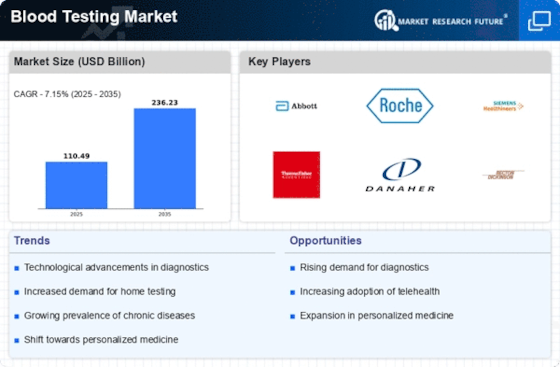
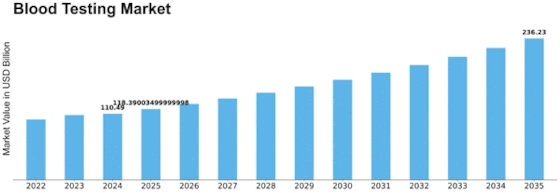
As per MRFR analysis, the Blood Testing Market size was valued at USD 110.49 Billion in 2024. The market is projected to grow from USD 118.39 Billion in 2025 to USD 236.23 Billion by 2035, exhibiting a CAGR of 7.15% during the forecast period 2025-2035. North America led the market with over 45% share, generating around USD 49.7 Billion in revenue.
 
The Blood Testing Market is expanding due to rising prevalence of chronic and infectious diseases, growing demand for early diagnosis, and increasing adoption of advanced diagnostic technologies. Key trends include integration of automated analyzers, use of molecular and point‑of‑care testing, and expanding healthcare diagnostics infrastructure to support preventive care and personalized treatment.
 
According to the World Health Organization, diseases such as diabetes and cardiovascular conditions—diagnosed primarily through blood tests—are among the top causes of global morbidity and mortality, driving demand for broader screening.

Key Market Trends & Highlights

The Blood Testing Market is experiencing robust growth driven by technological advancements and a shift towards preventive healthcare.

  • Technological advancements are revolutionizing blood testing methodologies, enhancing accuracy and efficiency. North America remains the largest market, while Asia-Pacific is emerging as the fastest-growing region in blood testing. The Complete Blood Count segment dominates the market, whereas Blood Glucose Tests are witnessing the fastest growth. Rising prevalence of chronic diseases and increasing demand for preventive healthcare are key drivers propelling market expansion.

Market Size & Forecast

2024 Market Size 110.49 (USD Billion)
2035 Market Size 236.23 (USD Billion)
CAGR (2025 - 2035) 7.15%
Largest Regional Market Share in 2024 North America

Major Players

Companies such as  Abbott Laboratories (US), <a href="https://diagnostics.roche.com/global/en/products/product-category/lab-type/blood-screening.html">Roche Diagnostics</a> (CH), Siemens Healthineers (DE), <a href="https://www.thermofisher.com/search/browse/category/us/en/90222075">Thermo Fisher Scientific</a> (US), Danaher Corporation (US), Becton Dickinson and Company (US), Ortho Clinical Diagnostics (US), Bio-Rad Laboratories (US), Hologic, Inc. (US) are some of the major participants in the global market.

Market Trends

The Blood Testing Market is currently experiencing a transformative phase, driven by advancements in technology and an increasing emphasis on preventive healthcare. Innovations in diagnostic tools and methodologies are enhancing the accuracy and speed of blood tests, which, in turn, is likely to improve patient outcomes. Furthermore, the growing awareness of the importance of regular health check-ups is propelling demand for blood testing services.

This trend is particularly evident in emerging economies, where healthcare infrastructure is evolving rapidly, and access to diagnostic services is expanding. As a result, stakeholders in the Blood Testing Market are focusing on developing user-friendly and cost-effective solutions to cater to a broader audience.

In addition to technological advancements, regulatory frameworks are also adapting to the changing landscape of the Blood Testing Market. Governments are increasingly prioritizing the establishment of stringent quality standards to ensure the reliability of diagnostic tests. This regulatory focus may lead to enhanced consumer trust and, consequently, increased market growth.

Moreover, the integration of artificial intelligence and machine learning into blood testing processes appears to be on the rise, potentially streamlining operations and improving diagnostic accuracy. Overall, the Blood Testing Market is poised for substantial growth, driven by innovation, regulatory support, and a heightened focus on preventive healthcare.

Technological Advancements

The Blood Testing Market is witnessing rapid technological innovations that enhance the precision and efficiency of diagnostic procedures. New methodologies, such as point-of-care testing and automated laboratory systems, are streamlining processes and reducing turnaround times.

According to the World Health Organization, adoption of automated laboratory systems and point-of-care testing has increased globally, improving diagnostic turnaround times by up to 40%.

Regulatory Developments

Regulatory bodies are increasingly implementing stringent guidelines to ensure the quality and reliability of blood tests. This focus on regulation is likely to foster consumer confidence and promote market expansion.

The World Health Organization reports that more than 70% of countries have strengthened regulatory frameworks for diagnostic testing, ensuring reliability and safety of blood tests.

Shift Towards Preventive Healthcare

There is a growing trend towards preventive healthcare, with individuals becoming more proactive about their health. This shift is driving demand for regular blood testing, as people seek to monitor their health status and detect potential issues early.

The Pan American Health Organization indicates that rising awareness of preventive healthcare is driving regular blood testing, with screening coverage increasing by nearly 25% in developing regions over the last five years.

Blood Testing Market Market Drivers

Rising Awareness of Blood Disorders

The growing awareness of blood disorders, such as anemia and hemophilia, is driving the Blood Testing Market. Educational campaigns and advocacy efforts are informing the public about the importance of blood health and the need for regular testing. This heightened awareness is leading to an increase in the number of individuals seeking blood tests for diagnosis and monitoring.
 
Furthermore, the prevalence of blood disorders is prompting healthcare providers to recommend routine screenings, thereby boosting the demand for blood testing services. As awareness continues to rise, the Blood Testing Market is likely to experience sustained growth, reflecting the increasing focus on blood health.

Rising Prevalence of Chronic Diseases

The increasing incidence of chronic diseases such as diabetes, cardiovascular disorders, and cancer is a primary driver of the Blood Testing Market. As these conditions require regular monitoring and management, the demand for blood tests has surged. According to recent data, approximately 422 million people worldwide are living with diabetes, necessitating frequent blood glucose testing.
 
This trend is likely to continue, as healthcare providers emphasize early detection and management of chronic diseases. Consequently, the Blood Testing Market is expected to expand significantly, driven by the need for reliable diagnostic tools that facilitate timely interventions and improve patient outcomes.

Growing Demand for Preventive Healthcare

The shift towards preventive healthcare is significantly influencing the Blood Testing Market. As individuals become more health-conscious, there is a rising demand for routine blood tests to monitor health status and detect potential issues early. This trend is supported by initiatives promoting regular health screenings and awareness campaigns about the importance of preventive measures.
 
The market is expected to witness a notable increase in the adoption of blood tests for preventive purposes, with estimates suggesting that the preventive healthcare segment could account for a substantial share of the overall market. This growing focus on prevention is likely to drive the Blood Testing Market forward.

Technological Innovations in Blood Testing

Technological advancements are revolutionizing the Blood Testing Market, leading to more efficient and accurate diagnostic methods. Innovations such as point-of-care testing, microfluidics, and lab-on-a-chip technologies are enhancing the speed and precision of blood tests. For instance, the introduction of portable devices allows for immediate results, which is particularly beneficial in emergency settings.
 
The market for blood testing technologies is projected to grow at a compound annual growth rate of over 6% in the coming years, reflecting the increasing adoption of these advanced solutions. As healthcare systems continue to integrate cutting-edge technologies, the Blood Testing Market is poised for substantial growth.

Increasing Investment in Healthcare Infrastructure

Investment in healthcare infrastructure is a crucial factor propelling the Blood Testing Market. Governments and private entities are allocating significant resources to enhance healthcare facilities, particularly in developing regions. This investment is aimed at improving access to diagnostic services, including blood testing.
 
For example, initiatives to establish more laboratories and diagnostic centers are underway, which will likely increase the availability of blood tests. As healthcare systems expand and modernize, the Blood Testing Market is expected to benefit from improved access and increased testing capabilities, ultimately leading to higher demand for blood testing services.

Market Segment Insights

By Type: Complete Blood Count (Largest) vs. Blood Glucose Tests (Fastest-Growing)

The Blood Testing Market is characterized by a diverse range of types, with Complete Blood Count (CBC) tests holding the largest share due to their extensive use in diagnosing various health conditions. Blood Chemistry Tests and Blood Typing Tests also contribute significantly but are overshadowed by the dominant presence of the CBC segment. Meanwhile, Blood Glucose Tests are emerging as the fastest-growing segment, driven by the rising prevalence of diabetes and the increasing focus on preventive healthcare. In terms of growth trends, technology advancements are enhancing the efficiency and accuracy of Blood Testing Market procedures, paving the way for greater adoption of these tests. The growing awareness of chronic diseases and the importance of early diagnosis are significant drivers propelling Blood Glucose Tests to the forefront. The ongoing innovation in point-of-care testing has further accelerated interest in Blood Chemistry Tests, presenting opportunities for growth in an evolving healthcare landscape.

Complete Blood Count (Dominant) vs. Blood Glucose Tests (Emerging)

Complete Blood Count (CBC) tests represent the backbone of routine diagnostic testing, providing critical information about blood components. This dominance stems from their versatility, being able to identify a wide range of disorders such as anemia, infection, and many other diseases. Conversely, Blood Glucose Tests, while traditionally used for diabetes management, are rapidly gaining traction as the population becomes increasingly health-conscious. The emergence of home monitoring devices and increased healthcare spending are facilitating both segments' growth. While CBC tests are characterized by their comprehensive nature, Blood Glucose Tests are increasingly recognized for their role in proactive health management, making them essential in the modern healthcare framework.

By End User: Hospitals (Largest) vs. Home Care Settings (Fastest-Growing)

In the Blood Testing Market, the distribution of end users illustrates a significant concentration within hospitals, followed closely by diagnostic laboratories. Hospitals comprise the largest segment as they conduct extensive blood tests for a variety of medical conditions, solidifying their status in the market. Diagnostic laboratories also hold a major share as they provide specialized testing services for both hospitals and outpatient clients, contributing richly to the overall market landscape. Meanwhile, home care settings are quickly gaining traction, presenting themselves as a viable alternative for routine blood tests, especially in the wake of increasing demand for patient-centric care.

Hospitals (Dominant) vs. Home Care Settings (Emerging)

Within the Blood Testing Market, hospitals represent the dominant segment, leveraging comprehensive infrastructures that support advanced diagnostic technologies and vast patient volumes. They benefit from established relationships with healthcare providers and often have significant budgets allocated for innovative testing. On the other hand, home care settings are emerging as an important player in the market, driven by the convenience they offer to patients seeking accessible health monitoring solutions. The trend towards home testing is propelled by technological advancements, such as portable blood testing devices and telehealth services, catering to a growing preference for in-<a title="home healthcare" href="https://www.marketresearchfuture.com/reports/home-healthcare-market-2030" target="_blank" rel="noopener">home healthcare</a> options.

By Product: Reagents (Largest) vs. Consumables (Fastest-Growing)

In the Blood Testing Market, Reagents dominate the product segment, accounting for the largest share among the various components driving the market. Their critical role in accurate diagnostics positions them as a fundamental aspect within laboratories. In contrast, Consumables are rapidly gaining traction, spurred by the increasing demand for convenient testing solutions. They represent the fastest-growing segment due to their integral use in daily testing procedures and rising emphasis on point-of-care testing.

Reagents (Dominant) vs. Consumables (Emerging)

Reagents are pivotal to the blood testing process, ensuring test accuracy and reliability. They constitute a significant portion of the market share, benefiting from an ever-growing demand for precise diagnostics in healthcare. On the other hand, Consumables are emerging as a crucial aspect of the market, reflecting advancements in testing methodologies and increasing consumer preference for quick and easy testing solutions. As the healthcare industry continues to evolve, the emphasis on Consumables is anticipated to rise, driven by technological innovations and the pressing need for efficient blood testing tools in a rapidly changing landscape.

Get more detailed insights about Blood Testing Market Research Report - Forecast to 2035

Regional Insights

North America : Market Leader in Innovation

North America leads in the Blood Testing Market Size, accounting for over 45% of the global revenue in 2024. The region's growth is driven by advanced healthcare infrastructure, increasing prevalence of chronic diseases, and a strong emphasis on research and development. Regulatory support from agencies like the FDA further catalyzes innovation and adoption of new technologies, enhancing market dynamics. 

The United States is the primary contributor, with significant investments from key players such as Abbott Laboratories and Thermo Fisher Scientific. The competitive landscape is characterized by rapid technological advancements and a focus on personalized medicine. Canada also plays a vital role, contributing to the market with its robust healthcare system and increasing demand for diagnostic services.

Europe : Emerging Regulatory Frameworks

Europe Blood Testing Market was valued at USD 33.15 Billion in 2024, making it the second-largest regional market with a 30% share. The region benefits from stringent regulatory frameworks that ensure high-quality standards in medical devices and diagnostics. Increasing awareness of preventive healthcare and the rising incidence of infectious diseases are key drivers of market growth. 

Countries like Germany and the UK are leading the charge, supported by favorable government initiatives. Germany stands out as a major player, with a strong presence of companies like Siemens Healthineers and Roche Diagnostics. The competitive landscape is marked by collaborations and partnerships aimed at enhancing product offerings. The European market is also witnessing a shift towards point-of-care testing, driven by the need for rapid and accurate diagnostics.

Asia-Pacific : Rapidly Growing Healthcare Sector

Asia-Pacific is an emerging powerhouse in the blood testing market, projected to grow significantly due to increasing healthcare investments and rising awareness of health issues. The region holds about 20% of the global market share, with countries like China and India leading the growth trajectory. The demand for advanced diagnostic solutions is fueled by a growing population and rising incidences of lifestyle-related diseases.

China is the largest market in the region, with substantial contributions from local and international players. The competitive landscape is evolving, with companies focusing on innovation and affordability. India is also emerging as a key player, driven by government initiatives aimed at improving healthcare access and quality, thus enhancing the overall market dynamics.

Middle East and Africa : Untapped Market Opportunities

The Middle East and Africa region is characterized by untapped market potential in the blood testing sector, holding approximately 5% of the global market share. The growth is driven by increasing healthcare expenditure, rising awareness of disease prevention, and government initiatives to improve healthcare infrastructure. Countries like South Africa and the UAE are at the forefront, with significant investments in healthcare technology.

South Africa is the largest market in the region, supported by a growing demand for diagnostic services. The competitive landscape is gradually evolving, with both local and international players entering the market. The region is witnessing a shift towards more advanced testing methods, driven by the need for accurate and timely diagnostics, which is crucial for effective healthcare delivery.

Key Players and Competitive Insights

The Blood Testing Market is currently characterized by a dynamic competitive landscape, driven by technological advancements, increasing demand for early disease detection, and a growing emphasis on personalized medicine. Major players such as Abbott Laboratories (US), Roche Diagnostics (CH), and Siemens Healthineers (DE) are strategically positioned to leverage these trends. Abbott Laboratories (US) focuses on innovation in point-of-care testing, enhancing accessibility and speed in diagnostics.
 
Roche Diagnostics (CH) emphasizes its robust portfolio in molecular diagnostics, while Siemens Healthineers (DE) is investing heavily in digital transformation and AI integration to streamline laboratory workflows. Collectively, these strategies not only enhance their market presence but also intensify competition, as companies vie for leadership in a rapidly evolving sector. In terms of business tactics, companies are increasingly localizing manufacturing to reduce supply chain vulnerabilities and optimize operational efficiency.
 
The Blood Testing Market appears moderately fragmented, with a mix of established players and emerging companies. This structure allows for diverse competitive strategies, where key players can influence market dynamics through innovation and strategic partnerships. In August 2025, Abbott Laboratories (US) announced the launch of a new portable blood testing device aimed at enhancing patient care in remote areas. This strategic move is significant as it aligns with the growing trend towards decentralized healthcare, potentially expanding Abbott's market share in underserved regions.
 
The device's ability to deliver rapid results could redefine patient management protocols, thereby reinforcing Abbott's commitment to innovation. In September 2025, Roche Diagnostics (CH) unveiled a partnership with a leading tech firm to integrate AI capabilities into its diagnostic platforms. This collaboration is crucial as it not only enhances Roche's product offerings but also positions the company at the forefront of the digital transformation trend in healthcare. By leveraging AI, Roche aims to improve diagnostic accuracy and operational efficiency, which could lead to better patient outcomes and increased market competitiveness.
 
In October 2025, Siemens Healthineers (DE) launched a new cloud-based analytics platform designed to optimize laboratory operations. This initiative reflects Siemens' strategic focus on digitalization, enabling laboratories to harness data for improved decision-making. The platform's introduction is likely to enhance Siemens' competitive edge by providing customers with advanced tools for operational efficiency and cost reduction.
 
As of October 2025, the Blood Testing Market is witnessing a shift towards digitalization, sustainability, and AI integration, which are defining current competitive trends. Strategic alliances are increasingly shaping the landscape, allowing companies to pool resources and expertise to drive innovation. Looking ahead, competitive differentiation is expected to evolve, with a pronounced shift from price-based competition to a focus on technological innovation, supply chain reliability, and enhanced patient care solutions.

Key Companies in the Blood Testing Market include

Industry Developments

Recent developments in the Blood Testing Market indicate significant advancements and increased activities among key companies. Abbott Laboratories and Thermo Fisher Scientific Inc. have introduced innovative blood testing solutions to enhance diagnostic accuracy and speed.

In October 2023, Becton Dickinson and Company announced the expansion of its automation capabilities for blood analysis, aimed at improving operational efficiency. Current affairs reflect a growing demand for rapid diagnostics due to the ongoing evolution of infectious diseases and chronic conditions.

This is pushing companies like Hologic Inc. and Roche Holding AG to invest heavily in Research and Development. Notably, in September 2023, Danaher Corporation completed the acquisition of GE Healthcare’s biomanufacturing business, which bolsters its presence in the healthcare space.

This includes blood testing. Additionally, Siemens Healthineers has expanded its pipeline of advanced analyzers through partnerships focusing on the integration of artificial intelligence. The overall market is witnessing a boost in valuation, driven by technological advancements and strategic collaborations.

Over the past two to three years, companies have reported a significant increase in demand for blood tests, with Mindray Medical International Limited recently highlighting a 25% growth in their testing solutions segment.

Future Outlook

Blood Testing Market Future Outlook

The Blood Testing Market size is projected to reach USD 236.23 Billion by 2035, growing at a CAGR of 7.15%

New opportunities lie in:

  • <p>Development of portable blood testing devices for home use. Integration of AI-driven analytics for personalized medicine. Expansion of telehealth services incorporating blood testing solutions.</p>

By 2035, the Blood Testing Market is expected to be robust, reflecting substantial growth and innovation.

Market Segmentation

Blood Testing Market Type Outlook

  • Complete Blood Count
  • Blood Chemistry Tests
  • Blood Glucose Tests
  • Coagulation Tests
  • Blood Typing Tests

Blood Testing Market Product Outlook

  • Reagents
  • Consumables
  • Instruments
  • Software

Blood Testing Market End User Outlook

  • Hospitals
  • Diagnostic Laboratories
  • Home Care Settings
  • Research Institutions

Report Scope

MARKET SIZE 2024 110.49(USD Billion)
MARKET SIZE 2025 118.39(USD Billion)
MARKET SIZE 2035 236.23(USD Billion)
COMPOUND ANNUAL GROWTH RATE (CAGR) 7.15% (2025 - 2035)
REPORT COVERAGE Revenue Forecast, Competitive Landscape, Growth Factors, and Trends
BASE YEAR 2024
Market Forecast Period 2025 - 2035
Historical Data 2019 - 2024
Market Forecast Units USD Billion
Key Companies Profiled Abbott Laboratories (US), Roche Diagnostics (CH), Siemens Healthineers (DE), Thermo Fisher Scientific (US), Danaher Corporation (US), Becton Dickinson and Company (US), Ortho Clinical Diagnostics (US), Bio-Rad Laboratories (US), Hologic, Inc. (US)
Segments Covered Test Type, End Users, Product, Regional
Key Market Opportunities Integration of advanced technologies enhances accuracy and efficiency in the Blood Testing Market.
Key Market Dynamics Technological advancements and regulatory changes drive innovation and competition in the blood testing market.
Countries Covered North America, Europe, APAC, South America, MEA

FAQs

What is the current valuation of the Blood Testing Market in 2024?

<p>The Blood Testing Market was valued at 110.49 USD Billion in 2024.</p>

What is the projected market size for the Blood Testing Market by 2035?

<p>The market is projected to reach 236.23 USD Billion by 2035.</p>

What is the expected CAGR for the Blood Testing Market during the forecast period 2025 - 2035?

<p>The expected CAGR for the Blood Testing Market during 2025 - 2035 is 7.15%.</p>

Which companies are considered key players in the Blood Testing Market?

<p>Key players include Abbott Laboratories, Roche Diagnostics, Siemens Healthineers, and Thermo Fisher Scientific.</p>

What segment generated the highest revenue in the Blood Testing Market in 2024?

<p>Blood Typing Tests generated the highest revenue, valued at 40.49 USD Billion in 2024.</p>

How much is the Blood Chemistry Tests segment projected to grow by 2035?

<p>The Blood Chemistry Tests segment is projected to grow from 25.0 USD Billion in 2024 to 55.0 USD Billion by 2035.</p>

What is the market size for Blood Glucose Tests in 2024?

<p>The Blood Glucose Tests segment was valued at 15.0 USD Billion in 2024.</p>

Which end user segment is expected to see the most growth by 2035?

<p>The Hospitals segment is expected to grow significantly, from 40.0 USD Billion in 2024 to 85.0 USD Billion by 2035.</p>

What is the projected market size for instruments in the Blood Testing Market by 2035?

<p>The Instruments segment is projected to grow from 35.0 USD Billion in 2024 to 80.0 USD Billion by 2035.</p>

How does the market for diagnostic laboratories compare to hospitals in 2024?

<p>In 2024, the Diagnostic Laboratories segment was valued at 30.0 USD Billion, compared to 40.0 USD Billion for Hospitals.</p>

What is the market size for Complete Blood Count tests in 2024?

The market size for Complete Blood Count tests is expected to be 10.05 USD Billion in 2024.

  1. SECTION I: EXECUTIVE SUMMARY AND KEY HIGHLIGHTS |
    1. EXECUTIVE SUMMARY | |
      1. Market Overview | |
      2. Key Findings | |
      3. Market Segmentation | |
      4. Competitive Landscape | |
      5. Challenges and Opportunities | |
      6. Future Outlook 2
  2. SECTION II: SCOPING, METHODOLOGY AND MARKET STRUCTURE |
    1. MARKET INTRODUCTION | |
      1. Definition | |
      2. Scope of the study | | |
    2. RESEARCH METHODOLOGY | |
      1. Overview | |
      2. Data Mining | |
      3. Secondary Research | |
      4. Primary Research | | |
      5. Forecasting Model | |
      6. Market Size Estimation | | |
      7. Data Triangulation | |
      8. Validation 3
  3. SECTION III: QUALITATIVE ANALYSIS |
    1. MARKET DYNAMICS | |
      1. Overview | |
      2. Drivers | |
      3. Restraints | |
      4. Opportunities |
    2. MARKET FACTOR ANALYSIS | |
      1. Value chain Analysis | |
      2. Porter's Five Forces Analysis | | |
      3. COVID-19 Impact Analysis | | |
  4. SECTION IV: QUANTITATIVE ANALYSIS |
    1. Healthcare, BY Type (USD Billion) | |
      1. Complete Blood Count | |
      2. Blood Chemistry Tests | |
      3. Blood Glucose Tests | |
      4. Coagulation Tests | |
      5. Blood Typing Tests |
    2. Healthcare, BY End User (USD Billion) | |
      1. Hospitals | |
      2. Diagnostic Laboratories | |
      3. Home Care Settings | |
      4. Research Institutions |
    3. Healthcare, BY Product (USD Billion) | |
      1. Reagents | |
      2. Consumables | |
      3. Instruments | |
      4. Software |
    4. Healthcare, BY Region (USD Billion) | |
      1. North America | | |
      2. Europe | | |
      3. APAC | | |
      4. South America | | |
      5. MEA | | |
  5. SECTION V: COMPETITIVE ANALYSIS |
    1. Competitive Landscape | |
      1. Overview | |
      2. Competitive Analysis | |
      3. Market share Analysis | |
      4. Major Growth Strategy in the Healthcare | |
      5. Competitive Benchmarking | |
      6. Leading Players in Terms of Number of Developments in the Healthcare | |
      7. Key developments and growth strategies | | |
      8. Major Players Financial Matrix | | |
    2. Company Profiles | |
      1. Abbott Laboratories (US) | | |
      2. Roche Diagnostics (CH) | | |
      3. Siemens Healthineers (DE) | | |
      4. Thermo Fisher Scientific (US) | | |
      5. Danaher Corporation (US) | | |
      6. Becton Dickinson and Company (US) | | |
      7. Ortho Clinical Diagnostics (US) | | |
      8. Bio-Rad Laboratories (US) | | |
      9. Hologic, Inc. (US) | | |
    3. Appendix | |
      1. References | |
      2. Related Reports 6 LIST OF FIGURES |
    4. MARKET SYNOPSIS |
    5. NORTH AMERICA MARKET ANALYSIS |
    6. US MARKET ANALYSIS BY TYPE |
    7. US MARKET ANALYSIS BY END USER |
    8. US MARKET ANALYSIS BY PRODUCT |
    9. CANADA MARKET ANALYSIS BY TYPE |
    10. CANADA MARKET ANALYSIS BY END USER |
    11. CANADA MARKET ANALYSIS BY PRODUCT |
    12. EUROPE MARKET ANALYSIS |
    13. GERMANY MARKET ANALYSIS BY TYPE |
    14. GERMANY MARKET ANALYSIS BY END USER |
    15. GERMANY MARKET ANALYSIS BY PRODUCT |
    16. UK MARKET ANALYSIS BY TYPE |
    17. UK MARKET ANALYSIS BY END USER |
    18. UK MARKET ANALYSIS BY PRODUCT |
    19. FRANCE MARKET ANALYSIS BY TYPE |
    20. FRANCE MARKET ANALYSIS BY END USER |
    21. FRANCE MARKET ANALYSIS BY PRODUCT |
    22. RUSSIA MARKET ANALYSIS BY TYPE |
    23. RUSSIA MARKET ANALYSIS BY END USER |
    24. RUSSIA MARKET ANALYSIS BY PRODUCT |
    25. ITALY MARKET ANALYSIS BY TYPE |
    26. ITALY MARKET ANALYSIS BY END USER |
    27. ITALY MARKET ANALYSIS BY PRODUCT |
    28. SPAIN MARKET ANALYSIS BY TYPE |
    29. SPAIN MARKET ANALYSIS BY END USER |
    30. SPAIN MARKET ANALYSIS BY PRODUCT |
    31. REST OF EUROPE MARKET ANALYSIS BY TYPE |
    32. REST OF EUROPE MARKET ANALYSIS BY END USER |
    33. REST OF EUROPE MARKET ANALYSIS BY PRODUCT |
    34. APAC MARKET ANALYSIS |
    35. CHINA MARKET ANALYSIS BY TYPE |
    36. CHINA MARKET ANALYSIS BY END USER |
    37. CHINA MARKET ANALYSIS BY PRODUCT |
    38. INDIA MARKET ANALYSIS BY TYPE |
    39. INDIA MARKET ANALYSIS BY END USER |
    40. INDIA MARKET ANALYSIS BY PRODUCT |
    41. JAPAN MARKET ANALYSIS BY TYPE |
    42. JAPAN MARKET ANALYSIS BY END USER |
    43. JAPAN MARKET ANALYSIS BY PRODUCT |
    44. SOUTH KOREA MARKET ANALYSIS BY TYPE |
    45. SOUTH KOREA MARKET ANALYSIS BY END USER |
    46. SOUTH KOREA MARKET ANALYSIS BY PRODUCT |
    47. MALAYSIA MARKET ANALYSIS BY TYPE |
    48. MALAYSIA MARKET ANALYSIS BY END USER |
    49. MALAYSIA MARKET ANALYSIS BY PRODUCT |
    50. THAILAND MARKET ANALYSIS BY TYPE |
    51. THAILAND MARKET ANALYSIS BY END USER |
    52. THAILAND MARKET ANALYSIS BY PRODUCT |
    53. INDONESIA MARKET ANALYSIS BY TYPE |
    54. INDONESIA MARKET ANALYSIS BY END USER |
    55. INDONESIA MARKET ANALYSIS BY PRODUCT |
    56. REST OF APAC MARKET ANALYSIS BY TYPE |
    57. REST OF APAC MARKET ANALYSIS BY END USER |
    58. REST OF APAC MARKET ANALYSIS BY PRODUCT |
    59. SOUTH AMERICA MARKET ANALYSIS |
    60. BRAZIL MARKET ANALYSIS BY TYPE |
    61. BRAZIL MARKET ANALYSIS BY END USER |
    62. BRAZIL MARKET ANALYSIS BY PRODUCT |
    63. MEXICO MARKET ANALYSIS BY TYPE |
    64. MEXICO MARKET ANALYSIS BY END USER |
    65. MEXICO MARKET ANALYSIS BY PRODUCT |
    66. ARGENTINA MARKET ANALYSIS BY TYPE |
    67. ARGENTINA MARKET ANALYSIS BY END USER |
    68. ARGENTINA MARKET ANALYSIS BY PRODUCT |
    69. REST OF SOUTH AMERICA MARKET ANALYSIS BY TYPE |
    70. REST OF SOUTH AMERICA MARKET ANALYSIS BY END USER |
    71. REST OF SOUTH AMERICA MARKET ANALYSIS BY PRODUCT |
    72. MEA MARKET ANALYSIS |
    73. GCC COUNTRIES MARKET ANALYSIS BY TYPE |
    74. GCC COUNTRIES MARKET ANALYSIS BY END USER |
    75. GCC COUNTRIES MARKET ANALYSIS BY PRODUCT |
    76. SOUTH AFRICA MARKET ANALYSIS BY TYPE |
    77. SOUTH AFRICA MARKET ANALYSIS BY END USER |
    78. SOUTH AFRICA MARKET ANALYSIS BY PRODUCT |
    79. REST OF MEA MARKET ANALYSIS BY TYPE |
    80. REST OF MEA MARKET ANALYSIS BY END USER |
    81. REST OF MEA MARKET ANALYSIS BY PRODUCT |
    82. KEY BUYING CRITERIA OF HEALTHCARE |
    83. RESEARCH PROCESS OF MRFR |
    84. DRO ANALYSIS OF HEALTHCARE |
    85. DRIVERS IMPACT ANALYSIS: HEALTHCARE |
    86. RESTRAINTS IMPACT ANALYSIS: HEALTHCARE |
    87. SUPPLY / VALUE CHAIN: HEALTHCARE |
    88. HEALTHCARE, BY TYPE, 2024 (% SHARE) |
    89. HEALTHCARE, BY TYPE, 2024 TO 2035 (USD Billion) |
    90. HEALTHCARE, BY END USER, 2024 (% SHARE) |
    91. HEALTHCARE, BY END USER, 2024 TO 2035 (USD Billion) |
    92. HEALTHCARE, BY PRODUCT, 2024 (% SHARE) |
    93. HEALTHCARE, BY PRODUCT, 2024 TO 2035 (USD Billion) |
    94. BENCHMARKING OF MAJOR COMPETITORS 7 LIST OF TABLES |
    95. LIST OF ASSUMPTIONS | |
      1. |
    96. North America MARKET SIZE ESTIMATES; FORECAST | |
      1. BY TYPE, 2025-2035 (USD Billion) | |
      2. BY END USER, 2025-2035 (USD Billion) | |
      3. BY PRODUCT, 2025-2035 (USD Billion) |
    97. US MARKET SIZE ESTIMATES; FORECAST | |
      1. BY TYPE, 2025-2035 (USD Billion) | |
      2. BY END USER, 2025-2035 (USD Billion) | |
      3. BY PRODUCT, 2025-2035 (USD Billion) |
    98. Canada MARKET SIZE ESTIMATES; FORECAST | |
      1. BY TYPE, 2025-2035 (USD Billion) | |
      2. BY END USER, 2025-2035 (USD Billion) | |
      3. BY PRODUCT, 2025-2035 (USD Billion) |
    99. Europe MARKET SIZE ESTIMATES; FORECAST | |
      1. BY TYPE, 2025-2035 (USD Billion) | |
      2. BY END USER, 2025-2035 (USD Billion) | |
      3. BY PRODUCT, 2025-2035 (USD Billion) |
    100. Germany MARKET SIZE ESTIMATES; FORECAST | |
      1. BY TYPE, 2025-2035 (USD Billion) | |
      2. BY END USER, 2025-2035 (USD Billion) | |
      3. BY PRODUCT, 2025-2035 (USD Billion) |
    101. UK MARKET SIZE ESTIMATES; FORECAST | |
      1. BY TYPE, 2025-2035 (USD Billion) | |
      2. BY END USER, 2025-2035 (USD Billion) | |
      3. BY PRODUCT, 2025-2035 (USD Billion) |
    102. France MARKET SIZE ESTIMATES; FORECAST | |
      1. BY TYPE, 2025-2035 (USD Billion) | |
      2. BY END USER, 2025-2035 (USD Billion) | |
      3. BY PRODUCT, 2025-2035 (USD Billion) |
    103. Russia MARKET SIZE ESTIMATES; FORECAST | |
      1. BY TYPE, 2025-2035 (USD Billion) | |
      2. BY END USER, 2025-2035 (USD Billion) | |
      3. BY PRODUCT, 2025-2035 (USD Billion) |
    104. Italy MARKET SIZE ESTIMATES; FORECAST | |
      1. BY TYPE, 2025-2035 (USD Billion) | |
      2. BY END USER, 2025-2035 (USD Billion) | |
      3. BY PRODUCT, 2025-2035 (USD Billion) |
    105. Spain MARKET SIZE ESTIMATES; FORECAST | |
      1. BY TYPE, 2025-2035 (USD Billion) | |
      2. BY END USER, 2025-2035 (USD Billion) | |
      3. BY PRODUCT, 2025-2035 (USD Billion) |
    106. Rest of Europe MARKET SIZE ESTIMATES; FORECAST | |
      1. BY TYPE, 2025-2035 (USD Billion) | |
      2. BY END USER, 2025-2035 (USD Billion) | |
      3. BY PRODUCT, 2025-2035 (USD Billion) |
    107. APAC MARKET SIZE ESTIMATES; FORECAST | |
      1. BY TYPE, 2025-2035 (USD Billion) | |
      2. BY END USER, 2025-2035 (USD Billion) | |
      3. BY PRODUCT, 2025-2035 (USD Billion) |
    108. China MARKET SIZE ESTIMATES; FORECAST | |
      1. BY TYPE, 2025-2035 (USD Billion) | |
      2. BY END USER, 2025-2035 (USD Billion) | |
      3. BY PRODUCT, 2025-2035 (USD Billion) |
    109. India MARKET SIZE ESTIMATES; FORECAST | |
      1. BY TYPE, 2025-2035 (USD Billion) | |
      2. BY END USER, 2025-2035 (USD Billion) | |
      3. BY PRODUCT, 2025-2035 (USD Billion) |
    110. Japan MARKET SIZE ESTIMATES; FORECAST | |
      1. BY TYPE, 2025-2035 (USD Billion) | |
      2. BY END USER, 2025-2035 (USD Billion) | |
      3. BY PRODUCT, 2025-2035 (USD Billion) |
    111. South Korea MARKET SIZE ESTIMATES; FORECAST | |
      1. BY TYPE, 2025-2035 (USD Billion) | |
      2. BY END USER, 2025-2035 (USD Billion) | |
      3. BY PRODUCT, 2025-2035 (USD Billion) |
    112. Malaysia MARKET SIZE ESTIMATES; FORECAST | |
      1. BY TYPE, 2025-2035 (USD Billion) | |
      2. BY END USER, 2025-2035 (USD Billion) | |
      3. BY PRODUCT, 2025-2035 (USD Billion) |
    113. Thailand MARKET SIZE ESTIMATES; FORECAST | |
      1. BY TYPE, 2025-2035 (USD Billion) | |
      2. BY END USER, 2025-2035 (USD Billion) | |
      3. BY PRODUCT, 2025-2035 (USD Billion) |
    114. Indonesia MARKET SIZE ESTIMATES; FORECAST | |
      1. BY TYPE, 2025-2035 (USD Billion) | |
      2. BY END USER, 2025-2035 (USD Billion) | |
      3. BY PRODUCT, 2025-2035 (USD Billion) |
    115. Rest of APAC MARKET SIZE ESTIMATES; FORECAST | |
      1. BY TYPE, 2025-2035 (USD Billion) | |
      2. BY END USER, 2025-2035 (USD Billion) | |
      3. BY PRODUCT, 2025-2035 (USD Billion) |
    116. South America MARKET SIZE ESTIMATES; FORECAST | |
      1. BY TYPE, 2025-2035 (USD Billion) | |
      2. BY END USER, 2025-2035 (USD Billion) | |
      3. BY PRODUCT, 2025-2035 (USD Billion) |
    117. Brazil MARKET SIZE ESTIMATES; FORECAST | |
      1. BY TYPE, 2025-2035 (USD Billion) | |
      2. BY END USER, 2025-2035 (USD Billion) | |
      3. BY PRODUCT, 2025-2035 (USD Billion) |
    118. Mexico MARKET SIZE ESTIMATES; FORECAST | |
      1. BY TYPE, 2025-2035 (USD Billion) | |
      2. BY END USER, 2025-2035 (USD Billion) | |
      3. BY PRODUCT, 2025-2035 (USD Billion) |
    119. Argentina MARKET SIZE ESTIMATES; FORECAST | |
      1. BY TYPE, 2025-2035 (USD Billion) | |
      2. BY END USER, 2025-2035 (USD Billion) | |
      3. BY PRODUCT, 2025-2035 (USD Billion) |
    120. Rest of South America MARKET SIZE ESTIMATES; FORECAST | |
      1. BY TYPE, 2025-2035 (USD Billion) | |
      2. BY END USER, 2025-2035 (USD Billion) | |
      3. BY PRODUCT, 2025-2035 (USD Billion) |
    121. MEA MARKET SIZE ESTIMATES; FORECAST | |
      1. BY TYPE, 2025-2035 (USD Billion) | |
      2. BY END USER, 2025-2035 (USD Billion) | |
      3. BY PRODUCT, 2025-2035 (USD Billion) |
    122. GCC Countries MARKET SIZE ESTIMATES; FORECAST | |
      1. BY TYPE, 2025-2035 (USD Billion) | |
      2. BY END USER, 2025-2035 (USD Billion) | |
      3. BY PRODUCT, 2025-2035 (USD Billion) |
    123. South Africa MARKET SIZE ESTIMATES; FORECAST | |
      1. BY TYPE, 2025-2035 (USD Billion) | |
      2. BY END USER, 2025-2035 (USD Billion) | |
      3. BY PRODUCT, 2025-2035 (USD Billion) |
    124. Rest of MEA MARKET SIZE ESTIMATES; FORECAST | |
      1. BY TYPE, 2025-2035 (USD Billion) | |
      2. BY END USER, 2025-2035 (USD Billion) | |
      3. BY PRODUCT, 2025-2035 (USD Billion) |
    125. PRODUCT LAUNCH/PRODUCT DEVELOPMENT/APPROVAL | |
      1. |
    126. ACQUISITION/PARTNERSHIP | |

Healthcare Market Segmentation

Healthcare By Type (USD Billion, 2025-2035)

  • Complete Blood Count
  • Blood Chemistry Tests
  • Blood Glucose Tests
  • Coagulation Tests
  • Blood Typing Tests

Healthcare By End User (USD Billion, 2025-2035)

  • Hospitals
  • Diagnostic Laboratories
  • Home Care Settings
  • Research Institutions

Healthcare By Product (USD Billion, 2025-2035)

  • Reagents
  • Consumables
  • Instruments
  • Software
Infographic

Free Sample Request

Kindly complete the form below to receive a free sample of this Report

Get Free Sample

Customer Strories

Compare Licence

×
Features License Type
Single User Multiuser License Enterprise User
Price $4,950 $5,950 $7,250
Maximum User Access Limit 1 User Upto 10 Users Unrestricted Access Throughout the Organization
Free Customization
Direct Access to Analyst
Deliverable Format
Platform Access
Discount on Next Purchase 10% 15% 15%
Printable Versions