×
Hero Background
English
Chinese
French
Japanese
Korean
German
Spanish

Bleaching Chemicals Market Trends

ID: MRFR/CnM/1862-HCR
135 Pages
Chitranshi Jaiswal
October 2025

Bleaching Chemicals Market information - By Type (Chlorine, Chlorine dioxide, Sodium Hypochlorite, Calcium Hypochlorite,Sodium Dichloroisocyanurate and Others), By Application (Cosmetic & Personal Care, Textile Industry, Household Industry, Food Additive, Pulp Bleaching and Others) and Region - Forecast to 2035

Share:
Download PDF ×

We do not share your information with anyone. However, we may send you emails based on your report interest from time to time. You may contact us at any time to opt-out.

Bleaching Chemicals Market Infographic
Purchase Options

Market Trends

Key Emerging Trends in the Bleaching Chemicals Market

The Bleaching Chemicals Market is undergoing transformative trends shaped by factors such as environmental concerns, technological advancements, and evolving applications across industries. Here's a comprehensive overview of the market trends presented in a paragraph with a pointer format:

Shift Towards Environmentally Friendly Bleaching Agents: A significant trend in the Bleaching Chemicals Market is the shift towards environmentally friendly bleaching agents. Regulatory pressures and increasing awareness of environmental sustainability have led to a demand for alternatives to traditional chlorine-based bleaching chemicals. Industries, particularly in textiles and pulp and paper, are adopting eco-friendly options such as hydrogen peroxide and oxygen-based bleaching agents to reduce the environmental impact of their processes.

Growing Demand in the Pulp and Paper Industry: The pulp and paper industry is a major consumer of bleaching chemicals, and a noticeable trend is the growing demand for high-performance bleaching agents. The industry is focusing on achieving brighter and cleaner paper products, and as a result, the demand for effective bleaching chemicals, including chlorine dioxide and hydrogen peroxide, is on the rise. Improved bleaching processes contribute to the production of high-quality paper with minimal environmental impact.

Increasing Use in Textile and Laundry Applications: Bleaching chemicals find extensive use in the textile industry for achieving color removal and brightness in fabrics. With consumers placing emphasis on clean and vibrant textiles, there's a growing trend in the use of bleaching agents in laundry applications. The textile industry is adopting advanced bleaching technologies to enhance the aesthetic appeal of garments and ensure the removal of unwanted colorants.

Focus on Safe and Efficient Bleaching Technologies: The industry is witnessing a focus on developing safe and efficient bleaching technologies. Manufacturers are investing in research and development to create bleach formulations that offer high efficacy while minimizing potential hazards to workers and the environment. The emphasis on safety aligns with regulatory requirements and the broader industry goal of adopting responsible chemical practices.

Rising Popularity of Oxygen-Based Bleaching Agents: Oxygen-based bleaching agents, such as hydrogen peroxide, are gaining popularity in various industries. These agents offer a bleach alternative with lower environmental impact and reduced formation of harmful by-products. The versatility of oxygen-based bleaching agents is evident in their applications in textiles, paper production, and even household cleaning products.

Challenges in Transition from Chlorine-Based Bleaching: The transition from chlorine-based bleaching chemicals to environmentally friendly alternatives poses challenges for the industry. While there's a growing demand for eco-friendly options, certain applications and processes may require adjustments to accommodate the transition. Overcoming challenges related to process compatibility and achieving comparable performance with alternative bleaching agents remains a key consideration for manufacturers.

Technological Innovations in Bleaching Processes: Continuous technological innovations are shaping the Bleaching Chemicals Market, particularly in the development of advanced bleaching processes. New technologies aim to enhance the efficiency of bleaching, reduce energy consumption, and optimize resource utilization. Innovations in bleaching equipment and methodologies contribute to more sustainable and cost-effective solutions for various industries.

Market Expansion in the Asia-Pacific Region: The Bleaching Chemicals Market is experiencing significant expansion in the Asia-Pacific region, driven by the growth of industries such as pulp and paper, textiles, and water treatment. Rapid industrialization in countries like China and India is contributing to increased demand for bleaching chemicals. The Asia-Pacific region is becoming a focal point for market players looking to capitalize on emerging opportunities.

Focus on Specialty Bleaching Chemicals: There is a growing focus on specialty bleaching chemicals tailored for specific applications. Industries such as healthcare, food processing, and electronics manufacturing require specialized bleaching agents with precise performance characteristics. Manufacturers are responding to these needs by developing custom formulations to address the unique requirements of diverse end-use sectors.

Challenges in Raw Material Availability and Pricing: The Bleaching Chemicals Market faces challenges related to the availability and pricing of raw materials, including hydrogen peroxide and chlorine. Fluctuations in raw material prices and supply chain disruptions can impact the overall cost of bleaching chemical production. Manufacturers are actively managing these challenges through strategic sourcing and exploring alternative raw material sources.

Increasing Adoption of Bleaching Chemicals in Water Treatment: Water treatment is emerging as a significant application for bleaching chemicals, particularly in the disinfection of drinking water and wastewater treatment. Chlorine-based bleaching agents, such as sodium hypochlorite, are commonly used for water disinfection due to their effectiveness in controlling microbial contaminants. The adoption of bleaching chemicals in water treatment reflects the importance of maintaining water quality and ensuring public health.

Author
Chitranshi Jaiswal
Research Analyst Level I

In her 3 years of experience in the market research field, she has handled critical cross-domain projects. She has an in-depth knowledge of market estimation & analysis, problem-solving, primary as well as secondary research, and team management.She holds an engineering degree and is an MBA professional from a well-known university, capable of evaluating the market and competitive conditions. An exceptional strategist with excellent communication skills and a passion for delivering cutting-edge & practical insights for the market. Proficient in multi-tasking, and can successfully deal with competing demands, while maintaining complete confidentiality. Generated business through active client and project development, networking, and high-quality responses. Her knowledge and skills have helped in making solid business decisions, securing funding from investors, and avoiding business failures.

Leave a Comment

FAQs

What are the different applications of bleaching chemicals?

Bleaching chemicals have an extensive range of applications including aquaculture, epidemic control, carpet industries, pulp bleaching, water treatment, food additive, household industry, textile industry, and cosmetic & personal care.

Which region is expected to have maximum share in the bleaching chemicals market?

APAC region is predicted to have maximum share in the bleaching chemicals market during the forecast period.

What are the different types of bleaching chemicals market?

The different types of bleaching chemicals include sodium dichloroisocyanurate, calcium hypochlorite, sodium hypochlorite, chlorine dioxide, and chlorine.

Which industry is the largest user of bleaching chemicals?

The paper and pulp industry is the largest user of bleaching chemicals.

Which factors may limit the growth of the bleaching chemicals market?

Heath issues such as damage to eyes and skin may hamper the bleaching chemicals market growth during the forecast period.

Market Summary

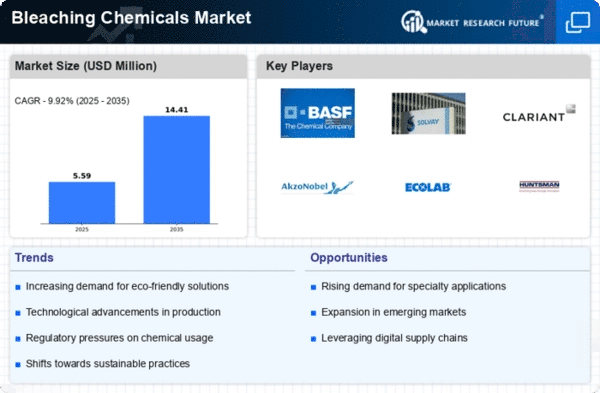
As per MRFR analysis, the Bleaching Chemicals Market Size was estimated at 5.09 USD Million in 2024. The Bleaching Chemicals industry is projected to grow from 5.6 in 2025 to 14.41 by 2035, exhibiting a compound annual growth rate (CAGR) of 9.92 during the forecast period 2025 - 2035.

Key Market Trends & Highlights

The Bleaching Chemicals Market is poised for growth driven by sustainability and technological advancements.

  • The North American region remains the largest market for bleaching chemicals, reflecting a strong demand across various industries.
  • Asia-Pacific is recognized as the fastest-growing region, indicating a shift towards increased production and consumption of bleaching agents.
  • The Pulp and Paper segment dominates the market, while the Water Treatment segment is emerging as the fastest-growing area due to rising environmental concerns.
  • Key market drivers include the rising demand in the textile industry and the expansion of household cleaning products, which are pushing for eco-friendly solutions.

Market Size & Forecast

2024 Market Size 5.09 (USD Million)
2035 Market Size 14.41 (USD Million)
CAGR (2025 - 2035) 9.92%
Largest Regional Market Share in 2024 Asia-Pacific

Major Players

<p>BASF SE (DE), Solvay SA (BE), Clariant AG (CH), AkzoNobel N.V. (NL), Ecolab Inc. (US), Huntsman Corporation (US), Olin Corporation (US), SABIC (SA), Dow Inc. (US)</p>

Market Trends

The Bleaching Chemicals Market is currently experiencing a dynamic phase characterized by evolving consumer preferences and increasing regulatory scrutiny. The demand for eco-friendly and sustainable bleaching agents is on the rise, as industries seek to minimize their environmental footprint. This shift is prompting manufacturers to innovate and develop products that align with sustainability goals. Additionally, the market is witnessing a growing trend towards the use of biodegradable and non-toxic bleaching agents, which are perceived as safer alternatives for both consumers and the environment. As a result, companies are investing in research and development to create advanced formulations that meet these emerging demands. Furthermore, the Bleaching Chemicals Market is influenced by the expansion of various end-use industries, including textiles, paper, and personal care. Each sector has unique requirements, driving the need for specialized bleaching solutions. The textile industry, in particular, is adapting to changing fashion trends and consumer expectations, leading to an increased focus on high-performance bleaching agents. This diversification within the market suggests a potential for growth, as businesses strive to enhance product quality while adhering to stringent safety and environmental regulations. Overall, the Bleaching Chemicals Market appears poised for continued evolution, with sustainability and innovation at the forefront of its trajectory.

Sustainability Focus

The Bleaching Chemicals Market is increasingly oriented towards sustainable practices. Manufacturers are prioritizing the development of eco-friendly bleaching agents that reduce environmental impact. This trend reflects a broader societal shift towards sustainability, influencing purchasing decisions across various industries.

Technological Advancements

Innovations in bleaching technology are reshaping the market landscape. New formulations and processes are being introduced, enhancing the efficiency and effectiveness of bleaching agents. These advancements not only improve product performance but also align with the growing demand for safer and more effective solutions.

Regulatory Compliance

The Bleaching Chemicals Market is subject to stringent regulations aimed at ensuring safety and environmental protection. Companies are adapting to these regulations by reformulating products and enhancing transparency in their supply chains. This compliance is becoming a critical factor in maintaining market competitiveness.

Bleaching Chemicals Market Market Drivers

Rising Demand in Textile Industry

The Global Bleaching Chemicals Market Industry experiences substantial growth driven by the increasing demand for bleaching agents in the textile sector. As the textile industry expands, particularly in developing regions, the need for effective bleaching agents to enhance fabric quality becomes paramount. In 2024, the market is projected to reach 25 USD Billion, reflecting the textile industry's reliance on bleaching chemicals for producing high-quality, white fabrics. This trend is expected to continue, with the market anticipated to grow at a CAGR of 4.37% from 2025 to 2035, potentially reaching 40 USD Billion by 2035. The integration of eco-friendly bleaching agents further supports this growth, aligning with sustainability goals in the industry.

Market Segment Insights

By Application: Pulp and Paper (Largest) vs. Water Treatment (Fastest-Growing)

<p>In the Bleaching Chemicals Market, the application segments exhibit distinct characteristics in market share distribution. The Pulp and Paper segment commands the largest share, driven by the demand for high-quality paper products in printing and packaging. Following closely are the Textile and Household segments, which also hold significant portions of the market, largely influenced by brand requirements for whiteness and brightness in finished products. Water Treatment and Food Processing segments, while smaller, have shown consistent demand, driven by environmental regulations and the need for hygiene. The growth trends within these application segments reveal a dynamic landscape for bleaching chemicals. The Pulp and Paper segment remains dominant due to ongoing expansion in the packaging industry, while Water Treatment is emerging as the fastest-growing segment. This shift is driven by increasing investments in water purification technologies and stricter water quality standards. Additionally, the rise of sustainable and eco-friendly bleaching agents is impacting the market, as both consumer preferences and regulatory frameworks shift towards greener alternatives.</p>

<p>Pulp and Paper: Dominant vs. Water Treatment: Emerging</p>

<p>The Pulp and Paper segment stands out as the dominant player within the Bleaching Chemicals Market, largely due to its extensive use of bleaching agents in producing white paper products, essential for the printing and packaging industries. It accounts for a significant portion of the chemical's demand. On the other hand, the Water Treatment segment represents an emerging opportunity, driven by increasing environmental awareness and regulatory pressures for cleaner water sources. As municipalities and industries invest in advanced water purification technologies, the use of bleaching agents is expected to rise, showcasing innovative solutions that align with sustainability trends. The dynamic nature of these segments highlights the contrasting characteristics of a well-established market versus a rapidly expanding one.</p>

By End Use: Industrial (Largest) vs. Commercial (Fastest-Growing)

<p>In the Bleaching Chemicals Market, the segment distribution reveals that Industrial end-use holds the largest share, primarily driven by its applications in various manufacturing processes, textile production, and paper bleaching. The Commercial segment closely follows, capitalizing on its demand in cleaning products and services, contributing significantly to market dynamics. Residential and Institutional uses are notable but contribute less in comparison to these other categories, indicating a more specialized application of bleaching chemicals in these areas. The growth trends in the Bleaching Chemicals Market are characterized by an increasing focus on sustainable and eco-friendly products, especially in the Commercial and Residential segments. Innovations in bleaching formulations are leading to higher efficiency and reduced environmental impact. Additionally, rising consumer awareness regarding hygiene and cleanliness is driving demand across all end-use segments, signaling a robust growth trajectory, particularly for the fast-growing Commercial sector and the dominant Industrial segment.</p>

<p>Industrial (Dominant) vs. Commercial (Emerging)</p>

<p>The Industrial segment of the Bleaching Chemicals Market remains dominant due to its extensive use in large-scale production processes, including textiles, pulp and paper, and water treatment facilities. This segment benefits from significant demand in various industries, driving its volume and dependency on efficient bleaching solutions. In contrast, the Commercial segment is emerging rapidly, primarily fueled by the growing cleaning and disinfecting industry. With the rise in demand for hygiene products, innovative bleaching agents designed for commercial cleaning applications are witnessing robust growth. This sector appeals to a broader customer base, including restaurants, hotels, and cleaning services, which are increasingly adopting advanced bleaching products to meet health and safety standards.</p>

By Type: Sodium Hypochlorite (Largest) vs. Hydrogen Peroxide (Fastest-Growing)

<p>In the Bleaching Chemicals Market, Sodium Hypochlorite holds the largest market share among the various types of bleaching agents, primarily due to its widespread use in water treatment and disinfection processes. Chlorine Bleach, a traditional choice, follows closely, benefitting from its long-standing applications in household cleaning products. Hydrogen Peroxide and Calcium Hypochlorite occupy noteworthy positions but have been gaining traction in specific niches like eco-friendly bleaching and pool sanitation, respectively.</p>

<p>Sodium Hypochlorite (Dominant) vs. Hydrogen Peroxide (Emerging)</p>

<p>Sodium Hypochlorite stands as the dominant player in the bleaching chemicals segment, largely due to its effectiveness and versatility in disinfecting and bleaching applications. Its robust usage in industrial and municipal markets further solidifies its foothold. In contrast, Hydrogen Peroxide is emerging as a preferred choice, particularly among environmentally conscious consumers and industries leaning towards sustainable solutions. As businesses pivot towards greener alternatives, Hydrogen Peroxide's non-toxic nature and decomposability make it an attractive option for various applications, from textile bleaching to food processing. Overall, the competitive landscape reflects a push for innovation and sustainability across both dominant and emerging players.</p>

By Form: Liquid (Largest) vs. Powder (Fastest-Growing)

<p>In the bleaching chemicals market, the form segment is primarily distributed among three categories: liquid, powder, and granular. The liquid form holds the largest market share, favored for its ease of use and versatility in various applications. Meanwhile, the powder form is gaining traction, attributed to its portability and efficiency in transportation. The granular form, while less dominant, is also carving out a niche in specific industrial applications where precise measurements are crucial. Growth trends indicate a robust increase in the demand for powder bleaching agents, which are increasingly favored in the textile and paper industries. This shift is driven by the need for more efficient chemical formulations that offer better storage and handling advantages. Additionally, environmental concerns are pushing manufacturers to innovate, leading to the introduction of eco-friendly powders that meet regulatory demands while appealing to conscientious consumers.</p>

<p>Liquid (Dominant) vs. Granular (Emerging)</p>

<p>The liquid form of bleaching chemicals is the dominant player in the market, primarily due to its widespread applicability across various sectors such as textiles, pulp and paper, and household cleaning products. Its formulation is designed to dissolve easily, allowing for uniform distribution and quick action in bleaching processes. In contrast, the granular form is emerging, particularly in industrial applications that require precise dosing and prolonged shelf life. Granular bleaching chemicals are often preferred in environments where stability and ease of handling are prioritized. They cater to specialized segments, making them appealing for niche markets, as they adapt well to automated processes and enhance operational efficiency.</p>

Get more detailed insights about Bleaching Chemicals Market Research Report - Forecast to 2035

Regional Insights

North America : Established Market with Growth Potential

The North American bleaching chemicals market, valued at $1.52 billion, is driven by increasing demand in the textile and paper industries. Regulatory support for sustainable practices is also a significant catalyst, as companies seek eco-friendly alternatives. The market is expected to grow steadily, with a focus on innovation and compliance with environmental regulations. Leading countries like the US and Canada dominate the market, with key players such as Ecolab Inc. and Dow Inc. driving competition. The presence of established companies ensures a robust supply chain, while ongoing investments in R&D are expected to enhance product offerings. The competitive landscape is characterized by strategic partnerships and mergers aimed at expanding market reach.

Europe : Innovation and Sustainability Focus

Europe's bleaching chemicals market, valued at $1.27 billion, is characterized by a strong emphasis on sustainability and innovation. Regulatory frameworks, such as REACH, drive the demand for eco-friendly products, pushing companies to adapt to stringent environmental standards. The market is witnessing a shift towards biodegradable and less harmful chemicals, aligning with consumer preferences for sustainable solutions. Germany, France, and the UK are leading countries in this region, with major players like BASF SE and Solvay SA actively participating in the market. The competitive landscape is marked by continuous innovation and collaboration among companies to develop advanced bleaching solutions. The focus on sustainability is expected to further enhance market growth, making Europe a key player in the global bleaching chemicals sector.

Asia-Pacific : Emerging Powerhouse in Chemicals

The Asia-Pacific region, with a market size of $2.3 billion, is the largest player in the bleaching chemicals market, driven by rapid industrialization and urbanization. The demand for bleaching agents in textiles, paper, and household products is surging, supported by favorable government policies and investments in manufacturing. The region's growth is further fueled by increasing consumer awareness regarding hygiene and cleanliness. China, India, and Japan are the leading countries in this market, with significant contributions from key players like Clariant AG and AkzoNobel N.V. The competitive landscape is vibrant, with numerous local and international companies vying for market share. The presence of established manufacturers and a growing middle class are expected to sustain the region's dominance in The Bleaching Chemicals.

Middle East and Africa : Untapped Market Potential

The Middle East and Africa region currently shows a market size of $0.0 billion in the bleaching chemicals sector, indicating significant untapped potential. The growth drivers include increasing industrial activities and a rising demand for cleaning and hygiene products. However, the market is still in its infancy, with limited production capabilities and regulatory frameworks in place. Countries like South Africa and the UAE are beginning to explore opportunities in this sector, with a focus on developing local manufacturing capabilities. The competitive landscape is still emerging, with few key players present. As investments in infrastructure and regulatory improvements take shape, the region is poised for gradual growth in the bleaching chemicals market.

Key Players and Competitive Insights

The Bleaching Chemicals Market is characterized by a dynamic competitive landscape, driven by increasing demand across various sectors such as textiles, paper, and personal care. Key players are actively engaging in strategies that emphasize innovation, sustainability, and regional expansion. For instance, BASF SE (DE) has been focusing on developing eco-friendly bleaching agents, which aligns with the growing consumer preference for sustainable products. Similarly, AkzoNobel N.V. (NL) has been enhancing its product portfolio through strategic partnerships aimed at improving its market reach and technological capabilities. These collective strategies not only enhance their competitive positioning but also contribute to a more sustainable market environment.

In terms of business tactics, companies are increasingly localizing manufacturing to reduce lead times and optimize supply chains. This approach appears to be particularly effective in a moderately fragmented market structure, where the influence of key players is significant yet allows for the emergence of smaller competitors. The collective actions of these major companies shape the market dynamics, fostering a competitive atmosphere that encourages innovation and efficiency.

In November 2025, Solvay SA (BE) announced the launch of a new line of biodegradable bleaching agents, which is expected to cater to the rising demand for environmentally friendly solutions. This strategic move not only positions Solvay as a leader in sustainable practices but also reflects a broader industry trend towards eco-conscious product development. The introduction of such innovative products may enhance customer loyalty and open new market segments.

In October 2025, Ecolab Inc. (US) expanded its operations in Asia by establishing a new manufacturing facility dedicated to producing advanced bleaching chemicals. This expansion is likely to bolster Ecolab's supply chain efficiency and responsiveness to regional market demands. By investing in local production capabilities, Ecolab aims to strengthen its competitive edge in a rapidly evolving market landscape.

In September 2025, Clariant AG (CH) entered into a strategic alliance with a leading technology firm to integrate AI-driven solutions into its bleaching chemical production processes. This collaboration is anticipated to enhance operational efficiency and reduce production costs, thereby allowing Clariant to offer more competitive pricing while maintaining high-quality standards. Such technological advancements are indicative of a broader trend towards digital transformation within the industry.

As of December 2025, the competitive trends in the Bleaching Chemicals Market are increasingly defined by digitalization, sustainability, and the integration of advanced technologies. Strategic alliances are playing a crucial role in shaping the current landscape, enabling companies to leverage shared expertise and resources. Looking ahead, it is likely that competitive differentiation will evolve from traditional price-based strategies to a focus on innovation, technological advancements, and supply chain reliability. This shift underscores the importance of adaptability and forward-thinking in maintaining a competitive edge in the market.

Key Companies in the Bleaching Chemicals Market market include

Industry Developments

In recent times, One1Star Solutions introduce its highly advanced & modern technical and excessive-performance Tetraacetylethylenediamine, a reliable and sophisticated solution used to disinfect and clean in various industries.

 One1Star Solutions is a registered firm that got a patent for Tetraacetylethylenediamine, with the ingredient used for common applications such as bleach activators, particularly in the detergent sector.


In the year 2022, Dark and Lovely, a distinguished hair coloring brand for women especially for the primary audience, the firm likely to launch a new product called Uplift Bleach Kit. This product is developed exclusively for the brightest shades of blonde & boldest and offers a next-generation with an advanced formula created with a unique technique that creates fashioned hair, devoid the damage.Geographic Analysis 

The report covers brief analysis of geographical region such as:

North America

    • US
    • Canada

Europe

    • Germany
    • France
    • Italy
    • Netherlands
    • U.K.
    • Rest of Europe

APAC

    • China
    • India
    • Japan
    • Rest of Asia-Pacific

RoW

    • South America
    • Middle East
    • Africa

Study Objectives of Bleaching Chemicals Market:

    • To provide detailed analysis of the market structure along with forecast for the next 7 years of the various segments and sub-segments of the global bleaching chemicals Market
    • To understand the supply and demand dynamics including supply and consumption concentration mapping
    • To provide region level market analysis and future outlook for North America, Europe, Asia, and Rest of the World (ROW) and their countries
    • To provide competitor positioning of the market
    • To provide company profiling of major players in the market along with their production and capacity
    • To provide regional trade analysis
    • To evaluate historical market trends, patents and technologies, and current government regulatory requirements that are relevant to the market

Intended Audience

    • Bleaching chemicals manufacturers
    • Traders and distributors of bleaching chemicals
    • Production Process industries
    • Potential investors
    • Raw material suppliers
    • Nationalized laboratory

The report about Global Bleaching Chemicals Market by Market Research Future comprises of extensive primary research along with detail analysis of qualitative as well as quantitative aspects by various industry experts and key opinion leaders to gain a deeper insight of the market and industry performance. The report gives a clear picture of the current market scenario which includes past and estimated future market size in terms of value and volume, technological advancement, macro economical and governing factors in the market. The report further provides detail information about strategies used by top key players in the industry.

It also gives a broad study about different market segments and regions.

Future Outlook

Bleaching Chemicals Market Future Outlook

<p>The Bleaching Chemicals Market is projected to grow at a 9.92% CAGR from 2024 to 2035, driven by increasing demand in textiles, paper, and water treatment sectors.</p>

New opportunities lie in:

  • <p>Development of eco-friendly bleaching agents for sustainable practices.</p>
  • <p>Expansion into emerging markets with tailored product offerings.</p>
  • <p>Investment in advanced bleaching technologies to enhance efficiency and reduce costs.</p>

<p>By 2035, the market is expected to achieve robust growth, positioning itself as a leader in sustainable chemical solutions.</p>

Market Segmentation

Bleaching Chemicals Market Form Outlook

  • Liquid
  • Powder
  • Granular

Bleaching Chemicals Market Type Outlook

  • Chlorine Bleach
  • Hydrogen Peroxide
  • Sodium Hypochlorite
  • Calcium Hypochlorite

Bleaching Chemicals Market End Use Outlook

  • Industrial
  • Commercial
  • Residential
  • Institutional

Bleaching Chemicals Market Application Outlook

  • Pulp and Paper
  • Textile
  • Household
  • Water Treatment
  • Food Processing

Report Scope

MARKET SIZE 20245.09(USD Million)
MARKET SIZE 20255.6(USD Million)
MARKET SIZE 203514.41(USD Million)
COMPOUND ANNUAL GROWTH RATE (CAGR)9.92% (2024 - 2035)
REPORT COVERAGERevenue Forecast, Competitive Landscape, Growth Factors, and Trends
BASE YEAR2024
Market Forecast Period2025 - 2035
Historical Data2019 - 2024
Market Forecast UnitsUSD Million
Key Companies ProfiledBASF SE (DE), Solvay SA (BE), Clariant AG (CH), AkzoNobel N.V. (NL), Ecolab Inc. (US), Huntsman Corporation (US), Olin Corporation (US), SABIC (SA), Dow Inc. (US)
Segments CoveredApplication, End Use, Type, Form
Key Market OpportunitiesGrowing demand for eco-friendly bleaching agents in textiles and paper industries presents a key opportunity.
Key Market DynamicsRising demand for eco-friendly bleaching agents drives innovation and regulatory shifts in the bleaching chemicals market.
Countries CoveredNorth America, Europe, APAC, South America, MEA

FAQs

What are the different applications of bleaching chemicals?

Bleaching chemicals have an extensive range of applications including aquaculture, epidemic control, carpet industries, pulp bleaching, water treatment, food additive, household industry, textile industry, and cosmetic &amp; personal care.

Which region is expected to have maximum share in the bleaching chemicals market?

APAC region is predicted to have maximum share in the bleaching chemicals market during the forecast period.

What are the different types of bleaching chemicals market?

The different types of bleaching chemicals include sodium dichloroisocyanurate, calcium hypochlorite, sodium hypochlorite, chlorine dioxide, and chlorine.

Which industry is the largest user of bleaching chemicals?

The paper and pulp industry is the largest user of bleaching chemicals.

Which factors may limit the growth of the bleaching chemicals market?

Heath issues such as damage to eyes and skin may hamper the bleaching chemicals market growth during the forecast period.

  1. Executive Summary
  2. Scope of The Report
    1. Market Definition
    2. Scope of The
      1. Research Objectives
      2. Assumptions & Limitations
    3. Study
    4. Markets Structure
    5. Market Research Methodology
    6. Research
    7. Process
    8. Secondary Research
    9. Primary Research
    10. Forecast Model
  3. Market Landscape
    1. Five Forces Analysis
      1. Bargaining
      2. Threat of substitutes
      3. Segment rivalry
    2. Threat of New Entrants
    3. power of buyers
    4. Value Chain/Supply Chain of Global Bleaching chemicals Market
  4. Industry Overview of Global Bleaching chemicals
    1. Market
    2. Introduction
    3. Growth Drivers
    4. Impact analysis
    5. Market Challenges
    6. Impact analysis
    7. Market Trends
    8. Introduction
    9. Growth Trends
    10. Impact analysis
  5. Global Bleaching
    1. chemicals Market by Region
  6. Global Bleaching chemicals
    1. Market by Type (Chlorine, Chlorine dioxide, Sodium hypochlorite, Calcium hypochlorite,
    2. Sodium dichloroisocyanurate, and others)
  7. Global Bleaching chemicals
    1. Market by Application (Cosmetic & personal care, Textile industry, Household
    2. industry, Food additive, Pulp bleaching, and others)
    3. Company Profiles
    4. Akzo Nobel
      1. Company Overview
      2. Financial
      3. Key Developments
      4. Company Overview
      5. Product/Business Segment Overview
      6. Key Developments
    5. Eka(Netherlands)
    6. Product/Business Segment Overview
    7. Updates
    8. Neutron Industries (U.S.)
    9. Financial Updates
    10. Aditya Birla Chemicals (India)
      1. Product/Business Segment Overview
      2. Financial Updates
      3. Key Developments
    11. Company Overview
    12. Hansol Chemicals (Korea)
      1. Company
      2. Product/Business Segment Overview
      3. Key Developments
    13. Overview
    14. Financial Updates
    15. Kemira Oyj (Europe)
      1. Company
      2. Product/Business Segment Overview
      3. Key Developments
    16. Overview
    17. Financial Updates
    18. State Industrial Products Corporation (U.S.)
      1. Product/Business Segment Overview
      2. Financial Updates
      3. Key Developments
    19. Company Overview
    20. Hercules and Hercules Inc. (U.S.),
      1. Product/Business Segment Overview
      2. Financial Updates
      3. Key Developments
    21. Company Overview
    22. Harbisonwalker International (HWI) Inc
      1. Product/Business Segment Overview
      2. Financial Updates
      3. Key Developments
    23. Company Overview
    24. 3M Company (U.S.),
      1. Company
      2. Product/Business Segment Overview
      3. Key Developments
    25. Overview
    26. Financial Updates
    27. Arrow-Magnolia International, Inc. (U.S.)
      1. Product/Business Segment Overview
      2. Financial Updates
      3. Key
    28. Company Overview
    29. Developments
  8. Conclusion
  9. LIST OF TABLES
  10. World Population by
    1. Major Regions (2020 To 2030) (Million)
  11. Global Bleaching
    1. chemicals Market: By Region, 2020-2027 (USD Million)
    2. Table 3
    3. North America Bleaching chemicals Market: By Country, 2020-2027
    4. (USD Million)
  12. Europe Bleaching chemicals Market:
    1. By Country, 2020-2027 (USD Million)
  13. Asia-Pacific
    1. Bleaching chemicals Market: By Country, 2020-2027 (USD Million)
  14. RoW Bleaching chemicals Market: By Country,
  15. Global Bleaching chemicals
    1. by Type Market: By Regions, 2020-2027 (USD Million)
    2. Table
  16. North America Bleaching chemicals by Type Market:
    1. By Country, 2020-2027 (USD Million)
  17. Europe Bleaching
    1. chemicals by Type Market: By Country, 2020-2027 (USD Million)
    2. Table10 Asia-Pacific Bleaching chemicals by Type
    3. Market: By Country, 2020-2027 (USD Million)
    4. Table11 RoW
    5. Bleaching chemicals by Type Market: By Country, 2020-2027 (USD
    6. Million)
    7. Table12 North America Bleaching chemicals
    8. for Application Market: By Country, 2020-2027 (USD Million)
    9. Table13
    10. Europe Bleaching chemicals for Application Market: By Country,
    11. Table14 Asia-Pacific Bleaching chemicals
    12. for Application Market: By Country, 2020-2027 (USD Million)
    13. Table15
    14. RoW Bleaching chemicals for Application Market: By Country, 2020-2027
    15. (USD Million)
    16. Table16 Global Bleaching chemicals for
    17. Application Market: By Region, 2020-2027 (USD Million)
    18. Table17
    19. North America Bleaching chemicals for Application Market: By
    20. Country, 2020-2027 (USD Million)
    21. Table18 Europe Bleaching
    22. chemicals for Application Market: By Country, 2020-2027 (USD Million)
    23. Table19 Asia-Pacific Bleaching chemicals for Application
    24. Market: By Country, 2020-2027 (USD Million)
    25. Table20 RoW Bleaching
    26. chemicals for Application Market: By Country, 2020-2027 (USD Million)
    27. Table21 RoW Bleaching chemicals for Application
    28. Market: By Country, 2020-2027 (USD Million)
    29. Table22 North
    30. America Bleaching chemicals for Form Market: By Country, 2020-2027
    31. (USD Million)
    32. Table23 Europe Bleaching chemicals for
    33. Form Market: By Country, 2020-2027 (USD Million)
    34. Table24 Asia-Pacific
    35. Bleaching chemicals for Form Market: By Country, 2020-2027 (USD Million)
    36. Table25 RoW Bleaching chemicals for Form Market:
    37. By Country, 2020-2027 (USD Million)
    38. Table26 Global Bleaching
    39. chemicals for Form Market: By Region, 2020-2027 (USD Million)
    40. Table27
    41. North America Bleaching chemicals for Form Market: By Country,
    42. Table28 Europe Bleaching chemicals
    43. for Form Market: By Country, 2020-2027 (USD Million)
    44. Table29
    45. Asia-Pacific Bleaching chemicals for Form Market: By Country,
    46. Table30 RoW Bleaching chemicals
    47. for Form Market: By Country, 2020-2027 (USD Million)
    48. Table31
    49. RoW Bleaching chemicals for Form Market: By Country, 2020-2027
    50. (USD Million)
    51. Table32 Global Type Market: By Region,
    52. Table33 Global Application Market:
    53. By Region, 2020-2027 (USD Million)
    54. Table34 Global Form Market:
    55. By Region, 2020-2027 (USD Million)
    56. Table35 North America
  18. Bleaching chemicals Market, By Country (USD Million)
    1. Table36
  19. North America Bleaching chemicals Market, By Type (Million
    1. USD)
    2. Table37 North America Bleaching chemicals Market,
    3. By Application (Million USD)
    4. Table38 North America Bleaching
  20. chemicals Market, By Form (Million USD)
    1. Table39
  21. Europe: Bleaching chemicals Market, By Country (USD Million)
    1. Table40 Europe: Bleaching chemicals Market, By
    2. Type (USD Million)
    3. Table41 Europe: Bleaching chemicals
  22. Market, By Application (USD Million)
    1. Table42 Europe:
  23. Bleaching chemicals Market, By Form (USD Million)
    1. Table43
  24. Asia-Pacific: Bleaching chemicals Market, By Country (USD Million)
    1. Table44 Asia-Pacific: Bleaching chemicals Market,
    2. By Type (USD Million)
    3. Table45 Asia-Pacific: Bleaching
  25. chemicals Market, By Application (USD Million)
    1. Table46
  26. Asia-Pacific: Bleaching chemicals Market, By Form (USD Million)
  27. Table47 RoW: Bleaching chemicals Market, By Country
    1. (USD Million)
    2. Table48 RoW Bleaching chemicals Market,
    3. By Type (USD Million)
    4. Table49 RoW: Bleaching chemicals
  28. Market, By Application (USD Million)
    1. Table50 RoW: Bleaching
  29. chemicals Market, By Form (USD Million)
  30. LIST OF FIGURES
  31. Global
    1. bleaching chemicals market segmentation
  32. Forecast
    1. Methodology
  33. Five Forces Analysis of global bleaching
    1. chemicals Market
  34. Value Chain of global
    1. bleaching chemicals Market
  35. Share of
  36. Global bleaching chemicals market in 2020, by country (in %)
    1. FIGURE 6
    2. Global bleaching chemicals market, 2020-2027, (USD billion)
  37. Sub-segments of Applications
    1. FIGURE 8
    2. Global bleaching chemicals market size by Application, 2020
    3. FIGURE
  38. Share of Global Bleaching chemicals Market by Application,
  39. Global
    1. bleaching chemicals market size by Type, 2020
  40. Share
    1. of global bleaching chemicals Market by Type, 2020 to 2027
  41. Global
    1. bleaching chemicals market size by Form, 2020
  42. Share
    1. of global bleaching chemicals Market by Form, 2020 to 2027

Bleaching Chemicals Market Segmentation

Market Segmentation Overview

  • Detailed segmentation data will be available in the full report
  • Comprehensive analysis by multiple parameters
  • Regional and country-level breakdowns
  • Market size forecasts by segment
Infographic

Free Sample Request

Kindly complete the form below to receive a free sample of this Report

Get Free Sample

Customer Strories

Compare Licence

×
Features License Type
Single User Multiuser License Enterprise User
Price $4,950 $5,950 $7,250
Maximum User Access Limit 1 User Upto 10 Users Unrestricted Access Throughout the Organization
Free Customization
Direct Access to Analyst
Deliverable Format
Platform Access
Discount on Next Purchase 10% 15% 15%
Printable Versions