Request Free Sample ×

Kindly complete the form below to receive a free sample of this Report

* Please use a valid business email

Leading companies partner with us for data-driven Insights

clients tt-cursor
Hero Background
English
Chinese
French
Japanese
Korean
German
Spanish

Biosensors Market Trends

ID: MRFR/HC/0720-CR
200 Pages
Nidhi Mandole
April 2025

Biosensors Market Research Report: Size, Share, Trend Analysis By Applications (Healthcare, Food Safety, Environmental Monitoring, Industrial Process, Agriculture), By Technology (Electrochemical, Optical, Piezoelectric, Thermal, Microwave), By Types (Wearable Biosensors, Implantable Biosensors, Invasive Biosensors, Non-Invasive Biosensors), By End Use (Point of Care Testing, Laboratory Testing, Research and Development) and By Regional (North America, Europe, South America, Asia Pacific, Middle East and Africa) - Growth Outlook & Industry Forecast 2025 To 2035

Share:
Download PDF ×

We do not share your information with anyone. However, we may send you emails based on your report interest from time to time. You may contact us at any time to opt-out.

Biosensor Market Infographic
Purchase Options

Market Trends

Key Emerging Trends in the Biosensor Market

The preclinical Contract Research Organization (CRO) market is witnessing dynamic shifts in response to evolving trends, playing a pivotal role in drug development. These trends are transforming the terrain and dictating some of pre-clinical research services’ key aspects. A major development is the growing tendency of pharmaceuticals and biotechnology providers to outsource their preclinical research activities. It also provides cost effectiveness and concentrates knowledge, while it speeds up the drug development process – thereby stimulating demand for preclinical CRO services. Technology is developing at a rapid pace that has led to changes and modernization of preclinical research methods. The adoption of innovative technologies like artificial intelligence, high-throughput screening methods and advanced imaging techniques makes preclinical studies more efficient helping both patients’ clients as well. In view of the stringent regulatory controls that govern drug development, there is an increasing focus on adherence to standards set by regulators in preclinical research. Left behind by clients emphasizing compliance and data integrity are CROs that fail to show a strong grasp of regulatory requirements. In the preclinical CRO market, there is a trend towards specialization and provision of niche services. CROs that focus on specialized skills in specialised therapeutic zones or use innovative pre-clinical models are devising a niche for themselves, servicing the different demands of pharma and biotech industries. Preclinical CRO services show significant growth from a global perspective based on market trends. Companies are also seeking a strategic presence in the emerging markets, which have been propelled by growing demand for preclinical research services stimulated by globalization of drug development endeavors. Pharmaceutical companies increasingly enter partnerships with preclinical CRO’s. The collaborations utilize the core competencies of both partners and promote innovation, pooled assets as well development of superior drugs. The increasing intricacy of drug development, which stems from biotechnology advancements and the quest to identify new therapeutics targets is affecting the preclinical CRO market. CROs that are able to adapt and negotiate this peculiarity, however, stand a chance of excelling in delivering end-to-end solutions for all the changing needs their clientele may have. The need for preclinical predictive models that are closer to human physiology and pathophysiological conditions increases with time. CROs that are investing in and offering state-of-the art predictive models, such as organoids or humanised mice model, get attention because they offer clinically relevant data during the preclinical phase. Pharmaceuticals and biotech companies’ main objective is to improve drug development process while lowering costs. There is a demand for preclinical CROs offering affordable services without compromising quality. This is through improved study designs, technology utilisation and tactical procedures.


Author
Author Profile
Nidhi Mandole
Senior Research Analyst

She is an extremely curious individual currently working in Healthcare and Medical Devices Domain. Nidhi is comfortably versed in data centric research backed by healthcare educational background. She leverages extensive data mining and analytics tools such as Primary and Secondary Research, Statistical Analysis, Machine Learning, Data Modelling. Her key role also involves Technical Sales Support, Client Interaction and Project management within the Healthcare team. Lastly, she showcases extensive affinity towards learning new skills and remain fascinated in implementing them.

Leave a Comment

FAQs

What is the current valuation of the biosensors market as of 2025?

<p>The biosensors market is valued at approximately 24.5 USD Billion in 2024.</p>

What is the projected market size for biosensors by 2035?

<p>The biosensors market is expected to reach 40.0 USD Billion by 2035.</p>

What is the expected CAGR for the biosensors market during the forecast period 2025 - 2035?

<p>The biosensors market is projected to grow at a CAGR of 4.56% from 2025 to 2035.</p>

Which application segments are driving growth in the biosensors market?

<p>The Medical Diagnostics segment is anticipated to grow from 10.0 USD Billion to 16.0 USD Billion by 2035.</p>

How does the Environmental Monitoring segment perform in the biosensors market?

<p>The Environmental Monitoring segment is expected to increase from 4.0 USD Billion to 6.0 USD Billion by 2035.</p>

What technologies are prevalent in the biosensors market?

<p>Electrochemical biosensors are projected to grow from 8.0 USD Billion to 12.0 USD Billion by 2035.</p>

What is the significance of the Healthcare end-use segment in the biosensors market?

<p>The Healthcare end-use segment is expected to expand from 10.0 USD Billion to 16.0 USD Billion by 2035.</p>

Which companies are considered key players in the biosensors market?

<p>Key players include Abbott Laboratories, Roche Diagnostics, and Siemens Healthineers, among others.</p>

What is the growth outlook for the Food Safety segment in the biosensors market?

<p>The Food Safety segment is likely to grow from 3.0 USD Billion to 5.0 USD Billion by 2035.</p>

How does the Industrial Process segment contribute to the biosensors market?

<p>The Industrial Process segment is projected to increase from 5.0 USD Billion to 8.0 USD Billion by 2035.</p>

Market Summary

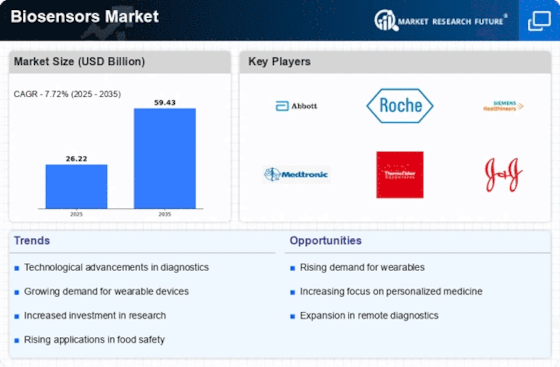
According to MRFR analysis, the Biosensors Market Size was valued at USD 26.22 Billion in 2024. The market is projected to grow from USD 28.25 Billion in 2025 to USD 59.43 Billion by 2035, registering a CAGR of 7.72% during the forecast period (2025–2035). North America led the market with over 40.05% share, generating around USD 10.5 billion in revenue.
 
The Biosensors Market is growing rapidly due to increasing demand for rapid diagnostics, rising prevalence of chronic diseases, and expanding use of wearable health monitoring devices. Key trends include advancements in nanotechnology-based sensors, integration with digital health platforms, and growing applications in medical diagnostics, environmental monitoring, and food safety.

Key Market Trends & Highlights

The Biosensors Market is experiencing robust growth driven by technological advancements and increasing demand for point-of-care testing.

  • North America remains the largest market for biosensors, driven by advanced healthcare infrastructure and innovation. The Asia-Pacific region is the fastest-growing market, fueled by rising healthcare investments and a focus on health and wellness. The healthcare segment dominates the market, while the food safety segment is emerging rapidly due to heightened safety standards. Technological innovations in biosensors and the rising prevalence of chronic diseases are key drivers propelling market expansion.

Market Size & Forecast

2024 Market Size 26.22 (USD Billion)
2035 Market Size 59.43 (USD Billion)
CAGR (2025 - 2035) 7.72%
Largest Regional Market Share in 2024 North America

Major Players

Companies such as <a href="https://www.abbott.com/en-us/products-solutions/biowearables" target="_blank" rel="noopener">Abbott Laboratories</a> (US), <a href="https://www.roche.com/solutions/diagnostics" target="_blank" rel="noopener">Roche Diagnostics</a> (CH), Siemens Healthineers (DE), Medtronic (US), Thermo Fisher Scientific (US), Johnson &amp; Johnson (US), Biosense Webster (US), Dexcom (US), Acon Laboratories (US) are some of the major participants in the global market.

Market Trends

The Biosensors Market is currently experiencing a dynamic evolution, driven by advancements in technology and increasing demand for rapid diagnostic solutions. The integration of biosensors into various sectors, including healthcare, environmental monitoring, and food safety, appears to be reshaping the landscape of diagnostics and monitoring.

As the need for real-time data and personalized medicine grows, the market is likely to expand, with innovations in materials and detection methods enhancing the performance and applicability of biosensors. Furthermore, the rising awareness of health and wellness among consumers may contribute to the adoption of biosensor technologies, fostering a more proactive approach to health management.

Chronic diseases continue to increase globally, with nearly 74% of global deaths attributed to chronic conditions according to the World Health Organization, accelerating the need for continuous monitoring technologies such as biosensors.

In addition, regulatory frameworks and funding initiatives from governmental bodies seem to support the growth of the Biosensors Market. Collaborations between academic institutions and industry players are likely to spur research and development, leading to novel applications and improved product offerings.

The trend towards miniaturization and portability of biosensors could also enhance user accessibility, making these technologies more prevalent in everyday life. Overall, the market is poised for substantial growth, driven by technological advancements and an increasing focus on health and safety across various sectors.

Technological Advancements

Recent innovations in nanotechnology and materials science are enhancing the sensitivity and specificity of biosensors. These advancements enable the development of more accurate and reliable devices, which are crucial for applications in medical diagnostics and environmental monitoring.

Increased Demand for Point-of-Care Testing

The shift towards point-of-care testing is becoming more pronounced, as healthcare providers seek rapid and efficient diagnostic solutions. This trend is likely to drive the adoption of biosensors, which offer quick results and facilitate timely decision-making in clinical settings.

Point-of-care testing is expanding rapidly, with over 70% of critical clinical decisions now relying on diagnostic test results, increasing the demand for rapid and accurate biosensor-based diagnostic devices.

Growing Focus on Health and Wellness

As consumers become more health-conscious, there is a rising interest in wearable biosensors that monitor various health parameters. This trend suggests a potential expansion of the market, as individuals seek tools to manage their health proactively.

Wearable health technologies are gaining traction, with more than 30% of adults in developed regions using wearable health monitoring devices, many of which incorporate biosensor technologies to track vital parameters in real time.

Biosensor Market Market Drivers

Rising Prevalence of Chronic Diseases

The rising prevalence of chronic diseases is a significant driver for the Biosensors Market. Conditions such as diabetes, cardiovascular diseases, and cancer necessitate continuous monitoring and management, which biosensors can facilitate. The demand for wearable biosensors, particularly for glucose monitoring, is on the rise, with the market for diabetes management expected to grow substantially.
 
This trend indicates a shift towards personalized healthcare solutions, where biosensors play a crucial role in providing real-time data to patients and healthcare providers. As the population ages and lifestyle-related diseases become more common, the reliance on biosensors for effective disease management is likely to increase.

Regulatory Support and Standardization

Regulatory support and standardization are crucial factors driving the Biosensors Market. Governments and regulatory bodies are increasingly recognizing the importance of biosensors in healthcare and are establishing guidelines to ensure their safety and efficacy. This regulatory framework not only fosters innovation but also instills confidence among manufacturers and consumers.
 
The establishment of standardized testing protocols and approval processes is likely to accelerate the introduction of new biosensor technologies into the market. As regulatory environments become more favorable, the market is expected to grow, with an increasing number of products receiving approval for clinical use.

Technological Innovations in Biosensors

The Biosensors Market is experiencing a surge in technological innovations that enhance the performance and capabilities of biosensors. Advances in nanotechnology, microfabrication, and materials science are leading to the development of highly sensitive and specific biosensors. For instance, the integration of microfluidics with biosensors allows for rapid and accurate analysis of biological samples.
 
This trend is reflected in the increasing investment in research and development, with the market projected to reach USD 30 billion by 2026. Such innovations not only improve the accuracy of diagnostics but also expand the applications of biosensors in various fields, including environmental monitoring and food safety.

Growing Demand for Home Healthcare Solutions

The growing demand for home healthcare solutions is significantly influencing the Biosensors Market. As patients increasingly prefer to manage their health from home, the need for portable and user-friendly biosensors is rising. This trend is particularly evident in the monitoring of chronic conditions, where patients can utilize biosensors for self-testing and data collection.
 
The convenience and efficiency of home healthcare solutions are likely to drive the adoption of biosensors, with the market projected to expand as more individuals seek to take control of their health. This shift towards home-based care is expected to reshape the landscape of the market.

Increased Investment in Healthcare Infrastructure

Increased investment in healthcare infrastructure is propelling the market forward. Governments and private entities are allocating substantial resources to enhance healthcare facilities and technologies, particularly in developing regions. This investment is aimed at improving diagnostic capabilities and patient care, leading to a higher adoption of biosensors in clinical settings.
 
For example, initiatives to establish point-of-care testing facilities are gaining traction, which directly benefits the biosensors market. The market is expected to witness a compound annual growth rate of over 10% in the coming years, driven by these infrastructural improvements and the growing emphasis on accessible healthcare solutions.

Market Segment Insights

By Application: Medical Diagnostics (Largest) vs. Environmental Monitoring (Fastest-Growing)

<p>The biosensors market is primarily driven by the medical diagnostics segment, which holds the largest market share among the application segments. This segment benefits from the increasing prevalence of chronic diseases and the growing demand for rapid and accurate diagnostic tools. Furthermore, environmental monitoring is gaining traction, reflecting its significance in enhancing safety measures and regulatory compliance. This segment shows a noteworthy share as healthcare providers and governmental agencies prioritize environmental health.</p>

<p>Food Safety (Dominant) vs. Industrial Process (Emerging)</p>

<p>The food safety segment remains a dominant force in the biosensors market, emphasizing the critical importance of ensuring safe food production and consumption. It leverages advanced biosensor technologies to detect pathogens, allergens, and contaminants, ensuring compliance with health regulations. Conversely, the industrial process segment is emerging, focusing on the optimization of production processes by incorporating biosensors for real-time monitoring and quality control. This growth is fueled by the increasing emphasis on automation, operational efficiency, and sustainable practices, enabling industries to leverage biosensors for enhancing product quality.</p>

By Technology: Electrochemical (Largest) vs. Optical (Fastest-Growing)

The technology segment is diverse, comprising electrochemical, optical, <a href="https://www.marketresearchfuture.com/reports/piezoelectric-devices-market-1221">piezoelectric</a>, thermal, and microwave biosensors. Among these, electrochemical biosensors hold the largest Biosensors Market share due to their long-established use in various applications such as glucose monitoring and point-of-care diagnostics. Optical biosensors are emerging rapidly, capitalizing on advanced technologies that provide faster and more accurate results, thus appealing to industries focused on precision and efficiency.

Technology: Electrochemical (Dominant) vs. Optical (Emerging)

<a href="https://www.marketresearchfuture.com/reports/electrochemical-biosensors-market-2792">Electrochemical biosensors</a> are the dominant players in the technology segment, known for their reliability and versatility in biosensing applications. They leverage electrochemical reactions to detect specific biological analytes, making them essential for medical diagnostics and environmental monitoring. On the other hand, optical biosensors are marked as emerging technologies, utilizing light-based techniques to analyze biological events. Their rapid growth is fueled by innovations in nanotechnology and materials science, enabling more sensitive and selective detection methods. As the demand for real-time diagnostics increases, optical biosensors are anticipated to capture significant market interest.

By End Use: Healthcare (Largest) vs. Agriculture (Fastest-Growing)

<p>The biosensors market is significantly driven by healthcare applications, which currently dominate the market share due to their critical role in medical diagnostics and patient monitoring. Technologies such as glucose monitors and diagnostic biosensors are extensively utilized in healthcare facilities, contributing to their large market presence. In contrast, agriculture, while smaller, is rapidly gaining momentum with the increasing need for precision farming and environmental monitoring, leading it to emerge as the fastest-growing segment in the biosensor landscape.</p>

<p>Healthcare: Glucose Monitoring (Dominant) vs. Agriculture: Soil Analysis (Emerging)</p>

<p>The healthcare segment, particularly in glucose monitoring, stands as the dominant force in the biosensors market, driven by the rising prevalence of diabetes and the need for continuous health monitoring. These biosensors offer convenience and accuracy, enabling patients to manage their conditions effectively. On the other hand, the agriculture segment is marked by the emerging soil analysis technology that aids farmers in optimizing crop yield and ensuring sustainable practices. This technology is characterized by its ability to provide real-time data, promoting smarter decision-making. As agriculture increasingly turns to data-driven solutions, the potential for biosensors in this sector continues to grow, reflecting a shift towards innovative farming practices.</p>

By End-Use: Point of Care Testing (Largest) vs. Laboratory Testing (Fastest-Growing)

The segmentation by end-use reveals that Point of Care Testing (POCT) commands the largest share, driven by its rapid diagnostic capabilities and patient-centric approach. This segment has become crucial in enhancing healthcare delivery in various settings, including home care and emergency services. Meanwhile, <a href="https://www.marketresearchfuture.com/reports/clinical-laboratory-test-market-1649">Laboratory Testing</a> also holds a significant position, favored for its accuracy and comprehensive analysis, yet it is gradually being overshadowed by the convenience offered by POCT. The growth trends indicate a robust rise in both segments, with Point of Care Testing benefiting from technological advancements in biosensors that enhance their usability and reliability. Continued investment in healthcare infrastructure and rising incidences of chronic diseases are primary drivers for the adoption of biosensors in laboratory testing. Furthermore, the growing need for quick results and efficient healthcare solutions fuels the demand for POCT, reflecting a shift towards more accessible medical testing options.

Point of Care Testing (Dominant) vs. Laboratory Testing (Emerging)

Point of Care Testing (POCT) within the market has established itself as a dominant force, renowned for its ability to deliver quick diagnostic results at or near the site of patient care. This segment leverages advanced biosensing technologies to provide immediate feedback, facilitating timely medical decisions. Its applicability in various settings, such as clinics and remote locations, showcases its versatility and increasing adoption. In contrast, Laboratory Testing is viewed as an emerging segment, valued for its depth of testing capabilities and adherence to regulatory standards. While it is growing due to the demand for comprehensive analytics, POCT's convenience and rapid results often make it the preferred choice in urgent care situations, prompting laboratories to innovate and adjust to this market shift.

Get more detailed insights about Biosensors Market Research Report—Global Forecast till 2035

Regional Insights

North America leads in the Biosensors Market Size, accounting for over 40.05% of the global revenue in 2024. This region held a majority share due to advanced healthcare infrastructure and increased Research and Development investments.

Europe Biosensors Market size was valued at USD 7.4 Billion in 2024, making it the second-largest regional market with a 30% share, driven by rising demand for personalized medicine and innovative biosensor technologies.

The APAC region, valued at 5.3 USD Billion in 2024, is anticipated to grow to 9.0 USD Billion, highlighting its emerging market potential fueled by population growth and healthcare advancements.

In contrast, South America and MEA represented smaller segments, with valuations of 1.75 USD Billion and 1.26 USD Billion in 2024, respectively, yet they offered opportunities for market expansion and increased healthcare accessibility.

South America is expected to reach 2.75 USD Billion by 2035, while the MEA market is projected to equal that value, reflecting a gradual increase in technological adoption and healthcare initiatives.

Collectively, these regional insights revealed a diverse landscape of the market, with significant growth potential across various geographical areas driven by advancements in technology and healthcare needs.

Key Players and Competitive Insights

The Global Biosensors Market is characterized by rapid growth driven by technological advancements, the increasing prevalence of chronic diseases, and the rising demand for point-of-care diagnostics.Players in this market are focusing on developing innovative biosensors that offer higher sensitivity, specificity, and user-friendliness to cater to evolving healthcare needs.The competitive landscape is shaped by a diverse array of companies ranging from established leaders to emerging players who are striving to enhance their market presence through strategic collaborations, mergers, and acquisitions.
 
The emphasis on research and development is a key factor that defines competition in the market, with a focus on integrating nanotechnology and biotechnology to create next-generation biosensing devices that can improve patient outcomes and streamline diagnostics.VivaQuant stands out in the market due to its innovative approaches and notable strengths. The company has established a substantial presence by focusing on developing advanced biosensors that offer rapid and accurate monitoring solutions.
 
Their emphasis on technological progression enables them to deliver products that meet the unique requirements of healthcare providers and patients alike. VivaQuant's commitment to enhancing the functionality and usability of biosensing devices sets them apart from competitors.By prioritizing user-friendly designs and efficient data analysis capabilities, the company has positioned itself favorably in addressing the growing demand for portable and reliable biosensors in various applications, thus capitalizing on market opportunities.
 
Abbott Laboratories is a prominent player in the Global Biosensors Market, recognized for its comprehensive portfolio of innovative products and solutions tailored to meet healthcare needs.The company offers a wide range of key products, including blood glucose monitoring systems and continuous glucose monitoring devices, that cater to the needs of individuals with diabetes, thus strengthening its market position.
 
Abbott's extensive global presence is amplified by its commitment to research and development, resulting in groundbreaking technologies that enhance diagnostic capabilities. The company's focus on mergers and acquisitions has enabled it to broaden its product offerings and strengthen its competitive edge in the market.Abbott Laboratories continues to lead through its strengths in scaling production capabilities while maintaining rigorous quality standards and meeting diverse customer demands across global regions.

Key Companies in the Biosensor Market include

Industry Developments

The Global Biosensors Market has witnessed significant developments recently. In September 2023, Dexcom launched its latest Continuous Glucose Monitoring product, enhancing diabetes management solutions.

Meanwhile, Abbott Laboratories announced advancements in their glucose monitoring technology in July 2023, which aim to further ease the monitoring process for patients.

Johnson and Johnson has been actively developing a new biosensor for heart health monitoring, which is expected to gain traction in the coming years. In terms of mergers and acquisitions, Medtronic completed the acquisition of Corventiv in August 2023, aiming to bolster its cardiac and remote monitoring portfolios.

Additionally, Bayer expanded its capabilities through a strategic partnership with Sensory Analytics in June 2023, focusing on innovative biosensor technologies.

Growth in the market is also evident as companies like Thermo Fisher Scientific and Roche reported expanded R&D investments aimed at enhancing biosensor applications across various healthcare sectors.

The demand for enhanced patient monitoring and personalized healthcare solutions drives market valuation, which has reportedly seen a significant rise over the past two years, influencing a surge in technological advancements and collaborations across the industry.

Future Outlook

Biosensor Market Future Outlook

The Biosensors Market size is projected to reach USD 59.43 Billion by 2035, growing at a CAGR of 7.72%, driven by technological advancements, increasing healthcare demands, and rising awareness of personalized medicine.

New opportunities lie in:

  • <p>Development of wearable biosensors for continuous health monitoring.</p>
  • <p> </p>
  • <p>Integration of biosensors with IoT for real-time data analytics.</p>
  • <p>Expansion into emerging markets with tailored biosensor solutions.</p>

By 2035, the Biosensors Market is expected to achieve substantial growth, driven by innovation and strategic market positioning.

Market Segmentation

Biosensors Market Type Outlook

  • Wearable Biosensors
  • Implantable Biosensors
  • Invasive Biosensors
  • Non-Invasive Biosensors

Biosensors Market End-Use Outlook

  • Point of Care Testing
  • Laboratory Testing
  • Research and Development

Biosensors Market Technology Outlook

  • Electrochemical
  • Optical
  • Piezoelectric
  • Thermal
  • Microwave

Biosensors Market Application Outlook

  • Healthcare
  • Food Safety
  • Environmental Monitoring
  • Industrial Process
  • Agriculture

Report Scope

MARKET SIZE 2024 26.22(USD Billion)
MARKET SIZE 2025 28.25(USD Billion)
MARKET SIZE 2035 59.43(USD Billion)
COMPOUND ANNUAL GROWTH RATE (CAGR) 7.72% (2025 - 2035)
REPORT COVERAGE Revenue Forecast, Competitive Landscape, Growth Factors, and Trends
BASE YEAR 2024
Market Forecast Period 2025 - 2035
Historical Data 2019 - 2024
Market Forecast Units USD Billion
Key Companies Profiled Abbott Laboratories (US), Roche Diagnostics (CH), Siemens Healthineers (DE), Medtronic (US), Thermo Fisher Scientific (US), Johnson & Johnson (US), Biosense Webster (US), Dexcom (US), Acon Laboratories (US)
Segments Covered Applications, Technology, Types, End Use, Regional
Key Market Opportunities Integration of wearable biosensors for real-time health monitoring and personalized medicine solutions.
Key Market Dynamics Technological advancements and regulatory changes drive innovation and competition in the market.
Countries Covered North America, Europe, APAC, South America, MEA

FAQs

What is the current valuation of the biosensors market as of 2025?

<p>The biosensors market is valued at approximately 24.5 USD Billion in 2024.</p>

What is the projected market size for biosensors by 2035?

<p>The biosensors market is expected to reach 40.0 USD Billion by 2035.</p>

What is the expected CAGR for the biosensors market during the forecast period 2025 - 2035?

<p>The biosensors market is projected to grow at a CAGR of 4.56% from 2025 to 2035.</p>

Which application segments are driving growth in the biosensors market?

<p>The Medical Diagnostics segment is anticipated to grow from 10.0 USD Billion to 16.0 USD Billion by 2035.</p>

How does the Environmental Monitoring segment perform in the biosensors market?

<p>The Environmental Monitoring segment is expected to increase from 4.0 USD Billion to 6.0 USD Billion by 2035.</p>

What technologies are prevalent in the biosensors market?

<p>Electrochemical biosensors are projected to grow from 8.0 USD Billion to 12.0 USD Billion by 2035.</p>

What is the significance of the Healthcare end-use segment in the biosensors market?

<p>The Healthcare end-use segment is expected to expand from 10.0 USD Billion to 16.0 USD Billion by 2035.</p>

Which companies are considered key players in the biosensors market?

<p>Key players include Abbott Laboratories, Roche Diagnostics, and Siemens Healthineers, among others.</p>

What is the growth outlook for the Food Safety segment in the biosensors market?

<p>The Food Safety segment is likely to grow from 3.0 USD Billion to 5.0 USD Billion by 2035.</p>

How does the Industrial Process segment contribute to the biosensors market?

<p>The Industrial Process segment is projected to increase from 5.0 USD Billion to 8.0 USD Billion by 2035.</p>

  1. SECTION I: EXECUTIVE SUMMARY AND KEY HIGHLIGHTS
    1. | 1.1 EXECUTIVE SUMMARY
    2. | | 1.1.1 Market Overview
    3. | | 1.1.2 Key Findings
    4. | | 1.1.3 Market Segmentation
    5. | | 1.1.4 Competitive Landscape
    6. | | 1.1.5 Challenges and Opportunities
    7. | | 1.1.6 Future Outlook
  2. SECTION II: SCOPING, METHODOLOGY AND MARKET STRUCTURE
    1. | 2.1 MARKET INTRODUCTION
    2. | | 2.1.1 Definition
    3. | | 2.1.2 Scope of the study
    4. | | | 2.1.2.1 Research Objective
    5. | | | 2.1.2.2 Assumption
    6. | | | 2.1.2.3 Limitations
    7. | 2.2 RESEARCH METHODOLOGY
    8. | | 2.2.1 Overview
    9. | | 2.2.2 Data Mining
    10. | | 2.2.3 Secondary Research
    11. | | 2.2.4 Primary Research
    12. | | | 2.2.4.1 Primary Interviews and Information Gathering Process
    13. | | | 2.2.4.2 Breakdown of Primary Respondents
    14. | | 2.2.5 Forecasting Model
    15. | | 2.2.6 Market Size Estimation
    16. | | | 2.2.6.1 Bottom-Up Approach
    17. | | | 2.2.6.2 Top-Down Approach
    18. | | 2.2.7 Data Triangulation
    19. | | 2.2.8 Validation
  3. SECTION III: QUALITATIVE ANALYSIS
    1. | 3.1 MARKET DYNAMICS
    2. | | 3.1.1 Overview
    3. | | 3.1.2 Drivers
    4. | | 3.1.3 Restraints
    5. | | 3.1.4 Opportunities
    6. | 3.2 MARKET FACTOR ANALYSIS
    7. | | 3.2.1 Value chain Analysis
    8. | | 3.2.2 Porter's Five Forces Analysis
    9. | | | 3.2.2.1 Bargaining Power of Suppliers
    10. | | | 3.2.2.2 Bargaining Power of Buyers
    11. | | | 3.2.2.3 Threat of New Entrants
    12. | | | 3.2.2.4 Threat of Substitutes
    13. | | | 3.2.2.5 Intensity of Rivalry
    14. | | 3.2.3 COVID-19 Impact Analysis
    15. | | | 3.2.3.1 Market Impact Analysis
    16. | | | 3.2.3.2 Regional Impact
    17. | | | 3.2.3.3 Opportunity and Threat Analysis
  4. SECTION IV: QUANTITATIVE ANALYSIS
    1. | 4.1 Semiconductor & Electronics, BY Application (USD Billion)
    2. | | 4.1.1 Medical Diagnostics
    3. | | 4.1.2 Environmental Monitoring
    4. | | 4.1.3 Food Safety
    5. | | 4.1.4 Industrial Process
    6. | | 4.1.5 Biodefense
    7. | 4.2 Semiconductor & Electronics, BY Technology (USD Billion)
    8. | | 4.2.1 Electrochemical
    9. | | 4.2.2 Optical
    10. | | 4.2.3 Piezoelectric
    11. | | 4.2.4 Thermal
    12. | | 4.2.5 Nanomaterial-based
    13. | 4.3 Semiconductor & Electronics, BY End Use (USD Billion)
    14. | | 4.3.1 Healthcare
    15. | | 4.3.2 Agriculture
    16. | | 4.3.3 Food and Beverage
    17. | | 4.3.4 Manufacturing
    18. | | 4.3.5 Research and Development
    19. | 4.4 Semiconductor & Electronics, BY Region (USD Billion)
    20. | | 4.4.1 North America
    21. | | | 4.4.1.1 US
    22. | | | 4.4.1.2 Canada
    23. | | 4.4.2 Europe
    24. | | | 4.4.2.1 Germany
    25. | | | 4.4.2.2 UK
    26. | | | 4.4.2.3 France
    27. | | | 4.4.2.4 Russia
    28. | | | 4.4.2.5 Italy
    29. | | | 4.4.2.6 Spain
    30. | | | 4.4.2.7 Rest of Europe
    31. | | 4.4.3 APAC
    32. | | | 4.4.3.1 China
    33. | | | 4.4.3.2 India
    34. | | | 4.4.3.3 Japan
    35. | | | 4.4.3.4 South Korea
    36. | | | 4.4.3.5 Malaysia
    37. | | | 4.4.3.6 Thailand
    38. | | | 4.4.3.7 Indonesia
    39. | | | 4.4.3.8 Rest of APAC
    40. | | 4.4.4 South America
    41. | | | 4.4.4.1 Brazil
    42. | | | 4.4.4.2 Mexico
    43. | | | 4.4.4.3 Argentina
    44. | | | 4.4.4.4 Rest of South America
    45. | | 4.4.5 MEA
    46. | | | 4.4.5.1 GCC Countries
    47. | | | 4.4.5.2 South Africa
    48. | | | 4.4.5.3 Rest of MEA
  5. SECTION V: COMPETITIVE ANALYSIS
    1. | 5.1 Competitive Landscape
    2. | | 5.1.1 Overview
    3. | | 5.1.2 Competitive Analysis
    4. | | 5.1.3 Market share Analysis
    5. | | 5.1.4 Major Growth Strategy in the Semiconductor & Electronics
    6. | | 5.1.5 Competitive Benchmarking
    7. | | 5.1.6 Leading Players in Terms of Number of Developments in the Semiconductor & Electronics
    8. | | 5.1.7 Key developments and growth strategies
    9. | | | 5.1.7.1 New Product Launch/Service Deployment
    10. | | | 5.1.7.2 Merger & Acquisitions
    11. | | | 5.1.7.3 Joint Ventures
    12. | | 5.1.8 Major Players Financial Matrix
    13. | | | 5.1.8.1 Sales and Operating Income
    14. | | | 5.1.8.2 Major Players R&D Expenditure. 2023
    15. | 5.2 Company Profiles
    16. | | 5.2.1 Abbott Laboratories (US)
    17. | | | 5.2.1.1 Financial Overview
    18. | | | 5.2.1.2 Products Offered
    19. | | | 5.2.1.3 Key Developments
    20. | | | 5.2.1.4 SWOT Analysis
    21. | | | 5.2.1.5 Key Strategies
    22. | | 5.2.2 Roche Diagnostics (CH)
    23. | | | 5.2.2.1 Financial Overview
    24. | | | 5.2.2.2 Products Offered
    25. | | | 5.2.2.3 Key Developments
    26. | | | 5.2.2.4 SWOT Analysis
    27. | | | 5.2.2.5 Key Strategies
    28. | | 5.2.3 Siemens Healthineers (DE)
    29. | | | 5.2.3.1 Financial Overview
    30. | | | 5.2.3.2 Products Offered
    31. | | | 5.2.3.3 Key Developments
    32. | | | 5.2.3.4 SWOT Analysis
    33. | | | 5.2.3.5 Key Strategies
    34. | | 5.2.4 Medtronic (US)
    35. | | | 5.2.4.1 Financial Overview
    36. | | | 5.2.4.2 Products Offered
    37. | | | 5.2.4.3 Key Developments
    38. | | | 5.2.4.4 SWOT Analysis
    39. | | | 5.2.4.5 Key Strategies
    40. | | 5.2.5 Thermo Fisher Scientific (US)
    41. | | | 5.2.5.1 Financial Overview
    42. | | | 5.2.5.2 Products Offered
    43. | | | 5.2.5.3 Key Developments
    44. | | | 5.2.5.4 SWOT Analysis
    45. | | | 5.2.5.5 Key Strategies
    46. | | 5.2.6 Becton Dickinson and Company (US)
    47. | | | 5.2.6.1 Financial Overview
    48. | | | 5.2.6.2 Products Offered
    49. | | | 5.2.6.3 Key Developments
    50. | | | 5.2.6.4 SWOT Analysis
    51. | | | 5.2.6.5 Key Strategies
    52. | | 5.2.7 Johnson & Johnson (US)
    53. | | | 5.2.7.1 Financial Overview
    54. | | | 5.2.7.2 Products Offered
    55. | | | 5.2.7.3 Key Developments
    56. | | | 5.2.7.4 SWOT Analysis
    57. | | | 5.2.7.5 Key Strategies
    58. | | 5.2.8 Dexcom (US)
    59. | | | 5.2.8.1 Financial Overview
    60. | | | 5.2.8.2 Products Offered
    61. | | | 5.2.8.3 Key Developments
    62. | | | 5.2.8.4 SWOT Analysis
    63. | | | 5.2.8.5 Key Strategies
    64. | | 5.2.9 Acon Laboratories (US)
    65. | | | 5.2.9.1 Financial Overview
    66. | | | 5.2.9.2 Products Offered
    67. | | | 5.2.9.3 Key Developments
    68. | | | 5.2.9.4 SWOT Analysis
    69. | | | 5.2.9.5 Key Strategies
    70. | 5.3 Appendix
    71. | | 5.3.1 References
    72. | | 5.3.2 Related Reports
  6. LIST OF FIGURES
    1. | 6.1 MARKET SYNOPSIS
    2. | 6.2 NORTH AMERICA MARKET ANALYSIS
    3. | 6.3 US MARKET ANALYSIS BY APPLICATION
    4. | 6.4 US MARKET ANALYSIS BY TECHNOLOGY
    5. | 6.5 US MARKET ANALYSIS BY END USE
    6. | 6.6 CANADA MARKET ANALYSIS BY APPLICATION
    7. | 6.7 CANADA MARKET ANALYSIS BY TECHNOLOGY
    8. | 6.8 CANADA MARKET ANALYSIS BY END USE
    9. | 6.9 EUROPE MARKET ANALYSIS
    10. | 6.10 GERMANY MARKET ANALYSIS BY APPLICATION
    11. | 6.11 GERMANY MARKET ANALYSIS BY TECHNOLOGY
    12. | 6.12 GERMANY MARKET ANALYSIS BY END USE
    13. | 6.13 UK MARKET ANALYSIS BY APPLICATION
    14. | 6.14 UK MARKET ANALYSIS BY TECHNOLOGY
    15. | 6.15 UK MARKET ANALYSIS BY END USE
    16. | 6.16 FRANCE MARKET ANALYSIS BY APPLICATION
    17. | 6.17 FRANCE MARKET ANALYSIS BY TECHNOLOGY
    18. | 6.18 FRANCE MARKET ANALYSIS BY END USE
    19. | 6.19 RUSSIA MARKET ANALYSIS BY APPLICATION
    20. | 6.20 RUSSIA MARKET ANALYSIS BY TECHNOLOGY
    21. | 6.21 RUSSIA MARKET ANALYSIS BY END USE
    22. | 6.22 ITALY MARKET ANALYSIS BY APPLICATION
    23. | 6.23 ITALY MARKET ANALYSIS BY TECHNOLOGY
    24. | 6.24 ITALY MARKET ANALYSIS BY END USE
    25. | 6.25 SPAIN MARKET ANALYSIS BY APPLICATION
    26. | 6.26 SPAIN MARKET ANALYSIS BY TECHNOLOGY
    27. | 6.27 SPAIN MARKET ANALYSIS BY END USE
    28. | 6.28 REST OF EUROPE MARKET ANALYSIS BY APPLICATION
    29. | 6.29 REST OF EUROPE MARKET ANALYSIS BY TECHNOLOGY
    30. | 6.30 REST OF EUROPE MARKET ANALYSIS BY END USE
    31. | 6.31 APAC MARKET ANALYSIS
    32. | 6.32 CHINA MARKET ANALYSIS BY APPLICATION
    33. | 6.33 CHINA MARKET ANALYSIS BY TECHNOLOGY
    34. | 6.34 CHINA MARKET ANALYSIS BY END USE
    35. | 6.35 INDIA MARKET ANALYSIS BY APPLICATION
    36. | 6.36 INDIA MARKET ANALYSIS BY TECHNOLOGY
    37. | 6.37 INDIA MARKET ANALYSIS BY END USE
    38. | 6.38 JAPAN MARKET ANALYSIS BY APPLICATION
    39. | 6.39 JAPAN MARKET ANALYSIS BY TECHNOLOGY
    40. | 6.40 JAPAN MARKET ANALYSIS BY END USE
    41. | 6.41 SOUTH KOREA MARKET ANALYSIS BY APPLICATION
    42. | 6.42 SOUTH KOREA MARKET ANALYSIS BY TECHNOLOGY
    43. | 6.43 SOUTH KOREA MARKET ANALYSIS BY END USE
    44. | 6.44 MALAYSIA MARKET ANALYSIS BY APPLICATION
    45. | 6.45 MALAYSIA MARKET ANALYSIS BY TECHNOLOGY
    46. | 6.46 MALAYSIA MARKET ANALYSIS BY END USE
    47. | 6.47 THAILAND MARKET ANALYSIS BY APPLICATION
    48. | 6.48 THAILAND MARKET ANALYSIS BY TECHNOLOGY
    49. | 6.49 THAILAND MARKET ANALYSIS BY END USE
    50. | 6.50 INDONESIA MARKET ANALYSIS BY APPLICATION
    51. | 6.51 INDONESIA MARKET ANALYSIS BY TECHNOLOGY
    52. | 6.52 INDONESIA MARKET ANALYSIS BY END USE
    53. | 6.53 REST OF APAC MARKET ANALYSIS BY APPLICATION
    54. | 6.54 REST OF APAC MARKET ANALYSIS BY TECHNOLOGY
    55. | 6.55 REST OF APAC MARKET ANALYSIS BY END USE
    56. | 6.56 SOUTH AMERICA MARKET ANALYSIS
    57. | 6.57 BRAZIL MARKET ANALYSIS BY APPLICATION
    58. | 6.58 BRAZIL MARKET ANALYSIS BY TECHNOLOGY
    59. | 6.59 BRAZIL MARKET ANALYSIS BY END USE
    60. | 6.60 MEXICO MARKET ANALYSIS BY APPLICATION
    61. | 6.61 MEXICO MARKET ANALYSIS BY TECHNOLOGY
    62. | 6.62 MEXICO MARKET ANALYSIS BY END USE
    63. | 6.63 ARGENTINA MARKET ANALYSIS BY APPLICATION
    64. | 6.64 ARGENTINA MARKET ANALYSIS BY TECHNOLOGY
    65. | 6.65 ARGENTINA MARKET ANALYSIS BY END USE
    66. | 6.66 REST OF SOUTH AMERICA MARKET ANALYSIS BY APPLICATION
    67. | 6.67 REST OF SOUTH AMERICA MARKET ANALYSIS BY TECHNOLOGY
    68. | 6.68 REST OF SOUTH AMERICA MARKET ANALYSIS BY END USE
    69. | 6.69 MEA MARKET ANALYSIS
    70. | 6.70 GCC COUNTRIES MARKET ANALYSIS BY APPLICATION
    71. | 6.71 GCC COUNTRIES MARKET ANALYSIS BY TECHNOLOGY
    72. | 6.72 GCC COUNTRIES MARKET ANALYSIS BY END USE
    73. | 6.73 SOUTH AFRICA MARKET ANALYSIS BY APPLICATION
    74. | 6.74 SOUTH AFRICA MARKET ANALYSIS BY TECHNOLOGY
    75. | 6.75 SOUTH AFRICA MARKET ANALYSIS BY END USE
    76. | 6.76 REST OF MEA MARKET ANALYSIS BY APPLICATION
    77. | 6.77 REST OF MEA MARKET ANALYSIS BY TECHNOLOGY
    78. | 6.78 REST OF MEA MARKET ANALYSIS BY END USE
    79. | 6.79 KEY BUYING CRITERIA OF SEMICONDUCTOR & ELECTRONICS
    80. | 6.80 RESEARCH PROCESS OF MRFR
    81. | 6.81 DRO ANALYSIS OF SEMICONDUCTOR & ELECTRONICS
    82. | 6.82 DRIVERS IMPACT ANALYSIS: SEMICONDUCTOR & ELECTRONICS
    83. | 6.83 RESTRAINTS IMPACT ANALYSIS: SEMICONDUCTOR & ELECTRONICS
    84. | 6.84 SUPPLY / VALUE CHAIN: SEMICONDUCTOR & ELECTRONICS
    85. | 6.85 SEMICONDUCTOR & ELECTRONICS, BY APPLICATION, 2024 (% SHARE)
    86. | 6.86 SEMICONDUCTOR & ELECTRONICS, BY APPLICATION, 2024 TO 2035 (USD Billion)
    87. | 6.87 SEMICONDUCTOR & ELECTRONICS, BY TECHNOLOGY, 2024 (% SHARE)
    88. | 6.88 SEMICONDUCTOR & ELECTRONICS, BY TECHNOLOGY, 2024 TO 2035 (USD Billion)
    89. | 6.89 SEMICONDUCTOR & ELECTRONICS, BY END USE, 2024 (% SHARE)
    90. | 6.90 SEMICONDUCTOR & ELECTRONICS, BY END USE, 2024 TO 2035 (USD Billion)
    91. | 6.91 BENCHMARKING OF MAJOR COMPETITORS
  7. LIST OF TABLES
    1. | 7.1 LIST OF ASSUMPTIONS
    2. | | 7.1.1
    3. | 7.2 North America MARKET SIZE ESTIMATES; FORECAST
    4. | | 7.2.1 BY APPLICATION, 2025-2035 (USD Billion)
    5. | | 7.2.2 BY TECHNOLOGY, 2025-2035 (USD Billion)
    6. | | 7.2.3 BY END USE, 2025-2035 (USD Billion)
    7. | 7.3 US MARKET SIZE ESTIMATES; FORECAST
    8. | | 7.3.1 BY APPLICATION, 2025-2035 (USD Billion)
    9. | | 7.3.2 BY TECHNOLOGY, 2025-2035 (USD Billion)
    10. | | 7.3.3 BY END USE, 2025-2035 (USD Billion)
    11. | 7.4 Canada MARKET SIZE ESTIMATES; FORECAST
    12. | | 7.4.1 BY APPLICATION, 2025-2035 (USD Billion)
    13. | | 7.4.2 BY TECHNOLOGY, 2025-2035 (USD Billion)
    14. | | 7.4.3 BY END USE, 2025-2035 (USD Billion)
    15. | 7.5 Europe MARKET SIZE ESTIMATES; FORECAST
    16. | | 7.5.1 BY APPLICATION, 2025-2035 (USD Billion)
    17. | | 7.5.2 BY TECHNOLOGY, 2025-2035 (USD Billion)
    18. | | 7.5.3 BY END USE, 2025-2035 (USD Billion)
    19. | 7.6 Germany MARKET SIZE ESTIMATES; FORECAST
    20. | | 7.6.1 BY APPLICATION, 2025-2035 (USD Billion)
    21. | | 7.6.2 BY TECHNOLOGY, 2025-2035 (USD Billion)
    22. | | 7.6.3 BY END USE, 2025-2035 (USD Billion)
    23. | 7.7 UK MARKET SIZE ESTIMATES; FORECAST
    24. | | 7.7.1 BY APPLICATION, 2025-2035 (USD Billion)
    25. | | 7.7.2 BY TECHNOLOGY, 2025-2035 (USD Billion)
    26. | | 7.7.3 BY END USE, 2025-2035 (USD Billion)
    27. | 7.8 France MARKET SIZE ESTIMATES; FORECAST
    28. | | 7.8.1 BY APPLICATION, 2025-2035 (USD Billion)
    29. | | 7.8.2 BY TECHNOLOGY, 2025-2035 (USD Billion)
    30. | | 7.8.3 BY END USE, 2025-2035 (USD Billion)
    31. | 7.9 Russia MARKET SIZE ESTIMATES; FORECAST
    32. | | 7.9.1 BY APPLICATION, 2025-2035 (USD Billion)
    33. | | 7.9.2 BY TECHNOLOGY, 2025-2035 (USD Billion)
    34. | | 7.9.3 BY END USE, 2025-2035 (USD Billion)
    35. | 7.10 Italy MARKET SIZE ESTIMATES; FORECAST
    36. | | 7.10.1 BY APPLICATION, 2025-2035 (USD Billion)
    37. | | 7.10.2 BY TECHNOLOGY, 2025-2035 (USD Billion)
    38. | | 7.10.3 BY END USE, 2025-2035 (USD Billion)
    39. | 7.11 Spain MARKET SIZE ESTIMATES; FORECAST
    40. | | 7.11.1 BY APPLICATION, 2025-2035 (USD Billion)
    41. | | 7.11.2 BY TECHNOLOGY, 2025-2035 (USD Billion)
    42. | | 7.11.3 BY END USE, 2025-2035 (USD Billion)
    43. | 7.12 Rest of Europe MARKET SIZE ESTIMATES; FORECAST
    44. | | 7.12.1 BY APPLICATION, 2025-2035 (USD Billion)
    45. | | 7.12.2 BY TECHNOLOGY, 2025-2035 (USD Billion)
    46. | | 7.12.3 BY END USE, 2025-2035 (USD Billion)
    47. | 7.13 APAC MARKET SIZE ESTIMATES; FORECAST
    48. | | 7.13.1 BY APPLICATION, 2025-2035 (USD Billion)
    49. | | 7.13.2 BY TECHNOLOGY, 2025-2035 (USD Billion)
    50. | | 7.13.3 BY END USE, 2025-2035 (USD Billion)
    51. | 7.14 China MARKET SIZE ESTIMATES; FORECAST
    52. | | 7.14.1 BY APPLICATION, 2025-2035 (USD Billion)
    53. | | 7.14.2 BY TECHNOLOGY, 2025-2035 (USD Billion)
    54. | | 7.14.3 BY END USE, 2025-2035 (USD Billion)
    55. | 7.15 India MARKET SIZE ESTIMATES; FORECAST
    56. | | 7.15.1 BY APPLICATION, 2025-2035 (USD Billion)
    57. | | 7.15.2 BY TECHNOLOGY, 2025-2035 (USD Billion)
    58. | | 7.15.3 BY END USE, 2025-2035 (USD Billion)
    59. | 7.16 Japan MARKET SIZE ESTIMATES; FORECAST
    60. | | 7.16.1 BY APPLICATION, 2025-2035 (USD Billion)
    61. | | 7.16.2 BY TECHNOLOGY, 2025-2035 (USD Billion)
    62. | | 7.16.3 BY END USE, 2025-2035 (USD Billion)
    63. | 7.17 South Korea MARKET SIZE ESTIMATES; FORECAST
    64. | | 7.17.1 BY APPLICATION, 2025-2035 (USD Billion)
    65. | | 7.17.2 BY TECHNOLOGY, 2025-2035 (USD Billion)
    66. | | 7.17.3 BY END USE, 2025-2035 (USD Billion)
    67. | 7.18 Malaysia MARKET SIZE ESTIMATES; FORECAST
    68. | | 7.18.1 BY APPLICATION, 2025-2035 (USD Billion)
    69. | | 7.18.2 BY TECHNOLOGY, 2025-2035 (USD Billion)
    70. | | 7.18.3 BY END USE, 2025-2035 (USD Billion)
    71. | 7.19 Thailand MARKET SIZE ESTIMATES; FORECAST
    72. | | 7.19.1 BY APPLICATION, 2025-2035 (USD Billion)
    73. | | 7.19.2 BY TECHNOLOGY, 2025-2035 (USD Billion)
    74. | | 7.19.3 BY END USE, 2025-2035 (USD Billion)
    75. | 7.20 Indonesia MARKET SIZE ESTIMATES; FORECAST
    76. | | 7.20.1 BY APPLICATION, 2025-2035 (USD Billion)
    77. | | 7.20.2 BY TECHNOLOGY, 2025-2035 (USD Billion)
    78. | | 7.20.3 BY END USE, 2025-2035 (USD Billion)
    79. | 7.21 Rest of APAC MARKET SIZE ESTIMATES; FORECAST
    80. | | 7.21.1 BY APPLICATION, 2025-2035 (USD Billion)
    81. | | 7.21.2 BY TECHNOLOGY, 2025-2035 (USD Billion)
    82. | | 7.21.3 BY END USE, 2025-2035 (USD Billion)
    83. | 7.22 South America MARKET SIZE ESTIMATES; FORECAST
    84. | | 7.22.1 BY APPLICATION, 2025-2035 (USD Billion)
    85. | | 7.22.2 BY TECHNOLOGY, 2025-2035 (USD Billion)
    86. | | 7.22.3 BY END USE, 2025-2035 (USD Billion)
    87. | 7.23 Brazil MARKET SIZE ESTIMATES; FORECAST
    88. | | 7.23.1 BY APPLICATION, 2025-2035 (USD Billion)
    89. | | 7.23.2 BY TECHNOLOGY, 2025-2035 (USD Billion)
    90. | | 7.23.3 BY END USE, 2025-2035 (USD Billion)
    91. | 7.24 Mexico MARKET SIZE ESTIMATES; FORECAST
    92. | | 7.24.1 BY APPLICATION, 2025-2035 (USD Billion)
    93. | | 7.24.2 BY TECHNOLOGY, 2025-2035 (USD Billion)
    94. | | 7.24.3 BY END USE, 2025-2035 (USD Billion)
    95. | 7.25 Argentina MARKET SIZE ESTIMATES; FORECAST
    96. | | 7.25.1 BY APPLICATION, 2025-2035 (USD Billion)
    97. | | 7.25.2 BY TECHNOLOGY, 2025-2035 (USD Billion)
    98. | | 7.25.3 BY END USE, 2025-2035 (USD Billion)
    99. | 7.26 Rest of South America MARKET SIZE ESTIMATES; FORECAST
    100. | | 7.26.1 BY APPLICATION, 2025-2035 (USD Billion)
    101. | | 7.26.2 BY TECHNOLOGY, 2025-2035 (USD Billion)
    102. | | 7.26.3 BY END USE, 2025-2035 (USD Billion)
    103. | 7.27 MEA MARKET SIZE ESTIMATES; FORECAST
    104. | | 7.27.1 BY APPLICATION, 2025-2035 (USD Billion)
    105. | | 7.27.2 BY TECHNOLOGY, 2025-2035 (USD Billion)
    106. | | 7.27.3 BY END USE, 2025-2035 (USD Billion)
    107. | 7.28 GCC Countries MARKET SIZE ESTIMATES; FORECAST
    108. | | 7.28.1 BY APPLICATION, 2025-2035 (USD Billion)
    109. | | 7.28.2 BY TECHNOLOGY, 2025-2035 (USD Billion)
    110. | | 7.28.3 BY END USE, 2025-2035 (USD Billion)
    111. | 7.29 South Africa MARKET SIZE ESTIMATES; FORECAST
    112. | | 7.29.1 BY APPLICATION, 2025-2035 (USD Billion)
    113. | | 7.29.2 BY TECHNOLOGY, 2025-2035 (USD Billion)
    114. | | 7.29.3 BY END USE, 2025-2035 (USD Billion)
    115. | 7.30 Rest of MEA MARKET SIZE ESTIMATES; FORECAST
    116. | | 7.30.1 BY APPLICATION, 2025-2035 (USD Billion)
    117. | | 7.30.2 BY TECHNOLOGY, 2025-2035 (USD Billion)
    118. | | 7.30.3 BY END USE, 2025-2035 (USD Billion)
    119. | 7.31 PRODUCT LAUNCH/PRODUCT DEVELOPMENT/APPROVAL
    120. | | 7.31.1
    121. | 7.32 ACQUISITION/PARTNERSHIP
    122. | | 7.32.1

Semiconductor & Electronics Market Segmentation

Semiconductor & Electronics By Application (USD Billion, 2025-2035)

  • Medical Diagnostics
  • Environmental Monitoring
  • Food Safety
  • Industrial Process
  • Biodefense

Semiconductor & Electronics By Technology (USD Billion, 2025-2035)

  • Electrochemical
  • Optical
  • Piezoelectric
  • Thermal
  • Nanomaterial-based

Semiconductor & Electronics By End Use (USD Billion, 2025-2035)

  • Healthcare
  • Agriculture
  • Food and Beverage
  • Manufacturing
  • Research and Development
Infographic

Free Sample Request

Kindly complete the form below to receive a free sample of this Report

Get Free Sample

Customer Strories

Compare Licence

×
Features License Type
Single User Multiuser License Enterprise User
Price $4,950 $5,950 $7,250
Maximum User Access Limit 1 User Upto 10 Users Unrestricted Access Throughout the Organization
Free Customization
Direct Access to Analyst
Deliverable Format
Platform Access
Discount on Next Purchase 10% 15% 15%
Printable Versions