×
Request Free Sample ×

Kindly complete the form below to receive a free sample of this Report

* Please use a valid business email

Leading companies partner with us for data-driven Insights

clients tt-cursor
Hero Background
English
Chinese
French
Japanese
Korean
German
Spanish

Biomass Market Analysis

ID: MRFR/CnM/17302-CR
128 Pages
Sejal Akre
February 2024

Biomass Market Research Report Information By Feedstock (Food Crop, Non-Food Crop, Wood, Agricultural Residue, Municipal Solid Waste (MSW), Microalgae and others), By Technology (Combined Heat and Power (CHP), Anaerobic Digestion and Gasification, Co-Firing and Landfill Gas), By Product (Biodiesel, Biomethanol, Biogas and Others) By End-Use (Industrial, Commercial and Residential) and By Region - Global Forecast to 2035

Share:
Download PDF ×

We do not share your information with anyone. However, we may send you emails based on your report interest from time to time. You may contact us at any time to opt-out.

Biomass Market Infographic
×
Biomass Market Infographic Full View
Purchase Options

Market Analysis

In-depth Analysis of Biomass Market Industry Landscape

The biomass market is characterized by a complex interplay of factors that influence its dynamics, including technological advancements, regulatory policies, environmental concerns, and market demand. Biomass, which includes organic materials such as wood, agricultural residues, and organic waste, holds significant potential as a renewable energy source and feedstock for various industrial processes. The dynamics of the biomass market are shaped by both supply-side and demand-side factors, as well as broader socio-economic and environmental trends.

On the supply side, the availability and composition of biomass resources play a crucial role in determining market dynamics. Biomass feedstocks vary in terms of their energy content, moisture content, and geographical distribution, which can impact their suitability for different applications. Factors such as land use practices, agricultural productivity, and forestry management practices influence the availability and cost of biomass feedstocks. Additionally, technological advancements in biomass conversion technologies, such as biomass gasification, pyrolysis, and biochemical conversion, have expanded the range of biomass feedstocks that can be effectively utilized, further shaping market dynamics.

Demand-side factors also contribute significantly to the dynamics of the biomass market. Growing concerns about climate change, energy security, and air pollution have spurred increasing demand for renewable energy sources, including biomass. Government policies and incentives aimed at promoting renewable energy deployment, such as renewable energy targets, feed-in tariffs, and tax incentives, drive market demand for biomass-based energy solutions. Moreover, the biomass market benefits from its versatility as a feedstock for various applications, including heat and power generation, biofuels production, biobased products manufacturing, and biochemicals production.

Regulatory policies and environmental considerations play a crucial role in shaping the biomass market dynamics. Stringent environmental regulations aimed at reducing greenhouse gas emissions and promoting sustainable resource management drive demand for biomass-based energy solutions. Additionally, policies that support the use of biomass for energy production, such as renewable energy mandates and carbon pricing mechanisms, incentivize investments in biomass projects and infrastructure. However, concerns about the environmental sustainability of biomass production and utilization, such as land use change, biodiversity loss, and competition with food production, also influence market dynamics and public perception of biomass as a renewable energy source.

Market dynamics in the biomass sector are further influenced by broader socio-economic trends and market forces. Economic factors such as energy prices, feedstock prices, and technological costs impact the competitiveness of biomass-based energy solutions relative to conventional fossil fuels. Market volatility in energy markets and agricultural commodity markets can also affect biomass supply and demand dynamics. Moreover, consumer preferences for sustainable products and corporate commitments to carbon neutrality drive demand for biomass-based products and renewable energy sources, shaping market dynamics and investment decisions in the biomass sector.

Author
Sejal Akre
Senior Research Analyst

She has over 5 years of rich experience, in market research and consulting providing valuable market insights to client. Hands on expertise in management consulting, and extensive knowledge in domain including ICT, Automotive & Transportation and Aerospace & Defense. She is skilled in Go-to market strategy, industry analysis, market sizing, in depth company profiling, competitive intelligence & benchmarking and value chain amongst others.

Leave a Comment

FAQs

How much is the Biomass Market?

Biomass Market was valued at USD 60365.74 Billion in 2024

What is the growth rate of the Biomass Market?

The growth rate of biomass market is 7.12%

Which region held the largest market share in the Biomass Market?

Asia Pacific held the largest market share in the Biomass Market.

Who are the key players in the Biomass Market?

Babcock & Wilcox Enterprises, Inc (B&W) (US), Dalkia (France), EnviTec Biogas AG (Germany), Ameresco Inc. (US), Drax Group (UK), Orsted A/S (Denmark), MVV Energie AG (Germany), Mitsubishi Heavy Industries, Ltd. (Japan), Vattenfall AB (Sweden) and Statkraft AS (Norway)

Which feedstock had the largest share in the Biomass Market?

Wood had the largest share in the biomass Market.

Which Technology had the largest market share in the Biomass Market?

Combined Heat and Power (CHP) has the largest market share in the Biomass Market

Which Product had the largest market share in the Biomass Market?

The biodiesel segment had the largest market share in the Biomass Market.

Which End-Use had the largest market share in the Biomass Market?

The commercial segment had the largest market share in the Biomass Market.

Market Summary

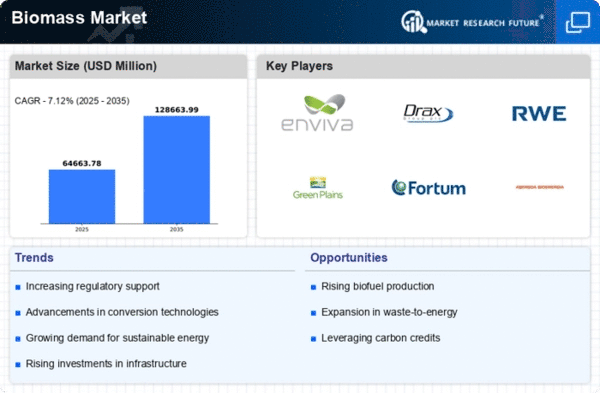
As per MRFR analysis, the Biomass Market Size was estimated at 60365.74 USD Million in 2024. The Biomass industry is projected to grow from 64665.0 in 2025 to 128663.99 by 2035, exhibiting a compound annual growth rate (CAGR) of 7.12 during the forecast period 2025 - 2035.

Key Market Trends & Highlights

The Biomass Market is experiencing robust growth driven by renewable energy demand and technological advancements.

  • The demand for renewable energy continues to rise, propelling the Biomass Market forward.
  • Technological advancements in biomass conversion processes are enhancing efficiency and sustainability.
  • North America remains the largest market, while Asia-Pacific is recognized as the fastest-growing region in biomass utilization.
  • Government policies and increasing energy security concerns are key drivers fueling the growth of biofuels and wood biomass segments.

Market Size & Forecast

2024 Market Size 60365.74 (USD Million)
2035 Market Size 128663.99 (USD Million)
CAGR (2025 - 2035) 7.12%
Largest Regional Market Share in 2024 North America

Major Players

<p>Enviva Holdings (US), Drax Group (GB), RWE AG (DE), Green Plains Inc. (US), Fortum Oyj (FI), Abengoa Bioenergy (ES), Biomass Energy Ltd. (GB), Pacific BioEnergy Corporation (CA), Aemetis Inc. (US)</p>

Market Trends

The Biomass Market is currently experiencing a transformative phase, driven by a growing emphasis on renewable energy sources and sustainability. This sector encompasses a diverse range of organic materials, including agricultural residues, wood waste, and dedicated energy crops, which are increasingly recognized for their potential to reduce greenhouse gas emissions. As governments and industries worldwide prioritize cleaner energy solutions, the Biomass Market is likely to expand, fostering innovation in conversion technologies and applications. Furthermore, the integration of biomass into existing energy systems appears to enhance energy security and diversify energy portfolios, making it an attractive option for many countries. In addition to environmental benefits, the Biomass Market is also influenced by economic factors. The rising demand for biofuels and bioproducts suggests a shift in consumer preferences towards sustainable alternatives. This trend may lead to increased investments in biomass infrastructure and research, potentially resulting in enhanced efficiency and cost-effectiveness. As the market evolves, stakeholders must navigate regulatory frameworks and technological advancements to capitalize on emerging opportunities. Overall, the Biomass Market seems poised for growth, driven by a confluence of environmental, economic, and technological factors.

Rising Demand for Renewable Energy

The Biomass Market is witnessing an increasing demand for renewable energy sources. This trend is largely fueled by global initiatives aimed at reducing carbon footprints and transitioning to sustainable energy systems. As countries commit to ambitious climate goals, biomass is emerging as a viable alternative to fossil fuels, potentially reshaping energy landscapes.

Technological Advancements in Conversion Processes

Innovations in biomass conversion technologies are playing a crucial role in enhancing the efficiency and viability of biomass utilization. Developments in gasification, anaerobic digestion, and fermentation processes indicate a shift towards more effective methods of transforming organic materials into energy. These advancements may lead to broader applications and increased market penetration.

Integration of Biomass in Circular Economy

The Biomass Market is increasingly aligning with principles of the circular economy, where waste materials are repurposed into valuable resources. This integration not only promotes sustainability but also encourages resource efficiency. As industries adopt circular practices, the potential for biomass to contribute to waste reduction and energy generation appears promising.

Biomass Market Market Drivers

Market Growth Projections

The Global Biomass Market Industry is poised for substantial growth, with projections indicating a market size of 60.4 USD Billion in 2024 and an anticipated increase to 101.5 USD Billion by 2035. This growth trajectory suggests a robust expansion driven by various factors, including rising energy demands, technological advancements, and supportive government policies. The compound annual growth rate of 4.84% from 2025 to 2035 further emphasizes the market's potential. Such projections highlight the increasing recognition of biomass as a critical component of the global energy mix, reinforcing its role in achieving energy security and sustainability.

Growing Environmental Concerns

Increasing environmental concerns regarding greenhouse gas emissions and pollution are propelling the Global Biomass Market Industry. Biomass Market is perceived as a cleaner alternative to fossil fuels, as it can significantly reduce carbon emissions when sourced sustainably. The growing awareness of environmental issues is prompting both consumers and industries to seek greener energy solutions. This shift is reflected in the rising investments in biomass energy projects globally. As stakeholders prioritize sustainability, the biomass market is expected to expand, aligning with global efforts to combat climate change and promote environmental stewardship. This trend indicates a robust future for biomass as a key player in the renewable energy sector.

Diverse Applications of Biomass

The versatility of biomass fuels in various applications is a notable driver of the Global Biomass Market Industry. Biomass Market can be utilized for electricity generation, heating, and as a feedstock for biofuels, catering to diverse energy needs across sectors. This adaptability enhances its appeal to a wide range of industries, including transportation, agriculture, and manufacturing. As the demand for sustainable energy solutions grows, the biomass market is likely to benefit from its ability to serve multiple purposes. This multifaceted nature of biomass fuels positions the industry for continued growth, as it aligns with the evolving energy landscape and the quest for sustainable alternatives.

Government Incentives and Policies

Government incentives and supportive policies are crucial drivers of the Global Biomass Market Industry. Many countries are establishing regulations that favor the use of biomass for energy production, such as tax credits, grants, and subsidies. These initiatives not only encourage investment in biomass technologies but also facilitate the development of infrastructure necessary for biomass production and distribution. For example, the European Union has set ambitious targets for renewable energy, which include significant contributions from biomass. Such policies are expected to propel the biomass market, with projections indicating a market size of 101.5 USD Billion by 2035, underscoring the importance of governmental support in fostering growth.

Rising Demand for Renewable Energy

The Global Biomass Market Industry is experiencing a surge in demand for renewable energy sources, driven by increasing awareness of climate change and the need for sustainable energy solutions. Governments worldwide are implementing policies to promote renewable energy, which includes biomass as a viable option. For instance, the global biomass market is projected to reach 60.4 USD Billion in 2024, reflecting a growing shift towards cleaner energy alternatives. This transition is further supported by technological advancements in biomass conversion processes, enhancing efficiency and reducing costs. As countries strive to meet their renewable energy targets, the biomass sector is likely to play a pivotal role in the global energy landscape.

Technological Advancements in Biomass Conversion

Technological innovations in biomass conversion processes are significantly influencing the Global Biomass Market Industry. Advances in gasification, anaerobic digestion, and fermentation technologies are enhancing the efficiency and viability of biomass as an energy source. These improvements not only increase the yield of biofuels but also reduce production costs, making biomass more competitive with fossil fuels. As a result, the market is likely to witness a compound annual growth rate of 4.84% from 2025 to 2035. Enhanced technologies also contribute to better waste management practices, as biomass can be derived from agricultural residues and organic waste, thereby promoting a circular economy.

Market Segment Insights

By Application: Electricity Generation (Largest) vs. Biofuels (Fastest-Growing)

<p>The Biomass Market is primarily driven by its diverse applications, with electricity generation holding the largest market share. This segment leverages biomass for sustainable energy production, catering to the increasing demand for renewable electricity. Other significant applications include heating and transportation, which contribute notably to the overall market. Each segment plays a crucial role in promoting the use of biomass, supplemented by governmental policies supporting renewable energy adoption and technological advancements that increase efficiency. In terms of growth trends, the biomass market is witnessing a surge in biofuels, marking it as the fastest-growing segment. This growth is propelled by the global shift towards sustainable transportation solutions and the increasing investments in biofuel technologies. Furthermore, industrial processes are also contributing to the overall demand, reflecting an expanding interest in sustainable practices across various industries, driven by environmental concerns and regulatory frameworks that favor biomass utilization.</p>

<p>Electricity Generation (Dominant) vs. Biofuels (Emerging)</p>

<p>Electricity generation is the dominant application within the Biomass Market, primarily due to its established infrastructure and government-backed incentives for renewable energy. Biomass power plants converting organic materials into electricity contribute significantly to energy grids, providing a reliable source of renewable energy. In contrast, biofuels are emerging rapidly as a dynamic portion of the market, fueled by advancements in production technologies and growing consumer awareness regarding sustainability. Biofuels provide an alternative to fossil fuels in transportation, with their potential to reduce greenhouse gas emissions attracting significant investments. As the renewable energy landscape evolves, both segments are expected to coexist, with electricity generation leading in stability and biofuels capturing the attention of environmentally conscious consumers.</p>

By Feedstock Type: Wood Biomass (Largest) vs. Energy Crops (Fastest-Growing)

<p>The Biomass Market showcases a diverse distribution among feedstock types, with wood biomass holding the largest share due to its established utilization in energy production. Agricultural residues and animal manure also play significant roles in the market, contributing to sustainable energy initiatives. Algae and energy crops have been gaining traction, driven by their potential for high yields and strong efficiency in energy production. As the market matures, these segments are poised to share an increasingly important role in the overall biomass landscape. Growth trends for feedstock types are influenced by environmental policies and the push for sustainable energy solutions. Wood biomass remains a staple, but energy crops are emerging as the fastest-growing segment, benefiting from advancements in agricultural technology and increased investments. Algal biomass is also witnessing momentum, propelled by innovations in the biotechnology sector and rising interest in biofuels. Collectively, these trends foretell a dynamic shift in the Biomass Market as it adapts to changing consumer demands and regulatory frameworks.</p>

<p>Wood Biomass (Dominant) vs. Algae (Emerging)</p>

<p>Wood biomass stands as the dominant player in the feedstock segment, primarily due to its long history of use and well-established supply chains. This traditional source not only provides a reliable energy source but also presents sustainability advantages when sourced responsibly. In contrast, algae is recognized as an emerging feedstock with the unique capability to grow rapidly and absorb carbon, making it an attractive option for biofuel production. Algae cultivation can take place in non-arable land and does not compete with food crops for resources, making it a sustainable alternative. The growth of algae within the Biomass Market signifies an exciting trend as it aligns with the shifts towards greener energy solutions.</p>

By Technology: Anaerobic Digestion (Largest) vs. Gasification (Fastest-Growing)

<p>Among the various technologies in the biomass market, anaerobic digestion takes the lead with the largest market share, primarily due to its efficient processing of organic waste and generation of biogas. Gasification follows as an innovative technology, converting biomass into syngas and subsequently into energy, which is witnessing rapid adoption. Combustion, fermentation, and pyrolysis are also significant contributors, aligning in diverse applications and catering to varying energy needs within the market.</p>

<p>Technology: Anaerobic Digestion (Dominant) vs. Gasification (Emerging)</p>

<p>Anaerobic digestion is recognized as the dominant technology in the biomass market, acting not only as a waste management solution but also as a renewable energy source by producing biogas for electricity and heat. The technology integrates with agricultural practices, making it appealing for farm operations and large waste producers. In contrast, gasification is emerging rapidly, enabling a versatile conversion of biomass into clean and valuable energy carriers like hydrogen and syngas. Although currently smaller in market share, gasification is attracting investments due to its potential in creating sustainable solutions for waste and energy production.</p>

By End Use: Residential (Largest) vs. Commercial (Fastest-Growing)

<p>The Biomass Market is witnessing a diverse distribution of market share across various end-use segments, with the Residential sector leading by a significant margin. This segment captures the interest of homeowners seeking sustainable and cost-effective heating solutions, contributing to a substantial portion of the overall market. In contrast, the Commercial sector, while smaller in share, is rapidly gaining traction as businesses increasingly adopt biomass technologies for their energy needs, highlighting a critical shift towards sustainability in business operations.</p>

<p>Residential (Dominant) vs. Commercial (Emerging)</p>

<p>The Residential segment of the Biomass Market stands out as the dominant force, driven by consumer demand for renewable energy sources that offer both economic and environmental benefits. Homeowners are increasingly installing biomass heating systems, which provides an efficient and eco-friendly alternative to fossil fuels. On the other hand, the Commercial segment is emerging as a significant player in the market, characterized by businesses integrating biomass solutions to meet their energy demands and reduce carbon footprints. This segment is fueled by a growing emphasis on corporate sustainability practices, innovation in biomass technologies, and supportive government policies, creating a robust framework for future growth.</p>

Get more detailed insights about Biomass Market Research Report — Global Forecast till 2035

Regional Insights

North America : Leading Biomass Market

North America is poised to maintain its leadership in the biomass market, holding a significant share of 30100.0. The region's growth is driven by increasing demand for renewable energy sources, supported by favorable government policies and incentives aimed at reducing carbon emissions. The push for sustainable energy solutions is further catalyzed by technological advancements in biomass conversion processes, making it a viable alternative to fossil fuels. The United States and Canada are the primary players in this market, with key companies like Enviva Holdings and Green Plains Inc. leading the charge. The competitive landscape is characterized by a mix of established firms and emerging startups, all vying for a share of the growing market. The presence of robust infrastructure and investment in research and development further solidifies North America's position as a biomass powerhouse.

Europe : Sustainable Energy Transition

Europe is rapidly advancing in the biomass market, with a market size of 18000.0. The region's commitment to sustainability and reducing greenhouse gas emissions is driving demand for biomass as a renewable energy source. Regulatory frameworks, such as the EU Renewable Energy Directive, are pivotal in promoting biomass utilization, ensuring that it plays a crucial role in the energy transition towards a low-carbon economy. Leading countries like Germany, the UK, and Finland are at the forefront of this movement, with major players such as Drax Group and RWE AG actively investing in biomass technologies. The competitive landscape is marked by a strong emphasis on innovation and sustainability, with companies focusing on efficient biomass production and supply chain management. This strategic focus positions Europe as a key player in The Biomass.

Asia-Pacific : Emerging Biomass Market

Asia-Pacific is emerging as a significant player in the biomass market, with a market size of 10000.0. The region's growth is fueled by increasing energy demands and a shift towards renewable energy sources. Governments are implementing policies to promote biomass energy, recognizing its potential to reduce reliance on fossil fuels and enhance energy security. The rising awareness of environmental issues is also contributing to the demand for cleaner energy alternatives. Countries like China and India are leading the charge, with investments in biomass technologies and infrastructure. The competitive landscape is evolving, with both local and international companies entering the market. Key players are focusing on developing efficient biomass conversion technologies and expanding their supply chains to meet the growing demand, positioning Asia-Pacific as a promising market for biomass energy.

Middle East and Africa : Developing Biomass Sector

The Middle East and Africa region is in the nascent stages of developing its biomass market, with a market size of 1265.74. The growth potential is significant, driven by increasing energy needs and a gradual shift towards renewable energy sources. However, challenges such as limited infrastructure and investment in biomass technologies hinder rapid development. Governments are beginning to recognize the importance of biomass in achieving energy diversification and sustainability goals. Countries like South Africa and Kenya are exploring biomass as a viable energy solution, with initiatives aimed at promoting its use. The competitive landscape is still developing, with a few key players beginning to emerge. As awareness grows and investments increase, the region is expected to see a gradual expansion in its biomass market, presenting both challenges and opportunities for stakeholders.

Key Players and Competitive Insights

The Biomass Market is currently characterized by a dynamic competitive landscape, driven by increasing demand for renewable energy sources and stringent environmental regulations. Key players are actively pursuing strategies that emphasize innovation, sustainability, and regional expansion. For instance, Enviva Holdings (US) has positioned itself as a leader in sustainable wood pellet production, focusing on expanding its production capacity and enhancing supply chain efficiencies. Similarly, Drax Group (GB) is investing heavily in carbon capture and storage technologies, aiming to transition its operations towards net-zero emissions. These strategic initiatives collectively shape a competitive environment that is increasingly focused on sustainability and technological advancement.

In terms of business tactics, companies are localizing manufacturing and optimizing their supply chains to enhance operational efficiency. The market appears moderately fragmented, with several key players exerting influence over their respective regions. This fragmentation allows for a diverse range of products and services, although it also intensifies competition among established firms and new entrants alike.

In November 2025, RWE AG (DE) announced a strategic partnership with a leading technology firm to develop advanced biomass conversion technologies. This collaboration is expected to enhance RWE's capabilities in producing sustainable energy solutions, thereby reinforcing its market position. The strategic importance of this partnership lies in its potential to accelerate innovation and improve the efficiency of biomass conversion processes, aligning with the growing demand for cleaner energy sources.

In October 2025, Green Plains Inc. (US) unveiled plans to expand its biofuel production facilities, focusing on integrating biomass feedstocks into its operations. This move is significant as it not only diversifies Green Plains' product offerings but also positions the company to capitalize on the increasing demand for renewable fuels. By enhancing its production capabilities, Green Plains aims to strengthen its competitive edge in the biomass sector.

In September 2025, Fortum Oyj (FI) completed the acquisition of a biomass energy company, further solidifying its presence in the renewable energy market. This acquisition is strategically important as it allows Fortum to expand its operational footprint and leverage synergies in biomass production. The integration of this new entity is expected to enhance Fortum's overall efficiency and sustainability initiatives, contributing to its long-term growth objectives.

As of December 2025, the Biomass Market is witnessing trends that emphasize digitalization, sustainability, and the integration of artificial intelligence in operational processes. Strategic alliances are increasingly shaping the competitive landscape, enabling companies to pool resources and expertise to drive innovation. The shift from price-based competition to a focus on technological advancement and supply chain reliability is becoming evident. Moving forward, competitive differentiation will likely hinge on the ability to innovate and adapt to evolving market demands, underscoring the importance of sustainable practices and advanced technologies in the biomass sector.

Key Companies in the Biomass Market include

Industry Developments

March 2023, Mitsubishi Heavy Industries, Ltd., and PT. PLN Nusantara Power has signed a Memorandum of Understanding (MoU) to begin three technical studies related to co-firing of less carbon-intensive fuels at Nusantara Power plants. This MoU builds on a previous agreement signed in November 2022 with PLN Group company PT. PLN Indonesia Power and will contribute to the implementation of solutions to accelerate the decarbonization of Indonesia's energy systems.

March 2023: Dalkia has entered long-term cooperation with Solvay to install a biomass boiler in Saint-Fons, France. Dalkia will use waste wood from demolished buildings and furniture that is acquired locally to generate steam and the plant will be put into operation by 2025.

Feb 2023, Ameresco, Inc has acquired ENERQOS Energy Solutions S.r.l., a renewable energy and energy efficiency company headquartered in Milan and signed a definitive purchase and sale agreement. With this acquisition, Ameresco will be able to expand its range of renewable energy projects and solutions throughout Italy.

November 2022: Babcock & Wilcox Enterprises, Inc. has signed a contract agreement with NRG Korea to investigate the viability of employing B&W's BrightLoopTM technology to produce hydrogen using biomass fuel in South Korea. B&W and NRG have signed a memorandum in order to research the technology and perhaps implement the project. The project would employ waste biomass as a feedstock to create hydrogen for fuel cells used for electricity generation.

November 2022, Renault Group collaborated with Dalkia to install a biomass boiler at its Maubeuge facility and replace 65% of the company's gas consumption to accelerate the decarbonization plan. 

Future Outlook

Biomass Market Future Outlook

<p>The Biomass Market is projected to grow at a 7.12% CAGR from 2024 to 2035, driven by increasing energy demands, sustainability initiatives, and technological advancements.</p>

New opportunities lie in:

  • <p>Development of advanced biomass gasification technologies</p>
  • <p>Expansion of biomass supply chains for urban energy solutions</p>
  • <p>Investment in biomass-based biofuels for transportation sectors</p>

<p>By 2035, the Biomass Market is expected to be a pivotal player in the global energy landscape.</p>

Market Segmentation

Biomass Market End Use Outlook

  • Residential
  • Commercial
  • Industrial
  • Agricultural
  • Transportation

Biomass Market Technology Outlook

  • Anaerobic Digestion
  • Gasification
  • Combustion
  • Fermentation
  • Pyrolysis

Biomass Market Application Outlook

  • Electricity Generation
  • Heating
  • Transportation
  • Industrial Processes
  • Biofuels

Biomass Market Feedstock Type Outlook

  • Wood Biomass
  • Agricultural Residues
  • Animal Manure
  • Algae
  • Energy Crops

Report Scope

MARKET SIZE 202460365.74(USD Million)
MARKET SIZE 202564665.0(USD Million)
MARKET SIZE 2035128663.99(USD Million)
COMPOUND ANNUAL GROWTH RATE (CAGR)7.12% (2024 - 2035)
REPORT COVERAGERevenue Forecast, Competitive Landscape, Growth Factors, and Trends
BASE YEAR2024
Market Forecast Period2025 - 2035
Historical Data2019 - 2024
Market Forecast UnitsUSD Million
Key Companies ProfiledEnviva Holdings (US), Drax Group (GB), RWE AG (DE), Green Plains Inc. (US), Fortum Oyj (FI), Abengoa Bioenergy (ES), Biomass Energy Ltd. (GB), Pacific BioEnergy Corporation (CA), Aemetis Inc. (US)
Segments CoveredApplication, Feedstock Type, Technology, End Use
Key Market OpportunitiesAdvancements in biomass conversion technologies enhance efficiency and sustainability in the Biomass Market.
Key Market DynamicsRising demand for renewable energy sources drives innovation and competition in the biomass market.
Countries CoveredNorth America, Europe, APAC, South America, MEA

FAQs

How much is the Biomass Market?

Biomass Market was valued at USD 60365.74 Billion in 2024

What is the growth rate of the Biomass Market?

The growth rate of biomass market is 7.12%

Which region held the largest market share in the Biomass Market?

Asia Pacific held the largest market share in the Biomass Market.

Who are the key players in the Biomass Market?

Babcock &amp; Wilcox Enterprises, Inc (B&amp;W) (US), Dalkia (France), EnviTec Biogas AG (Germany), Ameresco Inc. (US), Drax Group (UK), Orsted A/S (Denmark), MVV Energie AG (Germany), Mitsubishi Heavy Industries, Ltd. (Japan), Vattenfall AB (Sweden) and Statkraft AS (Norway)

Which feedstock had the largest share in the Biomass Market?

Wood had the largest share in the biomass Market.

Which Technology had the largest market share in the Biomass Market?

Combined Heat and Power (CHP) has the largest market share in the Biomass Market

Which Product had the largest market share in the Biomass Market?

The biodiesel segment had the largest market share in the Biomass Market.

Which End-Use had the largest market share in the Biomass Market?

The commercial segment had the largest market share in the Biomass Market.

  1. SECTION I: EXECUTIVE SUMMARY AND KEY HIGHLIGHTS
    1. | 1.1 EXECUTIVE SUMMARY
  2. SECTION II: SCOPING, METHODOLOGY AND MARKET STRUCTURE
    1. | 2.1 MARKET INTRODUCTION
    2. | 2.2 RESEARCH METHODOLOGY
  3. SECTION III: QUALITATIVE ANALYSIS
    1. | 3.1 MARKET DYNAMICS
    2. | 3.2 MARKET FACTOR ANALYSIS
  4. SECTION IV: QUANTITATIVE ANALYSIS
    1. | 4.1 Chemicals and Materials, BY Application (USD Million)
    2. | 4.2 Chemicals and Materials, BY Feedstock Type (USD Million)
    3. | 4.3 Chemicals and Materials, BY Technology (USD Million)
    4. | 4.4 Chemicals and Materials, BY End Use (USD Million)
    5. | 4.5 Chemicals and Materials, BY Region (USD Million)
  5. SECTION V: COMPETITIVE ANALYSIS
    1. | 5.1 Competitive Landscape
    2. | 5.2 Company Profiles
    3. | 5.3 Appendix

Biomass Market Segmentation

Market Segmentation Overview

  • Detailed segmentation data will be available in the full report
  • Comprehensive analysis by multiple parameters
  • Regional and country-level breakdowns
  • Market size forecasts by segment
Infographic

Free Sample Request

Kindly complete the form below to receive a free sample of this Report

Get Free Sample

Customer Strories

Compare Licence

×
Features License Type
Single User Multiuser License Enterprise User
Price $4,950 $5,950 $7,250
Maximum User Access Limit 1 User Upto 10 Users Unrestricted Access Throughout the Organization
Free Customization
Direct Access to Analyst
Deliverable Format
Platform Access
Discount on Next Purchase 10% 15% 15%
Printable Versions