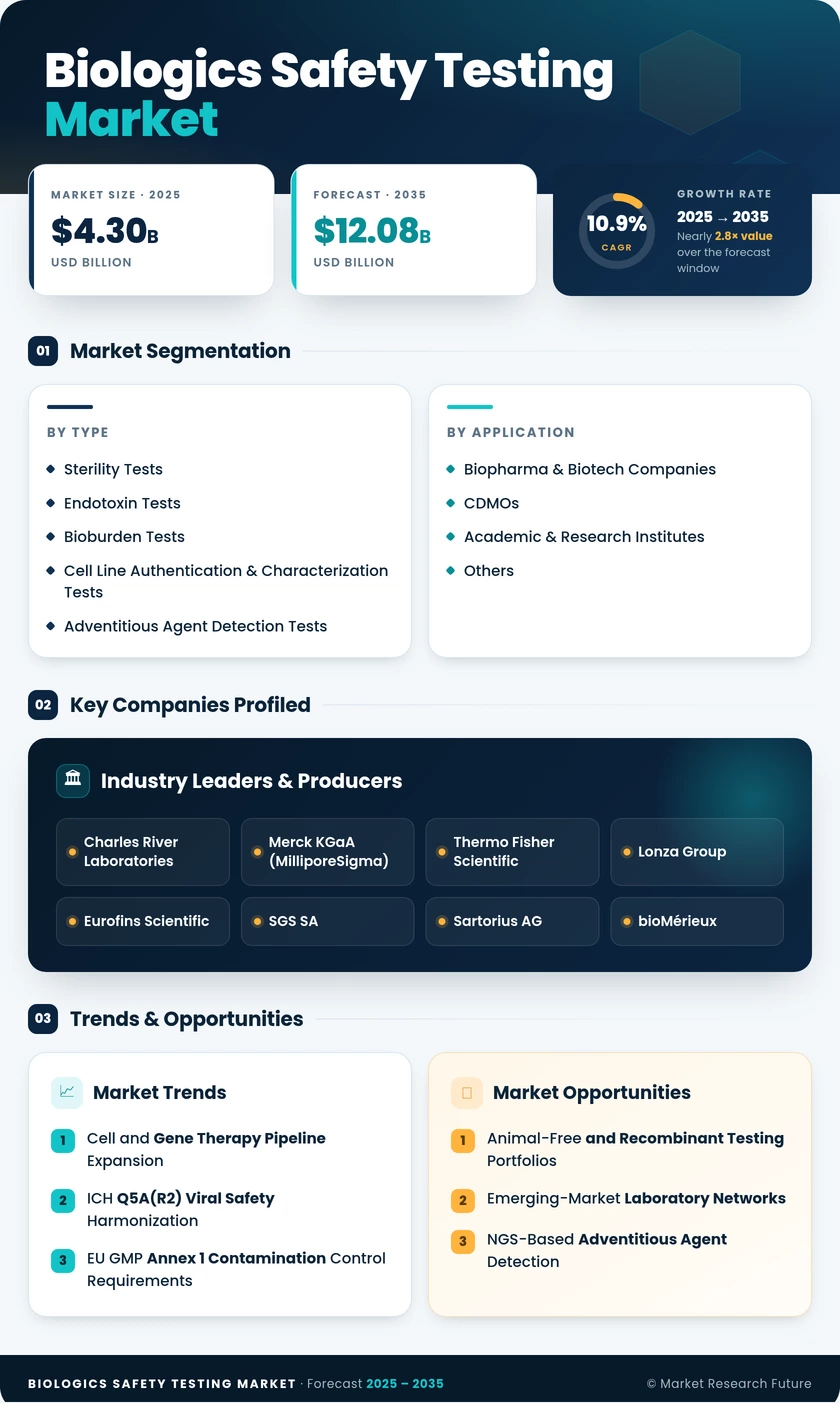
Segmentation Quick Reference
| Dimension | Sub-Segments | Dominant Segment | Fastest Growing Segment |
|---|---|---|---|
| By Product & Service | Products (Reagents & Kits, Instruments), Services | Products – 58.2% share (2025) | Services – 12.5% CAGR (2026–2035) |
| By Test Type | Sterility Tests, Endotoxin Tests, Bioburden Tests, Cell Line Authentication & Characterization Tests, Adventitious Agent Detection Tests, Mycoplasma Tests, Residual Host Contaminant Detection Tests | Sterility Tests – 26.6% share (2025) | Adventitious Agent Detection Tests – 12.8% CAGR (2026–2035) |
| By Application | Recombinant Protein / Monoclonal Antibodies, Vaccines & Therapeutics, Cellular & Gene Therapy, Blood & Blood Products, Tissue & Tissue Products, Stem Cell | Recombinant Protein / Monoclonal Antibodies – 29.5% share (2025) | Cellular & Gene Therapy – 13.8% CAGR (2026–2035) |
| By End User | Biopharma & Biotech Companies, CDMOs, Academic & Research Institutes, Others | Biopharma & Biotech Companies – 44.2% share (2025) | CDMOs – 13.6% CAGR (2026–2035) |
| By Region | North America, Europe, Asia-Pacific, South America, Middle East & Africa | North America – 40.5% share (2025) | Asia-Pacific – 12.6% CAGR (2026–2035) |
Market Segmentation Overview
By Product & Service
| Sub-Segment | Key Trend |
|---|---|
| Products | Reagents & Kits bundled with rFC alternatives; Instruments shifting to automated rapid detection |
| Services | Integrated testing bundled into CDMO manufacturing contracts. |
Products lead because Reagents & Kits are consumed with every batch released, whether testing happens in-house or at a contract lab. Services grow faster because viral vector and cell therapy testing require BSL-2 containment and validated virology methods that most emerging sponsors cannot justify building themselves. This aligns with the outsourcing momentum described in Section 9.1.
By Test Type
| Sub-Segment | Key Trend |
|---|---|
| Sterility Tests | Automation compressing per-test pricing |
| Endotoxin Tests | Transition from LAL to recombinant reagents |
| Bioburden Tests | Expanded in-process monitoring under Annex 1 |
| Cell Line Authentication & Characterization Tests | Master cell bank qualification for new modalities |
| Adventitious Agent Detection Tests | NGS replacing in vivo assays |
| Mycoplasma Tests | Migration to PCR-based rapid kits |
| Residual Host Contaminant Detection Tests | Tighter host-cell protein and DNA limits |
Sterility Tests hold the largest share because compendial release rules apply to every sterile biologic, even as automated systems reduce labor per test. Adventitious Agent Detection Tests grow fastest, driven by ICH Q5A(R2)'s broader scope and the replication-competent virus risks tied to lentiviral and AAV vectors. Mycoplasma Tests are gaining speed through PCR kits, which support rapid-release needs for autologous therapies.
By Application
| Sub-Segment | Key Trend |
|---|---|
| Recombinant Protein / Monoclonal Antibodies | Biosimilar launches sustaining release volumes |
| Vaccines & Therapeutics | Regionalized production for WHO prequalification |
| Cellular & Gene Therapy | Patient-specific batch panels raising test intensity |
| Blood & Blood Products | Pathogen reduction lowering testing frequency |
| Tissue & Tissue Products | Growth in allograft and regenerative products |
| Stem Cell | Pluripotent line characterization requirements |
Recombinant Protein / Monoclonal Antibodies lead because antibody plants run high batch volumes, and biosimilar entry adds new products needing full release panels. Cellular & Gene Therapy grows fastest since each autologous dose is its own batch, which multiplies sterility, mycoplasma, and vector safety tests per patient treated. Blood & Blood Products face slower growth as pathogen-reduction technologies reshape screening needs.
By End User
| Sub-Segment | Key Trend |
|---|---|
| Biopharma & Biotech Companies | In-house QC retained for commercial supply control |
| CDMOs | Bundled manufacturing-plus-testing contracts |
| Academic & Research Institutes | Outsourcing of complex virology work |
| Others | Combination product and device testing needs |
Biopharma & Biotech Companies remain the largest end user because large manufacturers keep routine release testing in-house to protect supply continuity and inspection readiness. CDMOs grow fastest as virtual biotechs buy manufacturing and testing together, and CDMOs spread validation and containment costs across many client programs. Academic & Research Institutes rely on external labs for GMP virology that grant funding cannot support.
.


 Noah Malgeri
Co-Founder

 Peter Groot koerkamp
Account and Business Manager

 Younghwan Choi
Senior Retail Manager

 Mark Irwin
Management Consultant

 Akif Moroglu
Strategy & Business Development Director

 Guilherme Gomes Martins
Product Management Director

 Joseph Aguayo
Sales Operations & Pricing Manager

 La Terria Dodd
Program Support Specialist

 Rob Kooiker
Group Product Manager HVAC & Fire Protection GMA