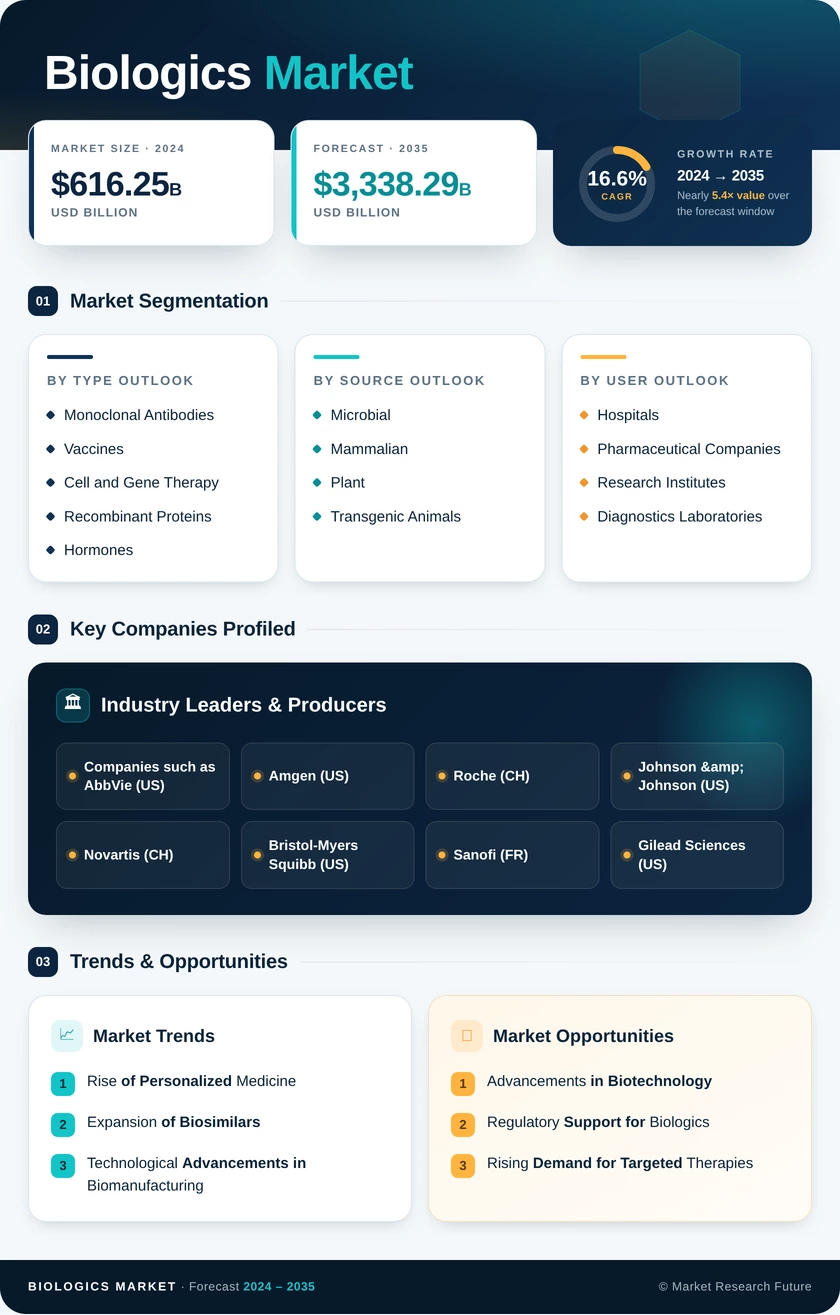
Segmentation Quick Reference
| Dimension | Sub-Segments | Dominant Segment | Fastest Growing Segment |
| By Product | Monoclonal Antibodies; Vaccines; Recombinant Proteins; Gene-Based Biologics; Cell Therapies; Other Biologics | Monoclonal Antibodies (61.3% share, 2025) | Gene-Based Biologics (11.3% CAGR, 2026–2035) |
| By Application | Oncology; Autoimmune & Inflammatory; Infectious Diseases; Metabolic & Endocrine Disorders; Ophthalmology; Rare Diseases; Other Applications | Oncology (33.6% share, 2025) | Metabolic & Endocrine Disorders (12.4% CAGR, 2026–2035) |
| By Source | Mammalian Cell-Culture; Microbial Systems; Plant-Based Systems; Insect-Cell Systems; Other Sources | Mammalian Cell-Culture (65.8% share, 2025) | Plant-Based Systems (11.7% CAGR, 2026–2035) |
| By Manufacturing Technology | Single-use Bioreactors; Stainless-Steel Fed-Batch; Continuous Perfusion Systems; Hybrid/Other Platforms | Single-use Bioreactors (57.6% share, 2025) | Continuous Perfusion Systems (11.5% CAGR, 2026–2035) |
| By End-user | Pharmaceutical & Biotech Companies; Contract Development & Manufacturing Organizations; Academic & Research Institutes; Hospitals & Specialty Clinics; Other End-users | Pharmaceutical & Biotech Companies (51.4% share, 2025) | Academic & Research Institutes (12.2% CAGR, 2026–2035) |
Market Segmentation Overview
By Product
| Sub-Segment | Key Trend |
| Monoclonal Antibodies | Subcutaneous reformulation and high-concentration delivery extend franchise life |
| Vaccines | Government preparedness contracts stabilize demand after pandemic normalization |
| Recombinant Proteins | Biosimilar competition compresses insulin and growth hormone pricing |
| Gene-Based Biologics | First-in-class approvals in hemophilia and inherited retinal disease |
| Cell Therapies | Allogeneic constructs target the autologous manufacturing bottleneck |
| Other Biologics | Blood-derived and fusion protein products serve defined clinical niches |
Monoclonal Antibodies lead this dimension because payers understand their pharmacology and manufacturers have optimized CHO fed-batch titers over three decades, keeping cost per gram predictable at commercial scale. Gene-Based Biologics grow fastest despite a small revenue base, since single-administration durability commands pricing that small patient cohorts can still support under outcomes-based agreements. Recombinant Proteins sit at the opposite end, where mature biosimilar competition erodes realized price faster than volume expands. Cell Therapies remain capacity-constrained until allogeneic platforms reach commercial scale.
By Application
| Sub-Segment | Key Trend |
| Oncology | Antibody-drug conjugates and CAR-T supply most incremental growth |
| Autoimmune & Inflammatory | Bispecific antibodies displace legacy TNF inhibitor regimens |
| Infectious Diseases | Post-exposure therapeutics extend beyond prophylactic vaccination |
| Metabolic & Endocrine Disorders | GLP-1 receptor agonists expand into chronic weight management |
| Ophthalmology | Gene therapy offers durable benefit after single administration |
| Rare Diseases | Orphan incentives and newborn screening deepen the patient pool |
| Other Applications | Neurology and transplant immunology build early pipelines |
Oncology holds the largest application share because checkpoint inhibitors and conjugated antibodies have become standard of care across multiple tumour types, and companion diagnostics accelerate prescribing at launch. Metabolic & Endocrine Disorders grow fastest, driven by GLP-1 label extensions that converted a diabetes franchise into a chronic weight-management category and triggered multi-billion-dollar capacity commitments. Autoimmune & Inflammatory demand remains large but is reshuffling internally as bispecific entrants take share from established TNF inhibitors. Ophthalmology's growth depends on gene therapy reimbursement decisions still pending in several markets.
By Source
| Sub-Segment | Key Trend |
| Mammalian Cell-Culture | High-titer CHO platforms remain default for glycosylated proteins |
| Microbial Systems | Cost-efficient fermentation dominates non-glycosylated protein output |
| Plant-Based Systems | Transient expression delivers rapid pandemic-scale response capability |
| Insect-Cell Systems | Baculovirus platforms supply most clinical AAV vector demand |
| Other Sources | Transgenic and cell-free approaches remain early-stage |
Mammalian Cell-Culture dominates because regulators have decades of review precedent with CHO lines and because complex glycosylation patterns cannot be reliably reproduced in simpler hosts. Plant-Based Systems record the fastest growth as sponsors pursue lower capital intensity, reduced viral clearance burden, and shorter response times for emerging pathogens. Insect-Cell Systems occupy a strategically important niche in viral vector supply, expanding in step with gene therapy pipelines. Microbial Systems hold steady where glycosylation is unnecessary, particularly in insulin analogue production.
By Manufacturing Technology
| Sub-Segment | Key Trend |
| Single-use Bioreactors | Rapid changeover supports multiproduct facility economics |
| Stainless-Steel Fed-Batch | Large dedicated trains persist for high-volume antibody products |
| Continuous Perfusion Systems | Volumetric productivity gains offset integration complexity |
| Hybrid/Other Platforms | Flexible facilities switch modes according to campaign volume |
Single-use Bioreactors lead this dimension because eliminating cleaning validation lets contract and multiproduct facilities turn campaigns in days, which matters far more than consumable cost for portfolios with many mid-volume products. Continuous Perfusion Systems grow fastest, since a threefold to fivefold productivity gain directly reduces cost of goods — the sharpest restraint facing sponsors under negotiated pricing. Stainless-Steel Fed-Batch retains a defensible position for blockbuster antibodies where 15,000 L trains and validated control strategies are already in place. Hybrid designs increasingly appear in new construction.
By End-user
| Sub-Segment | Key Trend |
| Pharmaceutical & Biotech Companies | Vertical integration protects supply continuity and margin |
| Contract Development & Manufacturing Organizations | Premium pricing for viral vector and bispecific expertise |
| Academic & Research Institutes | Federal translational grants fund first-in-human programs |
| Hospitals & Specialty Clinics | On-site autologous cell therapy shortens vein-to-vein time |
| Other End-users | Government stockpiles and non-profit institutes procure directly |
Pharmaceutical & Biotech Companies hold the majority position because originators have moved decisively toward owning their own drug-substance capacity after the lead-time crisis of 2023. Academic & Research Institutes grow fastest, converting grant funding into early clinical manufacturing and increasingly partnering with industry for scale-up. Contract Development & Manufacturing Organizations remain structurally necessary for surge capacity and specialized viral vector work, though price-competitive Asian entrants are compressing margins. Hospitals & Specialty Clinics represent the newest buyer class, gated primarily by reimbursement codes for institution-manufactured products.
just now


 Noah Malgeri
Co-Founder

 Peter Groot koerkamp
Account and Business Manager

 Younghwan Choi
Senior Retail Manager

 Mark Irwin
Management Consultant

 Akif Moroglu
Strategy & Business Development Director

 Guilherme Gomes Martins
Product Management Director

 Joseph Aguayo
Sales Operations & Pricing Manager

 La Terria Dodd
Program Support Specialist

 Rob Kooiker
Group Product Manager HVAC & Fire Protection GMA