×
Request Free Sample ×

Kindly complete the form below to receive a free sample of this Report

* Please use a valid business email

Leading companies partner with us for data-driven Insights

clients tt-cursor
Hero Background
English
Chinese
French
Japanese
Korean
German
Spanish

Biodegradable Packaging Market Analysis

ID: MRFR/PCM/10123-CR
111 Pages
Snehal Singh
April 2024

Biodegradable Packaging Market Research Report: By Material (Polylactic Acid, Starch-Based, Polyhydroxyalkanoates, Cellulose, Mushroom Packaging), By Packaging Type (Flexible Packaging, Rigid Packaging, Food Service Packaging, Containers, Bags), By End Use (Food and Beverages, Electronics, Personal Care, Textiles, Healthcare), By Distribution Channel (Online Retail, Supermarkets, Convenience Stores, Specialty Stores, Wholesalers) andBy Regional (North America, Europe, South America, Asia Pacific, Middle East and Africa)- Forecast to 2035.

Share:
Download PDF ×

We do not share your information with anyone. However, we may send you emails based on your report interest from time to time. You may contact us at any time to opt-out.

Biodegradable Packaging Market Infographic
Purchase Options

Market Analysis

In-depth Analysis of Biodegradable Packaging Market Industry Landscape

The biodegradable packaging market dynamics exhibit a robust and dynamic setup with the current surge in consciousness about ecological problems and the changeover to sustainable behaviors as main driving forces. Bio-based packaging demand is booming like never before as shoppers and businesses alike are more focused on swapping usual non-biodegradable packaging materials for green and bio-based packaging alternatives. It is mainly driven by two things: the plastic pollution issue, the overflow of landfill and expecting the greenhouse gas emissions to be low.

One of the most influential drivers in the market dynamics is the growing green consciousness, or how much impact packaging materials have on the environment. Consumers are becoming increasingly conscious about product choices they make, preferring packages that come from the recycling friendly materials. That is the new reality of consumer behavior which has forced businesses to change their approach to packaging to at least comply with the demand for sustainable products on the market. Subsequently, market is witnessing an innovation swing, where the companies are undertaking research and development extensive to create top-class biodegradable packaging materials with the due balance between functionality and environmental responsibility.

The role of government regulations and initiatives are of significant importance for enabling the market dynamics of biodegradable packaging. For most countries the regulations are severe and they restrict businesses from using non-biodegradable products, thus urging them to find sustainable alternatives. Therefore, this regulatory environment put forward a great background for the biodegradable packaging industry to flourish. Governments are giving boost to the companies that are adopting eco-friendly packaging through incentives and their policies which are promotion sustainable practices in such way that it help business in every industry to choose planet friendly packaging.

In addition to these factors is market dynamics which are affected by the growing inter-sector collaboration and partnerships. Organizations are beginning to see the value in using their resources and capabilities together so that the process of transitioning to sustainable packaging solutions can be done in a timely manner. By working together the packaging manufacturers, the raw material suppliers and the research institutions create the opportunity for a sharing process the information and an environment which stimulates innovation. The partnerships in this case not only add corporate strength but also improve the competitiveness of the market as a whole.

As the adoption of biodegradable packing has been history, the cost consideration has been a challenge for the widespread adoption of the biodegradable packaging. Nonetheless, because the technology keeps evolving and as the economies of scale prevail the cost differentiation between the conventional and the biodegradable packaging is becoming equal. As a result of this cost reduction, this factor has a tremendous impact upon the market dynamics, and is the one that makes sustainable packaging solutions affordable for the great majority of enterprises and customers.

Author
Snehal Singh
Assistant Manager - Research

High acumen in analyzing complex macro & micro markets with more than 6 years of work experience in the field of market research. By implementing her analytical skills in forecasting and estimation into market research reports, she has expertise in Packaging, Construction, and Equipment domains. She handles a team size of 20-25 resources and ensures smooth running of the projects, associated marketing activities, and client servicing.

Leave a Comment

FAQs

What is the size of the Global Biodegradable Packaging Market in 2024?

The Global Biodegradable Packaging Market is expected to be valued at 15.95 billion USD in 2024.

What is the expected CAGR for the Global Biodegradable Packaging Market from 2025 to 2035?

Biodegradable Packaging Market is expected to grow with a CAGR of 5.2% in the period 2025-2035

Which region is expected to hold the largest share of the market by 2035?

Europe is projected to hold the largest market share, expected to be valued at 12.0 billion USD by 2035.

What are the key applications and materials driving the Global Biodegradable Packaging Market?

Key applications include packaging solutions utilizing materials like polylactic acid, starch-based, polyhydroxyalkanoates, cellulose, and mushroom packaging.

Who are the major players in the Global Biodegradable Packaging Market?

Key players in the market include Novamont, Amcor, Plantic Technologies, NatureWorks, and Dow.

What is the expected market value for polylactic acid in 2024?

The market value for Polylactic Acid is expected to reach 5.0 billion USD in 2024.

How much is the biodegradable packaging market in North America projected to be worth in 2035?

North America is projected to be valued at 10.0 billion USD in the biodegradable packaging market by 2035.

What challenges might impact the growth of the Global Biodegradable Packaging Market?

Challenges include the need for greater bio-based material technologies and addressing consumer awareness of biodegradable options.

What is the market growth rate for starch-based biodegradable packaging from 2024 to 2035?

The starch-based segment is expected to grow from 3.5 billion USD in 2024 to 9.0 billion USD by 2035.

Market Summary

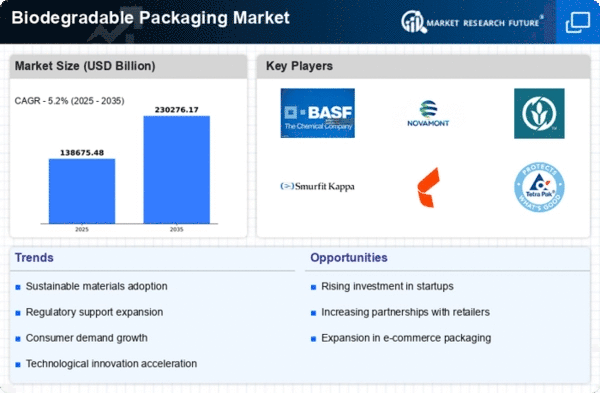
As per MRFR analysis, the Biodegradable Packaging Market Size was estimated at 131820.8 USD Billion in 2024. The biodegradable packaging industry is projected to grow from 138678.15 in 2025 to 230276.17 by 2035, exhibiting a compound annual growth rate (CAGR) of 5.2 during the forecast period 2025 - 2035.

Key Market Trends & Highlights

The Biodegradable Packaging Market is experiencing robust growth driven by sustainability trends and regulatory support.

  • Consumer demand for sustainable packaging solutions is rising, particularly in North America, which remains the largest market.
  • Technological advancements in material science are facilitating the development of innovative biodegradable materials, especially in the Asia-Pacific region.
  • Food packaging continues to dominate the market, while medical packaging is emerging as the fastest-growing segment.
  • Rising environmental awareness and government regulations are key drivers propelling the adoption of biodegradable packaging solutions.

Market Size & Forecast

2024 Market Size 131820.8 (USD Billion)
2035 Market Size 230276.17 (USD Billion)
CAGR (2025 - 2035) 5.2%
Largest Regional Market Share in 2024 North America

Major Players

BASF SE (DE), Novamont S.p.A. (IT), NatureWorks LLC (US), Smurfit Kappa Group (IE), Mondi Group (GB), Tetra Pak (SE), Biopac (GB), BioBag International AS (NO), PackTech (US)

Market Trends

The Biodegradable Packaging Market is currently experiencing a notable transformation, driven by increasing environmental awareness and regulatory pressures. Consumers are becoming more conscious of their ecological footprint, prompting businesses to seek sustainable alternatives to traditional packaging materials. This shift is not merely a trend but appears to be a fundamental change in how products are packaged and delivered. Companies are investing in innovative materials that decompose naturally, thus reducing waste and pollution. As a result, the market is witnessing a surge in demand for biodegradable options across various sectors, including food and beverage, cosmetics, and consumer goods. Moreover, advancements in technology are facilitating the development of new biodegradable materials that offer comparable performance to conventional plastics. This evolution suggests that the Biodegradable Packaging Market is poised for substantial growth, as manufacturers strive to meet consumer expectations while adhering to stricter environmental regulations. The collaboration between businesses, governments, and research institutions is likely to foster further innovation, enhancing the appeal of biodegradable solutions. In this context, the market's trajectory appears promising, with a clear inclination towards sustainability and responsible consumption shaping its future.

Rising Consumer Demand for Sustainability

There is an observable increase in consumer preference for sustainable products, which is influencing the Biodegradable Packaging Market. Shoppers are actively seeking out brands that prioritize eco-friendly practices, leading companies to adopt biodegradable materials in their packaging strategies.

Regulatory Support and Initiatives

Governments worldwide are implementing regulations aimed at reducing plastic waste, which is bolstering the Biodegradable Packaging Market. These policies encourage the adoption of biodegradable alternatives, creating a favorable environment for manufacturers to innovate and expand their product offerings.

Technological Advancements in Material Science

Innovations in material science are paving the way for the development of new biodegradable packaging solutions. Research into alternative materials is yielding products that not only meet performance standards but also decompose efficiently, thus enhancing the market's growth potential.

Biodegradable Packaging Market Market Drivers

Market Growth Projections

The Global Biodegradable Packaging Market Industry is poised for substantial growth, with projections indicating a market value of 20.5 USD Billion in 2024 and an anticipated increase to 45.3 USD Billion by 2035. This growth trajectory suggests a compound annual growth rate of 7.47% from 2025 to 2035. The increasing adoption of biodegradable materials across various sectors, including food and beverage, cosmetics, and consumer goods, is likely to drive this expansion. As businesses and consumers alike prioritize sustainability, the market is expected to evolve, presenting new opportunities for innovation and investment in biodegradable packaging solutions.

Rising Environmental Concerns

The Global Biodegradable Packaging Market Industry is experiencing a surge in demand driven by increasing environmental awareness among consumers and businesses. As plastic pollution continues to pose significant threats to ecosystems, stakeholders are actively seeking sustainable alternatives. This shift is evidenced by the projected market value of 20.5 USD Billion in 2024, reflecting a growing preference for biodegradable materials. Governments worldwide are implementing stricter regulations on plastic usage, further propelling the adoption of biodegradable packaging solutions. The emphasis on reducing carbon footprints and promoting circular economies is likely to enhance the industry's growth trajectory.

Government Regulations and Initiatives

Government policies and initiatives play a crucial role in shaping the Global Biodegradable Packaging Market Industry. Many countries are introducing regulations aimed at reducing plastic waste, which encourages manufacturers to adopt biodegradable alternatives. For instance, the European Union has set ambitious targets for reducing single-use plastics, which has led to increased investments in biodegradable packaging technologies. These regulatory frameworks not only foster innovation but also create a favorable environment for market growth. As a result, the industry is expected to witness a compound annual growth rate of 7.47% from 2025 to 2035, indicating a robust shift towards sustainable packaging solutions.

Market Expansion in Emerging Economies

Emerging economies are becoming pivotal players in the Global Biodegradable Packaging Market Industry. As these regions experience rapid economic growth, there is a corresponding increase in consumer spending and demand for packaged goods. Countries in Asia-Pacific and Latin America are witnessing a shift towards sustainable packaging solutions, driven by urbanization and changing lifestyles. This expansion is expected to contribute significantly to the market's projected growth, with estimates suggesting a market value of 45.3 USD Billion by 2035. The increasing availability of biodegradable packaging options in these regions is likely to further stimulate demand and foster industry development.

Technological Advancements in Materials

Innovations in material science are significantly influencing the Global Biodegradable Packaging Market Industry. The development of advanced biodegradable polymers and composites has expanded the range of applications for sustainable packaging. For example, materials derived from renewable resources, such as cornstarch and sugarcane, are gaining traction due to their eco-friendly properties. These advancements not only enhance the performance of biodegradable packaging but also reduce production costs, making them more accessible to manufacturers. As the market evolves, the integration of smart technologies in biodegradable packaging could further enhance functionality, thereby attracting a broader consumer base.

Consumer Demand for Sustainable Products

The growing consumer preference for sustainable products is a key driver of the Global Biodegradable Packaging Market Industry. As awareness of environmental issues rises, consumers are increasingly opting for products that align with their values. This trend is reflected in the packaging choices made by companies, which are now prioritizing biodegradable options to meet consumer expectations. The shift towards sustainability is not merely a passing trend; it is becoming a fundamental aspect of brand identity. Companies that embrace biodegradable packaging are likely to enhance their market position and appeal to environmentally conscious consumers, thereby driving industry growth.

Market Segment Insights

By Application: Food Packaging (Largest) vs. Medical Packaging (Fastest-Growing)

The biodegradable packaging market has witnessed significant diversification within its application segment. Food packaging holds the largest share, driven by increasing consumer demand for sustainable solutions in food preservation and storage. Following closely are consumer goods and medical packaging applications, which also contribute substantially to overall market dynamics. Electronics packaging, while less prominent, is gradually gaining traction as eco-conscious companies seek environmentally friendly alternatives for their products. Growth prospects in the biodegradable packaging sector are fueled by consumer preferences shifting towards sustainable packaging solutions. The food packaging segment benefits from stringent regulations promoting eco-friendly materials in the food industry, while medical packaging is emerging as a fast-growing area due to rising environmental concerns and innovations in bioplastics. The increased investment in research and development further propels advancements in biodegradable materials, enhancing their adoption across various applications.

Food Packaging (Dominant) vs. Electronics Packaging (Emerging)

Food packaging remains the dominant application in the biodegradable packaging market, characterized by its extensive use in grocery stores, restaurants, and takeout services. This segment is particularly favored for its ability to extend shelf life while minimizing environmental impact. Emerging as a noteworthy counterpart, electronics packaging is witnessing a rise as companies in the tech sector lean towards sustainable alternatives to conventional plastic. This sector is still in its infancy compared to food packaging but is gaining momentum due to rising consumer awareness and regulatory initiatives encouraging the adoption of biodegradable solutions. As the shift towards eco-friendly practices continues, both segments are vital to advancing the overall sustainability of the packaging industry.

By Material Type: Starch-based (Largest) vs. PLA (Fastest-Growing)

In the Biodegradable Packaging Market, the material type segment is primarily characterized by starch-based products, which dominate the market share due to their abundant availability and cost-effectiveness. Following starch-based alternatives, PLA (Polylactic Acid) has emerged as a significant player, benefiting from a growing consumer preference for sustainable options. PHA (Polyhydroxyalkanoates) and cellulose-based materials, while less prevalent, are carving out niche markets that attract environmentally conscious brands. The growth trends within the biodegradable packaging segment are heavily influenced by regulatory policies and consumer awareness regarding environmental sustainability. Starch-based materials continue to lead with their versatility and ease of use, while PLA is gaining momentum as the fastest-growing alternative owing to advancements in manufacturing processes and rising investments in production capabilities. PHA and cellulose-based products are expected to experience growth as technology improves and demand for innovative packaging solutions increases.

Starch-based (Dominant) vs. PHA (Emerging)

Starch-based materials have secured a dominant position in the biodegradable packaging market due to their favorable properties such as high biodegradability, low cost, and ease of processing. They are often used in a variety of applications, including flexible films and food containers, making them a preferred choice for manufacturers focusing on compliance with sustainability standards. On the other hand, PHA is viewed as an emerging material type with unique biodegradable characteristics that allow for compostability in marine environments, adding to its appeal. Although still in the early phases of market penetration compared to starch-based options, PHA's distinct properties and potential for specialized uses in medical and food packaging are fostering interest and investment from key players within the industry, signaling a promising future.

By End Use: Food and Beverage (Largest) vs. Healthcare (Fastest-Growing)

In the biodegradable packaging market, the food and beverage segment holds the largest market share, driven by the increasing demand for sustainable packaging solutions among environmentally conscious consumers. This segment encompasses a wide range of products, including takeaway containers, edible packaging, and compostable bags, which cater to various food service establishments and retail applications. Healthcare also plays a significant role in this market, although it is considered the fastest-growing segment due to rising awareness about the environmental impacts of plastic waste in the medical field. Increased regulations on single-use plastics are pushing healthcare providers towards eco-friendly alternatives, boosting the growth of biodegradable packaging solutions in this sector.

Food and Beverage: Dominant vs. Healthcare: Emerging

The food and beverage sector is recognized as the dominant force in the biodegradable packaging market, leveraging its extensive applications in restaurants, cafes, and retail chains. Innovative solutions such as molded fiber containers and bioplastics have gained traction, enabling food brands to enhance their sustainability profiles while meeting consumer preferences for eco-friendly options. Conversely, the healthcare segment is emerging rapidly, motivated by stricter regulations and a global push towards greener practices. Biodegradable packaging in healthcare includes items like sterile packaging and medical waste disposal systems, which not only meet hygiene standards but also align with a growing commitment towards reducing environmental impacts.

Get more detailed insights about Biodegradable Packaging Market Research Report—Global Forecast till 2035

Regional Insights

North America : Leading Market Innovators

North America is poised to maintain its leadership in the biodegradable packaging market, holding a significant share of 52.73% in 2024. The region's growth is driven by increasing consumer awareness regarding sustainability and stringent regulations promoting eco-friendly packaging solutions. Government initiatives aimed at reducing plastic waste further catalyze demand, making biodegradable options more appealing to manufacturers and consumers alike. The United States and Canada are the primary contributors to this market, with key players like NatureWorks LLC and BASF SE leading the charge. The competitive landscape is characterized by innovation and collaboration among companies to develop advanced biodegradable materials. As businesses adapt to changing regulations and consumer preferences, the market is expected to see continued growth and diversification in product offerings.

Europe : Sustainability Focused Market

Europe is a significant player in the biodegradable packaging market, accounting for 38.65% of the global share. The region's growth is largely driven by stringent environmental regulations and a strong consumer preference for sustainable products. Initiatives like the European Green Deal aim to reduce plastic waste and promote biodegradable alternatives, creating a favorable environment for market expansion. Leading countries such as Germany, France, and Italy are at the forefront of this transition, with companies like Novamont S.p.A. and Tetra Pak investing heavily in research and development. The competitive landscape is marked by a mix of established firms and innovative startups, all striving to meet the increasing demand for eco-friendly packaging solutions. This dynamic environment is expected to foster further advancements in biodegradable materials and technologies.

Asia-Pacific : Emerging Market Potential

The Asia-Pacific region is witnessing rapid growth in the biodegradable packaging market, with a market share of 32.0%. This growth is fueled by rising environmental concerns and increasing government support for sustainable packaging solutions. Countries like China and India are implementing policies to reduce plastic usage, thereby driving demand for biodegradable alternatives in various sectors, including food and beverage. China, Japan, and India are leading the charge in this market, with key players such as BioBag International AS and PackTech making significant strides. The competitive landscape is evolving, with both local and international companies vying for market share. As consumer awareness grows and regulations tighten, the region is expected to see a surge in innovative biodegradable packaging solutions, catering to diverse market needs.

Middle East and Africa : Untapped Market Opportunities

The Middle East and Africa region represents an emerging market for biodegradable packaging, with a market share of 8.4%. The growth in this region is driven by increasing awareness of environmental issues and a gradual shift towards sustainable packaging solutions. Governments are beginning to implement regulations aimed at reducing plastic waste, which is expected to further boost demand for biodegradable options. Countries like South Africa and the UAE are leading the way in adopting biodegradable packaging solutions, with local companies exploring innovative materials. The competitive landscape is still developing, with opportunities for both established firms and new entrants to capture market share. As the region continues to evolve, the demand for eco-friendly packaging is anticipated to grow, presenting significant opportunities for investment and innovation.

Key Players and Competitive Insights

The Biodegradable Packaging Market is currently characterized by a dynamic competitive landscape, driven by increasing consumer demand for sustainable solutions and regulatory pressures aimed at reducing plastic waste. Key players such as BASF SE (DE), Novamont S.p.A. (IT), and NatureWorks LLC (US) are strategically positioned to leverage innovation and sustainability in their operations. BASF SE (DE) focuses on developing advanced biopolymers, while Novamont S.p.A. (IT) emphasizes the integration of compostable materials into its product lines. NatureWorks LLC (US) is known for its production of Ingeo biopolymer, derived from renewable resources, which aligns with the growing trend towards eco-friendly packaging solutions. Collectively, these strategies not only enhance their market presence but also contribute to shaping a competitive environment that prioritizes sustainability and innovation.In terms of business tactics, companies are increasingly localizing manufacturing to reduce carbon footprints and optimize supply chains. The market structure appears moderately fragmented, with numerous players vying for market share. However, the influence of key players is substantial, as they set benchmarks for quality and sustainability that smaller companies often strive to meet. This competitive structure fosters an environment where innovation is crucial for differentiation.

In November BASF SE (DE) announced a partnership with a leading food packaging company to develop a new line of biodegradable films aimed at the food sector. This strategic move is significant as it not only expands BASF's product offerings but also reinforces its commitment to sustainability in food packaging, a sector that is increasingly scrutinized for its environmental impact.

In October Novamont S.p.A. (IT) launched a new range of compostable packaging solutions designed specifically for the e-commerce sector. This initiative is particularly noteworthy as it addresses the growing demand for sustainable packaging in online retail, thereby positioning Novamont as a leader in this niche market. The launch reflects a broader trend towards eco-conscious consumerism, which is likely to shape future purchasing decisions.

In September NatureWorks LLC (US) expanded its production capacity for Ingeo biopolymer by 20%, responding to the rising global demand for biodegradable materials. This expansion is crucial as it not only enhances NatureWorks' ability to meet market needs but also signals a robust growth trajectory for the company in the biodegradable packaging sector. Such capacity increases are indicative of a broader trend towards scaling sustainable production methods.

As of December current competitive trends in the Biodegradable Packaging Market are increasingly defined by digitalization, sustainability, and the integration of advanced technologies such as AI. Strategic alliances among key players are shaping the landscape, fostering innovation and enhancing supply chain efficiencies. The competitive differentiation is likely to evolve from traditional price-based competition towards a focus on innovation, technology, and reliability in supply chains. This shift underscores the importance of sustainable practices as a core component of competitive strategy in the market.

Key Companies in the Biodegradable Packaging Market include

Industry Developments

In the Global Biodegradable Packaging Market, recent developments have highlighted a significant shift towards sustainable materials. Companies like Novamont, Amcor, and NatureWorks are increasing their investments in Research and Development to enhance biodegradable materials that meet regulatory and consumer demands.

As of September 2023, Smurfit Kappa announced a collaboration with various organizations to innovate in biodegradable solutions, aiming to minimize environmental impact. Furthermore, Berry Global reported positive growth in its biodegradable packaging segment, reinforcing the industry’s shift toward environmentally friendly options.

Current affairs include a continued emphasis on environmental policies in various regions pushing for regulations on single-use plastics, thus bolstering the biodegradable packaging market’s growth. In October 2023, BASF's acquisition of a smaller bioplastics company was confirmed, aiming at expanding their portfolio in biodegradable solutions.

In recent years, the market has also witnessed expansion, particularly notable in 2021 and 2022, where demand surged as more businesses committed to sustainability. This growth trajectory indicates a strong market valuation increase, contributing to a competitive landscape that encourages innovation among major companies including Dow, Tetra Pak, and Mondi Group.

Future Outlook

Biodegradable Packaging Market Future Outlook

The Biodegradable Packaging Market is projected to grow at a 5.2% CAGR from 2025 to 2035, driven by increasing environmental regulations, consumer demand for sustainable products, and technological advancements.

New opportunities lie in:

  • Development of innovative compostable materials for food packaging
  • Expansion of e-commerce packaging solutions using biodegradable options
  • Partnerships with retailers for sustainable packaging initiatives

By 2035, the market is expected to be robust, reflecting a strong commitment to sustainability.

Market Segmentation

Biodegradable Packaging Market End Use Outlook

  • Food and Beverage
  • Healthcare
  • Personal Care
  • Retail

Biodegradable Packaging Market Application Outlook

  • Food Packaging
  • Consumer Goods Packaging
  • Medical Packaging
  • Electronics Packaging

Biodegradable Packaging Market Material Type Outlook

  • Starch-based
  • PLA
  • PHA
  • Cellulose-based

Report Scope

MARKET SIZE 2024131820.8(USD Billion)
MARKET SIZE 2025138678.15(USD Billion)
MARKET SIZE 2035230276.17(USD Billion)
COMPOUND ANNUAL GROWTH RATE (CAGR)5.2% (2025 - 2035)
REPORT COVERAGERevenue Forecast, Competitive Landscape, Growth Factors, and Trends
BASE YEAR2024
Market Forecast Period2025 - 2035
Historical Data2019 - 2024
Market Forecast UnitsUSD Billion
Key Companies ProfiledBASF SE (DE), Novamont S.p.A. (IT), NatureWorks LLC (US), Smurfit Kappa Group (IE), Mondi Group (GB), Tetra Pak (SE), Biopac (GB), BioBag International AS (NO), PackTech (US)
Segments CoveredApplication, Material Type, End Use
Key Market OpportunitiesGrowing consumer demand for sustainable solutions drives innovation in the Biodegradable Packaging Market.
Key Market DynamicsRising consumer demand for sustainable solutions drives innovation and competition in the biodegradable packaging sector.
Countries CoveredNorth America, Europe, APAC, South America, MEA

FAQs

What is the size of the Global Biodegradable Packaging Market in 2024?

The Global Biodegradable Packaging Market is expected to be valued at 15.95 billion USD in 2024.

What is the expected CAGR for the Global Biodegradable Packaging Market from 2025 to 2035?

Biodegradable Packaging Market is expected to grow with a CAGR of 5.2% in the period 2025-2035

Which region is expected to hold the largest share of the market by 2035?

Europe is projected to hold the largest market share, expected to be valued at 12.0 billion USD by 2035.

What are the key applications and materials driving the Global Biodegradable Packaging Market?

Key applications include packaging solutions utilizing materials like polylactic acid, starch-based, polyhydroxyalkanoates, cellulose, and mushroom packaging.

Who are the major players in the Global Biodegradable Packaging Market?

Key players in the market include Novamont, Amcor, Plantic Technologies, NatureWorks, and Dow.

What is the expected market value for polylactic acid in 2024?

The market value for Polylactic Acid is expected to reach 5.0 billion USD in 2024.

How much is the biodegradable packaging market in North America projected to be worth in 2035?

North America is projected to be valued at 10.0 billion USD in the biodegradable packaging market by 2035.

What challenges might impact the growth of the Global Biodegradable Packaging Market?

Challenges include the need for greater bio-based material technologies and addressing consumer awareness of biodegradable options.

What is the market growth rate for starch-based biodegradable packaging from 2024 to 2035?

The starch-based segment is expected to grow from 3.5 billion USD in 2024 to 9.0 billion USD by 2035.

  1. SECTION I: EXECUTIVE SUMMARY AND KEY HIGHLIGHTS
    1. | 1.1 EXECUTIVE SUMMARY
    2. | 1.1.1 Market Overview
    3. | 1.1.2 Key Findings
    4. | 1.1.3 Market Segmentation
    5. | 1.1.4 Competitive Landscape
    6. | 1.1.5 Challenges and Opportunities
    7. | 1.1.6 Future Outlook
  2. SECTION II: SCOPING, METHODOLOGY AND MARKET STRUCTURE
    1. | 2.1 MARKET INTRODUCTION
    2. | 2.1.1 Definition
    3. | 2.1.2 Scope of the study
    4. |-- 2.1.2.1 Research Objective
    5. |-- 2.1.2.2 Assumption
    6. |-- 2.1.2.3 Limitations
    7. | 2.2 RESEARCH METHODOLOGY
    8. | 2.2.1 Overview
    9. | 2.2.2 Data Mining
    10. | 2.2.3 Secondary Research
    11. | 2.2.4 Primary Research
    12. |-- 2.2.4.1 Primary Interviews and Information Gathering Process
    13. |-- 2.2.4.2 Breakdown of Primary Respondents
    14. | 2.2.5 Forecasting Model
    15. | 2.2.6 Market Size Estimation
    16. |-- 2.2.6.1 Bottom-Up Approach
    17. |-- 2.2.6.2 Top-Down Approach
    18. | 2.2.7 Data Triangulation
    19. | 2.2.8 Validation
  3. SECTION III: QUALITATIVE ANALYSIS
    1. | 3.1 MARKET DYNAMICS
    2. | 3.1.1 Overview
    3. | 3.1.2 Drivers
    4. | 3.1.3 Restraints
    5. | 3.1.4 Opportunities
    6. | 3.2 MARKET FACTOR ANALYSIS
    7. | 3.2.1 Value chain Analysis
    8. | 3.2.2 Porter's Five Forces Analysis
    9. |-- 3.2.2.1 Bargaining Power of Suppliers
    10. |-- 3.2.2.2 Bargaining Power of Buyers
    11. |-- 3.2.2.3 Threat of New Entrants
    12. |-- 3.2.2.4 Threat of Substitutes
    13. |-- 3.2.2.5 Intensity of Rivalry
    14. | 3.2.3 COVID-19 Impact Analysis
    15. |-- 3.2.3.1 Market Impact Analysis
    16. |-- 3.2.3.2 Regional Impact
    17. |-- 3.2.3.3 Opportunity and Threat Analysis
  4. SECTION IV: QUANTITATIVE ANALYSIS
    1. | 4.1 Packaging & Transport, BY Application (USD Billion)
    2. | 4.1.1 Food Packaging
    3. | 4.1.2 Consumer Goods Packaging
    4. | 4.1.3 Medical Packaging
    5. | 4.1.4 Electronics Packaging
    6. | 4.2 Packaging & Transport, BY Material Type (USD Billion)
    7. | 4.2.1 Starch-based
    8. | 4.2.2 PLA
    9. | 4.2.3 PHA
    10. | 4.2.4 Cellulose-based
    11. | 4.3 Packaging & Transport, BY End Use (USD Billion)
    12. | 4.3.1 Food and Beverage
    13. | 4.3.2 Healthcare
    14. | 4.3.3 Personal Care
    15. | 4.3.4 Retail
    16. | 4.4 Packaging & Transport, BY Region (USD Billion)
    17. | 4.4.1 North America
    18. |-- 4.4.1.1 US
    19. |-- 4.4.1.2 Canada
    20. | 4.4.2 Europe
    21. |-- 4.4.2.1 Germany
    22. |-- 4.4.2.2 UK
    23. |-- 4.4.2.3 France
    24. |-- 4.4.2.4 Russia
    25. |-- 4.4.2.5 Italy
    26. |-- 4.4.2.6 Spain
    27. |-- 4.4.2.7 Rest of Europe
    28. | 4.4.3 APAC
    29. |-- 4.4.3.1 China
    30. |-- 4.4.3.2 India
    31. |-- 4.4.3.3 Japan
    32. |-- 4.4.3.4 South Korea
    33. |-- 4.4.3.5 Malaysia
    34. |-- 4.4.3.6 Thailand
    35. |-- 4.4.3.7 Indonesia
    36. |-- 4.4.3.8 Rest of APAC
    37. | 4.4.4 South America
    38. |-- 4.4.4.1 Brazil
    39. |-- 4.4.4.2 Mexico
    40. |-- 4.4.4.3 Argentina
    41. |-- 4.4.4.4 Rest of South America
    42. | 4.4.5 MEA
    43. |-- 4.4.5.1 GCC Countries
    44. |-- 4.4.5.2 South Africa
    45. |-- 4.4.5.3 Rest of MEA
  5. SECTION V: COMPETITIVE ANALYSIS
    1. | 5.1 Competitive Landscape
    2. | 5.1.1 Overview
    3. | 5.1.2 Competitive Analysis
    4. | 5.1.3 Market share Analysis
    5. | 5.1.4 Major Growth Strategy in the Packaging & Transport
    6. | 5.1.5 Competitive Benchmarking
    7. | 5.1.6 Leading Players in Terms of Number of Developments in the Packaging & Transport
    8. | 5.1.7 Key developments and growth strategies
    9. |-- 5.1.7.1 New Product Launch/Service Deployment
    10. |-- 5.1.7.2 Merger & Acquisitions
    11. |-- 5.1.7.3 Joint Ventures
    12. | 5.1.8 Major Players Financial Matrix
    13. |-- 5.1.8.1 Sales and Operating Income
    14. |-- 5.1.8.2 Major Players R&D Expenditure. 2023
    15. | 5.2 Company Profiles
    16. | 5.2.1 BASF SE (DE)
    17. |-- 5.2.1.1 Financial Overview
    18. |-- 5.2.1.2 Products Offered
    19. |-- 5.2.1.3 Key Developments
    20. |-- 5.2.1.4 SWOT Analysis
    21. |-- 5.2.1.5 Key Strategies
    22. | 5.2.2 Novamont S.p.A. (IT)
    23. |-- 5.2.2.1 Financial Overview
    24. |-- 5.2.2.2 Products Offered
    25. |-- 5.2.2.3 Key Developments
    26. |-- 5.2.2.4 SWOT Analysis
    27. |-- 5.2.2.5 Key Strategies
    28. | 5.2.3 NatureWorks LLC (US)
    29. |-- 5.2.3.1 Financial Overview
    30. |-- 5.2.3.2 Products Offered
    31. |-- 5.2.3.3 Key Developments
    32. |-- 5.2.3.4 SWOT Analysis
    33. |-- 5.2.3.5 Key Strategies
    34. | 5.2.4 Smurfit Kappa Group (IE)
    35. |-- 5.2.4.1 Financial Overview
    36. |-- 5.2.4.2 Products Offered
    37. |-- 5.2.4.3 Key Developments
    38. |-- 5.2.4.4 SWOT Analysis
    39. |-- 5.2.4.5 Key Strategies
    40. | 5.2.5 Mondi Group (GB)
    41. |-- 5.2.5.1 Financial Overview
    42. |-- 5.2.5.2 Products Offered
    43. |-- 5.2.5.3 Key Developments
    44. |-- 5.2.5.4 SWOT Analysis
    45. |-- 5.2.5.5 Key Strategies
    46. | 5.2.6 Tetra Pak (SE)
    47. |-- 5.2.6.1 Financial Overview
    48. |-- 5.2.6.2 Products Offered
    49. |-- 5.2.6.3 Key Developments
    50. |-- 5.2.6.4 SWOT Analysis
    51. |-- 5.2.6.5 Key Strategies
    52. | 5.2.7 Biopac (GB)
    53. |-- 5.2.7.1 Financial Overview
    54. |-- 5.2.7.2 Products Offered
    55. |-- 5.2.7.3 Key Developments
    56. |-- 5.2.7.4 SWOT Analysis
    57. |-- 5.2.7.5 Key Strategies
    58. | 5.2.8 BioBag International AS (NO)
    59. |-- 5.2.8.1 Financial Overview
    60. |-- 5.2.8.2 Products Offered
    61. |-- 5.2.8.3 Key Developments
    62. |-- 5.2.8.4 SWOT Analysis
    63. |-- 5.2.8.5 Key Strategies
    64. | 5.2.9 PackTech (US)
    65. |-- 5.2.9.1 Financial Overview
    66. |-- 5.2.9.2 Products Offered
    67. |-- 5.2.9.3 Key Developments
    68. |-- 5.2.9.4 SWOT Analysis
    69. |-- 5.2.9.5 Key Strategies
    70. | 5.3 Appendix
    71. | 5.3.1 References
    72. | 5.3.2 Related Reports

Packaging & Transport Market Segmentation

Packaging & Transport By Application (USD Billion, 2025-2035)

  • Food Packaging
  • Consumer Goods Packaging
  • Medical Packaging
  • Electronics Packaging

Packaging & Transport By Material Type (USD Billion, 2025-2035)

  • Starch-based
  • PLA
  • PHA
  • Cellulose-based

Packaging & Transport By End Use (USD Billion, 2025-2035)

  • Food and Beverage
  • Healthcare
  • Personal Care
  • Retail
Infographic

Free Sample Request

Kindly complete the form below to receive a free sample of this Report

Get Free Sample

Customer Strories

Compare Licence

×
Features License Type
Single User Multiuser License Enterprise User
Price $4,950 $ $7,250
Maximum User Access Limit 1 User Upto 10 Users Unrestricted Access Throughout the Organization
Free Customization
Direct Access to Analyst
Deliverable Format
Platform Access
Discount on Next Purchase 10% 15% 15%
Printable Versions