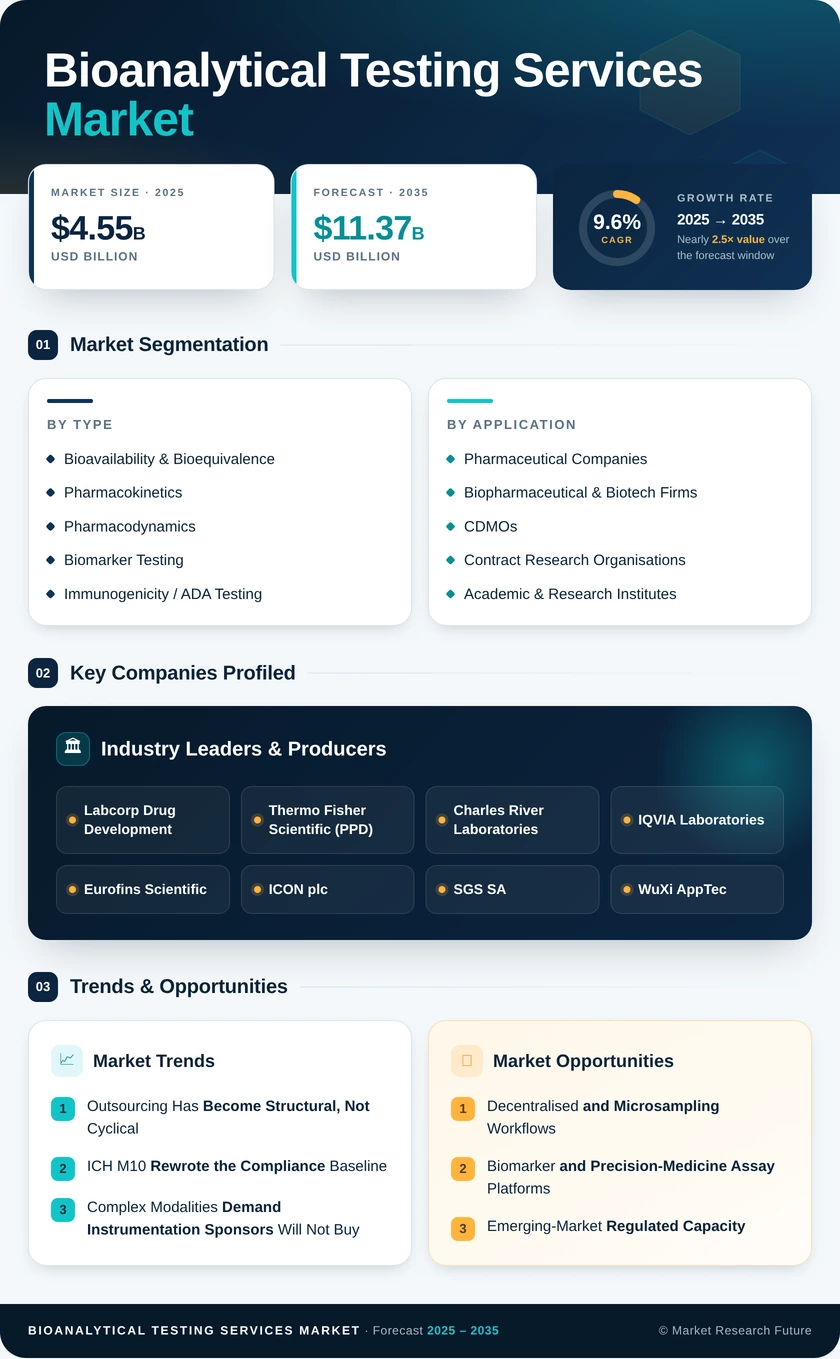
Segmentation Quick Reference
| Dimension | Sub-Segments | Dominant Segment | Fastest Growing Segment |
| By Molecule Type | Small Molecules; Large Molecules | Small Molecules | Large Molecules |
| By Test Type | Bioavailability & Bioequivalence; Pharmacokinetics; Pharmacodynamics; Biomarker Testing; Immunogenicity / ADA Testing; Method Development & Validation; Other Test Types | Bioavailability & Bioequivalence | Biomarker Testing |
| By End User | Pharmaceutical Companies; Biopharmaceutical & Biotech Firms; CDMOs; Contract Research Organisations; Academic & Research Institutes; Other End Users | Pharmaceutical Companies | CDMOs |
| By Geography | North America; Europe; Asia-Pacific; South America; Middle East & Africa | North America | Asia-Pacific |
Market Segmentation Overview
By Molecule Type
| Sub-Segment | Key Trend |
| Small Molecules | High-throughput bioequivalence volume tied to patent-cliff generics; pricing commoditised |
| Large Molecules | Antibody-drug conjugate and bispecific assays require orthogonal quantification workflows. |
Molecule type remains the cleanest predictor of assay economics. Small-molecule work scales on throughput and automation; large-molecule work scales on scientific depth, reagent control and immunogenicity capability. Providers are reallocating capital toward the latter without abandoning the volume base that funds it.
By Test Type
| Sub-Segment | Key Trend |
| Bioavailability & Bioequivalence | Registration-driven demand across generics; regional laboratories competitive |
| Pharmacokinetics | Dose-selection and ethnic-bridging studies sustain steady multi-region demand. |
| Pharmacodynamics | Target-engagement evidence increasingly expected at IND stage. |
| Biomarker Testing | Fit-for-purpose qualification pulled earlier into development timelines. |
| Immunogenicity / ADA Testing | Mandatory tiered testing for all biologics filings |
| Method Development & Validation | ICH M10 documentation depth raising per-method effort |
| Other Test Types | Metabolite identification and stability profiling round out scope. |
Test type is where margin dispersion is widest. Bioequivalence sits near the commodity floor while biomarker and immunogenicity work commands premium pricing tied to scientific scarcity rather than capacity.
By End User
| Sub-Segment | Key Trend |
| Pharmaceutical Companies | Consolidating to three or fewer preferred analytical providers |
| Biopharmaceutical & Biotech Firms | Fully outsourced models driven by venture capital efficiency pressure |
| CDMOs | Bundling analytical scope into manufacturing contracts |
| Contract Research Organisations | Subcontracting specialty assays to instrument-rich partners |
| Academic & Research Institutes | Translational grant funding supports exploratory biomarker work. |
| Other End Users | Public health and government programmes contribute modest volume. |
End-user mix is shifting faster than segment shares suggest. CDMO encroachment blurs the boundary between manufacture and analysis, and buyers should model that convergence when structuring multi-year supply agreements.
By Geography
| Sub-Segment | Key Trend |
| North America | Automation retrofit and cell/gene therapy assay capacity expansion |
| Europe | Biosimilar comparability workload and EU CTR documentation standards |
| Asia-Pacific | ICH alignment converting cost arbitrage into regulated pivotal-study wins |
| South America | ANVISA registration requirements driving domestic laboratory accreditation |
| Middle East & Africa | Sovereign biotech strategies funding nascent laboratory infrastructure |
Regional divergence is widening rather than converging. Mature markets compete on inspection credibility and turnaround; emerging markets compete on accreditation build-out and registration-linked demand.
Opus 5 High

 Noah Malgeri
Co-Founder
Noah Malgeri
Co-Founder

 Peter Groot koerkamp
Account and Business Manager
Peter Groot koerkamp
Account and Business Manager

 Younghwan Choi
Senior Retail Manager
Younghwan Choi
Senior Retail Manager

 Mark Irwin
Management Consultant
Mark Irwin
Management Consultant

 Akif Moroglu
Strategy & Business Development Director
Akif Moroglu
Strategy & Business Development Director

 Guilherme Gomes Martins
Product Management Director
Guilherme Gomes Martins
Product Management Director

 Joseph Aguayo
Sales Operations & Pricing Manager
Joseph Aguayo
Sales Operations & Pricing Manager

 La Terria Dodd
Program Support Specialist
La Terria Dodd
Program Support Specialist

 Rob Kooiker
Group Product Manager HVAC & Fire Protection GMA
Rob Kooiker
Group Product Manager HVAC & Fire Protection GMA