×
Request Free Sample ×

Kindly complete the form below to receive a free sample of this Report

* Please use a valid business email

Leading companies partner with us for data-driven Insights

clients tt-cursor
Hero Background
English
Chinese
French
Japanese
Korean
German
Spanish

Bio process Technology Market Trends

ID: MRFR/LS/1563-HCR
85 Pages
Rahul Gotadki
February 2026

Bioprocess Technology Market Research Report: Size, Share, Trend Analysis By Applications (Monoclonal Antibodies, Vaccines, Recombinant Proteins, Gene Therapy), By Product Type (Bioreactors, Filtration Systems, Separation Systems, Cell Culture Systems), By End Users (Pharmaceuticals, Biotechnology Companies, Academic Research Institutions, Contract Research Organizations), By Scale of Operation (Laboratory Scale, Pilot Scale, Industrial Scale) and By Regional (North America, Europe, South America, Asia-Pacific, Middle East and Africa) - Growth Outlook & Industry Forecast 2025 To 2035

Share:
Download PDF ×

We do not share your information with anyone. However, we may send you emails based on your report interest from time to time. You may contact us at any time to opt-out.

Bio process Technology Market Infographic
Purchase Options

Market Trends

Key Emerging Trends in the Bio process Technology Market

The Bioprocess Technology market has witnessed noteworthy trends, reflecting the continuous advancements in biotechnology, pharmaceuticals, and the growing demand for efficient and scalable processes for the production of biopharmaceuticals. One significant trend is the increasing adoption of single-use bioprocessing systems. Single-use technologies offer advantages such as flexibility, reduced cross-contamination risks, and faster turnaround times, contributing to cost-effectiveness in bioproduction. This trend is driven by the industry's shift towards modular and flexible manufacturing processes, enabling biopharmaceutical companies to adapt quickly to changing production needs and optimize resource utilization.

Moreover, the market is experiencing a surge in demand for continuous bioprocessing. Traditionally, bioprocessing involved batch production, but the move towards continuous processing offers benefits like higher productivity, reduced manufacturing footprint, and improved product quality. Continuous bioprocessing is particularly advantageous in the production of monoclonal antibodies and other biologics, where the steady-state operation allows for greater control over critical parameters. This trend aligns with the industry's quest for efficiency, cost-effectiveness, and the ability to meet the growing global demand for biopharmaceuticals.

Technological advancements in analytics, automation, and data management are playing a pivotal role in shaping market trends within the Bioprocess Technology industry. The integration of real-time monitoring and control systems enhances process understanding, reduces variability, and ensures consistent product quality. Automation in bioprocessing not only increases efficiency but also addresses labor shortages and minimizes manual errors. Additionally, the use of advanced data analytics tools facilitates process optimization, predictive maintenance, and better decision-making, contributing to the overall efficiency and reliability of bioproduction.

Another noteworthy trend is the focus on sustainability in bioprocessing. As the biopharmaceutical industry grows, there is a heightened awareness of the environmental impact of production processes. Companies are adopting green bioprocessing practices, incorporating renewable energy sources, optimizing raw material usage, and implementing waste reduction strategies. This trend reflects the industry's commitment to responsible and sustainable manufacturing practices, aligning with global efforts to minimize the ecological footprint of bioproduction.

The market for bioprocess technology is also influenced by the increasing demand for personalized medicine and cell and gene therapies. The development and commercialization of these advanced therapies require specialized bioprocessing technologies capable of handling complex cell culture processes, viral vector production, and gene editing procedures. The trend towards personalized medicine emphasizes the need for flexible and adaptable bioprocessing solutions to cater to the unique requirements of individualized treatments.

Geographically, market trends in the Bioprocess Technology market vary based on regional research capabilities, manufacturing capacities, and regulatory environments. Developed regions with established biopharmaceutical industries, such as North America and Europe, are witnessing continuous innovation and adoption of advanced bioprocessing technologies. In contrast, emerging markets in Asia-Pacific are experiencing rapid growth, driven by increased investments in biotechnology, favorable regulatory landscapes, and a growing demand for biopharmaceutical products.


Author
Rahul Gotadki
Research Manager

He holds an experience of about 9+ years in Market Research and Business Consulting, working under the spectrum of Life Sciences and Healthcare domains. Rahul conceptualizes and implements a scalable business strategy and provides strategic leadership to the clients. His expertise lies in market estimation, competitive intelligence, pipeline analysis, customer assessment, etc.

Leave a Comment

FAQs

What is the projected market valuation of the Bioprocess Technology Market by 2035?

<p>The projected market valuation of the Bioprocess Technology Market is expected to reach 53.92 USD Billion by 2035.</p>

What was the market valuation of the Bioprocess Technology Market in 2024?

<p>The overall market valuation of the Bioprocess Technology Market was 27.74 USD Billion in 2024.</p>

What is the expected CAGR for the Bioprocess Technology Market during the forecast period 2025 - 2035?

<p>The expected CAGR for the Bioprocess Technology Market during the forecast period 2025 - 2035 is 6.23%.</p>

Which application segment is projected to have the highest growth in the Bioprocess Technology Market?

<p>The Monoclonal Antibodies application segment is projected to grow from 8.5 USD Billion in 2024 to 16.5 USD Billion by 2035.</p>

What are the key product types in the Bioprocess Technology Market?

<p>Key product types include Bioreactors, Filtration Systems, Separation Systems, and Cell Culture Systems.</p>

How much is the Cell Culture Systems segment expected to grow by 2035?

<p>The Cell Culture Systems segment is expected to grow from 8.24 USD Billion in 2024 to 15.42 USD Billion by 2035.</p>

Who are the leading companies in the Bioprocess Technology Market?

<p>Leading companies in the Bioprocess Technology Market include Thermo Fisher Scientific, Sartorius, Merck KGaA, and GE Healthcare.</p>

What is the expected growth for the Pharmaceuticals end-user segment by 2035?

<p>The Pharmaceuticals end-user segment is expected to grow from 10.0 USD Billion in 2024 to 20.0 USD Billion by 2035.</p>

What is the anticipated growth for the Industrial Scale of Operation in the Bioprocess Technology Market?

The Industrial Scale of Operation is anticipated to grow from 14.77 USD Billion in 2024 to 28.07 USD Billion by 2035.

Which end-user segment is projected to experience the least growth by 2035?

The Contract Research Organizations end-user segment is projected to grow from 4.74 USD Billion in 2024 to 8.92 USD Billion by 2035.

Market Summary

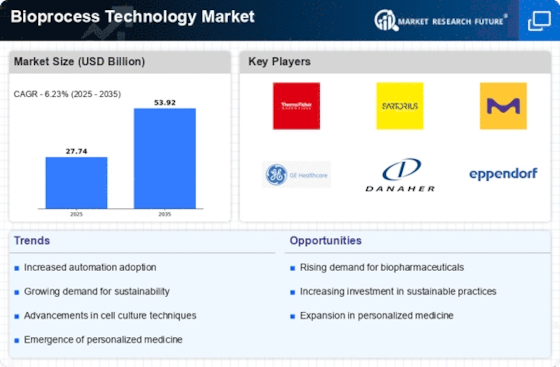
As per Market Research Future analysis, the Bioprocess Technology Market Size was estimated at 27.74 USD Billion in 2024. The Bioprocess Technology industry is projected to grow from 29.46 USD Billion in 2025 to 53.92 USD Billion by 2035, exhibiting a compound annual growth rate (CAGR) of 6.23% during the forecast period 2025 - 2035

Key Market Trends & Highlights

The Bioprocess Technology Market is poised for substantial growth driven by innovation and sustainability.

  • North America remains the largest market for bioprocess technology, reflecting robust demand for biopharmaceuticals. The Asia-Pacific region is emerging as the fastest-growing market, fueled by increasing investments in biotech startups. Monoclonal antibodies dominate the market, while vaccines are rapidly gaining traction as the fastest-growing segment. Rising demand for biopharmaceuticals and technological advancements in bioprocessing are key drivers propelling market expansion.

Market Size & Forecast

2024 Market Size 27.74 (USD Billion)
2035 Market Size 53.92 (USD Billion)
CAGR (2025 - 2035) 6.23%
Largest Regional Market Share in 2024 North America

Major Players

Thermo Fisher Scientific (US), Sartorius (DE), Merck KGaA (DE), GE Healthcare (US), Danaher Corporation (US), Eppendorf AG (DE), Boehringer Ingelheim (DE), AbbVie (US), Lonza Group (CH)

Market Trends

The Bioprocess Technology Market is currently experiencing a transformative phase, driven by advancements in biomanufacturing processes and increasing demand for biopharmaceuticals. This sector appears to be evolving rapidly, with a growing emphasis on sustainable practices and the integration of automation technologies.

Companies are increasingly focusing on optimizing production efficiency while minimizing environmental impact, which suggests a shift towards greener methodologies.

Furthermore, the rise of personalized medicine is likely to influence the development of tailored bioprocessing solutions, enhancing the overall efficacy of therapeutic products. In addition, the Bioprocess Technology Market is witnessing a surge in collaborations between academic institutions and industry players.

These partnerships seem to foster innovation and accelerate the development of novel bioprocessing techniques. As regulatory frameworks continue to evolve, there is a potential for increased investment in research and development, which may further propel market growth. Overall, the landscape of the Bioprocess Technology Market appears dynamic, with various factors converging to shape its future trajectory.

Sustainable Practices

The emphasis on sustainability within the Bioprocess Technology Market is becoming increasingly pronounced. Companies are exploring eco-friendly alternatives in their production processes, aiming to reduce waste and energy consumption. This trend indicates a broader commitment to environmental stewardship, which may resonate well with consumers and stakeholders alike.

Automation and Digitalization

The integration of automation and digital technologies is transforming the Bioprocess Technology Market. By leveraging advanced data analytics and process automation, organizations are enhancing operational efficiency and reducing human error. This trend suggests a move towards more streamlined and responsive biomanufacturing processes.

Collaborative Innovation

Collaborations between academia and industry are fostering innovation in the Bioprocess Technology Market. These partnerships appear to facilitate the exchange of knowledge and resources, leading to the development of cutting-edge bioprocessing techniques. This trend may enhance the overall competitiveness of the market.

Bio process Technology Market Market Drivers

Regulatory Support and Compliance

Regulatory frameworks are increasingly supportive of bioprocess technology, which is crucial for ensuring the safety and efficacy of biopharmaceutical products. The Bioprocess Technology Market is benefiting from streamlined approval processes and guidelines that encourage innovation while maintaining high safety standards.

Regulatory agencies are recognizing the importance of bioprocessing in the development of new therapies, leading to initiatives that promote research and development in this field.

As a result, companies are more inclined to invest in bioprocess technology, knowing that regulatory support can facilitate market entry and reduce time to commercialization. This trend is expected to bolster the growth of the bioprocess technology market.

Rising Demand for Biopharmaceuticals

The increasing prevalence of chronic diseases and the aging population are driving the demand for biopharmaceuticals, which are produced using bioprocess technology. This trend is evident as the biopharmaceutical market is projected to reach approximately USD 500 billion by 2025.

The Bioprocess Technology Market is poised to benefit from this surge, as bioprocessing techniques are essential for the production of monoclonal antibodies, vaccines, and other biologics.

Furthermore, advancements in bioprocessing methods, such as continuous manufacturing and single-use technologies, are enhancing production efficiency and reducing costs. As a result, companies are increasingly investing in bioprocess technology to meet the growing demand for innovative therapies, thereby propelling the market forward.

Increasing Investment in Biotech Startups

The Bioprocess Technology Market is witnessing a surge in investment from venture capitalists and private equity firms targeting biotech startups.

This influx of capital is primarily driven by the potential for innovative bioprocessing solutions that can address unmet medical needs. Investors are increasingly recognizing the value of bioprocess technology in developing novel therapeutics and biologics. 

As a result, many startups are emerging with groundbreaking technologies that enhance bioprocess efficiency and product quality. This trend not only stimulates innovation but also contributes to the overall growth of the bioprocess technology market, as these startups often collaborate with established companies to bring their solutions to market.

Technological Advancements in Bioprocessing

Technological innovations are transforming the Bioprocess Technology Market, enabling more efficient and cost-effective production processes.

The integration of automation, artificial intelligence, and machine learning into bioprocessing is streamlining operations and enhancing product quality. For instance, the adoption of real-time monitoring systems allows for better control of bioprocess parameters, leading to higher yields and reduced production times.

Additionally, the development of advanced bioreactor designs and improved cell culture techniques is facilitating the production of complex biologics. As these technologies continue to evolve, they are likely to attract significant investments, further driving growth in the bioprocess technology sector.

Focus on Sustainable Manufacturing Practices

Sustainability is becoming a key focus within the Bioprocess Technology Market, as companies seek to minimize their environmental impact. The shift towards greener manufacturing processes is driven by both regulatory pressures and consumer demand for environmentally friendly products.

Bioprocessing techniques, such as the use of renewable resources and waste reduction strategies, are being adopted to enhance sustainability. For example, the implementation of biocatalysis and fermentation processes can lead to lower energy consumption and reduced carbon footprints.

As sustainability becomes a priority, companies that invest in bioprocess technology are likely to gain a competitive edge, positioning themselves favorably in the market.

Market Segment Insights

By Application: Monoclonal Antibodies (Largest) vs. Vaccines (Fastest-Growing)

In the bioprocess technology market, monoclonal antibodies hold a significant share, dominating the application segment due to their extensive use in therapeutic and diagnostic applications.</p> <p> </p> <p>Following closely are vaccines, which have seen a sharp increase in demand, especially in the wake of global health challenges. The recombinant proteins and gene therapy sectors also contribute to the market, albeit at a smaller scale, reflecting unique applications in drug development and personalized medicine.

<h4 style="margin-top: 25px; margin-bottom: 15px;">Biopharmaceuticals: Monoclonal Antibodies (Dominant) vs. Gene Therapy (Emerging)</h4>

Monoclonal antibodies have established themselves as a dominant force in biopharmaceuticals, widely recognized for their effectiveness in treating various conditions, including cancer and autoimmune disorders. Their strong market position is bolstered by a robust pipeline of approved therapies and ongoing research.</p> <p> </p> <p>In contrast, gene therapy is emerging as a revolutionary approach, promising innovative treatments for genetic disorders and rare diseases. Although still in its developmental stages, advancements in delivery mechanisms and regulatory support are positioning gene therapy as a key growth area within the bioprocess technology market.

By Product Type: Bioreactors (Largest) vs. Filtration Systems (Fastest-Growing)

The Bioprocess Technology Market showcases a diverse range of product types, with bioreactors leading the way in market share. This segment dominates due to its essential role in the cultivation of microorganisms and cell cultures, fundamental for biopharmaceutical production.</p> <p> </p> <p>Following bioreactors, filtration systems hold a significant portion of the market, used extensively in purification processes, while separation systems and cell culture systems occupy smaller shares but contribute to specific operational needs across bioprocessing.

<h4 style="margin-top: 25px; margin-bottom: 15px;">Filtration Systems (Dominant) vs. Separation Systems (Emerging)</h4>

Filtration systems are critical in maintaining the integrity of bioprocesses by ensuring the removal of contaminants and unwanted byproducts, thus maintaining product quality. They represent a dominant portion of the market due to their widespread application in various industries, including pharmaceuticals and biotechnology.</p> <p> </p> <p>Conversely, separation systems are emerging, gaining traction as they offer advanced methodologies for isolating desired products from complex mixtures. These systems are designed to enhance efficiency and scalability in bioprocessing, catering to the increasing demand for precision in product isolation, which is pivotal for innovation in bioproduct development.

By End User: Pharmaceuticals (Largest) vs. Biotechnology Companies (Fastest-Growing)

The Bioprocess Technology Market displays a diverse range of end users, among which the pharmaceuticals segment holds the largest share. This sector significantly benefits from advanced bioprocessing technologies, leading to efficient production and lowered costs.</p> <p> </p> <p>The biotechnology companies segment, while smaller in market share, is rapidly growing as these organizations increasingly focus on innovative product development and personalized medicine. This diversification contributes to the overall dynamics of the market.

<h4 style="margin-top: 25px; margin-bottom: 15px;">Pharmaceuticals (Dominant) vs. Biotechnology Companies (Emerging)</h4>

Pharmaceuticals represent the dominant end user segment within the Bioprocess Technology Market, primarily due to their extensive utilization of these technologies for drug manufacturing, formulation, and quality control. Characterized by high regulatory standards and a rigorous development timeline, this segment thrives on efficiency and reliability offered by bioprocess technologies.</p> <p> </p> <p>On the other hand, biotechnology companies are categorized as an emerging segment that is swiftly gaining traction. These companies focus on cutting-edge research and the development of novel therapeutic products, further propelled by strategic collaborations and advancements in synthetic biology. Their agility in adopting new bioprocessing applications positions them favorably for growth.

By Scale of Operation: Industrial Scale (Largest) vs. Laboratory Scale (Fastest-Growing)

In the Bioprocess Technology Market, the scale of operation significantly influences market dynamics, with the industrial scale holding the largest share. This segment is characterized by mass production capabilities that are crucial for meeting the global demand for bioproducts. Conversely, the laboratory scale, while smaller in share, is rapidly gaining traction as it supports research and development activities, crucial for innovation within the industry.</p> <p> </p> <p>Moreover, pilot scale operations serve as essential intermediaries, helping to bridge the gap between laboratory experiments and full-scale industrial production, thus holding a notable place in the market hierarchy. The growth trends in this segment are influenced by several factors, including advancements in bioprocessing techniques and increased regulatory support for biopharmaceutical manufacturing.</p> <p> </p> <p>The industrial scale continues to dominate due to its ability to efficiently produce large volumes, although the laboratory scale is seeing robust growth driven by the rise in biotechnology research and the need for more personalized medicine solutions. Furthermore, pilot scale operations are vital for testing new bioprocess technologies before they are implemented on a larger scale, making them critical to the overall market development strategy in the bioprocess landscape.

<h4 style="margin-top: 25px; margin-bottom: 15px;">Industrial Scale (Dominant) vs. Laboratory Scale (Emerging)</h4>

The industrial scale in the Bioprocess Technology Market is recognized as the dominant force, primarily due to its significance in large-volume production of biologics and other bioproducts. This segment enables manufacturers to harness economies of scale, resulting in lowered per-unit costs and maximized output efficiency.</p> <p> </p> <p>In contrast, the laboratory scale, while emerging, plays a crucial role in the initial stages of bioprocess research and development. It offers flexibility and is essential for experimentation and validation of bioprocess techniques before scaling up. The growth of the laboratory scale is propelled by the increasing number of startups in biotech and a surge in academic research initiatives, emphasizing its importance in the innovation pipeline of the industry.

Get more detailed insights about Bioprocess Technology Market Research Report- Forecast To 2035

Regional Insights

The Bioprocess Technology Market is expected to reach a valuation of 26.11 USD Billion in 2023, with significant contributions from various regions.

North America holds a majority share, valued at 10.5 USD Billion in 2023 and is set to reach 53.9 USD Billion by 2035, driven by advanced bioprocessing technologies and a robust research environment. Europe follows closely, with a valuation of 8.0 USD Billion in 2023, projected to increase to 53.9 USD Billion by 2035, supported by a growing focus on biopharmaceuticals.

The Asia-Pacific region, valued at 5.5 USD Billion in 2023 and expected to rise to 9.5 USD Billion in 2032, demonstrates significant growth potential due to increasing investments in bioprocessing infrastructure and a rising demand for biopharmaceuticals.

South America, with a valuation of 1.5 USD Billion in 2023 and anticipated to grow to 2.5 USD Billion by 2032, is gradually emerging as a market with economic growth and investments in biotechnology. Lastly, the MEA region, valued at 0.6 USD Billion in 2023, shows growth prospects, with expectations to reach 1.3 USD Billion by 2032 as the bioprocess technology sector develops.

Overall, the global market reflects varied opportunities and challenges across different regions.

Key Players and Competitive Insights

The Bioprocess Technology Market is characterized by rapid evolution and intense competition, driven by the rising demand for biopharmaceuticals and bioprocessing equipment that facilitate drug development and production.
The market encompasses a variety of players, including small-scale biotechnology firms, large pharmaceutical corporations, and specialized equipment manufacturers. Technological advancements, regulatory frameworks, and the need for cost-effective solutions influence competition within this sector.
Companies are investing heavily in research and development to innovate and improve existing platforms, which leads to an ever-changing landscape. Key strategies for success in this market include forging strategic alliances, enhancing product portfolios, and expanding into emerging markets.
The competitive dynamics are further complicated by the need to ensure compliance with stringent regulatory standards, driving companies to focus on quality and efficiency as they strive for market leadership.Eppendorf AG has a prominent position in the Bioprocess Technology Market, leveraging its strong expertise in bioprocessing and laboratory supplies.
The company is recognized for its innovative approach to bioprocess development and scaling, enabling researchers and manufacturers to optimize their workflows. With a well-established brand reputation, Eppendorf AG emphasizes high-quality products that ensure reliability and precision.
Their extensive portfolio includes bioreactors, cell culture systems, and laboratory equipment, which are widely adopted in both research and industrial applications. The company's commitment to innovation is further evidenced by its ongoing investment in modern technologies, allowing Eppendorf AG to maintain a competitive edge.
Their strategic focus on customer needs and the continuous improvement of their product offerings are instrumental in enhancing their role within the bioprocess technology landscape.GE Healthcare holds a significant market share in the Bioprocess Technology Market, recognized for providing solutions that facilitate the efficient production of biopharmaceuticals.
The company features a comprehensive array of products and services, including bioprocess technology platforms, process development tools, and advanced analytics systems. Leveraging its extensive experience and resources, GE Healthcare excels in addressing the complexities of biomanufacturing, offering end-to-end solutions that cater to the specific needs of its clients.
The company's investment in cutting-edge technologies, such as single-use components and automation solutions, positions it as a leader in the market. Furthermore, GE Healthcare's collaborative approach to partnerships with biopharma companies allows it to adapt rapidly to industry changes, reinforcing its status as a trusted player in the bioprocess technology arena.

Key Companies in the Bio process Technology Market include

Industry Developments

The Bioprocess Technology Market has witnessed significant developments recently, with companies like Eppendorf AG and Thermo Fisher Scientific enhancing their product offerings to improve efficiency in biopharmaceutical developments. Agilent Technologies has also expanded its portfolio, focusing on advanced bioprocess analytics.

A noteworthy acquisition in the market is the acquisition of a majority stake in a bioprocessing company by Danaher Corporation, aimed at enhancing its production capabilities. Additionally, Merck KGaA and Fujifilm Diosynth Biotechnologies have been collaborating on biotherapeutics development, which has garnered attention in the industry.

The overall market has seen robust growth, with increased funding and investments driving innovations in upstream and downstream processing. Companies like Sartorius AG have reported substantial increases in their market valuation, indicating a strong demand trend.

The necessity for more efficient and scalable manufacturing processes has prompted firms like Waters Corporation and Repligen Corporation to accelerate their development of new technologies.

Current trends highlight a surge in demand for single-use bioprocessing systems, signifying a shift toward more flexible manufacturing solutions. Overall, the market continues to evolve with mergers, acquisitions, and innovative solutions shaping its future landscape.

Future Outlook

Bio process Technology Market Future Outlook

The Bioprocess Technology Market is projected to grow at a 6.23% CAGR from 2025 to 2035, driven by advancements in biomanufacturing, increasing demand for biologics, and regulatory support.

New opportunities lie in:

  • Development of integrated bioprocessing platforms for enhanced efficiency.
  • Expansion into emerging markets with tailored bioprocess solutions.
  • Investment in sustainable bioprocess technologies to meet environmental regulations.

By 2035, the Bioprocess Technology Market is expected to be robust, reflecting substantial growth and innovation.

Market Segmentation

Bio process Technology Market End User Outlook

  • Pharmaceuticals
  • Biotechnology Companies
  • Academic Research Institutions
  • Contract Research Organizations

Bio process Technology Market Application Outlook

  • Monoclonal Antibodies
  • Vaccines
  • Recombinant Proteins
  • Gene Therapy

Bio process Technology Market Product Type Outlook

  • Bioreactors
  • Filtration Systems
  • Separation Systems
  • Cell Culture Systems

Bio process Technology Market Scale of Operation Outlook

  • Laboratory Scale
  • Pilot Scale
  • Industrial Scale

Report Scope

MARKET SIZE 2024 27.74(USD Billion)
MARKET SIZE 2025 29.46(USD Billion)
MARKET SIZE 2035 53.92(USD Billion)
COMPOUND ANNUAL GROWTH RATE (CAGR) 6.23% (2025 - 2035)
REPORT COVERAGE Revenue Forecast, Competitive Landscape, Growth Factors, and Trends
BASE YEAR 2024
Market Forecast Period 2025 - 2035
Historical Data 2019 - 2024
Market Forecast Units USD Billion
Key Companies Profiled Thermo Fisher Scientific (US), Sartorius (DE), Merck KGaA (DE), GE Healthcare (US), Danaher Corporation (US), Eppendorf AG (DE), Boehringer Ingelheim (DE), AbbVie (US), Lonza Group (CH)
Segments Covered Applications, Product Type, End Users, Scale of Operation, Regional
Key Market Opportunities Advancements in cell culture technologies enhance productivity in the Bioprocess Technology Market.
Key Market Dynamics Technological advancements and regulatory changes drive innovation and efficiency in the Bioprocess Technology Market.
Countries Covered North America, Europe, APAC, South America, MEA

FAQs

What is the projected market valuation of the Bioprocess Technology Market by 2035?

<p>The projected market valuation of the Bioprocess Technology Market is expected to reach 53.92 USD Billion by 2035.</p>

What was the market valuation of the Bioprocess Technology Market in 2024?

<p>The overall market valuation of the Bioprocess Technology Market was 27.74 USD Billion in 2024.</p>

What is the expected CAGR for the Bioprocess Technology Market during the forecast period 2025 - 2035?

<p>The expected CAGR for the Bioprocess Technology Market during the forecast period 2025 - 2035 is 6.23%.</p>

Which application segment is projected to have the highest growth in the Bioprocess Technology Market?

<p>The Monoclonal Antibodies application segment is projected to grow from 8.5 USD Billion in 2024 to 16.5 USD Billion by 2035.</p>

What are the key product types in the Bioprocess Technology Market?

<p>Key product types include Bioreactors, Filtration Systems, Separation Systems, and Cell Culture Systems.</p>

How much is the Cell Culture Systems segment expected to grow by 2035?

<p>The Cell Culture Systems segment is expected to grow from 8.24 USD Billion in 2024 to 15.42 USD Billion by 2035.</p>

Who are the leading companies in the Bioprocess Technology Market?

<p>Leading companies in the Bioprocess Technology Market include Thermo Fisher Scientific, Sartorius, Merck KGaA, and GE Healthcare.</p>

What is the expected growth for the Pharmaceuticals end-user segment by 2035?

<p>The Pharmaceuticals end-user segment is expected to grow from 10.0 USD Billion in 2024 to 20.0 USD Billion by 2035.</p>

What is the anticipated growth for the Industrial Scale of Operation in the Bioprocess Technology Market?

The Industrial Scale of Operation is anticipated to grow from 14.77 USD Billion in 2024 to 28.07 USD Billion by 2035.

Which end-user segment is projected to experience the least growth by 2035?

The Contract Research Organizations end-user segment is projected to grow from 4.74 USD Billion in 2024 to 8.92 USD Billion by 2035.

  1. SECTION I: EXECUTIVE SUMMARY AND KEY HIGHLIGHTS
    1. | 1.1 EXECUTIVE SUMMARY
    2. | | 1.1.1 Market Overview
    3. | | 1.1.2 Key Findings
    4. | | 1.1.3 Market Segmentation
    5. | | 1.1.4 Competitive Landscape
    6. | | 1.1.5 Challenges and Opportunities
    7. | | 1.1.6 Future Outlook
  2. SECTION II: SCOPING, METHODOLOGY AND MARKET STRUCTURE
    1. | 2.1 MARKET INTRODUCTION
    2. | | 2.1.1 Definition
    3. | | 2.1.2 Scope of the study
    4. | | | 2.1.2.1 Research Objective
    5. | | | 2.1.2.2 Assumption
    6. | | | 2.1.2.3 Limitations
    7. | 2.2 RESEARCH METHODOLOGY
    8. | | 2.2.1 Overview
    9. | | 2.2.2 Data Mining
    10. | | 2.2.3 Secondary Research
    11. | | 2.2.4 Primary Research
    12. | | | 2.2.4.1 Primary Interviews and Information Gathering Process
    13. | | | 2.2.4.2 Breakdown of Primary Respondents
    14. | | 2.2.5 Forecasting Model
    15. | | 2.2.6 Market Size Estimation
    16. | | | 2.2.6.1 Bottom-Up Approach
    17. | | | 2.2.6.2 Top-Down Approach
    18. | | 2.2.7 Data Triangulation
    19. | | 2.2.8 Validation
  3. SECTION III: QUALITATIVE ANALYSIS
    1. | 3.1 MARKET DYNAMICS
    2. | | 3.1.1 Overview
    3. | | 3.1.2 Drivers
    4. | | 3.1.3 Restraints
    5. | | 3.1.4 Opportunities
    6. | 3.2 MARKET FACTOR ANALYSIS
    7. | | 3.2.1 Value chain Analysis
    8. | | 3.2.2 Porter's Five Forces Analysis
    9. | | | 3.2.2.1 Bargaining Power of Suppliers
    10. | | | 3.2.2.2 Bargaining Power of Buyers
    11. | | | 3.2.2.3 Threat of New Entrants
    12. | | | 3.2.2.4 Threat of Substitutes
    13. | | | 3.2.2.5 Intensity of Rivalry
    14. | | 3.2.3 COVID-19 Impact Analysis
    15. | | | 3.2.3.1 Market Impact Analysis
    16. | | | 3.2.3.2 Regional Impact
    17. | | | 3.2.3.3 Opportunity and Threat Analysis
  4. SECTION IV: QUANTITATIVE ANALYSIS
    1. | 4.1 Healthcare, BY Application (USD Billion)
    2. | | 4.1.1 Monoclonal Antibodies
    3. | | 4.1.2 Vaccines
    4. | | 4.1.3 Recombinant Proteins
    5. | | 4.1.4 Gene Therapy
    6. | 4.2 Healthcare, BY Product Type (USD Billion)
    7. | | 4.2.1 Bioreactors
    8. | | 4.2.2 Filtration Systems
    9. | | 4.2.3 Separation Systems
    10. | | 4.2.4 Cell Culture Systems
    11. | 4.3 Healthcare, BY End User (USD Billion)
    12. | | 4.3.1 Pharmaceuticals
    13. | | 4.3.2 Biotechnology Companies
    14. | | 4.3.3 Academic Research Institutions
    15. | | 4.3.4 Contract Research Organizations
    16. | 4.4 Healthcare, BY Scale of Operation (USD Billion)
    17. | | 4.4.1 Laboratory Scale
    18. | | 4.4.2 Pilot Scale
    19. | | 4.4.3 Industrial Scale
    20. | 4.5 Healthcare, BY Region (USD Billion)
    21. | | 4.5.1 North America
    22. | | | 4.5.1.1 US
    23. | | | 4.5.1.2 Canada
    24. | | 4.5.2 Europe
    25. | | | 4.5.2.1 Germany
    26. | | | 4.5.2.2 UK
    27. | | | 4.5.2.3 France
    28. | | | 4.5.2.4 Russia
    29. | | | 4.5.2.5 Italy
    30. | | | 4.5.2.6 Spain
    31. | | | 4.5.2.7 Rest of Europe
    32. | | 4.5.3 APAC
    33. | | | 4.5.3.1 China
    34. | | | 4.5.3.2 India
    35. | | | 4.5.3.3 Japan
    36. | | | 4.5.3.4 South Korea
    37. | | | 4.5.3.5 Malaysia
    38. | | | 4.5.3.6 Thailand
    39. | | | 4.5.3.7 Indonesia
    40. | | | 4.5.3.8 Rest of APAC
    41. | | 4.5.4 South America
    42. | | | 4.5.4.1 Brazil
    43. | | | 4.5.4.2 Mexico
    44. | | | 4.5.4.3 Argentina
    45. | | | 4.5.4.4 Rest of South America
    46. | | 4.5.5 MEA
    47. | | | 4.5.5.1 GCC Countries
    48. | | | 4.5.5.2 South Africa
    49. | | | 4.5.5.3 Rest of MEA
  5. SECTION V: COMPETITIVE ANALYSIS
    1. | 5.1 Competitive Landscape
    2. | | 5.1.1 Overview
    3. | | 5.1.2 Competitive Analysis
    4. | | 5.1.3 Market share Analysis
    5. | | 5.1.4 Major Growth Strategy in the Healthcare
    6. | | 5.1.5 Competitive Benchmarking
    7. | | 5.1.6 Leading Players in Terms of Number of Developments in the Healthcare
    8. | | 5.1.7 Key developments and growth strategies
    9. | | | 5.1.7.1 New Product Launch/Service Deployment
    10. | | | 5.1.7.2 Merger & Acquisitions
    11. | | | 5.1.7.3 Joint Ventures
    12. | | 5.1.8 Major Players Financial Matrix
    13. | | | 5.1.8.1 Sales and Operating Income
    14. | | | 5.1.8.2 Major Players R&D Expenditure. 2023
    15. | 5.2 Company Profiles
    16. | | 5.2.1 Thermo Fisher Scientific (US)
    17. | | | 5.2.1.1 Financial Overview
    18. | | | 5.2.1.2 Products Offered
    19. | | | 5.2.1.3 Key Developments
    20. | | | 5.2.1.4 SWOT Analysis
    21. | | | 5.2.1.5 Key Strategies
    22. | | 5.2.2 Sartorius (DE)
    23. | | | 5.2.2.1 Financial Overview
    24. | | | 5.2.2.2 Products Offered
    25. | | | 5.2.2.3 Key Developments
    26. | | | 5.2.2.4 SWOT Analysis
    27. | | | 5.2.2.5 Key Strategies
    28. | | 5.2.3 Merck KGaA (DE)
    29. | | | 5.2.3.1 Financial Overview
    30. | | | 5.2.3.2 Products Offered
    31. | | | 5.2.3.3 Key Developments
    32. | | | 5.2.3.4 SWOT Analysis
    33. | | | 5.2.3.5 Key Strategies
    34. | | 5.2.4 GE Healthcare (US)
    35. | | | 5.2.4.1 Financial Overview
    36. | | | 5.2.4.2 Products Offered
    37. | | | 5.2.4.3 Key Developments
    38. | | | 5.2.4.4 SWOT Analysis
    39. | | | 5.2.4.5 Key Strategies
    40. | | 5.2.5 Danaher Corporation (US)
    41. | | | 5.2.5.1 Financial Overview
    42. | | | 5.2.5.2 Products Offered
    43. | | | 5.2.5.3 Key Developments
    44. | | | 5.2.5.4 SWOT Analysis
    45. | | | 5.2.5.5 Key Strategies
    46. | | 5.2.6 Eppendorf AG (DE)
    47. | | | 5.2.6.1 Financial Overview
    48. | | | 5.2.6.2 Products Offered
    49. | | | 5.2.6.3 Key Developments
    50. | | | 5.2.6.4 SWOT Analysis
    51. | | | 5.2.6.5 Key Strategies
    52. | | 5.2.7 Boehringer Ingelheim (DE)
    53. | | | 5.2.7.1 Financial Overview
    54. | | | 5.2.7.2 Products Offered
    55. | | | 5.2.7.3 Key Developments
    56. | | | 5.2.7.4 SWOT Analysis
    57. | | | 5.2.7.5 Key Strategies
    58. | | 5.2.8 AbbVie (US)
    59. | | | 5.2.8.1 Financial Overview
    60. | | | 5.2.8.2 Products Offered
    61. | | | 5.2.8.3 Key Developments
    62. | | | 5.2.8.4 SWOT Analysis
    63. | | | 5.2.8.5 Key Strategies
    64. | | 5.2.9 Lonza Group (CH)
    65. | | | 5.2.9.1 Financial Overview
    66. | | | 5.2.9.2 Products Offered
    67. | | | 5.2.9.3 Key Developments
    68. | | | 5.2.9.4 SWOT Analysis
    69. | | | 5.2.9.5 Key Strategies
    70. | 5.3 Appendix
    71. | | 5.3.1 References
    72. | | 5.3.2 Related Reports
  6. LIST OF FIGURES
    1. | 6.1 MARKET SYNOPSIS
    2. | 6.2 NORTH AMERICA MARKET ANALYSIS
    3. | 6.3 US MARKET ANALYSIS BY APPLICATION
    4. | 6.4 US MARKET ANALYSIS BY PRODUCT TYPE
    5. | 6.5 US MARKET ANALYSIS BY END USER
    6. | 6.6 US MARKET ANALYSIS BY SCALE OF OPERATION
    7. | 6.7 CANADA MARKET ANALYSIS BY APPLICATION
    8. | 6.8 CANADA MARKET ANALYSIS BY PRODUCT TYPE
    9. | 6.9 CANADA MARKET ANALYSIS BY END USER
    10. | 6.10 CANADA MARKET ANALYSIS BY SCALE OF OPERATION
    11. | 6.11 EUROPE MARKET ANALYSIS
    12. | 6.12 GERMANY MARKET ANALYSIS BY APPLICATION
    13. | 6.13 GERMANY MARKET ANALYSIS BY PRODUCT TYPE
    14. | 6.14 GERMANY MARKET ANALYSIS BY END USER
    15. | 6.15 GERMANY MARKET ANALYSIS BY SCALE OF OPERATION
    16. | 6.16 UK MARKET ANALYSIS BY APPLICATION
    17. | 6.17 UK MARKET ANALYSIS BY PRODUCT TYPE
    18. | 6.18 UK MARKET ANALYSIS BY END USER
    19. | 6.19 UK MARKET ANALYSIS BY SCALE OF OPERATION
    20. | 6.20 FRANCE MARKET ANALYSIS BY APPLICATION
    21. | 6.21 FRANCE MARKET ANALYSIS BY PRODUCT TYPE
    22. | 6.22 FRANCE MARKET ANALYSIS BY END USER
    23. | 6.23 FRANCE MARKET ANALYSIS BY SCALE OF OPERATION
    24. | 6.24 RUSSIA MARKET ANALYSIS BY APPLICATION
    25. | 6.25 RUSSIA MARKET ANALYSIS BY PRODUCT TYPE
    26. | 6.26 RUSSIA MARKET ANALYSIS BY END USER
    27. | 6.27 RUSSIA MARKET ANALYSIS BY SCALE OF OPERATION
    28. | 6.28 ITALY MARKET ANALYSIS BY APPLICATION
    29. | 6.29 ITALY MARKET ANALYSIS BY PRODUCT TYPE
    30. | 6.30 ITALY MARKET ANALYSIS BY END USER
    31. | 6.31 ITALY MARKET ANALYSIS BY SCALE OF OPERATION
    32. | 6.32 SPAIN MARKET ANALYSIS BY APPLICATION
    33. | 6.33 SPAIN MARKET ANALYSIS BY PRODUCT TYPE
    34. | 6.34 SPAIN MARKET ANALYSIS BY END USER
    35. | 6.35 SPAIN MARKET ANALYSIS BY SCALE OF OPERATION
    36. | 6.36 REST OF EUROPE MARKET ANALYSIS BY APPLICATION
    37. | 6.37 REST OF EUROPE MARKET ANALYSIS BY PRODUCT TYPE
    38. | 6.38 REST OF EUROPE MARKET ANALYSIS BY END USER
    39. | 6.39 REST OF EUROPE MARKET ANALYSIS BY SCALE OF OPERATION
    40. | 6.40 APAC MARKET ANALYSIS
    41. | 6.41 CHINA MARKET ANALYSIS BY APPLICATION
    42. | 6.42 CHINA MARKET ANALYSIS BY PRODUCT TYPE
    43. | 6.43 CHINA MARKET ANALYSIS BY END USER
    44. | 6.44 CHINA MARKET ANALYSIS BY SCALE OF OPERATION
    45. | 6.45 INDIA MARKET ANALYSIS BY APPLICATION
    46. | 6.46 INDIA MARKET ANALYSIS BY PRODUCT TYPE
    47. | 6.47 INDIA MARKET ANALYSIS BY END USER
    48. | 6.48 INDIA MARKET ANALYSIS BY SCALE OF OPERATION
    49. | 6.49 JAPAN MARKET ANALYSIS BY APPLICATION
    50. | 6.50 JAPAN MARKET ANALYSIS BY PRODUCT TYPE
    51. | 6.51 JAPAN MARKET ANALYSIS BY END USER
    52. | 6.52 JAPAN MARKET ANALYSIS BY SCALE OF OPERATION
    53. | 6.53 SOUTH KOREA MARKET ANALYSIS BY APPLICATION
    54. | 6.54 SOUTH KOREA MARKET ANALYSIS BY PRODUCT TYPE
    55. | 6.55 SOUTH KOREA MARKET ANALYSIS BY END USER
    56. | 6.56 SOUTH KOREA MARKET ANALYSIS BY SCALE OF OPERATION
    57. | 6.57 MALAYSIA MARKET ANALYSIS BY APPLICATION
    58. | 6.58 MALAYSIA MARKET ANALYSIS BY PRODUCT TYPE
    59. | 6.59 MALAYSIA MARKET ANALYSIS BY END USER
    60. | 6.60 MALAYSIA MARKET ANALYSIS BY SCALE OF OPERATION
    61. | 6.61 THAILAND MARKET ANALYSIS BY APPLICATION
    62. | 6.62 THAILAND MARKET ANALYSIS BY PRODUCT TYPE
    63. | 6.63 THAILAND MARKET ANALYSIS BY END USER
    64. | 6.64 THAILAND MARKET ANALYSIS BY SCALE OF OPERATION
    65. | 6.65 INDONESIA MARKET ANALYSIS BY APPLICATION
    66. | 6.66 INDONESIA MARKET ANALYSIS BY PRODUCT TYPE
    67. | 6.67 INDONESIA MARKET ANALYSIS BY END USER
    68. | 6.68 INDONESIA MARKET ANALYSIS BY SCALE OF OPERATION
    69. | 6.69 REST OF APAC MARKET ANALYSIS BY APPLICATION
    70. | 6.70 REST OF APAC MARKET ANALYSIS BY PRODUCT TYPE
    71. | 6.71 REST OF APAC MARKET ANALYSIS BY END USER
    72. | 6.72 REST OF APAC MARKET ANALYSIS BY SCALE OF OPERATION
    73. | 6.73 SOUTH AMERICA MARKET ANALYSIS
    74. | 6.74 BRAZIL MARKET ANALYSIS BY APPLICATION
    75. | 6.75 BRAZIL MARKET ANALYSIS BY PRODUCT TYPE
    76. | 6.76 BRAZIL MARKET ANALYSIS BY END USER
    77. | 6.77 BRAZIL MARKET ANALYSIS BY SCALE OF OPERATION
    78. | 6.78 MEXICO MARKET ANALYSIS BY APPLICATION
    79. | 6.79 MEXICO MARKET ANALYSIS BY PRODUCT TYPE
    80. | 6.80 MEXICO MARKET ANALYSIS BY END USER
    81. | 6.81 MEXICO MARKET ANALYSIS BY SCALE OF OPERATION
    82. | 6.82 ARGENTINA MARKET ANALYSIS BY APPLICATION
    83. | 6.83 ARGENTINA MARKET ANALYSIS BY PRODUCT TYPE
    84. | 6.84 ARGENTINA MARKET ANALYSIS BY END USER
    85. | 6.85 ARGENTINA MARKET ANALYSIS BY SCALE OF OPERATION
    86. | 6.86 REST OF SOUTH AMERICA MARKET ANALYSIS BY APPLICATION
    87. | 6.87 REST OF SOUTH AMERICA MARKET ANALYSIS BY PRODUCT TYPE
    88. | 6.88 REST OF SOUTH AMERICA MARKET ANALYSIS BY END USER
    89. | 6.89 REST OF SOUTH AMERICA MARKET ANALYSIS BY SCALE OF OPERATION
    90. | 6.90 MEA MARKET ANALYSIS
    91. | 6.91 GCC COUNTRIES MARKET ANALYSIS BY APPLICATION
    92. | 6.92 GCC COUNTRIES MARKET ANALYSIS BY PRODUCT TYPE
    93. | 6.93 GCC COUNTRIES MARKET ANALYSIS BY END USER
    94. | 6.94 GCC COUNTRIES MARKET ANALYSIS BY SCALE OF OPERATION
    95. | 6.95 SOUTH AFRICA MARKET ANALYSIS BY APPLICATION
    96. | 6.96 SOUTH AFRICA MARKET ANALYSIS BY PRODUCT TYPE
    97. | 6.97 SOUTH AFRICA MARKET ANALYSIS BY END USER
    98. | 6.98 SOUTH AFRICA MARKET ANALYSIS BY SCALE OF OPERATION
    99. | 6.99 REST OF MEA MARKET ANALYSIS BY APPLICATION
    100. | 6.100 REST OF MEA MARKET ANALYSIS BY PRODUCT TYPE
    101. | 6.101 REST OF MEA MARKET ANALYSIS BY END USER
    102. | 6.102 REST OF MEA MARKET ANALYSIS BY SCALE OF OPERATION
    103. | 6.103 KEY BUYING CRITERIA OF HEALTHCARE
    104. | 6.104 RESEARCH PROCESS OF MRFR
    105. | 6.105 DRO ANALYSIS OF HEALTHCARE
    106. | 6.106 DRIVERS IMPACT ANALYSIS: HEALTHCARE
    107. | 6.107 RESTRAINTS IMPACT ANALYSIS: HEALTHCARE
    108. | 6.108 SUPPLY / VALUE CHAIN: HEALTHCARE
    109. | 6.109 HEALTHCARE, BY APPLICATION, 2024 (% SHARE)
    110. | 6.110 HEALTHCARE, BY APPLICATION, 2024 TO 2035 (USD Billion)
    111. | 6.111 HEALTHCARE, BY PRODUCT TYPE, 2024 (% SHARE)
    112. | 6.112 HEALTHCARE, BY PRODUCT TYPE, 2024 TO 2035 (USD Billion)
    113. | 6.113 HEALTHCARE, BY END USER, 2024 (% SHARE)
    114. | 6.114 HEALTHCARE, BY END USER, 2024 TO 2035 (USD Billion)
    115. | 6.115 HEALTHCARE, BY SCALE OF OPERATION, 2024 (% SHARE)
    116. | 6.116 HEALTHCARE, BY SCALE OF OPERATION, 2024 TO 2035 (USD Billion)
    117. | 6.117 BENCHMARKING OF MAJOR COMPETITORS
  7. LIST OF TABLES
    1. | 7.1 LIST OF ASSUMPTIONS
    2. | | 7.1.1
    3. | 7.2 North America MARKET SIZE ESTIMATES; FORECAST
    4. | | 7.2.1 BY APPLICATION, 2025-2035 (USD Billion)
    5. | | 7.2.2 BY PRODUCT TYPE, 2025-2035 (USD Billion)
    6. | | 7.2.3 BY END USER, 2025-2035 (USD Billion)
    7. | | 7.2.4 BY SCALE OF OPERATION, 2025-2035 (USD Billion)
    8. | 7.3 US MARKET SIZE ESTIMATES; FORECAST
    9. | | 7.3.1 BY APPLICATION, 2025-2035 (USD Billion)
    10. | | 7.3.2 BY PRODUCT TYPE, 2025-2035 (USD Billion)
    11. | | 7.3.3 BY END USER, 2025-2035 (USD Billion)
    12. | | 7.3.4 BY SCALE OF OPERATION, 2025-2035 (USD Billion)
    13. | 7.4 Canada MARKET SIZE ESTIMATES; FORECAST
    14. | | 7.4.1 BY APPLICATION, 2025-2035 (USD Billion)
    15. | | 7.4.2 BY PRODUCT TYPE, 2025-2035 (USD Billion)
    16. | | 7.4.3 BY END USER, 2025-2035 (USD Billion)
    17. | | 7.4.4 BY SCALE OF OPERATION, 2025-2035 (USD Billion)
    18. | 7.5 Europe MARKET SIZE ESTIMATES; FORECAST
    19. | | 7.5.1 BY APPLICATION, 2025-2035 (USD Billion)
    20. | | 7.5.2 BY PRODUCT TYPE, 2025-2035 (USD Billion)
    21. | | 7.5.3 BY END USER, 2025-2035 (USD Billion)
    22. | | 7.5.4 BY SCALE OF OPERATION, 2025-2035 (USD Billion)
    23. | 7.6 Germany MARKET SIZE ESTIMATES; FORECAST
    24. | | 7.6.1 BY APPLICATION, 2025-2035 (USD Billion)
    25. | | 7.6.2 BY PRODUCT TYPE, 2025-2035 (USD Billion)
    26. | | 7.6.3 BY END USER, 2025-2035 (USD Billion)
    27. | | 7.6.4 BY SCALE OF OPERATION, 2025-2035 (USD Billion)
    28. | 7.7 UK MARKET SIZE ESTIMATES; FORECAST
    29. | | 7.7.1 BY APPLICATION, 2025-2035 (USD Billion)
    30. | | 7.7.2 BY PRODUCT TYPE, 2025-2035 (USD Billion)
    31. | | 7.7.3 BY END USER, 2025-2035 (USD Billion)
    32. | | 7.7.4 BY SCALE OF OPERATION, 2025-2035 (USD Billion)
    33. | 7.8 France MARKET SIZE ESTIMATES; FORECAST
    34. | | 7.8.1 BY APPLICATION, 2025-2035 (USD Billion)
    35. | | 7.8.2 BY PRODUCT TYPE, 2025-2035 (USD Billion)
    36. | | 7.8.3 BY END USER, 2025-2035 (USD Billion)
    37. | | 7.8.4 BY SCALE OF OPERATION, 2025-2035 (USD Billion)
    38. | 7.9 Russia MARKET SIZE ESTIMATES; FORECAST
    39. | | 7.9.1 BY APPLICATION, 2025-2035 (USD Billion)
    40. | | 7.9.2 BY PRODUCT TYPE, 2025-2035 (USD Billion)
    41. | | 7.9.3 BY END USER, 2025-2035 (USD Billion)
    42. | | 7.9.4 BY SCALE OF OPERATION, 2025-2035 (USD Billion)
    43. | 7.10 Italy MARKET SIZE ESTIMATES; FORECAST
    44. | | 7.10.1 BY APPLICATION, 2025-2035 (USD Billion)
    45. | | 7.10.2 BY PRODUCT TYPE, 2025-2035 (USD Billion)
    46. | | 7.10.3 BY END USER, 2025-2035 (USD Billion)
    47. | | 7.10.4 BY SCALE OF OPERATION, 2025-2035 (USD Billion)
    48. | 7.11 Spain MARKET SIZE ESTIMATES; FORECAST
    49. | | 7.11.1 BY APPLICATION, 2025-2035 (USD Billion)
    50. | | 7.11.2 BY PRODUCT TYPE, 2025-2035 (USD Billion)
    51. | | 7.11.3 BY END USER, 2025-2035 (USD Billion)
    52. | | 7.11.4 BY SCALE OF OPERATION, 2025-2035 (USD Billion)
    53. | 7.12 Rest of Europe MARKET SIZE ESTIMATES; FORECAST
    54. | | 7.12.1 BY APPLICATION, 2025-2035 (USD Billion)
    55. | | 7.12.2 BY PRODUCT TYPE, 2025-2035 (USD Billion)
    56. | | 7.12.3 BY END USER, 2025-2035 (USD Billion)
    57. | | 7.12.4 BY SCALE OF OPERATION, 2025-2035 (USD Billion)
    58. | 7.13 APAC MARKET SIZE ESTIMATES; FORECAST
    59. | | 7.13.1 BY APPLICATION, 2025-2035 (USD Billion)
    60. | | 7.13.2 BY PRODUCT TYPE, 2025-2035 (USD Billion)
    61. | | 7.13.3 BY END USER, 2025-2035 (USD Billion)
    62. | | 7.13.4 BY SCALE OF OPERATION, 2025-2035 (USD Billion)
    63. | 7.14 China MARKET SIZE ESTIMATES; FORECAST
    64. | | 7.14.1 BY APPLICATION, 2025-2035 (USD Billion)
    65. | | 7.14.2 BY PRODUCT TYPE, 2025-2035 (USD Billion)
    66. | | 7.14.3 BY END USER, 2025-2035 (USD Billion)
    67. | | 7.14.4 BY SCALE OF OPERATION, 2025-2035 (USD Billion)
    68. | 7.15 India MARKET SIZE ESTIMATES; FORECAST
    69. | | 7.15.1 BY APPLICATION, 2025-2035 (USD Billion)
    70. | | 7.15.2 BY PRODUCT TYPE, 2025-2035 (USD Billion)
    71. | | 7.15.3 BY END USER, 2025-2035 (USD Billion)
    72. | | 7.15.4 BY SCALE OF OPERATION, 2025-2035 (USD Billion)
    73. | 7.16 Japan MARKET SIZE ESTIMATES; FORECAST
    74. | | 7.16.1 BY APPLICATION, 2025-2035 (USD Billion)
    75. | | 7.16.2 BY PRODUCT TYPE, 2025-2035 (USD Billion)
    76. | | 7.16.3 BY END USER, 2025-2035 (USD Billion)
    77. | | 7.16.4 BY SCALE OF OPERATION, 2025-2035 (USD Billion)
    78. | 7.17 South Korea MARKET SIZE ESTIMATES; FORECAST
    79. | | 7.17.1 BY APPLICATION, 2025-2035 (USD Billion)
    80. | | 7.17.2 BY PRODUCT TYPE, 2025-2035 (USD Billion)
    81. | | 7.17.3 BY END USER, 2025-2035 (USD Billion)
    82. | | 7.17.4 BY SCALE OF OPERATION, 2025-2035 (USD Billion)
    83. | 7.18 Malaysia MARKET SIZE ESTIMATES; FORECAST
    84. | | 7.18.1 BY APPLICATION, 2025-2035 (USD Billion)
    85. | | 7.18.2 BY PRODUCT TYPE, 2025-2035 (USD Billion)
    86. | | 7.18.3 BY END USER, 2025-2035 (USD Billion)
    87. | | 7.18.4 BY SCALE OF OPERATION, 2025-2035 (USD Billion)
    88. | 7.19 Thailand MARKET SIZE ESTIMATES; FORECAST
    89. | | 7.19.1 BY APPLICATION, 2025-2035 (USD Billion)
    90. | | 7.19.2 BY PRODUCT TYPE, 2025-2035 (USD Billion)
    91. | | 7.19.3 BY END USER, 2025-2035 (USD Billion)
    92. | | 7.19.4 BY SCALE OF OPERATION, 2025-2035 (USD Billion)
    93. | 7.20 Indonesia MARKET SIZE ESTIMATES; FORECAST
    94. | | 7.20.1 BY APPLICATION, 2025-2035 (USD Billion)
    95. | | 7.20.2 BY PRODUCT TYPE, 2025-2035 (USD Billion)
    96. | | 7.20.3 BY END USER, 2025-2035 (USD Billion)
    97. | | 7.20.4 BY SCALE OF OPERATION, 2025-2035 (USD Billion)
    98. | 7.21 Rest of APAC MARKET SIZE ESTIMATES; FORECAST
    99. | | 7.21.1 BY APPLICATION, 2025-2035 (USD Billion)
    100. | | 7.21.2 BY PRODUCT TYPE, 2025-2035 (USD Billion)
    101. | | 7.21.3 BY END USER, 2025-2035 (USD Billion)
    102. | | 7.21.4 BY SCALE OF OPERATION, 2025-2035 (USD Billion)
    103. | 7.22 South America MARKET SIZE ESTIMATES; FORECAST
    104. | | 7.22.1 BY APPLICATION, 2025-2035 (USD Billion)
    105. | | 7.22.2 BY PRODUCT TYPE, 2025-2035 (USD Billion)
    106. | | 7.22.3 BY END USER, 2025-2035 (USD Billion)
    107. | | 7.22.4 BY SCALE OF OPERATION, 2025-2035 (USD Billion)
    108. | 7.23 Brazil MARKET SIZE ESTIMATES; FORECAST
    109. | | 7.23.1 BY APPLICATION, 2025-2035 (USD Billion)
    110. | | 7.23.2 BY PRODUCT TYPE, 2025-2035 (USD Billion)
    111. | | 7.23.3 BY END USER, 2025-2035 (USD Billion)
    112. | | 7.23.4 BY SCALE OF OPERATION, 2025-2035 (USD Billion)
    113. | 7.24 Mexico MARKET SIZE ESTIMATES; FORECAST
    114. | | 7.24.1 BY APPLICATION, 2025-2035 (USD Billion)
    115. | | 7.24.2 BY PRODUCT TYPE, 2025-2035 (USD Billion)
    116. | | 7.24.3 BY END USER, 2025-2035 (USD Billion)
    117. | | 7.24.4 BY SCALE OF OPERATION, 2025-2035 (USD Billion)
    118. | 7.25 Argentina MARKET SIZE ESTIMATES; FORECAST
    119. | | 7.25.1 BY APPLICATION, 2025-2035 (USD Billion)
    120. | | 7.25.2 BY PRODUCT TYPE, 2025-2035 (USD Billion)
    121. | | 7.25.3 BY END USER, 2025-2035 (USD Billion)
    122. | | 7.25.4 BY SCALE OF OPERATION, 2025-2035 (USD Billion)
    123. | 7.26 Rest of South America MARKET SIZE ESTIMATES; FORECAST
    124. | | 7.26.1 BY APPLICATION, 2025-2035 (USD Billion)
    125. | | 7.26.2 BY PRODUCT TYPE, 2025-2035 (USD Billion)
    126. | | 7.26.3 BY END USER, 2025-2035 (USD Billion)
    127. | | 7.26.4 BY SCALE OF OPERATION, 2025-2035 (USD Billion)
    128. | 7.27 MEA MARKET SIZE ESTIMATES; FORECAST
    129. | | 7.27.1 BY APPLICATION, 2025-2035 (USD Billion)
    130. | | 7.27.2 BY PRODUCT TYPE, 2025-2035 (USD Billion)
    131. | | 7.27.3 BY END USER, 2025-2035 (USD Billion)
    132. | | 7.27.4 BY SCALE OF OPERATION, 2025-2035 (USD Billion)
    133. | 7.28 GCC Countries MARKET SIZE ESTIMATES; FORECAST
    134. | | 7.28.1 BY APPLICATION, 2025-2035 (USD Billion)
    135. | | 7.28.2 BY PRODUCT TYPE, 2025-2035 (USD Billion)
    136. | | 7.28.3 BY END USER, 2025-2035 (USD Billion)
    137. | | 7.28.4 BY SCALE OF OPERATION, 2025-2035 (USD Billion)
    138. | 7.29 South Africa MARKET SIZE ESTIMATES; FORECAST
    139. | | 7.29.1 BY APPLICATION, 2025-2035 (USD Billion)
    140. | | 7.29.2 BY PRODUCT TYPE, 2025-2035 (USD Billion)
    141. | | 7.29.3 BY END USER, 2025-2035 (USD Billion)
    142. | | 7.29.4 BY SCALE OF OPERATION, 2025-2035 (USD Billion)
    143. | 7.30 Rest of MEA MARKET SIZE ESTIMATES; FORECAST
    144. | | 7.30.1 BY APPLICATION, 2025-2035 (USD Billion)
    145. | | 7.30.2 BY PRODUCT TYPE, 2025-2035 (USD Billion)
    146. | | 7.30.3 BY END USER, 2025-2035 (USD Billion)
    147. | | 7.30.4 BY SCALE OF OPERATION, 2025-2035 (USD Billion)
    148. | 7.31 PRODUCT LAUNCH/PRODUCT DEVELOPMENT/APPROVAL
    149. | | 7.31.1
    150. | 7.32 ACQUISITION/PARTNERSHIP
    151. | | 7.32.1

Healthcare Market Segmentation

Healthcare By Application (USD Billion, 2025-2035)

  • Monoclonal Antibodies
  • Vaccines
  • Recombinant Proteins
  • Gene Therapy

Healthcare By Product Type (USD Billion, 2025-2035)

  • Bioreactors
  • Filtration Systems
  • Separation Systems
  • Cell Culture Systems

Healthcare By End User (USD Billion, 2025-2035)

  • Pharmaceuticals
  • Biotechnology Companies
  • Academic Research Institutions
  • Contract Research Organizations

Healthcare By Scale of Operation (USD Billion, 2025-2035)

  • Laboratory Scale
  • Pilot Scale
  • Industrial Scale
Infographic

Free Sample Request

Kindly complete the form below to receive a free sample of this Report

Get Free Sample

Customer Strories

Compare Licence

×
Features License Type
Single User Multiuser License Enterprise User
Price $4,950 $5,950 $7,250
Maximum User Access Limit 1 User Upto 10 Users Unrestricted Access Throughout the Organization
Free Customization
Direct Access to Analyst
Deliverable Format
Platform Access
Discount on Next Purchase 10% 15% 15%
Printable Versions