×
Hero Background
English
Chinese
French
Japanese
Korean
German
Spanish

Bilirubin Blood Test Market Analysis

ID: MRFR/LS/0249-CR
148 Pages
Kinjoll Dey
August 2019

Bilirubin Blood Test Market Research Report Information by Test Type (Total Serum Bilirubin), Product Type (Consumables and Instruments), Applications (Pediatric/Infants and Adults), End User (Hospitals, Pediatric Clinics) and Region (North America, Europe, Asia Pacific and Rest of the World (RoW)) - Forecast till 2035

Share:
Download PDF ×

We do not share your information with anyone. However, we may send you emails based on your report interest from time to time. You may contact us at any time to opt-out.

Bilirubin Blood Test Market Infographic
Purchase Options

Market Analysis

In-depth Analysis of Bilirubin Blood Test Market Industry Landscape

In the realm of medical technology, a noticeable divide exists between developed and developing countries, with the former enjoying the benefits of advanced devices, while the latter often relies on traditional methods and large-scale equipment. This technological gap is particularly evident in the field of bilirubin blood testing. Developed nations such as the U.S., Japan, and Germany boast access to cutting-edge portable bilirubin blood test devices, facilitating more efficient and streamlined diagnostic processes. In contrast, many developing countries, grappling with slower technological advancements and limited access to such sophisticated devices, continue to employ traditional methods and bulky equipment. This disparity in technological adoption presents a unique market dynamic, with untapped opportunities for growth in developing regions. Countries like China and India, marked by burgeoning populations and a growing need for advanced healthcare solutions, emerge as potential markets for the expansion of the bilirubin blood test market. However, challenges persist, as major manufacturers predominantly based in developed nations tend to distribute their devices globally, including to developing countries. This approach can inadvertently escalate the cost of these advanced products, limiting accessibility for healthcare professionals in regions with constrained resources.

To address this issue and seize untapped opportunities, manufacturers are encouraged to reevaluate their distribution strategies. Instead of primarily focusing on established markets in developed nations, they can redirect their attention to the unexplored potential in developing countries. By doing so, manufacturers not only contribute to bridging the technological gap but also position themselves to capture a significant share of emerging markets.

The evolving landscape of global healthcare demands a more inclusive approach, recognizing the diverse needs and resources of both developed and developing regions. Manufacturers should consider adapting their products to cater to the specific requirements of developing countries, keeping in mind factors such as cost-effectiveness, ease of use, and compatibility with existing healthcare infrastructure.

In addition to expanding market reach, this shift in focus can have positive implications for public health in developing nations. Access to advanced diagnostic tools, such as portable bilirubin blood test devices, can enhance the efficiency and accuracy of medical assessments. This, in turn, contributes to early detection and intervention for conditions like neonatal jaundice, significantly improving health outcomes.

Collaborative efforts between manufacturers, healthcare professionals, and regulatory bodies can further facilitate the introduction of advanced medical technologies in developing regions. Initiatives aimed at reducing barriers to entry, providing training programs for healthcare personnel, and optimizing supply chains can accelerate the integration of innovative healthcare solutions.

The global landscape of medical technology is marked by a stark contrast between developed and developing countries. The potential for growth in the bilirubin blood test market lies in addressing this divide by redirecting focus toward untapped opportunities in regions with evolving healthcare needs. Manufacturers have a pivotal role in driving this transformation, not only by expanding market reach but also by contributing to the improvement of healthcare standards in developing nations.

Author
Kinjoll Dey
Research Analyst Level I

He is an extremely curious individual currently working in Healthcare and Medical Devices Domain. Kinjoll is comfortably versed in data centric research backed by healthcare educational background. He leverages extensive data mining and analytics tools such as Primary and Secondary Research, Statistical Analysis, Machine Learning, Data Modelling. His key role also involves Technical Sales Support, Client Interaction and Project management within the Healthcare team. Lastly, he showcases extensive affinity towards learning new skills and remain fascinated in implementing them.

Leave a Comment

FAQs

What is the projected market valuation of the Bilirubin Blood Test Market by 2035?

The Bilirubin Blood Test Market is projected to reach a valuation of 2.528 USD Billion by 2035.

What was the market valuation of the Bilirubin Blood Test Market in 2024?

In 2024, the market valuation of the Bilirubin Blood Test Market was 1.248 USD Billion.

What is the expected CAGR for the Bilirubin Blood Test Market during the forecast period 2025 - 2035?

The expected CAGR for the Bilirubin Blood Test Market during the forecast period 2025 - 2035 is 6.63%.

Which companies are considered key players in the Bilirubin Blood Test Market?

Key players in the Bilirubin Blood Test Market include Abbott Laboratories, Roche Diagnostics, Siemens Healthineers, and Thermo Fisher Scientific.

What are the main segments of the Bilirubin Blood Test Market?

The main segments of the Bilirubin Blood Test Market include Test Type, Product Type, Application, and End-Users.

Market Summary

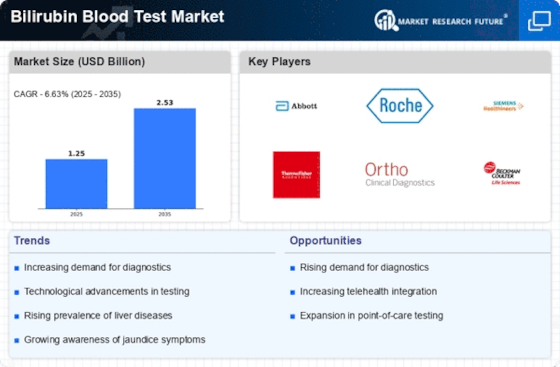
As per MRFR analysis, the Bilirubin Blood Test Market Size was estimated at 1.248 USD Billion in 2024. The Bilirubin Blood Test industry is projected to grow from 1.33 in 2025 to 2.528 by 2035, exhibiting a compound annual growth rate (CAGR) of 6.63 during the forecast period 2025 - 2035.

Key Market Trends & Highlights

The Bilirubin Blood Test Market is experiencing notable growth driven by technological advancements and increasing health awareness.

  • Technological advancements in testing methodologies are enhancing the accuracy and efficiency of bilirubin blood tests. North America remains the largest market, while the Asia-Pacific region is emerging as the fastest-growing area for bilirubin testing. The Total Serum Bilirubin segment holds the largest market share, whereas the Direct/Conjugated Bilirubin Test segment is witnessing the fastest growth. Rising incidence of liver diseases and increased awareness of jaundice are key drivers propelling market expansion.

Market Size & Forecast

2024 Market Size 1.248 (USD Billion)
2035 Market Size 2.528 (USD Billion)
CAGR (2025 - 2035) 6.63%
Largest Regional Market Share in 2024 North America

Major Players

<p>Abbott Laboratories (US), <a href="https://diagnostics.roche.com/global/en/products/lab/bilt3-cps-000050.html">Roche Diagnostics</a> (CH), Siemens Healthineers (DE), <a href="https://www.thermofisher.com/order/catalog/product/de/en/230220010">Thermo Fisher Scientific </a>(US), Ortho Clinical Diagnostics (US), Beckman Coulter (US), Mindray Medical International (CN), Sysmex Corporation (JP), Bio-Rad Laboratories (US)</p>

Market Trends

The Bilirubin Blood Test Market is currently experiencing a notable evolution, driven by advancements in diagnostic technologies and an increasing awareness of liver health. The growing prevalence of liver diseases, alongside rising incidences of jaundice, has led to a heightened demand for bilirubin testing. Healthcare providers are increasingly adopting innovative testing methods that offer rapid results and improved accuracy, which may enhance patient outcomes. Furthermore, the integration of point-of-care testing devices is likely to facilitate easier access to bilirubin testing, particularly in remote or underserved regions. This shift towards more accessible testing options could potentially reshape the landscape of the Bilirubin Blood Test Market. In addition, the emphasis on preventive healthcare is influencing the market dynamics. Patients are becoming more proactive about their health, seeking regular check-ups that include bilirubin tests as part of routine screenings. This trend is further supported by educational initiatives aimed at informing the public about the importance of monitoring bilirubin levels. As a result, the Bilirubin Blood Test Market appears poised for growth, with a focus on enhancing testing capabilities and expanding access to essential diagnostic services. The interplay of technological advancements and changing patient behaviors suggests a promising future for this market segment.

Technological Advancements in Testing

The Bilirubin Blood Test Market is witnessing a surge in technological innovations that enhance testing accuracy and speed. New devices and methodologies are being developed, allowing for quicker results and improved patient experiences. This trend is likely to attract more healthcare facilities to adopt advanced testing solutions.

Increased Awareness of Liver Health

There is a growing public consciousness regarding liver health, which is driving demand for bilirubin testing. Educational campaigns and health initiatives are encouraging individuals to monitor their liver function regularly, thereby expanding the market for bilirubin blood tests.

Shift Towards Preventive Healthcare

The Bilirubin Blood Test Market is experiencing a shift towards preventive healthcare practices. Patients are increasingly seeking routine screenings that include bilirubin tests, reflecting a proactive approach to health management. This trend may lead to a sustained increase in testing frequency.

Bilirubin Blood Test Market Market Drivers

Rising Incidence of Liver Diseases

The increasing prevalence of liver diseases, such as hepatitis and cirrhosis, is a primary driver for the Bilirubin Blood Test Market. According to health statistics, liver diseases have shown a notable rise, leading to a heightened demand for diagnostic tests. This trend is likely to continue as more individuals seek medical attention for liver-related issues. The Bilirubin Blood Test Market serves as a crucial tool in diagnosing and monitoring these conditions, thereby propelling market growth. Furthermore, the aging population is more susceptible to liver diseases, which may further amplify the demand for bilirubin testing. As healthcare providers emphasize early detection and management of liver diseases, the Bilirubin Blood Test Market is expected to expand significantly.

Growing Focus on Preventive Healthcare

The shift towards preventive healthcare is significantly influencing the Bilirubin Blood Test Market. As individuals become more health-conscious, there is a growing emphasis on regular health screenings, including liver function tests. Preventive measures are increasingly recognized as essential for early detection of potential health issues, including liver dysfunction. This trend is supported by various health organizations advocating for routine screenings, which may lead to an increase in bilirubin testing. The market is likely to benefit from this proactive approach, as healthcare providers recommend bilirubin tests as part of comprehensive health assessments. Consequently, the Bilirubin Blood Test Market is poised for growth as preventive healthcare becomes a priority for both patients and providers.

Regulatory Support for Diagnostic Testing

Regulatory support for diagnostic testing is a crucial factor influencing the Bilirubin Blood Test Market. Governments and health authorities are increasingly recognizing the importance of accurate diagnostic tools in managing public health. This recognition has led to the establishment of guidelines and frameworks that promote the use of bilirubin tests in clinical settings. Additionally, funding and support for research and development in diagnostic technologies are likely to enhance the availability and reliability of bilirubin testing. As regulatory bodies continue to advocate for improved diagnostic practices, the market for bilirubin blood tests is expected to grow, driven by the need for effective monitoring of liver health.

Technological Innovations in Diagnostic Testing

Technological advancements in diagnostic testing methodologies are transforming the Bilirubin Blood Test Market. Innovations such as point-of-care testing and automated laboratory systems enhance the accuracy and efficiency of bilirubin testing. These advancements not only improve patient outcomes but also streamline laboratory workflows, making testing more accessible. The introduction of portable devices allows for rapid testing in various settings, including outpatient clinics and home care. As healthcare systems increasingly adopt these technologies, the market for bilirubin blood tests is likely to experience substantial growth. Moreover, the integration of artificial intelligence in diagnostic processes may further refine testing accuracy, thereby increasing the reliance on bilirubin tests in clinical practice.

Increased Awareness of Jaundice and Its Implications

The rising awareness of jaundice and its implications is driving the demand for bilirubin testing within the Bilirubin Blood Test Market. Educational campaigns and health initiatives have contributed to a better understanding of jaundice symptoms and the importance of timely diagnosis. As more individuals recognize the signs of jaundice, they are more likely to seek medical evaluation, leading to an increase in bilirubin tests. This heightened awareness is particularly evident among parents, as neonatal jaundice is a common concern. The emphasis on early detection and treatment of jaundice is likely to sustain the demand for bilirubin testing, thereby positively impacting the market.

Market Segment Insights

By Test Type: Total Serum Bilirubin (Largest) vs. Direct/Conjugated Bilirubin Test (Fastest-Growing)

<p>The Bilirubin Blood Test Market showcases a diverse range of test types, with Total Serum Bilirubin (TSB) leading in market share due to its broad application in diagnosing and monitoring liver function. In contrast, the Direct/Conjugated Bilirubin Test has demonstrated rapid growth, capturing attention for its precision in identifying specific liver disease conditions. Indirect/Unconjugated Bilirubin Tests, while essential, hold a smaller share compared to these two key segments. Overall, the distribution reflects the importance of comprehensive testing approaches in clinical practices. Growth trends indicate a significant shift towards more specialized testing, particularly in the Direct/Conjugated Bilirubin realm. Factors driving this trend include an increasing prevalence of liver-related disorders and rising awareness of diagnostic accuracy among healthcare professionals. Advances in technology and the development of point-of-care testing have further propelled the demand for these tests, making them integral to modern diagnostic protocols and leading to their rapid adoption in various clinical settings.</p>

<p>Total Serum Bilirubin (Dominant) vs. Direct/Conjugated Bilirubin Test (Emerging)</p>

<p>Total Serum Bilirubin (TSB) remains the dominant player in the Bilirubin Blood Test Market due to its versatility in assessing overall liver health and diagnosing various conditions, such as jaundice and liver disease. Its widespread acceptance in laboratories and clinics ensures a strong foothold in routine testing. Meanwhile, the Direct/Conjugated Bilirubin Test is emerging as a vital tool for pinpointing specific pathologies. Its precise measurement capabilities allow for better diagnosis and treatment monitoring. This segment's growth is fueled by an increasing demand for specificity in testing, driving innovation and adoption in clinical settings. Together, these segments illustrate a balanced market that caters to both broad screening needs and targeted diagnostic purposes.</p>

By Product Type: Consumables (Largest) vs. Instruments (Fastest-Growing)

<p>In the Bilirubin Blood Test Market, the product type segment is characterized by a significant distribution of market share between consumables and instruments. Consumables, including test kits and reagents, constitute the largest segment, accounting for a substantial portion of the total market. Their widespread use in laboratories and healthcare facilities ensures a steady demand, as consumables are vital for carrying out bilirubin tests effectively. In contrast, the instruments segment, comprising the devices used for testing, is the fastest-growing. Innovations in technology and increasing healthcare needs are driving this segment's growth as newer, more efficient devices become available.</p>

<p>Product Type: Consumables (Dominant) vs. Instruments (Emerging)</p>

<p>In the Bilirubin Blood Test Market, consumables play a dominant role due to their essential nature in the testing process. They include a wide range of products such as test kits, reagents, and specimen collection devices, which are critical for accurate bilirubin testing. These consumables are often favored for their ease of use and cost-effectiveness, making them preferred choices in clinical settings. On the other hand, the instruments segment is emerging rapidly, driven by technological advancements in diagnostic devices. These instruments offer improved accuracy, automation, and faster results, making them increasingly desirable in modern laboratories. The growing preference for point-of-care testing is likewise contributing to the rise of this segment.</p>

By Application: Infants (Largest) vs. Adults (Fastest-Growing)

<p>In the Bilirubin Blood Test Market, the application segment is significantly divided between infants and adults. The infant segment holds a substantial market share due to the rising incidence of neonatal jaundice, which necessitates timely testing and diagnosis. Furthermore, healthcare providers are increasingly aware of the importance of early detection, thereby propelling the demand for bilirubin testing in newborns.</p>

<p>Application: Infants (Dominant) vs. Adults (Emerging)</p>

<p>The infant segment is characterized by its higher prevalence of bilirubin testing, largely driven by the need to monitor jaundice in newborns. This segment has established itself as dominant in the market due to the critical nature of timely diagnosis in infants to prevent complications. Conversely, the adult segment is emerging rapidly, fueled by growing health awareness, aging demographics, and the rising prevalence of conditions like liver diseases. Adults are increasingly seeking bilirubin tests not only for jaundice but also as part of routine health check-ups, emphasizing the segment's potential for growth.</p>

By End-Users: Hospitals (Largest) vs. Pathological Labs (Fastest-Growing)

<p>In the Bilirubin Blood Test Market, hospitals represent the largest segment, benefitting from their extensive patient base and integrated healthcare services. Following closely are pathological labs, which are essential for diagnostic testing and have been gaining market share due to the growing demand for early disease diagnosis. Other segments like research laboratories and pediatric clinics also contribute to the market but remain comparatively smaller in size. The growth trends in this segment are fueled by an increasing prevalence of liver diseases and a heightened focus on preventive healthcare. Technological advancements in diagnostic procedures and a rise in the number of accredited pathological labs have further propelled the demand for bilirubin blood tests. Additionally, heightened awareness of neonatal jaundice and the subsequent need for bilirubin testing in pediatric populations drive sustained growth in this area.</p>

<p>Pathological Labs (Dominant) vs. Pediatric Clinics (Emerging)</p>

<p>Pathological labs play a dominant role in the Bilirubin Blood Test Market, attributed to their focus on meticulous testing protocols and robust infrastructure capable of handling a high volume of tests. These facilities are equipped with advanced diagnostic technologies, ensuring accurate and rapid results which are critical in clinical decision-making. The growing incidence of liver-related diseases and advancements in lab technology bolster their market position. Meanwhile, pediatric clinics represent an emerging segment, driven by the increasing incidence of conditions like neonatal jaundice, which demands specialized care and timely testing. These clinics are tailored to cater to younger demographics, highlighting their importance in continuous health monitoring and early intervention strategies.</p>

Get more detailed insights about Bilirubin Blood Test Market Research Report - Forecast till 2035

Regional Insights

Key Companies in the Bilirubin Blood Test Market market include

Industry Developments

Future Outlook

Bilirubin Blood Test Market Future Outlook

<p>The Bilirubin Blood Test Market is projected to grow at a 6.63% CAGR from 2024 to 2035, driven by increasing prevalence of liver diseases and advancements in diagnostic technologies.</p>

New opportunities lie in:

  • <p>Development of portable bilirubin testing devices for home use.</p><p>Integration of AI-driven analytics for enhanced diagnostic accuracy.</p><p>Expansion of <a href="https://www.marketresearchfuture.com/reports/telehealth-market-900">telehealth </a>services for remote bilirubin testing and consultations.</p>

<p>By 2035, the market is expected to be robust, reflecting significant advancements and increased accessibility.</p>

Market Segmentation

Bilirubin Blood Test Market End-Users Outlook

  • Diagnostics Centers
  • Pathological Labs
  • Hospitals
  • Research Laboratories
  • Academic Institutions
  • Pediatric Clinics
  • Child Specialist Hospitals

Bilirubin Blood Test Market Test Type Outlook

  • Total Serum Bilirubin (TSB)
  • Direct/Conjugated Bilirubin Test
  • Indirect/Unconjugated Bilirubin Test

Bilirubin Blood Test Market Application Outlook

  • Infants
  • Adults

Bilirubin Blood Test Market Product Type Outlook

  • Consumables
  • Instruments

Report Scope

MARKET SIZE 20241.248(USD Billion)
MARKET SIZE 20251.33(USD Billion)
MARKET SIZE 20352.528(USD Billion)
COMPOUND ANNUAL GROWTH RATE (CAGR)6.63% (2024 - 2035)
REPORT COVERAGERevenue Forecast, Competitive Landscape, Growth Factors, and Trends
BASE YEAR2024
Market Forecast Period2025 - 2035
Historical Data2019 - 2024
Market Forecast UnitsUSD Billion
Key Companies ProfiledMarket analysis in progress
Segments CoveredMarket segmentation analysis in progress
Key Market OpportunitiesIntegration of advanced diagnostic technologies enhances accuracy in the Bilirubin Blood Test Market.
Key Market DynamicsRising demand for early disease detection drives innovation and competition in the Bilirubin Blood Test market.
Countries CoveredNorth America, Europe, APAC, South America, MEA

FAQs

What is the projected market valuation of the Bilirubin Blood Test Market by 2035?

The Bilirubin Blood Test Market is projected to reach a valuation of 2.528 USD Billion by 2035.

What was the market valuation of the Bilirubin Blood Test Market in 2024?

In 2024, the market valuation of the Bilirubin Blood Test Market was 1.248 USD Billion.

What is the expected CAGR for the Bilirubin Blood Test Market during the forecast period 2025 - 2035?

The expected CAGR for the Bilirubin Blood Test Market during the forecast period 2025 - 2035 is 6.63%.

Which companies are considered key players in the Bilirubin Blood Test Market?

Key players in the Bilirubin Blood Test Market include Abbott Laboratories, Roche Diagnostics, Siemens Healthineers, and Thermo Fisher Scientific.

What are the main segments of the Bilirubin Blood Test Market?

The main segments of the Bilirubin Blood Test Market include Test Type, Product Type, Application, and End-Users.

  1. SECTION I: EXECUTIVE SUMMARY AND KEY HIGHLIGHTS
    1. EXECUTIVE SUMMARY
      1. Market Overview
      2. Key Findings
      3. Market Segmentation
      4. Competitive Landscape
      5. Challenges and Opportunities
      6. Future Outlook 2 SECTION II: SCOPING, METHODOLOGY AND MARKET STRUCTURE
    2. MARKET INTRODUCTION
      1. Definition
      2. Scope of the study
    3. RESEARCH METHODOLOGY
      1. Overview
      2. Data Mining
      3. Secondary Research
      4. Primary Research
      5. Forecasting Model
      6. Market Size Estimation
      7. Data Triangulation
      8. Validation 3 SECTION III: QUALITATIVE ANALYSIS
    4. MARKET DYNAMICS
      1. Overview
      2. Drivers
      3. Restraints
      4. Opportunities
    5. MARKET FACTOR ANALYSIS
      1. Value chain Analysis
      2. Porter's Five Forces Analysis
      3. COVID-19 Impact Analysis
    6. Healthcare, BY Test Type (USD Billion)
      1. Total Serum Bilirubin (TSB)
      2. Direct/Conjugated Bilirubin Test
      3. Indirect/Unconjugated Bilirubin Test
    7. Healthcare, BY Product Type (USD Billion)
      1. Consumables
      2. Instruments
    8. Healthcare, BY Application (USD Billion)
      1. Infants
      2. Adults
    9. Healthcare, BY End-Users (USD Billion)
      1. Diagnostics Centers
      2. Pathological Labs
      3. Hospitals
      4. Research Laboratories
      5. Academic Institutions
      6. Pediatric Clinics
      7. Child Specialist Hospitals
    10. Healthcare, BY Region (USD Billion)
      1. North America
      2. Europe
      3. APAC
      4. South America
      5. MEA
    11. Competitive Landscape
      1. Overview
      2. Competitive Analysis
      3. Market share Analysis
      4. Major Growth Strategy in the Healthcare
      5. Competitive Benchmarking
      6. Leading Players in Terms of Number of Developments in the Healthcare
      7. Key developments and growth strategies
      8. Major Players Financial Matrix
    12. Company Profiles
      1. Abbott Laboratories (US)
      2. Roche Diagnostics (CH)
      3. Siemens Healthineers (DE)
      4. Thermo Fisher Scientific (US)
      5. Ortho Clinical Diagnostics (US)
      6. Beckman Coulter (US)
      7. Mindray Medical International (CN)
      8. Sysmex Corporation (JP)
      9. Bio-Rad Laboratories (US)
    13. Appendix
      1. References
      2. Related Reports 6 LIST OF FIGURES
    14. MARKET SYNOPSIS
    15. NORTH AMERICA MARKET ANALYSIS
    16. US MARKET ANALYSIS BY TEST TYPE
    17. US MARKET ANALYSIS BY PRODUCT TYPE
    18. US MARKET ANALYSIS BY APPLICATION
    19. US MARKET ANALYSIS BY END-USERS
    20. CANADA MARKET ANALYSIS BY TEST TYPE
    21. CANADA MARKET ANALYSIS BY PRODUCT TYPE
    22. CANADA MARKET ANALYSIS BY APPLICATION
    23. CANADA MARKET ANALYSIS BY END-USERS
    24. EUROPE MARKET ANALYSIS
    25. GERMANY MARKET ANALYSIS BY TEST TYPE
    26. GERMANY MARKET ANALYSIS BY PRODUCT TYPE
    27. GERMANY MARKET ANALYSIS BY APPLICATION
    28. GERMANY MARKET ANALYSIS BY END-USERS
    29. UK MARKET ANALYSIS BY TEST TYPE
    30. UK MARKET ANALYSIS BY PRODUCT TYPE
    31. UK MARKET ANALYSIS BY APPLICATION
    32. UK MARKET ANALYSIS BY END-USERS
    33. FRANCE MARKET ANALYSIS BY TEST TYPE
    34. FRANCE MARKET ANALYSIS BY PRODUCT TYPE
    35. FRANCE MARKET ANALYSIS BY APPLICATION
    36. FRANCE MARKET ANALYSIS BY END-USERS
    37. RUSSIA MARKET ANALYSIS BY TEST TYPE
    38. RUSSIA MARKET ANALYSIS BY PRODUCT TYPE
    39. RUSSIA MARKET ANALYSIS BY APPLICATION
    40. RUSSIA MARKET ANALYSIS BY END-USERS
    41. ITALY MARKET ANALYSIS BY TEST TYPE
    42. ITALY MARKET ANALYSIS BY PRODUCT TYPE
    43. ITALY MARKET ANALYSIS BY APPLICATION
    44. ITALY MARKET ANALYSIS BY END-USERS
    45. SPAIN MARKET ANALYSIS BY TEST TYPE
    46. SPAIN MARKET ANALYSIS BY PRODUCT TYPE
    47. SPAIN MARKET ANALYSIS BY APPLICATION
    48. SPAIN MARKET ANALYSIS BY END-USERS
    49. REST OF EUROPE MARKET ANALYSIS BY TEST TYPE
    50. REST OF EUROPE MARKET ANALYSIS BY PRODUCT TYPE
    51. REST OF EUROPE MARKET ANALYSIS BY APPLICATION
    52. REST OF EUROPE MARKET ANALYSIS BY END-USERS
    53. APAC MARKET ANALYSIS
    54. CHINA MARKET ANALYSIS BY TEST TYPE
    55. CHINA MARKET ANALYSIS BY PRODUCT TYPE
    56. CHINA MARKET ANALYSIS BY APPLICATION
    57. CHINA MARKET ANALYSIS BY END-USERS
    58. INDIA MARKET ANALYSIS BY TEST TYPE
    59. INDIA MARKET ANALYSIS BY PRODUCT TYPE
    60. INDIA MARKET ANALYSIS BY APPLICATION
    61. INDIA MARKET ANALYSIS BY END-USERS
    62. JAPAN MARKET ANALYSIS BY TEST TYPE
    63. JAPAN MARKET ANALYSIS BY PRODUCT TYPE
    64. JAPAN MARKET ANALYSIS BY APPLICATION
    65. JAPAN MARKET ANALYSIS BY END-USERS
    66. SOUTH KOREA MARKET ANALYSIS BY TEST TYPE
    67. SOUTH KOREA MARKET ANALYSIS BY PRODUCT TYPE
    68. SOUTH KOREA MARKET ANALYSIS BY APPLICATION
    69. SOUTH KOREA MARKET ANALYSIS BY END-USERS
    70. MALAYSIA MARKET ANALYSIS BY TEST TYPE
    71. MALAYSIA MARKET ANALYSIS BY PRODUCT TYPE
    72. MALAYSIA MARKET ANALYSIS BY APPLICATION
    73. MALAYSIA MARKET ANALYSIS BY END-USERS
    74. THAILAND MARKET ANALYSIS BY TEST TYPE
    75. THAILAND MARKET ANALYSIS BY PRODUCT TYPE
    76. THAILAND MARKET ANALYSIS BY APPLICATION
    77. THAILAND MARKET ANALYSIS BY END-USERS
    78. INDONESIA MARKET ANALYSIS BY TEST TYPE
    79. INDONESIA MARKET ANALYSIS BY PRODUCT TYPE
    80. INDONESIA MARKET ANALYSIS BY APPLICATION
    81. INDONESIA MARKET ANALYSIS BY END-USERS
    82. REST OF APAC MARKET ANALYSIS BY TEST TYPE
    83. REST OF APAC MARKET ANALYSIS BY PRODUCT TYPE
    84. REST OF APAC MARKET ANALYSIS BY APPLICATION
    85. REST OF APAC MARKET ANALYSIS BY END-USERS
    86. SOUTH AMERICA MARKET ANALYSIS
    87. BRAZIL MARKET ANALYSIS BY TEST TYPE
    88. BRAZIL MARKET ANALYSIS BY PRODUCT TYPE
    89. BRAZIL MARKET ANALYSIS BY APPLICATION
    90. BRAZIL MARKET ANALYSIS BY END-USERS
    91. MEXICO MARKET ANALYSIS BY TEST TYPE
    92. MEXICO MARKET ANALYSIS BY PRODUCT TYPE
    93. MEXICO MARKET ANALYSIS BY APPLICATION
    94. MEXICO MARKET ANALYSIS BY END-USERS
    95. ARGENTINA MARKET ANALYSIS BY TEST TYPE
    96. ARGENTINA MARKET ANALYSIS BY PRODUCT TYPE
    97. ARGENTINA MARKET ANALYSIS BY APPLICATION
    98. ARGENTINA MARKET ANALYSIS BY END-USERS
    99. REST OF SOUTH AMERICA MARKET ANALYSIS BY TEST TYPE
    100. REST OF SOUTH AMERICA MARKET ANALYSIS BY PRODUCT TYPE
    101. REST OF SOUTH AMERICA MARKET ANALYSIS BY APPLICATION
    102. REST OF SOUTH AMERICA MARKET ANALYSIS BY END-USERS
    103. MEA MARKET ANALYSIS
    104. GCC COUNTRIES MARKET ANALYSIS BY TEST TYPE
    105. GCC COUNTRIES MARKET ANALYSIS BY PRODUCT TYPE
    106. GCC COUNTRIES MARKET ANALYSIS BY APPLICATION
    107. GCC COUNTRIES MARKET ANALYSIS BY END-USERS
    108. SOUTH AFRICA MARKET ANALYSIS BY TEST TYPE
    109. SOUTH AFRICA MARKET ANALYSIS BY PRODUCT TYPE
    110. SOUTH AFRICA MARKET ANALYSIS BY APPLICATION
    111. SOUTH AFRICA MARKET ANALYSIS BY END-USERS
    112. REST OF MEA MARKET ANALYSIS BY TEST TYPE
    113. REST OF MEA MARKET ANALYSIS BY PRODUCT TYPE
    114. REST OF MEA MARKET ANALYSIS BY APPLICATION
    115. REST OF MEA MARKET ANALYSIS BY END-USERS
    116. KEY BUYING CRITERIA OF HEALTHCARE
    117. RESEARCH PROCESS OF MRFR
    118. DRO ANALYSIS OF HEALTHCARE
    119. DRIVERS IMPACT ANALYSIS: HEALTHCARE
    120. RESTRAINTS IMPACT ANALYSIS: HEALTHCARE
    121. SUPPLY / VALUE CHAIN: HEALTHCARE
    122. HEALTHCARE, BY TEST TYPE, 2024 (% SHARE)
    123. HEALTHCARE, BY TEST TYPE, 2024 TO 2035 (USD Billion)
    124. HEALTHCARE, BY PRODUCT TYPE, 2024 (% SHARE)
    125. HEALTHCARE, BY PRODUCT TYPE, 2024 TO 2035 (USD Billion)
    126. HEALTHCARE, BY APPLICATION, 2024 (% SHARE)
    127. HEALTHCARE, BY APPLICATION, 2024 TO 2035 (USD Billion)
    128. HEALTHCARE, BY END-USERS, 2024 (% SHARE)
    129. HEALTHCARE, BY END-USERS, 2024 TO 2035 (USD Billion)
    130. BENCHMARKING OF MAJOR COMPETITORS 7 LIST OF TABLES
    131. LIST OF ASSUMPTIONS
    132. North America MARKET SIZE ESTIMATES; FORECAST
      1. BY TEST TYPE, 2025-2035 (USD Billion)
      2. BY PRODUCT TYPE, 2025-2035 (USD Billion)
      3. BY APPLICATION, 2025-2035 (USD Billion)
      4. BY END-USERS, 2025-2035 (USD Billion)
    133. US MARKET SIZE ESTIMATES; FORECAST
      1. BY TEST TYPE, 2025-2035 (USD Billion)
      2. BY PRODUCT TYPE, 2025-2035 (USD Billion)
      3. BY APPLICATION, 2025-2035 (USD Billion)
      4. BY END-USERS, 2025-2035 (USD Billion)
    134. Canada MARKET SIZE ESTIMATES; FORECAST
      1. BY TEST TYPE, 2025-2035 (USD Billion)
      2. BY PRODUCT TYPE, 2025-2035 (USD Billion)
      3. BY APPLICATION, 2025-2035 (USD Billion)
      4. BY END-USERS, 2025-2035 (USD Billion)
    135. Europe MARKET SIZE ESTIMATES; FORECAST
      1. BY TEST TYPE, 2025-2035 (USD Billion)
      2. BY PRODUCT TYPE, 2025-2035 (USD Billion)
      3. BY APPLICATION, 2025-2035 (USD Billion)
      4. BY END-USERS, 2025-2035 (USD Billion)
    136. Germany MARKET SIZE ESTIMATES; FORECAST
      1. BY TEST TYPE, 2025-2035 (USD Billion)
      2. BY PRODUCT TYPE, 2025-2035 (USD Billion)
      3. BY APPLICATION, 2025-2035 (USD Billion)
      4. BY END-USERS, 2025-2035 (USD Billion)
    137. UK MARKET SIZE ESTIMATES; FORECAST
      1. BY TEST TYPE, 2025-2035 (USD Billion)
      2. BY PRODUCT TYPE, 2025-2035 (USD Billion)
      3. BY APPLICATION, 2025-2035 (USD Billion)
      4. BY END-USERS, 2025-2035 (USD Billion)
    138. France MARKET SIZE ESTIMATES; FORECAST
      1. BY TEST TYPE, 2025-2035 (USD Billion)
      2. BY PRODUCT TYPE, 2025-2035 (USD Billion)
      3. BY APPLICATION, 2025-2035 (USD Billion)
      4. BY END-USERS, 2025-2035 (USD Billion)
    139. Russia MARKET SIZE ESTIMATES; FORECAST
      1. BY TEST TYPE, 2025-2035 (USD Billion)
      2. BY PRODUCT TYPE, 2025-2035 (USD Billion)
      3. BY APPLICATION, 2025-2035 (USD Billion)
      4. BY END-USERS, 2025-2035 (USD Billion)
    140. Italy MARKET SIZE ESTIMATES; FORECAST
      1. BY TEST TYPE, 2025-2035 (USD Billion)
      2. BY PRODUCT TYPE, 2025-2035 (USD Billion)
      3. BY APPLICATION, 2025-2035 (USD Billion)
      4. BY END-USERS, 2025-2035 (USD Billion)
    141. Spain MARKET SIZE ESTIMATES; FORECAST
      1. BY TEST TYPE, 2025-2035 (USD Billion)
      2. BY PRODUCT TYPE, 2025-2035 (USD Billion)
      3. BY APPLICATION, 2025-2035 (USD Billion)
      4. BY END-USERS, 2025-2035 (USD Billion)
    142. Rest of Europe MARKET SIZE ESTIMATES; FORECAST
      1. BY TEST TYPE, 2025-2035 (USD Billion)
      2. BY PRODUCT TYPE, 2025-2035 (USD Billion)
      3. BY APPLICATION, 2025-2035 (USD Billion)
      4. BY END-USERS, 2025-2035 (USD Billion)
    143. APAC MARKET SIZE ESTIMATES; FORECAST
      1. BY TEST TYPE, 2025-2035 (USD Billion)
      2. BY PRODUCT TYPE, 2025-2035 (USD Billion)
      3. BY APPLICATION, 2025-2035 (USD Billion)
      4. BY END-USERS, 2025-2035 (USD Billion)
    144. China MARKET SIZE ESTIMATES; FORECAST
      1. BY TEST TYPE, 2025-2035 (USD Billion)
      2. BY PRODUCT TYPE, 2025-2035 (USD Billion)
      3. BY APPLICATION, 2025-2035 (USD Billion)
      4. BY END-USERS, 2025-2035 (USD Billion)
    145. India MARKET SIZE ESTIMATES; FORECAST
      1. BY TEST TYPE, 2025-2035 (USD Billion)
      2. BY PRODUCT TYPE, 2025-2035 (USD Billion)
      3. BY APPLICATION, 2025-2035 (USD Billion)
      4. BY END-USERS, 2025-2035 (USD Billion)
    146. Japan MARKET SIZE ESTIMATES; FORECAST
      1. BY TEST TYPE, 2025-2035 (USD Billion)
      2. BY PRODUCT TYPE, 2025-2035 (USD Billion)
      3. BY APPLICATION, 2025-2035 (USD Billion)
      4. BY END-USERS, 2025-2035 (USD Billion)
    147. South Korea MARKET SIZE ESTIMATES; FORECAST
      1. BY TEST TYPE, 2025-2035 (USD Billion)
      2. BY PRODUCT TYPE, 2025-2035 (USD Billion)
      3. BY APPLICATION, 2025-2035 (USD Billion)
      4. BY END-USERS, 2025-2035 (USD Billion)
    148. Malaysia MARKET SIZE ESTIMATES; FORECAST
      1. BY TEST TYPE, 2025-2035 (USD Billion)
      2. BY PRODUCT TYPE, 2025-2035 (USD Billion)
      3. BY APPLICATION, 2025-2035 (USD Billion)
      4. BY END-USERS, 2025-2035 (USD Billion)
    149. Thailand MARKET SIZE ESTIMATES; FORECAST
      1. BY TEST TYPE, 2025-2035 (USD Billion)
      2. BY PRODUCT TYPE, 2025-2035 (USD Billion)
      3. BY APPLICATION, 2025-2035 (USD Billion)
      4. BY END-USERS, 2025-2035 (USD Billion)
    150. Indonesia MARKET SIZE ESTIMATES; FORECAST
      1. BY TEST TYPE, 2025-2035 (USD Billion)
      2. BY PRODUCT TYPE, 2025-2035 (USD Billion)
      3. BY APPLICATION, 2025-2035 (USD Billion)
      4. BY END-USERS, 2025-2035 (USD Billion)
    151. Rest of APAC MARKET SIZE ESTIMATES; FORECAST
      1. BY TEST TYPE, 2025-2035 (USD Billion)
      2. BY PRODUCT TYPE, 2025-2035 (USD Billion)
      3. BY APPLICATION, 2025-2035 (USD Billion)
      4. BY END-USERS, 2025-2035 (USD Billion)
    152. South America MARKET SIZE ESTIMATES; FORECAST
      1. BY TEST TYPE, 2025-2035 (USD Billion)
      2. BY PRODUCT TYPE, 2025-2035 (USD Billion)
      3. BY APPLICATION, 2025-2035 (USD Billion)
      4. BY END-USERS, 2025-2035 (USD Billion)
    153. Brazil MARKET SIZE ESTIMATES; FORECAST
      1. BY TEST TYPE, 2025-2035 (USD Billion)
      2. BY PRODUCT TYPE, 2025-2035 (USD Billion)
      3. BY APPLICATION, 2025-2035 (USD Billion)
      4. BY END-USERS, 2025-2035 (USD Billion)
    154. Mexico MARKET SIZE ESTIMATES; FORECAST
      1. BY TEST TYPE, 2025-2035 (USD Billion)
      2. BY PRODUCT TYPE, 2025-2035 (USD Billion)
      3. BY APPLICATION, 2025-2035 (USD Billion)
      4. BY END-USERS, 2025-2035 (USD Billion)
    155. Argentina MARKET SIZE ESTIMATES; FORECAST
      1. BY TEST TYPE, 2025-2035 (USD Billion)
      2. BY PRODUCT TYPE, 2025-2035 (USD Billion)
      3. BY APPLICATION, 2025-2035 (USD Billion)
      4. BY END-USERS, 2025-2035 (USD Billion)
    156. Rest of South America MARKET SIZE ESTIMATES; FORECAST
      1. BY TEST TYPE, 2025-2035 (USD Billion)
      2. BY PRODUCT TYPE, 2025-2035 (USD Billion)
      3. BY APPLICATION, 2025-2035 (USD Billion)
      4. BY END-USERS, 2025-2035 (USD Billion)
    157. MEA MARKET SIZE ESTIMATES; FORECAST
      1. BY TEST TYPE, 2025-2035 (USD Billion)
      2. BY PRODUCT TYPE, 2025-2035 (USD Billion)
      3. BY APPLICATION, 2025-2035 (USD Billion)
      4. BY END-USERS, 2025-2035 (USD Billion)
    158. GCC Countries MARKET SIZE ESTIMATES; FORECAST
      1. BY TEST TYPE, 2025-2035 (USD Billion)
      2. BY PRODUCT TYPE, 2025-2035 (USD Billion)
      3. BY APPLICATION, 2025-2035 (USD Billion)
      4. BY END-USERS, 2025-2035 (USD Billion)
    159. South Africa MARKET SIZE ESTIMATES; FORECAST
      1. BY TEST TYPE, 2025-2035 (USD Billion)
      2. BY PRODUCT TYPE, 2025-2035 (USD Billion)
      3. BY APPLICATION, 2025-2035 (USD Billion)
      4. BY END-USERS, 2025-2035 (USD Billion)
    160. Rest of MEA MARKET SIZE ESTIMATES; FORECAST
      1. BY TEST TYPE, 2025-2035 (USD Billion)
      2. BY PRODUCT TYPE, 2025-2035 (USD Billion)
      3. BY APPLICATION, 2025-2035 (USD Billion)
      4. BY END-USERS, 2025-2035 (USD Billion)
    161. PRODUCT LAUNCH/PRODUCT DEVELOPMENT/APPROVAL
    162. ACQUISITION/PARTNERSHIP

Bilirubin Blood Test Market Segmentation

Market Segmentation Overview

  • Detailed segmentation data will be available in the full report
  • Comprehensive analysis by multiple parameters
  • Regional and country-level breakdowns
  • Market size forecasts by segment
Infographic

Free Sample Request

Kindly complete the form below to receive a free sample of this Report

Get Free Sample

Customer Strories

Compare Licence

×
Features License Type
Single User Multiuser License Enterprise User
Price $4,950 $5,950 $7,250
Maximum User Access Limit 1 User Upto 10 Users Unrestricted Access Throughout the Organization
Free Customization
Direct Access to Analyst
Deliverable Format
Platform Access
Discount on Next Purchase 10% 15% 15%
Printable Versions