Request Free Sample ×

Kindly complete the form below to receive a free sample of this Report

* Please use a valid business email

Leading companies partner with us for data-driven Insights

clients tt-cursor
Hero Background
English
Chinese
French
Japanese
Korean
German
Spanish

Bicycle Saddle Market Size

ID: MRFR/AT/11177-HCR
128 Pages
Shubham Munde
March 2026

Bicycle Saddle Market Research Report Information by Type (Plastic, Leather, and Other), By Application (Mountain Bicycle, Road Bicycles, BMX Bicycles, and Others), And By Region (North America, Europe, Asia-Pacific, And Rest of The World) –Market Forecast Till 2035

Share:
Download PDF ×

We do not share your information with anyone. However, we may send you emails based on your report interest from time to time. You may contact us at any time to opt-out.

Bicycle Saddle Market Infographic
Purchase Options

Bicycle Saddle Size

Bicycle Saddle Market Growth Projections and Opportunities

It's important for saddle producers to make new saddles that support better and cause less pain because more and more users want to be comfortable on their trips. A bigger trend in the market is that bikers want saddles that make their ride better all around. This is why comfortable designs are being pushed.

Another important thing that affects the business is the material that is used to make bicycle seats. People still like leather and other basic materials because they last a long time and look good with any style. But carbon fiber and man-made materials have become more common because they are light and simple to work with. These parts make the bike stronger and better able to handle bad weather. They also make it lighter. Two big things that affect the bicycle saddle market are what people like and how they ride. More people are riding bikes for fun and health, and more and more people are getting unique saddle designs. Getting to work, going on the road, and mountain biking are some of these sports. Each field has its own needs that these patterns are made to meet. Many types of people buy bikes, so more and more bike brands are making saddles with different styles and features to fit different riding styles.

Bicycle saddles have more features now than they did in the past, which has changed how the market works. Gel plugs and suspension systems are two types of technology that can reduce shock. If you use these, the ride will be smoother because the hits and shocks will be less intense. Pressure mapping and 3D printing can also be used to make each saddle unique and make sure that each person gets the best fit possible.

The global green movement has affected bicycle saddle sales. Sustainable and eco-friendly materials are in demand for saddles because consumers are increasingly mindful of their environmental impact. Eco-friendly and recycled-material shops are more likely to attract recreational bike riders. It may or may not be easy to buy bicycle saddles depending on how the store is set up and run. Because of the rise of e-commerce, companies can now talk to buyers directly. It's also helpful to have bike shops in your area and work with them to get a wide range of people. When you work with bike builders in smart ways, you can change the business. In these deals, there may be unique saddle options or package options. The way bicycle saddles look changes with the times and fashion. Like the rest of the bike, the saddle can be changed to fit your tastes in terms of color, style, and look. People care a lot about how things look, so companies that make them might have to work with artists to keep up with changing fashion trends.
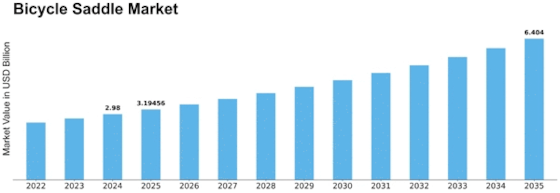

Bicycle Saddle Market Size Graph
Author
Author Profile
Shubham Munde
Team Lead - Research

Shubham brings over 7 years of expertise in Market Intelligence and Strategic Consulting, with a strong focus on the Automotive, Aerospace, and Defense sectors. Backed by a solid foundation in semiconductors, electronics, and software, he has successfully delivered high-impact syndicated and custom research on a global scale. His core strengths include market sizing, forecasting, competitive intelligence, consumer insights, and supply chain mapping. Widely recognized for developing scalable growth strategies, Shubham empowers clients to navigate complex markets and achieve a lasting competitive edge. Trusted by start-ups and Fortune 500 companies alike, he consistently converts challenges into strategic opportunities that drive sustainable growth.

Leave a Comment

FAQs

What is the current valuation of the Bicycle Saddle Market as of 2024?

<p>The Bicycle Saddle Market was valued at 2.98 USD Billion in 2024.</p>

What is the projected market valuation for the Bicycle Saddle Market in 2035?

<p>The market is projected to reach a valuation of 6.404 USD Billion by 2035.</p>

What is the expected CAGR for the Bicycle Saddle Market during the forecast period 2025 - 2035?

<p>The expected CAGR for the Bicycle Saddle Market during the forecast period 2025 - 2035 is 7.2%.</p>

Which types of materials dominate the Bicycle Saddle Market?

<p>The market segments include Plastic, Leather, and Others, with Plastic valued at 2.54 USD Billion and Leather at 2.34 USD Billion by 2035.</p>

What are the primary applications of bicycle saddles in the market?

<p>The primary applications include Mountain Bicycles, Road Bicycles, BMX Bicycles, and Others, with Road Bicycles projected to reach 2.12 USD Billion by 2035.</p>

Who are the key players in the Bicycle Saddle Market?

<p>Key players include Selle Italia, Brooks England, Fizik, Selle Royal, Giant, Trek Bicycle Corporation, Specialized Bicycle Components, Bontrager, and Prologo.</p>

How does the market for mountain bicycle saddles compare to road bicycle saddles?

In 2035, mountain bicycle saddles are projected to reach 1.89 USD Billion, while road bicycle saddles are expected to reach 2.12 USD Billion.

What is the market size for BMX bicycle saddles projected to be by 2035?

The market size for BMX bicycle saddles is projected to reach 1.12 USD Billion by 2035.

What growth trends are observed in the Bicycle Saddle Market?

The market appears to be on a growth trajectory, with a projected increase from 2.98 USD Billion in 2024 to 6.404 USD Billion by 2035.

What factors might influence the growth of the Bicycle Saddle Market in the coming years?

Factors such as increasing cycling participation, advancements in saddle technology, and rising demand for specialized saddles may influence market growth.

Market Summary

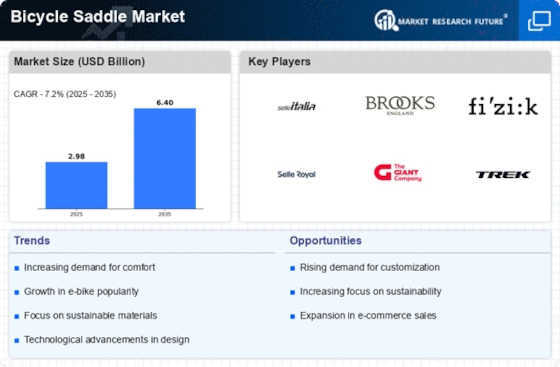
As per Market Research Future analysis, the Bicycle Saddle Market Size was estimated at 2.98 USD Billion in 2024. The Bicycle Saddle industry is projected to grow from 3.195 USD Billion in 2025 to 6.404 USD Billion by 2035, exhibiting a compound annual growth rate (CAGR) of 7.2% during the forecast period 2025 - 2035

Key Market Trends & Highlights

The Bicycle Saddle Market is experiencing a dynamic shift towards innovation and sustainability.

  • Ergonomic design innovations are becoming increasingly prevalent, enhancing rider comfort and performance. Sustainability in materials is gaining traction, with manufacturers prioritizing eco-friendly options. Integration of smart technology in bicycle saddles is emerging, appealing to tech-savvy consumers. Rising health consciousness and urbanization are driving demand, particularly in North America for plastic saddles and in Asia-Pacific for leather options.

Market Size & Forecast

2024 Market Size 2.98 (USD Billion)
2035 Market Size 6.404 (USD Billion)
CAGR (2025 - 2035) 7.2%
Largest Regional Market Share in 2024 Europe

Major Players

Selle Italia (IT), <a href="https://www.brooksengland.com/en_uk/bags/saddle.html">Brooks England</a> (GB), Fizik (IT), Selle Royal (IT), Giant (TW), Trek Bicycle Corporation (US), Specialized Bicycle Components (US), Bontrager (US), <a href="https://prologo.it/en">Prologo</a> (IT)

Market Trends

The Bicycle Saddle Market is currently experiencing a dynamic evolution, driven by a confluence of factors that reflect changing consumer preferences and advancements in technology. As cycling continues to gain traction as a preferred mode of transportation and recreation, the demand for comfortable and ergonomic saddles has surged. Manufacturers are increasingly focusing on innovative designs that enhance rider comfort, reduce fatigue, and improve overall performance. This shift is indicative of a broader trend towards personalization, where cyclists seek products tailored to their specific needs and riding styles. Furthermore, the integration of sustainable materials into saddle production is becoming more prevalent, aligning with the growing consumer awareness regarding environmental issues. In addition to comfort and sustainability, the Bicycle Saddle Market is witnessing a rise in the popularity of smart saddles equipped with technology that monitors performance metrics. These advancements suggest a potential shift in how cyclists interact with their equipment, as data-driven insights could enhance the riding experience. The market landscape is also influenced by the increasing participation of women in cycling, prompting brands to develop saddles that cater specifically to female anatomy and preferences. Overall, the Bicycle Saddle Market appears poised for continued growth, characterized by innovation, sustainability, and a focus on user-centric design.

Ergonomic Design Innovations

The emphasis on ergonomic design is reshaping the Bicycle Saddle Market. Manufacturers are prioritizing comfort through advanced shapes and materials that conform to the rider's body, thereby reducing discomfort during long rides.

Sustainability in Materials

Sustainability is becoming a key consideration in the Bicycle Saddle Market. Brands are increasingly utilizing eco-friendly materials and production processes, appealing to environmentally conscious consumers.

Integration of Smart Technology

The incorporation of smart technology into bicycle saddles is gaining traction. Features such as performance tracking and health monitoring are likely to enhance the cycling experience, attracting tech-savvy riders.

Bicycle Saddle Market Market Drivers

Rising Health Consciousness

The increasing awareness of health and fitness among consumers appears to be a primary driver for the Bicycle Saddle Market. As more individuals prioritize physical activity, cycling has emerged as a favored exercise. This trend is reflected in the growing number of cycling enthusiasts, which has been estimated to reach over 100 million participants in various regions. Consequently, the demand for comfortable and supportive bicycle saddles has surged, as riders seek to enhance their cycling experience. The Bicycle Saddle Market is likely to benefit from this health trend, as manufacturers innovate to create saddles that cater to diverse body types and riding styles, ensuring optimal comfort and performance.

Increase in E-Bike Popularity

The rise in popularity of electric bicycles (e-bikes) is emerging as a key driver for the Bicycle Saddle Market. E-bikes offer an accessible alternative for individuals who may find traditional cycling challenging, thus broadening the cycling demographic. Recent statistics indicate that e-bike sales have surged by over 30% in various markets, leading to an increased demand for specialized saddles that cater to the unique needs of e-bike riders. As this segment continues to expand, the Bicycle Saddle Market is likely to see a corresponding increase in the development of saddles designed specifically for e-bikes, enhancing comfort and performance for this growing user base.

Environmental Sustainability Initiatives

The growing emphasis on environmental sustainability is influencing the Bicycle Saddle Market. Consumers are becoming more conscious of their ecological footprint, leading to a preference for products made from sustainable materials. Manufacturers are responding by developing bicycle saddles that utilize eco-friendly materials, such as recycled plastics and organic fabrics. This shift is evident in market trends, where the segment of sustainable bicycle products is expected to grow by 20% over the next five years. As the demand for environmentally responsible options increases, the Bicycle Saddle Market is poised to adapt and thrive in this evolving landscape.

Technological Advancements in Saddle Design

Technological advancements in saddle design are reshaping the Bicycle Saddle Market. Innovations such as 3D printing and advanced materials are enabling manufacturers to create saddles that are not only lightweight but also tailored to individual preferences. For instance, the introduction of customizable saddles has gained traction, allowing cyclists to adjust features such as width and padding. This trend is supported by market data indicating that the segment of customizable bicycle saddles is projected to grow by 15% annually. As consumers increasingly seek personalized solutions, the Bicycle Saddle Market is likely to see a surge in demand for these innovative products.

Urbanization and Infrastructure Development

Urbanization is a significant factor influencing the Bicycle Saddle Market. As cities expand and populations increase, there is a notable shift towards sustainable transportation solutions. Many urban areas are investing in cycling infrastructure, such as dedicated bike lanes and parking facilities, which encourages more individuals to adopt cycling as a mode of transport. This trend is supported by data indicating that cities with robust cycling infrastructure experience a 30% increase in cycling rates. As a result, the demand for high-quality bicycle saddles is expected to rise, as commuters seek reliable and comfortable options for their daily travels.

Market Segment Insights

By Type: Plastic (Largest) vs. Leather (Fastest-Growing)

In the Bicycle Saddle Market, the distribution of saddle types reveals that <a href="https://www.marketresearchfuture.com/reports/plastics-market-8347">Plastic</a> saddles lead the market, recognized for their affordability and lightweight properties. Leather saddles, although less dominant in terms of market share, are witnessing a rapid rise in popularity due to their premium quality and comfort features tailored for a more dedicated cycling audience. Others segment encompasses materials like synthetic composites that are slowly gaining traction, but they currently hold a smaller share compared to the top two materials.

Plastic (Dominant) vs. Leather (Emerging)

Plastic saddles are considered the dominant choice in the Bicycle Saddle Market primarily due to their cost-effectiveness and versatility, catering well to casual cyclists and mass-market consumers. In contrast, leather saddles are emerging as a favored selection among serious cyclists who prioritize comfort and longevity. The craftsmanship associated with leather saddles appeals to a niche market seeking high-quality products for long-distance rides. As environmental consciousness grows, both segments are likely to evolve, with plastic makers innovating towards more sustainable options and leather producers emphasizing ethical sourcing practices.

By Application: Mountain Bicycles (Largest) vs. Road Bicycles (Fastest-Growing)

The Bicycle Saddle Market exhibits a diverse distribution across applications, with Mountain Bicycles holding the largest share. This segment is favored for its durability and ergonomic design, catering to the specific needs of mountain biking enthusiasts. Road Bicycles, while currently smaller in market share, have been experiencing rapid growth due to the increasing popularity of road cycling for fitness and leisure. This trend is indicative of a broader societal shift towards active lifestyles. The growth of the Road Bicycle segment is propelled by several factors, including a rise in cycling events and urban cycling infrastructure development. Innovations in saddle technology targeting comfort and performance are also gaining traction, enticing riders to invest in high-quality saddles. As the demand for Road Bicycles continues to rise, manufacturers are responding by diversifying their offerings to meet the needs of avid cyclists, further solidifying this segment's position in the market.

Mountain Bicycles: Dominant vs. Road Bicycles: Emerging

Mountain Bicycles represent the dominant segment in the Bicycle Saddle Market, characterized by robust and rugged designs that ensure rider comfort during challenging terrains. These saddles are engineered to endure various conditions, reflecting the adventurous spirit of mountain bikers. In contrast, Road Bicycles are emerging rapidly, primarily due to their increasing popularity among fitness enthusiasts and urban commuters. This segment is aligned with trends towards lightweight materials and aerodynamic designs, prioritizing speed and efficiency. The evolving preferences among cyclists for performance-driven products have prompted innovations in saddle designs, positioning Road Bicycles as a key growth segment. As the cycling culture expands, both Mountain and Road Bicycles will continue to shape the landscape of the Bicycle Saddle Market.

Get more detailed insights about Bicycle Saddle Market Research Report—Global Forecast till 2035

Regional Insights

By region, the study provides market insights into North America, Europe, Asia-Pacific, and Rest of the World. The anticipated expansion of the Bicycle Saddle Market in North America can be attributed to several key factors. The surge in recreational cycling is a consequence of a cultural shift towards outdoor activities and an active lifestyle. Notably, the U.S. Bureau of Economic Analysis (BEA) reports that the outdoor recreation economy achieved a record-breaking $682 billion in economic output, generating 4.5 million jobs and constituting 1.9% of the total U.S. GDP in 2021.

Furthermore, the International Trade Administration's Monthly Trade Monitor reveals a notable uptick of 234% in travel spending within the U.S., reaching $7.8 billion during the January to October period compared to the previous year. This trend is particularly pronounced in North America, where an increasing number of individuals are embracing cycling for leisure, thereby contributing significantly to the expansion of the bicycle accessories market. These economic indicators underscore the business opportunities presented by the growing interest in outdoor and recreational activities, particularly in the cycling sector.

Further, the major countries studied in the market report are the US, Canada, Germany, France, the UK, Italy, Spain, China, Japan, India, Australia, South Korea, and Brazil.

Figure 2: BICYCLE SADDLE MARKET SHARE BY REGION 2022 (USD Billion)

Europe Bicycle Saddle Market accounts for the second-largest market share as the heightened interest in cycling, fueled by a growing focus on health and fitness in Europe, has resulted in an increased demand for bicycles and associated accessories. As indicated by the EuropeActive report, European fitness memberships experienced a significant uptick of approximately 7 million members, representing a 12.3% increase from 56.2 million in 2021 to 63.1 million by the end of 2022, approaching pre-COVID levels seen in 2019. Among the 20 largest operators, membership numbers rose by 2.6 million or 22%, reaching 14.8 million.

Leading fitness operators by the end of 2022 included Basic-Fit (3,352,000 members), RSG Group (1,805,000 members), and PureGym (1,655,000 members).

Total revenues for the European fitness industry saw a substantial 66% increase to EUR 28.0 billion in 2022, closely approaching figures observed in 2019. The total number of fitness clubs saw a modest uptick of 0.5%, reaching 63,830. This surge in fitness memberships and industry revenues underscores the growing commitment to health and well-being in the European market. As cycling becomes a favored activity for leisure, commuting, and exercise, there is a correlated surge in demand for high-quality bicycle saddles, presenting notable business opportunities in the bicycle accessories sector.

Further, the German Bicycle Saddle Market held the largest market share, and the UK Bicycle Saddle Market was the fastest-growing market in the European region

The Asia-Pacific Bicycle Saddle Market is expected to grow at the fastest CAGR from 2023 to 2032. The growing demand for specialized saddles, driven by the increasing popularity of electric bicycles (e-bikes), is a noteworthy trend. E-bike riders are actively seeking tailored saddles that meet their unique requirements. In the fiscal year 2022, the sale of electric bikes in India reached 231,338 units.

The introduction of the Faster Adoption and Manufacturing of (Hybrid &) Electric Vehicles (FAME) initiative in April 2015 by the Department of Heavy Industry in collaboration with the Society of Indian Automobile Manufacturers has significantly influenced the market. The second phase of FAME is set to provide subsidies for approximately 7,000 e-buses, 500,000 e-3 wheelers, 55,000 e-4 wheeler passenger cars, and 1 million e-2 wheelers.

As part of this initiative, 2,877 charging stations are being constructed at 68 locations, with an estimated cost of INR 5 billion. Moreover, the flourishing Asia Pacific market for bicycle saddles is underscored by several factors. The rising middle class in many Asian countries, coupled with increased disposable incomes, has fueled a demand for premium and performance-oriented saddles. This market growth is further propelled by health-conscious lifestyles, the prevalent e-bike trend, and the increasing middle-class aspiration for high-quality cycling equipment. These factors collectively contribute to the expansion and diversification of the bicycle saddle market in the Asia Pacific region.

Moreover, China’s Bicycle Saddle Market held the largest market share, and the Indian Bicycle Saddle Market was the fastest-growing market in the Asia-Pacific region.

Key Players and Competitive Insights

Leading market players are investing heavily in research and development to expand their product lines, which will help the Bicycle Saddle Market, grow even more. Market participants are also undertaking a variety of strategic activities to expand their global footprint, with important market developments including new product launches, contractual agreements, mergers and acquisitions, higher investments, and collaboration with other organizations. To expand and survive in a more competitive and rising market climate, the Bicycle Saddle industry must offer cost-effective items. Manufacturing locally to minimize operational costs is one of the key business tactics used by manufacturers in the global Bicycle Saddle industry to benefit clients and increase the market sector. In recent years, the Bicycle Saddle industry has offered some of the most significant advantages to the cycling community. Major players in the Bicycle Saddle Market, including Brooks England, Selle Royal, WTB, Tioga, Fizik, Prologo, 4ZA, Specialized, SMP, Astute, and ISM Seat are attempting to increase market demand by investing in research and development operations. Brooks England, a longstanding private entity with 157 years of industry presence, specializes in the Retail sector. Headquartered in Smethwick, England, GB, the company maintains a workforce ranging from 500 to 1.0K employees. Brooks England is a distinguished manufacturer in the bicycle saddle industry, focusing on the production and marketing of saddles, bike accessories, cycle bags, and backpacks. The company employs a unique approach to saddle production by utilizing exclusively sourced leather from cows in the Northern U.K., primarily Ireland. This strategic choice is attributed to the natural occurrence of colder winters in the region, resulting in hides with a desirable combination of thickness and flexibility, ideal for the construction of premium saddles. Prologo emerged with the ambition to lead in the bicycle industry, introducing innovation and reshaping perspectives on saddles and gloves across disciplines like Road racing, XC, Cyclocross, and Gravity. The Proxim line, powered by Prologo, stands as the official saddle line for the EWS and E-EWS, utilized by Team Lapierre Overvolt, Nicolas Vouilloz, Julien Absalon, and other esteemed teams and athletes. Collaborating with cycling excellence, innovative and patented technologies like the Multi-Sector System (MSS) and CPC (Connect Power Control) are crafted to ensure an unparalleled riding experience. These distinctive features empower saddles to seamlessly adapt to the rider's style and movements. The MYOWN fitting system provides consumers with a tool to identify the most suitable saddle based on individual characteristics and the practiced discipline.

Key Companies in the Bicycle Saddle Market include

Industry Developments

May 2023: In May 2023, Fizik introduced the enhanced Antares saddle range, designed to provide superior comfort and adaptability for cyclists. The updated line features a center cut-out, a sleek low-profile design, and a broader snout, all strategically incorporated to eliminate pressure points, enhance rider comfort, and promote increased mobility during seated cycling.

June 2023: In June 2023, Velo unveiled its latest innovation within the Angel saddle line, the Angel Revo Halo. This new saddle introduces an expanded thermoplastic polyurethane foam, offering cyclists an additional option to tailor support and cushioning for an optimal riding experience. Building on the success of the original Angel, nitrogen-infused Atmos Foam Angel Revo saddles, and Angel TT, the Revo Halo integrates foam technology from the footwear industry, elevating levels of comfort, shock absorption, and durability.

The saddle is available with titanium rails, maintaining a consistent 248mm length and 148mm width, aligning with the specifications of the Angel TT and Angel Revo models.

Future Outlook

Bicycle Saddle Market Future Outlook

The Bicycle Saddle Market is projected to grow at a 7.2% CAGR from 2025 to 2035, driven by increasing cycling popularity, innovation in materials, and rising health consciousness.

New opportunities lie in:

  • <p>Development of ergonomic saddles tailored for long-distance cyclists. Expansion into e-commerce platforms for direct-to-consumer sales. Partnerships with fitness apps for integrated saddle recommendations.</p>

By 2035, the market is expected to achieve robust growth, reflecting evolving consumer preferences and technological advancements.

Market Segmentation

Bicycle Saddle Market Type Outlook

  • Plastic
  • Leather
  • Others

Bicycle Saddle Market Application Outlook

  • Mountain Bicycle
  • Road Bicycles
  • BMX Bicycles
  • Others

Report Scope

MARKET SIZE 2024 2.98(USD Billion)
MARKET SIZE 2025 3.195(USD Billion)
MARKET SIZE 2035 6.404(USD Billion)
COMPOUND ANNUAL GROWTH RATE (CAGR) 7.2% (2025 - 2035)
REPORT COVERAGE Revenue Forecast, Competitive Landscape, Growth Factors, and Trends
BASE YEAR 2024
Market Forecast Period 2025 - 2035
Historical Data 2019 - 2024
Market Forecast Units USD Billion
Key Companies Profiled Selle Italia (IT), Brooks England (GB), Fizik (IT), Selle Royal (IT), Giant (TW), Trek Bicycle Corporation (US), Specialized Bicycle Components (US), Bontrager (US), Prologo (IT)
Segments Covered Type, Application, Region
Key Market Opportunities Integration of ergonomic designs and sustainable materials in the Bicycle Saddle Market presents a growth opportunity.
Key Market Dynamics Rising consumer demand for ergonomic designs drives innovation and competition in the bicycle saddle market.
Countries Covered North America, Europe, APAC, South America, MEA

FAQs

What is the current valuation of the Bicycle Saddle Market as of 2024?

<p>The Bicycle Saddle Market was valued at 2.98 USD Billion in 2024.</p>

What is the projected market valuation for the Bicycle Saddle Market in 2035?

<p>The market is projected to reach a valuation of 6.404 USD Billion by 2035.</p>

What is the expected CAGR for the Bicycle Saddle Market during the forecast period 2025 - 2035?

<p>The expected CAGR for the Bicycle Saddle Market during the forecast period 2025 - 2035 is 7.2%.</p>

Which types of materials dominate the Bicycle Saddle Market?

<p>The market segments include Plastic, Leather, and Others, with Plastic valued at 2.54 USD Billion and Leather at 2.34 USD Billion by 2035.</p>

What are the primary applications of bicycle saddles in the market?

<p>The primary applications include Mountain Bicycles, Road Bicycles, BMX Bicycles, and Others, with Road Bicycles projected to reach 2.12 USD Billion by 2035.</p>

Who are the key players in the Bicycle Saddle Market?

<p>Key players include Selle Italia, Brooks England, Fizik, Selle Royal, Giant, Trek Bicycle Corporation, Specialized Bicycle Components, Bontrager, and Prologo.</p>

How does the market for mountain bicycle saddles compare to road bicycle saddles?

In 2035, mountain bicycle saddles are projected to reach 1.89 USD Billion, while road bicycle saddles are expected to reach 2.12 USD Billion.

What is the market size for BMX bicycle saddles projected to be by 2035?

The market size for BMX bicycle saddles is projected to reach 1.12 USD Billion by 2035.

What growth trends are observed in the Bicycle Saddle Market?

The market appears to be on a growth trajectory, with a projected increase from 2.98 USD Billion in 2024 to 6.404 USD Billion by 2035.

What factors might influence the growth of the Bicycle Saddle Market in the coming years?

Factors such as increasing cycling participation, advancements in saddle technology, and rising demand for specialized saddles may influence market growth.

  1. SECTION I: EXECUTIVE SUMMARY AND KEY HIGHLIGHTS
    1. | 1.1 EXECUTIVE SUMMARY
    2. | | 1.1.1 Market Overview
    3. | | 1.1.2 Key Findings
    4. | | 1.1.3 Market Segmentation
    5. | | 1.1.4 Competitive Landscape
    6. | | 1.1.5 Challenges and Opportunities
    7. | | 1.1.6 Future Outlook
  2. SECTION II: SCOPING, METHODOLOGY AND MARKET STRUCTURE
    1. | 2.1 MARKET INTRODUCTION
    2. | | 2.1.1 Definition
    3. | | 2.1.2 Scope of the study
    4. | | | 2.1.2.1 Research Objective
    5. | | | 2.1.2.2 Assumption
    6. | | | 2.1.2.3 Limitations
    7. | 2.2 RESEARCH METHODOLOGY
    8. | | 2.2.1 Overview
    9. | | 2.2.2 Data Mining
    10. | | 2.2.3 Secondary Research
    11. | | 2.2.4 Primary Research
    12. | | | 2.2.4.1 Primary Interviews and Information Gathering Process
    13. | | | 2.2.4.2 Breakdown of Primary Respondents
    14. | | 2.2.5 Forecasting Model
    15. | | 2.2.6 Market Size Estimation
    16. | | | 2.2.6.1 Bottom-Up Approach
    17. | | | 2.2.6.2 Top-Down Approach
    18. | | 2.2.7 Data Triangulation
    19. | | 2.2.8 Validation
  3. SECTION III: QUALITATIVE ANALYSIS
    1. | 3.1 MARKET DYNAMICS
    2. | | 3.1.1 Overview
    3. | | 3.1.2 Drivers
    4. | | 3.1.3 Restraints
    5. | | 3.1.4 Opportunities
    6. | 3.2 MARKET FACTOR ANALYSIS
    7. | | 3.2.1 Value chain Analysis
    8. | | 3.2.2 Porter's Five Forces Analysis
    9. | | | 3.2.2.1 Bargaining Power of Suppliers
    10. | | | 3.2.2.2 Bargaining Power of Buyers
    11. | | | 3.2.2.3 Threat of New Entrants
    12. | | | 3.2.2.4 Threat of Substitutes
    13. | | | 3.2.2.5 Intensity of Rivalry
    14. | | 3.2.3 COVID-19 Impact Analysis
    15. | | | 3.2.3.1 Market Impact Analysis
    16. | | | 3.2.3.2 Regional Impact
    17. | | | 3.2.3.3 Opportunity and Threat Analysis
  4. SECTION IV: QUANTITATIVE ANALYSIS
    1. | 4.1 Automobile, BY Type (USD Billion)
    2. | | 4.1.1 Plastic
    3. | | 4.1.2 Leather
    4. | | 4.1.3 Others
    5. | 4.2 Automobile, BY Application (USD Billion)
    6. | | 4.2.1 Mountain Bicycle
    7. | | 4.2.2 Road Bicycles
    8. | | 4.2.3 BMX Bicycles
    9. | | 4.2.4 Others
    10. | 4.3 Automobile, BY Region (USD Billion)
    11. | | 4.3.1 North America
    12. | | | 4.3.1.1 US
    13. | | | 4.3.1.2 Canada
    14. | | 4.3.2 Europe
    15. | | | 4.3.2.1 Germany
    16. | | | 4.3.2.2 UK
    17. | | | 4.3.2.3 France
    18. | | | 4.3.2.4 Russia
    19. | | | 4.3.2.5 Italy
    20. | | | 4.3.2.6 Spain
    21. | | | 4.3.2.7 Rest of Europe
    22. | | 4.3.3 APAC
    23. | | | 4.3.3.1 China
    24. | | | 4.3.3.2 India
    25. | | | 4.3.3.3 Japan
    26. | | | 4.3.3.4 South Korea
    27. | | | 4.3.3.5 Malaysia
    28. | | | 4.3.3.6 Thailand
    29. | | | 4.3.3.7 Indonesia
    30. | | | 4.3.3.8 Rest of APAC
    31. | | 4.3.4 South America
    32. | | | 4.3.4.1 Brazil
    33. | | | 4.3.4.2 Mexico
    34. | | | 4.3.4.3 Argentina
    35. | | | 4.3.4.4 Rest of South America
    36. | | 4.3.5 MEA
    37. | | | 4.3.5.1 GCC Countries
    38. | | | 4.3.5.2 South Africa
    39. | | | 4.3.5.3 Rest of MEA
  5. SECTION V: COMPETITIVE ANALYSIS
    1. | 5.1 Competitive Landscape
    2. | | 5.1.1 Overview
    3. | | 5.1.2 Competitive Analysis
    4. | | 5.1.3 Market share Analysis
    5. | | 5.1.4 Major Growth Strategy in the Automobile
    6. | | 5.1.5 Competitive Benchmarking
    7. | | 5.1.6 Leading Players in Terms of Number of Developments in the Automobile
    8. | | 5.1.7 Key developments and growth strategies
    9. | | | 5.1.7.1 New Product Launch/Service Deployment
    10. | | | 5.1.7.2 Merger & Acquisitions
    11. | | | 5.1.7.3 Joint Ventures
    12. | | 5.1.8 Major Players Financial Matrix
    13. | | | 5.1.8.1 Sales and Operating Income
    14. | | | 5.1.8.2 Major Players R&D Expenditure. 2023
    15. | 5.2 Company Profiles
    16. | | 5.2.1 Selle Italia (IT)
    17. | | | 5.2.1.1 Financial Overview
    18. | | | 5.2.1.2 Products Offered
    19. | | | 5.2.1.3 Key Developments
    20. | | | 5.2.1.4 SWOT Analysis
    21. | | | 5.2.1.5 Key Strategies
    22. | | 5.2.2 Brooks England (GB)
    23. | | | 5.2.2.1 Financial Overview
    24. | | | 5.2.2.2 Products Offered
    25. | | | 5.2.2.3 Key Developments
    26. | | | 5.2.2.4 SWOT Analysis
    27. | | | 5.2.2.5 Key Strategies
    28. | | 5.2.3 Fizik (IT)
    29. | | | 5.2.3.1 Financial Overview
    30. | | | 5.2.3.2 Products Offered
    31. | | | 5.2.3.3 Key Developments
    32. | | | 5.2.3.4 SWOT Analysis
    33. | | | 5.2.3.5 Key Strategies
    34. | | 5.2.4 Selle Royal (IT)
    35. | | | 5.2.4.1 Financial Overview
    36. | | | 5.2.4.2 Products Offered
    37. | | | 5.2.4.3 Key Developments
    38. | | | 5.2.4.4 SWOT Analysis
    39. | | | 5.2.4.5 Key Strategies
    40. | | 5.2.5 Giant (TW)
    41. | | | 5.2.5.1 Financial Overview
    42. | | | 5.2.5.2 Products Offered
    43. | | | 5.2.5.3 Key Developments
    44. | | | 5.2.5.4 SWOT Analysis
    45. | | | 5.2.5.5 Key Strategies
    46. | | 5.2.6 Trek Bicycle Corporation (US)
    47. | | | 5.2.6.1 Financial Overview
    48. | | | 5.2.6.2 Products Offered
    49. | | | 5.2.6.3 Key Developments
    50. | | | 5.2.6.4 SWOT Analysis
    51. | | | 5.2.6.5 Key Strategies
    52. | | 5.2.7 Specialized Bicycle Components (US)
    53. | | | 5.2.7.1 Financial Overview
    54. | | | 5.2.7.2 Products Offered
    55. | | | 5.2.7.3 Key Developments
    56. | | | 5.2.7.4 SWOT Analysis
    57. | | | 5.2.7.5 Key Strategies
    58. | | 5.2.8 Bontrager (US)
    59. | | | 5.2.8.1 Financial Overview
    60. | | | 5.2.8.2 Products Offered
    61. | | | 5.2.8.3 Key Developments
    62. | | | 5.2.8.4 SWOT Analysis
    63. | | | 5.2.8.5 Key Strategies
    64. | | 5.2.9 Prologo (IT)
    65. | | | 5.2.9.1 Financial Overview
    66. | | | 5.2.9.2 Products Offered
    67. | | | 5.2.9.3 Key Developments
    68. | | | 5.2.9.4 SWOT Analysis
    69. | | | 5.2.9.5 Key Strategies
    70. | 5.3 Appendix
    71. | | 5.3.1 References
    72. | | 5.3.2 Related Reports
  6. LIST OF FIGURES
    1. | 6.1 MARKET SYNOPSIS
    2. | 6.2 NORTH AMERICA MARKET ANALYSIS
    3. | 6.3 US MARKET ANALYSIS BY TYPE
    4. | 6.4 US MARKET ANALYSIS BY APPLICATION
    5. | 6.5 CANADA MARKET ANALYSIS BY TYPE
    6. | 6.6 CANADA MARKET ANALYSIS BY APPLICATION
    7. | 6.7 EUROPE MARKET ANALYSIS
    8. | 6.8 GERMANY MARKET ANALYSIS BY TYPE
    9. | 6.9 GERMANY MARKET ANALYSIS BY APPLICATION
    10. | 6.10 UK MARKET ANALYSIS BY TYPE
    11. | 6.11 UK MARKET ANALYSIS BY APPLICATION
    12. | 6.12 FRANCE MARKET ANALYSIS BY TYPE
    13. | 6.13 FRANCE MARKET ANALYSIS BY APPLICATION
    14. | 6.14 RUSSIA MARKET ANALYSIS BY TYPE
    15. | 6.15 RUSSIA MARKET ANALYSIS BY APPLICATION
    16. | 6.16 ITALY MARKET ANALYSIS BY TYPE
    17. | 6.17 ITALY MARKET ANALYSIS BY APPLICATION
    18. | 6.18 SPAIN MARKET ANALYSIS BY TYPE
    19. | 6.19 SPAIN MARKET ANALYSIS BY APPLICATION
    20. | 6.20 REST OF EUROPE MARKET ANALYSIS BY TYPE
    21. | 6.21 REST OF EUROPE MARKET ANALYSIS BY APPLICATION
    22. | 6.22 APAC MARKET ANALYSIS
    23. | 6.23 CHINA MARKET ANALYSIS BY TYPE
    24. | 6.24 CHINA MARKET ANALYSIS BY APPLICATION
    25. | 6.25 INDIA MARKET ANALYSIS BY TYPE
    26. | 6.26 INDIA MARKET ANALYSIS BY APPLICATION
    27. | 6.27 JAPAN MARKET ANALYSIS BY TYPE
    28. | 6.28 JAPAN MARKET ANALYSIS BY APPLICATION
    29. | 6.29 SOUTH KOREA MARKET ANALYSIS BY TYPE
    30. | 6.30 SOUTH KOREA MARKET ANALYSIS BY APPLICATION
    31. | 6.31 MALAYSIA MARKET ANALYSIS BY TYPE
    32. | 6.32 MALAYSIA MARKET ANALYSIS BY APPLICATION
    33. | 6.33 THAILAND MARKET ANALYSIS BY TYPE
    34. | 6.34 THAILAND MARKET ANALYSIS BY APPLICATION
    35. | 6.35 INDONESIA MARKET ANALYSIS BY TYPE
    36. | 6.36 INDONESIA MARKET ANALYSIS BY APPLICATION
    37. | 6.37 REST OF APAC MARKET ANALYSIS BY TYPE
    38. | 6.38 REST OF APAC MARKET ANALYSIS BY APPLICATION
    39. | 6.39 SOUTH AMERICA MARKET ANALYSIS
    40. | 6.40 BRAZIL MARKET ANALYSIS BY TYPE
    41. | 6.41 BRAZIL MARKET ANALYSIS BY APPLICATION
    42. | 6.42 MEXICO MARKET ANALYSIS BY TYPE
    43. | 6.43 MEXICO MARKET ANALYSIS BY APPLICATION
    44. | 6.44 ARGENTINA MARKET ANALYSIS BY TYPE
    45. | 6.45 ARGENTINA MARKET ANALYSIS BY APPLICATION
    46. | 6.46 REST OF SOUTH AMERICA MARKET ANALYSIS BY TYPE
    47. | 6.47 REST OF SOUTH AMERICA MARKET ANALYSIS BY APPLICATION
    48. | 6.48 MEA MARKET ANALYSIS
    49. | 6.49 GCC COUNTRIES MARKET ANALYSIS BY TYPE
    50. | 6.50 GCC COUNTRIES MARKET ANALYSIS BY APPLICATION
    51. | 6.51 SOUTH AFRICA MARKET ANALYSIS BY TYPE
    52. | 6.52 SOUTH AFRICA MARKET ANALYSIS BY APPLICATION
    53. | 6.53 REST OF MEA MARKET ANALYSIS BY TYPE
    54. | 6.54 REST OF MEA MARKET ANALYSIS BY APPLICATION
    55. | 6.55 KEY BUYING CRITERIA OF AUTOMOBILE
    56. | 6.56 RESEARCH PROCESS OF MRFR
    57. | 6.57 DRO ANALYSIS OF AUTOMOBILE
    58. | 6.58 DRIVERS IMPACT ANALYSIS: AUTOMOBILE
    59. | 6.59 RESTRAINTS IMPACT ANALYSIS: AUTOMOBILE
    60. | 6.60 SUPPLY / VALUE CHAIN: AUTOMOBILE
    61. | 6.61 AUTOMOBILE, BY TYPE, 2024 (% SHARE)
    62. | 6.62 AUTOMOBILE, BY TYPE, 2024 TO 2035 (USD Billion)
    63. | 6.63 AUTOMOBILE, BY APPLICATION, 2024 (% SHARE)
    64. | 6.64 AUTOMOBILE, BY APPLICATION, 2024 TO 2035 (USD Billion)
    65. | 6.65 BENCHMARKING OF MAJOR COMPETITORS
  7. LIST OF TABLES
    1. | 7.1 LIST OF ASSUMPTIONS
    2. | | 7.1.1
    3. | 7.2 North America MARKET SIZE ESTIMATES; FORECAST
    4. | | 7.2.1 BY TYPE, 2025-2035 (USD Billion)
    5. | | 7.2.2 BY APPLICATION, 2025-2035 (USD Billion)
    6. | 7.3 US MARKET SIZE ESTIMATES; FORECAST
    7. | | 7.3.1 BY TYPE, 2025-2035 (USD Billion)
    8. | | 7.3.2 BY APPLICATION, 2025-2035 (USD Billion)
    9. | 7.4 Canada MARKET SIZE ESTIMATES; FORECAST
    10. | | 7.4.1 BY TYPE, 2025-2035 (USD Billion)
    11. | | 7.4.2 BY APPLICATION, 2025-2035 (USD Billion)
    12. | 7.5 Europe MARKET SIZE ESTIMATES; FORECAST
    13. | | 7.5.1 BY TYPE, 2025-2035 (USD Billion)
    14. | | 7.5.2 BY APPLICATION, 2025-2035 (USD Billion)
    15. | 7.6 Germany MARKET SIZE ESTIMATES; FORECAST
    16. | | 7.6.1 BY TYPE, 2025-2035 (USD Billion)
    17. | | 7.6.2 BY APPLICATION, 2025-2035 (USD Billion)
    18. | 7.7 UK MARKET SIZE ESTIMATES; FORECAST
    19. | | 7.7.1 BY TYPE, 2025-2035 (USD Billion)
    20. | | 7.7.2 BY APPLICATION, 2025-2035 (USD Billion)
    21. | 7.8 France MARKET SIZE ESTIMATES; FORECAST
    22. | | 7.8.1 BY TYPE, 2025-2035 (USD Billion)
    23. | | 7.8.2 BY APPLICATION, 2025-2035 (USD Billion)
    24. | 7.9 Russia MARKET SIZE ESTIMATES; FORECAST
    25. | | 7.9.1 BY TYPE, 2025-2035 (USD Billion)
    26. | | 7.9.2 BY APPLICATION, 2025-2035 (USD Billion)
    27. | 7.10 Italy MARKET SIZE ESTIMATES; FORECAST
    28. | | 7.10.1 BY TYPE, 2025-2035 (USD Billion)
    29. | | 7.10.2 BY APPLICATION, 2025-2035 (USD Billion)
    30. | 7.11 Spain MARKET SIZE ESTIMATES; FORECAST
    31. | | 7.11.1 BY TYPE, 2025-2035 (USD Billion)
    32. | | 7.11.2 BY APPLICATION, 2025-2035 (USD Billion)
    33. | 7.12 Rest of Europe MARKET SIZE ESTIMATES; FORECAST
    34. | | 7.12.1 BY TYPE, 2025-2035 (USD Billion)
    35. | | 7.12.2 BY APPLICATION, 2025-2035 (USD Billion)
    36. | 7.13 APAC MARKET SIZE ESTIMATES; FORECAST
    37. | | 7.13.1 BY TYPE, 2025-2035 (USD Billion)
    38. | | 7.13.2 BY APPLICATION, 2025-2035 (USD Billion)
    39. | 7.14 China MARKET SIZE ESTIMATES; FORECAST
    40. | | 7.14.1 BY TYPE, 2025-2035 (USD Billion)
    41. | | 7.14.2 BY APPLICATION, 2025-2035 (USD Billion)
    42. | 7.15 India MARKET SIZE ESTIMATES; FORECAST
    43. | | 7.15.1 BY TYPE, 2025-2035 (USD Billion)
    44. | | 7.15.2 BY APPLICATION, 2025-2035 (USD Billion)
    45. | 7.16 Japan MARKET SIZE ESTIMATES; FORECAST
    46. | | 7.16.1 BY TYPE, 2025-2035 (USD Billion)
    47. | | 7.16.2 BY APPLICATION, 2025-2035 (USD Billion)
    48. | 7.17 South Korea MARKET SIZE ESTIMATES; FORECAST
    49. | | 7.17.1 BY TYPE, 2025-2035 (USD Billion)
    50. | | 7.17.2 BY APPLICATION, 2025-2035 (USD Billion)
    51. | 7.18 Malaysia MARKET SIZE ESTIMATES; FORECAST
    52. | | 7.18.1 BY TYPE, 2025-2035 (USD Billion)
    53. | | 7.18.2 BY APPLICATION, 2025-2035 (USD Billion)
    54. | 7.19 Thailand MARKET SIZE ESTIMATES; FORECAST
    55. | | 7.19.1 BY TYPE, 2025-2035 (USD Billion)
    56. | | 7.19.2 BY APPLICATION, 2025-2035 (USD Billion)
    57. | 7.20 Indonesia MARKET SIZE ESTIMATES; FORECAST
    58. | | 7.20.1 BY TYPE, 2025-2035 (USD Billion)
    59. | | 7.20.2 BY APPLICATION, 2025-2035 (USD Billion)
    60. | 7.21 Rest of APAC MARKET SIZE ESTIMATES; FORECAST
    61. | | 7.21.1 BY TYPE, 2025-2035 (USD Billion)
    62. | | 7.21.2 BY APPLICATION, 2025-2035 (USD Billion)
    63. | 7.22 South America MARKET SIZE ESTIMATES; FORECAST
    64. | | 7.22.1 BY TYPE, 2025-2035 (USD Billion)
    65. | | 7.22.2 BY APPLICATION, 2025-2035 (USD Billion)
    66. | 7.23 Brazil MARKET SIZE ESTIMATES; FORECAST
    67. | | 7.23.1 BY TYPE, 2025-2035 (USD Billion)
    68. | | 7.23.2 BY APPLICATION, 2025-2035 (USD Billion)
    69. | 7.24 Mexico MARKET SIZE ESTIMATES; FORECAST
    70. | | 7.24.1 BY TYPE, 2025-2035 (USD Billion)
    71. | | 7.24.2 BY APPLICATION, 2025-2035 (USD Billion)
    72. | 7.25 Argentina MARKET SIZE ESTIMATES; FORECAST
    73. | | 7.25.1 BY TYPE, 2025-2035 (USD Billion)
    74. | | 7.25.2 BY APPLICATION, 2025-2035 (USD Billion)
    75. | 7.26 Rest of South America MARKET SIZE ESTIMATES; FORECAST
    76. | | 7.26.1 BY TYPE, 2025-2035 (USD Billion)
    77. | | 7.26.2 BY APPLICATION, 2025-2035 (USD Billion)
    78. | 7.27 MEA MARKET SIZE ESTIMATES; FORECAST
    79. | | 7.27.1 BY TYPE, 2025-2035 (USD Billion)
    80. | | 7.27.2 BY APPLICATION, 2025-2035 (USD Billion)
    81. | 7.28 GCC Countries MARKET SIZE ESTIMATES; FORECAST
    82. | | 7.28.1 BY TYPE, 2025-2035 (USD Billion)
    83. | | 7.28.2 BY APPLICATION, 2025-2035 (USD Billion)
    84. | 7.29 South Africa MARKET SIZE ESTIMATES; FORECAST
    85. | | 7.29.1 BY TYPE, 2025-2035 (USD Billion)
    86. | | 7.29.2 BY APPLICATION, 2025-2035 (USD Billion)
    87. | 7.30 Rest of MEA MARKET SIZE ESTIMATES; FORECAST
    88. | | 7.30.1 BY TYPE, 2025-2035 (USD Billion)
    89. | | 7.30.2 BY APPLICATION, 2025-2035 (USD Billion)
    90. | 7.31 PRODUCT LAUNCH/PRODUCT DEVELOPMENT/APPROVAL
    91. | | 7.31.1
    92. | 7.32 ACQUISITION/PARTNERSHIP
    93. | | 7.32.1

Automobile Market Segmentation

Automobile By Type (USD Billion, 2025-2035)

  • Plastic
  • Leather
  • Others

Automobile By Application (USD Billion, 2025-2035)

  • Mountain Bicycle
  • Road Bicycles
  • BMX Bicycles
  • Others
Infographic

Free Sample Request

Kindly complete the form below to receive a free sample of this Report

Get Free Sample

Customer Strories

Compare Licence

×
Features License Type
Single User Multiuser License Enterprise User
Price $4,950 $5,950 $7,250
Maximum User Access Limit 1 User Upto 10 Users Unrestricted Access Throughout the Organization
Free Customization
Direct Access to Analyst
Deliverable Format
Platform Access
Discount on Next Purchase 10% 15% 15%
Printable Versions