Request Free Sample ×

Kindly complete the form below to receive a free sample of this Report

* Please use a valid business email

Leading companies partner with us for data-driven Insights

clients tt-cursor
Hero Background
English
Chinese
French
Japanese
Korean
German
Spanish

Beverage Cartons Market Analysis

ID: MRFR/PCM/10229-HCR
128 Pages
Snehal Singh
March 2026

Beverage Cartons Market Research Report Information By Type (Refrigerated Cartons and Shelf-Stable Cartons), By Application (Fruit & Vegetable Juices, Dairy Products and Others), and By Region (North America, Europe, Asia-Pacific, and Rest of The World) – Market Forecast Till 2035

Share:
Download PDF ×

We do not share your information with anyone. However, we may send you emails based on your report interest from time to time. You may contact us at any time to opt-out.

Beverage Cartons Market Infographic
Purchase Options

Market Analysis

In-depth Analysis of Beverage Cartons Market Industry Landscape

The dynamics of beverage carton industry entail various forces which determine economic growth rates as well as general features of this sector. One of the main factors driving the demand in this area is the increasing inclination towards sustainable packaging options among consumers/clients/consumers/preferred by consumers. On account of rising environmental concerns beverage cartons have become an attractive option both to manufacturers and buyers since they are mainly manufactured using renewable materials such as paperboard.

Additionally, increased demand for RTDs has fueled growth in the beverage carton market significantly. In today’s fast-paced life style, convenience that comes with these containers fits perfectly thus supporting adoption of portable packaging solutions that can be carried along while moving around or taken on trips anywhere else in particular. Thus producers work hard to create innovative designs and functionality so as to fulfill new customer requirements differentiating themselves from rivals.

Furthermore, government regulations and policies on packaging materials have been instrumental in defining the market dynamics. This has caused beverage companies to seek out alternative options since there are strict anti-plastic and non-biodegradable legislation. These beverage cartons fit the bill as they are a sustainable option under this sector’s environmentally friendly packaging drive. Thus, there has been an alteration of this entire market arena due to regulatory pressure for sustainable packaging with more recyclable materials for its carton products.

In the landscape of competition in the beverage cartons market, major companies fight for always fighting over shares by using means such as mergers, acquisitions, joint ventures among others. This indicates that new and improved products keep getting into the market which makes it even more competitive. Also, strategic alliances between drink carton producers and manufacturers play a role in intensifying their dynamism because some of these alliances result into customized packages meant to suit particular product requirements.

Moreover, consumer awareness along with preferences also greatly impacts market dynamics associated with beverage cartons. As consumers become aware of their own environmental footprints, they start demanding products that come wrapped in those items whose materials resonate with them most. Therefore, this shift in purchasing behavior called for refreshing marketing campaigns aimed at underlining how recyclable, biodegradable and generally eco-friendly all types of beverage cartons are.

On this note, it is important to highlight that regional trends plus cultural differences influence market dynamics regarding beverage cartons because of the global reach enjoyed by the beverage industry. Developed economies have strong concerns about environment prompting them to use environmentally friendly packaging than emerging markets where different economic development stages and levels of consumer education may be observed.


Author
Author Profile
Snehal Singh
Manager - Research

High acumen in analyzing complex macro & micro markets with more than 6 years of work experience in the field of market research. By implementing her analytical skills in forecasting and estimation into market research reports, she has expertise in Packaging, Construction, and Equipment domains. She handles a team size of 20-25 resources and ensures smooth running of the projects, associated marketing activities, and client servicing.

Leave a Comment

FAQs

What is the current valuation of the Beverage Cartons Market as of 2024?

<p>The Beverage Cartons Market was valued at 18.81 USD Billion in 2024.</p>

What is the projected market valuation for the Beverage Cartons Market in 2035?

<p>The market is projected to reach 30.53 USD Billion by 2035.</p>

What is the expected CAGR for the Beverage Cartons Market during the forecast period 2025 - 2035?

<p>The expected CAGR for the Beverage Cartons Market during 2025 - 2035 is 4.5%.</p>

Which segments are included in the Beverage Cartons Market?

<p>The market segments include Refrigerated Cartons, Shelf-Stable Cartons, Fruit & Vegetable Juices, Dairy Products, and Others.</p>

What were the valuations for Refrigerated and Shelf-Stable Cartons in 2024?

<p>In 2024, Refrigerated Cartons were valued at 7.53 USD Billion, while Shelf-Stable Cartons were valued at 11.28 USD Billion.</p>

How do the projected valuations for Refrigerated and Shelf-Stable Cartons compare in 2035?

<p>By 2035, Refrigerated Cartons are projected to reach 11.25 USD Billion, and Shelf-Stable Cartons are expected to grow to 19.28 USD Billion.</p>

What applications are driving growth in the Beverage Cartons Market?

Key applications driving growth include Fruit &amp; Vegetable Juices, Dairy Products, and Others.

What were the market valuations for Fruit & Vegetable Juices and Dairy Products in 2024?

In 2024, Fruit &amp; Vegetable Juices were valued at 6.5 USD Billion, while Dairy Products were valued at 8.0 USD Billion.

What are the projected valuations for Fruit & Vegetable Juices and Dairy Products in 2035?

By 2035, Fruit &amp; Vegetable Juices are projected to reach 10.2 USD Billion, and Dairy Products are expected to grow to 12.5 USD Billion.

Who are the key players in the Beverage Cartons Market?

Key players in the market include Tetra Pak, SIG Combibloc, Elopak, Stora Enso, Mondi Group, International Paper, Smurfit Kappa, DS Smith, and Nippon Paper Industries.

Market Summary

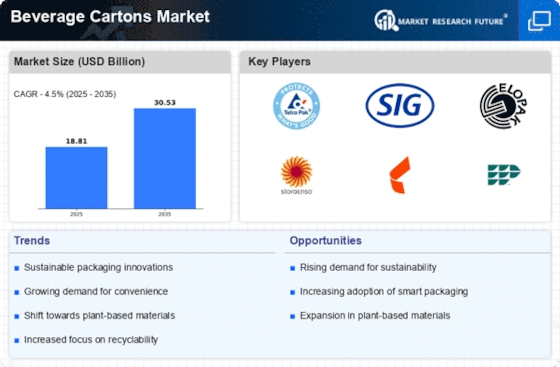
As per Market Research Future analysis, the Beverage Cartons Market was estimated at 18.81 USD Billion in 2024. The Beverage Cartons industry is projected to grow from 19.66 USD Billion in 2025 to 30.53 USD Billion by 2035, exhibiting a compound annual growth rate (CAGR) of 4.5% during the forecast period 2025 - 2035

Key Market Trends & Highlights

The Beverage Cartons Market is experiencing a transformative shift towards sustainability and health-conscious offerings.

  • The North American region remains the largest market for beverage cartons, driven by increasing consumer demand for sustainable packaging solutions. In the Asia-Pacific region, the beverage cartons market is the fastest-growing, fueled by rising disposable incomes and urbanization. Refrigerated cartons dominate the market, while shelf-stable cartons are witnessing rapid growth due to their convenience and longer shelf life. Key market drivers include sustainability initiatives and health and wellness trends, which are shaping product offerings across various segments.

Market Size & Forecast

2024 Market Size 18.81 (USD Billion)
2035 Market Size 30.53 (USD Billion)
CAGR (2025 - 2035) 4.5%
Largest Regional Market Share in 2024 Asia Pacific

Major Players

Tetra Pak (SE), SIG Combibloc (DE), Elopak (NO), Stora Enso (FI), Mondi Group (GB), International Paper (US), Smurfit Kappa (IE), DS Smith (GB), Nippon Paper Industries (JP)

Market Trends

The Beverage Cartons Market is currently experiencing a notable transformation, driven by evolving consumer preferences and increasing environmental awareness. As sustainability becomes a focal point for both manufacturers and consumers, there is a growing demand for eco-friendly packaging solutions. This shift is prompting companies to innovate and adopt materials that are recyclable or made from renewable resources. Furthermore, the rise in health consciousness among consumers is influencing the types of beverages being packaged, with a marked increase in demand for organic and natural products. This trend is likely to shape the future of the Beverage Cartons Market, as brands strive to align their offerings with consumer values. In addition to sustainability, technological advancements are playing a crucial role in the Beverage Cartons Market. Innovations in production processes and materials are enhancing the functionality and appeal of beverage cartons. For instance, the integration of smart packaging technologies is emerging, allowing for better tracking and consumer engagement. As the market continues to evolve, companies that can effectively leverage these advancements while addressing consumer needs are likely to gain a competitive edge. Overall, the Beverage Cartons Market appears poised for growth, with a focus on sustainability, health, and technological integration driving its trajectory.

Sustainability Focus

The emphasis on sustainable packaging solutions is reshaping the Beverage Cartons Market. Companies are increasingly adopting materials that are recyclable or derived from renewable resources, responding to consumer demand for environmentally friendly options.

Health-Conscious Offerings

There is a noticeable shift towards health-oriented beverages within the Beverage Cartons Market. Consumers are gravitating towards organic and natural products, prompting brands to adapt their packaging strategies to align with these preferences.

Technological Innovations

Advancements in technology are significantly impacting the Beverage Cartons Market. The introduction of smart packaging solutions is enhancing consumer interaction and product tracking, providing brands with new opportunities for engagement.

Beverage Cartons Market Market Drivers

Emerging Markets Growth

Emerging markets are presenting new opportunities for the Beverage Cartons Market. As economies develop and disposable incomes rise, there is an increasing demand for packaged beverages. Countries in Asia and Africa are witnessing a surge in consumption of juice, dairy, and non-alcoholic beverages, which are often packaged in cartons. Market analysts predict that the beverage carton consumption in these regions could grow by 10% annually over the next five years. This growth is driven by urbanization, changing lifestyles, and a growing middle class. Consequently, manufacturers are likely to focus on expanding their presence in these emerging markets, thereby fueling the overall growth of the Beverage Cartons Market.

Health and Wellness Trends

The Beverage Cartons Market is experiencing a notable shift towards health and wellness trends. With consumers increasingly prioritizing health, there is a rising demand for beverages that offer nutritional benefits. This trend is reflected in the growing popularity of functional drinks, such as those fortified with vitamins and minerals. According to recent data, the functional beverage market is expected to grow at a CAGR of 8% through 2026. Beverage cartons, which provide a convenient and hygienic packaging option, are well-positioned to cater to this demand. As manufacturers innovate to create healthier beverage options, the Beverage Cartons Market is likely to see an expansion in product offerings that align with these health-conscious consumer preferences.

Sustainability Initiatives

The Beverage Cartons Market is increasingly influenced by sustainability initiatives. As consumers become more environmentally conscious, there is a growing demand for eco-friendly packaging solutions. Beverage cartons, often made from renewable resources, align with this trend. In fact, the market for sustainable packaging is projected to reach USD 500 billion by 2027, indicating a robust shift towards environmentally responsible products. Companies are investing in recyclable and biodegradable materials, which not only appeal to consumers but also comply with stringent regulations aimed at reducing plastic waste. This focus on sustainability is likely to drive innovation within the Beverage Cartons Market, as manufacturers seek to enhance the environmental profile of their products.

Technological Advancements

Technological advancements are playing a pivotal role in shaping the Beverage Cartons Market. Innovations in packaging technology, such as improved barrier properties and enhanced printing techniques, are enabling manufacturers to produce more efficient and visually appealing cartons. For instance, advancements in digital printing allow for greater customization and shorter production runs, which can lead to increased market responsiveness. Furthermore, the integration of smart packaging technologies, such as QR codes and NFC tags, is enhancing consumer engagement and providing additional product information. These technological developments not only improve the functionality of beverage cartons but also contribute to the overall growth of the Beverage Cartons Market, as companies strive to meet evolving consumer expectations.

Convenience and Portability

The demand for convenience and portability is a significant driver in the Beverage Cartons Market. As lifestyles become increasingly fast-paced, consumers are seeking packaging solutions that offer ease of use and on-the-go consumption. Beverage cartons, with their lightweight and resealable features, cater to this need effectively. The ready-to-drink segment, which heavily relies on carton packaging, has seen substantial growth, with a projected increase of 6% annually through 2025. This trend is particularly evident among younger consumers who prioritize convenience in their purchasing decisions. As a result, the Beverage Cartons Market is likely to continue evolving to meet the demands of a convenience-oriented consumer base.

Market Segment Insights

By Type: Refrigerated Cartons (Largest) vs. Shelf-Stable Cartons (Fastest-Growing)

In the Beverage Cartons Market, the segment comprises two main types: Refrigerated Cartons and Shelf-Stable Cartons. Refrigerated Cartons currently hold a dominant position in the market, largely due to their association with perishable goods such as dairy and juices. The convenience and freshness perceived by consumers opting for these cartons enable this segment to capture a significant share of overall beverage packaging. On the other hand, Shelf-Stable Cartons have gained traction, particularly in the non-refrigerated beverage category, improving accessibility and shelf life for products. This segment caters to on-the-go consumers and is increasingly being favored by manufacturers seeking cost-effective packaging solutions.

Refrigerated Cartons (Dominant) vs. Shelf-Stable Cartons (Emerging)

Refrigerated Cartons are widely recognized for preserving freshness and extending the shelf life of perishable beverages, catering to a consumer base that prioritizes quality and taste. As a result, they are predominant in the market, particularly for dairy products, smoothies, and other chilled beverages. Conversely, Shelf-Stable Cartons have emerged rapidly, thanks to advancements in technology that allow for longer shelf life without refrigeration. They have become a preferred choice for juice, non-dairy beverages, and other drinks that do not require cold storage, making them an appealing option for both consumers and retailers. The flexibility in distribution and storage provided by Shelf-Stable Cartons is driving their growth in various markets.

By Application: Fruit & Vegetable Juices (Largest) vs. Dairy Products (Fastest-Growing)

In the Beverage Cartons Market, the application segments show a distinct distribution of market share. Fruit &amp; vegetable juices dominate the market, driven by increasing health consciousness among consumers and a growing preference for natural beverage options. This segment is characterized by its robust demand, especially in the retail sector, as consumers increasingly opt for healthier alternatives to sugary drinks. Dairy products, while currently smaller in share, are rapidly gaining traction, appealing to consumers who seek convenience and ready-to-drink options in their daily diets. The growth trajectory of dairy products within the Beverage Cartons Market indicates significant potential, influenced by changing consumer lifestyles that prioritize convenience and health benefits. The rising popularity of plant-based and dairy alternatives is further enhancing this segment’s attractiveness. Innovations in packaging, which improve shelf life and preserve product quality, are also pivotal. As manufacturers respond to evolving consumer preferences by diversifying their offerings, dairy products are set to become a more prominent player in the beverage carton segment, reflecting a shift toward healthier and more sustainable choices.

Fruit &amp; Vegetable Juices (Dominant) vs. Dairy Products (Emerging)

The Fruit &amp; Vegetable Juices segment stands out as the dominant category within the Beverage Cartons Market, reflecting strong consumer demand for nutritious and natural products. It caters to a wide range of demographics, appealing particularly to health-conscious individuals seeking refreshing, vitamin-rich beverages. This segment benefits from innovative flavors and packaging that enhance on-shelf visibility. Conversely, the Dairy Products segment is emerging as a competitive force within the market. This segment is characterized by its convenience and the growing trend of ready-to-drink dairy beverages, which are increasingly popular among busy consumers. Factors such as health benefits associated with dairy, including protein content and probiotics, are attracting a diverse consumer base, solidifying its position for future growth.

Get more detailed insights about Beverage Cartons Market Research Report - Global Forecast till 2035

Regional Insights

North America : Market Leader in Innovation

North America is the largest market for beverage cartons, holding approximately 40% of the global share. The region's growth is driven by increasing consumer demand for sustainable packaging solutions and stringent regulations promoting eco-friendly materials. The rise in health-conscious consumers is also pushing brands to adopt carton packaging for juices and dairy products, further fueling market expansion. The United States and Canada are the leading countries in this market, with major players like Tetra Pak and International Paper dominating the landscape. The competitive environment is characterized by continuous innovation and investment in sustainable practices. Companies are focusing on enhancing product features, such as recyclability and lightweight designs, to meet consumer preferences and regulatory requirements.

Europe : Sustainability and Innovation Hub

Europe is the second-largest market for beverage cartons, accounting for around 30% of the global market share. The region's growth is significantly influenced by stringent environmental regulations and a strong consumer preference for sustainable packaging. Initiatives like the European Green Deal are catalyzing the shift towards recyclable and biodegradable materials, driving demand for innovative carton solutions. Leading countries in this market include Germany, France, and the UK, where companies like SIG Combibloc and Stora Enso are prominent. The competitive landscape is marked by a focus on sustainability, with firms investing in R&D to develop advanced carton technologies. The presence of key players fosters a dynamic environment, encouraging collaboration and innovation to meet regulatory standards and consumer expectations.

Asia-Pacific : Emerging Market with High Potential

Asia-Pacific is witnessing rapid growth in the beverage cartons market, holding approximately 25% of the global share. The region's expansion is driven by increasing urbanization, rising disposable incomes, and a growing preference for packaged beverages. Countries like China and India are leading this trend, supported by favorable government policies promoting sustainable packaging solutions. China is the largest market in the region, with significant contributions from local players and international companies like Nippon Paper Industries. The competitive landscape is evolving, with a mix of established brands and emerging startups focusing on innovative packaging solutions. The demand for convenience and sustainability is shaping the market, prompting companies to invest in advanced technologies and eco-friendly materials.

Middle East and Africa : Untapped Market Opportunities

The Middle East and Africa region is gradually emerging in the beverage cartons market, currently holding about 5% of the global share. The growth is driven by increasing consumer awareness regarding health and sustainability, alongside a rise in the consumption of packaged beverages. Governments are also beginning to implement regulations that encourage the use of eco-friendly packaging, which is expected to boost market growth in the coming years. Leading countries in this region include South Africa and the UAE, where companies are beginning to invest in sustainable packaging solutions. The competitive landscape is still developing, with both local and international players vying for market share. Key players like Mondi Group and DS Smith are focusing on expanding their presence and enhancing product offerings to cater to the growing demand for beverage cartons.

Key Players and Competitive Insights

Leading market players are investing heavily in research and development in order to expand their product lines, which will help the Beverage Cartons Market, grow even more. Market participants are also undertaking a variety of strategic activities to expand their global footprint, with important market developments including new product launches, contractual agreements, mergers and acquisitions, higher investments, and collaboration with other organizations. To expand and survive in a more competitive and rising market climate, Beverage Cartons industry must offer cost-effective items. Manufacturing locally to minimize operational costs is one of the key business tactics used by manufacturers in the global Beverage Cartons industry to benefit clients and increase the market sector. In recent years, the Beverage Cartons industry has offered some of the most significant advantages to medicine. Major players in the Beverage Cartons Market, including Tetra Pak, Elopak, Sig Combibloc Group Ltd., Mondi Group, Westrock Company, Visy, Stora Enso, Pactiv Evergreen, IPI S.r.l., and Greatview Aseptic Packaging Co. Ltd., are attempting to increase market demand by investing in research and development operations. A supplier of complete solutions for processing and packaging is Tetra Pak International SA (Tetra Pak), a division of Tetra Laval International SA. The business provides solutions for the distribution of food items such as dairy products, ice cream, dry goods, cheese, fruits, and vegetables, as well as juices and nectars. Evaporators, heat exchangers, aseptic processing systems, separators, homogenizers, and flow equipment are just a few of the many processing tools it provides. It creates and sells a range of distribution equipment, including conveyors, cardboard packers, and film wrappers. Tetra Pak offers comprehensive machine lines, including tools, services, engineering, installation, and design. Tetra Pak and Uniboard agreed to a contract of USD 2.5 million in November 2022 to develop a cardboard recycling facility for used beverage cartons (UBC). The money will be used to construct a facility that can recycle 8,000 tonnes of UBC every year; it should be up and running by 2023. Packaging solutions are provided by Ardagh Group SA (Ardagh). It produces and sells packaging made of glass and metal. For the market, which includes beer, food, hard seltzers, wine, spirits, carbonated soft drinks, energy drinks, juices, and sparkling waters, the company produces metal and glass containers. The business sells tinplate and aluminium packaging items, such as two- and three-piece cans with peelable ends and a variety of forms, sizes, and graphic designs. These goods have uses in the markets for food and drink, pharmaceuticals, personal care, household products, and industrial coatings. The corporation has production operations spread across a number of nations in the Americas, Europe, Asia, and Africa. The headquarters of Ardagh are in Luxembourg. For its line of apple cider vinegar beverages, Ardagh Group S.A. and Bragg Live Food Products teamed up to launch a new 16oz glass bottle in March 2021.

Key Companies in the Beverage Cartons Market include

Industry Developments

May 2022: Coca-Cola UNITED and O-I Glass Inc. launched a collaboration to recycle glass bottles. Coca-Cola UNITED is committed to creating a world free of trash, and by 2030 the company intends to use 50% recycled material in its bottles. The bottling company is working with O-I Glass to gather more recycled glass so that it may be made into new glass bottles.

August 2023:

SIG Combibloc Group, a leading supplier of system solutions for beverage carton packaging, announced the launch of its new Combibloc EcoPlus carton, which is made with up to 95% renewable materials.

September 2023:

SIG Combibloc has partnered with PepsiCo to launch a new recyclable beverage carton made from 100% recycled paperboard. The new carton is called the SIG Nature 100 and will be used to package PepsiCo's Naked brand of juices and smoothies.

Future Outlook

Beverage Cartons Market Future Outlook

The Beverage Cartons Market is projected to grow at a 4.5% CAGR from 2025 to 2035, driven by sustainability trends, innovation in packaging, and increasing demand for convenience.

New opportunities lie in:

  • <p>Expansion into plant-based beverage cartons Development of smart packaging solutions Partnerships with e-commerce platforms for direct-to-consumer sales</p>

By 2035, the Beverage Cartons Market is expected to be robust, reflecting strong growth and innovation.

Market Segmentation

Beverage Cartons Market Type Outlook

  • Refrigerated Cartons
  • Shelf-Stable Cartons

Beverage Cartons Market Application Outlook

  • Fruit & Vegetable Juices
  • Dairy Products
  • Others

Report Scope

MARKET SIZE 2024 18.81(USD Billion)
MARKET SIZE 2025 19.66(USD Billion)
MARKET SIZE 2035 30.53(USD Billion)
COMPOUND ANNUAL GROWTH RATE (CAGR) 4.5% (2025 - 2035)
REPORT COVERAGE Revenue Forecast, Competitive Landscape, Growth Factors, and Trends
BASE YEAR 2024
Market Forecast Period 2025 - 2035
Historical Data 2019 - 2024
Market Forecast Units USD Billion
Key Companies Profiled Tetra Pak (SE), SIG Combibloc (DE), Elopak (NO), Stora Enso (FI), Mondi Group (GB), International Paper (US), Smurfit Kappa (IE), DS Smith (GB), Nippon Paper Industries (JP)
Segments Covered Type, Application, Region
Key Market Opportunities Growing demand for sustainable packaging solutions in the Beverage Cartons Market presents significant opportunities.
Key Market Dynamics Rising consumer preference for sustainable packaging drives innovation and competition in the beverage cartons market.
Countries Covered North America, Europe, APAC, South America, MEA

FAQs

What is the current valuation of the Beverage Cartons Market as of 2024?

<p>The Beverage Cartons Market was valued at 18.81 USD Billion in 2024.</p>

What is the projected market valuation for the Beverage Cartons Market in 2035?

<p>The market is projected to reach 30.53 USD Billion by 2035.</p>

What is the expected CAGR for the Beverage Cartons Market during the forecast period 2025 - 2035?

<p>The expected CAGR for the Beverage Cartons Market during 2025 - 2035 is 4.5%.</p>

Which segments are included in the Beverage Cartons Market?

<p>The market segments include Refrigerated Cartons, Shelf-Stable Cartons, Fruit & Vegetable Juices, Dairy Products, and Others.</p>

What were the valuations for Refrigerated and Shelf-Stable Cartons in 2024?

<p>In 2024, Refrigerated Cartons were valued at 7.53 USD Billion, while Shelf-Stable Cartons were valued at 11.28 USD Billion.</p>

How do the projected valuations for Refrigerated and Shelf-Stable Cartons compare in 2035?

<p>By 2035, Refrigerated Cartons are projected to reach 11.25 USD Billion, and Shelf-Stable Cartons are expected to grow to 19.28 USD Billion.</p>

What applications are driving growth in the Beverage Cartons Market?

Key applications driving growth include Fruit &amp; Vegetable Juices, Dairy Products, and Others.

What were the market valuations for Fruit & Vegetable Juices and Dairy Products in 2024?

In 2024, Fruit &amp; Vegetable Juices were valued at 6.5 USD Billion, while Dairy Products were valued at 8.0 USD Billion.

What are the projected valuations for Fruit & Vegetable Juices and Dairy Products in 2035?

By 2035, Fruit &amp; Vegetable Juices are projected to reach 10.2 USD Billion, and Dairy Products are expected to grow to 12.5 USD Billion.

Who are the key players in the Beverage Cartons Market?

Key players in the market include Tetra Pak, SIG Combibloc, Elopak, Stora Enso, Mondi Group, International Paper, Smurfit Kappa, DS Smith, and Nippon Paper Industries.

  1. SECTION I: EXECUTIVE SUMMARY AND KEY HIGHLIGHTS
    1. | 1.1 EXECUTIVE SUMMARY
    2. | | 1.1.1 Market Overview
    3. | | 1.1.2 Key Findings
    4. | | 1.1.3 Market Segmentation
    5. | | 1.1.4 Competitive Landscape
    6. | | 1.1.5 Challenges and Opportunities
    7. | | 1.1.6 Future Outlook
  2. SECTION II: SCOPING, METHODOLOGY AND MARKET STRUCTURE
    1. | 2.1 MARKET INTRODUCTION
    2. | | 2.1.1 Definition
    3. | | 2.1.2 Scope of the study
    4. | | | 2.1.2.1 Research Objective
    5. | | | 2.1.2.2 Assumption
    6. | | | 2.1.2.3 Limitations
    7. | 2.2 RESEARCH METHODOLOGY
    8. | | 2.2.1 Overview
    9. | | 2.2.2 Data Mining
    10. | | 2.2.3 Secondary Research
    11. | | 2.2.4 Primary Research
    12. | | | 2.2.4.1 Primary Interviews and Information Gathering Process
    13. | | | 2.2.4.2 Breakdown of Primary Respondents
    14. | | 2.2.5 Forecasting Model
    15. | | 2.2.6 Market Size Estimation
    16. | | | 2.2.6.1 Bottom-Up Approach
    17. | | | 2.2.6.2 Top-Down Approach
    18. | | 2.2.7 Data Triangulation
    19. | | 2.2.8 Validation
  3. SECTION III: QUALITATIVE ANALYSIS
    1. | 3.1 MARKET DYNAMICS
    2. | | 3.1.1 Overview
    3. | | 3.1.2 Drivers
    4. | | 3.1.3 Restraints
    5. | | 3.1.4 Opportunities
    6. | 3.2 MARKET FACTOR ANALYSIS
    7. | | 3.2.1 Value chain Analysis
    8. | | 3.2.2 Porter's Five Forces Analysis
    9. | | | 3.2.2.1 Bargaining Power of Suppliers
    10. | | | 3.2.2.2 Bargaining Power of Buyers
    11. | | | 3.2.2.3 Threat of New Entrants
    12. | | | 3.2.2.4 Threat of Substitutes
    13. | | | 3.2.2.5 Intensity of Rivalry
    14. | | 3.2.3 COVID-19 Impact Analysis
    15. | | | 3.2.3.1 Market Impact Analysis
    16. | | | 3.2.3.2 Regional Impact
    17. | | | 3.2.3.3 Opportunity and Threat Analysis
  4. SECTION IV: QUANTITATIVE ANALYSIS
    1. | 4.1 Packaging & Transport, BY Type (USD Billion)
    2. | | 4.1.1 Refrigerated Cartons
    3. | | 4.1.2 Shelf-Stable Cartons
    4. | 4.2 Packaging & Transport, BY Application (USD Billion)
    5. | | 4.2.1 Fruit & Vegetable Juices
    6. | | 4.2.2 Dairy Products
    7. | | 4.2.3 Others
    8. | 4.3 Packaging & Transport, BY Region (USD Billion)
    9. | | 4.3.1 North America
    10. | | | 4.3.1.1 US
    11. | | | 4.3.1.2 Canada
    12. | | 4.3.2 Europe
    13. | | | 4.3.2.1 Germany
    14. | | | 4.3.2.2 UK
    15. | | | 4.3.2.3 France
    16. | | | 4.3.2.4 Russia
    17. | | | 4.3.2.5 Italy
    18. | | | 4.3.2.6 Spain
    19. | | | 4.3.2.7 Rest of Europe
    20. | | 4.3.3 APAC
    21. | | | 4.3.3.1 China
    22. | | | 4.3.3.2 India
    23. | | | 4.3.3.3 Japan
    24. | | | 4.3.3.4 South Korea
    25. | | | 4.3.3.5 Malaysia
    26. | | | 4.3.3.6 Thailand
    27. | | | 4.3.3.7 Indonesia
    28. | | | 4.3.3.8 Rest of APAC
    29. | | 4.3.4 South America
    30. | | | 4.3.4.1 Brazil
    31. | | | 4.3.4.2 Mexico
    32. | | | 4.3.4.3 Argentina
    33. | | | 4.3.4.4 Rest of South America
    34. | | 4.3.5 MEA
    35. | | | 4.3.5.1 GCC Countries
    36. | | | 4.3.5.2 South Africa
    37. | | | 4.3.5.3 Rest of MEA
  5. SECTION V: COMPETITIVE ANALYSIS
    1. | 5.1 Competitive Landscape
    2. | | 5.1.1 Overview
    3. | | 5.1.2 Competitive Analysis
    4. | | 5.1.3 Market share Analysis
    5. | | 5.1.4 Major Growth Strategy in the Packaging & Transport
    6. | | 5.1.5 Competitive Benchmarking
    7. | | 5.1.6 Leading Players in Terms of Number of Developments in the Packaging & Transport
    8. | | 5.1.7 Key developments and growth strategies
    9. | | | 5.1.7.1 New Product Launch/Service Deployment
    10. | | | 5.1.7.2 Merger & Acquisitions
    11. | | | 5.1.7.3 Joint Ventures
    12. | | 5.1.8 Major Players Financial Matrix
    13. | | | 5.1.8.1 Sales and Operating Income
    14. | | | 5.1.8.2 Major Players R&D Expenditure. 2023
    15. | 5.2 Company Profiles
    16. | | 5.2.1 Tetra Pak (SE)
    17. | | | 5.2.1.1 Financial Overview
    18. | | | 5.2.1.2 Products Offered
    19. | | | 5.2.1.3 Key Developments
    20. | | | 5.2.1.4 SWOT Analysis
    21. | | | 5.2.1.5 Key Strategies
    22. | | 5.2.2 SIG Combibloc (DE)
    23. | | | 5.2.2.1 Financial Overview
    24. | | | 5.2.2.2 Products Offered
    25. | | | 5.2.2.3 Key Developments
    26. | | | 5.2.2.4 SWOT Analysis
    27. | | | 5.2.2.5 Key Strategies
    28. | | 5.2.3 Elopak (NO)
    29. | | | 5.2.3.1 Financial Overview
    30. | | | 5.2.3.2 Products Offered
    31. | | | 5.2.3.3 Key Developments
    32. | | | 5.2.3.4 SWOT Analysis
    33. | | | 5.2.3.5 Key Strategies
    34. | | 5.2.4 Stora Enso (FI)
    35. | | | 5.2.4.1 Financial Overview
    36. | | | 5.2.4.2 Products Offered
    37. | | | 5.2.4.3 Key Developments
    38. | | | 5.2.4.4 SWOT Analysis
    39. | | | 5.2.4.5 Key Strategies
    40. | | 5.2.5 Mondi Group (GB)
    41. | | | 5.2.5.1 Financial Overview
    42. | | | 5.2.5.2 Products Offered
    43. | | | 5.2.5.3 Key Developments
    44. | | | 5.2.5.4 SWOT Analysis
    45. | | | 5.2.5.5 Key Strategies
    46. | | 5.2.6 International Paper (US)
    47. | | | 5.2.6.1 Financial Overview
    48. | | | 5.2.6.2 Products Offered
    49. | | | 5.2.6.3 Key Developments
    50. | | | 5.2.6.4 SWOT Analysis
    51. | | | 5.2.6.5 Key Strategies
    52. | | 5.2.7 Smurfit Kappa (IE)
    53. | | | 5.2.7.1 Financial Overview
    54. | | | 5.2.7.2 Products Offered
    55. | | | 5.2.7.3 Key Developments
    56. | | | 5.2.7.4 SWOT Analysis
    57. | | | 5.2.7.5 Key Strategies
    58. | | 5.2.8 DS Smith (GB)
    59. | | | 5.2.8.1 Financial Overview
    60. | | | 5.2.8.2 Products Offered
    61. | | | 5.2.8.3 Key Developments
    62. | | | 5.2.8.4 SWOT Analysis
    63. | | | 5.2.8.5 Key Strategies
    64. | | 5.2.9 Nippon Paper Industries (JP)
    65. | | | 5.2.9.1 Financial Overview
    66. | | | 5.2.9.2 Products Offered
    67. | | | 5.2.9.3 Key Developments
    68. | | | 5.2.9.4 SWOT Analysis
    69. | | | 5.2.9.5 Key Strategies
    70. | 5.3 Appendix
    71. | | 5.3.1 References
    72. | | 5.3.2 Related Reports
  6. LIST OF FIGURES
    1. | 6.1 MARKET SYNOPSIS
    2. | 6.2 NORTH AMERICA MARKET ANALYSIS
    3. | 6.3 US MARKET ANALYSIS BY TYPE
    4. | 6.4 US MARKET ANALYSIS BY APPLICATION
    5. | 6.5 CANADA MARKET ANALYSIS BY TYPE
    6. | 6.6 CANADA MARKET ANALYSIS BY APPLICATION
    7. | 6.7 EUROPE MARKET ANALYSIS
    8. | 6.8 GERMANY MARKET ANALYSIS BY TYPE
    9. | 6.9 GERMANY MARKET ANALYSIS BY APPLICATION
    10. | 6.10 UK MARKET ANALYSIS BY TYPE
    11. | 6.11 UK MARKET ANALYSIS BY APPLICATION
    12. | 6.12 FRANCE MARKET ANALYSIS BY TYPE
    13. | 6.13 FRANCE MARKET ANALYSIS BY APPLICATION
    14. | 6.14 RUSSIA MARKET ANALYSIS BY TYPE
    15. | 6.15 RUSSIA MARKET ANALYSIS BY APPLICATION
    16. | 6.16 ITALY MARKET ANALYSIS BY TYPE
    17. | 6.17 ITALY MARKET ANALYSIS BY APPLICATION
    18. | 6.18 SPAIN MARKET ANALYSIS BY TYPE
    19. | 6.19 SPAIN MARKET ANALYSIS BY APPLICATION
    20. | 6.20 REST OF EUROPE MARKET ANALYSIS BY TYPE
    21. | 6.21 REST OF EUROPE MARKET ANALYSIS BY APPLICATION
    22. | 6.22 APAC MARKET ANALYSIS
    23. | 6.23 CHINA MARKET ANALYSIS BY TYPE
    24. | 6.24 CHINA MARKET ANALYSIS BY APPLICATION
    25. | 6.25 INDIA MARKET ANALYSIS BY TYPE
    26. | 6.26 INDIA MARKET ANALYSIS BY APPLICATION
    27. | 6.27 JAPAN MARKET ANALYSIS BY TYPE
    28. | 6.28 JAPAN MARKET ANALYSIS BY APPLICATION
    29. | 6.29 SOUTH KOREA MARKET ANALYSIS BY TYPE
    30. | 6.30 SOUTH KOREA MARKET ANALYSIS BY APPLICATION
    31. | 6.31 MALAYSIA MARKET ANALYSIS BY TYPE
    32. | 6.32 MALAYSIA MARKET ANALYSIS BY APPLICATION
    33. | 6.33 THAILAND MARKET ANALYSIS BY TYPE
    34. | 6.34 THAILAND MARKET ANALYSIS BY APPLICATION
    35. | 6.35 INDONESIA MARKET ANALYSIS BY TYPE
    36. | 6.36 INDONESIA MARKET ANALYSIS BY APPLICATION
    37. | 6.37 REST OF APAC MARKET ANALYSIS BY TYPE
    38. | 6.38 REST OF APAC MARKET ANALYSIS BY APPLICATION
    39. | 6.39 SOUTH AMERICA MARKET ANALYSIS
    40. | 6.40 BRAZIL MARKET ANALYSIS BY TYPE
    41. | 6.41 BRAZIL MARKET ANALYSIS BY APPLICATION
    42. | 6.42 MEXICO MARKET ANALYSIS BY TYPE
    43. | 6.43 MEXICO MARKET ANALYSIS BY APPLICATION
    44. | 6.44 ARGENTINA MARKET ANALYSIS BY TYPE
    45. | 6.45 ARGENTINA MARKET ANALYSIS BY APPLICATION
    46. | 6.46 REST OF SOUTH AMERICA MARKET ANALYSIS BY TYPE
    47. | 6.47 REST OF SOUTH AMERICA MARKET ANALYSIS BY APPLICATION
    48. | 6.48 MEA MARKET ANALYSIS
    49. | 6.49 GCC COUNTRIES MARKET ANALYSIS BY TYPE
    50. | 6.50 GCC COUNTRIES MARKET ANALYSIS BY APPLICATION
    51. | 6.51 SOUTH AFRICA MARKET ANALYSIS BY TYPE
    52. | 6.52 SOUTH AFRICA MARKET ANALYSIS BY APPLICATION
    53. | 6.53 REST OF MEA MARKET ANALYSIS BY TYPE
    54. | 6.54 REST OF MEA MARKET ANALYSIS BY APPLICATION
    55. | 6.55 KEY BUYING CRITERIA OF PACKAGING & TRANSPORT
    56. | 6.56 RESEARCH PROCESS OF MRFR
    57. | 6.57 DRO ANALYSIS OF PACKAGING & TRANSPORT
    58. | 6.58 DRIVERS IMPACT ANALYSIS: PACKAGING & TRANSPORT
    59. | 6.59 RESTRAINTS IMPACT ANALYSIS: PACKAGING & TRANSPORT
    60. | 6.60 SUPPLY / VALUE CHAIN: PACKAGING & TRANSPORT
    61. | 6.61 PACKAGING & TRANSPORT, BY TYPE, 2024 (% SHARE)
    62. | 6.62 PACKAGING & TRANSPORT, BY TYPE, 2024 TO 2035 (USD Billion)
    63. | 6.63 PACKAGING & TRANSPORT, BY APPLICATION, 2024 (% SHARE)
    64. | 6.64 PACKAGING & TRANSPORT, BY APPLICATION, 2024 TO 2035 (USD Billion)
    65. | 6.65 BENCHMARKING OF MAJOR COMPETITORS
  7. LIST OF TABLES
    1. | 7.1 LIST OF ASSUMPTIONS
    2. | | 7.1.1
    3. | 7.2 North America MARKET SIZE ESTIMATES; FORECAST
    4. | | 7.2.1 BY TYPE, 2025-2035 (USD Billion)
    5. | | 7.2.2 BY APPLICATION, 2025-2035 (USD Billion)
    6. | 7.3 US MARKET SIZE ESTIMATES; FORECAST
    7. | | 7.3.1 BY TYPE, 2025-2035 (USD Billion)
    8. | | 7.3.2 BY APPLICATION, 2025-2035 (USD Billion)
    9. | 7.4 Canada MARKET SIZE ESTIMATES; FORECAST
    10. | | 7.4.1 BY TYPE, 2025-2035 (USD Billion)
    11. | | 7.4.2 BY APPLICATION, 2025-2035 (USD Billion)
    12. | 7.5 Europe MARKET SIZE ESTIMATES; FORECAST
    13. | | 7.5.1 BY TYPE, 2025-2035 (USD Billion)
    14. | | 7.5.2 BY APPLICATION, 2025-2035 (USD Billion)
    15. | 7.6 Germany MARKET SIZE ESTIMATES; FORECAST
    16. | | 7.6.1 BY TYPE, 2025-2035 (USD Billion)
    17. | | 7.6.2 BY APPLICATION, 2025-2035 (USD Billion)
    18. | 7.7 UK MARKET SIZE ESTIMATES; FORECAST
    19. | | 7.7.1 BY TYPE, 2025-2035 (USD Billion)
    20. | | 7.7.2 BY APPLICATION, 2025-2035 (USD Billion)
    21. | 7.8 France MARKET SIZE ESTIMATES; FORECAST
    22. | | 7.8.1 BY TYPE, 2025-2035 (USD Billion)
    23. | | 7.8.2 BY APPLICATION, 2025-2035 (USD Billion)
    24. | 7.9 Russia MARKET SIZE ESTIMATES; FORECAST
    25. | | 7.9.1 BY TYPE, 2025-2035 (USD Billion)
    26. | | 7.9.2 BY APPLICATION, 2025-2035 (USD Billion)
    27. | 7.10 Italy MARKET SIZE ESTIMATES; FORECAST
    28. | | 7.10.1 BY TYPE, 2025-2035 (USD Billion)
    29. | | 7.10.2 BY APPLICATION, 2025-2035 (USD Billion)
    30. | 7.11 Spain MARKET SIZE ESTIMATES; FORECAST
    31. | | 7.11.1 BY TYPE, 2025-2035 (USD Billion)
    32. | | 7.11.2 BY APPLICATION, 2025-2035 (USD Billion)
    33. | 7.12 Rest of Europe MARKET SIZE ESTIMATES; FORECAST
    34. | | 7.12.1 BY TYPE, 2025-2035 (USD Billion)
    35. | | 7.12.2 BY APPLICATION, 2025-2035 (USD Billion)
    36. | 7.13 APAC MARKET SIZE ESTIMATES; FORECAST
    37. | | 7.13.1 BY TYPE, 2025-2035 (USD Billion)
    38. | | 7.13.2 BY APPLICATION, 2025-2035 (USD Billion)
    39. | 7.14 China MARKET SIZE ESTIMATES; FORECAST
    40. | | 7.14.1 BY TYPE, 2025-2035 (USD Billion)
    41. | | 7.14.2 BY APPLICATION, 2025-2035 (USD Billion)
    42. | 7.15 India MARKET SIZE ESTIMATES; FORECAST
    43. | | 7.15.1 BY TYPE, 2025-2035 (USD Billion)
    44. | | 7.15.2 BY APPLICATION, 2025-2035 (USD Billion)
    45. | 7.16 Japan MARKET SIZE ESTIMATES; FORECAST
    46. | | 7.16.1 BY TYPE, 2025-2035 (USD Billion)
    47. | | 7.16.2 BY APPLICATION, 2025-2035 (USD Billion)
    48. | 7.17 South Korea MARKET SIZE ESTIMATES; FORECAST
    49. | | 7.17.1 BY TYPE, 2025-2035 (USD Billion)
    50. | | 7.17.2 BY APPLICATION, 2025-2035 (USD Billion)
    51. | 7.18 Malaysia MARKET SIZE ESTIMATES; FORECAST
    52. | | 7.18.1 BY TYPE, 2025-2035 (USD Billion)
    53. | | 7.18.2 BY APPLICATION, 2025-2035 (USD Billion)
    54. | 7.19 Thailand MARKET SIZE ESTIMATES; FORECAST
    55. | | 7.19.1 BY TYPE, 2025-2035 (USD Billion)
    56. | | 7.19.2 BY APPLICATION, 2025-2035 (USD Billion)
    57. | 7.20 Indonesia MARKET SIZE ESTIMATES; FORECAST
    58. | | 7.20.1 BY TYPE, 2025-2035 (USD Billion)
    59. | | 7.20.2 BY APPLICATION, 2025-2035 (USD Billion)
    60. | 7.21 Rest of APAC MARKET SIZE ESTIMATES; FORECAST
    61. | | 7.21.1 BY TYPE, 2025-2035 (USD Billion)
    62. | | 7.21.2 BY APPLICATION, 2025-2035 (USD Billion)
    63. | 7.22 South America MARKET SIZE ESTIMATES; FORECAST
    64. | | 7.22.1 BY TYPE, 2025-2035 (USD Billion)
    65. | | 7.22.2 BY APPLICATION, 2025-2035 (USD Billion)
    66. | 7.23 Brazil MARKET SIZE ESTIMATES; FORECAST
    67. | | 7.23.1 BY TYPE, 2025-2035 (USD Billion)
    68. | | 7.23.2 BY APPLICATION, 2025-2035 (USD Billion)
    69. | 7.24 Mexico MARKET SIZE ESTIMATES; FORECAST
    70. | | 7.24.1 BY TYPE, 2025-2035 (USD Billion)
    71. | | 7.24.2 BY APPLICATION, 2025-2035 (USD Billion)
    72. | 7.25 Argentina MARKET SIZE ESTIMATES; FORECAST
    73. | | 7.25.1 BY TYPE, 2025-2035 (USD Billion)
    74. | | 7.25.2 BY APPLICATION, 2025-2035 (USD Billion)
    75. | 7.26 Rest of South America MARKET SIZE ESTIMATES; FORECAST
    76. | | 7.26.1 BY TYPE, 2025-2035 (USD Billion)
    77. | | 7.26.2 BY APPLICATION, 2025-2035 (USD Billion)
    78. | 7.27 MEA MARKET SIZE ESTIMATES; FORECAST
    79. | | 7.27.1 BY TYPE, 2025-2035 (USD Billion)
    80. | | 7.27.2 BY APPLICATION, 2025-2035 (USD Billion)
    81. | 7.28 GCC Countries MARKET SIZE ESTIMATES; FORECAST
    82. | | 7.28.1 BY TYPE, 2025-2035 (USD Billion)
    83. | | 7.28.2 BY APPLICATION, 2025-2035 (USD Billion)
    84. | 7.29 South Africa MARKET SIZE ESTIMATES; FORECAST
    85. | | 7.29.1 BY TYPE, 2025-2035 (USD Billion)
    86. | | 7.29.2 BY APPLICATION, 2025-2035 (USD Billion)
    87. | 7.30 Rest of MEA MARKET SIZE ESTIMATES; FORECAST
    88. | | 7.30.1 BY TYPE, 2025-2035 (USD Billion)
    89. | | 7.30.2 BY APPLICATION, 2025-2035 (USD Billion)
    90. | 7.31 PRODUCT LAUNCH/PRODUCT DEVELOPMENT/APPROVAL
    91. | | 7.31.1
    92. | 7.32 ACQUISITION/PARTNERSHIP
    93. | | 7.32.1

Packaging & Transport Market Segmentation

Packaging & Transport By Type (USD Billion, 2025-2035)

  • Refrigerated Cartons
  • Shelf-Stable Cartons

Packaging & Transport By Application (USD Billion, 2025-2035)

  • Fruit & Vegetable Juices
  • Dairy Products
  • Others
Infographic

Free Sample Request

Kindly complete the form below to receive a free sample of this Report

Get Free Sample

Customer Strories

Compare Licence

×
Features License Type
Single User Multiuser License Enterprise User
Price $4,950 $5,950 $7,250
Maximum User Access Limit 1 User Upto 10 Users Unrestricted Access Throughout the Organization
Free Customization
Direct Access to Analyst
Deliverable Format
Platform Access
Discount on Next Purchase 10% 15% 15%
Printable Versions