Betaine Market (2026 - 2035)

ID: MRFR/FnB/1968-CR
110 Pages
Harshita Gorde
Last Updated: July 01, 2026
Betaine Market Size, Share, Industry Trend & Analysis Research Report Information By Form (Betaine Anhydrous, Betaine Monohydrate, Betaine HCl, Cocamidopropyl Betaine, Other Forms), By Type (Synthetic Betaine, Natural Betaine), By Application (Food, Beverages & Dietary Supplements, Animal Feed, Personal Care, Detergent, Other Applications), By Geography (North America, Europe, Asia-Pacific, South America, Middle East & Africa) – Forecast Till 2035
Betaine Market
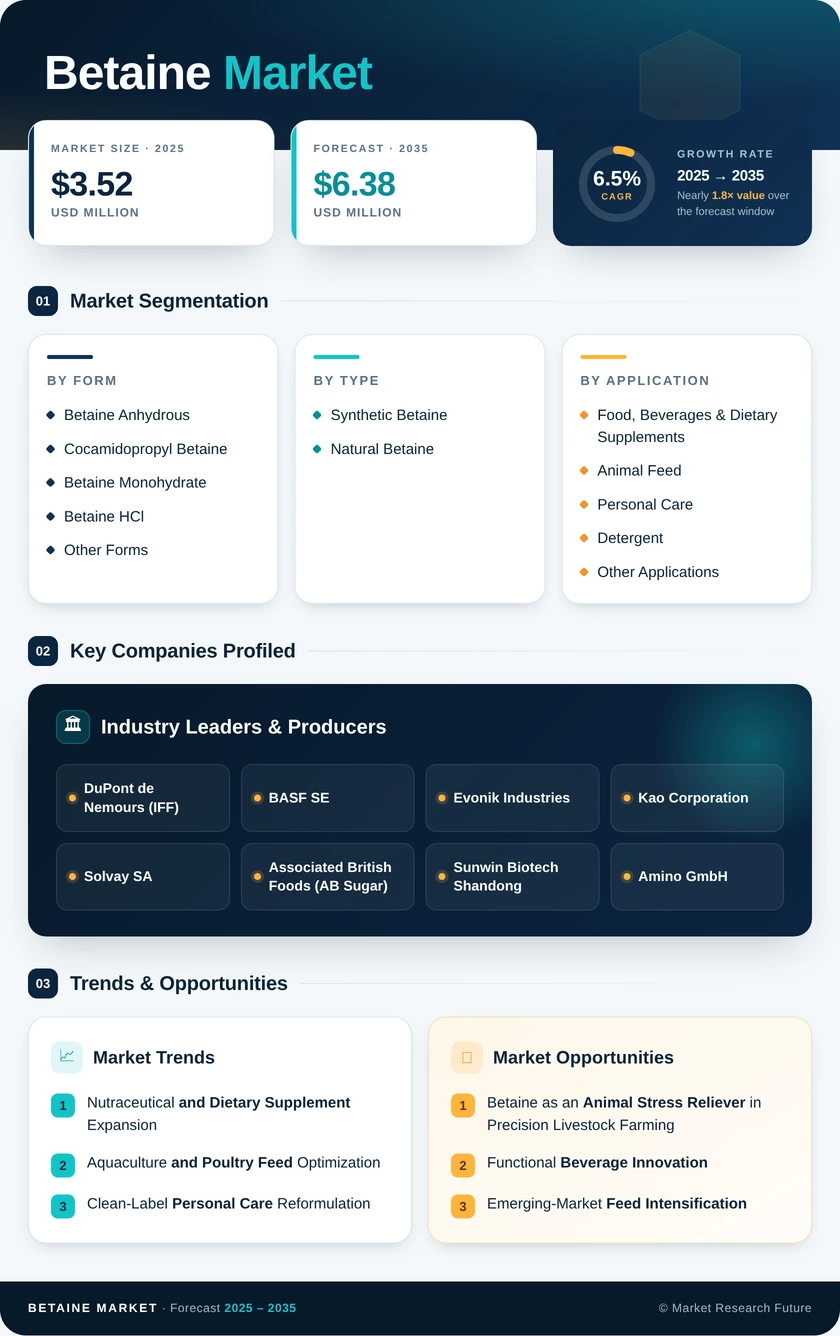
Market Size
Forecast Period2026-2035
CAGR (2026-2035)6.5%
2025 Market SizeUSD 3.52 Billion
2035 Market SizeUSD 6.38 Billion
Key Players
DuPont de Nemours
BASF SE
Evonik Industries
Kao Corporation
Solvay SA
Associated British Foods
Opportunities
  • Betaine as an Animal Stress Reliever in Precision Livestock Farming
  • Functional Beverage Innovation
  • Emerging-Market Feed Intensification
  1. 1 Market Overview
  2. 1 Study Assumptions & Market Definition
  3. 2 Scope of the Study
  4. 3 Research Methodology
  5. 2 Market Summary & Key Takeaways
  6. 3 Market Dynamics
  7. 1 Market Drivers Analysis
  8. 1 Rising Betaine Anhydrous Supplement Adoption in Nutraceuticals
  9. 2 Expansion of Betaine Animal Feed Additive in Aquaculture
  10. 3 Clean-Label Personal Care Reformulation
  11. 4 Sugar Beet–Derived Natural Betaine Capacity Growth
  12. 2 Market Restraints Analysis
  13. 1 Adverse Reactions Linked to Synthetic Cosmetic Ingredients
  14. 2 Climate-Driven Sugar Beet Supply Volatility
  15. 3 Competition from Alternative Feed Osmolytes
  16. 3 Market Opportunity Analysis
  17. 1 Betaine as an Animal Stress Reliever in Precision Livestock Farming
  18. 2 Functional Beverage Innovation
  19. 3 Emerging-Market Feed Intensification
  20. 4 Data-Enabled Ingredient Traceability and Premiumization
  21. 5 Oral Care and Cosmeceutical Expansion
  22. 4 Industry Value Chain Analysis
  23. 5 Porter's Five Forces Analysis
  24. 4 Global Betaine Market Size & Forecast (2021–2035)
  25. 1 Historical Market Size (2021–2025)
  26. 2 Current & Forecast Market Size (2026–2035)
  27. 3 Market Size by Revenue (USD Billion)
  28. 4 Year-over-Year Growth Analysis
  29. 5 Segmentation Analysis
  30. 1 By Form
  31. 1 Betaine Anhydrous
  32. 2 Betaine Monohydrate
  33. 3 Betaine HCl
  34. 4 Cocamidopropyl Betaine
  35. 5 Other Forms
  36. 2 By Type
  37. 1 Synthetic Betaine
  38. 2 Natural Betaine
  39. 3 By Application
  40. 1 Food, Beverages & Dietary Supplements
  41. 2 Animal Feed
  42. 3 Personal Care
  43. 4 Detergent
  44. 5 Other Applications
  45. 6 Regional Analysis
  46. 1 North America
  47. 1 United States
  48. 2 Canada
  49. 3 Mexico
  50. 2 Europe
  51. 1 Germany
  52. 2 United Kingdom
  53. 3 France
  54. 4 Italy
  55. 5 Spain
  56. 6 Nordic Countries
  57. 7 Russia
  58. 8 Rest of Europe
  59. 3 Asia-Pacific
  60. 1 China
  61. 2 India
  62. 3 Japan
  63. 4 South Korea
  64. 5 ASEAN
  65. 6 Rest of Asia-Pacific
  66. 4 South America
  67. 1 Brazil
  68. 2 Argentina
  69. 3 Rest of South America
  70. 5 Middle East & Africa
  71. 1 Saudi Arabia
  72. 2 UAE
  73. 3 South Africa
  74. 4 Egypt
  75. 5 Rest of MEA
  76. 7 Competitive Landscape
  77. 1 Market Share Analysis (2025)
  78. 2 Competitive Benchmarking Matrix
  79. 3 Company Profiles
  80. 1 DuPont de Nemours (IFF)
  81. 2 BASF SE
  82. 3 Evonik Industries
  83. 4 Kao Corporation
  84. 5 Solvay SA
  85. 6 Associated British Foods (AB Sugar)
  86. 7 Sunwin Biotech Shandong
  87. 8 Amino GmbH
  88. 9 Stepan Company
  89. 10 Healthy Holdings Ltd
  90. 8 Future Outlook & Strategic Recommendations (2026–2035)
  91. 1 AI-Driven Formulation and Precision Nutrition
  92. 2 Sustainability and Circular Biorefinery Economics
  93. 3 Expanding Aquaculture and Feed Intensification
  94. 4 ESG Reporting and Ingredient Transparency
  95. 9 Recent Developments & News
  96. 10 Frequently Asked Questions (FAQs)
  97. 11 Report Scope & Methodology
  98. 1 Study Period & Base Year
  99. 2 Data Sources & Citations
  100. 3 Abbreviations
  101. 1 LIST OF TABLES |
  102. TABLE 1 Global Betaine Market Size & Forecast, by Revenue (USD Billion), 2021–2035 |
  103. TABLE 2 Global Betaine Market – Year-over-Year Growth Analysis, 2021–2035 |
  104. TABLE 3 Global Betaine Market – Driver Impact Analysis |
  105. TABLE 4 Global Betaine Market – Restraints Impact Analysis |
  106. TABLE 5 Global Betaine Market Size, by Form, 2021–2035 |
  107. TABLE 6 Global Betaine Market Size, by Type, 2021–2035 |
  108. TABLE 7 Global Betaine Market Size, by Application, 2021–2035 |
  109. TABLE 8 Global Betaine Market Size, by Region, 2021–2035 |
  110. TABLE 9 North America Betaine Market Size, by Country, 2021–2035 |
  111. TABLE 10 Europe Betaine Market Size, by Country, 2021–2035 |
  112. TABLE 11 Asia-Pacific Betaine Market Size, by Country, 2021–2035 |
  113. TABLE 12 South America Betaine Market Size, by Country, 2021–2035 |
  114. TABLE 13 Middle East & Africa Betaine Market Size, by Country, 2021–2035 |
  115. TABLE 14 Competitive Benchmarking Matrix – Global Betaine Market, 2025 |
  116. TABLE 15 Company Profiles – Key Players, Global Betaine Market |
  117. TABLE 16 Recent Developments & Strategic Announcements, 2023–2025 |
  118. TABLE 17 Report Scope & Methodology Summary |
  119. TABLE 18 Detailed Sources and Citations
  120. 2 LIST OF FIGURES |
  121. FIGURE 1 Global Betaine Market Dynamics — Drivers, Restraints & Opportunities |
  122. FIGURE 2 Industry Value Chain Analysis — Betaine Market |
  123. FIGURE 3 Porter's Five Forces Analysis — Betaine Market |
  124. FIGURE 4 Global Betaine Market Size Trend (USD Billion), 2021–2035 |
  125. FIGURE 5 Global Betaine Market Share, by Form (%), 2025 |
  126. FIGURE 6 Global Betaine Market Share, by Type (%), 2025 |
  127. FIGURE 7 Global Betaine Market Share, by Application (%), 2025 |
  128. FIGURE 8 Global Betaine Market Share, by Region (%), 2025 |
  129. FIGURE 9 North America Betaine Market Share, by Country (%), 2025 |
  130. FIGURE 10 Europe Betaine Market Share, by Country (%), 2025 |
  131. FIGURE 11 Asia-Pacific Betaine Market Share, by Country (%), 2025 |
  132. FIGURE 12 South America Betaine Market Share, by Country (%), 2025 |
  133. FIGURE 13 Middle East & Africa Betaine Market Share, by Country (%), 2025 |
  134. FIGURE 14 Competitive Landscape — Market Concentration & Key Player Positioning

Segmentation Quick Reference

DimensionSub-SegmentsDominant SegmentFastest Growing Segment
By FormBetaine Anhydrous, Betaine Monohydrate, Betaine HCl, Cocamidopropyl Betaine, Other FormsBetaine AnhydrousCocamidopropyl Betaine
By TypeSynthetic Betaine, Natural BetaineSynthetic BetaineNatural Betaine
By ApplicationFood, Beverages & Dietary Supplements; Animal Feed; Personal Care; Detergent; Other ApplicationsFood, Beverages & Dietary SupplementsAnimal Feed
By GeographyNorth America, Europe, Asia-Pacific, South America, Middle East & AfricaNorth AmericaAsia-Pacific


Market Segmentation Overview

By Form

Sub-SegmentKey Trend
Betaine AnhydrousExpanding into sports nutrition and liver-health nutraceuticals
Betaine MonohydrateStable demand in feed-grade and industrial chemical applications
Betaine HClGrowing niche in digestive health supplements
Cocamidopropyl BetaineRapid adoption as sulfate-free surfactant in personal care
Other FormsSpecialty uses in pharmaceutical excipients and niche industrial processes


Betaine Anhydrous remains the backbone of the global Betaine Market by form, serving dual roles in human nutrition and animal feed. Cocamidopropyl Betaine is experiencing the strongest growth momentum, driven by the global personal care industry's accelerating shift toward mild, biodegradable cleansing agents.

By Type

Sub-SegmentKey Trend
Synthetic BetaineDominant in high-volume feed and detergent applications due to cost advantage
Natural BetaineGaining share as clean-label and organic certification trends intensify


Synthetic Betaine continues to account for the majority of global output, supported by large-scale chemical synthesis operations concentrated in China. Natural Betaine extracted from sugar beet molasses is closing the cost gap as European and North American biorefineries invest in co-product valorization.

By Application

Sub-SegmentKey Trend
Food, Beverages & Dietary SupplementsClinical evidence for liver health and cardiovascular benefits driving adoption
Animal FeedPrecision nutrition and heat-stress management scaling usage in aquaculture and poultry
Personal CareClean-beauty reformulation replacing sulfates with betaine-based surfactants
DetergentBiodegradable surfactant demand in household and industrial cleaners
Other ApplicationsEmerging pharmaceutical and cosmeceutical formulations


Food, Beverages & Dietary Supplements lead the Betaine Market by application value, with betaine anhydrous supplements representing the fastest-growing product category within this segment. Animal Feed is projected to be the highest-growth application over the forecast period as global aquaculture and poultry operations standardize betaine inclusion protocols.

By Geography

Sub-SegmentKey Trend
North AmericaDietary supplement e-commerce and personal care innovation
EuropeNatural betaine sugar beet extraction and cosmetics regulation
Asia-PacificSynthetic production scale-up and aquaculture feed intensification
South AmericaPoultry export–driven feed demand
Middle East & AfricaPersonal care market emergence and feed modernization


North America maintains the largest share of the global Betaine Market, underpinned by robust supplement consumption and personal care R&D investment. Asia-Pacific is the fastest-growing region, with China's synthetic production dominance and India's aquaculture expansion serving as twin growth engines through 2035.


Download PDF ×

We do not share your information with anyone. However, we may send you emails based on your report interest from time to time. You may contact us at any time to opt-out.