×
Hero Background
English
Chinese
French
Japanese
Korean
German
Spanish

Benzathine Penicillin G Market Share

ID: MRFR/Pharma/5079-HCR
90 Pages
Rahul Gotadki
October 2025

Benzathine Penicillin G Market by Application (Syphilis, Rheumatic Fever), Mode of Injection (Intravenous, Intramuscular), End User (Hospitals & Clinics, Ambulatory Surgical Centers, Diagnostic Centers, Research Centers) -Forecast till 2035

Share:
Download PDF ×

We do not share your information with anyone. However, we may send you emails based on your report interest from time to time. You may contact us at any time to opt-out.

Benzathine Penicillin G Market Infographic
Purchase Options

Market Share

Benzathine Penicillin G Market Share Analysis

The Pharmaceutical Industry’s strategic positioning in the Benzathine Penicillin G Market is changing. Differentiation has become a major strategy among companies who are working to differentiate their products from competitors’. This may entail improving formulations, optimizing delivery systems or introducing extended-release options, all of which are aimed at incorporating unique features that cater for specific medical needs and preferences. By distinguishing themselves in terms of product attributes, organizations seek to attract healthcare providers and gain a competitive advantage.

Cost leadership is another crucial strategy within the Benzathine Penicillin G Market. Companies work towards making manufacturing processes efficient, securing good deals with suppliers, and establishing effective distribution channels to offer affordable solutions. Given the importance of Benzathine Penicillin Gas treatment for various bacterial infections its affordability matters significantly for healthcare systems and patients. Companies aim to win a larger market share and ensure their products have broad reach by offering competitive pricing.

Within the Benzathine Penicillin G Market, innovation plays an important role in determining market share position. Pharmaceutical firms have been investing in research and development so as to bring new formulations, modes of delivery, and combinations into use. Advancements in antibiotic therapies like; better stability, reduced dosing frequency or greater efficacy are the key targets here. Through staying ahead with scientific and technological advancements not only do they meet emerging health care needs but also position themselves as pacesetters in the market thereby winning confidence from medical professionals as well as institutions.

The trend today within the Benzathine Penicillin G Market is towards strategic partnerships and collaboration throughout. They link up with research institutions, governments’ agencies or global health bodies so as to increase their knowledge base while widening their coverage area respectively. For instance, these collaborations provide access diverse patient populations for clinical trials sharing ideas about Comprehensive Antibiotic Stewardship Programs (CASP) and result into a strong market share for a company as well as antimicrobial resistance across the globe.

Marketing and branding have become key issues in the Benzathine Penicillin G Market. Companies are developing marketing campaigns that target healthcare professionals to ensure they understand more about their products regarding their effectiveness and safety. Having a good brand name is not only important for building reputation but also for establishing trust among healthcare providers who then prescribe those drugs. Education programs, online platforms and participation in medical conferences help to effectively reach out to the intended audience.

In the Benzathine Penicillin G Market, companies are increasingly adopting customer-centered approaches because they realize that patient experiences like satisfaction or service delivery affect them significantly. Creating tailored educational content, ensuring availability of comprehensive support services, and ensuring steady supply of products enhance positive user experiences. By focusing on patients’ overall well-being and satisfaction as well as healthcare providers’ needs, organizations strive to create lasting relationships with these stakeholders that can greatly influence market share.

Author
Rahul Gotadki
Assistant Manager

He holds an experience of about 7+ years in Market Research and Business Consulting, working under the spectrum of Life Sciences and Healthcare domains. Rahul conceptualizes and implements a scalable business strategy and provides strategic leadership to the clients. His expertise lies in market estimation, competitive intelligence, pipeline analysis, customer assessment, etc. In addition to the above, his other responsibility includes strategic tracking of high growth markets & advising clients on the potential areas of focus they could direct their business initiatives

Leave a Comment

FAQs

Which region is expected to dominate the benzathine penicillin G market?

The Americas is expected to dominate the benzathine penicillin G market.

Who are the key competitors in the benzathine penicillin G market?

Key competitors in the benzathine penicillin G market include CSC Pharmaceuticals, Triveni Interchem Private Limited, Merck KGaA, Sandoz International GmbH, ECPlaza Network Inc, Alembic IT Department, Pfizer Inc, and Abcam plc.

What are the different strategies used by market players to create a dominance in the benzathine penicillin G market?

Different strategies used by market players to create a dominance in the benzathine penicillin G market include mergers, collaborations, acquisitions, and product launches.

What are the key factors driving the benzathine penicillin G market?

Rising prevalence of respiratory infections and sedentary lifestyle are adding market growth.

Which factors may limit the benzathine penicillin G market growth?

Side effects and lack of awareness may limit market growth.

Market Summary

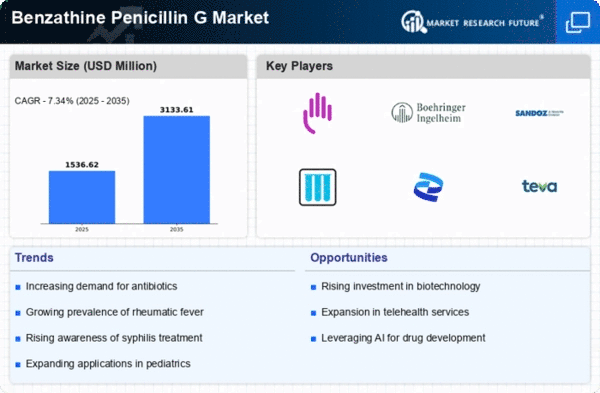
As per MRFR analysis, the Benzathine Penicillin G Market Size was estimated at 1.43 USD Million in 2024. The Benzathine Penicillin G industry is projected to grow from 1.55 in 2025 to 3.13 by 2035, exhibiting a compound annual growth rate (CAGR) of 7.34 during the forecast period 2025 - 2035.

Key Market Trends & Highlights

The Benzathine Penicillin G market is poised for growth driven by rising demand for preventive healthcare and technological advancements.

  • North America remains the largest market for Benzathine Penicillin G, driven by a robust healthcare infrastructure.
  • The Asia-Pacific region is emerging as the fastest-growing market, fueled by increasing healthcare access and awareness.
  • Rheumatic fever treatment represents the largest segment, while home healthcare is rapidly gaining traction as a preferred delivery method.
  • Key market drivers include the rising incidence of rheumatic fever and growing awareness of antibiotic resistance, which are shaping market dynamics.

Market Size & Forecast

2024 Market Size 1.43 (USD Million)
2035 Market Size 3.13 (USD Million)
CAGR (2025 - 2035) 7.34%
Largest Regional Market Share in 2024 North America

Major Players

<p>Bristol-Myers Squibb (US), Boehringer Ingelheim (DE), Sandoz (CH), Mylan (US), Pfizer (US), Teva Pharmaceuticals (IL), Aurobindo Pharma (IN), Hikma Pharmaceuticals (GB)</p>

Market Trends

The Benzathine Penicillin G Market is currently experiencing a notable evolution, driven by various factors that influence its dynamics. The increasing prevalence of bacterial infections, particularly rheumatic fever and syphilis, has led to a heightened demand for this antibiotic. Healthcare providers are increasingly recognizing the efficacy of Benzathine Penicillin G in treating these conditions, which appears to bolster its market presence. Furthermore, the growing emphasis on preventive healthcare measures suggests that the market may continue to expand as awareness of the benefits of timely antibiotic treatment increases. In addition to the rising demand, the Benzathine Penicillin G Market is also witnessing advancements in manufacturing processes and distribution channels. Pharmaceutical companies are likely investing in innovative production techniques to enhance the quality and availability of this essential medication. Moreover, the expansion of healthcare infrastructure in developing regions could potentially facilitate greater access to Benzathine Penicillin G, thereby contributing to market growth. As the landscape evolves, stakeholders must remain vigilant to emerging trends and shifts in consumer preferences that may shape the future of this market.

Rising Demand for Preventive Healthcare

The Benzathine Penicillin G Market is likely benefiting from an increasing focus on preventive healthcare. As awareness of the importance of early intervention in bacterial infections grows, healthcare providers may be more inclined to prescribe this antibiotic for prophylactic purposes, particularly in at-risk populations.

Technological Advancements in Production

Innovations in manufacturing processes are expected to play a crucial role in the Benzathine Penicillin G Market. Enhanced production techniques could lead to improved quality and efficiency, allowing pharmaceutical companies to meet the rising demand while maintaining cost-effectiveness.

Expansion of Healthcare Access in Developing Regions

The ongoing development of healthcare infrastructure in emerging markets appears to be a significant trend influencing the Benzathine Penicillin G Market. As access to essential medications improves, the potential for increased consumption of this antibiotic may rise, particularly in areas with high rates of bacterial infections.

Benzathine Penicillin G Market Market Drivers

Market Growth Projections

The Global Benzathine Penicillin G Market Industry is projected to experience substantial growth over the next decade. With an anticipated market size of 1.57 USD Billion in 2024, it is expected to reach 4.43 USD Billion by 2035. This growth reflects a compound annual growth rate of 9.89% from 2025 to 2035. Such projections underscore the increasing recognition of Benzathine Penicillin G Market's role in public health and its potential to address various infectious diseases. The market dynamics are influenced by factors such as rising healthcare expenditures and the ongoing need for effective antibiotic therapies.

Emergence of New Treatment Protocols

The emergence of new treatment protocols that incorporate Benzathine Penicillin G Market is shaping the Global Benzathine Penicillin G Market Industry. Healthcare professionals are increasingly adopting evidence-based practices that highlight the efficacy of this antibiotic in various clinical scenarios. For instance, its role in treating syphilis and preventing rheumatic fever has been underscored in recent guidelines. As these protocols gain traction, the demand for Benzathine Penicillin G Market is expected to rise, further solidifying its position in the market. This trend indicates a broader acceptance of Benzathine Penicillin G Market as a vital therapeutic agent.

Regulatory Support for Antibiotic Use

Regulatory bodies worldwide are increasingly recognizing the importance of Benzathine Penicillin G Market in treating bacterial infections. This support is reflected in streamlined approval processes and guidelines that promote its use in clinical settings. The Global Benzathine Penicillin G Market Industry benefits from such regulatory frameworks, which encourage healthcare providers to utilize this antibiotic effectively. As guidelines evolve to address antibiotic resistance and promote appropriate usage, the market is likely to experience sustained growth, ensuring that Benzathine Penicillin G Market remains a cornerstone in infectious disease management.

Growing Awareness of Preventive Healthcare

There is a notable shift towards preventive healthcare, which is influencing the Global Benzathine Penicillin G Market Industry. Healthcare providers are increasingly advocating for the use of Benzathine Penicillin G Market as a prophylactic measure against rheumatic fever and other infections. This trend is particularly evident in developed nations, where public health campaigns emphasize the importance of early intervention. As a result, the market is projected to grow from 1.57 USD Billion in 2024 to 4.43 USD Billion by 2035, reflecting a compound annual growth rate of 9.89% from 2025 to 2035.

Rising Incidence of Rheumatic Heart Disease

The increasing prevalence of rheumatic heart disease globally drives the demand for Benzathine Penicillin G Market. This condition, often resulting from untreated streptococcal throat infections, necessitates long-term antibiotic prophylaxis to prevent complications. The Global Benzathine Penicillin G Market Industry is expected to see a surge in usage as healthcare systems prioritize preventive measures. In regions where rheumatic heart disease is endemic, such as parts of Africa and South Asia, the need for effective treatment options remains critical. As awareness and screening programs improve, the market is likely to expand significantly.

Expansion of Healthcare Infrastructure in Developing Regions

The expansion of healthcare infrastructure in developing regions is a significant driver for the Global Benzathine Penicillin G Market Industry. As countries invest in healthcare facilities and services, access to essential medicines, including Benzathine Penicillin G Market, improves. This is particularly relevant in low- and middle-income countries, where the burden of infectious diseases remains high. Enhanced distribution networks and increased availability of healthcare professionals contribute to the rising demand for this antibiotic. Consequently, the market is poised for growth as these regions enhance their healthcare capabilities.

Market Segment Insights

By Application: Rheumatic Fever (Largest) vs. Syphilis (Fastest-Growing)

<p>In the Benzathine Penicillin G Market, the application segments show distinct market share distributions. Rheumatic Fever has solidified its place as the largest segment, commanding attention for its historical relevance and ongoing treatment requirements. Meanwhile, Bacterial Infections and Streptococcal Infections follow with significant shares as well, illustrating a competitive landscape where each application caters to specific medical needs.</p>

<p>Rheumatic Fever (Dominant) vs. Syphilis (Emerging)</p>

<p>Rheumatic Fever remains a dominant application in the Benzathine Penicillin G Market due to its substantial historical prevalence and ongoing treatment initiatives. Its well-established protocols and familiarity within the medical community ensure a steady demand. In contrast, Syphilis represents an emerging segment with increasing prevalence and a growing focus on public health responses. The rise in syphilis cases has spurred healthcare providers to prioritize effective treatments like Benzathine Penicillin G, driving market interest and innovation. As awareness increases, so does the importance of targeting this segment for broader health outcomes.</p>

By End Use: Hospitals (Largest) vs. Home Healthcare (Fastest-Growing)

<p>The Benzathine Penicillin G market exhibits a significant distribution among its key end-use segments, namely Hospitals, Clinics, and Home Healthcare. Hospitals hold the largest share of the market, driven by the growing number of patients requiring treatment for bacterial infections and rheumatic fever. Clinics, while crucial, occupy a smaller portion due to their limited scope of services compared to hospitals. Home Healthcare is witnessing robust growth as patients increasingly prefer treatments that allow them to remain in the comfort of their homes, leading to a shift in prescribing patterns for Benzathine Penicillin G.</p>

<p>Hospitals (Dominant) vs. Home Healthcare (Emerging)</p>

<p>In the Benzathine Penicillin G market, Hospitals are the dominant end-use segment owing to their extensive facilities and resources for treating severe infections. They facilitate a comprehensive range of services, including inpatient and outpatient treatments, making them the primary prescribing site for Benzathine Penicillin G. Conversely, Home Healthcare is emerging as a significant player, driven by patient preference for convenient, at-home therapies. This segment is characterized by a surge in home-based treatment options and telehealth services, enabling patients to receive equivalent care levels without hospital stays. The shift towards Home Healthcare is largely influenced by the growing geriatric population and advancements in medical technology that support safe home treatment.</p>

By Formulation: Injectable (Largest) vs. Oral (Fastest-Growing)

<p>In the Benzathine Penicillin G market, the formulation segment is predominantly dominated by injectables, which capture the largest market share owing to their efficacy and rapid onset of action in treating bacterial infections. Injectable forms are widely preferred in clinical settings, especially for acute conditions, making them a staple in treatment protocols. On the other hand, oral formulations, while smaller in share, are gaining traction due to their convenience and ease of administration. This shift is notable among patients requiring long-term treatment or in pediatric cases where compliance is crucial. The growth trends within the formulation segment are largely influenced by the rising prevalence of bacterial infections and the need for affordable and effective treatment options. Injectable formulations remain a dominant choice due to their effectiveness in severe infections, while the oral segment grows rapidly, driven by advancements in formulation technologies and increased awareness of treatment options. Emerging markets also present opportunities for oral Benzathine Penicillin G, as healthcare accessibility improves, further fueling growth and shifting preferences in patient demographics.</p>

<p>Injectable (Dominant) vs. Oral (Emerging)</p>

<p>Injectable formulations of Benzathine Penicillin G have established themselves as the dominant choice within the market, primarily due to their immediate therapeutic effects and reliability in acute care situations. They are essential in treating various infections, particularly rheumatic fever and syphilis, where timely administration is critical. Conversely, oral formulations are emerging as a viable alternative, driven by patient preference for ease of use and the growing trend of outpatient therapies. Although currently less utilized, oral options benefit from technological advancements that improve their pharmacokinetic profiles, making them more effective. As healthcare systems evolve, both segments will play crucial roles, with injectables maintaining dominance while oral formulations capture a growing share of the patient population.</p>

By Distribution Channel: Pharmacies (Largest) vs. Online Retail (Fastest-Growing)

<p>In the Benzathine Penicillin G Market, pharmacies dominate the distribution channel segment, accounting for a significant share of overall sales due to their established presence and accessibility to patients. This traditional distribution method is well-trusted among consumers, contributing to its robust market leadership. On the other hand, online retail is rapidly gaining traction, driven by the increasing consumer preference for convenience and easy access to medication. This shift toward online platforms is reshaping how benzathine penicillin G is delivered to patients, indicating a dynamic market environment. The growth trends within this segment reflect the evolving healthcare landscape. The rise of online retail is fueled by technological advancements and changing patient behaviors, as consumers seek more efficient ways to obtain their medications. Pharmacies are leveraging their established networks to improve service delivery, while online retail continues to expand, particularly among younger demographics who prioritize digital solutions. This competition between the two channels is expected to intensify as both strive to cater to consumer demands and preferences in the coming years.</p>

<p>Pharmacies (Dominant) vs. Online Retail (Emerging)</p>

<p>Pharmacies serve as the dominant distribution channel in the Benzathine Penicillin G Market, providing established trust and direct consumer interaction. They offer personalized service, expert advice, and a sense of security, which are crucial in the medication supply chain. On the other hand, online retail is emerging as a significant player, appealing to tech-savvy consumers who seek convenience and an efficient purchasing experience. This channel benefits from lower operational costs and the ability to reach a broader audience beyond geographical limitations. As both segments continue to evolve, they will influence the overall market dynamics, with pharmacies adapting to the digital age while online platforms work to build trust in the pharmaceutical distribution.</p>

Get more detailed insights about Benzathine Penicillin G Market Research Report –Forecast to 2035

Regional Insights

North America : Market Leader in Penicillin

North America holds a commanding market share of 72% in the Benzathine Penicillin G market as of 2024. The region's growth is driven by increasing prevalence of bacterial infections and a robust healthcare infrastructure. Regulatory support from agencies like the FDA has also catalyzed market expansion, ensuring the availability of high-quality pharmaceuticals. The rising demand for effective treatments further propels market dynamics, making it a focal point for investment and innovation. The competitive landscape in North America is characterized by major players such as Bristol-Myers Squibb, Pfizer, and Mylan, who dominate the market with their extensive product portfolios. The presence of advanced manufacturing facilities and strong distribution networks enhances their market position. Additionally, ongoing research and development initiatives are expected to introduce new formulations, further solidifying North America's leadership in the Benzathine Penicillin G market.

Europe : Growing Demand and Innovation

Europe represents a significant market share of 35% in the Benzathine Penicillin G sector, driven by increasing awareness of antibiotic treatments and supportive healthcare policies. The region's growth is further fueled by stringent regulations ensuring drug safety and efficacy, which enhance consumer confidence. The European Medicines Agency (EMA) plays a crucial role in regulating the market, fostering innovation while ensuring compliance with health standards. Leading countries such as Germany, France, and the UK are at the forefront of this market, with key players like Boehringer Ingelheim and Sandoz contributing to the competitive landscape. The presence of advanced research institutions and a focus on developing new therapeutic applications for Benzathine Penicillin G are expected to drive future growth. The collaboration between pharmaceutical companies and healthcare providers is also enhancing market dynamics, ensuring a steady supply of essential medications.

Asia-Pacific : Emerging Powerhouse in Healthcare

The Asia-Pacific region is witnessing a burgeoning market for Benzathine Penicillin G, holding a 25% share as of 2024. This growth is primarily driven by increasing healthcare access, rising awareness of infectious diseases, and government initiatives aimed at improving public health. Regulatory bodies in countries like India and China are actively promoting the use of antibiotics, which is expected to further boost market demand in the coming years. Countries such as India and China are leading the charge in this market, with key players like Aurobindo Pharma and Teva Pharmaceuticals establishing a strong presence. The competitive landscape is evolving, with local manufacturers increasingly entering the market to meet rising demand. Additionally, partnerships between pharmaceutical companies and healthcare providers are enhancing distribution channels, ensuring that Benzathine Penicillin G is accessible to a broader population.

Middle East and Africa : Untapped Market Potential

The Middle East and Africa region, with a market share of 11% in Benzathine Penicillin G, presents significant growth opportunities. The increasing burden of infectious diseases and a growing healthcare infrastructure are key drivers of market expansion. Governments are investing in healthcare improvements, which is expected to enhance access to essential medications, including antibiotics. Regulatory frameworks are gradually evolving to support the pharmaceutical sector, fostering a conducive environment for market growth. Leading countries in this region include South Africa and the UAE, where the presence of key players like Hikma Pharmaceuticals is notable. The competitive landscape is characterized by a mix of local and international companies striving to capture market share. As healthcare systems continue to develop, the demand for effective treatments like Benzathine Penicillin G is anticipated to rise, paving the way for new entrants and innovations in the market.

Key Players and Competitive Insights

The Benzathine Penicillin G Market is characterized by a competitive landscape that is increasingly shaped by innovation, strategic partnerships, and regional expansions. Key players such as Bristol-Myers Squibb (US), Boehringer Ingelheim (DE), and Pfizer (US) are actively pursuing strategies that enhance their market positioning. Bristol-Myers Squibb (US) focuses on expanding its product portfolio through research and development, while Boehringer Ingelheim (DE) emphasizes strategic collaborations to enhance its manufacturing capabilities. Pfizer (US) is leveraging its extensive distribution network to penetrate emerging markets, thereby increasing its global footprint. Collectively, these strategies contribute to a dynamic competitive environment, where innovation and operational efficiency are paramount.

In terms of business tactics, companies are increasingly localizing manufacturing to reduce costs and improve supply chain resilience. The market structure appears moderately fragmented, with several players vying for market share. However, the influence of major companies is significant, as they set industry standards and drive technological advancements. This competitive structure fosters an environment where smaller firms can innovate, yet they often struggle to compete against the resources and capabilities of larger entities.

In November 2025, Sandoz (CH) announced a strategic partnership with a leading biotechnology firm to enhance its production capabilities for Benzathine Penicillin G. This collaboration is expected to streamline their supply chain and improve product availability in key markets. The strategic importance of this partnership lies in Sandoz's ability to leverage advanced biotechnological processes, potentially leading to cost reductions and increased efficiency in production.

In October 2025, Mylan (US) launched a new formulation of Benzathine Penicillin G aimed at pediatric patients, addressing a critical need in the market. This move not only diversifies Mylan's product offerings but also positions the company as a leader in addressing specific patient demographics. The introduction of this formulation is likely to enhance Mylan's competitive edge, particularly in regions with high pediatric populations.

In September 2025, Teva Pharmaceuticals (IL) expanded its distribution network in Asia, focusing on increasing access to Benzathine Penicillin G in underserved markets. This strategic expansion is indicative of Teva's commitment to improving healthcare access and aligns with global health initiatives. By enhancing its distribution capabilities, Teva is poised to capture a larger market share in the rapidly growing Asian pharmaceutical sector.

As of December 2025, current trends in the Benzathine Penicillin G Market are increasingly defined by digitalization, sustainability, and the integration of artificial intelligence (AI) in manufacturing processes. Strategic alliances are becoming more prevalent, as companies recognize the need for collaboration to drive innovation and efficiency. The competitive differentiation is likely to evolve from traditional price-based competition to a focus on technological advancements, supply chain reliability, and sustainable practices. This shift suggests that companies that prioritize innovation and operational excellence will be better positioned to thrive in the future.

Key Companies in the Benzathine Penicillin G Market market include

Industry Developments

Future Outlook

Benzathine Penicillin G Market Future Outlook

<p>The Benzathine Penicillin G Market is projected to grow at a 7.34% CAGR from 2024 to 2035, driven by increasing prevalence of rheumatic fever and syphilis.</p>

New opportunities lie in:

  • <p>Expansion of telehealth services for remote patient management</p>
  • <p>Development of combination therapies to enhance efficacy</p>
  • <p>Investment in automated compounding systems for efficiency</p>

<p>By 2035, the market is expected to solidify its position as a critical component of infectious disease management.</p>

Market Segmentation

Benzathine Penicillin G Market End Use Outlook

  • Hospitals
  • Clinics
  • Home Healthcare

Benzathine Penicillin G Market Application Outlook

  • Rheumatic Fever
  • Bacterial Infections
  • Syphilis
  • Streptococcal Infections

Benzathine Penicillin G Market Formulation Outlook

  • Injectable
  • Oral
  • Topical

Benzathine Penicillin G Market Distribution Channel Outlook

  • Pharmacies
  • Online Retail
  • Hospitals

Report Scope

MARKET SIZE 20241.43(USD Million)
MARKET SIZE 20251.55(USD Million)
MARKET SIZE 20353.13(USD Million)
COMPOUND ANNUAL GROWTH RATE (CAGR)7.34% (2024 - 2035)
REPORT COVERAGERevenue Forecast, Competitive Landscape, Growth Factors, and Trends
BASE YEAR2024
Market Forecast Period2025 - 2035
Historical Data2019 - 2024
Market Forecast UnitsUSD Million
Key Companies ProfiledBristol-Myers Squibb (US), Boehringer Ingelheim (DE), Sandoz (CH), Mylan (US), Pfizer (US), Teva Pharmaceuticals (IL), Aurobindo Pharma (IN), Hikma Pharmaceuticals (GB)
Segments CoveredApplication, End Use, Formulation, Distribution Channel
Key Market OpportunitiesEmerging antibiotic resistance drives demand for Benzathine Penicillin G in treating rheumatic fever and syphilis.
Key Market DynamicsRising demand for Benzathine Penicillin G driven by regulatory support and increasing prevalence of rheumatic heart disease.
Countries CoveredNorth America, Europe, APAC, South America, MEA

FAQs

Which region is expected to dominate the benzathine penicillin G market?

The Americas is expected to dominate the benzathine penicillin G market.

Who are the key competitors in the benzathine penicillin G market?

Key competitors in the benzathine penicillin G market include CSC Pharmaceuticals, Triveni Interchem Private Limited, Merck KGaA, Sandoz International GmbH, ECPlaza Network Inc, Alembic IT Department, Pfizer Inc, and Abcam plc.

What are the different strategies used by market players to create a dominance in the benzathine penicillin G market?

Different strategies used by market players to create a dominance in the benzathine penicillin G market include mergers, collaborations, acquisitions, and product launches.

What are the key factors driving the benzathine penicillin G market?

Rising prevalence of respiratory infections and sedentary lifestyle are adding market growth.

Which factors may limit the benzathine penicillin G market growth?

Side effects and lack of awareness may limit market growth.

  1. Definition
    1. Scope of the Study
      1. Research Objective
      2. Assumptions
      3. Limitations
    2. Introduction
    3. Primary Research
    4. Secondary Research
    5. Market Size Estimation
    6. Drivers
    7. Restraints
    8. Opportunities
    9. Challenges
    10. Macroeconomic Indicators
    11. Technology Trends & Assessment
    12. Porter’s Five Forces Analysis
      1. Bargaining Power of Suppliers
      2. Bargaining Power of Buyers
      3. Threat of New Entrants
      4. Threat of Substitutes
      5. Intensity of Rivalry
    13. Value Chain Analysis
    14. Investment Feasibility Analysis
    15. Pricing Analysis
  2. Chapter 6. Global Benzathine Penicillin G Market, by Application
    1. Introduction
    2. Bacterial infection
      1. Bejel
      2. Diphtheria
      3. Rheumatic fever
    3. Syphilis
  3. Chapter 7. Global Benzathine Penicillin G Market, by Mode of Injection
    1. Introduction
    2. Intravenous Injection
    3. Intramuscular Injection
  4. Chapter 8. Global Benzathine Penicillin G Market, by End Users
    1. Introduction
    2. Hospitals and Clinics
    3. Ambulatory Surgical Centers
    4. Diagnostic Centers
    5. Research centers
    6. Others
  5. Chapter 9. Global Benzathine Penicillin G Market, by Region
    1. Introduction
    2. America
      1. North America
      2. South America
    3. Europe
      1. Western Europe
      2. Eastern Europe
    4. Asia-Pacific
      1. Japan
      2. China
      3. India
      4. Australia
      5. Republic of Korea
      6. Rest of Asia-Pacific
    5. Middle East & Africa
      1. United Arab Emirates
      2. Saudi Arabia
      3. Oman
      4. Kuwait
      5. Qatar
      6. Rest of the Middle East & Africa
    6. Chapter 10. Company Landscape
    7. Introduction
    8. Market Share Analysis
    9. Key Development & Strategies
      1. Key Developments
    10. Chapter 11 Company Profiles
    11. Pfizer Inc
      1. Company Overview
      2. Type Overview
      3. Financials
      4. Key Developments
      5. SWOT Analysis
    12. Alembic IT Department.
      1. Company Overview
      2. Type Overview
      3. Financial Overview
      4. Key Developments
      5. SWOT Analysis
    13. ECPlaza Network Inc
      1. Company Overview
      2. Type Overview
      3. Financial Overview
      4. Key Development
      5. SWOT Analysis
    14. Abcam plc
      1. Company Overview
      2. Type/Business Segment Overview
      3. Financial Overview
      4. Key Development
      5. SWOT Analysis
    15. Sandoz International GmbH
      1. Company Overview
      2. Type Overview
      3. Financial overview
      4. Key Developments
      5. SWOT Analysis
    16. Merck KGaA
      1. Company Overview
      2. Type Overview
      3. Financial Overview
      4. Key Developments
      5. SWOT Analysis
    17. Triveni Interchem Private Limited
      1. Overview
      2. Type Overview
      3. Financials
      4. Key Developments
      5. SWOT Analysis
    18. CSC PHARMACEUTICALS
      1. Overview
      2. Type Overview
      3. Financials
      4. Key Developments
      5. SWOT Analysis
    19. Others
    20. Chapter 12 Appendix
  6. LIST OF TABLES
  7. Global Benzathine Penicillin G Market Industry Synopsis, 2018–2023
  8. Global Benzathine Penicillin G Market Estimates & Forecast, 2018–2023, (USD Million)
  9. Global Benzathine Penicillin G Market, by Region, 2018–2023, (USD Million)
  10. Global Benzathine Penicillin G Market, by Application, 2018–2023, (USD Million)
  11. Global Benzathine Penicillin G Market, by Mode of injection, 2018–2023, (USD Million)
  12. Global Benzathine Penicillin G Market, by End-User, 2018–2023, (USD Million)
  13. North America: Global Benzathine Penicillin G Market, by Application, 2018–2023, (USD Million)
  14. North America: Global Benzathine Penicillin G Market, by Mode of injection, 2018–2023, (USD Million)
  15. North America: Global Benzathine Penicillin G Market, by End-User, 2018–2023, (USD Million)
  16. US: Global Benzathine Penicillin G Market, by Application, 2018–2023, (USD Million)
  17. US: Global Benzathine Penicillin G Market, by Mode of injection, 2018–2023, (USD Million)
  18. US: Global Benzathine Penicillin G Market, by End-User, 2018–2023, (USD Million)
  19. Canada: Global Benzathine Penicillin G Market, by Application, 2018–2023, (USD Million)
  20. Canada: Global Benzathine Penicillin G Market, by Mode of injection, 2018–2023, (USD Million)
  21. Canada: Global Benzathine Penicillin G Market, by End-User, 2018–2023, (USD Million)
  22. South America: Global Benzathine Penicillin G Market, by Application, 2018–2023, (USD Million)
  23. South America: Global Benzathine Penicillin G Market, by Mode of injection, 2018–2023, (USD Million)
  24. South America: Global Benzathine Penicillin G Market, by End-User, 2018–2023, (USD Million)
  25. Europe: Global Benzathine Penicillin G Market, Application, 2018–2023, (USD Million)
  26. Europe: Global Benzathine Penicillin G Market, by Mode of injection, 2018–2023, (USD Million)
  27. Europe: Global Benzathine Penicillin G Market, by End-User, 2018–2023, (USD Million)
  28. Western Europe: Global Benzathine Penicillin G Market, by Application, 2018–2023, (USD Million)
  29. Western Europe: Global Benzathine Penicillin G Market, by Mode of injection, 2018–2023, (USD Million)
  30. Western Europe: Global Benzathine Penicillin G Market, by End-User, 2018–2023, (USD Million)
  31. Eastern Europe: Global Benzathine Penicillin G Market, by Application, 2018–2023, (USD Million)
  32. Eastern Europe: Global Benzathine Penicillin G Market, by Mode of injection, 2018–2023, (USD Million)
  33. Eastern Europe: Global Benzathine Penicillin G Market, by End-User, 2018–2023, (USD Million)
  34. Asia-Pacific: Global Benzathine Penicillin G Market, by Application, 2018–2023, (USD Million)
  35. Asia-Pacific: Global Benzathine Penicillin G Market, by Mode of injection, 2018–2023, (USD Million)
  36. Asia-Pacific: Global Benzathine Penicillin G Market, by End-User, 2018–2023, (USD Million)
  37. Middle East & Africa: Global Benzathine Penicillin G Market, by Application, 2018–2023, (USD Million)
  38. Middle East & Africa: Global Benzathine Penicillin G Market, by Mode of injection, 2018–2023, (USD Million)
  39. Middle East & Africa: Global Benzathine Penicillin G Market, by End-User, 2018–2023, (USD Million)
  40. LIST OF FIGURES
  41. Research Process
  42. Segmentation for the Global Benzathine Penicillin G Market
  43. Market Dynamics for the Global Benzathine Penicillin G Market
  44. Global Benzathine Penicillin G Market Share, by Application 2017
  45. Global Benzathine Penicillin G Market Share, by Mode of injection, 2017
  46. Global Benzathine Penicillin G Market Share, by End-User, 2017
  47. Global Benzathine Penicillin G Market Share, by Region, 2017
  48. North America Benzathine Penicillin G Market Share, by Country, 2017
  49. Europe Prescribed Health Apps Share, by Country, 2017
  50. Asia-Pacific Benzathine Penicillin G Market Share, by Country, 2017
  51. Middle East & Africa Benzathine Penicillin G Market Share, by Country, 2017
  52. Global Benzathine Penicillin G Market: Company Share Analysis, 2017 (%)
  53. Pfizer Inc: Key Financials
  54. Pfizer Inc: Segmental Revenue
  55. Pfizer Inc: Geographical Revenue
  56. Alembic IT Department.: Key Financials
  57. Alembic IT Department.: Segmental Revenue
  58. Alembic IT Department.: Geographical Revenue
  59. ECPlaza Network Inc: Key Financials
  60. ECPlaza Network Inc: Segmental Revenue
  61. ECPlaza Network Inc: Geographical Revenue
  62. Abcam plc: Key Financials
  63. Abcam plc: Segmental Revenue
  64. Abcam plc: Geographical Revenue
  65. Sandoz International GmbH: Key Financials
  66. Sandoz International GmbH: Segmental Revenue
  67. Sandoz International GmbH: Geographical Revenue
  68. Merck KGaA: Key Financials
  69. Merck KGaA: Segmental Revenue
  70. Merck KGaA: Geographical Revenue
  71. Triveni Interchem Private Limited: Key Financials
  72. Triveni Interchem Private Limited: Segmental Revenue
  73. Triveni Interchem Private Limited: Geographical Revenue
  74. CSC PHARMACEUTICALS: Key Financials
  75. CSC PHARMACEUTICALS: Segmental Revenue
  76. CSC PHARMACEUTICALS: Geographical Revenue

Benzathine Penicillin G Market Segmentation

Market Segmentation Overview

  • Detailed segmentation data will be available in the full report
  • Comprehensive analysis by multiple parameters
  • Regional and country-level breakdowns
  • Market size forecasts by segment
Infographic

Free Sample Request

Kindly complete the form below to receive a free sample of this Report

Get Free Sample

Customer Strories

Compare Licence

×
Features License Type
Single User Multiuser License Enterprise User
Price $4,950 $5,950 $7,250
Maximum User Access Limit 1 User Upto 10 Users Unrestricted Access Throughout the Organization
Free Customization
Direct Access to Analyst
Deliverable Format
Platform Access
Discount on Next Purchase 10% 15% 15%
Printable Versions