×
Hero Background
English
Chinese
French
Japanese
Korean
German
Spanish

Bench Hydraulic Press Market Share

ID: MRFR/PCM/12502-HCR
128 Pages
Pradeep Nandi
October 2025

Bench Hydraulic Press Market Research Report Information By Type (H-Type and C-Type), By Application (Laboratory, Production Workshop, Machining Plant, and Others), And By Region (North America, Europe, Asia-Pacific, And Rest Of The World) –Market Forecast Till 2035

Share:
Download PDF ×

We do not share your information with anyone. However, we may send you emails based on your report interest from time to time. You may contact us at any time to opt-out.

Bench Hydraulic Press Market Infographic
Purchase Options

Market Share

Bench Hydraulic Press Market Share Analysis

In the competitive realm of the Bench Hydraulic Press market, companies deploy diverse strategies to establish and strengthen their market share positioning. A fundamental approach is differentiation, where companies strive to distinguish their bench hydraulic presses from competitors by offering unique features, designs, or functionalities. This might encompass innovations in hydraulic technology for enhanced precision, modular designs allowing customization, or safety features catering to specific industrial applications. Through differentiation, companies attract customers seeking specific attributes, allowing them to secure a distinctive market share within the Bench Hydraulic Press industry.

Cost leadership is another prevalent strategy in this market, where companies aim to become the low-cost providers of Bench Hydraulic Presses. This involves optimizing manufacturing processes, achieving economies of scale, and efficiently managing the supply chain to offer competitive prices. Cost leadership is effective in appealing to cost-conscious buyers, especially in industries where hydraulic presses are essential for manufacturing processes. However, maintaining high-quality standards, durability, and safety features is crucial to ensure customer satisfaction and loyalty in this cost-driven strategy.

Market segmentation is widely adopted in the Bench Hydraulic Press industry. Companies analyze the diverse needs of their customer base and create specialized hydraulic presses tailored for specific market segments. For instance, they might develop presses suitable for metal fabrication, plastic molding, or woodworking applications. By addressing the unique requirements of each segment, companies can establish a robust presence within different markets, contributing to an overall enhanced market share.

Strategic partnerships and collaborations play a vital role in the Bench Hydraulic Press market. Companies often form alliances with metalworking equipment suppliers, industrial automation specialists, or manufacturers of precision components to strengthen their supply chain, enhance product quality, and expand market reach. Collaborative efforts can lead to shared resources, access to new technologies, and entry into new geographical markets. Through strategic partnerships, companies can navigate industry challenges more effectively, ultimately contributing to a more secure market share position.

Innovation stands as a cornerstone strategy in the Bench Hydraulic Press market, driven by the continual pursuit of improved efficiency, safety, and adaptability. Companies invest in research and development to introduce advanced control systems, ergonomic designs, and energy-efficient features in their hydraulic presses. Innovations in press functionality, such as multi-axis control or integrated automation capabilities, also cater to evolving industrial requirements and technological trends. By staying at the forefront of innovation, companies not only attract forward-thinking buyers but also position themselves as leaders in the Bench Hydraulic Press market, securing a significant market share.

Customer-centric strategies are gaining prominence as companies recognize the importance of providing exceptional customer experiences. This involves offering comprehensive training programs, responsive customer support, and value-added services such as maintenance packages. Exceptional customer service contributes to satisfaction and loyalty, encouraging manufacturers and workshops to choose a particular brand for their bench hydraulic press needs. By focusing on building strong relationships with customers, companies can solidify their market share and maintain a competitive edge in the Bench Hydraulic Press market.

Author
Pradeep Nandi
Senior Research Analyst

I have a bachelor's degree in mechanical engineering and an MBA. I have more than two years of expertise in the retail, food, and beverage, chemical, and material industries, and hence have developed a sound cross-domain expertise. A firm believer in lifelong learning and sharing of knowledge. Having a proclivity for hatching ideas and trying to absorb as much information as possible in a short amount of time. Introducing corporates to the data and insight, which enables them to move from probability to possibility, has been my key areas of interest. 

Leave a Comment

FAQs

How much is the Bench Hydraulic Press market?

The global Bench Hydraulic Press market size was valued at Significant Value in 2022.

What is the growth rate of the Bench Hydraulic Press market?

The global market is foreseen to rise at a CAGR of4.60% during the forecast period, 2025-2035.

Which region had the biggest market share in the Bench Hydraulic Press market?

North America had the biggest share in the global market

Who are the prime players in the Bench Hydraulic Press market?

The key players in the market are Enerpac, Bucher Industries, Dayang Hydraulic Press, Parker Hannifin, Greenerd Press & Machine, Buffalo Hydraulic, Heritage Machinery, Beta Tools, RK Machinery, and Bosch.

Which type led the Bench Hydraulic Press market?

The C-type category dominated the market in 2022.

Which application had the largest market revenue share in the Bench Hydraulic Press market?

The machining plant had the largest share in the global market.

Market Summary

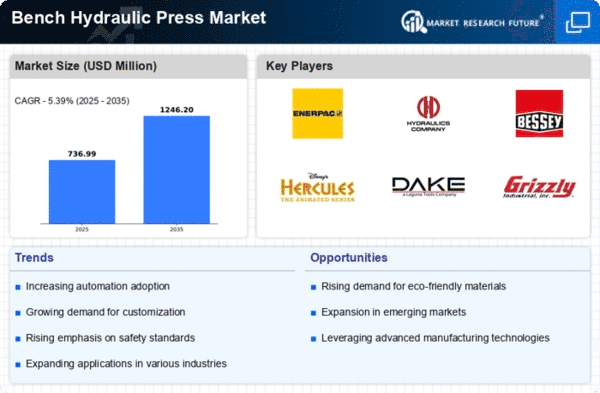
As per MRFR analysis, the Bench Hydraulic Press Market Size was estimated at 699.3 USD Million in 2024. The Bench Hydraulic Press industry is projected to grow from 737.01 USD Million in 2025 to 1246.2 USD Million by 2035, exhibiting a compound annual growth rate (CAGR) of 5.39 during the forecast period 2025 - 2035.

Key Market Trends & Highlights

The Bench Hydraulic Press Market is experiencing robust growth driven by technological advancements and increasing demand across various sectors.

  • Technological advancements are enhancing the efficiency and capabilities of bench hydraulic presses, making them more appealing to manufacturers.
  • Sustainability initiatives are prompting manufacturers to adopt eco-friendly practices, influencing the design and operation of hydraulic presses.
  • The metal forming segment remains the largest market, while the automotive repair segment is witnessing the fastest growth due to rising vehicle maintenance needs.
  • Rising demand in the manufacturing sector and increased focus on safety standards are key drivers propelling market expansion.

Market Size & Forecast

2024 Market Size 699.3 (USD Million)
2035 Market Size 1246.2 (USD Million)
CAGR (2025 - 2035) 5.39%
Largest Regional Market Share in 2024 North America

Major Players

<p>Enerpac (US), Hydraulic Press Company (US), Bessey Tool GmbH (DE), Herkules Equipment Corporation (US), Dake Corp (US), Grizzly Industrial Inc (US), Baileigh Industrial (US), KAKA Industrial (US)</p>

Market Trends

The Bench Hydraulic Press Market is currently experiencing a notable evolution, driven by advancements in technology and increasing demand across various sectors. Industries such as automotive, manufacturing, and metalworking are increasingly adopting hydraulic presses for their efficiency and precision. This shift appears to be influenced by the need for enhanced productivity and the ability to handle complex tasks with ease. Furthermore, the growing emphasis on automation and smart manufacturing solutions is likely to propel the market forward, as companies seek to integrate more sophisticated machinery into their operations. In addition, sustainability concerns are becoming more prominent within the Bench Hydraulic Press Market. Manufacturers are exploring eco-friendly materials and energy-efficient designs to meet regulatory standards and consumer expectations. This trend suggests a potential shift towards greener technologies, which may reshape product offerings in the near future. As the market continues to evolve, it is essential for stakeholders to remain vigilant and adaptable to these changes, ensuring they capitalize on emerging opportunities while addressing challenges that may arise in this dynamic landscape.

Technological Advancements

The Bench Hydraulic Press Market is witnessing a surge in technological innovations, particularly in automation and control systems. Enhanced features such as digital interfaces and remote monitoring capabilities are becoming increasingly prevalent, allowing for improved precision and efficiency in operations.

Sustainability Initiatives

There is a growing focus on sustainability within the Bench Hydraulic Press Market, with manufacturers striving to develop eco-friendly products. This trend encompasses the use of recyclable materials and energy-efficient designs, aligning with global efforts to reduce environmental impact.

Customization and Versatility

The demand for customized solutions is rising in the Bench Hydraulic Press Market. Companies are increasingly seeking versatile machines that can be tailored to specific applications, enabling them to optimize their production processes and meet unique operational requirements.

Bench Hydraulic Press Market Market Drivers

Market Growth Projections

The Global Bench Hydraulic Press Market Industry is poised for substantial growth, with projections indicating a market value of 3.73 USD Billion in 2024 and an anticipated increase to 6.2 USD Billion by 2035. This growth trajectory suggests a compound annual growth rate (CAGR) of 4.72% from 2025 to 2035. Such figures highlight the increasing reliance on hydraulic presses across various sectors, including manufacturing, automotive, and aerospace. The consistent demand for efficient and reliable hydraulic solutions is likely to drive investments and innovations within the industry, shaping its future landscape.

Technological Advancements

Technological advancements play a pivotal role in shaping the Global Bench Hydraulic Press Market Industry. Innovations in hydraulic systems, control mechanisms, and materials have led to the development of more efficient and versatile hydraulic presses. These advancements not only improve performance but also enhance safety features, making them more appealing to end-users. As industries increasingly prioritize automation and precision, the demand for advanced hydraulic presses is expected to rise. This trend is anticipated to contribute to a compound annual growth rate (CAGR) of 4.72% from 2025 to 2035, indicating a robust growth trajectory for the market.

Increased Investment in R&D

Investment in research and development (R&D) is a critical driver of innovation within the Global Bench Hydraulic Press Market Industry. Companies are allocating resources to develop new hydraulic press technologies that enhance efficiency, precision, and safety. This focus on R&D is essential for maintaining competitiveness in a rapidly evolving market. As manufacturers seek to differentiate their products and meet the diverse needs of various industries, the emphasis on innovative hydraulic press solutions is expected to grow. This trend may lead to the introduction of advanced features and capabilities, further stimulating market expansion.

Growing Focus on Sustainability

Sustainability initiatives are becoming increasingly important within the Global Bench Hydraulic Press Market Industry. As companies strive to reduce their environmental impact, there is a growing emphasis on energy-efficient hydraulic presses that minimize energy consumption and waste. Manufacturers are investing in eco-friendly technologies and practices, aligning with global sustainability goals. This shift not only enhances corporate responsibility but also appeals to environmentally conscious consumers. Consequently, the demand for hydraulic presses that meet these sustainability criteria is likely to rise, further propelling market growth in the coming years.

Growing Demand in Manufacturing Sector

The Global Bench Hydraulic Press Market Industry experiences a notable surge in demand driven by the expanding manufacturing sector. As industries increasingly adopt automation and advanced manufacturing techniques, the need for efficient and reliable hydraulic presses becomes paramount. In 2024, the market is projected to reach 3.73 USD Billion, reflecting the industry's reliance on hydraulic presses for tasks such as metal forming, assembly, and material testing. This trend is likely to continue as manufacturers seek to enhance productivity and reduce operational costs, thereby solidifying the hydraulic press's role in modern manufacturing processes.

Rising Adoption in Automotive Industry

The automotive industry significantly influences the Global Bench Hydraulic Press Market Industry, as hydraulic presses are essential for various manufacturing processes, including stamping, molding, and assembly. The increasing production of electric vehicles (EVs) and the need for lightweight materials have further propelled the demand for hydraulic presses. As manufacturers strive for efficiency and sustainability, the integration of hydraulic presses in automotive production lines is likely to expand. This trend is expected to contribute to the market's growth, with projections indicating a market value of 6.2 USD Billion by 2035, underscoring the automotive sector's pivotal role in driving hydraulic press adoption.

Market Segment Insights

By Application: Metal Forming (Largest) vs. Automotive Repair (Fastest-Growing)

<p>In the Bench Hydraulic Press Market, the application segments showcase distinct distributions, with Metal Forming leading in market share due to its widespread use across various industries, including manufacturing and fabrication. Following closely is Material Testing, which finds significant application in quality assurance processes, while Automotive Repair emerges as a critical segment driven by the increasing demand for vehicle maintenance and repair services. As we examine growth trends, Automotive Repair stands out as the fastest-growing segment, propelled by the rising vehicle ownership and the necessity for regular servicing. Woodworking and Jewelry Making also reflect growth potential, albeit smaller in comparison. Such trends indicate a shift towards more specialized applications and increased user adoption across different sectors, ultimately shaping the market landscape.</p>

<p>Metal Forming (Dominant) vs. Jewelry Making (Emerging)</p>

<p>Metal Forming remains the dominant application in the Bench Hydraulic Press Market, characterized by its extensive application in producing metal components and parts through shaping and pressing processes. This segment benefits from robust industrial demand, including aerospace, automotive, and construction sectors. In contrast, Jewelry Making represents an emerging application, with artisans and hobbyists increasingly adopting hydraulic presses for creating intricate designs and pieces. This segment is driven by the growing popularity of customized jewelry and artistic craftsmanship, providing unique opportunities for market players to explore niche offerings and cater to evolving consumer preferences.</p>

By End Use: Manufacturing (Largest) vs. Construction (Fastest-Growing)

<p>The Bench Hydraulic Press Market is witnessing significant segmentation based on its end-use applications. Manufacturing captures the largest market share due to its diverse applications in producing components and materials across various industries. Similarly, sectors like automotive and aerospace benefit greatly from bench hydraulic presses tailored for precision and durability in mass production. The construction sector, while smaller, is gaining traction as it embraces hydraulic presses to facilitate efficient assembly and heavy lifting tasks, reflecting a broader trend towards mechanization.</p>

<p>Manufacturing: Dominant vs. Construction: Emerging</p>

<p>In the Bench Hydraulic Press Market, the manufacturing segment stands out as the dominant force. It is characterized by extensive utilization across machinery and tooling applications where precision is critical. In comparison, construction is an emerging segment, demonstrating robust growth driven by the increasing complexity of construction projects that require innovative equipment solutions. The demand for efficient assembly and handling of heavy materials creates a growing need for hydraulic presses in construction applications, positioning it as a vital player in the market's future development.</p>

By Type: Manual Hydraulic Press (Largest) vs. Electric Hydraulic Press (Fastest-Growing)

<p>In the Bench Hydraulic Press Market, the manual hydraulic press holds a significant market share, being widely adopted for its cost-effectiveness and simplicity in operation. Its robust design and ease of use make it a popular choice among small-scale workshops and hobbyists. In contrast, the electric hydraulic press is gaining traction, reflecting a notable increase in its market presence. As industries shift towards automation and technological innovations, the electric variant is expected to cater to more advanced applications that require precision and efficiency. The growth of the electric hydraulic press segment can be attributed to the rising demand for higher productivity and the need for reduced labor costs in manufacturing processes. Additionally, the growing trend of automation across various industries fuels the electric hydraulic press's adoption, reflecting a shift in preference from manual operations to energy-efficient solutions. Furthermore, advancements in electric press technologies are steadily enhancing their performance, making them an attractive option for manufacturers aiming for greater efficiency and reliability in their operations.</p>

<p>Manual Hydraulic Press (Dominant) vs. Portable Hydraulic Press (Emerging)</p>

<p>The manual hydraulic press remains the dominant player in the Bench Hydraulic Press Market due to its established presence and widespread use in various applications. Its straightforward operation and lower initial cost make it ideal for small-scale jobs and DIY enthusiasts. Conversely, the portable hydraulic press is an emerging segment that captures the attention of on-site professionals who require mobility without sacrificing pressing power. Its compact design allows users to operate in diverse environments, making it a valuable tool for construction and fieldwork. As the demand for versatile tools grows, this portable option provides the essential functionality needed for dynamic work conditions, thus carving out a niche within the market.</p>

By Capacity: Up to 10 Tons (Largest) vs. Above 30 Tons (Fastest-Growing)

<p>The Bench Hydraulic Press Market exhibits a diverse distribution of capacities, with the 'Up to 10 Tons' segment holding the largest share. This category attracts a wide range of consumers, including hobbyists and small-scale industries, leveraging its affordability and ease of use. Meanwhile, the 'Above 30 Tons' segment is emerging rapidly, gaining traction amongst heavy-duty industries requiring robust and high-performance solutions. Increased demand for intricate metal shaping and other specialized applications contributes to this shift in market dynamics. As industries continue to innovate and optimize production processes, growth trends indicate a burgeoning interest in higher-capacity hydraulic presses. Key drivers include advancements in material technology and a steady increase in manufacturing requirements. The growing emphasis on efficiency, along with the quest for precision in complex tasks, propels the 'Above 30 Tons' segment, while the 'Up to 10 Tons' segment remains a staple for its versatility. Expect continued evolution, as manufacturers respond to demands for different operating capacities and functionalities.</p>

<p>Up to 10 Tons (Dominant) vs. Above 30 Tons (Emerging)</p>

<p>The 'Up to 10 Tons' segment of the Bench Hydraulic Press Market establishes itself as the dominant force due to its affordability and multifunctional applications. It caters to a broad demographic, ranging from DIY enthusiasts to small factories, facilitating various tasks like metal forming and assembly. This segment is characterized by user-friendly designs and efficient performance, making it accessible for non-professional users. Conversely, the 'Above 30 Tons' segment represents an emerging force, primarily appealing to industrial clients demanding high pressures and precision. The advancement in manufacturing techniques, along with a growing trend in custom fabrication, positions this segment for accelerated growth as businesses seek to enhance production capabilities and achieve complex engineering tasks.</p>

By Material: Steel (Largest) vs. Aluminum (Fastest-Growing)

<p>In the Bench Hydraulic Press Market, steel holds the largest market share, being the go-to material for its strength and durability. It is prominently used in various industrial applications, providing operators with machines that offer consistent performance. Aluminum, while smaller in share, is rapidly gaining traction among users looking for lighter alternatives, which enhance maneuverability and reduce fatigue during operation.</p>

<p>Steel (Dominant) vs. Aluminum (Emerging)</p>

<p>Steel, as the dominant material in the Bench Hydraulic Press Market, offers high tensile strength and resistance to heavy loads, making it a popular choice among industries requiring robust machinery. In contrast, aluminum is emerging as a favored alternative, driven by its lightweight properties, which facilitate easier handling and transport. This shift is being bolstered by technological advancements that improve aluminum's performance under high-pressure conditions. As manufacturers explore innovative approaches, both materials are reshaping their positions, appealing to distinct segments of the market.</p>

Get more detailed insights about Bench Hydraulic Press Market Research Report — Global Forecast till 2035

Regional Insights

North America : Market Leader in Hydraulic Presses

North America is poised to maintain its leadership in the Bench Hydraulic Press market, holding a significant market share of 350.0. The region's growth is driven by robust manufacturing sectors, increasing automation, and a rising demand for precision tools. Regulatory support for manufacturing innovation and safety standards further catalyzes market expansion. The trend towards sustainable practices is also influencing product development, with manufacturers focusing on energy-efficient solutions. The competitive landscape in North America is characterized by the presence of key players such as Enerpac, Hydraulic Press Company, and Baileigh Industrial. The U.S. remains the dominant country, contributing significantly to the market size. Companies are investing in R&D to enhance product offerings and meet evolving customer needs. The focus on advanced technology and customer-centric solutions positions North America as a hub for hydraulic press innovation.

Europe : Emerging Market with Growth Potential

Europe's Bench Hydraulic Press market is valued at 200.0, reflecting a growing demand driven by the automotive and aerospace industries. The region benefits from stringent regulations that promote safety and efficiency in manufacturing processes. Additionally, the push for sustainable manufacturing practices is leading to innovations in hydraulic press technology. Countries like Germany and France are at the forefront, with increasing investments in advanced manufacturing technologies. Germany is the leading country in Europe, hosting major players like Bessey Tool GmbH and Herkules Equipment Corporation. The competitive landscape is marked by a mix of established companies and emerging startups focusing on niche markets. The European market is also witnessing collaborations and partnerships aimed at enhancing product offerings and expanding market reach. As the region adapts to new technologies, the hydraulic press market is expected to flourish.

Asia-Pacific : Rapid Growth in Emerging Economies

The Asia-Pacific region, with a market size of 130.0, is experiencing rapid growth in the Bench Hydraulic Press sector. This growth is fueled by industrialization, urbanization, and increasing investments in manufacturing infrastructure. Countries like China and India are leading the charge, driven by a burgeoning automotive sector and rising demand for machinery. Regulatory frameworks are also evolving to support manufacturing efficiency and safety, further boosting market potential. China stands out as the largest market in the region, with numerous local manufacturers emerging alongside global players. The competitive landscape is dynamic, with companies focusing on cost-effective solutions and technological advancements. The presence of key players like KAKA Industrial and Grizzly Industrial Inc. enhances the region's market competitiveness. As the demand for hydraulic presses continues to rise, Asia-Pacific is set to become a significant player in the global market.

Middle East and Africa : Niche Market with Growth Opportunities

The Middle East and Africa region, with a market size of 19.3, presents a niche yet promising opportunity in the Bench Hydraulic Press market. The growth is primarily driven by increasing industrial activities and a focus on infrastructure development. Countries in the Gulf Cooperation Council (GCC) are investing heavily in manufacturing capabilities, which is expected to boost demand for hydraulic presses. Regulatory initiatives aimed at enhancing industrial safety and efficiency are also contributing to market growth. South Africa and the UAE are leading the market in this region, with a growing number of local manufacturers and distributors. The competitive landscape is characterized by a mix of international and regional players, focusing on tailored solutions for local industries. As the region continues to develop its manufacturing sector, the hydraulic press market is likely to see significant growth in the coming years.
Key Players and Competitive Insights

The Bench Hydraulic Press Market is currently characterized by a competitive landscape that is both dynamic and multifaceted. Key growth drivers include the increasing demand for precision engineering and the rising adoption of hydraulic technology across various industries. Major players such as Enerpac (US), Hydraulic Press Company (US), and Bessey Tool GmbH (DE) are strategically positioned to leverage these trends. Enerpac (US) focuses on innovation and product development, aiming to enhance operational efficiency and expand its product portfolio. Meanwhile, Hydraulic Press Company (US) emphasizes customer-centric solutions, tailoring its offerings to meet specific industry needs. Bessey Tool GmbH (DE) is actively pursuing regional expansion, particularly in emerging markets, to capitalize on the growing demand for hydraulic presses. Collectively, these strategies contribute to a competitive environment that is increasingly defined by technological advancements and customer engagement.

In terms of business tactics, companies are increasingly localizing manufacturing to reduce lead times and optimize supply chains. This approach not only enhances responsiveness to market demands but also mitigates risks associated with global supply chain disruptions. The market structure appears moderately fragmented, with several key players holding substantial market shares while numerous smaller firms contribute to the overall competitive dynamics. The collective influence of these key players shapes market trends and drives innovation, fostering a competitive atmosphere that encourages continuous improvement.

In November 2025, Enerpac (US) announced the launch of a new line of eco-friendly hydraulic presses designed to reduce energy consumption by up to 30%. This strategic move underscores the company's commitment to sustainability and positions it favorably in a market increasingly focused on environmentally responsible practices. By integrating energy-efficient technologies, Enerpac (US) not only enhances its product appeal but also aligns with global sustainability goals, potentially attracting a broader customer base.

In October 2025, Bessey Tool GmbH (DE) entered into a strategic partnership with a leading automation technology firm to develop smart hydraulic press solutions. This collaboration aims to integrate AI-driven features into their hydraulic presses, enhancing operational efficiency and user experience. The significance of this partnership lies in its potential to set new industry standards for automation in hydraulic applications, thereby reinforcing Bessey Tool GmbH's competitive edge in the market.

In September 2025, Hydraulic Press Company (US) expanded its manufacturing capabilities by investing in advanced robotics for its production lines. This investment is expected to increase production efficiency by 25% and reduce operational costs. The strategic importance of this move is twofold: it not only enhances the company's production capacity but also positions it to respond more effectively to fluctuating market demands, thereby solidifying its market presence.

As of December 2025, current competitive trends in the Bench Hydraulic Press Market are increasingly influenced by digitalization, sustainability, and AI integration. Strategic alliances are playing a pivotal role in shaping the landscape, enabling companies to pool resources and expertise to drive innovation. Looking ahead, competitive differentiation is likely to evolve from traditional price-based competition towards a focus on technological innovation, supply chain reliability, and sustainable practices. This shift suggests that companies that prioritize these aspects may gain a significant advantage in an increasingly competitive market.

Key Companies in the Bench Hydraulic Press Market market include

Industry Developments

June 2023: Dayang Hydraulic Press, a Chinese manufacturer of hydraulic presses, acquired MVD, an Italian manufacturer of hydraulic presses. This acquisition will expand Dayang Hydraulic Press's global footprint in the hydraulic press market.

May 2023: Parker Hannifin, an American manufacturer of motion and control technologies, announced a partnership with Guangdong Yizumi Precision Machinery Co., Ltd., a Chinese manufacturer of injection molding machines. The partnership will focus on developing new hydraulic press solutions for the plastics industry.

April 2023: Bosch Rexroth, a German manufacturer of hydraulics and automation technologies, announced a partnership with FANUC Corporation, a Japanese manufacturer of CNC machine tools. The partnership will focus on developing new hydraulic press solutions for the metalworking industry.

Future Outlook

Bench Hydraulic Press Market Future Outlook

<p>The Bench Hydraulic Press Market is projected to grow at a 5.39% CAGR from 2024 to 2035, driven by technological advancements, increased automation, and rising demand in manufacturing sectors.</p>

New opportunities lie in:

  • <p>Development of smart hydraulic press systems with IoT integration</p>
  • <p>Expansion into emerging markets with tailored product offerings</p>
  • <p>Partnerships with automotive manufacturers for specialized hydraulic solutions</p>

<p>By 2035, the market is expected to achieve robust growth, solidifying its position in the industrial sector.</p>

Market Segmentation

Bench Hydraulic Press Market Type Outlook

  • Manual Hydraulic Press
  • Electric Hydraulic Press
  • Pneumatic Hydraulic Press
  • Portable Hydraulic Press

Bench Hydraulic Press Market End Use Outlook

  • Manufacturing
  • Construction
  • Automotive
  • Aerospace
  • Education

Bench Hydraulic Press Market Capacity Outlook

  • Up to 10 Tons
  • 10 to 20 Tons
  • 20 to 30 Tons
  • Above 30 Tons

Bench Hydraulic Press Market Material Outlook

  • Steel
  • Aluminum
  • Cast Iron
  • Composite Materials

Bench Hydraulic Press Market Application Outlook

  • Metal Forming
  • Material Testing
  • Automotive Repair
  • Woodworking
  • Jewelry Making

Report Scope

MARKET SIZE 2024699.3(USD Million)
MARKET SIZE 2025737.01(USD Million)
MARKET SIZE 20351246.2(USD Million)
COMPOUND ANNUAL GROWTH RATE (CAGR)5.39% (2024 - 2035)
REPORT COVERAGERevenue Forecast, Competitive Landscape, Growth Factors, and Trends
BASE YEAR2024
Market Forecast Period2025 - 2035
Historical Data2019 - 2024
Market Forecast UnitsUSD Million
Key Companies ProfiledEnerpac (US), Hydraulic Press Company (US), Bessey Tool GmbH (DE), Herkules Equipment Corporation (US), Dake Corp (US), Grizzly Industrial Inc (US), Baileigh Industrial (US), KAKA Industrial (US)
Segments CoveredApplication, End Use, Type, Capacity, Material
Key Market OpportunitiesIntegration of smart technology enhances efficiency in the Bench Hydraulic Press Market.
Key Market DynamicsRising demand for efficient manufacturing processes drives innovation and competition in the Bench Hydraulic Press Market.
Countries CoveredNorth America, Europe, APAC, South America, MEA

FAQs

How much is the Bench Hydraulic Press market?

The global Bench Hydraulic Press market size was valued at Significant Value in 2022.

What is the growth rate of the Bench Hydraulic Press market?

The global market is foreseen to rise at a CAGR of4.60% during the forecast period, 2025-2035.

Which region had the biggest market share in the Bench Hydraulic Press market?

North America had the biggest share in the global market

Who are the prime players in the Bench Hydraulic Press market?

The key players in the market are Enerpac, Bucher Industries, Dayang Hydraulic Press, Parker Hannifin, Greenerd Press &amp; Machine, Buffalo Hydraulic, Heritage Machinery, Beta Tools, RK Machinery, and Bosch.

Which type led the Bench Hydraulic Press market?

The C-type category dominated the market in 2022.

Which application had the largest market revenue share in the Bench Hydraulic Press market?

The machining plant had the largest share in the global market.

  1. EXECUTIVE SUMMARY
  2. MARKET INTRODUCTION
    1. Definition
    2. Scope of the Study
      1. Research Objective
      2. Assumptions
      3. Limitations
  3. RESEARCH METHODOLOGY
    1. Overview
    2. Data Mining
    3. Secondary Research
    4. Primary Research
      1. Primary Interviews
      2. Breakdown of Primary Respondents
    5. and Information Gathering Process
    6. Forecasting Model
    7. Market Size Estimation
      1. Bottom-Up Approach
      2. Top-Down Approach
    8. Data Triangulation
    9. Validation
  4. MARKET DYNAMICS
    1. Overview
    2. Drivers
    3. Restraints
    4. Opportunities
  5. MARKET FACTOR ANALYSIS
    1. Value Chain Analysis
    2. Porter’s Five Forces Analysis
      1. Bargaining Power
      2. Threat of New Entrants
      3. Threat of Substitutes
      4. Intensity of Rivalry
    3. of Suppliers
    4. Bargaining Power of Buyers
    5. COVID-19 Impact Analysis
      1. Market Impact Analysis
      2. Regional Impact
      3. Opportunity and
    6. Threat Analysis
  6. GLOBAL BENCH HYDRAULIC PRESS MARKET, BY TYPE
    1. Overview
    2. H-Type
    3. C-Type
  7. GLOBAL BENCH HYDRAULIC PRESS MARKET, BY APPLICATION
    1. Overview
    2. Laboratory
    3. Production Workshop
    4. Machining Plant
    5. Others
  8. GLOBAL BENCH HYDRAULIC
  9. PRESS MARKET, BY REGION
    1. Overview
    2. North America
      1. US
      2. Italy
      3. Spain
      4. Rest of Europe
    3. Canada
    4. Europe
    5. Germany
    6. France
    7. UK
    8. Asia-Pacific
      1. China
      2. India
      3. Japan
      4. South Korea
      5. Australia
      6. Rest of Asia-Pacific
    9. Rest of the World
      1. Middle East
      2. Africa
      3. Latin America
  10. COMPETITIVE LANDSCAPE
    1. Overview
    2. Competitive Analysis
    3. Market Share Analysis
    4. Major Growth Strategy
    5. in the Global Bench Hydraulic Press Market,
    6. Competitive Benchmarking
    7. Leading Players in Terms of Number of Developments
    8. in the Global Bench Hydraulic Press Market,
    9. Key developments and Growth Strategies
      1. New Product Launch/Service
      2. Joint Ventures
    10. Deployment
    11. Merger & Acquisitions
    12. Major Players Financial Matrix
      1. Sales & Operating Income, 2022
      2. Major Players
    13. R&D Expenditure. 2022
  11. COMPANY PROFILES
    1. Enerpac
      1. Company Overview
      2. Financial Overview
      3. Products Offered
      4. Key Developments
      5. SWOT Analysis
      6. Key Strategies
    2. Bucher Industries
      1. Company Overview
      2. Financial Overview
      3. Products Offered
      4. Key Developments
      5. SWOT Analysis
      6. Key Strategies
    3. Dayang Hydraulic Press
      1. Company Overview
      2. Financial Overview
      3. Products Offered
      4. Key Developments
      5. SWOT Analysis
      6. Key Strategies
    4. Parker Hannifin
      1. Company Overview
      2. Financial Overview
      3. Products Offered
      4. Key Developments
      5. SWOT Analysis
      6. Key Strategies
    5. Greenerd Press & Machine
      1. Company Overview
      2. Financial Overview
      3. Products Offered
      4. Key Developments
      5. SWOT Analysis
      6. Key Strategies
    6. Buffalo Hydraulic
      1. Company Overview
      2. Financial Overview
      3. Products Offered
      4. Key Developments
      5. SWOT Analysis
      6. Key Strategies
    7. Heritage Machinery
      1. Company Overview
      2. Financial Overview
      3. Products Offered
      4. Key Developments
      5. SWOT Analysis
      6. Key Strategies
    8. Beta Tools
      1. Company Overview
      2. Financial Overview
      3. Products Offered
      4. Key Developments
      5. SWOT Analysis
      6. Key Strategies
    9. RK Machinery
      1. Company Overview
      2. Financial Overview
      3. Products Offered
      4. Key Developments
      5. SWOT Analysis
      6. Key Strategies
    10. Bosch
      1. Company Overview
      2. Financial Overview
      3. Products Offered
      4. Key Developments
      5. SWOT Analysis
      6. Key Strategies
  12. APPENDIX
    1. References
    2. Related Reports
    3. LIST
  13. OF TABLES
    1. TABLE
  14. GLOBAL BENCH HYDRAULIC PRESS MARKET, SYNOPSIS, 2018-2032
  15. GLOBAL BENCH HYDRAULIC PRESS MARKET, ESTIMATES
    1. & FORECAST, 2018-2032 (USD BILLION)
  16. GLOBAL BENCH HYDRAULIC PRESS MARKET, BY TYPE, 2018-2032
    1. (USD BILLION)
    2. TABLE
  17. GLOBAL BENCH HYDRAULIC PRESS MARKET, BY APPLICATION, 2018-2032 (USD BILLION)
  18. NORTH AMERICA:
  19. BENCH HYDRAULIC PRESS MARKET, BY TYPE, 2018-2032 (USD BILLION)
  20. NORTH AMERICA: BENCH
  21. HYDRAULIC PRESS MARKET, BY APPLICATION, 2018-2032 (USD BILLION)
  22. US: BENCH HYDRAULIC PRESS
  23. MARKET, BY TYPE, 2018-2032 (USD BILLION)
  24. US: BENCH HYDRAULIC PRESS MARKET, BY APPLICATION,
  25. CANADA: BENCH HYDRAULIC PRESS MARKET, BY TYPE, 2018-2032 (USD
    1. BILLION)
    2. TABLE
  26. CANADA: BENCH HYDRAULIC PRESS MARKET, BY APPLICATION, 2018-2032 (USD BILLION)
  27. EUROPE: BENCH
  28. HYDRAULIC PRESS MARKET, BY TYPE, 2018-2032 (USD BILLION)
  29. EUROPE: BENCH HYDRAULIC PRESS MARKET, BY
    1. APPLICATION, 2018-2032 (USD BILLION)
  30. GERMANY: BENCH HYDRAULIC PRESS MARKET, BY TYPE,
  31. GERMANY: BENCH HYDRAULIC PRESS MARKET, BY APPLICATION, 2018-2032
    1. (USD BILLION)
    2. TABLE
  32. FRANCE: BENCH HYDRAULIC PRESS MARKET, BY TYPE, 2018-2032 (USD BILLION)
  33. FRANCE: BENCH
  34. HYDRAULIC PRESS MARKET, BY APPLICATION, 2018-2032 (USD BILLION)
  35. ITALY: BENCH HYDRAULIC
  36. PRESS MARKET, BY TYPE, 2018-2032 (USD BILLION)
  37. ITALY: BENCH HYDRAULIC PRESS MARKET, BY APPLICATION,
  38. SPAIN: BENCH HYDRAULIC PRESS MARKET, BY TYPE, 2018-2032 (USD
    1. BILLION)
    2. TABLE
  39. SPAIN: BENCH HYDRAULIC PRESS MARKET, BY APPLICATION, 2018-2032 (USD BILLION)
  40. UK: BENCH HYDRAULIC
  41. PRESS MARKET, BY TYPE, 2018-2032 (USD BILLION)
  42. UK: BENCH HYDRAULIC PRESS MARKET, BY APPLICATION,
  43. REST OF EUROPE: BENCH HYDRAULIC PRESS MARKET, BY TYPE, 2018-2032
    1. (USD BILLION)
    2. TABLE
  44. REST OF EUROPE: BENCH HYDRAULIC PRESS MARKET, BY APPLICATION, 2018-2032 (USD
    1. BILLION)
    2. TABLE
  45. ASIA-PACIFIC: BENCH HYDRAULIC PRESS MARKET, BY TYPE, 2018-2032 (USD BILLION)
  46. ASIA-PACIFIC:
  47. BENCH HYDRAULIC PRESS MARKET, BY APPLICATION, 2018-2032 (USD BILLION)
  48. JAPAN: BENCH
  49. HYDRAULIC PRESS MARKET, BY TYPE, 2018-2032 (USD BILLION)
  50. JAPAN: BENCH HYDRAULIC PRESS MARKET, BY
    1. APPLICATION, 2018-2032 (USD BILLION)
  51. CHINA: BENCH HYDRAULIC PRESS MARKET, BY TYPE, 2018-2032
    1. (USD BILLION)
    2. TABLE
  52. CHINA: BENCH HYDRAULIC PRESS MARKET, BY APPLICATION, 2018-2032 (USD BILLION)
  53. INDIA:
  54. BENCH HYDRAULIC PRESS MARKET, BY TYPE, 2018-2032 (USD BILLION)
  55. INDIA: BENCH HYDRAULIC
  56. PRESS MARKET, BY APPLICATION, 2018-2032 (USD BILLION)
  57. AUSTRALIA: BENCH HYDRAULIC PRESS MARKET,
    1. BY TYPE, 2018-2032 (USD BILLION)
  58. AUSTRALIA: BENCH HYDRAULIC PRESS MARKET, BY APPLICATION, 2018-2032
    1. (USD BILLION)
    2. TABLE
  59. SOUTH KOREA: BENCH HYDRAULIC PRESS MARKET, BY TYPE, 2018-2032 (USD BILLION)
  60. SOUTH KOREA:
  61. BENCH HYDRAULIC PRESS MARKET, BY APPLICATION, 2018-2032 (USD BILLION)
  62. REST OF ASIA-PACIFIC:
  63. BENCH HYDRAULIC PRESS MARKET, BY TYPE, 2018-2032 (USD BILLION)
  64. REST OF ASIA-PACIFIC:
  65. BENCH HYDRAULIC PRESS MARKET, BY APPLICATION, 2018-2032 (USD BILLION)
  66. REST OF THE
  67. WORLD: BENCH HYDRAULIC PRESS MARKET, BY TYPE, 2018-2032 (USD BILLION)
  68. REST OF THE
  69. WORLD: BENCH HYDRAULIC PRESS MARKET, BY APPLICATION, 2018-2032 (USD BILLION)
  70. MIDDLE EAST:
  71. BENCH HYDRAULIC PRESS MARKET, BY TYPE, 2018-2032 (USD BILLION)
  72. MIDDLE EAST: BENCH HYDRAULIC
  73. PRESS MARKET, BY APPLICATION, 2018-2032 (USD BILLION)
  74. AFRICA: BENCH HYDRAULIC PRESS MARKET, BY
    1. TYPE, 2018-2032 (USD BILLION)
  75. AFRICA: BENCH HYDRAULIC PRESS MARKET, BY APPLICATION, 2018-2032
    1. (USD BILLION)
    2. TABLE
  76. LATIN AMERICA: BENCH HYDRAULIC PRESS MARKET, BY TYPE, 2018-2032 (USD BILLION)
  77. LATIN AMERICA:
  78. BENCH HYDRAULIC PRESS MARKET, BY APPLICATION, 2018-2032 (USD BILLION)
  79. LIST OF FIGURES
  80. RESEARCH PROCESS
  81. MARKET STRUCTURE
  82. FOR THE GLOBAL BENCH HYDRAULIC PRESS MARKET
  83. MARKET DYNAMICS FOR THE GLOBAL BENCH HYDRAULIC
  84. PRESS MARKET
    1. FIGURE
  85. GLOBAL BENCH HYDRAULIC PRESS MARKET, SHARE (%), BY TYPE, 2022
  86. GLOBAL BENCH HYDRAULIC
  87. PRESS MARKET, SHARE (%), BY APPLICATION, 2022
  88. GLOBAL BENCH HYDRAULIC PRESS MARKET, SHARE
    1. (%), BY REGION, 2022
    2. FIGURE
  89. NORTH AMERICA: BENCH HYDRAULIC PRESS MARKET, SHARE (%), BY REGION, 2022
  90. EUROPE: BENCH
  91. HYDRAULIC PRESS MARKET, SHARE (%), BY REGION, 2022
  92. ASIA-PACIFIC: BENCH HYDRAULIC PRESS MARKET,
    1. SHARE (%), BY REGION, 2022
  93. REST OF THE WORLD: BENCH HYDRAULIC PRESS MARKET, SHARE (%),
    1. BY REGION, 2022
    2. FIGURE
  94. GLOBAL BENCH HYDRAULIC PRESS MARKET: COMPANY SHARE ANALYSIS, 2022 (%)
  95. ENERPAC: FINANCIAL
    1. OVERVIEW SNAPSHOT
    2. FIGURE
  96. ENERPAC: SWOT ANALYSIS
  97. BUCHER INDUSTRIES: FINANCIAL OVERVIEW SNAPSHOT
  98. BUCHER INDUSTRIES:
  99. SWOT ANALYSIS
    1. FIGURE
  100. DAYANG HYDRAULIC PRESS: FINANCIAL OVERVIEW SNAPSHOT
  101. DAYANG HYDRAULIC PRESS: SWOT ANALYSIS
  102. PARKER HANNIFIN:
    1. FINANCIAL OVERVIEW SNAPSHOT
  103. PARKER HANNIFIN: SWOT ANALYSIS
  104. GREENERD PRESS & MACHINE: FINANCIAL
    1. OVERVIEW SNAPSHOT
    2. FIGURE
  105. GREENERD PRESS & MACHINE: SWOT ANALYSIS
  106. BUFFALO HYDRAULIC: FINANCIAL OVERVIEW SNAPSHOT
  107. BUFFALO HYDRAULIC:
  108. SWOT ANALYSIS
    1. FIGURE
  109. HERITAGE MACHINERY: FINANCIAL OVERVIEW SNAPSHOT
  110. HERITAGE MACHINERY: SWOT ANALYSIS
  111. BETA TOOLS:
    1. FINANCIAL OVERVIEW SNAPSHOT
  112. BETA TOOLS: SWOT ANALYSIS
  113. RK MACHINERY: FINANCIAL OVERVIEW SNAPSHOT
  114. RK MACHINERY:
  115. SWOT ANALYSIS
    1. FIGURE
  116. BOSCH: FINANCIAL OVERVIEW SNAPSHOT
  117. BOSCH: SWOT ANALYSIS

Bench Hydraulic Press Market Segmentation

Market Segmentation Overview

  • Detailed segmentation data will be available in the full report
  • Comprehensive analysis by multiple parameters
  • Regional and country-level breakdowns
  • Market size forecasts by segment
Infographic

Free Sample Request

Kindly complete the form below to receive a free sample of this Report

Get Free Sample

Customer Strories

Compare Licence

×
Features License Type
Single User Multiuser License Enterprise User
Price $4,950 $5,950 $7,250
Maximum User Access Limit 1 User Upto 10 Users Unrestricted Access Throughout the Organization
Free Customization
Direct Access to Analyst
Deliverable Format
Platform Access
Discount on Next Purchase 10% 15% 15%
Printable Versions