Request Free Sample ×

Kindly complete the form below to receive a free sample of this Report

* Please use a valid business email

Leading companies partner with us for data-driven Insights

clients tt-cursor
Hero Background
English
Chinese
French
Japanese
Korean
German
Spanish

Beetroot Powder Market Analysis

ID: MRFR/FnB/10990-CR
128 Pages
Snehal Singh
November 2023

Beetroot Powder Market Size, Share, Industry Trend & Analysis Research Report: By Application (Food and Beverages, Nutraceuticals, Cosmetics, Pharmaceuticals), By Form (Organic, Conventional, Instant), By Distribution Channel (Online Retail, Supermarkets, Health Food Stores, Specialty Stores), By End Use (Household, Commercial, Industrial) andBy Regional (North America, Europe, South America, Asia Pacific, Middle East and Africa)- Forecast to 2035.

Share:
Download PDF ×

We do not share your information with anyone. However, we may send you emails based on your report interest from time to time. You may contact us at any time to opt-out.

Beetroot Powder Market Infographic
Purchase Options

Market Analysis

In-depth Analysis of Beetroot Powder Market Industry Landscape

Beetroot powder market revolves around the production and consumption of powdered form of beetroot, a popular root vegetable known for its vibrant color and numerous health benefits. Market dynamics within this sector are influenced by various factors including changing consumer preferences, health consciousness, technological advancements, agricultural practices, and market trends.

One of the primary drivers shaping market dynamics in the beetroot powder industry is the increasing focus on health and wellness. Consumers are becoming more health-conscious and are seeking natural and nutritious food products. Beetroot powder is gaining popularity due to its high nutritional value, including vitamins, minerals, antioxidants, and dietary fiber. It is also known for its potential health benefits such as improving blood pressure, enhancing exercise performance, and supporting overall cardiovascular health. As a result, there is a growing demand for beetroot powder as a functional ingredient in various food and beverage products.

Technological innovations play a crucial role in driving market dynamics within the beetroot powder sector. Advances in processing technologies have improved the efficiency and quality of beetroot powder production, resulting in higher yields and better sensory properties. Innovations such as freeze-drying, spray-drying, and vacuum-drying techniques help preserve the nutritional content and color of beetroot, enhancing its appeal to consumers. Additionally, developments in packaging technologies enable longer shelf life and better preservation of beetroot powder, expanding its market reach and application possibilities.

Agricultural practices also influence market dynamics within the beetroot powder industry. Changes in climate patterns, soil conditions, and farming techniques can affect beetroot yields, quality, and availability. Sustainable and organic farming practices are gaining traction, driven by consumer demand for ethically produced and environmentally friendly products. Organic beetroot powder, produced without synthetic pesticides or fertilizers, appeals to health-conscious consumers seeking clean label products. Furthermore, initiatives to reduce food waste and promote circular economy principles contribute to the utilization of beetroot by-products for powder production, enhancing sustainability and resource efficiency in the supply chain.

Market dynamics are also influenced by changing consumer preferences and market trends. The growing popularity of plant-based diets, vegetarianism, and veganism has led to increased demand for plant-derived ingredients such as beetroot powder. It is used as a natural colorant, flavor enhancer, and nutritional supplement in various food and beverage applications, including smoothies, juices, soups, sauces, snacks, and baked goods. Moreover, the rising interest in clean label and natural ingredients drives the demand for beetroot powder as an alternative to synthetic additives and artificial colors in processed foods.

Supply chain complexities and market dynamics are closely intertwined within the beetroot powder industry. The global nature of supply chains, transportation logistics, and market volatility can affect the availability, pricing, and quality of beetroot powder. Effective supply chain management, including sourcing, processing, packaging, distribution, and marketing, is essential for meeting customer demand and ensuring product quality and safety.

Furthermore, market dynamics within the beetroot powder industry are influenced by factors such as competitive landscape, industry regulations, and consumer education. The presence of established players and the entry of new entrants contribute to competitive pressures and innovation within the market. Additionally, regulatory compliance with food safety standards, labeling requirements, and quality control measures is essential for market access and consumer trust. Consumer education and awareness campaigns about the health benefits and versatile uses of beetroot powder also play a crucial role in shaping market dynamics and driving demand.

In conclusion, the beetroot powder market is characterized by dynamic forces driven by changing consumer preferences, health consciousness, technological advancements, agricultural practices, and market trends. As the demand for natural, nutritious, and functional ingredients continues to rise, the market for beetroot powder is expected to witness steady growth, driven by innovation, sustainability, and evolving market dynamics.

Author
Author Profile
Snehal Singh
Manager - Research

High acumen in analyzing complex macro & micro markets with more than 6 years of work experience in the field of market research. By implementing her analytical skills in forecasting and estimation into market research reports, she has expertise in Packaging, Construction, and Equipment domains. She handles a team size of 20-25 resources and ensures smooth running of the projects, associated marketing activities, and client servicing.

Leave a Comment

FAQs

What is the projected market valuation of the Beetroot Powder Market by 2035?

<p>The Beetroot Powder Market is projected to reach approximately 0.9238 USD Billion by 2035.</p>

What was the market valuation of the Beetroot Powder Market in 2024?

In 2024, the Beetroot Powder Market was valued at 0.54 USD Billion.

What is the expected CAGR for the Beetroot Powder Market from 2025 to 2035?

The expected CAGR for the Beetroot Powder Market during the forecast period 2025 - 2035 is 5.0%.

Which application segment is anticipated to have the highest valuation in 2035?

The Food and Beverages segment is expected to grow from 0.25 USD Billion in 2024 to 0.42 USD Billion by 2035.

How does the valuation of the Organic form of beetroot powder compare to Conventional by 2035?

The Organic form is projected to increase from 0.15 USD Billion in 2024 to 0.25 USD Billion by 2035, while Conventional is expected to rise from 0.25 USD Billion to 0.45 USD Billion.

What are the key distribution channels for beetroot powder in 2025?

In 2025, Supermarkets and Online Retail are likely to dominate, with valuations of 0.2 USD Billion and 0.15 USD Billion respectively.

Which companies are leading the Beetroot Powder Market?

Key players in the Beetroot Powder Market include Beetroot Powder Co, Superfoodies, NutraBlast, and Healthworks.

What is the projected growth for the Commercial end-use segment by 2035?

The Commercial end-use segment is expected to grow from 0.162 USD Billion in 2024 to approximately 0.27 USD Billion by 2035.

How does the Pharmaceuticals segment's valuation change from 2024 to 2035?

The Pharmaceuticals segment is projected to increase from 0.09 USD Billion in 2024 to 0.15 USD Billion by 2035.

What is the anticipated market trend for Health Food Stores as a distribution channel by 2035?

Health Food Stores are expected to grow from 0.1 USD Billion in 2024 to around 0.15 USD Billion by 2035.

Market Summary

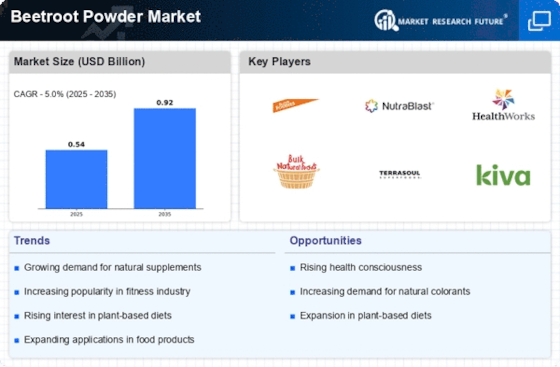
As per Market Research Future analysis, the Beetroot Powder Market Size was estimated at 0.54 USD Billion in 2024. The Beetroot Powder industry is projected to grow from USD 0.567 Billion in 2025 to USD 0.9238 Billion by 2035, exhibiting a compound annual growth rate (CAGR) of 5.0% during the forecast period 2025 - 2035

Key Market Trends & Highlights

The Beetroot Powder Market is experiencing robust growth driven by health trends and culinary innovations.

  • The demand for natural ingredients in food and beverages is rising, particularly in North America, the largest market. Asia-Pacific emerges as the fastest-growing region, with increasing interest in beetroot powder among health-conscious consumers. The food and beverages segment remains the largest, while the nutraceuticals segment is witnessing the fastest growth due to heightened health awareness. Key market drivers include the growing popularity of plant-based diets and the expansion of e-commerce platforms, facilitating access to beetroot powder.

Market Size & Forecast

2024 Market Size 0.54 (USD Billion)
2035 Market Size 0.9238 (USD Billion)
CAGR (2025 - 2035) 5.0%
Largest Regional Market Share in 2024 Europe

Major Players

Beetroot Powder Co (US), Superfoodies (US), NutraBlast (US), Healthworks (US), Bulk Natural Foods (GB), Terrasoul Superfoods (US), Kiva (US), Sunfood (US), Organic Burst (GB)

Market Trends

The beetroot powder market is currently experiencing a notable transformation, driven by increasing consumer awareness regarding health and wellness. This shift reflects evolving beetroot powder market trends, where consumers increasingly prefer natural and organic products over synthetic additives. Beetroot powder, recognized for its rich nutritional profile, is gaining traction among health-conscious consumers. Its versatility in culinary applications, ranging from smoothies to baked goods, further enhances its appeal. Additionally, the rise of plant-based diets seems to contribute to the market's expansion, as beetroot powder serves as a valuable ingredient for those seeking nutritious options without animal products.

Moreover, the Beetroot Powder Market is likely to benefit from the increasing popularity of functional foods. These products, which offer health benefits beyond basic nutrition, are becoming more prevalent in consumer diets. Beetroot powder, with its potential to support cardiovascular health and enhance athletic performance, aligns well with these emerging beetroot powder market trends. As more individuals prioritize their well-being, the demand for beetroot powder is expected to grow. Overall, the beetroot powder market appears poised for continued growth, driven by evolving consumer preferences and a heightened focus on health and nutrition.

Rising Demand for Natural Ingredients

There is a growing preference among consumers for products that are derived from natural sources. This trend is evident in the beetroot powder market, where individuals are increasingly seeking out organic and minimally processed options. As awareness of the benefits of natural ingredients rises, beetroot powder is positioned to meet this demand.

Expansion in Culinary Applications

The versatility of beetroot powder is becoming more recognized in various culinary contexts. It is being incorporated into a wide range of recipes, from smoothies to baked goods, enhancing both flavor and nutritional value. This expansion is a significant contributor to evolving beetroot powder market trends.

Focus on Health and Wellness

The ongoing emphasis on health and wellness is significantly influencing the Beetroot Powder Market. Consumers are actively seeking products that contribute to their overall well-being, and beetroot powder, known for its potential health benefits, is increasingly viewed as a valuable addition to a balanced diet.

Beetroot Powder Market Market Drivers

Expansion of E-commerce Platforms

The expansion of e-commerce platforms is transforming the retail landscape for the beetroot powder Market. As online shopping becomes more prevalent, consumers are increasingly turning to digital channels to purchase health products, including beetroot powder. This shift is supported by data indicating that e-commerce sales in the health and wellness sector have surged, with many consumers appreciating the convenience and variety offered by online retailers. The ability to access a wide range of beetroot powder products, along with detailed information and customer reviews, enhances consumer confidence and encourages purchases. Consequently, this trend is likely to drive market growth as more consumers discover and buy beetroot powder through e-commerce platforms.

Innovations in Product Development

Innovations in product development are playing a crucial role in shaping the Beetroot Powder Market. Manufacturers are increasingly exploring new formulations and applications for beetroot powder, catering to diverse consumer preferences. This includes the introduction of beetroot powder blends, ready-to-drink beverages, and fortified snacks that incorporate beetroot powder for added nutritional value. Market data suggests that the demand for innovative health products is on the rise, with consumers seeking unique flavors and health benefits. As companies invest in research and development to create novel products, the beetroot powder market is likely to witness enhanced growth opportunities, appealing to a broader audience and meeting the evolving needs of health-conscious consumers.

Rising Popularity of Functional Foods

The trend towards functional foods is emerging as a key driver for the Beetroot Powder Market. Functional foods, which provide health benefits beyond basic nutrition, are gaining traction among consumers seeking to enhance their overall well-being. Beetroot powder, recognized for its potential to improve stamina and support detoxification, fits seamlessly into this category. Market data indicates that the functional food market is projected to grow significantly, with consumers increasingly gravitating towards products that offer specific health benefits. This shift is likely to create new opportunities for beetroot powder manufacturers to innovate and develop products that cater to the evolving preferences of health-conscious consumers.

Increased Awareness of Health Benefits

The heightened awareness regarding the health benefits associated with beetroot powder is likely to propel the Beetroot Powder Market. Research suggests that beetroot powder may contribute to improved cardiovascular health, enhanced athletic performance, and better digestion due to its high nitrate content. As consumers become more informed about the advantages of incorporating beetroot powder into their diets, the demand for this product is expected to rise. Market analysis indicates that the dietary supplement segment, which includes beetroot powder, has been expanding, with a notable increase in sales attributed to the growing consumer focus on preventive health measures. This trend may further solidify the position of beetroot powder in the health and wellness sector.

Growing Popularity of Plant-Based Diets

The increasing shift towards plant-based diets appears to be a significant driver for the Beetroot Powder Market. As consumers become more health-conscious, they are actively seeking natural and nutritious alternatives to traditional food products. Beetroot powder, known for its rich nutrient profile, including vitamins, minerals, and antioxidants, aligns well with this trend. Market data indicates that the plant-based food sector has been experiencing robust growth, with projections suggesting a compound annual growth rate of over 10% in the coming years. This trend is likely to bolster the demand for beetroot powder as a versatile ingredient in smoothies, snacks, and health supplements, thereby enhancing its market presence.

Market Segment Insights

By Application: Food and Beverages (Largest) vs. Nutraceuticals (Fastest-Growing)

In the Beetroot Powder Market, the application segment illustrates a diverse interplay between food and beverages, nutraceuticals, cosmetics, and pharmaceuticals. Food and beverages take the dominant position in terms of market share, driven by increasing consumer awareness of health and nutrition. This sector embraces beetroot powder as a natural ingredient, enhancing product offerings such as smoothies, health drinks, and dietary supplements. Nutraceuticals, while currently a smaller segment, are witnessing rapid growth, driven by the trend towards natural health solutions and the rising preference for preventive healthcare.

Food and Beverages: Dominant vs. Nutraceuticals: Emerging

The food and beverages sector stands as the primary arena for beetroot powder, recognized for its vibrant color and health benefits. This segment has harnessed the power of beetroot for various applications, ranging from functional foods to beverages like juices and smoothies. On the other hand, nutraceuticals are emerging rapidly, characterized by an increased consumer shift towards supplements that promote health and wellness. The rise of plant-based diets and the growing emphasis on preventive healthcare are pivotal in driving this segment's growth. Nutraceuticals make an appealing case with their focus on enhancing health without artificial additives, carving a significant niche in the market.

By Form: Organic (Largest) vs. Instant (Fastest-Growing)

In the Beetroot Powder Market, the segment distribution reveals that Organic beetroot powder commands the largest share, reflecting a growing consumer preference for natural and health-conscious products. Conventional options have maintained a steady presence in the market, but they are gradually losing ground to the more sought-after Organic variety. Instant beetroot powder, while smaller in terms of current market share, is rapidly gaining traction, appealing particularly to consumers looking for convenience and quick preparation solutions.

Organic (Dominant) vs. Instant (Emerging)

Organic beetroot powder has established itself as the dominant player in this segment, characterized by its natural sourcing and perceived health benefits. It appeals to a health-conscious demographic that prioritizes clean and organic ingredients in their diets. On the other hand, Instant beetroot powder is emerging as a new trend, driven by its convenience and versatility in various applications, from smoothies to baking. This segment is particularly attractive to busy consumers and athletes seeking quick and effective nutrition. As health trends continue to evolve, both Organic and Instant forms are expected to see continued interest, catering to different consumer needs.

By Distribution Channel: Online Retail (Largest) vs. Supermarkets (Fastest-Growing)

In the Beetroot Powder Market, the distribution channels showcase a diverse range of consumer preferences. Online Retail holds a significant share, largely due to the convenience it offers to customers who favor home delivery and the ability to compare products effectively. On the other hand, Supermarkets are crucial as they provide immediate access to products, catering to consumers who prefer physical shopping experiences. The presence of health food sections in these stores further enhances their appeal to health-conscious shoppers. Growth trends within the Beetroot Powder Market segment are notable, with Online Retail projected to continue its dominance driven by increasing digital engagement and e-commerce growth. Conversely, Supermarkets are emerging as the fastest-growing channel as they adapt to trends by increasing organic product offerings and enhancing in-store promotions of health-focused items. This reflects a shift in consumer behavior towards purchasing healthy foods conveniently.

Online Retail (Dominant) vs. Health Food Stores (Emerging)

Online Retail has established itself as a dominant distribution channel in the Beetroot Powder Market. Its ability to reach a wide customer base and facilitate easy access to a variety of brands and products is unmatched. This channel caters especially to younger, tech-savvy consumers who appreciate the convenience of online shopping. In contrast, Health Food Stores are emerging as a key player in this market, appealing to health-conscious consumers who prefer shopping at specialized outlets where they can find a curated selection of health products, including beetroot powder. These stores tend to offer a more personalized shopping experience and often feature organic product lines, thus attracting a dedicated clientele keen on wellness and nutrition.

By End Use: Household (Largest) vs. Commercial (Fastest-Growing)

The Beetroot Powder Market sees significant division among its end-use segments, with the Household segment commanding the largest share. This segment thrives on consumer trends towards natural and organic products, where beetroot powder is increasingly sighted as a health supplement for individuals. Conversely, the Commercial segment is emerging rapidly, driven by food and beverage manufacturers recognizing the potential of beetroot powder as a natural colorant and flavor enhancer, appealing to health-conscious consumers. The Industrial segment, while valuable, remains less prominent than the other two, primarily catering to specific applications like dye and food processing. Growth trends indicate that the Household segment has witnessed steady demand fueled by rising health awareness among consumers, leading to increased adoption for personal use. On the other hand, the Commercial sector is gaining momentum, propelled by innovative food formulations and the rising trend of clean label products. Companies are incorporating beetroot powder into beverages, snacks, and dietary supplements, boosting its consumption across various culinary applications. Meanwhile, the Industrial segment may see growth, albeit slower, focused on specific use cases aligned with nutritional and functional benefits.

Household (Dominant) vs. Commercial (Emerging)

The Household segment remains a dominant force in the Beetroot Powder Market, characterized by increasing consumer awareness regarding health benefits and a shift towards natural supplements. Consumers prefer beetroot powder for its high antioxidant properties and versatility in various recipes. This segment is driven by personal consumption, where individuals use the powder in smoothies, baking, and as a dietary supplement. On the other hand, the Commercial segment is recognized as an emerging player, with food manufacturers harnessing beetroot powder for its natural coloring and health benefits. The trend towards organic, clean-label products is accelerating growth in this segment, as manufacturers respond to the heightened consumer interest in health-oriented and clean ingredients. As these segments continue to evolve, synergies between them could foster further innovation in product development.

Get more detailed insights about Beetroot Powder Market Research Report – Forecast till 2035

Regional Insights

North America : Health-Conscious Market Leader

North America is the largest market for beetroot powder, holding approximately 45% of the global share. The region's growth is driven by increasing health consciousness among consumers, rising demand for natural food products, and a growing trend towards plant-based diets. Regulatory support for organic products further catalyzes market expansion, with various health organizations promoting the benefits of beetroot powder in nutrition. The United States is the leading country in this market, with key players such as Beetroot Powder Market Co, Superfoodies, and NutraBlast dominating the landscape. The competitive environment is characterized by innovation in product offerings and marketing strategies aimed at health-conscious consumers. The presence of established brands and a robust distribution network enhances market accessibility, contributing to sustained growth in the region.

Europe : Emerging Market with Potential

Europe is witnessing a significant rise in the demand for beetroot powder, accounting for approximately 30% of the global market share. The growth is fueled by increasing awareness of health benefits associated with beetroot, such as improved athletic performance and cardiovascular health. Regulatory frameworks in the EU promote organic and natural food products, which further supports market growth and consumer acceptance. Leading countries in this region include Germany, the UK, and France, where the market is characterized by a mix of local and international players. Companies like Bulk Natural Foods and Organic Burst are making strides in product innovation and sustainability. The competitive landscape is evolving, with a focus on high-quality, organic offerings that cater to the health-conscious consumer base, enhancing the overall market dynamics.

Asia-Pacific : Rapid Growth and Adoption

Asia-Pacific is emerging as a significant player in the beetroot powder market, holding around 20% of the global share. The region's growth is driven by increasing health awareness, rising disposable incomes, and a growing trend towards natural and organic food products. Countries like India and China are witnessing a surge in demand, supported by favorable government policies promoting health and wellness initiatives. In this region, India and Australia are leading markets, with a growing number of local and international brands entering the space. The competitive landscape is marked by innovation in product formulations and marketing strategies aimed at health-conscious consumers. Key players are focusing on expanding their distribution channels to meet the rising demand, contributing to the overall growth of the market in Asia-Pacific.

Middle East and Africa : Untapped Market Potential

The Middle East and Africa region is gradually emerging in the beetroot powder market, currently holding about 5% of the global share. The growth is primarily driven by increasing health awareness and a shift towards natural food products. Countries like South Africa and the UAE are beginning to recognize the benefits of beetroot powder, supported by local health initiatives and a growing interest in superfoods. In this region, the competitive landscape is still developing, with a few local players and international brands starting to establish a presence. The market is characterized by a lack of awareness compared to other regions, but this presents an opportunity for growth. As health trends continue to evolve, the demand for beetroot powder is expected to rise, attracting more players to the market.

Key Players and Competitive Insights

The Beetroot Powder Market is currently characterized by a dynamic competitive landscape, driven by increasing consumer awareness regarding health benefits and the rising demand for natural food products. Key players such as Beetroot Powder Market Co (US), Superfoodies (US), and NutraBlast (US) are strategically positioning themselves through innovation and regional expansion. These companies are not only focusing on product diversification but are also enhancing their supply chains to meet the growing global demand. The collective strategies of these firms contribute to a moderately fragmented market structure, where competition is intensifying as companies seek to differentiate themselves through quality and sustainability.In terms of business tactics, companies are increasingly localizing manufacturing to reduce costs and improve supply chain efficiency. This approach allows them to respond swiftly to market demands while minimizing logistical challenges. The competitive structure of the Beetroot Powder Market remains moderately fragmented, with several players vying for market share. The influence of key players is significant, as they set trends that smaller companies often follow, thereby shaping the overall market dynamics.

In August Beetroot Powder Market Co (US) announced a partnership with a leading organic farm to enhance its sourcing of raw materials. This strategic move is likely to bolster the company's commitment to sustainability and quality, aligning with consumer preferences for organic products. By securing a reliable supply chain, Beetroot Powder Market Co (US) positions itself favorably against competitors, potentially increasing its market share in the premium segment.
In September Superfoodies (US) launched a new line of beetroot powder infused with superfoods, targeting health-conscious consumers. This innovation reflects the company's focus on product differentiation and meeting evolving consumer tastes. By expanding its product range, Superfoodies (US) not only enhances its competitive edge but also taps into the growing trend of functional foods, which could lead to increased customer loyalty and market penetration.
In July NutraBlast (US) implemented advanced AI-driven analytics to optimize its supply chain operations. This technological integration is expected to enhance efficiency and reduce costs, allowing NutraBlast (US) to offer competitive pricing without compromising on quality. The adoption of AI signifies a broader trend within the industry, where companies leverage technology to gain operational advantages and improve customer experiences.
As of October the Beetroot Powder Market is witnessing trends such as digitalization, sustainability, and the integration of advanced technologies like AI. Strategic alliances are becoming increasingly important, as companies collaborate to enhance their product offerings and market reach. Looking ahead, competitive differentiation is likely to evolve, with a shift from price-based competition to a focus on innovation, technology, and supply chain reliability. This transition may redefine how companies engage with consumers, emphasizing quality and sustainability over mere cost considerations.

Key Companies in the Beetroot Powder Market include

Industry Developments

The Global Beetroot Powder Market has recently seen increased interest primarily due to rising consumer demand for natural and nutritious food products. Notable companies such as Kcores, Dancing Bee Equipment, and Tropical Superfoods are expanding their product lines to include organic beetroot powder, capitalizing on the health trend. In August 2023, BulkSupplements announced a significant increase in production capacity to meet soaring demand. Furthermore, Naturevibe Botanicals launched a new beetroot powder variant enriched with vitamins, appealing to health-conscious consumers.

Recent mergers and acquisitions have been minimal, with no significant deals reported among the key players such as Earth Expo Company or BetterBody Foods. Overall, the market is expected to experience a growth trajectory driven by the health and wellness trend, with projections indicating a market valuation of USD 120 million by 2025, reflecting a compound annual growth rate of over 5%. The Global Beetroot Powder Market is poised for growth as more companies focus on innovative product development and marketing strategies to attract health-oriented consumers.

Future Outlook

Beetroot Powder Market Future Outlook

The Beetroot Powder Market is projected to grow at a 5.0% CAGR from 2025 to 2035, driven by increasing health awareness, demand for natural ingredients, and expanding applications in food and beverage sectors.

New opportunities lie in:

  • <p>Developing organic beetroot powder lines for health-conscious consumers. Creating innovative packaging solutions to enhance shelf life and convenience. Expanding distribution channels through e-commerce platforms for wider market reach.</p>

By 2035, the Beetroot Powder Market is expected to achieve robust growth and increased market penetration.

Market Segmentation

Beetroot Powder Market Form Outlook

  • Organic
  • Conventional
  • Instant

Beetroot Powder Market End Use Outlook

  • Household
  • Commercial
  • Industrial

Beetroot Powder Market Application Outlook

  • Food and Beverages
  • Nutraceuticals
  • Cosmetics
  • Pharmaceuticals

Beetroot Powder Market Distribution Channel Outlook

  • Online Retail
  • Supermarkets
  • Health Food Stores
  • Specialty Stores

Report Scope

MARKET SIZE 2024 0.54(USD Billion)
MARKET SIZE 2025 0.567(USD Billion)
MARKET SIZE 2035 0.9238(USD Billion)
COMPOUND ANNUAL GROWTH RATE (CAGR) 5.0% (2025 - 2035)
REPORT COVERAGE Revenue Forecast, Competitive Landscape, Growth Factors, and Trends
BASE YEAR 2024
Market Forecast Period 2025 - 2035
Historical Data 2019 - 2024
Market Forecast Units USD Billion
Key Companies Profiled Beetroot Powder Co (US), Superfoodies (US), NutraBlast (US), Healthworks (US), Bulk Natural Foods (GB), Terrasoul Superfoods (US), Kiva (US), Sunfood (US), Organic Burst (GB)
Segments Covered Application, Form, Distribution Channel, End Use, Regional
Key Market Opportunities Growing demand for natural food colorants and health supplements drives opportunities in the Beetroot Powder Market.
Key Market Dynamics Rising consumer demand for natural supplements drives innovation and competition in the beetroot powder market.
Countries Covered North America, Europe, APAC, South America, MEA

FAQs

What is the projected market valuation of the Beetroot Powder Market by 2035?

<p>The Beetroot Powder Market is projected to reach approximately 0.9238 USD Billion by 2035.</p>

What was the market valuation of the Beetroot Powder Market in 2024?

In 2024, the Beetroot Powder Market was valued at 0.54 USD Billion.

What is the expected CAGR for the Beetroot Powder Market from 2025 to 2035?

The expected CAGR for the Beetroot Powder Market during the forecast period 2025 - 2035 is 5.0%.

Which application segment is anticipated to have the highest valuation in 2035?

The Food and Beverages segment is expected to grow from 0.25 USD Billion in 2024 to 0.42 USD Billion by 2035.

How does the valuation of the Organic form of beetroot powder compare to Conventional by 2035?

The Organic form is projected to increase from 0.15 USD Billion in 2024 to 0.25 USD Billion by 2035, while Conventional is expected to rise from 0.25 USD Billion to 0.45 USD Billion.

What are the key distribution channels for beetroot powder in 2025?

In 2025, Supermarkets and Online Retail are likely to dominate, with valuations of 0.2 USD Billion and 0.15 USD Billion respectively.

Which companies are leading the Beetroot Powder Market?

Key players in the Beetroot Powder Market include Beetroot Powder Co, Superfoodies, NutraBlast, and Healthworks.

What is the projected growth for the Commercial end-use segment by 2035?

The Commercial end-use segment is expected to grow from 0.162 USD Billion in 2024 to approximately 0.27 USD Billion by 2035.

How does the Pharmaceuticals segment's valuation change from 2024 to 2035?

The Pharmaceuticals segment is projected to increase from 0.09 USD Billion in 2024 to 0.15 USD Billion by 2035.

What is the anticipated market trend for Health Food Stores as a distribution channel by 2035?

Health Food Stores are expected to grow from 0.1 USD Billion in 2024 to around 0.15 USD Billion by 2035.

  1. SECTION I: EXECUTIVE SUMMARY AND KEY HIGHLIGHTS |
    1. EXECUTIVE SUMMARY | |
      1. Market Overview | |
      2. Key Findings | |
      3. Market Segmentation | |
      4. Competitive Landscape | |
      5. Challenges and Opportunities | |
      6. Future Outlook 2
  2. SECTION II: SCOPING, METHODOLOGY AND MARKET STRUCTURE |
    1. MARKET INTRODUCTION | |
      1. Definition | |
      2. Scope of the study | | |
    2. RESEARCH METHODOLOGY | |
      1. Overview | |
      2. Data Mining | |
      3. Secondary Research | |
      4. Primary Research | | |
      5. Forecasting Model | |
      6. Market Size Estimation | | |
      7. Data Triangulation | |
      8. Validation 3
  3. SECTION III: QUALITATIVE ANALYSIS |
    1. MARKET DYNAMICS | |
      1. Overview | |
      2. Drivers | |
      3. Restraints | |
      4. Opportunities |
    2. MARKET FACTOR ANALYSIS | |
      1. Value chain Analysis | |
      2. Porter's Five Forces Analysis | | |
      3. COVID-19 Impact Analysis | | |
  4. SECTION IV: QUANTITATIVE ANALYSIS |
    1. Food, Beverages & Nutrition, BY Application (USD Billion) | |
      1. Food and Beverages | |
      2. Nutraceuticals | |
      3. Cosmetics | |
      4. Pharmaceuticals |
    2. Food, Beverages & Nutrition, BY Form (USD Billion) | |
      1. Organic | |
      2. Conventional | |
      3. Instant |
    3. Food, Beverages & Nutrition, BY Distribution Channel (USD Billion) | |
      1. Online Retail | |
      2. Supermarkets | |
      3. Health Food Stores | |
      4. Specialty Stores |
    4. Food, Beverages & Nutrition, BY End Use (USD Billion) | |
      1. Household | |
      2. Commercial | |
      3. Industrial |
    5. Food, Beverages & Nutrition, BY Region (USD Billion) | |
      1. North America | | |
      2. Europe | | |
      3. APAC | | |
      4. South America | | |
      5. MEA | | |
  5. SECTION V: COMPETITIVE ANALYSIS |
    1. Competitive Landscape | |
      1. Overview | |
      2. Competitive Analysis | |
      3. Market share Analysis | |
      4. Major Growth Strategy in the Food, Beverages & Nutrition | |
      5. Competitive Benchmarking | |
      6. Leading Players in Terms of Number of Developments in the Food, Beverages & Nutrition | |
      7. Key developments and growth strategies | | |
      8. Major Players Financial Matrix | | |
    2. Company Profiles | |
      1. Beetroot Powder Co (US) | | |
      2. Superfoodies (US) | | |
      3. NutraBlast (US) | | |
      4. Healthworks (US) | | |
      5. Bulk Natural Foods (GB) | | |
      6. Terrasoul Superfoods (US) | | |
      7. Kiva (US) | | |
      8. Sunfood (US) | | |
      9. Organic Burst (GB) | | |
    3. Appendix | |
      1. References | |
      2. Related Reports 6 LIST OF FIGURES |
    4. MARKET SYNOPSIS |
    5. NORTH AMERICA MARKET ANALYSIS |
    6. US MARKET ANALYSIS BY APPLICATION |
    7. US MARKET ANALYSIS BY FORM |
    8. US MARKET ANALYSIS BY DISTRIBUTION CHANNEL |
    9. US MARKET ANALYSIS BY END USE |
    10. CANADA MARKET ANALYSIS BY APPLICATION |
    11. CANADA MARKET ANALYSIS BY FORM |
    12. CANADA MARKET ANALYSIS BY DISTRIBUTION CHANNEL |
    13. CANADA MARKET ANALYSIS BY END USE |
    14. EUROPE MARKET ANALYSIS |
    15. GERMANY MARKET ANALYSIS BY APPLICATION |
    16. GERMANY MARKET ANALYSIS BY FORM |
    17. GERMANY MARKET ANALYSIS BY DISTRIBUTION CHANNEL |
    18. GERMANY MARKET ANALYSIS BY END USE |
    19. UK MARKET ANALYSIS BY APPLICATION |
    20. UK MARKET ANALYSIS BY FORM |
    21. UK MARKET ANALYSIS BY DISTRIBUTION CHANNEL |
    22. UK MARKET ANALYSIS BY END USE |
    23. FRANCE MARKET ANALYSIS BY APPLICATION |
    24. FRANCE MARKET ANALYSIS BY FORM |
    25. FRANCE MARKET ANALYSIS BY DISTRIBUTION CHANNEL |
    26. FRANCE MARKET ANALYSIS BY END USE |
    27. RUSSIA MARKET ANALYSIS BY APPLICATION |
    28. RUSSIA MARKET ANALYSIS BY FORM |
    29. RUSSIA MARKET ANALYSIS BY DISTRIBUTION CHANNEL |
    30. RUSSIA MARKET ANALYSIS BY END USE |
    31. ITALY MARKET ANALYSIS BY APPLICATION |
    32. ITALY MARKET ANALYSIS BY FORM |
    33. ITALY MARKET ANALYSIS BY DISTRIBUTION CHANNEL |
    34. ITALY MARKET ANALYSIS BY END USE |
    35. SPAIN MARKET ANALYSIS BY APPLICATION |
    36. SPAIN MARKET ANALYSIS BY FORM |
    37. SPAIN MARKET ANALYSIS BY DISTRIBUTION CHANNEL |
    38. SPAIN MARKET ANALYSIS BY END USE |
    39. REST OF EUROPE MARKET ANALYSIS BY APPLICATION |
    40. REST OF EUROPE MARKET ANALYSIS BY FORM |
    41. REST OF EUROPE MARKET ANALYSIS BY DISTRIBUTION CHANNEL |
    42. REST OF EUROPE MARKET ANALYSIS BY END USE |
    43. APAC MARKET ANALYSIS |
    44. CHINA MARKET ANALYSIS BY APPLICATION |
    45. CHINA MARKET ANALYSIS BY FORM |
    46. CHINA MARKET ANALYSIS BY DISTRIBUTION CHANNEL |
    47. CHINA MARKET ANALYSIS BY END USE |
    48. INDIA MARKET ANALYSIS BY APPLICATION |
    49. INDIA MARKET ANALYSIS BY FORM |
    50. INDIA MARKET ANALYSIS BY DISTRIBUTION CHANNEL |
    51. INDIA MARKET ANALYSIS BY END USE |
    52. JAPAN MARKET ANALYSIS BY APPLICATION |
    53. JAPAN MARKET ANALYSIS BY FORM |
    54. JAPAN MARKET ANALYSIS BY DISTRIBUTION CHANNEL |
    55. JAPAN MARKET ANALYSIS BY END USE |
    56. SOUTH KOREA MARKET ANALYSIS BY APPLICATION |
    57. SOUTH KOREA MARKET ANALYSIS BY FORM |
    58. SOUTH KOREA MARKET ANALYSIS BY DISTRIBUTION CHANNEL |
    59. SOUTH KOREA MARKET ANALYSIS BY END USE |
    60. MALAYSIA MARKET ANALYSIS BY APPLICATION |
    61. MALAYSIA MARKET ANALYSIS BY FORM |
    62. MALAYSIA MARKET ANALYSIS BY DISTRIBUTION CHANNEL |
    63. MALAYSIA MARKET ANALYSIS BY END USE |
    64. THAILAND MARKET ANALYSIS BY APPLICATION |
    65. THAILAND MARKET ANALYSIS BY FORM |
    66. THAILAND MARKET ANALYSIS BY DISTRIBUTION CHANNEL |
    67. THAILAND MARKET ANALYSIS BY END USE |
    68. INDONESIA MARKET ANALYSIS BY APPLICATION |
    69. INDONESIA MARKET ANALYSIS BY FORM |
    70. INDONESIA MARKET ANALYSIS BY DISTRIBUTION CHANNEL |
    71. INDONESIA MARKET ANALYSIS BY END USE |
    72. REST OF APAC MARKET ANALYSIS BY APPLICATION |
    73. REST OF APAC MARKET ANALYSIS BY FORM |
    74. REST OF APAC MARKET ANALYSIS BY DISTRIBUTION CHANNEL |
    75. REST OF APAC MARKET ANALYSIS BY END USE |
    76. SOUTH AMERICA MARKET ANALYSIS |
    77. BRAZIL MARKET ANALYSIS BY APPLICATION |
    78. BRAZIL MARKET ANALYSIS BY FORM |
    79. BRAZIL MARKET ANALYSIS BY DISTRIBUTION CHANNEL |
    80. BRAZIL MARKET ANALYSIS BY END USE |
    81. MEXICO MARKET ANALYSIS BY APPLICATION |
    82. MEXICO MARKET ANALYSIS BY FORM |
    83. MEXICO MARKET ANALYSIS BY DISTRIBUTION CHANNEL |
    84. MEXICO MARKET ANALYSIS BY END USE |
    85. ARGENTINA MARKET ANALYSIS BY APPLICATION |
    86. ARGENTINA MARKET ANALYSIS BY FORM |
    87. ARGENTINA MARKET ANALYSIS BY DISTRIBUTION CHANNEL |
    88. ARGENTINA MARKET ANALYSIS BY END USE |
    89. REST OF SOUTH AMERICA MARKET ANALYSIS BY APPLICATION |
    90. REST OF SOUTH AMERICA MARKET ANALYSIS BY FORM |
    91. REST OF SOUTH AMERICA MARKET ANALYSIS BY DISTRIBUTION CHANNEL |
    92. REST OF SOUTH AMERICA MARKET ANALYSIS BY END USE |
    93. MEA MARKET ANALYSIS |
    94. GCC COUNTRIES MARKET ANALYSIS BY APPLICATION |
    95. GCC COUNTRIES MARKET ANALYSIS BY FORM |
    96. GCC COUNTRIES MARKET ANALYSIS BY DISTRIBUTION CHANNEL |
    97. GCC COUNTRIES MARKET ANALYSIS BY END USE |
    98. SOUTH AFRICA MARKET ANALYSIS BY APPLICATION |
    99. SOUTH AFRICA MARKET ANALYSIS BY FORM |
    100. SOUTH AFRICA MARKET ANALYSIS BY DISTRIBUTION CHANNEL |
    101. SOUTH AFRICA MARKET ANALYSIS BY END USE |
    102. REST OF MEA MARKET ANALYSIS BY APPLICATION |
    103. REST OF MEA MARKET ANALYSIS BY FORM |
    104. REST OF MEA MARKET ANALYSIS BY DISTRIBUTION CHANNEL |
    105. REST OF MEA MARKET ANALYSIS BY END USE |
    106. KEY BUYING CRITERIA OF FOOD, BEVERAGES & NUTRITION |
    107. RESEARCH PROCESS OF MRFR |
    108. DRO ANALYSIS OF FOOD, BEVERAGES & NUTRITION |
    109. DRIVERS IMPACT ANALYSIS: FOOD, BEVERAGES & NUTRITION |
    110. RESTRAINTS IMPACT ANALYSIS: FOOD, BEVERAGES & NUTRITION |
    111. SUPPLY / VALUE CHAIN: FOOD, BEVERAGES & NUTRITION |
    112. FOOD, BEVERAGES & NUTRITION, BY APPLICATION, 2024 (% SHARE) |
    113. FOOD, BEVERAGES & NUTRITION, BY APPLICATION, 2024 TO 2035 (USD Billion) |
    114. FOOD, BEVERAGES & NUTRITION, BY FORM, 2024 (% SHARE) |
    115. FOOD, BEVERAGES & NUTRITION, BY FORM, 2024 TO 2035 (USD Billion) |
    116. FOOD, BEVERAGES & NUTRITION, BY DISTRIBUTION CHANNEL, 2024 (% SHARE) |
    117. FOOD, BEVERAGES & NUTRITION, BY DISTRIBUTION CHANNEL, 2024 TO 2035 (USD Billion) |
    118. FOOD, BEVERAGES & NUTRITION, BY END USE, 2024 (% SHARE) |
    119. FOOD, BEVERAGES & NUTRITION, BY END USE, 2024 TO 2035 (USD Billion) |
    120. BENCHMARKING OF MAJOR COMPETITORS 7 LIST OF TABLES |
    121. LIST OF ASSUMPTIONS | |
      1. |
    122. North America MARKET SIZE ESTIMATES; FORECAST | |
      1. BY APPLICATION, 2025-2035 (USD Billion) | |
      2. BY FORM, 2025-2035 (USD Billion) | |
      3. BY DISTRIBUTION CHANNEL, 2025-2035 (USD Billion) | |
      4. BY END USE, 2025-2035 (USD Billion) |
    123. US MARKET SIZE ESTIMATES; FORECAST | |
      1. BY APPLICATION, 2025-2035 (USD Billion) | |
      2. BY FORM, 2025-2035 (USD Billion) | |
      3. BY DISTRIBUTION CHANNEL, 2025-2035 (USD Billion) | |
      4. BY END USE, 2025-2035 (USD Billion) |
    124. Canada MARKET SIZE ESTIMATES; FORECAST | |
      1. BY APPLICATION, 2025-2035 (USD Billion) | |
      2. BY FORM, 2025-2035 (USD Billion) | |
      3. BY DISTRIBUTION CHANNEL, 2025-2035 (USD Billion) | |
      4. BY END USE, 2025-2035 (USD Billion) |
    125. Europe MARKET SIZE ESTIMATES; FORECAST | |
      1. BY APPLICATION, 2025-2035 (USD Billion) | |
      2. BY FORM, 2025-2035 (USD Billion) | |
      3. BY DISTRIBUTION CHANNEL, 2025-2035 (USD Billion) | |
      4. BY END USE, 2025-2035 (USD Billion) |
    126. Germany MARKET SIZE ESTIMATES; FORECAST | |
      1. BY APPLICATION, 2025-2035 (USD Billion) | |
      2. BY FORM, 2025-2035 (USD Billion) | |
      3. BY DISTRIBUTION CHANNEL, 2025-2035 (USD Billion) | |
      4. BY END USE, 2025-2035 (USD Billion) |
    127. UK MARKET SIZE ESTIMATES; FORECAST | |
      1. BY APPLICATION, 2025-2035 (USD Billion) | |
      2. BY FORM, 2025-2035 (USD Billion) | |
      3. BY DISTRIBUTION CHANNEL, 2025-2035 (USD Billion) | |
      4. BY END USE, 2025-2035 (USD Billion) |
    128. France MARKET SIZE ESTIMATES; FORECAST | |
      1. BY APPLICATION, 2025-2035 (USD Billion) | |
      2. BY FORM, 2025-2035 (USD Billion) | |
      3. BY DISTRIBUTION CHANNEL, 2025-2035 (USD Billion) | |
      4. BY END USE, 2025-2035 (USD Billion) |
    129. Russia MARKET SIZE ESTIMATES; FORECAST | |
      1. BY APPLICATION, 2025-2035 (USD Billion) | |
      2. BY FORM, 2025-2035 (USD Billion) | |
      3. BY DISTRIBUTION CHANNEL, 2025-2035 (USD Billion) | |
      4. BY END USE, 2025-2035 (USD Billion) |
    130. Italy MARKET SIZE ESTIMATES; FORECAST | |
      1. BY APPLICATION, 2025-2035 (USD Billion) | |
      2. BY FORM, 2025-2035 (USD Billion) | |
      3. BY DISTRIBUTION CHANNEL, 2025-2035 (USD Billion) | |
      4. BY END USE, 2025-2035 (USD Billion) |
    131. Spain MARKET SIZE ESTIMATES; FORECAST | |
      1. BY APPLICATION, 2025-2035 (USD Billion) | |
      2. BY FORM, 2025-2035 (USD Billion) | |
      3. BY DISTRIBUTION CHANNEL, 2025-2035 (USD Billion) | |
      4. BY END USE, 2025-2035 (USD Billion) |
    132. Rest of Europe MARKET SIZE ESTIMATES; FORECAST | |
      1. BY APPLICATION, 2025-2035 (USD Billion) | |
      2. BY FORM, 2025-2035 (USD Billion) | |
      3. BY DISTRIBUTION CHANNEL, 2025-2035 (USD Billion) | |
      4. BY END USE, 2025-2035 (USD Billion) |
    133. APAC MARKET SIZE ESTIMATES; FORECAST | |
      1. BY APPLICATION, 2025-2035 (USD Billion) | |
      2. BY FORM, 2025-2035 (USD Billion) | |
      3. BY DISTRIBUTION CHANNEL, 2025-2035 (USD Billion) | |
      4. BY END USE, 2025-2035 (USD Billion) |
    134. China MARKET SIZE ESTIMATES; FORECAST | |
      1. BY APPLICATION, 2025-2035 (USD Billion) | |
      2. BY FORM, 2025-2035 (USD Billion) | |
      3. BY DISTRIBUTION CHANNEL, 2025-2035 (USD Billion) | |
      4. BY END USE, 2025-2035 (USD Billion) |
    135. India MARKET SIZE ESTIMATES; FORECAST | |
      1. BY APPLICATION, 2025-2035 (USD Billion) | |
      2. BY FORM, 2025-2035 (USD Billion) | |
      3. BY DISTRIBUTION CHANNEL, 2025-2035 (USD Billion) | |
      4. BY END USE, 2025-2035 (USD Billion) |
    136. Japan MARKET SIZE ESTIMATES; FORECAST | |
      1. BY APPLICATION, 2025-2035 (USD Billion) | |
      2. BY FORM, 2025-2035 (USD Billion) | |
      3. BY DISTRIBUTION CHANNEL, 2025-2035 (USD Billion) | |
      4. BY END USE, 2025-2035 (USD Billion) |
    137. South Korea MARKET SIZE ESTIMATES; FORECAST | |
      1. BY APPLICATION, 2025-2035 (USD Billion) | |
      2. BY FORM, 2025-2035 (USD Billion) | |
      3. BY DISTRIBUTION CHANNEL, 2025-2035 (USD Billion) | |
      4. BY END USE, 2025-2035 (USD Billion) |
    138. Malaysia MARKET SIZE ESTIMATES; FORECAST | |
      1. BY APPLICATION, 2025-2035 (USD Billion) | |
      2. BY FORM, 2025-2035 (USD Billion) | |
      3. BY DISTRIBUTION CHANNEL, 2025-2035 (USD Billion) | |
      4. BY END USE, 2025-2035 (USD Billion) |
    139. Thailand MARKET SIZE ESTIMATES; FORECAST | |
      1. BY APPLICATION, 2025-2035 (USD Billion) | |
      2. BY FORM, 2025-2035 (USD Billion) | |
      3. BY DISTRIBUTION CHANNEL, 2025-2035 (USD Billion) | |
      4. BY END USE, 2025-2035 (USD Billion) |
    140. Indonesia MARKET SIZE ESTIMATES; FORECAST | |
      1. BY APPLICATION, 2025-2035 (USD Billion) | |
      2. BY FORM, 2025-2035 (USD Billion) | |
      3. BY DISTRIBUTION CHANNEL, 2025-2035 (USD Billion) | |
      4. BY END USE, 2025-2035 (USD Billion) |
    141. Rest of APAC MARKET SIZE ESTIMATES; FORECAST | |
      1. BY APPLICATION, 2025-2035 (USD Billion) | |
      2. BY FORM, 2025-2035 (USD Billion) | |
      3. BY DISTRIBUTION CHANNEL, 2025-2035 (USD Billion) | |
      4. BY END USE, 2025-2035 (USD Billion) |
    142. South America MARKET SIZE ESTIMATES; FORECAST | |
      1. BY APPLICATION, 2025-2035 (USD Billion) | |
      2. BY FORM, 2025-2035 (USD Billion) | |
      3. BY DISTRIBUTION CHANNEL, 2025-2035 (USD Billion) | |
      4. BY END USE, 2025-2035 (USD Billion) |
    143. Brazil MARKET SIZE ESTIMATES; FORECAST | |
      1. BY APPLICATION, 2025-2035 (USD Billion) | |
      2. BY FORM, 2025-2035 (USD Billion) | |
      3. BY DISTRIBUTION CHANNEL, 2025-2035 (USD Billion) | |
      4. BY END USE, 2025-2035 (USD Billion) |
    144. Mexico MARKET SIZE ESTIMATES; FORECAST | |
      1. BY APPLICATION, 2025-2035 (USD Billion) | |
      2. BY FORM, 2025-2035 (USD Billion) | |
      3. BY DISTRIBUTION CHANNEL, 2025-2035 (USD Billion) | |
      4. BY END USE, 2025-2035 (USD Billion) |
    145. Argentina MARKET SIZE ESTIMATES; FORECAST | |
      1. BY APPLICATION, 2025-2035 (USD Billion) | |
      2. BY FORM, 2025-2035 (USD Billion) | |
      3. BY DISTRIBUTION CHANNEL, 2025-2035 (USD Billion) | |
      4. BY END USE, 2025-2035 (USD Billion) |
    146. Rest of South America MARKET SIZE ESTIMATES; FORECAST | |
      1. BY APPLICATION, 2025-2035 (USD Billion) | |
      2. BY FORM, 2025-2035 (USD Billion) | |
      3. BY DISTRIBUTION CHANNEL, 2025-2035 (USD Billion) | |
      4. BY END USE, 2025-2035 (USD Billion) |
    147. MEA MARKET SIZE ESTIMATES; FORECAST | |
      1. BY APPLICATION, 2025-2035 (USD Billion) | |
      2. BY FORM, 2025-2035 (USD Billion) | |
      3. BY DISTRIBUTION CHANNEL, 2025-2035 (USD Billion) | |
      4. BY END USE, 2025-2035 (USD Billion) |
    148. GCC Countries MARKET SIZE ESTIMATES; FORECAST | |
      1. BY APPLICATION, 2025-2035 (USD Billion) | |
      2. BY FORM, 2025-2035 (USD Billion) | |
      3. BY DISTRIBUTION CHANNEL, 2025-2035 (USD Billion) | |
      4. BY END USE, 2025-2035 (USD Billion) |
    149. South Africa MARKET SIZE ESTIMATES; FORECAST | |
      1. BY APPLICATION, 2025-2035 (USD Billion) | |
      2. BY FORM, 2025-2035 (USD Billion) | |
      3. BY DISTRIBUTION CHANNEL, 2025-2035 (USD Billion) | |
      4. BY END USE, 2025-2035 (USD Billion) |
    150. Rest of MEA MARKET SIZE ESTIMATES; FORECAST | |
      1. BY APPLICATION, 2025-2035 (USD Billion) | |
      2. BY FORM, 2025-2035 (USD Billion) | |
      3. BY DISTRIBUTION CHANNEL, 2025-2035 (USD Billion) | |
      4. BY END USE, 2025-2035 (USD Billion) |
    151. PRODUCT LAUNCH/PRODUCT DEVELOPMENT/APPROVAL | |
      1. |
    152. ACQUISITION/PARTNERSHIP | |

Food, Beverages & Nutrition Market Segmentation

Food, Beverages & Nutrition By Application (USD Billion, 2025-2035)

  • Food and Beverages
  • Nutraceuticals
  • Cosmetics
  • Pharmaceuticals

Food, Beverages & Nutrition By Form (USD Billion, 2025-2035)

  • Organic
  • Conventional
  • Instant

Food, Beverages & Nutrition By Distribution Channel (USD Billion, 2025-2035)

  • Online Retail
  • Supermarkets
  • Health Food Stores
  • Specialty Stores

Food, Beverages & Nutrition By End Use (USD Billion, 2025-2035)

  • Household
  • Commercial
  • Industrial
Infographic

Free Sample Request

Kindly complete the form below to receive a free sample of this Report

Get Free Sample

Customer Strories

Compare Licence

×
Features License Type
Single User Multiuser License Enterprise User
Price $4,950 $5,950 $7,250
Maximum User Access Limit 1 User Upto 10 Users Unrestricted Access Throughout the Organization
Free Customization
Direct Access to Analyst
Deliverable Format
Platform Access
Discount on Next Purchase 10% 15% 15%
Printable Versions