Request Free Sample ×

Kindly complete the form below to receive a free sample of this Report

* Please use a valid business email

Leading companies partner with us for data-driven Insights

clients tt-cursor
Hero Background
English
Chinese
French
Japanese
Korean
German
Spanish

Beef Market Trends

ID: MRFR/FnB/10381-HCR
200 Pages
Snehal Singh
April 2026

Beef Market Size, Share, Industry Trend & Analysis Research Report By Product Type (Fresh Beef, Processed Beef, Frozen Beef, Canned Beef), By Distribution Channel (Supermarkets, Online Retail, Convenience Stores, Meat Shops), By Cut Type (Steaks, Ground Beef, Roasts, Ribs), By Packaging Type (Vacuum Packaging, Modified Atmosphere Packaging, Traditional Packaging) and By Regional (North America, Europe, South America, Asia Pacific, Middle East and Africa) - Forecast to 2035

Share:
Download PDF ×

We do not share your information with anyone. However, we may send you emails based on your report interest from time to time. You may contact us at any time to opt-out.

Beef Market Infographic
Purchase Options

Market Trends

Key Emerging Trends in the Beef Market

The beef market is a dynamic and complex sector that is influenced by a multitude of factors, reflecting the intricate interplay between supply and demand. One of the key drivers of market dynamics in the beef industry is the global demand for meat consumption. As economies develop and disposable incomes rise, there is a corresponding increase in the demand for protein-rich foods, with beef being a significant contributor.

Supply-side dynamics in the beef market are heavily influenced by factors such as livestock production practices, weather conditions, and input costs. Cattle ranching plays a pivotal role in determining the availability of beef in the market. Adverse weather conditions, such as droughts or extreme temperatures, can impact the quality and quantity of cattle available for slaughter, directly affecting beef production. Additionally, fluctuations in the cost of feed and other inputs can influence the profitability of cattle farming, thereby affecting the overall supply of beef.

Trade policies and geopolitical factors also exert a considerable impact on the beef market. International trade agreements, tariffs, and import/export regulations can shape the flow of beef across borders. For instance, changes in trade agreements or the imposition of tariffs on beef imports can disrupt established supply chains and alter market dynamics. Moreover, disease outbreaks in cattle populations can have far-reaching consequences, leading to trade restrictions and affecting the global availability of beef.

Consumer preferences and dietary trends contribute significantly to the demand side of the beef market. Shifts in consumer behavior towards healthier or more sustainable eating habits can influence the demand for specific types of beef products, such as grass-fed or organic beef. Additionally, cultural and regional preferences play a role in shaping the demand for different cuts of beef and preparation methods.

The role of technology in the beef industry cannot be overlooked when analyzing market dynamics. Advancements in farming practices, such as precision agriculture and genetic engineering, contribute to increased efficiency and productivity in cattle farming. These technological innovations can impact the cost of production and, in turn, influence the pricing and availability of beef in the market.

Environmental and sustainability concerns are becoming increasingly significant factors in shaping market dynamics within the beef industry. Consumers are becoming more conscious of the environmental impact of meat production, leading to a growing demand for sustainable and ethically sourced beef. This shift in consumer preferences is prompting producers and stakeholders in the beef industry to adopt more sustainable practices, such as reducing greenhouse gas emissions and minimizing resource use.

Author
Author Profile
Snehal Singh
Manager - Research

High acumen in analyzing complex macro & micro markets with more than 6 years of work experience in the field of market research. By implementing her analytical skills in forecasting and estimation into market research reports, she has expertise in Packaging, Construction, and Equipment domains. She handles a team size of 20-25 resources and ensures smooth running of the projects, associated marketing activities, and client servicing.

Leave a Comment

FAQs

What is the current valuation of the Beef Market in 2025?

<p>The Beef Market valuation is approximately 420.9 USD Billion in 2024, and it is expected to grow significantly by 2035.</p>

What is the projected market size for the Beef Market by 2035?

The Beef Market is projected to reach a valuation of 766.61 USD Billion by 2035.

What is the expected CAGR for the Beef Market during the forecast period 2025 - 2035?

The expected CAGR for the Beef Market during the forecast period 2025 - 2035 is 5.6%.

Which companies are the key players in the Beef Market?

Key players in the Beef Market include JBS S.A., Tyson Foods, Inc., Cargill, Inc., and National Beef Packing Company, LLC.

What are the main product types in the Beef Market and their valuations?

The main product types include Fresh Beef valued at 400.0 USD Billion and Processed Beef valued at 200.0 USD Billion.

How does the distribution channel impact the Beef Market?

Supermarkets dominate the distribution channel with a valuation of 400.0 USD Billion, while Online Retail is projected to reach 100.0 USD Billion.

What are the leading cut types in the Beef Market?

Steaks and Ground Beef are leading cut types, with valuations of 220.0 USD Billion and 180.0 USD Billion, respectively.

What packaging types are prevalent in the Beef Market?

Vacuum Packaging is a prevalent type, with a valuation of 280.0 USD Billion, indicating a strong preference for this method.

How does the Beef Market's growth compare to other meat markets?

The Beef Market's growth appears robust, with a projected increase to 766.61 USD Billion by 2035, suggesting a strong consumer demand.

What trends are influencing the Beef Market in 2025?

Trends influencing the Beef Market include increased demand for premium cuts and sustainable packaging solutions.

Market Summary

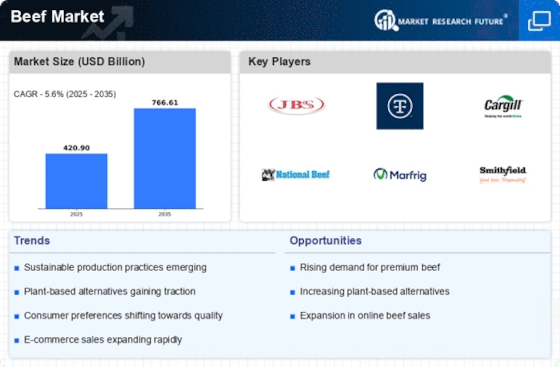
As per Market Research Future analysis, the Beef Market Size was estimated at 420.9 USD Billion in 2024. The Beef industry is projected to grow from 444.48 USD Billion in 2025 to 766.61 USD Billion by 2035, exhibiting a compound annual growth rate (CAGR) of 5.6% during the forecast period 2025 - 2035

Key Market Trends & Highlights

The beef market is currently experiencing a dynamic shift towards health-conscious and sustainable practices.

  • Health-conscious consumers are increasingly favoring premium beef options, particularly in North America. The Asia-Pacific region is witnessing rapid growth in processed beef, driven by changing dietary preferences. Supermarkets remain the largest distribution channel for beef, while online retail is emerging as the fastest-growing segment. Rising demand for premium beef and evolving consumer preferences are key drivers shaping the market landscape.

Market Size & Forecast

2024 Market Size 420.9 (USD Billion)
2035 Market Size 766.61 (USD Billion)
CAGR (2025 - 2035) 5.6%
Largest Regional Market Share in 2024 North America

Major Players

JBS S.A. (BR), Tyson Foods, Inc. (US), Cargill, Inc. (US), National Beef Packing Company, LLC (US), Marfrig Global Foods S.A. (BR), Smithfield Foods, Inc. (US), Danish Crown A/S (DK), BRF S.A. (BR), <a href="https://www.hormelfoods.com/">Hormel Foods Corporation (US)</a>

Market Trends

The Beef Market is currently experiencing a dynamic phase characterized by evolving consumer preferences and shifting production practices. As health consciousness rises among consumers, there is a noticeable trend towards leaner cuts and grass-fed options, which are perceived as healthier alternatives. Additionally, sustainability concerns are influencing purchasing decisions, prompting both producers and consumers to seek more environmentally friendly practices. This shift is not merely a fleeting trend; it appears to be reshaping the entire landscape of beef production and consumption. Furthermore, technological advancements in farming and processing are likely enhancing efficiency and quality, potentially leading to a more competitive market environment. In parallel, the global demand for beef is diversifying, with emerging markets showing increased interest in premium products. This trend suggests that consumers are willing to pay a premium for quality, which may drive innovation in product offerings. The Beef Market is thus at a crossroads, where traditional practices meet modern demands, creating a complex interplay of factors that could define its future trajectory. As the market evolves, stakeholders must remain agile to adapt to these changes and capitalize on new opportunities.

Health-Conscious Choices

Consumers are increasingly gravitating towards leaner beef options and grass-fed varieties, driven by a desire for healthier dietary choices. This trend reflects a broader shift in eating habits, where nutritional value plays a crucial role in purchasing decisions.

Sustainability Focus

There is a growing emphasis on sustainable practices within the Beef Market, as both producers and consumers prioritize environmentally friendly methods. This focus on sustainability is reshaping production processes and influencing consumer preferences.

Technological Advancements

Innovations in farming and processing technologies are enhancing efficiency and product quality in the Beef Market. These advancements may lead to improved competitiveness and the introduction of new products that cater to evolving consumer demands.

Beef Market Market Drivers

Global Trade Dynamics

The Beef Market is significantly influenced by global trade dynamics, which affect supply and pricing structures. Trade agreements and tariffs can alter the competitive landscape, impacting both domestic and international markets. For example, recent trade negotiations have opened new markets for beef exports, particularly in regions with growing middle-class populations. This expansion presents opportunities for producers to increase their market reach and revenue. However, fluctuations in trade policies can also pose challenges, as they may lead to price volatility and supply chain disruptions. Understanding these dynamics is essential for stakeholders in the Beef Market to navigate the complexities of international trade.

Evolving Consumer Preferences

In the Beef Market, evolving consumer preferences are reshaping purchasing behaviors. There is a marked shift towards plant-based diets and alternative protein sources, which has prompted traditional beef producers to reconsider their strategies. While beef remains a staple in many diets, the rise of flexitarianism—where consumers reduce meat consumption without eliminating it entirely—has led to a diversification of product lines. Data suggests that nearly 30% of consumers are actively seeking meat alternatives, which could influence the Beef Market to innovate and incorporate hybrid products that blend beef with plant-based ingredients. This adaptation may be crucial for maintaining market share in an increasingly competitive landscape.

Health and Nutrition Awareness

Health and nutrition awareness is increasingly shaping consumer choices within the Beef Market. As individuals become more health-conscious, there is a growing emphasis on the nutritional benefits of beef, such as its high protein content and essential vitamins. This trend is reflected in market data, which indicates that lean beef products are gaining popularity among health-focused consumers. Additionally, educational campaigns highlighting the role of beef in a balanced diet are likely to bolster demand. The Beef Market may need to enhance its marketing efforts to effectively communicate these health benefits, thereby appealing to a broader audience and countering the rise of alternative protein sources.

Rising Demand for Premium Beef

The Beef Market is currently experiencing a notable increase in demand for premium beef products. Consumers are increasingly seeking high-quality, grass-fed, and organic beef options, which are perceived as healthier and more sustainable. This trend is driven by a growing awareness of food quality and sourcing, as well as a shift towards more discerning eating habits. According to recent data, the premium beef segment has seen a growth rate of approximately 5% annually, indicating a robust market potential. As consumers become more educated about the nutritional benefits of premium beef, the Beef Market is likely to adapt by enhancing product offerings and marketing strategies to cater to this evolving consumer preference.

Technological Innovations in Production

Technological advancements are playing a pivotal role in the Beef Market, particularly in production and supply chain management. Innovations such as precision agriculture, genetic improvements, and enhanced breeding techniques are contributing to increased efficiency and sustainability. For instance, the implementation of data analytics in livestock management has shown to improve feed conversion rates and reduce waste. Furthermore, advancements in meat processing technology are enhancing product quality and safety, which is paramount in meeting consumer expectations. As these technologies continue to evolve, the Beef Market is likely to witness a transformation that not only boosts productivity but also aligns with sustainability goals.

Market Segment Insights

By Product Type: Fresh Beef (Largest) vs. Processed Beef (Fastest-Growing)

<p>The product type segment of the beef market showcases a diverse array of offerings, with Fresh Beef maintaining the largest share. Fresh Beef, known for its high-quality attributes and consumer preference for minimally processed foods, is favored in various culinary applications. Processed Beef follows closely, displaying significant growth momentum driven by changing consumer lifestyles and increasing demand for convenience foods. The growth trends in this segment are shaped by factors like the rise in health-conscious eating habits favoring natural options, alongside the ongoing expansion of the processed beef category, which benefits from innovations in preservation and convenience packaging. These dynamics illustrate a competitive landscape where consumer preferences increasingly dictate trends, prompting beef producers to adapt and innovate their product lines.</p>

<p>Fresh Beef (Dominant) vs. Processed Beef (Emerging)</p>

<p>Fresh Beef stands as the dominant force in the beef market due to its perception as a premium product, appealing to consumers seeking quality and freshness. It is characterized by its minimal processing, which resonates with health-conscious buyers. In contrast, Processed Beef represents an emerging segment that is quickly gaining traction, largely driven by modern consumers' busy lifestyles seeking ready-to-cook options. The processed category encompasses various products, from sausages to ready-meals, making it versatile and appealing to a broader audience. Despite the challenges posed by health trends regarding preservatives, the segment adapts and thrives through flavorsome offerings and innovations, making it a crucial player in the evolving landscape of the beef market.</p>

By Distribution Channel: Supermarkets (Largest) vs. Online Retail (Fastest-Growing)

In the Beef Market, distribution channels play a critical role in determining consumer access and sales dynamics. Supermarkets hold the largest share in the distribution landscape, catering to a broad consumer base with their extensive product range and convenience. This channel benefits from established customer loyalty and frequent shopping habits, which solidify its dominance. On the other hand, online retail is experiencing rapid growth, appealing particularly to tech-savvy consumers seeking convenience and varied options. This shift is propelled by technological advancements and changing shopping behaviors, making it a pivotal segment to watch.

Supermarkets (Dominant) vs. Online Retail (Emerging)

Supermarkets are a dominant force in the Beef Market, leveraging their large store formats, strategic locations, and integrated supply chains to provide customers with fresh and varied beef products. They cater to a wide demographic, making them pivotal in beef distribution. Conversely, online retail, though currently emerging, is reshaping consumer interactions with beef products. The convenience of home delivery and the ability to compare products online is attracting a younger audience and busy consumers. As online shopping continues to gain traction, it is set to redefine how beef products are marketed and sold, fostering innovative approaches to engage customers.

By Cut Type: Steaks (Largest) vs. Ground Beef (Fastest-Growing)

<p>The beef market demonstrates a significant distribution across various cut types, with steaks holding the largest share. This segment appeals to both high-end consumers and restaurants, thanks to its premium quality and flavor profile. Ground beef follows as a versatile option that has increased its presence within households and fast-food chains, constituting a substantial portion of total beef sales. Overall, roasts and ribs contribute to the market but do not match the prominence of steaks and ground beef.</p>

<p>Steaks (Dominant) vs. Ground Beef (Emerging)</p>

<p>The steaks segment of the beef market is characterized by high-quality meat cuts, appealing to consumers who prioritize flavor, texture, and cooking methods like grilling and broiling. This segment enjoys dominance due to its association with premium dining experiences. In contrast, ground beef is emerging rapidly as a staple in mainstream households and fast-food chains due to its affordability and versatility in various cuisines. The convenience of quick preparation methods fuels its growth, making it a preferred choice among consumers seeking convenience without compromising on taste.</p>

By Packaging Type: Vacuum Packaging (Largest) vs. Modified Atmosphere Packaging (Fastest-Growing)

The Beef Market presents a diverse landscape in packaging types, with Vacuum Packaging holding the highest market share. This method is favored for its ability to extend shelf life while preserving freshness and flavor, making it a popular choice among consumers and retailers alike. In contrast, Modified Atmosphere Packaging is gaining traction rapidly, driven by the increasing consumer demand for sustainable and quality-driven products. Traditional Packaging remains a staple, yet its share is gradually declining as newer technologies gain momentum.

Vacuum Packaging (Dominant) vs. Modified Atmosphere Packaging (Emerging)

Vacuum Packaging is a well-established leader in the Beef Market, recognized for its efficiency in maintaining meat quality and extending shelf life by removing air and sealing the product tightly. Its dominance is attributed to its effectiveness in reducing spoilage and maximizing flavor preservation. On the other hand, Modified Atmosphere Packaging is emerging as a formidable contender, utilizing gases like nitrogen and carbon dioxide to enhance freshness and safety. This method is growing in popularity due to its ability to cater to the increasing consumer preference for premium, high-quality meat options. As sustainability becomes a key driver in purchasing decisions, both packaging strategies will continue to evolve, addressing environmental concerns while meeting market demand.

Get more detailed insights about Beef Market Research Report-Global Forecast till 2035

Regional Insights

North America : Market Leader in Beef Market Production

North America is the largest market for beef, accounting for approximately 30% of global consumption. The region's growth is driven by increasing demand for high-quality beef products, supported by a robust supply chain and advanced farming techniques. Regulatory frameworks, such as the USDA's food safety standards, further enhance market stability and consumer confidence. The U.S. and Canada are the primary contributors, with the U.S. alone holding about 25% of the global market share. The competitive landscape in North America is characterized by major players like Tyson Foods, JBS, and Cargill, which dominate the market. These companies leverage advanced technologies and sustainable practices to meet consumer demands. The presence of a well-established distribution network and strong export capabilities also contribute to the region's market strength, ensuring a steady supply of beef products to both domestic and international markets.

Europe : Growing Demand for Sustainable Beef Market

Europe's beef market is witnessing a shift towards sustainable practices, driven by consumer preferences for ethically sourced products. The region accounts for about 20% of global beef consumption, with countries like Germany and France being the largest markets. Regulatory initiatives, such as the EU's Common Agricultural Policy, promote sustainable farming and animal welfare, influencing market dynamics significantly. The demand for organic and grass-fed beef is on the rise, reflecting changing consumer attitudes. Leading countries in Europe include Germany, France, and the UK, where local producers are increasingly focusing on quality over quantity. The competitive landscape features both large-scale producers and small farms, creating a diverse market. Key players like Danish Crown and ABP Food Group are adapting to these trends by investing in sustainable practices and innovative product offerings, ensuring they meet the evolving demands of European consumers.

Asia-Pacific : Emerging Market with High Potential

The Asia-Pacific region is rapidly emerging as a significant player in The Beef Market, accounting for approximately 25% of total consumption. The growth is fueled by rising disposable incomes, urbanization, and changing dietary preferences towards protein-rich foods. Countries like China and Japan are leading this trend, with China alone representing a substantial share of the market. Regulatory support for food safety and quality standards is also enhancing consumer trust in beef products. China, Japan, and Australia are the leading countries in this region, with a competitive landscape that includes both domestic and international players. Major companies like JBS and Cargill are expanding their presence to cater to the growing demand. The market is characterized by a mix of traditional and modern retail channels, with e-commerce gaining traction as consumers seek convenient purchasing options for beef products.

Middle East and Africa : Untapped Market with Growth Potential

The Middle East and Africa region presents a unique opportunity in the beef market, currently holding about 10% of global consumption. The growth is driven by increasing population, urbanization, and a rising middle class that demands higher-quality protein sources. Countries like South Africa and Egypt are at the forefront, with regulatory frameworks gradually evolving to support food safety and quality standards, enhancing market potential. South Africa is the largest market in the region, followed by Egypt, with both countries focusing on improving local production capabilities. The competitive landscape includes local producers and international players, with companies like BRF S.A. and Marfrig Global Foods expanding their operations. The region's diverse culinary preferences also create opportunities for various beef products, catering to both traditional and modern consumer tastes.

Key Players and Competitive Insights

The Beef Market is characterized by a complex interplay of competitive dynamics, driven by factors such as consumer demand for high-quality protein, sustainability concerns, and technological advancements in production. Major players like JBS S.A. (BR), Tyson Foods, Inc. (US), and Cargill, Inc. (US) are at the forefront, each adopting distinct strategies to enhance their market positioning. JBS S.A. (BR) focuses on expanding its international footprint through strategic acquisitions, while Tyson Foods, Inc. (US) emphasizes innovation in product offerings, particularly in plant-based alternatives. Cargill, Inc. (US) is increasingly investing in sustainable practices, which aligns with the growing consumer preference for environmentally friendly products. Collectively, these strategies contribute to a competitive environment that is both dynamic and multifaceted.
In terms of business tactics, companies are increasingly localizing manufacturing to reduce transportation costs and enhance supply chain efficiency. The Beef Market appears moderately fragmented, with a mix of large corporations and smaller regional players. The collective influence of key players shapes market trends, as they leverage their scale to optimize operations and respond to shifting consumer preferences.
In August 2025, Tyson Foods, Inc. (US) announced a partnership with a leading technology firm to develop AI-driven solutions for supply chain management. This strategic move is likely to enhance operational efficiency and reduce waste, positioning Tyson as a leader in technological integration within the beef sector. The emphasis on AI reflects a broader trend towards digital transformation in the industry, which could redefine competitive advantages.
In September 2025, Cargill, Inc. (US) launched a new line of sustainably sourced beef products aimed at environmentally conscious consumers. This initiative not only caters to a growing market segment but also reinforces Cargill's commitment to sustainability, potentially enhancing brand loyalty and market share. The focus on sustainable sourcing is indicative of a larger shift within the industry towards environmentally responsible practices.
In October 2025, JBS S.A. (BR) completed the acquisition of a regional beef processing facility in the United States, which is expected to bolster its production capacity and improve distribution networks. This acquisition aligns with JBS's strategy to strengthen its market presence in North America, allowing for greater responsiveness to local demand and enhancing its competitive edge.
As of October 2025, the Beef Market is witnessing trends that emphasize digitalization, sustainability, and technological integration. Strategic alliances are increasingly shaping the competitive landscape, as companies collaborate to enhance their capabilities and market reach. Looking ahead, competitive differentiation is likely to evolve from traditional price-based competition towards innovation, technology adoption, and supply chain reliability, reflecting the industry's response to changing consumer expectations and market dynamics.

Key Companies in the Beef Market include

Industry Developments

The Beef Market has recently experienced notable developments, including the growing demand for beef in various regions driving price increases. In October 2023, JBS announced an expansion of its production capacity in North America, anticipating higher consumer demand. Meanwhile, in September 2023, Tyson Foods reported significant revenue growth despite facing rising commodity costs, showcasing resilience within the market. Additionally, Marfrig and BRF are collaborating to enhance their export capabilities to Asia, highlighting the target on high-growth markets.

In terms of mergers and acquisitions, in August 2023, Hormel Foods acquired a regional meat processor to broaden its offerings, indicating strategic moves to capture market share. The overall market valuation for companies like Cargill and Smithfield Foods saw an upward shift, reflecting increased consumer preference for beef products and socio-economic recovery post-COVID-19. Over the past two years, the beef sector has faced challenges such as supply chain disruptions and regulatory changes, but recent adjustments indicate a trend towards stabilization within the Beef Market. Additionally, focus on sustainability and traceability in beef production is gaining momentum among major industry players.

Future Outlook

Beef Market Future Outlook

The Beef Market is projected to grow at a 5.6% CAGR from 2025 to 2035, driven by rising protein demand, innovative processing technologies, and expanding export opportunities.

New opportunities lie in:

  • Development of premium grass-fed beef product lines
  • Investment in automated meat processing technologies
  • Expansion into emerging markets with tailored beef products

By 2035, the beef market is expected to achieve robust growth, solidifying its position as a key protein source.

Market Segmentation

Beef Market Cut Type Outlook

  • Steaks
  • Ground Beef
  • Roasts
  • Ribs

Beef Market Product Type Outlook

  • Fresh Beef
  • Processed Beef
  • Frozen Beef
  • Canned Beef

Beef Market Packaging Type Outlook

  • Vacuum Packaging
  • Modified Atmosphere Packaging
  • Traditional Packaging

Beef Market Distribution Channel Outlook

  • Supermarkets
  • Online Retail
  • Convenience Stores
  • Meat Shops

Report Scope

MARKET SIZE 2024 420.9(USD Billion)
MARKET SIZE 2025 444.48(USD Billion)
MARKET SIZE 2035 766.61(USD Billion)
COMPOUND ANNUAL GROWTH RATE (CAGR) 5.6% (2025 - 2035)
REPORT COVERAGE Revenue Forecast, Competitive Landscape, Growth Factors, and Trends
BASE YEAR 2024
Market Forecast Period 2025 - 2035
Historical Data 2019 - 2024
Market Forecast Units USD Billion
Key Companies Profiled JBS S.A. (BR), Tyson Foods, Inc. (US), Cargill, Inc. (US), National Beef Packing Company, LLC (US), Marfrig Global Foods S.A. (BR), Smithfield Foods, Inc. (US), Danish Crown A/S (DK), BRF S.A. (BR), Hormel Foods Corporation (US)
Segments Covered Product Type, Distribution Channel, Cut Type, Packaging Type, Regional
Key Market Opportunities Adoption of sustainable practices and alternative proteins reshapes consumer preferences in the Beef Market.
Key Market Dynamics Rising consumer demand for sustainable beef production influences market dynamics and competitive strategies among producers.
Countries Covered North America, Europe, APAC, South America, MEA

FAQs

What is the current valuation of the Beef Market in 2025?

<p>The Beef Market valuation is approximately 420.9 USD Billion in 2024, and it is expected to grow significantly by 2035.</p>

What is the projected market size for the Beef Market by 2035?

The Beef Market is projected to reach a valuation of 766.61 USD Billion by 2035.

What is the expected CAGR for the Beef Market during the forecast period 2025 - 2035?

The expected CAGR for the Beef Market during the forecast period 2025 - 2035 is 5.6%.

Which companies are the key players in the Beef Market?

Key players in the Beef Market include JBS S.A., Tyson Foods, Inc., Cargill, Inc., and National Beef Packing Company, LLC.

What are the main product types in the Beef Market and their valuations?

The main product types include Fresh Beef valued at 400.0 USD Billion and Processed Beef valued at 200.0 USD Billion.

How does the distribution channel impact the Beef Market?

Supermarkets dominate the distribution channel with a valuation of 400.0 USD Billion, while Online Retail is projected to reach 100.0 USD Billion.

What are the leading cut types in the Beef Market?

Steaks and Ground Beef are leading cut types, with valuations of 220.0 USD Billion and 180.0 USD Billion, respectively.

What packaging types are prevalent in the Beef Market?

Vacuum Packaging is a prevalent type, with a valuation of 280.0 USD Billion, indicating a strong preference for this method.

How does the Beef Market's growth compare to other meat markets?

The Beef Market's growth appears robust, with a projected increase to 766.61 USD Billion by 2035, suggesting a strong consumer demand.

What trends are influencing the Beef Market in 2025?

Trends influencing the Beef Market include increased demand for premium cuts and sustainable packaging solutions.

  1. SECTION I: EXECUTIVE SUMMARY AND KEY HIGHLIGHTS
    1. | 1.1 EXECUTIVE SUMMARY
    2. | | 1.1.1 Market Overview
    3. | | 1.1.2 Key Findings
    4. | | 1.1.3 Market Segmentation
    5. | | 1.1.4 Competitive Landscape
    6. | | 1.1.5 Challenges and Opportunities
    7. | | 1.1.6 Future Outlook
  2. SECTION II: SCOPING, METHODOLOGY AND MARKET STRUCTURE
    1. | 2.1 MARKET INTRODUCTION
    2. | | 2.1.1 Definition
    3. | | 2.1.2 Scope of the study
    4. | | | 2.1.2.1 Research Objective
    5. | | | 2.1.2.2 Assumption
    6. | | | 2.1.2.3 Limitations
    7. | 2.2 RESEARCH METHODOLOGY
    8. | | 2.2.1 Overview
    9. | | 2.2.2 Data Mining
    10. | | 2.2.3 Secondary Research
    11. | | 2.2.4 Primary Research
    12. | | | 2.2.4.1 Primary Interviews and Information Gathering Process
    13. | | | 2.2.4.2 Breakdown of Primary Respondents
    14. | | 2.2.5 Forecasting Model
    15. | | 2.2.6 Market Size Estimation
    16. | | | 2.2.6.1 Bottom-Up Approach
    17. | | | 2.2.6.2 Top-Down Approach
    18. | | 2.2.7 Data Triangulation
    19. | | 2.2.8 Validation
  3. SECTION III: QUALITATIVE ANALYSIS
    1. | 3.1 MARKET DYNAMICS
    2. | | 3.1.1 Overview
    3. | | 3.1.2 Drivers
    4. | | 3.1.3 Restraints
    5. | | 3.1.4 Opportunities
    6. | 3.2 MARKET FACTOR ANALYSIS
    7. | | 3.2.1 Value chain Analysis
    8. | | 3.2.2 Porter's Five Forces Analysis
    9. | | | 3.2.2.1 Bargaining Power of Suppliers
    10. | | | 3.2.2.2 Bargaining Power of Buyers
    11. | | | 3.2.2.3 Threat of New Entrants
    12. | | | 3.2.2.4 Threat of Substitutes
    13. | | | 3.2.2.5 Intensity of Rivalry
    14. | | 3.2.3 COVID-19 Impact Analysis
    15. | | | 3.2.3.1 Market Impact Analysis
    16. | | | 3.2.3.2 Regional Impact
    17. | | | 3.2.3.3 Opportunity and Threat Analysis
  4. SECTION IV: QUANTITATIVE ANALYSIS
    1. | 4.1 Food, Beverages & Nutrition, BY Product Type (USD Billion)
    2. | | 4.1.1 Fresh Beef
    3. | | 4.1.2 Processed Beef
    4. | | 4.1.3 Frozen Beef
    5. | | 4.1.4 Canned Beef
    6. | 4.2 Food, Beverages & Nutrition, BY Distribution Channel (USD Billion)
    7. | | 4.2.1 Supermarkets
    8. | | 4.2.2 Online Retail
    9. | | 4.2.3 Convenience Stores
    10. | | 4.2.4 Meat Shops
    11. | 4.3 Food, Beverages & Nutrition, BY Cut Type (USD Billion)
    12. | | 4.3.1 Steaks
    13. | | 4.3.2 Ground Beef
    14. | | 4.3.3 Roasts
    15. | | 4.3.4 Ribs
    16. | 4.4 Food, Beverages & Nutrition, BY Packaging Type (USD Billion)
    17. | | 4.4.1 Vacuum Packaging
    18. | | 4.4.2 Modified Atmosphere Packaging
    19. | | 4.4.3 Traditional Packaging
    20. | 4.5 Food, Beverages & Nutrition, BY Region (USD Billion)
    21. | | 4.5.1 North America
    22. | | | 4.5.1.1 US
    23. | | | 4.5.1.2 Canada
    24. | | 4.5.2 Europe
    25. | | | 4.5.2.1 Germany
    26. | | | 4.5.2.2 UK
    27. | | | 4.5.2.3 France
    28. | | | 4.5.2.4 Russia
    29. | | | 4.5.2.5 Italy
    30. | | | 4.5.2.6 Spain
    31. | | | 4.5.2.7 Rest of Europe
    32. | | 4.5.3 APAC
    33. | | | 4.5.3.1 China
    34. | | | 4.5.3.2 India
    35. | | | 4.5.3.3 Japan
    36. | | | 4.5.3.4 South Korea
    37. | | | 4.5.3.5 Malaysia
    38. | | | 4.5.3.6 Thailand
    39. | | | 4.5.3.7 Indonesia
    40. | | | 4.5.3.8 Rest of APAC
    41. | | 4.5.4 South America
    42. | | | 4.5.4.1 Brazil
    43. | | | 4.5.4.2 Mexico
    44. | | | 4.5.4.3 Argentina
    45. | | | 4.5.4.4 Rest of South America
    46. | | 4.5.5 MEA
    47. | | | 4.5.5.1 GCC Countries
    48. | | | 4.5.5.2 South Africa
    49. | | | 4.5.5.3 Rest of MEA
  5. SECTION V: COMPETITIVE ANALYSIS
    1. | 5.1 Competitive Landscape
    2. | | 5.1.1 Overview
    3. | | 5.1.2 Competitive Analysis
    4. | | 5.1.3 Market share Analysis
    5. | | 5.1.4 Major Growth Strategy in the Food, Beverages & Nutrition
    6. | | 5.1.5 Competitive Benchmarking
    7. | | 5.1.6 Leading Players in Terms of Number of Developments in the Food, Beverages & Nutrition
    8. | | 5.1.7 Key developments and growth strategies
    9. | | | 5.1.7.1 New Product Launch/Service Deployment
    10. | | | 5.1.7.2 Merger & Acquisitions
    11. | | | 5.1.7.3 Joint Ventures
    12. | | 5.1.8 Major Players Financial Matrix
    13. | | | 5.1.8.1 Sales and Operating Income
    14. | | | 5.1.8.2 Major Players R&D Expenditure. 2023
    15. | 5.2 Company Profiles
    16. | | 5.2.1 JBS S.A. (BR)
    17. | | | 5.2.1.1 Financial Overview
    18. | | | 5.2.1.2 Products Offered
    19. | | | 5.2.1.3 Key Developments
    20. | | | 5.2.1.4 SWOT Analysis
    21. | | | 5.2.1.5 Key Strategies
    22. | | 5.2.2 Tyson Foods, Inc. (US)
    23. | | | 5.2.2.1 Financial Overview
    24. | | | 5.2.2.2 Products Offered
    25. | | | 5.2.2.3 Key Developments
    26. | | | 5.2.2.4 SWOT Analysis
    27. | | | 5.2.2.5 Key Strategies
    28. | | 5.2.3 Cargill, Inc. (US)
    29. | | | 5.2.3.1 Financial Overview
    30. | | | 5.2.3.2 Products Offered
    31. | | | 5.2.3.3 Key Developments
    32. | | | 5.2.3.4 SWOT Analysis
    33. | | | 5.2.3.5 Key Strategies
    34. | | 5.2.4 National Beef Packing Company, LLC (US)
    35. | | | 5.2.4.1 Financial Overview
    36. | | | 5.2.4.2 Products Offered
    37. | | | 5.2.4.3 Key Developments
    38. | | | 5.2.4.4 SWOT Analysis
    39. | | | 5.2.4.5 Key Strategies
    40. | | 5.2.5 Marfrig Global Foods S.A. (BR)
    41. | | | 5.2.5.1 Financial Overview
    42. | | | 5.2.5.2 Products Offered
    43. | | | 5.2.5.3 Key Developments
    44. | | | 5.2.5.4 SWOT Analysis
    45. | | | 5.2.5.5 Key Strategies
    46. | | 5.2.6 Smithfield Foods, Inc. (US)
    47. | | | 5.2.6.1 Financial Overview
    48. | | | 5.2.6.2 Products Offered
    49. | | | 5.2.6.3 Key Developments
    50. | | | 5.2.6.4 SWOT Analysis
    51. | | | 5.2.6.5 Key Strategies
    52. | | 5.2.7 Danish Crown A/S (DK)
    53. | | | 5.2.7.1 Financial Overview
    54. | | | 5.2.7.2 Products Offered
    55. | | | 5.2.7.3 Key Developments
    56. | | | 5.2.7.4 SWOT Analysis
    57. | | | 5.2.7.5 Key Strategies
    58. | | 5.2.8 BRF S.A. (BR)
    59. | | | 5.2.8.1 Financial Overview
    60. | | | 5.2.8.2 Products Offered
    61. | | | 5.2.8.3 Key Developments
    62. | | | 5.2.8.4 SWOT Analysis
    63. | | | 5.2.8.5 Key Strategies
    64. | | 5.2.9 Hormel Foods Corporation (US)
    65. | | | 5.2.9.1 Financial Overview
    66. | | | 5.2.9.2 Products Offered
    67. | | | 5.2.9.3 Key Developments
    68. | | | 5.2.9.4 SWOT Analysis
    69. | | | 5.2.9.5 Key Strategies
    70. | 5.3 Appendix
    71. | | 5.3.1 References
    72. | | 5.3.2 Related Reports
  6. LIST OF FIGURES
    1. | 6.1 MARKET SYNOPSIS
    2. | 6.2 NORTH AMERICA MARKET ANALYSIS
    3. | 6.3 US MARKET ANALYSIS BY PRODUCT TYPE
    4. | 6.4 US MARKET ANALYSIS BY DISTRIBUTION CHANNEL
    5. | 6.5 US MARKET ANALYSIS BY CUT TYPE
    6. | 6.6 US MARKET ANALYSIS BY PACKAGING TYPE
    7. | 6.7 CANADA MARKET ANALYSIS BY PRODUCT TYPE
    8. | 6.8 CANADA MARKET ANALYSIS BY DISTRIBUTION CHANNEL
    9. | 6.9 CANADA MARKET ANALYSIS BY CUT TYPE
    10. | 6.10 CANADA MARKET ANALYSIS BY PACKAGING TYPE
    11. | 6.11 EUROPE MARKET ANALYSIS
    12. | 6.12 GERMANY MARKET ANALYSIS BY PRODUCT TYPE
    13. | 6.13 GERMANY MARKET ANALYSIS BY DISTRIBUTION CHANNEL
    14. | 6.14 GERMANY MARKET ANALYSIS BY CUT TYPE
    15. | 6.15 GERMANY MARKET ANALYSIS BY PACKAGING TYPE
    16. | 6.16 UK MARKET ANALYSIS BY PRODUCT TYPE
    17. | 6.17 UK MARKET ANALYSIS BY DISTRIBUTION CHANNEL
    18. | 6.18 UK MARKET ANALYSIS BY CUT TYPE
    19. | 6.19 UK MARKET ANALYSIS BY PACKAGING TYPE
    20. | 6.20 FRANCE MARKET ANALYSIS BY PRODUCT TYPE
    21. | 6.21 FRANCE MARKET ANALYSIS BY DISTRIBUTION CHANNEL
    22. | 6.22 FRANCE MARKET ANALYSIS BY CUT TYPE
    23. | 6.23 FRANCE MARKET ANALYSIS BY PACKAGING TYPE
    24. | 6.24 RUSSIA MARKET ANALYSIS BY PRODUCT TYPE
    25. | 6.25 RUSSIA MARKET ANALYSIS BY DISTRIBUTION CHANNEL
    26. | 6.26 RUSSIA MARKET ANALYSIS BY CUT TYPE
    27. | 6.27 RUSSIA MARKET ANALYSIS BY PACKAGING TYPE
    28. | 6.28 ITALY MARKET ANALYSIS BY PRODUCT TYPE
    29. | 6.29 ITALY MARKET ANALYSIS BY DISTRIBUTION CHANNEL
    30. | 6.30 ITALY MARKET ANALYSIS BY CUT TYPE
    31. | 6.31 ITALY MARKET ANALYSIS BY PACKAGING TYPE
    32. | 6.32 SPAIN MARKET ANALYSIS BY PRODUCT TYPE
    33. | 6.33 SPAIN MARKET ANALYSIS BY DISTRIBUTION CHANNEL
    34. | 6.34 SPAIN MARKET ANALYSIS BY CUT TYPE
    35. | 6.35 SPAIN MARKET ANALYSIS BY PACKAGING TYPE
    36. | 6.36 REST OF EUROPE MARKET ANALYSIS BY PRODUCT TYPE
    37. | 6.37 REST OF EUROPE MARKET ANALYSIS BY DISTRIBUTION CHANNEL
    38. | 6.38 REST OF EUROPE MARKET ANALYSIS BY CUT TYPE
    39. | 6.39 REST OF EUROPE MARKET ANALYSIS BY PACKAGING TYPE
    40. | 6.40 APAC MARKET ANALYSIS
    41. | 6.41 CHINA MARKET ANALYSIS BY PRODUCT TYPE
    42. | 6.42 CHINA MARKET ANALYSIS BY DISTRIBUTION CHANNEL
    43. | 6.43 CHINA MARKET ANALYSIS BY CUT TYPE
    44. | 6.44 CHINA MARKET ANALYSIS BY PACKAGING TYPE
    45. | 6.45 INDIA MARKET ANALYSIS BY PRODUCT TYPE
    46. | 6.46 INDIA MARKET ANALYSIS BY DISTRIBUTION CHANNEL
    47. | 6.47 INDIA MARKET ANALYSIS BY CUT TYPE
    48. | 6.48 INDIA MARKET ANALYSIS BY PACKAGING TYPE
    49. | 6.49 JAPAN MARKET ANALYSIS BY PRODUCT TYPE
    50. | 6.50 JAPAN MARKET ANALYSIS BY DISTRIBUTION CHANNEL
    51. | 6.51 JAPAN MARKET ANALYSIS BY CUT TYPE
    52. | 6.52 JAPAN MARKET ANALYSIS BY PACKAGING TYPE
    53. | 6.53 SOUTH KOREA MARKET ANALYSIS BY PRODUCT TYPE
    54. | 6.54 SOUTH KOREA MARKET ANALYSIS BY DISTRIBUTION CHANNEL
    55. | 6.55 SOUTH KOREA MARKET ANALYSIS BY CUT TYPE
    56. | 6.56 SOUTH KOREA MARKET ANALYSIS BY PACKAGING TYPE
    57. | 6.57 MALAYSIA MARKET ANALYSIS BY PRODUCT TYPE
    58. | 6.58 MALAYSIA MARKET ANALYSIS BY DISTRIBUTION CHANNEL
    59. | 6.59 MALAYSIA MARKET ANALYSIS BY CUT TYPE
    60. | 6.60 MALAYSIA MARKET ANALYSIS BY PACKAGING TYPE
    61. | 6.61 THAILAND MARKET ANALYSIS BY PRODUCT TYPE
    62. | 6.62 THAILAND MARKET ANALYSIS BY DISTRIBUTION CHANNEL
    63. | 6.63 THAILAND MARKET ANALYSIS BY CUT TYPE
    64. | 6.64 THAILAND MARKET ANALYSIS BY PACKAGING TYPE
    65. | 6.65 INDONESIA MARKET ANALYSIS BY PRODUCT TYPE
    66. | 6.66 INDONESIA MARKET ANALYSIS BY DISTRIBUTION CHANNEL
    67. | 6.67 INDONESIA MARKET ANALYSIS BY CUT TYPE
    68. | 6.68 INDONESIA MARKET ANALYSIS BY PACKAGING TYPE
    69. | 6.69 REST OF APAC MARKET ANALYSIS BY PRODUCT TYPE
    70. | 6.70 REST OF APAC MARKET ANALYSIS BY DISTRIBUTION CHANNEL
    71. | 6.71 REST OF APAC MARKET ANALYSIS BY CUT TYPE
    72. | 6.72 REST OF APAC MARKET ANALYSIS BY PACKAGING TYPE
    73. | 6.73 SOUTH AMERICA MARKET ANALYSIS
    74. | 6.74 BRAZIL MARKET ANALYSIS BY PRODUCT TYPE
    75. | 6.75 BRAZIL MARKET ANALYSIS BY DISTRIBUTION CHANNEL
    76. | 6.76 BRAZIL MARKET ANALYSIS BY CUT TYPE
    77. | 6.77 BRAZIL MARKET ANALYSIS BY PACKAGING TYPE
    78. | 6.78 MEXICO MARKET ANALYSIS BY PRODUCT TYPE
    79. | 6.79 MEXICO MARKET ANALYSIS BY DISTRIBUTION CHANNEL
    80. | 6.80 MEXICO MARKET ANALYSIS BY CUT TYPE
    81. | 6.81 MEXICO MARKET ANALYSIS BY PACKAGING TYPE
    82. | 6.82 ARGENTINA MARKET ANALYSIS BY PRODUCT TYPE
    83. | 6.83 ARGENTINA MARKET ANALYSIS BY DISTRIBUTION CHANNEL
    84. | 6.84 ARGENTINA MARKET ANALYSIS BY CUT TYPE
    85. | 6.85 ARGENTINA MARKET ANALYSIS BY PACKAGING TYPE
    86. | 6.86 REST OF SOUTH AMERICA MARKET ANALYSIS BY PRODUCT TYPE
    87. | 6.87 REST OF SOUTH AMERICA MARKET ANALYSIS BY DISTRIBUTION CHANNEL
    88. | 6.88 REST OF SOUTH AMERICA MARKET ANALYSIS BY CUT TYPE
    89. | 6.89 REST OF SOUTH AMERICA MARKET ANALYSIS BY PACKAGING TYPE
    90. | 6.90 MEA MARKET ANALYSIS
    91. | 6.91 GCC COUNTRIES MARKET ANALYSIS BY PRODUCT TYPE
    92. | 6.92 GCC COUNTRIES MARKET ANALYSIS BY DISTRIBUTION CHANNEL
    93. | 6.93 GCC COUNTRIES MARKET ANALYSIS BY CUT TYPE
    94. | 6.94 GCC COUNTRIES MARKET ANALYSIS BY PACKAGING TYPE
    95. | 6.95 SOUTH AFRICA MARKET ANALYSIS BY PRODUCT TYPE
    96. | 6.96 SOUTH AFRICA MARKET ANALYSIS BY DISTRIBUTION CHANNEL
    97. | 6.97 SOUTH AFRICA MARKET ANALYSIS BY CUT TYPE
    98. | 6.98 SOUTH AFRICA MARKET ANALYSIS BY PACKAGING TYPE
    99. | 6.99 REST OF MEA MARKET ANALYSIS BY PRODUCT TYPE
    100. | 6.100 REST OF MEA MARKET ANALYSIS BY DISTRIBUTION CHANNEL
    101. | 6.101 REST OF MEA MARKET ANALYSIS BY CUT TYPE
    102. | 6.102 REST OF MEA MARKET ANALYSIS BY PACKAGING TYPE
    103. | 6.103 KEY BUYING CRITERIA OF FOOD, BEVERAGES & NUTRITION
    104. | 6.104 RESEARCH PROCESS OF MRFR
    105. | 6.105 DRO ANALYSIS OF FOOD, BEVERAGES & NUTRITION
    106. | 6.106 DRIVERS IMPACT ANALYSIS: FOOD, BEVERAGES & NUTRITION
    107. | 6.107 RESTRAINTS IMPACT ANALYSIS: FOOD, BEVERAGES & NUTRITION
    108. | 6.108 SUPPLY / VALUE CHAIN: FOOD, BEVERAGES & NUTRITION
    109. | 6.109 FOOD, BEVERAGES & NUTRITION, BY PRODUCT TYPE, 2024 (% SHARE)
    110. | 6.110 FOOD, BEVERAGES & NUTRITION, BY PRODUCT TYPE, 2024 TO 2035 (USD Billion)
    111. | 6.111 FOOD, BEVERAGES & NUTRITION, BY DISTRIBUTION CHANNEL, 2024 (% SHARE)
    112. | 6.112 FOOD, BEVERAGES & NUTRITION, BY DISTRIBUTION CHANNEL, 2024 TO 2035 (USD Billion)
    113. | 6.113 FOOD, BEVERAGES & NUTRITION, BY CUT TYPE, 2024 (% SHARE)
    114. | 6.114 FOOD, BEVERAGES & NUTRITION, BY CUT TYPE, 2024 TO 2035 (USD Billion)
    115. | 6.115 FOOD, BEVERAGES & NUTRITION, BY PACKAGING TYPE, 2024 (% SHARE)
    116. | 6.116 FOOD, BEVERAGES & NUTRITION, BY PACKAGING TYPE, 2024 TO 2035 (USD Billion)
    117. | 6.117 BENCHMARKING OF MAJOR COMPETITORS
  7. LIST OF TABLES
    1. | 7.1 LIST OF ASSUMPTIONS
    2. | | 7.1.1
    3. | 7.2 North America MARKET SIZE ESTIMATES; FORECAST
    4. | | 7.2.1 BY PRODUCT TYPE, 2025-2035 (USD Billion)
    5. | | 7.2.2 BY DISTRIBUTION CHANNEL, 2025-2035 (USD Billion)
    6. | | 7.2.3 BY CUT TYPE, 2025-2035 (USD Billion)
    7. | | 7.2.4 BY PACKAGING TYPE, 2025-2035 (USD Billion)
    8. | 7.3 US MARKET SIZE ESTIMATES; FORECAST
    9. | | 7.3.1 BY PRODUCT TYPE, 2025-2035 (USD Billion)
    10. | | 7.3.2 BY DISTRIBUTION CHANNEL, 2025-2035 (USD Billion)
    11. | | 7.3.3 BY CUT TYPE, 2025-2035 (USD Billion)
    12. | | 7.3.4 BY PACKAGING TYPE, 2025-2035 (USD Billion)
    13. | 7.4 Canada MARKET SIZE ESTIMATES; FORECAST
    14. | | 7.4.1 BY PRODUCT TYPE, 2025-2035 (USD Billion)
    15. | | 7.4.2 BY DISTRIBUTION CHANNEL, 2025-2035 (USD Billion)
    16. | | 7.4.3 BY CUT TYPE, 2025-2035 (USD Billion)
    17. | | 7.4.4 BY PACKAGING TYPE, 2025-2035 (USD Billion)
    18. | 7.5 Europe MARKET SIZE ESTIMATES; FORECAST
    19. | | 7.5.1 BY PRODUCT TYPE, 2025-2035 (USD Billion)
    20. | | 7.5.2 BY DISTRIBUTION CHANNEL, 2025-2035 (USD Billion)
    21. | | 7.5.3 BY CUT TYPE, 2025-2035 (USD Billion)
    22. | | 7.5.4 BY PACKAGING TYPE, 2025-2035 (USD Billion)
    23. | 7.6 Germany MARKET SIZE ESTIMATES; FORECAST
    24. | | 7.6.1 BY PRODUCT TYPE, 2025-2035 (USD Billion)
    25. | | 7.6.2 BY DISTRIBUTION CHANNEL, 2025-2035 (USD Billion)
    26. | | 7.6.3 BY CUT TYPE, 2025-2035 (USD Billion)
    27. | | 7.6.4 BY PACKAGING TYPE, 2025-2035 (USD Billion)
    28. | 7.7 UK MARKET SIZE ESTIMATES; FORECAST
    29. | | 7.7.1 BY PRODUCT TYPE, 2025-2035 (USD Billion)
    30. | | 7.7.2 BY DISTRIBUTION CHANNEL, 2025-2035 (USD Billion)
    31. | | 7.7.3 BY CUT TYPE, 2025-2035 (USD Billion)
    32. | | 7.7.4 BY PACKAGING TYPE, 2025-2035 (USD Billion)
    33. | 7.8 France MARKET SIZE ESTIMATES; FORECAST
    34. | | 7.8.1 BY PRODUCT TYPE, 2025-2035 (USD Billion)
    35. | | 7.8.2 BY DISTRIBUTION CHANNEL, 2025-2035 (USD Billion)
    36. | | 7.8.3 BY CUT TYPE, 2025-2035 (USD Billion)
    37. | | 7.8.4 BY PACKAGING TYPE, 2025-2035 (USD Billion)
    38. | 7.9 Russia MARKET SIZE ESTIMATES; FORECAST
    39. | | 7.9.1 BY PRODUCT TYPE, 2025-2035 (USD Billion)
    40. | | 7.9.2 BY DISTRIBUTION CHANNEL, 2025-2035 (USD Billion)
    41. | | 7.9.3 BY CUT TYPE, 2025-2035 (USD Billion)
    42. | | 7.9.4 BY PACKAGING TYPE, 2025-2035 (USD Billion)
    43. | 7.10 Italy MARKET SIZE ESTIMATES; FORECAST
    44. | | 7.10.1 BY PRODUCT TYPE, 2025-2035 (USD Billion)
    45. | | 7.10.2 BY DISTRIBUTION CHANNEL, 2025-2035 (USD Billion)
    46. | | 7.10.3 BY CUT TYPE, 2025-2035 (USD Billion)
    47. | | 7.10.4 BY PACKAGING TYPE, 2025-2035 (USD Billion)
    48. | 7.11 Spain MARKET SIZE ESTIMATES; FORECAST
    49. | | 7.11.1 BY PRODUCT TYPE, 2025-2035 (USD Billion)
    50. | | 7.11.2 BY DISTRIBUTION CHANNEL, 2025-2035 (USD Billion)
    51. | | 7.11.3 BY CUT TYPE, 2025-2035 (USD Billion)
    52. | | 7.11.4 BY PACKAGING TYPE, 2025-2035 (USD Billion)
    53. | 7.12 Rest of Europe MARKET SIZE ESTIMATES; FORECAST
    54. | | 7.12.1 BY PRODUCT TYPE, 2025-2035 (USD Billion)
    55. | | 7.12.2 BY DISTRIBUTION CHANNEL, 2025-2035 (USD Billion)
    56. | | 7.12.3 BY CUT TYPE, 2025-2035 (USD Billion)
    57. | | 7.12.4 BY PACKAGING TYPE, 2025-2035 (USD Billion)
    58. | 7.13 APAC MARKET SIZE ESTIMATES; FORECAST
    59. | | 7.13.1 BY PRODUCT TYPE, 2025-2035 (USD Billion)
    60. | | 7.13.2 BY DISTRIBUTION CHANNEL, 2025-2035 (USD Billion)
    61. | | 7.13.3 BY CUT TYPE, 2025-2035 (USD Billion)
    62. | | 7.13.4 BY PACKAGING TYPE, 2025-2035 (USD Billion)
    63. | 7.14 China MARKET SIZE ESTIMATES; FORECAST
    64. | | 7.14.1 BY PRODUCT TYPE, 2025-2035 (USD Billion)
    65. | | 7.14.2 BY DISTRIBUTION CHANNEL, 2025-2035 (USD Billion)
    66. | | 7.14.3 BY CUT TYPE, 2025-2035 (USD Billion)
    67. | | 7.14.4 BY PACKAGING TYPE, 2025-2035 (USD Billion)
    68. | 7.15 India MARKET SIZE ESTIMATES; FORECAST
    69. | | 7.15.1 BY PRODUCT TYPE, 2025-2035 (USD Billion)
    70. | | 7.15.2 BY DISTRIBUTION CHANNEL, 2025-2035 (USD Billion)
    71. | | 7.15.3 BY CUT TYPE, 2025-2035 (USD Billion)
    72. | | 7.15.4 BY PACKAGING TYPE, 2025-2035 (USD Billion)
    73. | 7.16 Japan MARKET SIZE ESTIMATES; FORECAST
    74. | | 7.16.1 BY PRODUCT TYPE, 2025-2035 (USD Billion)
    75. | | 7.16.2 BY DISTRIBUTION CHANNEL, 2025-2035 (USD Billion)
    76. | | 7.16.3 BY CUT TYPE, 2025-2035 (USD Billion)
    77. | | 7.16.4 BY PACKAGING TYPE, 2025-2035 (USD Billion)
    78. | 7.17 South Korea MARKET SIZE ESTIMATES; FORECAST
    79. | | 7.17.1 BY PRODUCT TYPE, 2025-2035 (USD Billion)
    80. | | 7.17.2 BY DISTRIBUTION CHANNEL, 2025-2035 (USD Billion)
    81. | | 7.17.3 BY CUT TYPE, 2025-2035 (USD Billion)
    82. | | 7.17.4 BY PACKAGING TYPE, 2025-2035 (USD Billion)
    83. | 7.18 Malaysia MARKET SIZE ESTIMATES; FORECAST
    84. | | 7.18.1 BY PRODUCT TYPE, 2025-2035 (USD Billion)
    85. | | 7.18.2 BY DISTRIBUTION CHANNEL, 2025-2035 (USD Billion)
    86. | | 7.18.3 BY CUT TYPE, 2025-2035 (USD Billion)
    87. | | 7.18.4 BY PACKAGING TYPE, 2025-2035 (USD Billion)
    88. | 7.19 Thailand MARKET SIZE ESTIMATES; FORECAST
    89. | | 7.19.1 BY PRODUCT TYPE, 2025-2035 (USD Billion)
    90. | | 7.19.2 BY DISTRIBUTION CHANNEL, 2025-2035 (USD Billion)
    91. | | 7.19.3 BY CUT TYPE, 2025-2035 (USD Billion)
    92. | | 7.19.4 BY PACKAGING TYPE, 2025-2035 (USD Billion)
    93. | 7.20 Indonesia MARKET SIZE ESTIMATES; FORECAST
    94. | | 7.20.1 BY PRODUCT TYPE, 2025-2035 (USD Billion)
    95. | | 7.20.2 BY DISTRIBUTION CHANNEL, 2025-2035 (USD Billion)
    96. | | 7.20.3 BY CUT TYPE, 2025-2035 (USD Billion)
    97. | | 7.20.4 BY PACKAGING TYPE, 2025-2035 (USD Billion)
    98. | 7.21 Rest of APAC MARKET SIZE ESTIMATES; FORECAST
    99. | | 7.21.1 BY PRODUCT TYPE, 2025-2035 (USD Billion)
    100. | | 7.21.2 BY DISTRIBUTION CHANNEL, 2025-2035 (USD Billion)
    101. | | 7.21.3 BY CUT TYPE, 2025-2035 (USD Billion)
    102. | | 7.21.4 BY PACKAGING TYPE, 2025-2035 (USD Billion)
    103. | 7.22 South America MARKET SIZE ESTIMATES; FORECAST
    104. | | 7.22.1 BY PRODUCT TYPE, 2025-2035 (USD Billion)
    105. | | 7.22.2 BY DISTRIBUTION CHANNEL, 2025-2035 (USD Billion)
    106. | | 7.22.3 BY CUT TYPE, 2025-2035 (USD Billion)
    107. | | 7.22.4 BY PACKAGING TYPE, 2025-2035 (USD Billion)
    108. | 7.23 Brazil MARKET SIZE ESTIMATES; FORECAST
    109. | | 7.23.1 BY PRODUCT TYPE, 2025-2035 (USD Billion)
    110. | | 7.23.2 BY DISTRIBUTION CHANNEL, 2025-2035 (USD Billion)
    111. | | 7.23.3 BY CUT TYPE, 2025-2035 (USD Billion)
    112. | | 7.23.4 BY PACKAGING TYPE, 2025-2035 (USD Billion)
    113. | 7.24 Mexico MARKET SIZE ESTIMATES; FORECAST
    114. | | 7.24.1 BY PRODUCT TYPE, 2025-2035 (USD Billion)
    115. | | 7.24.2 BY DISTRIBUTION CHANNEL, 2025-2035 (USD Billion)
    116. | | 7.24.3 BY CUT TYPE, 2025-2035 (USD Billion)
    117. | | 7.24.4 BY PACKAGING TYPE, 2025-2035 (USD Billion)
    118. | 7.25 Argentina MARKET SIZE ESTIMATES; FORECAST
    119. | | 7.25.1 BY PRODUCT TYPE, 2025-2035 (USD Billion)
    120. | | 7.25.2 BY DISTRIBUTION CHANNEL, 2025-2035 (USD Billion)
    121. | | 7.25.3 BY CUT TYPE, 2025-2035 (USD Billion)
    122. | | 7.25.4 BY PACKAGING TYPE, 2025-2035 (USD Billion)
    123. | 7.26 Rest of South America MARKET SIZE ESTIMATES; FORECAST
    124. | | 7.26.1 BY PRODUCT TYPE, 2025-2035 (USD Billion)
    125. | | 7.26.2 BY DISTRIBUTION CHANNEL, 2025-2035 (USD Billion)
    126. | | 7.26.3 BY CUT TYPE, 2025-2035 (USD Billion)
    127. | | 7.26.4 BY PACKAGING TYPE, 2025-2035 (USD Billion)
    128. | 7.27 MEA MARKET SIZE ESTIMATES; FORECAST
    129. | | 7.27.1 BY PRODUCT TYPE, 2025-2035 (USD Billion)
    130. | | 7.27.2 BY DISTRIBUTION CHANNEL, 2025-2035 (USD Billion)
    131. | | 7.27.3 BY CUT TYPE, 2025-2035 (USD Billion)
    132. | | 7.27.4 BY PACKAGING TYPE, 2025-2035 (USD Billion)
    133. | 7.28 GCC Countries MARKET SIZE ESTIMATES; FORECAST
    134. | | 7.28.1 BY PRODUCT TYPE, 2025-2035 (USD Billion)
    135. | | 7.28.2 BY DISTRIBUTION CHANNEL, 2025-2035 (USD Billion)
    136. | | 7.28.3 BY CUT TYPE, 2025-2035 (USD Billion)
    137. | | 7.28.4 BY PACKAGING TYPE, 2025-2035 (USD Billion)
    138. | 7.29 South Africa MARKET SIZE ESTIMATES; FORECAST
    139. | | 7.29.1 BY PRODUCT TYPE, 2025-2035 (USD Billion)
    140. | | 7.29.2 BY DISTRIBUTION CHANNEL, 2025-2035 (USD Billion)
    141. | | 7.29.3 BY CUT TYPE, 2025-2035 (USD Billion)
    142. | | 7.29.4 BY PACKAGING TYPE, 2025-2035 (USD Billion)
    143. | 7.30 Rest of MEA MARKET SIZE ESTIMATES; FORECAST
    144. | | 7.30.1 BY PRODUCT TYPE, 2025-2035 (USD Billion)
    145. | | 7.30.2 BY DISTRIBUTION CHANNEL, 2025-2035 (USD Billion)
    146. | | 7.30.3 BY CUT TYPE, 2025-2035 (USD Billion)
    147. | | 7.30.4 BY PACKAGING TYPE, 2025-2035 (USD Billion)
    148. | 7.31 PRODUCT LAUNCH/PRODUCT DEVELOPMENT/APPROVAL
    149. | | 7.31.1
    150. | 7.32 ACQUISITION/PARTNERSHIP
    151. | | 7.32.1

Food, Beverages & Nutrition Market Segmentation

Food, Beverages & Nutrition By Product Type (USD Billion, 2025-2035)

  • Fresh Beef
  • Processed Beef
  • Frozen Beef
  • Canned Beef

Food, Beverages & Nutrition By Distribution Channel (USD Billion, 2025-2035)

  • Supermarkets
  • Online Retail
  • Convenience Stores
  • Meat Shops

Food, Beverages & Nutrition By Cut Type (USD Billion, 2025-2035)

  • Steaks
  • Ground Beef
  • Roasts
  • Ribs

Food, Beverages & Nutrition By Packaging Type (USD Billion, 2025-2035)

  • Vacuum Packaging
  • Modified Atmosphere Packaging
  • Traditional Packaging
Infographic

Free Sample Request

Kindly complete the form below to receive a free sample of this Report

Get Free Sample

Customer Strories

Compare Licence

×
Features License Type
Single User Multiuser License Enterprise User
Price $4,950 $5,950 $7,250
Maximum User Access Limit 1 User Upto 10 Users Unrestricted Access Throughout the Organization
Free Customization
Direct Access to Analyst
Deliverable Format
Platform Access
Discount on Next Purchase 10% 15% 15%
Printable Versions
%>