×
Hero Background
English
Chinese
French
Japanese
Korean
German
Spanish

Battery Additives Market Analysis

ID: MRFR/CnM/6052-HCR
140 Pages
Priya Nagrale
October 2025

Battery Additives Market Research Report Information by Type (Conductive Additive, Porous Additive, and Nucleating Additive), Application (Li-Ion Batteries, Lead-Acid Batteries), and Region (Asia-Pacific, North America, Europe, Latin America) — Forecast till 2035

Share:
Download PDF ×

We do not share your information with anyone. However, we may send you emails based on your report interest from time to time. You may contact us at any time to opt-out.

Battery Additives Market Infographic
Purchase Options

Market Analysis

In-depth Analysis of Battery Additives Market Industry Landscape

The Battery Additives market is driven by a dynamic interplay of factors that collectively shape its trajectory. One of the primary driving forces behind the market's growth is the increasing demand for batteries across various industries, including automotive, consumer electronics, and renewable energy. As the global transition towards electric vehicles gains momentum and the adoption of renewable energy storage solutions rises, the demand for high-performance batteries escalates, thereby boosting the need for advanced battery additives. The automotive sector, in particular, plays a pivotal role in driving market dynamics, as electric vehicle manufacturers seek additives to enhance battery performance, longevity, and safety.

Technological advancements and innovations stand out as key factors influencing the Battery Additives market. Ongoing research and development efforts focus on developing new additives that can improve battery efficiency, increase energy density, and address challenges such as capacity degradation. Innovations in materials science, nanotechnology, and chemical engineering contribute to the discovery of novel additives that can optimize various aspects of battery performance. Companies investing in research and staying at the forefront of technological advancements often gain a competitive edge, shaping the overall dynamics of the market.

The regulatory landscape significantly impacts the Battery Additives market. Governments worldwide are implementing stringent environmental regulations and standards to promote sustainable practices, reduce emissions, and ensure the safe disposal of batteries. Compliance with these regulations influences the formulation of battery additives, pushing manufacturers to develop eco-friendly and non-toxic solutions. Additionally, regulatory support for electric vehicles and renewable energy storage solutions directly affects the demand for battery additives, shaping market dynamics by creating opportunities for growth in alignment with sustainable practices.

Raw material availability and pricing constitute essential aspects of the market's dynamics. The production of battery additives relies on key raw materials, and any fluctuations in their availability or pricing can impact the overall cost structure for manufacturers. Supply chain disruptions or changes in material costs can influence product pricing and, subsequently, market dynamics. Companies that establish resilient and diversified supply chains are better positioned to navigate these challenges and maintain stability in the face of market fluctuations.

Consumer preferences and awareness contribute significantly to the Battery Additives market dynamics. As consumers increasingly prioritize sustainability, there is a growing demand for electric vehicles and renewable energy solutions, directly influencing the need for advanced battery technologies. Moreover, consumers are becoming more conscious of the environmental impact of battery production and disposal, driving the market towards cleaner and more sustainable additives. Companies responding to these preferences by offering eco-friendly and recyclable battery additives can gain favor in the market, shaping dynamics through consumer-driven demand.

Market competition and the presence of key players play a crucial role in shaping the dynamics of the Battery Additives market. Intense competition encourages companies to invest in research, product development, and marketing to differentiate their offerings. Strategic collaborations, mergers, and acquisitions also contribute to the competitive landscape, influencing market dynamics by consolidating expertise and resources. Additionally, the market dynamics are shaped by the entry of new players, which can bring fresh perspectives, technologies, and innovations, driving overall growth and evolution within the industry.

Global economic conditions impact the Battery Additives market, influencing factors such as investment, production, and consumer spending. Economic downturns may lead to reduced consumer purchasing power and delayed investments in electric vehicles and renewable energy projects, affecting the demand for battery additives. Conversely, economic growth and increased investments in clean energy initiatives can drive market expansion, shaping the dynamics in a positive direction.

In conclusion, the Battery Additives market is characterized by a complex interplay of factors, including technological advancements, regulatory landscapes, raw material dynamics, consumer preferences, competition, and economic conditions. As the world continues its shift towards sustainable energy solutions, the demand for advanced battery additives is expected to grow, further influencing the market's dynamics. Companies that adapt to these dynamics, stay innovative, and align their strategies with evolving trends are well-positioned to thrive in this dynamic and rapidly evolving market.

Is this conversation helpful so far?

Author
Priya Nagrale
Senior Research Analyst

With an experience of over five years in market research industry (Chemicals & Materials domain), I gather and analyze market data from diverse sources to produce results, which are then presented back to a client. Also, provide recommendations based on the findings. As a Senior Research Analyst, I perform quality checks (QC) for market estimations, QC for reports, and handle queries and work extensively on client customizations. Also, handle the responsibilities of client proposals, report planning, report finalization, and execution

Leave a Comment

FAQs

At what CAGR is the battery additives market projected to grow during the forecast period?

The battery additives market is projected to grow at a 9.1% CAGR

What will be the value of the battery additives market during the forecast period?

The battery additives market is predicted to touch USD 1.9 billion by 2035.

Which region is expected to dominate the battery additives market?

The APAC region is expected to dominate the battery additives market.

What are the key factors driving the battery additives market growth?

Growing demand for rechargeable batteries in military and defense, rising adoption of electric vehicles, and technological advances are adding market growth.

Which factors may limit the battery additives market growth?

Safety issues may limit market growth.

Market Summary

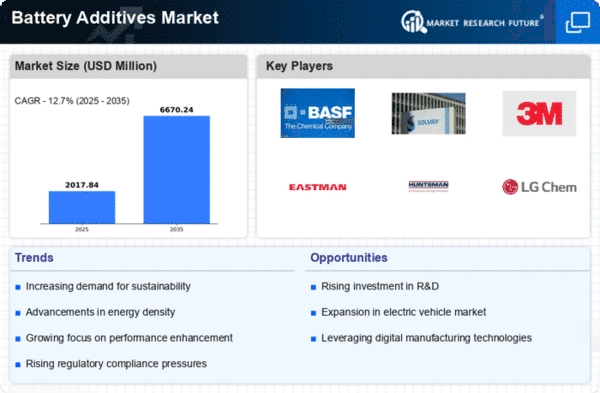
As per MRFR analysis, the Battery Additives Market Size was estimated at 1790.45 USD Million in 2024. The Battery Additives industry is projected to grow from 2017.85 in 2025 to 6670.24 by 2035, exhibiting a compound annual growth rate (CAGR) of 12.7 during the forecast period 2025 - 2035.

Key Market Trends & Highlights

The Battery Additives Market is poised for substantial growth driven by sustainability and technological advancements.

  • The North American region remains the largest market for battery additives, reflecting a robust demand for advanced energy storage solutions.
  • Asia-Pacific is identified as the fastest-growing region, propelled by increasing investments in electric vehicle infrastructure.
  • Lithium ion batteries dominate the market, while lead acid batteries are experiencing rapid growth due to their cost-effectiveness in various applications.
  • Key market drivers include the rising demand for electric vehicles and technological innovations in battery chemistry, which are shaping the future of energy storage.

Market Size & Forecast

2024 Market Size 1790.45 (USD Million)
2035 Market Size 6670.24 (USD Million)
CAGR (2025 - 2035) 12.7%
Largest Regional Market Share in 2024 Asia-Pacific

Major Players

<p>BASF SE (DE), Solvay SA (BE), 3M Company (US), Eastman Chemical Company (US), Huntsman Corporation (US), LG Chem Ltd. (KR), Nippon Shokubai Co., Ltd. (JP), Shenzhen Capchem Technology Co., Ltd. (CN), Tosoh Corporation (JP), Kraton Corporation (US)</p>

Market Trends

The Battery Additives Market is currently experiencing a transformative phase, driven by the increasing demand for enhanced performance and longevity in energy storage solutions. As industries pivot towards sustainable practices, the need for advanced additives that improve battery efficiency and safety has become paramount. Innovations in material science are leading to the development of novel compounds that not only enhance the electrochemical properties of batteries but also contribute to their overall environmental sustainability. This shift is indicative of a broader trend towards greener technologies, as manufacturers seek to align with global sustainability goals. Moreover, the Battery Additives Market is witnessing a surge in research and development activities aimed at optimizing existing formulations and discovering new additives. This focus on innovation is likely to foster collaborations between chemical manufacturers and battery producers, creating a dynamic ecosystem that encourages the exchange of ideas and technologies. As the market evolves, it appears that regulatory frameworks will also play a crucial role in shaping the future landscape, potentially influencing the types of additives that gain traction in various applications. Overall, the Battery Additives Market is poised for significant growth, driven by technological advancements and a collective commitment to sustainability.

Sustainability Focus

The emphasis on environmentally friendly solutions is reshaping the Battery Additives Market. Manufacturers are increasingly prioritizing sustainable materials and processes, which aligns with global initiatives aimed at reducing carbon footprints. This trend suggests a shift towards bio-based additives and recyclable components, enhancing the overall ecological profile of battery technologies.

Technological Advancements

Rapid advancements in technology are propelling the development of innovative battery additives. These enhancements are likely to improve energy density, charge cycles, and overall performance. As research progresses, new formulations may emerge, offering superior characteristics that cater to the evolving needs of various industries.

Collaborative Innovations

The Battery Additives Market is witnessing a rise in partnerships between chemical companies and battery manufacturers. Such collaborations are fostering a culture of innovation, where shared expertise leads to the creation of cutting-edge additives. This trend indicates a collective effort to address challenges in battery performance and safety.

Battery Additives Market Market Drivers

Rising Renewable Energy Integration

The integration of renewable energy sources into the global energy mix is a significant driver for the Global Battery Additives Market Industry. As countries strive to reduce their carbon footprints, the demand for energy storage solutions grows. Battery additives play a crucial role in enhancing the performance of batteries used in solar and wind energy systems. These additives improve charge/discharge efficiency and extend battery life, making them essential for effective energy storage. The increasing reliance on renewable energy is expected to propel the market forward, as more efficient battery systems become necessary to support grid stability and energy management.

Growing Demand for Electric Vehicles

The increasing adoption of electric vehicles (EVs) is a primary driver of the Global Battery Additives Market Industry. As governments worldwide implement stringent emission regulations and promote sustainable transportation, the demand for high-performance batteries rises. Battery additives enhance energy density, cycle life, and overall efficiency, making them crucial for EV manufacturers. In 2024, the market is projected to reach 1.26 USD Billion, reflecting the growing need for advanced battery technologies. By 2035, this figure is expected to nearly double to 2.94 USD Billion, indicating a robust compound annual growth rate (CAGR) of 7.99% from 2025 to 2035.

Increasing Consumer Electronics Market

The burgeoning consumer electronics market is a vital driver of the Global Battery Additives Market Industry. With the proliferation of smartphones, laptops, and wearable devices, the demand for high-capacity batteries is surging. Battery additives enhance the performance and safety of these batteries, addressing consumer expectations for longer battery life and faster charging times. As the consumer electronics sector continues to expand, the need for advanced battery technologies will likely increase, further stimulating the market. This trend underscores the importance of battery additives in meeting the evolving demands of modern technology.

Regulatory Support for Sustainable Practices

Regulatory frameworks promoting sustainable practices significantly impact the Global Battery Additives Market Industry. Governments worldwide are implementing policies aimed at reducing environmental impact and encouraging the development of eco-friendly battery technologies. These regulations often incentivize the use of advanced battery additives that enhance recyclability and reduce harmful emissions. As manufacturers adapt to these regulations, the demand for innovative battery solutions is expected to rise. This regulatory support not only fosters market growth but also aligns with global sustainability goals, creating a favorable environment for the development of the battery additives sector.

Technological Advancements in Battery Chemistry

Innovations in battery chemistry significantly influence the Global Battery Additives Market Industry. Research and development efforts are focused on creating additives that improve battery performance, safety, and longevity. For instance, advancements in lithium-ion and solid-state batteries are leading to the incorporation of specialized additives that enhance thermal stability and reduce degradation. These technological improvements are vital for meeting the increasing energy demands of various applications, including consumer electronics and renewable energy storage. As these technologies evolve, the market is likely to experience substantial growth, driven by the need for more efficient and reliable battery systems.

Market Segment Insights

By Application: Lithium Ion Batteries (Largest) vs. Lead Acid Batteries (Fastest-Growing)

<p>The Battery Additives Market is primarily characterized by significant segments such as Lithium Ion batteries, which hold the largest market share due to their extensive application in consumer electronics and electric vehicles. Meanwhile, Lead Acid batteries remain a vital player, benefiting from their established presence in various sectors including automotive and renewable energy systems. The evolving landscape shows a gradual rise in the adoption of Nickel Cadmium and Alkaline batteries, although they currently hold a smaller share compared to Lithium Ion and Lead Acid counterparts.</p>

<p>Lithium Ion Batteries (Dominant) vs. Lead Acid Batteries (Emerging)</p>

<p>Lithium Ion batteries stand out as the dominant force in the Battery Additives Market, driven by rapid advancements in technology and a growing emphasis on energy efficiency. Their lightweight, high energy density, and ability to be recharged rapidly make them ideal for modern applications, especially in electric vehicles and portable electronics. Conversely, Lead Acid batteries, while categorized as an emerging segment, possess a robust legacy, particularly in automotive applications. Their low cost and reliability contribute to their persistent demand, although innovation in additive technology is crucial for maintaining competitiveness against the more advanced Lithium Ion technology.</p>

By End Use: Automotive (Largest) vs. Consumer Electronics (Fastest-Growing)

<p>The Battery Additives Market is primarily driven by various end-use segments, with Automotive leading the charge as the largest contributor. The automotive industry relies heavily on efficient battery technology for electric vehicles, which has significantly bolstered demand for battery additives. In contrast, the Consumer Electronics segment is rapidly gaining traction, driven by the increasing use of portable devices and demand for enhanced battery performance and longevity.</p>

<p>Automotive (Dominant) vs. Industrial (Emerging)</p>

<p>In the Battery Additives Market, the Automotive segment is dominant due to the surge in electric vehicle production and advancements in battery technology aimed at improving efficiency. This has led to a strong demand for additives that enhance battery performance and longevity. Conversely, the Industrial segment is considered an emerging market, fueled by the growing need for reliable power storage solutions. This segment is seeing increased investments, driven by automation and the demand for renewable energy solutions, indicating a shift towards more sustainable industrial applications of battery technologies.</p>

By Type: Conductive Additives (Largest) vs. Electrolyte Additives (Fastest-Growing)

<p>The Battery Additives Market is primarily segmented into Conductive Additives, Electrolyte Additives, Performance Additives, and Stabilizers. Among these, Conductive Additives hold the largest market share, driven by their essential role in enhancing electrical conductivity and overall battery efficiency. On the other hand, Electrolyte Additives are witnessing rapid growth, capitalizing on the increasing demand for improved battery performance in electric vehicles and renewable energy storage applications. Growth trends in the Battery Additives Market are influenced by the surge in electric vehicle adoption and advancements in battery technology. The rising focus on energy efficiency and longer-life batteries propels the demand for specialized additives. Electrolyte Additives, in particular, benefit from innovations aimed at enhancing battery stability and performance, positioning them as the fastest-growing segment as manufacturers seek to meet evolving consumer demands.</p>

<p>Performance Additives (Dominant) vs. Stabilizers (Emerging)</p>

<p>In the Battery Additives Market, Performance Additives are considered a dominant force due to their crucial role in optimizing battery performance and longevity. They enhance characteristics such as charge retention, thermal stability, and overall durability, making them indispensable in various applications including consumer electronics and electric vehicles. Conversely, Stabilizers are an emerging segment valued for their ability to enhance the thermal stability and reliability of batteries. As manufacturers increasingly prioritize product safety and longevity in battery systems, the demand for Stabilizers is on the rise. This transition reflects a larger trend toward prioritizing sustainability and performance in battery design, ensuring that both Performance Additives and Stabilizers will play pivotal roles in the future of battery technologies.</p>

By Formulation: Liquid Additives (Largest) vs. Powder Additives (Fastest-Growing)

<p>In the Battery Additives Market, the formulation segment showcases a diverse mix of liquid, powder, and gel additives, each contributing uniquely to the overall landscape. Liquid additives hold the largest market share, primarily due to their widespread adoption in various battery chemistries and applications, offering enhanced performance and stability. Following closely, powder additives are witnessing a rapid influx of interest and innovation, tapping into emerging battery technologies that demand lightweight and efficient solutions. Gel additives, while currently a smaller segment, are gaining traction due to their specific applications in niche markets, including advanced energy storage systems.</p>

<p>Liquid Additives (Dominant) vs. Powder Additives (Emerging)</p>

<p>Liquid additives are the dominant formulation in the Battery Additives Market, recognized for their superior conductivity and mixability, making them ideal for a wide range of battery types, including lead-acid and lithium-ion. Their ability to improve energy density and performance has solidified their position in both consumer electronics and electric vehicles. On the other hand, powder additives are emerging as a key player, driven by the demand for lighter and more efficient battery solutions. Their versatility allows for customization in various applications, enhancing both capacity and lifespan. As battery technology continues to evolve, the balance between these two formulation types will likely shift, presenting opportunities for innovation and market growth.</p>

By Functionality: Enhancement of Conductivity (Largest) vs. Improvement of Cycle Life (Fastest-Growing)

<p>In the Battery Additives Market, the functionality segment sees a diverse array of values contributing to its overall dynamics. Notably, Enhancement of Conductivity holds the largest market share, driven by the growing demand for higher efficiency in energy storage solutions. It is pivotal in increasing battery performance, particularly in electric vehicles and portable electronics. Meanwhile, Improvement of Cycle Life is recognized as the fastest-growing segment, attributed to advancements in battery technologies that extend the lifespan of batteries through innovative additives that reduce deterioration during usage.</p>

<p>Enhancement of Conductivity (Dominant) vs. Improvement of Cycle Life (Emerging)</p>

<p>Enhancement of Conductivity is pivotal for modern batteries, facilitating superior performance and efficiency. This characteristic is particularly essential in electric vehicle (EV) applications, where rapid energy transfer is critical. The dominance of this segment is largely due to the increasing demand for high-performance batteries. Conversely, Improvement of Cycle Life is emerging as a vital focus in the market, appealing to manufacturers aiming for longevity and sustainability. Innovations in additives that mitigate wear and degradation during charging cycles are driving its growth. This segment is gaining traction as manufacturers prioritize enhanced lifetime capabilities without compromising performance.</p>

Get more detailed insights about Battery Additives Market Research Report – Forecast till 2035

Regional Insights

North America : Innovation and Sustainability Focus

The North American battery additives market is projected to reach $450.0 million by 2025, driven by increasing demand for electric vehicles (EVs) and renewable energy storage solutions. Regulatory support for clean energy initiatives and advancements in battery technology are key growth catalysts. The region's focus on sustainability and innovation is expected to further enhance market dynamics, with a notable shift towards eco-friendly additives. Leading countries such as the US and Canada are at the forefront of this market, hosting major players like 3M Company and Eastman Chemical Company. The competitive landscape is characterized by significant investments in R&D and strategic partnerships aimed at enhancing product offerings. The presence of established companies ensures a robust supply chain, catering to the growing demand for high-performance battery additives.

Europe : Regulatory Support and Innovation

The European battery additives market is anticipated to grow significantly, reaching $350.0 million by 2025. This growth is fueled by stringent environmental regulations and a strong push towards electric mobility. The European Union's Green Deal and various national initiatives are pivotal in driving demand for advanced battery technologies, thereby enhancing the market for additives. The region's commitment to sustainability is a key driver of innovation in this sector. Germany, France, and the UK are leading countries in this market, with key players like BASF SE and Solvay SA actively contributing to advancements in battery technology. The competitive landscape is marked by collaborations between manufacturers and research institutions, focusing on developing high-performance additives. This synergy is expected to bolster the region's position as a leader in the battery additives market.

Asia-Pacific : Dominating Global Market Leader

Asia-Pacific is the largest market for battery additives, with a projected size of $800.0 million by 2025. The region's rapid industrialization, coupled with a surge in electric vehicle adoption, is driving demand for high-quality battery additives. Government initiatives promoting clean energy and technological advancements in battery manufacturing are significant growth drivers. The region's market share reflects its pivotal role in the global battery supply chain. China, Japan, and South Korea are the leading countries in this market, with major players like LG Chem Ltd. and Nippon Shokubai Co., Ltd. dominating the landscape. The competitive environment is characterized by aggressive R&D investments and a focus on innovation. The presence of numerous manufacturers ensures a diverse range of products, catering to the evolving needs of the battery industry.

Middle East and Africa : Emerging Market Potential

The Middle East and Africa battery additives market is projected to reach $190.45 million by 2025, driven by increasing investments in renewable energy and electric mobility. The region's growing focus on sustainable energy solutions and government initiatives to promote clean technologies are key factors contributing to market growth. As the demand for energy storage solutions rises, the battery additives market is expected to expand significantly. Countries like South Africa and the UAE are emerging as key players in this market, with a growing number of local and international companies entering the landscape. The competitive environment is evolving, with investments in local manufacturing and partnerships aimed at enhancing product availability. This growth trajectory positions the region as a potential hub for battery additive production in the coming years.

Key Players and Competitive Insights

The Battery Additives Market is currently characterized by a dynamic competitive landscape, driven by the increasing demand for advanced battery technologies across various sectors, including electric vehicles (EVs) and renewable energy storage. Key players such as BASF SE (DE), Solvay SA (BE), and LG Chem Ltd. (KR) are strategically positioning themselves through innovation and partnerships. For instance, BASF SE (DE) has focused on enhancing its product portfolio with sustainable additives, while Solvay SA (BE) emphasizes its commitment to developing high-performance materials that cater to the evolving needs of battery manufacturers. These strategies collectively foster a competitive environment that prioritizes technological advancement and sustainability.

In terms of business tactics, companies are increasingly localizing manufacturing to reduce supply chain vulnerabilities and optimize operational efficiency. The market structure appears moderately fragmented, with several players vying for market share. However, the influence of major companies like 3M Company (US) and Eastman Chemical Company (US) is notable, as they leverage their extensive resources and expertise to shape market dynamics.

In November 2025, LG Chem Ltd. (KR) announced a strategic partnership with a leading EV manufacturer to co-develop next-generation battery additives aimed at enhancing energy density and longevity. This collaboration is significant as it not only strengthens LG Chem's position in the EV sector but also aligns with the growing trend towards sustainable battery solutions. The partnership is expected to yield innovative products that could redefine performance standards in the industry.

In October 2025, BASF SE (DE) unveiled a new line of eco-friendly battery additives designed to improve the efficiency of lithium-ion batteries. This launch is pivotal, as it reflects the company's commitment to sustainability and positions it favorably in a market increasingly focused on environmental impact. The introduction of these additives is likely to attract attention from manufacturers seeking to enhance the performance of their products while adhering to stricter environmental regulations.

In September 2025, 3M Company (US) expanded its production capabilities for battery additives in response to rising global demand. This expansion is indicative of the company's proactive approach to scaling operations and meeting the needs of a rapidly growing market. By increasing production capacity, 3M Company (US) aims to solidify its market presence and cater to the burgeoning demand for high-performance battery solutions.

As of December 2025, current competitive trends in the Battery Additives Market are heavily influenced by digitalization, sustainability, and the integration of artificial intelligence (AI) in manufacturing processes. Strategic alliances are becoming increasingly vital, as companies recognize the need to collaborate to drive innovation and enhance supply chain reliability. The competitive differentiation is likely to evolve from traditional price-based competition towards a focus on technological innovation and sustainable practices, suggesting a transformative shift in how companies approach market positioning.

Key Companies in the Battery Additives Market market include

Industry Developments

    • May 2023: A team of researchers from the University of California, Berkeley, announced that they had developed a new battery additive that can extend the lifespan of lithium-ion batteries by up to 50%. The additive, called MXene, is a type of two-dimensional material that can help to prevent the degradation of lithium-ion batteries.
    • June 2023: A team of researchers from the Massachusetts Institute of Technology announced that they had developed a new battery additive that can improve the efficiency of lithium-ion batteries by up to 20%. The additive, called Graphene Oxide, is a type of carbon material that can help to conduct heat away from the battery's electrodes.

Intended Audience:

    • Battery Additives Market Manufacturers
    • Raw Material Suppliers
    • Li-Ion Battery Manufacturers
    • Lead-Acid Battery Manufacturers
    • Traders and Distributors of Battery Additives Market
    • Research and Development Laboratories
    • Nationalized Laboratories

Future Outlook

Battery Additives Market Future Outlook

<p>The Battery Additives Market is projected to grow at a 12.7% CAGR from 2024 to 2035, driven by advancements in battery technology, increasing demand for electric vehicles, and renewable energy storage solutions.</p>

New opportunities lie in:

  • <p>Development of high-performance additives for lithium-ion batteries</p>
  • <p>Expansion into emerging markets with tailored product offerings</p>
  • <p>Investment in R&D for sustainable and eco-friendly additives</p>

<p>By 2035, the Battery Additives Market is expected to be robust, driven by innovation and increasing global demand.</p>

Market Segmentation

Battery Additives Market Type Outlook

  • Conductive Additives
  • Electrolyte Additives
  • Performance Additives
  • Stabilizers

Battery Additives Market End Use Outlook

  • Automotive
  • Consumer Electronics
  • Industrial
  • Energy Storage

Battery Additives Market Application Outlook

  • Lead Acid Batteries
  • Lithium Ion Batteries
  • Nickel Cadmium Batteries
  • Alkaline Batteries

Battery Additives Market Formulation Outlook

  • Liquid Additives
  • Powder Additives
  • Gel Additives

Battery Additives Market Functionality Outlook

  • Enhancement of Conductivity
  • Improvement of Cycle Life
  • Thermal Stability
  • Corrosion Resistance

Report Scope

MARKET SIZE 20241790.45(USD Million)
MARKET SIZE 20252017.85(USD Million)
MARKET SIZE 20356670.24(USD Million)
COMPOUND ANNUAL GROWTH RATE (CAGR)12.7% (2024 - 2035)
REPORT COVERAGERevenue Forecast, Competitive Landscape, Growth Factors, and Trends
BASE YEAR2024
Market Forecast Period2025 - 2035
Historical Data2019 - 2024
Market Forecast UnitsUSD Million
Key Companies ProfiledBASF SE (DE), Solvay SA (BE), 3M Company (US), Eastman Chemical Company (US), Huntsman Corporation (US), LG Chem Ltd. (KR), Nippon Shokubai Co., Ltd. (JP), Shenzhen Capchem Technology Co., Ltd. (CN), Tosoh Corporation (JP), Kraton Corporation (US)
Segments CoveredApplication, End Use, Type, Formulation, Functionality
Key Market OpportunitiesGrowing demand for advanced battery technologies drives innovation in the Battery Additives Market.
Key Market DynamicsRising demand for advanced battery technologies drives innovation in battery additives, enhancing performance and sustainability.
Countries CoveredNorth America, Europe, APAC, South America, MEA

FAQs

At what CAGR is the battery additives market projected to grow during the forecast period?

The battery additives market is projected to grow at a 9.1% CAGR

What will be the value of the battery additives market during the forecast period?

The battery additives market is predicted to touch USD 1.9 billion by 2035.

Which region is expected to dominate the battery additives market?

The APAC region is expected to dominate the battery additives market.

What are the key factors driving the battery additives market growth?

Growing demand for rechargeable batteries in military and defense, rising adoption of electric vehicles, and technological advances are adding market growth.

Which factors may limit the battery additives market growth?

Safety issues may limit market growth.

  1. Executive Summary
  2. Market Introduction
    1. Market Definition
    2. Scope of the Study
    3. List of Assumptions
    4. Markets Structure
  3. Market Research Methodology
    1. Research Process
    2. Primary Research
    3. Secondary Research
    4. Market Size Estimation
    5. Forecast Model
  4. Market Dynamics of Global Battery Additives Market
    1. Introduction
    2. Drivers
    3. Restraints
    4. Opportunities
    5. Challenges
    6. Trends/Technology
  5. Market Factor Analysis of Global
    1. Battery Additives Market
    2. Supply Chain Analysis
      1. Raw Material
      2. Manufacturers/Producers
      3. Distributors/Retailers/Wholesalers/E-Commerce
      4. End Users
    3. Suppliers
    4. Porter’s Five Forces Analysis
      1. Threat
      2. Bargaining Power of Buyers
      3. Bargaining Power
      4. Threat of Substitutes
      5. Intensity of Competitive
    5. of New Entrants
    6. of Suppliers
    7. Rivalry
  6. Global Battery Additives Market, by Type
    1. Introduction
    2. Conductive Additive
      1. Market Estimates & Forecast, 2021-2030
      2. Market Estimates & Forecast, by Region, 2021-2030
    3. Porous Additive
      1. Market Estimates & Forecast, 2021-2030
      2. Market Estimates &
    4. Forecast, by Region, 2021-2030
    5. Nucleating Additive
      1. Market Estimates
      2. Market Estimates & Forecast, by Region,
    6. & Forecast, 2021-2030
  7. Global Battery Additives Market, by Application
    1. Introduction
    2. Li-Ion Batteries
      1. Market Estimates & Forecast, 2021-2030
      2. Market Estimates & Forecast, by Region, 2021-2030
    3. Application
  8. Market Estimates & Forecast, by Region, 2021-2030
    1. & Forecast, by Region, 2021-2030
    2. & Forecast, 2021-2030
    3. Batteries
    4. Estimates & Forecast, by Region, 2021-2030
  9. Portable Devices
  10. Market Estimates & Forecast, 2021-2030
  11. Market Estimates
  12. EVs
  13. Market Estimates
  14. Market Estimates & Forecast, by Region,
  15. Others
  16. Market Estimates & Forecast, 2021-2030
  17. Market Estimates & Forecast, by Region, 2021-2030
    1. Lead-Acid
      1. Market Estimates & Forecast, 2021-2030
      2. Market
  18. Global Battery Additives
  19. Market, by Region
    1. Introduction
    2. North America
      1. Market
      2. Market Estimates & Forecast,
      3. Market Estimates & Forecast, by Application, 2021-2030
      4. US
    3. Estimates & Forecast, 2021-2030
    4. by Type, 2021-2030
  20. Market Estimates & Forecast, by Type, 2021-2030
    1. & Forecast, by Application, 2021-2030
    2. Estimates & Forecast, 2021-2030
    3. by Type, 2021-2030
    4. & Forecast, by Application, 2021-2030
    5. Estimates & Forecast, 2021-2030
    6. by Type, 2021-2030
    7. Estimates & Forecast, by Application, 2021-2030
    8. Market Estimates & Forecast, 2021-2030
    9. by Type, 2021-2030
    10. Estimates & Forecast, by Application, 2021-2030
    11. Estimates & Forecast, 2021-2030
    12. by Type, 2021-2030
    13. Estimates & Forecast, by Application, 2021-2030
    14. Market Estimates & Forecast, 2021-2030
    15. Forecast, by Type, 2021-2030
  21. Market Estimates
  22. Canada
  23. Market
  24. Market Estimates & Forecast,
  25. Market Estimates & Forecast, by Application,
    1. Europe
      1. Market Estimates & Forecast, 2021-2030
      2. Market Estimates & Forecast, by Type, 2021-2030
      3. Market Estimates
      4. Germany
      5. France
      6. Italy
      7. Spain
      8. UK
      9. Russia
      10. Poland
      11. Rest of Europe
  26. Market Estimates & Forecast, by Application, 2021-2030
    1. Asia-Pacific
      1. Market Estimates & Forecast, 2021-2030
      2. Market Estimates &
      3. Market Estimates & Forecast, by Application,
      4. China
      5. India
      6. Japan
      7. Australia & New
      8. Rest of Asia Pacific
    2. Forecast, by Type, 2021-2030
    3. Estimates & Forecast, by Application, 2021-2030
    4. Market Estimates & Forecast, 2021-2030
    5. by Type, 2021-2030
    6. Estimates & Forecast, by Application, 2021-2030
    7. Zealand
    8. Estimates & Forecast, by Type, 2021-2030
    9. Forecast, by Application, 2021-2030
    10. Market Estimates & Forecast, 2021-2030
    11. by Type, 2021-2030
    12. Middle East & Africa
      1. Market Estimates & Forecast,
      2. Market Estimates & Forecast, by Type, 2021-2030
  27. Market Estimates & Forecast, by Application, 2021-2030
    1. Market Estimates & Forecast, 2021-2030
    2. by Type, 2021-2030
    3. Estimates & Forecast, by Application, 2021-2030
    4. Market Estimates & Forecast, 2021-2030
    5. by Type, 2021-2030
    6. Estimates & Forecast, by Application, 2021-2030
    7. & Africa
  28. GCC
  29. Market Estimates & Forecast,
  30. Market Estimates & Forecast, by Application,
  31. Israel
  32. Market Estimates & Forecast, 2021-2030
  33. Market Estimates & Forecast, by Type, 2021-2030
  34. Market
  35. North Africa
  36. Market Estimates & Forecast,
  37. Market Estimates & Forecast, by Application,
  38. Turkey
  39. Market Estimates & Forecast, 2021-2030
  40. Market Estimates & Forecast, by Type, 2021-2030
  41. Market
  42. Rest of Middle East
  43. Market Estimates & Forecast, 2021-2030
  44. Market Estimates & Forecast, by Type, 2021-2030
    1. & Forecast, by Application, 2021-2030
    2. Estimates & Forecast, 2021-2030
    3. by Type, 2021-2030
  45. Market Estimates
    1. Latin America
      1. Market
      2. Market Estimates & Forecast,
      3. Market Estimates & Forecast, by Application, 2021-2030
      4. Brazil
  46. Market Estimates & Forecast, by Type, 2021-2030
    1. & Forecast, by Application, 2021-2030
    2. Estimates & Forecast, 2021-2030
    3. by Type, 2021-2030
    4. Estimates & Forecast, by Application, 2021-2030
    5. & Forecast, by Type, 2021-2030
    6. by Application, 2021-2030
  47. Market Estimates
  48. Mexico
  49. Market
  50. Market Estimates & Forecast,
  51. Market Estimates & Forecast, by Application,
  52. Argentina
  53. Market Estimates & Forecast, 2021-2030
  54. Market Estimates & Forecast, by Type, 2021-2030
  55. Market
  56. Rest of Latin America
  57. Market Estimates & Forecast, 2021-2030
  58. Market Estimates
  59. Market Estimates & Forecast,
  60. Company Landscape
    1. Introduction
    2. Market Strategy
    3. Key Development Analysis (Expansion/Merger & Acquisition/Joint
    4. Venture/New Product Development/Agreement/Investment)
  61. Company Profiles
    1. Cabot Corporation
      1. Company Overview
      2. Financial Updates
      3. Product/Business Segment Overview
      4. Strategy
      5. Key
      6. SWOT Analysis
    2. Developments
    3. 3M
      1. Company Overview
      2. Financial Updates
      3. Product/Business Segment Overview
      4. Key Developments
      5. SWOT Analysis
    4. Strategy
    5. Imerys
      1. Company Overview
      2. Financial Updates
      3. Product/Business
      4. Strategy
      5. Key Developments
      6. SWOT
    6. Segment Overview
    7. Analysis
    8. Hammond
      1. Company Overview
      2. Financial Updates
      3. Product/Business Segment Overview
      4. Strategy
      5. Key
      6. SWOT Analysis
    9. Developments
    10. SGL Carbon
      1. Company
      2. Financial Updates
      3. Product/Business Segment Overview
      4. Strategy
      5. Key Developments
      6. SWOT Analysis
      7. Company Overview
      8. Financial Updates
      9. Strategy
      10. Key Developments
      11. SWOT Analysis
    11. Overview
    12. Borregaard
    13. Product/Business Segment Overview
    14. HOPAX
      1. Company Overview
      2. Product/Business Segment Overview
      3. Strategy
      4. Key Developments
      5. SWOT Analysis
    15. Financial Updates
    16. PENOX
      1. Financial Updates
      2. Product/Business Segment
      3. Strategy
      4. Key Developments
      5. SWOT Analysis
    17. Company Overview
    18. Overview
    19. ALTANA
      1. Company Overview
      2. Financial Updates
      3. Strategy
      4. Key Developments
      5. SWOT Analysis
    20. Product/Business Segment Overview
    21. US Research Nanomaterials, Inc
      1. Company
      2. Financial Updates
      3. Product/Business Segment Overview
      4. Strategy
      5. Key Developments
      6. SWOT Analysis
    22. Overview
    23. Conclusion
  62. LIST OF TABLES
  63. Global Battery Additives Market,
    1. by Region, 2021-2030
  64. North America: Battery Additives Market, by Country,
  65. Europe: Battery Additives Market, by Country, 2021-2030
  66. Asia-Pacific: Battery Additives Market, by Country, 2021-2030
    1. Table
  67. Middle East & Africa: Battery Additives Market, by Country, 2021-2030
    1. Table
  68. Latin America: Battery Additives Market, by Country, 2021-2030
  69. Global
  70. Battery Additives Type Market, by Region, 2021-2030
  71. North America:
  72. Battery Additives Type Market, by Country, 2021-2030
  73. Europe: Battery
  74. Additives Type Market, by Country, 2021-2030
    1. Table10 Asia-Pacific: Battery
  75. Additives Type Market, by Country, 2021-2030
    1. Table11 Middle East & Africa:
  76. Battery Additives Type Market, by Country, 2021-2030
    1. Table12 Latin America:
  77. Battery Additives Type Market, by Country, 2021-2030
    1. Table13 Global Battery
  78. Additives Application Market, by Region, 2021-2030
    1. Table14 North America: Battery
  79. Additives by Application Market, by Country, 2021-2030
    1. Table15 Europe: Battery
  80. Additives Application Market, by Country, 2021-2030
    1. Table16 Asia-Pacific: Battery
  81. Additives Application Market, by Country, 2021-2030
    1. Table17 Middle East &
  82. Africa: Battery Additives Application Market, by Country, 2021-2030
    1. Table18
  83. Latin America: Battery Additives Application Market, by Country, 2021-2030
    1. Table19
  84. Global Battery Additives End-Use Industry Market, by Region, 2021-2030
    1. Table20
  85. Global Type Market, by Region, 2021-2030
    1. Table21 Global Application Market,
    2. by Region, 2021-2030
  86. Table22 Global End-Use Industry Market, by Region, 2021-2030
  87. Table22 North America: Battery Additives Market, by Country
    1. Table23 North
  88. America: Battery Additives Market, by Type
    1. Table24 North America: Battery Additives
  89. Market, by Application
  90. Table25 Europe: Battery Additives Market, by Country
  91. Table26 Europe: Battery Additives Market, by Type
    1. Table27 Europe: Battery
  92. Additives Market, by Application
    1. Table28 Asia-Pacific: Battery Additives Market,
    2. by Country
  93. Table29 Asia-Pacific: Battery Additives Market, by Type
    1. Table30
  94. Asia-Pacific: Battery Additives Market, by Application
    1. Table31 Middle East
  95. & Africa: Battery Additives Market, by Country
    1. Table32 Middle East &
  96. Africa: Battery Additives Market, by Type
    1. Table33 Middle East & Africa:
  97. Battery Additives Market, by Application
    1. Table34 Latin America: Battery Additives
  98. Market, by Country
  99. Table35 Latin America: Battery Additives Market, by Type
  100. Table36 Latin America: Battery Additives Market, by Application
    1. LIST
  101. OF FIGURES
  102. Global Battery Additives Market Segmentation
    1. FIGURE
  103. Forecast Research Methodology
  104. Five Forces Analysis of Global Battery
    1. Additives Market
  105. Value Chain of Global Battery Additives Market
  106. Share of Global Battery Additives Market in 2020, by Country (%)
    1. FIGURE
  107. Global Battery Additives Market, 2021-2030
  108. Global Battery Additives
  109. Market Size, by Type, 2020
  110. Share of Global Battery Additives Market,
    1. by Type, 2021-2030
  111. Global Battery Additives Market Size, by Application,
  112. Share of Global Battery Additives Market, by Application, 2021-2030

Battery Additives Market Segmentation

Market Segmentation Overview

  • Detailed segmentation data will be available in the full report
  • Comprehensive analysis by multiple parameters
  • Regional and country-level breakdowns
  • Market size forecasts by segment
Infographic

Free Sample Request

Kindly complete the form below to receive a free sample of this Report

Get Free Sample

Customer Strories

Compare Licence

×
Features License Type
Single User Multiuser License Enterprise User
Price $4,950 $5,950 $7,250
Maximum User Access Limit 1 User Upto 10 Users Unrestricted Access Throughout the Organization
Free Customization
Direct Access to Analyst
Deliverable Format
Platform Access
Discount on Next Purchase 10% 15% 15%
Printable Versions