×
Hero Background
English
Chinese
French
Japanese
Korean
German
Spanish

Batteries Market Analysis

ID: MRFR/EnP/1363-HCR
185 Pages
Swapnil Palwe
October 2025

Batteries Market Research Report Information by Battery Type (Lead acid, Lithium ion, Nickel metal hydride and Nickel cadmium), by Application (Two/Three Wheelers, Electric Cars, Heavy Vehicles, and others) and by Region - Forecast to 2035

Share:
Download PDF ×

We do not share your information with anyone. However, we may send you emails based on your report interest from time to time. You may contact us at any time to opt-out.

Batteries Market Infographic
Purchase Options

Market Analysis

In-depth Analysis of Batteries Market Industry Landscape

The battery market is experiencing dynamic shifts driven by evolving consumer needs, technological advancements, and global sustainability goals. In recent years, there has been a notable surge in demand for batteries, fueled by the growing prevalence of electric vehicles (EVs), renewable energy systems, and portable electronic devices. This increasing demand has given rise to a competitive landscape, with established players and emerging entrants vying for market share. A big factor in market movement is the fast improvement of battery tech. As scientists strive to find new ways, they are trying out different battery types. These offer better power storage space, live for longer and charge up quicker than before. Lithium-ion batteries are very popular, especially in electric vehicles. But now other options like solid-state and lithium sulfur ones are getting noticed because they might solve some of the problems with older lithium techs. The electric car market is really important for how the battery business changes. Governments worldwide are putting more and harder rules on emissions, pushing car makers to put a lot of money into electric cars. This way of living is causing more and more people to need batteries, which in turn makes them put their money into huge factories for making lots of these. Big car companies and tech firms are making deals or spending a lot of money on battery factories to get ahead in this quickly growing market. Moreover, worries about keeping things sustainable are changing what people want to buy and laws. This is pushing the market toward environmentally friendly answers. People want more clean energy, so they're asking for batteries to store extra power from sources like wind and sun. This app goes beyond single homes to cover big energy storage projects for the whole grid. It helps keep renewable sources like solar and wind reliable and steady. Along with improvements in technology and plans for keeping things sustainable, the way countries behave also affects how the market changes. The supply chain for important battery parts like lithium, cobalt and nickel often comes from just a few places. This makes some people worry about getting enough resources or the prices going up and down too much. People are working hard to get different things in the supply chain and find new, better materials. This is happening so we can avoid these problems and keep a good battery market that lasts for long time. As the battery market evolves, it is witnessing a shift in the competitive landscape. Traditional battery manufacturers face competition not only from each other but also from new entrants, including startups and companies from adjacent industries. The potential for breakthrough technologies and innovative business models keeps the market dynamic and fosters an environment of continuous improvement and adaptation.

Author
Swapnil Palwe
Team Lead - Research

With a technical background as Bachelor's in Mechanical Engineering, with MBA in Operations Management , Swapnil has 6+ years of experience in market research, consulting and analytics with the tasks of data mining, analysis, and project execution. He is the POC for our clients, for their consulting projects running under the Automotive/A&D domain. Swapnil has worked on major projects in verticals such as Aerospace & Defense, Automotive and many other domain projects. He has worked on projects for fortune 500 companies' syndicate and consulting projects along with several government projects.

Leave a Comment

FAQs

What CAGR is estimated to be generated in the batteries market?

A 15.34% CAGR is foreseen in the market during the forecast period.

Who are the companies opposing each other in the global batteries market?

Zhejiang Haijiu Battery Co. Ltd, Chaowei Power Holding ltd and The Furukawa Battery Co. ltd are influencing the market.

What inducements are creating a promising backdrop in the batteries market?

The upwelling in demand for electric vehicles is anticipated to boost the market.

What is the revenue grossing potential for the batteries market?

The market is expected to display a steady earning potential in the forecast period.

What regions are taking charge of the batteries market globally?

The region in North America is assessed to head the development of the market.

Market Summary

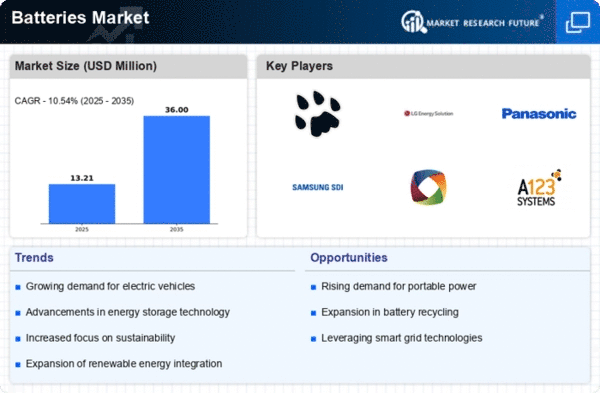
As per Market Research Future analysis, the Batteries Market Size was estimated at 11.95 USD Million in 2024. The Batteries industry is projected to grow from 13.21 USD Million in 2025 to 36.0 USD Million by 2035, exhibiting a compound annual growth rate (CAGR) of 10.54% during the forecast period 2025 - 2035.

Key Market Trends & Highlights

The Batteries Market is currently experiencing a transformative shift towards sustainability and advanced technologies.

  • Sustainable battery technologies are gaining traction, driven by environmental concerns and regulatory support. North America remains the largest market, while Asia-Pacific is emerging as the fastest-growing region in battery adoption. The consumer electronics segment continues to dominate, whereas the electric vehicle segment is witnessing rapid growth. Rising demand for electric vehicles and advancements in battery chemistry are key drivers propelling market expansion.

Market Size & Forecast

2024 Market Size 11.95 (USD Million)
2035 Market Size 36.0 (USD Million)
CAGR (2025 - 2035) 10.54%
Largest Regional Market Share in 2024 Asia-Pacific

Major Players

<p>CATL (CN), LG Energy Solution (KR), Panasonic (JP), Samsung SDI (KR), BYD (CN), A123 Systems (US), Toshiba (JP), SK Innovation (KR), Northvolt (SE), Saft (FR)</p>

Market Trends

The Batteries Market is currently experiencing a transformative phase, driven by advancements in technology and increasing demand for energy storage solutions. The shift towards renewable energy sources has catalyzed the need for efficient battery systems, particularly in sectors such as electric vehicles and portable electronics. As consumers and industries alike prioritize sustainability, the market is adapting to meet these evolving requirements. Innovations in battery chemistry and design are emerging, suggesting a potential for enhanced performance and longevity. Furthermore, the integration of smart technologies into battery management systems appears to be gaining traction, indicating a future where batteries are not only energy sources but also integral components of smart grids and energy management systems. In addition to technological advancements, regulatory frameworks are evolving to support the growth of the Batteries Market. Governments worldwide are implementing policies aimed at reducing carbon emissions and promoting clean energy solutions. This regulatory push is likely to foster investment in battery production and recycling initiatives, thereby enhancing the overall sustainability of the market. As the global focus on climate change intensifies, the Batteries Market is poised for significant growth, with opportunities for innovation and collaboration across various sectors. The interplay between consumer demand, technological progress, and regulatory support will shape the future landscape of this dynamic market.

Sustainable Battery Technologies

The trend towards sustainable battery technologies is gaining momentum, as manufacturers explore eco-friendly materials and recycling methods. This shift not only addresses environmental concerns but also aligns with consumer preferences for greener products.

Integration with Renewable Energy

The integration of batteries with renewable energy sources is becoming increasingly prevalent. This trend reflects a growing recognition of the need for efficient energy storage solutions to complement solar and wind power, enhancing grid stability.

Smart Battery Management Systems

The development of smart battery management systems is on the rise, enabling better monitoring and optimization of battery performance. These systems leverage advanced algorithms and connectivity features, potentially improving efficiency and lifespan.

Batteries Market Market Drivers

Market Growth Projections

The Global Batteries Market Industry is poised for remarkable growth, with projections indicating a market value of 115.4 USD Billion in 2024 and an anticipated surge to 661.7 USD Billion by 2035. This growth trajectory suggests a compound annual growth rate (CAGR) of 17.2% from 2025 to 2035. The increasing demand for batteries across various sectors, including automotive, consumer electronics, and renewable energy, underpins this expansion. The market's evolution is likely to be influenced by technological advancements, regulatory support, and changing consumer preferences, all contributing to a dynamic and rapidly evolving landscape.

Advancements in Battery Technology

Technological innovations in battery chemistry and design are significantly influencing the Global Batteries Market Industry. Developments in lithium-ion, solid-state, and flow batteries are enhancing energy density, charging speed, and overall performance. These advancements not only improve the efficiency of batteries but also extend their lifespan, making them more appealing for various applications, including consumer electronics and renewable energy storage. As the industry evolves, manufacturers are likely to invest heavily in research and development, aiming to create batteries that meet the growing energy demands of modern society. This trend is expected to contribute to the market's expansion and sustainability.

Growth of Renewable Energy Sources

The increasing integration of renewable energy sources, such as solar and wind, into the global energy mix is driving the demand for energy storage solutions, thereby impacting the Global Batteries Market Industry. Batteries Market play a crucial role in storing excess energy generated during peak production times, ensuring a stable energy supply during periods of low generation. As countries strive to meet their renewable energy targets, the need for efficient and reliable battery systems is likely to grow. This trend aligns with the projected market growth, with estimates indicating a rise to 661.7 USD Billion by 2035, driven by the need for energy storage solutions.

Rising Demand for Electric Vehicles

The increasing adoption of electric vehicles (EVs) is a pivotal driver for the Global Batteries Market Industry. As governments worldwide implement stricter emissions regulations and promote sustainable transportation, the demand for high-capacity batteries is surging. In 2024, the market is projected to reach 115.4 USD Billion, with EVs accounting for a substantial portion of this growth. The transition to electric mobility is expected to accelerate, potentially leading to a market value of 661.7 USD Billion by 2035. This shift indicates a compound annual growth rate (CAGR) of 17.2% from 2025 to 2035, highlighting the critical role of batteries in the automotive sector.

Consumer Electronics Market Expansion

The rapid expansion of the consumer electronics market is a significant contributor to the Global Batteries Market Industry. As devices such as smartphones, tablets, and wearable technology become increasingly prevalent, the demand for compact and efficient batteries is rising. Manufacturers are focusing on developing batteries that offer longer life cycles and faster charging capabilities to meet consumer expectations. This trend is expected to bolster the market, with a projected value of 115.4 USD Billion in 2024. The continuous innovation in battery technology to support the growing consumer electronics sector is likely to play a vital role in shaping the future of the industry.

Government Initiatives and Regulations

Government initiatives aimed at promoting sustainable energy solutions are crucial drivers for the Global Batteries Market Industry. Policies that incentivize the use of renewable energy and electric vehicles are fostering an environment conducive to battery adoption. For instance, various countries are implementing subsidies and tax breaks for EV purchases, which in turn increases the demand for batteries. These regulatory frameworks not only support market growth but also encourage manufacturers to innovate and improve battery technologies. As a result, the market is expected to experience substantial growth, potentially reaching 661.7 USD Billion by 2035, reflecting the impact of supportive government policies.

Market Segment Insights

By Application: Consumer Electronics (Largest) vs. Electric Vehicles (Fastest-Growing)

<p>The application segment of the batteries market is largely dominated by consumer electronics, which holds a significant share due to the widespread adoption of portable devices such as smartphones, laptops, and wearables. Electric vehicles, on the other hand, represent the fastest-growing segment, fueled by the global shift towards sustainable transportation and government incentives encouraging EV adoption. Growing demand in these areas drives innovation and competition among manufacturers.</p>

<p>Consumer Electronics (Dominant) vs. Electric Vehicles (Emerging)</p>

<p>Consumer electronics continue to hold a dominant position in the batteries market, thanks to their extensive use in everyday devices that have become essential for modern living. High-performance lithium-ion batteries are commonly utilized in this segment, providing efficient energy solutions with longer life spans and reduced charging times. Meanwhile, electric vehicles are rapidly emerging as a key player, characterized by advanced battery technologies aimed at enhancing vehicle range and minimizing environmental impact. The evolution of battery management systems and charging infrastructure further supports the growing popularity of electric vehicles, making them an exciting area for investment and development.</p>

By End Use: Residential (Largest) vs. Transportation (Fastest-Growing)

<p>The Batteries Market exhibits diverse distribution across its end-use segments. The residential sector holds the largest market share, driven by the rising adoption of energy storage solutions for renewable energy sources such as solar and wind. This segment is particularly prominent in regions with high residential energy consumption and a shift towards sustainable living. In contrast, the transportation segment is rapidly gaining ground, bolstered by the transition to electric vehicles (EVs) and increasing investments in public transport electrification, making it a key player in the market dynamics.</p>

<p>Transportation: EVs (Dominant) vs. Utilities (Emerging)</p>

<p>The transportation segment, particularly focused on electric vehicles (EVs), is currently the dominant force within the Batteries Market, characterized by significant advancements in lithium-ion battery technology that enhance energy density and overall performance. This segment benefits from aggressive government policies promoting EV adoption and the decrease in battery costs. Conversely, the utilities sector represents an emerging segment, where batteries play a crucial role in grid stabilization and energy management solutions. As utilities increasingly incorporate energy storage systems to balance supply and demand, the market for battery technologies in this domain is expected to grow steadily, driven by the need for renewable integration.</p>

By Battery Type: Lithium-ion (Largest) vs. Solid-state (Fastest-Growing)

<p>The battery type segment is primarily dominated by lithium-ion batteries, which account for a substantial portion of the market share due to their widespread use in consumer electronics and electric vehicles. Following closely, lead-acid batteries hold a significant share, particularly in automotive and backup power applications, while nickel-metal hydride batteries, favored in hybrid vehicles, also contribute to the segment. Emerging technologies such as sodium-ion and solid-state batteries are gaining traction, though their market shares are currently smaller compared to traditional options.</p>

<p>Lithium-ion (Dominant) vs. Solid-state (Emerging)</p>

<p>Lithium-ion batteries are the dominant force in the batteries market, thanks to their high energy density, lightweight nature, and ability to recharge quickly. They are extensively used across various applications, including smartphones, electric vehicles, and renewable energy storage. In contrast, solid-state batteries are emerging as a revolutionary technology, offering enhanced safety and performance due to their solid electrolyte composition. They promise higher energy density and longer life cycles, which positions them as a game-changer for electric vehicles and portable electronics moving forward. As manufacturers continue to innovate, the shift towards solid-state technology is expected to accelerate, attracting increased investment and interest.</p>

By Chemistry: Lithium Polymer (Largest) vs. Nickel Cadmium (Fastest-Growing)

<p>In the Batteries Market, the Chemistry segment shows a dynamic distribution of market share among various technologies. Lithium Polymer batteries are currently the largest segment, known for their superior energy density and lightweight characteristics. In contrast, Nickel Cadmium batteries, although historically less popular, are experiencing a resurgence, especially in applications demanding high discharge rates and durability. Other chemistries like Alkaline and Zinc-air also contribute to the market but lag behind these two in terms of share and growth. The growth trends in the Chemistry segment are influenced by advancements in technology and increasing demand for energy-efficient solutions. Lithium Polymer batteries are favored in consumer electronics, while Nickel Cadmium is gaining traction in industrial applications due to its robust performance in extreme conditions. Additionally, environmental regulations and the push for sustainable energy storage solutions are driving interest in various battery chemistries, indicating a vibrant future for this segment.</p>

<p>Lithium Polymer (Dominant) vs. Nickel Cadmium (Emerging)</p>

<p>Lithium Polymer batteries are at the forefront of the batteries market, celebrated for their ability to deliver high energy, lightweight design, and flexibility in form factors, making them ideal for portable electronics and electric vehicles. Their dominant position is supported by ongoing innovations in battery technology aimed at enhancing safety and capacity. On the other hand, Nickel Cadmium batteries, once deemed outdated, are making a comeback in specific sectors thanks to their extensive cycle life and high discharge capabilities. They are particularly favored in applications such as power tools and emergency lighting due to their reliability in harsh conditions. As sustainability considerations grow, both chemistries are evolving to meet new market demands, ensuring their respective niches remain relevant.</p>

By Form Factor: Cylindrical (Largest) vs. Pouch (Fastest-Growing)

<p>In the Batteries Market, the form factor segment is primarily dominated by cylindrical batteries, which are widely utilized in consumer electronics and electric vehicles due to their efficiency and reliability. Cylindrical cells hold the largest market share, owing to their mature technology and established manufacturing processes. Meanwhile, pouch batteries, recognized for their lightweight and flexibility, are experiencing rapid growth. They have started to capture significant attention, particularly in portable electronics and electric vehicles, where space optimization is crucial. The growth trends in this segment are largely driven by technological advancements and the increasing demand for lightweight battery solutions. Pouch cells&rsquo; design allows for better energy density and versatility, making them ideal for applications requiring compact solutions. This shift indicates a broader trend toward innovation, as manufacturers seek to enhance performance and sustainability in response to evolving consumer preferences and environmental regulations.</p>

<p>Cylindrical (Dominant) vs. Pouch (Emerging)</p>

<p>Cylindrical batteries are the dominant form factor in the Batteries Market, recognized for their robust construction and high-performance capabilities, making them the preferred choice for numerous applications including electric vehicles and power tools. Their standardization in size and shape facilitates widespread compatibility and interchangeability, contributing to their popularity. Conversely, pouch batteries represent an emerging segment, particularly favored in consumer electronics due to their lightweight nature and ability to fit into compact spaces. While cylindrical batteries continue to lead in market share, pouch batteries are gaining traction, driven by innovations that focus on improving energy density and reducing weight, positioning them as a viable alternative for future technology-driven applications.</p>

Get more detailed insights about Batteries Market Research Report - Global Forecast to 2035

Regional Insights

North America : Innovation and Sustainability Focus

North America is witnessing significant growth in the batteries market, driven by increasing demand for electric vehicles (EVs) and renewable energy storage solutions. The market size is projected at $2.39 billion, reflecting a robust interest in sustainable technologies and regulatory support for clean energy initiatives. Government incentives and policies aimed at reducing carbon emissions are further catalyzing this growth, making the region a key player in the global market. The competitive landscape is characterized by major players such as A123 Systems (US) and Tesla, alongside established companies like Panasonic (JP) and LG Energy Solution (KR). The U.S. and Canada are leading the charge, with investments in battery manufacturing and R&D. The presence of innovative startups and established firms enhances the region's capacity to meet the growing demand for advanced battery technologies, positioning North America as a leader in the global transition to sustainable energy solutions.

Europe : Regulatory Support and Innovation

Europe's batteries market is on an upward trajectory, with a market size of $2.39 billion, driven by stringent regulations promoting electric mobility and renewable energy. The European Union's Green Deal and battery directives are pivotal in shaping the market landscape, encouraging investments in sustainable battery technologies. The region's commitment to reducing greenhouse gas emissions is fostering innovation and demand for high-performance batteries, making it a significant player in the global market. Leading countries such as Germany, France, and Sweden are at the forefront, with key players like Northvolt (SE) and Saft (FR) driving advancements in battery technology. The competitive landscape is marked by collaborations between automotive manufacturers and battery producers, enhancing the region's capabilities in EV battery production. This synergy is crucial for meeting the increasing demand for electric vehicles and energy storage solutions across Europe.

Asia-Pacific : Dominating The Batteries

Asia-Pacific is the dominant force in The Batteries, boasting a market size of $7.17 billion. The region's growth is fueled by rapid industrialization, increasing adoption of electric vehicles, and a strong focus on renewable energy sources. Countries like China, Japan, and South Korea are leading the charge, supported by favorable government policies and substantial investments in battery technology. The region's market share reflects its pivotal role in the global supply chain for batteries, particularly in lithium-ion technology. China stands out as a major player, with companies like CATL (CN) and BYD (CN) leading the market. Japan and South Korea also contribute significantly, with firms such as Panasonic (JP) and LG Energy Solution (KR) enhancing the competitive landscape. The presence of these key players, coupled with ongoing innovations, positions Asia-Pacific as a powerhouse in the batteries market, catering to both domestic and international demand.

Middle East and Africa : Emerging Market Potential

The Middle East and Africa region is currently in the nascent stages of developing its batteries market, with a market size of $0.0 billion. However, there is a growing recognition of the importance of energy storage solutions and electric mobility, driven by increasing energy demands and the need for sustainable practices. Governments are beginning to explore policies that support renewable energy initiatives, which could catalyze future growth in the batteries sector. Countries like South Africa and the UAE are starting to invest in battery technologies, albeit at a slower pace compared to other regions. The competitive landscape is still emerging, with limited presence of major global players. However, as the region seeks to diversify its energy sources and improve infrastructure, there is potential for significant growth in the batteries market in the coming years, particularly in energy storage and electric vehicle sectors.

Key Players and Competitive Insights

The Batteries Market is currently characterized by intense competition and rapid innovation, driven by the increasing demand for energy storage solutions across various sectors, including electric vehicles (EVs), consumer electronics, and renewable energy systems. Key players such as CATL (CN), LG Energy Solution (KR), and BYD (CN) are at the forefront, leveraging their technological prowess and extensive manufacturing capabilities to capture market share. CATL, for instance, focuses on enhancing battery efficiency and sustainability, while LG Energy Solution emphasizes strategic partnerships to bolster its supply chain resilience. These strategies collectively contribute to a competitive landscape that is both dynamic and multifaceted, as companies strive to differentiate themselves through innovation and operational excellence.

In terms of business tactics, localization of manufacturing and supply chain optimization are pivotal. The market structure appears moderately fragmented, with several players vying for dominance. However, the influence of major companies like Panasonic (JP) and Samsung SDI (KR) is substantial, as they continue to expand their production capacities and invest in R&D. This competitive structure fosters an environment where collaboration and strategic alliances are increasingly common, allowing companies to pool resources and expertise to address the growing demand for advanced battery technologies.

In November 2025, BYD (CN) announced the opening of a new battery manufacturing facility in Europe, aimed at increasing its production capacity to meet the surging demand for EV batteries. This strategic move not only enhances BYD's operational footprint in a key market but also positions the company to better serve its European customers, thereby strengthening its competitive edge. The facility is expected to produce batteries with improved energy density, which could significantly impact the performance of EVs in the region.

In October 2025, LG Energy Solution (KR) entered into a partnership with a leading automotive manufacturer to develop next-generation solid-state batteries. This collaboration is indicative of LG's commitment to innovation and its strategic focus on advancing battery technology. Solid-state batteries are anticipated to offer higher energy densities and improved safety, which could revolutionize the EV market. This partnership underscores the importance of technological advancement in maintaining a competitive advantage in the rapidly evolving Batteries Market.

In September 2025, Panasonic (JP) unveiled its latest battery technology, which reportedly increases energy efficiency by 15% compared to previous models. This development is crucial as it aligns with the growing consumer demand for longer-lasting and more efficient batteries. Panasonic's focus on R&D and continuous improvement reflects a broader trend within the industry, where companies are increasingly prioritizing innovation over price competition.

As of December 2025, the competitive trends in the Batteries Market are heavily influenced by digitalization, sustainability, and the integration of AI technologies. Strategic alliances are shaping the landscape, enabling companies to enhance their capabilities and respond to market demands more effectively. The shift from price-based competition to a focus on innovation, technology, and supply chain reliability is evident, suggesting that future competitive differentiation will hinge on the ability to deliver advanced, sustainable solutions that meet the evolving needs of consumers and industries alike.

Key Companies in the Batteries Market market include

Industry Developments

The key players of the batteries market are developing modern age batteries to store energy efficiently. The project is known as a virtual transmission that increases the reliability of battery power more.  

The interest in hybrid batteries is higher in many industrial sectors. Due to this, the key market players are introducing solar-based hybrid batteries. It is a measure to reduce the high cost of hybrid battery replacements.  

The telecommunication industries are expanding their market. Due to this, the industry requires a massive amount of electricity. They are demanding more for hybrid batteries a backup power plan. It can significantly increase the demand for batteries in the forecast period. 

Batteries Market Report Outlook

  • Market overview highlights
  • Analysis based upon COVID 19
  • Explanation upon the Market Dynamics
  • Value chain analysis
  • Market segmentation overview
  • The regional analysis
  • Competitive landscape analysis
  • Recent Developments

Future Outlook

Batteries Market Future Outlook

<p>The Batteries Market is projected to grow at a 10.54% CAGR from 2024 to 2035, driven by advancements in technology, increasing demand for electric vehicles, and renewable energy integration.</p>

New opportunities lie in:

  • <p>Development of solid-state battery technology for enhanced safety and performance.</p>
  • <p>Expansion of battery recycling facilities to capture valuable materials.</p>
  • <p>Investment in grid-scale energy storage solutions to support renewable energy deployment.</p>

<p>By 2035, the Batteries Market is expected to be robust, driven by innovation and sustainability initiatives.</p>

Market Segmentation

Batteries Market End Use Outlook

  • Residential
  • Commercial
  • Transportation
  • Telecommunications
  • Utilities

Batteries Market Chemistry Outlook

  • Alkaline
  • Lithium Polymer
  • Nickel Cadmium
  • Zinc-air
  • Lithium Iron Phosphate

Batteries Market Application Outlook

  • Consumer Electronics
  • Electric Vehicles
  • Energy Storage Systems
  • Industrial Equipment
  • Medical Devices

Batteries Market Form Factor Outlook

  • Cylindrical
  • Prismatic
  • Pouch
  • Button Cell
  • Square

Batteries Market Battery Type Outlook

  • Lithium-ion
  • Lead-acid
  • Nickel-metal Hydride
  • Sodium-ion
  • Solid-state

Report Scope

MARKET SIZE 2024 11.95(USD Million)
MARKET SIZE 2025 13.21(USD Million)
MARKET SIZE 2035 36.0(USD Million)
COMPOUND ANNUAL GROWTH RATE (CAGR) 10.54% (2024 - 2035)
REPORT COVERAGE Revenue Forecast, Competitive Landscape, Growth Factors, and Trends
BASE YEAR 2024
Market Forecast Period 2025 - 2035
Historical Data 2019 - 2024
Market Forecast Units USD Million
Key Companies Profiled CATL (CN), LG Energy Solution (KR), Panasonic (JP), Samsung SDI (KR), BYD (CN), A123 Systems (US), Toshiba (JP), SK Innovation (KR), Northvolt (SE), Saft (FR)
Segments Covered Application, End Use, Battery Type, Chemistry, Form Factor
Key Market Opportunities Advancements in solid-state battery technology enhance energy density and safety in the Batteries Market.
Key Market Dynamics Rising demand for electric vehicles drives innovation and competition in the batteries market, influencing supply chain dynamics.
Countries Covered North America, Europe, APAC, South America, MEA

FAQs

What CAGR is estimated to be generated in the batteries market?

A 15.34% CAGR is foreseen in the market during the forecast period.

Who are the companies opposing each other in the global batteries market?

Zhejiang Haijiu Battery Co. Ltd, Chaowei Power Holding ltd and The Furukawa Battery Co. ltd are influencing the market.

What inducements are creating a promising backdrop in the batteries market?

The upwelling in demand for electric vehicles is anticipated to boost the market.

What is the revenue grossing potential for the batteries market?

The market is expected to display a steady earning potential in the forecast period.

What regions are taking charge of the batteries market globally?

The region in North America is assessed to head the development of the market.

  1. REPORT PROLOGUE
  2. INTRODUCTION
    1. DEFINITION
    2. SCOPE OF THE STUDY
      1. RESEARCH OBJECTIVE
      2. ASSUMPTIONS
      3. LIMITATIONS
    3. MARKET STRUCTURE
    4. MARKET SEGMENTATION
  3. RESEARCH METHODOLOGY
    1. RESEARCH PROCESS
    2. PRIMARY RESEARCH
    3. SECONDARY RESEARCH
    4. MARKET SIZE ESTIMATION
    5. FORECAST MODEL
  4. MARKET DYNAMICS
    1. DRIVERS & OPPURTUNITIES
    2. CHALLENGES & RESTRAINTS
    3. VALUE CHAIN ANALYSIS
    4. PORTER’S FIVE FORCES ANALYSIS
  5. BATTERIES MARKET, BY BATTERY TYPE
    1. INTRODUCTION
    2. LEAD ACID
    3. LITHIUM ION
    4. NICKEL METAL HYDRID
    5. NICKEL CADMIUM
  6. BATTERIES MARKET, BY APPLICATION
    1. INTRODUCTION
    2. TWO/THREE WHEELERS
    3. ELECTRIC CARS
    4. HEAVY VEHICLES
    5. OTHERS
  7. BATTERIES MARKET, BY REGION
    1. INTRODUCTION
    2. NORTH AMERICA
      1. U.S.
      2. CANADA
      3. MEXICO
    3. EUROPE
      1. U.K.
      2. GERMANY
      3. FRANCE
      4. SPAIN
      5. REST OF EUROPE
    4. ASIA–PACIFIC
      1. CHINA
      2. INDIA
      3. JAPAN
      4. REST OF ASIA PACIFIC
    5. SOUTH AMERICA
      1. BRAZIL
      2. ARGENTINA
      3. REST OF SOUTH AMERICA
    6. MIDDLE EAST & AFRICA
      1. SAUDI ARABIA
      2. UAE
      3. QATAR
      4. SOUTH AFRICA
      5. REST OF MIDDLE EAST & AFRICA
  8. COMPANY LANDSCAPE
    1. INTRODUCTION
    2. COMPETITIVE STRATEGY ANALYSIS
    3. PARTNERSHIPS AND COLLABORATIONS
    4. MERGERS & ACQUISITIONS
    5. BUSINESS EXPANSION
    6. LAUNCH/DEVELOPMENT
  9. COMPANY PROFILE
    1. EXIDE TECHNOLOGIES
      1. COMPANY OVERVIEW
      2. BUSINESS SEGMENT OVERVIEW
      3. FINANCIAL UPDATES
      4. KEY DEVELOPMENTS
    2. DOUGLAS BATTERY
      1. COMPANY OVERVIEW
      2. BUSINESS SEGMENT OVERVIEW
      3. FINANCIAL UPDATES
      4. KEY DEVELOPMENTS
    3. EAST PENN MANUFACTURING CO.
      1. COMPANY OVERVIEW
      2. BUSINESS SEGMENT OVERVIEW
      3. FINANCIAL UPDATES
      4. KEY DEVELOPMENTS
    4. JOHNSON CONTROLS INC
      1. COMPANY OVERVIEW
      2. BUSINESS SEGMENT OVERVIEW
      3. FINANCIAL UPDATES
      4. KEY DEVELOPMENTS
    5. THE FURUKAWA BATTERY CO.
      1. COMPANY OVERVIEW
      2. BUSINESS SEGMENT OVERVIEW
      3. FINANCIAL UPDATES
      4. KEY DEVELOPMENTS
    6. ZHEJIANG HAIJIU BATTERY CO
      1. COMPANY OVERVIEW
      2. BUSINESS SEGMENT OVERVIEW
      3. FINANCIAL UPDATES
      4. KEY DEVELOPMENTS
    7. CHAOWEI POWER HOLDING LTD
      1. COMPANY OVERVIEW
      2. BUSINESS SEGMENT OVERVIEW
      3. FINANCIAL UPDATES
      4. KEY DEVELOPMENTS
    8. CAMEL GROUP
      1. COMPANY OVERVIEW
      2. BUSINESS SEGMENT OVERVIEW
      3. FINANCIAL UPDATES
      4. KEY DEVELOPMENTS
    9. FENGFAN CO. LTD
      1. COMPANY OVERVIEW
      2. BUSINESS SEGMENT OVERVIEW
      3. FINANCIAL UPDATES
      4. KEY DEVELOPMENTS
  10. MRFR CONCLUSION
  11. APPENDIX
  12. LIST OF TABLES
  13. GLOBAL BATTERIES SYSTEMMARKET SNAPSHOT
  14. DRIVERS FOR THE MARKET
  15. RESTRAINTS FOR THE MARKET
  16. GLOBAL BATTERIES MARKET, BY BATTERY TYPE, 2024-2030 (USD MILLION)
  17. LEAD ACID: GLOBAL BATTERIES MARKET, BY REGION, 2024-2030 (USD MILLION)
  18. LITHIUM ION:GLOBAL BATTERIES MARKET, BY REGION, 2024-2030 (USD MILLION)
  19. NICKEL METAL HYDRIDE:GLOBAL BATTERIES MARKET, BY REGION, 2024-2030 (USD MILLION)
  20. NICKEL CADMIUM:GLOBAL BATTERIES MARKET, BY REGION, 2024-2030 (USD MILLION)
  21. GLOBAL BATTERIES MARKET, BY APPLICATION, 2024-2030 (USD MILLION)
  22. TWO/THREE WHEELERS: GLOBAL BATTERIES MARKET, BY REGION, 2024-2030 (USD MILLION)
  23. ELECTRIC CARS: GLOBAL BATTERIES MARKET, BY REGION, 2024-2030 (USD MILLION)
  24. HEAVY VEHICALES: GLOBAL BATTERIES MARKET, BY REGION, 2024-2030 (USD MILLION)
  25. OTHERS: GLOBAL BATTERIES MARKET, BY REGION, 2024-2030 (USD MILLION)
  26. GLOBAL BATTERIES MARKET, BY REGION, 2024-2030 (USD MILLION)
  27. NORTH AMERICA: GLOBAL BATTERIES MARKET, BY COUNTRY, 2024-2030 (USD MILLION)
  28. U.S.: GLOBAL BATTERIES MARKET, BY BATTERY TYPE, 2024-2030 (USD MILLION)
  29. U.S.: GLOBAL BATTERIES MARKET, BY APPLICATION, 2024-2030 (USD MILLION)
  30. CANADA: GLOBAL BATTERIES MARKET, BY BATTERY TYPE, 2024-2030 (USD MILLION)
  31. CANADA: GLOBAL BATTERIES MARKET, BY APPLICATION, 2024-2030 (USD MILLION)
  32. MEXICO: GLOBAL BATTERIES MARKET, BY BATTERY TYPE, 2024-2030 (USD MILLION)
  33. MEXICO: GLOBAL BATTERIES MARKET, BY APPLICATION, 2024-2030 (USD MILLION)
  34. EUROPE: GLOBAL BATTERIES MARKET, BY COUNTRY, 2024-2030 (USD MILLION)
  35. U.K.: GLOBAL BATTERIES MARKET, BY BATTERY TYPE, 2024-2030 (USD MILLION)
  36. U.K.: GLOBAL BATTERIES MARKET, BY APPLICATION, 2024-2030 (USD MILLION)
  37. GERMANY: GLOBAL BATTERIES MARKET, BY BATTERY TYPE, 2024-2030 (USD MILLION)
  38. GERMANY: GLOBAL BATTERIES MARKET, BY APPLICATION, 2024-2030 (USD MILLION)
  39. FRANCE: GLOBAL BATTERIES MARKET, BY BATTERY TYPE, 2024-2030 (USD MILLION)
  40. FRANCE: GLOBAL BATTERIES MARKET, BY APPLICATION, 2024-2030 (USD MILLION)
  41. SPAIN: GLOBAL BATTERIES MARKET, BY BATTERY TYPE, 2024-2030 (USD MILLION)
  42. SPAIN: GLOBAL BATTERIES MARKET, BY APPLICATION, 2024-2030 (USD MILLION)
  43. REST OF EUROPE: GLOBAL BATTERIES MARKET, BY BATTERY TYPE, 2024-2030 (USD MILLION)
  44. REST OF EUROPE: GLOBAL BATTERIES MARKET, BY APPLICATION, 2024-2030 (USD MILLION)
  45. ASIA PACIFIC: GLOBAL BATTERIES MARKET, BY COUNTRY, 2024-2030 (USD MILLION)
  46. CHINA: GLOBAL BATTERIES MARKET, BY BATTERY TYPE, 2024-2030 (USD MILLION)
  47. CHINA: GLOBAL BATTERIES MARKET, BY APPLICATION, 2024-2030 (USD MILLION)
  48. INDIA: GLOBAL BATTERIES MARKET, BY BATTERY TYPE, 2024-2030 (USD MILLION)
  49. INDIA: GLOBAL BATTERIES MARKET, BY APPLICATION, 2024-2030 (USD MILLION)
  50. JAPAN: GLOBAL BATTERIES MARKET, BY BATTERY TYPE, 2024-2030 (USD MILLION)
  51. JAPAN: GLOBAL BATTERIES MARKET, BY APPLICATION, 2024-2030 (USD MILLION)
  52. REST OF APAC: GLOBAL BATTERIES MARKET, BY BATTERY TYPE, 2024-2030 (USD MILLION)
  53. REST OF APAC: GLOBAL BATTERIES MARKET, BY APPLICATION, 2024-2030 (USD MILLION)
  54. SOUTH AMERICA: GLOBAL BATTERIES MARKET, BY COUNTRY, 2024-2030 (USD MILLION)
  55. BRAZIL: GLOBAL BATTERIES MARKET, BY BATTERY TYPE, 2024-2030 (USD MILLION)
  56. BRAZIL: GLOBAL BATTERIES MARKET, BY APPLICATION, 2024-2030 (USD MILLION)
  57. ARGENTINA: GLOBAL BATTERIES MARKET, BY BATTERY TYPE, 2024-2030 (USD MILLION)
  58. ARGENTINA: GLOBAL BATTERIES MARKET, BY APPLICATION, 2024-2030 (USD MILLION)
  59. REST OF SOUTH AMERICA: GLOBAL BATTERIES MARKET, BY BATTERY TYPE, 2024-2030 (USD MILLION)
  60. REST OF SOUTH AMERICA: GLOBAL BATTERIES MARKET, BY APPLICATION, 2024-2030 (USD MILLION)
  61. MIDDLE EAST & AFRICA: GLOBAL BATTERIES MARKET, BY COUNTRY, 2024-2030 (USD MILLION)
  62. SAUDI ARABIA: GLOBAL BATTERIES MARKET, BY BATTERY TYPE, 2024-2030 (USD MILLION)
  63. SAUDI ARABIA: GLOBAL BATTERIES MARKET, BY APPLICATION, 2024-2030 (USD MILLION)
  64. UAE: GLOBAL BATTERIES MARKET, BY BATTERY TYPE, 2024-2030 (USD MILLION)
  65. UAE: GLOBAL BATTERIES MARKET, BY APPLICATION, 2024-2030 (USD MILLION)
  66. QATAR: GLOBAL BATTERIES MARKET, BY BATTERY TYPE, 2024-2030 (USD MILLION)
  67. QATAR: GLOBAL BATTERIES MARKET, BY APPLICATION, 2024-2030 (USD MILLION)
  68. SOUTH AFRICA: GLOBAL BATTERIES MARKET, BY BATTERY TYPE, 2024-2030 (USD MILLION)
  69. SOUTH AFRICA: GLOBAL BATTERIES MARKET, BY APPLICATION, 2024-2030 (USD MILLION)
  70. REST OF MIDDLE EAST & AFRICA: GLOBAL BATTERIES MARKET, BY BATTERY TYPE, 2024-2030 (USD MILLION)
  71. REST OF MIDDLE EAST & AFRICA: GLOBAL BATTERIES MARKET, BY APPLICATION, 2024-2030 (USD MILLION)
  72. LIST OF FIGURES
  73. RESEARCH METHODOLOGY
  74. IMPACT ANALYSIS: DRIVERS AND RESTRAINTS
  75. GLOBAL BATTERIES MARKET, BY BATTERY TYPE, 2024-2030 (USD MILLION)
  76. GLOBAL BATTERIES MARKET, BY APPLICATION, 2024-2030 (USD MILLION)
  77. GLOBAL BATTERIES MARKET, BY REGION, 2024-2030 (USD MILLION)
  78. NORTH AMERICA: GLOBAL BATTERIES MARKET, BY COUNTRY, 2024-2030 (USD MILLION)
  79. EUROPE: GLOBAL BATTERIES MARKET, BY COUNTRY, 2024-2030 (USD MILLION)
  80. ASIA PACIFIC: GLOBAL BATTERIES MARKET, BY COUNTRY, 2024-2030 (USD MILLION)
  81. SOUTH AMERICA: GLOBAL BATTERIES MARKET, BY COUNTRY, 2024-2030 (USD MILLION)
  82. MIDDLE EAST & AFRICA: GLOBAL BATTERIES MARKET, BY COUNTRY, 2024-2030 (USD MILLION)

Batteries Market Segmentation

Market Segmentation Overview

  • Detailed segmentation data will be available in the full report
  • Comprehensive analysis by multiple parameters
  • Regional and country-level breakdowns
  • Market size forecasts by segment
Infographic

Free Sample Request

Kindly complete the form below to receive a free sample of this Report

Get Free Sample

Customer Strories

Compare Licence

×
Features License Type
Single User Multiuser License Enterprise User
Price $4,950 $5,950 $7,250
Maximum User Access Limit 1 User Upto 10 Users Unrestricted Access Throughout the Organization
Free Customization
Direct Access to Analyst
Deliverable Format
Platform Access
Discount on Next Purchase 10% 15% 15%
Printable Versions