Request Free Sample ×

Kindly complete the form below to receive a free sample of this Report

* Please use a valid business email

Leading companies partner with us for data-driven Insights

clients tt-cursor
Hero Background
English
Chinese
French
Japanese
Korean
German
Spanish

Base Chemical Market Trends

ID: MRFR/CnM/0492-HCR
115 Pages
Anshula Mandaokar
March 2026

Basic Chemicals Market Research Report Information By Type (Organic- Ammonia, Chlorine, Sodium Hydroxide, and Inorganic- Benzene, Ethylene, Propylene), Application (Plastics, Fiber, Rubber, Fertilizers, Soaps & Detergents, Adhesives, And Building Materials) Region Forecast Till 2035

Share:
Download PDF ×

We do not share your information with anyone. However, we may send you emails based on your report interest from time to time. You may contact us at any time to opt-out.

Base Chemical Market Infographic
Purchase Options

Market Trends

Key Emerging Trends in the Base Chemical Market

The Base Chemical Market is experiencing several significant trends that are reshaping its landscape, driven by factors such as technological advancements, sustainability concerns, and shifts in global demand patterns.

Focus on Sustainable Practices:

There is a growing emphasis on sustainability across the base chemical industry, with companies striving to reduce environmental impact and promote eco-friendly production processes. Initiatives such as carbon footprint reduction, waste minimization, and renewable energy adoption are gaining prominence as stakeholders prioritize sustainable practices. Shift Towards Bio-based Chemicals:

The market is witnessing a shift towards bio-based chemicals derived from renewable sources such as biomass, agricultural waste, and algae. Bio-based chemicals offer environmental benefits such as reduced greenhouse gas emissions and decreased reliance on fossil fuels, driving their adoption in various applications. Technological Innovations in Production Processes:

Technological advancements are revolutionizing base chemical production processes, leading to improvements in efficiency, yield, and cost-effectiveness. Innovations such as catalytic processes, membrane technologies, and molecular modeling are driving optimization and innovation in chemical manufacturing. Circular Economy Initiatives:

Circular economy principles are gaining traction in the base chemical industry, promoting resource efficiency and waste reduction. Initiatives such as chemical recycling, closed-loop manufacturing, and product life extension programs are reshaping the industry's approach to resource management and sustainability. Demand for Specialty Chemicals:

There is a growing demand for specialty chemicals that offer unique properties and functionalities for specific applications. Specialty chemicals cater to diverse industries such as healthcare, electronics, and agriculture, driving innovation and market growth in niche segments. Rising Demand from Emerging Markets:

Emerging markets are emerging as key drivers of growth in the base chemical industry, fueled by rapid industrialization, urbanization, and economic development. Countries in Asia-Pacific, Latin America, and Africa are experiencing increasing demand for base chemicals to support infrastructure development and industrial expansion. Adoption of Digitalization and Industry 4.0:

The base chemical industry is embracing digitalization and Industry 4.0 technologies to optimize operations, enhance productivity, and improve supply chain management. Technologies such as artificial intelligence, IoT, and predictive analytics are enabling real-time monitoring, data-driven decision-making, and automation across the value chain. Regulatory Compliance and Safety Standards:

Compliance with regulatory standards and safety requirements is a top priority for base chemical manufacturers. Stringent regulations governing chemical production, transportation, and handling drive investments in safety measures, risk mitigation strategies, and regulatory compliance initiatives. Focus on Health and Safety:

There is an increased focus on health and safety within the base chemical industry, driven by concerns about worker well-being and community health. Companies are implementing robust safety protocols, training programs, and emergency response plans to ensure a safe working environment and minimize risks associated with chemical handling. Shift Towards Greener Alternatives:

Consumer preferences and regulatory pressures are driving the shift towards greener alternatives in the base chemical market. Bio-based, renewable, and environmentally friendly alternatives to conventional chemicals are gaining traction as stakeholders seek to reduce environmental impact and meet sustainability goals. Collaboration and Partnerships:

Collaboration and partnerships are becoming increasingly important in the base chemical industry, enabling companies to access complementary technologies, expertise, and market opportunities. Strategic alliances with research institutions, startups, and industry peers foster innovation, accelerate product development, and enhance market competitiveness. Resilience Amidst Market Volatility:

The base chemical industry has demonstrated resilience in the face of market volatility and economic uncertainty. Despite fluctuations in raw material prices, geopolitical tensions, and global economic challenges, base chemical manufacturers have implemented agile strategies to adapt to changing market conditions and maintain stability.

Author
Author Profile
Anshula Mandaokar
Team Lead - Research

Anshula Mandaokar holds an academic degree in Chemical Engineering and has been contributing to the field for more than 5 years. She has expertise in Market Research and Business Consulting and serves as a Team Lead for a reputed Market Research firm under the Chemicals and Materials domain spectrum. She has worked on multiple projects, generating explicit results in a quick turnaround time. Her understanding of data interpretation justifies her role as a leader.

Leave a Comment

FAQs

What is the projected market valuation of the Base Chemical Market by 2035?

<p>The Base Chemical Market is projected to reach a valuation of 14.77 USD Billion by 2035.</p>

What was the market valuation of the Base Chemical Market in 2024?

<p>In 2024, the overall market valuation was 9.01 USD Billion.</p>

What is the expected CAGR for the Base Chemical Market during the forecast period 2025 - 2035?

<p>The expected CAGR for the Base Chemical Market during the forecast period 2025 - 2035 is 4.6%.</p>

Which companies are considered key players in the Base Chemical Market?

<p>Key players in the Base Chemical Market include BASF SE, Dow Inc., SABIC, LyondellBasell Industries N.V., and ExxonMobil Chemical.</p>

What are the projected valuations for the Agriculture segment by 2035?

<p>The Agriculture segment is projected to grow from 1.5 USD Billion to 2.5 USD Billion by 2035.</p>

How does the Pharmaceuticals segment's valuation change from 2024 to 2035?

The Pharmaceuticals segment's valuation is expected to increase from 2.0 USD Billion in 2024 to 3.0 USD Billion by 2035.

What is the anticipated growth for the Plastics end-use segment by 2035?

The Plastics end-use segment is anticipated to grow from 2.8 USD Billion to 4.5 USD Billion by 2035.

What are the projected valuations for Hydrocarbons in the chemical type segment by 2035?

Hydrocarbons are projected to increase from 2.5 USD Billion to 4.5 USD Billion by 2035.

What is the expected change in valuation for the E-commerce distribution channel by 2035?

The E-commerce distribution channel is expected to grow from 1.0 USD Billion to 2.0 USD Billion by 2035.

What production process is projected to see the highest growth in the Base Chemical Market by 2035?

Fermentation is projected to see the highest growth, increasing from 2.7 USD Billion to 4.0 USD Billion by 2035.

Market Summary

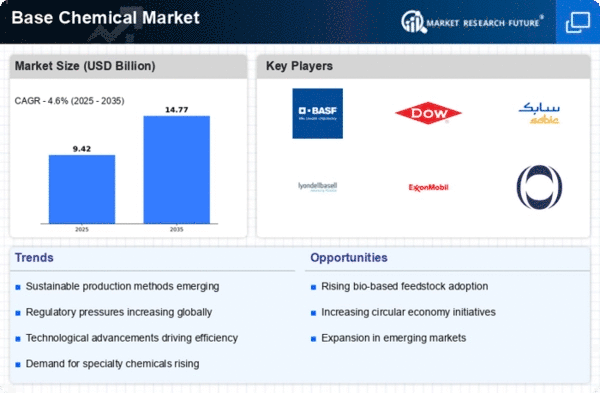
As per MRFR analysis, the Base Chemical Market Size was estimated at 9.01 USD Billion in 2024. The Base Chemical industry is projected to grow from 9.42 USD Billion in 2025 to 14.77 USD Billion by 2035, exhibiting a compound annual growth rate (CAGR) of 4.6% during the forecast period 2025 - 2035.

Key Market Trends & Highlights

The Base Chemical Market is currently experiencing a transformative shift towards sustainability and innovation.

  • North America remains the largest market for base chemicals, driven by robust industrial activity and innovation.
  • Asia-Pacific is emerging as the fastest-growing region, propelled by increasing urbanization and industrialization.
  • The agriculture segment continues to dominate the market, while the pharmaceuticals segment is witnessing rapid growth due to rising health demands.
  • Rising demand from end-user industries and regulatory support for chemical innovations are key drivers shaping the market landscape.

Market Size & Forecast

2024 Market Size 9.01 (USD Billion)
2035 Market Size 14.77 (USD Billion)
CAGR (2025 - 2035) 4.6%
Largest Regional Market Share in 2024 Asia-Pacific

Major Players

BASF (DE), Dow (US), SABIC (SA), LyondellBasell (US), ExxonMobil (US), Ineos (GB), Formosa Plastics (TW), Mitsubishi Chemical (JP), Eastman Chemical (US)

Market Trends

The Base Chemical Market is currently experiencing a dynamic evolution, driven by various factors that shape its landscape. The increasing demand for sustainable and eco-friendly products appears to be a pivotal influence, prompting manufacturers to innovate and adapt their processes. This shift towards sustainability is not merely a trend but seems to be a fundamental change in consumer preferences, which could redefine the market's future. Additionally, advancements in technology are likely to enhance production efficiency and reduce costs, thereby fostering competitiveness among key players. As companies strive to meet regulatory standards and consumer expectations, the integration of digital solutions into operations may also play a crucial role in shaping market dynamics. Moreover, the Base Chemical Market is witnessing a growing emphasis on circular economy principles. This approach encourages the recycling and repurposing of materials, which may lead to reduced waste and a more sustainable supply chain. The interplay between traditional manufacturing practices and innovative, sustainable methods suggests a complex yet promising future for the industry. Stakeholders must remain vigilant and adaptable to navigate the challenges and opportunities that lie ahead, ensuring that they align with the evolving market demands and environmental considerations.

Sustainability Initiatives

The Base Chemical Market is increasingly influenced by sustainability initiatives, as companies strive to reduce their environmental impact. This trend involves the adoption of greener production methods and the development of bio-based chemicals, which may appeal to environmentally conscious consumers.

Technological Advancements

Technological advancements are reshaping the Base Chemical Market, with innovations in production processes and digitalization enhancing efficiency. These developments could lead to cost reductions and improved product quality, positioning companies to better compete in a rapidly changing landscape.

Circular Economy Practices

The integration of circular economy practices is gaining traction within the Base Chemical Market. This approach emphasizes recycling and resource recovery, potentially transforming waste into valuable inputs, thereby promoting sustainability and reducing reliance on virgin materials.

Base Chemical Market Market Drivers

Rising Demand from End-User Industries

The Global Basic Chemicals Market Industry experiences a robust demand from various end-user sectors, including automotive, construction, and consumer goods. As industries expand, the need for basic chemicals such as ethylene, propylene, and ammonia increases. For instance, the automotive sector's growth is anticipated to drive the demand for plastics and synthetic fibers, which are derived from basic chemicals. This trend is expected to contribute to the market's valuation of 498.8 USD Billion in 2024, with projections indicating a potential rise to 799.1 USD Billion by 2035, reflecting a compound annual growth rate of 4.38% from 2025 to 2035.

Emerging Markets and Economic Development

Emerging markets are becoming increasingly significant in the Global Basic Chemicals Market Industry. Countries in Asia-Pacific, Latin America, and Africa are witnessing rapid industrialization and economic development, leading to heightened demand for basic chemicals. As these regions develop, they require essential chemicals for manufacturing, agriculture, and energy production. For instance, the rise of the middle class in these regions is driving consumption of consumer goods, which in turn fuels the demand for chemicals. This trend is expected to contribute to the overall growth of the market, with projections indicating a valuation of 799.1 USD Billion by 2035.

Global Population Growth and Urbanization

The continuous growth of the global population and urbanization trends are key drivers of the Global Basic Chemicals Market Industry. As urban areas expand, there is an escalating demand for infrastructure, housing, and consumer products, all of which rely heavily on basic chemicals. The increasing population is expected to drive consumption patterns that favor products derived from chemicals, such as plastics and fertilizers. This trend is likely to sustain the market's growth trajectory, with an anticipated valuation of 498.8 USD Billion in 2024 and a potential rise to 799.1 USD Billion by 2035, reflecting a CAGR of 4.38% from 2025 to 2035.

Regulatory Support for Sustainable Practices

Regulatory frameworks promoting sustainability are influencing the Global Basic Chemicals Market Industry significantly. Governments worldwide are implementing stringent regulations aimed at reducing carbon emissions and encouraging the adoption of eco-friendly practices. This regulatory support is likely to drive innovation in the production of bio-based chemicals and promote the use of renewable resources. For instance, policies incentivizing the reduction of greenhouse gas emissions may lead to increased investment in sustainable chemical production methods. Consequently, this shift could enhance market growth and align with the projected increase in market value to 799.1 USD Billion by 2035.

Technological Advancements in Production Processes

Technological innovations play a pivotal role in enhancing the efficiency of production processes within the Global Basic Chemicals Market Industry. Advancements such as automation, process optimization, and the adoption of green chemistry are increasingly prevalent. These innovations not only reduce production costs but also minimize environmental impact, aligning with global sustainability goals. For example, the integration of digital technologies in chemical manufacturing has shown to improve yield and reduce waste. As companies invest in these technologies, they are likely to enhance their competitive edge, thereby contributing to the overall growth of the market.

Market Segment Insights

By Application: Agriculture (Largest) vs. Automotive (Fastest-Growing)

<p>In the Base Chemical Market, the application segment is notably diverse with agriculture leading significantly in terms of market share. This sector benefits from the extensive use of fertilizers and pesticides, which constitute a substantial part of the overall base chemical consumption. Driven by rising food demand and the increasing adoption of advanced agricultural practices, agriculture dominates the application landscape. Conversely, automotive applications hold a smaller yet rapidly expanding share due to the growing trend in automotive production technologies and the shift toward lightweight materials.</p>

<p>Agriculture (Dominant) vs. Automotive (Emerging)</p>

<p>The agriculture segment remains the dominant player in the Base Chemical Market due to its extensive reliance on chemical products for enhancing crop yields and protecting plants. This sector utilizes a broad range of base chemicals, including fertilizers, herbicides, and pesticides, which are vital for sustaining food production in an ever-growing global population. In contrast, the automotive sector is gaining traction as an emerging application area, driven by trends toward innovation in manufacturing processes, including the increased use of chemicals for coatings, adhesives, and composites that improve vehicle performance and sustainability.</p>

By End Use: Fertilizers (Largest) vs. Plastics (Fastest-Growing)

In the Base Chemical Market, the end use segment reveals a diverse distribution of demand among fertilizers, <a href="https://www.marketresearchfuture.com/reports/plastics-market-8347" target="_blank" title="plastics">plastics</a>, detergents, coatings, and adhesives. Fertilizers hold the largest share, driven by the ongoing global need for agricultural productivity and food security. Meanwhile, plastics are rapidly expanding, reflecting increased industrial production and consumer demand, making them a significant player in this sector. Detergents, coatings, and adhesives follow, each contributing to niche markets that are growing steadily as well. Growth trends in the Base Chemical Market's end use segment are influenced by various factors. The demand for fertilizers is being propelled by advancements in agricultural technologies, ensuring that crop yields meet global food demands. Plastics, on the other hand, are experiencing the fastest growth due to innovations in sustainable materials and the incorporation of new applications in various industries, including packaging and construction. Together, these segments indicate a robust performance that underscores the evolving landscape of base chemicals.

Fertilizers (Dominant) vs. Plastics (Emerging)

Fertilizers have established themselves as the dominant force in the Base Chemical Market, fueled by an ever-increasing requirement for higher agricultural outputs. As the cornerstone of crop production, fertilizers play a critical role in enhancing soil health and crop yields, leading to their prominence in the market. Conversely, plastics have emerged as a significant and rapidly evolving sector, driven by innovations in production techniques and an expanding array of applications in consumer goods and industrial processes. The emerging popularity of biodegradable plastics also reflects a shifting consumer preference towards sustainability, positioning them as a pivotal segment within the market. This dynamic tension between the established dominance of fertilizers and the burgeoning potential of plastics characterizes the current landscape of the Base Chemical Market.

By Chemical Type: Alkalis (Largest) vs. Acids (Fastest-Growing)

<p>In the Base Chemical Market, Alkalis dominate the chemical type segment, holding the largest market share due to their wide applications in industries such as <a href="https://www.marketresearchfuture.com/reports/soap-market-12470" target="_blank" title="soap">soap</a> manufacturing, glass production, and chemical processing. Salts and Hydrocarbons closely follow, providing essential inputs for various chemical reactions and products. However, Acids have emerged as a significant contributor, gaining traction in specialized applications like food processing and metal treatment, driving a dynamic distribution of market shares across these chemical types. As the market evolves, Acids are witnessing rapid growth, propelled by increasing demand in sectors like pharmaceuticals and agriculture. Regulatory changes favoring sustainable practices are also contributing to this trend. The ongoing innovations in acid formulations are enhancing their applications, making them attractive for various new market segments, thereby solidifying their position as the fastest-growing segment within the Base Chemical Market.</p>

<p>Alkalis (Dominant) vs. Hydrocarbons (Emerging)</p>

<p>Alkalis are a cornerstone of the Base Chemical Market, recognized for their versatility in industrial applications ranging from detergents to water treatment. As a dominant force, they benefit from established production processes and extensive distribution networks, securing their market position. In contrast, Hydrocarbons are gaining momentum as an emerging segment, driven by advancements in renewable energy and petrochemical derivatives. Their role in the development of biofuels and sustainable chemicals aligns with global trends towards decarbonization and environmental sustainability. The competition between these segments is characterized by innovation and adaptation to changing consumer preferences, with Hydrocarbons increasingly carving out their niche in a sector traditionally led by Alkalis.</p>

By Production Process: Thermal Cracking (Largest) vs. Catalytic Reforming (Fastest-Growing)

<p>In the Base Chemical Market, the production process segment is characterized by a diverse array of methods including Thermal Cracking, Catalytic Reforming, Hydrocracking, Electrolysis, and Fermentation. Among these, Thermal Cracking holds the largest market share, dominating the production of essential base chemicals by effectively breaking down larger hydrocarbons into valuable products. Catalytic Reforming, while not as dominant as Thermal Cracking, is quickly gaining attention due to its growing application in the production of high-octane gasoline and aromatics.</p>

<p>Thermal Cracking (Dominant) vs. Catalytic Reforming (Emerging)</p>

<p>Thermal cracking is a well-established method that focuses on breaking down heavy hydrocarbons into lighter fractions, making it fundamental in base chemical production. Its dominance is driven by its cost-effectiveness and ability to produce a variety of valuable chemicals. Conversely, Catalytic Reforming is an emerging process that enables the conversion of naphtha into higher-value products such as aromatic hydrocarbons. Its growing adoption is fueled by an increasing demand for high-octane fuels and the industry's push towards refining efficiency, positioning it as a significant trendsetter in the evolving landscape of base chemical production.</p>

By Distribution Channel: Direct Sales (Largest) vs. E-commerce (Fastest-Growing)

In the Base Chemical Market, 'Direct Sales' holds the largest market share, providing manufacturers a direct route to customers that enhances engagement and reduces distribution costs. Following this, 'Wholesale' and 'Retail' play significant roles, offering different advantages through bulk transactions and customer outreach. Meanwhile, 'E-commerce' is emerging as a strong contender, rapidly gaining traction among consumers who prioritize convenience and online transactions, reshaping how these products are marketed and sold.

Direct Sales (Dominant) vs. E-commerce (Emerging)

'Direct Sales' has established itself as the dominant distribution channel in the Base Chemical Market, allowing manufacturers to build strong relationships with buyers through customized service and tailored solutions. This approach involves a substantial investment in sales personnel and customer relationship management. In contrast, 'E-commerce' is an emerging channel with growing importance, appealing to a tech-savvy clientele that prefers to conduct business online. This channel's flexibility and scalability allow companies to reach wider audiences while driving down operational costs. As businesses adapt to changing consumer behaviors, the shift towards E-commerce is expected to accelerate, indicating significant potential for growth and innovation in this sector.

Get more detailed insights about Basic Chemicals Market Research Report – Forecast to 2035

Regional Insights

North America : Innovation and Sustainability Focus

The North American base chemical market, valued at $2.7B, is driven by innovation and sustainability initiatives. Regulatory frameworks are increasingly favoring eco-friendly practices, pushing companies to adopt greener technologies. The demand for base chemicals is also fueled by the growth in end-user industries such as automotive and construction, which are increasingly focusing on sustainable materials. This region's market share reflects a robust commitment to reducing carbon footprints and enhancing operational efficiencies. Leading players like Dow, ExxonMobil, and LyondellBasell dominate the competitive landscape, leveraging advanced technologies to maintain their market positions. The U.S. remains the largest contributor, supported by a strong manufacturing base and significant investments in R&D. The presence of key players ensures a dynamic market environment, fostering innovation and competitive pricing strategies. As companies adapt to changing regulations, the focus on sustainability will likely shape future growth trajectories.

Europe : Regulatory Compliance and Innovation

Europe's base chemical market, valued at €2.5B, is characterized by stringent regulatory compliance and a strong push towards sustainability. The European Union's Green Deal and REACH regulations are pivotal in shaping market dynamics, encouraging companies to innovate and reduce environmental impacts. The demand for bio-based and recycled chemicals is on the rise, reflecting a shift towards circular economy principles. This regulatory landscape is a significant driver of market growth, pushing for cleaner production methods and sustainable practices. Germany and France are leading countries in this sector, with major players like BASF and Ineos at the forefront. The competitive landscape is marked by a mix of established firms and emerging startups focusing on sustainable solutions. The presence of key players ensures a robust supply chain, while collaborations and partnerships are increasingly common to meet regulatory requirements and consumer demands for greener products. This focus on sustainability is expected to drive future growth in the region.

Asia-Pacific : Emerging Powerhouse in Chemicals

The Asia-Pacific base chemical market, valued at $3.5B, is the largest globally, driven by rapid industrialization and urbanization. Countries like China and India are experiencing significant growth in demand for base chemicals, fueled by expanding manufacturing sectors and increasing consumer markets. Regulatory support for industrial growth and investment in infrastructure further catalyze market expansion. The region's market share reflects its pivotal role in global supply chains, particularly in the production of petrochemicals and specialty chemicals. China stands out as a dominant player, with major companies like Sinopec and Formosa Plastics leading the charge. The competitive landscape is characterized by a mix of local and international firms, all vying for market share. The presence of key players ensures a dynamic environment, with ongoing investments in technology and capacity expansion. As the region continues to grow, the focus on sustainability and innovation will likely shape its future trajectory in the base chemical market.

Middle East and Africa : Resource-Rich Frontier

The Middle East and Africa base chemical market, valued at $0.31B, is emerging as a resource-rich frontier with significant growth potential. The region benefits from abundant natural resources, particularly oil and gas, which serve as feedstocks for chemical production. Regulatory frameworks are evolving to support industrial growth, attracting foreign investments and fostering local production capabilities. The market is gradually expanding, driven by increasing demand for chemicals in construction, agriculture, and consumer goods sectors. Saudi Arabia and the UAE are leading countries in this market, with major players like SABIC and Ineos establishing strong footholds. The competitive landscape is characterized by a focus on vertical integration and strategic partnerships to enhance production efficiencies. As the region continues to develop its chemical industry, the emphasis on sustainability and innovation will be crucial for capturing market opportunities and addressing environmental challenges.

Key Players and Competitive Insights

The Base Chemical Market is currently characterized by a dynamic competitive landscape, driven by factors such as increasing demand for sustainable products, technological advancements, and strategic mergers and acquisitions. Major players like BASF (DE), Dow (US), and SABIC (SA) are actively positioning themselves through innovation and regional expansion. BASF (DE) focuses on sustainability initiatives, aiming to reduce carbon emissions in its production processes, while Dow (US) emphasizes digital transformation to enhance operational efficiency. SABIC (SA) is leveraging partnerships to expand its product portfolio, particularly in high-performance materials, which collectively shapes a competitive environment that is increasingly focused on sustainability and technological integration.Key business tactics within the Base Chemical Market include localizing manufacturing and optimizing supply chains to enhance responsiveness to market demands. The market structure appears moderately fragmented, with a mix of large multinational corporations and smaller regional players. The collective influence of these key players fosters a competitive atmosphere where innovation and operational efficiency are paramount, allowing companies to differentiate themselves in a crowded marketplace.

In November BASF (DE) announced a significant investment in a new bio-based production facility in Germany, aimed at producing sustainable chemicals derived from renewable resources. This strategic move underscores BASF's commitment to sustainability and positions the company to meet the growing demand for eco-friendly products, potentially enhancing its market share in the green chemicals segment.

In October Dow (US) launched a new digital platform designed to streamline its supply chain operations, integrating AI and machine learning to predict demand fluctuations more accurately. This initiative not only enhances operational efficiency but also allows Dow to respond more swiftly to market changes, thereby strengthening its competitive edge in the Base Chemical Market.

In September SABIC (SA) entered into a strategic partnership with a leading technology firm to develop advanced materials for the automotive industry. This collaboration is expected to accelerate innovation in high-performance materials, positioning SABIC as a key player in the evolving landscape of automotive manufacturing, where lightweight and durable materials are increasingly sought after.

As of December current competitive trends in the Base Chemical Market are heavily influenced by digitalization, sustainability, and AI integration. Strategic alliances are becoming more prevalent, enabling companies to pool resources and expertise to drive innovation. The competitive differentiation is likely to evolve from traditional price-based competition to a focus on technological advancements, sustainability, and supply chain reliability, reflecting a broader shift in market dynamics.

Key Companies in the Base Chemical Market include

Industry Developments

October 2021- Evonik, a specialty chemicals firm, disclosed that the company plans to deprive its basic chemicals production site in Lülsdorf, Germany. The company statement revealed that the search for the new owner of the complete facility is still going on. Still, the firm is also considering alternatives to sell parts of the business. Christian Kullmann's chairman of the firm's executive board said that Lülsdorf had been a great location choice for basic chemicals for decades. However, the company's focus is on greater-margin specialty chemicals. Further growth of the site doesn't make sense for the company.

Thus, Evonik has started looking for new owners who can best shape the site's future. Lülsdorf has a massive capacity as a site for chemical production. March 2021- IPO for Rs 600 crore by Laxmi Organic Industries Limited (LOIL) opens in Maharashtra. The ethyl-acetate manufacturer based in Maharashtra is strengthening its position in the cash flow-rich basic chemicals space and growing rapidly in a few specialty chemicals- especially in fluorochemicals. LOIL, Business brief Incorporated in 1989, is one of the largest producers of ethyl acetate across India, with a local market share of over 30 percent.

Basic Chemicals have advanced due to the various discoveries made about their many basic uses in the industry. These uses include the manufacturing of benzene in ammonia, calcium carbonate, sodium hydroxide, chlorine, and sulfuric acid. Basic Chemicals Market are also developing due to their use in products such as rubber plastic fiber soaps and detergents, ink solvents, and fertilizers. Basic Chemicals Market are advancing due to their end users' development such as transportation packaging agriculture textile electronics and electrical paints coatings.

And all these end users are developing mainly in the developed as well as developing countries.Other advancements include growing demand for packaged beverages and food products due to the convenience and improved lifestyle of the population. Also, there are developments made in the demand factor of Basic Chemicals Market due to increasing economies in countries such as India and China which results due to rising numbers of the working population.

Future Outlook

Base Chemical Market Future Outlook

The Base Chemical Market is projected to grow at a 4.6% CAGR from 2025 to 2035, driven by increasing demand in various industries and technological advancements.

New opportunities lie in:

  • Expansion into bio-based chemical production facilities.
  • Investment in advanced recycling technologies for waste reduction.
  • Development of customized chemical solutions for emerging markets.

By 2035, the Base Chemical Market is expected to achieve robust growth and enhanced competitive positioning.

Market Segmentation

Base Chemical Market End Use Outlook

  • Fertilizers
  • Plastics
  • Detergents
  • Coatings
  • Adhesives

Base Chemical Market Application Outlook

  • Agriculture
  • Construction
  • Automotive
  • Pharmaceuticals
  • Textiles

Base Chemical Market Product Type Outlook

  • Alkalis
  • Acids
  • Solvents
  • Oxidizers
  • Salts

Base Chemical Market Production Process Outlook

  • Thermal Cracking
  • Hydrocracking
  • Catalytic Reforming
  • Electrolysis
  • Fermentation

Base Chemical Market Distribution Channel Outlook

  • Direct Sales
  • Wholesale
  • Retail
  • E-commerce
  • Distributors

Report Scope

MARKET SIZE 2024 9.01(USD Billion)
MARKET SIZE 2025 9.42(USD Billion)
MARKET SIZE 2035 14.77(USD Billion)
COMPOUND ANNUAL GROWTH RATE (CAGR) 4.6% (2025 - 2035)
REPORT COVERAGE Revenue Forecast, Competitive Landscape, Growth Factors, and Trends
BASE YEAR 2024
Market Forecast Period 2025 - 2035
Historical Data 2019 - 2024
Market Forecast Units USD Billion
Key Companies Profiled BASF (DE), Dow (US), SABIC (SA), LyondellBasell (US), ExxonMobil (US), Ineos (GB), Formosa Plastics (TW), Mitsubishi Chemical (JP), Eastman Chemical (US)
Segments Covered Application, End Use, Product Type, Production Process, Distribution Channel
Key Market Opportunities Adoption of sustainable production methods enhances growth potential in the Base Chemical Market.
Key Market Dynamics Rising demand for sustainable chemicals drives innovation and regulatory shifts in the base chemical market.
Countries Covered North America, Europe, APAC, South America, MEA

FAQs

What is the projected market valuation of the Base Chemical Market by 2035?

<p>The Base Chemical Market is projected to reach a valuation of 14.77 USD Billion by 2035.</p>

What was the market valuation of the Base Chemical Market in 2024?

<p>In 2024, the overall market valuation was 9.01 USD Billion.</p>

What is the expected CAGR for the Base Chemical Market during the forecast period 2025 - 2035?

<p>The expected CAGR for the Base Chemical Market during the forecast period 2025 - 2035 is 4.6%.</p>

Which companies are considered key players in the Base Chemical Market?

<p>Key players in the Base Chemical Market include BASF SE, Dow Inc., SABIC, LyondellBasell Industries N.V., and ExxonMobil Chemical.</p>

What are the projected valuations for the Agriculture segment by 2035?

<p>The Agriculture segment is projected to grow from 1.5 USD Billion to 2.5 USD Billion by 2035.</p>

How does the Pharmaceuticals segment's valuation change from 2024 to 2035?

The Pharmaceuticals segment's valuation is expected to increase from 2.0 USD Billion in 2024 to 3.0 USD Billion by 2035.

What is the anticipated growth for the Plastics end-use segment by 2035?

The Plastics end-use segment is anticipated to grow from 2.8 USD Billion to 4.5 USD Billion by 2035.

What are the projected valuations for Hydrocarbons in the chemical type segment by 2035?

Hydrocarbons are projected to increase from 2.5 USD Billion to 4.5 USD Billion by 2035.

What is the expected change in valuation for the E-commerce distribution channel by 2035?

The E-commerce distribution channel is expected to grow from 1.0 USD Billion to 2.0 USD Billion by 2035.

What production process is projected to see the highest growth in the Base Chemical Market by 2035?

Fermentation is projected to see the highest growth, increasing from 2.7 USD Billion to 4.0 USD Billion by 2035.

  1. SECTION I: EXECUTIVE SUMMARY AND KEY HIGHLIGHTS
    1. | 1.1 EXECUTIVE SUMMARY
    2. | | 1.1.1 Market Overview
    3. | | 1.1.2 Key Findings
    4. | | 1.1.3 Market Segmentation
    5. | | 1.1.4 Competitive Landscape
    6. | | 1.1.5 Challenges and Opportunities
    7. | | 1.1.6 Future Outlook
  2. SECTION II: SCOPING, METHODOLOGY AND MARKET STRUCTURE
    1. | 2.1 MARKET INTRODUCTION
    2. | | 2.1.1 Definition
    3. | | 2.1.2 Scope of the study
    4. | | | 2.1.2.1 Research Objective
    5. | | | 2.1.2.2 Assumption
    6. | | | 2.1.2.3 Limitations
    7. | 2.2 RESEARCH METHODOLOGY
    8. | | 2.2.1 Overview
    9. | | 2.2.2 Data Mining
    10. | | 2.2.3 Secondary Research
    11. | | 2.2.4 Primary Research
    12. | | | 2.2.4.1 Primary Interviews and Information Gathering Process
    13. | | | 2.2.4.2 Breakdown of Primary Respondents
    14. | | 2.2.5 Forecasting Model
    15. | | 2.2.6 Market Size Estimation
    16. | | | 2.2.6.1 Bottom-Up Approach
    17. | | | 2.2.6.2 Top-Down Approach
    18. | | 2.2.7 Data Triangulation
    19. | | 2.2.8 Validation
  3. SECTION III: QUALITATIVE ANALYSIS
    1. | 3.1 MARKET DYNAMICS
    2. | | 3.1.1 Overview
    3. | | 3.1.2 Drivers
    4. | | 3.1.3 Restraints
    5. | | 3.1.4 Opportunities
    6. | 3.2 MARKET FACTOR ANALYSIS
    7. | | 3.2.1 Value chain Analysis
    8. | | 3.2.2 Porter's Five Forces Analysis
    9. | | | 3.2.2.1 Bargaining Power of Suppliers
    10. | | | 3.2.2.2 Bargaining Power of Buyers
    11. | | | 3.2.2.3 Threat of New Entrants
    12. | | | 3.2.2.4 Threat of Substitutes
    13. | | | 3.2.2.5 Intensity of Rivalry
    14. | | 3.2.3 COVID-19 Impact Analysis
    15. | | | 3.2.3.1 Market Impact Analysis
    16. | | | 3.2.3.2 Regional Impact
    17. | | | 3.2.3.3 Opportunity and Threat Analysis
  4. SECTION IV: QUANTITATIVE ANALYSIS
    1. | 4.1 Chemicals and Materials, BY Application (USD Billion)
    2. | | 4.1.1 Agriculture
    3. | | 4.1.2 Pharmaceuticals
    4. | | 4.1.3 Construction
    5. | | 4.1.4 Automotive
    6. | | 4.1.5 Textiles
    7. | 4.2 Chemicals and Materials, BY End Use (USD Billion)
    8. | | 4.2.1 Fertilizers
    9. | | 4.2.2 Plastics
    10. | | 4.2.3 Detergents
    11. | | 4.2.4 Coatings
    12. | | 4.2.5 Adhesives
    13. | 4.3 Chemicals and Materials, BY Chemical Type (USD Billion)
    14. | | 4.3.1 Alkalis
    15. | | 4.3.2 Acids
    16. | | 4.3.3 Salts
    17. | | 4.3.4 Oxides
    18. | | 4.3.5 Hydrocarbons
    19. | 4.4 Chemicals and Materials, BY Production Process (USD Billion)
    20. | | 4.4.1 Thermal Cracking
    21. | | 4.4.2 Catalytic Reforming
    22. | | 4.4.3 Hydrocracking
    23. | | 4.4.4 Electrolysis
    24. | | 4.4.5 Fermentation
    25. | 4.5 Chemicals and Materials, BY Distribution Channel (USD Billion)
    26. | | 4.5.1 Direct Sales
    27. | | 4.5.2 Wholesale
    28. | | 4.5.3 Retail
    29. | | 4.5.4 E-commerce
    30. | | 4.5.5 Distributors
    31. | 4.6 Chemicals and Materials, BY Region (USD Billion)
    32. | | 4.6.1 North America
    33. | | | 4.6.1.1 US
    34. | | | 4.6.1.2 Canada
    35. | | 4.6.2 Europe
    36. | | | 4.6.2.1 Germany
    37. | | | 4.6.2.2 UK
    38. | | | 4.6.2.3 France
    39. | | | 4.6.2.4 Russia
    40. | | | 4.6.2.5 Italy
    41. | | | 4.6.2.6 Spain
    42. | | | 4.6.2.7 Rest of Europe
    43. | | 4.6.3 APAC
    44. | | | 4.6.3.1 China
    45. | | | 4.6.3.2 India
    46. | | | 4.6.3.3 Japan
    47. | | | 4.6.3.4 South Korea
    48. | | | 4.6.3.5 Malaysia
    49. | | | 4.6.3.6 Thailand
    50. | | | 4.6.3.7 Indonesia
    51. | | | 4.6.3.8 Rest of APAC
    52. | | 4.6.4 South America
    53. | | | 4.6.4.1 Brazil
    54. | | | 4.6.4.2 Mexico
    55. | | | 4.6.4.3 Argentina
    56. | | | 4.6.4.4 Rest of South America
    57. | | 4.6.5 MEA
    58. | | | 4.6.5.1 GCC Countries
    59. | | | 4.6.5.2 South Africa
    60. | | | 4.6.5.3 Rest of MEA
  5. SECTION V: COMPETITIVE ANALYSIS
    1. | 5.1 Competitive Landscape
    2. | | 5.1.1 Overview
    3. | | 5.1.2 Competitive Analysis
    4. | | 5.1.3 Market share Analysis
    5. | | 5.1.4 Major Growth Strategy in the Chemicals and Materials
    6. | | 5.1.5 Competitive Benchmarking
    7. | | 5.1.6 Leading Players in Terms of Number of Developments in the Chemicals and Materials
    8. | | 5.1.7 Key developments and growth strategies
    9. | | | 5.1.7.1 New Product Launch/Service Deployment
    10. | | | 5.1.7.2 Merger & Acquisitions
    11. | | | 5.1.7.3 Joint Ventures
    12. | | 5.1.8 Major Players Financial Matrix
    13. | | | 5.1.8.1 Sales and Operating Income
    14. | | | 5.1.8.2 Major Players R&D Expenditure. 2023
    15. | 5.2 Company Profiles
    16. | | 5.2.1 BASF SE (DE)
    17. | | | 5.2.1.1 Financial Overview
    18. | | | 5.2.1.2 Products Offered
    19. | | | 5.2.1.3 Key Developments
    20. | | | 5.2.1.4 SWOT Analysis
    21. | | | 5.2.1.5 Key Strategies
    22. | | 5.2.2 Dow Inc. (US)
    23. | | | 5.2.2.1 Financial Overview
    24. | | | 5.2.2.2 Products Offered
    25. | | | 5.2.2.3 Key Developments
    26. | | | 5.2.2.4 SWOT Analysis
    27. | | | 5.2.2.5 Key Strategies
    28. | | 5.2.3 SABIC (SA)
    29. | | | 5.2.3.1 Financial Overview
    30. | | | 5.2.3.2 Products Offered
    31. | | | 5.2.3.3 Key Developments
    32. | | | 5.2.3.4 SWOT Analysis
    33. | | | 5.2.3.5 Key Strategies
    34. | | 5.2.4 LyondellBasell Industries N.V. (NL)
    35. | | | 5.2.4.1 Financial Overview
    36. | | | 5.2.4.2 Products Offered
    37. | | | 5.2.4.3 Key Developments
    38. | | | 5.2.4.4 SWOT Analysis
    39. | | | 5.2.4.5 Key Strategies
    40. | | 5.2.5 ExxonMobil Chemical (US)
    41. | | | 5.2.5.1 Financial Overview
    42. | | | 5.2.5.2 Products Offered
    43. | | | 5.2.5.3 Key Developments
    44. | | | 5.2.5.4 SWOT Analysis
    45. | | | 5.2.5.5 Key Strategies
    46. | | 5.2.6 Ineos Group Limited (GB)
    47. | | | 5.2.6.1 Financial Overview
    48. | | | 5.2.6.2 Products Offered
    49. | | | 5.2.6.3 Key Developments
    50. | | | 5.2.6.4 SWOT Analysis
    51. | | | 5.2.6.5 Key Strategies
    52. | | 5.2.7 Mitsubishi Chemical Corporation (JP)
    53. | | | 5.2.7.1 Financial Overview
    54. | | | 5.2.7.2 Products Offered
    55. | | | 5.2.7.3 Key Developments
    56. | | | 5.2.7.4 SWOT Analysis
    57. | | | 5.2.7.5 Key Strategies
    58. | | 5.2.8 Formosa Plastics Corporation (TW)
    59. | | | 5.2.8.1 Financial Overview
    60. | | | 5.2.8.2 Products Offered
    61. | | | 5.2.8.3 Key Developments
    62. | | | 5.2.8.4 SWOT Analysis
    63. | | | 5.2.8.5 Key Strategies
    64. | | 5.2.9 Eastman Chemical Company (US)
    65. | | | 5.2.9.1 Financial Overview
    66. | | | 5.2.9.2 Products Offered
    67. | | | 5.2.9.3 Key Developments
    68. | | | 5.2.9.4 SWOT Analysis
    69. | | | 5.2.9.5 Key Strategies
    70. | 5.3 Appendix
    71. | | 5.3.1 References
    72. | | 5.3.2 Related Reports
  6. LIST OF FIGURES
    1. | 6.1 MARKET SYNOPSIS
    2. | 6.2 NORTH AMERICA MARKET ANALYSIS
    3. | 6.3 US MARKET ANALYSIS BY APPLICATION
    4. | 6.4 US MARKET ANALYSIS BY END USE
    5. | 6.5 US MARKET ANALYSIS BY CHEMICAL TYPE
    6. | 6.6 US MARKET ANALYSIS BY PRODUCTION PROCESS
    7. | 6.7 US MARKET ANALYSIS BY DISTRIBUTION CHANNEL
    8. | 6.8 CANADA MARKET ANALYSIS BY APPLICATION
    9. | 6.9 CANADA MARKET ANALYSIS BY END USE
    10. | 6.10 CANADA MARKET ANALYSIS BY CHEMICAL TYPE
    11. | 6.11 CANADA MARKET ANALYSIS BY PRODUCTION PROCESS
    12. | 6.12 CANADA MARKET ANALYSIS BY DISTRIBUTION CHANNEL
    13. | 6.13 EUROPE MARKET ANALYSIS
    14. | 6.14 GERMANY MARKET ANALYSIS BY APPLICATION
    15. | 6.15 GERMANY MARKET ANALYSIS BY END USE
    16. | 6.16 GERMANY MARKET ANALYSIS BY CHEMICAL TYPE
    17. | 6.17 GERMANY MARKET ANALYSIS BY PRODUCTION PROCESS
    18. | 6.18 GERMANY MARKET ANALYSIS BY DISTRIBUTION CHANNEL
    19. | 6.19 UK MARKET ANALYSIS BY APPLICATION
    20. | 6.20 UK MARKET ANALYSIS BY END USE
    21. | 6.21 UK MARKET ANALYSIS BY CHEMICAL TYPE
    22. | 6.22 UK MARKET ANALYSIS BY PRODUCTION PROCESS
    23. | 6.23 UK MARKET ANALYSIS BY DISTRIBUTION CHANNEL
    24. | 6.24 FRANCE MARKET ANALYSIS BY APPLICATION
    25. | 6.25 FRANCE MARKET ANALYSIS BY END USE
    26. | 6.26 FRANCE MARKET ANALYSIS BY CHEMICAL TYPE
    27. | 6.27 FRANCE MARKET ANALYSIS BY PRODUCTION PROCESS
    28. | 6.28 FRANCE MARKET ANALYSIS BY DISTRIBUTION CHANNEL
    29. | 6.29 RUSSIA MARKET ANALYSIS BY APPLICATION
    30. | 6.30 RUSSIA MARKET ANALYSIS BY END USE
    31. | 6.31 RUSSIA MARKET ANALYSIS BY CHEMICAL TYPE
    32. | 6.32 RUSSIA MARKET ANALYSIS BY PRODUCTION PROCESS
    33. | 6.33 RUSSIA MARKET ANALYSIS BY DISTRIBUTION CHANNEL
    34. | 6.34 ITALY MARKET ANALYSIS BY APPLICATION
    35. | 6.35 ITALY MARKET ANALYSIS BY END USE
    36. | 6.36 ITALY MARKET ANALYSIS BY CHEMICAL TYPE
    37. | 6.37 ITALY MARKET ANALYSIS BY PRODUCTION PROCESS
    38. | 6.38 ITALY MARKET ANALYSIS BY DISTRIBUTION CHANNEL
    39. | 6.39 SPAIN MARKET ANALYSIS BY APPLICATION
    40. | 6.40 SPAIN MARKET ANALYSIS BY END USE
    41. | 6.41 SPAIN MARKET ANALYSIS BY CHEMICAL TYPE
    42. | 6.42 SPAIN MARKET ANALYSIS BY PRODUCTION PROCESS
    43. | 6.43 SPAIN MARKET ANALYSIS BY DISTRIBUTION CHANNEL
    44. | 6.44 REST OF EUROPE MARKET ANALYSIS BY APPLICATION
    45. | 6.45 REST OF EUROPE MARKET ANALYSIS BY END USE
    46. | 6.46 REST OF EUROPE MARKET ANALYSIS BY CHEMICAL TYPE
    47. | 6.47 REST OF EUROPE MARKET ANALYSIS BY PRODUCTION PROCESS
    48. | 6.48 REST OF EUROPE MARKET ANALYSIS BY DISTRIBUTION CHANNEL
    49. | 6.49 APAC MARKET ANALYSIS
    50. | 6.50 CHINA MARKET ANALYSIS BY APPLICATION
    51. | 6.51 CHINA MARKET ANALYSIS BY END USE
    52. | 6.52 CHINA MARKET ANALYSIS BY CHEMICAL TYPE
    53. | 6.53 CHINA MARKET ANALYSIS BY PRODUCTION PROCESS
    54. | 6.54 CHINA MARKET ANALYSIS BY DISTRIBUTION CHANNEL
    55. | 6.55 INDIA MARKET ANALYSIS BY APPLICATION
    56. | 6.56 INDIA MARKET ANALYSIS BY END USE
    57. | 6.57 INDIA MARKET ANALYSIS BY CHEMICAL TYPE
    58. | 6.58 INDIA MARKET ANALYSIS BY PRODUCTION PROCESS
    59. | 6.59 INDIA MARKET ANALYSIS BY DISTRIBUTION CHANNEL
    60. | 6.60 JAPAN MARKET ANALYSIS BY APPLICATION
    61. | 6.61 JAPAN MARKET ANALYSIS BY END USE
    62. | 6.62 JAPAN MARKET ANALYSIS BY CHEMICAL TYPE
    63. | 6.63 JAPAN MARKET ANALYSIS BY PRODUCTION PROCESS
    64. | 6.64 JAPAN MARKET ANALYSIS BY DISTRIBUTION CHANNEL
    65. | 6.65 SOUTH KOREA MARKET ANALYSIS BY APPLICATION
    66. | 6.66 SOUTH KOREA MARKET ANALYSIS BY END USE
    67. | 6.67 SOUTH KOREA MARKET ANALYSIS BY CHEMICAL TYPE
    68. | 6.68 SOUTH KOREA MARKET ANALYSIS BY PRODUCTION PROCESS
    69. | 6.69 SOUTH KOREA MARKET ANALYSIS BY DISTRIBUTION CHANNEL
    70. | 6.70 MALAYSIA MARKET ANALYSIS BY APPLICATION
    71. | 6.71 MALAYSIA MARKET ANALYSIS BY END USE
    72. | 6.72 MALAYSIA MARKET ANALYSIS BY CHEMICAL TYPE
    73. | 6.73 MALAYSIA MARKET ANALYSIS BY PRODUCTION PROCESS
    74. | 6.74 MALAYSIA MARKET ANALYSIS BY DISTRIBUTION CHANNEL
    75. | 6.75 THAILAND MARKET ANALYSIS BY APPLICATION
    76. | 6.76 THAILAND MARKET ANALYSIS BY END USE
    77. | 6.77 THAILAND MARKET ANALYSIS BY CHEMICAL TYPE
    78. | 6.78 THAILAND MARKET ANALYSIS BY PRODUCTION PROCESS
    79. | 6.79 THAILAND MARKET ANALYSIS BY DISTRIBUTION CHANNEL
    80. | 6.80 INDONESIA MARKET ANALYSIS BY APPLICATION
    81. | 6.81 INDONESIA MARKET ANALYSIS BY END USE
    82. | 6.82 INDONESIA MARKET ANALYSIS BY CHEMICAL TYPE
    83. | 6.83 INDONESIA MARKET ANALYSIS BY PRODUCTION PROCESS
    84. | 6.84 INDONESIA MARKET ANALYSIS BY DISTRIBUTION CHANNEL
    85. | 6.85 REST OF APAC MARKET ANALYSIS BY APPLICATION
    86. | 6.86 REST OF APAC MARKET ANALYSIS BY END USE
    87. | 6.87 REST OF APAC MARKET ANALYSIS BY CHEMICAL TYPE
    88. | 6.88 REST OF APAC MARKET ANALYSIS BY PRODUCTION PROCESS
    89. | 6.89 REST OF APAC MARKET ANALYSIS BY DISTRIBUTION CHANNEL
    90. | 6.90 SOUTH AMERICA MARKET ANALYSIS
    91. | 6.91 BRAZIL MARKET ANALYSIS BY APPLICATION
    92. | 6.92 BRAZIL MARKET ANALYSIS BY END USE
    93. | 6.93 BRAZIL MARKET ANALYSIS BY CHEMICAL TYPE
    94. | 6.94 BRAZIL MARKET ANALYSIS BY PRODUCTION PROCESS
    95. | 6.95 BRAZIL MARKET ANALYSIS BY DISTRIBUTION CHANNEL
    96. | 6.96 MEXICO MARKET ANALYSIS BY APPLICATION
    97. | 6.97 MEXICO MARKET ANALYSIS BY END USE
    98. | 6.98 MEXICO MARKET ANALYSIS BY CHEMICAL TYPE
    99. | 6.99 MEXICO MARKET ANALYSIS BY PRODUCTION PROCESS
    100. | 6.100 MEXICO MARKET ANALYSIS BY DISTRIBUTION CHANNEL
    101. | 6.101 ARGENTINA MARKET ANALYSIS BY APPLICATION
    102. | 6.102 ARGENTINA MARKET ANALYSIS BY END USE
    103. | 6.103 ARGENTINA MARKET ANALYSIS BY CHEMICAL TYPE
    104. | 6.104 ARGENTINA MARKET ANALYSIS BY PRODUCTION PROCESS
    105. | 6.105 ARGENTINA MARKET ANALYSIS BY DISTRIBUTION CHANNEL
    106. | 6.106 REST OF SOUTH AMERICA MARKET ANALYSIS BY APPLICATION
    107. | 6.107 REST OF SOUTH AMERICA MARKET ANALYSIS BY END USE
    108. | 6.108 REST OF SOUTH AMERICA MARKET ANALYSIS BY CHEMICAL TYPE
    109. | 6.109 REST OF SOUTH AMERICA MARKET ANALYSIS BY PRODUCTION PROCESS
    110. | 6.110 REST OF SOUTH AMERICA MARKET ANALYSIS BY DISTRIBUTION CHANNEL
    111. | 6.111 MEA MARKET ANALYSIS
    112. | 6.112 GCC COUNTRIES MARKET ANALYSIS BY APPLICATION
    113. | 6.113 GCC COUNTRIES MARKET ANALYSIS BY END USE
    114. | 6.114 GCC COUNTRIES MARKET ANALYSIS BY CHEMICAL TYPE
    115. | 6.115 GCC COUNTRIES MARKET ANALYSIS BY PRODUCTION PROCESS
    116. | 6.116 GCC COUNTRIES MARKET ANALYSIS BY DISTRIBUTION CHANNEL
    117. | 6.117 SOUTH AFRICA MARKET ANALYSIS BY APPLICATION
    118. | 6.118 SOUTH AFRICA MARKET ANALYSIS BY END USE
    119. | 6.119 SOUTH AFRICA MARKET ANALYSIS BY CHEMICAL TYPE
    120. | 6.120 SOUTH AFRICA MARKET ANALYSIS BY PRODUCTION PROCESS
    121. | 6.121 SOUTH AFRICA MARKET ANALYSIS BY DISTRIBUTION CHANNEL
    122. | 6.122 REST OF MEA MARKET ANALYSIS BY APPLICATION
    123. | 6.123 REST OF MEA MARKET ANALYSIS BY END USE
    124. | 6.124 REST OF MEA MARKET ANALYSIS BY CHEMICAL TYPE
    125. | 6.125 REST OF MEA MARKET ANALYSIS BY PRODUCTION PROCESS
    126. | 6.126 REST OF MEA MARKET ANALYSIS BY DISTRIBUTION CHANNEL
    127. | 6.127 KEY BUYING CRITERIA OF CHEMICALS AND MATERIALS
    128. | 6.128 RESEARCH PROCESS OF MRFR
    129. | 6.129 DRO ANALYSIS OF CHEMICALS AND MATERIALS
    130. | 6.130 DRIVERS IMPACT ANALYSIS: CHEMICALS AND MATERIALS
    131. | 6.131 RESTRAINTS IMPACT ANALYSIS: CHEMICALS AND MATERIALS
    132. | 6.132 SUPPLY / VALUE CHAIN: CHEMICALS AND MATERIALS
    133. | 6.133 CHEMICALS AND MATERIALS, BY APPLICATION, 2024 (% SHARE)
    134. | 6.134 CHEMICALS AND MATERIALS, BY APPLICATION, 2024 TO 2035 (USD Billion)
    135. | 6.135 CHEMICALS AND MATERIALS, BY END USE, 2024 (% SHARE)
    136. | 6.136 CHEMICALS AND MATERIALS, BY END USE, 2024 TO 2035 (USD Billion)
    137. | 6.137 CHEMICALS AND MATERIALS, BY CHEMICAL TYPE, 2024 (% SHARE)
    138. | 6.138 CHEMICALS AND MATERIALS, BY CHEMICAL TYPE, 2024 TO 2035 (USD Billion)
    139. | 6.139 CHEMICALS AND MATERIALS, BY PRODUCTION PROCESS, 2024 (% SHARE)
    140. | 6.140 CHEMICALS AND MATERIALS, BY PRODUCTION PROCESS, 2024 TO 2035 (USD Billion)
    141. | 6.141 CHEMICALS AND MATERIALS, BY DISTRIBUTION CHANNEL, 2024 (% SHARE)
    142. | 6.142 CHEMICALS AND MATERIALS, BY DISTRIBUTION CHANNEL, 2024 TO 2035 (USD Billion)
    143. | 6.143 BENCHMARKING OF MAJOR COMPETITORS
  7. LIST OF TABLES
    1. | 7.1 LIST OF ASSUMPTIONS
    2. | | 7.1.1
    3. | 7.2 North America MARKET SIZE ESTIMATES; FORECAST
    4. | | 7.2.1 BY APPLICATION, 2025-2035 (USD Billion)
    5. | | 7.2.2 BY END USE, 2025-2035 (USD Billion)
    6. | | 7.2.3 BY CHEMICAL TYPE, 2025-2035 (USD Billion)
    7. | | 7.2.4 BY PRODUCTION PROCESS, 2025-2035 (USD Billion)
    8. | | 7.2.5 BY DISTRIBUTION CHANNEL, 2025-2035 (USD Billion)
    9. | 7.3 US MARKET SIZE ESTIMATES; FORECAST
    10. | | 7.3.1 BY APPLICATION, 2025-2035 (USD Billion)
    11. | | 7.3.2 BY END USE, 2025-2035 (USD Billion)
    12. | | 7.3.3 BY CHEMICAL TYPE, 2025-2035 (USD Billion)
    13. | | 7.3.4 BY PRODUCTION PROCESS, 2025-2035 (USD Billion)
    14. | | 7.3.5 BY DISTRIBUTION CHANNEL, 2025-2035 (USD Billion)
    15. | 7.4 Canada MARKET SIZE ESTIMATES; FORECAST
    16. | | 7.4.1 BY APPLICATION, 2025-2035 (USD Billion)
    17. | | 7.4.2 BY END USE, 2025-2035 (USD Billion)
    18. | | 7.4.3 BY CHEMICAL TYPE, 2025-2035 (USD Billion)
    19. | | 7.4.4 BY PRODUCTION PROCESS, 2025-2035 (USD Billion)
    20. | | 7.4.5 BY DISTRIBUTION CHANNEL, 2025-2035 (USD Billion)
    21. | 7.5 Europe MARKET SIZE ESTIMATES; FORECAST
    22. | | 7.5.1 BY APPLICATION, 2025-2035 (USD Billion)
    23. | | 7.5.2 BY END USE, 2025-2035 (USD Billion)
    24. | | 7.5.3 BY CHEMICAL TYPE, 2025-2035 (USD Billion)
    25. | | 7.5.4 BY PRODUCTION PROCESS, 2025-2035 (USD Billion)
    26. | | 7.5.5 BY DISTRIBUTION CHANNEL, 2025-2035 (USD Billion)
    27. | 7.6 Germany MARKET SIZE ESTIMATES; FORECAST
    28. | | 7.6.1 BY APPLICATION, 2025-2035 (USD Billion)
    29. | | 7.6.2 BY END USE, 2025-2035 (USD Billion)
    30. | | 7.6.3 BY CHEMICAL TYPE, 2025-2035 (USD Billion)
    31. | | 7.6.4 BY PRODUCTION PROCESS, 2025-2035 (USD Billion)
    32. | | 7.6.5 BY DISTRIBUTION CHANNEL, 2025-2035 (USD Billion)
    33. | 7.7 UK MARKET SIZE ESTIMATES; FORECAST
    34. | | 7.7.1 BY APPLICATION, 2025-2035 (USD Billion)
    35. | | 7.7.2 BY END USE, 2025-2035 (USD Billion)
    36. | | 7.7.3 BY CHEMICAL TYPE, 2025-2035 (USD Billion)
    37. | | 7.7.4 BY PRODUCTION PROCESS, 2025-2035 (USD Billion)
    38. | | 7.7.5 BY DISTRIBUTION CHANNEL, 2025-2035 (USD Billion)
    39. | 7.8 France MARKET SIZE ESTIMATES; FORECAST
    40. | | 7.8.1 BY APPLICATION, 2025-2035 (USD Billion)
    41. | | 7.8.2 BY END USE, 2025-2035 (USD Billion)
    42. | | 7.8.3 BY CHEMICAL TYPE, 2025-2035 (USD Billion)
    43. | | 7.8.4 BY PRODUCTION PROCESS, 2025-2035 (USD Billion)
    44. | | 7.8.5 BY DISTRIBUTION CHANNEL, 2025-2035 (USD Billion)
    45. | 7.9 Russia MARKET SIZE ESTIMATES; FORECAST
    46. | | 7.9.1 BY APPLICATION, 2025-2035 (USD Billion)
    47. | | 7.9.2 BY END USE, 2025-2035 (USD Billion)
    48. | | 7.9.3 BY CHEMICAL TYPE, 2025-2035 (USD Billion)
    49. | | 7.9.4 BY PRODUCTION PROCESS, 2025-2035 (USD Billion)
    50. | | 7.9.5 BY DISTRIBUTION CHANNEL, 2025-2035 (USD Billion)
    51. | 7.10 Italy MARKET SIZE ESTIMATES; FORECAST
    52. | | 7.10.1 BY APPLICATION, 2025-2035 (USD Billion)
    53. | | 7.10.2 BY END USE, 2025-2035 (USD Billion)
    54. | | 7.10.3 BY CHEMICAL TYPE, 2025-2035 (USD Billion)
    55. | | 7.10.4 BY PRODUCTION PROCESS, 2025-2035 (USD Billion)
    56. | | 7.10.5 BY DISTRIBUTION CHANNEL, 2025-2035 (USD Billion)
    57. | 7.11 Spain MARKET SIZE ESTIMATES; FORECAST
    58. | | 7.11.1 BY APPLICATION, 2025-2035 (USD Billion)
    59. | | 7.11.2 BY END USE, 2025-2035 (USD Billion)
    60. | | 7.11.3 BY CHEMICAL TYPE, 2025-2035 (USD Billion)
    61. | | 7.11.4 BY PRODUCTION PROCESS, 2025-2035 (USD Billion)
    62. | | 7.11.5 BY DISTRIBUTION CHANNEL, 2025-2035 (USD Billion)
    63. | 7.12 Rest of Europe MARKET SIZE ESTIMATES; FORECAST
    64. | | 7.12.1 BY APPLICATION, 2025-2035 (USD Billion)
    65. | | 7.12.2 BY END USE, 2025-2035 (USD Billion)
    66. | | 7.12.3 BY CHEMICAL TYPE, 2025-2035 (USD Billion)
    67. | | 7.12.4 BY PRODUCTION PROCESS, 2025-2035 (USD Billion)
    68. | | 7.12.5 BY DISTRIBUTION CHANNEL, 2025-2035 (USD Billion)
    69. | 7.13 APAC MARKET SIZE ESTIMATES; FORECAST
    70. | | 7.13.1 BY APPLICATION, 2025-2035 (USD Billion)
    71. | | 7.13.2 BY END USE, 2025-2035 (USD Billion)
    72. | | 7.13.3 BY CHEMICAL TYPE, 2025-2035 (USD Billion)
    73. | | 7.13.4 BY PRODUCTION PROCESS, 2025-2035 (USD Billion)
    74. | | 7.13.5 BY DISTRIBUTION CHANNEL, 2025-2035 (USD Billion)
    75. | 7.14 China MARKET SIZE ESTIMATES; FORECAST
    76. | | 7.14.1 BY APPLICATION, 2025-2035 (USD Billion)
    77. | | 7.14.2 BY END USE, 2025-2035 (USD Billion)
    78. | | 7.14.3 BY CHEMICAL TYPE, 2025-2035 (USD Billion)
    79. | | 7.14.4 BY PRODUCTION PROCESS, 2025-2035 (USD Billion)
    80. | | 7.14.5 BY DISTRIBUTION CHANNEL, 2025-2035 (USD Billion)
    81. | 7.15 India MARKET SIZE ESTIMATES; FORECAST
    82. | | 7.15.1 BY APPLICATION, 2025-2035 (USD Billion)
    83. | | 7.15.2 BY END USE, 2025-2035 (USD Billion)
    84. | | 7.15.3 BY CHEMICAL TYPE, 2025-2035 (USD Billion)
    85. | | 7.15.4 BY PRODUCTION PROCESS, 2025-2035 (USD Billion)
    86. | | 7.15.5 BY DISTRIBUTION CHANNEL, 2025-2035 (USD Billion)
    87. | 7.16 Japan MARKET SIZE ESTIMATES; FORECAST
    88. | | 7.16.1 BY APPLICATION, 2025-2035 (USD Billion)
    89. | | 7.16.2 BY END USE, 2025-2035 (USD Billion)
    90. | | 7.16.3 BY CHEMICAL TYPE, 2025-2035 (USD Billion)
    91. | | 7.16.4 BY PRODUCTION PROCESS, 2025-2035 (USD Billion)
    92. | | 7.16.5 BY DISTRIBUTION CHANNEL, 2025-2035 (USD Billion)
    93. | 7.17 South Korea MARKET SIZE ESTIMATES; FORECAST
    94. | | 7.17.1 BY APPLICATION, 2025-2035 (USD Billion)
    95. | | 7.17.2 BY END USE, 2025-2035 (USD Billion)
    96. | | 7.17.3 BY CHEMICAL TYPE, 2025-2035 (USD Billion)
    97. | | 7.17.4 BY PRODUCTION PROCESS, 2025-2035 (USD Billion)
    98. | | 7.17.5 BY DISTRIBUTION CHANNEL, 2025-2035 (USD Billion)
    99. | 7.18 Malaysia MARKET SIZE ESTIMATES; FORECAST
    100. | | 7.18.1 BY APPLICATION, 2025-2035 (USD Billion)
    101. | | 7.18.2 BY END USE, 2025-2035 (USD Billion)
    102. | | 7.18.3 BY CHEMICAL TYPE, 2025-2035 (USD Billion)
    103. | | 7.18.4 BY PRODUCTION PROCESS, 2025-2035 (USD Billion)
    104. | | 7.18.5 BY DISTRIBUTION CHANNEL, 2025-2035 (USD Billion)
    105. | 7.19 Thailand MARKET SIZE ESTIMATES; FORECAST
    106. | | 7.19.1 BY APPLICATION, 2025-2035 (USD Billion)
    107. | | 7.19.2 BY END USE, 2025-2035 (USD Billion)
    108. | | 7.19.3 BY CHEMICAL TYPE, 2025-2035 (USD Billion)
    109. | | 7.19.4 BY PRODUCTION PROCESS, 2025-2035 (USD Billion)
    110. | | 7.19.5 BY DISTRIBUTION CHANNEL, 2025-2035 (USD Billion)
    111. | 7.20 Indonesia MARKET SIZE ESTIMATES; FORECAST
    112. | | 7.20.1 BY APPLICATION, 2025-2035 (USD Billion)
    113. | | 7.20.2 BY END USE, 2025-2035 (USD Billion)
    114. | | 7.20.3 BY CHEMICAL TYPE, 2025-2035 (USD Billion)
    115. | | 7.20.4 BY PRODUCTION PROCESS, 2025-2035 (USD Billion)
    116. | | 7.20.5 BY DISTRIBUTION CHANNEL, 2025-2035 (USD Billion)
    117. | 7.21 Rest of APAC MARKET SIZE ESTIMATES; FORECAST
    118. | | 7.21.1 BY APPLICATION, 2025-2035 (USD Billion)
    119. | | 7.21.2 BY END USE, 2025-2035 (USD Billion)
    120. | | 7.21.3 BY CHEMICAL TYPE, 2025-2035 (USD Billion)
    121. | | 7.21.4 BY PRODUCTION PROCESS, 2025-2035 (USD Billion)
    122. | | 7.21.5 BY DISTRIBUTION CHANNEL, 2025-2035 (USD Billion)
    123. | 7.22 South America MARKET SIZE ESTIMATES; FORECAST
    124. | | 7.22.1 BY APPLICATION, 2025-2035 (USD Billion)
    125. | | 7.22.2 BY END USE, 2025-2035 (USD Billion)
    126. | | 7.22.3 BY CHEMICAL TYPE, 2025-2035 (USD Billion)
    127. | | 7.22.4 BY PRODUCTION PROCESS, 2025-2035 (USD Billion)
    128. | | 7.22.5 BY DISTRIBUTION CHANNEL, 2025-2035 (USD Billion)
    129. | 7.23 Brazil MARKET SIZE ESTIMATES; FORECAST
    130. | | 7.23.1 BY APPLICATION, 2025-2035 (USD Billion)
    131. | | 7.23.2 BY END USE, 2025-2035 (USD Billion)
    132. | | 7.23.3 BY CHEMICAL TYPE, 2025-2035 (USD Billion)
    133. | | 7.23.4 BY PRODUCTION PROCESS, 2025-2035 (USD Billion)
    134. | | 7.23.5 BY DISTRIBUTION CHANNEL, 2025-2035 (USD Billion)
    135. | 7.24 Mexico MARKET SIZE ESTIMATES; FORECAST
    136. | | 7.24.1 BY APPLICATION, 2025-2035 (USD Billion)
    137. | | 7.24.2 BY END USE, 2025-2035 (USD Billion)
    138. | | 7.24.3 BY CHEMICAL TYPE, 2025-2035 (USD Billion)
    139. | | 7.24.4 BY PRODUCTION PROCESS, 2025-2035 (USD Billion)
    140. | | 7.24.5 BY DISTRIBUTION CHANNEL, 2025-2035 (USD Billion)
    141. | 7.25 Argentina MARKET SIZE ESTIMATES; FORECAST
    142. | | 7.25.1 BY APPLICATION, 2025-2035 (USD Billion)
    143. | | 7.25.2 BY END USE, 2025-2035 (USD Billion)
    144. | | 7.25.3 BY CHEMICAL TYPE, 2025-2035 (USD Billion)
    145. | | 7.25.4 BY PRODUCTION PROCESS, 2025-2035 (USD Billion)
    146. | | 7.25.5 BY DISTRIBUTION CHANNEL, 2025-2035 (USD Billion)
    147. | 7.26 Rest of South America MARKET SIZE ESTIMATES; FORECAST
    148. | | 7.26.1 BY APPLICATION, 2025-2035 (USD Billion)
    149. | | 7.26.2 BY END USE, 2025-2035 (USD Billion)
    150. | | 7.26.3 BY CHEMICAL TYPE, 2025-2035 (USD Billion)
    151. | | 7.26.4 BY PRODUCTION PROCESS, 2025-2035 (USD Billion)
    152. | | 7.26.5 BY DISTRIBUTION CHANNEL, 2025-2035 (USD Billion)
    153. | 7.27 MEA MARKET SIZE ESTIMATES; FORECAST
    154. | | 7.27.1 BY APPLICATION, 2025-2035 (USD Billion)
    155. | | 7.27.2 BY END USE, 2025-2035 (USD Billion)
    156. | | 7.27.3 BY CHEMICAL TYPE, 2025-2035 (USD Billion)
    157. | | 7.27.4 BY PRODUCTION PROCESS, 2025-2035 (USD Billion)
    158. | | 7.27.5 BY DISTRIBUTION CHANNEL, 2025-2035 (USD Billion)
    159. | 7.28 GCC Countries MARKET SIZE ESTIMATES; FORECAST
    160. | | 7.28.1 BY APPLICATION, 2025-2035 (USD Billion)
    161. | | 7.28.2 BY END USE, 2025-2035 (USD Billion)
    162. | | 7.28.3 BY CHEMICAL TYPE, 2025-2035 (USD Billion)
    163. | | 7.28.4 BY PRODUCTION PROCESS, 2025-2035 (USD Billion)
    164. | | 7.28.5 BY DISTRIBUTION CHANNEL, 2025-2035 (USD Billion)
    165. | 7.29 South Africa MARKET SIZE ESTIMATES; FORECAST
    166. | | 7.29.1 BY APPLICATION, 2025-2035 (USD Billion)
    167. | | 7.29.2 BY END USE, 2025-2035 (USD Billion)
    168. | | 7.29.3 BY CHEMICAL TYPE, 2025-2035 (USD Billion)
    169. | | 7.29.4 BY PRODUCTION PROCESS, 2025-2035 (USD Billion)
    170. | | 7.29.5 BY DISTRIBUTION CHANNEL, 2025-2035 (USD Billion)
    171. | 7.30 Rest of MEA MARKET SIZE ESTIMATES; FORECAST
    172. | | 7.30.1 BY APPLICATION, 2025-2035 (USD Billion)
    173. | | 7.30.2 BY END USE, 2025-2035 (USD Billion)
    174. | | 7.30.3 BY CHEMICAL TYPE, 2025-2035 (USD Billion)
    175. | | 7.30.4 BY PRODUCTION PROCESS, 2025-2035 (USD Billion)
    176. | | 7.30.5 BY DISTRIBUTION CHANNEL, 2025-2035 (USD Billion)
    177. | 7.31 PRODUCT LAUNCH/PRODUCT DEVELOPMENT/APPROVAL
    178. | | 7.31.1
    179. | 7.32 ACQUISITION/PARTNERSHIP
    180. | | 7.32.1

Chemicals and Materials Market Segmentation

Chemicals and Materials By Application (USD Billion, 2025-2035)

  • Agriculture
  • Pharmaceuticals
  • Construction
  • Automotive
  • Textiles

Chemicals and Materials By End Use (USD Billion, 2025-2035)

  • Fertilizers
  • Plastics
  • Detergents
  • Coatings
  • Adhesives

Chemicals and Materials By Chemical Type (USD Billion, 2025-2035)

  • Alkalis
  • Acids
  • Salts
  • Oxides
  • Hydrocarbons

Chemicals and Materials By Production Process (USD Billion, 2025-2035)

  • Thermal Cracking
  • Catalytic Reforming
  • Hydrocracking
  • Electrolysis
  • Fermentation

Chemicals and Materials By Distribution Channel (USD Billion, 2025-2035)

  • Direct Sales
  • Wholesale
  • Retail
  • E-commerce
  • Distributors
Infographic

Free Sample Request

Kindly complete the form below to receive a free sample of this Report

Get Free Sample

Customer Strories

Compare Licence

×
Features License Type
Single User Multiuser License Enterprise User
Price $4,950 $5,950 $7,250
Maximum User Access Limit 1 User Upto 10 Users Unrestricted Access Throughout the Organization
Free Customization
Direct Access to Analyst
Deliverable Format
Platform Access
Discount on Next Purchase 10% 15% 15%
Printable Versions