Request Free Sample ×

Kindly complete the form below to receive a free sample of this Report

* Please use a valid business email

Leading companies partner with us for data-driven Insights

clients tt-cursor
Hero Background
English
Chinese
French
Japanese
Korean
German
Spanish

Bar Soap Market Share

ID: MRFR/CG/11053-HCR
128 Pages
Pradeep Nandi
April 2026

Bar Soap Market Size, Share, Industry Trend & Analysis Research Report Information By Material Type (Natural and Synthetic), By Application (Bathing, Dish Washing, Hand Washing, and Others), By Quality (Low, Standard, and Premium), And By Region (North America, Europe, Asia-Pacific, And Rest Of The World) – Forecast Till 2035

Share:
Download PDF ×

We do not share your information with anyone. However, we may send you emails based on your report interest from time to time. You may contact us at any time to opt-out.

Bar Soap Market Infographic
Purchase Options

Market Share

Bar Soap Market Share Analysis

Market situating methodologies are essential in the bar soap industry's exceptionally aggressive climate, impacting how brands lay out their presence and separate themselves. A usually utilized approach is to focus on item separation, in which organizations feature exceptional characteristics or constituents that recognize their bar soaps from those of contenders. As a delineation, a brand might underscore normal parts, scent choices, or explicit skin benefits to draw in an objective segment looking for those credits. Estimating and esteem situating procedures are utilized by brands to obtain a piece of the pie and an upper hand. Others utilize value advancements and limits to draw in cost cognizant shoppers, though some position themselves as premium. The effect of dispersion channels on portion of the overall industry situating is significant. To expand their perceivability and availability, brands might decide to work in drug stores, stores, or online stages; on the other hand, they might seek after specific systems to keep up with selectiveness. Brand situating is vital for a bar soap brand, as it acquires portion of the overall industry and impacts shopper discernment through the advancement of values, for example, legacy, mission, manageability, brutality free practices, and social causes. Consistent development and the formation of new items are basic variables in procuring piece of the pie. Putting resources into innovative work to present novel plans, bundling, or ecologically practical choices empowers brands to lay out a one-of-a-kind situation in a profoundly cutthroat market. By determining customer inclinations and patterns, organizations can jump all over the chance introduced by moving business sectors and keep an upper hand. In the bar soap industry, the execution of showcasing procedures like promoting, virtual entertainment, and powerhouse coordinated efforts is critical for brand situating, client maintenance, and piece of the pie extension. In the industry, piece of the pie situating is exceptionally reliant upon brands' understanding of provincial inclinations. This information empowers them to redo items, scents, definitions, and bundling to engage an extensive variety of customer sections. In the industry, powerful correspondence, item separation, estimating, conveyance, marking, and advancement are parts of piece of the pie situating systems. By exploring these components, effective brands fulfil shopper prerequisites.

Author
Author Profile
Pradeep Nandi
Senior Research Analyst

I have a bachelor's degree in mechanical engineering and an MBA. I have more than two years of expertise in the retail, food, and beverage, chemical, and material industries, and hence have developed a sound cross-domain expertise. A firm believer in lifelong learning and sharing of knowledge. Having a proclivity for hatching ideas and trying to absorb as much information as possible in a short amount of time. Introducing corporates to the data and insight, which enables them to move from probability to possibility, has been my key areas of interest. 

Leave a Comment

FAQs

What is the current valuation of the Bar Soap Market as of 2024?

<p>The Bar Soap Market was valued at 32.98 USD Billion in 2024.</p>

What is the projected market size for the Bar Soap Market in 2035?

<p>The Bar Soap Market is projected to reach 53.54 USD Billion by 2035.</p>

What is the expected CAGR for the Bar Soap Market during the forecast period 2025 - 2035?

<p>The expected CAGR for the Bar Soap Market during the forecast period 2025 - 2035 is 4.5%.</p>

Which companies are the key players in the Bar Soap Market?

Key players in the Bar Soap Market include Procter &amp; Gamble, Unilever, Colgate-Palmolive, Johnson &amp; Johnson, Henkel, Reckitt Benckiser, L'Oreal, Coty, Beiersdorf, and Palmolive.

How does the market segment for Natural and Synthetic bar soaps compare?

<p>In 2024, the Natural segment was valued at 13.19 USD Billion, while the Synthetic segment reached 19.79 USD Billion.</p>

What are the projected values for different applications of bar soap by 2035?

<p>By 2035, the projected values for bar soap applications include Bathing at 19.0 USD Billion, Dish Washing at 12.0 USD Billion, and Hand Washing at 16.0 USD Billion.</p>

What is the market performance of premium bar soaps compared to standard and low-quality soaps?

In 2024, premium bar soaps were valued at 9.0 USD Billion, while standard and low-quality soaps were valued at 15.73 USD Billion and 8.25 USD Billion, respectively.

What trends are influencing the growth of the Bar Soap Market?

The growth of the Bar Soap Market appears to be influenced by increasing consumer preference for natural ingredients and sustainable products.

How does the Bar Soap Market's growth compare to other personal care segments?

The Bar Soap Market's growth, with a projected CAGR of 4.5%, suggests a steady increase compared to other personal care segments, which may experience varying growth rates.

What factors could impact the Bar Soap Market's valuation by 2035?

Factors that could impact the Bar Soap Market's valuation by 2035 include shifts in consumer preferences, regulatory changes, and innovations in product formulations.

Market Summary

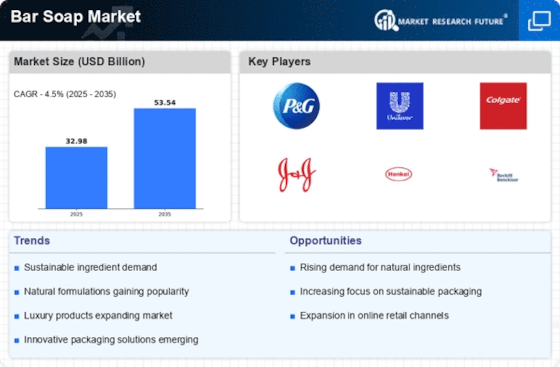
As per Market Research Future analysis, the Bar Soap Market Size was estimated at 30.05 USD Billion in 2024. The Bar Soap industry is projected to grow from 31.4 USD Billion in 2025 to 48.8 USD Billion by 2035, exhibiting a compound annual growth rate (CAGR) of 4.5% during the forecast period 2025 - 2035

Key Market Trends & Highlights

The Bar Soap Market is experiencing a notable shift towards natural ingredients and e-commerce growth.

  • The North American market remains the largest, driven by a strong preference for natural ingredients in bar soap products. In the Asia-Pacific region, the market is rapidly expanding, fueled by increasing urbanization and health awareness. Natural bar soaps dominate the market, while synthetic options are emerging as the fastest-growing segment due to innovative formulations. Rising demand for eco-friendly products and the influence of social media are key drivers propelling market growth.

Market Size & Forecast

2024 Market Size 30.05 (USD Billion)
2035 Market Size 48.8 (USD Billion)
CAGR (2025 - 2035) 4.5%
Largest Regional Market Share in 2024 North America

Major Players

<a href="https://in.pg.com/">Procter &amp; Gamble (US)</a>, Unilever (GB), Colgate-Palmolive (US), <a href="https://www.jnjvisionpro.com/en-us/">Johnson &amp; Johnson (US)</a>, Henkel (DE), Reckitt Benckiser (GB), L'Oreal (FR), Coty (US), Beiersdorf (DE), Palmolive (US)

Market Trends

The Bar Soap Market is currently experiencing a dynamic evolution, driven by shifting consumer preferences and increasing awareness regarding personal hygiene. As individuals become more conscious of the ingredients in their personal care products, there is a noticeable shift towards natural and organic formulations. This trend reflects a broader societal movement towards sustainability and health, as consumers seek products that align with their values. Additionally, the rise of e-commerce platforms has transformed the way consumers access and purchase bar soap, allowing for greater variety and convenience. While premiumization is a significant driver, manufacturers remain focused on optimizing the manufacturing process to ensure the average soap cost remains competitive for budget-conscious demographics. Brands are now focusing on enhancing their online presence to cater to this growing demand. The fluctuations in global soap prices, influenced by the volatility of raw material costs like palm oil and tallow, are pushing manufacturers to optimize their supply chains to maintain affordability without compromising quality.

The global soap industry is currently undergoing a significant transformation as manufacturers pivot toward sustainable production methods to meet the projected market growth. Moreover, the Bar Soap Market is witnessing a diversification of product offerings, with brands introducing innovative scents, textures, and packaging designs. This diversification not only appeals to a wider audience but also encourages brand loyalty among consumers who seek unique and personalized experiences. The market appears to be increasingly competitive, with both established and emerging brands vying for consumer attention. As the landscape continues to evolve, it is likely that the Bar Soap Market will further adapt to meet the changing needs and preferences of consumers, ensuring its relevance in the personal care industry.

Shift Towards Natural Ingredients

There is a growing preference for bar soaps made from natural and organic ingredients. Consumers are increasingly aware of the potential harmful effects of synthetic chemicals, leading them to seek products that are perceived as safer and more environmentally friendly.

E-commerce Growth

The rise of online shopping has significantly impacted the Bar Soap Market. Consumers now have access to a wider range of products and brands, allowing them to make informed choices and discover new offerings that may not be available in traditional retail settings.

Product Innovation and Customization

Brands are focusing on creating unique formulations and personalized experiences. This trend includes the introduction of diverse scents, textures, and packaging, catering to the desires of consumers who seek individuality in their personal care products.

Bar Soap Market Market Drivers

Diverse Product Offerings

The bar soap Market is characterized by a diverse range of product offerings that cater to various consumer preferences. This diversity includes formulations for sensitive skin, moisturizing properties, and specialized scents, which appeal to a broad audience. The introduction of artisanal and handcrafted soaps has also gained traction, as consumers seek unique and personalized experiences. Market data suggests that the premium segment of bar soaps is witnessing robust growth, with consumers willing to pay more for high-quality, unique products. This trend encourages manufacturers to innovate and expand their product lines, thereby enhancing competition and driving sales within the Bar Soap Market.

Health and Hygiene Awareness

The Bar Soap Market is significantly influenced by heightened health and hygiene awareness among consumers. The increasing focus on personal hygiene, particularly in the wake of various health campaigns, has led to a surge in soap consumption. Data indicates that The Bar Soap Market is expected to reach a valuation of over 30 billion dollars by 2026, with bar soap accounting for a substantial share. This trend is further supported by educational initiatives promoting handwashing and the use of soap as a primary means of preventing illness. Consequently, manufacturers are capitalizing on this awareness by marketing their bar soaps as essential hygiene products, thus driving growth in the Bar Soap Market.

Emerging Markets and Urbanization

The Bar Soap Market is witnessing growth driven by emerging markets and urbanization trends. As urban populations expand, there is an increasing demand for personal care products, including bar soap. This trend is particularly evident in developing regions, where rising disposable incomes and changing lifestyles are leading to greater consumption of hygiene products. Market analysis suggests that the Asia-Pacific region is expected to see the highest growth rate in the bar soap segment, with a projected increase of over 10% annually. This urbanization trend is prompting manufacturers to tailor their products to meet the specific needs of these markets, thereby enhancing their competitive edge in the Bar Soap Market.

Rising Demand for Eco-Friendly Products

The Bar Soap Market is experiencing a notable increase in demand for eco-friendly products. Consumers are becoming increasingly aware of environmental issues, leading to a preference for sustainable and biodegradable options. This trend is reflected in the growing sales of natural and organic bar soaps, which are perceived as safer for both personal health and the environment. According to recent data, the market for eco-friendly personal care products is projected to grow at a compound annual growth rate of approximately 8% over the next five years. This shift towards sustainability is compelling manufacturers to innovate and reformulate their products, thereby enhancing their market presence in the Bar Soap Market.

Influence of Social Media and Online Marketing

The Bar Soap Market is increasingly shaped by the influence of social media and online marketing strategies. Brands are leveraging platforms such as Instagram and TikTok to engage with consumers, showcasing their products through visually appealing content. This digital engagement has proven effective in reaching younger demographics, who are more inclined to purchase products endorsed by influencers. Data indicates that brands utilizing social media marketing experience a 30% higher engagement rate compared to traditional marketing methods. As a result, companies are investing in digital marketing campaigns to enhance brand visibility and drive sales, thereby contributing to the growth of the Bar Soap Market.

Market Segment Insights

By Material Type: Natural (Largest) vs. Synthetic (Fastest-Growing)

In the Bar Soap Market, the material type segment is primarily dominated by natural ingredients, which cater to a substantial portion of consumer demand due to increasing preferences for organic and healthy lifestyle products. The natural segment has gained traction as consumers become more conscious of the ingredients they put on their skin, leading to a significant market presence for soaps made from botanical and plant-based components.

Material Type: Natural (Dominant) vs. Synthetic (Emerging)

Natural bar soaps are characterized by their composition, which typically includes organic oils, fats, and <a href="https://www.marketresearchfuture.com/reports/essential-oils-market-2024" target="_blank" rel="noopener">essential oils</a> derived from nature. As consumers gravitate towards sustainable and eco-friendly products, the natural segment has carved out a dominant position in the market. Meanwhile, synthetic bar soaps are experiencing rapid growth as they offer unique formulations designed for specific skin concerns and preferences. Advances in formulation technology have enabled synthetic soaps to mimic popular natural options while providing additional benefits. The competition between these segments reflects broader trends in consumer preferences, with the natural category appealing to health-conscious buyers and synthetic options attracting those seeking performance-driven products.

By Application: Bathing (Largest) vs. Hand Washing (Fastest-Growing)

The Bar Soap Market is primarily segmented into four applications: bathing, dish washing, hand washing, and others. To better understand consumer behavior, analysts often evaluate how different usage habits define each specific soap category within the broader personal care industry.  Among these, the bathing category holds the largest share, driven by rising consumer preferences for traditional bathing products and the demand for premium formulations. The surging demand for hand soap bars is a primary driver for this segment, as consumers increasingly view solid bars as a more sustainable and plastic-free alternative to liquid soaps for frequent daily use. Hand washing has emerged as a significant segment, fueled by increased hygiene awareness and health initiatives promoting hand cleanliness. The growth trends in the bar soap application segment reflect changing consumer behaviors and lifestyles. Furthermore, as consumers look for ways to reduce plastic waste from liquid dispensers, the competitive hand soap cost associated with bulk bar soap options is driving rapid growth in the hand washing segment. Bathing remains a staple in personal care routines, while hand washing is experiencing rapid growth, particularly in the wake of global health concerns. As sustainability trends gain traction, consumers are also leaning towards eco-friendly products across all segments, further shaping the market dynamics.

Bathing (Dominant) vs. Dish Washing (Emerging)

The bathing segment remains dominant in the Bar Soap Market, characterized by its wide-ranging appeal and established consumer base. This segment benefits from strong brand loyalty and a variety of product offerings, including glycerin, herbal, and moisturizing soaps. Conversely, the dish washing segment is emerging, driven by the growing preference for bar soaps as an eco-friendly alternative to liquid detergents. This shift is part of a broader trend towards minimizing plastic waste. Both segments reflect distinct consumer needs: while bathing caters to personal and sensory experiences, dish washing emphasizes convenience and sustainability. Together, they represent the evolving landscape of consumer preferences in the bar soap industry.

By Quality: Premium (Largest) vs. Standard (Fastest-Growing)

In the Bar Soap Market, the quality segment showcases a diverse distribution where premium bar soaps capture significant attention due to evolving consumer preferences. Premium offerings dominate the market share as they appeal to a growing segment of health-conscious consumers. In contrast, standard bar soaps hold a substantial share as well, primarily due to their affordability and wide availability, making them a staple in households across various demographics.

Premium (Dominant) vs. Standard (Emerging)

The premium segment of the bar soap market is characterized by its focus on high-quality ingredients, sustainable production processes, and unique fragrances that cater to discerning consumers. These soaps often position themselves as luxury items, appealing to consumers looking for both effectiveness and a sensory experience. On the other hand, standard bar soaps have gained traction as the fastest-growing segment, bolstered by their cost-effectiveness and strong brand loyalty. They are ideal for everyday use, balancing quality with affordability, which makes them a favored choice among budget-conscious buyers.

Get more detailed insights about Bar Soap Market Research Report – Forecast till 2035

Regional Insights

North America : Market Leader in Bar Soap Market

North America is the largest market for bar soap, accounting for approximately 40% of the global market share. The region's growth is driven by increasing consumer awareness regarding hygiene and the rising demand for natural and organic products. Regulatory support for sustainable practices and eco-friendly formulations further catalyzes market expansion. The U.S. and Canada are the primary contributors, with a strong focus on innovation and product differentiation. The competitive landscape in North America is characterized by the presence of major players such as Procter & Gamble, Colgate-Palmolive, and Johnson & Johnson. These companies leverage advanced marketing strategies and extensive distribution networks to maintain their market positions. The trend towards premium and artisanal soaps is gaining traction, with consumers increasingly seeking products that offer unique benefits and experiences. This shift is reshaping the competitive dynamics in the region.

Europe : Emerging Trends in Bar Soap Market

Europe is witnessing a significant transformation in the bar soap market, holding approximately 30% of the global share. The growth is fueled by a shift towards sustainable and eco-friendly products, driven by stringent regulations and consumer preferences for natural ingredients. Countries like Germany and France are leading this trend, with increasing demand for organic and artisanal soaps. Regulatory frameworks promoting sustainability are pivotal in shaping market dynamics. The competitive landscape in Europe features key players such as Unilever, Henkel, and L'Oreal, who are adapting to changing consumer preferences by innovating their product lines. The market is also seeing a rise in local brands that emphasize quality and sustainability. This competitive environment encourages established companies to enhance their offerings, ensuring they meet the evolving demands of environmentally conscious consumers. The focus on transparency and ethical sourcing is becoming increasingly important in this region.

Asia-Pacific : Rapid Growth in Emerging Markets

The Asia-Pacific region is rapidly emerging as a key player in the bar soap market, accounting for approximately 25% of the global share. The growth is driven by rising disposable incomes, urbanization, and increasing awareness of personal hygiene. Countries like China and India are at the forefront, with a growing middle class that is increasingly investing in personal care products. Regulatory initiatives promoting hygiene standards are also contributing to market growth. The competitive landscape in Asia-Pacific is diverse, with both multinational corporations and local brands vying for market share. Key players such as Colgate-Palmolive and Reckitt Benckiser are expanding their presence through strategic partnerships and localized product offerings. The market is characterized by a mix of traditional and modern retail channels, with e-commerce gaining traction as a preferred shopping method among consumers. This dynamic environment is fostering innovation and competition in the region.

Middle East and Africa : Untapped Potential in Bar Soap Market

The Middle East and Africa region is gradually emerging in the bar soap market, holding about 5% of the global share. The growth is primarily driven by increasing urbanization, rising disposable incomes, and a growing awareness of personal hygiene. Countries like South Africa and the UAE are leading the market, with a notable shift towards premium and natural products. Regulatory frameworks are evolving to support product safety and quality, which is essential for market growth. The competitive landscape in this region is characterized by a mix of local and international players. Companies such as Palmolive and Beiersdorf are expanding their footprint through innovative marketing strategies and product diversification. The market is witnessing a growing trend towards organic and herbal soaps, reflecting consumer preferences for natural ingredients. This shift is creating opportunities for new entrants and local brands to capture market share in this evolving landscape.

Key Players and Competitive Insights

The Bar Soap Market is currently characterized by a dynamic competitive landscape, driven by evolving consumer preferences and a heightened focus on sustainability. Major players such as Procter & Gamble (US), Unilever (GB), and Colgate-Palmolive (US) are strategically positioning themselves through innovation and product diversification. Procter & Gamble (US) emphasizes eco-friendly formulations, while Unilever (GB) focuses on expanding its natural product lines. Colgate-Palmolive (US) is enhancing its market presence through targeted marketing campaigns aimed at health-conscious consumers. Collectively, these strategies not only enhance brand loyalty but also intensify competition, as companies vie for market share in an increasingly crowded space.Key business tactics within the Bar Soap Market include localizing manufacturing and optimizing supply chains to meet regional demands. The market structure appears moderately fragmented, with a mix of established brands and emerging players. This fragmentation allows for niche market opportunities, yet the collective influence of key players like Reckitt Benckiser (GB) and Henkel (DE) remains substantial, as they leverage their extensive distribution networks and brand recognition to maintain competitive advantages.
In August Reckitt Benckiser (GB) announced a partnership with a leading sustainable packaging firm to develop biodegradable packaging for its bar soap products. This strategic move underscores the company's commitment to sustainability and aligns with growing consumer demand for environmentally friendly products. By integrating sustainable practices into its supply chain, Reckitt Benckiser (GB) not only enhances its brand image but also positions itself favorably against competitors who may lag in this area.
In September Henkel (DE) launched a new line of bar soaps infused with natural ingredients sourced from local suppliers. This initiative reflects a broader trend towards transparency and ethical sourcing in the beauty and personal care industry. By emphasizing local partnerships, Henkel (DE) not only supports regional economies but also appeals to consumers who prioritize sustainability and ethical consumption, thereby strengthening its market position.
In October Unilever (GB) unveiled a digital platform aimed at enhancing customer engagement through personalized product recommendations based on consumer preferences. This digital transformation strategy is indicative of a broader trend towards integrating technology into consumer interactions. By leveraging data analytics, Unilever (GB) seeks to foster deeper connections with its customers, potentially leading to increased brand loyalty and sales.
As of October the Bar Soap Market is witnessing significant trends such as digitalization, sustainability, and the integration of artificial intelligence in product development and marketing strategies. Strategic alliances are increasingly shaping the competitive landscape, as companies collaborate to enhance their product offerings and market reach. Looking ahead, competitive differentiation is likely to evolve from traditional price-based competition to a focus on innovation, technological advancements, and supply chain reliability, as companies strive to meet the changing demands of consumers.

Key Companies in the Bar Soap Market include

Industry Developments

For instance, January 2023 Unilever acquired Dr. Squatch, a leading natural bar soap brand in the United States. The acquisition was worth $1.4 billion and is expected to help Unilever expand its portfolio of natural personal care products.

For instance, December 2023 Henkel, the parent company of brands like Dial and Lever 2000, announced a partnership with The Recycling Partnership to improve the recycling of bar soap packaging. The partnership will emphasizes on developing and implementing recycling programs for bar soap packaging in communities across the United States.

For instance, August 2022 Johnson & Johnson, the parent company of brands like Dove and Caress, announced a new partnership with the Rainforest Alliance to promote sustainable sourcing of palm oil. The partnership will focus on working with palm oil suppliers to implement sustainable practices that protect the environment and support local communities. Palm oil is a common ingredient in bar soap.

Future Outlook

Bar Soap Market Future Outlook

The Bar Soap Market is projected to grow at a 4.5% CAGR from 2025 to 2035, driven by increasing consumer preference for natural ingredients and sustainable packaging.

New opportunities lie in:

  • <p>Expansion into eco-friendly packaging solutions Development of premium artisanal bar soap lines Integration of digital marketing strategies for targeted consumer engagement</p>

By 2035, the Bar Soap Market is expected to achieve robust growth, reflecting evolving consumer preferences and innovative product offerings.

Market Segmentation

Bar Soap Market Quality Outlook

  • Low
  • Standard
  • Premium

Bar Soap Market Application Outlook

  • Bathing
  • Dish Washing
  • Hand Washing
  • Others

Bar Soap Market Material Type Outlook

  • Natural
  • Synthetic

Report Scope

MARKET SIZE 2024 30.5 (USD Billion)
MARKET SIZE 2025 31.4 (USD Billion)
MARKET SIZE 2035 48.8 (USD Billion)
COMPOUND ANNUAL GROWTH RATE (CAGR) 4.5% (2025 - 2035)
REPORT COVERAGE Revenue Forecast, Competitive Landscape, Growth Factors, and Trends
BASE YEAR 2024
Market Forecast Period 2025 - 2035
Historical Data 2019 - 2024
Market Forecast Units USD Billion
Key Companies Profiled Procter & Gamble (US), Unilever (GB), Colgate-Palmolive (US), Johnson & Johnson (US), Henkel (DE), Reckitt Benckiser (GB), L'Oreal (FR), Coty (US), Beiersdorf (DE), Palmolive (US)
Segments Covered Material Type, Application, Quality, Region
Key Market Opportunities Growing consumer preference for natural ingredients and eco-friendly packaging in the Bar Soap Market.
Key Market Dynamics Rising consumer preference for natural ingredients drives innovation and competition in the bar soap market.
Countries Covered North America, Europe, APAC, South America, MEA

FAQs

What is the current valuation of the Bar Soap Market as of 2024?

<p>The Bar Soap Market was valued at 32.98 USD Billion in 2024.</p>

What is the projected market size for the Bar Soap Market in 2035?

<p>The Bar Soap Market is projected to reach 53.54 USD Billion by 2035.</p>

What is the expected CAGR for the Bar Soap Market during the forecast period 2025 - 2035?

<p>The expected CAGR for the Bar Soap Market during the forecast period 2025 - 2035 is 4.5%.</p>

Which companies are the key players in the Bar Soap Market?

Key players in the Bar Soap Market include Procter &amp; Gamble, Unilever, Colgate-Palmolive, Johnson &amp; Johnson, Henkel, Reckitt Benckiser, L'Oreal, Coty, Beiersdorf, and Palmolive.

How does the market segment for Natural and Synthetic bar soaps compare?

<p>In 2024, the Natural segment was valued at 13.19 USD Billion, while the Synthetic segment reached 19.79 USD Billion.</p>

What are the projected values for different applications of bar soap by 2035?

<p>By 2035, the projected values for bar soap applications include Bathing at 19.0 USD Billion, Dish Washing at 12.0 USD Billion, and Hand Washing at 16.0 USD Billion.</p>

What is the market performance of premium bar soaps compared to standard and low-quality soaps?

In 2024, premium bar soaps were valued at 9.0 USD Billion, while standard and low-quality soaps were valued at 15.73 USD Billion and 8.25 USD Billion, respectively.

What trends are influencing the growth of the Bar Soap Market?

The growth of the Bar Soap Market appears to be influenced by increasing consumer preference for natural ingredients and sustainable products.

How does the Bar Soap Market's growth compare to other personal care segments?

The Bar Soap Market's growth, with a projected CAGR of 4.5%, suggests a steady increase compared to other personal care segments, which may experience varying growth rates.

What factors could impact the Bar Soap Market's valuation by 2035?

Factors that could impact the Bar Soap Market's valuation by 2035 include shifts in consumer preferences, regulatory changes, and innovations in product formulations.

  1. SECTION I: EXECUTIVE SUMMARY AND KEY HIGHLIGHTS |
    1. EXECUTIVE SUMMARY | |
      1. Market Overview | |
      2. Key Findings | |
      3. Market Segmentation | |
      4. Competitive Landscape | |
      5. Challenges and Opportunities | |
      6. Future Outlook 2
  2. SECTION II: SCOPING, METHODOLOGY AND MARKET STRUCTURE |
    1. MARKET INTRODUCTION | |
      1. Definition | |
      2. Scope of the study | | |
    2. RESEARCH METHODOLOGY | |
      1. Overview | |
      2. Data Mining | |
      3. Secondary Research | |
      4. Primary Research | | |
      5. Forecasting Model | |
      6. Market Size Estimation | | |
      7. Data Triangulation | |
      8. Validation 3
  3. SECTION III: QUALITATIVE ANALYSIS |
    1. MARKET DYNAMICS | |
      1. Overview | |
      2. Drivers | |
      3. Restraints | |
      4. Opportunities |
    2. MARKET FACTOR ANALYSIS | |
      1. Value chain Analysis | |
      2. Porter's Five Forces Analysis | | |
      3. COVID-19 Impact Analysis | | |
  4. SECTION IV: QUANTITATIVE ANALYSIS |
    1. Consumer and Retail, BY Material Type (USD Billion) | |
      1. Natural | |
      2. Synthetic |
    2. Consumer and Retail, BY Application (USD Billion) | |
      1. Bathing | |
      2. Dish Washing | |
      3. Hand Washing | |
      4. Others |
    3. Consumer and Retail, BY Quality (USD Billion) | |
      1. Low | |
      2. Standard | |
      3. Premium |
    4. Consumer and Retail, BY Region (USD Billion) | |
      1. North America | | |
      2. Europe | | |
      3. APAC | | |
      4. South America | | |
      5. MEA | | |
  5. SECTION V: COMPETITIVE ANALYSIS |
    1. Competitive Landscape | |
      1. Overview | |
      2. Competitive Analysis | |
      3. Market share Analysis | |
      4. Major Growth Strategy in the Consumer and Retail | |
      5. Competitive Benchmarking | |
      6. Leading Players in Terms of Number of Developments in the Consumer and Retail | |
      7. Key developments and growth strategies | | |
      8. Major Players Financial Matrix | | |
    2. Company Profiles | |
      1. Procter & Gamble (US) | | |
      2. Unilever (GB) | | |
      3. Colgate-Palmolive (US) | | |
      4. Johnson & Johnson (US) | | |
      5. Henkel (DE) | | |
      6. Reckitt Benckiser (GB) | | |
      7. L'Oreal (FR) | | |
      8. Coty (US) | | |
      9. Beiersdorf (DE) | | |
      10. Palmolive (US) | | |
    3. Appendix | |
      1. References | |
      2. Related Reports 6 LIST OF FIGURES |
    4. MARKET SYNOPSIS |
    5. NORTH AMERICA MARKET ANALYSIS |
    6. US MARKET ANALYSIS BY MATERIAL TYPE |
    7. US MARKET ANALYSIS BY APPLICATION |
    8. US MARKET ANALYSIS BY QUALITY |
    9. CANADA MARKET ANALYSIS BY MATERIAL TYPE |
    10. CANADA MARKET ANALYSIS BY APPLICATION |
    11. CANADA MARKET ANALYSIS BY QUALITY |
    12. EUROPE MARKET ANALYSIS |
    13. GERMANY MARKET ANALYSIS BY MATERIAL TYPE |
    14. GERMANY MARKET ANALYSIS BY APPLICATION |
    15. GERMANY MARKET ANALYSIS BY QUALITY |
    16. UK MARKET ANALYSIS BY MATERIAL TYPE |
    17. UK MARKET ANALYSIS BY APPLICATION |
    18. UK MARKET ANALYSIS BY QUALITY |
    19. FRANCE MARKET ANALYSIS BY MATERIAL TYPE |
    20. FRANCE MARKET ANALYSIS BY APPLICATION |
    21. FRANCE MARKET ANALYSIS BY QUALITY |
    22. RUSSIA MARKET ANALYSIS BY MATERIAL TYPE |
    23. RUSSIA MARKET ANALYSIS BY APPLICATION |
    24. RUSSIA MARKET ANALYSIS BY QUALITY |
    25. ITALY MARKET ANALYSIS BY MATERIAL TYPE |
    26. ITALY MARKET ANALYSIS BY APPLICATION |
    27. ITALY MARKET ANALYSIS BY QUALITY |
    28. SPAIN MARKET ANALYSIS BY MATERIAL TYPE |
    29. SPAIN MARKET ANALYSIS BY APPLICATION |
    30. SPAIN MARKET ANALYSIS BY QUALITY |
    31. REST OF EUROPE MARKET ANALYSIS BY MATERIAL TYPE |
    32. REST OF EUROPE MARKET ANALYSIS BY APPLICATION |
    33. REST OF EUROPE MARKET ANALYSIS BY QUALITY |
    34. APAC MARKET ANALYSIS |
    35. CHINA MARKET ANALYSIS BY MATERIAL TYPE |
    36. CHINA MARKET ANALYSIS BY APPLICATION |
    37. CHINA MARKET ANALYSIS BY QUALITY |
    38. INDIA MARKET ANALYSIS BY MATERIAL TYPE |
    39. INDIA MARKET ANALYSIS BY APPLICATION |
    40. INDIA MARKET ANALYSIS BY QUALITY |
    41. JAPAN MARKET ANALYSIS BY MATERIAL TYPE |
    42. JAPAN MARKET ANALYSIS BY APPLICATION |
    43. JAPAN MARKET ANALYSIS BY QUALITY |
    44. SOUTH KOREA MARKET ANALYSIS BY MATERIAL TYPE |
    45. SOUTH KOREA MARKET ANALYSIS BY APPLICATION |
    46. SOUTH KOREA MARKET ANALYSIS BY QUALITY |
    47. MALAYSIA MARKET ANALYSIS BY MATERIAL TYPE |
    48. MALAYSIA MARKET ANALYSIS BY APPLICATION |
    49. MALAYSIA MARKET ANALYSIS BY QUALITY |
    50. THAILAND MARKET ANALYSIS BY MATERIAL TYPE |
    51. THAILAND MARKET ANALYSIS BY APPLICATION |
    52. THAILAND MARKET ANALYSIS BY QUALITY |
    53. INDONESIA MARKET ANALYSIS BY MATERIAL TYPE |
    54. INDONESIA MARKET ANALYSIS BY APPLICATION |
    55. INDONESIA MARKET ANALYSIS BY QUALITY |
    56. REST OF APAC MARKET ANALYSIS BY MATERIAL TYPE |
    57. REST OF APAC MARKET ANALYSIS BY APPLICATION |
    58. REST OF APAC MARKET ANALYSIS BY QUALITY |
    59. SOUTH AMERICA MARKET ANALYSIS |
    60. BRAZIL MARKET ANALYSIS BY MATERIAL TYPE |
    61. BRAZIL MARKET ANALYSIS BY APPLICATION |
    62. BRAZIL MARKET ANALYSIS BY QUALITY |
    63. MEXICO MARKET ANALYSIS BY MATERIAL TYPE |
    64. MEXICO MARKET ANALYSIS BY APPLICATION |
    65. MEXICO MARKET ANALYSIS BY QUALITY |
    66. ARGENTINA MARKET ANALYSIS BY MATERIAL TYPE |
    67. ARGENTINA MARKET ANALYSIS BY APPLICATION |
    68. ARGENTINA MARKET ANALYSIS BY QUALITY |
    69. REST OF SOUTH AMERICA MARKET ANALYSIS BY MATERIAL TYPE |
    70. REST OF SOUTH AMERICA MARKET ANALYSIS BY APPLICATION |
    71. REST OF SOUTH AMERICA MARKET ANALYSIS BY QUALITY |
    72. MEA MARKET ANALYSIS |
    73. GCC COUNTRIES MARKET ANALYSIS BY MATERIAL TYPE |
    74. GCC COUNTRIES MARKET ANALYSIS BY APPLICATION |
    75. GCC COUNTRIES MARKET ANALYSIS BY QUALITY |
    76. SOUTH AFRICA MARKET ANALYSIS BY MATERIAL TYPE |
    77. SOUTH AFRICA MARKET ANALYSIS BY APPLICATION |
    78. SOUTH AFRICA MARKET ANALYSIS BY QUALITY |
    79. REST OF MEA MARKET ANALYSIS BY MATERIAL TYPE |
    80. REST OF MEA MARKET ANALYSIS BY APPLICATION |
    81. REST OF MEA MARKET ANALYSIS BY QUALITY |
    82. KEY BUYING CRITERIA OF CONSUMER AND RETAIL |
    83. RESEARCH PROCESS OF MRFR |
    84. DRO ANALYSIS OF CONSUMER AND RETAIL |
    85. DRIVERS IMPACT ANALYSIS: CONSUMER AND RETAIL |
    86. RESTRAINTS IMPACT ANALYSIS: CONSUMER AND RETAIL |
    87. SUPPLY / VALUE CHAIN: CONSUMER AND RETAIL |
    88. CONSUMER AND RETAIL, BY MATERIAL TYPE, 2024 (% SHARE) |
    89. CONSUMER AND RETAIL, BY MATERIAL TYPE, 2024 TO 2035 (USD Billion) |
    90. CONSUMER AND RETAIL, BY APPLICATION, 2024 (% SHARE) |
    91. CONSUMER AND RETAIL, BY APPLICATION, 2024 TO 2035 (USD Billion) |
    92. CONSUMER AND RETAIL, BY QUALITY, 2024 (% SHARE) |
    93. CONSUMER AND RETAIL, BY QUALITY, 2024 TO 2035 (USD Billion) |
    94. BENCHMARKING OF MAJOR COMPETITORS 7 LIST OF TABLES |
    95. LIST OF ASSUMPTIONS | |
      1. |
    96. North America MARKET SIZE ESTIMATES; FORECAST | |
      1. BY MATERIAL TYPE, 2025-2035 (USD Billion) | |
      2. BY APPLICATION, 2025-2035 (USD Billion) | |
      3. BY QUALITY, 2025-2035 (USD Billion) |
    97. US MARKET SIZE ESTIMATES; FORECAST | |
      1. BY MATERIAL TYPE, 2025-2035 (USD Billion) | |
      2. BY APPLICATION, 2025-2035 (USD Billion) | |
      3. BY QUALITY, 2025-2035 (USD Billion) |
    98. Canada MARKET SIZE ESTIMATES; FORECAST | |
      1. BY MATERIAL TYPE, 2025-2035 (USD Billion) | |
      2. BY APPLICATION, 2025-2035 (USD Billion) | |
      3. BY QUALITY, 2025-2035 (USD Billion) |
    99. Europe MARKET SIZE ESTIMATES; FORECAST | |
      1. BY MATERIAL TYPE, 2025-2035 (USD Billion) | |
      2. BY APPLICATION, 2025-2035 (USD Billion) | |
      3. BY QUALITY, 2025-2035 (USD Billion) |
    100. Germany MARKET SIZE ESTIMATES; FORECAST | |
      1. BY MATERIAL TYPE, 2025-2035 (USD Billion) | |
      2. BY APPLICATION, 2025-2035 (USD Billion) | |
      3. BY QUALITY, 2025-2035 (USD Billion) |
    101. UK MARKET SIZE ESTIMATES; FORECAST | |
      1. BY MATERIAL TYPE, 2025-2035 (USD Billion) | |
      2. BY APPLICATION, 2025-2035 (USD Billion) | |
      3. BY QUALITY, 2025-2035 (USD Billion) |
    102. France MARKET SIZE ESTIMATES; FORECAST | |
      1. BY MATERIAL TYPE, 2025-2035 (USD Billion) | |
      2. BY APPLICATION, 2025-2035 (USD Billion) | |
      3. BY QUALITY, 2025-2035 (USD Billion) |
    103. Russia MARKET SIZE ESTIMATES; FORECAST | |
      1. BY MATERIAL TYPE, 2025-2035 (USD Billion) | |
      2. BY APPLICATION, 2025-2035 (USD Billion) | |
      3. BY QUALITY, 2025-2035 (USD Billion) |
    104. Italy MARKET SIZE ESTIMATES; FORECAST | |
      1. BY MATERIAL TYPE, 2025-2035 (USD Billion) | |
      2. BY APPLICATION, 2025-2035 (USD Billion) | |
      3. BY QUALITY, 2025-2035 (USD Billion) |
    105. Spain MARKET SIZE ESTIMATES; FORECAST | |
      1. BY MATERIAL TYPE, 2025-2035 (USD Billion) | |
      2. BY APPLICATION, 2025-2035 (USD Billion) | |
      3. BY QUALITY, 2025-2035 (USD Billion) |
    106. Rest of Europe MARKET SIZE ESTIMATES; FORECAST | |
      1. BY MATERIAL TYPE, 2025-2035 (USD Billion) | |
      2. BY APPLICATION, 2025-2035 (USD Billion) | |
      3. BY QUALITY, 2025-2035 (USD Billion) |
    107. APAC MARKET SIZE ESTIMATES; FORECAST | |
      1. BY MATERIAL TYPE, 2025-2035 (USD Billion) | |
      2. BY APPLICATION, 2025-2035 (USD Billion) | |
      3. BY QUALITY, 2025-2035 (USD Billion) |
    108. China MARKET SIZE ESTIMATES; FORECAST | |
      1. BY MATERIAL TYPE, 2025-2035 (USD Billion) | |
      2. BY APPLICATION, 2025-2035 (USD Billion) | |
      3. BY QUALITY, 2025-2035 (USD Billion) |
    109. India MARKET SIZE ESTIMATES; FORECAST | |
      1. BY MATERIAL TYPE, 2025-2035 (USD Billion) | |
      2. BY APPLICATION, 2025-2035 (USD Billion) | |
      3. BY QUALITY, 2025-2035 (USD Billion) |
    110. Japan MARKET SIZE ESTIMATES; FORECAST | |
      1. BY MATERIAL TYPE, 2025-2035 (USD Billion) | |
      2. BY APPLICATION, 2025-2035 (USD Billion) | |
      3. BY QUALITY, 2025-2035 (USD Billion) |
    111. South Korea MARKET SIZE ESTIMATES; FORECAST | |
      1. BY MATERIAL TYPE, 2025-2035 (USD Billion) | |
      2. BY APPLICATION, 2025-2035 (USD Billion) | |
      3. BY QUALITY, 2025-2035 (USD Billion) |
    112. Malaysia MARKET SIZE ESTIMATES; FORECAST | |
      1. BY MATERIAL TYPE, 2025-2035 (USD Billion) | |
      2. BY APPLICATION, 2025-2035 (USD Billion) | |
      3. BY QUALITY, 2025-2035 (USD Billion) |
    113. Thailand MARKET SIZE ESTIMATES; FORECAST | |
      1. BY MATERIAL TYPE, 2025-2035 (USD Billion) | |
      2. BY APPLICATION, 2025-2035 (USD Billion) | |
      3. BY QUALITY, 2025-2035 (USD Billion) |
    114. Indonesia MARKET SIZE ESTIMATES; FORECAST | |
      1. BY MATERIAL TYPE, 2025-2035 (USD Billion) | |
      2. BY APPLICATION, 2025-2035 (USD Billion) | |
      3. BY QUALITY, 2025-2035 (USD Billion) |
    115. Rest of APAC MARKET SIZE ESTIMATES; FORECAST | |
      1. BY MATERIAL TYPE, 2025-2035 (USD Billion) | |
      2. BY APPLICATION, 2025-2035 (USD Billion) | |
      3. BY QUALITY, 2025-2035 (USD Billion) |
    116. South America MARKET SIZE ESTIMATES; FORECAST | |
      1. BY MATERIAL TYPE, 2025-2035 (USD Billion) | |
      2. BY APPLICATION, 2025-2035 (USD Billion) | |
      3. BY QUALITY, 2025-2035 (USD Billion) |
    117. Brazil MARKET SIZE ESTIMATES; FORECAST | |
      1. BY MATERIAL TYPE, 2025-2035 (USD Billion) | |
      2. BY APPLICATION, 2025-2035 (USD Billion) | |
      3. BY QUALITY, 2025-2035 (USD Billion) |
    118. Mexico MARKET SIZE ESTIMATES; FORECAST | |
      1. BY MATERIAL TYPE, 2025-2035 (USD Billion) | |
      2. BY APPLICATION, 2025-2035 (USD Billion) | |
      3. BY QUALITY, 2025-2035 (USD Billion) |
    119. Argentina MARKET SIZE ESTIMATES; FORECAST | |
      1. BY MATERIAL TYPE, 2025-2035 (USD Billion) | |
      2. BY APPLICATION, 2025-2035 (USD Billion) | |
      3. BY QUALITY, 2025-2035 (USD Billion) |
    120. Rest of South America MARKET SIZE ESTIMATES; FORECAST | |
      1. BY MATERIAL TYPE, 2025-2035 (USD Billion) | |
      2. BY APPLICATION, 2025-2035 (USD Billion) | |
      3. BY QUALITY, 2025-2035 (USD Billion) |
    121. MEA MARKET SIZE ESTIMATES; FORECAST | |
      1. BY MATERIAL TYPE, 2025-2035 (USD Billion) | |
      2. BY APPLICATION, 2025-2035 (USD Billion) | |
      3. BY QUALITY, 2025-2035 (USD Billion) |
    122. GCC Countries MARKET SIZE ESTIMATES; FORECAST | |
      1. BY MATERIAL TYPE, 2025-2035 (USD Billion) | |
      2. BY APPLICATION, 2025-2035 (USD Billion) | |
      3. BY QUALITY, 2025-2035 (USD Billion) |
    123. South Africa MARKET SIZE ESTIMATES; FORECAST | |
      1. BY MATERIAL TYPE, 2025-2035 (USD Billion) | |
      2. BY APPLICATION, 2025-2035 (USD Billion) | |
      3. BY QUALITY, 2025-2035 (USD Billion) |
    124. Rest of MEA MARKET SIZE ESTIMATES; FORECAST | |
      1. BY MATERIAL TYPE, 2025-2035 (USD Billion) | |
      2. BY APPLICATION, 2025-2035 (USD Billion) | |
      3. BY QUALITY, 2025-2035 (USD Billion) |
    125. PRODUCT LAUNCH/PRODUCT DEVELOPMENT/APPROVAL | |
      1. |
    126. ACQUISITION/PARTNERSHIP | |

Consumer and Retail Market Segmentation

Consumer and Retail By Material Type (USD Billion, 2025-2035)

  • Natural
  • Synthetic

Consumer and Retail By Application (USD Billion, 2025-2035)

  • Bathing
  • Dish Washing
  • Hand Washing
  • Others

Consumer and Retail By Quality (USD Billion, 2025-2035)

  • Low
  • Standard
  • Premium
Infographic

Free Sample Request

Kindly complete the form below to receive a free sample of this Report

Get Free Sample

Customer Strories

Compare Licence

×
Features License Type
Single User Multiuser License Enterprise User
Price $4,950 $5,950 $7,250
Maximum User Access Limit 1 User Upto 10 Users Unrestricted Access Throughout the Organization
Free Customization
Direct Access to Analyst
Deliverable Format
Platform Access
Discount on Next Purchase 10% 15% 15%
Printable Versions
%>